My Granddaughter’s Fiancé Dumped My Homemade Pie in the Trash in Front of 30 Customers: “Nobody Pays $28 for a Pie Some Old Woman Made”—Every Pie in His Barn Came Out of My Ovens
Part 1
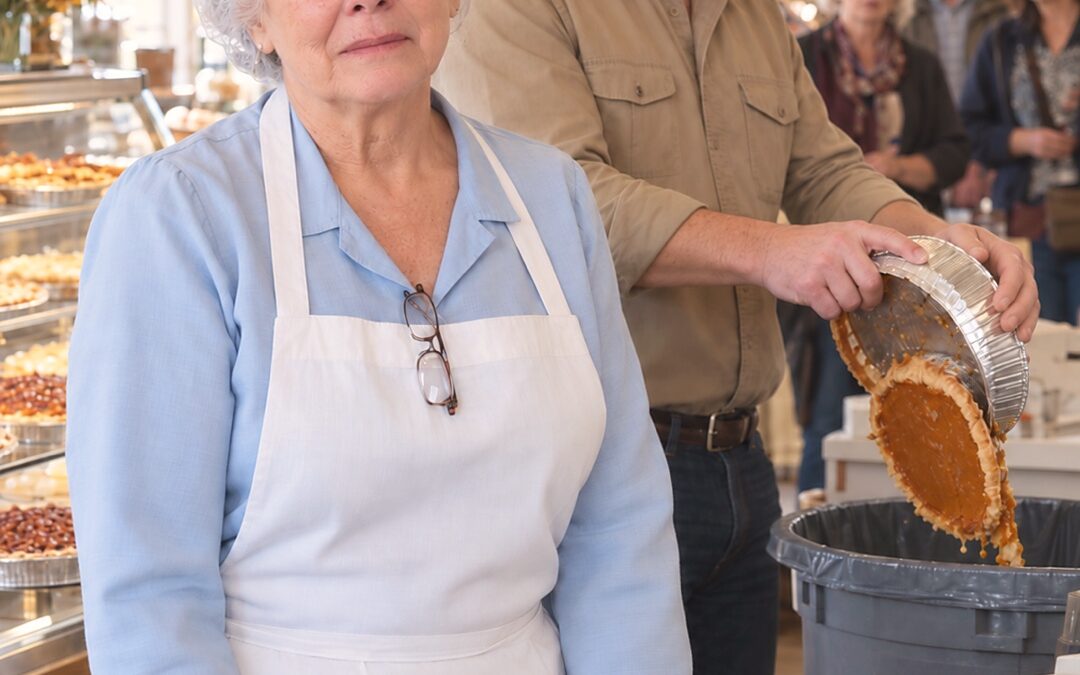
Colby Rutledge took the sweet potato pie I'd baked at six that morning for the boy who drives his hayride tractor, held it over the trash barrel by the pie barn register, and turned it upside down, pan and all, in front of thirty-some people waiting in line. "Nobody pays twenty-eight dollars for a pie some old woman made, Rena," he said. "They pay for my mama's name on the box." Then he told me I was through, kept the $198 he owed me for two Saturdays to cover what he called wasted product, and pointed me out the loading dock, five weeks before he was supposed to marry my granddaughter. Every pie on his shelves had come out of my own ovens in Macon, and he'd spent three Saturdays ordering the woman who owns them around his barn for eleven dollars an hour.
It hit the bottom with a sound like a wet sack of feed. The pan came after it, rang once against the side, and settled crooked on top of somebody's coffee cup.
Wanda stopped with a twenty in her hand. The girl at the second register looked down at her shoes. Eli was in the dock doorway with his cap off and the tractor keys hanging from one finger, and the man in the sport coat at Colby's elbow found something in the glass pie case that needed studying. I'd started after the pie when he picked it up, and my new knee had caught on me, so I was standing there holding on to the end of the counter like an old woman, which I suppose I was. Glenda Sapp, who buys two pies every Saturday for her Sunday school class and had been leaning over the counter sniffing at mine not two minutes before, said, "Well, I never," and she meant it.
"Colby Rutledge," she said, "all I said was, 'That one on the shelf is the only thing in this barn that smells like a real pie.' I offered her full price for it."
"And that's the problem, Mrs. Sapp." He said it to the whole line. "I run a commercial food operation. People drive out here for a consistent product, not some little home recipe she cooked up in my oven without asking."
"That pie belonged to the boy," I said. Behind me on the break shelf there was nothing left but the strip of masking tape I'd stuck to the edge that morning, ELI in black marker, so nobody would take it for merchandise.
He put the lid back on the barrel. "You're through here, Rena. And don't look for a check for those two Saturdays. That hundred and ninety-eight dollars covers the wasted product."
"Those were hours I worked."
"Take it up with somebody who cares."
Wanda slid the twenty into her drawer without ringing it up. She didn't look at me when she said it. "Go on now, Rena."
Glenda set her pocketbook on the counter like she was fixing to stay. "Colby, that woman's car was in your lot before the sun was."
"Mrs. Sapp, do you want your two pies or not?"
She looked at me. I gave her the smallest shake of my head I had, and she said she'd take them, and Wanda rang her up at the main register with her mouth pressed flat. The receipt curled out of the register, and Glenda folded it once and tucked it in her pocketbook with all the others, for the church.
Colby had already turned back to the man in the sport coat. Ten minutes earlier he'd walked that man down the counter under his hand-painted sign, MAMA RUTLEDGE'S HOMESTYLE PIES — BAKED FRESH IN OUR BARN, telling him, loud enough to reach the pumpkin patch, "Four hundred pies a weekend, every one of them Mama's recipe, baked right here in this barn." I'd been folding boxes at the end of the counter while Wanda fussed at me to turn the prices out, and I'd kept my mouth shut about the cold oven I fired up at six. Now the man looked from the barrel to his leather folder and said, not loud, "Committee meets the twentieth, Colby. They'll want to hear it from Mrs. Kittredge herself."
"She'll be at our engagement party Saturday the eighteenth. You'll hear it from her mouth."
I was eight feet away when I heard my own name. My hands kept peeling off my plastic gloves, one finger at a time.
So this was the banker. The Saturday before, I'd heard Colby cussing out a Wes Albritton on the dock phone, and I'd taken him for a bill collector. Standing there with my gloves in my hand, I still didn't know all of it, but I knew somebody had just promised that man my say-so. He looked over at me then, once, at the hairnet and the cap and the tag that said RENA, as if I came with the napkin dispenser, and went back to his folder.
I dropped the gloves in the wastebasket under the counter. Colby pointed at the loading dock over his shoulder without turning around. "Take the trash out on your way."
"That one?"
"You heard me."
So I lifted the bag out of the barrel, my pie and all, and tied off the neck, and asked for a fresh liner, because I was raised that you don't leave a barrel bare for the next girl. "Under the sink," Wanda said to her register. The bag was heavier than I'd figured. My pan pushed a hard edge against my leg the whole length of the counter, and a woman holding a pumpkin-shaped candle stepped back to let me by as if I might be catching. Glenda put her hand on my arm when I passed her. "Rena, honey, you want me to say something?"
"No, ma'am. You get your pies."
A man by the door in a Braves cap said, "Ma'am, I'm sorry," as I went past, and his wife elbowed him, and behind me I heard Colby tell Wes, "Sorry about that. You can't get good help out here," and Wes didn't answer him.
Eli caught up with me on the dock steps. He was twenty, all legs, with a faded Bulldogs shirt under his work jacket, and he'd stood in that doorway long enough to see the whole thing. "That pie was for me?"
"It was."
"You go on back in there before he docks you too."
"He can't dock what he ain't paid, Miss Rena. He's three checks behind on me." He watched the bag hanging off my hand. Then he said it low, so it wouldn't carry back inside. "The lady before you quit 'cause he never paid her. So did the one before her."
I shook my head at him once and kept walking. He put his cap back on and pulled the bill down. The gravel had ruts where the delivery trucks turned, and I took the flat side, with that bag knocking against my calf.
I'd been Rena for three Saturdays. It had started with a phone call in September.
Leah called to say she was marrying Colby Rutledge on November fifteenth, out at his farm, and when I said I'd like to meet him first, she knew exactly what I meant. "Don't you dare send one of your people to look into him, Grandma." She has called my company "Grandma's plant" since she was four. So I didn't send anybody. She'd mentioned his pie lady had quit again, and there was a sign wired to his gate: PIE BARN HELP WANTED — SATURDAYS — $11/HR — ASK FOR COLBY.
I put Rena Baxley on the application, my daddy's name for me and my maiden name. I took a room at the Hampton Inn off I-20 and told my family I was at my sister Ruby's in Asheville while the knee healed. My first Saturday Wanda sent me into the walk-in, and the cases were plain white, but when I turned a foil tin over, there was my lot code pressed into the bottom. KP.
That same morning Eli saw me favoring the knee and brought his own camp stool out of the tractor shed for me, and at ten he handed me the bigger half of his sausage biscuit. His Mamaw Velma had passed last winter, and nobody had made him a real sweet potato pie since. So this morning I came in at six and baked him one.
Emmett's Buick was parked at the far end of the lot, a 2009 Lucerne the color of weak tea, with a scrape on the back bumper he never would let me get fixed. I opened the passenger door, set the bag on the floor mat, and leaned on the roof until the knee quit. Filling had started to leak out through a seam, and a yellow jacket had already found it and was walking the plastic like he'd paid for it. I shooed him off with the back of my hand.
I untied it. On top were napkins and a paper cup with coffee still in it and a cinnamon roll somebody had taken one bite of. My pan was under that. I worked it loose by the rim. Half the pie was still in it, mashed flat, and a stripe of orange lay across the old dent near the edge, right over the letters Emmett scratched in with a roofing nail the week we sold our first pies at the Macon farmers market. E.K. 4-84.
We baked in our own kitchen then, in an oven whose door wouldn't shut unless you lifted it, and Emmett whittled a pine wedge to hold it closed. He was the one people remembered. I did the baking, and he shook the hands and knew everybody's birthday and knew which customer needed to take a pie home without paying for it, and twenty years later, when we had a plant and trucks, strangers still asked him how his wife kept the bottom crust from going soggy. He died in 2015.
There were Chick-fil-A napkins in the glovebox. I used three on the dent and it wouldn't come clean. A crumb of browned crust had worked down into the scratches of the E, and I picked at it with the corner of a napkin, and then I quit before I scraped the letter.
I set the pan on the passenger seat. Then I pulled the seat belt across it and clicked it in. I sat a good while with my feet out on the gravel, and a pickup crunched by behind me, and when I reached over to straighten the belt I found it buckled over a pie pan. I left it like that.
The pan wasn't all that was in the bag. Down at the bottom were four empty foil tins, the ones I'd cleared off the counter that morning after the thaw, before I started Eli's pie, and Colby had swept them into his barrel with everything else. I pulled them out, got in behind the wheel, and turned the first one over on my knee.
KP-279-C.
I've carried a little spiral notebook in my purse since 1984, back when people promised Emmett things over the telephone and forgot all about it by Tuesday. The early ones have oven temperatures in them and farmers market orders. This one had a grocery list on the first page and the number for the orthopedic clinic on the second. I turned to a clean page and wrote it down. The second tin said the same, and so did the third. The fourth said KP-280-C. My handwriting has gone spidery since the knee, from holding the pen tight when it hurts, and I made myself go slow so I could read it back later in front of anybody who asked. I wrote each one on its own line exactly the way it was stamped, and then I did some arithmetic on the back page. Those plain white cases were Hearthside, our private-label line, the one that never carries the family name. A Hearthside sweet potato costs a foodservice customer six dollars and forty cents through a broker. I know because I set the price. He was getting twenty-eight for it with his mama's name on the box.
I called Odessa Fain. She has run our plant in Macon for twenty-two years and has never once mistaken me being quiet for me agreeing with her.
"Saturday inventory," she said, instead of hello. "What's wrong?"
"Nothing I can't manage."
"That's generally when something's wrong."
I told her what I needed. Every Hearthside shipment that had ended up at a place called Rutledge Farms in Barlow County, direct or through a broker, with the dates and the invoices and what had been paid on them. And three sweet potato tins off line C, real tins, not just the labels, so I could set them next to mine. A forklift beeped somewhere behind her. "Next to what?"
"Four I've got here."
"Where's here?"
"A pie barn outside Bramlett." The forklift beeped again, so I added, "In the parking lot."
"Mrs. Kittredge, are you all right?"
"I'm sitting in a gravel lot in a hairnet, Odessa. I'm fine."
"A hairnet," she said. Then, because she knows me, "Don't call the customer, don't call the broker. That about it?"
"That's it. Bring it up yourself Monday. I'm at the Hampton Inn off I-20."
"How long are you staying up there?"
"Long as it takes. Bring a sweater, they keep the lobby cold enough to hang meat."
"You're supposed to be in Asheville."
"That's what I told everybody."
"Ten o'clock," she said, and then, right before she hung up, "Lorene. Take that hairnet off before you walk into a hotel."
I reached up. It was still on under the cap. I took off the cap and the net came away with it, and then the name tag, which had snagged a thread and left a little pull in my blouse when it finally came loose. I put RENA in the console.
Across the lot Colby was walking Wes to a silver Camry with one hand on his shoulder, laughing at something. Wes didn't laugh. He set his folder on the roof to dig out his keys, and Colby kept talking through the window until the car was rolling, and then he stood there in the gravel next to his black Ram and checked his phone like a man who'd had a good morning. A minute later Eli came around the side of the barn on the green John Deere, pulling a wagonload of grown folks in Georgia sweatshirts, and he lifted two fingers off the wheel at the Buick as he went by. I lifted two back. The wagon bumped off toward the corn maze with a woman in the back shrieking at every rut.
My phone buzzed on the seat. Eli, asking did I make it out of the lot all right. I typed that I had, and started to type something about the pie, and deleted it, and told him to go eat his lunch. He sent a thumbs-up. Through the windshield the barn doors stood open and the line went clear out past the porch, and a woman was holding a box up so her husband could see the picture on the lid.
Leah thought her grandmother was in North Carolina doing knee exercises. She thought her fiancé was building something fine out of his daddy's farm, and she had spent half the summer texting me pictures of the barn and asking whether white roses would hold up in November. I told her to ask the florist, and that annoyed her. She was thirty-one and had paid her own way through nursing school and never once took kindly to being managed, and the last time we talked she'd been happy. I dug in my purse for the key.
My phone buzzed again before I got the key in. Leah. "Grandma, Colby's throwing us an engagement party at the farm next Saturday, in the pie barn," she said. "He wants to meet you so bad. He says wait till you taste his mama's sweet potato."
Part 2
"Colby's been telling people you stole from him."
Glenda Sapp caught me beside the Buick after the early service at Bramlett First Methodist, still in her choir robe, with one sleeve twisted up around her wrist. I'd sat in the back pew, because a church that size doesn't notice one more old woman in the back, and spent half the sermon trying to find a way to hold my knee that didn't throb.
"Says you carried merchandise out of his barn and walked off with it," she said. "He told the whole supper committee last night, and half of them buy his pies."
"What did you tell them?"
"I told them I was standing right there when he threw your pie in the garbage, and he fired you because he got embarrassed in front of that banker." She tugged the robe loose from her elbow. "Somebody ought to say it."
"Glenda, don't go fighting with anybody for me. Not yet."
"Not yet," she said, and looked at me a second longer than she needed to.
People were coming out of the sanctuary around us. A man carrying a covered casserole stepped around the puddle by the curb, and two women by the steps were arguing about whose turn it was to bring coffee. Glenda dug for her keys and came up with a fistful of pie receipts instead, fifty-six dollars every Saturday that the church paid her back for, and stuffed them back in her pocketbook. "You staying at that hotel by yourself?"
"Yes, ma'am."
"Well, you let somebody know if you need a ride." She patted my arm once and went off toward the building, the robe dragging the pavement behind her.
I sat in the Buick with the door open and called my assistant in Macon. She picked up on the second ring, sounding like Sunday.
"I need you to do one thing," I said. "If the bank calls, tell them where I am."
"Which bank?"
"You'll know it when it calls."
"And where are you, Mrs. Kittredge?"
"The Hampton Inn in Bramlett. And don't mention it to Annette."
There was a pause long enough to hear her deciding not to ask. "Yes, ma'am."
On the way back I had to sit at the light by the courthouse while a man in a pickup worked himself out of a parking space he'd gone into at a bad angle. I let him take his time.
*
At two that afternoon Leah came through the lobby doors with a white garment bag over her arm and my daughter right behind her. On the phone the day before I'd told her I was coming down from Asheville early to rest the knee at a hotel near the farm before the party, so as far as she knew I'd only just checked in. She crossed the lobby and got her arms around me before I could stand all the way up. "Grandma! You're early!"
"You're squeezing my ribs, baby."
Annette set her keys on the little table by my chair. "Mama, you couldn't have told us you were coming?"
My daughter is fifty-four and has been correcting my travel arrangements since she got her license. She sells houses in Atlanta and thinks of showing up anywhere without an appointment as a kind of bad manners. I told her I'd told Leah, and Leah was a grown woman with a telephone, and Annette sat down.
They'd come straight from the fitting. Leah unzipped the bag far enough to show me ivory lace and a row of little covered buttons, and I said it was pretty, and she said I hadn't even seen the whole thing, and I said I'd seen enough. Annette said the seamstress had taken the hem up twice. I poured myself another little cup of the free lobby coffee, which tasted free.
"Listen," I said. "Don't tell Colby I'm in town yet. Let me surprise him Saturday."
Leah's whole face went up. "Oh, he'll love that. He thinks you're still up in Asheville." She dropped into the chair across from me. "And I swapped my Saturday night shift for the party, so I can actually be there and not dead on my feet."
She works weekend nights in the ICU at the hospital in Athens, Friday through Sunday, seven at night to seven in the morning, and sleeps days, which is why she'd never once been out to that barn on a Saturday. She had little creases at the corners of her eyes that she didn't have a year ago.
"Oh, and Grandma, Colby wants to ask you something at the party." She took one of the wrapped mints out of the bowl and turned it in her fingers. "It's a bank thing. He's been working with Wes, that man at the bank who's been riding him about everything. He says you'll just have to nod, Grandma, so Wes can see you're on board."
"On board with what?"
"With us. The wedding. You know how bank people are." She unwrapped the mint. "I told him about Grandma's rule at the Fourth of July, the two percent, and he about cried, he thought it was so sweet. So you're basically already on board."
Every grandchild of mine gets two percent of Kittredge stock when they marry or when they turn thirty-five, whichever comes first, and last year two percent came to a little over four million dollars. Leah never once talked about that money like it was hers. She drove a 2016 Corolla with a crease in the passenger door and paid her own rent, and she'd have told you the stock was a thing that happened to other people. Emmett and I set it up that way so nobody would have to wait for a funeral. Leah was thirty-one.
"Has he ever asked you about my knee?" I said.
She looked at me funny. "Not really. I told him Grandma's recovering in Asheville, and he never asked from what." She laughed. "He's seen that picture of you and Grandpa on my refrigerator, the one from 1987. He thought you were pretty. He's wanted to drive down to Macon twice, but something always comes up at the farm."
"I had a perm in that picture that ought to be against the law."
"Mama," Annette said. "I hope you're not fixing to start asking that boy about his finances."
"I'm listening to my granddaughter."
"Mama, you ran off the dentist and you ran off the Hollingsworth boy. Let her have this one."
I didn't answer that, and for once Annette let it drop. Leah had quit laughing.
I leaned toward her. "Baby, you met him in April. You got engaged in August. November fifteenth is mighty fast."
"I know when I met him."
"I know you do."
She pulled the garment bag up onto her lap and held it there. "Colby and I know what we're doing, Grandma." Her voice had gone flat in a way I'd heard before, the year she was fifteen. Annette stood up and said she had to get Leah back to Athens before her shift.
At the door Leah came back and kissed me again. "I won't ruin your surprise," she said, and smiled. From the window I saw Annette back out. Leah was still talking when they turned onto the road. I waited till the car was gone before I took my purse upstairs. The hairnet was folded inside it, under my church bulletin.
*
Monday at ten, Odessa knocked on my door with a fat folder under one arm and a Kittredge cooler in the other hand. She looked at the bed, which I'd covered in hotel notepaper, and said, "You've been busy."
"I've been waiting on you."
She set the cooler on the little desk and opened the lid. Three foil sweet potato tins from line C. I got out the four from the trash bag and set them alongside hers. Odessa picked up one of my four and tilted it toward the window, where the light was better, and ran her thumbnail along the edge the way she does on the line when a crimp looks off. Same crimp on the rim. Same stamp pressed in the bottom. KP, the day of the year, the line.
Odessa opened the folder. "Came through a broker, Dixie Table Brokers, August 22. Hearthside's a private-label line. Nothing on the paperwork says Kittredge, and that's how your Emmett wanted it."
"I remember." Emmett never did want his name on a pie he didn't control the box for.
She laid the account statement next to the tins. "Rutledge Farms. Two thousand eight hundred eighty pies since August. Eighteen thousand four hundred thirty-two dollars on our books." She ran her pen down the column. "Paid, zero. Not one dollar."
I took my reading glasses off and folded them.
"Want me to cut him off today?"
"No. Keep shipping. I don't want him smelling anything before Saturday."
She looked at me over the top of the folder. "What's Saturday?"
"His engagement party. To Leah."
Odessa took her pen out from behind her ear and put it back. She turned a page, and turned it back. I asked her to have the company lawyer pull the board-consent file on the grandchildren's stock and have it on his desk by Friday, and she wrote it down without asking me why. Then she unclipped a single sheet from behind the statement and ran her finger down to the last line. "Broker's rep wrote this up September thirtieth, after he talked to Rutledge about the balance. 'Customer states balance will be paid in full after his wedding on November fifteenth.'" She looked up at me. "Lorene. That's our Leah."
Part 3
Eli had his grandmother's recycling spread across the kitchen table when I got there Tuesday afternoon. He'd called me Monday night and asked could I come by, he had something I'd want to see, and he'd sounded about twelve years old saying it.
The house was a little red-brick place on Sandy Creek Road with a concrete porch and a storm door that didn't quite catch. A Kroger calendar hung by the refrigerator, still on February, with a dentist appointment circled that his Mamaw never got to. He'd left most everything in that house right where she put it. He pulled a chair out for me, then moved it a few inches closer to the table when he saw how I was standing, and asked did I want coffee, or he had sweet tea. I said I was fine, honey, and he sat down across from me and pushed a stack of yellow papers my way.
HEARTHSIDE SWEET POTATO 10 IN — 24 CT
His own signature was at the bottom of every one. "Colby has me sign when the truck comes and he's off showing people around," he said. "I been keeping the copies since Saturday. And these." He reached in a brown grocery sack and pulled out flattened Mama Rutledge's boxes and a handful of empty tins. "Out of the recycling. Mamaw used to save boxes to wrap Christmas presents in. I don't know. I figured you might want them."
"Eli, don't you go carrying anything else off that farm on my account."
"Wasn't on your account, exactly." He rubbed his thumb along a scratch in the tabletop. "Mamaw would've called that sign lying. Baked fresh in our barn. Nobody's baked anything in that barn since I started, and I started in May. They come in frozen, I put them in the walk-in, and Wanda takes out what she needs."
I unfolded one of the boxes. Somebody had spent real money on the printing. "Tell me about the other pie ladies."
He looked over at the window. "There's been five before you, since the barn opened back in August. First one quit after two weekends. One stayed near about a month. One only lasted a Saturday, because Colby hollered at her over some boxes in front of customers. They all worked, and they all asked for their checks, and none of them got one." He got up and poured himself a glass of tea anyway. "One of them had to borrow gas money off me to get home. She lived out by the county line. I had fourteen dollars."
"Did Wanda know?"
"She had to. She just told everybody Colby handled payroll."
"Still three checks?"
He took a long drink before he answered. "He's three checks behind. I asked him about it last Thursday. He was sitting in his truck behind the office with the air running." Eli set the glass down and looked straight at me, and when he said it he made his voice go deep and easy the way Colby's does. "'Her family's got money coming, son. Hang on till Thanksgiving.'"
The refrigerator motor started rattling. He got up and bumped the door with his hip, and it quit.
"Whose family?" I asked.
"Didn't say. I figured his girlfriend's. His fiancée." He sat back down and pulled his chair in. "Miss Rena, can I ask you something? Who are you, really? You got that nice Buick. You don't act scared of Colby even when he's carrying on. And you know things. About the trucks, and those numbers on the bottoms of the pans."
"Colby's not the first boss I've had who talks too much." I folded a ticket back along its crease. "I used to work at a bakery down in Macon."
"Big bakery?"
"Fair-sized."
He studied me a while and decided to let it go, which I've since found out is about the most Eli thing there is. "I was thinking about calling the state labor people. About our checks."
"You've got every right in the world to."
"Would you tell them what he did to you?"
"Yes. But not yet. I want him to say it in front of people."
"He's already said plenty in front of people."
"He has. I want him to say the rest of it." I squared the tickets up and slid them back to him. "Put these somewhere dry."
He put them in the drawer under the kitchen telephone. At the door I saw a pair of women's gardening gloves hanging off a nail by the light switch, the fingers still curled. "Mamaw's," he said. "I haven't got around to moving them." I told him to leave them where he wanted them. He was still standing on the porch when I backed out onto Sandy Creek Road.
*
Wednesday at noon the wedding dress was hanging on Leah's closet door in Athens, and my granddaughter was sitting cross-legged on the bed eating cold spaghetti out of a plastic container. "Don't tell Mom I eat in my bedroom," she said.
"You're thirty-one years old."
"She still brings up the grape juice." She'd had the second fitting that morning and looked worn down to the nub, hair in a knot, a red line across her wrist where the hair tie had been. She offered me the fork. I said no thank you. Colby hadn't seen the dress, she said. She'd told him he'd better not come poking around her apartment. "Are you really going to surprise him Saturday?"
"That's the plan."
"He's been working on that barn every day. He even borrowed your Christmas letter." She pointed the fork at me. "The one you sent me last year, on your fancy company paper, with the sweet potato recipe on the back? He wants to frame the recipe for the pie barn. Something rustic." She made little quote marks with her fingers. "Colby and his rustic." She smiled at the dress. "He was so sweet to his mama when she was on my unit, Grandma. Two nights, and he slept in that awful vinyl chair both of them, and brought the nurses doughnuts. You don't see that. Most sons, you call them twice and they say keep us posted."
I straightened the bottom of the garment bag where it had caught on the closet knob. My Christmas letter.
"Has he ever said where the pies in that barn come from?" I asked. "His mama's pies."
Her fork stopped. "Why?"
"I'm curious."
"About pies."
"That's mostly what I'm curious about."
She set the container down on the nightstand. "I asked you one thing, Grandma. Don't investigate him."
"I'm not sending anybody."
She looked at me for a long few seconds, and I saw her hear it, the way I'd put it, and decide she was too tired to pick it up. "You're doing that thing where you answer exactly what I asked and not one word more."
"I learned it raising your mother."
That got half a smile out of her, against her will. We talked about the flowers after that, and she showed me the shoes, and one of them had a scuff on the heel from walking around the bridal shop. I said somebody would have to get mighty close to the floor to see it. At the door she hugged me hard and said, "Please don't start anything Saturday," and I said I'd be there to meet her fiancé, and she held the door while I walked down the hall to the elevator.
I drove back to Bramlett with the radio off.
*
At seven that evening I was sitting on the hotel bed sorting Odessa's papers into piles when my phone lit up. Eli.
Colby fired me. By text. Says don't come back.
I texted back what happened, and he answered in pieces. Shelby, the girl at the second register, drives past the Hampton Inn going home. She'd seen my Buick there all month, and Monday night Eli's own truck was parked right next to it, when he came by with a sack of biscuits he'd been too shy to bring up to my room. She told Colby. Colby went to hollering about people talking behind his back before his party, and after supper he sent the text.
Keep that message, I wrote.
Already did. He's asking folks what you been saying about him, Miss Rena.
Let him ask. Go home, Eli.
I set the phone down by the folder, and in a few minutes it rang. A man said he was with the Barlow County Sheriff's Office. He sounded polite and tired, and somebody behind him was talking about a fender. "Am I speaking with Rena Baxley?"
"You're speaking with the woman Colby Rutledge calls Rena Baxley."
He let that go by. "Ma'am, I'm following up on a complaint. Mr. Rutledge says a former employee took property off his farm Saturday and has been contacting his staff."
"I carried out a trash bag he told me to carry out."
"Yes, ma'am. That's part of what he's reporting." He sounded like a man who would rather be home eating supper. "I'm trying to settle this before it turns into something else."
"Then I'm listening." I got up off the bed and went to the desk, where my spiral notebook lay open next to the seven tins, four of mine and three of Odessa's, all lined up with their bottoms showing.
"He says bring back whatever you took out of that barn, Friday at nine, and sign a statement," the deputy said, "or he swears out a warrant Friday afternoon." Paper rustled on his end. "Ma'am, is Baxley your legal name?"
Part 4
At nine Friday morning Colby Rutledge had a typed statement waiting on his desk and a fresh stack of pie boxes against the office wall.
I'd thought about not going. I'd thought about it most of Wednesday night and all of Thursday. But a warrant sworn out on Rena Baxley would have a deputy running Rena Baxley's tag by suppertime, and the Buick is registered to Lorene Kittredge of Macon, and I wasn't about to let my real name walk into that barn on a sheriff's printout one day before I could walk it in myself.
"Close the door, Rena."
I left it open. The festival was shut on weekdays, and out the window there was nothing moving but a maintenance truck by the corn maze and a man restringing wire on the fence along the pumpkin patch. Colby sat behind a metal desk with a Dunkin' cup and a calculator. I set the black trash bag down beside his chair.
"Here's your garbage. The four empty tins I took are back in it." The codes were already in my notebook and Odessa's three tins were sitting in my hotel room, and once he had his trash back he had nothing left to say I stole.
"What about that pie pan?"
"The pan's mine."
He leaned back. "You're making this harder than it needs to be. You know that? The deputy only asked you to come in because I asked him to ask."
That was worth knowing, and I put it away.
The boxes along the wall weren't the ones I'd folded. They were heavier stock, with a glossy golden pie on the front and new lettering across the top, MAMA RUTLEDGE'S — BAKED FRESH IN OUR BARN SINCE 1962. He saw me reading. "New packaging. We're expanding. People want a story with their food, that's what sells." He pushed the paper across the desk. "Sign that and we're done."
I put my reading glasses on.
"I, Rena Baxley, admit I made false statements to customers about Rutledge Farms pies."
There was a line for me to sign under it. I set the paper back down on his side. "I'm not signing that."
"It's false. I told one customer that one pie I'd baked for one boy wasn't for sale. You can write that down and I'll sign it twice."
Colby found his friendly voice, which was worse. "The deputy goes to my church, Rena. You want magistrate court over a bag of trash? Your word against a man who owns a farm? And don't you get Eli Spurlock mixed up in this. That boy won't work in this county again, the way he's running his mouth."
"Are we finished?"
"Not till you sign."
"Then I reckon we'll be here a while." I took out my phone, set it face up on his desk, and said, "Say that part about the deputy again, Colby. I'd like to keep it."
He looked at the phone, picked up his Dunkin' cup, and set it back down without drinking.
Wanda came to the doorway with a stack of folded aprons against her hip and stopped. "Rena?" Her eyes went to the bag on the floor, and then to the paper, and then to her son.
"She's here to clear up a misunderstanding, Mama," Colby said, and slid the statement under a folder.
"Colby, let her go."
"Mama, hush."
She didn't move for a second. "She's an old woman, and you've already fired her." Then she stepped out of the doorway and looked down at her aprons while I went by.
Outside, the air smelled like cut grass and whatever somebody was putting on the tractor. The Buick sat by itself at the customer entrance. I got in and started it, and the statement was still lying on Colby's desk, and my pan was still on my passenger seat where it had been all week.
*
At eleven Eli was waiting by my car in the Hampton Inn lot. He had on clean jeans and a gray sweatshirt with one frayed cuff, and his pickup was two spaces down with the driver's door held shut by black tape. He stood up off the bumper when he saw me.
"Why aren't you home?"
"Had something to bring you." He pulled a little card out from between the pages of a grocery store circular, where he'd kept it flat. "Found it in Mamaw's kitchen drawer."
It was yellow and gone soft at the corners, with grease spots near the bottom, written in pencil in a hand that leaned hard to the right and got smaller as it went, the way people write when they're running out of card.
"Sweet Tater Pie — Velma. 1 c. sugar (less if Otis is eating). Bake till it don't jiggle."
"Otis was my granddaddy," Eli said. "She always claimed he fussed if she used too much sugar. I never once heard him fuss about pie." He shifted his boots on the concrete. "Mamaw'd want it with somebody who knows what to do with it."
I meant to say something back to him. There's a concrete planter by the hotel doors with dead petunias in it, and I walked over and sat down on the edge of it, holding that card by its corners so my thumbs wouldn't touch the pencil. Eli came and stood by me and asked was I all right. I told him it was my knee. He looked at my knee and then at the card and didn't say anything about either one.
Bake till it don't jiggle. Emmett used to stand behind me when I tested a custard and tell me to quit poking the poor thing and let it be done when it was done.
"She wrote that before I was born," Eli said.
"She had good handwriting."
"She taught Sunday school forty years." He scuffed at the concrete. "Colby's been calling around about me. Farm supply. The equipment place. Told my cousin I can't be trusted around money."
I put the card in the inside pocket of my cardigan, flat. "Don't argue with him. And tomorrow evening you're coming to that party."
"Miss Rena, he fired me. He'll throw me out."
"He won't. You're not going as his help. You're going as my guest." I got up off the planter with one hand on the rim. "Wear a pressed shirt."
"I got one from church," he said, after a minute, and went back to his truck and worked the taped door open. I didn't go in till he had.
The lobby smelled like carpet shampoo. My phone rang at the elevator, and it was Annette, and she didn't say hello.
"Ruby let it slip you never went to Asheville. I don't know what you're doing down here, Mama, and I don't care. Leah says come tomorrow happy or don't come."
I pressed the button. "Did Leah hear it from Ruby?"
"No. Ruby called me, Mama, and she was crying. She thought you'd had some kind of spell." Annette breathed out hard through her nose, like she has since she was nine. "You're seventy-two years old. Why can't you just let Leah have a nice wedding?"
"She's still got time for one," I said, and the elevator came, and I told her goodbye.
*
At four Wes Albritton walked into the lobby with the same leather folder he'd carried around the pie barn. I was sitting by the windows. He saw me and stopped a few feet off, and I watched him place me and then not believe it.
"You're the lady from Saturday. At the counter."
"Yes, sir."
"My office called Macon the day that letter came in," he said, picking each word. "They told me you were traveling, and Mr. Rutledge said to ask you at the party. Then this morning your assistant said you'd meet me here." He looked at the empty chair. "Mrs. Kittredge?"
"Lorene Kittredge. You saw me boxing pies."
He sat down with the folder on his knees. A couple came through the doors behind him pulling suitcases, and he waited for them to pass like a banker does, deciding which question to ask first. "Under another name."
"Rena Baxley. Both of them are mine."
He took out a sheet of cream paper, and I knew the stationery before he had it all the way out, the little blue seal in the corner that Emmett picked out of a catalog in 1991, gone a shade fuzzy, the way things get after they've been through a copier. "Mr. Rutledge supplied this to the bank. We received it Monday, the sixth. It's dated October fourth." He held it level and read it out to me, every word, in a flat careful voice like a man reading a will. "'Dear Mr. Albritton: I am pleased to confirm that upon my granddaughter Leah's marriage to Colby Rutledge on November 15, her two percent interest in Kittredge Pies, Inc. will pass to her, and the company consents to its pledge as collateral for the Rutledge Farms loan.'" He lowered it. "Signed Lorene B. Kittredge, Chairman."
The signature was mine, near enough, the same loop on the K I put on every Christmas letter, only printed, not ink. Under it somebody had typed Lorene B. Kittredge, Chairman. "Mr. Albritton, I have never in my life put a B. in my name."
Then I saw where Colby had got the paper. The Christmas letter, on my fancy company stationery, with the sweet potato recipe on the back, so he could frame it for the barn.
"I didn't write that letter," I said. "And the board has never consented to pledging anybody's stock for anything."
Wes took a pen out and didn't write with it. "I shouldn't tell you this much about a customer's file, Mrs. Kittredge, but it's your name on that letter. A pledge needs Leah's own signature, and he told us she'd sign it at the wedding, once your consent was on file. Mr. Rutledge has a $1.1 million note with us that comes due December thirty-first, and he hasn't made a payment on time since summer. This letter is what's holding his file together. If it's not genuine, it's bank fraud. The committee meets Monday."
"October fourth I sold Glenda Sapp two pies out of that barn."
He looked up.
"Under the name Rena," I said. "Glenda can tell you. She keeps every receipt for her church."
He wrote that on the inside of the folder, and then he sat and looked at it. "He's expecting you tomorrow evening."
"I know he is."
Wes put the letter back in his folder. "He wants you to say it out loud at the party," he said. "Right there at the pie counter, so I can hear it."
"Then you come hear it," I said.
Part 5
At six-thirty Saturday evening I walked into the pie barn in my navy church suit, with my white hair done and down and no hairnet anywhere on me, and Odessa Fain beside me carrying a Kittredge cooler. Eli came in behind us in a pressed blue shirt with the fold lines still in the sleeves.
The gray trash barrel was right where it had been, by the main register. Wanda stood behind that register in her Mama Rutledge's apron, breaking open a roll of quarters, and the young cashier was at the second one, where I'd boxed pies three Saturdays. There must have been sixty people in there. Colby's friends and his church crowd, a three-piece band by the dock doors, festival people drifting in from the corn maze with pumpkins under their arms. Somebody had hung a banner over the counter, CONGRATULATIONS COLBY & LEAH, and somebody else had pushed two high-tops up against the freezer wall. Wes Albritton stood at one of them with his folder. He gave me a small nod.
Glenda Sapp was at the counter picking up her two pies like every Saturday of the world. She saw me before anybody. "Well, Rena, look at you. I'd about not have known you."
"I washed the barn out of it."
She laughed, and then she looked at Odessa's cooler and stopped laughing, and moved her pocketbook to the other arm.
Colby was at the microphone beside the pie case in a tan sport coat, holding a pie box tied up with a red ribbon. "We've got folks coming from three counties now," he was saying, and a man by the band lifted his cup. "Four hundred pies a weekend, every one of them Mama's recipe, baked right here in this barn."
Wanda kept her eyes on her quarters.
Leah came through the crowd in a blue dress with my daughter a step behind her. She'd been cool with me on the phone all week and she was still cool now, but she was raised right, and she took my arm anyway. "I thought you were riding with Mom," she said, looking past me at Odessa and Eli. "Grandma, who are these people?"
"They came with me."
"There's my bride!" Colby said into the microphone, and set it down and came over with his hand already out.
Leah smiled up at him. "Colby, this is my grandmother. Lorene Kittredge."
His hand stopped halfway. His eyes went to the trash barrel by the register before they came up to my face. "Rena?"
"Rena's what my daddy called me. Baxley's the name I was born with."
Wanda set down the roll of quarters she was breaking. One of them rolled off the edge of the counter and rang on the floor and went somewhere under the pie case, and nobody bent down for it.
Colby took his hand back. He was fast, I'll give him that. "Leah, she worked here. She came in here in a hairnet under a made-up name to spy on me. She's lied to you about everything, sweetheart."
Leah's hand loosened on my arm. "Grandma?"
"I worked behind that counter three Saturdays," I said. "And I used my own name." I looked at the box under his arm. "Is that the sweet potato you brought for me? Take it out and turn the tin over."
"I'm not doing some little show for you."
"I've got two right here," Glenda said, and before anybody could stop her she had one of her boxes open and the pie lifted out, tin and all, tipped up on its edge so the bottom faced the room. Odessa took a tin from the cooler and set it beside Glenda's. The band quit in the middle of a song. The people at the nearest tables started edging toward the counter, and Wes came over from his high-top.
Odessa put one finger on the stamp in the bottom of Glenda's pie. "KP-279-C. Kittredge Pies, Macon, line C. Monday, October sixth."
"Pressed right in the metal," Glenda said, turning it so the people behind her could see.
"Now yours, Colby," I said.
He held on to the ribbon box. Leah reached over and took it out of his hands, and he let her. She pulled the ribbon loose and lifted the lid, and I tipped the pie up in its tin and held the bottom where Wes could see it, and then set it down next to Glenda's. The same stamp. Glenda pulled her own pie closer and read the numbers again. The cashier leaned over her register to see. Wanda had stopped making change and was looking at the box she'd just handed somebody.
"I buy from a broker in Atlanta," Colby said, louder. "Everybody buys from a supplier."
"That's right," Odessa said. "Dixie Table Brokers sells our Hearthside line. I've run that plant twenty-two years, and your account hasn't paid us one dollar since August."
"You said you baked them here," Glenda said. "You stood right there last Saturday and told that man you baked them here."
"Mama," Colby said, "tell them."
Wanda was looking at the open box. "You told me they came from a supplier, son."
"They do!"
Leah stepped back from him. "Colby, are those Grandma's pies?"
"Sweetheart, I can explain. It's a supplier arrangement. The boxes are branding."
Wes opened his folder and held up the cream-colored letter. "Mrs. Kittredge, did you write me this?"
Colby moved toward him. "Wes, we talked about that in private."
"I'm asking Mrs. Kittredge."
"No, Mr. Albritton. I never wrote it and I never signed it. October fourth I was standing behind that register selling my own pies for eleven dollars an hour."
Glenda had her pocketbook open before I finished. She dug past her glasses case and a church bulletin and came up with a receipt and smoothed it flat on the counter with the side of her hand, and Wes leaned over it. CASHIER: RENA. "That's the Saturday she rang me up," Glenda said. "I remember because that register kept sticking."
"It still does," the cashier said, to nobody in particular.
Colby reached for the receipt, and Wes put his hand down flat on top of it. Leah had taken the letter from Wes and was reading it, and her lips moved when she got to the part about the stock. "You told me Grandma just had to nod," she said. "You already sent the bank a letter saying she agreed?"
He turned on me then, in front of all of them. "Leah, listen to me. She's a crazy old woman who dressed up like the help. Nobody in this county's going to take her word over—"
"You were right, Colby. Nobody pays twenty-eight dollars for a pie some old woman made. They've been paying it for mine."
Colby set the ribbon pie box down on the counter and wiped his palm down the front of his jeans, then did it again, though there was nothing on it.
The girl at the second register had quit pretending to count her drawer. Eli stood by the dock door where he'd stood the Saturday before with his cap off, except this time he had his chin up. Somewhere in the back a woman said, "Well, I'll be," and I heard her husband shush her.
Wes closed his folder. "Committee's Monday, Colby. I'll be bringing this letter, not you."
"The committee hasn't even met. You can't pull my loan over one piece of paper."
"I won't be the one pulling it," Wes said.
Odessa snapped the cooler shut. "Hearthside stops shipping tonight. Your account goes to collections Monday."
Glenda picked up her two boxes and set them back down in front of Wanda. "I want my fifty-six dollars back. Tonight. I paid for your mama's homemade pies, Colby, it says so right up there." Behind her a man held up a box over his head, and then another one did. "I bought six of those for my office," the first man said.
"Mama, don't," Colby said.
Wanda opened the cash drawer. She counted fifty-six dollars into Glenda's hand and took back both boxes, and then the next man set his pie on the counter, and she counted out his. Colby stood beside the register and watched her do it. When the drawer was about empty she shut it, and stacked the returned boxes in Colby's arms. "Take those out on your way, son." Then she untied her apron, and pulled it over her head, and folded it once and laid it by the register. Then she went into the back office and came out with the stepladder.
"Mama, what are you doing?"
She set it up against the wall under the hand-painted sign and climbed it, in her church shoes, in front of the whole barn. She unhooked one end, and the sign tipped, and Eli was there holding the ladder before I saw him move. She unhooked the other end and handed it down to him. Colby put his hand out for it, and Eli just kept it.
Wanda came down the steps one at a time. "I haven't baked a pie since Dewitt died. I'm sorry, Rena." She looked at the customers lined up for their money. "Those boxes never should've had my name on them."
Eli leaned the sign against the office wall with the painted side turned in.
Leah slid her ring off. Colby saw her doing it. "Leah, don't." She set it on the counter by the register, about four inches from the gray trash barrel, and never said one word to him. He reached for her hand, and she drew it back and came and stood by me, and his hand stayed out there until a man squeezed past him to get his refund.
Colby looked at the ring and then at me. "She's been lying to you for a month too, Leah," he said.
And my granddaughter turned around and asked me, in front of everybody, "Were you ever in Asheville at all, Grandma?"
Part 6
"No, baby. I was in that barn."
We were outside by then, by the hay wagon at the edge of the corn maze, far enough from the barn lights that nobody could watch us. Leah had her arms folded tight against the evening, and behind us the band was carrying its equipment out to a van. Somebody dropped a mic stand on the gravel and it clattered a long way.
"All that time?"
"Every Saturday since September. For eleven dollars an hour, which is what the sign said, and which I never did see."
She pressed the heels of her hands against her eyes. "Grandma, why didn't you just tell me?"
"You told me not to send anybody. So I came myself."
She laughed once, a short ugly laugh that wasn't really one, and wiped her face with the back of her wrist. "You actually filled out an application."
"They had one on a clipboard."
"I could've brought him to Macon. We could've had supper."
"He canceled every time you tried. You told me so yourself."
"Because he was busy." She looked toward the barn doors, where the light was coming out yellow across the gravel, and then she shook her head. "No. Don't let me do that. You were right about him, and I can see it, and I don't want to talk about it tonight."
Eli was standing over by the green John Deere, keeping an eye on the people coming out with their refunds. Leah looked at him. "Colby told everybody you stole something out of that barn."
"I carried out a bag of trash he told me to carry out. My pan was in it."
"Grandpa's pan?" She frowned. "Why on earth did you have Grandpa's pan at work?"
"Because that morning I baked that young man a sweet potato pie in it," I said, "and Colby poured it in the garbage in front of thirty people."
Eli had come over. "I never asked her to," he said. "She just heard me talking about Mamaw's."
Leah looked down at the gravel a long time. "Grandpa used to keep that pan up on the top shelf where I couldn't reach it," she said. "You let me use it one time. I burned the crust."
"You did. We ate the filling out of the middle with spoons."
She laughed again, a real one this time, and wiped under her nose, and I let her have a minute.
"Eli," I said, "before you go home. How would you like to work at the plant in Macon?"
He looked at me like I'd asked him to fly. "Doing what?"
"Apprentice on line C. You'll start with the people who know the machines, and they'll teach you. Nineteen dollars and fifty cents an hour. Monday, December eighth."
"Nineteen-fifty," he said. "Is that real pay?"
"Every two weeks. Direct deposit, if you want it."
He ran a finger down the fold line in his sleeve. He looked at Leah, and then at the barn, and then back at me. "Yes, ma'am. I'd like that a whole lot."
Wanda came out of the barn with the sign under her arm, folded down the middle where it had a hinge I'd never noticed. Her apron was gone. She stood the sign against the wagon wheel and said Colby was still inside with the banker. I asked her for the names of the five women who'd worked that counter before me.
"What for?"
"He owes them their wages. Kittredge will pay what he owes."
She rubbed at a red mark on her neck where the apron string had sat all those weekends. "All five?"
"All five. And Eli's three checks," I said. "Those too, with his Saturdays."
"I've got their numbers at the house," she said, and nodded, and kept nodding a little after she'd stopped meaning anything by it.
My daughter came around the back of the wagon last, with her coat over her arm. She stopped next to Leah, and she didn't look at me at first. "I told her to go ahead and marry him, Mama. I'm sorry."
"Come here," I said, and she did, and Leah came too and put her forehead against my shoulder for about as long as it takes to count to three. Somebody hollered for Eli to move the tractor so a truck could get through, and he went and climbed up and started it. My pan was still buckled in on the passenger side of the Buick when I got there, and I drove back to the hotel with it like that.
*
Tuesday, December second, Eli drove me up to the Barlow County Courthouse in Bramlett. It was his last week before line C, and he'd washed my Buick for it without asking, and vacuumed the floor mats, and found a Chick-fil-A napkin under the seat that he held up to me like evidence. The first Tuesday of the month is when they sell foreclosures in Georgia, out on the courthouse steps, the same as they've done since before I was born.
Wanda asked me to come, and I brought her a check for the five women. It was in an envelope in my coat pocket.
At ten we stood near the bottom of the stone steps with Wanda and Glenda. The Bramlett Herald box by the door had the front page turned out: FARM OWNER CHARGED WITH FORGERY IN LOAN CASE. Colby was out on bond. He stood twenty feet off in a sport coat next to his lawyer, holding a folder against his hip, and he'd gotten a haircut for it. He never did get his warrant. Our company lawyer called the sheriff that Friday afternoon. The notice had run four weeks in the Herald, right above the state's stop-sale order on his homestyle label.
The bank's attorney came up the steps with a sheaf of papers and read the notice of sale from the top step, the legal description and the deed and the default. Rutledge Farms. One hundred forty acres. A woman next to me asked her friend if that took in the pumpkin patch, and her friend said it took in all of it. Wes stood one step below him with his folder, there to see it done. The attorney asked for bids. A man from Piedmont Farm Credit raised his hand and gave the bank's number, and the attorney said it back, and asked again, and a truck went by on the street below rattling over a patch in the pavement, and nobody else raised a hand. It took about four minutes. The attorney folded his papers once and slid them in his inside pocket, and Wes wrote one line in his folder and closed it.
Colby looked across the steps at me once. Then he followed his lawyer inside.
Wanda held her pocketbook flat against her chest. "Dewitt's daddy bought the first piece of that place," she said. "He planted those pecans by the house." Glenda moved in closer to her. "I remember him," Glenda said. "He used to sell us sweet corn out of the back of a Ford." Out on the sidewalk I gave her the envelope, and she held it with both hands like it might blow off.
"I'll get it to them," she said. "Thank you, Lorene." I straightened her coat cuff where it had folded under, and Eli opened the Buick's door for me, and she was still standing on the sidewalk with Glenda when we pulled off.
*
The Saturday before Christmas my kitchen in Macon smelled like roasting sweet potatoes before the neighbors had their porch lights off. Leah was home early for the holiday, at the table in her sock feet drinking out of Emmett's old mug. Annette was at the sink peeling, fussing that my peeler was older than she was and took off half the potato. I told her to quit pushing so hard. Eli came in the back door at eight in his second week on line C, with flour on one sleeve he swore wasn't from work, and washed his hands at my sink like he'd done it all his life.
Velma's card was propped against the flour canister, where I'd put it before breakfast, in a little plastic sleeve Leah brought me from the office supply store so the pencil wouldn't rub. I'd used one cup of sugar, not a grain less. Otis wasn't eating.
I opened the oven. The pie was browned and cracked once down the middle the way they do, in Emmett's dented aluminum pan with E.K. 4-84 scratched along the rim. I set it on a folded towel and shook it, and it didn't jiggle. Leah had found the masking tape in my junk drawer while I wasn't looking, and when I turned around there was a strip of it stuck to the counter in front of the towel, ELI, in my black marker, in her handwriting. Nobody explained it to him.
I turned the pan so the dent faced me and set the whole thing in front of him, and handed him the knife.
He cut the first piece too big, and looked at it, and put part of it back. "Mamaw always did that," he said. Leah slid a plate under it before it hit the towel. Annette passed him a fork.
Eli ate his piece standing up at my counter, and when he was done he ran his fork around the plate for the crumbs, and there wasn't a thing left in my kitchen for anybody to throw away.



