In Front of 200 Homecoming Fans, the New Athletic Director Told Me Over His Microphone, “Lunch Ladies Are Paid to Be Invisible, Yvonne”—He Never Asked Whose Money Paid for the Lights Over His Head
Part 1 — THE MICROPHONE AT HOMECOMING
PART 1 — 6:41 ON HOMECOMING NIGHT
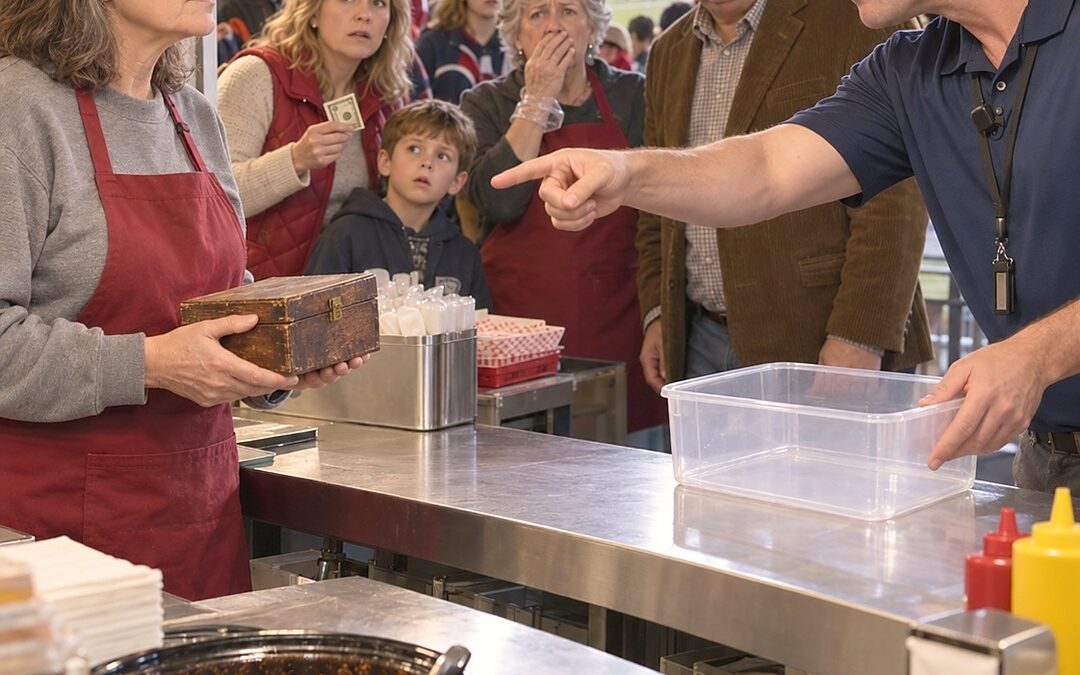
At 6:41 on Homecoming night, with two hundred people stacked up at my concession window, the new athletic director leaned over my counter and said into the microphone clipped to his collar, "Lunch ladies are paid to be invisible, Yvonne. Go be invisible somewhere else."
The speakers over the gate carried it to the ticket line and the visiting team's buses, and then Trent Ketterman set a clear plastic tub on my counter and told me I had until kickoff to fill it, because a trailer from Summit Fan Services was taking over my stand.
I had run that window for thirty-one years without a paycheck, and what Trent Ketterman didn't know, standing there so pleased with himself under the stadium lights, was whose money had paid the electric bill for those lights every season since 2011.
The woman nearest my window still had a five-dollar bill in one hand and a brown leather wallet with a brass snap in the other.
She wore a red quilted vest.
Her little boy kept his hand on the counter.
"Mrs. P?"
Behind me, Bonnie Gaydos pulled off one plastic glove so fast it tore at the wrist.
At the far end of the counter, Gail Reinhart stopped scrolling long enough to raise her head.
Then her phone dropped back into her palm.
The fryer was holding at 350 degrees.
I reached past Trent and switched it off.
He stopped talking.
"Safety first," I said.
The oil hissed after the switch clicked.
Bonnie had chili in one slow cooker and sauerkraut in another, with the kielbasa already cut beside them.
The nacho ladle sat crooked in the warmer.
I straightened it.
Trent watched my hand.
He was forty-one and dressed for September football as though somebody might photograph him for a brochure.
His maroon quarter-zip was pressed, his khakis still had a crease, and his white-soled shoes hadn't picked up cinder dust yet.
The wireless microphone sat high on his collar.
A district lanyard bounced against his chest when he moved.
"Yvonne."
"I heard you."
"Then let's move."
He put two fingers against the microphone clip, checked the little green light, and turned so the line could hear him better.
The band was tuning near the south end.
Gold shirts filled the middle rows of the home bleachers.
"Folks, we're upgrading the game-night experience."
Someone in the back of my line called, "We already ordered."
Trent lifted one hand toward the white trailer parked beyond the east end zone.
"Summit will honor reasonable requests."
I had never known what an unreasonable request for a hot dog looked like.
I went back to packing the order in front of me.
The Colliers Grill was cinder block painted maroon.
The paint under the serving window had been touched up so many times you could feel ridges in it.
Our steel shutter rolled into a housing overhead, and one corner squealed every Friday.
The old steel key hung from a nail inside.
Above the shelf sat the wooden cigar box we used for the float.
Walt had brought that box home in 1995.
A customer at Anthracite Steel had given it to him.
Trent tapped the plastic tub.
"Cash box too."
I turned to him.
"Booster money."
"District facility."
"Booster account."
"We can sort accounting later, Yvonne."
He angled his collar toward the crowd again.
"I've been trying to bring this operation up to a professional standard since July."
His hand moved to the trailer.
A blue banner covered half its side.
SUMMIT FAN SERVICES.
The serving window faced the home crowd, and the line already reached the track.
"They have electronic point-of-sale systems."
"We have Hal."
Hal Brenneman was our treasurer.
He used deposit slips with carbon paper.
Trent stared at me for two beats, then reached across and shut the warmer lid.
The woman in the red vest tightened her fingers around the brass snap on her wallet.
Her boy pulled his hand off the counter.
"You're done."
Trent lowered his voice, though the microphone still had him.
"Gwen Albrecht told me something interesting in August."
I kept my hands on the counter.
"Did she."
"She said the donor never misses a Homecoming."
I looked at him then.
He touched his lanyard with one thumb.
"So whoever we're dealing with is here tonight."
His eyes moved over the reserved seats and up toward the press box.
"A serious person does not want to buy a hot dog from the help."
The woman in the red vest stopped putting her five-dollar bill away.
Bonnie stood behind me with the torn glove hanging from two fingers.
Trent kept going.
"You understand optics."
"No."
His hand stayed on the warmer lid.
"I understand hot dogs."
A whistle blew on the field.
Players were coming out for warmups.
Trent checked his watch.
6:44.
"Sixteen minutes."
"I know what time kickoff is."
"I mean sixteen minutes to clear the stand."
He picked up the plastic tub and set it closer to me.
"Food and supplies. Anything personal goes with you."
"Those slow cookers belong to Bonnie."
"Take them."
A man in a brown corduroy blazer worked around the end of the line.
Vern Maddox had been on the school board longer than some of our teachers had been alive.
He came through the side door without knocking and stopped between Trent and the back wall.
"Yvonne."
"Vern."
His fingers worked one cuff of the blazer.
"Don't make a scene, Yvonne."
The fryer switch was already off.
"I'm packing up, Vern."
He gave a small nod and moved aside.
Gail remained at the end of the counter with her phone in her hand.
She had been Booster president six years.
She owned the hair salon beside the Rite Aid and had helped me serve three hundred hot dogs after the 2022 playoff game.
"Gail?"
Her thumb stopped.
She read whatever was on her screen, then scrolled again.
I took off my apron.
My concession smock was underneath.
Trent pointed to the shelves.
"Let's keep the transition moving."
A maroon practice jersey appeared beside Bonnie.
Caleb Strohl ducked under the counter flap.
He was seventeen now, six-foot-three, number 72.
When he was little, his head barely cleared that counter.
"Mrs. P, you want the chili?"
"I've got it."
"It's heavy."
"I know."
He lifted it anyway.
The cord dragged behind him.
Trent turned.
"Strohl."
Caleb stopped with the cooker against his chest.
Steam dampened the front of his practice jersey.
"Yes, sir?"
"Locker room. Now."
"Coach sent me."
"This is an athletics transition, Caleb. Locker room."
Caleb shifted the pot.
I nodded at the floor beside Bonnie.
"Set it there."
He did.
Trent moved his hand toward the field.
"Now."
Caleb ducked back under the flap.
He made it six steps before turning his head.
I was taking down the cigar box.
The lid stuck.
It always had.
I worked my fingernail under the edge and opened it.
Bills filled the bottom.
Walt's index card was still taped inside the lid, yellowed at the edges with faded pencil writing and four old squares of tape.
The card had stayed there through price changes, new health rules, two Booster presidents, and a raccoon that got into the buns in 2007.
I peeled the first corner loose.
My thumbnail caught the tape.
Then another corner came free.
"Hot dogs 75¢. Kids who are short get one anyway. —W."
The pencil had faded.
His W hadn't.
I pressed my thumb on the card until the nail went white.
Then I put it in my smock pocket.
Trent reached toward the box.
"That's district property."
"It's an index card."
"The contents of this facility remain here."
"The card doesn't."
Vern shifted his weight.
Gail kept reading her phone.
I set the cigar box on the counter and started the float.
Ten five-dollar bills made the first stack.
"Fifty."
I counted ten more fives into a second stack.
"One hundred."
Then I counted the ones in twenties, flattening each stack against the counter before starting the next.
"One twenty. One forty. One sixty. One eighty. Two hundred."
Bonnie stood with the chili cooker at her feet.
The people still waiting at the window could see my hands.
Twelve ones remained.
I counted them separately and laid them beside the stacks.
"Two hundred twelve dollars."
Trent breathed out close to his microphone.
The sound came through the gate speakers.
"Ones and fives."
He pulled the box across the counter.
I reached for the nail beside the back door.
The old steel key came off with a scrape.
I set it beside his hand.
"That's the stand key."
"Thank you, Yvonne."
He reached into his pocket and brought out a new brass padlock, clean enough to catch the concession light.
He rolled the shutter down.
The bad corner squealed all the way.
Trent pushed the shackle through the ring and snapped it shut.
"New lock."
He put the only key on his lanyard.
"I'll control access from here."
People began moving away from our window toward Summit's trailer.
At 6:52, I came around the end of the building.
The maroon shutter was down, my old steel key was still inside on the counter, and the new lock hung outside.
Tower number three stood beyond the chain-link fence with its lamps warming overhead, the maintenance gate beside it still open for game night.
Walt had helped raise that tower.
On Sunday, August 25, 1991, he wore his father's welding hood while Booster men steadied the steel and argued about whether the east tower leaned.
Before they raised it, Walt stamped W.P. 91 into the base plate with punches he kept in an old socket box.
We started running the concession stand in 1995, and that fall he wrote the price card after a boy came up short on a hot dog.
Walt died Thursday, October 8, 1998, at thirty-four.
His shop settlement was $412,000, and I left most of it in plain index funds because I had a job, a brick ranch on Cherry Street, and no reason to discuss money around Cinder Run.
On April 12, 2011, I sat in the back row while the school board voted to stop night football over the $28,400 seasonal cost of the lights.
That May I climbed the stairs to Gwen Albrecht's office in Pottsville and signed the papers for fund 0611.
The lights came back in September 2011.
Nobody asked who paid.
In 2014, the Courier guessed the Friend of the Field was a trucking heir from Philadelphia.
It cost me nothing to let them think it. That was the trouble.
On August 18 this year, Gwen and I had lunch in Pottsville, and I approved $600,000 for Field Renewal, scheduled for Monday, September 21.
"Let the man do his job," I told her. "I'll tell them at the dedication."
At 7:00, I went through the open maintenance gate and stood on the steel base plate of tower three.
W.P. 91 was under my left shoe.
The letters were rough.
Walt never cared much about pretty welds where nobody could see them.
Kickoff went into the end zone while Summit's line bent along the track and began turning back on itself.
A teenager left it and came over to me.
I knew him from the elementary cafeteria.
He had needed pictures beside the menu words in second grade.
Now he had a driver's license.
"Mrs. P, what happened?"
"Nothing, hon."
He checked the locked shutter behind me.
"Doesn't look like nothing."
"Game's that way."
He went back to his friends.
By 7:40, Summit was out of cheese sauce and people at the rear of the line were hearing sixty-two minutes.
A man in Tamarack Valley green came off the track holding a hot dog split open in its cardboard boat.
He stopped at the trailer window.
"Hey, this thing's frozen in the middle."
The worker leaned out.
The man held it closer.
"I want my money back."
I could smell fryer oil from the trailer even from the tower.
My own shutter stayed down behind the home bleachers.
Under it sat $212.
Two hundred twelve.
I caught myself counting it again.
"Stop it, Vonnie."
Walt used to call me that.
Nobody else does.
At 8:24, Gail came along the track.
She slowed when she saw me inside the maintenance gate.
"Gail."
"Yvonne."
"Who signed Summit in?"
She shifted her phone from one hand to the other.
The drum line started behind us.
"We'll talk."
"When?"
"After Homecoming."
She walked on and joined Vern near the fifty.
By the fourth quarter, the Summit window had a handwritten NO NACHOS sign taped inside it.
The Colliers scored again, the home crowd started filing out, and the trailer shutter came down while my stand stayed locked.
I remained by tower three until the players headed for the locker room.
The red warning light blinked overhead.
From my back porch on Cherry Street, that same red light was six-tenths of a mile away.
I knew the distance because Walt had measured it years ago in the car we owned before the Buick.
I went to the parking lot.
My 2008 Lucerne sat under a maple near the far end.
Somebody had left a Homecoming program under the windshield wiper.
I moved it to the passenger seat, sat down, and left the engine off.
Cars backed around me.
Headlights moved over the dashboard.
I took Walt's card from my pocket.
"Hot dogs 75¢. Kids who are short get one anyway. —W."
I put it in the cup holder.
Then I picked up my phone.
9:52.
Gwen's cell number was saved under ALBRECHT, GWEN.
I called.
She answered on the fourth ring.
"Yvonne?"
"Gwen, it's Yvonne Pasternak. I need you to hold Monday's grant."
A turn signal clicked in the car beside mine.
"All of it?"
"All six hundred."
"All right."
A minivan passed behind me.
I kept one hand on the Buick door handle.
Gwen was still there.
Papers moved on her end.
"You were at Homecoming?"
"Yes."
"Then we need to talk."
"About what?"
The paper noise stopped.
"Trent Ketterman emailed me this afternoon."
Tower three was still visible over the parked cars.
"What did he write?"
Gwen read it.
"Please wire the full amount to Summit Sports Surfaces LLC at the donor's request."
A pickup rolled past my hood and turned toward the gate.
"I never asked for that, Gwen," I said.
"I know," she said. "That's why I was about to call you."
Part 2 — THE BRASS PADLOCK
PART 2 — THE BRASS PADLOCK
At 7:30 Saturday morning, my kitchen phone rang beside the refrigerator.
Tessa Lund from the Courier had seen the Homecoming video.
"Mrs. Pasternak, do you want to respond to what Trent Ketterman said?"
Everybody carries a television station now.
"No, thank you."
"Did the Boosters approve Summit taking over?"
"You'll have to ask the Boosters."
"Can I quote you?"
"You can quote no comment."
I hung up before she found a fourth version of the same question.
At 7:52, Hal Brenneman knocked at my back door carrying an aluminum pan under one arm.
The top of his late wife's breakfast casserole was pale enough that I lifted the foil, checked it, and put the foil back.
Hal sat at my kitchen table in his gray cardigan.
He stared at the pan instead of me.
"I was near the fifty."
"I saw you."
"Six forty-one, give or take."
Hal corrected himself.
"No. Six forty-one exactly. I heard the speakers."
I wiped the counter.
"I should've come over."
"You were working Booster money."
"I had eyes."
He rubbed the edge of one thumbnail against the table.
"I didn't do anything."
I rinsed my dish towel and wrung it out over the sink.
Hal waited for me to say more.
I wiped the same stretch of counter again.
Gwen's name stayed out of my mouth.
So did six hundred thousand dollars.
At 9:38, Hal called my cell.
"Ten o'clock. Field."
"You picking me up?"
"Nine fifty-two."
Of course he had a time.
His Mercury Grand Marquis rolled into my driveway at 9:51.
Hal looked at the dashboard clock.
"Close enough."
The car still smelled faintly of the peppermints Miriam used to keep in every door pocket.
We reached Colliers Field just after ten.
There was no game, only cleanup crews and the Summit trailer behind the east end zone.
Hal drove past the home bleachers and slowed before I asked him to.
The brass padlock hung from the shutter ring.
Fresh metal.
No rust.
A greasy thumbprint showed near the bottom where somebody had pushed it closed the night before.
I watched it through the passenger window.
Hal watched me watching it.
"New."
"Last night."
He pulled the Mercury onto the gravel.
Kurt Dolan was hosing the trailer floor.
Dirty water ran across the concrete and toward the cinder track, carrying a paper nacho tray with it.
The tray caught against the gravel.
I walked over, picked it up, and dropped it into a barrel.
Hal had already reached the Booster mailbox.
A white envelope was taped to the front, with a delivery slip clipped underneath.
Gail Reinhart's signature sat on that slip.
September 19.
Hal handed me the envelope without saying anything.
I opened it on the Mercury's hood.
The letter gave the Boosters until Friday, September 25.
The concession account balance was printed in the second paragraph.
$44,310.
My finger stopped there.
Then I read the last paragraph.
Turn over the account to the district or pay a $9,000 field-use fee.
Hal leaned beside me.
"Forty-four three ten."
He paused.
"Plus nine."
"I can read."
"I know."
He took another sheet from his folder and laid it beside the letter.
Friday, September 11.
A consent letter giving Summit Fan Services access to the Colliers Grill for a Homecoming trial.
Gail's signature sat at the bottom.
I put my fingertip on it.
Hal's name wasn't anywhere on the page.
"Six years as treasurer."
He checked himself.
"Five and eleven months, if we're counting."
"We're not."
He opened his cardigan and pulled out the school-board agenda packet, folded lengthwise.
The employment page showed Trent Ketterman's salary.
$74,000.
Under it:
District supplement: $18,000.
Hal tapped the smaller line.
"June."
"Where'd it come from?"
"Packet doesn't say."
Across the track, Kurt shut off the hose.
The sudden quiet carried farther than I expected.
He noticed us and lifted one hand.
Hal folded the agenda again.
"Peretti?"
"Not yet."
"Gail?"
"No."
"Vern?"
I closed the envelope.
"Take me home."
Hal put the papers back in his folder.
On Monday morning, I had Bonnie cover the elementary kitchen while I took the first half of the day off and drove twenty-five minutes to Pottsville.
At 9:30, Gwen opened the door to her office on the second floor of the old bank building on Centre Street.
The radiator knocked twice behind her desk.
A framed photograph showed the same building in 1924, before anybody had painted parking lines outside.
Three printed sheets were waiting for me.
Gwen placed them in order.
August.
August again.
Friday, September 18.
I touched the first page where her own reply used the words "a capital gift of approximately $600,000."
Then I touched the timestamp on the third sheet.
4:52 p.m.
I didn't need to read the body again.
I'd heard it in the Buick Friday night.
"Before the September vote?" I asked.
Gwen nodded.
"But you told him it was anticipated."
"I did."
"He told the board more than that."
"He did."
I slid the pages back toward her.
She turned her monitor.
The Foundation portal showed the fund in one block.
FRIEND OF THE FIELD — 0611.
FIELD RENEWAL — $600,000.
RELEASE 9/21.
My name wasn't on the public-facing line.
Gwen pulled a new instruction sheet from beneath the keyboard.
I read it slowly.
Hold the grant at the Foundation.
Release funds only through open competitive bid.
No payment to any contractor with a conflict of interest.
I signed at the bottom.
Yvonne Ann Pasternak.
Gwen watched the pen leave the page.
"He'll call."
"That's your phone."
"He'll ask why."
"You don't know why."
"I don't."
She squared the page against the desk.
"He'll ask who the donor is again."
"Tell him the program is called 'The Friend of the Field.'"
"And if he asks for the person's name?"
I put the pen down.
"He can keep asking."
Gwen looked over her glasses.
"He'll never ask you."
"Probably not."
At 10:17, I went back downstairs and sat in my Buick on Centre Street.
I didn't start the engine.
My signed copy of the new instruction rested on the passenger seat.
I picked it up and ran my thumb once over my own name.
Across the street, the old bank windows reflected a delivery truck crawling through downtown.
Two women came out carrying folders.
Neither knew who I was.
I set my copy facedown on the seat.
The red second hand on the Buick clock moved around once.
Then again.
At 10:21, I started the car.
By 12:50, I was back at Cinder Run Elementary.
Bonnie had the lunch count sheet under a salt shaker so the exhaust fan wouldn't move it.
Peg was scraping the last onions from a pan.
Tina had already stacked the clean trays.
"How bad?" Bonnie asked.
"Kitchen survived."
"I meant Pottsville."
I took my smock from its hook.
"So did Pottsville."
Peg handed me a sheet pan.
"You miss us?"
"No."
"Good."
I tied my apron.
There were onions to finish and pierogi to move before afternoon cleanup.
At 1:15, I carried the last hot sheet pan through the loading-dock door.
Trent Ketterman was waiting beside my Buick.
Pressed blue shirt.
No collar microphone today.
His lanyard hung straight down the front, and the concession key caught daylight against his belt line.
Bonnie saw him through the open door.
Peg leaned past her shoulder.
"I can stay," Bonnie said.
"No."
She remained inside the doorway anyway.
I kept the hot pan balanced on the towel in my hands.
Trent stepped away from the Buick.
"Yvonne, I want to reset the conversation."
"Do you."
"We both want a good outcome here."
"Do we."
He put one finger against the plastic badge on his lanyard.
"I've been told your car was seen on Centre Street this morning."
"Cars do park there."
His voice softened.
"I'm trying to make you a partner in the transition."
I shifted the sheet pan because heat had found my thumb through the towel.
"What transition?"
"The concession program."
"You locked me out."
"Temporary access control."
The key flashed when he moved.
"Summit is bringing a professional standard to game-night service, and there may still be a role for community volunteers if everybody works constructively."
"My little stand gets volunteers now?"
His finger stopped on the lanyard.
"Yvonne, you know people."
"I know people who eat."
"You know families. You know this town. You know who gets invited upstairs in Pottsville."
Behind me, a metal pan hit the rack inside the kitchen.
Trent lowered his voice another notch.
"The Foundation won't identify the donor."
"They shouldn't."
"We have a capital project waiting on six hundred thousand dollars."
"We?"
"The district."
"You said project like it belonged to you."
He took his hand off the badge.
"This is exactly the kind of friction I'm trying to avoid."
The heat from the pan had reached my other hand now.
I shifted it again.
Trent noticed.
He moved aside from the loading-door path but didn't leave.
"I can help you with the stand."
"I thought Summit had it."
"Summit has the Homecoming transition and a concession framework."
"That's a lot of words for hot dogs."
Peg appeared behind Bonnie.
Neither woman spoke.
Trent kept his voice smooth.
"I am offering you a path back into the game-night operation."
"For what?"
"Information."
His fingers closed around the key on his lanyard.
Not enough to remove it.
Just enough to hold it still.
"I don't need financial information," he said. "I don't need the fund documents. I need one name."
I stepped past him with the sheet pan.
He followed as far as the yellow line painted beside the loading dock.
"Yvonne."
I stopped before the kitchen door.
"Get me the donor's name, Yvonne, and I'll let you keep your little stand."
Part 3 — THE WITHDRAW BUTTON
PART 3 — THE WITHDRAW BUTTON
At 11:20 Monday night, my laptop showed me a blue button worth six hundred thousand dollars.
I sat at my kitchen table with the Foundation portal open and a Kroger receipt under my elbow.
Butter, $4.89.
I had circled it after supper.
The portal had made me sign in twice, once with my password and again with a six-digit code sent to my phone.
I typed the last digit wrong.
The screen kicked me back.
I said a word Bonnie would not allow around first graders and started over.
When the account finally opened, the top of the page read FRIEND OF THE FIELD, fund 0611.
The pending Field Renewal grant sat below it.
$600,000.
Status: HOLD.
And underneath that was the blue button.
Withdraw recommendation.
I moved the cursor over it.
The arrow became a hand.
One click could pull back the whole grant before Monday's release went anywhere.
The refrigerator started behind me.
I began counting seasons.
"One."
My chair scraped when I stood.
"Four."
I crossed the kitchen.
"Eight."
My hand found the back-door knob.
"Twelve."
I stepped onto the porch.
"Fifteen."
The red warning light on tower three blinked beyond the roofs.
Then dark.
Then red again.
"Sixteen."
Sixteen seasons of electric bills.
I stood there until the porch boards got cold through my socks.
Then I went inside.
The laptop had dimmed.
I touched the trackpad, and Withdraw recommendation came back in blue.
A small gray link below it said Fund history.
I clicked that instead.
Years of electricity and maintenance rolled down the screen, followed by lunch-balance payments and the $18,000 athletic-director supplement approved in June.
My finger stayed on the trackpad.
I went back to the grant page.
The blue button was still there.
I moved the cursor off it.
Then I closed the laptop.
At 2:50 Wednesday afternoon, a student aide came through the elementary kitchen holding a folded sheet of district paper.
The top corner had been crushed in his fist.
He handed it to me between the steam table and the dish sink.
MRS. PASTERNAK — ATHLETICS OFFICE, 3:30.
Peg read it over my shoulder.
"He writes like a dentist."
"He's younger than my dentist."
Bonnie checked the wall clock.
"You leave at three anyway."
Tina kept scraping mashed potatoes from a hotel pan.
I slid the note into my smock pocket and finished the last twenty minutes of cleanup.
At 3:27, I crossed the high school lot.
Football practice was going on behind the bleachers.
Pads cracked above the concrete hallway leading to Trent's office.
I had been inside twice before he took the job, once for ice and once when a freezer outlet died.
He had changed the room.
A framed championship photo from his old Pittsburgh-area district hung behind his desk, and Summit brochures were stacked beneath it.
New keys hung from a hook beside a foam-board mockup propped against the file cabinet.
SENIOR NIGHT — FIELD RENEWAL RECOGNITION.
A printed rectangle on the mockup marked a presentation area at midfield.
Trent's own lanyard hung from his neck.
"Close the door, Yvonne."
I left it open six inches.
He noticed.
His pen rolled once between his fingers.
"Sit."
"I'll stand."
He set the pen down.
"We need to talk about controls."
"Whose?"
"The concession operation."
He opened a folder.
Blank cash sheets sat on top.
"You've been handling game-night money for thirty-one years."
"Hal handles the books."
"You handle the cash before he sees it."
"Then count it."
Trent leaned back.
"I'm trying to establish a professional standard."
"Count it."
The sounds of practice came through the open door.
A whistle.
Cleats above us.
Somebody yelled for the second unit.
Trent picked up his pen again.
"I also want to avoid an unnecessary public fight."
He tapped the pen against the Senior Night mockup.
"We have a donor who never misses Homecoming."
"So I've heard."
"A donor providing serious capital deserves serious recognition."
He turned the board enough for me to see it.
Midfield.
A presentation mark.
A time block beside it.
"Senior Night gives us the right stage."
"For football?"
"For the donor."
He spoke more slowly now.
"We recognize the gift properly, put the donor in front of the community, and get the Field Renewal program moving with some momentum."
I studied the printed rectangle.
"You know she'll come?"
"I know she doesn't miss the big nights."
His pen tapped the word RECOGNITION.
"When people give six hundred thousand dollars, Yvonne, they generally aren't shy when it's time to sign."
I put his note from the kitchen on the edge of his desk.
"You called me here about cash."
His voice dropped.
"Yes."
He closed the folder.
"If you're not connected to this donor, then all I have is a volunteer who has handled cash for three decades without district controls."
I could still see the mockup beside him.
The Summit logo appeared in small print along the bottom.
"Nobody counts cash for thirty-one years without some of it sticking to her fingers."
A secretary farther down the hall shut a drawer.
One of the players ran past the office.
I looked at Trent once.
"Count it."
He blinked.
"Excuse me?"
"Count it."
I walked out.
My hands stayed steady through the corridor beneath the bleachers.
At the stairwell, I missed the push bar on the first try.
Thursday at 5:50, I went back to Colliers Field.
Practice was nearly finished, and the September sun sat low behind the visitors' side.
I stood outside the chain-link fence near tower three.
The concession shutter was still down.
The new lock hung from it.
A strip of old masking tape clung beside the window where our Friday price sheet had been.
Number 72 broke away from the players jogging to the sideline.
Caleb Strohl came over with his helmet in one hand and his shoulder pads still on.
"Mrs. P."
"You're supposed to be practicing."
"We're done."
Coach Ray Biederman followed several steps behind with his hands in his windbreaker pockets.
"He's done."
Caleb rested his helmet against the fence.
"You busy next Friday?"
"I work Fridays."
"At eight?"
"I hope not."
He rubbed dried mud from one knee pad.
"Senior Night."
"I know."
"We walk before halftime."
"I know that too."
He took a breath.
"Would you walk me?"
"Your mother will be there."
"Yeah."
"Dana should walk you."
"She is."
He nodded at Coach Biederman.
"I get two."
Ray stopped beside us.
"Every senior picks who walks him. Been that way since 1986."
Caleb picked up his helmet again.
"My dad isn't coming."
Kyle Strohl had left in 2018 for oil-field work in North Dakota.
Dana had carried the house after that, and Caleb had gotten used to carrying whatever needed carrying.
"Mom shouldn't have to do it alone," he said.
"You sure?"
"Yes."
He pointed through the fence at the base of tower three.
"Come here."
The maintenance gate was still open from practice.
I walked around through it, and Caleb met me at the base plate inside the fence.
He crouched.
Mud flaked from his football pants as he brushed his fingers across the stamped letters.
W.P. 91.
"Your husband, right?"
"Yes."
Caleb stood.
"Mr. Ketterman's script says Mother only."
Ray's face tightened.
"Script?"
"He gave us lineup sheets."
"Bring me yours tomorrow."
Caleb nodded.
The athletics-office window glowed under the bleachers.
"Will you do it?" he asked.
"Ask your mother."
"I did."
"And?"
"She said ask you."
"Then yes."
Caleb's grin came fast.
"Thanks, Mrs. P."
"Go shower before your mother blames me for the car."
He grabbed his helmet and ran for the locker room.
At 8:40 that night, my phone buzzed against the kitchen counter while I was washing a saucepan.
HAL BRENNEMAN.
I dried my hand and answered.
"Tell me."
Paper moved on his end.
Hal took a breath.
"Rhonda called."
I stopped wiping the pan.
"From the business office?"
"Eight twenty-six."
Of course he had the time.
"She checked account 4410."
Hal paused.
"Athletics discretionary."
I put the towel down.
"What did she find?"
"Money first."
His papers moved again.
"Wednesday before Homecoming."
He counted under his breath.
"September sixteenth."
"Hal."
"Twelve thousand."
He stopped there long enough for me to hear the refrigerator humming.
"Memo says partnership fee."
I leaned against the counter.
"And you said there were two things."
"There are three now."
He corrected himself.
"Two things she told me, one thing she copied."
"Go on."
"She photographed the Summit transfer instruction out of the athletics file."
I straightened.
"Why?"
"Because she saw the second signature."
Hal shuffled something.
"She sent me the picture. I'll print it."
"Whose signature?"
"I'll show you Saturday."
"Hal."
He ignored that.
"The other thing is the filing."
I could hear him moving a page into place.
He stopped counting long enough to read it.
"Twelve thousand dollars landed in the athletics account the Wednesday before Homecoming," Hal said. "The memo says 'partnership fee.' And Yvonne, Summit's filing lists the wife."
Part 4 — NINETY FIRST GRADERS
PART 4 — NINETY FIRST GRADERS
At 9:12 Saturday morning, September 26, I sat across from Hal Brenneman at his scratched oak kitchen table while he lined up four sheets of paper between us.
Miriam's old credit union calendar still hung beside the refrigerator.
Hal had turned it to September.
He put his glasses beside the first page.
"Who is the Friend of the Field?"
"Me."
His fingers stopped on the paper.
"Since when?"
"May 2011."
He sat back.
"The lights?"
"Yes."
"And the lunch balances?"
"Yes."
Hal picked up a pencil, then put it down again.
"What about the six hundred?"
"Mine to recommend."
His chair creaked.
I told him what I had never told the Boosters.
Walt's settlement had been $412,000 in 1999, and I had left most of it in plain index funds instead of spending it.
When the board shut down night football in 2011 over the $28,400 seasonal light bill, I went to Gwen.
We opened fund 0611.
Hal stared at the table.
"The Courier said Philadelphia."
"I know."
"A trucking heir."
"I know."
He rubbed the edge of the first photocopy.
"I spent fifteen years writing thank-you notes in my head to a trucking heir."
"Saved you postage."
He almost smiled.
Then he didn't.
"Why didn't you tell us?"
"It was easier to be the lunch lady."
Hal pulled the four pages closer.
The first showed Summit Fan Services LLC.
His finger ran down the ownership line until it stopped at Brooke Dolan Ketterman.
He put that sheet beside the vendor disclosure.
"Ketterman's wife."
"Yes."
He circled the ownership percentage with his pencil.
Twenty-four percent.
Then he moved to the vendor form.
RELATED TO A DISTRICT EMPLOYEE?
NO.
Hal drew one hard circle around the checked box.
"That's clean."
"No."
"I meant easy."
He slid the third page over the first two.
Dennis Maddox's name appeared on the Summit quote.
Hal moved Brooke's name and Dennis's name close enough that both showed at once.
"Vern's nephew."
"Yes."
His pencil tapped once beside Dennis's name.
"Commission."
"Rhonda thinks so."
The fourth sheet had been folded in half.
Its crease ran through the middle of the account instructions.
A handwritten note sat in the margin.
RHONDA — PHOTO FROM ATHLETICS FILE, 9/24.
Hal opened it flat.
"She took this with her phone."
Payment in full.
Advance.
Operating account.
No escrow.
Second signature required.
B. D. Ketterman.
Hal put the page beside Brooke's ownership sheet.
He moved one finger from the initials to her full name.
"Brooke Dolan Ketterman."
"That's what I thought."
A leaf blower started somewhere outside and rattled against Hal's kitchen window.
Hal waited until it moved down the block.
"Peretti doesn't know this?"
"Not from me."
"He should."
"You're Booster treasurer."
Hal picked up the manila folder beside his elbow.
I pointed to the ownership page and the vendor form.
"Take those."
Then I touched Rhonda's folded copy.
"And that."
"What about you?"
"Not yet."
Hal started loading the pages into the folder.
"The twelve thousand too?"
"Yes."
He stopped before closing it.
"The fund?"
"No."
"Yvonne."
"Tell him Summit has a family problem and a money problem."
Hal looked at the papers again.
"Numbers first."
"That's your department."
He closed the folder.
On Monday morning, Hal carried those papers into Dr. Alan Peretti's office, and Peretti listened without promising him anything.
Wednesday at 10:40, about ninety first and second graders came through my cafeteria.
Milk came first, then the hot tray, with fruit at the end.
Noah changed his mind at fruit as usual.
He picked applesauce.
Then peaches.
I was behind the steam table beside Bonnie while Peg ran the register.
Tina was helping a girl open a milk carton when Dr. Peretti appeared in the kitchen doorway.
Cheryl Rusnak stood beside him with a gray folder tucked under one arm.
Peretti's tie was crooked.
His tie was never crooked.
Bonnie stopped reaching for trays.
I kept serving.
"Chicken patty?"
The boy in front of me nodded.
I put one on his tray.
"Mrs. Pasternak."
Peretti's voice carried over the dish machine.
"One minute."
The next child wanted no gravy.
I served her, wiped my hands on my apron, and walked around the steam table.
Cheryl handed Peretti the folder.
"Can we speak in the office?"
"No."
Children kept sliding trays along the rail behind me.
"Here is fine."
Peretti opened the folder.
"This is a suspension with pay, effective immediately, pending review."
Bonnie lowered her serving spoon.
I kept my eyes on the page Peretti handed me.
Cash handling and unauthorized free food at district events.
School board letterhead.
I read the first page.
Then I turned to the signature.
Vern Maddox.
"Who complained?"
"The complaint was submitted under the board president's signature."
"Who wrote it?"
Peretti didn't answer.
"Policy requires removal from cash handling and student food service while the complaint is pending."
I handed the letter back.
"You'll need another cook for lunch."
"Coverage is arranged."
A tray tipped behind us and sent peas rolling beneath a table.
A first grader bent down for them.
Tina came around with a broom.
"Leave those, honey."
I untied my apron and hung it on the hook beside the walk-in without folding it.
My badge came off next.
Then the hairnet.
I put both in Cheryl's palm.
Her hand closed around them.
Bonnie picked up the serving spoon again, but she put two chicken patties on one tray and had to remove one.
Peg kept ringing lunches.
Tina swept the peas into a dustpan and stood there holding it after the floor was clean.
I walked through the cafeteria.
Chair legs scraped.
Milk cartons snapped open.
A little boy at the end table held up his pudding cup when I passed.
"Mrs. P."
I stopped.
He kept the cup out toward me.
"Keep it, hon."
He pulled it back against his tray.
I walked on.
At 10:47, the loading-dock door closed behind me.
My Buick sat in the employee row.
My purse was with me.
My lunch stayed in the staff refrigerator.
At 7:30 that night, Dana Strohl knocked at my back door with a foil-covered dish of pierogi.
The smell of onions came in before she did.
"Caleb said you like these."
"Caleb lies."
Dana gripped the dish tighter.
"I like them."
She put it on my kitchen table.
Her blue dental-office scrub top still had her name stitched above the pocket.
"Caleb heard."
"Cinder Run heard."
"He wouldn't eat dinner."
"Seventeen-year-old linemen eat."
"Usually enough for rent."
I took two plates from the cabinet.
Dana stayed standing.
"I brought something else."
She opened her purse.
The photograph was five by seven, Caleb at eleven in a too-big winter coat, holding a hot dog near our old concession window.
His front tooth was chipped.
He had forgotten to smile.
Dana turned it over.
"Dear Friend: This is Caleb, the day he stopped skipping lunch. —Dana S."
My thumb pressed the lower corner.
Only once.
The paper bent.
I set the photograph face-down.
Dana sat.
"That was 2019."
"I remember him."
"He owed two hundred fourteen dollars and fifty-five cents."
I knew the number.
Dana didn't know that.
"The school sent me the letter that December."
Paid in full by a friend.
I took the foil off the pierogi.
Steam fogged my glasses, so I removed them.
"When Caleb's account got over two hundred, he stopped eating lunch."
She pulled one fork closer.
"Told me he wasn't hungry."
I put two pierogi on her plate.
"Then the balance disappeared."
Dana ate half of one before speaking again.
"I've written every December since."
"To the Foundation?"
"Care of them."
She touched the back of the photograph.
"I never know if she gets them."
"She does."
Dana looked up.
I corrected myself.
"Gwen's good about that."
"Do you know somebody there?"
"Somebody."
"Could you pass this along?"
I turned the photograph over again.
"I'll see she gets it."
Dana nodded and ate the rest of the pierogi.
Thursday morning, Gwen called at 8:06.
I was standing at my kitchen counter with Dana's photograph beside the phone.
"Peretti was here yesterday," Gwen said.
"How long?"
"Two hours."
I touched the edge of the photograph.
"He read the whole fund file?"
"Yes."
Paper moved on Gwen's end.
"Trent has told the board and Summit that the donor will appear Friday night and sign on the field."
I stopped touching the photograph.
"He told them that?"
"He did."
"Gwen."
"I know."
She let the line sit.
Then she asked, "If I get the microphone Friday, may I use your name?"
I turned Dana's photograph face-up.
Caleb at eleven stared back at me with that hot dog in his hand.
"Yes."
Gwen took a breath.
"If he gives me the microphone, I'll use it."
At 6:15 that evening, I drove past Colliers Field.
Practice was over.
Two Summit men were setting up an easel near midfield.
A foam-core check, nearly the size of a cabinet door, leaned against it.
Trent stood several feet away with his phone in his hand.
Kurt Dolan crouched beside the easel.
I slowed the Buick.
The lettering was large enough to read from the track.
PAY TO THE ORDER OF:
Summit Sports Surfaces LLC.
$600,000.00.
FROM:
THE FRIEND OF THE FIELD.
The signature line was blank.
I pulled closer to the curb.
Under the blank signature line of the oversize check, a strip of masking tape in Kurt Dolan's block capitals said: DONOR SIGNS HERE 8:22. TRENT HAS THE PEN.
Part 5 — THE CHECK AT MIDFIELD
PART 5 — 8:22
At 7:48 Friday night, October 2, about fourteen hundred people were inside Colliers Field when I took my place beside tower number three.
I wore my navy church coat.
The air had cooled enough that I kept it buttoned.
The concession stand was still locked.
Trent's key flashed on his lanyard whenever he crossed beneath the stadium lights.
Summit's trailer sat behind the east end zone, with Kurt Dolan moving between it and midfield.
The foam-core check waited on an easel behind the home bench.
I could read the dollar sign from the fence.
At 8:04, Dana Strohl found me.
She wore a cream sweater and had Caleb's Senior Night card in one hand.
"He's nervous."
"He's six-three and two hundred sixty pounds."
"He's still my kid."
Caleb stood with the other seniors near Coach Biederman.
Number 72.
Pads off.
Maroon jersey over a white undershirt.
Dana saw him looking for us and closed her hand around his for a few seconds before the lineup started.
He let her.
Then he noticed me and raised his chin.
Trent worked the fifty-yard line with his district lanyard on the outside of his jacket.
The small microphone remained clipped to his collar.
Every instruction came through the stadium PA.
At 8:10, the drum line stopped.
"Senior Night recognition will begin."
Families crossed the grass while Trent worked down his script at a steady pace.
Caleb moved closer to the front.
Dana stood beside him.
I stayed behind the fence.
Trent reached the next card.
"Caleb Strohl, escorted by his mother, Dana Strohl."
Caleb stayed where he was.
Trent lifted his head as Caleb turned and held one hand straight out at me.
People nearest the sideline followed his arm.
Dana opened the maintenance gate.
Trent covered his collar microphone with his palm.
It did almost nothing.
"Strohl. Mother only."
The speakers carried it.
Caleb nodded at Dana.
"My mom's right here."
Then he held his hand out again.
"That's two."
Trent tightened his grip on the script.
"Caleb."
"She's the one who showed up."
The front rows heard that without help.
Coach Ray Biederman came off the sideline.
"The rule's been the same since 1986."
Trent turned to him.
"This is my program."
"It's my team."
The band director raised one hand, and a drummer who had started a roll stopped.
Caleb kept his arm out.
Dana came through the gate.
"Come on."
Coach Biederman nodded at me.
I walked onto the grass.
Applause started behind the home bench before I reached them.
Dana took Caleb's left arm.
I took his right.
We crossed the field together.
Gail Reinhart stood at the rail with her phone down.
Vern Maddox sat in the front row in his brown corduroy blazer.
Hal stood near the track.
Bonnie Gaydos had come down beside the fence.
At the fifty, Coach Biederman read Caleb's name himself.
Caleb squeezed my elbow once.
Then he let go.
We walked off the field.
At 8:17, I went back to the fence.
Five minutes later, Kurt Dolan rolled the easel onto midfield.
The foam-core check came with him.
PAY TO THE ORDER OF Summit Sports Surfaces LLC.
$600,000.00.
FROM: THE FRIEND OF THE FIELD.
The signature line was blank.
Beneath it, the masking tape was still there.
DONOR SIGNS HERE 8:22. TRENT HAS THE PEN.
Trent held a wireless handheld microphone.
His collar microphone was still clipped in place.
Kurt squared the easel with the fifty-yard line.
Vern had moved down closer to the rail, while Gail and Hal stood several yards apart along the track.
Peretti waited beside Marian Tobin near the home bench.
Then Gwen Albrecht came through the south gate carrying a folder.
Trent spread one hand to the crowd.
"Folks, tonight the Friend of the Field joins us."
He let the noise settle.
"Whoever she is, she's too classy to wait in a concession line."
A few laughs came from the middle rows.
At the rail stood the woman from Homecoming in the red quilted vest.
Her son was beside her.
She still carried the brown leather wallet with the brass snap.
"Gwen! Is she here?"
Gwen crossed the sideline.
"She is."
Trent searched the reserved seats.
Gwen held out her hand.
"May I?"
He gave her the handheld microphone.
His fingers stayed on it half a beat longer than hers.
Gwen opened the folder.
"I was asked to read two entries from the Friend of the Field account."
She read the first line.
"Lights and field-light maintenance, sixteen seasons, $454,400."
A man in the third row said, "Jesus."
The woman beside him told him there were children around.
Gwen went to the next line.
"A leadership supplement for the athletic director's position, $18,000."
Trent's right hand went to his lanyard.
His thumb pressed the plastic badge holder.
Then he looked down at the key hanging below it.
Gwen closed the folder halfway.
"The Friend of the Field is Yvonne Pasternak."
The woman in the red vest turned from Gwen to me.
Her son leaned over the rail.
"Mrs. P?"
The woman's wallet opened in her hand.
A folded five-dollar bill was still inside one pocket.
She left it there and closed the brass snap.
Bonnie stopped with both forearms on the fence.
Gail lowered her phone into her purse.
Vern gripped the rail.
Hal removed his cap.
Gwen called my name once.
"Yvonne?"
I opened the maintenance gate.
My shoes sank slightly into the grass as I crossed.
Trent faced me.
His mouth opened.
Nothing came out.
Gwen handed me the microphone.
I took it.
I stopped three feet from Trent, beside the check he had expected somebody else to sign.
"I've been invisible for thirty-one years, Mr. Ketterman. That's how the lights stayed on."
Trent raised his head to tower three.
He kept it there.
Then his fingers touched the microphone clipped to his collar twice, checking the little unit that had carried his own voice on Homecoming night.
The boy at the rail called, "Mrs. P!" again.
I reached into my church coat and took out my black Sharpie.
Kurt shifted closer to the easel.
Marian Tobin stepped off the sideline with a folder against her ribs.
Kurt stopped.
I uncapped the marker and drew one black line through Summit Sports Surfaces LLC.
The man in the third row leaned forward.
"Well, I'll be."
I wrote above the crossed-out contractor.
Cinder Run Area School District — open bid only
A child behind the fence tugged his father's sleeve.
"Is that Mrs. P?"
"Yep."
I moved to the blank signature line.
The tape underneath still said TRENT HAS THE PEN.
I never asked him for it.
I signed:
Yvonne A. Pasternak.
The letters looked oversized because the check was nearly the size of a door.
Hal stared at my name.
Then at me.
I capped the Sharpie.
Peretti stepped onto the grass.
I put the handheld microphone into his open hand before moving away from the easel.
He stopped in front of Trent and unclipped the microphone from Trent's collar himself.
The cable pulled free of the quarter-zip.
Peretti spoke into the handheld.
"Mr. Ketterman, you are on administrative leave as of this moment."
Vern's fingers tightened around the rail.
Voices rose through the home stands.
Marian Tobin removed one sheet from her folder.
A red stamp across the top read STATE ETHICS COMMISSION — REFERRAL.
She put it in Trent's hand.
"Summit's agreements lacked board approval."
One sentence.
Then she stepped back.
Trent held the referral by one corner.
Peretti put a second page on top of it.
ADMINISTRATIVE LEAVE — EFFECTIVE IMMEDIATELY.
Trent tried to tuck both sheets beneath his lanyard.
They slipped.
He caught them against his jacket.
Peretti pointed at the key.
Trent looked down.
The brass key hung from the same lanyard as his district badge.
He worked the clip.
His fingers slipped once.
Then it came free.
He held the key for another beat.
I put my hand out.
Trent placed it directly into my palm.
The metal was warm.
His empty key clip swung against the front of his jacket.
The woman in the red vest watched it move.
So did her son.
I turned to Caleb.
He and Dana had come down from the Senior Night line.
"Hold this."
Caleb opened his hand.
I put the key in it.
He hooked it onto his belt loop.
Peretti handed the wireless microphone back to me.
Trent still stood beside the check, clutching the leave notice and the Ethics Commission referral.
I lifted the microphone.
"Go be invisible somewhere else."
His shoulders dropped.
He pulled the lanyard over his head and held it in the same hand as the papers.
Then he walked.
Past the fifty.
Past the home bench.
Past Gail and Hal.
People at the rail made room without speaking to him.
He crossed the cinder track and went through the gate beneath the speakers.
The administrative-leave page flapped against his leg until the gate shut behind him.
I handed the microphone back to Gwen.
Kurt Dolan was already moving.
He crossed to the Summit trailer and backed his truck to the hitch.
The reverse alarm beeped over the east end while people along the track stayed where they were.
Kurt dropped the coupler onto the ball.
He climbed into the truck.
The trailer rolled forward.
One tire fell into a rut in the cinders.
The whole box jumped.
A stack of paper cups slid across the inside and crashed against the serving window.
Kurt kept driving.
The trailer passed through the east gate and disappeared behind the buses.
Gwen raised the microphone.
"One final instruction from the donor."
The stands settled again.
"$540,000 will go toward field renewal through an open competitive bid."
The home side applauded.
Gwen waited.
"$60,000 will establish a permanent district lunch-debt fund so no child carries a lunch balance."
A little girl at the rail pulled on her mother's sleeve.
"Does that mean lunch is free?"
Her mother bent down to answer.
Gwen closed the folder.
"The fund will be called Walt's Rule."
I could see tower three over her shoulder.
W.P. 91 was down at its base, inside the fence.
The game resumed at 8:39.
The drum line picked up again, and people began turning back to football.
Peretti came to me beside the maintenance gate.
He carried the complaint folder from Wednesday.
A yellow sticky note marked the second page.
He opened it there.
Trent Ketterman's initials sat in the lower corner.
Peretti kept one finger on them.
"Mrs. Pasternak," he said, "Trent wrote the entire complaint. Vern read only the first page before he signed it."
Part 6 — THE LIGHTS AT 6:31
PART 6 — 6:31
At 6:45 Monday morning, October 5, Dr. Alan Peretti walked into my elementary kitchen carrying my badge and a thin stack of paper.
Bonnie saw him first.
She stopped with a breakfast tray halfway onto the rack.
Peg left the register drawer open.
Tina had one hand inside a case of applesauce cups.
I was standing on the wrong side of the steam table.
Peretti came to the stainless counter.
"Mrs. Pasternak."
"Morning."
He put my badge down between us.
"You are reinstated effective immediately."
I clipped it to my smock.
The breakfast line had started forming outside the cafeteria doors.
Sneakers squeaked in the hall.
Peretti straightened his tie, but the knot stayed crooked.
"I acted under policy once the complaint was submitted. The review no longer supports your suspension."
I nodded.
Then he laid three things on the counter.
The first was a printed email.
I read only the top.
FROM: Trent Ketterman.
TO: Alan Peretti; Cinder Run Area School Board.
11:14 p.m., Sunday, October 4.
RESIGNATION.
The second sheet was a transfer receipt from the athletics discretionary account.
$12,000.00.
RETURNED.
Monday, October 5.
The third was the Summit concession agreement.
A red stamp crossed the first page.
VOID.
Peretti squared the three papers with the edge of the counter.
"The remaining review is pending with the board and counsel."
Someone stood behind him.
Vern Maddox.
Same brown corduroy blazer.
His hat was in his hands.
He kept turning the brim against one thumb.
Bonnie picked up the tray she had stopped with but didn't move it to the rack.
Peg closed the register drawer.
Tina tore open the applesauce case.
A first grader at the front of the breakfast line was trying to balance a milk carton on top of his cereal bowl.
Vern came inside.
He spoke to his hat first.
"Dennis quit Summit Saturday."
His nephew.
He turned the hat once more.
"Called me himself."
Peretti took the complaint folder from under his arm.
A yellow tab marked page two.
He opened it.
Trent's initials sat at the bottom corner.
Vern stared at that page.
Then he looked at the first one.
"It was on my letterhead. I signed it."
The milk carton slipped off the cereal bowl.
The boy caught it against his shirt.
Bonnie handed him a napkin without leaving her station.
Vern kept going.
"I read the first page."
He stopped.
"As board president, I should've—"
His fingers worked the hat brim.
"I never turned it over."
Peretti left the folder open.
Vern looked at Trent's initials again.
"He told me it was documentation."
I picked up the dish towel beside the sink and wiped a wet circle from the counter.
"Did you ask to see missing money?"
"No."
"Did you ask Hal?"
"No."
The hat turned once.
"I signed it."
Peg began counting breakfast tickets again.
Tina put applesauce cups into two rows.
Vern finally raised his head.
"The board will have to answer for our part."
Peretti closed the folder.
"The board will deal with the rest."
I put the towel down.
"Have you eaten?"
Vern blinked.
"No."
"We have oatmeal."
He looked at Bonnie.
"Plain?"
"Brown sugar if Bonnie likes you."
Bonnie slid one packet onto a tray.
Vern took it.
He ate standing against the wall while children came through for breakfast.
At 6:53, I went to my hook.
A new hairnet hung there.
Bonnie had left it for me.
I had missed Thursday and Friday.
The apron knot caught when I pulled it tight.
I worked it loose and tied it again.
A girl with purple barrettes reached the steam table and held her tray out with both hands.
"You're back."
"I'm back."
She took a sausage patty.
Then Mason came through at 6:58.
He stopped in front of me.
"Where'd you go Wednesday?"
"Home."
"Why?"
"I had a doctor thing."
He studied me.
"Are you better?"
"Yes."
"Okay."
He took toast, then remembered juice and backed up two places until Peg sent him around the end of the line.
By 7:10, cartons snapped open and chair legs scraped while somebody at the second table complained about oatmeal.
Vern carried his own tray to the return window.
He put the empty brown-sugar packet on top.
Then he left.
At 7:22, Bonnie handed me a sheet pan.
"You remember how to work here?"
"I'll try."
She handed me the next one too.
Friday, October 9, I reached Colliers Field at 5:54.
No presentation.
No giant check.
Just another home game.
Caleb was waiting beside the shutter.
The brass key hung from his belt loop.
He had a slow cooker of chili sitting on the concrete beside him.
"You're early."
"Coach said if I spilled this in the locker room, I'm running tomorrow."
"Coach is learning."
Caleb unhooked the key.
For three weeks, that lock had belonged to Trent.
Now a seventeen-year-old lineman pushed the key into it.
The cylinder stuck.
Caleb tried again.
"Don't muscle it."
"I'm not."
"You are."
He eased the key backward, turned it, and the shackle popped.
He handed me the open lock.
I raised the shutter.
The bad corner squealed.
Dust from three weeks of being closed sat along the inside sill.
Caleb hooked the key back onto his belt loop.
Then he carried the chili inside.
Hal Brenneman was already there in his gray cardigan.
His adding machine sat beside the wooden cigar box.
He began counting the float while I stocked buns.
Ten five-dollar bills went down first.
"Fifty."
Another ten.
"One hundred."
I opened a case of paper boats.
Hal counted ones into twenties.
"One twenty."
He made another stack.
"One forty."
Caleb plugged in the chili cooker.
Hal kept going until twelve ones remained.
"Two hundred."
He counted the last twelve individually.
"Two hundred twelve."
Same float as Homecoming.
Hal pulled two folded papers from his cardigan pocket.
He put the first beside the cigar box.
It was Ketterman's demand for the $44,310 concession balance and the $9,000 field-use fee.
A district notice had been stapled across it.
WITHDRAWN — OCTOBER 5.
Hal tapped the date.
"Monday."
Then he laid down the Booster account statement.
BALANCE: $44,310.00.
No transfer out.
He checked the number against his adding-machine tape.
"Forty-four three ten."
The second folded paper was Gail's September 11 consent letter allowing Summit to use the stand for the Homecoming trial.
Across the copy, Peretti's office had stamped:
NO EFFECT — SUMMIT AGREEMENT VOID.
Hal tucked the bank statement beneath the cigar box.
Then he folded the other two papers together.
"Still forty-four three ten."
"Good."
He went back to the float.
At 6:03, Gail Reinhart came through the side door carrying a clear bakery box from Giant.
Pink-and-white frosted cookies showed through the lid.
She set them near the napkins.
"Peace offering."
I moved the box six inches away from the paper boats.
"That frosting stains."
"I know."
Hal kept working.
Caleb went outside for the second slow cooker.
Gail stayed beside the counter.
"I should've said something."
"Yes."
She pressed one fingernail into the edge of the plastic bakery lid.
"I saw what he was doing."
I stacked buns.
"I thought Vern had approved it."
"Maybe."
"I thought we'd fix it after Homecoming."
I stopped stacking.
"You should've said something."
"Yes."
She picked up the bakery box.
Then she put it back.
"Can I leave these?"
"Leave them."
Gail walked out through the side door.
No key changed hands.
There was no key to return.
At 6:08, Dana came in with Caleb.
She carried the photograph.
Caleb at eleven in the too-big winter coat, a hot dog in his hand, now with clear tape running along one edge.
"Can I?"
I opened the cigar box.
Walt's card was inside where I had put it back after Senior Night.
"Hot dogs 75¢. Kids who are short get one anyway. —W."
Dana placed Caleb's photograph beside it.
The writing on the back faced out.
"Dear Friend: This is Caleb, the day he stopped skipping lunch. —Dana S."
She taped it down.
My thumb found the edge of Walt's card.
I pressed until the nail went white.
Caleb stood at the serving window.
Outside, players crossed the field in warmups.
Dana stayed beside me without speaking.
I let go of the card.
Then I shut the cigar box.
"Five minutes," Hal said.
At 6:15, people started lining up.
By 6:20, about fifty people reached from the window to the trash barrels.
I grabbed the shutter handle.
Caleb stepped back.
The same bad corner squealed on the way up.
People outside cheered while Hal opened the cash box and Caleb took his place beside the chili.
The first customer ordered two hot dogs.
The next wanted four.
Somebody farther back called, "You got nachos?"
"We have cheese," Caleb called.
The line kept moving.
At 6:27, Hal checked his watch.
"Timer's set."
By 6:29, the field had gone dark enough that people began raising their heads toward the towers.
Tower three stood closest to the stand.
The fence hid the base plate from my window, but I knew the exact spot where W.P. 91 sat in the steel.
A boy about nine came to the counter in a Colliers sweatshirt.
He put one quarter down.
"Twenty-five."
Then another.
"Fifty."
He checked both pockets and came up empty.
Hot dogs were $2.50.
He counted the same two quarters again.
"Twenty-five. Fifty."
The person behind him waited.
No parent came forward.
Caleb reached toward the register.
I shook my head.
The scoreboard changed to 6:30.
The red warning light blinked above tower three.
I put a hot dog in a paper boat.
The boy searched his pocket again.
At 6:31 the lights came on over Colliers Field, and I stood in my window where anybody could see me and handed a boy a hot dog he was two dollars short for.



