My Daughter Untied My Apron in Front of Her In-Laws: “The Roast Stays, Dad. You Go Out the Back”—She’d Sold My Late Wife’s Recipes for $150,000 and Forgot Whose Name Was on the Jar
Part 1
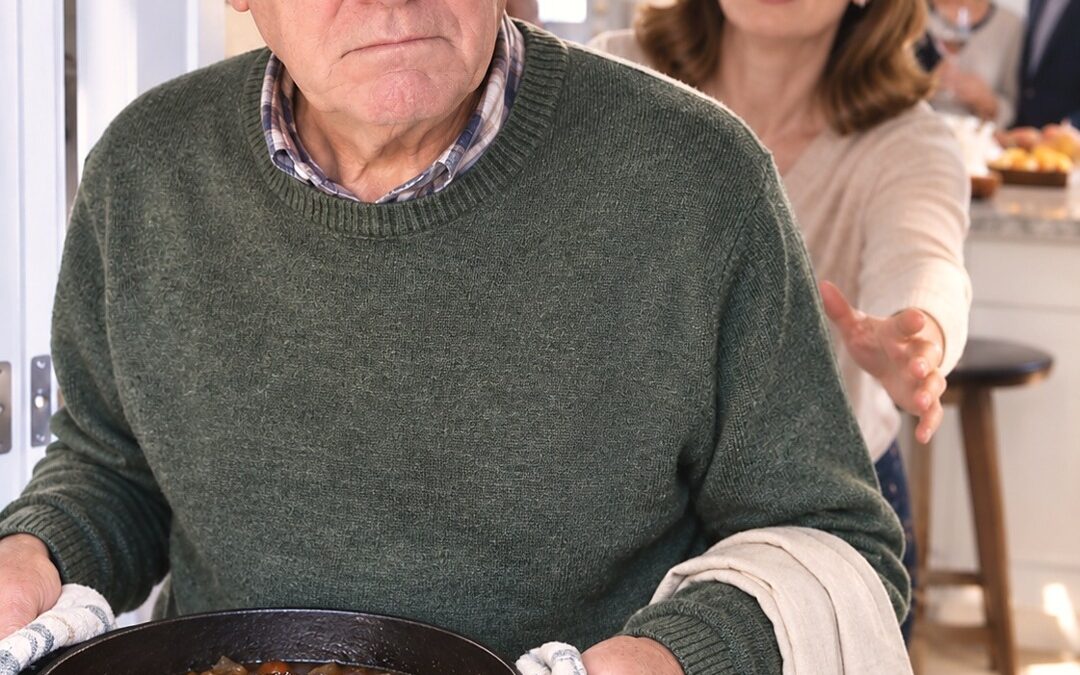
My daughter reached around me at her stove and yanked my apron strings loose in front of her husband's parents, and she said, "The roast stays, Dad. You go out the back before Sid sees you." Her mother-in-law laughed into her wine and said, "Fix him a plate for the garage, Jenny. He's earned that much." I was sixty-eight, I'd been standing over my late wife's Dutch oven for six hours, and the man ringing the front bell had come to buy her name for a freezer box.
Nobody else in that kitchen knew whose name it really was.
Jenny caught the apron before it hit her floor, wadded it up, and pushed it at my chest. "Out through the garage, Dad. Now. Before he's in the hall."
"I'm not done with the gravy, Jenny."
"I'll finish the gravy."
Verna turned on her stool with her glass. "Can't he finish the gravy first, honey? Then he can go." She laughed again, like she'd made a fair offer.
"Mom," Caleb said from the sink. "Grandpa made the whole supper."
"Caleb. Finish the rack." Jenny took the wooden spoon right out of my hand and dropped it in the dishwater next to him. "Dad, please. You smell like onions, and I need this one thing to go right."
It was 5:48 on Sunday, the eighth of March. The roast had been resting under foil since a quarter after five in Hazel's Griswold No. 8, seven pounds of chuck, the onions cooked down so far you'd need a search party to find one. Verna Ziegler sat at the island in a cream sweater with little gold buttons, sixty-seven and on her second glass of white wine. She and Duane had never once come to one of my Sunday suppers. Duane, seventy, a retired orthodontist, stood by the relish tray with a pickled mushroom on a toothpick, studying it like it might need a retainer. Corey was in the dining-room doorway holding a corkscrew he hadn't opened a thing with in twenty minutes, looking at the floor about a foot in front of his own shoes. My grandson Caleb, sixteen, a junior at Wausau West, had been washing the same roasting rack since the Lexus pulled in.
Through the window over the sink I could see that black Lexus parked nose-up to the garage door, and a man in a quarter-zip on the front porch with something flat tucked under one arm. Jenny didn't tell me who he was. She told Corey to get the door, and when Corey started in with "Jen, maybe we just," she said it again, and he went.
It was my daughter's kitchen, and her husband's folks were watching, and I have never made a scene in my life. I wasn't going to start in front of a man in a quarter-zip.
So I folded the apron. Plain canvas from Fleet Farm, twelve dollars, one of two Hazel bought because she said I could ruin anything just by leaning on a hot stove. I put it over my arm.
"Thank you," Jenny said. "I'll save you some."
I took two towels off the counter, slid them under the handles, and lifted the pot. Cast iron and seven pounds of beef. I've been lifting that much since before she was born. My Buick was out at the curb, because Jenny had told me that morning to leave the driveway for company.
She was halfway to the dining room when she heard the lid knock. "Where are you going with that?"
"Home."
"Dad, that's supper."
"It's your mother's pot."
Verna tapped her glass with one nail. Duane set his mushroom down on a napkin. From the front hall a man's voice asked if he was early, and Corey said no, no, come on in.
Jenny came back across the kitchen fast and low. "Dad. Dad. Leave the pot."
I stepped around her.
The back door let out into the garage, where Corey kept his golf bag and a snowblower with one wheel off and a bag of water-softener salt slumped against the wall. I went out the side door and down the drive. Jenny followed me as far as the garage step. She put her fingers on the door frame and kept them there.
"You're embarrassing me."
At the curb I set the pot on the passenger seat of my Buick, on a folded towel I'd brought down that morning for the drive. The car still smelled a little of the peppermints Hazel kept in the console. I found two in there last Christmas, still wrapped.
"Can we talk tomorrow?" she called down the drive.
"We can."
"Don't make this into something, Dad." Her phone went off in her back pocket. She checked it and went inside.
I was reaching for the gearshift when the side door of the garage banged open and Caleb came down the drive to the curb at a run in his Wausau West sweatshirt, no coat, shoes slapping the wet concrete. He had the lid in both hands.
"You forgot the lid, Grandpa."
He passed it in through the window by the rim, careful, because the knob on that lid is a wooden thread spool. Hazel screwed it on in 1989, after I broke the original knob on the walk-in floor. She took the spool out of her sewing basket and drilled the hole herself at our kitchen table. I told her I'd buy a proper knob. She said I could do that after I fixed the loose drawer by the stove. The drawer got fixed. The spool stayed.
I set the lid on the pot. It rattled against the rim and sat crooked. I lifted it and tried again, and the spool knocked the iron and it rattled some more. Caleb looked back at the house. The third time it seated.
"Go on in, Caleb. It's cold."
"I could come with you. I've got the Ranger."
The club's old 1998 Ford Ranger was parked at the curb right behind me. He'd been driving it since he got his license. If the light hits the driver's door right you can still read LANTERN under the paint.
"You've got school."
He leaned down to see the pot on the seat. "There's no supper in there now."
"They'll scare something up."
He stood at the end of the drive with his arms crossed tight against the cold while I pulled away from the curb, and he was still standing there when I lost him in the mirror.
The clocks had gone ahead that morning, so I'd lost an hour before I ever lit her stove. I took 51 north with the radio off. They'd patched a lane up by Brokaw, and the Buick thumped over every seam, and I kept my right hand flat on that lid the whole twenty-five minutes with the spool pressed into my palm. My phone sat dark in the cup holder. I passed the Kwik Trip where I'd meant to get milk that morning.
I'd cooked forty years at Hazel's Lantern Supper Club. I fed two governors in that place, and a bishop, and fellows who came straight in from changing tractor tires and tracked mud clear to the bar. I never once sent a cook out the back because somebody important was pulling in. I could have told Verna she'd eaten at my place herself once, back when her husband still had a practice. I thought of that up around Brokaw.
My house sits behind the old club on Highway 64. Dad opened the place as a tavern called The Lantern in 1958, the year I was born. He died in 1979 and left it to me at twenty-one, single, better with a skillet than with people, and I turned it into a supper club. Hazel came along four years later. We closed in October of 2019. Hazel was tired, my knees had started losing arguments with the tile, and the fryer wanted more than either of us wanted to give it.
The building still stands. Knotty-pine bar, lantern lamps over the booths, a concrete front step cracked on the left side where the frost gets under it. I pulled into the gravel about twenty after six. The sign creaked in the wind the way it always has. HAZEL'S LANTERN SUPPER CLUB.
I didn't go in the house. I carried the pot to the front step and sat down next to it. The cold came straight up through the seat of my pants. A pickup went by towing an empty snowmobile trailer, and somebody's dog behind the houses up the road had an opinion about it.
There's a fork in my glovebox. Hazel put it there years ago because I was forever buying potato salad at gas stations with nothing to eat it with. I got it out and lifted the lid and pulled off a piece of beef.
It was good. Tender, but it held together till you asked it to quit. The gravy was the right brown and didn't taste of flour. I'd have sent that out to any table in the place. I ate a second bite, because I hadn't had anything since a cheese sandwich at noon, and then I set the fork on the foil and sat there with my hands between my knees until I couldn't feel the step anymore.
Inside, I left the pot on the stove and changed my shirt. The one I'd cooked in had a gravy spot down the front.
Then I got the step stool out of the pantry.
The blue Royal Dansk tin sits on the top shelf of the hall closet, above the winter coats. Hazel bought the cookies at Christmas in 1989, they were gone by sometime in 1990, and the recipe cards have lived in it ever since. I hadn't had the lid off since New Year's. I don't need the cards. I know every one of those recipes the way you know your own back steps in the dark. I wanted to see her handwriting, that's all.
I took it to the kitchen table. Hazel's three-by-five cards, in bundles, with rubber bands gone stiff. Friday Perch Batter. Creamed Chicken. Sunday Gravy. Big round capitals, and her sevens crossed through the middle because her mother taught her that way and she wasn't about to stop.
I took out the Sunday bundle. Mashed potatoes. Glazed carrots. Beef soup from the leftover roast. Her little yeast rolls.
No Sunday Pot Roast.
I took the rubber bands off everything and laid all eighty-some cards out on the table in rows on the oilcloth and went through them twice. I lifted the paper liner out of the bottom of the tin. That card had been in there on New Year's Day. I'd seen it when I was digging out her bread pudding for Caleb, who wanted to make one for the cooking club without a box mix.
And I remembered Jenny in my hallway one Saturday in February, checking on me, as she called it, asking did I still keep all of Mom's cards.
"Never need 'em," I'd told her.
Halfway through putting them back, I came across the batter card from 1983, the corner gone yellow from fryer oil. Hazel walked into The Lantern that March asking did I need a waitress. I told her we had one. She asked if the one we had knew how to keep the beer glasses from smelling like dish soap. We were married that June, Saturday the eighteenth. She died on a Tuesday, the seventeenth of January, 2023, sixty-four years old, and some mornings I still take down two coffee mugs before I catch myself.
I put the cards back in her order and put the tin up on the shelf where it lives.
At 9:40 my phone buzzed on the kitchen table. Caleb. Two pictures, no words.
The first was a tablet lying on Jenny's dining-room table, the edge of a man's sleeve beside it and a water glass. On the screen was a frozen-dinner box, and on the box was my daughter, smiling, in Hazel's white club apron with HAZEL stitched in red across the bib. Across the top it said:
"HAZEL'S LANTERN Sunday Pot Roast — Jenny's Kitchen — Mom's recipe. My kitchen."
There was a picture of a roast on it, too, carrots fanned around it like a magazine. It had that gray look meat gets when somebody hurries it.
That apron hung on a nail inside the hall closet door. It had hung there since the funeral. I got up and opened the closet. The nail was there with nothing on it. That Saturday in February, on her way out, Jenny had asked could she use my bathroom, and the bathroom is right past that closet.
The second picture was a business card. Badger Hearth Foods, Milwaukee. Sid Lundquist, Vice President of Brands.
Then the screen lit up again.
"Grandpa, did you sell Grandma's name?"
I read that until the screen went dim. Then I thumbed back the one word I could spell without thinking about it.
"No."
Three little dots came up under it. They went away. They came back. They went away, and nothing came after them.
Here's what Jenny didn't know.
All her life I told her, "It's your mother's place." I meant Hazel made it what people remembered. In 1991 I put her name up on the sign for our anniversary, and when Jenny waited tables for us from 1999 to 2002, it was her mother who signed her paychecks.
But I cooked. Every recipe in that building came out of my head, and Hazel wrote them down on cards while I talked, because I read slow and spell worse. "Low and slow, Wendell," she'd holler at some new kid trying to rush a roast. That was my rule. She liked throwing it back at me.
In 1996 her big sister LaVonne, who kept our books, put the name HAZEL'S LANTERN and every recipe the club ever served into a little company, Lantern Supper Club LLC, and I'm the only owner. LaVonne files its papers with the state every year, so hers is the name on the envelopes. She wanted Hazel on there with me. Hazel wouldn't have it.
"It's your dad's place, Wendell. I just put my name on the sign."
That company's name is printed along the bottom of every jar of Sunday Gravy I sell, about three hundred a year at seven dollars apiece. Jenny calls them Dad's little gravy jars. She's never turned one over. And she hasn't said a word to LaVonne since the two of them fought over Hazel's jewelry after the funeral.
About eleven I put my coat on, took the club keys off the hook, and walked across the gravel.
The front door sticks at the bottom. You have to lift while you turn. Inside it smelled like pine cleaner and a building that's been shut up. I reached around the corner for the switch, and the little amber lamps over the bar came on. They hadn't been lit since we held Hazel's lunch in there after the funeral.
Behind the register hung the frame Hazel used to dust every Thursday when she wiped down the bar. HAZEL'S LANTERN. Registered 1996. I lifted it off the hook. The pine behind it was a shade lighter than the rest of the wall, about the size of a placemat.
I set it on the bar next to a case of Sunday Gravy I'd boxed for the next market, took out a jar, and turned it over. Along the bottom of the cream label, in small print:
"Lantern Supper Club LLC · Merrill, Wis."
I set the jar beside the frame and called LaVonne Hoeft. She's seventy-four. She picked up on the first ring, and I could hear sneakers squeaking on a basketball court behind her.
"Bucks are on," she said. "What's wrong?"
"LaVonne, is my company still alive?"
"You pay me twenty-five dollars every year to keep it that way."
I told her about supper. The apron strings, the garage, the man from Badger Hearth, the picture on Caleb's phone, the card that wasn't in the tin. She turned the game down partway through.
"Did you sign anything for her?"
"Nothing about the club. Just that bill-paying paper before my surgery."
"Did you give her that card?"
"No."
"Well," LaVonne said, and I could hear her pulling something across her table. "Well, I'll be."
"Get everything out of that filing cabinet. The old agreement, whatever the state sent this year. All of it."
"Tomorrow?"
"Wednesday. Your kitchen."
After we hung up I found a clean spoon under the bar, opened the jar, and tasted it. Too much black pepper in that batch. I wrote PEPPER on the side of the case in marker so I'd remember, and spelled it right, too.
At 11:52 my phone lit up on the bar. Caleb again. "Then Mom's lying to them, Grandpa. She told Mr. Lundquist you're too forgetful to be alone at a stove. She said she signs for you now."
Part 2
At nine Monday morning my daughter smiled down at me from a For Sale sign on Grand Avenue in Wausau. Same smile as every school picture after seventh grade, head tipped a little to the left, her office number underneath in red.
I parked the Buick next to a pickup with a cracked windshield and went in with nothing in my hands. No papers, no lawyer, no LaVonne. I'd come to give her one chance with the door shut and nobody watching, and I didn't want anything on me that looked like I'd come for a fight.
Jenny worked at a glass desk by the front windows, a Starbucks cup by her keyboard and her reading glasses pushed up in her hair. She stopped typing when she saw me.
"Dad. You could've called."
"Could have."
She looked over at the two other agents across the room, one of them talking into a headset, and took me back to her office and shut the door.
"About last night," she said, sitting down. "I know you were upset."
"I took my supper home."
"You took everybody's supper home."
I pulled the visitor chair up to the glass. "Jenny, I know about Sid. I know about the box. I know the Sunday Pot Roast card's gone out of your mother's tin. Call that man and tell him the truth, and I'll never say a word."
She looked at me a long time. Then she laughed, one short breath through her nose.
"Tell him what truth?"
"That you didn't make those recipes."
"Mom did. Her handwriting's on every card."
"She wrote down what I told her."
"That's your version."
I hadn't come down there ready to argue about who stood at the stove for forty years.
"Who cooked at the Lantern, Jenny?"
"You did. Dad, I know that."
"Then why tell Sid your mother made those recipes?"
"Because she wrote them down."
"You were there. You watched her writing while I talked."
She glanced at the door like somebody might come through it and help her. There was a picture on the wall behind her desk, Hazel and me at the club in 2014, Hazel with an arm around Jenny and me by the carving station in a clean shirt for once. Jenny saw me looking at it.
"Mom promised me that tin, Dad. You can't even spell roast."
I moved my chair back a couple inches. "No. I can't spell much of anything."
"That's not what I meant."
"It's what you said."
She rubbed her forehead with two fingers. "I tried that roast twice, you know. Twice. I know it's hard. I have respect for what you did."
"How long'd you give it?"
"Three hours. The card wasn't exactly clear."
"Three hours."
"People have jobs, Dad. They don't have six hours to stand over a pot."
I let that go by.
"Look," she said, "I was keeping strangers off your back. That's all."
"By telling Sid I'm forgetful?"
She went still for a second. "Who said that?"
"Did you say it?"
"I said you'd had a hard couple of years."
"That's a different thing."
"I was protecting you. From people asking you questions you wouldn't follow."
She opened her desk drawer and took out a little appointment card and slid it across the glass to me with one finger.
"It's a wellness check. Thursday at two. Just go."
A memory clinic in Wausau. My name typed on it, the date, the time.
"You made me an appointment."
"They do these for everybody your age."
"Without asking me."
"Dad, you're sixty-eight."
"I know it. I was there."
She didn't smile. I put the card in my shirt pocket and stood up.
"Have you called Sid yet?"
"I'm at work." She straightened a pen on the glass. "Sid's coming back the twenty-second to do it right, with Corey's folks. So please don't make me sorry I told you that."
"All right."
She followed me to the office door. "Are you going to go?"
"I've got the card."
"That's not an answer."
It was the only one she got. Out in the Buick I found the card had bent in my pocket, so I flattened it on the dashboard with the side of my hand before I drove home. I don't know why. It wasn't mine to keep nice.
Tuesday I took three cases of gravy to the winter farmers market at the old armory in Merrill. We'd had freezing rain in the night, and the Buick's door took two pulls to open, and the sidewalk out front was half salt. Inside, the folding tables run along the walls under the old basketball hoops. I've had the same table since we closed, by the furnace grate where it's warm. Seven dollars a jar, cash preferred, though Caleb set me up to take cards on my phone, and I've done it twice.
By a quarter after nine I'd sold a dozen. Then two sisters from St. Francis came over with canvas bags, the pair who used to come in every Friday and order one perch dinner and split it.
"Four for me," the older one said. "Four for her."
I started wrapping them in newspaper. "Having company?"
"Oh, we're stocking up. Jenny says it's all going in the freezer aisle."
My hands stopped on the newspaper.
"You haven't seen?" The younger one already had her phone out, and she held it close to my face, the way people do with a man my age. Jenny's Facebook page. Saturday, February 28.
"Mom's Hazel's Lantern is coming back—to freezers all over Wisconsin! Her recipes, my kitchen. #HazelsLegacy"
Six hundred and forty people had reacted to it. Under that, people I'd fed for thirty years. One remembered Hazel bringing a birthday cake to their table with the candles already lit. One said Hazel would be so proud. One said she'd waited her whole life to buy that pot roast at the Pick 'n Save.
In the picture Jenny stood next to the mock-up box in Hazel's apron. You could read HAZEL clear across her chest.
"Isn't that something," the older sister said.
"That's something."
"She's doing her mother proud."
I gave the phone back. They paid fifty-six dollars and I made change out of the old green cash box and said I'd tell Jenny they stopped by.
After they left I picked up a jar and turned it over in my hand and read the bottom of the label, which I've read a few thousand times. Jenny has stood in my kitchen next to cases of these and asked me why on earth I still bother at my age. She's moved them off the counter to set down her purse.
A fellow behind the sisters wanted two for his mother. By ten the table was bare, and I hadn't explained one thing to anybody.
Wednesday I was at LaVonne's at ten. She lives in a little ranch house in Merrill with aluminum siding and a Bucks flag by the door. Hazel and I painted her kitchen in 1994, and you can still see where I missed above the refrigerator. She had coffee poured in two of her Melmac cups, the butterscotch-colored ones, and a cardboard file box on the table.
"Sit," she said. "You look like something the cat drug in."
She took a green folder out of the box and opened it in front of me. A state seal in the corner of the top page. Under that, a typed sheet from 1996 with my signature at the bottom, the big W Hazel always said looked like a sawhorse. And a little card-stock form from this January that LaVonne had paper-clipped to the front so it wouldn't wander off.
"That's the company, and the company's you," LaVonne said, and tapped the 1996 sheet. "It owns the name and every recipe, and there isn't another owner on God's green earth."
There was one other paper. Before my heart surgery in June of 2023, I'd signed something so Jenny could pay my bills if I ever couldn't. It only counted if a doctor said I couldn't. No doctor ever had. I was selling gravy again by Christmas.
"And that bill-paying paper never kicked in," LaVonne said, "so she can't sign a thing in your name."
She squared the pages up against the table. "Now. What do you want me to do?"
"Find me the Chicago people. 2014."
She didn't even have to dig. She went to the back of the box and came out with a letter on heavy paper, a frozen-food outfit from Chicago, dated Tuesday, June 10, 2014. Sixty thousand dollars for the name.
"You remember what she said," LaVonne said, and pushed her glasses up.
I remembered. Hazel at our stove in her white apron with a wooden spoon in her hand, reading that letter over my shoulder.
"Don't you ever let anybody put my name on a frozen dinner, Wendell. Tell them no, and then feed them anyway."
So I called the man and told him no, and he drove up from Chicago anyhow to change my mind, and Hazel sat him down in the second booth and gave him a plate of pot roast before he went home.
LaVonne put the letter by my cup. "One letter from me and it's over, Wendell."
"Ends the deal. Doesn't end what she told them about me."
She drank some coffee. "So what, then?"
"Sunday the twenty-second, I'm going back down there."
"Why wait two weeks?"
"Because Verna and Duane watched me carry that pot out through the garage. Corey stood there with a corkscrew. That man from Milwaukee thinks I can't be trusted with a stove. I want the same people in the same kitchen."
"Hazel would've just fed them."
"I'm going to do that too."
She made a noise that wasn't quite a laugh and put everything back in the green folder and pushed it across to me. Then she held up one finger.
"There's something else. Badger Hearth's lawyer wrote me Monday. Wants to know who owns the company."
"Did you answer her?"
"Not yet."
"Don't. I'll answer her myself. Sunday the twenty-second."
"She sent a copy of something along with it." LaVonne reached into the file box one more time. "I was going to call you tonight."
LaVonne slid the copy across the table. My name was typed on it, and under my name, in my daughter's round handwriting: "Wendell J. Strobel, signed for him by Jennifer L. Ziegler". LaVonne said, "She signed you away nine days ago, Wendell."
Part 3
At eight Thursday morning my doctor asked me what year it was, and I told her, and she asked what county we were in.
"Lincoln. Unless somebody moved Merrill overnight."
She's been my doctor twenty years, through two bad knees, a gallbladder, and the heart surgery. She knows I can't spell my way out of a paper bag. She also knows I've driven myself to every appointment I ever had.
"So what's this about, Wendell?"
I put Jenny's appointment card on her desk. "My daughter booked me into a memory clinic at two o'clock this afternoon. She's telling people I shouldn't be alone at a stove."
"Are you having trouble at the stove?"
"Made a seven-pound chuck roast Sunday."
"How'd it turn out?"
"Pretty good. I ate it on my front step."
She let that one sit. Then she put her pen down. "Do you want me to call these people?"
"No. I want the whole test. Whatever you give a man when somebody says he's losing his marbles. And when we're done, you write the result to me. Nobody else."
She looked at me over her glasses a second and called the nurse in.
The date I knew. The county I'd already done. She gave me three words to hang on to, apple, table, penny, and went on to other things. She had me draw a clock with the hands at ten past eleven, and I took my time on the circle, because circles have never been my best work, and she said good, and I said she could use a better clock in that room, the one over the door was four minutes slow. Then she had me count back from a hundred by sevens. Ninety-three, eighty-six, seventy-nine. The nurse was still hunting for the right box on her sheet when I got to fifty-eight.
"Slow down, Wendell."
"You said count."
Pictures of animals. Follow these three steps in order. Apple, table, penny. Then my doctor handed me a pencil and a sheet with one empty line on it.
"Write any sentence you want."
That stopped me longer than the arithmetic. I sat there with the pencil and thought about Hazel at our kitchen table with her cards, and I wrote it slow and pressed hard, the way I write everything.
"My wife spelld for me 40 years."
My doctor read it. She didn't fix the spelling. She added up her marks and turned the sheet around so I could see it.
Thirty out of thirty.
"Can you put that in a letter?"
"Yes."
She typed while I watched a man in a Packers jacket scrape his windshield with a credit card out in the lot. "I can only speak to what I see in this room today, Wendell," she said while it printed. "But I see plenty." There was one sentence on that letter I cared about, and I read it slow enough to be sure of every word.
"In my opinion Mr. Strobel has full capacity to manage his own affairs."
"Are you going to the two o'clock?" she asked.
"No."
"Wendell, I can explain the medical side to anybody you want me to. I can't settle a family fight about money."
"I'm not asking you to."
She wanted to know was I taking my heart pills, and was I walking. I told her every morning, and to the mailbox. She said that wasn't what she meant. I said it was a long driveway. She wrote something down.
At home I put the letter in LaVonne's green folder and the folder in the drawer under the phone. At two o'clock, when Jenny had me down for the clinic, I was at my sink washing a skillet. The phone rang at 2:17 and Jenny's name came up. It rang again at 2:24. I dried the skillet.
At 3:30 her car came up the gravel with Verna in the passenger seat.
I was out front with the broom, sweeping birdseed shells off the step. Jenny was out of the car before the engine quit.
"The clinic called me. Why didn't you go?"
"I saw my own doctor this morning."
"You were supposed to see the specialist."
"I saw the one who's known me twenty years."
Verna was getting out on her side, slow, minding her good shoes on the gravel. Jenny dropped her voice.
"We're worried about you."
"Who's we?"
"Me. Corey."
"Then you two can call my doctor."
Verna came around the front of the car with her purse on her arm. "Hello, Wendell." She looked up at the old sign over the club. "I don't think I've been out here in years."
"Let's go in," Jenny said. "It's cold."
In my kitchen Verna sat down at the table and kept her coat on. Jenny stayed standing. She took in the clean counters and the Dutch oven on the back burner and opened my refrigerator like a health inspector.
"Where's all the food from Sunday?"
"Freezer."
"All that meat?" She shut the door and turned to Verna. "See? This is what I mean. He makes more than he can eat, he skips appointments, he doesn't answer his phone."
"I was standing right here when you called," I said.
"So you just didn't pick up."
"That's right."
Verna moved her purse to the next chair. "Well. He seems to know why he didn't answer."
Jenny didn't hear that, or let on she didn't. "Dad, I want to take Mom's tin home. For safekeeping. Things go missing."
"They sure do."
She went down the hall. I heard the closet door and the step stool scrape across the floor and the winter coats getting shoved along the rod.
Verna watched me. "She's very worried, Wendell. Jenny says you've had some trouble since Hazel passed. Getting mixed up."
I got a short glass down out of the cupboard. Then an orange out of the crisper, and a jar of cherries, and the Korbel from over the refrigerator, where Hazel kept it so it wouldn't get used for cooking. I cut a wedge of orange and muddled it with a cherry and a spoon of sugar, poured the brandy, ice, and topped it with Sprite. Brandy old fashioned sweet, the way we made it at the Lantern. Nothing fancy about it. Hazel used to say half the people who complained about an old fashioned just wanted more pop in it.
I set it in front of her.
"Oh, I shouldn't."
"You and Duane came out to the Lantern for your anniversary in 1994. September. You had the walleye. Duane had the prime rib, medium. You sent your first old fashioned back for too much bitters, and Hazel made me fix you another one, and then she brought you two a slice of chocolate cake with a candle in it."
Verna put her hand around the glass and didn't pick it up.
"Duane still had his practice then," she said after a while.
"He was wearing a bow tie."
She watched the orange slice go around in the ice. She didn't drink any. Then she turned her head and looked down the hall at Jenny, who was up on my step stool with one arm in my closet, and she kept looking at her a good long time.
Jenny came back with the blue tin under her arm and set it on the table. "I'll bring it back when things settle down."
I put my hand flat on the lid.
"Dad."
I didn't say anything. I didn't move my hand. The tin is about the size of a church hymnal, and my hand pretty well covers it.
"These were Mom's."
"They're the club's recipes."
"Mom wrote them."
"Yes, she did."
Jenny took hold of the edge of it. Her fingers stayed there a couple of seconds. Verna was watching the tin now instead of Jenny. Jenny let go.
"You're being unreasonable."
"Could be."
"He's been doing this," Jenny said to Verna. "Deciding regular things are precious all of a sudden."
"How long have those cards been in that tin?" Verna asked me.
"Since 1990."
"Since 1990," Verna said, mostly to the glass, and Jenny picked up her coat.
"We're going."
Verna stood up with the drink still in her hand. "I haven't finished."
"Bring it."
"I can't take the man's glass."
"Keep it," I said. "I've got a cupboard full."
She carried it out to the car, minding the ice. Jenny waited by the driver's side until Verna was in. Then she shut Verna's door for her and came back around and stood there with her own door open between us. The sun was going down behind the club roof, and meltwater was running along the edge of the gravel toward the ditch.
"You made me look like a fool in there."
"In my own kitchen."
"You know what I mean." She kept her voice down so it wouldn't carry through the glass. "You have no idea what's riding on this. Corey's commissions are down to nothing. The cabin's sitting up at Lake Alice with no siding on it. We put everything we had into that place."
"So tell Sid the truth and ask him for a different deal."
"There isn't a different deal, Dad."
A car went by on 64. Through the windshield I could see Verna in the passenger seat with my glass in her lap, looking straight ahead.
Jenny put her hands on top of the car door.
"If you show up on the twenty-second and make a scene, everybody in that room hears you're not safe alone. See who lets you near Caleb then."
The rubber seal on her door was coming loose at the bottom. Somebody had tried pushing it back in the groove with a thumb and it hadn't taken. I kept my eyes on that instead of her. I didn't answer. She started to get in.
Jenny looked back at me over the top of the car door. "I took you off Caleb's pickup list at school this morning, Dad. Just so you know."
Part 4
At 2:45 Monday afternoon the woman at the front desk of Wausau West High School turned her computer screen a little more toward herself and looked up my name a second time.
"I'm sorry, Mr. Strobel. You're off Caleb's pickup list, and that's the list we go by for visitors, too."
"I've been coming two years. Third Monday of the month."
"I know who you are." She said it kindly. She had reading glasses on a beaded chain and a Kleenex box with a cardinal on it, and she was kind the whole time, and it didn't help one bit. "Your daughter called last week. You can't go back to the classrooms."
I had a case of Sunday Gravy on the counter between us, twelve jars. Today was gravy without a packet. Last month was fish batter, and in the fall Caleb asked me to show them a real pot roast, because his mother had told him nobody cooks anything that long anymore.
Through the glass beside the office door I could see clear down the hall. Caleb was outside the foods room in his apron talking with two other boys. Somebody'd already put a stockpot on, and the steam was coming up off it in the doorway.
"He knows I'm coming."
"I'm sure he does."
"Could you call him down for a minute?"
"I can't. I'm sorry." She checked her screen. "There's a note about family concerns."
"What kind of concerns?"
"I'm not allowed to say."
"Well. That's a fine arrangement."
She gave me a tired smile and checked the screen again. "Would you like me to call your daughter for you?"
"No, ma'am. I believe she's been called enough."
Caleb saw me through the glass. He started down the hall fast, and she got up and met him at the office door before he could come through it.
"Caleb, you need to go back to class, hon."
"That's my grandpa. He comes every month."
"I know. Please go back."
He looked past her at me. I held up two fingers off the counter. "Go on. Tell them to heat it slow, and don't let it boil."
"We need the gravy."
"It's right here." I pushed the case across the counter to the woman. "Can I leave these for the club?"
"Of course you can."
I walked out with my visitor sticker still on my jacket, crooked. The wind had come up across the lot. A bus driver had her window down, talking to another bus driver about somebody's husband. I got in the Buick and sat. There was a school calendar I'd taped up over the glovebox in September. Third Mondays circled in blue ballpoint, every one, clear through December.
I took the sticker off. It tore down the middle, and I folded both halves into the ashtray.
My phone buzzed. "Sorry Grandpa. She did it Thursday."
I typed it one finger at a time. "Not your doing. Make good gravy."
He sent back a thumbs-up. I put the phone in the console and drove north.
By Tuesday afternoon I had twenty-four more jars cooling on my counter. You don't stop a batch because your daughter's mad at you. I wrote the date on the case in numbers, because numbers I can manage, and I thought about Hazel at the kitchen table with her cards, back in our first year.
"How much flour?"
"Enough to coat it."
"Wendell."
"Quarter cup for a four-pound roast."
"How long does it go?"
"Till it's done."
She'd put her pencil down. "Try again." And we'd go around like that till she had something another cook could follow on my night off.
Wednesday the eighteenth, Jenny called at 11:20 in the morning. I was at the sink with my big stockpot. I could hear her office behind her, a printer going, somebody talking about a showing in Schofield.
"Dad. We need to talk about Sunday."
"All right."
"Sid's coming at five-thirty. Corey's folks. Caleb'll be there." She sounded tired. "Their lawyer has some concerns."
"What kind of concerns?"
"Paperwork. It's complicated."
"Try me," I said, and turned the water down.
She let out a breath into the phone. "There's a company name involved. They want proof of who can sign for it. They won't take what I signed unless I get something from your doctor saying I can handle things for you."
"You got one?"
"She won't talk to me without you."
"Sounds reasonable."
"Can you stop saying that?" Somebody in her office said her name, and she covered the phone and said one minute. "We're too far along for people to start asking questions now. They already put money down."
"How much?"
"Ten thousand."
"And the rest of it?" I said.
There was a little wait. "A hundred and forty."
I turned the water off. A hundred and fifty thousand dollars. My dad's tavern and forty years of Saturday nights and Hazel at the door with the menus, and she'd put a price on it while I stood at her stove cooking for her in-laws.
"Where's the ten thousand now?"
"In the cabin."
"Does Corey know how you signed that paper?"
"Dad, I don't have time for this." Then she got quieter, and it came out smooth, like something she'd said to herself in the car. "All we need Sunday is your signature. The lawyer says that settles it. You come, you sit down, you sign. Sign where I point Sunday, and I'll put you back on Caleb's list."
I looked at the drying rack. There was nothing in it but a slotted spoon.
"I'll come. I'll bring the roast."
"Do not bring that pot."
"It's Sunday."
"We're having food brought in. Promise me you won't make a scene."
"I never have yet."
That seemed to settle her. "Five-thirty," she said, and hung up.
I set the phone on the counter and finished the stockpot. Then I took the green folder out of the drawer under the phone and laid it on the table and didn't open it. I knew what was in it. I just wanted it where I could see it while I ate my lunch.
Saturday night, the twenty-first, Caleb came across the gravel a little after seven. He'd parked the Ranger around back of the club where you can't see it from the highway, which is how I knew before he said a word that his mother didn't know where he was.
"Your mom know you're here?"
"No."
"Come in. Take your shoes off."
I'd made chicken noodle soup and there was enough for two, so I warmed him a bowl. He's grown an inch since Christmas and eats like he's trying to catch up to it. He sat at the kitchen table with one hand in the pocket of his sweatshirt while he ate, and when the bowl was half gone he took the hand out and laid a three-by-five card on the oilcloth next to the salt and pepper.
I knew the handwriting from across the table. Sunday Pot Roast.
I didn't pick it up.
"Where'd you get that?"
"Mom's junk drawer. The company's test kitchen took pictures of it and mailed it back, and she threw it in with the twist ties and the dead batteries." He pushed it an inch closer to me. "I'm sorry, Grandpa. I saw her taking pictures of all of them back in January, when she was up here. I thought she was making some family cookbook thing."
"That's all right."
"She took this one later."
"What else is going on down there?"
He stirred his soup around. "She's made the roast every night this week. It keeps coming out gray. The whole house smells like onions, and Dad eats it and says it's good, and then he goes out to the garage." He put his spoon down. "Grandma Verna called last night. I heard Mom on the phone in the laundry room. Grandma Verna wanted to know how come you remembered what she ordered in 1994 if you can't remember anything."
"What'd your mom say?"
"She said you have good days. Then she called Mr. Lundquist and told him if you seem off on Sunday, he should ask you what day it is." He was quiet a second. "Are you going to sign it, Grandpa?"
"I'm going to bring the roast."
"That's not what I asked."
"I know it."
I stood up. I patted my shirt pocket, then the other one. "Can't find my glasses."
Caleb found them with one glance. They were sitting right by the salt shaker. He didn't say so.
"Want me to read it?"
"Would you?"
He held the card up under the kitchen light. His voice has been changing since Christmas. It drops on some words and goes up on others when he isn't expecting it.
"Four-pound chuck roast. Quarter cup flour. Salt and pepper. Two large onions."
I said it along with him, half a beat ahead, the way you say a prayer you've said ten thousand times.
"Brown the beef all over."
"In hot fat."
He grinned a little. "Yeah. In hot fat. Oven at two seventy-five."
"Covered."
"Covered. Cook till fork tender." He turned the card a little toward the light. "Rest it twenty minutes, covered."
I didn't say that one with him. I'd gotten there and I just didn't.
He looked up. "Grandpa?"
I pulled the chair out next to him and sat down in it.
"Read the oven temp again."
He looked back at the card. "Two hundred seventy-five degrees."
"That's right."
I knew it was right.
We sat there while he finished his soup. The blue tin had been sitting on the end of my kitchen table since Thursday, when Jenny tried to take it. I opened the lid and put Hazel's card in, right at the front, where you'd see it first.
Caleb washed his bowl without being asked and dried it and put it in the wrong cupboard. At the door he pulled his shoes on and got out his keys.
"Drive careful," I told him.
He opened the door and then turned around with his hand still on the knob.
"Grandpa, Mom hired a photographer for tomorrow. She wants a picture of you signing it."
Part 5
I started the roast at ten Sunday morning, in Hazel's pot, on my own stove.
At 5:55 that evening I rang my daughter's front doorbell with the Griswold No. 8 between two folded towels and a Pick 'n Save sack hooked over two fingers. In the sack was one jar of Sunday Gravy and LaVonne's green folder. That was all I brought.
Caleb opened the door. He checked the pot, then the front steps behind me.
"You came to the front."
"That's where the bell is."
He took the sack off my fingers without being asked. "Careful," I said. "There's a jar in there."
The house smelled like roast, but wrong. Onions still sharp in the air, the way they get when somebody turns the oven up to save time. Caleb saw me sniff. "She started at three," he said, low.
The same kitchen. Verna at the island in the cream sweater with the gold buttons, a glass of white wine. Duane by the relish tray working on a pickle with a toothpick. Corey in the dining-room doorway with the corkscrew in his hand, the same one, I'd bet money. And Jenny at the counter in Hazel's white club apron, HAZEL in red across the bib, with a roasting pan in front of her and a gray piece of beef in it, the onions still holding their shape.
"Dad?"
Verna turned on her stool. "Oh, Jenny, he brought his pot. Bless him."
She said it to Jenny. She was looking at me.
"Evening, Verna. Duane."
Duane put his toothpick down and said good evening. Jenny came around the island fast, wiping her hands on the apron.
"I told you not to bring that."
"I remember."
"Go sit down. Dining room. The end chair." She was almost whispering. "Please, Dad. I'm asking you to cooperate."
"I came when you asked."
Corey moved out of the doorway for me without anybody telling him to.
Sid Lundquist was standing by the china hutch in a navy quarter-zip, talking with a woman who held a blue folder against her chest. He had a pleasant face, the kind of man who asks a waitress how her night's going and then waits to hear. A young fellow with a camera was by the window fooling with a lens. And on an easel next to the hutch, about the size of a storm window, stood the box.
"HAZEL'S LANTERN Sunday Pot Roast — Jenny's Kitchen — Mom's recipe. My kitchen."
It looked bigger than it had on Caleb's phone. Jenny smiling, in that apron.
"You must be Wendell," Sid said, and came over with his hand out.
"Give me one second here." There was a heavy cork trivet in the middle of the table, and I set Hazel's pot down on it, square in the middle, not at the end. The good china chattered a little in the hutch.
"Dad," Jenny said from the doorway. "I said the end."
"I'll sit down directly."
Sid bent over the pot. "Is that the famous roast?"
"Same one I always make."
"I've been looking forward to this." He shook my hand then. Good handshake. "Sid Lundquist."
"I made one too, Sid," Jenny said. "From Mom's card."
"Two versions," Sid said, pleased. "Well."
The woman with the blue folder sat down across from me and opened it. She was the company's lawyer, she said, and she wanted to make sure everybody was comfortable with what was being signed. The photographer asked Jenny did she want him signing at the table, and Jenny said yes, right there, and he moved a lamp. Verna came in with her wine. Duane carried the relish tray in and put it on the sideboard and stayed standing by it. Caleb set my sack down on the floor and sat in the chair next to mine. Corey stayed in the doorway.
The clock on the hutch said 6:05.
The lawyer took one page out of her folder and laid it in front of me, and a pen across it. My name was typed near the bottom with a line over it. I left the pen where she'd put it.
"Before we start," Sid said, gently. "Wendell, do you know what day it is?"
Jenny smoothed the tablecloth with one hand.
"Sunday. I've cooked on it for forty-seven years."
The photographer laughed, once, and then stopped, because Sid didn't. Sid blinked at me and sat back.
I turned to the lawyer. "Could I show you something, ma'am?"
"Dad, they're trying to finish."
"Won't take long." Caleb was already handing me the sack. I took out the jar. Metal lid, cream label, seven dollars at the Merrill market. I set it on the tablecloth in front of her.
"Read the bottom, ma'am."
She picked it up and turned it over and tipped it toward the window to see the small print, and she read it out loud.
"Lantern Supper Club LLC · Merrill, Wis."
"That's my company," I said. "It's owned the name and every recipe that club ever served since 1996, and I'm the only one who owns it. And that paper Jenny signed for me never was any good, because no doctor ever said I couldn't sign for myself." I passed her the green folder. "It's all in there. My sister-in-law keeps good files."
Jenny stood up from her chair. "Those are old papers. Aunt LaVonne keeps all that junk."
"Please sit down, Jennifer."
Jenny didn't sit. The lawyer turned pages. I could hear the photographer's camera strap tick against his buttons. Duane came a step closer to the table. Corey set the corkscrew down on the sideboard next to the relish tray, and I hadn't seen both his hands empty all evening.
The lawyer closed the folder on one finger and turned to Sid. "He's right."
Then she opened it again, took out my doctor's letter, and read it out the same way she'd read the jar.
"In my opinion Mr. Strobel has full capacity to manage his own affairs."
Verna took her reading glasses out of her sweater pocket and put them on. The lawyer saw her do it and turned the letter around on the tablecloth so Verna could read it too, and Verna leaned in over Duane's empty chair and did.
Jenny reached for her water glass and missed the stem and caught the rim before it went over.
"Mom wrote every one of those cards!"
"She wrote them because I spell like a fence post. She wrote down what I said."
"You never told me that."
"I told you I cooked. You were there. You carried the plates out."
"You always said it was Mom's place."
"It was. Her name was on the sign and her hand was on the cards, and LaVonne's name was on the state's papers because LaVonne files them. I never said it was hers to sell."
Sid put both palms flat on the table and studied the box on the easel. "My people should have checked the state before we put a dime down." He said it to the box. Then he turned to Jenny, and when he talked it was slow.
"Jennifer, you told me your father couldn't be left alone with a stove."
Jenny turned around to the doorway. "Corey. Tell him."
Corey's eyes went to the corkscrew on the sideboard. Then he put his hand on the back of an empty chair instead and said it out to the whole room.
"I drove her to the clinic to book it, Wendell. I knew."
"Corey."
"I knew what she was telling people." He pulled the chair out and didn't sit in it. "I should've said so two weeks ago, in the kitchen."
Verna set her glass down on the sideboard so hard the wine jumped. Duane wasn't looking at Jenny at all. He was looking at Sid, the man he'd brought to this house.
I looked at my daughter in her mother's apron.
"The roast stays, Jenny. Your mother's name goes home with me."
Jenny reached behind her back and yanked the apron strings loose. The bib slid down off her chest, and she caught it against her stomach with both hands and stood there holding it, the strings hanging down by her knees.
The photographer lowered his camera.
Caleb stood up. I don't think he knew he was going to. He just stood up beside me, and then he didn't know what to do, so he stayed there.
Sid got out of his chair. He walked over to the easel, lifted the box off it, and carried it back past me to his briefcase by the hutch. He laid it in, flat, and snapped both latches. He did it right there in front of me, an arm's length from my plate, and he didn't hurry it.
"Sid," Jenny said. "Wait. We can work something out."
"I can't buy something you don't own, Jennifer."
The lawyer stood and put her own folder under her arm. "The deal's off. Badger Hearth will want its ten thousand dollars back."
"We already spent it," Jenny said, and then looked like she wished she hadn't.
"Then you'll find it," Sid said.
Duane came around the end of the table to him. "Sid. I'm sorry I ever brought you to this house."
Sid put a hand on his arm. "You didn't know."
"I told you she was handling the family business," Duane said. "I told the whole club." He turned to Jenny then, and she dropped her eyes to the apron in her hands.
I stood up and lifted the lid off the roast, spool and all. Steam came up off it and fogged the bottom of the hutch glass.
"Plates are left of the sink. Everybody eats."
Caleb went for the plates like I'd fired a starter's pistol. Sid said, "Wendell, we don't want to impose," and I said there was seven pounds of beef in there, and the lawyer glanced at Sid, and then she set her folder down on the window seat and pulled out a chair. Corey held the meat with a fork while I carved, and his hand was steady. The first slice fell apart at the edge, so I cut the next one thicker.
I filled the first plate myself, a thick slice and two potatoes and gravy over all of it, and set it down at Verna's place.
"There's your plate, Verna. Garage is cold this time of year."
Verna pulled her chair in and picked up her fork.
Sid took a bite and stopped chewing for a second. Then he took another one.
"What do you run it at?" he asked me.
"Two seventy-five."
"Covered," Caleb said from the kitchen doorway, with the gravy boat.
Duane wanted to know how long. Six hours, I told him. Duane turned toward the gray roast on the kitchen counter, where you could see it through the doorway, and didn't ask anything else. Duane passed me the rolls. The photographer put his camera in the bag and ate standing up by the window, and asked was there more gravy, and Caleb found the ladle.
Jenny sat down in the end chair she'd saved for me, with Hazel's apron folded in her lap. She didn't take a plate. Caleb put one in front of her anyway.
I ate a potato and half a slice of beef, so it couldn't be said I didn't. Then I put the jar back in the Pick 'n Save sack, and the green folder in beside it.
"You're going?" Caleb said.
"Bring the pot home when you're done with it."
"I will."
Sid stood up when I got to the doorway and said he was sorry, and I said thank you and shook his hand again. Verna lifted her fork at me. Duane nodded. Corey sat looking at his supper with the fork still in his hand.
I left the roast on the table and walked down the hall and out the front door. The air had gone cold again. I'd made it down one step when the door opened behind me.
Jenny caught me on the porch, still holding the apron. "Dad. Their lawyer's sending that paper I signed to the district attorney in Wausau. She says it's your name on it, so it's up to you. Are you going to let her?"
Part 6
I didn't answer her on the porch. I drove home with the jar and the folder on the seat beside me, and Monday morning I called Badger Hearth's lawyer myself from my kitchen phone. She said that page could go to the district attorney in Wausau or it could stay in her file, and since it was my name Jenny had signed, what I wanted would count for a good deal. I told her I wouldn't push it, as long as the ten thousand went back by April 24, and Jenny put the truth up on Facebook in the same place she'd put the other thing, and she never signed anybody's name but her own again.
"She's still my daughter," I said. The lawyer said she'd put that in her letter.
The real estate office on Grand Avenue let Jenny go that same week, once Badger Hearth's lawyer had already called her broker to ask whose signature that was. By the first of April somebody had taken her face off the For Sale signs and stuck a new girl's on.
On Friday, April 10, LaVonne had the lawyer's letter out by the sugar bowl. There were four of us at her table. LaVonne, me, Jenny and Corey. LaVonne and Jenny hadn't been in the same room since the jewelry fight after the funeral, and they'd said about six words to each other since we sat down, three of them "pass the cream."
"I sold the Lund," Corey said. "Eight thousand six hundred. I made up the rest out of my last commission check."
"You had that boat a long time," I said.
"Eleven years." He turned his cup around by the handle. "Fellow from Rhinelander came and got it Saturday. Caleb helped me clean out the storage boxes. He found my good pliers I thought I lost in 2019."
Hazel's white apron was folded over the back of the empty chair next to LaVonne. Jenny had brought it in with her, washed and ironed, and set it there without saying anything, and none of us said anything about it either.
"Well, Jennifer," LaVonne said. "You said you had something to show your father."
Jenny slid her phone across to me. "I wrote it myself. Corey checked my spelling."
"Nothing wrong with that."
It was a new post, just words, no picture. I read it slow, with my finger under the lines, and she didn't jump in and finish any of the sentences for me, which I noticed.
"I said Mom's recipes were mine to sell. They were never mine. Hazel's Lantern belongs to my dad, Wendell Strobel, who cooked every one of those recipes and is as sharp as he ever was. I'm sorry."
"That's what's going up," she said.
"All right."
She took the phone back. Her thumb sat over the button. Then she turned the screen around so it was facing me, and she pressed it while I watched, and the post came up on her page with her name on top of it. She left the phone lying there between my cup and hers.
LaVonne got up and took four peanut butter cookies out of a Cool Whip tub on the counter, the kind with the fork marks, and put them on a plate.
"Mom made those," Jenny said.
"Your mom got that recipe from me," LaVonne said. "Don't tell your father."
Jenny took a cookie and broke a corner off it and didn't eat it. "Every time somebody at the office asked how the cabin was coming, I said we were almost done," she said. "We have a floor and three walls. Sid made it sound so easy. Mom's name, some old cards, somebody else does the work." She turned to LaVonne. "And you never call."
"You never picked up," LaVonne said. "Your mother picked out those earrings for you herself, Jennifer. I was trying to tell you that at the funeral."
"I know that now."
"I needed it to be Mom's, Dad."
"It was hers. She gave it to me. You could've asked."
"You'd have said no."
"I might have." I picked up the corner of cookie she'd broken off, and ate it, since she wasn't going to. "Then I'd have fed you."
She pressed her thumb into the crumbs on the plate. LaVonne got the pot off the stove and came around and poured coffee into Jenny's Melmac cup, the butterscotch one, all the way to the top.
"Thank you, Aunt LaVonne."
"You're welcome, Jennifer."
When they left, Jenny put her coat on and went out to the car. The apron stayed on the back of the chair. She didn't forget it. I watched her look at it from the door.
On Friday, May 15, Hazel would have been sixty-eight, and I opened the Lantern for one night. A Friday fish fry for Caleb's cooking club at Wausau West. The ten thousand had gone back on the twenty-third, a day early. Jenny called the school herself and put my name back on Caleb's pickup list, and the woman with the cardinal Kleenex box called me to say so.
By five the lantern lamps were lit, every booth had a paper placemat, and the relish trays were out with the radishes cut into roses the old way. The bar smelled like brandy and orange peel. Half the room was cooking-club parents. The other half were old regulars who'd read both of Jenny's posts and wanted to sit in a booth one more time and tell me where they'd sat in 1987.
Butch Nowak was back at the fryer. Seventy-three years old, thirty-one of them spent frying fish for me, and he'd brought his own spatula from the bait shop because he didn't trust mine.
"Uff da, Wendell. This fryer still pulls left."
"Always has."
"Thought you'd fix it while you were closed."
"Didn't figure you were coming back."
He laughed and dropped a basket of perch into the oil, and the oil came up so loud that two cooking-club kids by the walk-in jumped back.
Verna and Duane came in at ten after six, and Duane had his wallet out before he got to the register. Two perch dinners. I took his money and made change. Verna stood next to him with her purse held in front of her.
"I said a terrible thing about a garage, Wendell."
"You did."
"I'm sorry."
I put the change in Duane's hand and walked them to the second booth from the kitchen. Hazel's booth. She used to sit there after the rush with a glass of ice water and her shoes off under the table. Verna slid in slow and put her hand flat on the wood where there's still a ring from Hazel's glass, and kept it there while Duane read the menu like he hadn't already ordered.
At seven Corey came in the front alone in work pants and an old Badgers sweatshirt.
"You need help?"
The kid I'd hired for dishes had called in sick at four. I took a canvas apron off the hook and tossed it to him.
"Hot water's on the left."
He caught it against his chest and went through the swinging doors. I heard him ask Butch where the clean racks went. He was back there till close, and he didn't come out to say hi to one person.
At 8:40 Caleb came out of the kitchen with a rack of clean glasses and said, "Grandpa. Mom's out back."
Jenny was standing by the dumpster in her dark coat with her car parked on the gravel, as far from the lights as she could get it. I went out the back door. It smelled like fryer and wet pavement.
"I wasn't sure I should come," she said.
"Why'd you park back here?"
She looked toward the dining-room windows. "I saw Verna's car."
"She paid for her supper."
"I don't think she wants to see me."
"You could ask her."
Jenny didn't move from the dumpster. She rubbed her hands together. "I haven't eaten."
"There's perch."
"I don't want to bother anybody."
I looked down the dark side of the building to where the gravel turns the corner toward the highway and the sign.
"Front door, Jenny."
She stood there another second. Then she walked around the side of the building, and I went back in through the kitchen, past Corey at the sink, and by the time I got to the bar she was coming in the front past the register, looking up at the lamps. She sat on the last stool by the kitchen door. I brought her a plate of perch and potato salad.
"Is that your potato salad?"
"Same one."
A man at the register needed change for a fifty, so I went and made it. When I came back she'd eaten half the perch and was asking Caleb for another napkin. Over in Hazel's booth Verna had turned around in her seat to look. Then she turned back.
Around eleven, after the last car pulled out, Caleb was at the big stove in the club kitchen making Sunday Gravy for the next batch of jars, with Hazel's pot on the back burner and the blue tin open on the counter beside him. Corey was shutting down the dish machine. Jenny stood in the kitchen doorway with her coat on and her fingers on the door frame, and she didn't leave.
The apron was in my hands. LaVonne had sent it home with me in a Kwik Trip bag.
"I need more stock, Grandpa."
"Add it slow. Stop when it coats the spoon."
He reached for the measuring cup, and I stepped in behind him and slipped Hazel's apron over his head. He looked down at the red letters across his chest.
"You sure, Grandpa?"
"You're cooking, aren't you?"
He turned back to the stove, and I brought the strings around his middle and tied them in a double knot, snug, the way Hazel used to tie mine on a Saturday when I had my hands full.
That name isn't for sale. Not to Milwaukee and not to Chicago. Someday the tin goes to Caleb, rubber bands and all, and he can decide what to cook out of it.
He stirred the gravy once more and reached for the lid.
Caleb set the lid on, spool up, first try. "Low and slow," he said, like it was his idea. I let him have it.



