My Hotel Manager Dropped My 30-Year Pin Down the Laundry Chute in Front of 22 Housekeepers: “This Is a Four-Star Hotel, Not a Warming Shelter”—For 14 Months She’d Had Me Shred Our Time Sheets, and I Never Shredded One
Part 1
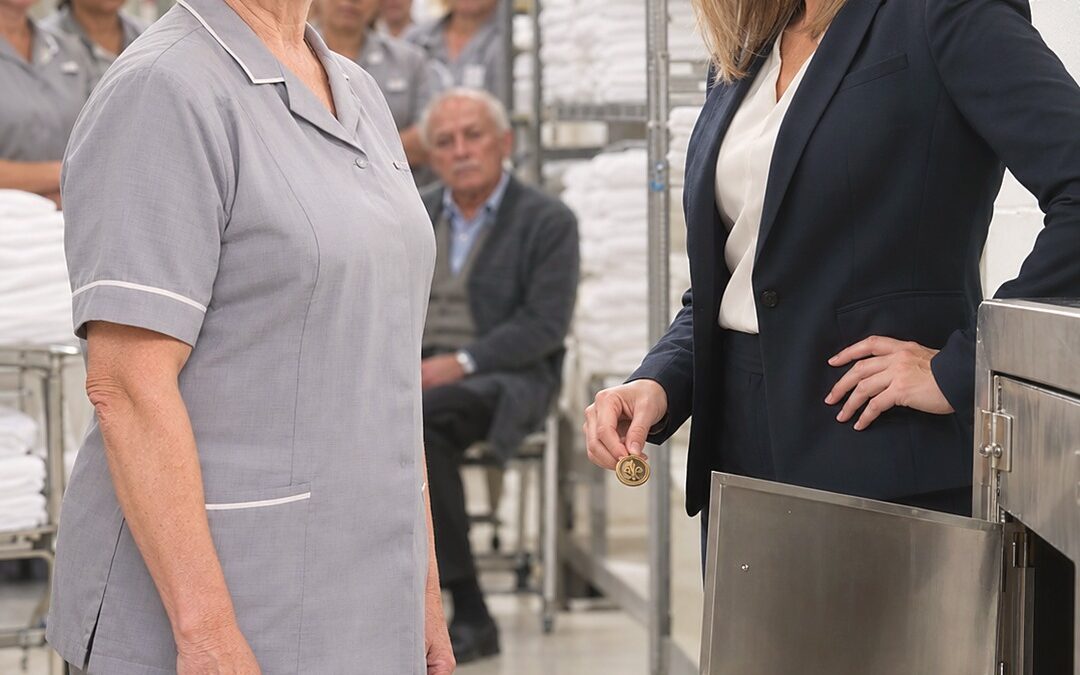
"This is a four-star hotel, not a warming shelter, Marilyn," Courtney Strand said, and she unhooked the thirty-year pin from my uniform and dropped it down the laundry chute in front of twenty-two housekeepers, while the old man I'd pulled in off the iced-over loading ramp sat shaking by the mangle in my cardigan. Then she fired me for cause, ten weeks before my retirement, which under the Bayshore's handbook meant the $18,400 longevity award I'd been earning since 1994 was gone. Then she held out her hand for last week's room sheets, still in the manila envelope she'd given me Sunday, the ones she'd had me shred every Sunday for fourteen months, and I handed them over without a word, because every week before that one was in five banker's boxes under my basement stairs, signed in ink by the woman who'd worked it.
I swear I heard the pin land in the canvas cart two floors down. I couldn't have, not over the mangle, but you work next to a chute long enough and you know what a pair of jeans sounds like going down it, and this was smaller.
Courtney tucked the manila envelope under her arm and turned to the line-up. Twenty-two women in gray smocks around the folding table, most of them still holding the coffee they'd brought down.
"Anybody else who wants to drag strays in off the dock can follow her pin."
Bree Halloran took one step toward the chute door. Courtney said "Leave it" without even looking, and Bree stopped with her hand halfway up and started chewing the inside of her cheek, which is what Bree does instead of talking back.
The old man pushed himself forward on the folding chair. Somebody had given him a clean hand towel for the cut over his eyebrow, and he let it drop into his lap and tried to get his feet under him. "I'll go," he said. "I'm making trouble for you."
"Sit down. You're bleeding on my good cardigan."
He sat. He looked at the towel in his lap like he wasn't sure whose it was.
"Take that cardigan off him," Courtney said. "And get him out of that chair."
"The cardigan's mine."
"I'm talking about the chair."
"Well, he's staying in it. The ambulance is coming."
"Mrs. Sobczak." Courtney only used my last name when she was writing somebody up. "I told you to walk him to the bus shelter on Front Street. EMS can find him there."
"He fell on our ramp, Courtney."
"And you brought him into a restricted area."
"He couldn't tell me what town he was in."
"I called 911," Bree said from the table. "Seven thirty-eight. They're on their way."
Courtney let that sit long enough that the girl next to Bree started squaring up a stack of pillowcases that was already square. Then she lifted her clipboard and read off it like a grocery list.
"Unauthorized person in a restricted area, and insubordination. Shannon will mail your last check."
Shannon Kehl was standing halfway down the basement stairs in her little black office flats, the ones that squeak on a wet floor. She does payroll and most of the paperwork out of a closet behind the front desk. She looked at her shoes and kept looking at them.
Courtney had already turned her back on me. She had a habit of doing that in the middle of your sentence, so you'd finish it to the back of her blazer.
"Listen up, ladies. Two weeks from today Vanderhoef takes the keys, and they're buying the leanest housekeeping department on the bay. Lean is why I'll be running all nine of their Michigan hotels by spring."
Doreen Gilchrist stood at the end of the table nearest the stairs, where she always stands because of her knee, and she had her eyes on the floor drain. Doreen is two years shy of Medicare. I didn't have to ask what arithmetic she was doing.
The old man said, to nobody in particular, "I had a car."
"Get your things, Marilyn."
So I went into the housekeeping office for my Meijer tote. The shredder sat by the filing cabinet with its little green light on, and my name was still at the top of the November board in Courtney's block capitals. I took the tote off its hook and touched nothing else. I could see her watching me through the door glass the whole time, and I suppose that was fair, since she'd just given me every reason in the world to take something.
When I came out, the dock door was open and two EMTs were backing a stretcher in over the threshold with sleet melting on their shoulders. It was 7:58 by the clock over the mangle. The taller one crouched in front of the chair.
"Sir, what's your name?"
"Cliff."
"Okay, Cliff. Cliff what?"
He looked past the EMT at the open door, at the gray coming in off the bay. "I had a car. Where'd my car go?"
"We'll find your car, buddy."
The other one asked was he on the ice when we found him, and how long, and Bree said yes and I said I didn't know, not long, his raincoat was only soaked down the one side. Courtney started telling him a staff member had brought the man inside against instructions, and the EMT said "Good thing" without looking up and went on wrapping the blood pressure cuff.
They got him onto the stretcher. As they rolled him past me his hand came out from under the blanket and got hold of my wrist. His fingers were still cold. My cardigan was bunched up under his chin.
"What's your name?"
"Marilyn."
"Marilyn," he said, like he was setting it down someplace he'd find it later. "I'm Cliff."
One wheel on that stretcher had a wobble, and it rattled across the dock plate going out. Courtney waited until the door swung shut behind them. Then she pointed at it.
"Staff use the dock."
I'd used that door every working day for thirty-one years. I didn't tell her so. I went out it, and down beside the ramp on the gravel, because the concrete had a fresh skin of ice on it and I wasn't about to fall on my behind in front of her.
*
At ten after eight I was still in the employee lot, working at the driver's door of my Escape with my fingernails, because the handle was frozen and a 2013 doesn't have a lot of handles to spare.
Bree came out the dock door at a run. No hat, no hood, her smock soaked down one side, and she smelled like the bottom of the soiled-linen cart, which is bleach and wet terry cloth and some things I won't go into. She had her fist closed.
"Hold still, Mrs. S."
"What did you do?"
"Climbed in the cart. It was under a fitted sheet." She opened her hand. The pin was wet, the little red stone and the gold-tone edge, and she fumbled the clasp in the sleet and got it through my coat on the second try. It sat crooked, tipped toward my collar like it was trying to read something over my shoulder.
I didn't fix it. I put my hand flat over it and left my hand there, and Bree had the decency to study the side mirror of my car.
"She cut me to thirty-one hours last week. I worked thirty-nine. It's on my sheets."
"I know it is."
"You know?" She shoved her wet hair back. "Payroll keeps telling me the computer's right."
"You still have your pay stubs?"
"Most of them. In my glovebox."
"Take a picture of every one and text them to me. Tonight. Not on the clock."
She opened her mouth to ask me why, and then she shut it and dug in the pocket of her fleece instead. She came out with a man's steel wristwatch, the strap snapped at the buckle and a little fog of water under the crystal. "This was by the ramp. I ran it out to the ambulance but they'd already pulled away."
I set it in the cup holder. Over Bree's shoulder, Shannon Kehl was standing in the dock doorway with an unlit cigarette, watching the two of us stand around in the sleet. She didn't come down and she didn't go back in.
"What do we do tomorrow?" Bree said.
"Write your real hours. Same as always."
She went back across the lot without pulling her hood up. Shannon stepped aside to let her in.
*
I'd learned to keep paper at the cannery, a long time before Courtney Strand ever bought a navy blazer.
Fourteen years I did payroll at Grand Traverse Fruit, till they chained the gates in '94. The owner's son shaved time off the seasonal pickers and called it a correction. Hilda Boersma kept the books, and she'd saved every paper punch card in a Folgers can, and the man from the state believed those cards and nothing else. Hilda told me, folding up her reading glasses, "The machine says what somebody tells it to say. The paper says what she signed."
The September after Courtney came, she cancelled the Shred-it truck because eighty-nine dollars a month was waste, and she handed me the first manila envelope herself. "Guest names are on those. Shred them every Sunday after I enter the numbers." I heard Hilda as plain as the radio. I took that envelope into the office and fed the shredder a stack of old pink linen invoices out of the bottom drawer, and the yellow sheets went home in my Meijer tote. Courtney watched the bin the first few Sundays. It was always full of strips. She never once looked at what color they were.
That October my own stub came up two and a half hours short of my own sheet. I sat in the Escape and added it three times.
And here's the part I'm going to say plain. I knew for fourteen months and I kept my mouth shut. Last spring two of the girls went to Courtney about their hours. One lost her weekends. The other one just quit being on the schedule, like a burnt-out bulb nobody bothered to replace. I had Friday, January sixteenth, circled on the calendar by my phone, and the handbook's words about "good standing on their last day" pretty near memorized. I was going to mail those boxes to the state the day my check cleared and not a day before. That's who I was on the morning of November third. I'd like to tell it different, but I won't.
At the light on Eighth Street I rubbed a hole in the windshield fog with my sleeve. The defroster in that car never did amount to much.
*
By eleven I had all five boxes out from under the stairs and up on the ping-pong table. Len bought that table at the St. Francis rummage sale for forty dollars and spent two Saturdays shimming the legs with matchbooks, and we played exactly one game on it, during which he accused the floor of leaning. Staples banker's boxes, labeled by month in my own black marker. The bottoms had gone soft from the basement damp.
My phone started buzzing before I had the lids off. Bree sent eleven pictures, then seven more, then one that was mostly her thumb. Then a text: am i gonna get fired for this. I wrote back Not if you keep your originals and keep quiet at work. She sent a thumbs-up.
I got the legal pad out of the kitchen drawer, the one that sticks unless you lift it, and sharpened a pencil on Len's little sharpener by the wall phone. Then I did what I used to do at the cannery. Sheet on the left, stub on the right, pencil in between.
Week of October 13. Tuesday the 14th. Bree's handwriting is big and runs uphill, and she presses so hard you can read her through to the next sheet. IN 7:30. Fourteen rooms. OUT 4:55. I held my phone up beside it and spread the picture of her stub with two fingers until I could make out the line. Paid to 3:30.
I took out her half hour for lunch and figured it again, and then once more slower, because the first answer and the second agreed and I didn't care for either one.
Wednesday, short. Thursday, short. A note in the margin in Bree's hand, 418 shower drain, waited on maint. Short again.
Upstairs the refrigerator clicked off and I could hear Dale Kowalski next door scraping slush off his walk before it set up. I pulled Doreen's folder next. Doreen crosses her sevens, a nun taught her that at St. Pat's, and I'd know those sevens anywhere. Some weeks hers matched. Most weeks they didn't.
The roof on the north side had been curling since the spring thaw, and there was a brown ring on the back bedroom ceiling I'd been calling old for two years. The longevity check was the roof. Whatever was left was going to be a used Subaru I'd priced in September and then driven home from in the Escape. I sat down on the bottom step with the pencil behind my ear and figured what this house would look like in five years without that check, and then I quit figuring, because it didn't help any, and pulled the next folder.
Around two I went upstairs and opened the drawer where I keep the Christmas cards. Maureen Dunleavy Ashby sends one every year to everybody who ever worked for her dad, a photo of herself in Naples next to a palm tree strung with lights, and she writes the inside by hand, which Ed would've liked. Last year's had a phone number under the return address. I dialed it standing up and got a machine.
"Maureen, it's Marilyn Sobczak. Your dad hired me. There's something in my basement you need to see before you sign anything on the seventeenth."
I gave my number. Then I stood there holding the receiver and almost said Courtney's name and didn't. Maureen hadn't been up north much since Ed passed in 2019. She had lawyers for this kind of thing. For all I knew she'd play that message for her husband over cocktails and they'd have a good laugh about the old gal and her basement.
Andy called at four from the service bay at the dealership, where his phone never gets more than one bar. Somebody from the hotel had called there looking for me. "Ma, what the heck happened?" I said I'd tell him tomorrow at supper. He said, "Don't sign anything." I said nobody'd asked me to. He said, "They will."
At six I had a can of tomato soup going in the little saucepan, because I wasn't about to dirty the big one for one person, and Channel 7 on the set by the toaster. They opened on the front of the Bayshore lit up against the gray water.
"Grand Rapids hotel chairman Cliff Vanderhoef injured in a fall at the Bayshore Grand."
Then a file photo. A man in a dark suit at some ribbon cutting, silver hair combed straight back, a steel watch on his wrist.
I turned off the burner. I'd brought the watch in from the car and set it on the windowsill, and I picked it up now and held it next to the screen like that would tell me something the screen hadn't. The anchor said he was the founder of a company buying the Bayshore, that he'd been taken to Munson that morning after a fall near the service entrance, that the sale was expected to close later this month.
The old man on our folding chair, in the cardigan Len got me at JCPenney. The one she'd wanted walked to the bus shelter.
The soup started to get a skin on it.
Then Courtney came on, standing in front of our lobby fireplace in her good navy blazer, and told Channel 7 that the Bayshore's staff had followed every procedure, and that the one employee who hadn't was no longer with us.
Part 2
Shannon Kehl came up my walk at ten o'clock Tuesday morning holding a white envelope flat against her coat to keep the sleet off it.
"Come in, it's cold."
"I can't stay." She came as far as the kitchen mat and kept her coat zipped to the chin. I had two mugs out by the pot. She looked at them, and at my table, and didn't sit.
The envelope had MARILYN A. SOBCZAK typed across the front. Courtney liked a middle initial on anything disciplinary. Inside was a Separation and Release Agreement, four pages stapled crooked, and on page three the part they figured I'd look at first: my $18,400 longevity award "restored in full" if I signed and returned it by Friday, November 7, at 5 p.m.
"She fired me yesterday," I said, "and today she wants to give it back."
"It's a settlement." Shannon pointed at the next page without touching it. "There's this part too."
Halfway down, in the same neat type as the rest:
"I acknowledge that I moved an injured person and delayed emergency services, contrary to hotel protocol, and I certify that I have returned all hotel documents and records in my possession."
Under that was a paragraph promising I'd never say one word that might hurt the good name of the Bayshore Grand Hotel or its management.
"Delayed," I said. "Bree called at seven thirty-eight. They were in the door at seven fifty-eight. You were on the stairs, Shannon. You saw the clock same as me."
She looked at my refrigerator. There's a magnet on it from the cannery's last summer picnic, a cherry with a face on it, and she looked at that.
"Jim Vanderhoef's lawyers asked how his father was handled," she said. "Courtney's report has to say something."
"So she wants my name under it. And what's this business about records? Since when does a housekeeper certify she hasn't got any hotel records?"
"It's standard."
"Since when?"
"Marilyn, I didn't write it."
"I know you didn't. You just drove it over."
She worked her thumb up and down the zipper pull on her coat. Then she said it to the floor, fast, like it had been sitting in her mouth since she parked. "She asked me twice if you ever took anything home."
"Did she."
"I told her your lunch bag."
I folded the agreement back along its creases and laid it on the table between us. Shannon looked at it like it might go off.
"Eighteen thousand is a lot of money, Marilyn."
"Eighteen-four."
Courtney got a bonus every quarter the margins went up. She told us so at the Christmas party, standing by the punch bowl, like it was a present to the whole department. I'd wondered more than once whose hours were paying for it.
"You worked there longer than I've been out of high school. Just think about it, okay?"
She had the storm door open when she turned around. "She really does think those sheets are estimates."
"You've seen them, Shannon. You've seen the handwriting."
She didn't answer that. Out front she sat in her Malibu with the engine off for a good while before she backed out, and I stood at the window and watched her do it.
*
At noon I called the state and got a woman who said, "Wage and Hour, this is Pam." I asked how far back a person could go for money on hours somebody changed after she'd worked them. "That depends on the claim, ma'am. Can I get your name?" I hung up on her. Then I wrote Pam, Wage and Hour, 12:04 at the top of a clean page of the legal pad, as I would have logged any call at the cannery, put the agreement in the drawer with the Christmas cards, and went down and sat with October until my eyes quit on me.
*
Andy comes for supper Tuesdays. He came in the back door at six still wearing his dealership jacket with a streak of grease on the cuff, carrying a gallon of milk from Meijer because he'd decided mine was about to turn. I had pierogi from the freezer going in Len's cast iron with a whole onion, and he took a plate down before I'd shut off the burner and propped his phone against the napkin holder with the Channel 7 story on it.
"Ma, sign it. It's eighteen grand. Nobody down there's gonna back you up."
He hadn't even swallowed.
"You don't know what's down there."
"I know you've got a roof that needs doing."
"The roof's needed doing since April."
"And now it's November." He turned his phone so I'd have to look at Courtney in front of the fireplace. "Guys at work saw this. She's saying you broke procedure on the man who's buying the place. You think his lawyers care about your side? They're gonna protect the deal."
"Would you sign a paper saying you held up an ambulance somebody else already called?"
He pushed an onion around his plate. "I'm not saying it's fair."
"You're saying sign it."
"I'm saying take the money. I've watched guys get walked out of the dealership after twenty years. They hire some lawyer off a billboard on 31, spend every dime, and nobody ever hands them their job back."
"I don't want the job back."
"Then what do you want?"
I looked at the basement door before I could stop myself, and he saw me do it.
"They've been shorting the girls on their hours," I said.
He set his fork down. "How long?"
"A while."
"Did you report it?"
"No."
"Why not?"
I got up for the coffee so I wouldn't have to look at him for it. "I was waiting to retire."
Andy looked at the basement door himself then. "And they kept losing money while you waited?"
I picked up his plate. There were two pierogi left on it.
"Yes," I said.
He didn't reach for either one.
He dried while I washed, the same as Len and I did for thirty-some years, and he put the skillet in the wrong cupboard the same as Len did too. I let it go. At the door he took the leftover pierogi in the Cool Whip tub anyway.
"If they find some other reason to hold up your retirement money, don't say I didn't warn you. And get somebody who knows the law to read that thing before you do anything."
He went out into the sleet. His mug was still on the counter, half full, and I left it there till morning.
*
By Wednesday afternoon the agreement was still unsigned in the kitchen drawer, and I drove out to Munson Medical Center with the watch wrapped in a clean dish towel in my coat pocket. The nurse on the phone had said I could leave it at the fifth-floor desk. I'd rather hand a man his own watch.
His door was half open. Courtney was in there ahead of me with a vase of white lilies about the size of a fire hydrant, wearing her navy blazer and the good slacks she saves for when the owners are in the building, and she was smiling up at a tall man in a gray suit by the window. Cliff was propped in the bed with a square of gauze taped over his left eyebrow. Somebody from a bank in Grand Rapids had tied a get-well balloon to the bed rail, and his raincoat hung on the back of the door with a gray salt line across the hem from our ramp.
"Jim," Courtney said, "this is the housekeeper I told you about."
The man in the suit came over and shook my hand. Jim Vanderhoef, forty-eight, the son, the one the paper said was running the deal. He had a good firm handshake that let go fast.
Cliff looked at me politely, the way you look at a woman from church whose name you're supposed to know. "They tell me I lost about two hours. I'm sorry, ma'am. I don't remember your face."
"That's all right. You had a lot going on."
"Our lawyers will want to talk to you about how my father was moved," Jim said. He said it kindly enough, like a man reading off a card somebody handed him in the hall.
"Mrs. Sobczak was very upset Monday," Courtney told him, low, like she was passing along the forecast. "We're handling it on our end."
"I wrote it all down Monday. Times and everything."
Courtney quit fussing with the lilies. "You wrote up an account? Of a hotel incident?"
"You'd fired me by then, Courtney. I had the afternoon free."
Jim got out his phone and asked would I leave my number at the nurses' station, and I said I would. I unfolded the dish towel and set the watch on the tray table beside a cup of ice chips.
"Bree found it on the ramp. She's the girl who called the ambulance."
Cliff picked it up. He turned it over and ran his thumb along the engraving on the back, and I could read it upside down from where I stood.
Cliff — 40 years — Bev
His thumb stopped on her name and stayed there. Jim said, "Dad?" and Cliff said, "She had it done at a jeweler on Monroe Avenue and wouldn't tell me what it cost," which didn't mean anything to anybody in that room but him.
Courtney stepped aside to let me by. She was looking at the broken strap.
I had my hand on the door when Cliff Vanderhoef said, "You sat me by the mangle."
Part 3
Thursday at seven Bree parked her old Pontiac out front under the streetlight and came up my walk with two of the Tuesday-Thursday girls behind her, and every one of them was carrying her pay stubs in a Ziploc sandwich bag.
"Why on earth are they in baggies?"
"You said keep the originals," Bree said. "They're not getting wet on my watch."
One of the girls had used a freezer bag with the blue zipper, and the other had written her own name on hers in Sharpie, like a kid's lunch, which I didn't say. I cleared the mail off the kitchen table and went down for the October box. I brought them up one at a time. I wasn't going to have five boxes of other people's signatures sitting on my kitchen floor where anybody could see in the window.
Bree found her Tuesday sheet before I had the lid flat on the table. "That's mine. That's my fourteen. The people in 417 left every towel in the place on the bathroom floor, I remember that day." She laid her stub beside it and put her finger on the bottom line, and then she didn't say anything else for a while.
The girl with the freezer bag found a Wednesday with a note about a late checkout. She looked at her signature, then her stub. "Payroll told me the clock rounds sometimes."
"Does it round by an hour and ten minutes?"
She turned her stub upside down to read the pay-period dates, as if they might come out different that way, and then slid it across to me. I wrote the difference on my legal pad. The next one matched, and Bree pushed it aside. The one after that was short. We went like that for the better part of an hour, and the coffee went cold, and nobody got up to warm it.
At half past seven somebody knocked on the front door instead of coming around back, which nobody who knows me does.
Doreen Gilchrist was on my porch in her good wool coat with her car keys in her fist. She looked past me down the hall to the kitchen light and the girls bent over the table.
"I saw the cars."
"Come in, Doreen. You can check yours too. It's your own paper."
"I can't, Marilyn. I need my insurance till I'm sixty-five."
"Nobody's asking you to quit anything."
"Courtney asked me Tuesday had I heard from you. I said no." She looked down at the porch boards. Len replaced two of them the summer before he passed, and the new wood never did go gray to match. "The specialist wants to see my knee again in February. I can't pay for that myself. I know what she's doing. I still have to go in Monday."
"I know you do."
"Those girls in there ought to be careful."
"I'll tell them."
She went back down the steps holding the rail with both hands and got in her Buick, and she sat a long time with the dome light on before she pulled out.
When I came back to the kitchen Bree said, "Was that Doreen?" and I said it was, and that Doreen said to be careful. The girl with the Sharpie bag put her stub back in it and zipped it shut. After a minute she unzipped it again, took the stub out and smoothed it flat next to her sheet with the side of her hand.
Bree's Pontiac stayed under the streetlight till after nine. Anybody driving down Rose Street could see it.
When the others had gone, Bree stood by the door zipping her jacket and looked at the box on my table.
"If you need somebody to say those are my hours, I'll say it. Out loud."
"Think about that before you promise it."
"I already did. On the way over." And she went out to start her car, which takes some doing in November.
*
Friday at eleven, Cliff Vanderhoef came up my front walk by himself, a black sedan idling at the curb behind him with the driver reading the Record-Eagle over the steering wheel. Cliff had a smaller bandage over the eyebrow now and a good gray overcoat, and he wiped his feet on my mat about three times longer than he needed to.
"Mrs. Sobczak."
"Marilyn's fine."
"Then it's Cliff, unless you're fixing to send me a bill." He looked around my front room. "Jim wanted to send somebody along with me. I told him I've been visiting people unsupervised since before he was born."
I put him in Len's chair by the window and brought him coffee, and he waited till I sat before he picked it up.
"Bev and I honeymooned at the Bayshore in 1971," he said. "Three nights. We couldn't afford the third one, and we took it anyhow. She liked to sit out on the lawn early and watch the boats go out on the bay." He turned the cup a quarter turn on its saucer. "She's been gone since '21. When Jim started on this deal I told him I wanted to see that water at sunup one more time before anybody knew I was in town. Car service put me at your back door at seven-twenty-five. I sent the driver to park and figured I'd walk up the ramp."
"That ramp's been bad since Halloween. I've written it up four times."
"Well, now it's written up five." He set the cup down. "Tell me what happened after. I've only got pieces. The heat off that machine against my back. Somebody's sweater. That's the whole of it."
So I told him, flat, the way I'd tell it to a priest. Bree getting the chair. The bus shelter on Front Street. When I got to the pin and the chute, he looked at the rug and stayed looking at it.
"In front of all of them."
"Twenty-two."
"For bringing me in out of the sleet."
"Unauthorized person in a restricted area, and insubordination. Shannon will mail your last check." I said it just like she had. I'd had four days to get it right.
He put his hand over his mouth and kept it there a bit. On the mantel there's Len at his last Christmas, in the Packers sweater my sister sent him as a joke, and Cliff looked at that a long time.
"Your husband?"
"Len. He carried mail thirty-two years."
"Bev did all our Christmas cards. I still find addresses on the backs of envelopes in the kitchen drawer." He cleared his throat. "Marilyn, is there anything else down there I ought to know before I sign on the seventeenth?"
I thought about Doreen on my porch with her keys in her fist.
"Ask the women. When it's safe for them to answer."
He nodded slowly, like he'd been told the price of something and figured it was fair.
"I carried bags at the Pantlind in 1969. I know what safe means."
On his way out he set his business card on top of the TV, square to the edge, with Jim's number written on the back in ballpoint.
*
At ten to five that afternoon I walked into the Bayshore Grand through the lobby doors. Thirty-one years and I had never once come in the front on a workday. The lobby smelled like the pine candle Courtney keeps on the front desk, and a gas fire was going behind the glass in the big stone fireplace, and somebody had put out a dish of those red-and-white peppermints I'd been told for fifteen years not to eat.
The new lead was behind the desk talking to the clerk. Courtney had picked her the Tuesday after I left. She saw me and stood up straighter.
"Marilyn. Are you supposed to be here?"
"I'm dropping off paperwork. Is she in?"
"She's in a meeting."
"Then you can give her this."
The unsigned agreement was in a plain envelope, and on the back I'd written one line in ballpoint, pressing hard enough to come through on the front.
"I'll sign that I helped him. I won't sign that I hurt him."
The new lead read it upside down and then right side up. "Do you want a receipt?"
"I'd appreciate one."
She wrote the time on a sheet of hotel stationery and signed it, and I folded it into my coat pocket. When I turned to go she said, "I didn't ask for your job, Marilyn."
"I never said you did, hon."
I went out the same doors I came in.
*
Saturday at four Courtney Strand came up my porch steps in a black puffer coat over the navy blazer, and left her Lexus running at the curb, which tells you how long she planned to stay. I opened the inside door and left the storm door latched.
"Marilyn. We need to talk."
"Go ahead."
"May I come in?"
"No."
She had a folder under her arm. She didn't open it. "I got your envelope. Your refusal is disappointing."
"The words weren't true."
"That's your interpretation."
"It's my signature."
She looked off down Rose Street, toward where Bree's car had been. "After you walked into my lobby yesterday with that envelope, I had the new lead empty the office shredder. The bin was full of pink paper. Linen invoices, she said, from 2019. Not one yellow strip in the whole bag."
I didn't say anything to that.
"And Shannon tells me Bree Halloran's car sat outside this house all Thursday night. With other employees."
"They came for coffee."
"Those sheets have guest names on them, Marilyn. That's a privacy breach, and I'm going to the police Monday if I have to."
"You do what you think you have to, Courtney."
She stepped up close enough to the storm door that her breath fogged the glass, and I watched it fade. Then she took one step back and tucked the folder tighter under her arm.
"Nine o'clock Monday, Marilyn. The boxes come back to my office, or Bree Halloran is off my schedule by noon."
Part 4
At nine o'clock Monday I walked into Courtney's office behind the front desk with one yellow sheet in a plain envelope and no boxes.
She was behind her desk. Shannon stood by the filing cabinet with her arms folded over a steno pad. And in the chair by the window, legs crossed, coffee from the lobby in a Bayshore mug, sat Jim Vanderhoef.
"I asked Jim to sit in," Courtney said, "so he can see what we're dealing with." She looked at my envelope. "Where are the boxes?"
"Home."
"I gave you a direct instruction."
"You don't sign my checks anymore, Courtney. You saw to that."
I took the sheet out and laid it on her desk, facing Jim. Bree's big uphill handwriting, her signature dug into the paper at the bottom.
"IN 7:30 — OUT 4:55 — 14 rooms — B. Halloran"
"Tuesday, October fourteenth," I said. "Her stub pays her to three-thirty."
Courtney barely looked down. "The girls fill those in at the start of the shift. They're planning estimates."
"She planned to be there till five to five?"
"They estimate their workload, Marilyn. You know that."
"Then why's there a line on there that says OUT?"
Jim picked the sheet up by one corner and held it to the window light. "Is there anybody who can confirm these are real times? Somebody besides you and Ms. Halloran?"
Courtney already had her desk phone in her hand. "Send me Doreen Gilchrist. Now, please."
It took Doreen four minutes to come up from the basement on that knee. I know because I watched the clock on Courtney's wall the whole time, and Courtney spent the four minutes squaring two folders on her blotter. Doreen came in wearing her work shoes and an apron still damp down the front.
"Doreen, we're just clearing something up," Courtney said. "How the girls fill out room sheets."
Jim leaned forward in his chair. "Mrs. Gilchrist, are the times on your signed sheets the hours you actually worked?"
Doreen looked at Courtney. She didn't look at me once.
"I might've wrote mine wrong sometimes. I don't want any trouble."
"Thank you, Doreen. That's all."
She stood by the door a second like there was something else in her mouth, and then she went out. I heard her shoes going back down the hall, one heavy, one light.
Jim set Bree's sheet back on the desk, square.
"Mrs. Sobczak, without a witness this is your handwriting against a payroll system. I can't hold up a closing over that."
"It's Bree's handwriting."
"You understand what I mean."
"I understand you."
"Bree Halloran comes off the schedule at noon," Courtney said, to Shannon, as if I'd already gone. "And Officer whoever has my complaint on the stolen records. They'll be in touch with her."
Shannon wrote something on her steno pad and didn't look up from it.
Bree was standing in the hall outside the office door in her smock. She'd heard. She unclipped her name badge and held it out to me.
"Hang on to this for me? I don't want it getting thrown out."
I took it. She walked past the front desk and out through the lobby, which she'd never done either, and through the big front windows I watched her cross the lot to her Pontiac. She sat in it with her hands on the wheel. Then she drove out onto the side street without her headlights on, and somebody honked.
When I turned around Shannon was in Courtney's doorway with the steno pad held against her chest. She opened her mouth to say something to me. From inside the office Courtney said her name, only her name, and Shannon went back in and shut the door.
*
At one o'clock somebody knocked on my kitchen door. Cliff Vanderhoef stood on the back step holding a clear plastic bag with MUNSON PATIENT BELONGINGS printed on it in blue.
"They found something of yours."
It was my gray cardigan, washed and folded, one sleeve tucked under the other the way a nurse folds things. I'd given it up for lost in the ambulance. I took it out and the weight was wrong. Something in the pocket.
A Meijer receipt, folded in quarters, gone soft as a hankie at the creases. I didn't have to open it. I opened it.
"Marn — milk, eggs, the good rye. Back by 6. L."
Len left that on the counter the Saturday morning in March, 2020, that he went out for groceries. He never came back by six. I'd had it in that pocket ever since, and on Monday I'd wrapped the cardigan around a stranger without once thinking about it.
"The nurse found it," Cliff said. "I didn't read it. Well. I read it."
I had to sit down. The nearest place was the top step of the basement stairs, so that's where I sat, with the cold coming up through my slacks. I held the receipt by the edges. He'd written the good rye smaller than the rest because he was running out of paper, and there was a brown ring on one corner from my coffee cup that morning. He always got the dark loaf from the bakery counter and complained about the price every single time.
Cliff stood in the kitchen doorway and studied my calendar from the funeral home, very hard, for a long time.
When I could, I folded the note back along its old creases and put it in the cardigan pocket and laid the cardigan over a kitchen chair.
"How'd the meeting go?" he said.
"Jim told you."
"Jim told me his side." He looked past me down the stairs. "There are more sheets, aren't there."
I'd never shown anybody. Not Andy, not Bree. I stood up and switched on the basement light.
"Watch the third step. It's soft."
He came down holding Len's railing and stopped at the ping-pong table. Five boxes, the lids off, the yellow sheets standing in their folders by pay week. "Good Lord," he said.
He didn't ask permission. He just reached into the middle of September and pulled one out at random, and turned it to the bulb.
Doreen's sevens. Doreen's crossed sevens, in blue ballpoint, along the bottom.
"Rm 418 flooded — stayed till 6:10 — D. Gilchrist"
Cliff looked at it a long while.
"Nobody estimates a flood at seven-thirty in the morning."
He took a picture of it with his phone, and then another one closer, and then he asked if he could borrow October. I said he could if he signed for it, and I wrote out a receipt on my legal pad and he signed it standing up at the ping-pong table without a word of argument. He carried the box up the stairs himself, one step at a time, with me right behind him in case.
*
At three o'clock Thursday afternoon Jim Vanderhoef came back to my kitchen with his father and a printout about two inches thick, and before he took his coat off he said, "I owe you an apology, Mrs. Sobczak."
I told him he could start by sitting down. He took Andy's chair and kept his coat on, like a man who wasn't sure yet he'd be asked to stay.
I moved the mail off the table. Jim spread his pages out where Bree's stubs had been a week before.
Under the purchase agreement, he said, they had the right to pull the payroll company's administrator log, every change anybody had ever made to a time punch after the fact. He'd asked for all of it on Monday night, after his father came home with a photograph of a flood.
"Two thousand five hundred and forty edits in fourteen months," he said. "Every one of them under Courtney's login. Almost every one on a Sunday night." He ran his finger down a column. "Every sheet in your October box that we checked matches an edit that cut the time. Every one."
"Sundays," I said. "She handed me the envelope Sunday afternoons."
"We figure about sixty-four thousand dollars in hours, across the department. That's before anybody looks at the girls who've quit."
I looked at the printout. Rows and rows of little numbers, and somewhere in there was Bree's Tuesday, and Doreen's flood, and my own two and a half hours from the October before. I couldn't have told you which line was which. I didn't need to. The sheets in the box had already told me.
Cliff said, "Call Maureen, Jim."
Jim set his phone face up on my table on speaker, and Maureen Dunleavy Ashby answered from Naples on the second ring with a television going somewhere behind her.
"Marilyn? I got your message. I should've called you back ten days ago. I'm sorry about that."
"You had a lot going on."
"Not so much I couldn't call back a woman my dad hired." Jim walked her through it, short. She asked two questions about the sale and one about Bree. "That girl lost her shifts over this?"
"Monday at noon," I said.
"Then I'll pay her for the week myself, out of my own checkbook, and she's back on the schedule starting Monday the seventeenth. Jim, write this down. I want a letter to every woman in that department, signed by me." She said it slow so he could type. "No employee will lose a shift, a dollar, or a job for anything said about her hours."
Jim read it back. She said good.
"Should we be talking to Courtney?" he asked.
"Don't tell Courtney a thing. She works for me till I'm standing in that basement."
Then she said to me, direct, "And keep those boxes safe, Marilyn. Nobody's hands on them but yours till I get there."
She said she'd fly up Sunday. She said she'd bring her camel coat because her dad always said November up north would kill a Floridian. Then she hung up, and the television sound went with her, and it was just the three of us and the refrigerator running.
Jim started squaring his printout. Cliff got his coat off the back of the chair and worked one arm into it, slow, the way he'd done everything since the ramp, and when he had it on he looked at me over the top of his glasses.
"Seven o'clock Monday, Mrs. Sobczak," Cliff said. "Line-up. I'd like to see the room where I sat."
Part 5
Courtney had Maureen's email printed out and clipped to the front of her clipboard. I know because she read it out loud to the line-up at seven o'clock that Monday, before Bree and I ever came through the door, and four different girls told me so afterward, every one of them in the same prissy voice.
"Mr. Vanderhoef would like to meet the housekeeping staff at a special 7 a.m. line-up Monday, ahead of regular line-up. Bree Halloran is reinstated as of Monday; he asked. Former staff will attend."
To Courtney that was a buyer being nice for the cameras after the Channel 7 story. A rich old man shaking hands with the help. And if Marilyn Sobczak was fool enough to turn up in her basement anyhow, that suited her fine, because she'd called the police again Friday to have somebody there at seven-thirty to collect the stolen records. She'd told the girls that part too.
So she was calm. She stood at the head of the folding table in her navy blazer with her clipboard against her hip, and the girls stood around that table in gray smocks, and Cliff Vanderhoef sat on the same folding chair by the mangle where we'd put him two weeks before, with a cane across his knees and a clean overcoat on. Jim stood behind him. Maureen Dunleavy Ashby was by the chute door in a camel coat, holding her pocketbook in front of her with both hands, looking at the basement like she was trying to find her father in it.
At four minutes after seven the dock door banged open and Bree backed through it pulling a soiled-linen cart, in her uniform, with five banker's boxes stacked in the bottom. I came in behind, holding the top box steady.
Courtney saw the boxes first and then me.
"She's not an employee. Somebody call—"
"I let her in, Courtney."
Maureen hadn't raised her voice. She came away from the chute door and took a single sheet of paper out of her pocketbook, and she unfolded it and put on her reading glasses.
"I'm going to read you something before anybody says anything else. It's got my name at the bottom." She looked down the table at the girls. "No employee will lose a shift, a dollar, or a job for anything said about her hours."
A woman down by the ironer, one of the Tuesday-Thursday girls, said, "Does that mean we can talk about our pay?"
"That's exactly what it means."
"Without getting our weekends cut?"
"Without anybody touching your weekends, hon."
Maureen handed the letter to Shannon, who was standing by the office door with her arms wrapped around herself. "Pin that on the board, Shannon. Right where they'll see it."
Courtney tried once. "Maureen, could I have two minutes with you privately before we go any further?"
"After."
"I really think, for the staff's sake—"
"After, Courtney."
Shannon used four thumbtacks, one in every corner.
*
Bree tipped the cart and I lifted the boxes out one at a time and set them on the folding table, September to October, left to right, like a payroll week at the cannery. Then I opened October and took out Bree's Tuesday and held it up where the whole table could see it.
"Everybody here knows these," I said. "You write IN when you get your rooms. You write OUT when your last bed's made. You sign it at the bottom. This one says she was here till five to five."
"IN 7:30 — OUT 4:55 — 14 rooms — B. Halloran"
Jim came around his father's chair with a page from his printout and read off it in a plain voice, like a man reading a box score.
"Tuesday, October 14. B. Halloran. Out 4:55, changed to 3:30. Edited Sunday, October 19, 10:52 p.m. User: cstrand."
"Planning estimates," Courtney said. "I've said so."
"Ten fifty-two on a Sunday night," somebody said, down the table, not loud.
That log had been sitting in the payroll company's computer for fourteen months, and nobody had ever asked it a thing. A line that says changed to 3:30 doesn't tell you anything by itself. You need the piece of paper a woman signed at five to five with her feet aching to tell you what it got changed from. Those girls had been writing that down every day since September of the year before, and handing it in, and Courtney had been handing it to me.
Courtney turned. "Mr. Vanderhoef. You can see what this is. A disgruntled employee with a box of scrap paper."
Cliff shifted the cane on his knees. "I can't see a thing, Ms. Strand. I was on the floor that morning, and I didn't know my own last name till lunch. That's their paper, not mine. Ask them."
So Courtney looked at the girls. Doreen was already moving.
She came out of the line on her bad knee, and she went to the September box and walked her fingers through the folders without asking anybody, the way she'd go through a supply closet looking for the last case of shampoo. She found her sheet. She laid it flat on the table. Then she unhooked the name pin off her smock, DOREEN in white letters on blue, twenty-four years of it, and she set it down on top of the paper.
"I wrote that flood. Four-eighteen. I was there till ten after six, and she paid me to three-thirty."
"Doreen. You told Mr. Vanderhoef's son a week ago—"
"I know what I told him. I was scared of you a week ago." Doreen took off her reading glasses and folded them. "I went home in wet socks that day, Courtney. You don't estimate wet socks."
Bree went next. She found her own week in October and set her pin on it, and she had to try twice because her hands weren't working right.
Then the girl with the Sharpie baggie. She came around the table, found a Wednesday with her name across the bottom, and put her pin down beside her signature. A younger girl I'd trained in August pulled September toward her and found three sheets of hers in a row and put her pin on the middle one.
After that I quit being able to follow it. They came around both ends of the table at once, reaching past each other, asking "What week was the boiler thing?" and "Where's July?" and somebody saying "There's no July, Theresa, it starts September," and pins went down on yellow paper all up and down that folding table. A girl who'd only been there since spring didn't have a pin yet, and she took the name badge off her lanyard and put that down instead. When they quit moving there was a pin or a badge on a stack in front of every one of the twenty-two places at that table. I counted. Counting is what I do.
Courtney looked at all that paper. She looked at Maureen.
"These women will say anything with the owner standing there."
"You told them anybody who wanted could follow my pin, Courtney. Twenty-two of them just did."
She didn't say anything back. She reached over and pushed the latch down on the chute door, hard, with the heel of her hand, and it clicked against nothing, because it was already latched. She kept her palm flat on that cold steel door like she was holding it shut against something coming up from below.
Bree had her face turned into the shoulder of her smock. Across the table Doreen picked a thread off her pin and set it back down exactly where it had been, square on the flood.
*
At seven-thirty Shannon came away from the staffing board.
"Courtney, I'm not going to do this anymore."
"Shannon, this is a personnel matter. Let me handle it."
"You handled it." Shannon looked at Jim and not at Courtney. "She gave me her password. Sunday nights. She stood behind my chair and read me the numbers."
Two girls by the mangle looked at each other. One of them said, "Sunday nights?" and the other one said, "I was home in my slippers Sunday nights," and looked down at her pin on the table.
"I typed them," Shannon said. "I didn't decide them. I'd like that written down somewhere."
Maureen folded her glasses into her coat pocket. "Courtney, there won't be a closing bonus."
One of the older girls said, "What closing bonus?"
Maureen answered her and not Courtney. "Three hundred and eighty thousand dollars, if this sale closed at the price your hours made it worth."
The girl looked down at her own sheet. I watched her lips move while she did the math on something.
"I hit every target you gave me," Courtney said. "Every quarter."
"That bonus was for honest numbers." Maureen held out her hand, palm up. "Your master key card, please. And the badge."
Courtney worked the key card out of its holder. The badge on her blazer was the magnet kind, and it caught on the wool, and she had to pick at it with her thumbnail while twenty-two women and their pins watched her do it. She set them both in Maureen's hand.
"Jim," she said. "You told me we'd talk. About the region."
"I said we'd talk." Jim had his folder closed against his chest. "There's no regional job, Ms. Strand. There never was one with your name on it."
She turned to Cliff. "You knew he'd spoken to me about it."
"I knew he said he'd talk to you," Cliff said. "That's all he ever says to anybody."
She put one hand on the back of a folding chair. It scraped an inch across the concrete, and the sound went all the way to the far end of the room.
Cliff got himself up off his chair, slow, on the cane. "Jim. Maureen. The closing waits until every verified hour is paid, out of the sale money. Every one of these ladies, and the ones who quit."
"Agreed," Maureen said.
The head of security had been standing at the bottom of the stairs the whole time. He came over now and said, "Ma'am, I'll walk you out."
"The lobby is fine."
"The dock, ma'am."
Courtney picked up her coat. The sleeve had caught under the chair leg and she had to yank it loose. Doreen moved her stack an inch out of her way as she went past. The security man opened the dock door, the same steel door she'd pointed me through two weeks before, and a wet gust came in off the bay.
At the top of the ramp, beside a Traverse City patrol car with its engine running, stood the officer she'd called. He had a little notebook out already. He looked right past her, down into the basement at the folding table and the boxes and all those pins, and then at me.
"Morning," he said. "I'm looking for a Marilyn Sobczak. I'm here about some boxes."
Part 6
I went up the ramp on the gravel side, same as I'd come down it two weeks before, and the officer met me halfway. Up close he was younger than I'd figured, mid-thirties, with a mustache he was still deciding about.
"Officer Dana Kuiper, ma'am. We had a complaint last Monday about hotel records taken from the premises." He nodded back toward Courtney, who was standing beside his car with her coat over her arm. "Ms. Strand says you have them."
"They're on the folding table down there. All five boxes."
Courtney said, "She's had them in her house for over a year. Confidential documents. Guest names."
Maureen came up the ramp behind me in her camel coat, holding the rail and taking her time about it.
"Those are my hotel's records, Officer, and I asked Mrs. Sobczak on Thursday to keep them safe."
"You were in Florida on Thursday," Courtney said.
"I was on the telephone on Thursday, Courtney. They have them in Florida."
Officer Kuiper looked at Maureen and then at his notebook. "And you are?"
"The owner. For two more weeks."
He asked her to say it again so he could write it right, and she did, and she gave him the letter about the hours too, and he read that standing in the sleet with the girls watching through the open dock door. They'd all come over from the table to see. Somebody had propped the door with a laundry cart.
"Ms. Strand," he said, "the property owner says these records are being kept for a payroll investigation, at her request. I'm closing your complaint. If you've got something else you want to report, you can come down to the station on Woodmere and file it."
"She's been lying to this company for fourteen months."
"Ma'am, that's not what I'm here about."
He closed the notebook and put it in his breast pocket and walked around to the driver's side. Courtney followed him the whole way there, still talking, and kept talking while he opened his door. I didn't stay to see how that went. Maureen took my elbow and we went back down the gravel and in through the dock.
Through the little wire-glass window in that door you could watch the whole rest of it, and some of the girls did. The patrol car pulled out. Courtney stood in the lot a while with her coat on her arm. Then she walked over to the employee entrance, the one with the card reader, and went through her purse for the card that wasn't in it anymore, because it was in Maureen's coat pocket. She went through the purse twice. Then she walked around the building toward the front, on the sidewalk, in the sleet.
In the linen room Maureen stood by the mangle and took her gloves off one finger at a time.
"Marilyn, I want you back through January sixteenth. Your real retirement day. The firing comes out of your file like it never happened, and the award gets paid in full."
"One condition."
"Name it."
"Bree runs the board."
Bree, who'd been standing at the cart pretending she wasn't listening, turned all the way around. "Mrs. S, I'm supposed to be saving for nursing school, not running anybody's board."
"Lead pays better than housekeeping," I said. "You'll save faster. And you run it right."
She looked down the table at the twenty-two stacks with the pins on them and found her own. "Okay. But nobody writes anybody's hours but their own."
Doreen reached across her September box and picked her pin up off the flood sheet. She pinned it back on her smock without looking, the way you do a thing you've done every morning for twenty-four years, and she said, "Then somebody'd better tell me who's got the fourth floor, because it isn't going to clean itself."
Bree went for the room board.
*
The back pay went out the day before Thanksgiving, about sixty-four thousand dollars to twenty-six women. Bree taped her stub to her refrigerator with the real hours on it. Twenty-six was the twenty-two of us still on the floor and four who'd quit over the years, and Maureen's office tracked every one of them down. The sale closed December first. The state opened its own case, and I gave them Pam's name off my legal pad. Maureen sued Courtney for every quarterly bonus she'd collected for savings that were never savings.
On the eighteenth, a Thursday, I sat in a little hearing room at the Grand Traverse County courthouse between Bree and Doreen, in a room that smelled like wet wool and a radiator somebody ought to bleed. Courtney sat up front beside her lawyer in a charcoal suit. A reporter from the Record-Eagle had a notebook on his knee.
The judge was a heavyset woman with half-glasses who read the consent judgment out loud like a lunch lady taking attendance. Sixty-two thousand four hundred dollars, the bonuses repaid to Maureen, enforceable. "Ms. Strand, for the record, your current employer?"
Courtney stood. All nine Michigan hotels by spring, she'd told the whole line-up, standing at the head of my folding table. "I'm between positions, Your Honor."
"Then you can sign between positions." The judge slid the pages across.
Courtney looked at the number at the bottom of the first page and turned to her lawyer and said, not quite quiet enough, "Can they take it all at once?" He leaned down and said something I couldn't hear. She pushed the papers back about an inch. The clerk kept her hand on the edge of the page and waited, and the radiator knocked twice. Courtney signed, and then she signed the second page.
On her way out she looked at me once, with her coat over her arm. Then she went under the clock over the door.
Doreen said, "Good. Now can we eat? I put forty minutes on that meter."
*
Friday, January sixteenth, at three-thirty in the afternoon, the girls came down from the floors with their room sheets for my last line-up.
Three-thirty used to be the time Courtney's computer said everybody went home. I'd thought about that driving in.
The ramp was salted gritty and there was a new strip of rubber matting up the side of it, put down the week after Cliff fell. He was there, the owner now, in a wool sweater under his overcoat, standing by the mangle because he said he'd sat in that chair long enough for one lifetime. Bree was at the folding table with the board, making two dollars and ten cents an hour more than she had at Christmas, and she'd already moved two girls off the fourth floor before I got my coat off. Doreen was sorting keys into the floor baskets and told me not to touch any of them because I was retired at four.
Andy came straight from the dealership in his jacket, the grease still on the cuff, and stood by the stairs like a man in a church that wasn't his. When the girls got busy he came over.
"I told you to sign it, Ma."
"You did."
"I watched her on TV and believed her before I ever asked you." He rubbed at the grease spot with his thumb and made it worse. "I'll do the roof."
"You've got your own bills."
"I know a guy for the flashing. Shingles are on me."
Cliff handed me a Bayshore envelope with a check in it for eighteen thousand four hundred dollars, and I checked the amount, which I do with every check anybody ever hands me, and put it in my tote. Next to the office door there was a new gray filing cabinet with a lock on it, and a label across the top drawer in black letters you could read from the stairs.
"ROOM SHEETS — KEEP 7 YEARS"
I took the week's sheets from the girls, the same cheap yellow paper with the little boxes for IN and OUT, and handed the whole stack to Bree.
"By pay week. Then lock it."
She filed them and turned the key and gave the key back to Cliff, who gave it right back to her.
"Are we done with the speeches?" Doreen said. "Because some of us have got beds to strip before four."
"Nobody's made one yet," Cliff said.
"Well, don't start."
He laughed out loud at that, a big bark of a laugh that made the girl at the ironer drop a pillowcase, and he went and sat down on the folding chair by the mangle after all, with his cane across his knees, and stayed out of the way like a man who knew whose room it was.
Then Bree came around the table to me and reached for the thirty-year pin on my uniform. "Let me do it right this time, Mrs. S."
She unhooked it. Over her shoulder I could see the chute door in the wall, latched, with nobody's hand on it. Cliff was on the folding chair by the mangle with his eyes half shut in the heat, and the mangle was running, and the dock door I'd gone out of two months before was standing open to let the cold in, because somebody had a cart halfway through it. Bree held the pin up against my collar and squinted and tried to line it up with the old holes in the cloth, and her fingers were cold.
Bree pinned it back on me crooked, same as she had in the parking lot, and I wore it that way up the dock ramp and all the way home.



