I Shut My Ranch Well Off for Eight Hours, and the HOA President Called a Deputy and Said, “That’s Not Your Water, Old Man”—She Never Asked Why 57 Houses Went Dry
Part 1
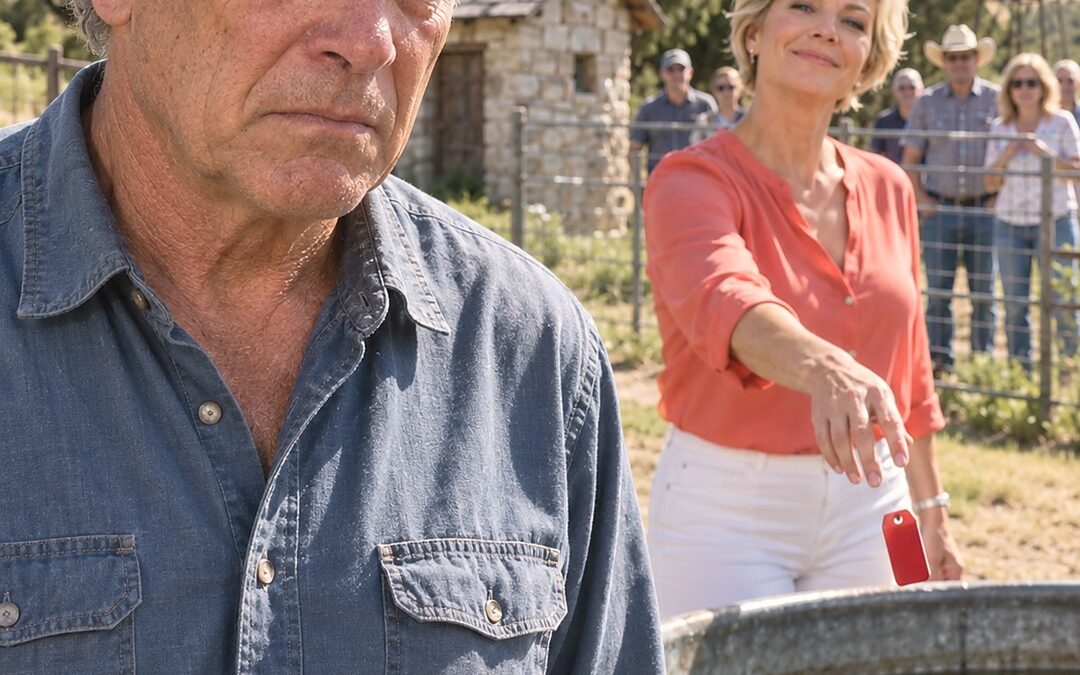
Sloane Hadley ripped my lockout tag off the pump panel, flicked it into the stock tank in front of forty-some neighbors at my fence, and said, "That's not your water, old man, that's community water, and you're leaving here in handcuffs." I was sixty-five, my father had been in the ground behind that pump house since the week before Christmas, and a crowd that had never once waved at him was about to watch his son get put in a county car at his own well. She had no idea the valve feeding her whole subdivision was one I'd drawn on a legal pad at my father's kitchen table nine years before, and until about three-thirty that afternoon, I didn't know it was still open.
The tag went in faceup and turned a slow half circle toward the overflow pipe, my own handwriting on it in black Sharpie.
DANGER — LOCKED OUT — DO NOT OPERATE — G. KOTHMANN — 4/11 — 7:00 AM TO 3:00 PM
I'd lettered it at six-thirty that morning at Daddy's workbench, in the square capitals he taught me. In all my working life I never saw a man pull a lockout tag off a panel that wasn't his. I saw a lineman in Bexar County lose two fingers over less.
Sloane had her phone on a selfie stick, aimed at me, and white slacks on in a cow lot. Behind her stood Deputy Manny Ochoa with his thumbs hooked in his duty belt, looking at the stock tank like he'd have liked to climb in after the tag. My father bought that boy's 4-H steer at the county fair six years running and overpaid every time.
Up at the fence somebody laughed out loud at "handcuffs." I knew the laugh before I found the face. Craig Vogel, the Reserve's treasurer, sitting in his red golf cart with a Dairy Queen cup in the holder, laughing like she'd told a good one at a fish fry. Phones were up all along the barbed wire.
"Ma'am," I said, "you just pulled a safety tag off equipment that's apart."
"You shut off fifty-seven homes."
"I shut off my well."
"Your well." She swung the camera at my panel. "Y'all hear him?"
On my tailgate sat a Folgers can with the new check valve and the new pressure switch in it. The old valve lay in the dirt where I'd wrestled it out of threads that hadn't turned since Reagan. Fresh pipe dope needs a couple of hours before you can put pressure on it, and I wasn't about to do this job twice.
"It'll be back on at three, like the tag says."
"People can't flush their toilets, Mr. Kothmann."
"The pump's apart, Mrs. Hadley. I can't change that."
She turned the phone around on herself. "Did everybody get that?"
Manny stepped in, careful not to touch anything. "Mrs. Hadley, this is a private well on private property. I can't make a man run his pump. That's a civil matter." He tipped his hat back a little. "Who's y'all's water company? I'll call them."
"We don't have a water provider. We have our own well."
That caught me. I spent thirty-one years with the city water system in San Antonio hunting leaks and water that leaves the plant and never shows up on anybody's bill. After that long you get an itch for numbers that don't add. If the Reserve had its own well, why had every faucet over there quit when I threw my breaker?
"Then your well's got a problem, ma'am, and it isn't on my side of the fence."
"Dwayne says it's your line."
I looked forty yards up the fence at the cedar thicket. In 2017 Daddy and I had put an emergency tie-in up there for the developer, and that next January he'd called to tell me it was shut. I shook my head and looked back at the coffee can. Valve out, switch out. There wasn't a fitting in that pump room that would have held a pound of pressure.
"I couldn't have turned it on if I'd wanted to."
I picked up the pipe wrench.
"Put that down," Sloane said. "He's destroying evidence."
"He's fixing a pipe," Manny said.
"That's what he says."
I leaned the wrench on the tailgate. "Am I being detained, Manny?"
"No, sir."
"Then I've got work."
She came a step closer. Her perfume got there before she did, something with gardenia in it. "You think you can do whatever you please out here because you've got a few cows."
"Eight hundred sixty acres, Mrs. Hadley. And this ranch isn't in your HOA."
"I've run this board four years and never lost a vote."
"Then you ought to know this ranch isn't yours to run."
Craig laughed again, smaller. She swung around on him. "Craig, are you filming?"
"Got it."
"Good. Because he tampered with our line, and I intend to swear to it."
Manny hitched his belt up. "Then come down to the office and swear it."
Nobody over there was sick. It was missed showers and a sink of breakfast dishes on a Saturday, and people were mad about it, and I didn't blame them for being mad. I blamed them some for the phones.
That's when Irma Kuehne came through the gate.
Irma was seventy-nine, Arnold Kuehne's widow, and her back yard ran right up to our east fence. She had a cane with the rubber tip worn crooked on one side, and her brown Buick LeSabre was parked out on the road among all those Tahoes like a church lady who'd wandered into a tailgate party. She went past Sloane without a look and stopped at the stock tank.
"Ground's slick there, Mrs. Kuehne."
"I know what mud is, Gus."
She hooked the floating tag with the crook of her cane, brought it up streaming, and handed it to me.
"Arnold always liked your daddy," she said. "They sat together at the men's breakfast at St. Paul. Thirty years of bad coffee."
Then she went back out the gate. Sloane went after her talking about community responsibility, and Manny went after Sloane, and once it got plain there wouldn't be any handcuffs the fence thinned out.
Craig stayed. He sat in that red golf cart a good half hour, watching me work with a pipe wrench, before he puttered off toward the clubhouse.
At one o'clock I had the new check valve seated. The threads took clean, no binding. I'd doped them by the directions on the can, not like my father used to, with his thumb and a prayer, and now it had to cure.
Jean came down from the house with iced tea in one of our glasses with the little raised dots around the bottom.
"How many deputies did they bring?"
"One."
"How many did they need?"
"None."
She folded her arms and looked at the fence. A couple of people were still out in their back yards with their phones on us.
"Somebody called the house asking if you'd been arrested. I asked who it was and they hung up."
We'd been married thirty-nine years. She spent most of them running a middle-school library, which is fine training for people who think they're owed something. She never wanted to live out here. Our daughter and the two grandkids were in San Antonio, and so was a house where the plumbing worked without my help.
"Dwayne Hadley's office called too," she said. "They want to come talk about buying the place again. Said they're prepared to be generous."
"Tell them to write it down."
"That's what I told them." She watched me wipe a bead of dope off the fitting. "How long before that deputy comes back?"
"Depends what Sloane tells him."
"Gus. I don't want to spend another Saturday watching the kitchen window for a county car."
I put the rag down. "Neither do I."
She looked at the pump house. "Your daddy did this in the dark. I used to hear his truck at four in the morning when we came up for Easter."
"April and October. I figured it was an old man's habit."
"So why'd you start at seven?"
"Because I'm putting in a check valve, and I'm too old to do pipe work with a flashlight in my teeth."
She took the empty glass and went back up to the house.
My grandfather drilled that well in 1954, in the drought, three hundred forty feet down into the Trinity. Kothmanns have been on this land since 1921. We have the water tested every year and it comes back clean, which is more than I could say for some of what I signed off on in San Antonio.
At one-fifty I cleaned up the old valve on the tailgate. There was scale packed behind the seat like wet coffee grounds. It had been fixing to quit for years. Inside the pump house, on the wall by the panel, ran a column of carpenter-pencil marks, how far down the water sat every spring and fall since that first drought, my grandfather's at the top and then mostly Daddy's. He liked a carpenter's pencil because you can find one in the dark.
The Reserve went up on what used to be an oat field, fifty-seven houses and a swimming pool shaped like Texas, Panhandle and all. Sloane's letters started once she made president. One about our burn barrel, one about the windmill squeaking, "an unapproved structure visible from common areas." In February she took a petition to the county commissioners to limit livestock next to houses. They turned it down on Monday, March ninth, and I took a copy home and put it in Daddy's desk.
At two-fifteen Jean came back without any tea.
"Somebody posted that you cut them off because they complained about the cattle."
"Who?"
"Does it matter?"
"No."
"Then why'd you ask?"
I wiped my fingers on my jeans. "Habit."
"Are you going to tell anybody what actually happened?"
"I told forty people."
"That's not going to stop whatever she puts on Facebook."
"I don't argue with people on Facebook."
She sat on the edge of the tailgate, careful of the tools. "Your daddy kept every piece of paper he ever got. Have you even looked to see if he had trouble with these people before?"
"I haven't been through all of it."
"We've been here four months, Gus."
"I know how long we've been here."
She pressed her lips together and got up. I let her get about halfway to the house.
"Jean. I'm going to get the water on."
"Good," she said, and kept walking.
At two-forty-five the dope had set up. I hung the wet tag on the dash of my Silverado where the sun could get at it. The ink had already started to bleed around my initials. I put the test gauge on, pumped the line up by hand and watched the needle. It settled and stayed. I ran my fingers around the new valve and the switch, and they came away dry.
At three I threw the breaker. The motor came up with the same low hum it's had my whole life, and the gauge climbed and sat right where it belonged. I opened the hydrant by the stock tank. It coughed once and ran clear.
At three-twenty somebody hollered across the field.
"WATER!"
Then a cheer from the Reserve, like a run had scored at a Little League game.
I stood there with my hand on the hydrant. Twenty minutes is about how long it takes to fill a pipe from here to a tank on the other side of an oat field.
I shut the hydrant off and walked up the fence into the cedar.
The thicket had grown in so close you couldn't see the vault from the pump house anymore. I found it by the flat limestone rock Daddy sat on to eat his sandwich the weekend we poured it. I pulled two branches back and took a pry bar to the lid.
The two-inch meter was turning. The little red flow star spun steady, and the totalizer, which is the odometer on a water meter, read 41,287,400 gallons.
I sat back on my heels in the cedar needles.
In August of 2017 the Reserve's own well started pumping sand and quit, and Dwayne Hadley came up our drive with his hat in his hand. I was up for Labor Day. I drew the tie-in on a yellow legal pad at Daddy's kitchen table, a tap off the six-inch line, a shutoff, a check valve and a meter, and the two of us poured this vault that Sunday. I wrote them a one-page agreement too. Ninety days, so much per thousand gallons by the meter, a price Daddy thought was too high and Dwayne thought was a steal, and Dwayne would drill a new well. They signed it the Friday after.
On January 15, 2018, Daddy called me in San Antonio.
"They got their own well going. I shut that valve."
I reached down and put my hand on the shutoff handle. Wide open.
Back in the pump house, behind the pump manual in the cabinet, was a green ledger I had never seen in my life. A column headed R. Monthly readings in his square capitals, eight years of them, not a month skipped. Carbon copies of invoices in the back, every one to Hadley Homes LLC, P.O. Box 212, Hester. The first two were marked paid, with a date. None of the rest were. The agreement was folded in quarters inside the front cover, his signature next to Dwayne's, my handwriting all over it.
Every April and October entry since 2018 began at 4:00 a.m. He'd been timing his maintenance to their storage tank so their faucets never knew he was out here.
His figures got smaller toward the back, but they stayed inside the columns. The last one was dated Sunday, November 30, eighteen days before he died. The pencil had slid downhill across the rule.
"R — 391,400 gal. Billed. Unpaid. Not their fault. —E.K."
In the hospital, at the end, he had to stop and rest between the E and the K when he signed his own name.
I shut the ledger and went out to the hydrant by the stock tank and opened it and put my wrists under the cold water. It ran off my hands onto my boots. I turned my hands over and left them there. A couple of the heifers came up to the tank and drank alongside me. I'd been ten feet from that cabinet since seven o'clock that morning.
Jean called from the porch that supper was getting cold.
"Did you get it fixed?" she said when I came up.
"It's fixed."
"Then why were you standing out there like a fence post?"
"Daddy's been giving those people water for eight years. Nobody's paid him a dime since 2017."
She came down one step and I told her the rest. She listened without interrupting, except to look over at the subdivision when I said Dwayne's name.
"And Dwayne knew?"
"He signed it."
"Are you going to cut them off?"
"No."
"After today?"
I set my keys on the porch rail. "They didn't sign anything, Jean. They bought houses with faucets in them."
She went in and came back out with a plate under foil. "It's cold. Eat it anyway."
After supper I got the old data logger out of the toolbox on my truck. It's a gray box in a padded case, and it had ridden under a coil of test leads since I retired, the way some men keep a pocketknife they never use. I clipped it to the meter and set it to record flow every fifteen minutes. Then I shut the lid and ran my own padlock through the hasp. Anybody who wanted that valve, open or shut, could come ask me.
In the pump house I opened the ledger to his last line and sat there with the pencil a while. Then I turned to a clean page and wrote the date, the totalizer reading, and G.K. I left his page alone.
At the kitchen table I got out a yellow legal pad. Jean sat across from me with her reading glasses on and a library book open that she wasn't reading.
I wrote to the board of The Reserve at Cypress Bend. Your water comes from the Kothmann well, through a metered tie-in put in under a 2017 emergency agreement. I have the readings and the signed paper. Nobody is getting shut off. Call me and come look. I'd mail it certified Monday.
Jean pulled the pad across the table and read it.
"You're going to be nice to them."
"Daddy was."
"Look where it got him."
I took the pad back and fixed the date on the first line. Jean shut her book.
At 9:40 that night Manny Ochoa called the house phone. "Mr. Kothmann, Mrs. Hadley came in and swore you tampered with the Reserve's water line," he said. "And Craig Vogel signed a statement that he watched you cut it with a saw."
Part 2
Manny Ochoa sat at my kitchen table at nine Monday morning with a spiral notebook and the same face he'd worn Saturday, which was the face of a man who'd been sent to a cow lot on his day off.
By Sunday night Sloane's video had been shared better than three hundred times, in Reserve Neighbors and on the Hester community page both. Forty-six seconds of Sloane at my pump house saying I'd left elderly people and babies without water, and it ended on her saying handcuffs. My part about three o'clock wasn't in it. At church two pews around us had stayed empty, and a woman from the altar guild who had asked Jean about the grandkids every Sunday since January went straight past us to the fellowship hall. She'd seen the altar guild woman before I did.
"She's real good at trimming things," Jean said, about Sloane, and handed me back my phone.
Jean poured Manny coffee. "Milk?"
"Black's fine, ma'am. Thank you."
The legal pad with my letter on it was still by the salt shaker. He saw it and didn't ask.
"Start with why you shut the well off," he said.
I told him about the check valve and the pressure switch, and I went out to the back step and brought in the old valve in the cardboard box I'd kept it in. He turned it over and looked at the scale behind the seat.
"What time'd you get it running?"
"Three. They started hollering over there about twenty after."
He wrote that down. "Mrs. Hadley says you interrupted their water on purpose."
"I interrupted my pump on purpose."
"Mr. Vogel says he saw you cut their line."
"Then Craig ought to get his eyes looked at. He had a good half hour to look."
Manny closed the notebook on his pen. "Would you mind showing me?"
We walked up the east fence together. I unlocked the vault and pulled the lid, and the meter was turning, the same as it had been turning since 2017. Manny squatted and looked at the pipe going in and the pipe coming out.
"Pipe looks fine to me. Doesn't matter what it looks like to me. Two people swore to it; it goes to the county attorney."
"I understand."
"You got paper on this?"
I took the agreement out of my shirt pocket. He read the top, and the ninety days, and the signatures, and handed it back.
"Contracts are civil. I don't do contracts." He stood up and knocked the dirt off his knee and looked down the fence line at the backs of all those houses, the trampolines and the propane grills. "Don't change anything up here till somebody's had a look."
"The pump stays on."
"Good."
On the porch Jean had put his coffee in a travel mug for him. He stood holding it.
"Your daddy bought my steer every year at the fair."
"Six years running."
"He paid more than it was worth. Every year. I put it toward my first truck." He looked down into the mug. "I'll be in touch, Mr. Kothmann."
He drove out over the cattle guard before ten. I stood on the porch till I couldn't hear it rattle anymore, and then I went in and dug a business card out of Daddy's desk.
I called a lawyer in Fredericksburg I'd known since we were both sophomores in high school. He'd done Daddy's estate and charged us about half what he should have.
"Don't post anything," he said.
"I wasn't going to."
"And don't go over there explaining the water to every neighbor who walks up to your fence. You've got a criminal complaint on you now. Anything you say about that line, she'll say you said it different."
"Somebody ought to tell them."
"Write the board. Send them the agreement. Let their own people come look at it." He paused. "Certified, Gus. Keep the green card."
After lunch I drove into Hester. At the post office the clerk, a girl in a Hester Bobcats lanyard who couldn't have been twenty, weighed my envelope and asked if I wanted a return receipt, and I said I did. I addressed it to the HOA board at the mailing address on file with the county, 400 Main Street. It didn't mean a thing to me. Daddy's invoices had all gone to a post office box.
On the way home a man I'd shaken hands with at church two Sundays before saw my Silverado at the light by the Dairy Queen and looked the other way.
Tuesday's mail brought two envelopes I didn't like.
The first was from a law office in Austin. The attorney for The Reserve at Cypress Bend demanded that I cease "interference with the Reserve's water infrastructure," or face a fine of $500 a day and a restraining order. I read it standing at the counter and called my lawyer and read it to him. He laughed, one short one.
"They can't fine a man who isn't a member."
"You want to tell them, or should I?"
"I'll tell them. You keep that pump running."
The second envelope was heavier. Cypress Bend Land Partners LLC wanted to buy Kothmann Ranch. Four million one hundred thousand dollars, cash, and the offer expired at five o'clock Friday, April twenty-fourth. Eleven pages of purchase language behind it, and somebody had used a yellow highlighter on the deadline.
Jean read it over my shoulder and put the dish towel down on the counter.
"Lord."
"That's a lot of money for cedar and limestone."
"Our cedar and limestone." She pulled out a chair. "Who is it?"
"Doesn't say."
I got the laptop out of Daddy's desk and looked the company up on the Texas Secretary of State's site. Registered address, 400 Main Street, Hester. I typed the address into the search box by itself.
Hadley Homes.
I opened the drawer and took out my receipt from the day before and laid it next to the screen. Same street, same number.
"That's where you sent the letter," Jean said.
"That's their address of record."
"Dwayne Hadley's office."
"Yes."
"Somebody wants this place awful bad, Gus."
"Nobody pays four million dollars for cattle." Daddy's heifers were bringing about what heifers brought when I was in college, give or take the price of diesel.
She picked up the Austin envelope and turned it over like there might be something on the back. "Are we going to court?"
"Could be."
"Your daddy hated lawyers."
"He paid for one for me once."
"When?"
"When I was seventeen. He paid the lawyer, and I spent that summer working it off hauling hay for anybody who'd pay me." I could tell she was waiting. "I put his truck through the fellowship hall wall at St. Paul. Not all the way through."
"You told me you hit a fence."
"I didn't tell you everything that happened."
She put the envelope down. She didn't smile, but she didn't not smile either. "Well. This looks expensive too."
Wednesday afternoon Irma Kuehne came to the east fence with a plate under aluminum foil. She'd driven the Buick down Cypress Bend Drive to the end of the cul-de-sac and walked through the gate with her cane, which is about a hundred yards of rough pasture for a woman of seventy-nine.
"Made too many kolaches," she said.
Peach on one side of the plate, cream cheese on the other. Jean came out from the porch and told her to come sit in the shade, and Irma said she was fine standing a minute, which meant she wanted to say something first.
"I wanted to say I'm sorry about Saturday, Gus."
"You didn't do anything."
"I stood there while that woman made a spectacle of herself on your property."
"You fished my tag out."
"Well, she threw it in your cattle's drinking water. That's just plain ugly." She looked out at the heifers. "They sent me a letter about my mailbox. I'm already crosswise with them, so don't you worry about me."
"What's wrong with your mailbox?" Jean said.
"Not one thing that wasn't wrong with it in 2018. Arnold put a bluebonnet sticker on it the week we closed on the house. He said a mailbox ought to tell you who lives there." She took a kolache off her own plate and ate half of it standing up. "Sloane says it isn't uniform."
I knew better than to talk about the water. My lawyer had been particular. So when she asked what all the fuss with the cattle was about anyway, I went up to the house and got the copy of the petition out of Daddy's desk, the one I'd brought home from the commissioners' meeting in March, and nothing else.
Irma spread it on the hood of my Silverado and put her glasses on. She read the heading first, the way a banker's wife reads things, and then started down the names with her finger.
"Thirty-one people signed this?"
"That's what it says."
"Half of these don't even live on the back side." Her finger moved down. "That's the woman with the little terrier. She'd sign a petition against Christmas." It went down some more, and stopped.
She leaned in. She didn't say anything for long enough that Jean came around the hood to look, still holding the foil she'd taken off the plate.
It was Arnold Kuehne's name.
Irma tapped the line with a fingernail the color of a cherry Life Saver. "Arnold's been dead two years, Gus. He signed everything A. W. Kuehne. That's not his hand."
Part 3
Thursday morning I printed out what the logger had caught since Saturday and spread it over the place mats. Five in the morning Tuesday, the line jumped straight up and sat there an hour. Thursday, the same. Wednesday afternoon it climbed slow from two o'clock till supper.
Jean looked over my shoulder. "That's them taking showers?"
"That's them watering St. Augustine. And that's somebody topping off a swimming pool shaped like Texas."
"With your daddy's water," she said, and took her towels on upstairs.
The certified-mail tracking said my letter had been delivered and signed for that morning, at 400 Main Street. It didn't give a name yet. I wrote the date on the receipt with a pen and put it back in the drawer.
After lunch I drove over to Irma's. She was waiting by the Buick with a manila envelope under her arm and her cane hooked over the top of the door.
"We'll take mine," she said.
"What's wrong with my truck?"
"I'm not climbing up into that Silverado with my knee acting up." She held her keys out to me. "You drive."
I drove us to Hester in her Buick at fifty-one miles an hour, because she said that's what it likes. The envelope had the petition copy in it and a stack of old papers from Hester State Bank with Arnold's signature on them, the real one. He'd signed loan papers there forty years. She said she could pick his hand out from across a room.
At the sheriff's office Manny came out from behind the counter when he saw her.
"Mrs. Kuehne."
"Deputy, I need to report a forged signature."
He took us back to a little room with a table and three chairs that didn't match. Irma put the petition down and turned it around so it faced him and put her finger on her husband's name.
"Arnold died in March two years ago. This was filed in February. Of this year."
Manny looked at it a long time, and then at me. "Where'd this copy come from?"
"County commissioners' office," I said. "I was there when they voted it down."
"Mr. Kothmann," he said, and wrote my name down under hers.
He told her he'd need the original from the county clerk and something with Arnold's real signature on it, and she slid the bank papers across before he'd finished saying it. He asked if she'd seen who carried the petition around. She said she hadn't.
"I won't tell you something I didn't see."
He wrote that down too. "Can't promise you how long, ma'am."
"Nobody ever can."
Outside she said, "Post office first."
She'd written out a request to see the HOA's books, the payment records and the contracts, especially anything to do with water. Texas law lets any owner ask, she said, and they've got ten business days to answer. She paid to send it certified and put the receipt in her pocketbook and snapped it shut.
"Your lawyer tell you to do that?"
"Arnold did. Forty years ago. He said whenever somebody acts like you oughtn't see the books, ask for the books."
At the Dairy Queen she got a small vanilla cone and sat by the window watching the drive-through.
"Gus. What's going on with that water?"
"My lawyer wants their own people to look first."
She set the cone down on its napkin. "But you know something."
"They wouldn't believe the man they think is stealing it. They'd believe an engineer they paid for."
She thought about that and picked the cone back up. "Well. I hope they hire one who can read."
Friday morning in Fredericksburg my lawyer turned his monitor around so I could see it. "I want their engineer at your pump house next Saturday at ten. Their lawyer can come watch." He sent it while I sat there. The HOA's lawyer wrote back yes before I'd finished my coffee.
"One more thing," he said. "Don't go over to Hadley's and start an argument."
"I've got one question for Dwayne."
"I'm sure you do." He took off his glasses. "A man offers you four million dollars the same week his sister-in-law tries to get you arrested, there's more than one question. Just don't give him anything he can call a threat."
Monday morning I parked across from 400 Main Street in Hester. Hadley Homes had the whole old brick building, the one that used to be the Western Auto, with tinted windows now. Dwayne's silver F-350 sat out front with the company name on the door.
Before I got out I turned on the voice recorder on my phone and put it in my shirt pocket, screen in. In Texas only one person in a conversation has to know it's being recorded. I was the one.
The office smelled like new paint and lemon oil. On an easel by the door stood a big color drawing.
THE RESERVE — PHASE II — 42 LOTS — COMING SOON
I stood and looked at it. The new lots ran a lot farther along the Kothmann line than the old ones did, and somebody had drawn in a second entrance and a whole new row of back yards looking out on our pasture. On a filing cabinet behind the girl at the desk was a refrigerator magnet that said Hadley Water Services, with a cartoon water drop smiling.
Dwayne came out in a pressed western shirt with his logo stitched over the pocket. "Gus Kothmann. Been a while."
"Morning, Dwayne."
He shook my hand and took me back to his office. There was a framed aerial photo of the Reserve behind the desk, pool and all. "Come about the offer?"
"Come about the water."
His hand stopped halfway to a desk drawer. "What about it?"
I laid the agreement on his desk. "You remember signing this?"
"Sure."
"You remember drilling the new well?"
He leaned back, and the chair creaked. "Gus, that was a long time ago."
"It was ninety days."
"Ninety days was your idea, Gus. After that your daddy was just being neighborly."
"He billed you every month."
"Your daddy and I had an understanding. He wasn't going to put families out of water."
"That's not what I asked you."
He straightened a desk calendar that didn't need it. "He told me his boy didn't need to know about any of it. Your daddy said you'd come up here mad." His eyes went to my shirt pocket and back. I kept my mouth shut.
He pulled the offer out of a folder like he'd had it ready. "Look. Fifty-seven families are used to that water. No judge in Corbin County's going to let you take it off them. Take the four-point-one, go back to San Antonio, see your grandkids on Sundays."
"I'm not taking it off anybody."
"Then what's the problem?"
"You never paid for it."
He nodded at the easel through the doorway like I'd asked. "County won't sign off on Phase II without a certified water source. You're sitting on the only one there is. That's why it's lot money, Gus. Not cow money."
"I figured."
"Call off Saturday," he said, friendly. "No need to stir everybody up."
"The HOA accepted it."
"You could cancel it."
"They accepted it, Dwayne."
He pushed the agreement back across the desk to me. He never once asked what the meter read. I had it written on the back of my hand in ballpoint in case he did.
That evening Irma's Buick came up the drive. She had a printout of a notice Sloane had posted Saturday on the Reserve's website and on the clubhouse door, a full week ahead like their bylaws say, for a special open board meeting "on site at the Kothmann pump house." She left it on the table for me. She'd also heard Sloane on her porch phone that afternoon, through the kitchen window.
"She said, 'I already posted it, Dwayne.' Just like that. And then she went in the house."
Tuesday afternoon a county constable pulled up at my gate and asked me to sign that I'd been served. It was a temporary restraining order. The order said Gus Kothmann shall not interrupt or reduce the water to The Reserve at Cypress Bend. Hearing set for Tuesday, May fifth. I never meant to do either one.
Stapled behind it was Sloane's sworn affidavit, signed Monday, about elderly residents and babies without water. Nowhere in it did it say the water came back on at three-twenty that same Saturday. The judge had only heard from her.
The constable hadn't got to the cattle guard before Irma's Buick turned in past him. She got out with a letter in her hand and held it up.
"Two hundred fifty dollars," she said. "For Arnold's bluebonnet. Uniform mailbox policy."
"It's been on there since 2018."
"I told them that. They said past violations don't excuse current ones." She folded the letter back on its creases. "I'm not taking it off, Gus."
"I wouldn't."
My lawyer called that night. "I asked their lawyer for the board minutes," he said. "That board never voted to send you a letter or to file for that order. Sloane did it on her own. She needs Saturday's vote to cover herself, and she needs it in front of everybody."
He asked if I wanted to object to a board meeting being held in my yard. I said let them come. Then I sat down at the kitchen table with the copy of the notice Irma had left me and unfolded it.
Item two was circled in red pen, like a teacher circles the wrong answer: "Resolution authorizing legal action against August Kothmann and a fine of $500 per day, retroactive to April 11." Under it, item three: "Confirmation of officers and of the Hadley Water Services contract." The outfit with the smiling cartoon water drop on Dwayne's file cabinet. Sloane was going to hold a vote in my yard, forty yards from Daddy's meter, on whether to keep paying Dwayne for it.
Part 4
Somebody had written THIEF across the KOTHMANN RANCH — EST. 1921 sign at our front gate, in black marker, in letters a foot tall, right over the raised wooden letters my father painted every other spring whether they needed it or not.
I found it Wednesday morning going out to check the heifers. Whoever did it had walked in over the cattle guard in the dark, which is a good way to break an ankle, and I'll admit some small part of me hoped they had.
A pickup from the Reserve came by slow while I was standing there, a man in a burnt-orange Longhorns cap at the wheel. He looked at me and at the sign and kept going.
I went back to the house for a bottle of Goop and a rag, and Jean followed me down to the gate in her house shoes. When she saw it she stopped walking.
"Oh, Gus."
"It'll come off. Most of it."
I put the Goop on the rag and started on the T. The marker came up slow and took some of Daddy's white paint with it. Jean stood by the truck with her arms wrapped around herself.
"Who would do that?"
"Somebody with a marker."
"Don't." She said it sharp enough that I stopped. "Somebody walked up our drive in the dark, Gus. Up to our house. And you're making jokes."
I didn't have anything good, so I kept scrubbing. By the time the bottle was half gone the word was mostly gone too, except the H. A faint gray ghost of the H stayed down in the grain of the wood.
When I came back in, her suitcase was standing by the back door. The blue roller with the broken wheel she uses for San Antonio.
"Friday," she said. "I'm going to our daughter's for a few days. To see the kids."
"All right."
"That's all?"
"You can go, Jean."
"I'm asking you to come with me."
"The inspection's Saturday."
"Let their lawyer do it."
"Somebody has to open the vault."
"Then give him the key."
I opened the refrigerator and stood there and shut it again without taking anything out.
"Take Dwayne's money," she said. "Your daddy's gone. I want to see the grandkids on a Sunday without a deputy calling."
I sat down at the table and she sat across from me. She grew up in Alamo Heights, with sidewalks. For thirty-some years she drove up here on holidays and listened to me talk about moving home someday, and now it was someday and somebody had written THIEF on our gate.
I got my lawyer's envelope out of the drawer and turned it over and worked it out on the back in pencil. The offer, less what the government takes, less a house in San Antonio near our daughter and a workshop for me. Jean let me finish. I didn't tell her what it came to.
She took the pencil out of my hand and laid it down.
"I'll leave the suitcase there till Friday," she said, and went down the hall, and pretty soon I heard her opening dresser drawers.
Thursday night I couldn't sleep. A little after eleven I got up and pulled my boots on over my pajama legs.
Jean rolled over. "Where are you going?"
"Pump house."
"At this hour? What for?"
"I'll know when I get there."
Somewhere across the east fence a sprinkler was going, the kind with the little metal arm knocking against its stop. The pump house smelled like it always has, old cedar boards and warm wire. I pulled the string and the bulb buzzed before it caught.
The gauge was right where it ought to be. I checked the panel and laid my hand on the motor housing. Everything was fine. I hadn't needed to come out, and I sat down on Daddy's stool by the manual cabinet anyway.
For forty years he ran this place while I worked in San Antonio. I'd call Sunday nights and ask about the cattle and the well, and he'd tell me fine, everything's fine. By the time I moved home he'd been under the live oak behind this shed three weeks.
The door opened. Jean stood there in her robe with my old barn coat on over it, her slippers dark from the wet grass.
"You left the kitchen light on," she said.
In thirty-nine years she had never once been inside the pump house. Not at Easter, not at Thanksgiving, not since January. She looked around at the panel and the pipes like it was somebody else's closet.
"It's smaller than I thought."
"It holds what it needs to."
She went over to the wall where the pencil marks ran. "What are these?"
"Static water level. How far down the water sits when the pump's resting. Spring and fall."
The oldest ones were at the top in my grandfather's hand and Daddy's ran on down from there, a long uneven column with a few drips of white paint across it from when somebody did the trim. Jean started at the bottom and read up, moving her finger along beside the numbers without touching them. Then her finger stopped.
"What's this?"
I put the flashlight on it.
"4/66 — SWL 188 FT — E.K."
And right under it, in crooked capitals a little kid makes when he's pressing too hard:
"GUS 5"
"You wrote that?"
"I guess I did."
"You were five."
She put her thumb on it. Right over the G, which leans backward, like it was about to fall over.
I'd forgotten it was there. I remembered it now. Daddy dropping the line down the well and me standing on a bucket, and him handing me his carpenter's pencil, which was too fat for my hand, and telling me to put my name up there so he'd know who helped.
Jean kept her thumb on the wall.
I turned around and looked at the pressure gauge. The needle was holding fine. I tapped the glass with my finger. Then I tapped it again, and I kept on tapping it. There was nothing wrong with that gauge.
Behind me the floorboards creaked when she shifted her weight.
"Did he know you still meant to come back?" she said.
"He asked every time we came up."
"What'd you tell him?"
"After I retire."
"And then you retired."
"And then you had a year left at the school, and then the second grandbaby came. He'd call and ask if we'd listed the house yet. I told him to quit worrying."
"He worried anyway."
"He did."
She stood there a while longer reading the wall.
"Well. I guess I'm not driving to San Antonio tomorrow."
I turned around. She held her hand out.
"Give me that flashlight. You're pointing it at the floor."
I gave it to her. She held it on the bottom of the column, steady, while I checked the new marks against the old ones, and when we left she shut the door herself and tried the latch twice.
Friday at noon Irma's Buick came up the drive, and she rolled the window down while it was still moving.
"Gus, wash your hands. I've got something."
She had a folder on the seat beside her and her reading glasses hanging on a beaded cord. The HOA's records had come by email that morning. Not from Sloane. From Craig Vogel, the treasurer, signed with just his first name. Under the attachments he'd written one line: I should have asked to see that well years ago. She'd printed it at the library.
At the kitchen table she slid the payment records across to me and tapped the column with the vendor's name in it. Hadley Water Services, every month, all the way down. Seventy-five checks. The ones in 2020 were signed by a treasurer Irma said she'd never laid eyes on. After that it was Craig's name on every one, and starting in 2022 Sloane's was next to his.
Irma turned to the budget page, put her finger under line fourteen, and read it out loud.
"Well No. 1 operations & testing — Hadley Water Services — $3,100/mo"
Jean set the coffeepot down. Irma pushed the papers toward her. "Look who we're paying."
I went and got the agreement out of Daddy's desk and laid it down beside the bank copies, his signature and Dwayne's.
"Hadley Homes quit paying my father in December of 2017," I said. "In January of 2020 Dwayne's other company started billing y'all to run your well."
Irma looked from one paper to the other. Then she did the arithmetic out loud, about halfway, under her breath, and quit.
"But it's your well we're on," she said.
"That's what the meter says."
She took her glasses off. "Then what in the world is he operating?"
"I'd like somebody to show us."
"Dwayne stood in our kitchen in 2018 and told Arnold we had our own water. There's a pump behind the clubhouse that runs. It's got green lights. I never set foot in that well house. I don't believe Sloane has either." She closed the folder. "I don't much like that woman, Gus. But I believe she's been signing those checks without the first idea what for. I want Craig to explain them where everybody can hear."
At 4:55 my cell phone rang. Jean was at the sink. She turned the water off when she saw who it was.
"Gus, let's make this simple," Dwayne said. "Four-point-six. Cash. Final. I can have a title company out there Monday, before this turns into something neither one of us wants."
"That's more than Tuesday."
"It's a good way out. Think about Jean."
I looked at her. She was standing at the sink with the dish towel in her hand.
"I have," I said. "No."
"Gus."
"No, Dwayne. Y'all have a good evening."
I hung up at 4:57. Jean hung the towel over the oven handle.
"You could've warned me you were going to turn down that much money."
"I wasn't sure he'd call."
"That's not what I meant." She came and sat. "He wants it for the well."
"He's charging the neighbors to run one that I'd bet doesn't pump a drop. And he wants to buy ours before they find out."
"Then they need to find out."
"Tomorrow."
She pushed my supper plate across to me. "Eat before somebody else calls."
At 8:10 the house phone rang. Jean was in the den folding towels and I was at the table with the meeting notice.
"Kothmann residence."
It was a woman, and she sounded tired. I could hear road noise and a blinker going.
"Mr. Kothmann, this is Dana Kolb, I'm the engineer the Reserve's HOA hired for tomorrow," she said. "I called their lawyer first and got his voicemail. I just came from their well house. There's a steel cap welded on their well, and somebody scratched 9-17 in the bead. So before I stand up in front of fifty people, I need you to tell me where their water is coming from."
Part 5
Sloane Hadley brought the same selfie stick she'd pointed at me two Saturdays before, and this time she had a little microphone clipped to her collar.
At ten o'clock I opened the east gate and called up the fence to the people standing in the cedar. "Y'all might as well come on through. There's room. No sense standing in the brush."
About fifty came, some carrying folding chairs from their garages, and a lot of them I knew by now. The woman who'd wanted to know when she could flush her toilet. The fellow in the Astros shirt who'd filmed me the whole time Sloane was talking about handcuffs. Craig Vogel parked his red golf cart within a yard of where he'd parked it the first time. The man in the Longhorns cap stood up front with his arms folded.
Manny Ochoa was by the pump house with his thumbs in his belt. Sloane had asked the sheriff's office for "a law enforcement presence," and Manny was it. He nodded at me. "Morning, Mr. Kothmann."
"Coffee's up at the house if you want it, Manny."
"I'm all right."
Jean sat on my tailgate with a thermos. I'd set a folding chair by the stock tank for Irma, and she was in it with her cane across her knees. The HOA's lawyer had come out from Austin in a black SUV, a young man with boots so new the soles were still yellow. The other three board members stood together by the gate in a little huddle, like people waiting on a casserole.
Sloane had parked her white Escalade out on the road, nose out, angled so nobody could box it in. She had on a cream pantsuit, in a pasture. Dwayne's silver F-350 pulled in last and parked by the gate. He sat in it with the engine running a good while before he shut it off and got out.
Dana Kolb was by the pump house with a clipboard and work boots that had real dirt on them. She and I had been up at the vault together since nine.
Sloane walked to my truck. "We'll conduct the meeting from the tailgate."
Jean looked at her a second, then picked up her thermos and stepped down. I moved my toolbox. Sloane climbed up without asking and got her phone fixed on the end of the stick.
The young lawyer came up beside her holding his own phone flat against his chest. I could see an email open on it. He leaned in and said something low, and I caught "postpone" and "the engineer's findings."
"No," Sloane said, loud enough for the fence. "These homeowners have waited two weeks for answers, and they're getting them." She touched her screen. "Good morning, Reserve Neighbors. We're live at the Kothmann ranch so everybody can see the sabotage for themselves."
Somebody behind me said, "Lord, she's filming again."
Sloane called the meeting to order standing on my tailgate. "For nine years this neighborhood has had its own private water. Not one dime to the city. Not one dime to anybody. We have the lowest dues in Corbin County, and we've worked to keep it that way." She looked out at the phones. "I've run this board four years and never lost a vote. Item one. Ms. Kolb."
Dana stepped up to the front.
"I inspected the Reserve's well house last night. There's a steel cap welded on their well, and somebody scratched 9-17 in the bead."
Craig had been unfolding an agenda. He quit. Along the fence a couple of people lowered their phones and looked at each other, and somebody in the back said, "Welded?" loud enough to carry.
"That can't be right," Sloane said. "The pump behind our clubhouse runs. There are green lights."
"That's a booster pump, ma'am. It pulls from your storage tank." Dana turned and looked at the fence. "Your tank is fed by one pipe, and that pipe runs east to this fence and through a meter in Mr. Kothmann's vault."
A woman by Irma said, "What does that mean?"
"It means that meter is the only water going into the Reserve," Dana said. "And a system your size has to tell the state every year where its water comes from. Somebody's been telling the state it's that welded-shut well."
The young lawyer put his hand over his mouth.
"Mr. Kothmann," Dana said, "would you open it up for them?"
We walked up the fence line, the whole crowd stepping around limestone and cedar roots, Manny behind them. I unlocked the padlock and lifted the lid, and they crowded in around the hole. The meter was turning along at its Saturday-morning pace.
"How do we know that's our water?" the man in the Longhorns cap said.
"A hose won't show you," Dana said. "Your tank soaks that up. Open the drain on the bottom of the storage tank and pull the level down, and the fill valve will open."
Craig took a key off the ring in his pocket and held it out. "Well house," he said. The man in the Longhorns cap took it and went through the gate at a jog, and his cap came off and he didn't stop for it.
We stood there. Somebody's kid asked if there were snakes in the cedar. A few minutes later the woman next to me held up her phone. It was him, out of breath, saying it was open and running all over the gravel. The little red star in the meter face picked up and spun faster.
"That's your tank calling for water," Dana said.
The toilet woman bent down to see better. "That's our water going through there?"
"Yes, ma'am."
She straightened up and looked at me across the hole, and then down at her phone, which was still recording. She turned it off. "I'm sorry, Mr. Kothmann. I thought you were cutting us off."
"You were told that."
"I was." She put the phone in her back pocket. "I shared it, too. Her video. To my sister in Kerrville."
Dwayne was standing about ten feet back, by himself. Sloane turned around and found him.
"Dwayne?"
"Emil agreed to a temporary arrangement," he said, not to her, to me. "When our well had trouble. It was supposed to get the subdivision going."
I handed Dana the agreement. She unfolded it and read one sentence out loud.
"This agreement terminates ninety (90) days from the date below unless renewed in writing." She turned the page so the people closest could see it. "Signed Dwayne Hadley, for Hadley Homes LLC."
"Is that your signature, sir?"
"Yes, but me and Emil had an understanding."
Irma didn't wait to hear what kind. She'd had Jean carry her chair up the fence after us, and now she opened her folder on her lap and read line fourteen again, slower, for the back rows. Then she looked up over her glasses. "That's what we pay Dwayne's company every month to run that well with the lid welded on it."
"Irma, those are confidential board records," Sloane said.
"They're my records, Sloane. I own a house over there. I asked for them."
"Craig had no business sending those."
Craig stepped forward. He took his glasses off and folded them and put them in his shirt pocket like he was going to need both hands.
"I signed sixty-three of those checks. I never once asked to see the well."
"Craig, this is not the time."
He walked past her to where Manny was standing. "I never saw a saw, Manny. He had a pipe wrench. Sloane wrote it and I signed it."
Manny got his notebook out. "You're correcting your statement, Mr. Vogel?"
"Yes, sir."
"Then you'll come in Monday and swear to the new one."
"I will."
The fellow in the Astros shirt turned his phone off Sloane and onto Craig, and then two or three others did the same. Craig stood there and let them.
Sloane went back down the fence to the tailgate, and everybody came after her. Dwayne stayed by his truck. When I'd locked the vault and come down, she was already up on the tailgate again.
"This is a contract dispute between Mr. Kothmann and a vendor," she said. "It's not a board matter. Item two."
"Mrs. Hadley." The young lawyer said it out loud this time. "I'm asking the board to table item two. We can't fine a man who isn't a member, and I won't defend it in court."
One of the directors by the gate made the motion. Another one seconded. Every hand went up but hers. "Fine," Sloane said. "Item two is tabled."
I heard Jean unscrew the top of her thermos.
"Item three. Confirmation of officers, and of our contract with Hadley Water Services, which has served this neighborhood for years." Sloane raised the stick a little higher so the camera got her hand. "All in favor."
Her own hand went up. It stayed up by itself.
"Opposed," Craig said, and raised his.
The three by the gate looked at each other, and then all three went up after Craig's. Sloane counted them with her eyes. Then she looked out past them for the people who'd stood behind her at this fence two weeks before. A woman in the front row who'd been filming me lowered her phone about six inches and kept it pointed at Sloane.
Four to one. Manny wrote something down in his notebook.
The lawyer said the bylaws let them name an acting president on the spot, and they did, the tall director with the Aggie ring, and Craig seconded it. The new acting president walked up to my tailgate. Sloane still had her agenda spread out on it.
"I'll need that," he said.
She gathered the pages up and squared them against the tailgate and handed them down to him, and fifty people she'd been president of five minutes before watched her do it.
"I move we suspend every payment to Hadley Water Services, effective right now," he said. The lady in the sun visor seconded it before he'd quite finished. It passed four to nothing, with Sloane's hands down at her sides.
"April's check is in my truck," Craig said. "It's staying there." He turned toward the gate. "You can come ask me for it yourself, Dwayne. I'm not signing another one for a well with a lid welded on it."
Dwayne got his keys out of his pocket. Then he put them back and didn't move.
Sloane climbed down off the tailgate and came at me with the stick still up.
"It's still community water. Fifty-seven families live on that water. Whatever your daddy did, you can't just—"
"That's not your water, Sloane. It never was. My daddy wrote down every gallon."
She lowered the selfie stick. The phone was still on the end of it, still aimed up at her own face, and I could read the viewer count from where I stood, 212, still going up. She dragged her thumb across the screen and missed. She did it again and missed again. The third time she quit trying and pressed the whole phone flat against the front of her blouse, and stood there holding it like that, with the little red light still showing through her fingers.
Up front the man in the Longhorns cap had come back, out of breath, with his cap in his hand, and he was standing right where he could see it. Irma folded her hands on top of her cane. Over by the gate Dwayne had his truck keys out again, turning them over and over in his fingers.
I said it to the yard, not to her. "Nobody's tap goes dry over any of this. The pump stays on."
Manny Ochoa had been holding a folded paper against his leg the whole meeting. He opened it now. "Mrs. Hadley, Irma Kuehne tells me her husband passed two years ago in March," he said. "So I need you to tell me who signed Arnold's name to this."
Part 6
Sloane looked at that petition a long time. Manny held it out to her and didn't hurry her, and fifty people stood in my pump-house yard and listened to the cattle pull at the hay.
She looked over at Dwayne's truck first, like there might be some help in it. Dwayne was looking at his boots.
"I was four names short," she said. "Arnold would've signed it anyway."
Irma didn't get up out of her chair. "You should've asked him, then. Before we buried him."
Manny folded the petition back along its creases and put it inside his notebook. "Mrs. Hadley, I can't arrest anybody today for a misdemeanor I didn't see happen. I'm going to write up what you just said and walk it over to the county attorney Monday morning." He turned a page. "Your complaint against Mr. Kothmann's closed as of right now. Mr. Vogel, I'll see you Monday too."
"Yes, sir," Craig said.
"These are my neighbors," Sloane said, to Manny or to me, I couldn't tell which. The fellow in the Astros shirt kept filming.
The acting president came over with the agenda still in his hand. "Sloane, we need that video down. Today. Here."
"It's my personal page."
"You posted it as president."
The man in the Longhorns cap stepped up beside her, close enough to see her screen. "I watched that video about ten times," he said. "I'd like to watch you take it down."
She opened Facebook with him right at her shoulder. She found the video and held her thumb on it, and pressed delete, and the forty-six seconds were gone. Then she typed for a while. Before she posted it she read it out loud, flat, like the minutes.
"Mr. Kothmann was performing scheduled maintenance on his private well. Water service returned Saturday afternoon. Our engineer confirmed that the Reserve receives water through his property."
"Post it," the Longhorns man said.
She pressed the button with him watching.
Dwayne had started for his truck. He had the door half open when I took the green card out of my shirt pocket, the return receipt the post office had mailed back to me.
"Dwayne."
He stopped with one hand on the door.
"D. Hadley 4/16," I read off it. "That's the letter I sent your board, telling them where their water came from. You signed for it Thursday before last. Nobody on that board ever saw it."
The young lawyer turned around and looked at Dwayne. So did the three directors, and Craig.
"I get a lot of mail at that office," Dwayne said.
"You signed this one yourself."
Manny walked over to the truck, not fast. "Mr. Hadley, don't leave just yet. I need your information, and I'm going to want to hear about that letter." Dwayne shut the door. Behind him Dana was telling the lawyer her written report went to the HOA and to the state on Monday, both, and the lawyer was writing it down on the back of an envelope.
Craig came across the yard to me. He stopped about two steps further off than a man usually does.
"Gus. I signed what she put in front of me because it was easier than not signing it. I sat out here half an hour that day. I watched you the whole time." He looked down at the dirt. "I should've told Manny what I saw. I'm sorry."
"You ever see a saw?"
"No."
"Then tell that to your board, too."
"I'm resigning as treasurer at the May meeting," he said. "I'll read them the new statement myself." He nodded and went back over toward Manny.
The man in the Longhorns cap waited till Craig was gone. He took the cap off and held it in front of him in both fists.
"Mr. Kothmann. That word on your sign Wednesday. That was me."
Jean was close enough to hear it. "Did you ask him first?"
"No, ma'am. I just saw her video."
I went to my Silverado and got the bottle of Goop and the rag off the floorboard, where they'd been riding since Wednesday, and handed them to him.
"There's an H that didn't come off," I said. "Sign's by the cattle guard."
He looked at the bottle, then put his cap back on and walked down toward the front gate with it.
The acting president came over then with the lawyer. "Mr. Kothmann, the board would like a real contract for the water. What are you asking?"
"My daddy's price. Three-fifty a thousand. Starting today."
"That's it?"
"That's it. Have your lawyer send me the draft." Then Irma said from her chair that this time the HOA could have copies of its own bills, and he said yes ma'am.
Sloane walked back across my pasture to her Escalade by herself. People stepped out of her way and didn't look at her, and the Escalade went off down Cypress Bend Drive slow, with the phone face down on the dash.
The next morning at St. Paul the altar guild woman sat down in our pew, right next to Jean, with a pecan pie in a Pyrex dish on her lap. She didn't explain it. She passed Jean the hymnal open to the right page, and after the benediction she left the pie.
That Monday the HOA's lawyer dropped their suit, and on May 5, the day of the hearing, the judge dissolved the order. My lawyer filed for the back water against Hadley Homes the same week.
On Thursday, August 20, I sat on a wooden bench in the Corbin County Courthouse in Hester with Jean on one side of me, Irma on the other, and Craig at the far end with his hat on his knee. Manny Ochoa stood by the back doors in his uniform.
It was Dwayne's sentencing. He stood up front in a gray suit he'd bought for it. He'd already signed a plea deal and pleaded guilty to theft by deception for the money Hadley Water Services took from the HOA, and to tampering with a governmental record for the reports he'd filed with the state. The prosecutor asked the judge's leave to play a piece of a recording.
"Ninety days was your idea, Gus. After that your daddy was just being neighborly."
You could hear his office chair creak behind his voice. Jean found my hand down on the bench between us.
"Did you know that well was welded shut, Mr. Hadley?" the prosecutor asked.
Dwayne put both hands on the lectern and held on to it hard enough that it shifted on the floor, and his own lawyer reached over and steadied it.
"Yes."
The judge looked straight at him. "Four years in the state penitentiary, the sentences to run together. And you'll pay back to the homeowners every dollar they paid you for that well." Irma leaned over to Craig and said, "That's our money," and Craig nodded without taking his eyes off the back of Dwayne's head.
A bailiff walked Dwayne to the side and put the cuffs on him, and the door he had to go out was past the end of our bench. He looked at Jean. Then at me. Irma he didn't look at, and she sat there with both hands on the crook of her cane and watched him all the way to the door. Then it shut behind him, and the bailiff's keys went on jingling on the other side of it for a while.
My lawyer leaned down behind me. "Hadley Homes signed the judgment in July, Gus. Every gallon after those first two invoices. And the county's shelved Phase II."
Sloane came up later that morning in a plain navy dress with no phone in her hand. She pleaded to tampering with a governmental record for the four names, Arnold's and three neighbors who'd never seen her petition.
The judge read out loud from her own affidavit, elderly and babies without water, and said it left out that the water was back by three-twenty. He mentioned the statement she'd written for Craig to sign, too. He gave her twelve months' probation and a hundred hours of community service and a fine, and she was to hold no office on any homeowners' board while she was on probation. She said, "Yes, Your Honor," to her hands.
She was waiting in the hallway when we came out. She stopped in front of Irma and me, holding her court papers.
"Irma, I put Arnold's name on that paper. I'm sorry. Mr. Kothmann, I'm sorry about your tag, and the handcuffs."
Irma nodded once.
"Tag dried out fine," I said.
Sloane folded the papers against her waist and went on down the hall toward the side door. Craig had been allowed to fix his statement, and the county attorney never charged him. On the courthouse steps Irma took my arm. "Watch that bottom one," she said. "It's higher than it looks." Sloane had resigned from the board in May. The homeowners put Irma on it, and the board made Irma president.
Before sunup on Thursday, October 1, I went out to read the meter. Jean came behind me in my barn coat with the flashlight, like she has every first of the month since April, complaining about the dew the whole way up the fence. She held the light on the totalizer while I wrote the number on my hand with a ballpoint like Daddy did, and the old gray logger was still clipped to the meter, still counting every fifteen minutes for nobody in particular.
Across the fence the porch light was on at the big stone house at the head of Cypress Bend Drive. There's been a For Sale sign in that yard since Labor Day. The HOA's check was on the shelf by the manuals, made out to the Kothmann Ranch, signed Irma Kuehne, President, in a hand like a bank officer's wife.
The tag was tacked to the wall now, next to GUS 5. It had dried out curled, and the ink had run where it sat in the stock tank, so my initials came out purple at the edges, like a bruise.
I'd been keeping the readings on that clean page since April. I hadn't written on his page. I opened the ledger to it now.
"R — 391,400 gal. Billed. Unpaid. Not their fault. —E.K."
I put the pencil to the paper, and my hand wouldn't hold still on the first letter. It shook the point right off the line.
Jean came around beside me and moved the flashlight in closer and held it there, steady, until I could.
Under my father's last line, the one that ends Not their fault, I wrote the September reading for the Reserve, three hundred eighty-four thousand two hundred gallons, and after it, in the square capitals he taught me when I was five, I wrote Paid.



