At My Wife’s Funeral Lunch, My Stepson’s Wife Handed Me a Trash Bag of My Clothes in Front of 30 Guests: “Marlene’s Gone, Russ, and So’s the Meal Ticket”—Then a Silver Bentley Pulled Up
Part 1
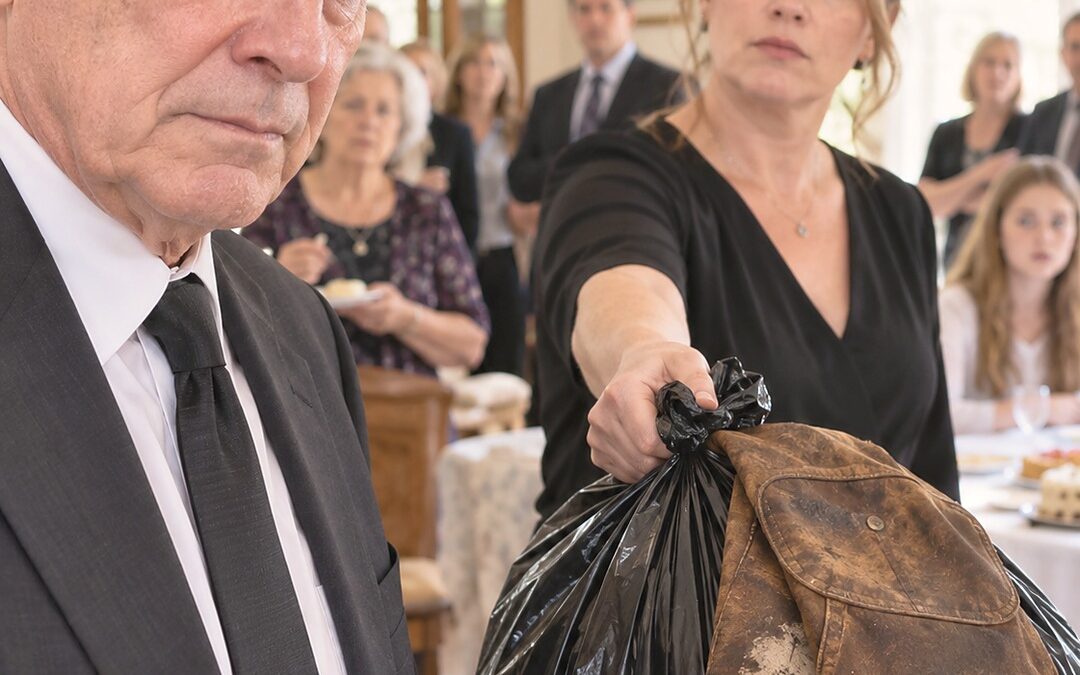
Two hours after we buried my wife, my stepson's wife handed me a black Hefty bag with my clothes already stuffed in it, in front of thirty people eating ham biscuits in Marlene's living room. Heather said it loud enough for the kitchen to hear: "Marlene's gone, Russ, and so's the meal ticket, and those aren't your grandkids, and this was never your house." I was sixty-eight, I had nowhere to sleep that night, and the two grandkids who called me Pop were watching from the cake table, and nobody in that house knew whose silver Bentley would stop out front for me forty minutes later.
My old leather farrier's apron was folded on top of the bag. Heather had taken it off the hook by the back door, where it had hung for nineteen years, and she'd folded it with the scorch mark turned up, the pale spot on the bib from a gelding that kicked a hot shoe off my anvil in 2012. Marlene complained about the smell of that apron for nineteen years. Then she'd hang it back up herself after I fell asleep in my chair. Heather had left the graveside before the last prayer, to set out the food, she said.
I looked at the carpet instead of at Heather. There were four little dents where the hospice bed had stood until Thursday, and somebody had vacuumed around them without getting them out. We'd had the service at Hager & Sons at eleven and put Marlene in the ground at Versailles Cemetery, where the wind kept lifting one corner of the casket spray and the funeral home man kept pressing it back down with two fingers. I kissed her forehead before they closed the lid, and that was about all I'd managed all day.
"Well?" Heather said. "You going to take it or not?"
Bonnie Eades, Marlene's best friend for thirty years, stood in the dining room door holding half a biscuit she'd quit eating. The three cafeteria ladies Marlene had worked with had stopped clearing plates. The bunco ladies were on the sofa in a row, and Scott's crew from the shop, all five of them, had the front window. Ron Spears from the sheriff's office stood by the hall with a paper plate of potato salad. Marlene made Ron eat his green beans in the middle-school cafeteria in 1990, and he still brings it up.
Scott was in the hallway between the living room and the kitchen with a can of Coke he hadn't opened. Forty-five years old. Marlene's only child, and the executor of her will, which she'd done on purpose so he'd feel trusted.
"Scott?"
He looked at the floor in front of my shoes. "Maybe some space'd be good, Russ."
Heather shifted the bag to her other hand. "I've got a photographer coming Monday at nine." Then, louder, "For the listing. And while everybody's here." She turned to the room. "Marlene told this whole family at Christmas there was four hundred thousand dollars put up for these kids. Scott's got her bank statements. There's not twelve thousand left in there."
"Heather," Scott said.
"Well, there's not. Somebody knows where it went."
At the cake table Emma pushed her chair back. "Mom—"
"Emma, go get another bag of ice."
"We've got ice."
"Then go check on it."
Emma looked at me first. Seventeen, with Marlene's eyes and her mother's habit of answering a question before you're done asking it. I told her go on, sweetheart. She went slow enough that her mother noticed. Tucker stayed put in the navy tie he'd worn to the cemetery, the knot pulled halfway down his shirt, a square of yellow sheet cake in front of him with one bite gone and the fork laid across the plate.
I could have told Heather a few things about that house. Marlene bought 209 Clifton Street in 1994 with her daddy's life insurance, white frame, green shutters, a porch swing that had needed new chains for six years. Before we married I had my lawyer, Nora Bledsoe, draw up a paper saying I'd never claim a board of it, so it would go to Scott, and her will said the same. In March, when she could still sit up at the kitchen table, Marlene wanted to add a line letting me stay as long as I liked. I told her, "I won't live off your house." She told Scott anyway, right there over her coffee: "Russ stays as long as he wants." Heather was standing by the refrigerator. "We'll handle it, Marlene." And Scott nodded at his mother about like he was nodding at his shoes now.
So the house was Scott's, and I'd seen to that myself. The money was another animal. Answering Heather would have meant telling thirty people something Marlene made me keep for ten years, in her own living room, on the day we put her in the ground.
I set the apron straight so it wouldn't slide off the bag. "I'll be gone before Sunday."
Heather looked at the bunco ladies. "Everybody heard him."
Scott opened his Coke then. The little snap of the tab carried all the way into the kitchen. Ron Spears set his plate down on the end table and left it there. It was Scott's house under the will, and you don't settle whose shirts are whose with a badge, but Ron didn't eat another bite. Bonnie went out through the kitchen with her purse on her arm and her phone already at her ear.
"Russ," Scott said, when I had my hand on the screen door. "She's just trying to get things organized."
"Your mother would've fed everybody here another biscuit before she sent anybody home."
His thumb worked the tab of that Coke back and forth. I went on out.
The April sun had warmed the porch steps. My truck, a 2004 F-250 with TILLMAN FARRIER SERVICE lettered on the door by hand, was in the driveway where I'd left it that morning, and Scott's work van sat behind it with two crew trucks pulled in so close there wasn't room to back a wheelbarrow out. One of them had run over Marlene's little strip of monkey grass. She'd have had something to say about that. I wasn't going back inside to ask anybody to move anything.
Gil Prather came across Clifton Street with his reading glasses pushed up on his forehead. Gil was seventy and had been a groom at Keeneland till his knees quit. He looked at the vans.
"You want me to make 'em move those vans?"
"Leave it, Gil."
"You fixing to walk to Lexington?"
"Not today."
"I've got a spare room. Don't thank me, just take it."
The knot on the bag had come loose and a gray shirtsleeve was hanging out. Marlene bought that shirt at the Kroger two Christmases ago, on clearance, because she said I needed one thing without grease on the collar. I was poking it back in when the side door opened and Emma came down the walk in her black dress with Marlene's old blue cardigan over it, holding an orange pill bottle.
"Your Lipitor, Pop. She didn't pack it."
"Thank you, honey."
"She went through the bathroom cabinet. I watched her." She took the bag out of my hands before I could stop her. "Here, give me that."
Gil was asking me whether my keys were in the house or in my pocket, so I turned around to tell him, and behind me I could hear the plastic being worked open and then pulled tight. Emma had tied it with a double knot, the kind Marlene used on bread sacks because she swore those little wire twists never stayed on.
"Can I come with you?"
"Your daddy needs you today."
"He doesn't need me. He's got a Coke." Her lower lip moved once and she got hold of it. "You didn't take Grandma's money."
"No, honey."
"Then tell Mom."
"Not today."
Heather was at the side door. "Emma! The ice."
Emma went back without answering her. At the door she turned around one more time, and I lifted the bag a little so she could see I had my pills, and she went in.
At ten after three I was sitting on the low brick wall along Bonnie's front walk next door with the bag at my feet. People came out of Marlene's house with casserole dishes under foil and looked at me and then at the house, working out what stopping would cost them. One of the cafeteria ladies did stop. She gave me half a ham biscuit wrapped in a napkin.
"You haven't eaten, Russ."
"No, ma'am."
"Marlene kept a list by the register," she said. "Kids with no lunch money. She'd settle it herself every payday. Thirty-one years." She stood up and smoothed her skirt. "I just thought you ought to know that about her."
I hadn't known. Marlene came home with her feet hurting and told me which boy ate four helpings of green beans and which teacher complained about the meatloaf, but she never once mentioned paying anybody's lunch bill. I sat there and ate the biscuit, which had gone dry around the edges, and I made it last.
Bonnie came out on her porch. Seventy-one and she'd known Marlene longer than I had, and she has never in her life bothered with hello when she had something to say.
"Sit down, Russ. Marlene told me to make a call, and I made it."
I went up and sat on her top step. "What call?"
"In March. She said if Heather tried to put you out, I was to telephone Della Calloway. So I did, at twelve till three."
"Bonnie."
"Don't Bonnie me. You men have been telling me there's things I don't understand since I learned to drive." She sat down beside me, leaving room for the bag. "She knew Heather would do this, you know."
"She could've told me."
"And you'd have argued."
I didn't have anything for that.
At 3:25 a silver Bentley Flying Spur turned onto Clifton Street, came slow past Gil's house and stopped at the curb dead in front of Marlene's big front window. A driver in a gray suit got out and came up Bonnie's walk.
"Mr. Tillman? Mrs. Calloway sent the car. She said you'd argue, and I'm to wait."
I could see the faces gathering in Marlene's window. The same people who'd watched Heather hand me the bag were looking at the car now. Heather came to the screen door and held it open with her elbow and turned her head back toward the living room.
"His boss lady sent her car. Rich old widow out on Old Frankfort Pike. That man's got a type."
Somebody inside laughed, one short laugh, and then quit. Scott came out past her onto the porch.
"Russ, whose car is that?"
"Della Calloway's."
"I know who Della Calloway is. What's she sending it for you for?"
"Giving me a ride."
"Mom never said anything about this."
There was a strip of green paint peeling under the nearest shutter. I'd promised Marlene I'd scrape it when the weather turned warm. "Your mother knew Della," I said.
"Scott," Bonnie said from her steps, "let the man go."
The driver tried to take the bag for the trunk and I kept it. I got in the back and set it on my knees. Tucker was at the window between two of Scott's crew, still in that tie. He lifted his hand. I lifted mine. He stayed in that window till we turned the corner.
We took Old Frankfort Pike out of town, past the stone fences. I shod other people's horses forty-four years, 1980 to 2024. In 2003 a broke trainer paid a $1,100 shoeing bill with a crooked-legged yearling filly nobody else would take. I named her Crooked Penny and spent two years straightening those legs. She never raced. In 2011 Della Calloway let me breed her to her stallion free, in trade for my work, if we'd own the foal half and half. Nora set up Bent Nail Stable LLC for my half. I named it for the two horseshoe nails I'd bent into wedding rings at my anvil the night before Marlene and I got married at the Woodford County Courthouse, Friday, June 16, 2006.
The colt came in 2012. Penny Whistle. In October 2015 he won the big fall sprint at Keeneland, and Della held the trophy and I watched from the rail in my work jacket. He's stood at stud at Calloway Farm since 2016, and Bent Nail's half of one good year beats what I made in forty-four years with a hammer.
Scott never knew any of it. At our first family supper in 2006 he looked across Marlene's table at me and said, "So you make your living at the back end of a horse." His daddy had been a racetrack groom and a gambler who walked out in 1990 when Scott was nine, and Scott hasn't watched a race since. Marlene made her rule in 2016, the first spring Penny Whistle stood at stud. Scott was never to know I could bail him out, or he'd never stand up on his own. Any help went through her. Della did the trophies and the pictures, and horse people figured Bent Nail for some investors from out of state. The race programs said Calloway Farm and Bent Nail Stable (c/o Bledsoe & Associates), and in every winner's circle picture I was the one outside the frame. The family saw an old truck and a man who did a little work for his boss lady out on the Pike.
In August 2019 Bent Nail wired Marlene a hundred and forty thousand dollars, and the next day her cashier's check saved Scott's shop. He thinks it was her savings. And in 2017 I put four hundred thousand dollars where neither of Emma and Tucker's parents could ever reach it, because Marlene asked me to, and because by then I'd met Heather.
I reached in the apron pocket for my reading glasses and my fingers hit something small and hard. It was a ring. One of the two horseshoe nails I bent at my anvil nineteen years ago. Marlene's. She'd got so thin after February it kept sliding off her finger, and I'd figured she put it away in her jewelry box. Mine has been on a chain around my neck since the wedding, because a farrier who wears a ring under a horse loses the finger. Under it was a piece of notepaper folded in four. She must have put them there the second week of March, the last week she could still walk down the hall to the back door by herself.
Her handwriting had gotten small at the end.
"Russ— If Heather puts you out, don't argue with her in my house. Get in Della's car. Then quit keeping my secret. It was never yours to keep. —M."
There was a little dent in the paper where she'd pushed too hard on the pen at "secret." I folded it back on its creases and put it in my shirt pocket. Then I pushed her ring onto my left little finger. It stopped at the knuckle, and I left it there.
"Would you turn the radio down a touch?" I asked the driver.
He looked at me in the mirror. "Sir, the radio's not on."
"All right, then."
About 4:15 we went through the day gate at Calloway Farm, past the stallion barn and the farm shop where my anvil has sat since before Penny Whistle was born, to the stone cottage behind the stallion barn that Della has called mine since 2016. I'd never slept there more than two nights running. Della was on the porch. Seventy-four, pearls, one hand on her cane, eyes too poor to drive anymore but she can still see a horse standing wrong at fifty yards. She looked at the Hefty bag.
"Good Lord. She put your clothes in the garbage."
"Ran short on suitcases, I guess."
"Marlene called me in March. Told me what Heather would do and what time she'd do it. She was off by twenty minutes."
"You could've warned me."
"She said you'd argue." Della pointed her cane at the door. "You are arguing."
From the barn Penny Whistle called, that high ringing whinny of his. I'd know it in my sleep.
After supper I called Nora Bledsoe at home from Della's kitchen phone with Della across the table listening and not pretending otherwise. Nora's been my lawyer since 2003, when I needed a bill of sale on a crooked filly.
"Russ? How'd it go today?"
"She had a good service." I looked at the ring on my finger. "Get the trust papers out, Nora. Monday I'm telling Scott."
Nora was quiet a second. "Does Heather know anything?"
"She thinks Marlene had four hundred thousand dollars in her checking account."
Della set her teacup down hard enough to slop it.
Back at the cottage I worked Emma's double knot loose and emptied the bag on the bed. My shirts went on hangers. The Lipitor went by the bathroom sink. My navy sport coat had been folded up under my work jeans, and I shook it out and hung it at the far end of the closet without going through the pockets, and it stayed there. I hung the apron over a kitchen chair. I put Marlene's note on the table by the lamp and went to bed about eleven and laid there.
At 7:40 Sunday morning my phone buzzed on Della's kitchen table. It was Emma, and it was a picture of her mother's Facebook post: 'My mother-in-law's husband drained her accounts while she was dying. Her grandkids' college money is GONE. He left her funeral in a Bentley.'
Part 2
The picture under Heather's post was taken through Marlene's front window. It showed me ducking into the back of the Bentley with that Hefty bag hugged to my chest, and she'd cropped it so tight you couldn't see Bonnie standing on her steps three feet away. That took some doing with a phone.
Della came into her kitchen in her house shoes and a quilted robe. "Who died now?"
"Nobody."
"Then why's that thing been buzzing since six?"
I turned the screen around. She put on her glasses and read it with her mouth pulled to one side.
"Well, that's ugly. Call Nora."
"I called Nora last night."
"Call her again." She cracked an egg on the side of the skillet harder than an egg needs. "You're going to sit at my table and let that woman tell the whole county you robbed your wife on her deathbed?"
"I'm going to drink my coffee."
"Marlene told you to quit keeping her secret, Russ. She told me what she wrote you."
I didn't have an answer for that which wouldn't start a fight before breakfast, so I didn't give one.
By nine Heather had added a link under the post. A GoFundMe called Emma & Tucker's College Fund, organized by Heather Medley, goal $25,000. The picture was an old Christmas one of the kids in front of Marlene's tree, Tucker in braces, Emma in the green sweater her grandmother got her at JCPenney. Heather wrote that both children faced an uncertain future because the money promised for their education had disappeared. I read the whole thing. She never once said where the money had been kept, or that she'd ever laid eyes on it.
The post had 412 comments. I read nine. A woman I hadn't seen since the Woodford County Fair called me a disgrace to Marlene's memory. Somebody tagged the sheriff's office. A fellow whose mares I'd shod for twelve years wrote that he'd always figured me for honest, and that was the one I stopped on.
Della took the phone out of my hand and turned it face down by the butter dish. "Quit reading that mess."
By noon it had a little over two thousand dollars. I knew the names. One of the bunco ladies gave a hundred. A boy from Scott's crew gave fifty he didn't have. Two of the cafeteria ladies gave twenty-five apiece. They'd stood in Marlene's living room eating her ham and watched Heather hand me that bag, and now they were paying to put back money nobody had taken.
A little before noon Gil Prather drove my F-250 up the farm lane. You can hear that diesel coming a quarter mile off. He parked by the cottage and climbed down holding the keys.
"Heather told me to get it off her driveway," he said. "Said the photographer needs a clean shot of the house Monday. I told her I'd be glad to." He looked up the hill toward the big house, where the Bentley sat in the open garage with the driver wiping the hood with a chamois. "Your boss lady's got a nicer car than the governor."
"She's had it a while."
"Well. Good for her." He dropped the keys in my palm and went around back to kick my left rear tire, which was low, and which he told me was low, twice. Before he left to walk up and beg a ride home off Della's farm manager, he laid one finger on the lettering on my door. "Forty-four years you drove a truck said that on it. Never cheated a soul on a bill."
"I've made mistakes."
"That's not what I said, Russ."
Monday at 7:30 in the morning I drove to Medley Heating & Air on Lexington Road. I had a plain envelope inside my jacket with a photocopy of the first page of the trust, which Nora mailed me years ago and I kept with my farm papers. The real thing was at Pisgah Bank & Trust. It was never in Marlene's name and never in any account she could see. I'd come to show Scott, just Scott.
He was at the service counter sorting tickets. He'd missed a spot shaving under his ear, and there was a gray smear of solder on his work shirt from some job the week before. He saw me and put the tickets down.
"Heather's lawyer says I can't talk to you."
"Did you ask yourself whether you want to?"
He rubbed the bridge of his nose. Then he said it low, so it wouldn't carry to the office in back. "Did you take it, Russ? Just yes or no."
"No."
"Then where is it?"
"It's safe. It's been safe since before Tucker could ride a bicycle. Your mother never—"
The office door opened. Heather came out in black slacks with her phone in her hand. She had a lawyer in Lexington by then, the one whose face is on the side of the city buses.
"He'd say that." She came around the end of the counter. "Whatever you've got in your jacket, Russ, it goes to my attorney."
I hadn't known she'd seen the envelope. "It's for Scott."
"Then the attorney can look at it first."
Scott looked from her to me. "Do you have proof or don't you?"
I thought about handing it to him. Then I thought about what it was, a photocopy out of my own file cabinet, and what a man whose face is on a bus would say about it. That I'd printed it at the library. And I'd come there to talk to my wife's boy, and here the three of us were in his shop arguing over who got to touch an envelope.
"I'll bring you the real papers," I said. "From the bank."
"That's what I thought," Heather said, and she was already dialing somebody.
Out in the lot one of the crew was strapping a ladder to a truck. He saw me and gave the ratchet strap three more cranks it didn't need.
That afternoon Heather walked into the Woodford County Sheriff's Office and signed a sworn report saying I took approximately $400,000 from Marlene during her final months.
I found out Tuesday morning, when Ron Spears drove out to the cottage in a brown work jacket with a folder under his arm. Ron is forty-nine now and still eats his green beans first, because Marlene caught him hiding them in his milk carton in seventh grade and he's never got over it. He stood on my porch a minute listening to Penny Whistle holler from the stallion barn.
"That horse yours?"
"He wants his breakfast."
We sat at the kitchen table and he opened the folder. On top was a copy of Marlene's last bank statement. Scott was executor, so the bank had given him her last twelve months, May of last year through April. Pension coming in, hospice and the Kroger going out. The balance at the bottom said $11,412.
"Heather's position," Ron said, "is the money went out before these start. After Marlene got sick." He turned a page. "Scott asked the bank yesterday for three years of statements. They told him two, three weeks and a research fee. And Heather told him, quote, 'We don't need them. We know.' She told me that herself, like it helped her."
"Marlene never had four hundred thousand, Ron. I did."
He stopped turning pages. "Then show me."
"There's a trust at Pisgah Bank. For Emma and Tucker. Nora Bledsoe's got the file." I wrote Nora's number on the back of his folder, since he didn't seem to have any other paper.
"I'll need it certified from the bank, Russ. She signed a sworn report. A photocopy anybody can make on a Xerox doesn't answer that." He tapped the number. "Trust department's in Lexington. About a week, usually."
"And in the meantime she tells the whole town I stole it."
"In the meantime, if you go around waving copies, she says you made them, and it looks like you did. Get me the real thing." He closed the folder. "I haven't decided a thing about her report. I want you to know that."
Wednesday's mail brought a letter from the lawyer on the bus. It was dated Tuesday, April 21. It demanded an accounting of Marlene's money and the "return of $400,000 in education funds" within seven days, which ran out at five o'clock Tuesday, April 28, or they'd file suit. Della read it at her dining table and handed it back by one corner.
"And don't you dare write that woman a check."
"I wasn't fixing to."
That afternoon the fundraiser went over five thousand dollars. Another name I knew from the funeral, a man who'd sent a ham. I sat on the cottage step and wrote Heather a text and read it over for a while before I sent it.
"Take the GoFundMe down. The kids' college is safe, and I'll show you in writing."
Her answer came in under five minutes.
"Talk to my lawyer, Russ."
An hour later she had a screenshot of my text up on the fundraiser page as an update. Over it she'd typed four words: "Now he's threatening us." By suppertime there were six new donations under it.
I went out to the back of the stallion barn, where a gate latch had been rattling in the wind since breakfast, got a wrench from the shop and tightened it. Then I tightened it some more and stood there with the wrench in my hand.
At six-thirty my phone rang while I was still standing out there by the gate.
Bonnie didn't say hello. "She's doing Marlene's Derby party, Russ. Same people, same house. And she told the bunco girls she's going to stand up before post time and read out what you stole."
Part 3
Nora Bledsoe's office is up a flight of stairs over the old hardware store on Main Street, and the third step has had a dip worn in it since before either of us was born. I went up those stairs Thursday morning with a lawyer's letter in my jacket asking me for four hundred thousand dollars I didn't owe anybody.
Nora is sixty-one and has had my business since 2003. She held out her hand for the letter without looking up from her desk.
"That the fellow off the buses?"
"That's him."
"I've dealt with that office. Leave it here." She dropped it in a wire basket like it was a seed catalog and turned a thick folder around to face me. "Before we get into Heather's nonsense, I want you to look at this again."
THE MEDLEY GRANDCHILDREN'S EDUCATION TRUST. September 11, 2017. My signature was still right where I'd put it, back when Emma needed a step stool to reach Marlene's sink. Nora put her finger on the line in the middle of page one with both kids' names in it, and then on my signature at the bottom, in the same square, heavy hand I'd used on forty-four years of shoeing bills.
"It's irrevocable," Nora said. "Pisgah pays the school directly, tuition and books and housing, and no parent can draw a dime or borrow against it, and the bank writes each child at eighteen." She leaned back. "I wrote the bus fellow yesterday afternoon, after you called me about his letter. Told him the money's in an irrevocable trust that Marlene never owned a dime of. Which is about what Marlene told them at Christmas, isn't it."
It was close. At Christmas dinner in 2024, Marlene had set down the gravy boat and said to the whole table, "The kids' college is taken care of. Four hundred thousand, and nobody touches it." Heather asked her right then, across the sweet potatoes, where the money was. Marlene buttered a roll and said, "The bank will write Emma when she turns eighteen." That was all. She never said whose money it was, and Emma's college applications never went near it, because the trust doesn't pay a nickel until a child is enrolled somewhere. So Heather had spent sixteen months believing it was sitting in Marlene's checking account, and now she believed I'd emptied it.
"Heather was at Pisgah on Tuesday," Nora said. "She had Marlene's death certificate and asked for the kids' college account. I'm counsel on the trust, so the bank called me after."
"What'd they tell her?"
"The girl at the desk said, 'I can't discuss that, ma'am.' And Heather walked out of there telling people in the parking lot you'd already cleaned it out."
I rubbed my forehead. Down on Main Street a delivery truck had half the road blocked and somebody was leaning on a horn about it.
Nora slid one more sheet across. The wire record from August 2019. A hundred and forty thousand dollars from Bent Nail Stable to Marlene Tillman, the day before Marlene walked into Scott's office with her cashier's check. "I've got this, too, if it comes to it."
"Not unless I have to."
"He still thinks his mother saved that out of her lunch-lady pension?"
"Far as I know."
She studied me over her glasses. "You've kept an awful lot from that boy, Russ."
"I kept a promise to his mother."
"Those aren't always two different things." She put the wire record back. "The certified copies come from the trust department in Lexington next Thursday, the thirtieth. That's what Ron will take and what the bank will stand behind. Nothing else holds up against a sworn report, and you know it."
"Then we wait a week."
"And then what?" She took her glasses all the way off. "You want to do this in front of the whole town?"
"She did."
"You could settle it with Scott private."
"I tried Monday. I asked him at his own counter, and his wife answered for him."
Nora put her glasses back on, wrote THURSDAY 4/30 on a yellow sticky note, and pressed it onto the front of the folder with her thumb till it stayed.
Saturday morning I had Penny Whistle's left front foot between my knees in the stallion barn at Calloway Farm. He's fourteen and he still leans on you halfway through a trim to see if you'll hold him up, and I still won't let anybody else do his feet, knees or no knees. The aisle smelled like clean straw and the neatsfoot oil I'd rubbed into his halter.
"Quit that," I told him, and he leaned harder.
Della stood in the aisle on her cane. "He's behaving better than Heather."
"He generally listens when there's feed in the bucket." I set the foot down and reached for my rasp. "I'm going to Marlene's party, Della. Next Saturday."
"Nora told me. Then I'm going too."
I straightened up slow, one hand on his shoulder. "You don't need to get mixed up in this."
"I've been mixed up in it since 2011. That woman's calling you a thief over money that came out of this barn." She pointed her cane down the aisle at the horse. "Out of him. I'll come in my own car at twenty after six. Before the post parade, because nobody listens to anything once the horses are on the track."
She took her phone out of her coat pocket and held it at arm's length to find the right button.
"What are you doing?"
"Having my office call 209 Clifton Street." She got somebody in the farm office and said, "Honey, ring Mrs. Medley and RSVP for Mrs. Calloway and Mr. Tillman to the Derby party, please," and hung up, and looked at me. "Della Calloway doesn't walk into another woman's house without an RSVP."
"Heather will laugh."
"Let her."
I went back to his feet. Della stood there till I was done, telling me things about that horse I'd known since the night he was foaled.
Monday, April 27, Nora drove out to the farm herself, which she does about once a decade, and handed me the answer from Lexington on the cottage porch. It was one paragraph. "Absent documentary proof of the alleged trust, our client intends to proceed as stated in our letter of April 21."
"I told him what it was," I said.
"You told him through me, on my letterhead, with a photocopy he can say you made." Nora took the letter back and folded it in thirds. "He's going to file Wednesday, Russ. Filing is how a man like that gets paid. Thursday we'll have the certified copies, and then it's not my word, it's the bank's."
"And till Thursday?"
"Till Thursday you stay off Facebook and away from Clifton Street."
Tuesday at the Kroger the cashier, who'd known Marlene from the middle school, asked was I going to the party Saturday. When I said I was, her hand stopped over my bread sack.
Wednesday, April 29, started with a little rain. Nora called at nine-fifteen while I was on a stepladder fixing a hinge on the cottage screen door.
"She filed this morning. Woodford Circuit Court. Conversion, four hundred thousand dollars."
"That all?"
"That's plenty. Russ, stay away from her till Saturday."
"I wasn't planning on paying a call."
Around four I heard tires on the gravel. A white Chevy Tahoe came up the farm lane, right past the stallion barn without stopping at the office, because the day gate stands open and Heather had never in her life waited at a gate. She parked in front of the cottage and got out in big dark sunglasses, though it hadn't been sunny since Monday.
She looked the cottage over. The stone walls, the porch, the window boxes Della's girl keeps planted. She looked at it about like she'd looked at Marlene's kitchen cabinets the week after the funeral home came, deciding what was worth keeping.
"Nice. Must be handy, having somewhere to go when you leave somebody else's house."
She looked past me through the open door. The bed I hadn't made. My work boots by the kitchen chair. Marlene's note propped against the lamp, which from where Heather stood was just a piece of paper, and she looked right over it.
"What do you need, Heather?"
"Scott says you came by the shop with papers. My attorney hasn't received anything real."
"He'll get what he's got coming."
"We filed this morning, so you know we're serious." She took off the sunglasses. "And I heard about your RSVP. Your boss lady's office called the house like it was a wedding. I told the bunco girls, 'Let him come. Ron'll be there.'" She said Ron's name like she had him in her purse. Ron hadn't told her one thing since she signed that report. He doesn't tell a complainant anything in the middle of a case, but Heather took quiet to mean yes.
"Ron comes every year," I said.
"This year he's coming for a reason." She rubbed at a spot of mud on the Tahoe's door with her thumb. "You know the bank's calling Scott's line of credit? June thirtieth. Two hundred and twelve thousand dollars. You know what that does to a man?"
"I didn't know the amount."
"We could sell the house, but houses don't sell overnight, and we've got five men to pay on Fridays. So don't you stand there and tell me about those kids, Russ. Those kids are why I'm doing this." She glanced up the hill at the stallion barn and the big house behind it. "All this money sitting out here in horses, and Scott working himself half to death."
I thought about the August 2019 wire. Heather had been running the office that summer, and she deposited Marlene's check without asking where it came from. Scott didn't ask either. I didn't say any of that.
"I was trying to do this quietly," she said.
"You handed me a garbage bag in front of thirty people."
"You agreed to leave."
"I did."
"And now you're coming back with a lawyer and that woman."
There was mud splashed up the whole side of the white Tahoe from the farm lane. Heather opened her car door and looked back at me over the top of it. "You set one foot in Marlene's house Saturday, and Ron Spears will walk you out in handcuffs in front of everybody she ever fed. And you'll never see those kids again."
Part 4
Gil called at a quarter to eight Thursday morning. Somebody had looked the lawsuit up on the state court website, taken a screenshot of it, my full name and "conversion" and the dollar amount, and put it up on the Versailles community board, where it had more comments by breakfast than the post about the water main.
"Bonnie says they're calling you a thief down at the Kroger," Gil said.
"They've been calling me that since Sunday."
"Well, now it's got a case number. People believe a case number." He cleared his throat. "You want company today?"
"I've got somewhere to be."
At ten I was in Nora's office over the hardware store with a cup of her coffee, which is terrible and always has been. The certified copies had come down from Lexington that morning, with the trust department's raised seal on every page, and she had them squared up on her desk like a deck of cards.
Ron Spears knocked and came in and didn't take his coat off. He said good morning and sat down across from us and read. He read every page, turning each one by the corner, and Nora let him. A clock on Nora's filing cabinet that's been five minutes fast since the Clinton administration ticked. When he got to the bank's certification on the last page he went back to the front and read the first page again.
"So Marlene never had it," he said. "Not a dollar of this was ever in her name."
"No."
He shut the folder. "I'll go see the county attorney Monday about Heather's report. We'll do it the right way, which means nobody hears about it from me before then. Not her and not anybody at that party." He looked at Nora. "I'd take it kindly if you'd sit on your answer to that lawsuit till Monday too."
"I can do that," Nora said.
"What about the fundraiser?" I said. "She's past seven thousand. Marlene's bunco ladies. Your own deputies' wives, for all I know."
Ron put his hat on his knee. "Being wrong on the internet's not a crime, Russ. Spending the money might be."
He went down the stairs without touching the rail.
Della called while I was still sitting there, and Nora put her on speaker so she wouldn't have to repeat everything, which Della never does anyway.
"Nora says the papers came."
"They came."
"Then I'll make this easy. I'll wire the four hundred thousand to whatever account that woman wants this afternoon, she can buy herself a new hat, and you can come home and trim my mares."
I looked at Nora's window. There was a pigeon on the sill walking back and forth like it had lost something.
"That's their college. I'm not buying my name back with it."
Della breathed out through her nose loud enough to come through the speaker. "You're as stubborn as Crooked Penny ever was."
"She was easier to get along with."
"She couldn't talk."
I drove back out the Pike with a copy of the certified papers on the seat beside me. Halfway out the Pike my phone buzzed and I pulled over, thinking it was Heather.
It was Tucker.
"Mom says we can't come see you anymore. Is that true?"
The little picture by his name was him at ten years old in one of my old work caps, standing next to a mare whose name he couldn't remember even then. I took it on his birthday. When he was little he'd spend whole Saturday afternoons in my shop sorting horseshoe nails by size into a cardboard box he'd marked KEEP in green crayon, and Marlene wouldn't let me throw that box out even after he quit coming.
I typed, No buddy, you can come see me anytime. Then I thought about Heather picking up his phone at supper, and I erased it. I typed, Ask your dad. That was worse, and I erased it. The third one was longer. It said I loved him and I'd see him real soon. I sat there with my thumb over it, wondering what real soon meant to a thirteen-year-old whose mother had just told him never, and I erased that one too, and the screen went dark in my hand.
A milk truck went by and rocked the F-250 on its springs. I pulled back out.
At supper Della's driver walked a plate down from the big house, roast beef and mashed potatoes under plastic wrap, and set it on my counter and didn't leave.
"Miss Emma called the big house asking were you eating," he said. "Mrs. Calloway said I'm to tell her yes or no, and it had better be yes."
Marlene made roast beef on Sundays when Scott brought the kids, and Tucker wanted his potatoes with no gravy touching them, and Emma ate the carrots off the platter before anybody sat down. I pulled the wrap off and sat down, and he stood by the door with his hands folded till I'd had three bites, and then he went back up the hill to make his report.
That night about nine I went to the closet to find something fit to wear Saturday. I'd been living in my work clothes since the funeral. The navy sport coat was hanging way down at the end where I'd shoved it the night I unpacked the Hefty bag, and I hadn't laid a hand on it since. Marlene bought me that coat in 2017. She said a man who owned two pairs of funeral shoes ought to have a jacket to go with one of them.
There was a crease across the back of it from where Heather had folded it up under my jeans. I was brushing that out with my palm when I felt something stiff over the inside pocket, the one on the left.
It was Marlene's Derby pin. The little silver horseshoe I made her in 2015 out of one of Penny Whistle's racing plates, after Keeneland, and polished till she said she could see her lipstick in it. She wore it on her Derby hat every first Saturday in May for ten years. When people asked about it she only ever told them, "Russ made it out of an old horseshoe." Not a soul at those parties knew where the horseshoe came from.
There was a yellow sticky note folded around it.
"Pop — Grandma's Derby pin. Mom was going to wear it. —E."
So that's what Emma was doing with her back to me, on the curb, while I was telling Gil where my keys were. Getting the Lipitor in. Finding my coat by feel down in that bag and putting her grandmother's pin where her mother wouldn't think to look for it.
I sat on the bed. There's a rough spot by the clasp I never did get filed smooth, and it used to catch the lining of Marlene's hat. Every May I offered to fix it and every May she said leave it alone, Russell, it's fine, and every May it caught. I ran my thumb over it till I found it.
I set the pin on the windowsill. Then I put my boots back on and went down to the barn to check a mare that didn't need checking, and stood in her stall with my hand on her neck till she got tired of me and moved off to her hay.
Friday I cleaned out the truck. Old nails in the door pocket. A tube of hand cream Marlene kept in the glove box because my knuckles split every winter, squeezed flat and rolled up from the bottom like toothpaste. I threw out the coffee cups and left the hand cream.
At 9:10 that night headlights came up the farm lane. Scott's work truck, MEDLEY HEATING & AIR on the door and a ladder on the rack. He sat out there with the engine off a good while before he got out, and he came up on the porch in his work shirt with the sleeves rolled, and I opened the door before he could decide whether to knock.
"Can I come in?"
"You can."
He came in as far as the doormat and stood there looking around at the stone walls. "Mom always liked it out here."
"She did."
"Heather sent me over to the house today to clean out Mom's nightstand. For the photographer."
"I thought the photographer was two Mondays ago."
"She put it off so she could get Mom's things boxed up first. It's this Monday now." He rubbed his forehead with the back of his wrist. "Mom's old checkbook was in the drawer. You know how she was. Receipts, coupons, a grocery list from 2016. And this." He reached in his shirt pocket and took out the wire confirmation, stapled to a scrap of check register, with "for Scott's shop" written beside the amount in Marlene's hand. "Mom came in the office with a cashier's check that August and said she'd been putting a little back for years. Heather said we were lucky she had it." He swallowed.
I leaned back against the kitchen counter. He'd been nine years old when his daddy left and twenty-five when I came along, and I never once asked him to call me anything but Russ.
He backed up into the doorway and held it up under the porch light. "Mom stapled this in her checkbook. A hundred and forty thousand dollars, wired to her the day before she saved my shop. From something called Bent Nail Stable. Russ, what's Bent Nail Stable?"
Part 5
I didn't answer Scott's question Friday night. "If I told you tonight, Heather would have it twisted by breakfast," I said. "Come to your mother's party and stand where you stood the day of her funeral. Hear it with your own ears." And then I shut the cottage door with him still on the porch, which I'm not proud of.
At 6:05 Saturday evening, May 2, I parked the F-250 at the curb in front of 209 Clifton Street, the same curb, with Nora Bledsoe in the passenger seat holding her briefcase on her lap with both hands. Somebody had trimmed back the monkey grass where the crew truck ran over it. I straightened my navy sport coat on the walk, and we went up the steps and in the front door without knocking, the way I'd come in that door for nineteen years.
Marlene's silver julep cups were lined up on the sideboard. A white rental tent took up most of the side yard, with folding chairs under it nobody was sitting in. Somebody had made Benedictine sandwiches and cut the crusts off, though not as thin as Marlene cut them. The big TV in the corner had the post-parade coverage on with the sound down low. And there they all were, about thirty of them, the same ones. Bonnie by the kitchen door. Gil with his back to the big front window. The three cafeteria ladies passing a tray. The bunco ladies on the sofa, Scott's five men around the TV, and Ron Spears by the julep table in a sport coat, with his wife beside him picking the olives off a relish plate. Emma and Tucker at the cake table. And Scott in the hallway between the living room and the kitchen, right where he'd stood on April 18, with nothing in his hands this time.
Heather was by an easel in a big cream Derby hat with a green ribbon around the crown. There was no pin on it. The poster board on the easel had pictures of the kids glued all over it, and across the top in stick-on letters:
"EMMA & TUCKER'S COLLEGE FUND — $8,340 — THANK YOU, VERSAILLES!"
She saw me and touched Ron's sleeve as he went by her. "Ron, there he is."
"I see him, Heather," Ron said, and he went on to the julep table.
Tucker started across the room toward me and his mother said his name, and he stopped where he was with his plate. So I went to him. I asked how school was. He said okay and could he come see Penny Whistle sometime, and I said we'd work on it. Emma came up behind him. Her eyes went to my coat, to the left side, and back up to my face.
"Did you find it?" she said, so low I almost didn't catch it.
"I found it, honey."
She nodded and swallowed and went back to the cake table.
At 6:15 Heather tapped a spoon on one of Marlene's julep cups. The cafeteria ladies set their trays down. One of Scott's boys turned the TV down another notch.
"I just want to thank everybody for coming. Marlene threw this party every year, and Scott and I felt like she'd want it kept up." She put her hand flat on the poster board. "And I want to thank this town. When we found out what happened to the money Marlene put back for these kids, y'all stepped up."
Thirty heads turned my way, give or take. I stood by the front door with Nora.
Heather picked a bank statement up off the little table under the easel. "Scott, honey, hush, I'm almost done," she said, because he'd started to say something from the hall. She held the statement up high.
"Eleven thousand four hundred and twelve dollars. That's what was left of Marlene. Four hundred thousand for these kids, gone." She looked straight at Emma. "And every one of us heard her say it at Christmas. 'The kids' college is taken care of. Four hundred thousand, and nobody touches it.' Those were her words."
"It isn't gone," I said from the doorway.
Heather turned around slow. "Then where is it, Russ?"
Out front, a car door shut. Gil turned to the window, and then two of the bunco ladies got up off the sofa to look, and then most of the room was at that window, the same window, looking at the same curb, where a silver Bentley Flying Spur was sitting exactly where it sat on April 18.
"Well," Heather said, and she smiled at the room. "Here comes his rich widow."
The driver in the gray suit came around and opened the back door, and Della Calloway put her cane down on Clifton Street and came up Marlene's walk in a navy dress and her pearls, slow, with the driver one step behind her.
Gil had his face about two inches from the glass. "Heather," he said, "that's Della Calloway."
I held the screen door. Della came in and stopped on the rug and looked the room over, all of it, the poster, the hat, the julep cups, and then she looked at Heather.
"I'm not his widow, honey. I'm his partner." She shifted her weight on the cane.
Heather laughed, a little high. "Partner in what? Horseshoeing?"
"In Penny Whistle," Della said. "Forty thousand dollars a cover, every spring since 2016."
"Bent Nail?" Gil said. "Penny Whistle's Bent Nail?" He looked at me and then down at my boots. "I've read that name in the program at Keeneland every fall for ten years, Russ."
"You never asked, Gil."
"Well, you don't ask," Gil said, to nobody in particular, and he sat down on the arm of the sofa, which Marlene never let anybody do.
One of Scott's crew said, "Penny Whistle, the stud horse? Out on the Pike?" and another one told him to hush. In the hallway Scott's hand went to his shirt pocket and stayed there, flat over the wire confirmation.
Nora opened her briefcase and handed me the certified first page. I didn't give it to Heather. I held it out to Emma.
"Read the line in the middle, honey. Out loud, so your grandmother's friends can hear."
Emma took it in both hands. She read the top to herself first, and I watched her get to it.
"Pop. That's my name."
"Go on."
Her voice wobbled on the first few words and then it didn't. "for the benefit of my grandchildren, Emma Rose Medley and Tucker James Medley"
Tucker came around the cake table to look. "My name's on there too?"
"It's been on there since 2017, son."
Heather took the page out of her daughter's hands. She ran her finger down it like she was looking for a mistake on an invoice, and she found the bottom line. "Settlor: Russell D. Tillman." In my handwriting, square and heavy from forty-four years of writing out bills on the hood of a truck, the same handwriting that had been stuck to Marlene's refrigerator under a Kroger magnet on every farrier invoice since 2006. Heather had looked at that refrigerator every Sunday for nineteen years. I watched her look at my name and then up at the fridge, through the kitchen door, and back down.
"Marlene said—"
"Marlene said the kids' college was taken care of," I said. "She never said who took care of it."
"You could have told us. At the funeral, you could have—"
"You handed me the bag." I let her have a second with that. "You were right about one thing, Heather. This was never my house. But those have always been my grandkids, and the meal ticket was me."
Heather took off the Derby hat. She held it by the brim and set it down on the easel, right over the $8,340, and her other hand caught the wood frame till the easel quit rocking.
Ron Spears put his julep cup down. "There never was four hundred thousand dollars in Marlene's name, Heather."
His wife set the relish plate down too. One of the cafeteria ladies sat all the way down on the piano bench like her knees had made the decision for her.
Scott came out of the hall. He had the wire confirmation in his hand, unfolded, and his crew was right there by the TV where they'd been on April 18, close enough to hear every word of it.
"I stood right there in Mom's hall and let her hand you that bag." His voice went on the last word and he pushed through it. "Y'all saw me. I owned this house and I stood there with a Coke." He held the paper up at me. "This was you? In '19?"
"Your mother asked me. I said yes."
"I should've took that bag out of her hands."
Heather said, "Scott, don't you do this in front of—"
"You did," Scott said.
Emma stood by the cake table. She didn't go to her daddy, and she didn't go to her mother. She stayed right where she was.
The bunco lady who'd sat next to Marlene on Thursday nights since 1998 got up off the sofa. "Heather, you sat on my porch Sunday afternoon and told me you knew. Not thought. Knew."
"We believed—"
"I'd like my hundred dollars back, Heather."
"What?" Heather said.
"Twenty-five," one of the cafeteria ladies said. "That was for those kids."
"Fifty," said one of Scott's men, the one who'd turned away from me over a ratchet strap. The man next to him said, "A hundred. I'd like mine back too." Behind them three, four more had their phones out with the receipt emails up.
Heather got her own phone out of her purse. Her thumb missed the screen twice before it unlocked. "I'll refund everybody. I'm doing it right now, I'm doing it."
People started drifting out to the porch after that, a few at a time, with their julep cups and their napkins, nobody telling them to. Ron and his wife went out. The cafeteria ladies went out carrying the trays they'd brought, because a Kentucky woman doesn't leave a dish at a house like that. The crewman who'd stood by Tucker at the window on the day of the funeral stopped beside me on the way.
"Should've helped you with that bag, Russ."
"Help Scott get his trucks out of the drive sometime," I said. "That'd do."
Della held out her elbow, and I walked her to the porch swing. She sat down at one end, and I took the other, and the chains Marlene asked me to replace every spring for six years creaked the same as always. I always told her after Derby.
Inside, the announcer was saying the horses were going into the gate.
Gil leaned in the front door. "You're not going to watch it, Della?"
"I've seen horses run. Call it for us."
At 6:57 the Kentucky Derby went off on the big TV in Marlene's living room with nobody watching it. Gil stood in the doorway with one foot on the porch and called it for us the whole way around, wrong twice, and the people on the steps hollered at him. Marlene would've told him to get out of the doorway, he was letting the flies in.
Through the screen I could see Heather still standing by the easel with her phone, and Emma beside her, reading over her shoulder.
"Mom, why does it say you already took out thirty-one hundred dollars?"
Part 6
The thirty-one hundred dollars paid for a party tent from a rental place in Lexington and a caterer out of Midway, and Ron Spears found both in the first subpoena the county attorney's office sent GoFundMe, back in early June. Heather took the money out on Thursday, April 30, the same morning Ron was in Nora's office reading my papers.
On Tuesday, June 16, she stood up in Woodford District Court in a borrowed navy suit that was tight across the shoulders and read her statement off her phone. She'd pled guilty to falsely reporting an incident, and to theft by deception, which the county attorney knocked down to a misdemeanor, and her own lawyer asked the judge to let her say it out loud in open court. I expect he thought it would go easier on her.
"I said Russell Tillman stole from Marlene and from my children. He did not. He paid for my children's education, and I took money from my neighbors in their names."
Her thumb kept sliding on the screen, and she lost her place once and had to scroll back up.
I was in the second row with Scott. Bonnie was on my other side and Gil past her, and across the aisle Ron sat with his arms folded. Behind us were most of a row of people who'd given to that fundraiser, including the husband of one of the bunco ladies, who'd never once come to a Derby party at our house but had given fifty dollars on a Sunday afternoon because his wife told him to. GoFundMe had already sent the other $5,240 back to everybody in May. Her lawsuit against me had been dismissed with prejudice the same month, which Nora told me means it stays dismissed.
The judge was a heavyset woman with reading glasses on a beaded chain. "Mrs. Medley, you understand that conditional discharge means twelve months? Twelve months of not so much as a parking ticket?"
"Yes, Your Honor."
"And that two hundred hours means two hundred. Not a hundred and ninety and a nice note."
"Yes, ma'am."
"And the thirty-one hundred goes back to the people it came from, not to the tent company." She looked over her glasses. "With a letter to each one of them. In your own name, Mrs. Medley, not your lawyer's."
"Yes, Your Honor."
The judge signed and handed it down to the clerk. Bonnie leaned over and said she'd have made her read it again, slower. Gil said hush, Bonnie.
On her way up the aisle Heather stopped at the end of our row. She didn't look at me. "Scott. Did Tucker get his report card?"
"Last week."
"How'd he do?"
"Mostly A's. A C in science."
"Tell him I'm proud of him." She waited a second. "And Emma?"
"I'll bring Tucker Sunday at two," Scott said. "I'll ask Emma."
Heather nodded like she'd expected that, and went on out with the lawyer off the bus, who was already looking at his watch.
Scott had moved Heather's things to her sister's in Georgetown the second week of May, in his own truck, two trips. The house on Clifton Street never did get listed, and the photographer never came out.
Outside the sun had come out after a wet morning and somebody across the street was running a mower. Heather's sister had the car pulled up to the curb. Heather stood near the bottom of the courthouse steps with her phone, and I watched her paste the statement in under her own name on the Versailles board and push the button, and put the phone in her purse like it was hot.
She saw me. She came up two steps.
"Russ. I wanted to… I don't…" She looked at the courthouse door instead of at me. "I shouldn't have done it the day of the funeral."
"You shouldn't have done it any day, Heather."
She nodded at the step, maybe, or at her shoes. Then she went down to her sister's car and got in the passenger side.
On Saturday, September 19, Emma turned eighteen, and the cake sat on the same cake table in Marlene's living room where she'd been standing in April. Scott lives at 209 Clifton with the kids now. He moved the table closer to the big front window, I couldn't tell you why. Bonnie made the cake. Yellow frosting, EMMA across the top in blue, and the last A leaning uphill.
Scott tried to light eighteen candles with a gas station lighter, and the first four kept going out before he got to the fifth.
"Get the long matches," Emma said. "Second drawer."
He opened the wrong one.
"The one Grandma used, Dad."
He stopped with his hand on the drawer pull. Then he opened the one by the stove and the matches were right where Marlene always kept them.
Emma had ridden to school with Bonnie every morning of May. Bonnie told me Scott stood at the front window with his coffee every one of those mornings and watched her Buick back out of the drive with his daughter in it, and went to work. Emma came back around to him sometime in June. I don't know what did it. I didn't ask.
After cake Scott handed her an envelope that had come in that morning's mail. Pisgah Bank & Trust, addressed to Emma Rose Medley. She wiped her fingers on a napkin before she opened it, and read it standing up, and then put it back in the envelope and took it out and read it again.
"It's real," she said.
"It always was, honey."
She laid the letter flat on the counter, well away from the frosting.
Tucker read it over her shoulder with his mouth full. "Do I get one?"
"When you turn eighteen," I said.
"That's forever."
"Five years."
"That's what I said."
Emma looked over at Marlene's chair at the end of the kitchen table. Scott had kept it there, with the little flowered cushion Marlene sewed for it after the seat started bothering her hip. Nobody sits in it.
"She'd have wanted to see the envelope," Emma said. "She saved every envelope that ever had good news in it. In the drawer with the matches."
Scott opened the drawer back up. There was a rubber-banded stack in the back of it, a good inch thick, that none of us had noticed with the matches in front of it.
Scott had sold his bass boat and his second truck, and the bank put the shop on a payment plan for the $212,000. He never asked me for a dime. I never offered, because that was Marlene's rule and it was a good one, and he's standing up on his own now. He filed for divorce in July. Some nights Tucker had to come out on the back steps and tell him supper was getting cold.
I went out on the porch. After a minute the screen door opened and Scott came out and leaned on the rail and watched a pickup go by. We could hear Tucker inside asking Bonnie for another corner piece.
"She'll be the first one of us to go off to college," he said.
"Your mother would've had that letter framed by Monday."
"Yeah." He rubbed the back of his neck. "Russ, I been meaning… I've been trying to figure out how to…" He quit and started over. "I held the door for her, Russ. I'm sorry."
"I know you are. Now hold it for your kids."
He looked at me a good while. Then he nodded, once, and looked back at the road. A truck from the co-op went by with a load of straw and he lifted two fingers off the rail at the driver, the way I do it, and I don't believe he knew he'd done it.
Tucker banged out the screen door. "Pop, does Penny Whistle bite?"
"He's bit a jacket or two. You keep your fingers off his stall door and do what I say around him."
Emma was behind him with frosting on her thumb. "Pop, will you teach Dad how to make Grandma's ring? I want one like hers."
Scott looked at me. I looked at my left hand.
Saturday, October 3, Scott stood at my anvil in the farm shop at Calloway Farm in a pair of safety glasses that were too small for him and kept sliding down his nose. Marlene bought those glasses. Emma and Tucker were behind the yellow line Della had painted on the shop floor, and Tucker had already asked whether the forge would melt a quarter. Della had come down from the big house in the golf cart and parked it square in the shop door to watch, and she told him he could find out about the quarter after he owned one he didn't mind losing. Down at the stallion barn Penny Whistle hollered for no reason at all.
I'd taken my old leather apron off its nail by the shop door and tied it on Scott, scorch mark and all. It came about to his knees.
I took a horseshoe nail out of the coffee can and showed him how to bring it up in the forge. Don't rush it. Loosen your thumb or you'll have a blister by lunch. He hit it too hard the first time and it bent the wrong way, and he turned it in the tongs and looked at it.
"I keep putting the bend in the wrong place."
"You can straighten it."
He looked at the anvil, then at me. "Show me, Dad."
I didn't say anything about that. I took his wrist and moved it back half an inch and let go.
We brought it around the mandrel together, his hands where mine used to be when I could do this without stopping to straighten my knees. Marlene's ring was still on my left little finger, stopped at the knuckle where I'd pushed it in the back of Della's car in April. I hadn't taken it off.
Scott's first ring came off the mandrel crooked, one side bowed out farther than the other. He held it up to the shop light and turned it over and frowned at it.
"It's crooked," Scott said. "So was your mother's," I said, and I slid it onto my right hand, and it went right over the knuckle.



