The Auction House President Dropped My Late Husband’s Music Box in Front of Two Boston Buyers: “We Sell Estates Here, Ma’am, We Don’t Take Out the Trash”—He Never Looked at the Brass Seal That Fell Out
Part 1
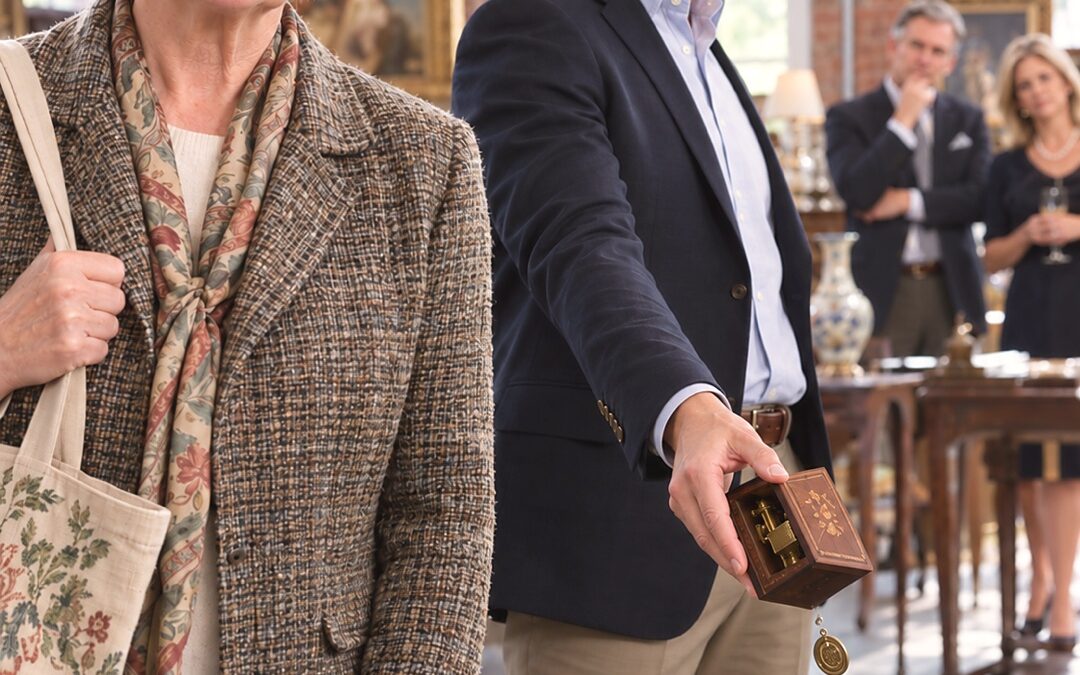
Preston Ellsworth held my husband's music box out over the slate floor of the appraisal hall so the two buyers from Boston could get a good look, said, "We sell estates here, ma'am, we don't take out the trash," and opened his hand. Cynthia Brault, the appraiser who'd asked him for twenty minutes with it, was fired before the pieces stopped sliding, and the job took with it the insurance that kept her husband on dialysis, $2,380 a month she'd have to find by October. He never once looked at the little brass seal that slid out of the broken bottom, the one Leland cut on his lathe in 1979, the winter he and I opened that auction house together.
I got down on my knees on that floor, which at seventy is a decision and not a reflex. One of my gloves had come off somewhere. A comb tooth had snapped clean off the movement and gone skating toward the podium, and I put my bare hand down on it before anybody could step there, and the broken end bit into my palm. I kept my hand shut. I could still hear the note the box made when it hit, one low note out of "Shenandoah," and then nothing.
Twelve minutes earlier I'd walked in the front door under the stone mill wheel with the box wrapped in a dish towel in my library-sale tote. I hadn't set foot in there since a retirement party in 2015. There was a glass case of mill-wheel keychains by the desk, nine dollars apiece. I'd walked to appraisal for thirty-two years, so I went down the old east corridor, past a sign I didn't read till afterward, and straight into a security guard.
"Ma'am, appraisal's not down here anymore." He eyed the tote. "What's in the bag?"
Behind him a tall man in a navy suit was coming along with a key card on a lanyard and two people from Boston in tow, an older man with a gray overcoat over his arm and a young woman with a tablet. "Nothing walks in or out of my house I don't know about." And then, "A week from Saturday, Alden, you sign at that podium in front of the whole Fall Sale, and I move into the river office for keeps."
The suit turned around. "Jerome?"
"Walk-in, Mr. Ellsworth. Came down the east passage."
Preston Ellsworth looked at my tote about how you'd look at a raccoon in the garage. "Two weeks after the snuff box? Check the bag."
"Who's signing the condition receipt?" I said.
Jerome looked at his boss. Preston held out his hand. I kept the tote against my hip until a woman in a brown cardigan came through the far doorway asking what on earth was going on, and that was Cynthia.
"Your website says you know cylinder boxes," I told her.
"Bring it in."
Preston came along. I unwrapped the box on her table, and she bent over the maple mill wheel in the lid.
"I've seen this mark."
"Our mark," Preston said. "On a knockoff."
"Leland made that in 1977," I said. "That wheel was on this box two years before it was ever on your sign. My husband and I—"
"No maker, no provenance, no paperwork. No value." He said it to the Boston man.
Cynthia had the lid up by then. "Give me twenty minutes with it."
"We're in the middle of a tour."
"Then go finish your tour. I've got an appraisal."
She said it in front of his buyers, and I watched him hear it. The Boston man moved the overcoat to his other arm. "Preston, maybe let the lady have her box."
That's when he picked it up.
"Enough," Cynthia said, before I'd even gotten my knees under me. "That was her property."
"You're done, Cynthia. Badge on the desk. Your insurance runs through the end of the month."
He said it like he was moving a lunch reservation. Cynthia's mouth came open and stayed that way, and then she got down on the slate next to me anyway, in a skirt, and told me not to touch the movement because there was broken steel in it.
The lid hung off one hinge. A corner of the cherry had cracked through. The movement plate had popped up on one side, two little brass screws pulled half out of the wood, and underneath it was a hollow I'd never seen in forty-nine years of winding that box. A shallow tray, with a bundle of chamois in it and a folded paper.
Cynthia peeled the chamois back far enough to show brass.
"That's the house seal. It's on the charter in the lobby."
Preston didn't turn his head. He was telling the Boston man about a Federal highboy in the Fall Sale. "That's a gift-shop copy of our logo. We sell them for nine dollars at the front desk. Jerome, walk them both out the loading dock."
Over by the windows the couple from Rutland were standing with their Shaker rocker between them, and the wife had a fistful of her husband's jacket. The girl from the front desk had come as far as the hall door with a clipboard pressed flat to her chest. The young woman from Boston let her tablet drift down to her side, screen still lit.
I put the paper inside my coat without unfolding it. Cynthia wrapped the brass and laid it in the broken case, and I put the whole business in my tote, splinters and all. The dish towel came away with slivers of cherry stuck in the terry.
Cynthia laid her badge on the front desk on the way past. "Take care of the rocker people, Tess. They've been waiting."
Jerome took us out through the back. He was thirty or so, and his shirt still had the store folds in it. At the dock door he got out an incident form and asked my name, and I gave it, Edith Tibbetts, and spelled it for him, and he wrote it down slow and careful.
Preston had followed us. I suppose he didn't trust Jerome to finish the job.
"Walk-ins go around back to the loading dock, ma'am. Appointments use the front."
I hadn't really looked at him till then. Forty-seven, maybe. Good haircut. His suit had been to a tailor more than once, and Cynthia's cardigan had a darned spot at the cuff.
"My husband built that box, Mr. Ellsworth. I'll be at your Fall Sale, and I'll come in the front."
He laughed. "Buy a paddle."
The door banged shut behind us. Half a minute later it banged open again, and the girl from the desk came down the steel ramp with my gray glove in one hand and a business card in the other.
"The gentleman from Boston asked me to give you this. Mr. Royce. He said to tell you he's sorry."
The card said Alden Royce, Senior Vice President, Acquisitions, Garrity & Finch. I put it in my pocket with the glove.
*
It was eleven-twenty when I set the box on the hood of the Volvo, out back by the dumpsters. Leland's 2004 V70, 214,000 miles, and you still have to pull the driver's door twice when it's damp. Cynthia's old Subaru was two spaces down.
She eased the lid up so it wouldn't pull on the one good hinge. Something in the movement dropped into place, and the cylinder turned on its own and played three notes. Just three. Then it quit.
Leland used to wind it on our anniversary while I made breakfast, and I'd tell him to quit before the coffee got cold. The first September after he died I made two slices of toast before I remembered. I scraped the butter off the second one and threw it out the back door for the jays.
Burned inside the lid, in his lettering that never once stayed on a straight line:
"E. — For every anniversary we get. — L. 9/12/77"
I opened my hand. The tooth had left a red line across my palm. I put it in my barn coat pocket and buttoned the pocket.
Then I unfolded the paper on the hood. Heavy cream stock gone yellow at the edges, and a typeface I knew, because I'd picked it out of a printer's book in 1979 over Leland's objections.
FOUNDER'S SHARE CERTIFICATE NO. 1 — DANFORTH MILLS AUCTION GALLERY, INC.
Issued to Leland J. Tibbetts. I turned it over. On the back, in his carpenter's printing, square and slow, how he only wrote when it counted:
"Transferred to Edith M. Tibbetts, my wife and co-founder, March 2, 2023. — Leland J. Tibbetts"
Under his name, pressed right into the paper, the mill wheel.
A week before he died. He'd asked for the music box that morning, and I'd set it on the hospital tray and thought he wanted to hear it. That afternoon he said, "If they ever try to sell the mill, Edie, ask the box." He was on the morphine by then. I patted his hand and went to start supper.
Cynthia was watching me over the hood.
"Mrs. Tibbetts, who are you?"
"I typed the papers that started that place. Edie Tibbetts."
She looked back at the mill, all four stories of brick, and then at me, and then she sat down on the bumper of her Subaru with her car keys in her lap. Her badge clip was still on her cardigan with nothing in it. "Your catalogs are in our reference cabinet. I've been there since 2016, I never even—" She stopped. "He came up from Boston two years ago and let nine people go his first month. I don't think he's ever read the thing on the lobby wall."
"Has anybody?"
"I have." She rubbed at a spot of dried mud on her shoe. "My husband's Marc. He does dialysis over in Lebanon, Tuesday, Thursday, Saturday. We leave the house at six. He's fifty-four." That seemed to be all she could say about Marc. "When they changed the plan last spring I asked what COBRA would run us. Two thousand three hundred and eighty a month."
A delivery truck backed up to the dock, beeping, and the driver rolled up his shutter and didn't look at us.
"Where's Malcolm in all this?"
"Board chair. At his camp in Maine, last I heard. They've been planning this Fall Sale since July like it's the moon landing."
Malcolm Haverill ran the savings bank when we sold to his group in 2011, $2.6 million over ten years. I'd signed enough checks across his desk to know the grain of it. At the funeral he told me the founder's business went with the sale, and I believed him, because it was Malcolm.
"Get what he said in writing," I told her. "And don't sign a thing they put in front of you today."
"Where are you going?"
"To see a man who owes my husband forty years of fishing trips."
*
Gil Gaudette's office is over his brother's hardware store on Mill Street, and Leland's two wooden lures still hang off the doorframe from the spring he tried to talk Gil into taking Wednesdays off. I climbed the stairs at three-thirty with the box under my arm.
Gil is sixty-eight and was in his shirtsleeves. He moved a pile of probate folders off the chair, and I set the certificate on his blotter. He read the front. He turned it over. He took his glasses off and wiped them on his shirttail, which is what Gil does instead of swearing.
"You know what this is, Edie?"
"I know what it was in 1979."
"Tell me."
Across the street a man was trying to fit two bags of mulch into a Honda Civic.
"The Articles made one special share. Number One. It never paid a dime. It did one thing." I said the rest the way I'd typed it on the Selectric forty-seven years ago. "No sale, merger or transfer of the Corporation or of the Mill shall be made without the written consent of the holder of Founder's Share No. 1."
Gil wrote it on a yellow pad and drew two lines under written consent.
"And in 2011? You sold it with the rest?"
"I thought we sold everything. Malcolm's lawyers drew up the papers. Leland signed. I was in Burlington with my mother." I didn't say the rest of that. Gil had been at her funeral.
"You have a copy of the agreement?"
"Leland's workshop. The oak cabinet, if it's anywhere."
He told me to find it. Then he asked how a thing like that comes to fall out of a music box, and I told him, the corridor and the twenty minutes and the slate, and when I got to the loading dock he put his pen down.
"He walked you out the back. Past the dumpsters."
"Cynthia too. She asked him for twenty minutes and he took her badge for it."
Gil lifted the lid of the box with two fingers and studied the split in the cherry a long time. "Leland would've gone straight up those stairs to his office."
"And I'd have spent a week baking pies for people to apologize."
That got a snort out of him. Then he took the certificate to the copier, both sides, and put the original in a big envelope with my name across the front and locked it in the gray safe behind his desk.
"I could keep that in the Volvo," I said.
"Last time I rode in that Volvo, the window went down when you hit the lock."
"I fixed that."
"Uh-huh." He rapped the safe door once with a knuckle, like he was checking a melon. Then he sat back. "If that article's still in force, and that share wasn't part of the sale, then a week from Saturday they can't sign without you."
I held up the copy. You could see the mill wheel through the back of the paper, faint.
"Find out what they're signing, Gil."
He nodded. When I told him about Marc he wrote Cynthia's name under the article, and at the door he said, "Does Malcolm know you have this?"
"I haven't talked to Malcolm since the funeral."
"Keep it that way a while."
*
I stopped up to Price Chopper for milk on the way home and came out with English muffins and no milk.
At home I set the box on the kitchen table on a clean dish towel and laid the chamois beside it, open, the brass sitting in it. It's heavier than it looks.
I sat down across from it with Gil's copy. Founder's Share No. 1 was Leland's one fancy idea, the winter of 1979, the two of us in the back room of the mill in our coats with the space heater pointed at my feet. Bankers come and go, he said, and somebody someday is going to want to sell this building out from under the town, and I want one of us to have to say yes first. I told him it sounded like something out of a Perry Mason. Then I typed it, and he read it over my shoulder twice and said that'll do, Edie, and went out to the lathe to start on the seal.
My sewing machine sits where the hospital bed stood that March, under the window, and I found I'd moved my chair so I didn't have to look at it. The daylilies along the porch had gone brown at the tips, and I'd been meaning to cut the dead stalks back since Labor Day. I didn't wind the box. I didn't eat much either. The kitchen clock had gotten four minutes slow, which it does when nobody stands on a chair on Sundays to fix it, so around nine I stood on a chair and fixed it.
At 9:47 the kitchen phone rang, and it was Malcolm Haverill, who hadn't called me since the funeral. "Edie, I hear you came by the gallery today with Leland's box," he said. "Whatever fell out of it, don't show it to anybody until you and I talk."
Part 2
I told Malcolm I was on my way to bed and hung up, and I did go to bed, though I can't say I slept. At ten the next morning Officer Kurt Rideout's cruiser came up into the dooryard while I was cutting the dead stalks off the daylilies with the cheap Agway shears, the ones that pinch your thumb every fourth cut.
Kurt is thirty-four. His grandmother bought her kitchen table at one of our Saturday auctions in 1988, a cherry drop-leaf with one leg Leland glued himself, and Kurt ate every Thanksgiving of his childhood off it. He got out holding a paper in a plastic sleeve and took his time up the walk.
"Morning, Mrs. Tibbetts."
"Kurt. Your grandmother still shoveling her own steps?"
"Eighty-nine and won't let me near the shovel." He looked at the paper instead of me. "I wish I was here for coffee."
I set the shears on the porch rail. "What's Preston Ellsworth done?"
He didn't ask how I knew. He read me the part he had to read, that Mr. Ellsworth had filed a complaint yesterday regarding an attempted theft in the vault corridor and a stated intent to return to the property. Then he slid the notice out of the sleeve.
"You are hereby notified not to enter or remain upon the premises of Danforth Mills Auction Gallery, 1 Mill Street."
The maple at the end of the driveway had just started going yellow at the top. I looked at that.
"Attempted theft of what?"
"Snuff box. Victorian. Been missing out of their consignment vault since August twenty-fourth." He rubbed the back of his neck. "The complaint's on file. Nobody's charging anybody. I'm serving a paper, that's all I'm doing today."
"I never saw a snuff box in my life, Kurt. I was looking for appraisal."
"I figured." He shifted his feet on my bottom step. "He put down that you said you'd be back. At the Fall Sale."
"I said I'd use the front door. So now I can't go to the Fall Sale?"
"Not unless they pull it."
He held out a receipt and his pen. I went in and got my own pen out of the kitchen drawer and signed with that, and he gave me a copy for Gil without my asking. Through the screen door he could see the box on the kitchen table, lid hanging crooked.
"That's Leland's?"
"What's left of it."
He stood there with his hand on the screen door handle a second longer than he needed to. "I was supposed to be at the Fall Sale anyway. Police detail. They hire one of us for the door every year." He let go of the handle. "I'll be there Saturday the nineteenth, is all I'm saying. Gram still says her mantel clock ran better after he had it apart than the day she bought it." He went back to the cruiser and backed around my daylilies as careful as if they were somebody's kids.
At ten-seventeen my phone buzzed. Cynthia had sent a picture of her termination letter, dated yesterday. Her coverage would end Wednesday, September 30. Under it came another text. They're offering $8,000 severance if I sign a statement that your box was "a modern reproduction."
I called her. "Did you sign?"
"No." I heard a cupboard close on her end. "Marc's dialysis place called about October. He heard me tell them we needed another day to figure it out, and now he's asking should he skip Tuesday." She stopped. "I told him he's going Tuesday."
"Good."
"Eight thousand's three months of COBRA, Edie."
"I know what it is."
"That box wasn't any reproduction. I had my hands on it."
"I know that too."
She had a lawyer at nine the next morning. I told her to bring both letters, and then I went back out and finished the daylilies before lunch, every last dead stalk, and raked them into a pile I never did get around to burning.
*
Malcolm's Buick came up the drive at four, fresh from the car wash, new inspection sticker. Malcolm has always kept a car like he means to sell it Tuesday.
I'd set it out on the dish towel before he knocked. I wanted to see where his eyes went.
He came up the porch in a brown cardigan over a pressed shirt and gave me the banker's handshake, the one that lets you know he signed off on half the mortgages in Windsor County. He's seventy-six now and walks like it in the mornings, Ruth Ann at the post office says. He stepped into the kitchen and his eyes went to the brass on the dish towel and stayed there long enough for me to latch the screen door, hang my sweater on its hook and get two mugs down.
I held up the pot and he said black, thank you, and sat across from the box. "Preston emailed the board an incident report last night. Your name was in it. I couldn't believe what I was reading."
"Which part?"
"Cynthia. The accident with Leland's box."
"Accident." I poured. "He held it out at arm's length, Malcolm."
"Preston can be abrupt. He's used to a faster pace than we ever had up here."
"He was fast with Cynthia, I'll give him that."
"That situation is under review."
"By who? The board?" I set the pot back on the burner. "You're the board, Malcolm."
He moved his mug an inch back from the edge. Then he lifted a corner of the chamois with one finger, like a dish towel off rising bread.
"That's the original," he said. "Leland took it home when we bought the business. We had a new one made."
"I know."
"Strictly speaking it belongs with the company's historical materials." He laid the chamois back over it. "I've talked to a couple of people. The gallery could make you an offer for the archives, Edie, the seal and the box, we'd put them in the lobby case with a little card for Leland."
"How much of an offer?"
"Fifty thousand dollars."
The refrigerator kicked on. Fifty thousand dollars is a new roof and the furnace both, with some left over for the Volvo, and I'd be lying if I said I didn't add it up right there with the coffee pot in my hand. I also knew Malcolm hadn't come straight from his camp in Maine to buy a broken music box out of the goodness of his heart.
"Was there anything else in that box?"
"Sawdust."
He looked at me across the table. I looked back, and he was the one who picked up his coffee.
That last week, he came every day. I made him coffee in this same kitchen while the hospice nurse checked the pump. On the Thursday, I came into the bedroom with clean towels, and Leland had the music box upside down on the hospital tray with a jeweler's screwdriver in his hand, and Malcolm walked in right behind me. Leland turned the box right side up and asked Malcolm to wind it for him. I hadn't thought about that afternoon in three years. He was looking at the box the same way now.
Then the fellowship hall after the funeral, Malcolm holding a paper plate of ham salad, bending down to say it close to my ear. "That founder's business went away with the sale, Edie. Don't you worry about it." I'd thanked him for it.
"There's no trouble with the old sale agreement, is there?" I said.
"None whatsoever."
"Then I don't need fifty thousand dollars."
He pressed his lips together. "You'll think it over."
"I've thought it over."
He stood and buttoned his cardigan, which he never used to do indoors. "There's a trespass notice now, Edie. I'd hate to see you make this difficult for yourself."
"Kurt Rideout brought it by this morning. Drive careful through town, Malcolm. School lets out at three."
The Buick went back down the drive keeping well clear of my flower beds.
*
Robbie called at six-twenty while I had a grilled cheese in the skillet.
"Mom. Saturday. Come up to Burlington and I'll take you to dinner. I'll drive down and get you."
"That's sweet of you. I have plans."
"What plans?" he said, and I told him his father had left me some paperwork.
"On your anniversary?"
"He'd have thought that was funny." I flipped the sandwich. "How's that class of yours?"
He told me half of them thought the Revolution started in Virginia, and by the time he finished, the sandwich was black on one side and I ate it anyway, standing at the stove.
After supper I took the flashlight out to Leland's workshop. It still smells of machine oil and cedar shavings out there. The lathe was under its sheet. His fishing boots were under the bench where he'd stepped out of them. The bottom drawer of the oak file cabinet sticks, always has, and I had to brace my foot against the cabinet and pull till the whole thing rocked against the wall.
Forty years of folders, all labeled in his square hand. Near the back was a thick one, MILL SALE 2011.
I'd never opened it. That March I was sleeping on a cot beside my mother's bed in Burlington, and Leland brought the closing papers home in a banker's box and told me it was done, and it was.
Thirty-four pages. I turned past the payment schedule. Page eleven was about what wasn't included. I pulled the work lamp down close.
"Founder's Share No. 1 is excluded from this sale and remains with Leland J. Tibbetts and his heirs."
I pushed my reading glasses back up and checked the number at the bottom of the page. Eleven.
Malcolm Haverill had signed it on the line, and then, in the margin next to the word heirs, he'd put his initials, neat as a deposit slip.
Part 3
Gil had the Garrity & Finch press release flat on his desk under a stapler when I came up the stairs at nine Thursday.
"Fourteen point two million," he said. "Signing at the Fall Sale, Saturday the nineteenth, five-thirty, at the podium. In front of the whole room, it says here, like it's a ribbon-cutting."
There was a picture of Preston and Alden Royce under the stone mill wheel. Preston had his arms folded. Alden had his hands in his pockets and wasn't smiling as much as Preston.
"And Malcolm's end of it?"
"Three point four, give or take." Gil turned a folder around to face me. "Now look at this. I pulled the Articles from the Secretary of State. That's what's on file in Montpelier today."
It was my typing. I'd know it anywhere. The Selectric needed a ribbon that whole winter and I was too cheap to buy one, so the bottom of every page goes pale. Article Seven was right where I'd put it, and nobody had ever filed an amendment to touch it.
I opened my tote and laid page eleven on top.
Gil read the exclusion and Malcolm's initials in the margin, and set his pen down. "Then somebody told Boston it's dead."
"Malcolm."
"Malcolm swore to Garrity's lawyers that the share died with Leland. Probate shows no certificate, because Leland signed it over to you the week before, so they took Malcolm's word." He rubbed his eyes under his glasses. "There's also some board resolution from August retiring the share. I haven't seen the wording."
"Can they do that?"
"Not to a share somebody's holding. You can't vote a person's property away at a board meeting."
"So I call Garrity."
"Not yet. Let me see what I can get in front of a judge first."
"And Preston? Does he know any of this?"
"From what you tell me, Preston thinks Article Seven is a vitamin." He squared the papers. "Malcolm told him that share died with Leland, I'd bet the store on it. Preston's been here two years. He never had a reason to read the thing hanging in his own lobby, and Malcolm never gave him one." He looked at me over his glasses. "And you don't go down there."
"I've been out their loading dock once. I'm in no hurry to do it again."
"And Edie. Don't show that seal to anybody else. Not the Bulletin, not your neighbors, not Robbie."
"Malcolm's already seen it."
Gil stopped writing. "When?"
"Yesterday. I put it out on the table for him."
"Edie."
"He looked at it like it owed him money, Gil. Then he offered me fifty thousand dollars for it."
Gil wrote that down too, and the date, and underlined fifty.
I didn't tell anybody else. Not Robbie. Malcolm had left a message on the machine Wednesday night, Edie, give me a call when you get a chance, and I let the light blink.
Downstairs Gil's brother was selling a man furnace filters and waved at me through the window. I drove home the long way, by the river. The maples along the Sable were only just tipping yellow, and the mill stood up over the water with the morning sun in every window. Leland used to say that roof needed replacing every time we had money for anything else. I didn't slow down.
*
Cynthia came at two Friday in her old Subaru. She sat in the dooryard a minute with the engine off, looking at something on her phone, before she came up the steps with a cardboard catalog under her arm and a jeweler's loupe in a little black case.
She put the catalog on my kitchen table. Fall 1980. Tan cover, our mill wheel pressed into the stock.
"Where on earth did you get that?"
"Estate sale in Woodstock, eight years ago, before I ever worked there. Two dollars." She almost smiled. "I liked the typing."
I'd typed every word inside it. Leland pressed the seal into every cover himself, four hundred of them, one at a time at this same table, holding each one up to the window to check it was even. That first Fall Sale about finished us. The furnace quit in October and we had forty-seven consignors wanting their checks before Thanksgiving.
"Look at the rim," Cynthia said, and handed me the loupe. "Down at eight o'clock."
I bent over it. On the rim of the wheel, right beside the spoke, was a nick no bigger than an eyelash.
"His chisel slipped," I said. "He was cutting the die on the lathe and it jumped. He about started over."
"Why didn't he?"
"We couldn't afford another piece of brass."
She unfolded the chamois and set the die on the dish towel under the loupe. Same nick. Then she laid Gil's photocopy of the back of the certificate beside it, where the seal showed under Leland's name, and it was there too, same place. She lined the three of them up on my table and sat back in her chair.
"You can't get that off a nine-dollar keychain," she said. "Those are cast from a scan of the new seal. They don't have the slip."
She had letterhead in her bag, her name and her old certifications under it, and she asked to borrow the table. I put the kettle on. She wrote for twenty minutes without looking up, in a small hand that leaned left, then signed it and dated it and slid it across to me. One page. The die, the slip, the catalog, the certificate copy, and that she had examined the die herself on September eighth after it fell out of my music box.
"Can you write that now you're fired?"
"I knew what I was looking at Tuesday. I still do."
Then she asked could she see the box, and I slid it over, and she opened the lid with her thumbs on the cherry, away from the burned letters, and put the loupe in her eye. She was quiet over it a long while. Leland used to hum when he did that. She didn't.
She turned the box over once in her hands. "The comb's the problem. One tooth gone, two loose. I can fix it, but not today." I told her to look twice before cutting any brass. Leland made everything twice.
I put her letter in the folder with page eleven. She put the loupe back in its case and then didn't get up.
"Preston called me again yesterday," she said. "To see if I'd signed. I said no. And then he said Malcolm Haverill says that seal is the real old one, it belongs to the company, the chairman knows exactly what it is." She turned her mug a quarter turn on the oilcloth. "He didn't say anything about a certificate. Just the seal. He wants it, Edie. He told me if I want the eight thousand I'd better quit helping you."
So Malcolm had gone from my kitchen to Preston, that night or the next morning. He'd sat in that very chair with the brass in front of him and told me strictly speaking it was company history.
"Marc's next three are already on the calendar," Cynthia said, mostly to the mug. "Tuesday he asked the nurse what one session runs without insurance. She told him. He won't tell me what she said, which is how I know it's bad." She picked the mug up and put it down without drinking. "I'm not signing it."
After she left I locked the die in the drawer with the good silver, the only drawer in the house with a key, and hid the key in the sugar bowl, which Leland would have said is the first place a burglar looks.
*
Saturday, September twelfth, was our fiftieth.
I was up before six and didn't bother getting dressed. Leland always started the coffee on our anniversary before I was out of bed, burnt or not, and wound the box on the counter while it perked. I made my own coffee. I didn't go near the box. It sat on the kitchen table where it had sat all week with the corner broken off.
Robbie texted at 6:40, Happy 50th Mom, love you, call me, with a little picture of a cake. I wrote back Thank you honey, and then I stood there trying to think what else and didn't come up with anything, so I sent it like that. Fifty years ago that morning I was in my mother's front room in Bethel with my hair in rollers and Leland was at the Grange hall putting up the folding chairs himself, because he didn't trust his brothers to get the rows straight.
At seven-fifty I was at the kitchen window in my robe with the mug in both hands when a black BMW X5 turned in between the stone posts at the bottom of the drive. It came up past the gravel where people park, swung onto the lawn and stopped with its front tires square in the middle of my daylilies.
Preston Ellsworth got out with a folder. He stood in my dooryard a minute looking up at the porch and the roofline and the barn, the way a flatlander looks at a place he's thinking of making an offer on.
He came up the porch steps without knocking and held the folder against the screen door. "Mrs. Tibbetts, that seal belongs to my company," Preston said. "Monday morning it's on my desk or it's in an evidence bag."
Part 4
He pushed the folder flat against the screen until the wire bowed in.
"Are you going to ask me in, Mrs. Tibbetts?"
"No."
"I won't take much of your time."
"You've already used some of it."
He opened the folder, took out a sheet on gallery letterhead and read it to me through the screen, slow, watching my face the whole time.
"Founder's Share No. 1 lapsed upon the death of Leland J. Tibbetts and is hereby retired."
"August twentieth," he said. "The full board. Your husband's little share is retired, Garrity's lawyers have the resolution, it's done. So let's talk about the seal."
Malcolm's signature was at the bottom. I could read it through the screen.
"Tuesday you said it was a nine-dollar keychain."
"I've since learned otherwise." He didn't even blink. "Here's what I'm prepared to do. You bring the seal to my office Monday at nine and sign a standard release acknowledging it's company property, and I withdraw the theft complaint. I'll also authorize Cynthia's severance. Eight thousand, and a good reference. A woman in her situation could use both."
"She was fired for asking you not to drop my box."
"She was terminated for insubordination. It's documented."
"So is the box."
He tapped the folder on the screen, twice. "If you don't, we file for recovery of stolen company property, the seal goes into an evidence bag, and Cynthia Brault won't hold a loupe anywhere in New England again. I'll see to that personally."
He leaned to see past me into the kitchen, to the table. "Is that the box? Huh." He looked at it like it was a lamp at a yard sale with no shade. "You know, if you'd made an appointment like everybody else, none of this would've happened."
Behind me the kitchen clock was ticking. It was right, for once.
I looked past his shoulder at the lawn. Those were the daylilies Leland put in along the porch the year Robbie was born, because I said the place needed something besides tomatoes.
"You're parked on my daylilies, Mr. Ellsworth."
He looked at me like I'd answered him in French. "Did you hear one word I said?"
"Every one."
He checked his watch, a big steel one with too many dials, like I was the one holding him up. "Monday. Nine o'clock." He tucked a copy of the resolution into the frame of my screen door and went down the steps.
He backed off the lawn too fast and caught the stone border with a tire and knocked one of the rocks out into the drive. He didn't get out to put it back. I never said a thing to him about the certificate. I went in and rinsed my mug, and then I stood at the sink and rinsed it again, and dried it, and hung it on its hook by the window, where I could watch his BMW go down Sawyer Hill toward the river until the maples took it.
*
After lunch I went out to the workshop.
On anniversaries Leland used to say he needed five minutes to finish something, and I'd go out two hours later and find the radio on and a clock in forty pieces across the bench. I lifted a corner of the sheet off the lathe. There was still a short piece of maple in the chuck with his pencil marks on it, where he'd meant to turn it down. I put the sheet back.
On the shelf over the bench sat the old embossing press frame, cast iron, with an empty slot in the jaws where the die used to ride. Every catalog cover I ever typed went through that press.
Tacked to the wall beside it, half hidden behind a feed-store calendar from three years ago still turned to March, was a small manila envelope. Carpenter's pencil.
"Spare teeth. For when you drop it, Edie."
I sat down on his stool with it. Inside were three brass comb teeth, wrapped in a scrap of flannel off one of his old shirts, the green plaid one I'd tried to give to the church rummage sale twice. I unbuttoned my coat pocket and took out the broken one and laid it beside them on my knee. Same length. He'd have held each blank up to a steel rule with his bad eye shut, filing a hair at a time, and I could see him doing it as plain as I could see the bench.
I'm not the one who drops things. I never was. He just liked saying it. The year we got married he dropped my mother's gravy boat on Thanksgiving, and for forty-some years after, any time something of his slipped off the counter, he'd look at me and say, "Edie, honestly." The year he got sick he dropped his coffee mug every morning for a week, before we knew what it was, and said it every time, and I let him.
I put the broken tooth back in my pocket and buttoned it. I sat there until the window went blue and my hands went cold.
When I finally went in, Robbie's name was on my phone. Missed call, 6:12. I didn't call him back that night. If I had, I'd have had to tell him, and I wasn't ready to say any of it out loud.
*
Monday Gil had coffee down his shirt cuff from a convenience-store cup that leaked, and the resolution Preston tucked in my screen door was on the desk in front of him.
"That's void," he said. "You can't retire a share behind its holder's back. I filed for an emergency order at eight-thirty this morning."
"Good."
"The clerk at Windsor Superior Court set the hearing for Wednesday the twenty-third."
I counted on my fingers, which I hate doing in front of people. "That's four days after."
"Judge won't sign anything before he hears from the gallery's lawyer. And if we go tell Preston, he stands up in front of that room and says you're a confused old lady with a family keepsake, and he moves the signing up to Friday. Then it's closed. Then your remedy is a lawsuit against Garrity & Finch, two years, maybe three." He took his glasses off. "You'd be seventy-three, and Garrity would own the mill while we argued."
I sat there with my coat still on. Half my life I'd put into that building, and it was going to come down to an opening on some clerk's calendar. I buttoned my coat back up to the collar, like I had someplace to be.
Then I opened my wallet and took out Alden Royce's card.
Gil looked at it a good while. "Royce gave you that?"
"Had the girl at the desk run it out to the loading dock."
"And you kept it."
"It's in front of you, Gil."
He pushed his chair back and pointed at the old IBM Selectric on the side table under its dust cover. "Ribbon's new. I do envelopes on it."
My fingers knew where the keys were before I did. Leland used to say I typed like I was mad at the paper. I wrote one page to Alden Royce. My name, Edith M. Tibbetts, co-founder. That I hold Founder's Share No. 1. Article Seven, word for word. That I do not consent to the sale scheduled for September nineteenth. That the original seal had fallen out of my husband's music box on the eighth, in front of him. No adjectives. Nothing about Preston. Gil read it through, slow, and handed it back without changing a comma.
We put in copies of the certificate, front and back, page eleven, and Cynthia's letter. At four-forty I handed it across the FedEx counter in Rutland, next to a rack of padded envelopes, and paid for overnight, signature required. The girl gave me a receipt and I folded it into my wallet behind where the card had been.
Tuesday the tracking said Garrity & Finch signed for it at 10:02 in the morning. Then nothing for two days. I drove past Malcolm's Buick outside the savings bank he hasn't worked at in years, and I didn't slow down.
Thursday I ate supper early, a bowl of soup and toast, and at seven-fifteen the kitchen phone rang.
"Mrs. Tibbetts? Alden Royce."
I put my spoon down.
"I read every page," he said. "Our general counsel called Malcolm Haverill yesterday. Malcolm had a long afternoon." A door shut somewhere on his end. "Your no-trespass notice will be rescinded tomorrow. The board's being told tonight. All three directors will be at the signing Saturday. They want the photograph."
"Has Mrs. Brault signed anything for Preston?"
"No."
"Good. Tell her not to." He said it like a man who'd read the statement Preston wanted her to sign.
"And Preston? Does he know?"
"I haven't told Preston about your certificate, and I don't intend to."
"Why on earth not?"
"I'd like to see what he does."
"Mr. Royce, on the eighth. Did you know who I was?"
"No, ma'am. I knew who he was. That turned out to be enough to make me read your letter twice as slow."
Neither of us said anything for a bit. Somebody's dog was barking down the hill, the Kittredges' probably, at nothing.
"I watched a man drop a box on the eighth, Mrs. Tibbetts, and I haven't stopped thinking about it," Alden Royce said. "Saturday at five-thirty I'm supposed to sign at that podium. I'd like the founder in the room. Use the front door."
Part 5
At five-twenty Saturday afternoon I came in the front door of the Danforth Mills Auction Gallery, under the stone mill wheel, in Leland's good tweed jacket over my church dress. The sleeves came down past my knuckles. Cynthia was on one side of me and Gil on the other with his leather case, and the box was in my tote with a fresh dish towel around it.
The appraisal hall was full. A hundred and fifty people, maybe more, holding bid paddles and little plastic cups of wine, and somebody had put white cloths over the display counters. The couple from Rutland were standing next to their Shaker rocker. Alden Royce and his associate were by a signing table with a leather folder on it. Malcolm and the other two directors sat in a row of folding chairs beside the podium. Officer Rideout was on the police detail by the hall door with his hat under his arm, and Jerome was over by the big screen.
Preston was at the podium with a fat black Montblanc in his hand.
"Biggest day in this mill since 1848." He waited for the room to clap, and it did.
Then he saw me.
He set the pen down. "Officer, that woman is under a no-trespass order."
Officer Rideout didn't move off the door. "Not since yesterday, Mr. Ellsworth. Your board chair rescinded it."
Preston turned around to Malcolm. Malcolm had the program open on his knees and was reading the lot list like it was news to him.
"Malcolm?"
Malcolm turned a page.
Preston leaned into the microphone and smiled out at the room, the smile he probably used on estate lawyers. "Folks, bear with us, there's been some kind of misunderstanding. Officer, if you'd see the lady out, we'll get started."
Officer Rideout stayed where he was. A man near me set his wine down on a display counter, on the white cloth, and left it there.
Alden walked over to the podium, not fast. "Before I sign, Preston, I need Article Seven answered."
"Lapsed. The board retired it August twentieth. Your lawyers have the resolution."
Gil set his case on the end of the signing table.
"And who are you?" Preston said.
"Gil Gaudette. I represent Mrs. Tibbetts." He said it like he does at Town Meeting when he wants the floor. "The share was transferred to Mrs. Tibbetts on March second, three years ago, a week before her husband died. Nobody can retire a share without its holder." He tipped his head sideways, at me. "The holder's standing next to me."
Preston looked me up and down, the tweed and the tote, and smiled at the room like he hadn't stood on my porch a week ago asking for that seal. "The holder of a nine-dollar keychain."
A few people laughed, the nervous kind. Then the woman from Rutland said, loud, "That's the lady whose box you broke," and her husband stepped up next to her with his paddle still in his hand.
"I watched him drop it," he said, to Officer Rideout and not to Preston. "She never went in any vault. She was in here with her own property. You can put my name down."
The square of slate where the box hit had a folding chair on it now, about three feet from Preston's shoes. Jerome came over and moved it without anybody asking him to.
*
"Could someone bring down the charter from the lobby wall?" I said.
The girl from the front desk was already going. She came back carrying the frame in both arms through all those people, turning sideways between the chairs, chin up over the top of it so she could see where she was walking.
"Are we really stopping a fourteen-million-dollar closing for an old woman's souvenir?" Preston said.
"Fourteen million two," I said. "It's in your press release."
I knew that table. I'd put every lot from thirty-two years of catalogs under a camera on it, though ours was a clumsy thing on a stand that Leland had to keep taping up. The new one swung down on an arm. I took the brass out of its chamois and set it under the lens myself, and Jerome hit the switch, and the mill wheel came up on the big screen over the podium, two feet across, every spoke.
"Look at the rim," I said. "Eight o'clock."
You could see it from the back windows. A little bite out of the rim beside the spoke.
The girl from the desk helped me slide the charter out of its frame, and I laid the bottom corner under the camera, the seal Leland pressed into it in 1979. Same bite. Same spoke.
Cynthia stepped up beside me. "Same chisel slip. Leland's. It's on every catalog from 1980 to 2011."
Somebody near the front said, "Well, I'll be."
Alden looked from the screen down to the slate where the box had landed, and then at Preston. "Did you ever pick it up, Preston?"
Preston didn't answer. He was looking at the screen. Then he turned around to the row of folding chairs.
"Malcolm. Tell them."
Malcolm didn't get up. "I heard you."
"Then tell them about the resolution."
Malcolm closed the program on his knees and kept his palms flat on top of it. Preston looked back at the screen.
"So it's an old seal," he said, to Alden. "Fine. That doesn't mean she owns anything."
Gil handed me the certificate out of his case. I put it under the lens back side up, and Leland's carpenter's printing filled the whole wall, bigger than he ever wrote anything in his life.
"Transferred to Edith M. Tibbetts, my wife and co-founder, March 2, 2023. — Leland J. Tibbetts"
The seal sat under his name with the same bite out of it.
Gil laid page eleven beside it. "Mr. Haverill, is that your signature? And your initials, next to heirs?"
Malcolm looked up at the screen a long time. "Yes."
Alden waited till the room settled. Then he asked me, plain, the way you'd ask a neighbor if the mail had come.
"Mrs. Tibbetts, do you consent to this sale?"
"No."
Preston came out from behind the podium. "Alden, she's a confused old woman who wandered into my vault corridor with a—"
I didn't let him finish. He hadn't let me.
"We sell estates here, Preston. We don't take out the trash. Loading dock's behind you."
Preston's hand went to the lanyard on his chest, and he unclipped the key card before anyone asked for it and held it out toward nobody, and Jerome walked over and took it.
Over by the rocker the woman from Rutland found a tissue in her purse and handed it to her husband instead of using it.
*
Alden closed the leather folder on the signing table and put his own pen back inside his jacket. "Garrity doesn't buy a house whose founder says no. And we wouldn't have kept a president who drops things."
"We have a purchase agreement," Preston said. "My contract—"
"That $1.1 million pays at closing, Preston," Gil said. "So does Malcolm's three point four. There isn't going to be one."
Preston looked down at the Montblanc lying on the podium and put his empty hand flat on the wood beside it.
I found I'd taken hold of the edge of the camera table. I let go and put my hand in my jacket pocket, Leland's pocket, and there was still a stub of carpenter's pencil in the bottom of it from God knows when.
Malcolm got up out of the folding chair. He had to push off his knee to do it. He looked at the room first, and then at me.
"I knew it went to Edie. I told him it died with Leland. I'm sorry, Edie."
"You told me—" Preston started.
"I know what I told you."
"You let me walk Boston through this building for six months!"
Malcolm didn't answer that. He looked over at the two directors beside him instead.
Alden turned to his associate. "Note that the holder of Founder's Share Number One refused consent, in front of the board, at five-forty." She typed it. I watched her do it.
The other two directors stood up beside Malcolm. The taller one said, "I move we suspend Mr. Ellsworth as president, pending a full review, effective now." The other one said, "Second." Malcolm put his hand up, and they put theirs up, and that made three. The associate typed that too.
"You can't do this here," Preston said.
"It's recorded," the taller director said. "Jerome will go up with you for your things. Leave the office keys."
Preston dug a ring out of his trouser pocket and dropped it on the signing table, and it landed on Alden's closed leather folder and slid off onto the floor, and nobody picked it up for him.
I had to sit down. Cynthia found me a folding chair and I sat in it with the tote on my lap and my hands on the box through the towel. My knees were going like a sewing machine treadle.
Officer Rideout came up the aisle with his hat still under his arm.
"Mr. Ellsworth. The report you filed on the eighth says she stole from your vault. I've got the folks who were in this room on the eighth, and they say different. Monday, nine o'clock, at the station."
"She was in a restricted corridor."
"Nine o'clock Monday."
Preston picked his Montblanc up off the podium. Jerome said, "This way, sir," and walked him down the side of the hall, past the couple from Rutland and their rocker, out the back toward the loading dock and up the back stairs to clear his office. Ten minutes later they came down again, Preston carrying a banker's box against his chest.
I got up and went to the dock door, which somebody had propped open with a brick. Preston crossed the back lot past the dumpsters with that box, the Montblanc sticking up out of the top of it, and tried to work the rear door of the BMW open with his elbow. The pen slid sideways down between two folders. He caught it, and then he just stood there by his car a while holding the box, with the dumpster lids up behind him.
Behind me in the hall, somebody was asking the auctioneer whether the Fall Sale was still on, and the taller director said it was, six-thirty, same as the catalog said. People went back to their wine. The couple from Rutland sat down on either side of their rocker like it was a bus bench.
When I came back in, Malcolm was at the podium with something in his hand.
Malcolm set the gallery's master key on the podium in front of me, the old brass one with the mill wheel on the bow. "Somebody has to open the front door Monday, Edie," he said. "The board would like it to be you."
Part 6
I picked the key up. It was warm from Malcolm's hand, which I didn't care for, and heavier than I remembered. I turned it over once and put it in Cynthia's hand and closed her fingers on it.
"Edie—"
"I'm seventy. I did my thirty-two years, and I retired when I meant to." I turned to the two directors. "She's been running the part that matters since before that man got here. She knows what a Shaker rocker brings without asking a computer, and she gives people time to tell her what they've got."
Malcolm cleared his throat. "Before you vote. I gave Garrity a sworn certificate I knew was false, and I let this board pass a resolution I knew was wrong. I'm resigning as chairman. Tonight. I'll put it in writing before I leave the building."
Nobody argued with him. Gil put his hand on my shoulder, and I could feel him getting ready to say something about Leland, so I said, "Don't, Gil," and he didn't, and kept the hand there. Malcolm sat back down in his folding chair and rolled the program up tight in one fist.
Cynthia was still holding the key out in front of her like it might go off. "I don't even know if I have a job to be acting anything from."
"The board voided your termination yesterday," Malcolm said, "before it ever went to payroll. Your coverage never stopped."
She stood there a second. Then she was already dialing, walking away from us toward the tall windows over the river with a finger in her other ear against the noise, and she stopped in the corner with her back to the room.
"They kept it, Marc. Tuesday's covered."
She listened. She leaned her forehead against the window glass and left it there.
The taller director waited till she turned around. "Mrs. Brault. Acting manager. Will you?"
Cynthia looked at me, and then at the key, and then at the director. "If the first thing I do as acting anything is fix that box."
"That seems fair," he said.
The two directors put their hands up. Malcolm kept his in his lap. Cynthia had wiped her face with the heel of her hand by then and put the key in her cardigan pocket. The girl from the front desk handed me the microphone off the podium, I guess because I looked like I had something to say. I did.
"Everybody uses the front door. Every walk-in gets twenty minutes."
A man at the back held up his paddle. "Even if we just want to know what it's worth?"
"Especially then."
The woman from Rutland put her hand up like she was in school. "Do we need appointments?"
"Not for a first look. That's how Leland and I started. A card table and a coffee can for the tickets."
"Twenty minutes apiece," Cynthia said, low, next to me, "I'm going to need another appraiser on Saturdays."
"Then hire one."
Jerome came down the back stairs carrying the brass nameplate off the river office door, PRESTON ELLSWORTH, PRESIDENT. He walked it across the hall to the lost-and-found bin by the dock, the one full of odd gloves and forgotten paddles, and set it in on top.
"Office is clear," he told Cynthia.
"Thank you, Jerome."
At six-thirty the auctioneer took the podium and the Fall Sale started, and I sat in the front row with my hands folded in my lap and bid on nothing at all.
*
Tuesday the twenty-ninth Cynthia called and said to come in. I came through the front door, and the girl at the desk said, "Morning, Mrs. Tibbetts," and waved me on back without getting up.
Cynthia's workbench in the new appraisal room had real lamps over it. I'd driven the box and Leland's envelope over to her the Monday after the sale. She'd cleaned the governor and set the plate back down on its two brass screws and done something to the hinge so the lid would stay up without pulling on the cherry.
"Still driving Leland's Volvo?"
"Brought it this morning. Started on the second try."
She showed me the comb under the lamp. "The fall loosened two others. They'd never have held tune. I put two of his spares in." She tipped the envelope with Leland's pencil on the front, and one brass tooth slid around loose in the bottom of it. "And that slot there is the one Preston broke."
I unbuttoned my coat pocket. The tooth was in there, where it had been since the eighth. I set it on her bench beside the empty slot, and then I picked it back up again.
"Leave it empty," I said. "And leave the cracks."
"I wasn't going to fill it."
"You'll hear the gap."
"I expect I will."
She didn't wind it for me. She closed the lid and slid it back across the bench with two fingers. "That's yours to do," she said, and went back to the clock spring she'd been fighting with when I came in.
She said Marc had made his Saturday, and his Tuesday, and that he'd asked if he could come along some Saturday and watch her work, which he never once asked to do in all the years she'd worked there. "He says he wants to see the famous front door." She handed me the envelope with the last spare in it. That night it went into the drawer of Leland's bench, under the calendar still turned to March.
There was a copy of the Danforth Mills Bulletin on her table. The picture on the front was the big screen with the two seals side by side, the nick at eight o'clock on both, and you could see the back of my head down in one corner. Below the fold it said Preston Ellsworth had been cited for giving false information to police, court date Tuesday, October 20. Under that, two inches on Malcolm Haverill stepping down as board chair "to spend more time at his camp in Maine." A line below said Garrity & Finch's counsel had referred his sworn certificate to the Vermont Attorney General.
Officer Rideout knocked on the open door about then with a document sleeve. It was my no-trespass notice with RESCINDED stamped across it in red. "Your copy. And they found that snuff box Monday the twenty-first, in the drawer for lot two-fourteen. Somebody filed it wrong." He didn't say anything about the box on the bench, though he stood there long enough to take in the crack across the corner before he put his hat back on. "Gram says if any of your clocks act up, she's got a man in Chester."
"Tell her thank you. And tell her to quit shoveling."
*
Saturday, October third, ten in the morning, Cynthia had a card table set up by the tall windows in the appraisal hall with a hand-lettered sign taped to the front, FRONT DOOR SATURDAY. Two folding chairs, a receipt book, a mug of coffee going cold. I set the box on the corner of the table.
"Where do you want me?"
"Right there. You do the forms. I'll do the looking."
"So you're doing all the work."
"I've met you, Edie."
At ten after, the front door opened and an old man came in wearing a feed-store cap, carrying something wrapped in a pillowcase, and stopped just inside like he wasn't sure he was allowed.
"Do I need an appointment?"
"No," Cynthia said. "Come on over."
He set the pillowcase on the table and got the knot half undone and stopped. "Probably ain't worth anything. I hate to take up your time."
"Take your time. We've got twenty minutes for everybody."
It was a mantel clock, a Seth Thomas, with a chipped case and no key, and a water ring on top where somebody had set a glass on it for forty years. His father bought it here in the eighties, he thought. He thought right.
A woman came in behind him with two picture frames in a Price Chopper bag, and Jerome showed her to the chairs by the window, and Cynthia said, "Edie, would you start her on a form?" So I did. Name, town, what she thought she had. All those years I filled out those forms, and my hand still makes the T in Tunbridge the same way. When I came back to the table the old man was telling Cynthia where the clock used to sit, on the shelf over his mother's stove, and how his father wound it every Sunday after church and nobody else was allowed to touch it.
I half remembered the lot, Leland at the podium telling the room it would run another hundred years if somebody would only wind it.
My phone buzzed against my hip. Robbie, who'd been calling since the twelfth and getting my machine. I stepped to the window and answered it.
"Mom, where are you?"
"At the mill, honey. Come down next Saturday. I want to show you your father's front door."
Then I went back, and while Cynthia had the back off the clock, I opened the lid of the box. The crack across the corner was still there. So was the split by the hinge, and the burned letters inside, crooked as ever.
"E. — For every anniversary we get. — L. 9/12/77"
The tooth was in my coat pocket. I could feel it through the wool when I leaned over the table, same pocket, buttoned. I took the key and wound it slow, the way he used to on the counter while the coffee perked, and Cynthia set her screwdriver down. The old man took off his cap and held it against his chest, and the woman with the picture frames turned around in her chair by the window, and Jerome stopped halfway across the floor with a stack of intake forms.
It played all the way through for the first time since August, and when it came to the note Preston broke, it skipped that one and kept going, and I let it.



