After 19 years mopping hospital floors, my boss fired me in front of 14 coworkers for giving a homeless man my lunch and my late husband’s coat. “We don’t feed strays here, Dolores,” he said—two nights later, that “stray” walked into our break room in Stan’s coat, and the whole hospital board walked in behind him.
Part 1
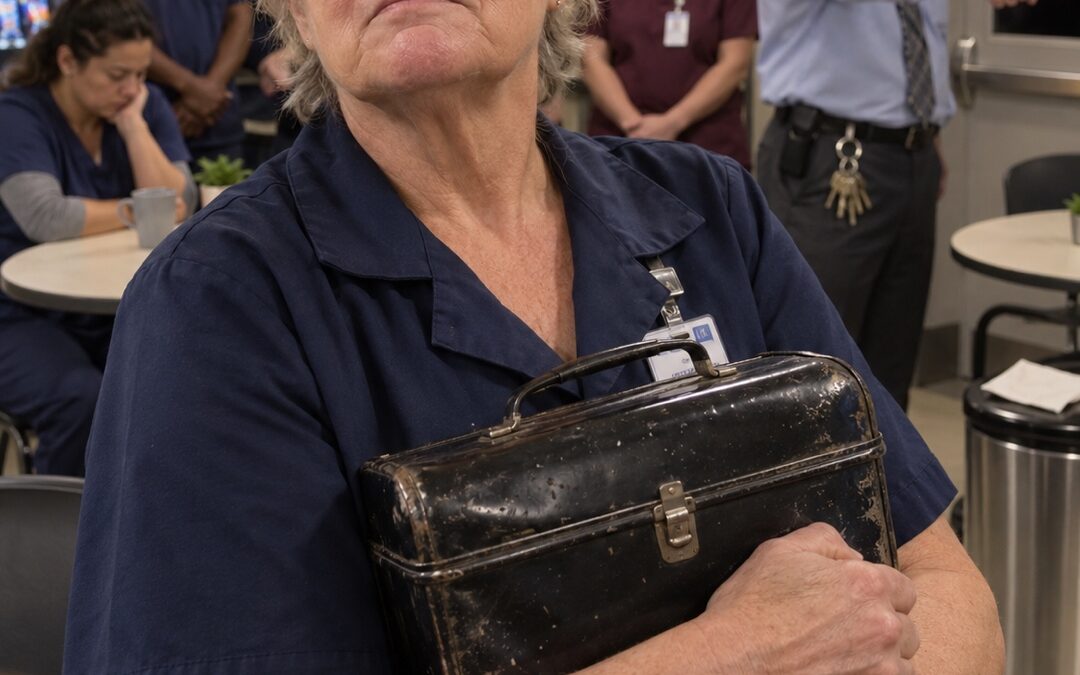
Gary Pruitt turned my husband’s old lunch pail upside down over the break room trash can and shook it until the last two pierogi fell out. “We don’t feed strays here, Dolores,” he said, loud enough for all fourteen of my coworkers in that basement to hear. “And starting tonight, we don’t pay them either.”
Nineteen years I’d mopped the floors at Brush Mountain Regional, and he fired me over a plate of potato pierogi and a coat that still smelled like Stan.
One pierogi split open on a crushed Diet Coke can. Gary set the empty pail on the table like he’d won it at the county fair and slid a form across to me.
“Second written warning,” he said. “Theft of hospital property. Neglect of duty.”
“What was my first written warning?”
He tipped his head at the phone propped against the microwave. It was on speaker. There was a crackle, and then Sheila Brandt from Human Resources said, “Gary’s report is clear.”
“That wasn’t my question, Sheila.”
Ray Shontz studied his coffee like there was a coupon at the bottom. Darlene Yingling had her arms folded over her scrub top and was staring at a spot on the wall a foot to the left of my head, which is where Darlene puts her eyes when she’s done something.
Gary tapped the paper. “Three warmed blankets removed from the ER linen warmer. Darlene saw you carry them out. She came to my office this afternoon.”
“She cleaned those bathrooms too,” Marisol Ortiz said from over by the vending machine. “I saw her.”
Gary didn’t even turn all the way around. “You want to join her?”
Marisol sat down so fast the metal chair shrieked on the tile. She’s twenty-six, with a little girl, Sofia, who’s four, and she checked her bank balance before she bought peanut butter crackers out of the machine. Gary had stood behind her in line and watched her do it.
“I’ve got keys to every door in this building,” he told me. “You’ve got a mop.” He jingled them when he said it. Thirty-some keys on his belt, heavy enough that his khakis rode crooked on the left, and he jingled them in the elevator too.
He pushed a pen at me. “Sign.”
I drew one line through the signature box, and under it I printed, big enough for the far end of the table to read:
I DO NOT AGREE. D. Kowalczyk.
Gary reached for the lunch pail then, and I put my hand flat on the lid right next to his. “Move it,” I said. He moved it.
There was a fresh dent by the latch. I rubbed a smear of potato off the corner with my thumb, and that dent bothered me more than anything typed on his paper. Stan carried that pail to Juniata Shops for thirty-four years and I don’t remember a scratch on it.
“Dolores,” Sheila said through the speaker, “refusal to sign doesn’t change the action.”
“I didn’t refuse. I wrote down what I thought of it.”
Connie Weyandt ducked her head quick, the way you do in church when the organist hits a wrong note.
“For the record,” Gary said, “this is your second warning. You were counseled.”
“Then give me a date.”
“You know when,” he said, and turned the page like that settled it.
It didn’t settle anything for me. Before the hospital I spent twenty-one years in the timekeeping office at Juniata Shops, and I still can’t hear somebody tell me I was someplace without wanting to see the punch. Gary knew that about me. I think it was most of why he couldn’t stand me.
Gary was a day man. Director of Facilities and Environmental Services, $112,000 a year, according to a salary list Bud Claar found online and passed around the break room. But Saturday was the donor signing, and he’d discovered nighttime the way some men discover golf. “This building’s gonna shine,” he told us Monday, and Tuesday, and again that night. He’d already ordered his own parking sign. RESERVED — G. PRUITT, VP OPERATIONS. Gary wasn’t vice president of anything yet, but he had a seat at the main table Saturday night, and he brought it up the way other people bring up their grandkids.
“You were already warned about your attitude,” he said, “after that payroll business in December.”
“I asked where six hours of my pay went.”
“You went around me.”
“You told me to take it up with payroll. So I took it up with payroll.”
“That’s what I mean.” He turned another page. “Neglect of duty. ER public restrooms not serviced between two and five a.m., Tuesday night.”
“Yes, they were.”
“The log doesn’t support that.”
“It does if nobody changed it.”
That got him. Only a little, he’s not a stupid man, but his thumb stopped on the corner of the page before he leaned back in the plastic chair. “You accusing me of something, Dolores?”
“I’m saying I cleaned those restrooms.”
“She did,” Marisol said again, quieter, to the tabletop.
“You already got your one warning,” Gary told her, and Marisol tucked both hands between her knees and kept them there.
Sheila came back on. “Dolores, there’s also the unauthorized removal of hospital linens.”
“Pat asked me to get those blankets. She’s off tonight. Call her.”
“Convenient,” Gary said, and didn’t reach for the phone.
“I saw you carrying them,” Darlene said, to the wall.
“You did. You didn’t ask me why.”
Her eyes came up then, the first time all night. She rubbed one thumb over the other, and they went right back down.
“Three blankets,” Gary said. “Sixty-two dollars apiece. They left hospital control.”
“They went twenty yards into your emergency waiting room, Gary. Last I checked that’s still in the building.”
He leaned on his knuckles. “To a vagrant.”
Somebody’s chair creaked. I closed Stan’s pail and clicked the latch, and the click came out louder than I meant it to.
Then he unclipped my badge off my scrub top himself, which he had no need to do. DEE K., it said. Nineteen years and they never found room on there for the rest of my name. He dropped it in a manila envelope and licked the flap. “Leon will walk you out. Your final check will be mailed.”
“Make sure it has all the hours on it,” I said. “Wouldn’t want another payroll business.”
That was all I gave him. I didn’t throw the coffee pot, though I thought about the coffee pot. Stan used to say I could insult a man in the same voice I’d use to ask if he took cream, and he considered that the secret of our whole marriage. Leon Fisher was holding the door in his security jacket, looking like he’d eaten something bad at the Sheetz. I tucked the pail under my arm and walked out past fourteen people I’d worked beside for years without turning my head toward a single one of them. If I had, I don’t think I’d have made it to the elevator.
The whole thing started two nights before that, with three dollars and fifteen cents.
It was around two in the morning, Monday night into Tuesday, and I was redding up the ER waiting room after a little boy lost his supper by the vending machines. The old man sat by himself under the TV, gray beard, old work boots, knit cap down to his eyebrows. He had coins spread on his palm and was counting them with one finger, and I counted right along with him from the trash can. $3.15. He studied the machine, then the prices, and closed his hand.
Brandon Kopp wandered over. Brandon was the temporary security kid they’d hired for donor week, twenty-two, and he’d recently learned that a radio clipped to your shoulder can turn a person into the FBI.
“You can’t camp here, buddy.”
“I’m sitting,” the old man said.
“This is a hospital.”
“I noticed.”
“It’s twelve degrees out, Brandon,” I said from the trash can.
“I’m handling it, Dee.”
“That explains how well it’s going.”
The old man ducked his head so Brandon wouldn’t catch him smiling. He drifted back to his desk mumbling about policy, and I sat down next to the old man with my lunch pail on my knees and asked if he was hungry. He said he was all right. “I always make too many,” I said.
That was a lie. I make exactly six pierogi for a shift, because my grandson Tyler eats anything left in the refrigerator after school and six is what survives him. I gave the man three. Potato and cheese, wrapped in wax paper. He ate slowly, and not in that fake polite way either, more like a man who actually wanted to know what they tasted like. After, he smoothed the wax paper flat on his knee.
“My mother wrapped food like this,” he said. “She scrubbed floors in a place like this. Nights.”
“What place?”
He shrugged. “Long time ago.”
He said his name was Art. Somebody had left a Wall Street Journal on the next chair, and after he ate he read the business section front to back and folded it the long way, like a commuter. His cuffs were filthy. His fingernails were clean. I saw that and didn’t think one more thing about it, which tells you how tired I was.
Tuesday night the snow started after midnight. By one it was blowing sideways against the ER windows, and Art was back in the same chair, rubbing his hands together between his knees.
I’d been at my locker ten minutes before, standing with my face in Stan’s coat longer than I’d admit to anybody. It’s a brown Carhartt, flannel-lined, with a STAN patch from the shops sewn over the chest. I never washed it. Four years. People will tell you Old Spice doesn’t last four years in a coat, and those people are wrong, or else I’m imagining it, and I don’t much care which.
I carried it upstairs and held it out. “Put this on.”
“That wasn’t a question,” I said, when he shook his head. He ran his thumb over the patch and asked was it my husband’s, and I said yes, and he asked was I sure about this, and I said no, put it on anyway. He did. It hung loose on him through the shoulders. Stan was a bigger man.
Pat Delaney came through from the back with two charts against her chest and stopped short. “Dee, get him some warm blankets, would you? Three. The warmer’s full anyhow.”
So I took three out of the linen warmer, and on my way back Darlene came around the corner with her cart. Her eyes went to the blankets, then to Art in Stan’s coat, then to me. “You running a hotel now?”
I kept walking. So did she.
Around two I took my spiral notebook out at the service desk and wrote down the crew’s times, like every shift for nineteen years. Leon 10:38. Ray 10:43. Darlene 10:52, which is Darlene. The hospital has electronic punches. I write mine down anyway. “Dee’s the real time clock,” Ray says, every single time, like he just thought of it.
Art watched me write. “You record everybody?”
“Somebody has to know when yinz were actually here.”
He nodded at the notebook. “Keep your notebooks.”
“You planning to audit me?”
“Maybe,” he said, and smiled down into the collar of my husband’s coat.
I did both ER public restrooms on that round, and again on the late one. There’s a weekly paper log taped behind each door in a plastic sleeve, and I initialed DK 2:10, and later DK 4:40. I remember the second one exactly because my phone went off in my pocket at 4:38 playing a duck quacking. Tyler had been fooling with my ringtones again. Nearly gave me a coronary in the ladies’ room.
Before sunrise I passed the donor poster by the lobby elevators. I’d wiped that glass almost every night since September. AGNES LINDQVIST EMERGENCY PAVILION, COMING 2027. Arthur Lindqvist, some trucking man out of Minneapolis, clean-shaven, glasses, nice suit, the kind of picture where the photographer tells you to think about your boat. I ran my cloth over the bottom corner and went home.
At 11:20 Wednesday night Leon walked me out the employee entrance carrying my cardboard box. Snow was coming down again. “I’m sorry, Dee,” he said at the car.
“You didn’t fire me.”
“Still.”
I put the box in my silver 2004 Buick LeSabre, the one with the coat-hanger antenna, and stood there with my keys. The log doesn’t support that. Well, it did. Unless somebody changed it.
“Leon, I left my purse inside.”
He considered the purse hanging off my shoulder. Leon did his years in the Army before he did security, and he has a real talent for deciding what he technically heard. “I already escorted you off employee property,” he said. “ER entrance is public.”
I drove around to the emergency entrance and walked in. Brandon glanced up from his desk. “You’re off shift, Dee.”
“I’m a member of the public.”
The log was still behind the ladies’ room door. D. Kowalczyk printed at the top of the column, and my initials in the Tuesday box in the blue pen I’d borrowed off Pat. I took two pictures and emailed both to myself standing right there by the hand dryer. Old timekeeper habit, backing up the backup. Tyler makes fun of me for it.
When I came out Brandon was standing over Art. Art had Stan’s coat on and the three blankets folded over one arm like a waiter’s towel.
“You gotta go,” Brandon said. “Gary says no loiterers. Donor people are coming.”
“It’s snowing,” Art said, to the window more than to him.
“He’s seventy-five if he’s a day, Brandon.” I found out later I was off by one.
“Dee, I got orders. From Gary.”
Art stood up and didn’t argue, and that bothered me more than if he had. Snow landed in his beard and stayed there. I asked if he had someplace to go and he said he’d manage.
“That means no. Get in the car.”
“Mrs.—” he started.
“You don’t know me well enough to argue with me,” I said, and he gave me a long look over the roof of the Buick and got in.
The Horseshoe Inn out on Plank Road had its VACANCY sign lit in the office window. Bev Sauers was behind the desk in pink slippers with a paperback face-down on the counter. “Room fourteen,” she said. “Seventy-one forty with the tax.”
In my purse was the rent envelope. $640, for my half of a duplex on 6th Avenue, separated out on Monday so I wouldn’t touch it. I touched it. I counted seventy-one dollars and forty cents onto Bev’s counter, and Art saw exactly where it came from.
“You need that,” he said.
“You need a room.”
“I can pay you back.”
“With what, your three dollars and fifteen cents? I saw you counting.”
“That was rude.”
“I mop hospital bathrooms for a living, hon. We’re past delicate.”
Room 14 smelled like motel soap and a space heater that had been running since 1987. Art set the blankets on the chair. I put Stan’s pail on the dresser and told him to keep the coat tonight, and he said he’d bring it back, and I said he’d better.
His hand went into the left pocket, and stopped there, and came out with a pair of brown leather work gloves. I’d torn the house apart for those gloves the winter after the funeral. “I thought those were gone,” I said, and my voice did something on gone.
There was a folded scrap of paper tucked inside the right glove. Art opened it with his thumb and held it out to me without a word. Pencil. Stan’s square shop-floor letters, the ones that always leaned uphill.
Left pocket, Dee. Don’t lose these. —S.
I sat down on the edge of the bed. That coat hung in my locker four years and I never once put my hand all the way into that pocket. Of course Stan had. Stan left notes everywhere, mostly because I’d lost whatever he was writing about. Two Decembers ago I found one wrapped in the Christmas lights that said Untangle these yourself. I set the note on the dresser next to his pail, because my hands weren’t steady enough to hold paper, and wiped under my eyes with the heel of my hand while Art had the decency to watch the parking lot. He didn’t tell me he was sorry.
After a while he took an old flip phone out of his pants pocket, and made one short call with his back to me. “Yes,” he said. Then, “Tomorrow.” He snapped it shut. That was the whole conversation.
I got up and took the empty pail off the dresser and asked if he needed anything else. He waved that off. He asked, “Your crew always meet downstairs before the shift?”
“Every night of the week.”
He looked down at the sleeve of Stan’s coat for a while and didn’t say anything.
I should have been thinking about Gary, and my rent. Instead I was standing in a motel room with a stranger in my dead husband’s coat and $3.15 in his pocket, and I had my hand on the doorknob when he picked the note up off the dresser.
He folded Stan’s note into my hand and said, “Mrs. Kowalczyk, what time does your crew meet on Friday night?”
I had never once told him my last name.
Part 2
Tyler was standing at the kitchen counter with Stan’s lunch pail in both hands when I woke up on the couch Thursday morning.
“What happened to this?”
I’d slept maybe four hours, in my coat, because I sat down at two-thirty to take my boots off and that was as far as I got. The school had called a two-hour delay for the snow, so Tyler was home and dressed and holding the pail up to the window. He’s sixteen and he got his grandfather’s way of looking at a dent like it insulted the family personally.
“Somebody drop it on you?”
“Sort of,” I said, and went and got the coffee down instead of answering, and my phone buzzed on the counter. Marisol. She’d screenshotted the night crew group chat. Gary had posted at 7:18 that morning:
Dolores K. is no longer employed. Do not contact her. Anyone caught feeding vagrants will be next 🙂
The threat I could’ve predicted. That little yellow smiley face, though, I was still chewing on in the shower an hour later.
“He put a smiley face?” Tyler said over my shoulder. “That’s psychotic.”
“Eat something.”
Another one came in. They changed the bathroom log. I stopped pouring. Marisol’s dots came up, went away, came back. The weekly sheet behind the ER ladies room door. I checked before I clocked out. Brand new sheet. Yours is gone. Then a picture: same door, same plastic sleeve, a clean white sheet with no initials on it and no D. Kowalczyk printed at the top, not even the coffee ring that had been on the old one.
I set the pot back on the burner crooked and it hissed at me. My own picture was still in my phone, DK 2:10 and DK 4:40, and I spread it with two fingers until the blue ink filled the whole screen, like it might have changed overnight too. Either Gary didn’t know I’d taken it or he didn’t care. I could use either one.
“So what happened?” Tyler said.
“He fired me. Last night.”
“Wait. Gary fired you?”
“Yes, Gary.”
“What for? What’d you even do?”
“He says I stole blankets and didn’t clean the bathrooms.”
“You stole blankets? Like actual blankets?”
“Evidently. Better lock up the bath towels.”
He didn’t laugh, which is how I knew he was scared.
His mother, my Karen, is a traveling nurse on a contract in Phoenix. Tyler’s been with me so he can finish at Altoona Area High instead of changing schools every thirteen weeks, and somewhere in there he started understanding money better than a sixteen-year-old should, which I don’t count as a compliment to me.
“How much do you have?”
“Enough,” I said.
“That’s not a number.”
“You sound like me.”
“That’s why you should answer it.” His eyes went to my purse on the chair. I should have known better than to raise a child who notices things. “You used the rent money.”
“Seventy-one forty. For a motel room. For Art.”
“The homeless guy? You got fired and then you paid for some guy’s motel?”
“I know how it sounds.”
“Grandma.”
“He was standing out in the snow, Tyler.”
He sat down across from me. The coffee was terrible, I’d shorted the grounds, and I drank it anyway. “Mom’s gonna freak out,” he said.
“Your mother is in Arizona. Let her freak out someplace warm.”
Then Marisol again. Friday the donor people want a night tour. Gary says nobody so much as sneezes.
A night tour. All week Gary had talked about Saturday and his seat at the main table, and never one word about Friday night.
Well. That explained the shining, and why he wanted Art out of that waiting room before somebody in a good coat walked past. It explained why he’d wanted me gone Wednesday, too, and not next month when nobody important was looking.
“What now?” Tyler said.
“Gary’s scared of somebody.”
“Good.”
“Don’t enjoy it yet.”
“I can enjoy it a little,” he said, and got his backpack, and at the door he turned around. “Take the bathroom picture with you. Wherever you’re going. And don’t let them delete it.”
“I emailed it to myself last night.”
He stared at me. “You’re sixty-one and you’re better at evidence than people on Dateline.”
“I kept time at the shops for twenty-one years. Every Monday some brakeman swore he worked Sunday.”
“That’s the most Altoona thing you’ve ever said,” he told me, and went.
At one o’clock I was in a padded chair in Human Resources in my good black slacks and the navy sweater Karen sent me three Christmases ago, and Sheila Brandt was squaring papers into a folder without lifting her eyes. In person she was smaller than on a speakerphone, and tireder. She had a fake ficus in the corner and a sign on the wall that said PEOPLE ARE OUR GREATEST ASSET, and I kept my opinion about that sign to myself, which I would like noted.
She slid a separation packet at me. “Your benefits continue through the end of the month.”
“I want to show you something first.” I put my phone on her desk with the picture open. “Tuesday night. ER restroom. My initials, 2:10 and 4:40.”
She gave it half a second, maybe less, and pushed it back with one finger like it was wet. “This meeting is to review your separation information.”
“This meeting is where you see what you didn’t see last night.”
“Gary provided documentation.”
“Gary provided accusations.”
“The decision’s been made, Dolores.”
“By who?” I said, and she said, “By management,” like management was a man with a desk somewhere.
“You signed it, Sheila.”
She didn’t answer that. I opened the packet. Second written warning, and still no first. When I asked where the first one was she said my file contained prior coaching, and when I said coaching isn’t a written warning she said she wasn’t going to argue terminology. “You fired me over terminology,” I said, and she let a short breath out through her nose.
The final pay sheet was in the back. I ran my finger down it the way I used to run a punch sheet at the shops, and then I ran it down again. Seven hours. “This is short,” I said.
“It reflects your final recorded hours.”
“It’s missing seven hours, Sheila.”
“You’d need to take that up with payroll.”
I didn’t say a thing. I let it sit there on the desk between us until she heard it herself, a second late, the exact words Gary gave me in December. She pulled the sheet back toward her. “I can submit an inquiry—”
The door opened without a knock. Gary, in a gray suit, with that same key ring hanging off his belt, suit and all.
“What’s she doing here?”
“Having the HR meeting HR didn’t think I needed before it fired me.”
“She can’t be in this department unescorted,” he told Sheila.
“Gary, we’re nearly finished.”
“We’re finished. You’re trespassing, Dolores.”
“In Human Resources? This is where they send people who aren’t employees anymore.”
He took out his phone. “Leon. HR.” I closed the folder. Sheila turned to her window. Gary leaned on the desk, close enough I got his breath mints. “Friday night donor representatives are walking this building. You will not interfere with my staff.”
“I didn’t ask about Friday.”
He stopped, just a hitch. “I’m telling you now,” he said, and I put that away with the smiley face.
Leon got there in two minutes, still in his jacket from the double Gary had him pulling for donor week, and sighed when he saw it was me. “Dee.”
“Round two, hon.”
The main lobby is between HR and the public doors, and I stopped under the donor poster. Habit, maybe. Same frame, same clean-shaven man in glasses, Arthur Lindqvist, and something about the forehead nagged at me. The nose, maybe. Leon asked if I was okay and I said fine. The man in the picture wore a suit that cost more than my Buick and had the face of somebody who’d never counted quarters in front of a vending machine in his life, so I kept walking.
At four I drove out to the Horseshoe Inn. Bev was behind the desk eating Utz chips and watching Judge Judy with the sound down.
“Room fourteen,” I said.
She pointed a chip at me. “Gone. Little after noon. Didn’t say where.” Then she reached under the counter. “Left you this, though.”
A white envelope with DEE across the front in block capitals. I counted it right there at the counter. Three twenties, a ten, a one, and a quarter, a dime and a nickel that I would swear were the same ones I watched him count Monday night. Seventy-one dollars and forty cents. There was a sheet off the motel notepad folded in with it.
Keep your notebooks. Bring them Friday. —A.
Bev leaned on the counter and asked was he a friend of mine. No. A relative? No. “Boyfriend?”
“Bev, I’m sixty-one years old.”
“I’m sixty-six. It ain’t over till they close the lid.”
I told her to eat her chips, and she went back to Judge Judy.
He’d watched me write in one notebook, one night. Fine. He knew I kept times. But bring them Friday? Bring them where, and to who? The note didn’t say, and Bev didn’t know, and I sat out in the Buick and read it until the windshield fogged.
Tyler was at the kitchen table doing algebra and eating Cheerios out of the box. “Did HR fix it?”
“No.”
“Did they look at the picture?”
“Half a second’s worth.”
“That seems illegal.”
“Probably is.”
I put Art’s envelope on the table. Tyler read the note and counted the money, of course he counted the money, and then he read the note again. “What notebooks?”
I tipped my head at the basement door. Two cardboard file boxes down there under the Christmas decorations, nineteen years of spiral notebooks. Stan tried to get me to throw them out every spring. “You saving these for the Smithsonian, Dee?” Maybe I was.
My phone buzzed. Marisol, and not a text this time. A picture of her pay stub. Then a second picture, Leon’s. I pulled my glasses down my nose and held the phone out at arm’s length. She’d circled three weeks in pen, the hours she worked against the hours on the check. Leon’s had two of the same kind of holes.
I dug my December stub out of the drawer under the phone, six hours short, and laid my final sheet next to it, seven more, and the coffee I’d had at noon turned on me.
Tyler leaned across the table to see, and I didn’t tell him anything, because I was still adding.
Marisol’s text came in at 6:12: “Dee it’s not just you. Look at mine. Look at Leon’s. He’s been shaving all of us. His go back way before I even started.”
Part 3
By eight o’clock Thursday night my kitchen looked like payroll had exploded in it. Pay stubs all over the table, spiral notebooks on the counter, Tyler’s laptop wedged between the salt shaker and a bowl of apples nobody had touched all week.
Marisol came first, with a Giant Eagle bag full of folded papers. She’d spent the afternoon texting the whole crew, and the ones who wouldn’t come had sent her pictures of their stubs anyway, Mike and Peggy and Kim and Andy and Rob, even Jamal, who’s only been with us two months. Leon came ten minutes after her, then Ray, then Lorraine Hite with three envelopes rubber-banded together, then Connie and Bud in Bud’s truck with Teresa riding in the middle.
Darlene Yingling showed up at 8:27. I know because I wrote it down. She stood on the mat with her coat buttoned and her purse held in front of her with both hands.
“You invited everybody?”
“Marisol invited everybody whose hours don’t match. I guess you don’t match.”
She sniffed. She and Marisol considered each other across my kitchen for a good long while, and nobody said the word blankets, which was probably the smartest thing anybody did all night. Nine of us, counting me.
Tyler came up from the basement with the two file boxes stacked against his chest and set them down by my chair with a grunt. Blue ones, red ones, one with a kitten in sunglasses on the cover that Tyler bought me at the Dollar General when he was seven. Ray pulled one out and thumbed through it. Dates and names, in and out, sick calls, who covered whose floor.
“Dee’s the real time clock,” Ray said, so pleased with himself. “I been saying that fifteen years.”
“Eighteen,” I said.
Tyler cracked his knuckles, which he knows I hate, and asked how far back his spreadsheet was supposed to go.
“Since I started,” Marisol said. “May.”
“Mine goes back further than that,” Leon said.
Lorraine pushed her envelopes across. “I found one from July. Not this past July. The one before.”
Darlene finally unbuttoned her coat. “My first one’s around then too.”
“You knew?” I said.
“No. I mean, I noticed some. I figured benefits, taxes. I don’t know what I figured,” she said, and sat.
We started with July a year and a half back, one pay period at a time, and it was slow, which suited me. Marisol read dates off her stubs, I found the matching notebook and read mine, and Tyler typed both. September 14, worked 8.5, paid 8. October 2, worked 8.5, paid 7.5.
“Half hour,” Tyler said.
Marisol made a face. “That’s nothing.”
“That’s seven dollars and a quarter at your rate,” I said. “Do it to you every couple weeks for a year and tell me it’s nothing.”
She quit talking after that. Leon went next, then Ray, then the rest of the table, then the pictures out of the Giant Eagle bag, and we drank coffee till the pot tasted like deck stripper.
At 9:35 Tyler sat back. “This is weird. It’s not random.” He’d highlighted the gaps in yellow. Half hours, mostly, an hour, two, now and then three. Too little to make a tired person drive back to payroll on four hours’ sleep.
Ray put his finger on the screen. “He never touched the new kid.”
Tyler scrolled to Jamal. Two months on the crew and not one minute missing. “Jamal’s cheap. Fourteen fifty an hour.”
“And you’re sixteen eighty-five,” Ray said. “Top of the crew.”
“So he takes more off you,” Leon said.
“Maybe,” I said, and didn’t like how it sounded. “Keep going.”
Somewhere in there Connie asked whatever happened to the old man from the waiting room, and Tyler, who has never once known when to hush, said, “She put him up at the Horseshoe Inn. Out of the rent money.” Connie said, “Oh, Dee.” Darlene didn’t say anything at all.
By 10:15 Tyler had fifteen rows on the sheet, me and everybody from that break room Wednesday night, and fourteen of them came up short. Jamal’s row was the only clean one. Darlene was down seventy hours. I was down sixty-four. Tyler did mine and turned the screen to me.
“Sixty-four times sixteen eighty-five.”
“I know what it is.”
He typed it anyway. $1,078.40.
The six hours I made such a fuss about in December turned out to be the only piece I’d ever noticed. I pressed my thumbnail into the edge of the table and left a little half-moon in the finish that’s still there.
Darlene leaned toward the screen. “What’s mine?”
“Seventy hours, but you’re on a different rate. I need all your stubs.” She pushed another stack over, and nobody teased anybody after that.
At 10:32 Tyler hit Enter one last time and the total came up at the bottom of the column. 1,180 hours. $18,640.
“Dios mío,” Marisol said. Bud rubbed his whole face with both hands. Lorraine reached for her coffee, found the cup empty, and set it back down very carefully. I checked Tyler’s formula twice, and when he asked why, if it was right, I said because I said so, which he’s been hearing since he was three.
“That’s stealing,” Leon said.
“Don’t call it that yet.”
“What do you call it, then?”
“Evidence.”
Darlene stood up. “I have to go. My son needs me.”
Marisol laughed once, not nicely. “Kyle’s twenty-two.”
“You don’t know a thing about my son.”
“I know you told Gary about Dee.”
“Enough,” I said, and they both quit. I slid Darlene’s stubs back across to her. “You’re short seventy hours too. You walking out that door doesn’t change it.”
Her phone was in her other hand, screen down, and her thumb was moving under the edge of my table. I saw it. I put it in a drawer in my head and let it sit there. “Sit down, Darlene,” I said, and she sat.
At 10:40 Tyler said, “There’s something else,” and pulled up the hospital’s internal newsletter. “I’m searching Gary Pruitt.”
“I don’t want to see it.”
“Too bad.” A picture loaded. Gary in a suit holding a little glass award next to Dr. Ellen Marsh, the CEO. OPERATIONAL EXCELLENCE AWARD: FACILITIES REDUCES NIGHT LABOR COSTS 11%. And down in the paragraph about efficiency, a $12,000 performance bonus.
Ray swore. Connie just said, “Eleven percent.”
I read the paragraph out loud. Improved labor utilization. Nice clean words. Nobody in that newsletter mentioned where the eleven percent came from. Half an hour here, an hour there, off mothers and guards and floor scrubbers too tired to sit up nights with their pay stubs.
“He got twelve thousand dollars for this?” Darlene said, mostly to herself.
I kept going. Gary Pruitt is also under consideration for the position of Vice President of Operations.
So that was the parking sign, and the seat at the main table. Three reasons on one sheet of paper to get rid of the highest-paid person on nights three days before the donor signed, and she happened to be the one who’d complained in December, with nineteen years of handwritten time in two boxes in her basement.
I got up. “Tyler, print this. All of it. I’m filing a wage complaint.”
Marisol sat up straighter. Leon tapped the table twice, like it had said something he agreed with. Darlene picked her purse up off the floor and put it in her lap.
“Tonight?” Connie said. “You sure, hon?”
“No,” I said, and got a black pen out of the junk drawer. “But I’m doing it.”
The Pennsylvania Department of Labor & Industry has a wage complaint form online. Tyler found it and I typed with two fingers, and we attached the spreadsheet and the pictures of the stubs. Tyler printed a signature page to scan back in.
“I’m signing,” Marisol said, before I asked. Leon said me too. Lorraine raised her hand like we were in school. Then Ray, and the pen went around the table one person to the next until it got to Darlene and stopped.
“You don’t have to,” I said.
She kept her eyes on the paper. “Kyle still owes this hospital almost nine thousand dollars. He had his gallbladder out last year. If Gary gets me fired—”
“They can’t cancel a payment plan because Gary’s mad at you.”
“You know that for sure?”
“No,” I said, which was the truth. I slid the pen the rest of the way over. “You decide.” She signed it.
At 10:50 I clicked Submit. Nine signatures on the page Tyler scanned: me, Marisol, Leon, Ray, Darlene, Connie, Bud, Teresa, Lorraine. He saved it three places, the laptop, a flash drive, my email. “Backup the backup,” he said, and I said now he was getting it. I printed one more copy for Ellen Marsh and one for Richard Hale, the chairman of the board, to carry in myself.
They left a little before eleven, the ones on the schedule driving straight to the hospital, late for Gary’s huddle for the first time in their lives. Bud took three copies of the spreadsheet, God knows why. Teresa cried in the driveway where she thought nobody could see her. Darlene went out last with her phone already lit up in her hand, and I stood at the storm door and watched her taillights go down 6th Avenue.
At 11:20 the kitchen phone rang. Not my cell. The old landline on the wall, which I keep because Stan refused to cancel it and after he died I never got around to disagreeing with him.
I said hello and nobody said anything back. Just breathing. I knew who it was before he opened his mouth.
“You’re organizing employees against management,” Gary said.
“I’m drinking coffee in my own kitchen.”
“Don’t play games with me.”
“Then don’t call my house at twenty after eleven.”
“I know who was there tonight. Every one of them. And you filed something with Labor and Industry. You’re going to withdraw it.”
“No, I’m not.”
“That’s not advice, Dolores.”
“Good, because I didn’t ask for any.”
“Those blankets are hospital property. A hundred and eighty-six dollars. I’m calling Altoona police first thing in the morning.”
Tyler stood up so fast his chair hit the stove. I held one finger up at him, and he stayed.
“Pat gave those blankets to Art.”
“Pat doesn’t own them. Where’s your bum friend, Dolores? Horseshoe Inn? On the rent money?” He sounded like a man talking around a toothpick. “You might want to go find him.”
So that was where Darlene’s thumb had been going. I wound the phone cord around my hand.
“Don’t call him that.”
He laughed. “You show up at that hospital Friday night, and every name on your little complaint finds out what unemployment looks like. All nine.”
“You’re threatening nine employees now, Gary?”
“I’m explaining consequences.”
“Then put them in writing, Gary.”
There was nothing on the line for a while. That one went in somewhere. When he came back his voice had dropped down low and friendly, which was worse.
“There’ll be a police officer at your door in the morning, Dolores,” Gary said. “Have the blankets ready. Or don’t, and I’ll tell him where you took that bum.”
Part 4
Officer Dan Hutchko knocked on my front door at 8:15 Friday morning. Tyler was at school. I’d spent the night at the kitchen table with a legal pad, writing down questions and crossing out the ones that were just swear words.
He took his knit cap off when I opened the door. “Morning, Dee.”
“Depends.”
I still thought of him as Danny Hutchko, fifteen and all elbows, waiting outside Juniata Shops for his dad after second shift. Now he had a badge and a little black notebook with a rubber band around it.
“I need to ask you about some hospital blankets.”
“Well, come in before the Yeagers next door decide I’m cooking meth.”
He wiped his boots twice and asked if I had coffee. I said not for cops who came to investigate me, then poured him a cup anyway. He stayed on his feet, which told me plenty.
“Gary Pruitt reported three blankets missing,” he said. “Sixty-two dollars apiece, he says. Says they left the property Wednesday night.”
“They did. Art had them over his arm when Gary’s security kid put him out in the snow.”
“Art who?”
“I don’t know his last name.” I heard how it sounded. “Or his address, or his phone, before you ask.”
Dan set his pen down real gentle, like it might go off. “Dee. That’s a man with no last name walking off with a hundred and eighty-six dollars of hospital property.”
“After the charge nurse told me to bring them out to him. Pat Delaney. You go ask her. She was off Wednesday night, or she’d have told Gary herself.”
He wrote that down. He’d already been by the Horseshoe Inn, and Bev Sauers told him the old man checked out Thursday. He drank his coffee and wouldn’t quite meet my eye, and I wished he’d been rude, so I’d have had something to do with my face.
“I have to file a report,” he said.
“Then file an accurate one, Danny.”
I slid my phone over with the picture of the restroom log already up. DK 2:10. DK 4:40. My initials in the blue pen I’d borrowed off Pat. I told him Gary fired me for stealing blankets and skipping the ER restrooms, and by Thursday morning that sheet was gone off the back of the door and a clean one was taped up in its place.
He tipped the phone toward the window to see it better. “You report that to anybody?”
“HR. She looked at it for half a second.”
My cell buzzed before he could answer. Ray.
Dee I’m sorry. I need my job. Take my name off anything you can.
Then Connie, then Bud, nearly on top of each other, the same thing with worse spelling. Teresa called instead, which is Teresa all over, and she was crying before I got the phone to my ear.
“He called me at seven, Dee. He said if I’m part of some false accusation there’s gonna be a disciplinary review, and I got twelve years in, I can’t…”
“Honey, you do what you need to do.”
She sniffed hard. “I saw those numbers last night. I know they’re real.”
“Then you hang on to that part,” I said, and she hung up without saying goodbye.
Gary had gone down the list before breakfast, before anybody could call anybody else. Darlene never called me at all. Her name came off anyway, Marisol heard it from Peggy, and by 8:40 our nine signatures were down to four: me, Marisol, Leon and Lorraine. I wrote the four on the legal pad and drew a box around them, which didn’t help a thing.
“That’s the wage thing?” Dan said.
“That’s the wage thing. And yes, I’m saving the texts.”
That got the first real smile out of him. “Dad used to say if Stan ever got arrested, you’d show up at the station with a folder. With tabs.”
“Stan deserved tabs.”
He put his cap back on and said he’d note that Pat allegedly authorized the blankets. I told him I hated that word. At the storm door he stopped.
“Gary called this in at 7:03,” he said.
“In between calling my crew, then.”
Dan let that one go by and fixed his cap. “Don’t do anything stupid, Dee.”
“I’m sixty-one years old.”
“Never stopped anybody yet.”
After he left I stood there listening to the refrigerator run. I’d known people would get scared. I’d figured Monday, maybe, once Gary had a weekend to work on them. I hadn’t figured on breakfast.
Lorraine texted at eleven. Still in. Marisol sent the same two words, plus a picture of Sofia asleep on the couch with a juice box, which I don’t believe was on purpose. Then Leon called.
“I’m not backing out,” he said.
“You’ve got a job to lose.”
“So did you.”
“That’s different.”
“How?”
Nothing useful came out of me, and he let me sit in that a while. “You still got those notebooks?”
“Two boxes.”
“Then don’t throw ’em out,” he said, and hung up.
At one-thirty I put both complaint copies in a manila envelope and wrote on the front in marker, DR. ELLEN MARSH and RICHARD HALE, WAGE RECORD DISCREPANCIES, NIGHT SHIFT. Tyler had printed his spreadsheet again before school and paper-clipped it, because he says staples are for amateurs. I added the pay stubs and a print of the restroom log and drove to the hospital.
At two I went past the coffee kiosk and the donor poster toward the administrative elevators, and a young woman with a lanyard came out from behind a desk to head me off. Gwen Albright. She had the kind of neat ponytail you only get if you’ve never once spilled soup on yourself in a car.
“I need to leave this for Dr. Marsh and Mr. Hale,” I said.
“Do you have an appointment? Dr. Marsh isn’t available, and I can’t accept documents for the board chairman.”
“Then take it for Dr. Marsh.”
She gave me that careful office smile people use right before they say no. “Concerns need to go through the appropriate department.”
“Human Resources fired me without looking at any evidence, hon. The appropriate department is why I’m standing here.”
“I’m not authorized to discuss that.”
“Then just take it.”
She didn’t, and behind me somebody said, “She’s been told not to be here.”
Gary. Of course.
He came across the lobby with Sheila Brandt at his elbow, him in a navy suit, her in a red scarf with a leather portfolio held against her chest. He told Gwen he’d handle it, and she looked so relieved I liked him even less.
“I told you yesterday,” Gary said.
“It’s two in the afternoon and this is a public lobby.”
“You’re interfering with operations.”
Sheila said, “Dolores, any employment concerns need to come through HR.”
“I came through HR. You signed my termination over a speakerphone.”
A man carrying a blue balloon that said IT’S A BOY slowed down on his way to the elevators. Gary saw him and dropped his voice. “This isn’t the place.”
“Well, isn’t that handy for you.”
He reached for the envelope and I pulled it back against my coat. Then he said the thing he must have been saving.
“The donor’s foundation is doing a night walkthrough tonight. God knows why. If you’re on this property after ten, you leave in cuffs.”
The balloon man quit pretending to read the elevator buttons. Sheila said “Gary” under her breath, and he acted like she hadn’t.
“You’re gonna have me arrested for walking into a hospital? I’m standing next to the gift shop.”
“Your access as a former employee is revoked. Leave.”
I held the envelope out to Gwen one more time, and Gary took it right out of my hand. For half a second I honestly thought he meant to pass it to her. Instead he tore it in half under Arthur Lindqvist’s picture, and the sound was a lot louder than paper has any business being. He tore it again and dropped the pieces in the trash can by the elevator.
The balloon man got on his elevator. Sheila was studying the carpet. I wanted to hit him with my purse, which has a can of Campbell’s soup in it more days than not, and I didn’t. I bent down, fished the pieces out from under somebody’s coffee cup and put them in my folder.
Gary laughed once. “What are you gonna do with that?”
“Staple it.”
In the Buick the heater fan squeaked the way it does till it warms up, and I made a list in my head, because that’s what I do. Four names. A complaint nobody upstairs would take. No blankets and no Art. A fired janitor with two boxes of notebooks and a sixteen-year-old’s spreadsheet, and Gary still had the job and every one of those keys. I added it up twice, the way I add everything, and Gary came out ahead both times.
Tyler came in at three-fifteen, took one look at me and set his backpack on the floor instead of the table.
“He tore it up,” I said. “In front of half the lobby and a man with a balloon.”
He sat down across from me. “Good.”
“How on earth is that good?”
“Witnesses, Grandma.”
It’s irritating, having a smart kid in the house. I stapled the complaint back together and we had grilled cheese and didn’t talk about it.
At nine-thirty he said, “You’re going.”
I was by the basement door with my coat on. “I haven’t decided.”
“You’ve got your shoes on. You’re holding two boxes of notebooks.”
I checked. I was. “Well. That hurts my argument some.”
He said he was coming, and he said “Grandma” the way Karen used to say “Mom” when she was sixteen and right, and I said no anyway. He didn’t like it. I didn’t either.
At 10:35 I was parked at the far edge of the employee lot with the engine running. That was the deal I’d made with myself. Art’s note said bring them Friday. It didn’t say one word about walking into the building.
I watched people go in the side entrance, Ray with his thermos, Marisol with her hood up, practically running. I had my hands at ten and two like I was taking my road test, thinking this was the dumbest thing I’d done since I let Stan talk me into the Bloomsburg Fair in a rainstorm, and I had my hand on the gearshift, I swear I did, when somebody knocked on my window.
I about came out of my seat.
An old man stood outside in Stan’s brown Carhartt. Beside him was a woman in a camel-colored wool coat, and behind the two of them stood Dr. Ellen Marsh, the CEO of Brush Mountain Regional, holding her own car keys like she’d forgotten what they were for.
I unlocked the door and got out. Art looked wrong somehow, and it took me a second.
He’d shaved. Under the parking lot lights, in Stan’s coat, he looked exactly like the man in the picture frame I’d dusted every night since September. “Mrs. Kowalczyk,” he said, “you’re late for your huddle.”
Part 5
Arthur Lindqvist didn’t explain one thing in that parking lot. He just bent and peered in my back window.
“Those the notebooks?”
“Nineteen years of them.”
“Bring them,” he said.
The woman in the camel coat had a stack of folded blankets over one arm. She held out her free hand and said she was Nora Haskins. Ellen Marsh started in on how she owed me an explanation, and Arthur, already hauling a box out of my back seat, said, “You can explain after Gary does.” She shut her mouth. A woman who runs a whole hospital, and he never even looked up from my back seat.
We went in the employee side door at 10:41, Arthur with one box of notebooks and me with the other, Stan’s lunch pail riding on top, and nobody stopped us. Down by the laundry carts six people were waiting. I knew Richard Hale from the annual report, cutting a ribbon in a hard hat that had never been near a hard day. The other four were Dr. Robert Imler, Joan Stifler, Frank Bilotta and Mary Beth Gorsuch. With Hale, that was the whole board, every one of them in town for Saturday. Sheila Brandt stood a step behind them with a folder and would not meet my eye.
The break room door was open maybe a foot. Arthur put up one finger and we all stopped, ten grown people bunched in a basement hallway, breathing laundry steam.
“Friday night, people. Big night.”
Through the gap I could see Marisol’s ponytail, Ray by the pop machine, Darlene against the wall, the same fourteen who’d watched him shake my pierogi into the trash. Leon stood just inside the door. Gary was up front with his master keys hanging off his belt so his pants sat crooked, same as Wednesday.
“Foundation people are touring tonight,” he said, “so nobody freelances. No unauthorized guests, no extra breaks, no feeding anybody who wanders in off the street.” He let that sit. “Like I told Dolores, we don’t feed strays here.”
Somebody’s chair squeaked. Next to me, Arthur took one slow breath and held my box tighter against Stan’s coat.
“And since we’re on performance,” Gary went on, “Facilities came in eleven percent under projected night labor cost. Eleven percent. That’s management, folks.” He touched his lapel. “Nothing’s official till after Saturday. But when Operations gets restructured, you might be looking at your next VP.”
Frank Bilotta made a noise he turned into a cough halfway through. Ellen shut her eyes. Arthur pushed the door open and walked into our break room in Stan’s coat.
“Sir, this area’s staff only—”
“Gary.” Ellen was right behind Arthur, then the board, then Nora and Sheila, and me last. Gary saw me and his hand went to his keys.
“She’s not supposed to be here.” Nobody answered him, so he pointed at Arthur. “And neither is he.”
“Gary,” Ellen said. “This is Mr. Lindqvist.”
Ray had a can of pop halfway to his mouth, and it stayed there.
“The donor?” Gary said, to nobody.
Arthur set my box on the table. “Arthur Lindqvist.”
Marisol put both hands over her mouth, and Ray said “Holy hell” not near as quiet as he thought he did.
“I didn’t… sir, I didn’t recognize…”
“I know you didn’t.” Arthur rubbed his chin, pink and raw from the razor. “My foundation sent this hospital one photograph, and it’s fifteen years old. I had a beard till four o’clock this afternoon. That was the idea.”
Gary tried a smile on Ellen. “There’s been a misunderstanding.”
“No,” Arthur said. “I understood you fine.”
Then he turned to the cinder-block wall and talked to it instead of Gary. “My mother’s name was Agnes. She cleaned this building back when it was Mercy. Nineteen years, nights. My father worked at Juniata Shops till the accident, and she scrubbed these floors so I could eat and finish school.” He turned back. “The pavilion is named for a cleaning woman, Mr. Pruitt.”
Gary pulled a chair half out from the table like he meant to sit down in front of all of us, and then didn’t, and just held on to it.
Then Pat Delaney came fast down the hall behind the board, snow melting in her hair, ER fleece zipped to the chin. She stopped dead in the doorway. “Dee? What in the world happened down here?”
I nearly laughed. She’d been off Wednesday and Thursday and honestly didn’t know.
“You wrote me a letter,” Arthur said.
Pat’s hand went up to her collar. “Oh. Oh, Lord.”
Nora already had a copy out. Arthur checked the date first. “November twenty-third.” He read only the last line. “Ask for Dee Kowalczyk. She’ll feed you before she asks your name.”
Connie turned in her chair to look at me, then everybody did. Since Wednesday I’d been chewing on how a man with three dollars and a flip phone knew my last name. Turned out it was Pat, in her loopy Catholic-school cursive.
“I told him not to announce himself,” Pat said to me, and folded her arms.
“You could’ve warned me.”
“Then it wouldn’t have worked, hon.”
“It about cost me my rent.”
Arthur almost smiled. Then he took the blankets off Nora’s arm and laid them on the table one at a time, counting out loud. One. Two. Three.
“Your three stolen blankets,” he said to Gary. “Your charge nurse gave them to me. I kept them.”
“I did,” Pat said. “I’d do it again tonight.”
Gary turned around. “Sheila?”
Sheila, flat against the wall by the coffee maker, didn’t say a word.
“We’re not finished,” Arthur said.
Nora opened her own folder. “Mr. Lindqvist asked the hospital this afternoon to pull badge-access records and the payroll audit logs.”
“On whose authority?”
“Mine,” said Hale, and Gary shut up.
Nora laid her pages out. “Badge access shows D. Kowalczyk in the emergency restroom corridor at 2:08 a.m. and again at 4:37 a.m. Wednesday morning. The paper log in her photograph says DK 2:10 and DK 4:40.”
“Paper can be faked,” Gary said.
“I took that picture before you swapped it out,” I said.
Nora went on like neither of us had spoken. “Payroll keeps an audit trail every time a manager edits hours. Over the last eighteen months, several hundred edits to night-shift timecards were made under one login.” She read it off the page. “G-P-R-U-I-T-T.”
Gary’s eyes went to the door. Leon was standing in it.
“Managers fix timecards all the time,” Gary said, fast. “Missed punches. Schedule corrections. That doesn’t prove a thing.”
“Good,” I said, and opened my box. “Then this’ll help.”
I stacked the notebooks on the table, blue and red Meads from the Rite Aid, the kitten one Tyler picked out on top, the old ones held shut with gumbands. “Nineteen years,” I said.
“Those are made up.” He laughed, too early.
“No, they’re not.” That was Leon, from the door, arms folded. “She’s been writing our times down since the day I started.”
Marisol stood up. Her hands were going but she stood. “I seen her do it every shift.” Ray put a hand halfway up, and Lorraine said, “Every single night.”
I opened one to last August. “Marisol Ortiz. August twenty-third. In 10:49, out 7:34.”
Nora ran a finger down her sheet. “Payroll paid seven and a quarter hours.”
“Darlene Yingling, October eleventh. In 10:52, out 7:29.”
Darlene stared at the tabletop while Nora said, “Seven even.”
“How many hours altogether?” Arthur said.
“Eleven hundred eighty,” Nora said. “Eighteen thousand six hundred forty dollars, across fourteen people.”
Gary pointed at me. “She organized this. She’s sore because she got fired.”
“I got sore after I did the math, Gary. Wednesday you stood right there and said starting tonight we don’t pay them either. You started eighteen months ago, the July before last.”
“That’s not evidence.”
I slid Tyler’s spreadsheet across, still paper-clipped, and Gary grabbed for it, and Richard Hale got his hand down flat on it first. “Don’t,” Hale said, and Gary didn’t. Then, to Nora, “And the eleven percent he was bragging on?”
“Some of it’s cut overtime and a replacement slot they eliminated,” Nora said. “These edits are the rest.”
Gary swung around on Ellen. “You knew? And you let me walk in here and…”
“I asked her to,” Arthur said. “I told her, let him run his meeting. I wanted to hear it the way they hear it.” He leaned one hand on my notebooks. “If I’d told your security boy my name Wednesday night, you’d have apologized to me and fired her on Monday.”
Gary looked at Ellen. Ellen was looking at my notebooks.
Sheila came off the wall then. She had my termination folder, the one with I DO NOT AGREE across the bottom, and her hands shook hard enough to rattle the pages.
“I relied on Gary’s report,” she said to me. “I didn’t ask for your statement. There wasn’t any first warning in the file and I didn’t even notice it was missing.”
“Sheila,” Gary said.
“No, Gary.” She didn’t turn around. “I signed it without reading it. I’m sorry, Dee.”
I nodded once. I wasn’t about to make her feel better yet.
Hale took his glasses off and folded them. “Mr. Pruitt, you’re suspended, effective immediately, pending investigation. I’ll need your ID badge.”
“Hale, come on. This is insane.”
“Badge.”
Gary went down the board one face at a time, looking for somebody. Mary Beth Gorsuch, a retired principal who had plainly taken things off bigger boys than Gary, said, “Give him the badge, Gary.”
He unclipped it himself, the way he’d unclipped mine off my scrub top Wednesday night, and Hale handed it straight to Leon. “Escort Mr. Pruitt out of the building, please.”
So the same man who’d walked me down that basement hall Wednesday night held the door for Gary. Gary got as far as me and stopped, and for a second I could see him trying to climb back into the man with the keys. Then his eyes dropped to Stan’s lunch pail.
I’d made a batch that afternoon, because pinching dough shut was more use than sitting at the table picturing Gary winning. I flipped the latch, took one out, folded back the wax paper and held it out to him.
He looked at me like I’d lost my mind.
“Go on, take it. We feed people here, Gary. Even strays.”
Nobody laughed. Marisol started crying, the quiet kind, into her sleeve. Gary looked at the pierogi one more second and walked past it, and you could hear those keys knocking against his hip all the way down the hall.
The door swung shut. Same trash can by the counter, a new bag in it. I wrapped the pierogi back up and set it in Stan’s pail, and Arthur watched me close the latch. Hale started in about investigators, and I didn’t hear much, because Marisol had come around the table to hug me and Ray stood behind her with no idea what to do with his hands. Darlene stayed in her chair with her face in her palms.
“I’ll sign the papers tomorrow night,” Arthur told the board, once the room settled. “On one condition.”
Then he turned around and looked straight at me.
Part 6
Saturday morning I drove back to Brush Mountain Regional to pick up a new badge, which is a sentence I’d have bet the Buick against on Thursday. Ellen’s office called at 7:12 and said to park by administration at nine, and that put me three spaces down from a sign I’d been hearing about since before Christmas.
RESERVED — G. PRUITT, VP OPERATIONS.
He’d ordered it before the board ever voted. Ray said it came in the week before Christmas with the bolts taped to the back, and Friday morning, end of Ray’s shift, Gary had him put it up so it would be in the signing pictures.
Ray Shontz was standing next to it with a cordless drill and a coffee from Sheetz. “Well, look who’s back,” he said when I got out.
“For a badge.”
Leon was there too, and between them stood Gary, holding a cardboard box against his stomach. No suit jacket, no badge. His tie was rolled up in the box next to a framed picture, two coffee mugs and that little glass Operational Excellence award. I don’t think anybody set this up for me. I wasn’t sorry I’d parked where I parked, though.
Ray put the drill to the first bolt.
“You really gotta do that while I’m standing here?” Gary said.
Ray squeezed the trigger and the drill whined. “Work order says this morning.”
“You could wait ten minutes.”
Ray let off the trigger and seemed to think it over. “Could,” he said, and started back up.
The first bolt came out and the sign leaned over like it was tired. That’s when Gary noticed me. “Dolores.”
“Gary.”
I left it there. He’d already turned down one meal from me, and I wasn’t wasting a speech on him in a parking lot.
Leon pointed at Gary’s belt. “Keys.”
The ring was still clipped there, the same one he’d jingled at me in front of all of us Wednesday night. I’ve got keys to every door in this building. You’ve got a mop.
He went to unhook it and the spring clip stuck. Ray kept on, second bolt, third bolt. Gary twisted the ring sideways and it still wouldn’t come, and Leon stood there with his hands folded, and nobody offered to help. Finally Gary muttered something and set his box on the hood of his Tahoe and used both hands, and the clip let go with a jangle.
There must have been thirty keys on it. Every piece of brass he liked reminding us was his. Leon held out a small cardboard box, Gary dropped the ring in, and the bottom sagged.
Ray backed out the last bolt and held the sign up by one corner. “Where you want this?”
Gary didn’t answer. Ray leaned it against his work cart. The post had four bolt holes and a rust stain shaped a little like Ohio.
Then a police cruiser pulled in, and Dan Hutchko got out with an envelope, and Gary’s shoulders came down before Dan was halfway across the asphalt.
“Gary Pruitt?”
“You know who I am, Danny.”
“I do.” Dan handed him the envelope. “This is a summons about the report you made on the hospital blankets. It’s being referred to the Blair County district attorney’s office for review as a possible false report. I’m also told Labor and Industry has opened a wage investigation.”
“This is ridiculous.”
“That’s not mine to decide,” Dan said.
Gary turned to me. “Dolores…” Then he couldn’t find the rest of it, and I wasn’t about to help him look.
Ellen and Hale came out the administration doors about then. Hale spoke first. “The board has started proceedings to recover your twelve-thousand-dollar performance bonus.”
Gary gave one short bark with nothing behind it. “You’re putting all this on me? This department saved the hospital money.”
Ray set his drill down on the cart. “Sure did. Eleven percent, right?”
Gary picked his box up off the Tahoe. Hale said, “Your candidacy for vice president has been withdrawn. And your place card at the main table tonight has Mrs. Kowalczyk’s name on it,” and that was the one that got him, worse than Danny and his envelope. He looked at me over the box like I’d taken it out of his pocket. A hundred and sixty-eight thousand a year and the seat he’d been bragging on all week, gone in two sentences from a retired banker in a gray topcoat.
He walked to his car with Leon a step behind, because policy says somebody has to walk you out, even on your last day. Wednesday night it had been me crossing that lot with my box and Leon a step behind. I’d figured I’d enjoy it more than I did.
At seven that evening you’d never have known the main lobby was the place Gary tore my envelope in half the afternoon before. Rows of folding chairs under the pavilion poster, white tablecloths, cameras set up about where the trash can used to be. The board on one side, foundation people on the other, and down front the whole night crew in our good clothes.
That was Arthur’s condition from the break room. The night crew sits in the front row, and Dee Kowalczyk sits at the main table, or I don’t sign. So all fourteen of them were down front, and nobody was left in the basement while the important people signed things upstairs. Lorraine had curled her hair. Bud wore a tie that looked like it had lived in a glove compartment since the Clinton administration. Even Darlene came, and sat three seats apart from everybody. Brandon Kopp had the lobby door, his last night, since nobody was keeping him past donor week. He called Arthur sir eleven times before the signing. I counted.
Up on the stage the main table had place cards, and one of them said DOLORES KOWALCZYK. Marisol put an elbow in my ribs. “Go.”
“I’m sitting with you.”
“No, you’re not,” she said, and when I called her bossy she said “Yes, ma’am” and pushed me.
Arthur was already up there in a dark suit. No beard, no Carhartt. He looked like the photograph now, except the photograph never once smiled at me. “Mrs. Kowalczyk.”
“Still Dee.”
“Then sit down, Dee.”
So I did. Gary’s seat. I tried not to think it and thought it anyway.
Ellen talked first and didn’t hide a thing. Payroll under independent review, Labor and Industry notified, every affected employee repaid plus twenty-five percent, and Sheila Brandt on administrative leave starting Monday, pending review. Then Sheila came down front with a stack of envelopes from payroll.
She came to me first and held one out. “Your back pay.”
I opened it right there. $1,348. My $1,078.40 plus the twenty-five percent.
“I shouldn’t have signed anything till I heard your side,” she said, and that was as far as she got.
“No, you shouldn’t have.”
She hugged the rest of the envelopes. “I’m sorry, Dee.”
This time I gave her more than a nod. “Then call the next one before you sign.”
“I will,” she said, and went down the front row with the rest, one envelope after another, thirteen more, $23,300 altogether. Jamal didn’t get one, and he clapped for every single person who did. Darlene took hers without lifting her head. A few minutes later she came up to the edge of the stage.
“Can I say something?”
“You’re already standing here, Darlene.”
Her mouth twitched and went flat again. “I told Gary about the blankets. And the motel.”
“I figured.”
“I was scared. Kyle’s bills…”
“You didn’t owe Gary my job because your boy owes this hospital money.”
She looked down at her good shoes. “No.”
“No,” I said.
“I’m sorry.”
I let her stand there with it a while. Then I told her to sit down before somebody thought we were giving speeches, and she laughed once and wiped her nose on her wrist.
Thirty million dollars for the Agnes Lindqvist Emergency Pavilion. Arthur signed, Hale signed, the cameras went off, and then Arthur stood back up and said he had one more item, and people started turning around in their seats to find me, which I did not care for.
“My mother worked nights in this building for nineteen years,” he said. “People who work nights get forgotten, because most administrators are asleep while they do it.” Ellen shifted in her chair and he glanced over. “I said most.” A few people laughed. Good. He wasn’t turning into a preacher on me.
“The foundation is establishing the Stan Kowalczyk Night Crew Fund,” he said. “Two million dollars, for overnight hospital employees with rent emergencies, medical bills, childcare that falls through. The committee will be chaired by Dee Kowalczyk.”
Down in the front row Marisol was crying into her sleeve again. I said “Arthur” and he went right on like I hadn’t.
“And Brush Mountain Regional has appointed her night EVS manager, effective immediately.”
I turned to Ellen, who was smiling. “Fifty-eight thousand a year,” she said, and slid a key ring across the tablecloth. Six keys, not thirty. Supply rooms, linen, the EVS office, the break room. I put them in my cardigan pocket and kept my hand off them the rest of the night, even in the elevator.
“You people have got to quit surprising me in public.”
Arthur laughed out loud, a big honk that turned heads two tables over.
Later, after the photographs, he found me by the poster with Stan’s coat folded over his arm, and he set it in mine. “I didn’t wash it. I figured you’d want to keep the Old Spice.”
I held it against my chest and said thank you, and he nodded, and that was all.
My first shift as night manager started Sunday at eleven. By two Monday morning the building had settled into its night noises, the elevators, the ice machine on two, a cart with one bad wheel, a monitor going off somewhere behind the ER doors. On my walk-through I stopped at the new coat rack by the waiting room entrance. The fund had paid for it and the first batch of coats, and Marisol had made the sign with a Sharpie and a ruler: TAKE ONE. No forms, nobody asking for ID.
Over by the vending machine a young man, twenty maybe, sat hunched in one of those bad orange chairs with some coins spread in his palm. He counted them, then counted them again, like the total might come out different. The machine still wanted $2.25 for a bag of pretzels.
“You waiting on somebody?”
He shook his head. “Just trying to get warm.” Then, with a glance at the doors, “You want me to leave?”
“No, I don’t.”
I’d carried Stan’s coat over my arm since I clocked in. I put my face in the collar one more time, the way I used to at my locker, and then I hung it on the rack with the others, on the hook nearest the door, and gave the collar a little tug so it sat straight.
I set Stan’s lunch pail on the chair next to him and said the same thing I’d said to Art, back when I didn’t know anybody’s name. “You hungry, hon? I always make too many.”



