At My 62nd Birthday Dinner, My Son Raised His Beer in Front of 23 Guests and Said, “To Mom, Who Hasn’t Heard a Word Any of Us Said in Six Years. Quietest, Happiest Six Years This Family Ever Had”—Two Sundays Later, at the Same Table, I Told the Notary We Wouldn’t Need an Interpreter
Part 1
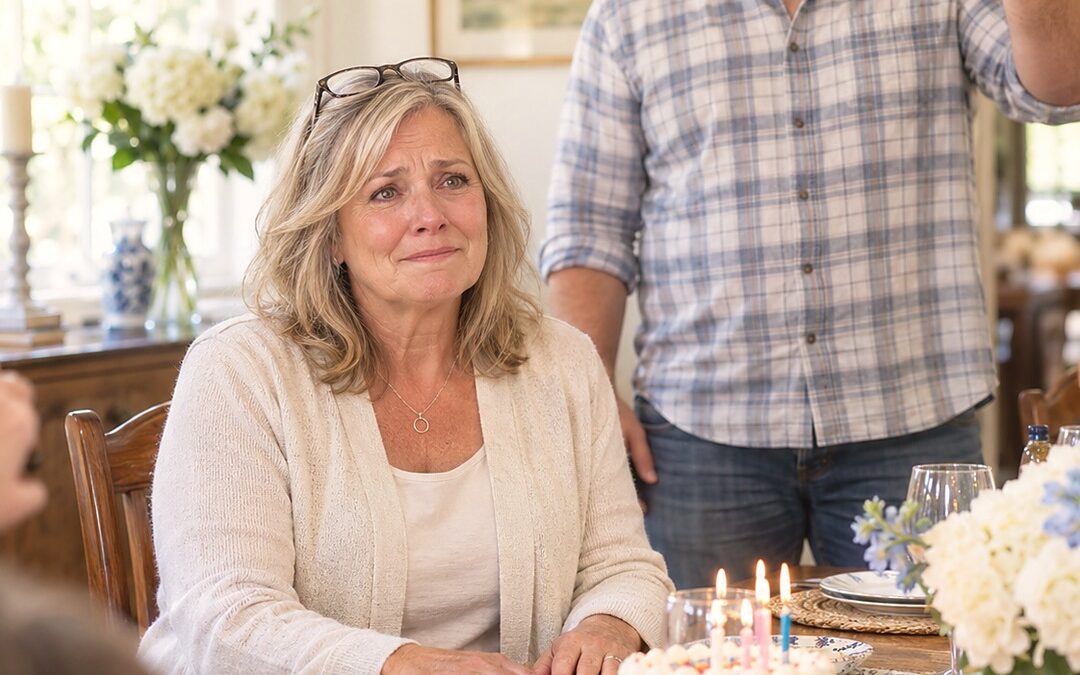
My son raised a can of Bell's at my sixty-second birthday dinner, in front of twenty-three people, in the lake house his father built and he meant to take from me inside of two weeks. "To Mom, who hasn't heard a word any of us said in six years," he said. "Quietest, happiest six years this family ever had." Everybody laughed, and my son-in-law Derek signed to me, Kyle says we love you, happy birthday, and I smiled and nodded like always. Not one person at that table knew my implant had started working in September, or that before the cake came out I would hear those two on my deck planning exactly how I'd sign it away.
Laughing isn't one sound. It's twenty-three separate sounds, and I'd never had the chance to sort them out before. Uncle Gord's came first and loudest, a big wet bark, and his wife Marcia had to knock him on the arm before he choked on his chicken. Pastor Dale gave the polite little chuckle he uses for the church announcements and then studied his potato salad like the Lord had left a note in it. Amy laughed. She's thirty-five and teaches second grade, and she knows better. Bev Vander Kolk, my neighbor two docks down, kept cutting her dark meat into smaller and smaller pieces.
My granddaughter Emma didn't laugh at all. She was ten, and she was watching her father's hands.
Derek had already reached for his pop. He'd left out the quietest, happiest part, all of it, and he'd done it smooth, no hitch, the way a man pours coffee in a kitchen he's poured coffee in a thousand times.
Emma slid a folded piece of pink construction paper across the tablecloth. She'd drawn our house on the front, right down to the crooked chimney Pete said he'd fix in the spring, every spring for thirty years. Then she finger-spelled H-A-P-P-Y B-D-A-Y, slow, stopping on the Y to remember which way the thumb went.
I'd practiced three words for her in my Buick every afternoon for a week, parked at the end of the driveway with the radio off so nobody walking by would think I'd had a stroke. "Thank you, Emma-bug." Not too loud. My iPhone was in my cardigan pocket, recording. I'd started a Voice Memo at 1:58, before grace, and named it First words, because a person likes to keep a thing like that.
I opened my mouth.
Across the table Derek caught my eye and lifted his hands. Everything good?
I shut my mouth and signed thank you to Emma instead. I wanted to know how long his hands had been doing that before I said one word out loud in front of him.
She threw her arms around my neck. "I drew the swans myself," she said into my collar. "Mom wanted to help and I said no."
I heard every word of it, and I patted her back like I hadn't.
"MOM." Kyle leaned across the table and pointed at the platter. "YOU WANT MORE CHICKEN?"
I shook my head.
"MORE POTATOES?"
Another shake.
"Okay, well, I'm trying," he said to nobody, and sat back in his father's chair.
Pete built that chair along with the table, white oak, arms on it so the man who carves has somewhere to rest his elbows. There's a dark scorch on the right arm where a soldering iron sat too long. Kyle was twelve that summer, the same year Pete hung a brass Schlage key around his neck on a shoelace, and he'd had a key to this house ever since.
"She eating enough?" Kyle asked Derek.
"She's fine."
"Looks skinny."
"She's sixty-two, Kyle. Leave her alone."
Kyle cracked another Two Hearted. Tara had called this a small family thing, and then she'd put both leaves in the table and borrowed the gray folding chairs from Third Reformed, the ones with the church's name stenciled under the seat. On the hutch Pete sat in his frame on the unfinished deck in 1989 with a level across his knees, and beside him sat Kyle's black Bluetooth speaker, the size of a pop can. Kyle had played Springsteen off it until Dale said grace. He'd never taken it home.
Bev touched the edge of my plate. She'd put a second thigh next to my potatoes and she mouthed, "Eat." She'd driven me to Grand Rapids on September fifteenth and done a crossword in the parking ramp the whole hour, and she didn't know what happened upstairs. Nobody did.
Across the table Gord asked Kyle how the brewery was.
Kyle peeled at the label on his can. "Closed in March, Uncle Gord. You know that."
"Well, I thought maybe you had something else going."
"Working on it." Kyle didn't look at him. Tara looked at the kitchen door.
Then Kyle rapped a knuckle on the oak beside my plate. "Eight feet of white oak," he said to Tara, not to me, though my elbow was six inches from his hand. "Some buyer's gonna stick a kids' table in here."
"Kyle," Tara said.
Derek's eyes went to Kyle for exactly one second. Then he turned to me with his patient face and signed, Kyle says it's the best table in Holland.
I nodded at Kyle. He raised his can to me.
For six years people had talked about me right over my potatoes, in the third person, like I was a centerpiece.
*
After the guests moved to the living room, I took the roaster.
"Mom, leave it," Amy said. "Dad always did that one." She stopped. She still says Dad like he's out in the garage.
I ran the water hotter and went after the burnt corner of the pan.
Pete died three years ago in January, on a Thursday, shoveling the driveway before sunup. Sixty-one. I found his coffee mug on the workbench with the milk still floating on top. I didn't hear him fall. I couldn't hear anything by then.
The scrub pad went back and forth. Bacterial meningitis took my hearing six years ago that February, nine days in the hospital and both ears gone. I was fifty-six, thirty-one years a court reporter at the Ottawa County Circuit Court in Grand Haven, nineteen of them under Judge Martin Vos, who sat Circuit then and sits Probate now. After that Pete bought a whiteboard and stuck it on the refrigerator, and outside the house Derek took over, the doctors, the insurance, the bank, because paperwork was his job. He's forty-one, a loan officer at Harbor West Bank and a deacon at Third Reformed. The spring I lost my hearing he took ASL I and II at Grand Rapids Community College, and Pastor Dale preached a whole sermon on the hands of the Lord with Derek in the second pew looking at his shoes. At church they call him Saint Derek. Five years ago I signed a financial power of attorney naming him, when the doctors still thought my hearing might come back on its own.
I quit talking out loud that Thanksgiving. I'd asked Kyle to pass the butter, and he laughed and said, "Mom, you sound like the foghorn at Big Red." Everybody heard him. I read it off his lips. That night I wrote No more talking on Pete's whiteboard, and Pete wiped it off with his thumb and wrote Please don't, and I didn't anyway.
The surgeons at Corewell Health put the implant in my left ear on Tuesday, July twenty-first. Derek drove me to the activation on August eleventh and signed what Dr. Anita Shah said: beeps and static first, and after six years deaf, speech could take a year, and some people never get it. Every Sunday after that he'd sign, Anything yet? and I'd sign back, Buzzing. Like bees in a jar. It was true, for a while.
On Tuesday, September first, the kettle whistled and I turned around before I knew why. On Labor Day, in the middle of a Tigers game on Pete's old radio, a man said there was a runner on second, and I sat right down on the pantry floor with a box of stale Triscuits in my lap.
That night I went to the answering machine on the little table by the kitchen door, the beige AT&T Pete wouldn't let me replace. Its red 1 had been blinking for three years. He'd called from Meijer on the Tuesday, two days before. He always called from Meijer. He always forgot.
I pressed Play. First the machine's own greeting, in Pete's voice: "You've reached the Brouwers. Jo can't hear the phone, so talk slow and leave a message." Then the beep.
"Jo, it's me. I'm at Meijer. Do we want the good bread or the cheap bread? Call me back. Oh. Right. Okay. I'm getting the good bread."
He said Oh. Right. so fast. His voice was rougher than I remembered. I'd forgotten that, too. I sat down on the step stool with one foot still caught on the bottom rung and played it again, and then I got up and left that red 1 blinking.
On September fifteenth Dr. Shah tested my word recognition. Seventy-eight percent. I asked her to take Derek off my patient portal. "I want to surprise my family," I said, and the first time it came out so loud a nurse looked in the door, so I said it again, smaller.
"Jo, you can leave that."
Derek was behind me in the kitchen doorway. The water in the sink had gone cold. He signed it too, Go sit, and I signed, Almost done, and he went off to find Pastor Dale about the October fundraiser.
The window over my sink faces west. Pete put it there so I could see the dock without going outside, and he put the screen door right next to it for the summer air. The deck railings out there needed paint.
*
By seven-thirty most people had gone. Dale and Linda were having coffee with Gord and Marcia.
Kyle took a beer out to the deck and sat down on the top step. Derek went after him and leaned on the railing with his phone. The screen door was open six inches, and I was at the sink with my back to it, working the blue scrub pad along the black strip in the corner of the roaster.
At 7:52 Kyle thumbed the tab of his can and said, "How much longer we gonna drag this out?"
Derek didn't look up from his phone. "Two weeks."
Kyle set the can down hard on the step. "You said that last week."
"This time it's real."
Kyle snorted and said it out toward the lake. "Mom'll put her name on a grocery list if Derek hands it to her."
I kept the scrub pad moving.
Derek tapped his screen. "Sunday the eleventh. Everybody at that table, Pastor Dale too. She smiles, she signs, and nobody can ever say we pushed her."
"She's signed stuff here before."
"Routine stuff. This is the house."
Kyle gave a short laugh. "Dad can't sign everything over to her from the cemetery."
The pad slipped. I caught it on the lip of the pan.
"Don't start that again," Derek said.
"I'm the one with the bank on my neck." Kyle stood up. "Two hundred forty thousand, Derek. I signed for it personally. Macatawa doesn't care the brewery closed. They want it by the thirtieth or they take my house on Thirty-second."
"I know what the letter says." Two taps, Derek's good shoes on the boards. "The Naperville people are still at eight-fifteen. Cash. The Halversons. They want to close the thirtieth."
"And the LLC's fifty-fifty."
"Tara filed it Tuesday. It's done."
"Why do we need her to sign anything? You've got the power of attorney."
"Not for a house. Lakeshore Title wants the owner's own hand on the deed, and a POA won't move real estate. Once it records, the LLC owns it and the buyers deal with the LLC."
A pontoon went by out on the lake with a radio playing something with a fiddle in it.
"What if she wants to stay?" Kyle said.
"Tara's looking at Maple Court."
"Mom hates places like that."
"Then she can hate it there."
"And if somebody asks why?"
"She's alone in a house that's too much for her." Derek's voice didn't change at all. "Six years of appointments and paperwork. That house is my back pay."
I lifted the roaster out of the water and set it on the drainboard. There's a dent in the corner from the Thanksgiving Pete dropped it carrying the turkey out, and he swore the turkey was fine, with gravy all over his shoe.
"Does Amy know what we're getting her to sign?"
"Amy thinks it's a Lady Bird deed. Keep it that way."
"She'll ask."
"She won't if I tell her it's handled." Derek's phone chimed. "I'll get Lakeshore Title for Tuesday. Bring Jo, get it started, do the real signing Sunday with everybody there. You don't have to do anything."
"Good. 'Cause I can't do that hand stuff."
"I know you can't."
The screen door squeaked. I put the roaster back under the water.
Derek took the dish towel off the hook by the stove and dried the two plates beside me. He didn't look at me. He smelled like Old Spice and the deck, that cedar smell. He put them in the right cupboard. He always knew where everything went in my kitchen. Then he turned and signed, Great party. Get some rest.
I signed, Thank you.
He smiled and took the towel with him.
I reached into the water for a dinner plate and it slid off the roaster and cracked against the side of the sink, and I caught it before it went over the edge. One of my mother's, with the wheat on the rim. I held it there under the water until my fingers quit.
At 8:15 Amy carried the cake in. Meijer, white frosting, a 6 and a 2 stuck in crooked. Pastor Dale started "Happy Birthday" in his pulpit voice, and Emma stood against my side and sang every word, watching my face between lines to see if I knew where they were. Kyle sang from Pete's chair.
I hadn't heard anybody sing to me in six years. I leaned over and blew the candles out in one breath. Everybody clapped. Derek signed, Happy birthday, Jo.
*
The last car left a little after nine. Bev was the last of all. She stood at the side door with her jacket over her arm and looked at me, then out at the deck, then back at me, and mouthed slow, "You okay?"
I nodded.
She didn't believe me. She touched my elbow and went home anyway, and I watched the Subaru's taillights go up South Shore Drive.
At 9:40 I stopped the recording. Seven hours and forty-two minutes. I saved it under First words and plugged the phone in.
The basement smells like cedar from the shelves Pete built along the back wall. My Stenograph was on its rolling case by the furnace, under a bedsheet, with Pete's masking tape still across the lid in black marker, JO'S. HANDS OFF., from the year Kyle borrowed it for a science fair and spilled orange pop in the case.
I pulled the sheet off and turned it on. The little screen lit up and the paper feed clicked like it had been waiting. My fingers found the keys on their own. Thirty-one years will leave you two bad knuckles, but the board still fit my hands.
New file. September 27. Deck. 7:52 p.m.
I took it down like I used to take down Judge Vos's courtroom, speaker by speaker, times in the margin. KYLE BROUWER. DEREK KESSLER. The paper folded itself into the tray in that neat accordion I used to dream about. When I got to Amy and the Lady Bird deed I stopped and played it back off the phone to be sure, and I'd had it right the first time, every word.
The file saved to the SD card. Upstairs I emailed the transcript and the recording to an address I'd made in August that nobody in my family knew about, and I checked the sent folder twice. Then I went back down, shut the machine off, and left the paper tape sitting right there in the tray.
The SD card went in my cardigan pocket.
Derek's text came in at 10:41 that night. "Tuesday 10 a.m. at Lakeshore Title, just the Lady Bird paperwork for the house. Don't worry, Mom. I'll do the signing."
Part 2
At ten o'clock Tuesday morning, September twenty-ninth, Derek sat beside me at Lakeshore Title Agency on East Eighth Street and told a stranger I couldn't wait to give away my house.
The stranger was Denise Kamphuis, fifty-four, short brown hair, reading glasses she kept pushing up with one knuckle. She had a jar of butterscotch on her desk that nobody was allowed to touch, from the look of it, and she'd been closing houses long enough to smell trouble before anybody uncapped a pen. I liked her right away.
Derek set a leather folder with Harbor West Bank pressed into the cover on the desk between us. "Just getting things lined up for the family signing," he said.
Denise read the first page. Her finger stopped halfway down. "This conveys the house to South Shore Holdings LLC, Mr. Kessler. After it records, she's a guest in it. I want her to tell me she knows that."
Derek turned to me, and his hands were patient and kind, the hands Pastor Dale preached about. Lady Bird deed. House stays yours. Sunday, at home, with family.
I nodded. Denise never took her eyes off me.
"We went over it at home. She's on board, she's been asking when."
What I'd been asking, twice, was when he planned to come fix the screen door. It still has a hole by the latch you could put a thumb through.
"Who's South Shore Holdings?" Denise said.
"Family LLC. Myself and my brother-in-law."
"And Mrs. Brouwer?"
"She's the grantor."
Denise tapped the page with a fingernail. "This says quitclaim. There's no life estate in here anywhere."
"That's how our attorney set it up." Derek leaned back. "Denise, she's got hearing difficulties. I don't want to confuse her with terminology."
Denise looked at his hands, lying on the folder like they were resting after a long day. "Lakeshore doesn't close a deed with a family member doing the signing. I'll book someone certified from Grand Rapids."
His smile stayed exactly where he'd put it. "She gets anxious with strangers. We were hoping to do it at the house Sunday, after dinner, with everybody around her. Pastor Dale will be there. Hoekstra, from Third Reformed."
Denise knew the name. Everybody in Holland knows the name. She took a yellow sticky note out of her drawer, wrote something on it I couldn't see, and stuck it inside her blotter. "Let me look at my calendar."
Derek talked a while after that about everything he'd done for me since Pete died. I watched Denise's eyes go from him to the line where my full legal name sat over the words for the sum of one dollar and other valuable consideration. She didn't offer me a pen.
When we stood up she touched my sleeve and looked straight at me. "Mrs. Brouwer, we'll speak again."
Derek signed, She says everything looks good.
I smiled at Denise. She'd been about to write something, and her pen stopped.
*
That night I opened the hutch drawer.
Derek had kept my papers in there since Pete's funeral, in manila folders labeled in his square printing. INSURANCE. TAXES. ESTATE. POWER OF ATTORNEY. I spread them across Pete's table under the hanging lamp and read every page like I used to proof a transcript, with a ruler under the line.
I checked the insurance renewal and Pete's estate papers and the tax appeal from the year the township reassessed us. Every document said exactly what Derek had told me it said when I signed it. Every one.
That was worse, somehow, than finding something crooked. I'd baked that man banket after he walked me through a beneficiary form at the bank.
The power of attorney was at the back, my signature from five years ago. I put everything back in order, exactly in order, and went down to the basement to take Tuesday off the Stenograph while I still had every word of it.
*
Wednesday morning I drove downtown by myself. The Buick needed gas and I didn't stop for it. I parked on Eighth Street and walked a sealed envelope into Lakeshore Title and set it on the receptionist's desk, with DENISE KAMPHUIS. PERSONAL. printed across the front.
"I can give her that," the girl said.
I nodded and left before anybody came out of the back.
Inside the envelope was Tuesday's meeting, taken off my machine and translated into plain English. Two columns, with the times. On the left, What Mrs. Kamphuis said. On the right, What my son-in-law signed to me. And one typed note at the bottom, with my cell number under it:
"My name is Johanna Brouwer. My hearing came back in September. Left column is what you said Tuesday. Right column is what my son-in-law signed to me. Please call me before you call him."
At 3:10 that afternoon I was peeling potatoes at the sink when something rang, and I turned toward Pete's answering machine before I figured out it was the phone on the counter. UNKNOWN CALLER. I hadn't answered a phone in six years. I picked it up and said hello too loud and had to hold it out away from my ear like it was hot.
"Mrs. Brouwer? This is Denise Kamphuis."
"Yes. I'm here."
A rustle of paper on her end. "Is Mr. Kessler with you?"
"No. He's at the bank."
"You heard everything I said yesterday."
"Every word."
"And this other column, that's what he signed?" She was reading as she talked. I could hear her flip the page. "Mrs. Brouwer, he told you the house was staying yours. That's what those signs mean?"
"That's what they mean."
"How long have you been able to hear?"
"Since Labor Day. My family doesn't know."
A chair creaked. When she came back, her voice had gone flat and careful, like she was talking to a jumper on a ledge. "I'm not notarizing that deed. I'll have to tell our compliance people, and I have to report what you've told me."
"Report it. Just keep Sunday on your calendar."
"Sunday?"
"October eleventh. Two-thirty, at my house. He's going to ask you."
It was quiet long enough that I checked to see if I'd lost her.
"Herrick Library," she said. "Tomorrow at ten. There's a study room in the back. And Mrs. Brouwer? Don't sign anything."
I looked at the potatoes. "I wasn't planning on it."
*
Thursday I was at Herrick District Library twelve minutes early. Denise was already in the study room, and next to her was a woman in a brown blazer with a paper cup of Biggby coffee and a reporter's notebook, the skinny kind that flips up.
"Jo, this is Sergeant Laura Pruim, Holland Police. She does financial crimes and elder abuse."
Pruim was forty-seven, short hair tucked behind one ear, a wedding ring she turned with her thumb while she listened. "Denise says you worked in the courts."
"Thirty-one years. Grand Haven."
"Then you know I've got to ask careful questions."
"I'd think less of you if you didn't."
I put two things on the table. Tuesday's transcript. Then the deck, printed off the steno file with KYLE BROUWER and DEREK KESSLER down the left side and the times in the margin starting at 7:52.
Pruim read the first page without saying anything. "Who took this down?"
"I did. That night, before eleven."
"You heard them yourself."
"With my own ears. Through a screen door."
She read on. At the line about the Naperville people she stopped and put her finger on it. "Eight hundred fifteen thousand."
"For my house. Cash."
"Is there a recording?"
"Seven hours and forty-two minutes. I started it at my birthday dinner because I wanted to keep the first thing I said to my granddaughter."
She asked to hear the deck. I played her ten seconds of it. Kyle first, then Derek. She reached over and stopped it herself.
"You heard it yourself, and you wrote it down the same night. That's your testimony; the recording is backup." She opened the skinny notebook. "Tuesday was a consultation, nothing was signed. Sunday, with a pen in her hand and a notary in the room, it's an attempt."
Denise had a hand over her mouth. "You want me to go through with it."
"I want to be in the room when he puts that pen in her hand. Nobody signs anything."
"There'll be twenty-some people at that table," I said. "The same ones who laughed at my birthday. If I tell them afterward, Derek tells them I misunderstood, and they'll believe him. They've believed him for six years."
Pruim looked at Denise. Denise looked at her coffee lid.
"I bring a second person to home signings sometimes," Denise said. "When there's a lot of paper."
"Your colleague," Pruim said.
"That's what I'll tell him."
Pruim slid the deck transcript back to me and wrote a number on the back of her card. I went out the back way, past the book drop.
*
Friday afternoon Kyle came into my kitchen with a brochure, and Tara and Derek came in behind him.
MAPLE COURT SENIOR LIVING. A white-haired couple walking by a pond, holding hands, both of them laughing at something off the edge of the picture.
"LOOK, MOM." Kyle tapped it. "NICE PLACE."
"They've got a unit opening November first," Tara said. "Two-fourteen. Second floor, but there's an elevator. I put fifteen hundred down so we wouldn't lose it."
Derek signed, Nice new apartment, by the lake, no stairs.
The lake was a retention pond behind the parking lot. I turned to the floor plan. One bedroom and a kitchenette, and nowhere at all for Pete's table.
"Oh, and the LLC paperwork came back from the state," Tara said, opening another envelope.
"Tara," Kyle said.
"What? I'm saying it's done."
Derek cleared his throat. Kyle watched me a second, and then he pointed out the window toward town.
"SAW YOUR CAR. EIGHTH STREET. WEDNESDAY."
He'd been down at the empty brewery clearing out equipment for the bank. I'd plain forgotten he still went there. I signed Bakery.
Derek watched my hands. "Bakery," he told Kyle.
Kyle shrugged. "Next time let somebody drive you."
Derek's phone buzzed on the counter. He took it out on the deck and slid the door shut behind him, and Tara started in on what furniture would fit in two-fourteen. "Your bedroom set should go. The big dresser, maybe not."
Pete built that dresser. I didn't sign anything.
When Derek came back he was grinning. "That was Lakeshore. Denise'll do Sunday at the house, two-thirty. She'll see how it goes, with family there. She's not going to stop a signing with a pastor watching."
"Good," Kyle said.
Derek leaned in close to him, low, the way you'd talk in church. "Guardianship takes months and a judge watches every dime. A signature takes ten minutes."
My phone was in the fruit bowl by the refrigerator, under two bananas, recording.
Kyle leaned back against my refrigerator, right on top of Pete's whiteboard, and said to Tara, "If she balks Sunday, Derek files for guardianship. Deaf widow, lives alone. Judge Vos'll sign it before lunch." Judge Vos was the man whose every word I took down for nineteen years.
Part 3
Emma came Saturday morning in yellow rain boots, though it hadn't rained since Thursday, with a library book on American Sign Language under one arm and a purple spiral notebook from Meijer under the other.
"Grandma, can we go down to the dock?"
I signed yes, and she was gone before I finished, clomping down the path Pete laid with the leftover brick from our fireplace. Two fishing boats were heading out toward the channel. A pair of swans had parked themselves off Bev's dock like they owned it.
Emma sat on the bench at the end of ours and opened the notebook. She'd written Grandma words across the cover in purple marker, and pressed hard enough on the G to go through to the next page.
"Look what I learned." She found a page in the library book and made the sign for lake, then swan, stiff as a crossing guard, checking the picture between every move. I fixed her wrist. "Like that?" I nodded, and she wrote it down.
"I've got Grandpa in here too." Three pages back, next to the word Grandpa, was a little man holding a hammer. Pete taught her to drive a nail when she was four. She bent it nearly sideways, and he kept that nail in a baby food jar on his workbench, and it's still there.
She practiced Grandpa a few times. Then she looked past my shoulder at the water.
"Grandma, the swans are coming."
I turned my head.
I did it before I could stop it, the same as you'd turn if somebody said your name in a grocery store. The swans were still thirty yards out and hadn't made a sound.
When I turned back, Emma had closed the notebook on her pencil. She was looking at me very steadily, the way her grandfather used to look at a board to see if it was true. Then she lifted her hands and signed, slow, getting every shape right.
You heard me.
I shook my head and pointed at the swans. No, I saw them.
She looked out at the water, then back at me. "But you were looking at me," she said, out loud, and didn't sign it.
I pointed at the swans again.
She didn't argue. She opened the notebook and drew a small question mark next to the word swan, and then she asked me how you sign tomorrow.
Her father had been interpreting for me since before she started kindergarten. She'd learned more sign language in three weeks off YouTube and library books than her Uncle Kyle had bothered to learn in six years.
"Mom says we're having dinner here next Sunday," she said. "Dad's bringing some lady from an office." She scraped the toe of her boot along the bench. "Are you moving, Grandma?"
I took her pencil and wrote under the question mark. I live here.
"I know." Scrape, scrape. "Mom says you'd have less cleaning."
Do you want me to move?
"No." That came quick. She leaned against my arm and opened the library book to the page for I love you. "Can you teach me this one right? The book's hand looks weird."
I showed her, and she did it over and over until she could do it without looking down. Across the water Bev came out on her deck in her robe and waved, and we waved back.
I could have said it right then. Thank you, Emma-bug. Three words, and they were ready, sitting right behind my teeth.
Instead I flipped to the back of her notebook and made her practice her spelling words for Monday's test, receive and believe and neighbor, until Amy pulled in. Whatever happened at my table next Sunday, nobody was going to turn around and ask a ten-year-old what she knew about her father.
"See you Sunday, Grandma." She signed I love you through the car window, the right way.
That night I took down Tuesday's title office and Friday's kitchen on the machine, both of them, and named the files Title and Fridge.
*
Monday morning, October fifth, Derek found out about my medical records.
He was at my kitchen table with his laptop, supposedly helping me sort out a prescription refill. I had pea soup going, split peas and the ham bone from Sunday, and it had been simmering since nine.
"Huh," he said. "That's odd."
I stirred.
He clicked something and leaned in close to the screen, and then he read it out loud, slow, like it might change if he said it right. "Proxy access restricted at patient request."
He called Kyle and put him on speaker, right there next to the salt and pepper.
"Something funny with your mom's medical portal. They took me off as proxy."
"Why?"
"Says patient request."
"She can't even work that thing."
"That's what I'm saying."
I scraped the bottom of the pot. A piece of ham came up on the spoon.
"Probably that doctor screwed something up," Kyle said. "Call 'em."
"They won't talk to me if I'm not authorized."
"Well, that's stupid."
Derek looked at my back. I let the soup run off the spoon.
"Hang on," he said.
He got up and walked into the hall behind me, and his shoes stopped under the smoke detector, and then he reached up and held the test button down.
It went right through the left side of my head like a nail.
I kept stirring. I had practiced for this exact thing, standing at this exact stove with Pete's radio turned up as loud as it would go, letting the Tigers lose behind me while I watched the peas. But a smoke detector is a different animal than a radio. Derek held that button down a long time. I watched a bubble come up by the ham bone and break, and another one, and my left ear wanted to turn so bad my neck ached.
It stopped.
Derek came back in. "Nothing. Not even a blink."
"Bev's been in her ear," Kyle said through the speaker.
Derek laughed. "About what?"
"Who knows. That woman thinks she runs South Shore Drive."
Derek hung up. He came over to the stove and smiled down at me and signed, Smells good.
I gave him a bowl. He had two. Before he left he wrote CALL PHARMACY THURS on Pete's whiteboard, though the refill had already gone through, and I wiped it off with the side of my hand after his car pulled out.
Then I sat down at the table where he'd been sitting, in the chair still warm from him, and found I'd turned the burner off at some point without remembering doing it. My left ear was ringing a high thin note, like a wet finger on a glass. Dr. Shah had said that could happen with a loud noise. She hadn't said anything about your hands.
*
Wednesday, October seventh, Kyle backed a rented U-Haul trailer up to my garage for the last of the brewery kegs. Derek came to help.
I was coming up the basement stairs with a laundry basket when Kyle met me at the top.
"MOM. WE'RE TAKING THE KEGS. NEED THE GARAGE OPEN."
I pointed at the opener on the fridge. When I got to the kitchen, he was standing by the back door with my Buick keys hanging off his finger, the Tulip Time keychain with the little wooden shoe Pete bought me the May Emma was born.
"NO MORE DRIVING DOWNTOWN, MOM." He pointed at the keys, then at me.
I held my hand out.
He shook his head and put them in his jacket pocket. "I saw you down on Eighth."
Derek came in from the garage and watched them go in the pocket. Then he signed, Doctor says rest.
I signed, My car.
We'll talk Sunday.
"It's just till things settle down," Kyle said. "You want groceries, Tara'll take you. Come on, those kegs aren't gonna move themselves."
I stood at the kitchen window and watched them roll four empty kegs up a two-by-ten into the trailer. Pete taught Kyle to back a trailer in this same driveway when he was fifteen, standing behind it waving his arms and hollering, and Kyle put it in the lilacs twice. The lilacs came back. Kyle was always sure everything would come back, that was the trouble with him. He had my keys in his pocket now and he jingled them every time he bent over, and I don't think he even heard it.
At noon Kyle came back in wanting bratwurst. "Any of those left from Labor Day?" I nodded toward the basement, and he went down to the chest freezer.
The freezer lid opened and banged shut. Then nothing for a while.
"Hey, Derek. Come look at this."
I went as far as the top of the stairs. Kyle had pulled the sheet off my Stenograph. He was holding up the paper tape that had folded into the tray the night of my birthday.
I'd left it there on purpose. The SD card was in my cardigan pocket and the file was in an email account nobody knew about. A man who thought I could hear would take one look at that paper and burn it in the grill. A man who didn't would laugh.
Kyle tore the strip loose. "What's all this?"
Derek came down the last two steps and took one look. "That's her old court reporting machine."
"She still use it?"
"Thirty-one years, she used it." Derek bent over the strip. "That's court shorthand. Keep it. I'll ask a reporter I know, after Sunday."
"Why after Sunday?"
"Because we've got enough going on before Sunday."
"Can you read any of it?"
"No."
"Can she? Without hearing anything?"
Derek took a second longer than he needed. "She used to do it in her sleep."
Kyle looked up the stairs and saw me standing there. He grinned and waved the paper at me like a parade flag.
"PLAYING WITH YOUR OLD TOYS, MOM?"
I nodded.
Kyle held the strip of paper up under the basement bulb, every word he'd said on my deck punched into it in steno, and laughed. "Gibberish," he said, and folded it into his wallet behind his fishing license.
Part 4
Friday morning, October ninth, Sergeant Pruim came up my front walk in jeans and a navy jacket, carrying a manila envelope, and she'd parked a plain gray Malibu down at the road instead of in my driveway.
"Anyone else here?"
"Just me and the furnace."
She looked at the empty hook by the refrigerator where my keys used to hang. "Your son still has your car keys?"
"Since Wednesday. I asked twice. Derek says we'll discuss it Sunday."
She sat down at Pete's table and slid the papers out across the oak. OTTAWA COUNTY PROBATE COURT across the top, and under it, In the Matter of Johanna M. Brouwer.
I'd seen a thousand of those. I knew what it was before I got to the second line.
"Guardianship," I said.
"Filed yesterday. Thursday."
Derek Kessler, Petitioner. A hearing on Tuesday, October twentieth, at nine in the morning, before Judge Martin Vos. I put my finger on the judge's name and kept it there.
"Twelve days out," Pruim said. "He marked it an emergency because of the thirtieth. That's how you get a hearing that fast."
"Did Derek ask for him?"
"He's just who it got assigned to."
"I took down every word that man said for nineteen years." I don't know why I told her that. She already knew. "He used to bring me a Sanders hot fudge when we ran past six."
Pruim turned to the next page without saying anything, which I appreciated.
On the consent line was Amy's signature, with the big loop on the A she's been making since she signed her name on Christmas cards in middle school. Dated Thursday. Yesterday. I looked at that loop a long time.
"Did you know?" Pruim said.
"She talks about Maple Court. Less to take care of. Nobody said guardian."
"Read his statement."
It was halfway down the page, typed, sworn, notarized.
"Respondent has profound hearing loss, cannot follow spoken conversation, and depends entirely on petitioner to understand financial and legal matters."
Under that he'd sworn I was becoming confused about money. Derek knew I'd balanced every household account in this house for thirty-eight years. Pete wouldn't go near a checkbook. He said it made his ears hot.
"Here's what worries me," Pruim said, and she leaned in on her elbows. "If you tell them now, they pull the deed, cancel Sunday, and tell everybody at church you got confused. And this," she touched the petition, "doesn't go away just because nobody signs a deed. It's on file. It's got your daughter's name on it. And your son has your car."
The furnace kicked on under the floor. I hadn't heard it in six years, and it rattled in the register by the hutch, because Pete never did get that vent straight.
"Could they put me out of my own house?"
"Nothing's been decided. You'd get to answer." She tapped one line at the bottom, the verification, where it says the petitioner declares under penalty of perjury that the statements are true. "But this changes things. He swore to it in front of a notary."
She took her finger off the page.
"That's not talk anymore."
I took my glasses off and cleaned them on my cardigan, slow, both lenses, which is what I do instead of saying things.
"When were they going to serve me?"
"Monday. If you don't sign Sunday."
"Monday, then. That's when they meant to tell me." I put the glasses back on. "Over the leftovers."
Pruim didn't smile. She slid the papers back in the envelope and set it in front of me. "Put this somewhere Derek won't look. Denise has told him she's bringing a colleague Sunday. That's me."
"You'll be at my table."
"I'll be at your table."
At the door she stopped by the bench Pete made out of leftover deck boards. "If anything changes before Sunday, you call me. Especially if anybody tries to take you anywhere. Can your neighbor drive you if you need it?"
"Bev has a Subaru and very strong opinions about where people park."
"Keep her close."
I put the envelope upstairs behind my sewing patterns, in the Butterick box, which no man in this family has ever opened.
*
Amy came at six-fifteen with a casserole wrapped in a dish towel. Derek had a bank dinner, she said. She came by herself.
"Chicken and rice. Emma helped crush the crackers."
I signed thank you. She had on the blue cardigan I gave her two Christmases ago, and one of the buttons had been replaced with one a shade darker, and it bothered me more than it should have.
She made room in my refrigerator, moving the milk around like it had done something to her. "Kyle told me about your keys."
I held up two fingers. Two days.
"He just worries about you driving."
My car.
"I know, Mom. Derek says they're being careful till everything's settled."
What everything?
She looked at my hands, then the refrigerator. "The house. Maple Court. All that." Then she tried to sign, which she hardly ever does, slow, fingers stiff. Maple Court is nice. Derek handles everything. Okay? She got nice wrong and did it over.
What do you want, Amy?
"I want you someplace you won't fall down those deck steps."
Pete built those steps wide enough to carry a sofa down to the dock, fourteen of them, rails on both sides. Amy had her wedding pictures taken on them.
I like my house.
"Okay." She looked down. "Okay."
She got a spoon out of the drawer to check the casserole, and then she said, to the countertop, not to me, "God, I hope this is right."
She didn't sign it.
I picked up the casserole and turned to the oven so she'd be looking at my back. The door sticks at the bottom and you have to jerk it. I jerked it.
"Mom, you don't have to heat it now. It's already cooked."
I set the timer anyway.
She came up and touched my arm and signed Love you, and I signed it back, and she kept looking at me. "Are you mad about something? Because Kyle gets pushy. He's scared about money, that brewery really hurt them. And Derek's just trying to help everybody."
I folded the dish towel in half, then in half again.
She stayed twenty more minutes and told me about a boy in her class who brought a live caterpillar in a sandwich bag. I wanted to go upstairs and get that envelope and put her own signature in front of her. But Amy tells Derek everything before bed. She always has. He'd have known before ten.
So I signed goodnight and watched her back out. She stopped at the mailbox and straightened the little red flag, the one Pete bent with the snowblower, and then she drove off.
*
Saturday Amy dropped Emma off at the dock around five so she could run to Meijer. Emma had the purple notebook, and her braid was coming loose on one side.
"Grandma, I learned a new one." She held her hands up. I miss Grandpa.
She had miss wrong, dragging her finger across her cheek instead of down from the lip. I took her hand and moved it right. She did it again, right.
"Mom says he made this bench."
I nodded.
"And the dock. And our table." She thought about it. "He made everything."
I pointed at Bev's house and shook my head, and she laughed. "Okay, not that."
She turned some pages. "I learned how to ask if somebody's okay." She made the signs slow and careful. Are you okay?
I nodded.
"No, that's just yes." She frowned at me like I was one of her mother's second graders. "You're supposed to answer with words, Grandma."
So I signed it, the whole sentence, Yes, I'm okay, and she copied it into the notebook with her tongue in the corner of her mouth.
She never brought up the swans, or last Saturday, or any of it. She swung her feet and told me Dad had told Mom somebody else might buy the house, maybe another family, she'd heard it when she came down for water.
"He said we can't keep paying for everything."
I looked up at the house. Pete put that roof on himself ten years ago and it still looks good. The gutters were clean. The property taxes went out in August, from my checking account, in my handwriting, same as every August. Kyle never paid a dime of them.
"I don't want different people here," she said, and put her head on my shoulder.
I signed I know against her hair, where she couldn't see it.
Amy honked. Emma jumped up, stuffed the library book in her backpack and ran for the driveway yelling "Love you, Grandma," and the purple notebook stayed behind on the bench.
I picked it up. The cover had curled from riding around in her backpack and there was a tulip sticker peeling off one corner.
Lake. Swan. Grandpa, with the little man and his hammer, and I saw now she'd given him six fingers on the hand holding it. I started to fix it with her pencil and then put the pencil back in the spiral. I love you in big letters with the hand shapes copied off the library book. Are you okay?
I put the notebook face down on my knee and looked at the swans for a while. The wind off the lake had gone cold, and I let it.
*
That night I typed my Revocation of Power of Attorney on the State of Michigan form at the kitchen table. Full legal name, Johanna M. Brouwer. Agent, Derek Kessler. I checked every blank twice, because I wasn't about to give that man a missing date to complain about. At eleven-fifteen I printed two copies and set them next to the good black pen Pete gave me when I retired.
Bev texted. Need anything for tomorrow?
Come early. Sit by me.
I'll be there.
Before I turned off the lamp I opened Emma's notebook again, to the last page, the one I hadn't turned to on the dock.
On the last page, under swan and Grandpa and I love you, Emma had written in pencil, How do you sign 'Dad is lying'?
Part 5
Kyle was sitting in Pete's chair again when Pastor Dale asked us all to bow our heads.
Same table, same leaves in it, same gray folding chairs from Third Reformed. The Bosmans were at a grandson's soccer game in Zeeland. Everybody else who'd laughed at my birthday was back in the same seats.
"Lord," Dale said, "thank You for gathering this family again. Bless Jo's next chapter. Give her peace in her new home, and bless the hands that are helping her get there."
I kept my eyes open. Derek had told Dale I was moving to Maple Court November first. He'd left out the part where I said yes, since I never had.
"Amen," said twenty-one people at once, and I heard every one of them. You'd think you would get used to that. I hadn't yet.
Derek touched my arm and signed, Prayer finished.
Bev was on my left, where I'd asked her to sit. She'd brought banket and a pan of cheesy potatoes and she hadn't asked me one question, not one. Under the table she pressed her shoe against mine once.
Across from me Emma had her purple notebook beside her plate. She hadn't asked me about the last page. I hadn't asked her either.
At 2:22 Derek looked at the clock over the hutch. "Title lady's coming at two-thirty," he told the table. "Little bit of family paperwork. Nothing to worry about."
Tara looked down at Mason's plate. Amy asked if they should clear first. "After," Derek said. "Denise just needs a clean spot."
Pastor Dale smiled at me. "Jo, I hope you're excited about the new place."
Derek signed, Pastor says nice apartment.
I gave Dale the same smile I'd given him two Sundays ago.
At two-thirty the doorbell rang and Derek got up so fast he banged his knee on the table leg. "I'll get it."
Denise came in with her leather folder under her arm, and behind her a woman in a navy jacket carrying a plain black bag. "Mr. Kessler. This is my colleague, Laura."
"Come on in, come in."
Laura nodded around at everybody and took the chair by the hutch, under Pete's picture, where she could see the whole table. Denise shook my hand. "Mrs. Brouwer."
Derek signed, Title lady here. Papers ready.
Kyle stood up with his Bell's before anybody else could. Tara said, "Kyle, sit down," and he didn't.
"One more before we do this." He lifted the can. "To Mom's next chapter. She won't hear this either."
A few people laughed. Less than last time, and thinner. Gord started to and Marcia put her hand flat on his sleeve. Bev set her fork down and didn't pick it up.
Derek turned to me. Kyle says we're proud of you.
Then Denise opened her folder on Pete's table and laid the deed down in front of me, QUITCLAIM DEED in capital letters across the top, my name under it, and South Shore Holdings LLC under that. Derek leaned in close at my shoulder and signed, right over the paper, Lady Bird deed. House stays yours. Just sign where Denise points.
I let him finish. I wanted to see him finish.
Denise uncapped a black pen and set it next to my hand. "I'm going to put my questions to Mrs. Brouwer myself before this pen moves."
Derek already had his hands up. "Denise, she's deaf. Talk to me, I'll sign it to her."
I put two fingers on the deed and slid it back across the oak to Denise, slow, with the pen still uncapped lying right on top of it.
"We won't need an interpreter, Denise. Ask me anything you like."
My voice came out low and a little rusty, like a door nobody's opened all winter. It did not sound like a foghorn.
Amy's fork hit her plate and bounced onto the rug. Derek's hands stayed up in the air in front of his chest, holding nothing. Uncle Gord said, "Jo?" the way you'd say it to somebody you thought was in Florida.
I looked at Bev. "Bev, would you take the kids down to the dock to see the swans?"
Bev was on her feet before I finished asking. "Mason. Ava. Emma, you too, hon." Mason wanted his dessert. Bev told him it would keep. Emma went last. At the kitchen doorway she turned around and signed, small, so only I could see, Are you okay?
Yes, I'm okay, I signed back. The whole sentence, the way she taught me. The screen door slapped shut behind them.
Then I turned to my son.
"Go ahead and give it again, Kyle. I'd like to hear how it sounds with my ears on."
He just stood there with the can.
"The toast," I said. "From my birthday. Go on."
"Mom, I was joking." He looked down the table. "Gord. You laughed. Tell her."
Gord rubbed his thumb along the rim of his plate. "I laughed, Kyle. I shouldn't have."
"Six quiet years, Kyle? I've heard every word you've said in this house since September, and I took down every one."
Kyle's thumb pushed into the side of the can, and the aluminum gave with a little pop. He went to set it down and missed the coaster. It tipped against the potato dish and beer ran out across Pete's table in a long brown tongue, straight for the deed, and Denise picked the deed up by one corner and held it out of the way like a wet cat.
Kyle didn't reach for a napkin. He didn't do anything. He stood there with his hand still shaped around a can that wasn't in it anymore.
Derek's hands started a sign. I don't know what it was going to be. They got halfway and stopped.
"Save it, Derek. I'd rather hear you say it."
I turned to the table, to Denise, to the woman under Pete's picture. "At my birthday Kyle said I hadn't heard a word in six years, and Derek signed me Kyle says we love you, happy birthday. Five minutes ago Kyle said I wouldn't hear his toast either, and Derek signed Kyle says we're proud of you. And with that pen next to my hand he signed Lady Bird deed. House stays yours. Just sign where Denise points." I looked at Derek. "Back pay, you said. Six years of appointments. I fed you banket after every one of them, and you ate it."
He put his hands under the table, both of them.
Tara laid a dish towel over the beer. Amy was staring at her husband. "Derek. What is she talking about?"
"She's confused about her birthday." He said it to the table, reasonable, his loan-officer voice. "The implant's obviously doing more than we knew, that's wonderful, but it doesn't mean she's understanding everything correctly."
"Denise," I said, "would you read the name of that document out loud?"
Denise held it up. "Quitclaim deed. From Johanna M. Brouwer to South Shore Holdings LLC."
"Does it say I can live here till I die?"
"No, Mrs. Brouwer. It doesn't say that anywhere."
"Then what was Mom supposed to get?" Amy said.
Derek looked at Denise. Denise looked at him back. "We were going to make sure she was cared for," he said.
"Where does it say that?"
Nobody answered her, so I turned to Kyle.
"Take out your wallet, Kyle. Behind your fishing license."
His head came up. "What?"
"Your wallet."
He looked at Derek. Derek was looking at the tablecloth. Kyle pulled his wallet out of his back pocket, worn soft at the corners, a Harbor Point Marine receipt sticking out of the fold, and slid out his fishing license, and behind it was the strip of paper tape, folded in four.
"You can't read this," he said. He unfolded it on the table anyway, flat, with both hands. "You can't even hear."
I didn't need to lean in. I'd written it.
"Kyle Brouwer, the deck, 7:52 p.m. 'Mom'll put her name on a grocery list if Derek hands it to her.'"
Gord turned all the way around in his chair. "Did you say that? About your mother?"
Kyle opened his mouth. What came out was, "That's out of context."
I took my phone out of my cardigan. Kyle's Bluetooth speaker was still on the hutch from my birthday, where he'd left it, under Pete's picture. I'd paired it that morning. I found the spot I wanted and played one sentence.
"Amy thinks it's a Lady Bird deed. Keep it that way."
Derek's own voice, in my dining room, out of a speaker the size of a pop can. I stopped it there. In the kitchen the refrigerator motor kicked on.
Amy didn't look at him right away. She looked at his hands first, under the edge of the table. "All those times I asked you what Mom thought about something," she said. "Were you telling me what she actually said?"
"Amy, listen to me."
"Answer that one out loud, Derek."
He didn't. She turned to me, and her chin was going the way it did when she was six. "Friday. In the kitchen. You heard me."
"I heard you, honey."
"I signed it. Derek said it was for Maple Court. I didn't read it, Mom. I laughed at that toast."
I took the copy of the guardianship petition out of my folder and set it in front of her, open to the consent page, with her loop on the A. She read the top of it. Then she pushed her chair back from her husband, about a foot, and left it there.
Pastor Dale had been sitting very still with his napkin folded in his lap. "Derek," he said. "I prayed over this. Over you helping her. Ten minutes ago."
Derek didn't look at him.
"Tara," I said. "You filed South Shore Holdings on September twenty-second."
She nodded.
"Did Kyle tell you what it was for?"
Tara looked at her husband, who was looking at the beer soaking into the dish towel. "I filed the LLC. Kyle said you'd agreed. I never asked you." Then, quieter, to Denise, "Is anything recorded?"
"Nothing's recorded," Denise said.
That was when Kyle found his voice, and it came out the size of the whole room. "Okay, enough. You want to know why? Macatawa Community Bank wants two hundred forty thousand dollars by October thirtieth or they take my house. My kids' house. And nobody at this table ever offered to help me with one dime of it."
"So you sell your mother's?" Gord said.
"I was going to pay her back."
"With what?" That was Tara. "You told me the brewery loan was getting refinanced. You told me that in August. It was due the thirtieth the whole time, and you knew it when you had me file that LLC."
Kyle looked at the kitchen door. "I was working on it."
Ava's crayons were still all over the place mat by Tara's elbow. Tara started picking them up one at a time and putting them back in the box, the right way, by color.
Denise uncapped her own pen, a red felt-tip, and wrote NOT EXECUTED across the face of the deed in letters an inch high, dated it, initialed it, and put it in her folder.
I slid one more paper across the table. "There's this, too."
Derek knew the heading upside down. His chair scraped. "Jo, you can't revoke a power of attorney at a dinner table."
"It's a state form, Derek. You can revoke it anywhere you like."
Denise asked me to state my name and asked if I was signing of my own free will. "Yes," I said, and signed it with Pete's pen, Johanna M. Brouwer, and she filled in her certificate and brought her stamp down on it with a thump that rattled the gravy boat.
"The authority I gave you five years ago is revoked," I told him.
Denise squared the paper and set a copy in front of him. "You'll get formal notice, Mr. Kessler. As of now you don't handle anything for Mrs. Brouwer. Not her bank, not her doctors, not her mail."
Derek reached for his leather folder, the Harbor West one. Then he saw Amy watching him do it, and he left it lying there.
Kyle was still on his feet beside the chair.
"That's your father's chair, Kyle."
He looked down at it, at the soldering-iron mark on the arm, and then he stepped away from it. I held out my hand. "My house key."
"Seriously?"
"Seriously."
He worked the brass Schlage off his ring. It caught on the split ring and he had to pry it with his thumbnail, twenty-six years of carrying it, and he set it down on the wet oak next to the dented can. Then he grabbed his jacket off the back of a folding chair and went for the hall.
I followed him. Behind us I heard Amy say, "Don't," to Derek, and a chair go back.
Kyle stopped in my front door with his jacket half on and said, "You faked being deaf to trap your own kids. Let's see what Judge Vos thinks of that on the twentieth."
Part 6
"Laura" was standing right behind Kyle in my front hall. None of us had seen her get up from the chair by the hutch.
"Mr. Brouwer. Before you go, I'd like a word."
Kyle turned around with one arm in his jacket. "Who are you?"
She took a badge wallet out of her inside pocket and let it fall open. "Sergeant Laura Pruim, Holland Police Department."
Kyle's jacket slid off his shoulder. He caught it in the crook of his elbow and held it there like a dish towel.
Derek came up the hall behind her. "Laura. Denise brought you as her colleague."
"Denise introduced me as her colleague. I'm also a police officer." She turned so she could see them both. "I'd like the two of you to step outside with me. Out on the deck, where you had this conversation the first time."
"Do we need lawyers?" Derek said.
"You're welcome to call one. Right now I'm asking if you'll talk to me."
Kyle looked past her at me. "Mom. Seriously? You called the cops on me?"
I didn't answer him.
Pastor Dale had come to the dining room doorway. He took off his reading glasses, folded them, and put them in his shirt pocket, and then he just stood there with his hand over the pocket like he was saying the pledge.
They went out through my kitchen. I went as far as the sink, where I'd stood with Pete's roaster on my birthday, and watched through the window. Pruim had her skinny notebook out. Kyle leaned on the railing and looked at the lake. Derek was talking already, a lot, and his hands were going the whole time, little pieces of signs coming loose out of habit, house and help and family, to a woman who didn't know one sign from another.
Behind me Dale said, "Jo."
I turned around.
"I laughed at your birthday."
"I know. I heard you."
"I heard what Kyle said, and I watched Derek sign you something else, and I thought…" He rubbed the back of his neck. "I thought he was sparing your feelings."
"Did it ever occur to you I might want to know what my own son said?"
He looked out at the deck a long time. "No, Jo. It didn't."
I wiped a ring of water off the counter with the dishcloth. "Well. Think about it."
*
Tuesday, October twentieth, Bev drove me to the Ottawa County Probate Court in West Olive. My Buick was sitting in my own driveway. Kyle had taken the keys on the seventh and sent them back through Pastor Dale two days after the dinner, Tulip Time keychain and all, in a Meijer bag. I wasn't quite ready to drive it yet.
The building smelled like floor wax and burnt coffee, same as every courthouse I ever worked in. I hadn't been inside one for six years.
When Bev and I came through the doors of Judge Vos's courtroom, the reporter at the steno machine looked up and nearly put her elbow through her water bottle.
"Jo Brouwer?"
Kendra Lubbers. Thirty-three now. I'd trained her when she came out of court reporting school scared to death of a fast cross-examination, and she still sat like I'd taught her, feet flat and wrists up.
"Good grief," she said. "I thought you couldn't hear."
"I had some work done."
She laughed and mopped up the water with her sleeve, and I heard her machine start clicking as she set up. I'd have known that sound anywhere. I caught myself listening to her rhythm instead of looking at the bench.
Kyle came in with Derek and Derek's lawyer, a man with a briefcase and a very good haircut. Kyle had on the gray sport coat I bought him four Christmases ago. Amy came in by herself and sat behind me next to Bev. Tara sat with Pastor Dale and Linda. Sergeant Pruim took the end of a bench by the aisle.
At nine the bailiff called it, and Judge Martin Vos came out the side door. Sixty-six, grayer, same half-glasses down his nose. He opened the file, and then he looked over those glasses at me.
"Mrs. Brouwer."
"Good morning, Your Honor."
He stopped. "Well. That's a voice I haven't heard in a while."
"Me either, Judge."
"Before we start," Judge Vos said, "I told both sides last week that Mrs. Brouwer reported for me for nineteen years. Nobody asked me to step aside, so I haven't."
Derek's lawyer stood. "Your Honor, the petitioner moves to withdraw the petition for appointment of guardian."
"On what grounds?"
"Mr. Kessler no longer believes an appointment is necessary. And the respondent concealed her recovered hearing from her own family for weeks."
"Counsel, the surgery is in the record. July twenty-first, Corewell Health. Nobody faked an implant." Judge Vos turned a page. "Twelve days ago he believed it under oath." Then he looked at me again. "Mrs. Brouwer, do you need an interpreter?"
"No, Your Honor."
He read Derek's sworn statement out loud into the record, slow, every word, like I'd heard him read a thousand jury instructions. "Respondent has profound hearing loss, cannot follow spoken conversation, and depends entirely on petitioner to understand financial and legal matters."
Kendra's keys clicked along under him.
"Mrs. Brouwer, I have one question for you. Do you understand what Mr. Kessler asked this court to do?"
"Yes, Your Honor. He asked you to take my affairs away from me and give them to him. I'm asking you not to. I've managed them myself for thirty-eight years, and I revoked his power of attorney on October eleventh, in front of a notary."
Judge Vos nodded once. "The withdrawal is accepted. The petition is dismissed." He made a note. "And I'm referring the verified petition and everything attached to it to the prosecutor's office. The statement was sworn. This court expects sworn statements to be true." He looked down at Kendra. "Ms. Lubbers, let the record reflect that the respondent appeared and answered for herself."
"Yes, Your Honor."
I watched her fingers. She got every word.
*
Out in the hallway Pruim caught Kyle and Derek by the elevators.
"Gentlemen. The Ottawa County prosecutor filed charges yesterday. Attempted false pretenses, one hundred thousand dollars or more, against both of you." She handed one set of papers to Derek's lawyer and one to Kyle, who didn't have a lawyer yet. Kyle read his own name at the top and put his other hand on the elevator rail.
Derek turned to Amy, who was standing by the drinking fountain with her arms crossed. "Harbor West put me on leave. Yesterday." He held his phone out to her, the email open on it. Amy read the screen and handed it back without a word.
Pastor Dale came down the hall with a white envelope. "Derek. The board met last night. You're off the deacon board, effective immediately."
"I've served that church twelve years, Dale."
"And Jo trusted you for six."
Tara came last, with a big brown envelope. "Macatawa Community Bank is going forward on the house on Thirty-second, Kyle. The Halversons backed out and Maple Court gave back the fifteen hundred." She handed him the letter. "I've been talking to Sergeant Pruim since last Monday."
Kyle read the top page and turned it over, like there might be a different date printed on the back. There wasn't.
Then he looked at me. "You could've called me first. You went straight to the police."
"I sat across a table from you twice, Kyle. You could've asked me anything."
The elevator came. He got on with Derek and the lawyer, and the doors were slow closing, and he looked at the floor tiles the whole time.
Amy came over and stood next to me. "Could Emma and I stay a while longer, Mom?"
They'd been in my guest room since that Sunday night. Emma's spelling book was on the desk Pete built under the upstairs window.
"As long as you want, honey."
That night Emma found me in the kitchen in her socks, with the purple notebook open to the last page. She held it out and didn't say anything. I read what she'd written and sat down at the table and pulled her in against my knee.
"There isn't a sign for that one, bug," I said. "You just say it with your mouth. And you didn't do anything wrong by wondering."
*
On the Wednesday after court I came out for the mail and found new mesh stapled around the latch of the screen door, tight, the old hole gone. A Harbor Point Marine truck was pulling out of the bottom of the drive. I stood there with the mail in my hand and didn't wave, and I didn't go after him either.
Tara had called me that night to ask whether she and the kids were still welcome on Sundays. I told her the kids had never needed asking.
Sunday, October twenty-fifth, we had dinner after church at Pete's table, with both leaves out of it and no folding chairs. Amy and Emma. Tara with Mason and Ava. Bev, the Hoekstras, Gord and Marcia. You could walk all the way around the table without anybody scooting in.
Emma helped me set the good plates. She put one down at the head of the table in front of Pete's chair before she remembered, and she stood there a second, and then she picked it up and carried it back to the hutch and set it down very carefully, like it was full. Nobody sat in Pete's chair. Gord looked at it when he came in and took the one beside it.
I carried the roast out. "Who wants the end?"
Gord already had a roll in each hand. "Me," he said. "Give me the end."
"Gord, that's your third roll. Put one back."
He looked at the rolls, then at me over his glasses. "Doesn't sound like any foghorn to me."
Amy gave him a look, and he cleared his throat. "Sorry, Jo."
"Pass the gravy."
He passed it.
Halfway through dinner Emma leaned across the table and signed Good dinner, Grandma. She likes to. It's ours now.
I put my fork down. I'd practiced three words in a Buick for a week once, for a birthday dinner, and never got to use them.
"Thank you, Emma-bug."
Out loud. Not too loud. She went red up to her ears and grinned and signed I love you, and I signed it back, because I can do both.
After dinner, while the rest of them were scraping plates, she followed me to the little table by the kitchen door. The red 1 was blinking on the AT&T.
"Is that Grandpa?"
I nodded and pressed Play.
"Jo, it's me. I'm at Meijer. Do we want the good bread or the cheap bread? Call me back. Oh. Right. Okay. I'm getting the good bread."
Emma stood with her nose about two inches from the speaker. "He sounds mad at himself."
"Every now and then he forgot."
"Did he get the good bread?"
"He always got the good bread."
I sat down on the step stool, the same one, and she sat on the floor next to my knee. After a while she said, "Does it still say you can't hear? The greeting?"
"It does."
So I pressed the button for a new one and waited for the beep and leaned in toward the little holes.
"You've reached Jo Brouwer. Leave a message. I'll hear it."
The display said 1 saved message. Emma checked it twice to make sure.
"Don't erase him."
"I won't."
In the dining room Bev was laughing at something Gord said, and somebody was stacking plates, and Ava wanted to know if there was more banket. Emma reached up and pressed Play one more time, and we listened all the way to the good bread.
Amy and Emma went home to their own house the first week of November. Emma calls the house phone every Sunday at six now. I pick up on the first ring, and she says, "Grandma, can you hear me?" and every Sunday I tell her the same thing. "Every word, sweetheart."



