My Son Bought Me a $389,000 House While I Slept in My Car. At the Gate, His Mother-in-Law Handed Me a Paper Plate: “Take a Plate for the Road, This Is Our House”—She Didn’t Know What a Retired Mailman Had in His Shirt Pocket
Part 1
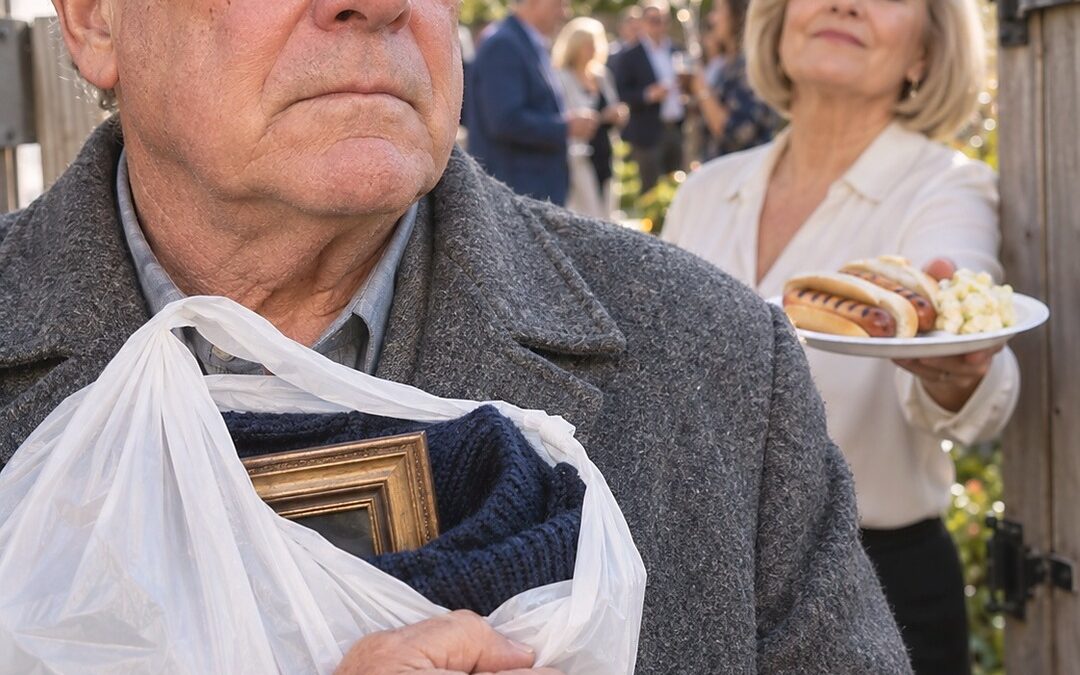
Patrice Vogel met me at the side gate with a paper plate, two hot dogs and a spoonful of potato salad, and held it out at arm's length so the thirty-some people in the backyard could watch her do it. "Take a plate for the road, Gene. This is a family party, and this is our house." My son paid $389,000 cash for that house, my name is the only one on it, and that night would make 148 nights asleep in my Buick behind the Meijer on Coldwater Road.
The potato salad had already slid down into one of the buns.
"Well, take it," Patrice said. "I'm trying to be nice."
Dennis Vogel leaned around the gatepost with a Miller Lite and gave my coat the once-over, slow, like a man pricing a riding mower at a yard sale.
"Check the collar, Pat. That coat's still got the Goodwill tag."
A woman by the grill in a Colts visor laughed into her napkin, and Dennis laughed louder to keep it going, and it kept going. Marv Foster from next door had a beer in his hand and started reading the label on it.
"Four ninety-nine," I said. "Half off on Tuesdays."
I carried mail for thirty-one years. You don't argue with the dog. You talk to the owner. The owner of this particular dog was somewhere inside that yellow house, and I hadn't driven across town to fight her mother over a hot dog.
The Meijer bag had a split handle, so I'd twisted the plastic around my wrist. Inside was Bud's Purdue diploma in its frame, wrapped up in my old navy USPS sweater. It rode in my trunk all summer under a tarp. If my name was on that house, Bud's diploma was going on its wall.
Patrice pointed the plate at the two garbage cans by the garage.
"You can leave your bag by the cans."
I pulled it in against my chest.
"It's not trash," I said. I had the next part ready, what it was and whose it was, and it didn't come. I worked my thumb under that twisted handle until the plastic bit, and I kept it there.
"Are you taking this or not, Gene?" Patrice kept the plate out.
"Where's Kelsey?" I said.
"Kelsey's busy."
"I can see that."
"Then you can see why this isn't a good time."
The house was two stories, yellow with white trim, a porch I'd only ever seen from the street. Four bedrooms, built in 1958. Kenji had told Lorraine that much, and Lorraine had told me, along with which side of the driveway the mailbox post stands on. I kept looking past Patrice toward the light beside the front door, wondering whether anybody inside ever bothered to turn it on. June always left ours burning when my route ran late. On the porch rail sat a pot of yellow mums with the Meijer tag still stuck in the dirt, $12.99. I'd parked next to that same rack of mums for a month. Nobody had watered them.
Dennis came closer, pulling his golf shirt down where it had worked loose from his khaki shorts.
"Just get Kelsey," I said. "I've got a question for her."
At the grill, a fellow turned a hamburger and the grease flared. Behind him a white banner hung between two posts. HAPPY 40TH DENNIS & PATRICE.
Donna Foster had come over to stand with Marv at the fence. Kayla Brandon, one of Kelsey's friends, had her phone out, though I couldn't tell whether she was filming me or checking something. She lowered it when I looked over.
"I bought this place cash, Gene. Then Pat had the whole kitchen redone. Quartz counters, thirty-one thousand dollars." He said it loud enough for the grill to hear.
"That's a nice counter," I said. "June always wanted the laminate that looks like butcher block. We never got around to it."
"That's all you've got to say?"
"I haven't seen it."
"You won't, either, if you keep this up. Not the way you're carrying on."
He moved the beer to his other hand. Patrice touched his elbow and said she'd handle me.
She noticed the bag again.
"What's in there?"
"A diploma. Bud's, from Purdue. Thought he might like it hung up."
"Here?"
She said it as if I'd brought a goat.
"You've got your wires crossed, old man," Dennis said, and went back to his guests.
The frame had rubbed a hole in the plastic. "Ope," I said, and shifted it off the torn handle and made sure the glass hadn't slipped.
"I'll wait for Kelsey," I said.
Patrice set the plate on the card table and pushed the gate partway shut.
"Then wait out here."
I stayed at the gate with the diploma against my coat and the hot dogs going soft in the sun.
Donna caught my eye from the fence, then followed Marv back toward their yard.
Kelsey came out about ten minutes later in cream pants and a pale green blouse, her hair held back with a black clip, white shoes that wouldn't last an afternoon on my old route. She stopped next to her mother.
"Gene. What are you doing here?"
"Looking for you. I need to know where Bud is."
"Travis is in Australia."
"I know where he was working. What's his phone number?"
"You have it."
"The one I have doesn't work."
"They change phones over there. They do that." She glanced back at the house. "Could we not do this today?"
"I drove up here to ask you."
"People are watching, Gene."
"They watched your mother hand me supper through the gate."
"Mom was only trying to help."
"I didn't ask her for anything. Where's my son, Kelsey?"
She dug in her pants pocket and came out with two twenties.
"Here. For gas."
She stepped in close and pushed the bills into my coat pocket. Her perfume was the kind June used to call first-floor-of-Macy's. I stood there smelling it and doing the arithmetic, and forty dollars came to about one night at the Budget Inn after tax. I took them out and held them toward her, but she wouldn't take them.
"Get yourself something decent to eat tonight, okay?"
"Is Bud all right?"
"Of course he's all right. He calls me every week."
She turned to the crowd by the grill.
"Everybody, I'm sorry about this. Gene's been having a hard time. He hasn't been well since June passed."
A woman with a plastic cup nodded. Kelsey had pitched her voice high enough to reach the picnic tables. I held the twenties between two fingers while she waited for the guests to finish looking at me.
"I've tried to get the two of you on the phone," she said, quieter, for me. "More than once. You don't remember."
"Name one."
Somebody behind her murmured. She took the twenties out of my hand and put them back in my pocket and patted it. "And stop sleeping wherever it is you've been sleeping. People talk."
June died two Februarys ago. Ovarian, the kind they find late. A little over a year after we buried her, Bud flew to Western Australia for a two-year contract near Karratha, and over pancakes at the Cracker Barrel on Illinois Road he told me, "Kelsey's closing on a place for you. She'll call you with the keys." He picked up the check before I could get my wallet out.
Kelsey never gave me an address. First the closing slipped, then Bud supposedly wanted to hand me the keys himself when he got home. In December she changed her number, and after that I couldn't reach her. Her note with Bud's Australia number was still in my glove box, a plus sign and a six-one and a long string after it in her round handwriting, with a little heart over the i in Travis. I'd dialed it so many times I didn't need the paper anymore.
The motel money ran out in the middle of May. Since then I'd slept in my 2011 Buick Lucerne, back by the Meijer cart return. I kept a sleeping bag on the back seat and moved the car when the overnight crew needed the spaces.
Wednesday morning, Lorraine Dubicki at the Waynedale post office slid a property-tax notice across her counter face up, so the first thing I'd see was my own name on the owner line. Tammy Rush had brought it in off my old Route 14. EUGENE R HADLEY, and under that an address on Kensington Boulevard I'd never been inside. Sixteen eighty-four twenty, due November tenth. I stood at her window long enough that the man behind me sighed.
Lorraine had also told me Kenji Mendoza, the carrier on Kensington, mentioned a big party Saturday. I'd driven past on Wednesday and seen the anniversary banner and Dennis's Ranger boat in the driveway. Kelsey would be home for her parents' party. I figured she couldn't shut the door on me with everybody standing outside.
At half past four she was still explaining why I should leave. The sun had come around onto the gate, and the hot dogs on the card table had a skin on them.
"Gene, you need to go home. We'll talk another day."
"Which home?"
She pressed her palms down the sides of her pants. "You'd call Travis at work and make it worse. That's what you'd do."
"He's thirty-six. He can talk to his pop."
She leaned in and smiled for the yard while she said it, low. "If you make a scene at my parents' party, I'll call the non-emergency line and tell them there's a confused old man at the gate. They come for that, Gene. They always come for that."
I'd delivered mail to half the cops in Waynedale and their mothers, and I knew which ones still sent Christmas cards by hand. I didn't tell her so. I moved the bag to my other arm.
"Do your parents know Bud bought this house?" I asked.
"They live here. Of course they know."
"Then why'd your mother tell me it's theirs?"
"People say things. Dennis put money into improvements."
She tucked a loose strand of hair behind the black clip.
"Gene, why are you doing this?"
"I've been asking you that since last summer."
A car door slammed out front, then another. A suitcase wheel rattled over the sidewalk, catching in every crack.
A man's voice said, "Ope, sorry. Is this the way around back?"
Bud came around the corner at 4:40, towing a black suitcase with one wheel that didn't roll right. His hair was shorter, and he'd put on some weight through the chest. Gray Purdue sweatshirt. An Uber idled at the curb behind him.
"Dad!"
He dropped the handle and came straight over and got his arms around my shoulders, and I got my free arm around his back, the other still holding the Meijer bag.
"Look at you, Pop. You're skinny."
"You're not," I said.
"Two weeks early. Surprise. Contract wrapped up ahead of schedule, landed in Fort Wayne about an hour ago, told the driver to bring me straight here."
Kelsey came to his side.
"Travis? You're not due back till the twenty-fourth."
"Plans changed."
He kissed her cheek. She kept her arms down.
"Wanted to surprise you guys."
He noticed the people in the backyard.
"Did I crash something?"
"Our anniversary," Dennis said.
"Forty years? Congratulations."
Bud shook his hand and wished Patrice a happy one, and she managed a smile. Then he saw the bag.
"What's that, Dad?"
"Something I brought you."
"You didn't have to."
He patted my shoulder.
"How's the house treating you? Is Marcy working out? I picked that agency myself."
"Who's Marcy?" I asked.
"The aide. From Heartland. She comes by during the week, helps with groceries and stuff."
"I don't know anybody named Marcy."
Kelsey got between us.
"Travis, honey, can we go inside?"
Bud talked around her.
"The woman from Heartland. She's been coming here for months, Dad. Three mornings a week."
"Here?"
"Yeah, here. Wait. You do live here, right?"
Somebody behind the gate turned the country music down. Kelsey took Bud's arm and said I was having one of my difficult days, and he moved his arm free.
There was a little cut by his chin where he'd shaved too close. He had the brown eyes June said made it impossible to stay mad at him.
Bud looked at the yellow house, then at me.
"Bud," I said, "I've been sleeping in the Buick behind the Meijer on Coldwater Road since May."
The suitcase fell over on the driveway. He left it. Over by the grill a burger caught and nobody turned it, and the smoke went straight up past the banner. Kayla Brandon had her phone up again, and this time she didn't lower it when I looked.
"What?"
"Since May," I said.
He turned on Kelsey.
"What is he talking about?"
"Travis, please. He's confused."
"Dad. This is your house. I put it in your—"
"I know that now."
"What do you mean, now?"
I took the notice out of my shirt pocket. The folds had gone soft from three days of handling. I put it in his hand at the edge of the gate.
"Read whose name is on it."
"Eugene R. Hadley," he read. "That's you."
"That's me," I said.
"4410 Kensington Boulevard."
He frowned at it.
"Of course it's here, Dad. I had the deed put in your name."
"Then somebody ought to have told me where to find the front door."
Kelsey reached for the paper and Bud lifted it out of her way.
"Why is he sleeping in his car?"
"He's not."
"Kel. He just told me he is."
"He stays different places. He gets things mixed up."
"Then where's Marcy? Call her."
"She isn't scheduled today."
"Call her, Kelsey."
She caught the bottom edge of the notice while he was still talking, tore it out of his fingers, and folded it hard.
"We'll do this inside. It's an old tax thing, he doesn't understand the paperwork."
She raised her voice to the guests still hanging around the driveway.
"It's okay, everybody. Gene's been confused, but we're getting him help."
Bud turned back to me.
"Why didn't you call me, Dad?"
"I did. Every week, on the Australia number Kelsey gave me."
"Dad, I haven't had a call from you since March of last year. Not one."
"I kept getting a woman in Perth. Real nice about it, every single time."
"He's been texting you," Kelsey said. "Forty-one texts, honey. All from Gene. I've seen every one."
"Forty-one?" Bud asked.
"Inside," she said.
His suitcase was still on the concrete, the handle down in an oil stain by the garage. He waited for me to explain the messages. Patrice put her hand on the gate latch.
"Forty-one texts from me. I've carried the same flip phone since 2009, and I have never sent a text message in my life."
Part 2
Patrice Vogel followed us around to the front yard. She'd picked the paper plate back up off the card table on her way, I couldn't tell you why.
The hot dogs were gone. A napkin lay across it now, and she kept smoothing it with her thumb while Bud stood by his tipped-over suitcase, waiting for Kelsey to explain the forty-one text messages.
"Show me," he said.
Kelsey held my tax notice against her blouse.
"Inside, Travis. Please. Everybody's staring."
"Then they can hear the answer out here."
He held his hand out to her, palm up. "And give Dad his paper back."
She looked at the notice a second like she might argue with it. Then she gave it over, and Bud tucked it into my shirt pocket and pressed the flap down with two fingers like I used to do with his lunch money in second grade.
Dennis had come out front behind Patrice with a fresh beer. He'd taken off his sunglasses and left a pale stripe across his nose.
"Travis, what's all this carrying on?"
Patrice turned to the guests who'd wandered down the driveway.
"Gene hasn't been himself. He drinks, you know. Kelsey's been looking after him for months."
Marv Foster stood with his hands in his pockets. Donna held her purse up against her front.
"I don't drink, Patrice," I said.
"There's no shame in needing help, Gene."
"Didn't say there was."
Dennis pointed his can at my Buick, parked along the curb.
"Then explain why you're living in a car."
"Been trying to."
Bud took out his phone.
"Everybody stop talking a minute."
He opened a conversation and scrolled up. When Kelsey moved in to see his screen, he stepped out into the driveway.
"Here's the last one. From Dad, September twenty-eighth."
He held it out to me. Beside the thread was a photograph of the two of us at his Purdue graduation, his arm around my shoulders, me in the blue tie June bought at JCPenney because she said the brown one made me look like a county tax collector.
Under it were the messages. Bud read the last one aloud.
"I'm fine, son. Don't call. I don't do the video thing."
"That's not from me," I said.
"Gene, you sent it," Kelsey said, before Bud could.
"Read me the number, Bud."
He tapped the contact.
"Two-six-zero, four-three-eight, zero-one-four-seven."
I took my TracFone out of my coat. The hinge had cracked by the charging port and clear tape held the battery cover on. I flipped it open, pressed Menu, and found My Phone Number.
"Two-six-zero, seven-four-seven, zero-one-nine-three."
Bud held the two screens side by side.
"That's not the number I've got for you."
"Same number since 2009, Bud."
"She said you got a new number."
"He did," Kelsey said. "He must've forgotten. We've been over this, Travis."
"Read me the message again, Bud," I said. "The word after fine."
He looked down. "Son."
"When's the last time you heard me call you that?"
Bud didn't answer. He scrolled up, and up, past a month of them, and his thumb slowed down.
Kelsey turned away to say something to the guests at the curb. Bud lifted his phone, his thumb on the contact that said Dad.
I put two fingers on the edge of his screen and pressed it down before she turned back. "Not yet, Bud," I said, low.
Bud looked toward the street, then back at me.
"I called that number every Sunday for three months, Dad. Always got voicemail. Then you sent that message telling me not to call."
"I called the Australia number Kelsey wrote down for me. It's in the glove box. Got a woman in Perth every time."
Kelsey started to answer, but Bud raised his hand.
"All right," Bud said. "Dad, you're sleeping in a bed tonight."
He dug a key card out of his wallet.
"I booked the Hampton Inn by the airport before I knew any of this. Take it, Dad. I'll stay here and figure out what's going on."
"Keep your room."
"You're sleeping in a parking lot."
"Not tonight, Bud. If I take your room, she gets to tell everybody I ran."
"I don't like that, Pop. Not one bit."
He still held the card out. I closed his fingers around it. "Come see me in the morning. Back of the Meijer on Coldwater, near the cart returns. Champagne Buick, two hundred eleven thousand miles. Hard to miss."
I put the bag on the back seat and folded the sweater back from the corner so he could see the frame. The sun came through the rear window and lit up the glass.
"You brought that?" he said.
"Thought it belonged on the wall of the house you bought."
He rested his palm on the Buick's roof.
"Nine o'clock."
"I'll be there," I said.
In the mirror I watched him pick up his suitcase. Kelsey waited by the gate and said something I couldn't hear, and he carried the suitcase toward the house without answering her.
At two in the morning Dwayne Pettit knocked on my passenger window.
"You alive, Mr. H?"
I sat up and felt around for my glasses. My shoes were on the floor mat on the passenger side, and the passenger seat was leaned back as far as it would go.
"Unless the rules changed since midnight."
Dwayne grinned. He worked overnight security at Meijer, and tonight he had two paper cups from the gas station across the road. He always handed me the one that wasn't dented.
"Black, right?"
I took one through the window and set it in the cup holder, too hot to drink.
"You know a guy drives a red Chevy Silverado?" he said. "Older fellow, gray hair, big around the middle."
"Plenty of them around here. What's he done?"
"Been through two times tonight. About eleven-thirty he drove past you, circled the building, left. Came back around one-fifteen and parked by the loading dock with his lights off. Chrome running boards, a hitch with three different balls on it."
Dennis Vogel drove a truck like that. I'd seen it Wednesday at Kensington with the Ranger hooked on behind.
"Anybody get out?" I asked.
"Nope. Ten minutes, maybe, watching this row the whole time."
"Could've been looking for somebody."
"That's what I'm telling you, Mr. H. I think he found him."
A delivery truck backed toward the loading bay, its alarm carrying across the empty lot. Dwayne offered to call somebody and I said not tonight, I'd write it down. He walked back toward the store swinging his flashlight against his leg.
The spiral notebook had been in my glove compartment since May. Saturday was my hundred forty-eighth night in the Buick, and I'd numbered every one, with the temperature and the mileage ahead of the question I ask myself.
I wrote:
Night 148. Meijer, Coldwater Road. 48 degrees. 211,043 miles. Bud called? He came by.
Bud pulled in Sunday at nine-oh-three.
I'd washed my face in the restroom and put on a clean shirt. The sleeping bag was rolled on the back seat, my old uniform shirts on hangers over the door. He parked a rental sedan two spaces off and came over with a McDonald's bag and a folder.
"Breakfast."
"Good. I haven't had a McMuffin in about a week."
He opened the passenger door. The seat was still pushed back from where I'd slept, and he touched the rolled-up bag and looked at the gap between the seats.
"Every night?"
"Since May."
"Why not go to somebody? Uncle Lonnie?"
"Lonnie's been in Arizona six years. The old postal crowd have families."
"So do you."
I took a bite.
"That's why you're here."
The spiral notebook lay open on the dashboard, where I'd left it after writing the night's entry. Bud glanced at the lines, then at the sleeping bag. He didn't reach for the book.
He opened the glove box without asking, like he did at sixteen looking for gum, and found Kelsey's note with the little heart over the i. He held it up to the windshield. "The last four are wrong, Dad. She switched the seven and the one." He put it in his shirt pocket and buttoned the flap.
He opened the folder and took out a printed invoice, Heartland Home Companions across the top and an Illinois Road address under it.
"Marcy R. Two thousand one hundred a month for part-time help. Shopping, cleaning, rides to appointments. Kelsey says she's been coming three mornings a week."
"To what address?"
"Kensington."
"Bud, I didn't have the address until Wednesday."
He laid the invoice on the Buick's hood.
"She told me she'd given you the keys."
"She told me you wanted to hand them to me yourself."
"From Australia? How would I do that?"
"Ask her."
"I put three thousand a month in our joint account for you," he said. "For Marcy, for groceries. Nineteen months."
I took the pen off the dashboard and did it on the inside cover of the notebook, same as I used to figure postage due. "Fifty-seven thousand," I said, and turned it so he could see.
He sat down sideways on the passenger seat.
"What happened to Oakdale, Dad?"
"Listed it in February. There was a second mortgage from your mother's treatments." I folded the McMuffin paper into a square.
"And after the mortgage?"
"What was left went where it went." I folded it again. "Budget Inn on Bluffton Road, two eighty-nine a week."
"Dad. Your pension."
"Comes in. Your mother's Parkview bill and a couple other things go right back out. Never missed one. Apartments want first and last and a deposit, and the Buick needed a transmission in March." The square wouldn't fold anymore, so I put it in the cup holder. "You do that math, Bud. I did it every Sunday."
"She was supposed to be looking after you."
"She's your wife, Bud."
He started for the rental car and stopped.
"The week I left, she had my phone for an afternoon. Said she was setting up the Australian SIM. I remember being annoyed because I couldn't find it."
"All right."
"She says you've got a second phone. She says you don't remember things."
I held up the TracFone.
"This is the only one I've got."
He put the Heartland invoice back in the folder and handed me the whole thing. He said he needed to check something at home.
"Pop, I'm sorry about all this."
I put the empty wrapper in the McDonald's bag.
"Find out who's been collecting the money for Marcy."
He drove off. The passenger seat stayed leaned back where he'd sat.
Monday morning I was at the Waynedale post office before Lorraine Dubicki opened her window. She'd worked there twenty years and still called me Geno. She was sorting registered-mail slips when I came up to the counter with the folder under my arm.
"Morning, Geno. You look terrible."
"You look about the same."
"What's going on?"
"I need to know where my mail's been going."
"I told you in July there was a forward on file."
"You did."
"You said Kelsey handled it. Didn't you ask where it went?"
"She said she'd done it online. Said it would all be waiting at the new place."
I rested an elbow on the counter.
"A man doesn't ask the window clerk where he lives."
"Well, this one should have." She tapped the Kensington address on her screen. "You know who's living in there? Those Vogels. Lost their condo out in Huntertown after Dennis put everything into a buddy's car wash. I had it from the buddy's carrier."
She pulled the keyboard toward her.
"It wasn't permanent. Twelve months, started June sixteenth last year, expired this June. That's why Tammy caught the tax paper. She knew your name off Route 14 and brought it in here."
"Can you see who filed it?"
She worked through several screens.
"Submitted online June eighth last year."
"I didn't submit it, Lorraine. I couldn't tell you where the password goes."
She adjusted her glasses and read the address off the screen.
"Three-one-two-two Illinois Road, Suite two-twelve."
I stopped her.
"Read that again."
She did. I opened the folder and laid Bud's Heartland invoice on the counter beside her keyboard. Under the company name was the same address.
"That's where Marcy's supposed to work out of," I said.
Lorraine leaned forward and looked at both.
"Same address, Geno."
"That's the UPS Store. There's no suite, it's a rented box."
"Somebody paid a verification charge online. A dollar ten. I can't see the whole card number from here, only that it was a Visa."
I wrote the date down in the notebook next to the amount.
"Does Bud know?" she asked.
"He's learning."
She slid a yellow slip from under the keyboard and wrote the Clinton Street address on it. I'd need a Postal Inspector, she said, to get the verification records.
When I turned for the door she reached through the window and caught my sleeve.
"Where have you been living, Geno? I figured you were north side, in the new place."
"The Buick."
"Since when?"
"May."
She took off her glasses and set them by the keyboard.
"Twenty years you worked next to me and you told me nothing."
"Didn't want to be a bother."
"You're being one now. Go see the Inspector."
A man came in behind me with a Priority box crushed at one corner, and Lorraine waved him to the next window. I sat behind the wheel of the Buick, opened the notebook to the forwarding record, and looked at the date again.
Somebody had paid a dollar and ten cents to become me, and I've never owned a computer in my life.
Part 3
Tuesday morning, I walked into Three Rivers Title carrying a property-tax notice with a coffee stain on the corner and asked to see who owned my house.
The receptionist looked at my license, then at the notice, then at me. "Do you have an appointment, Mr. Hadley?"
"No, ma'am. I've got a tax bill for a house I've never been inside."
She made a call. Five minutes later Becky Sauer came out of a back office, her reading glasses hanging from a chain. She checked my shoes before inviting me into a room with filing cabinets and a printer that rattled every time anybody used it.
"Have a seat, Mr. Hadley. What's the property address?"
"4410 Kensington Boulevard."
She typed it in.
"Closing June twenty-seventh, last year. Deed recorded June thirtieth, Eugene R. Hadley."
"That's me. Who paid for it?"
"Travis Hadley. Three hundred eighty-nine thousand, cash. No mortgage."
"That's my boy."
Becky opened another document and turned the screen my way. "Mrs. Hadley signed at closing for her husband. Power of attorney. He was in Australia."
"Can she sell it?" I asked.
"Not without your signature."
"She's got a copy of my old license," I said. "I'd guess she can get a signature."
Becky stopped typing and looked at me over her glasses a long second. Then she wrote something on a sticky note and put it on the inside of the file.
"Can I see what Bud sent you?"
She found an email in the file and printed it. The printer rattled it out a line at a time, Bud's email from Australia with Kelsey copied, and one sentence sat on a line by itself.
"Put it in my dad's name. He put his name on my loans."
I read that standing beside the printer, the paper still warm. Bud writes the way he talks, no extra words.
Becky asked if I wanted a copy of the recorded deed. I said yes, and whatever showed where she'd mailed the closing papers. The page she printed listed 6119 Oakdale Drive.
"That's my old house. I sold it June twelfth."
"It's the address Mrs. Hadley gave us for the owner's correspondence. We mailed the deed packet there after recording."
She slid the copies into a manila envelope and tapped it against the desk. "Mrs. Hadley called here more than once last summer asking whether a deed could be changed after it's recorded. I told her only the owner could do that."
She gave me her card and a green pen with the company name on it, because I'd been patting my pockets for one. The printer started rattling again when I stood up.
Outside, I folded the deed copy into my shirt pocket. On the way downtown I stopped at the Treasurer's window in the City-County Building and changed my mailing address to the only one I owned. Lorraine had already called ahead to Clinton Street for me. Ask for Inspector Delacroix, she'd said, and don't let him rush you.
The main post office on Clinton Street smelled of floor wax and damp cardboard. In all my years on the route I'd never once needed an appointment with an Inspector. My trouble had always been dogs and people swearing I'd lost a letter that was sitting on their own kitchen counter.
Ray Delacroix met me in a small interview room upstairs. His shirt sleeves were rolled unevenly, and he had a paper calendar beside his desk with yesterday's date still showing. On the wall behind him hung a photo of a jeep mail truck nosed into a snowbank. "My dad's," he said when he caught me looking. "Kokomo, the '78 blizzard. He finished the route on foot."
"Lorraine says you have a questionable change-of-address order."
"Questionable's one word for it."
I handed him the record. He glanced through it, then placed it beside the deed copy.
"Did you ever rent a private mailbox, Mr. Hadley?"
"No, sir. I carried mail to enough of them to know what they are."
"Then the box store's got a form with your name on it somewhere," he said, and wrote the box number on a yellow pad.
"Kelsey kept a copy of my old driver's license," I said. "She helped with the paperwork when June was in hospice."
"Do you still have that license?"
"Replaced it since."
He wrote that down. I gave him Bud's email, and he paper-clipped it to the deed copy.
"Kelsey said she'd handle my forwarding," I said. "I let her."
"Somebody paid that dollar-ten with a Visa," he said. "Whoever's card it was, I'll get the statements."
"If it's anything of Bud's, he'll hand it over without being asked a second time. He keeps his paperwork. Always has, since he was a kid with a paper route."
I told him about the messages Bud had received from a number saved as Dad. Delacroix wrote down both numbers and asked to see my TracFone.
"Keep it. Don't delete anything." He typed up my statement two fingers at a time, and I corrected his spelling of Waynedale before I signed.
"What about the house?"
"Get a lawyer for the house," he said. "I do mail."
"I did mail for thirty-one years," I said.
He tapped his pen on the box number on his yellow pad.
I put his card in my wallet next to June's photograph. It's from the Allen County Fair, the year Bud was born, and she's holding a corn dog.
Wednesday morning there was a Meijer receipt under my wiper blade, folded in half. Dwayne prints like they teach at the security outfit, all capitals, pressing hard.
RED SILVERADO BACK 1:15 AM. GUY GOT OUT, TOOK PICTURES OF YOUR CAR WITH THE FLASH ON LIKE IT WAS A WRECK. PLATE ON BACK. —D
I turned it over. He'd written the plate number twice, in case I couldn't read his sevens.
I tucked it into the notebook on the page for Night 151, and I drove the Buick around front to see whether anybody'd keyed it.
Wednesday evening I was behind the Meijer eating peanut butter on crackers with the driver's door open when the flip phone rang at eight-forty. Bud's number came up on the little screen.
"Pop. I'm in the Kroger parking lot."
"Buying groceries?"
"I needed to call where Kelsey couldn't hear me."
"She filed something on you, Dad." He stopped, and I heard a cart go by on his end. "Guardianship. Emergency guardianship. This afternoon."
I got the notebook out of the glove compartment.
"For what?"
"She says you can't manage your own affairs. She told me it's just to get you evaluated, to help you."
"What'd you tell her?"
"That I understood."
I wrote guardianship across the page.
"When's the hearing?"
"Friday at nine. Her lawyer's Grant Tillman. There's a medical letter attached from Dr. Brett Kaminski."
"Who's that?"
"Kelsey's boss at the dental office."
"A dentist is writing about my head."
"That's what it says." He was quiet a second. "She made pot roast tonight, Dad. Set a place at the table for you. Said you'd be home soon, after the evaluation. She was humming when she said it. She asked me if you'd ever been evaluated before. Said it like she was asking whether you'd had your flu shot."
I wrote pot roast in the margin. I don't know why.
"I let Delacroix go through my card statements this afternoon," Bud said. "He didn't tell me what he found. I'm letting her think I believe her."
"You still sleeping in that house?"
"On the couch. Delacroix knows about the petition. He wants you to bring the deed and your night log Friday."
I wrote down the hearing time and circled it. Then I turned back a page and looked at Night 148 a while. Bud called? He came by. My handwriting slanted uphill on that line. It does that when I write on my knee in the dark.
"Let her stand up in front of a judge," Bud said. "You still have my diploma?"
"Back seat."
"Keep it safe, Pop."
"Always have."
Thursday morning at 6:10 somebody knocked on my Buick window. It wasn't Dwayne. A man in a brown jacket stood by the driver's door with a thick envelope and showed his identification through the glass.
"Eugene R. Hadley?"
"That's me."
"Court papers."
I opened the door. He said he was serving an emergency guardianship petition and notice of Friday's hearing, wrote down the time, and left.
I got out and stood by the trunk in the cold with the envelope, and looked through the back window at the Meijer bag on the seat, the corner of Bud's frame showing where the sweater had slid. Then I got back in and opened the envelope under the dome light. Patrice's affidavit said I'd come to her party smelling of liquor. I've had two beers since June died, both at Tammy Rush's wedding, and I read that line over again to be sure of the word.
Behind it were two pictures of my Buick behind the Meijer, both stamped 1:15 a.m., the flash bouncing off my own back window.
A red Silverado came around the far end of the lot, pulling the Ranger boat. Dennis Vogel was behind the wheel with a fishing cap on. He passed slowly enough that I could see the straps holding down the cover. He lowered his window.
"Should've taken the plate, Gene."
He lifted two fingers off the steering wheel and drove out toward Coldwater Road.
I found the page headed Relief Requested. It asked the court to hand Kelsey Hadley control of my person and my estate, including the real property at 4410 Kensington Boulevard. All she had to do was prove I'd lost my mind.
Part 4
Magistrate Helen Ostrowski asked me why I was sleeping in a car when I owned a four-bedroom house.
It was nine-fifteen Friday morning, and my right knee had stiffened up on the courthouse bench. I'd worn my best blue shirt, the one June used to iron for church.
"Because nobody gave me the keys, ma'am."
Across the courtroom Kelsey sat beside her attorney, Grant Tillman, with a yellow legal pad. Patrice and Dennis had the row behind them. Tillman stood.
"Your Honor, Mr. Hadley's inability to explain his living arrangements is precisely why my client filed this petition."
"I explained them," I said.
"You'll get your turn, Mr. Hadley."
Tillman handed the clerk a stack of printouts and called Bud up.
"Mr. Travis Hadley, whose messages are these?"
"They came from a number saved in my phone as Dad. That's what I believed."
Tillman read one aloud.
"I'm fine, son. Don't call. I don't do the video thing."
"Forty-one messages. Several instructing you not to telephone your father. Did you accept them as genuine?"
"Yes, sir." Bud looked at his hands. "I mean, I didn't have a reason not to."
"Did you speak with your father regularly during those nineteen months?"
"No. I tried calling. Voicemail, every time."
Bud looked toward me.
Tillman handed up a letter from Dr. Brett Kaminski.
"DDS. He runs the practice where my client works."
"A dentist isn't a physician, Mr. Tillman. Has he examined Mr. Hadley?"
"Not personally. But we've scheduled a physician's evaluation."
The magistrate slid the dentist's letter to the far corner of her bench, and Tillman called Patrice, who'd put on a string of pearls for it.
"Mrs. Vogel," Tillman said, "tell the court what happened at your anniversary party."
"Gene showed up uninvited. We offered him food and asked him to come back another time. He wouldn't leave."
"What concerned you about his condition?"
"He smelled like liquor."
"Did you see him drinking, Mrs. Vogel?" the magistrate asked.
"No, ma'am. But I was standing right in front of him. I know what I smelled."
She kept touching the pearls while she talked. June wore hers to two weddings and a funeral.
Then it was Dennis's turn in the chair, and he sat in it like it was too small for him.
"Mr. Vogel," Tillman said, "you described Mr. Hadley wandering around the property."
"That's right. He's been around the neighborhood at odd hours. Wednesday, for instance. Driving past and looking at the house."
I raised my hand.
"I drove past the house Wednesday because I'd gotten a property-tax notice for it that morning."
"Do you have the notice?"
"Yes, ma'am."
"Keep it handy."
Tillman stood beside Kelsey's table.
"Your Honor, we have a widower living under unsafe conditions. He has refused the housing his family arranged. My client has photographs documenting where he's been sleeping."
Ostrowski went through the photographs one at a time, her reading glasses down on the end of her nose.
"Who took these photographs at one-fifteen in the morning?"
Tillman half stood. "A family member, Your Honor."
She kept the photographs in front of her.
"A sixty-eight-year-old man sleeping in a car in October, refusing a house in his own name. I have to take that seriously."
She started writing. I watched her pen move down the page, and I thought about what a guardian gets to decide, where you sleep and who signs for your checks and whether anybody has to ask you first, and my right knee started going up and down under the table until I put my hand on it. Across the aisle Kelsey folded her hands on the legal pad.
I put my hand on my coat where the notebook was.
She put down her pen.
"Mr. Hadley, would you like to be heard now?"
"Yes, ma'am. I've brought something."
"You're unrepresented. If this goes further, I'll appoint a guardian ad litem to investigate. Go ahead."
I brought my spiral notebook up to the bench. "I filed a mail-theft report with Inspector Delacroix at Clinton Street on Tuesday, ma'am. This is what I've written down every night since May."
Tillman rose.
"We haven't received this material, Your Honor."
"Neither have I, Mr. Tillman."
She opened it. Night one, May sixteenth, the Meijer lot. Entries continued through Thursday, with mileage beside temperature. Most ended with the same question.
She turned a page, and another. "What's this at the bottom of every entry, Mr. Hadley?"
"I was waiting for Bud to call."
"Bud?"
"Travis. Been calling him that since he was four."
She asked if anyone could confirm I'd been at Meijer overnight.
Dwayne Pettit stood in the back row, still wearing his Meijer security shirt. Bud had called him Thursday. Ostrowski waved him up.
"Where do you work, Mr. Pettit?"
"Overnight security at the Meijer on Coldwater Road."
"Have you seen Mr. Hadley there?"
"Since May, almost every night I'm on shift. He parks by the cart return."
"Have you ever seen him intoxicated?"
"No, ma'am. He washes up inside before the morning crew comes. Keeps his car clean."
She picked up the photographs.
"Were you working the night these were taken?"
"Yes, ma'am. Tuesday night. Red Silverado, quarter after one. Man got out and took pictures of Mr. Hadley's car with the flash on."
Dennis leaned toward Patrice and said something I couldn't hear.
"Did you see who it was?"
"I saw the truck better than the man, ma'am. So I wrote the plate down and stuck it under Mr. Hadley's wiper."
I had it in the notebook. I unfolded it and handed it up, and the magistrate read the plate number off the back of it, slow, one letter at a time.
Ostrowski turned the photographs over. "Mr. Vogel?"
"I took them," Dennis said. "Kelsey needed pictures for the lawyer. She was worried about him."
Tillman stood.
"Mr. Pettit, are you qualified to assess cognitive impairment?"
"No, sir. I can tell you what I've seen."
"Which is?"
"He's the only guy on that lot who signals in an empty parking lot."
A man in the back row laughed, then covered his mouth.
"Does Mr. Hadley appear to know where he is?" the magistrate asked.
"Yes, ma'am. Knows what day it is, too. I bring him coffee around two some mornings."
She turned to Tillman.
"Has your client provided anything showing Mr. Hadley was offered access to the Kensington property? Keys, written communications, an independent witness?"
"We have her sworn statement."
"I've read it."
Tillman bent down and talked into Kelsey's ear.
"No additional exhibits today."
She wrote on the order. Her pen was a cheap blue Bic, same as mine.
"The capacity evaluation will proceed. I'm not appointing a guardian on this record. I want the Postal Inspector's findings before Monday's hearing at one-thirty." She turned to me. "Mr. Hadley, you remain responsible for your own decisions unless this court orders otherwise."
"Yes, ma'am."
The clerk returned my notebook. Its cover had bent backward, and I straightened it.
In the hallway Bud asked to see it. We sat on a wooden bench overlooking Main Street.
Bud opened the first page.
"Night one. May sixteenth."
He turned several pages.
"Bud called? No." He turned another page. "Bud called? No." Another.
He stopped at the Fourth of July entry.
"Night 50. July 4th. 81 degrees. Fireworks over Foster Park. Bud called? No."
"You could see them from the lot?"
"Over the trees."
He continued through August, where the ink changed from black to blue. He was counting under his breath. He got somewhere in the forties and quit counting and just turned pages, and I let him.
"Pen ran out in August," I said. "That's why it changes color."
Bud closed the notebook on his knee.
"I thought you were ignoring me."
"I was calling the number Kelsey gave me."
"She told me you wanted space."
"From what?"
He picked at his sweatshirt cuff. I took the notebook back and smoothed its cover.
"We've got Monday yet," I said.
"Pop, I'm going to fix this."
"Then go home and act like you believe her a while longer."
Kelsey came down the hall with Tillman, Patrice following. She stopped at our bench.
"Sunday at two I'm having everybody back so they hear it from me. The people who watched what happened Saturday. They deserve to know your father isn't well."
"Everybody?" Bud said.
Tillman checked his watch.
"I'll call you Sunday afternoon once I hear from the evaluator."
Kelsey glanced at her phone and slid it into her purse.
They went toward the elevators.
"She's inviting the same people back," Bud said.
"Sounds that way."
"Keep that notebook somewhere safe."
I buttoned it inside my coat.
At 5:15 that afternoon Bud and I sat across from Inspector Ray Delacroix at the main post office on Clinton Street.
Delacroix placed Form 1583 between us. Box 212, rented June fifth last year by Kelsey Vogel Hadley. Under her name somebody had added mine, Eugene R. Hadley, with a signature.
"Is that yours, Mr. Hadley?"
"No, sir. I've signed my R the same way since I was twenty. Mine has a loop. That one doesn't."
Next came a printout with a phone number on it I knew by heart now.
"The number saved as Dad in your phone, Travis, is a Google Voice number registered to an email account belonging to Kelsey Vogel Hadley."
Bud looked at his phone and put it in his shirt pocket.
"She's been answering me as Dad."
Then the Heartland invoices, clipped together.
"Heartland Home Companions isn't licensed in Indiana," Delacroix said. "And there's no Marcy."
"Two thousand one hundred a month," Bud said.
"The county's taking the box records and the forms to a judge Monday morning," Delacroix said. "Federal's slower."
"Not before Sunday?" Bud asked.
"Monday morning means Monday morning."
The last sheet he set down was the shortest.
"There's one more record. The online identity-verification charge. One dollar and ten cents, paid with a Visa ending in 4471."
Bud had his wallet out before Delacroix finished the sentence. He took out the Visa and laid it beside the printout, its last four digits facing the inspector.
"That's my card," Bud said. "I gave her the spare the morning I left."
And at two o'clock Sunday, Kelsey would be serving lunch in my backyard to every single person who'd watched me get handed that plate.
Part 5
At 2:05 Sunday afternoon, I stood at the side gate of 4410 Kensington Boulevard wearing the same Goodwill coat Dennis Vogel had laughed at eight days earlier.
The little table beside the gate was still there, with the stack of white paper plates and a bowl of potato salad, the serving spoon sticking out. Somebody had swapped the red-checkered tablecloth for a blue one.
Bud was next to me and Deputy Sam Kessler a few feet behind, in his Allen County Sheriff's Department uniform. Bud had asked for a civil standby.
Patrice came through the gate with a glass of iced tea. She spotted Bud, then the deputy.
"Kelsey said you wouldn't come, Gene. Today was meant to help everybody understand."
"I went to court Friday," I said.
"Then you know this isn't appropriate."
She glanced over her shoulder. The yard had seen the deputy's uniform. People were drifting toward the fence the way they had a week ago Saturday, plates in their hands, Kayla Brandon with her phone up again. Marv Foster turned all the way around.
"Why is there a deputy here?"
"I asked him to come," Bud said.
"Travis, this is your wife's family. We're trying to help your father."
"Then listen to him."
Patrice folded her arms.
"Gene, whatever you think happened last weekend, Dennis and I have been very patient."
I took a paper plate off the stack. Same cheap white kind she'd held out to me, the kind that folds in half if you put a second hot dog on it. I laid it flat on the blue tablecloth and took the photocopies out one at a time, the deed out of my shirt pocket and the rest out of my coat, like I used to fan out mail on a counter for somebody who swore they never got it. Delacroix had the originals. The deed from Three Rivers Title with my name on the grantee line. The dollar-ten charge on Bud's Visa. The copy of Form 1583 with Eugene R. Hadley signed at the bottom in handwriting a good deal prettier than mine. The Google Voice page. Inspector Delacroix's letter to the court went on top.
Patrice watched me do it.
"Gene, we have guests."
"I know it." I picked the plate up with both hands and held it out to her at arm's length, same as she'd held it out to me. "Take a plate for the road, Patrice. It's a family party. And it's my house."
She took it because it was in front of her, I think. She took it by the rim with her fingertips like it had come straight off the grill, and she backed up one step, and the back of her leg hit the Igloo cooler and she sat down on it. The lid gave a little under her. The cups stacked on it went over into the grass.
The wind came along the fence and lifted a corner of the deed. She didn't put her hand on it. She watched it go up and come back down.
Dennis came over from the grill wiping his fingers on a paper towel, and saw Kessler. "What's he doing here?"
"Standing by," Kessler said.
Dennis reached for the papers, but Patrice pulled the plate in close.
"Don't," she told him, and he didn't.
Bud pushed the gate open with his hip, the same gate, and we went in, the three of us and the deputy, past the card table and the Igloo and the woman in the Colts visor, who stepped back onto somebody's foot to let us by.
Kelsey stood on the back porch steps with her phone in her right hand. Donna Foster had a paper plate balanced on her knee.
"Gene isn't well," Kelsey was saying. "We've been trying to get him the help he needs, but he keeps refusing it. I know a week ago Saturday was uncomfortable for everybody."
She stopped when she saw us.
"Go ahead, Kel," Bud said. "Finish what you were saying."
"Travis, why did you bring him? I've already explained it to you."
"Explain it to Dad."
"I don't want another argument." She turned her phone over and looked at the screen and turned it back. "I'm waiting on a call."
"I know," Bud said.
He took out his own phone and opened his contacts. I could see the picture of us at his Purdue graduation next to the entry saved as Dad, the one from the day I wore June's blue tie.
He pressed it and held the phone up by his shoulder so the folding chairs could see the screen. DAD, it said, over that old picture.
Something buzzed on the porch steps.
It took a second ring for people to find the sound, and by then they were all looking at Kelsey's right hand. She looked down at it herself. From the bottom of the steps I could read the screen fine. TRAVIS.
She pressed the phone flat against her thigh. It kept going, muffled, through her slacks.
Marv Foster had worked the label half off his beer bottle with his thumbnail. The woman who'd laughed at my coat put her hamburger down on her plate and didn't pick it back up.
"Answer it, Kel," Bud said.
"It's my phone."
"I can hear that. That's the number I've been texting for nineteen months."
She let it ring against her leg until it quit.
He ended the call.
Kelsey caught her heel on the porch riser and grabbed the railing.
"Why does my father's number ring on your phone?" Bud asked.
"Your father's been confused for months. I was the one dealing with it while you were away."
"By pretending to be him?"
"Travis, can we please talk in the kitchen?"
"You invited everybody."
Patrice got up off the cooler and came into the yard after us, carrying the plate below her waist. I took the copies off it and laid them on the porch railing. I left her Delacroix's letter.
I picked up Form 1583 and turned it toward the guests.
"This form says Eugene R. Hadley is authorized to receive mail at a rented box. That's my name signed there by somebody who isn't me." I tapped the second sheet. "The verification cost a dollar ten. On Bud's Visa."
Kelsey looked at Bud.
"I was handling the paperwork because you gave me power of attorney."
"That was for the closing, Kel."
I held up the phone record and read the one line I cared about. "Google Voice. Registered to the email of Kelsey Vogel Hadley."
Kelsey looked at her father.
"Dad, tell him."
Dennis balled up his paper towel.
"I don't know anything about postal forms."
"You know who lives in this house," I said. "Who owns it, Dennis?"
He glanced at Marv.
"I bought this place cash—"
"With my money," Bud said. "It's in Dad's name."
Dennis sat down on the bottom step.
I reached inside my coat collar, pulled off the Goodwill tag, and laid it on his knee.
"Four ninety-nine, Dennis. Paid in full."
He looked at the tag. He didn't touch it.
"She told us he didn't want it," Dennis said. "She said he'd signed something."
"That's enough," Kelsey said.
"Well, you told us," Dennis said.
Bud pointed toward the driveway.
"And the boat came out of Dad's care money. Twenty-four five."
"That money was for household expenses," Dennis said. He rubbed the back of his neck. "I was going bigger next spring anyway. Fella from Auburn already put five hundred down on it in September. He's coming for it Monday."
"Then whatever he brings comes to me," Bud said.
Dennis picked the tag up off his knee, turned it over and put it back down. "Fine."
Patrice put the plate on a nearby table but kept the letter.
"I knew he was in his car. Kelsey told me in July."
"July?" Bud asked.
"She said he'd been sleeping behind that store. I thought she had arrangements for him. I didn't know what to do."
Marv stepped away from the fence and came and stood next to me, close enough that our elbows touched.
I stayed by the railing, one hand on the copies, and let him stand there.
Patrice was reading Delacroix's letter. Her lips moved. Dennis didn't have his glasses, so she read it out to him, slow. "Under penalty of perjury. May be referred to the Allen County Prosecutor."
"Dennis. We signed those."
Kessler had come up beside the gate. "Those were sworn statements, Mr. Vogel," he said. "If I were you, I'd call a lawyer tonight."
Dennis looked at the letter in her hand, and then at Kessler.
"We'll be out."
I said, "Mail runs on this street at 11:40. Be gone before it does."
Kelsey came off the porch.
"You can't just throw my parents out."
"I'm not putting anybody out this afternoon," I said.
She turned to Kessler.
"Is that legal? He's threatening us."
"Ma'am, I'm just here so nobody gets hurt," Kessler said.
Bud walked out to the mailbox post at the end of the driveway. Kelsey caught up with him there.
"Tell him this is our home."
"You called this our forever home."
"Because it was supposed to be."
She caught his sleeve.
"Travis. It's a box at a UPS Store. People rent boxes."
Bud pulled off his wedding ring and set it on top of the mailbox. It rattled once on the metal and stayed.
Kelsey let go of his sleeve. He walked back up into the yard, past her.
"Dad was sleeping in a car and you let it go on."
"I kept receipts. Every single month. I can show you the spreadsheet."
"Fifty-seven thousand dollars, Kel," Bud said.
Kelsey climbed two porch steps and turned around. "Fine. You've been acting like he's some kind of saint, Travis. Ask him what he's been hiding from you."
"Leave it, Kelsey," Dennis said from the bottom step.
"You leave it. You were happy enough spending the money."
Dennis pulled his feet closer to the step. Kelsey turned to Bud.
"Ask him about the loans, Travis. I've had his statements coming to that box for a year. Ask your saint of a father why he's still paying for your degree. Four hundred eighteen a month, and he's living in a car."
Bud turned around to me. "Dad," he said. "You told me those were handled."
Part 6
"Handled means I was handling it," I said.
"From a parking lot," Bud said. He had hold of the porch rail and didn't let go of it.
Above him on the steps Kelsey still had one hand on the railing.
"Four hundred eighteen every month," she said. "Ask him how much he still owes."
"You had my statements coming to that box for a year, Kelsey," I said. "Say that part louder. The deputy's standing right there."
Deputy Kessler took a small notebook out of his shirt pocket and wrote something down. Kelsey took her hand off the railing and put it in her pocket.
Out in the yard Donna Foster started stacking paper plates, and two of Kelsey's friends found their purses, and Kayla Brandon finally put her phone away.
Bud came over and stood next to me, and he put his hand on the back of my neck the same as I used to when he struck out in Little League. We stood like that while people found their car keys.
At eleven Monday morning, Dennis Vogel was fighting a leather recliner into the back of a rented U-Haul, and the chair had gone in sideways and stuck.
"Turn it," Patrice said.
"I am turning it."
"The other way."
"Pat, there's only so many ways a chair turns."
I stood at the end of the driveway with Bud. The U-Haul had been there when we arrived, rear door open and a ramp stretched across the concrete, two suitcases waiting on the porch.
Bud looked at the chair wedged in the doorway and didn't offer. Neither did I. Dennis got his shoulder under it on the third try and shoved it in against the truck wall, and came down the ramp blowing like he'd run a mile.
Patrice came out of the house with a small envelope. She wore brown slacks and a cream cardigan, with packing tape stuck to the bottom of her shoe.
"Here."
She tipped two house keys into my palm and took the garage-door remote out of her cardigan pocket. She pressed the button once, and the detached garage door rose a few inches before she stopped it and handed the remote over.
"The left burner runs hot."
She went back toward the U-Haul. I tried the remote, and the garage door closed against the concrete.
"Want to go inside, Pop?"
"After they're done."
Bud went to check whether anything was left in the garage.
Dennis came down the ramp with a bottle of water. The Ranger sat on its trailer by the street.
Another pickup turned into the driveway. A man in work boots and a faded Auburn cap climbed out.
"Dennis Vogel?"
"That's me."
Lyle Eckert, the fella from Auburn, walked once around the boat, took an envelope from his jacket and handed it to Bud, not Dennis.
"Twenty-four thousand. Cashier's check. Your father-in-law said it goes to you."
Dennis signed the boat title against the side of the U-Haul. Then he took five hundred dollars out of his wallet, counted it out loud, and pushed it at Bud without looking at him.
Lyle hitched the Ranger to his pickup and pulled out onto Kensington. Dennis stood by the garage holding his water until the boat passed the Fosters' mailbox. Marv and Donna watched from their porch.
A few minutes before the mail came, Patrice carried out a kitchen box marked FRAGILE. Dennis slid it into the truck.
"Everything that's yours out?" Bud asked.
"Everything that's ours."
Dennis pulled down the rear door and secured the latch. Patrice climbed into the passenger seat, and he backed the U-Haul toward the street.
At eleven-forty Kelsey's car turned into the driveway. She parked behind my Buick and opened her trunk. Two empty suitcases were inside.
"I've come for my things."
Bud pointed toward the porch, where her boxes were waiting. Kelsey saw the U-Haul stopped at the corner.
"Mom? Dad? You said you'd wait for me."
Patrice turned in her seat to look back.
A voice came from the sidewalk.
"Kelsey Vogel Hadley?"
Deputy Sam Kessler was coming up the walk with Inspector Ray Delacroix beside him. Kelsey kept one hand on the trunk.
"Yes?"
"I'm Deputy Kessler, Allen County Sheriff's Department. There's a warrant for your arrest. Identity deception, forgery and theft, signed by an Allen County judge this morning."
"Is this about the mail?"
"It's about the mail, ma'am," Delacroix said. "Mostly."
Kessler came around the trunk. "Turn around, ma'am. Put your hands behind your back."
Instead she pulled out an empty suitcase and held onto it. "I'm only here to get my clothes."
"You can leave the suitcase, ma'am."
"Kelsey. Do what he says," Bud said.
She let go. Kessler cuffed her, and the cuffs made the same little ratchet sound as the hasp on a relay box, the green ones on the corners where we used to pick up our second bags, a sound I'd heard ten thousand times on Route 14 and never once thought about until right then. Halfway up the driveway Kenji stopped with his satchel on his shoulder and a white envelope in his hand, and waited.
At the corner Patrice climbed down from the U-Haul. She stood beside the passenger door watching Kessler with her daughter. Dennis stayed behind the wheel.
Next door Donna gripped Marv's forearm.
Kessler walked Kelsey toward the patrol car. She stopped beside Bud.
"You're really letting them do this?"
"You signed Dad's name."
"I was going to fix it."
She pulled once against the cuffs, and Kessler steadied her elbow.
"You knew where he was sleeping since July," Bud said.
Kessler put her in the rear seat and shut the door.
Kenji came the rest of the way up the driveway. He held the white envelope apart from the rest of the mail.
"Mr. Hadley?"
"Yes."
"First one I've delivered here with your name on it."
The address showed through the window.
Eugene R. Hadley
4410 Kensington Blvd.
"Lorraine said to watch for this one."
"Tell her it did."
I opened the envelope. Duplicate statement, fall installment, Allen County Treasurer, $1,684.20, mailed to the address I'd given them at the window on Tuesday.
Bud looked over my shoulder.
"I'll get it."
"You'll get the next one. I've got this one."
Kenji nodded at the house.
"Nice place."
"Just getting acquainted with it."
He headed back to his mail truck. Kessler's patrol car pulled away, and at the corner Dennis started the U-Haul moving again. Patrice was already back in the cab. The truck turned onto State Boulevard without stopping.
Bud came up beside me.
"You ready to go inside, Pop?"
I took the house keys from my pocket.
"Think I'll try the front door."
At 1:10 that afternoon Inspector Ray Delacroix called Bud while we sat at the kitchen island. Bud put the phone on speaker.
"Travis, Grant Tillman withdrew the guardianship petition this morning. Kelsey's initial hearing is Tuesday."
"And the dentist?" I said.
"His letter went to the Indiana dental board, and her folks' affidavits went to the prosecutor. And we're asking the court for restitution. Fifty-seven thousand."
Bud put his hand on the counter next to a coffee ring Patrice had left.
"Thank you, Inspector," I said.
"Keep your paperwork, Mr. Hadley."
Bud ended the call.
I sat across from him while he opened his laptop.
"There's something I should've said at the gate." He turned his coffee cup around by the handle. "Lorraine's number has been in my phone since your retirement party, Dad."
"You had a job on the other side of the world, Bud."
"I could've called her. Could've asked her to send somebody to knock on the door at Kensington. I didn't."
"No," I said. "You didn't."
He looked down at his laptop. I rinsed a coffee cup I'd found in the cabinet and sat back down.
He opened the Parent PLUS account and turned the screen toward me. The payoff balance showed $31,240.
"You put your name on seventy-one thousand dollars and kept paying it out of a Buick," Bud said.
"You put mine on a house and didn't tell me either."
"I wanted you to have somewhere good to live, Pop."
"You were in school, Bud. That was the job."
He picked up his phone. "I've got the money. I want to pay what's left."
"You've already done plenty."
"Pop."
That payment had been coming out of my pension for so long I knew which day the bank took it. I'd arranged the grocery money around it when June was sick and again at the Budget Inn.
I nodded. "Go ahead."
He hit Submit. "Paid."
"Keep that receipt."
"Already saved."
He closed the laptop and pushed back his chair.
"Now where's that diploma?"
I brought the torn Meijer bag in from the living room, carrying it underneath since the handle had finally given way. Bud took out the frame, still wrapped in my old navy USPS sweater, and found a scratch on the wooden corner.
"Got it when I moved the bag."
"Glass is fine."
We picked a spot in the hallway between the living room and the stairs. Bud found a hammer in the garage and I found a picture hook in a kitchen drawer.
"Here?"
"Little higher."
He moved it. "An inch to the left," I said.
"Pop."
"You asked."
He marked the spot, drove the nail into the plaster and brushed the white dust off the baseboard with his sleeve. He hung the diploma and stepped back.
"Straight?"
I stood next to him and looked.
"Straight." I looked at it some more. "Your mother would've liked that there."
"Yeah."
He went to return the hammer. I folded the USPS sweater and laid it on the chair under the diploma, one cuff stretched from years of pulling it over my watch. When he came back he asked if I wanted the frame moved.
"No. Leave it."
Bud was asleep on the couch by ten with one sock off and the TV still talking to itself about the Colts. Four bedrooms upstairs and he picked the couch. I turned the TV off and left him be. Thirty-six years old and he still sleeps with his mouth open, same as his mother did.
The porch light switch was by the front door, the old toggle kind that clicks. June used to leave ours burning on the nights my route ran long, Christmas weeks mostly, and I'd see it from the corner of Oakdale and know somebody had kept a plate warm for me. I flipped it on. Out front the bulb threw a yellow square down the steps, and a moth found it in about a minute.
I sat down at the island, Patrice's quartz cold under my wrists, with Kenji's envelope still where I'd left it. I got the log out of my shirt pocket. The pen was a green one from Becky Sauer's office, so that makes three colors in that book now.
Marv's thermometer across the driveway said fifty-four. I started a fresh page and wrote the whole address, Boulevard and all.
The pen stopped a second before the word Didn't, and then I made it go.
Night 1. 4410 Kensington Boulevard. 54 degrees. Bud called? Didn't have to. He's asleep on the couch.



