At My Parents’ 58th Anniversary Lunch, My Sister Told 74 Guests, “Mom and Dad’s Pension Has Kept Len’s Combine Running for Nine Years”—Dad Had Been Wearing a Recorder in His Shirt Pocket Since March
Part 1 — THE TOAST
PART 1 — THE TOAST
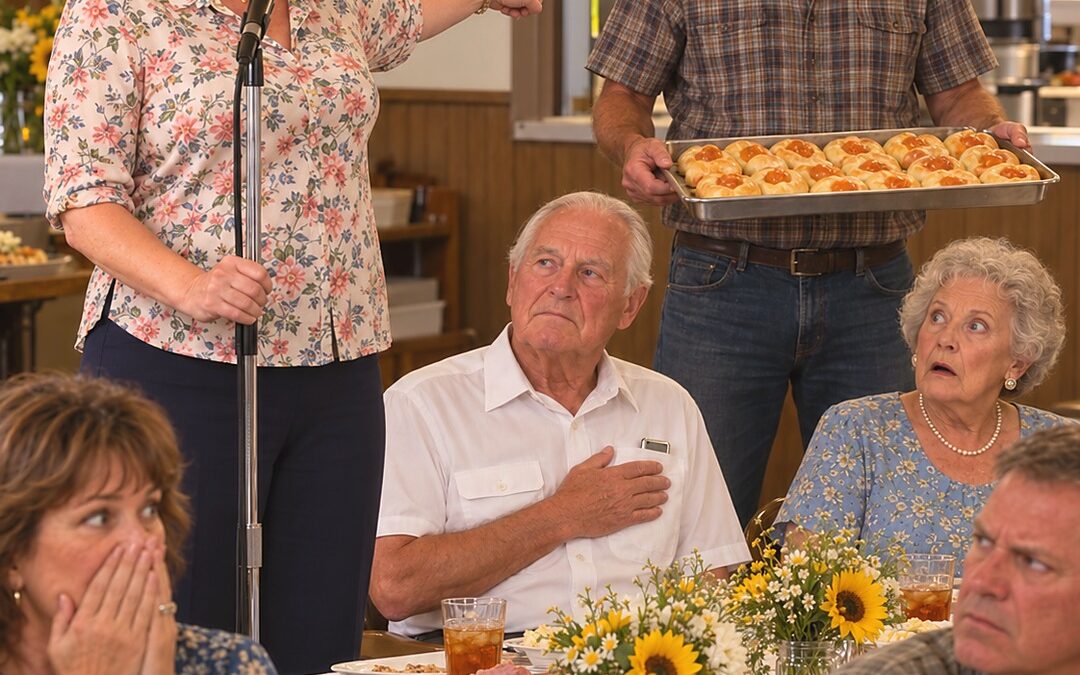
At 1:12 on a Sunday afternoon in August, with seventy-four people eating ham and scalloped potatoes in the Zion Lutheran fellowship hall, my sister tapped the microphone and said, "Mom and Dad's pension has kept Len's combine running for nine years, and we've never once made him say thank you."
I was standing at the pass-through window with a tray of fifty-eight apricot kolaches I'd baked at four that morning, and I hadn't told one soul in that room that five days earlier I'd closed on the sale of my whole farm.
Across the hall my father put his hand flat over the little silver recorder in his shirt pocket and kept it there.
Marlene lifted her glass and smiled at Mom and Dad like she'd just finished saying something sweet instead of telling the whole room I was living off them. She said family took care of family, and some people made that harder than others.
People laughed first, then clapped, and Craig clapped harder than most from the chair beside her. Mom sat at the head table with Dad while I stayed at the kitchen window.
The aluminum tray bent under my thumbs. I straightened the foil around the edge, worked one loose corner flat, then fixed the other side and did it a third time without raising my head.
"Come on, Lenny."
She said it the way you'd call a boy who forgot his lunch.
"At least wave."
Several people turned around. A man from Elm Creek grinned over his plate, while his wife lowered her eyes and cut another piece of ham.
The recipe card sat in my shirt pocket, soft at the edges from years of butter and flour, and one corner pressed against my chest. Mom found the tray from across the room and shaped one word with her lips.
Apricot.
I nodded.
At four that morning, I'd rolled dough under the stove light while the rest of the house stayed dark. Apricot filling stuck to my index finger, and I wiped it on a paper towel before moving the next kolache onto the pan.
The aluminum church tray waited on the kitchen table. I counted fifty-eight onto it, laid wax paper between the rows, then slid Mom's recipe card back into my shirt pocket after washing Janice's old yellow mixing bowl.
By 5:37, the last pan was cooling. I carried the tray to my truck with the filling still warm enough to soften the wax paper.
Now, in the fellowship hall, Marlene held her glass toward Dad.
"Nine years, folks."
Dad's silver Sony sat under the flap of his work-shirt pocket. I remembered Marlene noticing its red light at our table the year before and asking what it was.
Dad had tapped his hearing aid.
"that little light is my hearing aid charging"
Marlene had nodded and gone back to her potatoes.
The microphone squealed. Pastor Tim motioned toward Tyler Hrabak at the sound board, and Tyler pulled one slider until it stopped.
Marlene faced Mom.
"And Mom would give away the furnace."
A few people laughed.
I carried the kolaches out and stopped beside Mom's chair. She chose an apricot one, careful with the paper liner because her knuckles didn't bend easily anymore, while Dad reached from the far side of the tray.
"Thanks, son."
"Sure."
Marlene leaned toward the microphone.
"See? He can take one."
Another patch of laughter moved through the hall.
I carried the tray along the head table. Pastor Tim took cheese, one of the women from the altar committee chose poppy seed, and the Elm Creek man's wife waited until her husband reached for apricot before taking one from the opposite corner.
Dad ate half of his and put the rest beside his water glass. His hand had left the Sony, but the pocket flap stayed flat over it.
I moved toward the next table. A little boy pointed at the apricot row, his grandmother moved his hand away from the tray, then chose one for him herself.
"Use a plate, Mason."
He held both hands under it.
I kept moving.
Beth Anne Sorensen took an apricot near the end of the second table. She gave me a brief glance and said, "Len," before a woman beside her asked me whether the cheese ones had raisins.
"No raisins."
"Good."
Beth Anne set hers beside her plate instead of eating it.
At the front, Marlene touched the lapel of her navy blazer and angled the microphone toward Pat Hruska.
"I probably shouldn't spoil anything."
Pat, the director of the Platte Valley Area Agency on Aging, gave her a small warning smile.
Marlene spoiled it anyway.
"Pat Hruska from the Agency is bringing me a little something on Rally Day, September 13, so come hungry."
Craig stood halfway up from his chair and pointed toward his wife.
"She earned it."
The applause came again, louder this time.
One of the church women came through the pass-through asking for another serving spoon, so I set the tray down and dug through the utensil drawer until I found one with a bent handle. By the time I handed it over, Marlene had started naming errands she'd done for Mom and Dad that month.
Mom reached for her water glass.
Dad took his napkin off his knee and laid it beside his plate.
Marlene mentioned pharmacy pickups and an insurance form.
I carried six more kolaches to a table near the wall. A retired Co-op driver named Wes asked if Dad still had the little recorder he used at cattle sales, and before I could answer, Dad held up two fingers from the head table.
"Still got it."
Wes laughed.
"Figured you would."
Marlene was close enough to hear. She glanced at Dad's pocket, saw nothing but the flap, and went on talking to Pat.
At the serving line, one of the foil pans had shifted sideways and gravy was creeping toward the table edge. I put down the tray, shoved a folded paper placemat under the low side, and wiped the spill with two napkins.
When I straightened, Dad was watching Marlene.
He wasn't eating anymore.
Mom had finished half her kolache. She pinched the paper liner shut around the rest and put it beside her plate.
Dad reached for his water.
I went back to the kitchen for the second tray.
A stack of clean dessert plates waited beside the pass-through. I set the aluminum tray down, moved twelve plates to the serving counter, then stopped because Marlene was still talking and half the room could see me through the opening.
She thanked Pat and Craig, then thanked Mom and Dad for "letting me do the hard stuff" before waving toward the church volunteers who'd cooked lunch.
I picked up six forks from the silverware tub and lined them beside the plates.
The man from Elm Creek laughed at something Craig said. His wife kept cutting her ham.
I took the tray back out.
At the third table, Pastor Tim's wife asked if I'd baked them myself.
"Four this morning."
"You're crazy."
"Probably."
She took apricot.
Near the center table, an older man from Shelton asked if there were any poppy seed left. I turned the tray so he could see the last two without reaching across another person's plate.
"Take both."
"My doctor would object."
"Then don't tell him."
He took one.
I moved on.
At the next table, a woman I'd known since high school asked whether I still had that old Case combine.
"Still starts."
"That's not what I asked."
"It was Sunday. I gave her the church answer."
She smiled and took cheese.
I carried the tray toward the head table again.
Mom caught me passing and tapped one empty spot beside her plate.
"Sit down for five minutes."
"I've got food."
"You've got legs too."
"I noticed."
Dad moved his water glass out of the empty place.
I put the tray there instead.
"Close enough."
Mom took another apricot kolache from the corner.
Marlene glanced back from Pat.
"Lenny, don't eat all the profits."
Mom spoke before I could.
"He made them."
"With my recipe," Marlene said.
Mom lifted the kolache.
"My recipe."
That ended that exchange.
I took the tray again and headed for the kitchen.
By then several people had started stacking their own plates near the pass-through. A man handed me a napkin wrapped around a chicken bone, realized what he'd done, and took it back without either of us discussing it.
Through the opening, I watched Marlene lower the microphone and lean toward Mom.
She pulled one page from her purse.
A yellow tab stuck out beside a signature line.
— continue reading from here —
Marlene set the paper in front of Mom and handed her a pen.
Mom signed where the yellow tab pointed without lifting her head from the page.
Marlene put the paper back into her purse.
Five days earlier, on Tuesday, August 25, I had sat in Marcia Doherty's office in Kearney with two lawyers from the buyer across from me and a black pen that kept skipping on glossy paper. For ninety minutes they moved yellow tabs toward me, and every time a signature line came up I wrote Len Votava with the same bar across the V I'd used since high school.
When the last paper was done, Marcia capped her pen and said, "That's it." I carried my copies to the elevator in a flat envelope and put them behind the passenger seat of my F-250.
I told nobody.
I enjoyed knowing something Marlene didn't. I enjoyed Mom and Dad not knowing too, and that lasted five days.
Janice would have noticed.
Back in 2019, we'd been eating meatloaf at Mom and Dad's table when I told everybody I'd bought another pivot after saving for six years.
Dad set down his fork.
"What'd you buy?"
"Valley. Used."
Marlene didn't ask anything about the machine.
"So you'll be needing help paying for that."
"I paid for it."
Under the table, Janice nudged my ankle with the side of her shoe.
Later, in our truck, she pulled the heater vent toward her feet.
"Quit feeding people good news."
I drove home.
Janice died Thursday, November 11, 2021, at forty-seven. Her funeral was Monday, November 15.
My plan for this Sunday had been simple. Get through the anniversary lunch, clean the hall, then take Mom and Dad home around three and put the closing papers on their living-room table.
I wanted Mom to hear it from me.
By the time Marlene finally handed the microphone back to Pastor Tim, several tables had started clearing. I carried an empty tray to the kitchen, scraped crumbs into the trash, and stacked paper liners in a paper cup because Mom had taught me not to leave a mess for church volunteers when I was eight.
Craig came in carrying two cake plates.
One still had frosting.
He set them beside the sink.
"She gets nervous."
I turned the faucet lower.
"Marlene?"
"Big family stuff."
"She had a microphone."
Craig rubbed the back of his neck and picked up a dish towel.
"She talks."
"I noticed."
He dried one plate, missed a stripe of frosting, and set it down anyway.
"Don't make a thing of it."
"Nine years is a thing."
The towel stopped in his hand.
"You know Marlene."
"Yep."
"She's proud."
"Of what?"
Craig glanced toward the hall.
"Keeping your folks organized."
He left the towel beside the sink and walked out.
Mom came in carrying a stack of forks against her apron. One slipped, hit the tile near my boot, and spun once before I picked it up.
"Leave that one for the dishwasher."
"We are the dishwasher."
She gave me the towel Craig had dropped. Apricot filling had dried along the side of one finger.
"Don't mind your sister."
"I don't."
"You do."
I dried the next fork and set it in the clean tub.
"Your father liked the kolache."
"He ate half."
"He likes apricot."
"I know."
I pulled the recipe card from my pocket.
"You still want this back?"
"No."
Her fingertip stopped at the handwritten line in the corner.
Len likes more apricot.
"You make them better."
I slid the card back into my pocket.
Mom picked up two clean forks and went out through the swinging kitchen door.
Dad came through next on his way toward the restroom.
"You driving over later?"
"That was the plan."
"Three?"
"Three."
He nodded.
Marlene appeared behind him.
"Dad, we're taking you."
Dad faced her.
"Len's taking us."
"No."
She smiled at him.
"I've got paperwork for Mom."
Dad's mouth tightened once.
"Three o'clock," I said.
Marlene gave me the same patient smile she'd used during the toast.
"Lenny, relax."
"I am relaxed."
"Mom's accounts need signatures."
"On Sunday?"
"People still have bills Sunday."
Dad stayed beside the doorway.
"We'll bring them home," Marlene said.
"Fine. I'll come after."
She stepped around me and went back into the hall.
I drained the roasting pan, rinsed a streak of glaze from the bottom, and set it on the rack. Through the pass-through, I could see Mom at the head table while Marlene bent over her with another paper beside the purse.
Mom had the pen again.
She made a short mark near the bottom.
Marlene lifted the page, checked it against something inside her purse, then put both away.
Dad came out of the restroom and stopped near the doorway. His chin moved once toward the head table, but he stayed where he was.
Marlene capped the pen.
Dad walked outside.
By the time most of the folding chairs were stacked, Marlene was at the sink scraping a serving tray. Craig stood near the doorway, and Mom was far enough away that the running water covered us.
I dried my hands.
"Send me every note with my name on it, Marlene. Today."
She stopped scraping and laughed.
"Lenny. Nobody's asking you to pay anything back."
"Then sending them should be easy."
She pushed a strip of ham toward the drain.
"Your parents helped you. We kept records."
"What records?"
"The usual stuff."
"With my name?"
She turned the tray under the faucet.
"Yes."
"Send them."
"I'll bring the binder tomorrow."
The last word came out before the rest of her sentence was ready.
Marlene stopped moving.
Craig's keys clicked once against the metal doorframe, then stopped.
I kept drying the same spot on my hands.
Marlene set the tray down.
"The three-ring binder I keep for Mom and Dad's papers. That's what I meant."
"Eleven o'clock?"
"At Mom and Dad's."
"Bring everything with my name."
She picked up the tray again.
"You're taking a toast like it's an audit."
"I'm asking for paper."
"Fine."
I put the towel on the counter.
Craig shifted toward the hall.
"You ever witness anything with my name on it?"
He stopped.
Marlene answered before he could.
"Don't drag Craig into this."
"He just heard the question."
"This is family."
"So is he."
Water ran over the serving tray.
Marlene pushed a piece of ham from the drain screen into the trash.
"Mom signs things. Dad signs things. Somebody has to keep track of what they're signing."
"You?"
"Yes."
"Does Mom know every paper?"
Marlene set the tray against the backsplash.
"Mom knows what she needs to know."
Craig stepped into the hall.
I watched him go without calling him back.
"What exactly did she sign?"
"Don't start."
"I'm already started."
Marlene shoved the tray into the rack hard enough to knock it against the pan beside it.
"Your parents helped cover things when you were having trouble."
"What trouble?"
"Farm trouble. Equipment. Whatever you call it."
"My combine is paid off."
"I didn't say it wasn't."
"You told seventy-four people their pension keeps it running."
She picked up her purse.
"And tomorrow you can read the records."
"Eleven o'clock."
"Yes, Lenny."
She went out.
I stayed in the kitchen and found Mom's white plastic tub full of forks under the serving table.
She came back through the door carrying three more.
"People hide these under napkins."
One fork had scalloped potato dried between the tines.
Mom turned on the faucet.
I reached for the worn dish towel.
She put something on the counter between us.
My recipe card.
I checked my shirt pocket.
Empty.
"You dropped it by the coffee urn."
A smear of apricot filling marked one edge.
"That's new."
"Sorry."
"It's survived worse."
Mom rinsed the dirty fork and handed it to me.
I dried it.
She read the corner of the card again.
Len likes more apricot.
"I wrote that when you were what, twelve?"
"Maybe."
"You'd scrape the cheese ones empty."
"I still would."
"You were terrible."
"Still true."
She gave the card back.
Through the pass-through, Marlene stood near the coat rack talking to Pat. Craig was ten feet away with his hands in his pockets.
Mom followed where I was facing.
"She does a lot for us."
"I know."
"Your dad doesn't like paperwork."
"I know that too."
"And my hands aren't much good."
Water dripped from the fork onto the rubber mat.
"That doesn't mean you signed anything for me."
Mom set the fork in the clean tub.
"What are you asking me?"
"Nothing today."
"Len."
"Tomorrow's fine."
She reached for another fork, then left it in the sink.
"Marlene brings papers."
"What kind?"
"Bank things. Insurance."
"Anything about me?"
Her apron shifted when she took a breath.
"I don't remember."
I dried the last clean fork.
Mom pushed the tub toward me.
"Carry those out."
I picked it up.
"You still coming at three?"
"That was the plan."
She picked up the wet towel and hung it over the oven handle.
Outside the kitchen, Dad was already walking toward the side door with Marlene several steps behind him.
I carried the forks to the serving table and set down the tub.
The Elm Creek man who had laughed during the toast stood nearby putting on his jacket.
He gave me a quick nod.
His wife kept her plate in front of her until he moved toward the exit.
Then she got up and carried both plates to the trash.
At 2:34 p.m., Dad stood beside my F-250 in the church parking lot. The truck had 238,000 miles on it, and the driver's door squeaked whenever Nebraska weather changed its mind.
Marlene's black Tahoe waited near Elm Street.
Mom was already inside behind the glass.
Craig crossed toward his pickup while Marlene opened the Tahoe.
"Come on, Dad."
Dad stayed beside my truck.
I stopped a few feet from him.
"Three o'clock still?"
He shook his head once.
"Tomorrow."
"Eleven o'clock?"
"Yes."
Marlene leaned out from the driver's seat.
"Dad, we're leaving."
Dad moved toward the Tahoe.
Before he reached it, he glanced down at his shirt pocket. The flap lay flat over the small silver Sony.
"Just read what she shows you, son."
"Then come find me in the shed."
Part 2 — THE ELEVEN NOTES
PART 2 — THE ELEVEN NOTES
At 11:00 Monday morning, eleven promissory notes were waiting on Mom and Dad's kitchen table.
Marlene had put them in a three-ring binder with a white label across the front: Len's Notes. The plastic tablecloth underneath had faded yellow flowers, and the wall clock above the refrigerator clicked loud enough to hear between sentences.
Mom sat by the window with a mug of coffee she hadn't touched. I took the chair across from Marlene.
Dad was in the living room, close enough that I could see one work boot past the doorway. His blue shirt pocket was buttoned over the Sony, and Marlene never glanced that direction.
She opened the binder.
"Coffee?"
"No."
"You always drink coffee."
I pulled the binder a little closer.
"Show me the notes."
She removed the first page.
It had my parents' names up top. Mine was underneath, with an amount of $22,000 and a date that stopped me.
Thursday, November 18, 2021.
Janice's funeral had been Monday.
Three days earlier.
I touched the date once.
"What's this?"
Marlene leaned back.
"You know what it is."
"I don't."
"Equipment help."
I moved the page closer.
"What equipment?"
"Lenny."
"What equipment?"
Mom shifted in her chair, but her coffee stayed where it was.
Marlene pointed at the page.
"That fall was awful."
"My wife had just died."
"I know."
"Three days before this."
"I know when Janice died."
I read the signature at the bottom.
Ronald L. Votava.
My full name is Leonard.
Ronald had been Dad's older brother. Uncle Ronald died in 2003, and Marlene had handled part of the estate paperwork afterward because she was the family member who understood forms and notary stamps.
I knew those old papers.
I'd seen the name before.
Now it was sitting on a debt somebody claimed belonged to me.
"This isn't my name."
Marlene glanced down.
"It's the name on the form, Len."
"What form?"
She lifted one shoulder.
"The paperwork we used."
"Uncle Ronald's paperwork."
Mom kept her eyes on the yellow tab stuck near the signature line. That was how Marlene gave her papers: yellow tab, sign here, move to the next one.
Mom wasn't reading the typed name.
She was watching the tab.
I pushed the note closer to her.
"Mom, read who's borrowing."
She bent over the page.
Her lips moved across the first line.
Then she stopped.
"Ronald."
"That's Dad's brother."
"I know who Ronald was."
Marlene reached for the note.
"It's an old template."
I kept it where it was.
"You used Uncle Ronald's estate form for a loan to me?"
"It's the name on the form, Len."
"Eleven times?"
She didn't answer that.
The signature had a round V.
Mine never did.
I sign Len Votava, with a bar across the V, the same way I had signed every closing paper in Marcia's office last Tuesday, six days earlier.
Mom leaned closer.
"You signed them, honey."
I turned the paper so she could see the name again.
"No, Mom."
She read the date.
Marlene shut the binder halfway.
"We're not doing this."
I reopened it.
"We are."
Her chair scraped the linoleum.
I pulled out the next note.
March 3, 2022.
$14,500.
Ronald L. Votava again, with Craig Pruitt listed as witness and Marlene's notary stamp underneath.
I turned the pages one by one.
Eleven notes used Uncle Ronald's first name, Craig's witness line, and Marlene's seal. The dates moved forward while the amounts changed, but the handwriting never became mine.
I stopped adding the numbers.
The first page was enough.
I pushed it toward Mom.
"Did you see me sign this?"
She studied the date.
"No."
"Did Dad?"
"I don't know."
Marlene cut in.
"Mom doesn't remember every transaction."
"She remembers the funeral."
Mom's hand left the coffee mug.
The farm report played from the living room, somebody talking soybean futures and weather west of Grand Island. Dad didn't come into the kitchen.
Marlene tapped the binder.
"Your parents helped you."
"How?"
"Cash flow."
"Where did the money go?"
She picked up her coffee and put it down without drinking.
"Your operation."
"What account?"
She shifted the binder square with the edge of the table.
"Different things."
"Name one."
"Len, I don't keep nine years in my head."
I moved note one back in front of me.
Thursday, November 18.
Three days after Janice's funeral.
That week came back in pieces. Somebody from Zion had left a foil pan of chicken-and-rice casserole on my stove, and I remember eating two cold bites straight from it because washing a plate seemed like work.
A gallon of milk went bad in the refrigerator. Dad found it when he came over and carried it outside.
Janice's winter coat stayed on the hook by the laundry-room door, one sleeve turned partly inside out. Her brown snow boots were underneath it with dried mud on one heel.
A sympathy card sat on the kitchen counter with twenty dollars inside. I could see the edge of the bill through the envelope, and it stayed there unopened for days.
I can't remember a single day in that week I was off my own kitchen floor for very long.
I do not remember borrowing $22,000.
I set the page down.
"What did I buy?"
Marlene breathed out through her nose.
"We've been over this."
"No, you have."
Mom reached for her coffee, but the cup rattled against the saucer before she got it clear. She set it down, took the dish towel from the oven handle, and pressed the worn corner under one eye.
"I thought we were helping."
I shifted my chair closer.
"Mom, I'm not mad at you."
Marlene snapped the binder shut.
"See what you're doing?"
I kept my voice even.
"Open it."
She pushed it toward me instead.
"Fine."
I pulled out every note and spread them across the plastic tablecloth in two uneven rows. Eleven papers covered most of the faded yellow flowers.
The television in the living room went quiet.
The refrigerator kicked on once.
Marlene crossed her arms.
"Happy?"
"No."
I read Craig's name again.
Witness.
Eleven times.
"You notarized these."
"Yes."
"You watched me sign?"
"I handled the paperwork."
"That's not what I asked."
Her chair creaked when she shifted.
Mom said my name softly.
I kept the first note under my palm.
"Marlene, did you watch me sign these?"
"You're being ridiculous."
She reached for the papers.
I held note one in place.
"Those are Mom and Dad's records."
"They have my name."
"They stay here."
"Fine."
I took out my phone.
Marlene moved faster.
"No pictures."
"Why?"
"Private financial information."
"My signature is on it."
"It's not fake."
"Then you shouldn't care."
Mom made a small sound behind the dish towel.
I put the phone away.
Dad's television came back on.
He still didn't enter the kitchen.
Marlene gathered the pages and put them back in order. Then she reached into her tote and removed another document.
"This will clean things up."
I read the heading.
ACKNOWLEDGEMENT OF DEBT AND SECURITY AGREEMENT.
My name was already typed in, along with the farm address. Farther down, the document listed machinery, including my Case IH combine.
Marlene tapped one fingernail against the signature line.
"Sign that and we're done."
I read the security language twice.
"This gives Mom and Dad an interest in my machinery."
"It protects them."
"From what?"
"From unpaid loans."
"I never took the loans."
Her nail landed beside the line again.
"You acknowledge the balance, and everybody quits fighting."
"I'm taking this to my lawyer."
Marlene pulled the page toward herself.
"You're not taking originals."
"Give me a copy."
"I'll email one."
"Today."
She slid the acknowledgement into the binder.
"You've gotten very dramatic."
"You used a microphone yesterday."
Mom folded the dish towel and placed it beside her cold coffee.
At 11:47, I stood.
She started to lift one hand, then rested it on the table instead.
"I'll come back later."
"Len."
"I'm okay."
"You don't look okay."
"I've looked worse."
I pushed my chair underneath the table.
Marlene put the binder into her tote.
I pointed at it.
"Don't lose that."
She gave me a dry little laugh.
"I keep records."
Dad's work boot disappeared from the doorway.
He had moved farther into the living room.
I left through the kitchen door.
At 3:10 that afternoon, I walked into Pruitt Implement & Supply in Kearney for a hydraulic coupler I actually needed.
Brody was behind the parts counter with a yellow invoice pad and two open catalogs. He found the coupler in a bin, dropped it into a paper sack, and wrote $27.80 across the invoice.
I paid cash.
Craig came out of his office while Brody counted change.
He saw me and immediately shifted an invoice on the counter in front of him.
"Craig."
He kept reading.
"Busy."
"I need thirty seconds."
"Then you've got thirty."
I moved nearer his office.
He stayed by the parts counter.
Inside, files were stacked nearly to the ceiling, folders leaning against binders and metal trays full of paperwork. A steel safe sat behind Craig's desk.
"Eleven notes."
He shifted the invoice to his other hand.
"What about them?"
"You witnessed them."
"Marlene handles your folks."
"Did you witness me signing?"
He flattened the invoice against the counter.
"I sign a lot of things."
"Eleven?"
"Len, don't do this here."
"Where should I?"
Brody set my coins beside the paper sack and headed toward the shelves in back.
I pointed toward Craig's office.
"Are those notes in that safe?"
Craig lowered the invoice.
"Ask Marlene."
"I'm asking you."
He stepped away from the counter.
"Go home."
"Did I sign those notes?"
His shoulders dropped a fraction.
"You need to talk to your sister."
I picked up the paper sack and walked outside.
At 3:23, I sat in my F-250 with the driver's door open and pulled the plastic crate from behind my seat.
Janice's green ledger books were stacked by year. Her handwriting leaned slightly right, and the tabs were still marked in blue ink: Fuel, Equipment, Seed.
I opened 2021.
Receipts were taped beside entries. The bill of sale for the used Case IH had PAID written across it in Janice's handwriting hard enough to dent the page underneath.
No deposit matched the first note.
I checked the next ledger.
Nothing from Mom or Dad.
Under the books sat a bundle of unopened mail held together with a red rubber band. Some envelopes were from the weeks after Janice's funeral, when I had shoved anything that didn't look urgent behind the seat.
A farm-supply statement sat on top.
Under it were two insurance envelopes and a Christmas card still sealed.
I pushed the bundle back under the ledgers.
Then I checked enough of the later pages to know what wasn't there.
No Deere purchase appeared anywhere.
No unexplained parent-funded equipment payment showed up.
I shut the ledger and returned the crate behind my seat.
Across the lot, Craig stood inside his office near the safe.
He stepped away from the window when I started the truck.
At 7:40 that evening, I turned onto Elm Road with the sun low behind the shelterbelt.
Gravel snapped beneath my tires. Dad's pickup sat beside the machine shed instead of near the house, and Mom's kitchen light glowed through the window even though daylight still covered the yard.
I parked near the lane and shut off the engine.
The shed was dark except for one narrow line of yellow light under the metal door.
Dad normally left that door open in August.
I crossed the gravel.
A box fan hummed somewhere inside.
Then came a faint electronic hiss.
Small speakers.
Cheap ones.
I stopped with my hand near the latch.
Craig's voice came through first, too low for me to make out.
Then my sister's voice came through the metal door, small and tinny.
"Dad's ears are shot. He'll forget it by supper."
Part 3 — THE FEED CAP
PART 3 — THE FEED CAP
At 9:06 Tuesday morning, Marcia Doherty laid the first forged note under a brass desk lamp.
Her office was on Second Avenue in Kearney. I had brought photographs of all eleven notes, the acknowledgement Marlene wanted signed, and Janice's green ledger books in the grocery sack with the torn handle.
Marcia was sixty and wore drugstore reading glasses. She studied the first signature, then pushed the photograph beside a page I'd signed for her from an old farm file.
"Ronald L. Votava."
"Uncle Ronald."
"Your father's brother?"
"Died in 2003."
She checked the photograph again.
"And Marlene handled his estate papers?"
"Some of them."
My real signature sat six inches away: Len Votava, with the bar across the V.
Marcia moved to the witness line.
"Craig on every one?"
"All eleven."
"And Marlene notarized all eleven."
"Yes."
She worked through the photographs without making me repeat it. When she finished, she opened the green ledgers and found Janice's Equipment tab.
"Combine?"
"Paid off."
"Anything from your parents?"
"No."
"Any Deere equipment?"
"I've never owned one."
Marcia turned one more ledger page, then shut the book.
She asked whether any of the note money had ever entered my farm account, paid a dealer directly, or covered a debt I recognized. I told her no to all of it.
"Then we don't argue from memory," she said. "We build records."
I told her about the shed.
Not every word.
Just enough.
Monday night, after I heard Marlene's voice through the metal door, Dad opened it from inside. The box fan pushed warm air past him, and the little silver Sony sat on the workbench with a cable running into one of his cheap speakers.
I stepped in.
"Dad, that's Marlene."
He reached behind the speaker and pulled the cable free.
The voice died.
"Where was that recorded?"
Dad slipped the Sony into his shirt pocket.
"Tomorrow, Len."
"I need to hear the rest."
"Tomorrow."
He opened the side door for me.
I stood there another few beats, then went home.
Now Marcia took off her glasses.
"Nebraska is one-party consent. A person who's actually a party to a conversation can record it."
She set the glasses beside the notes.
"That doesn't mean I'm promising you these recordings walk straight into court."
I shifted the grocery sack off my knee.
"Then what does it mean?"
"It means the county attorney decides what he can use and how."
She tapped the edge of the first note.
"I'd want the original recorder. Original files with the timestamps intact. A statement from Emil about how that Sony was set up."
"And the recording itself."
"Yes."
She picked up her pen.
"I also want to know who speaks directly to your father on whatever is in there. If somebody addresses Emil and he answers, that's stronger footing than us guessing from where the recorder happened to be."
I thought about the one line I'd heard through the shed door.
Dad's ears are shot. He'll forget it by supper.
"Craig's on it too."
"Then his own words matter."
Marcia wrote another line.
"So do anybody else's."
I nodded toward the photographs.
"What do you need from Dad?"
"The recorder, if he'll give it to us. The files without somebody emailing them back and forth ten times. And him sitting in this office telling me what happened."
"Dad hasn't offered any of that."
"Then don't pressure him."
She stacked the photographs.
"Let him decide."
I reached for the grocery sack.
Marcia stopped me.
"One more thing. Have you received anything from your parents' credit union or bank?"
"Maybe."
"Statements?"
"I don't know."
"Notices?"
"I've got mail I haven't opened."
Her pen stopped.
"How much?"
"Enough."
There was a kitchen drawer at home with envelopes shoved behind appliance manuals, and another rubber-banded stack in the truck crate. Some had been sitting since after Janice died.
"There's a drawer," I said. "And some in the truck."
Marcia wrote one line on her pad.
"Bring anything financial next time."
I put the ledgers back in the sack.
She kept copies of the note photographs.
On Wednesday at 10:18, Beth Anne Sorensen sat across from me at the Gibbon café.
We took the booth by the Coke machine. She had coffee, and I had eggs that went cold while we talked.
Beth Anne put her phone facedown.
"You cannot ask me for Emil's accounts."
"I know."
"Or Dee's."
"I'm not asking."
She lowered her voice.
"Then what are you asking?"
"If Dad walks in himself?"
Her spoon stopped against the mug.
"If Emil asks for his own statements, we print them."
"Every page?"
"Whatever he's entitled to."
"How far back?"
"However far he requests."
I nodded.
The waitress came by with the pot.
Beth Anne covered her cup.
When the woman moved on, Beth Anne leaned closer.
"I flagged withdrawals in January."
My fork stopped over the plate.
"You flagged them?"
"I can tell you what I did. I can't give you account information."
"Why flag them?"
"Pattern."
"Did the power of attorney cover it?"
"Yes."
"Marlene's?"
She nodded once.
I set the fork down.
Beth Anne wrapped both hands around her mug.
"I followed procedure."
"I didn't say you didn't."
She watched the steam for a beat.
"Your dad can walk into my branch and ask for his own records."
"I heard you."
"That's all I can tell you."
The café door opened behind me.
A gust of warm air moved the napkin dispenser.
Beth Anne checked the clock over the register.
"I'll be at Zion on Rally Day anyway."
I kept eating.
"September thirteenth. I'm on coffee in the fellowship hall."
I nodded.
She picked up her mug.
We finished without discussing Sunday again.
At 1:35 Wednesday, I sat in my truck across Third Street from Platte Valley Federal Credit Union.
Dad's pickup came around the corner and stopped in the side lot.
He got out alone.
He wore his older Co-op cap and carried a white envelope under one arm. The wind caught the envelope flap while he crossed the parking lot, and he pinned it against his shirt with his elbow.
Beth Anne saw him through the glass.
She came around the teller counter and held the door.
Dad went inside.
My hand settled on the gearshift.
I could have crossed Third Street in ten seconds.
I stayed in the truck.
A grain truck rolled between us, rattling hard enough to shake my mirror.
When it cleared, Dad was gone from the lobby.
I drove home.
I called him Wednesday evening.
Mom answered.
"Your dad's tired."
"Can I talk to him?"
"Tomorrow, Len."
She hung up after that.
I called again Thursday after supper.
Mom answered that one too.
"He's gone to bed."
It was early enough that sunlight still hit the tops of the cottonwoods.
"Tell him I called."
"I will."
Thursday night, I spread printouts of all eleven notes across my kitchen table.
The house was quiet except for a sprinkler tapping the foundation outside.
Janice's magnifying glass was in the junk drawer.
She'd bought it to read seed labels after forty-five, then insisted the labels had gotten smaller.
I held it over the first signature.
Ronald L. Votava.
The R had a hard downward stroke.
The V curled at the bottom.
Mine didn't.
I moved to the next page and then the one after it.
The same hand had shaped the name each time.
The phone sat near my elbow.
I didn't call Dad a third time.
Instead I opened the kitchen drawer beside the refrigerator.
Appliance manuals filled the front.
Behind them sat envelopes I'd pushed there after Janice died.
I pulled out a rubber-banded stack.
Most were junk.
One was from Platte Valley Federal Credit Union.
The envelope had a 2026 date.
I tore it open.
The first page had my parents' names near the top and language about account activity farther down. I read halfway through the opening paragraph, stopped, and laid it beside the eleven note copies.
The magnifying glass stayed on top.
Another envelope in the stack carried the same credit union logo.
I opened that one too.
A notice inside referenced online account access and mailed statements.
I read the first few lines, put it under the other page, and pulled the rubber band around the remaining envelopes again.
Janice used to open mail at the counter with a steak knife she kept in the junk drawer.
The knife was still there.
I closed the drawer.
Friday at 4:16, Marlene's Tahoe came down my lane.
I was greasing the header.
My Co-op feed cap was on my head, faded gray across the crown with a dark sweat line above the bill. I'd worn that cap through four harvests and one transmission replacement, and the plastic adjustment strap had cracked near the last hole.
The black Tahoe stopped beside the machine shed.
Dust rolled past it.
Marlene got out.
Craig stayed in the passenger seat long enough to make me wonder if he planned to stay there.
Then he opened his door.
Marlene wore jeans, and her sunglasses sat on top of her head.
"What did you say to Beth Anne?"
"Hello."
"I'm serious."
"So am I."
She stopped near the header.
"Did you ask about Dad's accounts?"
"No."
"Don't lie to me."
I wiped grease from the fitting with a shop rag.
"Ask Beth Anne."
"I did."
Craig closed his door.
Marlene stepped nearer.
"Dad is confused."
"No."
"He is."
"He drove himself Wednesday."
"Exactly."
Her words sat between us.
She kept going.
"He shouldn't be handling financial matters alone."
"Because he drove?"
"Because he's eighty-two."
"He managed the Co-op."
"Thirty years ago."
"He auctioned cattle after that."
"Lenny."
She said it softly now, the same voice she used when she wanted me to sound younger than her.
"We have him scheduled Tuesday at nine in Kearney for an evaluation."
"Does Dad know?"
"He will."
"Who made the appointment?"
"I did."
Craig shifted behind her and checked the gravel near his shoe.
I put the grease gun on the header.
"He doesn't need your permission to cancel it."
Marlene crossed her arms.
"Somebody has to be responsible."
"Who decided that's you?"
"The power of attorney."
"That's money."
"It's more than money."
Craig raised his head.
His right hand rested beside the Tahoe door.
I wanted to know whether the recorder bothered him.
So I gave him something small and watched his hand.
"He records his own conversations."
Craig's right hand closed around the Tahoe door handle.
Marlene gave a short laugh.
"With that silly recorder?"
I watched Craig.
Marlene kept talking.
"He has to press the button."
Craig's hand stayed on the handle.
Marlene went on.
"He's recorded cattle prices for fifty years."
"Since 1979."
"Fine."
She brushed that away.
"Half of those tapes don't even play."
Craig stepped closer to the driver's side.
"Marl."
She faced him.
"What?"
"Let's go."
She ignored him.
Instead she pointed at the cap on my head.
"You think anybody's going to believe whatever story you've got?"
I wiped my palm on the shop rag.
"Depends on the story."
She took another step.
"If you ask, you ask in front of people, and nobody believes a man in a feed cap."
I lifted the bill of my cap just enough to clear the sweat from my forehead.
Craig opened the Tahoe door.
Marlene stayed where she was.
"You've always done this."
"Done what?"
"Act helpless until somebody else cleans it up."
I put the rag on the header.
"My combine is paid off."
"This isn't about your combine."
"It was at the anniversary lunch."
Her shoulders shifted.
Craig spoke again.
"Marlene."
She faced him this time.
He was already getting into the Tahoe.
Marlene walked around the hood.
Before getting in, she pointed through the open driver's door.
"Stay out of Dad's banking."
I left the grease gun on the header and watched her start the engine.
Craig sat beside her with one hand resting on the black document case at his feet.
"Tuesday, nine o'clock, Kearney," Marlene said, backing the Tahoe out of my lane. "After that, you visit when I say."
Part 4 — THE LAST VOICE AT NIGHT
PART 4 — THE LAST VOICE AT NIGHT
At 6:10 Saturday morning, Mom was standing on the front step in her robe when I pulled into the driveway.
She had slippers on, and one had a strip of silver duct tape across the toe. Dad's pickup was gone from its usual spot, while the machine shed doors were closed.
Mom waited until I shut off my truck.
"Len."
"Morning."
"You talked to your sister."
"Friday."
She came down one step. Her hair was still pinned from sleeping, and one loose pin hung near her ear.
"She called last night. She says you're trying to turn your father against her."
"I'm trying to find out who signed eleven notes."
Mom faced the road.
"Your sister says there's an appointment Tuesday."
"I heard."
"She says it's only a check."
"It isn't."
"How do you know?"
"Because she told me what happens after."
Mom caught the belt of her robe in one fist and held it against her stomach.
"She's done everything for us."
"Banking and appointments, yes."
"Your father's insurance too."
"That doesn't make my signature hers."
Her grip stayed on the robe belt.
"Please don't make us choose."
I watched the kitchen curtain move behind the screen door.
"You aren't choosing between children. I'm asking about papers."
"It doesn't feel different from here."
I had no useful answer for that.
"Where's Dad?"
"Out."
"Where?"
She opened the screen door halfway.
"I don't know."
Mom was terrible at lying. She could play a funeral hymn while two babies screamed behind her, but she had never managed a convincing lie at breakfast.
I checked my watch.
6:16.
"Mom."
She kept one foot inside the doorway.
"Don't go to Kearney Tuesday."
"I wasn't invited."
"Please."
I walked back to the F-250 and got inside.
For six minutes, I sat behind the wheel with the keys in my hand. Dad wouldn't give me the recorder Monday, Craig wouldn't answer a plain question, and eleven notes still carried a name that belonged to my dead uncle.
The key teeth dug into my palm.
Then Dad stepped out from behind the machine shed.
He wore his own old Co-op cap and an open work shirt over a white undershirt. The Sony made a small square beneath the shirt pocket.
He lifted one finger toward the shed.
I shut the truck door and followed him.
At 6:25, Dad slid the machine shed door closed behind me.
The place smelled of grease and old rubber. A box fan rattled on the workbench beside a coffee can of bolts, and Dad's old auctioneer microphone hung from a nail with its cord looped around the handle.
He pointed to a folding chair.
I stayed standing.
Dad took off his cap and set it on the tractor seat.
"I heard your sister on August second."
"Sunday, August second?"
"Yes."
Five weeks.
I leaned against the workbench.
"You knew before the anniversary lunch."
"Yes."
"You let her say that in front of seventy-four people."
Dad lowered himself onto an overturned feed bucket.
"I did."
"Why?"
He rubbed one palm over the knee of his work pants.
"I kept thinking there'd be another way."
He stopped.
The fan clicked against its wire cage.
Dad reached toward the workbench, moved a loose socket away from the edge, then left it there.
"I wasn't protecting you, Len. I was protecting me."
I shifted my weight off the bench.
"Did Mom sign anything after August second?"
"Twice."
A pickup passed on Elm Road outside, tires humming over pavement before the sound faded.
"You knew?"
"I was in the other room both times. I heard your mother sign."
"And you let it happen."
Dad picked up his old Co-op cap, then set it back on the tractor seat.
"I kept seeing Thanksgiving."
He stopped there.
"One chair empty."
His voice dropped.
"Me being the one who put her in court."
He stood before I could answer.
"And that Sunday at the church, after the toast."
"What about it?"
"Marlene put one page in front of your mother at the head table. Called it a caregiver authorization."
Dad moved toward the metal cabinet.
"I heard her tell your mother to sign by the yellow tab. Your mother signed it."
"What's in it?"
"I don't know."
He opened the cabinet.
"Come here."
From the bottom shelf, he pulled out a shoebox that had once held Red Wing work boots.
Inside were microcassettes.
Dozens.
Some had yellowed labels. Others had grease-pencil dates that stopped in the eighties and started again years later.
"Cattle prices," Dad said.
"I know."
"Started in seventy-nine."
He moved tapes aside until he found one near the bottom.
The label read:
Len — Christmas 1983 — sold the red calf — age 9
Dad put it into an old recorder.
Static scratched through the speaker first.
Then my own nine-year-old voice filled the shed.
"Dad, I don't want to sell Clover, but I'll do it."
Dad stopped the tape after six seconds.
Clover had been a red bottle calf with one white patch under her chin. I fed her warm milk replacer before school from a bottle with black electrical tape around the neck because I'd dropped it on the concrete twice.
A family from Holdrege bought her.
I stood beside Dad at the sale barn when the gate shut behind her, carrying forty-three dollars in my jeans pocket after expenses. Two days later, Dad took me to Kearney and I spent some of it on a used red bicycle with a cracked reflector.
I hadn't heard my own voice from that year since that year.
I opened the top drawer of the toolbox.
Sockets rolled against each other.
Behind me, Dad set the microcassette beside the shoebox.
"I listened to your sister forty-one times. After, I'd put you on, so the last voice in my head at night wasn't hers."
My palm rested on the metal drawer.
Dad reached into his shirt pocket and took out the small silver Sony.
The red light came on when he spoke.
"VA fellow set it voice-activated last November."
He connected the Sony to a small speaker.
A date appeared on the screen.
June 9, 2026.
10:22 a.m.
"Where?"
"Marlene's Tahoe. Leaving the credit union drive-up."
I straightened.
"You were there?"
"Passenger seat."
Dad pulled his Co-op jacket from a hook near the cabinet. He zipped it to the middle of his chest and pressed the cloth where the recorder would have been hidden underneath.
"I'd zipped this over it."
"You were awake?"
"Asleep when she started."
He put the jacket back on the hook.
The speaker gave a faint pop when he touched the cable.
Dad pressed play.
Road noise came through first.
A turn signal clicked.
Then Marlene's voice filled the shed.
"Craig, it's done. Forty-one hundred out of Dad's annuity, and I'll post it against Len's combine note like the others."
Craig answered through the Tahoe speakers.
"Marl, how many more of these can we—"
"Len doesn't open his mail. He hasn't opened his mail since Janice. Nobody's ever going to ask him."
There was a short rush of air from the Tahoe vents.
Then Marlene's voice came louder, aimed away from the Bluetooth call.
"Dad, you want the heat down?"
Dad's recorded voice sounded thick with sleep.
"I'm fine."
Craig came back through the speakers.
"And your dad?"
"Dad's ears are shot. He'll forget it by supper."
Dad stopped the recording.
I kept my palm on the open toolbox drawer.
The rubber-banded stack of unopened mail came into my head. Envelopes behind the kitchen manuals, more behind my truck seat, paper I'd pushed away after Janice died because some days opening an electric bill had seemed harder than rebuilding a hydraulic cylinder.
I pointed at the Sony.
"You answered her."
Dad studied the screen.
"Didn't know I did."
"You don't remember saying it?"
"No."
He moved the speaker cable away from the old cassette recorder.
"Heard myself later on the tape."
I pushed the toolbox drawer closed.
"Play it again."
Dad pressed the button.
"Len doesn't open his mail. He hasn't opened his mail since Janice. Nobody's ever going to ask him."
Then Marlene again.
"Dad, you want the heat down?"
"I'm fine."
Craig's recorded voice followed.
"And your dad?"
"Dad's ears are shot. He'll forget it by supper."
Dad stopped it.
"Marcia needs the original file."
Dad nodded.
"You give it to her Tuesday."
I checked him.
"Tuesday?"
"Labor Day Monday."
"Right."
He crossed to the cabinet and took out a thick white envelope marked Platte Valley Federal Credit Union.
I recognized Beth Anne's branch printing.
"You went in."
"Wednesday afternoon."
Dad handed me the envelope.
I opened it far enough to see page after page of account activity.
"How far back?"
"2017."
The paper edges pressed against my thumb.
Dad leaned against the cabinet.
"Fifty-four withdrawals."
I raised the first few pages.
"Beth Anne printed all of this?"
"I asked for my own statements."
"Does Mom know?"
"She knows I went in."
The envelope was heavier than it looked.
I put the pages back inside.
Dad took it from me and laid it beside the shoebox.
"There's a second one. March."
"What happened March?"
"Kitchen."
He wound part of the Sony cable around his palm, changed his mind, and let it hang loose.
"March twentieth. Afternoon."
I kept my place beside the workbench.
"What did you record?"
Dad's face stayed on the Sony.
"Your sister was talking."
"To Mom?"
He didn't answer that.
Instead he pressed buttons until another date appeared.
March 20, 2026.
3:40 p.m.
Dad moved the file almost to its end.
"I'm not playing you the whole thing."
"Why?"
"Because your mother hasn't heard it."
He pressed play.
Marlene's recorded voice came from farther away than it had in the Tahoe.
"Dad, you need anything?"
Dad's voice answered from another room.
"No."
He stopped the file.
I checked the Sony screen.
"You answered in that one too."
"Didn't hear myself then either."
Dad disconnected the speaker.
"Only later."
He set the recorder beside the old Clover tape.
I stayed beside the workbench.
"So you're in both conversations."
Dad picked up the white envelope.
"I was there."
He slid the statements under one arm.
"What do we do with all this?"
"We don't do Tuesday the way Marlene planned."
"What are we doing?"
"Sunday."
I moved around the workbench.
"Tomorrow?"
"Sunday after next."
"Rally Day."
"Yes."
He put his old Co-op cap on.
"Marlene gets the award that day."
"That's why."
"Dad, there'll be more people than at the anniversary lunch."
"I know."
Rally Day pulled in people who didn't stay for ordinary Sundays. Zion members came for the meal, and Pat Hruska was bringing staff from the Platte Valley Area Agency on Aging for the presentation.
Pastor Tim had told Dad they were planning for eighty-one lunches.
Dad checked the Sony screen.
"She said it in that hall. I want her answer in that hall. Sunday after next."
I went to the shed door but left it closed.
"Mom will be sitting there."
"Yes."
"So will Craig."
Dad tucked the cap lower over his forehead.
"And the people who clapped."
He picked up the credit-union envelope.
I took it from him.
"We take this to Marcia Tuesday."
"Yes."
"The Sony too."
"Yes."
The fan vibrated farther across the workbench.
Dad caught the base before it reached the edge.
"No more waiting."
He moved the fan back.
"No."
He closed the shoebox and returned it to the cabinet, but the old Clover tape stayed on the workbench.
I picked it up by the edges.
The grease-pencil letters had faded around my name.
Dad watched me set it beside the recorder.
Then he reached for the shed door.
"Len."
I stopped.
He left the door shut.
"There's one more card," Dad said. "It's your mother's voice. And I haven't told her it exists."
Part 5 — THE PLAQUE
PART 5 — THE PLAQUE
At 12:20 Sunday afternoon, eighty-one people were eating lunch in the Zion Lutheran fellowship hall.
Coffee smelled stronger than the ham, and spoons kept striking Corelle plates while people found seats. Marlene stood near Pat Hruska in her navy blazer, with Craig and Brody at the second table.
Dad sat beside Mom in his blue work shirt, the Sony under his pocket flap and his Co-op jacket hanging over the chair. Beth Anne sat two tables back, while Deputy Aaron Kuhlman ate lunch with his wife.
I stayed by the pie table.
My own faded Co-op feed cap was tucked into my back pocket.
Eight days had passed since Dad called me into the shed.
Marcia had copied both Sony files with their timestamps intact. On Tuesday, September 8, after the Labor Day weekend, she drafted Dad's revocation of the power of attorney, and he folded it into the inside pocket of his Co-op jacket.
Dad canceled Marlene's Tuesday evaluation appointment himself. Then he drove to Kearney and met Marcia instead.
Marlene called twice afterward.
He let both calls ring.
Now Pat stood at the front holding the Caregiver of the Year plaque flat against her chest.
Pastor Tim waited beside Tyler's sound board. Tyler had the livestream camera pointed toward the presentation, its red light showing.
Pat tapped the microphone.
"Can everybody hear me?"
Tyler raised one thumb.
Pat began talking about caregivers who drove parents to appointments, helped with paperwork, and made sure bills got handled when age made things harder. Marlene stood a few feet away with her chin raised.
A baby fussed near the coat rack.
Pat read Marlene's name.
People clapped.
Some stood.
Craig joined in from his chair.
Mom started to rise, then settled back.
Pat brought the plaque forward with both hands.
The brass plate caught the fluorescent lights.
PLATTE VALLEY AREA AGENCY ON AGING.
CAREGIVER OF THE YEAR.
MARLENE VOTAVA PRUITT.
SEPTEMBER 13, 2026.
Marlene stepped toward her but hadn't taken it yet.
"Thank you."
She accepted the microphone instead.
"I don't do any of this for recognition."
Dad adjusted his feet beneath the table.
"I do it because they're my parents."
A spoon struck a plate near the kitchen doors.
"And because family takes care of family."
Mom kept her napkin spread across her lap.
Marlene angled herself toward me.
"Sometimes that means carrying the people who won't carry themselves."
A man near the serving line stopped filling his water glass.
She continued.
"We've helped Lenny for years."
Craig bent over his plate when she said years and ran one thumb along the paper rim.
Marlene smiled toward Mom and Dad.
"And we've never once made him say that."
Dad pushed his chair back.
Its legs dragged across the tile.
He stood carefully and waited until both feet were steady beneath him.
"Pat, before she takes that, I'd like everybody to hear something. Tyler?"
Pat froze with the plaque still in her hands.
Pastor Tim crossed to the livestream setup and reached behind the camera.
The red light went dark.
There were no other cameras running.
Dad walked toward the sound board.
He took the small silver Sony from his shirt pocket and handed it to Tyler.
Marlene stepped forward.
"That thing?"
A woman at the end table closed her purse and set it beside her shoe.
Tyler found the right cable, plugged the Sony into the board, and adjusted one control until the speaker hiss disappeared.
Dad pointed to the first file.
Tyler pressed play.
Road noise came through the church speakers.
A turn signal clicked.
Then Marlene's recorded voice filled the same fellowship hall where she'd given her anniversary toast.
"Craig, it's done. Forty-one hundred out of Dad's annuity, and I'll post it against Len's combine note like the others."
Craig's recorded voice followed.
"Marl, how many more of these can we—"
"Len doesn't open his mail. He hasn't opened his mail since Janice. Nobody's ever going to ask him."
There was a short rush of air through the Tahoe vents.
"Dad, you want the heat down?"
Dad's recorded voice sounded thick with sleep.
"I'm fine."
Craig came back through the speakers.
"And your dad?"
"Dad's ears are shot. He'll forget it by supper."
A plastic cup fell from a child's tray near the wall, rolled under a table, and stopped against a man's shoe.
Craig's fingers closed around his fork.
Marlene kept her place beside Pat.
"That's edited."
Dad stood beside Tyler.
"I was in that car, Marlene. You asked me about the heat."
Craig pushed his chair back and stood.
His napkin slipped to the floor.
"That's me on the phone. It's real."
Marlene faced him.
"Craig—"
He lowered himself back into his chair.
Tyler kept one hand beside the controls.
Dad nodded.
The second file started.
Marlene's recorded voice came through.
"Right on the line, Mom, where the yellow tab is. Don't read the dates, it's just Len's hail note."
Mom's recorded voice followed.
"Does Len know we're helping him?"
Marlene answered.
"Len couldn't balance a checkbook with both hands, Mom. Leave the numbers to me."
A cabinet door clicked somewhere in the recorded kitchen.
Then Marlene called toward another room.
"Dad, you need anything?"
Dad's recorded voice answered.
"No."
Mom's hands stayed on the napkin in her lap.
She watched the speaker above Tyler's board.
When the words yellow tab came through, she shifted one hand over the other and stopped moving.
A woman two seats away pulled her purse onto her lap and zipped it shut.
Mom kept her face toward the speaker.
"That was my kitchen."
Dad stood beside Tyler.
Mom raised her face toward him.
"You recorded that?"
"It records when people talk."
Marlene stepped away from Pat.
"You told us you had to push the red button."
Dad answered from beside the sound board.
"Last year."
Several people from the anniversary lunch were sitting in the same half of the room.
The man from Elm Creek who had grinned when Marlene called me Lenny now studied the scalloped potatoes on his plate. His wife faced me across two tables with both hands under the edge of the tablecloth.
A man who had clapped during the anniversary toast pushed his chair back an inch and stopped there.
Near the wall, a teenage girl lifted a toddler onto her lap when he started tugging at her sleeve.
Dad returned to Mom's table.
Tyler unplugged the Sony but left it beside the board.
Beth Anne sat upright with her coffee untouched.
Craig remained in his chair.
Marlene stepped toward me.
"You did this."
I stayed beside the pie table.
"No. You chose the microphone."
A man near the serving line twisted his paper napkin around two fingers.
Marlene pointed toward me.
"Eleven notes."
"Forged."
"They are notarized."
"By you."
Brody picked at a corner of his napkin until a strip tore loose.
Marlene faced Craig.
"Tell him."
Craig picked up the napkin he'd dropped and placed it beside his plate.
He kept his lips closed.
Marlene came back to me.
Her eyes stopped at my shirt, then dropped to my jeans.
"Look at you."
I pulled my own feed cap from my back pocket and set it on the pie table beside the apricot pie.
Marlene's chin lifted.
"You can't even pay for your own boots!"
One folding chair creaked near the wall.
I didn't move.
"You never had to make me say it, Marlene. Nobody ever gave me anything to thank anybody for."
My hand rose to my shirt pocket.
Mom's recipe card was still there, its soft corner beneath my fingertips.
I let my arm drop.
"I closed on four hundred and eight acres on August 25th. Six million, one hundred twenty thousand."
Marlene's free hand found the back of a folding chair.
She held it.
Pat still had the plaque.
"Sold?"
"All of it."
Pat lowered the plaque a few inches.
"To who?"
"An energy company building a substation and a solar field."
Mom spoke from her chair.
"When?"
"Tuesday. Five days before your lunch."
She kept her hands on the napkin.
Marlene scanned the hall.
Her gaze landed on Craig first.
He remained seated.
Brody rolled the torn strip of napkin between his fingertips.
She searched the tables where people from Zion had congratulated her two weeks earlier.
The Elm Creek man stayed over his potatoes.
A woman from the choir pressed her purse under her chair with her shoe.
Pat lowered the plaque completely.
She carried it to the pie table and set it facedown beside my apricot pie and my feed cap.
Marlene watched her do it.
Tyler's low folding chair sat beside the sound board.
Marlene lowered herself onto it.
The rubber feet stayed planted on the tile.
Dad went to the back of his chair and reached into the inside pocket of his Co-op jacket.
He removed the folded document Marcia had prepared Tuesday.
Pastor Tim came to the pie table.
Beth Anne joined him.
Dad opened the paper beside Pat's facedown plaque.
REVOCATION OF POWER OF ATTORNEY.
Marlene rose halfway from Tyler's chair.
Aaron Kuhlman stood from his table and stepped into the aisle with his small notebook in one hand.
He took a position between Marlene and the pie table.
Dad uncapped a pen.
Pastor Tim read the heading and checked the signature line.
Beth Anne read the same page from the opposite side.
Dad signed.
Emil Votava.
The last letters shook slightly.
Pastor Tim signed as witness.
Beth Anne signed after him.
Dad clicked the pen shut.
He handed the revocation to Beth Anne.
She placed it into an envelope.
Marlene remained by Tyler's chair.
Mom pushed herself up from the table.
People shifted enough to give her a path.
She crossed to the pie table.
Marlene watched her come.
Mom stopped beside Dad.
"I signed. I didn't read the dates."
She stopped there.
Dad set his pen beside the pie.
Pastor Tim went back toward Tyler and left the livestream camera switched off.
Mom stayed next to Dad.
Pat's plaque remained facedown on the table.
My feed cap lay beside it.
Across the room, the Elm Creek man finally raised his head.
His wife was still watching me.
Craig stood from his chair.
He reached into his jacket pocket and brought out a small ring of keys.
"Len," Craig said quietly, and everybody turned. "I kept the originals."
Part 6 — THE ORIGINALS
PART 6 — THE ORIGINALS
At 8:30 Monday morning, Beth Anne locked the front doors of Platte Valley Federal Credit Union and turned the little sign to CLOSED.
The fluorescent lights buzzed over the teller line, and somebody's coffee from opening shift had been sitting on a warmer long enough to smell burned. Aaron Kuhlman stood near the conference-room door in uniform while Mom and Dad took two chairs at the table.
I sat across from them.
Beth Anne had asked Marlene to come in so the branch could open the records connected to the revoked power of attorney.
Marlene arrived four minutes late.
She stopped inside the door.
"What is he doing here?"
Aaron stayed where he was.
Beth Anne pointed toward the conference room.
"We need everybody together."
Marlene faced Mom.
"Mom, come with me."
Beth Anne shook her head.
"No. You're not taking her anywhere alone."
Marlene's purse slid from her shoulder to her elbow.
"I'm her daughter."
Mom pulled out her own chair.
"I'm sitting here."
Marlene remained standing.
Dad had the small silver Sony inside his shirt pocket. The flap lay open, and the red light came on when Beth Anne started speaking.
"I received Emil's revocation yesterday."
She placed a copy on the table.
"Marlene no longer has authority under his power of attorney."
Marlene faced Dad.
"You signed that in a church."
"Yes."
"With Len standing there."
"Yes."
She pressed her purse against the side of the chair.
"After he embarrassed me."
Dad adjusted his hearing aid.
"You embarrassed him."
Marlene pulled out a chair and sat.
Beth Anne opened her computer.
"Dee also asked this morning that no withdrawals be processed without her direct approval."
Marlene shifted toward Mom.
"You don't understand these accounts."
Mom left both hands around her purse.
"I understand what I'm asking for."
"You couldn't even tell me which annuity—"
Dad cut her off.
"Marlene."
She stopped.
The front door rattled as a customer tried the handle.
Beth Anne ignored it.
"I'm placing a fraud hold on the affected accounts."
Marlene pushed her chair back several inches.
"You can't."
"I can."
"Under what authority?"
"Account holders' request."
Dad nodded.
Mom did too.
Beth Anne clicked twice.
"Done."
Marlene stared at the computer screen.
Beth Anne opened a thin file beside her keyboard and removed one page.
A yellow tab still marked the signature line.
"This caregiver authorization is dated August 30."
She held it by the top corners long enough for Mom to recognize it.
"I won't honor it."
Mom pressed her lips together.
Marlene reached toward the page, but Beth Anne returned it to the file before her hand got there.
Aaron opened a legal pad.
"Mrs. Pruitt, we're also preserving records related to the notes and withdrawals."
"I'm a notary."
"Yes."
"I know record retention law."
"Then this should go quickly."
The outer door rattled again.
Beth Anne crossed the lobby.
Craig stood outside carrying a black document case.
A lawyer in a gray suit stood one step behind him with a leather portfolio under his arm. He came inside when Beth Anne unlocked the door, then remained near the glass.
Marlene saw the case.
Her shoulders went rigid.
Craig entered the conference room.
He didn't sit beside her.
He set the case on the table and opened it.
"Craig."
He kept going.
"Don't."
Inside were eleven original promissory notes.
A black notary log lay underneath them.
Aaron moved closer.
Craig removed the first note and placed it on the table.
November 18, 2021.
$22,000.
Ronald L. Votava.
Uncle Ronald's name sat above a signature that still wasn't mine.
Craig placed the remaining originals beside it.
Aaron pulled on gloves.
"Where were these kept?"
"My safe."
"At Pruitt Implement?"
"Yes."
"Since when?"
"Each one went in after it was signed."
Marlene leaned toward him.
"Craig."
He turned one page toward Aaron.
"You asked me to witness them."
"You knew what they were."
"I knew what you told me."
The lawyer in the gray suit opened his portfolio but did not take anything out.
Marlene watched Craig.
"You signed."
"Yes."
Craig took out the black notary log.
"I never threw anything away."
He opened it to the marked entries.
Beth Anne checked the dates against the records on her monitor.
Craig ran his finger down the notary column.
"Every entry says Leonard Votava appeared before the notary."
I pulled the first original closer.
The note itself said Ronald L. Votava.
"I wasn't in that room on any of those dates."
Craig's lawyer took out a pen and wrote something in his portfolio.
Beth Anne checked another date, then another.
Craig pointed toward the dealership entries.
"Every withdrawal that came through us went against the floor-plan line."
Aaron glanced at him.
"The dealership carried a $1.9 million floor-plan line with John Deere Financial due on the fifteenth of every month."
Craig's lawyer lowered his eyes to the portfolio.
Marlene sat back.
Beth Anne kept reading the screen.
Aaron gathered the eleven originals and the notary log, checked them against Craig's list, then sealed the whole set for transfer. Plastic crackled once across the table.
Craig closed the empty document case.
Marlene tracked the case, then the evidence package in Aaron's hands.
Her purse had slipped onto the floor.
She left it there.
"Mom, please. I need five minutes with you."
Beth Anne answered first.
"No."
"This has nothing to do with you."
"It does while you're in my branch."
Marlene leaned toward Mom.
"Tell her."
Mom reached across the table and pulled the copy of the revoked power of attorney closer.
She read the top line again.
Then she set it beside Dad.
"You told me where to sign."
Marlene opened her mouth.
Mom picked up her purse.
Craig's lawyer closed his portfolio.
Aaron carried the evidence package to the teller side of the branch.
On Thursday, September 24, Mom made coffee in the kitchen on Elm Road while Marcia spread care-fund papers across the plastic tablecloth.
The credit union's trust officer sat beside her with a calculator and a thin black folder. Mom brought out four mismatched mugs, including the WORLD'S BEST GRANDPA one she handed me even though I still didn't have grandchildren.
She noticed the mug after I took it.
"Wrong cupboard."
"I'll manage."
Mom sat beside Dad.
Marcia turned the first document around.
"This account will be held in Emil and Dee's names."
Dad read the heading before speaking.
"Len doesn't own it?"
"No."
He read another paragraph.
"And Marlene can't move it?"
"No."
Marcia tapped the funding line.
"Len is providing the initial money. Any recovery later can go back into the fund."
Mom leaned closer.
"How much?"
"$318,775."
Her spoon stopped against the inside of her mug.
Dad pushed the papers away by half an inch.
"We didn't ask you to replace that."
"I know."
"Then don't."
"The county can collect from the Pruitts. You two still need your money while they do it."
The trust officer turned to the next page.
Mom read from the top.
Slowly.
When she reached the signature page, she left the pen beside Marcia's folder.
"Can I take this overnight?"
Marcia nodded.
"Absolutely."
Mom closed the packet.
"That's what I should've done before."
Dad picked up his coffee.
Mom kept the papers in front of her.
"I knew Marlene handled things."
She picked at one soft corner of the recipe card I'd left beside my mug.
"I just…"
Her nail stopped on the old butter stain.
Dad watched her from the other side of the table.
Mom started again.
"I saw those yellow tabs."
She pressed the card flat.
"I didn't read past them."
The trust officer shifted his calculator aside.
Mom faced me.
"I signed. I didn't read the dates."
She picked up the recipe card, then put it down in the same place.
"I'm sorry, Len."
I moved my WORLD'S BEST GRANDPA mug out of the paperwork.
Dad turned another page of the care-fund packet.
Mom read beside him.
Five days later, on Tuesday, September 29, I was back at the same table when my phone buzzed.
Neil Gustafson.
Buffalo County attorney.
His text said the referral had been accepted, eleven counts of forgery and one count of exploiting a vulnerable adult were being prepared, and filing was set for Friday, October 16.
A second message said Craig's lawyer had offered the lot behind Pruitt Implement for sale toward restitution.
I handed the phone to Dad.
He read both messages and passed it to Mom.
Mom finished the second one, set my phone beside the sugar bowl, and reached for the mail pile.
A plain envelope sat on top.
Marlene's handwriting covered the front.
DEE.
Mom held it by one corner.
Dad watched her.
She carried it to the junk drawer and opened it.
Coupons lay over spare batteries and old church bulletins.
Mom slid Marlene's card underneath the coupons.
Then she shut the drawer.
On Friday afternoon, I stopped at Pruitt Implement for a filter I could've bought somewhere else.
Marlene was in the parking lot when I pulled in.
The dealership door behind her carried a white notice from John Deere Financial under the glass, the company name printed large enough to read from my truck.
Marlene had a cardboard box braced against one hip.
She wore jeans and an old gray sweatshirt.
The navy blazer from Rally Day was folded inside the box.
A framed certificate lay beneath it with the writing facedown.
There was no Caregiver of the Year plaque.
Pat's agency had sent its withdrawal letter earlier that week. Mom's copy was sitting in Marcia's file by then.
Marlene reached the black Tahoe.
She saw my F-250 across the lot.
For several feet she kept walking.
Then she stopped.
We faced each other across two rows of used equipment.
She shifted the box higher.
"Don't."
That was all.
I stayed beside my truck.
Marlene worked the liftgate open with one hand.
She put the box inside.
The navy blazer slipped against the cardboard wall, and one sleeve fell over the edge.
She tucked it back.
Then she pulled the liftgate down until the trunk closed.
On Sunday, October 4, the Zion fellowship hall had more empty tables than occupied ones.
Mom insisted on using the same tablecloths from August. Dad carried two folding chairs from the storage room, complained that Zion owned perfectly good younger men, then went back and carried two more before I could stop him.
"Put those down."
"I'm eighty-two, not glass."
"You complain enough for both."
Dad set one chair beside Mom's place.
She came from the kitchen carrying the kolache tray and put it in the center of the table.
No microphone stood at the front.
Tyler's sound board was covered.
Mom sat beside Dad while I took the chair across from them.
I pulled her recipe card from my shirt pocket.
The old butter mark still darkened one corner.
Mom held out her hand.
I gave it to her.
She read the handwriting in the lower corner without speaking.
Len likes more apricot.
Her chair moved softly as she stood.
She crossed to the serving counter and opened the drawer underneath it.
A pencil rolled against the wooden side.
Mom picked it up and came back to the table.
Her knuckles made writing slow.
She placed the card flat near her plate and set the pencil point under the old sentence.
I watched the graphite move.
Two words.
Then a period.
Mom gave the card back without saying anything.
Dad tugged his chair closer to the table.
"This leg's loose."
"It's a church chair."
"That's not a repair category."
He bent to inspect the rubber foot.
I held the recipe card by its edges.
My thumb crossed the old butter stain at the corner.
Under Mom's handwriting, the pencil line read:
Still true.
I put the card beside my plate.
Dad straightened up.
Then he reached into his shirt pocket and took out the small silver Sony.
He opened the flap all the way and folded it back before placing the recorder between our plates.
I counted the kolaches twice this time. Fifty-eight. Mom took the first one, and Dad set the little silver recorder on the tablecloth between the plates with the pocket flap folded back and its red light showing, where anybody could see it.



