At His Father’s Retirement Party, My Son-in-Law’s Brother Sprayed Febreze on My Chair in Front of 140 Guests: “Smell That, Folks? That’s Thirty-Eight Years of Garbage Truck”—He Spent Four Months Chasing the Owner and Never Once Asked Her Name
Part 1
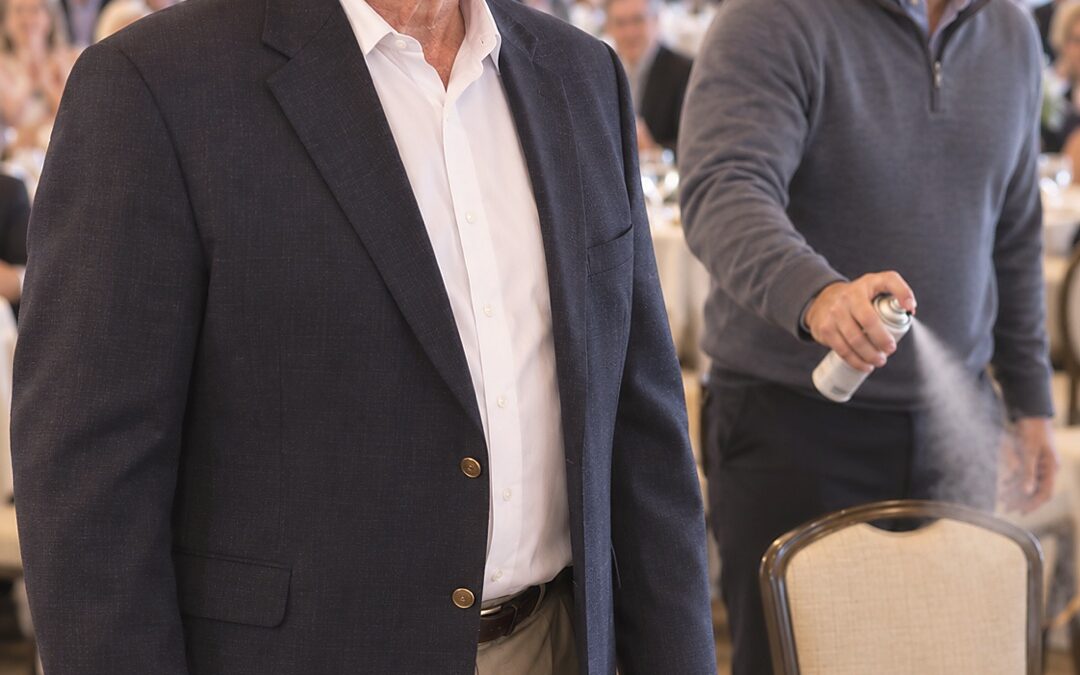
Blake Vollmer walked down the head table with a can of Febreze, in front of a hundred and forty people on his family's factory floor, and sprayed my chair, the back and then the seat, while I was still standing beside it. Then he said into the microphone, "Smell that, folks? That's thirty-eight years of garbage truck." And my son-in-law took me by the elbow and walked me past Furnace 2 and out to the loading dock so the family could have its picture taken without me, three weeks before my own retirement from the city, in a sport coat I'd bought for that party. In thirteen days, on that same floor, Blake was signing the biggest contract in Vollmer Glass Works' ninety-three years, $41 million of crushed bottles from Black Swamp Recovery, and he'd spent four months chasing my daughter's signature without the first idea it was hers.
Over at the country-club tables somebody laughed, and then a few more did, the kind of laughing people do when the man with the microphone is about to sign their invoices. Conrad Vollmer laughed once, a short bark, and went back to his roast beef. Near the front a furnace man in a pressed plaid shirt bent down and set his beer on the concrete beside his shoe and didn't pick it back up. And my granddaughter Kasia stood so fast her folding chair went over backward and smacked the floor hard enough that the drummer in the corner quit tapping.
"Grandpa, what the hell."
I put my hand flat on the tablecloth in front of her plate. Kasia is twenty, a junior at Bowling Green, and she has never in her life waited for anybody to tell her to sit down, but she stayed on her side of the table.
Blake kept the microphone. He set the can next to the centerpiece, between the carnations and a stack of programs, and turned to his father.
"Ninety-three years, Dad. And Friday after next, right here on this floor, I sign Black Swamp Recovery. Ten years of glass, forty-one million dollars, and Erie Shore keeps every line we've got."
That got real applause, the workers too. Everybody on that floor knew Erie Shore Brewing bought more than half of what came off the lines, and everybody had heard the talk about Pennsylvania. Blake let them clap.
"Their owner's driving up from Columbus to sign it personally."
Then the photographer, a big kid in a vest with a lot of pockets, waved the family up in front of Furnace 2, and chairs scraped, and Celia Vollmer came down the head table smoothing the front of her dress. She stopped by my chair. The seat still had a dark wet patch on it the size of a dinner plate.
"Just the Vollmers for this one, Joe."
Ross was right behind his mother. He teaches middle school band out in Sylvania, he's fifty-three, and he's a decent man six days out of seven. He took my elbow about the way he'd steer a seventh-grader with a tuba through a doorway.
"Joe, maybe just till they get the picture."
The chair on my other side was empty. ANN SADOWSKI, the card said, in somebody's good cursive, propped against a water glass nobody had filled. I picked the shoebox up off the floor and went where Ross pointed.
Behind me Kasia was arguing with somebody, her voice going up the way her mother's does, and the photographer was calling out tall ones in the back, and Blake had the microphone again, saying something about Dad's good side that got another laugh from the club tables. Ross kept his hand on my elbow the whole way. He didn't squeeze. He just kept it there.
It's a long walk from the head table to the river end of that building, and Furnace 2 hums the whole way. You feel it come up through your shoes. I worked eleven years in the batch house at Vollmer, 1975 to 1986, mixing sand and soda ash and broken glass for those furnaces, and I'd know that hum with my eyes shut.
I'd been on Robinwood Avenue at 9:20 that morning. Labor Day pushed our Friday route to Saturday, so I ran Route 9 a day late, and the Vollmers' carts on the 2200 block were stuffed with party boxes and plastic wrap and a case of champagne flutes somebody never opened. I emptied them. You don't take anything out of a man's can, and in thirty-eight years I never have. At 3:40 I brought Truck 214 into the yard on Laskey Road and showed Dante Fields, a kid I trained, what I had in the shoebox.
I told him, "That's for the old man on Robinwood."
Dante whistled through his teeth. I showered at the yard, went home to Valentine Street, and put on the sport coat from JCPenney.
At 6:50 I'd gone up to the head table to shake Conrad's hand, because it was his night and because it seemed like the neighborly thing.
"I've emptied your cans every Friday for nineteen years, Mr. Vollmer."
Conrad shook fine. It was Celia who turned around in her chair.
"You're the garbage man? On our street?"
Blake was behind her pouring himself a bourbon.
"Relax, Mom. Not after Monday he won't be."
My last day was October 2, so I figured he had the date wrong and let it go by. A while later I saw Celia lean over to him with her hand up beside her mouth, and I caught the tail end of it, "…smell the truck on him." I'd had a shower. I had on the Old Spice my father used to buy by the quart.
Annie was supposed to be in that empty chair. She sits on the board of the state recycling association, and their Saturday meeting in Columbus ran long, and after that I-75 did what I-75 does on a Saturday in September.
I could have ended Blake's toast with one sentence. I knew who owned Black Swamp Recovery, and I'd known since 2001.
It wasn't mine to tell.
Ross held the dock door for me with his foot.
"You can come back in when they're done."
"I didn't know he was going to do that, Joe. I swear to God."
"Go get your picture, Ross." He kept his hand on the push bar a second longer than he needed to, and then he went in and the door clanked shut behind him.
The dock looks out on the Maumee. At night the river is black and the High Level Bridge is all lit up, and there was a tug working something upstream real slow. I sat down on the edge with my legs hanging, which my knees had an opinion about, and opened the shoebox on my lap.
Inside, wrapped in one of Magda's dish towels, was a quart milk bottle. VOLLMER GLASS WORKS — TOLEDO, O. stands up off the side in raised letters, and on the bottom there's a 54 pressed into the glass, the year I was born. I found it in 1991 helping clean out a basement on Starr Avenue for a widow who was moving down to her daughter's in Florida and didn't want to see one more thing. Magda took one look at that 54 and it went on the windowsill over our kitchen sink, and it stood there thirty-five years. When St. Stephen's had its rummage sale that fall and I'd been carrying boxes over to the church hall a little too freely, she tied a paper tag around the neck with red yarn.
JOE'S — NOT FOR THE RUMMAGE SALE
My wife was born a Horvath. Her people were Hungarian and mine were Polish, and we argued every Christmas for forty years about whose stuffed cabbage was right. She cooked in the cafeteria at Waite High School for twenty-seven years. I buried her in March of 2019. She was sixty-six.
Under the bottle was the card I wrote at the kitchen table that afternoon, on the good stationery she kept in the dining room drawer.
Mr. Vollmer — Made the year I was born. Batch House, 1975–1986. Congratulations. —Joe Sadowski
The bow had worked loose in the box. Thirty-five years of steam off the sink had made the tag soft as a Kleenex, and the ink had run at the bottom of the S. I tried to tie it back. My fingers were thick when I was twenty, and after thirty-eight years of cart handles and tire chains they're mostly knuckle. I got one loop and the other end slid out. I put the bottle between my knees and tried again, using my thumbnail, and the yarn slid out again.
The dock door opened behind me.
"Grandpa?" Kasia had a paper plate with a napkin folded over it. She sat down next to me on the edge and peeled the napkin back. Stuffed cabbage, one pierogi, two kolaczki off the dessert table. "You didn't eat."
"I had a roll."
She put the plate between us, took the bottle out of my hands without asking, and tied Magda's yarn into a small bow, tight, and pulled the two ends even. Then she handed it back. I ran my thumb over the raised letters and ate the pierogi. It was cold and somebody had gone heavy on the pepper.
"You got your grandmother's fingers," I said.
"Mom says I got her mouth." She licked powdered sugar off her thumb. "Mom's usually right about me."
Kasia looked back at the door.
"They really don't know?"
"Nobody ever asked her."
"Uncle Blake told our whole end of the table the owner's some investment guy from Columbus. He's been chasing Rafi since May, Grandpa. He said Rafi's a tough little negotiator." She shook her head. "Mom is going to lose her mind."
"Your mother can decide what she's going to lose."
She had her phone out of her jacket already, thumb going.
"Don't put anything on there," I said. "Not me sitting out here, not what he did. None of it."
"Grandpa, he sprayed you like you were a gym locker."
"I was standing right there, honey. I know what he sprayed." She turned the phone over face down on the concrete and handed me one of the kolaczki, and we sat and listened to the band start up "Brown Eyed Girl" through the wall.
At 8:15 headlights swung through the gate. Annie drives too close to the curb, always has, her mother did it too. She came up the dock steps in the navy blazer she wears to board meetings, bent down to kiss my cheek, and stopped halfway with her nose an inch from my collar.
"Dad. What is that?"
Kasia told her. She told her the whole thing, the can and the microphone and "garbage truck" and the picture, with her hands going, and Annie stood there with her work bag still on her shoulder until Kasia ran out of breath. Then she turned around and took hold of the dock door handle.
"Annie."
"I'm going to walk in there and tell him exactly who he's been begging since May. In front of all of them. Tonight."
"Come here first." I got up, which took a minute, because my left knee had set like concrete on that dock. "Come here."
She let go of the handle but she didn't come any closer than the railing. Kasia picked up the empty plate and went down to the car.
"Thanksgiving," Annie said. "Celia asks me what I do. I tell her, 'Glass recycling. Same as my dad, more or less.' And Blake goes, 'So you sort bottles.' And I said, 'Some days.' And nobody's asked me one thing since. I told Ross in the car that night, 'If they ever like me, I want it to be for me.' And in May, when Blake came knocking, I told Ross, 'If Blake knows it's me, every number becomes a family favor, and every problem becomes my fault at Christmas.' So I gave the whole deal to Rafi. Rafi thinks the numbers are thin, Dad. Their credit's bad. I signed off anyway, for Ross, and for two hundred and ten people in the plant you used to work in."
She stopped. She was breathing hard, the way she did when she was twelve and had run home from the bus.
"Every bottle you ever lifted on a recycling week, Dad, ended up on my line."
"I know it."
"And he sprays you."
"You don't make a forty-one-million-dollar decision on a loading dock because your old man smells like air freshener."
She had her phone in her hand. Rafi's name was already on the screen. She didn't press it.
I said, "Whatever you decide, you decide it on that floor, to his face, with me standing there."
Annie turned and watched the tug get as far as the bridge.
"Fine," she said.
"Wait in the car for me."
"Dad, where are you going?"
I picked up the shoebox. "I brought the man a present."
I could have gone back through the dock door. Thirty seconds. Instead I went down the steps and around the outside of the building, along the old brick part that doesn't match the new metal part, past the Front Street sign that says 1933, and up the front step that's been patched three times and still isn't level. I came through that door in 1975 asking for work. I was twenty-one, and I didn't have a bad knee yet.
The party was still going under strings of lights. There was the banner over the head table, 93 YEARS — THANK YOU, CONRAD, and the buffet looked like the Mud Hens had been through it. I walked the whole length of that floor. Past the furnace men, and the furnace man with his beer still on the concrete by his shoe, who watched me go by. Past the bottle line girls in their good blouses. Past the club tables, where a woman in pearls found something to fix on her husband's sleeve. The photographer had his camera turned around, showing somebody the back screen, and I saw the picture going by: fourteen Vollmers in front of Furnace 2, Conrad in the middle, and Ross down at the end, and nobody standing where I'd have been.
Somebody had wiped my chair off and pushed it back in.
Conrad had a program open beside his plate. Blake sat beside him with a name tag on his lapel that said CEO in gold letters, which somebody must have had printed up in advance. I set the shoebox down in front of Conrad's plate.
"Congratulations, Mr. Vollmer."
He put a hand on the lid and nodded. "Well. Thank you, Joe."
He didn't open it. Celia reached across him, said something about the office on Monday, and slid the box down the tablecloth to the gift pile at the end, where it bumped up against a silver bag with tissue paper sticking out the top.
Blake was leaning back in his chair with his drink, smiling at me like we were old pals.
"Everything okay, Joe? Chair dry yet?" A man at the next table turned around in his seat to watch. "Dad's party. Nobody meant anything by it. Thirty-eight years in a truck, you've smelled worse than a little Febreze."
"I drive it, Blake. The arm does the lifting."
"Sure. Somebody's got to."
I said, "Congratulations on the contract. Read everything before you sign it."
His glass stopped about an inch off the table.
"Is that a threat, garbage man?"
I didn't answer him. Conrad had looked up from his program, and he was watching me over the top of his reading glasses when I turned around and walked back down the length of the floor and out the front door the way I'd come in.
Annie was out by the Buick with her arms folded, and Kasia was sitting on the hood of her mother's car swinging one foot.
"Did you tell him?"
"No."
"Did Conrad open it?"
"No." I got my keys out. "He put his hand on it, though."
She followed me home across the river and sat at the curb on Valentine Street with her engine running till my kitchen light came on.
I hung the sport coat over the porch rail to air out. Inside, I heated up some chicken paprikash from Thursday and ate it standing at the counter. Over the sink, the windowsill had a clean rectangle in the dust where the bottle had stood for thirty-five years. The clock on the stove was three minutes fast. It's been three minutes fast since March of 2019, because Magda was the one who fixed it. I left the sill alone and went to bed, and lay there listening to a freight go through Birmingham on the tracks past Front Street.
At 11:40 Kasia texted me the family picture. Fourteen Vollmers in front of Furnace 2, and under it Blake had written, 'Had to air the place out first.' Two hundred and six people had liked it.
Part 2
By nine o'clock Sunday morning the picture was up past four hundred, and Annie was at my kitchen table holding her phone a foot from her face because she'd left her readers in the car.
"Four hundred and twelve," she said. "Somebody from your yard put a thumbs-down under it. There's a garbage truck in his profile picture."
"That's half the yard."
"Ross hasn't said anything. Not under it, not to me. He was up and out to his folks' before I had the coffee on."
I had the percolator going and the bulletin from St. Stephen's on the counter, and I could already see I wasn't making the 10:30. I poured into Magda's big mug, the one with the chip by the handle, and put a second cup in front of Annie that she didn't touch, and sat down across from her. She'd been up all night. You can tell with Annie because she gets very neat. Her blazer from yesterday was folded over the back of the chair with the sleeves tucked in.
"Rafi never wanted this deal. I'll give him what he wanted."
She said it straight at me, like she'd practiced in the car.
"Then pull out because the numbers are bad," I said. "Or sign because they're good."
"Dad."
"Not on me."
She put the phone down on the table harder than the phone deserved. "The numbers were always thin. We're putting three point six million of our own equipment on their dock, and their bank won't return Conrad's calls. Rafi told me in June I was out of my mind. I said yes because of Ross. Because it's his family's plant, and because I thought someday his mother might sit next to me at Christmas and not ask me where I buy my blazers."
"And the two hundred and ten."
"And the two hundred and ten." She rubbed her eyes with the heels of her hands. "You don't have to keep saying the good reason for me."
"Somebody has to. You're tired."
I got up and turned the burner down under the percolator, though it was already off.
She called Rafi from my kitchen. I heard her half of it. "No, I'm at Dad's. Yes, I saw it. Keep the twenty-fifth. I'll be there in person. No, Rafi. Don't change a number. I know what I said in June. Keep the date." She hung up and sat looking at the phone with her mouth tight.
"He thinks I've lost it."
"Rafi thought that when you hired him."
That got something out of her that was almost a laugh. I've known Rafi Mendes since he was nineteen, on Annie's sort line in that rented garage on Matzinger Road, and I'm the one who taught him to back a truck by his mirrors. He's forty-four now and president of the whole thing.
Annie got up and rinsed her cup at the sink and set it upside down on my drainboard, on the left side, by the faucet. Magda did that for forty years. I never once saw Annie watch her do it.
Ross came to the house Monday evening at six-thirty.
I was out on the porch in the metal chair with the short leg, the one I keep a square of plywood under, reading the sports page from Sunday's paper. He parked his Subaru across Valentine Street and came across empty-handed, which wasn't like him. Ross was brought up by Celia Vollmer. He doesn't show up at a door without a box of something from Tony Packo's.
"Evening, Joe."
"Ross. Pull up a chair."
He stayed on the top step with his hands in the pocket of a gray pullover. He'd been at school all day and he still had the lanyard on with his ID card.
"I wanted to come yesterday," he said. "I thought everybody needed a day."
"Okay."
"What Blake did was stupid. He gets a microphone and he thinks he's Johnny Carson. He's been like that since he was nine. Joe, I only meant till the picture was done."
"He brought the can from home, Ross. You don't find a can of Febreze lying around a glass factory."
Ross looked off down the street at nothing. A kid went by on a bike with no hands.
"I know," he said. "And I should've come back out and got you. I'm sorry for that part." He took a breath. "But I'm asking you, could you let it go? For everybody. Mom's upset. Dad just handed over the whole company and Blake's got a lot riding on Black Swamp. And maybe, this one year, you could skip Thanksgiving. Just till it settles."
I set the paper down on my knee.
"At your mother's."
"Annie could still come. Kasia. It'd just be easier. Dad hasn't said ten words since Saturday night, Joe. He sits in his den with the TV off."
"For who?"
He didn't answer that. He turned the lanyard over in his fingers, and the porch light clicked on over his head, the motion sensor, which works when it wants to.
"Blake already sent something to the city." He said it to the porch boards.
I sat up in the chair. "Sent what?"
"About Saturday. About what you said at the table. I didn't read it, Joe. He was waving it around at supper, the refuse department, making sure there wasn't another incident. I don't know who he sent it to."
"Another incident."
"That's how he put it."
"Your father was sitting right next to him. He heard every word I said."
"I know."
"You heard what I said to him, Ross."
He didn't say yes or no. He stood there with his hand on the rail.
"I'm going to stay at Mom and Dad's a few days," he said. "Till it cools off."
"Does Annie know that?"
"I called her from the car."
He went down the steps and across the street. He sat in his Subaru at the curb a good minute before the headlights came on, and then he drove off toward the bridge. I sat out there till the streetlights came on and the lady two doors down called her cat in three times, and I went inside and didn't turn on the TV.
Annie came in the back door at 9:40 that night with her laptop under her arm. She's had a key to that door since she was fourteen, and the lock's been changed twice and she still has a key. She didn't take her coat off.
"Did he ask you to skip Thanksgiving?"
"He did."
"He called me from the car and told me he went over to make peace." She set the laptop on the kitchen table and opened it. "Rafi forwarded me this at 9:05 this morning. I've been sitting on it all day because I didn't want to read it to you on the phone."
"Read it to me now."
I got my reading glasses from beside the sugar bowl, but she read it out anyway, flat, like a grocery list.
"Rafi — I understand Ann Sadowski, my brother's wife, works for you. After an incident with her father at my family's event, I'd consider it a personal favor if she had nothing to do with our account. Frankly, I'd reconsider her employment. — Blake"
"Eight fifty-two this morning," she said. "First thing Monday. First thing he did as CEO, probably."
She scrolled down. "Rafi called me before he answered. I dictated it. He typed every word."
"Blake — Personnel matters stay inside Black Swamp. Our owner will sign in person on the 25th at 10 a.m., on your floor, as planned. — Rafi"
I took the laptop and read it myself, with the glasses on, and then slid it back.
"Saturday night he heard me tell him to read everything," I said. "And there's one outfit around here big enough to sell a plant ten years of glass. So he figured you work there."
"He figured it halfway."
"Half's about what he figures."
She almost smiled at that, and then she didn't.
"He still thinks the owner's some money man in Columbus. Rafi's been telling him all summer our owner's in Columbus this week, every time I had an association meeting. And he believed it. Four months, Dad. He never once asked what the name was."
She shut the lid halfway and opened it again.
"Ross said Blake sent something to the city," I told her. "About me. About Saturday."
"Sent what to the city?"
"He didn't read it. He heard it at supper."
"Dad, if that man is going after your job three weeks before you retire, I have lawyers. I have three of them on a retainer I pay whether they do anything or not."
"I've got three weeks and a union. And I'm not having your name wrote down in some city file next to mine because Blake Vollmer can't take a joke he made himself." I took my glasses off and folded them. "Let me find out what it is first."
She gave me the look her mother used to give me over the checkbook.
"Does Ross know about this email?"
"How would I show Ross? He's sleeping in his old bedroom at his mother's, down the hall from the man who wrote it."
Out the window over the sink I could see the porch light still on, and the metal chair, and the plywood under the leg.
Annie turned the laptop around on my kitchen table so I could see the line again. "Frankly, I'd reconsider her employment."
"He wants me fired, Dad," she said. "By me."
Part 3
Tuesday at 5:30 in the morning, before I could get the keys to 214 off the board, Al Gorski stuck his head out of his office at the Laskey Road yard and said, "Joe. Minute."
Out in the break room forty drivers were standing around the coffee machine, which had just eaten somebody's seventy-five cents again. Al shut the door on all that. He's fifty-eight, twenty-nine years with the city, and he chews the inside of his cheek when he's got bad news. He was chewing.
"This came in yesterday afternoon. Copy went to a councilman's office, too, which is why I got a phone call at home at eight o'clock last night." He turned the paper around on the desk so I could read it.
"At my family's private event on September 12, city employee Joseph Sadowski made threatening remarks about my company's business and said he would make sure our contract never got signed. He has had access to my parents' property every Friday for nineteen years. I request that he be kept away from the 2200 block of Robinwood Avenue."
Blake's name was at the bottom, typed, with CEO under it in capital letters. He'd had the job about two days when he wrote it.
"That's not what I said, Al."
"So tell me what you said."
"I said congratulations on the contract, read everything before you sign it. That's the whole speech. Before that he sprayed my chair with Febreze into a microphone in front of a hundred and forty people, and before that his mother found out I pick up her garbage."
Al quit chewing for a second. "He sprayed your chair."
"Back and seat."
He rubbed his jaw and pulled the morning route sheet out from under the complaint. ROUTE 9 had DANTE FIELDS typed beside it. My name was down at the bottom in pencil, next to WASH BAY, and under that, typed:
"Employee is not to service the 2200 block of Robinwood until further notice."
"I've run that route nineteen years."
"I know you have. It's pending review, Joe. Nobody's saying you did anything. But a councilman's office called my house, and I'm not sending you down that street while it's open." He tapped the complaint with one finger. "Here's the part you're not going to like. If it isn't cleared, a complaint on file stays in your personnel file when you go. Your pension's fine, it doesn't touch the pension. But the file's the file."
"How many days have I got?"
"Fourteen working days, counting today. Monday through Friday, you know how we count."
I was hired on a Monday, October 3, 1988, and I'd figured on going out October 2 in the same truck I'd had for the last eleven years. I stood there and did the arithmetic on that and came out with fourteen working days, same as Al. Eighteen if you counted the weekends, and the city never has.
"You can grieve it."
"I'm going to."
Out in the lot Dante was walking around 214 with a flashlight, checking tires. He saw me come out and stopped.
"Al told you?"
"You've got Route 9. Watch the arm on the right side, it's been jumping when it comes back down. And the Hendersons on Glenwood put their cart in backward every week, so get out and turn it, don't try and grab it from the street."
"Joe, I told him I'd trade you back the minute—"
"Drive what's on your sheet."
At 5:48 I watched my truck go out the yard gate with somebody else in it. Then I put on the rubber boots and spent the day in the wash bay, hosing down rear-loaders. That drain's been slow since spring and the water sits around your ankles, gray, with a skin of oil on it.
Around ten Al came out to the bay and stood back from the spray. "I can ask the office about putting you on another route. Something out in Point Place, or West Toledo."
"Leave it, Al."
"Joe, it's not even three weeks. Nobody'd blame you."
"Leave it how it is." He went back in.
By lunch my knees were talking to me, and I sat on an upside-down bucket by the bay door and ate a turkey sandwich out of a Kroger bag with one handle torn off.
I didn't call anybody. Annie would've had three lawyers on the phone before I finished my sandwich, and Blake's complaint didn't have her name anywhere in it, and I wanted it to stay that way. Fourteen working days. I could hose trucks for fourteen working days. What I couldn't get past was my name in pencil on that sheet, like somebody might want to erase it in a hurry.
Wednesday at four I went down to the union hall.
The steward had a copy of the complaint already, flat on the table with a paper clip on it. She's younger than most of our drivers, reading glasses on a beaded chain, and I'd been in front of her twice before, once over overtime and once when the city tried to move our winter start time without asking anybody.
"Tell me what you said. Exactly."
I told her. She wrote it down word for word and read it back to me.
"That's it?"
"That's it."
"I'll file the grievance today on your account. But to get it cleared before October second, I need one person who was close enough to hear it and isn't you. A furnace man would do. A Vollmer would be better."
The furnace man who set his beer down had been twenty feet off with the band playing, and I never did get his name. So I went down the head table in my head. Conrad, who laughed once and then watched me walk out. Celia. Blake. Ross. Kasia. Not Kasia. Kasia would have written ten pages in pen and driven them over herself, and I wasn't putting a twenty-year-old in the middle of her mother's in-laws.
"My son-in-law was standing right there," I said.
"Then start with your son-in-law." She slid my copy across the table. "And Joe. Don't you go anywhere near Blake Vollmer about this, and don't go near that house on Robinwood. Not to explain, not to apologize, not for anything."
"I wasn't planning to."
"Nobody ever is."
Thursday at 3:15 I signed in at the front office of Ross's school in Sylvania and sat on a folding chair in the back of the band room while thirty seventh-graders murdered "Seventy-Six Trombones." One trombone kept coming in a beat early, every time. Ross stood up front with his sleeves rolled and his tie off and stopped them at measure thirty-two, and started them again, and when he saw me he lost his place and the trombone came in early again.
When the bell rang a boy knocked over a music stand on his way out. Ross told him leave it.
"Joe. Is Annie all right?"
"Annie's fine." I handed him the copy of the complaint. He read it standing up, and halfway down he sat on the edge of the podium.
"Blake showed this to us at supper Monday. He was proud of it."
"Did anybody tell him it wasn't true?"
"I told him he shouldn't have gone to the city."
"That's not the same thing, Ross." I took a breath. "There's a grievance. The union needs one person from that table to write down what I said. That's all. Not what you think of your brother. Not what you think of me. Just the words."
He folded the complaint along the crease and held it.
"He's my brother, Joe. And when we got married I promised Annie I'd stay out of anything to do with the company. Anything."
"I'm not asking you about her. I'm asking you what I said."
Ross went over to the corner and picked up the music stand the boy had knocked over. He straightened the legs. He set the height. He put it in line with the others and moved it an inch, and moved it back, and he stood there with his hand on it.
"Blake says you were implying something. And Joe, I can't say he's wrong, because I didn't hear all of it."
"Implying what?"
"He doesn't say."
I took the complaint back off the stand where he'd laid it.
"You walked me outside, Ross. You were there." I put it in my jacket. "You've got Annie's number."
At 8:30 Thursday night somebody knocked on my screen door.
I was at the stove scrubbing the burner grate where I'd let a pot of soup boil over, and through the front window I could see a black Escalade at my curb with the engine running and the headlights on, lighting up my front steps like a used car lot. Blake was on the porch in a company quarter-zip, the Vollmer Glass Works logo stitched on the chest. He didn't try the handle. He stood back from the screen.
"Evening, Blake."
"You went to Ross's school."
"I did."
"You went into his classroom." He took a step closer. "Ross let it slip at supper when Mom asked where he'd been after school. He can't lie to our mother. He never could, it's the one thing about him. So now my mother's upset again, and Dad's not talking to anybody, and that's on you."
"You had the microphone Saturday, Blake. Not me."
"Don't."
"I asked your brother to write down what he heard me say. That's all I asked him."
"And he said no."
"He said you're his brother."
A moth was batting itself against the porch light over his head. Blake put his hand on the frame of the screen door, not the door, the frame, and leaned in close enough that I could smell the bourbon and some cologne that probably cost more than my sport coat.
"I've got a grievance with the city," I said. "That's between me and the city."
Blake said through the screen, "You went to my brother's school. Go near my family again and I tell the city you're stalking them, and you can retire with that in your file. And tell your daughter my brother's not coming home."
Part 4
Friday at 2:30 Dante brought 214 into the wash bay off Route 9 and climbed down out of the cab with something wrapped in a red shop rag.
I was hosing road salt from last winter off the underside of a rear-loader that nobody had washed right since March. I shut the nozzle off. Dante looked over at the office window first, where Al was talking to two drivers at dispatch, and then he unfolded the rag on his palm.
I knew it before I could see the letters. The yarn.
"Nine-twenty this morning," Dante said. "Twenty-two hundred block. I had the arm on their recycling cart and the lid flopped open coming up, and there's this little paper tag sitting right on top with red string on it, and I could see your name." He held it out to me. "I stopped the arm. Don't tell Al."
The recycling at 2200 goes in the same truck as everything else on a Friday. Another ten seconds and it would have been on top of a load of milk jugs and wine bottles headed for the transfer station.
"You know the rule," I said. "You don't take anything out of a man's can."
"That's the rule." He kept holding it out until I took it. "It's got your name on it, not hers, Joe. I'd do it again."
It was cold from the cart and wet on one side. Magda's tag was still on, soft as a wet napkin, and the bow Kasia tied on the dock Saturday night was still holding, both ends even. The card was gone. I'd laid it under the bottle in the shoebox, and somebody had taken the bottle out of the box and dropped it in the blue cart by itself.
I walked over to 214 and climbed up into my own cab and sat down. The seat was set for Dante, too far forward, and I pushed it back with my heel and sat there with the bottle on my leg. The hose was still lying on the floor of the bay, running.
Dante came over and stood by the step. "You want me to tell Al I found it?"
"No."
I wiped the bottom off with my shirttail. There was dirt down in the 54, and I went after it with my thumbnail, in the grooves of the five, the way Magda used to go after my fingernails with a brush before Sunday dinner. When I brought that bottle home in 1991 she turned it over and saw the number and said, Joe, that's your year, you can't give that away. I told her it was an old milk bottle. She put it on the sill anyway and moved her geranium cuttings into it.
I don't remember the water going off. When I looked up Dante was coiling the hose by the drain, and he hung it on its hook and went and checked his truck in.
I carried the bottle home inside my city jacket.
Saturday morning I drove out to Annie's in Point Place.
She's got a brick ranch a block from Maumee Bay with a garage too small for anything she owns. She had the door open before I got up the walk. The kitchen was clean in the way it gets when she hasn't slept, every dish put away, the counters wiped down to the bare laminate.
"Ross came Thursday while I was at the Fremont plant," she said. "He used his key."
She showed me. His half of the bedroom closet was empty, the hangers shoved together on the rod, and on the shelf above them there was a pale strip in the dust where his sweaters had sat folded since the wedding. Way down at the end he'd left one tie hanging, the black one he wears to his winter concerts. Annie took it down and folded it once and put it in the top dresser drawer and shut the drawer.
"He hasn't called me since Thursday morning."
Back in the kitchen she opened her laptop and turned it around. An email, addressed to Blake and to Vollmer's lawyer, from Rafi. Subject line: Black Swamp Recovery – Withdrawal from Proposed Supply Agreement.
"Rafi drafted it last night. I'm sending it Monday morning. Then I'm done with every single one of them."
"Rafi agrees?"
"He's already written it, Dad."
She pushed a printout across the table next to the laptop. Blake had sent a press release to the Toledo paper Friday afternoon, and somebody at the paper had put it up on their website already, with a picture of Blake and Conrad shaking hands in front of a furnace.
"Vollmer Glass Works and Black Swamp Recovery to Sign $41 Million Partnership Friday"
"Erie Shore's vice president is driving in from Cleveland for it. He invited the newspaper, Dad. He invited a photographer to come watch him sign with a woman he wants fired."
"Whatever you decide, you decide it on that floor, to his face, with me standing there."
"I know what you said on the dock."
"So I'm saying it in your kitchen."
She looked at me a while. "You've got something. I know when you've got something."
So I told her. The wash bay, and Al's route sheet with my name in pencil, and Ross in the band room with the music stand, and Blake on my porch Thursday with his engine running. I told her what he said about Ross not coming home, and she didn't move at all. Then I took the bottle out of my jacket and stood it on her kitchen table.
She saw the yarn first.
"Dante found it Friday morning," I said. "In your in-laws' recycling."
Annie reached out and touched the tag. She ran one finger along the J of JOE'S, and then she turned the tag over and looked at the back of it, though there was never anything written on the back. Her mother didn't waste paper.
"Kasia tied that bow," she said.
"On the dock. Saturday."
I took the steward's copy of Blake's complaint out of my pocket and unfolded it and laid it next to the bottle. She read it. She got to "threatening remarks" and went back to the top and read it again from the beginning, all the way down to the 2200 block of Robinwood.
Then she got up and went to the sink and ran the cold water over the insides of her wrists for a while and dried them on the towel hanging off the oven door. When she sat back down she pulled the laptop over. I watched her find Rafi's draft and close it. It asked her if she wanted to save it. She hit save. She didn't hit send.
"Then you're coming. In the city jacket."
"Al gives me two hours," I said, "or I take them."
"Rafi's going to have a fit."
"Rafi had a fit when you bought the second truck." She picked the bottle up and turned it so Magda's tag faced her, and she held it like that while her coffee got cold.
On Wednesday the 23rd, at 7:15 in the evening, I walked up the front walk at the Vollmers' on Robinwood Avenue.
Nineteen years I'd seen that house from the curb, through a windshield, at the end of a mechanical arm. I'd never once been up the walk. The bricks heave up by the steps where the maple roots are getting under them, and somebody had put out pots of yellow mums. Celia was at her Wednesday bridge club. Blake was home in Perrysburg. Ross had band rehearsal in Sylvania on Wednesdays.
Conrad answered the bell himself in a brown cardigan and house slippers.
"Joe."
I held out the bottle. "Your wife put this in your recycling. I wanted you to get it once from my hand."
He took it. He looked at the tag, and then he turned it over and tipped the bottom toward the porch light and found the 54.
"Celia did the gifts Sunday. I never opened half of them." He sat down in one of the porch chairs without asking me to, and then he waved me into the other one. "This is ours. This is from the old milk line."
"Starr Avenue. A basement, in 1991. Fifty-four was the year I was born." I sat. "My wife tied that tag on. Magda. We lost her in 2019."
"I'm sorry, Joe." He touched the yarn with one finger.
"I worked the batch house for you, Mr. Vollmer. Seventy-five to eighty-six. Till Furnace 1."
He sat with that a bit. Then he said, "November."
"November."
"There were two hundred and twelve of them," Conrad said. "Notices. I signed every one myself. My father said have the girl in the office use the stamp, and I wouldn't let her. I thought that was the decent thing." He rubbed his thumb over the raised letters. "I don't know anymore if it was."
A car went by slow on Robinwood with its radio up and then down.
"Blake showed us his complaint at supper on Monday," he said. "He passed it around the table. He was proud of it. He said he'd taken care of a problem for the family."
"You heard what I said to him Saturday night. You were sitting right next to him."
"I did."
"That was eleven days ago."
He set the bottle down on the porch boards beside his slipper.
"I told myself the city would sort it out. That's what I told myself in 1986, too. Two hundred twelve times."
I didn't help him with that. I let him sit in it.
"These Black Swamp people," he said after a while. "Blake says they're Columbus money. Who are they, Joe? You know something. You knew it Saturday."
I stood up. My knee cracked loud enough that he looked at it, and he reached down and picked the bottle back up off the boards.
"Friday."
"Joe."
I was down two steps when he said it, and I turned around. Conrad held the bottle against his cardigan with both hands. "You told my son to read everything before he signed it. I was sitting right there. Friday morning I'll tell whoever needs telling."
Part 5
Friday morning at roll call Al Gorski didn't even look up from his clipboard when I told him where I was going and for how long.
"Go. I didn't see you."
At 9:55 I walked back onto the floor at Vollmer Glass Works through the loading-dock door, the same door Ross had walked me out of thirteen days before, with Kasia next to me and my navy city jacket on, the one with the reflective stripe across the back and my name stitched over the pocket. Dante had 214 out on Route 9, and my rubber boots were standing by the wash bay drain on Laskey Road.
Kasia had hold of my sleeve. "Mom's two minutes out," she said, low, looking at her phone. "She says don't start without her."
"I'm not starting anything, honey."
There were about ninety of them on the floor, the day shift, safety glasses pushed up on their foreheads and gloves stuck in their back pockets. A lot of them had been at the party. The furnace man who'd set his beer down on the concrete that night was by the wall in a gray work shirt, with the old burn marks up his forearms that every furnace man has, and when he saw me he pushed off the wall and made room for me up front, by the table. A woman from the bottle line who'd been sitting near the head table that night looked at my jacket, and then over at the table, and then back at my jacket.
They'd put the table right where the fourteen Vollmers had stood for their picture, in front of Furnace 2. White tablecloth, two thick copies of the contract squared up side by side, a vase of flowers somebody had borrowed off a desk upstairs, and a vinyl banner over all of it: VOLLMER + BLACK SWAMP. Conrad and Celia were in the front row of folding chairs. Ross sat at the far end of the row in the same gray pullover he'd had on at my porch. Conrad saw me come in. He gave me one nod, small. Celia saw my jacket and turned to look at the banner instead. There was a man in a golf jacket with the Erie Shore Brewing logo on it, and a reporter from the Toledo paper with a camera around his neck and a notebook in his back pocket.
Blake had on a new navy suit. His lawyer stood next to him with the signing copies, which had come over at 9:30 that morning, and there was a yellow sticky flag poking out of one of them at page thirteen, the last page of terms his lawyer had marked.
Blake lifted his coffee cup.
"Ninety-three years, and the biggest contract in this company's history. My name goes on it at ten o'clock."
Some clapping. Then he saw me, and the cup came down.
"Not today. Somebody walk him out."
The furnace man next to me folded his arms across his chest. That was all. Two guys from the bottle line looked at each other and stayed where they were.
"I'm serious," Blake said. "This is a private signing. Joe, you've caused my family enough—"
"He's with our owner."
That was Rafi, from the other side of the table, in a white shirt with the sleeves rolled up, standing next to the Black Swamp lawyer.
"Your owner's driving up from Columbus, Rafi. You told me so yourself."
"I said our owner was in Columbus this week. More than once." Rafi set his hands on the back of a chair. "I'm the president, Blake. I work for her."
"You let me think—"
"I never told you our owner lived there. Our owner signs anything over a million personally. I told you that in May."
The dock door opened behind me and Annie came in, in her navy blazer, with a thin folder under her arm. She came and stood next to me. Blake looked at her and you could see him decide she was one more problem in his morning.
"Annie, this really isn't the day."
Rafi came around the end of the table.
"Blake, this is Ann Sadowski. She started Black Swamp Recovery in 2001, and she owns all of it. Her name's been on page fourteen since nine-thirty."
Blake laughed. It was a short one.
"That's not funny, Rafi."
"Four months, Blake. You asked me about tonnage. You asked me price per ton and color sorting and what happens if a load comes in dirty. You asked me twice if our owner would guarantee delivery. You never once asked me her name."
Blake looked at his lawyer, waiting for the lawyer to laugh too, and the lawyer had already picked up the second copy and was flipping it to the back with his thumb. He found the last page. He read it, and he kept his voice down, but I was ten feet from him.
"They said the signatory certificate comes at closing, same as always. I never opened the last page. Nobody told me the signer was Mr. Vollmer's daughter-in-law."
"How does a thing like that not go to your board?" the man from Erie Shore said. "Forty-one million dollars?"
The lawyer didn't look up from the page.
"Under the bylaws the CEO signs supply contracts under fifty million. It never went to the board."
I looked down the row at Ross. He was half out of his chair.
"I never saw the paper, Joe."
"You knew?" Blake said to him. "You knew who she was this whole time?"
"She's my wife, Blake. Of course I knew who she was."
Blake took the copy away from his lawyer and turned to page fourteen himself, and I watched his eyes go down it.
BLACK SWAMP RECOVERY LLC — By: __ — Name: Ann M. Sadowski — Title: Sole Member
He looked up at Annie. Then his eyes went to my jacket, to the stripe, and stayed there. In the front row Celia stood up, and sat back down again on the folding chair next to hers, which had somebody's purse on it.
"Why wouldn't you just tell me?" Blake said. "Four months. Why didn't somebody tell me?"
"Your mother asked me what I did at Thanksgiving," Annie said. "I told her. You told everybody I sorted bottles."
She opened the folder and laid three sheets of paper out on the white tablecloth, side by side, like a hand of cards. The email to Rafi from the Monday morning after the party. A printout of the family picture with his comment under it and the likes. And the complaint he filed with the City of Toledo, with the councilman's office on the cc line.
"These are private," Blake said.
"You sent this one to my company," Annie said. She put one finger on the email and read the one line out loud, not loud, just clear. "Frankly, I'd reconsider her employment."
"I didn't know you owned the company."
"You knew I was your brother's wife. You wanted me out of a job anyway. You asked the man who works for me to do it." She left her finger on the page. "Rafi, did he ask you?"
"Eight fifty-two Monday morning," Rafi said.
The man from Erie Shore stepped up to the table. He asked if he could, and Annie moved her hand, and he picked up the complaint and read it top to bottom while Blake watched him read it. He looked over the top of the page at me in my city jacket, and he put the complaint back down where he'd found it, square with the others.
Conrad got up out of his chair.
"He told you to read everything before you sign it, Blake. I was sitting next to you."
"Dad, you don't understand what he was implying—"
"I heard every word of it, son."
And Ross stepped out of the front row. He walked over and stood near the end of the table, in front of everybody, with his hands at his sides.
"I walked him out to the dock so we could take the picture without him. That was mine, not Blake's. I'm sorry, Joe, and I should have said it that night."
Blake turned around on all of us then. He pointed at me.
"So this is you. This is your big show. A garbage man and his—"
"Smell that, Blake? That's thirty-eight years of garbage truck. Ten years of glass off that truck, and you can't have it."
Blake turned page fourteen face down on the white cloth and left his hand flat on it.
Down front, the furnace man unfolded his arms and stuck his hands in his back pockets, and the woman from the bottle line said something to the girl next to her, and the photographer from the Toledo paper got it all, the hand, the face-down page, my jacket.
Annie glanced over at me, once, and turned back to the table.
"Black Swamp isn't signing with you, Blake."
He didn't move his hand. "You can't do that. We've got schedules built around this. The line alone is three point six—"
The man from Erie Shore didn't talk to Blake. He turned to Conrad.
"Conrad, without that glass we're in Pennsylvania in January."
Behind me the woman from the bottle line said "January" to the man next to her, and he pulled his safety glasses down off his forehead.
"I didn't say I wouldn't sign with Vollmer Glass."
Annie said it to Conrad. Conrad sat back down and took off his reading glasses.
The lawyer cleared his throat and said, to nobody special, that all four directors of the company were in the building, and under the bylaws nobody needed notice for a meeting if all four were present. Celia was looking at the floor. Ross was looking at his father. Blake's hand was still on page fourteen.
Conrad stood up. "Ross," he said, "you've held your grandfather's shares for thirty years and never once come to a board meeting. Come to this one."
Part 6
At 10:25 the four of them went up the steel stair to the glass office over the floor, Conrad first with his hand on the rail, then Ross, then Celia holding her purse in front of her, and Blake last with the contract still under his arm. The lawyer went up behind them and shut the door.
Annie and I sat down at the white table. Rafi stood behind us. Ninety people on the floor and the man from Erie Shore stood around in front of Furnace 2 with their heads tipped back, watching that office like it was a television in a bar.
You couldn't hear anything. You could see it all. Blake did most of the talking, with his hands. Conrad sat at the head of the table and let him. Then the lawyer laid a sheet of paper in front of each of them and said something short, and Conrad put his hand up. Ross put his up right after. Celia didn't. She looked down through the glass at the floor, at the white table, at me sitting there in my city jacket next to her son's wife, and she looked a while. Then she put her hand up too.
Blake stood by the door with one hand on the knob. When the lawyer said something else, he let go of the knob and held that hand up by himself.
Down on the floor somebody let out a low whistle, and the woman from the bottle line said "Well," to nobody, and the man from Erie Shore took his phone out and started typing with his thumbs.
"Three to one," Annie said.
They came down at 10:48. Blake came down last and stopped at the bottom of the stair beside Furnace 2, and his mother went past him without looking. Conrad came straight to the table.
"The board has removed my son as chief executive officer. I'm taking it back for now, on an interim basis, God help me." He turned to Annie. "Ann. Your company's putting three point six million dollars of equipment on my dock. I'll guarantee it personally. My name, not the company's. Have your lawyer write it however he likes."
The man from Erie Shore put his phone back in his jacket. Annie studied Conrad across the white cloth, and then she nodded once.
"One condition," she said, and she turned to Blake. "You withdraw the complaint against my father. In writing. Signed today, on this table. And Monday morning you read it yourself, out loud, at the Laskey Road yard, in front of the drivers, where they took his route away from him."
"You want me to stand up in front of a bunch of garbage men and—"
"Yes," Annie said.
Blake looked over at his mother. "Mom?"
Celia held her purse against her stomach. "I read what you wrote about him, Blake. You passed it around my supper table."
The lawyer took him by the arm and walked him two steps off, which wasn't far enough. "A complaint against a city employee that the witnesses say is false is a defamation problem, Blake. Your father's a witness. Your brother's a witness. I'm the company's lawyer, not yours, and I'm telling you to sign it."
The lawyer wrote it out longhand on a legal pad at the end of the table. Blake read it standing up. He signed it on the white cloth with the same pen they'd laid out for the contract, and the lawyer put it in an envelope addressed to the City of Toledo and handed Blake a copy.
Then the lawyer opened the contract to page fourteen and drew one straight line through Blake Vollmer, and printed Conrad Vollmer above it in block capitals, and both lawyers initialed the margin. Conrad sat down in the chair that had been set out for Blake. Annie sat down across from him. Conrad uncapped the pen and then stopped and looked at her over it.
"You still want to do business with this place? After all of us?"
"With your name on that guarantee," Annie said, "yes."
Conrad signed slow, the way men his age sign things, every letter of the whole name. They signed the first copy and slid them across and signed the second, and the photographer's camera clicked the whole time. Blake stood over by Furnace 2 with his hands in his pockets, close enough to see his own name with the line through it.
At 11:15 the photographer wanted the signers and the family in front of Furnace 2. Conrad and Annie in the middle, Celia, Ross. I started back toward the dock. I had a truck to wash and I'd used up most of Al's two hours.
"Mr. Sadowski."
It was Celia. She had the strap of her purse in both fists.
"Just the Vollmers—no. In the middle, Mr. Sadowski, please."
She stepped back half a step herself to make room for me. Annie held her hand out. Kasia came around and got hold of my sleeve on one side, and Ross got on the other, close enough that our shoulders bumped, and the photographer said look here, folks, and over his shoulder I could see Blake push open the loading-dock door and go out it into the daylight, and the door clank shut.
Monday at 5:30 a.m. there were about forty drivers in the yard on Laskey Road, standing around with their machine coffee, and Blake Vollmer stood in front of them in the same company quarter-zip he'd had on at my screen door. Al stood next to him with his clipboard. It was still dark out, and the lights over the fuel island buzzed like always. Blake had the paper folded in thirds. He opened it and read it without looking up once.
"On September 14 I filed a complaint against Joseph Sadowski. It was false. He told me to read my contract before I signed it. I apologize to him and to the City of Toledo."
Over by the pumps somebody's truck idled through the whole thing. Blake folded the paper back up, handed it to Al, and walked out the yard gate to the Escalade, and a couple of the drivers watched him go and the rest of them went to find their keys.
Al came over with the route sheet. "Personnel's got the withdrawal. Grievance is closed, and the complaint comes out of your file. I watched the girl in the office pull it." He handed me the sheet. ROUTE 9 — J. SADOWSKI, in ink, and his initials beside it.
Dante came over with his coffee and held out the keys to 214.
"You wash it?"
"Friday."
"Inside?"
He thought about it. "Most of it." Somebody had already pinned Saturday's Toledo paper to the bulletin board in the break room, folded to the headline: Vollmer names Conrad Vollmer interim CEO, signs $41 million deal with Black Swamp. Kasia texted me at seven that the picture on Facebook with Blake's comment under it was gone, comment and all.
Friday, October 2, I got up at 4:30 like I have every working day since 1988.
At 7:10 I turned 214 onto the 2200 block of Robinwood, and Conrad Vollmer was standing out at the curb in his cardigan next to his two carts. Nineteen years those carts had been out there before daylight and I never once saw who brought them down. He'd rolled them out himself. He stepped back onto the grass and put his hand up.
I worked the arm, both carts, and set them back down square, handles to the street, the way I've set down a couple hundred thousand carts, and I checked the right mirror to make sure they were standing. I lifted two fingers off the wheel. He kept his hand up till I was past the corner, and then I had the rest of the Old West End to do, same as any Friday, and I did it.
At 2:30 the crew stood for a picture in front of 214 at the yard. Dante had washed it, inside too this time, even the mirrors. Al was there, and Annie in her blazer, and Kasia up from Bowling Green, and Ross, who'd gone home to Point Place the Saturday after the signing with his sweaters in a laundry basket. Annie had bought a sheet cake at the bakery in Point Place and Dante cut the first piece too big and had to hold it up on two paper plates.
"Joe!" Al hollered from over by the fuel pumps. "Get in the picture before the cake melts. Some of us still work here."
They put me in the middle in my city jacket. I'd been in that truck since five in the morning, and I smelled like it, and Kasia leaned on my arm anyway, the same as on the dock.
Conrad had sent the bottle back with Ross that Sunday, in a new shoebox, with a note that said It has your name on it, Joe. Kasia had borrowed it Thursday night and wouldn't say why, and that morning she'd stood it on the dashboard of 214 herself, with the tags turned to the glass, so I drove the whole route without reading them and the sun came through the windshield onto the raised letters. I could see two tags on the neck now. I reached in through the open door and took it off the dash and held it up close, the way I have to now, and read the new one.
I opened my mouth. What I'd meant to say to her went somewhere, and all I said, to the fellow from the yard office holding up the camera, was "Go ahead and take it."
Kasia had tied a new tag on the neck with the same red yarn, right under her grandmother's, and in handwriting that's getting to look a lot like Magda's it said GRANDPA'S — NOT FOR THE RUMMAGE SALE EITHER.



