“Keep Your Tailgates Chained, Folks,” the Superintendent Said, Stripping the Vest Off My Back. He Never Noticed Whose Welds Were on the Plow Wings Out Front
Part 1 — TAILGATES
PART 1 — TAILGATES
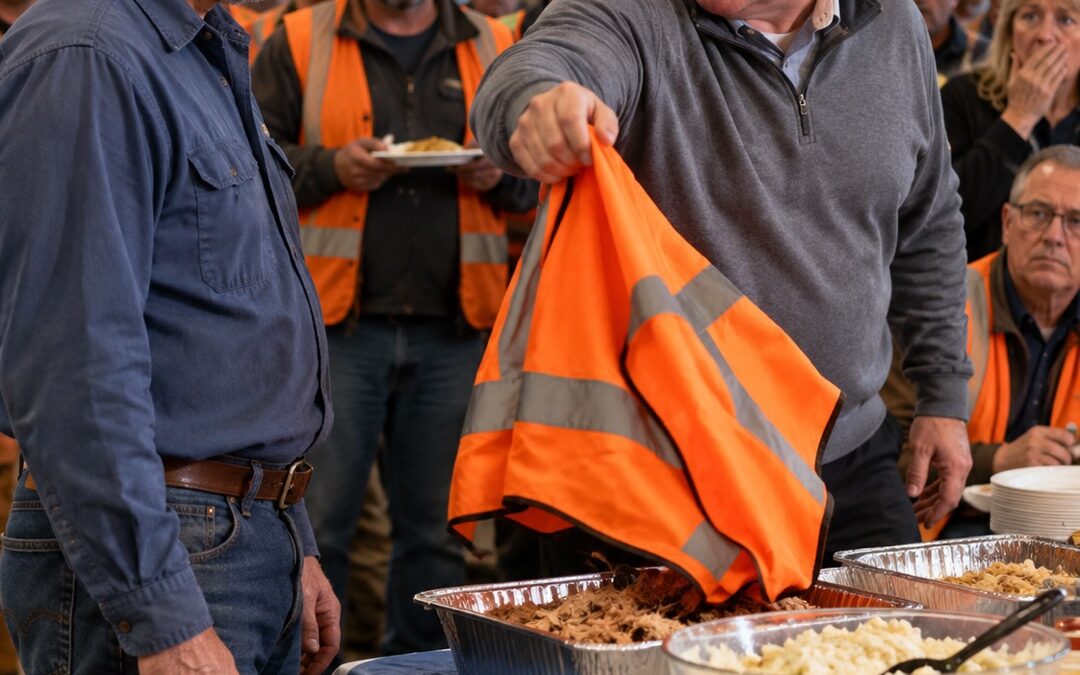
Cyrus Haugland peeled the county vest off my shoulders in front of sixty-four people and dropped it on the folding table, right next to the potato salad.
“Keep your tailgates chained, folks,” he said. “Ivar here has been selling the county’s plow wings out the back door, and I think we all know why a man gets desperate.”
I had been the county shop’s welder for thirty-four years, and I could have told him whose welds were on every wing plow the county owned, if anybody had ever thought to ask the man who built them.
It was 11:40 Saturday morning, October 10, and Bay 3 smelled like pulled pork, diesel, and the lemon cleaner our custodian bought by the five-gallon bucket. Thirty-nine of us from the highway department had come in wearing orange county vests, and thirty-eight were still wearing theirs. The rest of the sixty-four were spouses and guests, the three-member highway committee, two township chairmen, and Emil Skalicky from Skalicky Excavating out on County Road D.
The lunch had been loud right up until Cyrus grabbed my vest. Plastic forks had been knocking against paper plates, somebody had been laughing by the soda cooler, and men who spent all week yelling over diesel engines were talking twice as loud as necessary because that is what happens when you put road crews inside a metal building with food.
Then Cyrus pulled the vest off me.
I didn’t fight him for it. He never touched my skin, and I didn’t give him the chance to make it look like I had.
The collar of my work shirt had folded under when the vest came free. I fixed it, slow enough that my fingers did what I told them, while thirty-eight orange vests stayed in front of me.
A few of the crew kept their plates up near their chests. Others lowered them to waist level. One man near the parts counter still had his fork halfway to his mouth and seemed to forget what he was doing with it.
Emil stood six feet from me with a paper plate in his left hand. Pulled pork had fallen out of his bun and landed in the baked beans, and he kept looking at me instead of cleaning it up.
Across the table, Burdell Rasmusson had not touched his lunch. He was our shop foreman and had been my friend twenty-two years. His Styrofoam cup had left a wet ring on the plastic tablecloth, and he kept his eyes on that.
Cyrus straightened his shirt cuff. He was fifty-four, superintendent since January of the year before, wearing the same gray quarter-zip he favored whenever committee members came through the shop.
Nobody told him to lower his voice.
That bothered me more than the volume.
He had chosen a room full of people who knew me and made sure the men wearing the same orange county vest I had worn for years were close enough to hear every word. The spouses heard too. So did the township chairmen and the people who would sit across from Cyrus when December’s equipment audit came around.
“Ivar,” Leland Teig said.
He sat at the end of the table beside Norma Tabor, with Nels Hjelle on her other side. Those three made up the highway committee. Leland glanced at the vest Cyrus had dropped beside the food, then asked, “What exactly is he accusing you of?”
Cyrus answered before I could.
“Two Henke wings are missing from the reserve cage.”
Norma put down her plastic fork. “Two?”
“Two twelve-foot wings. Twenty-six thousand four hundred dollars of county equipment.”
Cyrus pointed toward Bay 4, though the reserve cage itself could not be seen from where we stood.
The county owned four of those wings. We had bought them in 2014, and I had fitted each one to the county mounts and welded the gussets onto all four. Two belonged on Units 20 and 21. The other two were reserve iron.
Norma turned in her chair.
“When were they found missing?”
“August.”
“August when?”
“Reserve count.”
Norma kept her eyes on him. “Were you planning on telling us before today, or—”
“I’m telling you now.”
“While accusing an employee.”
Cyrus settled his weight on his other foot.
“The employee had access.”
Every face around the lunch tables seemed to turn toward me at once. The exhaust fan over Bay 2 kept running, and somewhere near the service door a plastic chair scraped across concrete.
I could see orange everywhere.
Vests over sweatshirts. Vests over flannel. One hanging open because its zipper had been broken long enough that nobody bothered putting in a repair request.
Mine was on the table.
That was the part Cyrus wanted them to see.
“There are three keys to that reserve cage,” Cyrus said. “Mine. Burdell’s. Ivar’s. And Ivar was involved in the count that discovered the loss.”
Norma faced me.
“Is that true?”
“Yes.”
“What happened?”
I glanced across at Burdell. He stayed with the wet ring under his cup, so I answered.
“Friday, August twenty-first, Burdell and I did the annual reserve-cage count. The county had two reserve Henke wings under the west-side tarp. When we got to that rack, both were gone.”
Burdell’s chair gave a small creak.
“A twelve-foot wing isn’t a cordless drill,” I said. “You need equipment to move one.”
Burdell had pulled the tarp clear that morning, stared at the empty steel beneath it, and checked the count sheet.
“Two gone,” he had said.
On Monday the twenty-fourth, he told Cyrus at the wash bay while I stood there.
“Two reserve Henke wings are gone.”
Cyrus had looked up from his phone. “Friday?”
“Yes.”
“You sure they weren’t assigned out?”
“I checked.”
Cyrus put the phone away.
“I’ll look into it.”
Seven weeks went by. No deputy came through the shop, no committee meeting was called, and neither Burdell nor I was asked to surrender a cage key.
Then came the Roll-Out Luncheon, the first day since August when the entire highway committee and both township chairmen were together before the December equipment audit.
I finished.
Norma pushed her plate a few inches away.
“So Mr. Haugland knew August twenty-four.”
“Yes.”
Cyrus cut in. “I said I would look into it, and I did.”
Leland leaned back.
“What did you find?”
“The cage wasn’t forced, and only three people had access.”
Leland lifted his chin. “Found what, exactly?”
Cyrus turned toward me.
“Mr. Thorsby had significant personal debt.”
Emil stopped chewing.
I heard somebody behind me clear his throat and then cut it short.
My wife June had died Monday, November 3, 2025, at sixty-one. She had been a school nurse, and the ovarian cancer left $38,600 in hospital bills after she died. Her blue coffee cup was still in my cabinet, and Cyrus knew about the money because payroll had handled a change to my direct-deposit account when I refinanced the house.
Cyrus spread one hand toward the room.
“That’s what I mean by desperate.”
My throat shut hard enough that I had to swallow twice.
Somebody’s paper plate bent with a soft crack near the back wall.
I did not turn around.
I reached for the vest on the table. Cyrus had dropped it across the edge of the potato salad pan, and a little white dressing had gotten on the bottom.
I folded it once.
June had sewn the patch herself years ago because the county-issued name strip kept peeling loose in the wash.
IVAR T. · 34 YRS.
She had taken the old stitches out every January and changed the number. Last January there had been nobody to do it, so it still said thirty-four.
I ran my thumb over the patch once.
Then I set the vest down and kept my eyes on it.
Leland shifted in his chair.
“Cyrus, debt isn’t—”
“Access matters.”
“Debt and access are two different things.”
Cyrus pointed toward Burdell with his chin. “Burdell reported the loss.”
Norma spoke before he could continue.
“Why Ivar and not Burdell?”
“Because Burdell reported it to me.”
Burdell looked up then.
Only for a second.
Cyrus saw it.
So did I.
Norma held Cyrus’s gaze a second longer, then faced the back of the shop.
“Who buys wings like that — some contractor?”
Cyrus glanced toward Emil.
“Wings like that end up on somebody’s truck.”
Emil lowered his plate.
His plastic fork disappeared under his thumb.
“That supposed to involve me?” he asked.
Cyrus moved his head.
“I didn’t say that.”
“You looked over here.”
“I looked across the room.”
Emil glanced at Leland, then at the two township chairmen.
“I buy equipment all the time. Doesn’t mean I know where the county puts theirs.”
He had stepped into the conversation himself, and after that he stood very still with his plate sagging slightly at the edge.
— continue reading from here —
Leland asked, “You have any reason to believe a specific contractor has county equipment?”
“No.”
“Any vendor?”
“No.”
Leland set his cup down.
“Then nobody goes poking around a vendor’s yard before this hearing, and I mean nobody. No touching their equipment, no accusations. I’m not having Coulee County sued for defamation because somebody has a hunch.”
Cyrus nodded.
“Agreed.”
Emil gave one quick nod too, though nobody had asked him.
Norma turned back to Cyrus.
“And the Sheriff’s Office?”
“This is still an internal personnel matter.”
“Twenty-six thousand four hundred dollars in missing county equipment sounds expensive for personnel.”
“I’m handling it.”
Norma leaned forward.
“By suspending Ivar?”
“By protecting the county while facts are established.”
“Which facts?”
Cyrus picked up his clipboard.
“The ones I just gave you.”
“You gave me three keys and a hospital bill.”
Cyrus’s answer came fast.
“I gave you access and motive.”
I lifted my head.
“My wife’s bill isn’t your motive.”
His mouth opened.
I kept going.
“And it isn’t mine.”
Cyrus went quiet.
That was the first time since he pulled my vest off that I cut him short.
Norma looked down at the table.
Nels moved in his chair.
I didn’t look behind me, but one of the crew moved close enough that I heard a boot drag once on the concrete and stop.
Cyrus pulled my suspension letter from under his clipboard. “Pending investigation, you’re removed from county property except for scheduled proceedings. Your employee access is suspended.”
He held out his hand.
“Cage key.”
Stu Moe stood near the soda cooler at the end of the bay. Stu was sixty-six and drove a salt truck every winter whether his knees approved or not. He looked toward me, and I shook my head once.
I took my key ring from my pocket. The reserve-cage key had red tape wrapped around its neck because Burdell and I had gotten tired of trying the wrong key with gloves on, and another county key opened the shop.
I worked the red-taped key off first and put it in Cyrus’s hand. Then I took off the shop key and set it beside his clipboard.
Cyrus closed his fingers around the cage key.
“You’ll also leave your shop keys.”
“That one’s on the table.”
A couple of the road crew watched the key instead of me.
Those keys had opened the same doors before sunrise, after storms, on Sundays when a spreader mount broke and somebody needed it back before the next route. They were small enough to disappear under Cyrus’s paperwork.
The Tahoe outside the bay caught sunlight across the windshield.
Cyrus followed my glance.
“I take care of county property, Ivar. Eleven thousand county miles a year, and I don’t ask for a dime.”
Norma frowned.
“What does your Tahoe have to do with this?”
“Nothing. I’m making a point about stewardship.”
Nels looked through the open bay door.
“County owns the Tahoe.”
“Of course it does.”
Emil laughed once into his cup.
He quit when Norma faced his direction.
Cyrus slid my keys beside his clipboard.
“If you have anything relevant to the investigation, you can submit it through my office.”
“I have something.”
“What?”
“Thirty-four years.”
“That isn’t evidence.”
“No. Just thought we were naming what everybody brought to the table.”
Stu studied his shoes.
Leland pushed his chair back.
“Ivar, do you dispute the allegation?”
“Yes.”
“Do you dispute having access?”
“No.”
“Do you know where the missing wings are?”
I knew what a Henke wing looked like. I knew what my own work looked like. I did not know where those two pieces of iron sat at 12:03 that Saturday afternoon.
“No.”
Cyrus folded his arms.
“That’s convenient.”
He had come over from Illinois and taken the superintendent job Wednesday, January 15, 2025, while I was still splitting my life between work and June’s treatment in Rochester.
Leland gathered the loose napkins near his plate.
“If you’re challenging the suspension, the employee rule gives you a hearing.”
“I know.”
“Closed session is customary for personnel.”
“I don’t want closed.”
Cyrus looked over.
I picked up my folded vest.
“I’m requesting a public hearing, Leland, under the county employee rule. In open session. Right here.”
Several people moved behind me.
Cyrus leaned against the table. “You want sixty people listening to your personnel file?”
“You took my vest off in front of them.”
“That’s not the same thing.”
“You said I stole county iron in front of them. So I’ll answer in front of them.”
Cyrus tapped the clipboard.
“An open hearing means your finances and employment record can be discussed.”
“You already started.”
“And any evidence developed between now and then—”
“I said open.”
He went quiet.
I kept the vest against my side.
“If you have something, bring it. If you don’t, say that in the same room where you said the rest.”
Cyrus pushed away from the table.
“You don’t dictate county procedure.”
“I requested the hearing.”
“You’re suspended.”
“I heard that part.”
Leland raised a hand.
“That’s enough.”
Cyrus faced him.
Leland did not raise his voice.
“He made the request. I heard it.”
Cyrus started again.
“Leland, there are personnel issues here that—”
“I said I heard it.”
That shut him down.
Leland reached into his coat pocket and took out a small calendar booklet. Leland was the last man in Coulee County who still carried one instead of using his phone.
He flipped a page.
“Employee rule says reasonable notice. We also need all three committee members.”
Norma leaned over.
“November tenth?”
Nels checked his phone.
“Works.”
Cyrus looked around the bay. People had started sitting back down, though nobody had gone for seconds, and the potato salad had developed that dull skin mayonnaise gets under fluorescent lights.
“Fine. Tuesday, November tenth.”
“Time?” Leland asked.
“Six.”
Leland wrote it down.
“Six p.m.”
Emil had moved closer to the edge of the table.
“You really doing this right here?”
Leland closed his calendar.
“Ivar asked for open session.”
“I mean the garage.”
“No location yet.”
Emil rubbed the bottom of his plate against his palm.
“Whole thing seems like it ought to be somewhere official.”
I looked at him.
“This building takes county money just fine.”
Emil’s mouth pulled sideways.
“I wasn’t talking to you.”
“You were standing six feet from me.”
Cyrus stepped in before Emil answered.
“This isn’t turning into a debate with vendors.”
“Then stop having one,” Norma said.
Emil moved back.
The pulled pork on his plate had gone untouched since he spoke.
I picked up my paper plate. I had eaten half a bun before Cyrus started his show, and the rest had gone cold, so I dumped it in the trash barrel beside Bay 2.
Burdell came over while Cyrus talked to one of the township chairmen.
He stood beside me.
“Ivar.”
I gave him time.
He looked toward Cyrus, then down at his belt.
“You all right getting home?”
“I drove here.”
“I know.”
“Then I’m probably qualified to drive back.”
His mouth moved like he nearly smiled.
I tucked the folded vest under my arm.
“Burdell. August twenty-four.”
He set one hand against his belt.
“I remember.”
“You told him.”
“Yes.”
“And he did nothing.”
Burdell glanced toward the committee.
“Not here.”
“Seems to be where things get discussed now.”
His hand stayed at his belt.
“I’ll call you.”
“You had seven weeks.”
That got his attention.
I kept my voice low.
“I’m not asking you to pick a side in the middle of lunch. I’m asking whether there’s something you should have told me.”
His mouth opened, then closed.
Behind him, Cyrus laughed at something one of the township chairmen said.
Burdell heard it too.
“I’ll call you.”
I watched him for another second.
“You know where I live.”
He nodded.
Then he walked away.
Cyrus was talking to Emil by the open bay door. Emil shook his head hard enough to make a show of it, then slapped Cyrus on the shoulder.
I stepped over to the workbench along Bay 3.
My welding hood hung from the hook underneath.
Couldn’t take it.
County property.
My gloves were county property too, so I left both where they were.
One of the crew had moved my stool back against the bench to clear room for the luncheon tables. The seat had a crescent of grinding dust on it from Friday.
I brushed none of it off.
Stu came over with a paper cup of coffee.
“You need a ride?”
“No.”
“You need anything?”
“Not today.”
Stu looked toward the lunch tables.
“I heard the whole thing.”
“Most everybody did.”
He moved the coffee to his other hand.
“A lot of us did.”
I knew what he meant.
I didn’t give him an answer he could carry around the shop for the next month.
I headed for the personnel door.
Cyrus called after me.
“Ivar.”
I paused with one hand on the push bar.
“You’ll stay off county property until the hearing.”
“I heard you.”
“That includes the reserve cage.”
“You’re worried I’ll steal what’s already missing?”
A couple of people near the tables turned their heads.
Cyrus took a step toward me.
“I’m telling you the conditions of your suspension.”
“I know what you’re telling me.”
“You step onto restricted county property before that hearing and—”
“Then put it in the letter.”
He went quiet again.
I had spent the first half hour answering him because Leland and Norma were asking questions.
I wasn’t doing another half hour for Cyrus.
Nels spoke from the committee table.
“Leland.”
He had his phone to his ear.
Leland faced him.
Nels listened another few seconds, then lowered it.
“Facilities.”
Leland waited.
“The hearing room.”
Leland looked around Bay 3.
The folding tables were still out. The committee chairs were still lined along one side, with Units 20 and 21 parked deep behind them.
Emil faced Cyrus.
Burdell paused near the coffee urn.
I stayed at the personnel door with June’s patch pressed against my ribs under my arm.
“The courthouse board room is closed for the asbestos work. We’ll have to hold it in this bay.”
My hand stayed on the door.
Cyrus stopped laughing.
Part 2 — COUNTY ROAD D
PART 2 — COUNTY ROAD D
At 7:16 Saturday night, Piper was standing at my kitchen counter with a jar of Prego open beside her math book and asking whether sixty-four people thought I was a thief.
She had been living with me on school days since January, when her mother started taking more night shifts in Madison. Fourteen years old, five-foot-something, hair usually tied up with whatever rubber band she found first. That night it was a red one, and I had the county vest spread across the table.
The potato salad stain had dried pale near the bottom seam.
“I didn’t ask if they all believed him,” Piper said. “I asked who believes you.”
“Stu.”
“One.”
“Probably Ruth, once she hears it.”
“She wasn’t there.”
“That makes her easier to count.”
I had promised Kristin actual supper when Piper stayed with me. Kristin considered cereal after six p.m. evidence of male decline, so Piper and I had settled on spaghetti. The noodles were sticking together because I had forgotten the oil.
“What about Mr. Burdell?”
I kept working at the noodles.
“He’s your friend.”
“Has been.”
“That isn’t an answer.”
“No.”
She gave me the look June used to give eighth-grade boys who claimed they had forgotten a permission slip three days straight. I took two plates from the cabinet.
June’s blue mug was still on the second shelf.
I shut the door.
Piper carried the sauce over.
“What do you have that proves you didn’t take those wings?”
I sat down.
The county had taken my shop keys, the cage key, and my right to walk into Bay 3 until November 10. What they had not taken was my head.
Problem was, my head had no serial number stamped on it.
“A memory,” I said.
“Of what?”
“Four wings I worked on twelve years ago.”
“Is that good?”
“It’s a memory.”
“That sounds like no.”
“It sounds exactly like what I said.”
Outside, a pickup went past on the county road as Piper wound spaghetti around her fork.
“Grandpa.”
“What?”
“Who else knows what you remember?”
“Nobody.”
“Mr. Burdell?”
“He was there when I worked on them.”
“So he knows.”
“He might remember.”
“That’s different?”
“Yes.”
She took a bite.
I did too.
Piper’s fork stopped against the plate.
“Grandma did that patch?”
“Every year.”
“Why does it still say thirty-four?”
I took another bite I didn’t want.
“She died before January.”
Her eyes dropped to the plate.
The phone buzzed on the counter.
I knew who it was before I picked it up.
Burdell.
Can’t. Pension. I’m sorry.
I stood there with the phone in my hand, then gave it to Piper.
“That’s it?”
“That’s it.”
“What does pension mean?”
“He’s three years from retirement.”
She handed the phone back.
“So Cyrus can mess with it?”
“He has something to lose.”
“So do you.”
“Yes.”
“More.”
I put the phone face down.
After August 24, Burdell had started carrying the reserve sheets upstairs himself instead of leaving them at the corner of my bench while he went for coffee. Once, when I asked whether Cyrus had said anything more about the missing wings, Burdell told me, “Leave it alone until he asks.”
Piper glanced toward the phone.
“You should call him.”
“He said he can’t.”
“He texted that.”
“Same alphabet.”
“What if he wants you to ask?”
I picked up my fork.
“No.”
She opened the fridge after supper and put the sauce away. I washed the plates while she dried them, then she hung the towel on the oven handle.
At 8:03, I folded the vest and put it over the back of the spare kitchen chair.
The patch faced out.
Sunday morning, October 11, Piper wanted pancakes.
We had Bisquick.
That qualified.
By 10:30 she had talked me into driving out toward County Road D because her school project needed pictures of erosion control along farm ditches. I had no objection to driving and plenty to staying away from the house.
The sky had gone hard gray. Cornfields stood cut down to stubble, and a few combines farther west kicked dust that sat low over the fields.
Piper used my old Nikon because her phone camera, according to her, made culverts look “weird.”
I didn’t ask.
We took County Road D north.
Skalicky Excavating sat about six miles outside Rushford Springs behind a gravel apron wide enough for lowboys to turn around. Orange dump trucks sat near a loader, with two excavators parked nose to tail beside the shop. The company name was painted in black across the building, big enough to read at fifty miles an hour.
I was doing forty-three.
Piper lifted the camera toward a ditch, then lowered it.
“Grandpa.”
I saw them before she finished.
Two Henke wings stood leaning against the south wall of the equipment shed, both painted orange. The paint looked fresh enough that the cutting edges were still darker than the moldboards.
I eased off the gas but kept driving.
Piper twisted in the passenger seat.
“Those are the things?”
“Wings.”
“The missing ones?”
“I didn’t say that.”
“They look exactly like the ones at the county.”
“Henke sells more than four.”
We passed the driveway.
In the mirror, one wing sat slightly forward of the other. Its rear gusset showed plain through the orange paint, curved like an upside-down horseshoe.
Piper was still turned around.
“Why is the weld upside down?”
I faced the road again.
“What?”
“The horseshoe thing.”
She pointed behind us, though we were already well past the driveway.
“It’s upside down.”
“Seat belt straight.”
“It is straight.”
“Then sit straight.”
“Grandpa.”
“I heard you.”
“Was that your weld?”
I kept both hands on the wheel.
I had welded four gussets in 2014.
I remembered the first one because Burdell had complained about it.
That was all I let myself touch.
We reached the stop sign at County D and Highway 14, and I stopped fully.
Piper turned in her seat again.
“Go back.”
“No.”
“Why?”
“Leland was clear yesterday. Nobody goes poking around a vendor’s yard before the hearing, and nobody starts accusations.”
“We don’t have to go in.”
“No.”
“We could take a picture from the road.”
“No.”
“Why?”
“Because if Cyrus wants to say I stalked a contractor after being suspended, I’m not handing him the sentence.”
She pulled her jacket zipper up two inches.
“You already saw it.”
“Yes.”
“You know what that weld looks like.”
“I know what I think I saw at forty miles an hour.”
“You were doing forty-three.”
I turned onto Highway 14.
Piper checked the speedometer.
“Forty-two now.”
We drove west.
She stayed quiet for almost a mile.
Then she asked, “How did you never see those orange trucks before?”
“Because I was gone.”
“Where?”
“With Grandma.”
She turned toward the side window.
Back then, I had no idea what day the wings had left the cage. I had been away from work with June, then on bereavement leave, and I did not return to the shop until Monday, January 12. By then Skalicky’s orange rigs were running the north township routes while most of my days were spent indoors at the county shop.
Plow wings only mattered when the snow came.
“I didn’t see the rigs,” I said. “Not in snow.”
Piper kept watching the fields.
“But now you saw the wings.”
“Yes.”
“You’re going back.”
“Not today.”
“When?”
“I don’t know.”
She set the Nikon in her lap.
For the rest of the drive, she photographed exactly one culvert.
Wednesday, October 14, I picked her up after school at 3:22 and drove to the courthouse.
Piper still had her backpack. A yellow folder corner stuck out through a broken zipper.
Ruth Quandt sat behind the clerk’s counter wearing reading glasses low on her nose. She saw Piper behind me and said, “You brought counsel.”
“She charges in snacks.”
Piper put her backpack under a chair.
Ruth handed me the hearing form.
“Public session box is here. Employee rule number goes here. Date requested there.”
I filled it out standing at the counter.
Ruth caught me putting my address on the wrong line and tapped the proper box.
“Home address there, Ivar.”
I moved the pen.
Piper sat in a wooden chair beneath the county map while Ruth opened a cabinet behind her.
“You drink cocoa?”
“Yes.”
“Good.”
Ruth disappeared into the little break room and came back with a foam cup.
Piper took it carefully.
“Thank you.”
I signed the form.
Ruth stamped it October 14, 2026, at 3:41 p.m. and slid my copy across the counter.
“You’re on November tenth.”
“Six o’clock?”
“Six.”
“In Bay 3.”
“Yes.”
She pulled another agenda sheet from a tray, glanced at it, then stopped.
“That’s interesting.”
“What?”
Ruth turned the page slightly toward herself.
“Same meeting.”
“What same meeting?”
“Three-year plowing contract.”
Piper blew across her cocoa.
Ruth looked over her glasses.
“Skalicky Excavating.”
The cup stopped halfway to Piper’s mouth.
“Three hundred ninety thousand dollars.”
I kept my hearing copy flat against the counter.
The hearing and a Skalicky contract vote on the same night.
Ruth put the agenda back in the tray.
“Ivar?”
“I’m fine.”
She watched me another second.
I picked up my copy.
Piper carried the cocoa through the courthouse hall, and we were back in the truck a few minutes later.
I started the engine.
Piper looked through the windshield. “Grandpa, if you can’t prove it from the road, how do you prove it from inside the room?”
Part 3 — CLEANER THAN OURS
PART 3 — CLEANER THAN OURS
At 4:08 Thursday afternoon, October 22, I stood outside Bay 3 with no county key and watched Cyrus Haugland conduct a highway committee work session in the room where he had taken my vest twelve days earlier.
I was allowed in because the meeting was open. That seemed to bother him more than if I had climbed through a window.
The overhead doors were shut against a cold wind. Units 20 and 21 sat along the back wall with their wings folded, and somebody had parked the floor scrubber beside the coffee urn like it had been invited. Leland Teig sat at the folding table with Norma’s legal pad on one side and Nels working through a paper cup of coffee on the other.
I took a chair along the wall.
Cyrus noticed me before I sat.
“Ivar.”
“Cyrus.”
“This isn’t your hearing.”
“I checked the agenda.”
“That isn’t what I said.”
“I know.”
Leland spoke from the table. “He can attend, Cyrus.”
Cyrus went back to the whiteboard.
For twenty-nine minutes they worked through ordinary highway business, including a complaint from the Town of Morley about a grader leaving gravel against two mailboxes. At 4:37, Norma flipped her legal pad back a page.
“I want to return to the missing plow wings.”
Cyrus had a marker in his hand. The cap stuck when he tried to close it, and he worked it loose.
“That’s a personnel hearing item.”
“I’m asking about county property. Why hasn’t the loss gone to the Sheriff’s Office?”
“We covered this October tenth.”
“No, you accused Ivar October tenth. I’m asking why missing county property wasn’t reported.”
Cyrus set the marker on the tray.
“As I said then, it’s an internal personnel matter.”
Norma leaned forward.
“County iron disappeared.”
“And there’s an employee investigation in process.”
“So report the iron.”
“We’re establishing facts first.”
“Since August?”
Cyrus pulled out a chair.
“The committee asked for a process. We have a hearing scheduled.”
Leland said, “I told people to stay off vendor property until the hearing. I didn’t tell you not to report county equipment missing.”
“I understand that.”
Nels set down his coffee.
“Who else has been checked?”
Cyrus angled his chair toward him.
“What do you mean?”
“Keys. Access. Contractors. Anybody hauling equipment through here.”
“We’re reviewing relevant access.”
Norma asked, “With what investigator?”
Cyrus did not answer.
Norma lowered her pen to the pad and wrote something down.
Then she turned the page.
“We have a proposed three-year plowing contract on November tenth. Skalicky Excavating.”
Cyrus nodded.
“Correct.”
“I want to see the equipment we’re paying for.”
“You’ve seen the bid.”
“I said equipment.”
Nels shifted in his chair.
Norma looked toward Leland.
“I move that every contractor under consideration bring the proposed plow rigs into Bay 3 on vote night for committee inspection.”
She tapped her pen against the page.
“And put in the minutes that the rigs come in as they ran in January.”
The marker cap clicked against the tray.
Nobody spoke for a few seconds.
Cyrus said, “No objection from me.”
Nels glanced at Norma.
“I’ll second it.”
Cyrus pushed his chair back.
“Makes sense. Full transparency. Frankly, Skalicky’s trucks are cleaner than anything in this fleet; I drive a Tahoe with eleven thousand county miles a year, I know what clean looks like.”
Norma glanced through the personnel-door window.
“Your Tahoe is washed twice a week.”
“Because I maintain equipment.”
“You don’t plow with it.”
“No, Norma.”
She wrote another line.
I kept my mouth shut. Cyrus had backed Norma’s motion before anybody could ask why he might object, then started bragging about how clean Emil’s trucks were.
The orange rigs would be in Bay 3 on November tenth.
Piper’s voice came back from County Road D.
Why is the weld upside down?
I had a twelve-year-old memory and a room where the iron would come to me.
The work session broke at 5:11.
Norma came over while Cyrus talked to Nels near the office door.
“You didn’t say anything.”
“Wasn’t asked.”
“You usually manage.”
“I’m suspended. Trying new hobbies.”
She tucked the legal pad under one arm.
“Do you know something about Skalicky?”
“I know what I can prove right now.”
“What’s that?”
“Nothing.”
She studied me.
“The rigs will be here.”
“I heard the motion.”
“What are you planning?”
“To look.”
She gave me another second, then walked toward the door.
Friday, October 23, at 6:42 in the morning, I sat in the Kwik Trip off Highway 14 with a coffee I had paid $2.19 for and did not drink.
Sgt. Dee Okerlund came in wearing his brown Sheriff’s Office jacket and carrying no hat. He was fifty-five, about my height, and had known me long enough not to start with small talk.
He sat across from me while a delivery driver fought with the roller-grill door near the counter.
“You called my desk twice.”
“Yes.”
“You’re suspended.”
“Yes.”
“That part I heard.”
I pushed the coffee aside.
Dee said, “Tell me the rest.”
I told him all of it, from the August count through the luncheon and the hearing request, then told him about County Road D. I had driven past Skalicky’s place, seen two orange Henke wings against the shed, and kept going without entering the property or taking a photograph.
Dee took one drink.
“You went onto Skalicky’s property?”
“No.”
“Good.”
“Leland told everybody to stay off.”
“Also good.”
“He accused me publicly.”
“I heard.”
“Sixty-four people.”
“Smart.”
“Not the word I picked.”
Dee set his cup down.
“What exactly do you have on those wings?”
“A weld.”
“One weld?”
“More than one thing in it.”
“Explain.”
I stopped there.
I remembered the gusset, the woven bead, and something wrong about the pin hole, but I had not stood next to those orange wings. I wasn’t going to turn a glance through a windshield into testimony.
“I need them side by side.”
“With what?”
“The county pair.”
“And then?”
“I’ll know.”
Dee leaned back.
“Your boss is the custodian. He never filed. I can’t open a case on county iron without his report, and nobody can touch a vendor’s yard on a hunch.”
“I know.”
“Bring me something I can stand next to, in a room where he can’t say no.”
Norma’s motion sat there between us even though Dee had not been at the meeting.
“November tenth, the contractor rigs are coming into Bay 3.”
Dee held his cup halfway up.
“Whose idea?”
“Norma Tabor’s.”
“Cyrus agreed?”
“No objection.”
Dee took the drink.
“That helps.”
“He thinks it does.”
“Don’t get ahead of yourself.”
“I’m sitting in a Kwik Trip at six in the morning. I’m not ahead of much.”
Dee asked, “You’ll be allowed near the equipment?”
“Public hearing. Open meeting.”
“And nobody’s breaking into anything?”
“No.”
“Touching private equipment without permission?”
“No.”
He nodded.
“If equipment that appears to belong to the county ends up lawfully inside a county building at a public meeting, call me.”
“Before or after?”
“Before would be polite.”
He checked his watch and stood.
I looked at the coffee.
“Two nineteen.”
Dee followed my eyes.
“You ought to drink it.”
“I’ve wasted more on grinding discs.”
He left.
Saturday, October 24, at 7:06 p.m., I parked my F-150 across from Burdell Rasmusson’s house and watched his porch light burn over an empty step.
I had not called first.
Calling gave him room to send four words.
His house sat on a narrow county road east of town with a detached garage and a plastic deer beside the mailbox that his wife had been trying to throw away for years. Burdell’s pickup was there, and the television flashed blue against the living-room curtains.
I crossed the road.
The gravel on his walk popped under my boots.
Before I reached the porch, the curtain moved.
I saw half his face.
Then it settled.
I knocked.
“Burdell.”
A floorboard moved inside.
I knocked again.
“I’m not here to ask you to testify. I’m not asking you to save me.”
The television kept flashing against the curtain.
“I know Cyrus talked to you after August twenty-four.”
That was partly a lie.
I knew he had said something.
Burdell’s text had supplied the subject.
Pension.
I stayed by the door.
“Three years is a long time when a man holds your job over it.”
The curtain shifted.
Burdell stood behind it in a T-shirt and work pants, watching through the gap.
“I need one answer,” I said. “When you told Cyrus the wings were gone, did he tell you to stop looking?”
His mouth moved behind the glass.
I could not hear him.
“Open the door.”
He didn’t.
I stepped back from the porch.
The curtain drew closed until only the blue television light showed through it.
I turned toward my truck.
The porch light went out before I reached the truck. Behind the curtain, a man I’d trusted for twenty-two years stood with his hands in his pockets and didn’t come out.
Part 4 — THE WRONG WELD
PART 4 — THE WRONG WELD
At 6:18 Wednesday evening, November 4, Piper found my grandfather’s blacksmith horseshoe on the kitchen windowsill and asked why one side was flatter than the other.
She had her school sweatshirt on and one sock. The other sock was under the table beside her backpack, where socks apparently went to finish high school. I was standing at the sink rinsing two pork chops.
“Because he used it.”
“For horses?”
“That was generally the arrangement.”
She picked it up.
The horseshoe was black iron, heavy for its size and pitted deep along one edge. My grandfather had kept a forge behind his dairy barn outside Rushford Springs. By the time I was old enough to remember him clearly, he mostly sharpened mower blades and complained about factory hinges.
Piper turned the shoe around.
“This looks like your weld.”
I shut off the water.
“What weld?”
“The orange one. County Road D.”
I dried my hands. Eleven days had gone by since Burdell watched me from behind his curtain, and neither he nor Cyrus had called. Norma’s rule still stood, the November 10 hearing was six days away, and I had spent most of that time thinking about a mistake I made twelve years earlier.
Piper put the horseshoe flat against the counter.
“You said you remembered something.”
“I remember plenty.”
“You know what I mean.”
I took the pork chops to the stove and put them in the skillet. They hissed hard enough to give me a few seconds.
Piper stayed where she was.
“The first gusset was supposed to match that horseshoe right side up.”
She studied the iron.
“Supposed to?”
“Friday in 2014. Highway 14 washed out near the creek after all that rain.”
“I was two.”
“You were probably more useful then.”
She ignored that.
“We’d been on flood repair fourteen hours. Burdell wanted the four new Henke wings fitted before Monday.”
“You welded them that night?”
“Started them.”
I could still see Bay 2 under those old fluorescent tubes. The county had bought the wings bare enough that we had to adapt their mounts to our trucks, and four gussets needed reinforcing around the rear pin assembly.
I laid out the first plate, marked it, tacked it, then ran the weld with the gusset opening down when it should have been up.
Saturday morning, Burdell saw it while I was grinding slag off another bracket.
“What’d you do here?”
I looked.
Then I said a word my granddaughter did not need in the kitchen.
Burdell put his hand under the curve.
“You turned the gusset.”
“I can see that.”
“Cut it off.”
“I will.”
The wings were supposed to stay through Monday.
They didn’t.
A township crew came in early Monday morning because snow equipment was being shuffled ahead of schedule. By the time I arrived, the first wing had already been trucked out to be mounted.
Including my mistake.
I told Piper that part while the pork chops browned.
“So you couldn’t fix it?”
“Could’ve chased the truck across the county, pulled the wing, cut the gusset loose, cleaned the plate, welded it again.”
“Why didn’t you?”
I opened the silverware drawer and set two forks on the table.
“Three wings were still in the shop. Burdell wanted all four interchangeable, same setup on every truck, so I matched the other three to the first.”
Piper stared at me.
“You made the other three wrong too?”
“Same wrong.”
Her mouth opened, then she laughed once.
“You did that on purpose?”
“After the first one.”
“That’s insane.”
“Fabrication.”
“That is not what fabrication means.”
“Depends who’s paying.”
I took the chops off the heat.
Piper picked up the horseshoe again.
“So all four have the upside-down thing.”
“Yes.”
“And the orange ones had it.”
“One did that I saw.”
“What else?”
I sat.
“A woven V-bead.”
“What is that?”
“Instead of running one straight bead along the gusset, I worked the puddle side to side in a tight V. I used to do it on thick plate when I wanted more fill.”
“Can other welders do that?”
“Of course.”
“So that doesn’t prove anything.”
“By itself, no.”
She ran one finger along the old horseshoe.
“What else?”
“The pin hole.”
I reached for a junk envelope beside the fruit bowl and drew the mount on the back, putting the plate, gusset, and hole into one rough sketch.
“The jig was off.”
“How far?”
“Three-eighths inch.”
“That sounds tiny.”
“It is until you’re trying to drive a pin through steel. I caught it on the first wing, opened the fit instead of rebuilding the plate, then matched the other three so any county truck could take any wing.”
Piper studied the drawing.
“So the upside-down horseshoe, the V weld, and the hole all match.”
“The offset.”
“The wrong hole.”
“Offset.”
She pointed her fork toward the envelope.
“Still wrong.”
I took the pencil away from her.
“Eat.”
She sat but kept watching the horseshoe.
I cut my pork chop.
“Grandpa.”
“What?”
“Did anyone else weld county wings like that?”
“No.”
“How do you know?”
“Because nobody else on earth would have made my first mistake.”
She stopped cutting her pork chop.
I had seen that upside-down gusset plenty of times over the years when those wings came through the shop. Mostly I saw work I should have done differently on a Friday when I was too tired to be welding anything.
Piper turned the blacksmith horseshoe over in her hands.
“Could you say you did it for luck?”
“I could.”
“Like Grandma hanging one over the garage door.”
“Your grandmother believed horseshoes kept bad luck out if you pointed them up.”
Piper set it with the opening upward.
“So say that.”
“That would be a lie.”
“You’re trying to catch a man who lied about you.”
“Doesn’t improve the lie.”
She picked at the edge of her pork chop.
I put the horseshoe back where it had been.
“The truth is I screwed up.”
Piper rested her palm on the old iron.
She didn’t say anything.
I scraped the skillet into the trash.
Saturday, November 7, at 8:10 in the morning, Stu Moe had thirty-six orange county vests standing inside a rented VFW room on the south side of Rushford Springs.
I had not asked Stu to gather them. He called Friday night and said, “Be there at eight.”
I told him I did not want a rally.
“Then don’t bring signs.”
So I went.
Thirty-six men and women stood around folding chairs with coffee in foam cups. Plow drivers and mechanics were mixed in with grader operators and the parts clerk who had worked with me since Clinton was president.
My old vest was folded under my arm.
Stu stood beside the coffee urn.
“Ivar’s got five minutes.”
“I need two.”
People moved closer. Most had been at the luncheon, and I remembered enough of their faces from that Saturday without sorting who had watched me and who had watched the floor.
“Tuesday night, Skalicky’s rigs will be in Bay 3.”
“The county units will be there too.”
I held up one finger.
“Don’t speak. Stand.”
A woman from road maintenance frowned.
“That’s it?”
“That’s it.”
A driver near the back asked, “Stand where?”
“Behind me.”
“What if Cyrus starts in?”
“Let him.”
Another man lifted his coffee.
“You want all thirty-six?”
“Yes.”
“Vests?”
“Yes.”
“Why?”
I looked at the orange cloth covering half the room.
“Because he took mine in front of you.”
Stu pointed toward the doughnut boxes and people began moving again.
I left before the second cup of coffee.
Monday, November 9, at 7:32 in the evening, Cyrus Haugland came to my house alone.
Piper was upstairs. I had just carried a basket of laundry into the living room when headlights crossed the wall.
White Tahoe.
County plates.
Cyrus parked at the curb instead of my driveway.
I opened the front door before he knocked.
He glanced past me into the house.
“Can we speak privately?”
“We are.”
“Ivar.”
“You’re on my porch.”
He put his hands at his sides.
“The hearing doesn’t have to happen tomorrow.”
“Yes, it does.”
“No. You can withdraw the request.”
“I know how withdrawal works.”
He looked toward the neighboring house before dropping his voice.
“I can lift the suspension.”
I said nothing.
“You come back Wednesday. Keys restored. Shop access. Same assignment.”
“And?”
“A letter in your personnel file.”
“What does it say?”
“No finding.”
“Not cleared.”
“No finding is standard language.”
“Not cleared.”
He exhaled.
“You’re getting hung up on wording.”
“I weld for a living. Eighth-inch wording matters.”
“Ivar, this has grown beyond what it needs to be.”
“You started with sixty-four people.”
“I was addressing an equipment loss before an audit.”
“You were addressing me.”
He glanced toward the Tahoe.
“I’m trying to give you a path back.”
“And the missing wings?”
“We continue reviewing inventory.”
“Sheriff?”
“Still unnecessary.”
“Skalicky contract?”
“That’s separate.”
“Tomorrow?”
“The committee considers it tomorrow.”
Cyrus glanced toward the neighboring house again and lowered his voice another notch.
“At the October twenty-second work session, Norma asked why a loss nobody reported to the Sheriff needs a public hearing. Tomorrow this turns into a show, the contract vote gets dragged into it, and we spend the night arguing instead of moving forward.”
“Then move forward after six.”
He moved one foot back on the porch.
“You don’t have evidence.”
I looked past him at the Tahoe. The county washed it enough that my porch light reflected off the hood.
“Come look at the iron Tuesday, Cyrus. Anybody who wants to. It’s all in the bay.”
He stared at me, then gave a short laugh.
“Nobody reads a bay full of iron, Ivar.”
“Then stand close enough to see Tuesday,” I said.
Part 5 — BAY 3
PART 5 — BAY 3
At 5:30 Tuesday evening, November 10, two orange Skalicky trucks sat in Bay 3 beside county Units 20 and 21, and thirty-six orange vests stood behind the chair where I was supposed to sit.
Skalicky’s crew had bolted the wings back onto their rigs Monday afternoon to satisfy Norma Tabor’s inspection rule. The work-session minutes listed the rigs “as they ran in January,” so Cyrus could not pull the wings off before the meeting without inviting the first question, and he had already told me nobody reads a bay full of iron. About seventy people filled the bay, with the same folding table from the October luncheon set near the parts counter.
Cyrus sat behind it with Leland, Norma, and Nels.
Burdell was in the first row. He had come alone and kept his attention on the concrete between his boots.
Piper sat in the last row beside Ruth Quandt, holding a paper cup of hot cocoa Ruth had made before coming over. Sgt. Dee Okerlund stood against the wall near Bay 2 in his brown Sheriff’s Office jacket.
I had called him at 3:14.
“Something I can stand next to?” he had asked.
“Four of them.”
That brought him.
Stu Moe took his place behind me with the rest of the crew.
I wore a blue work shirt and the same jeans I had worn to the luncheon.
My old vest was at home.
At 5:58 Cyrus walked to the personnel door and shut it. At six, Leland called the hearing to order while one of Skalicky’s trucks dripped melted road slush onto the concrete.
“This is an open employee hearing requested by Ivar Thorsby,” Leland said. “It concerns his suspension and an allegation involving two county-owned Henke plow wings.”
Cyrus arranged his papers.
I had none.
For twenty minutes he did most of the talking. He went through the reserve count, the three cage keys, the lack of forced entry, and my hospital debt.
He avoided saying June’s name.
I appreciated that much.
Norma interrupted him once.
“During what period are you alleging Ivar removed the wings?”
Cyrus checked his notes. “We haven’t fixed an exact date.”
“So the access history you’re describing covers his entire employment.”
“It establishes opportunity.”
“It establishes employment.”
Cyrus pressed the clicker on his pen once and moved on.
I watched Emil.
He sat beside one of his drivers with his arms folded. The orange plow wing on his nearest truck was about ten feet behind him.
At 6:20 Cyrus closed his folder.
“That is the county’s position.”
Leland nodded toward me.
“Ivar.”
I stood and walked two steps toward the center aisle.
Cyrus spread one hand toward the trucks.
“Fine, Ivar. Point at whatever you like. There are four wings in this bay and nobody in this room can tell one from another.”
I stopped.
“You said I sold them out the back door, Cyrus. Come look who signed them.”
His head moved toward the orange rigs.
Emil laughed as he got out of his chair.
“Whoever welded these was drunk.”
I walked toward the county units.
“Burdell.”
He stood.
Two county mechanics came out from the line behind me, and at 6:48 they started moving Units 20 and 21 into the open work area beside the Skalicky trucks.
The first county unit rolled forward, then the second. When they finished, four wings sat side by side under the work lights, two county yellow and two Skalicky orange.
I stopped at the wall rack.
My tools were still county property.
“Can I use a work light?”
Leland glanced at Cyrus.
Cyrus shrugged.
“Point at whatever he wants.”
Burdell brought over two magnetic work lights and clipped them to the lift posts. White light fell across all four rear mounts.
I crouched beside Unit 20.
“Anybody who wants to see this, come closer.”
Norma stood first, with Nels and Leland behind her. Ruth brought Piper forward and held several feet back.
The thirty-six orange vests stayed where they were.
Stand.
Emil came over last.
I pointed to the gusset on Unit 20.
“Look at the rear plate.”
Norma bent lower.
“What am I looking for?”
“That.”
The gusset curved over the pin assembly with the opening down.
I moved to Unit 21.
Same shape.
Then I went to the first orange wing. The paint covered the plate, but the curve underneath it ran the same direction.
The fourth wing matched too.
Emil shifted his weight.
“That’s a standard repair.”
“No.”
Cyrus called from the table.
“A gusset shape proves nothing.”
“Correct.”
I pointed at the bead on the first county wing.
“Now the weld.”
The steel carried years of salt and grinding marks, but the pattern still showed. The bead crossed the joint in a tight woven V, and the same weave ran across Unit 21 and both orange wings.
Emil bent closer.
“A lot of welders weave.”
“Yes.”
Cyrus pushed his chair back.
“Then what are we doing?”
I held out my hand toward Burdell.
“Quarter.”
He checked his pocket.
I found one in mine instead, a Wisconsin state quarter scratched across the face.
I went to the first orange wing and set myself beside a chipped spot near the rear gusset.
Emil took one step toward me.
“That’s my equipment.”
Norma came closer.
“This is the inspection I asked for at the work session. Are you refusing it now?”
Emil glanced past her at the committee.
“No. Inspect it.”
Dee spoke from beside the truck.
“Then you’re consenting to the inspection. Go ahead, Ivar.”
I put the edge of the quarter against the chipped paint and scraped.
A thin strip of orange curled away, about the width of my thumbnail. Primer came next, then yellow showed underneath.
Norma crouched closer. Leland put one hand on his knee to get lower while I scraped a little farther and opened the yellow stripe another inch.
“Could be old municipal equipment,” Cyrus said.
I nodded.
“Could.”
His shoulders eased.
I pointed to the pin hole.
“The center is off the same amount on all four.”
Leland leaned in.
“Meaning?”
“Factory plate wasn’t right. My jig wasn’t right either. I matched all four so every county unit could swap wings without fighting a different setup.”
Burdell went to the tool chest and came back with a steel rule.
Cyrus started, “He is not authorized to—”
Norma cut him off.
“Burdell is the shop foreman.”
Burdell measured Unit 20, then Unit 21, then the two orange wings. He put his thumb against the same mark every time and carried the rule to the next piece of steel without saying the measurement aloud.
I walked back to the first county wing.
“Upside-down gusset. My mistake.”
Burdell’s head came up.
“I made the first one wrong after a flood repair shift. Burdell told me to cut it off, but that wing was already out for mounting before I got back to it.”
Norma faced Burdell.
“True?”
“Yes.”
“I matched the others so the county could swap them between trucks,” I said.
I swept the work light down the row, and the same crooked work repeated itself four times.
I stepped clear of the work lights.
“All four.”
The compressor near Bay 1 kicked on.
Cyrus had his pen in his hand.
Click.
Click.
The spring jumped out of the barrel, hit the concrete, and bounced near his shoe.
Nobody picked it up.
Emil reached toward the nearest orange wing, then pulled his hand back before his fingers touched the paint.
Cyrus found his voice.
“You cannot establish ownership from a weld.”
Norma pointed at the scraped strip.
“County yellow is under his orange paint.”
“That still doesn’t establish how it changed hands.”
“No,” I said. “It doesn’t.”
Dee stepped beside the orange truck, bent to inspect the exposed yellow, then crossed to the other wing.
“Emil.”
Emil wiped his mouth with the back of his hand.
“What?”
“Tell me where these came from.”
Cyrus moved around the table.
“This is an employment hearing.”
Dee stayed beside the wing.
“I know where I am.”
Emil’s driver edged farther away.
At 7:02 Dee asked, “Who sold you the wings?”
Emil faced Cyrus.
“He sold them to me! Sunday the twenty-first, he held the gate himself!”
Piper stood behind Ruth with the cocoa cup bending slightly under her fingers.
I stayed where I was.
Cyrus put his hand flat on the folding table.
“Don’t involve me in your story.”
Emil took a step toward him.
“You were there.”
Dee moved into the space between them without touching either man.
“Stay put. Both of you.”
Emil stayed where he was.
Dee looked from him to Cyrus.
“I’m taking statements at the station after this meeting. Neither one of you is under arrest right now, so don’t make me explain this twice.”
Burdell rose from the first row.
His chair scraped the concrete, and he walked into the open space beside the county wings.
“I signed the cage sheets.”
Cyrus faced him.
Burdell kept his eyes on Leland.
“Forty-seven Friday sheets. I marked those reserve wings present.”
Norma asked, “Did you inspect them?”
“No. They were under tarps. I signed without lifting them.”
Cyrus pointed at him.
“That is your responsibility.”
“I know.”
Burdell took a breath.
“The week after we found them gone, Ivar asked what you were doing about it. I told him you were handling it.”
Cyrus stepped away from the table.
“You’re admitting you falsified inventory.”
Burdell faced Leland.
“After August twenty-four, Cyrus told me if this went to the Sheriff, those sheets would be the first thing they read.”
“That is not what I said.”
“It is.”
Burdell kept his eyes on Leland.
“I couldn’t lose the pension.”
Dee asked Emil, “You said he held the gate?”
“Yes.”
Burdell’s head came up.
“No.”
Emil snapped, “You weren’t there.”
“No, I wasn’t.” Burdell looked toward me, then back at Emil. “But I know where Ivar was Sunday the twenty-first.”
My stomach pulled tight.
Burdell faced Leland.
“Friday the nineteenth, Ivar called me from the clinic parking lot in Rochester. June was upstairs, and he asked me to swap his Monday shift so he could stay with her through the weekend.”
Emil shook his head.
“That proves he made a phone call.”
Burdell’s voice came back harder.
“He was with June.”
I remembered my truck beside the concrete ramp under the clinic parking structure, with June several floors above me.
“The hospital garage charged my card that Sunday,” I said. “Dee can verify it.”
Dee gave one short nod.
“I will.”
Piper lowered the cocoa cup.
Cyrus backed into the folding table.
It moved half an inch across the concrete.
Leland Teig stood.
He looked first at the four wings, then at Cyrus.
“Cyrus, set your badge and the Tahoe key on the table.”
The pale potato-salad stain was still at the corner where he had dropped my vest.
Part 6 — THE PATCH
PART 6 — THE PATCH
At 7:10 Tuesday night, Cyrus Haugland unclipped the county lanyard from his belt and laid it on the folding table beside the Tahoe key. The key landed first, and the lanyard curled beside it near the spot where he had dropped my vest a month earlier.
Cyrus kept his fingertips on the table.
Leland Teig stood across from him.
“Step away.”
Cyrus took one step back. Norma and Nels stayed in their chairs.
Emil Skalicky was still beside the orange truck, six feet from Sgt. Dee Okerlund. His driver had moved clear over near Bay 2 and was staring at the concrete.
The thirty-six orange vests stayed behind me. Piper stood beside Ruth in the aisle, and Burdell had not sat down again.
Cyrus cleared his throat.
“You have one employee’s interpretation of old fabrication work and a contractor making accusations because he’s scared.”
Emil snapped around.
“Scared?”
“Emil,” Dee said.
He stopped.
Then Emil faced Leland.
“I paid him.”
Cyrus started, “Do not—”
Dee turned toward him.
“Let him speak.”
Emil rubbed his palm down the front of his work jacket.
“September twenty-second last year.”
Leland waited.
“Ninety-five hundred cash.”
Norma pushed her chair back.
“For the wings?”
“Yes.”
Cyrus said, “He’s lying.”
Emil pointed toward him.
“You told me no bid, no paperwork. You said they were surplus.”
Cyrus stepped away from the table.
“That never happened.”
“It was in a Kwik Trip envelope.”
Nels stared at Emil.
“You handed him ninety-five hundred dollars in cash?”
“Yes.”
“For county equipment?”
Emil hesitated.
“For the wings.”
Cyrus stepped toward him.
Dee moved between them.
“Stay back.”
Emil stayed put.
Cyrus said, “I never received money from this man.”
Emil answered before Dee could.
“You held the gate.”
Leland put one hand on the back of his chair.
“That’s enough for here.”
He faced Dee.
“Sergeant?”
“I’m not interviewing either man in this shop.”
“Fair.”
Dee addressed them both.
“You already heard me. Statements happen at the station.”
Norma pulled the meeting packet toward her.
“The contract.”
Cyrus faced her.
“You cannot seriously vote on that now.”
“We were scheduled to vote tonight.”
“You’re contaminating a procurement decision with an unproven personnel dispute.”
Nels pointed toward the orange wing with county yellow exposed beneath the scraped paint.
“That’s not personnel.”
Cyrus moved closer to the table.
“This hearing has nothing to do with whether Skalicky can perform snow removal.”
Norma opened the contract packet.
“It has plenty to do with whether I’m voting to give him county money.”
Leland raised his hand.
“Before we do that, I need something on the record.”
Norma stopped.
Leland kept one hand on the chair.
“Last year I told Cyrus to keep the small stuff off my agenda. Then I let him sign that forty-one-thousand-dollar emergency plowing contract alone, and I should have watched it. The county was paying Skalicky to plow snow with county wings that had been taken out of our own cage.”
Norma faced him.
“You should have.”
“Yes.”
Cyrus shook his head.
“That contract was under my authority.”
“It was.”
“Then don’t make it something it wasn’t.”
“I’m telling them what I missed.”
Norma moved the contract packet into the middle of the table.
“Then let’s deal with what’s in front of us.”
Cyrus stepped forward.
“I am still superintendent.”
Leland faced him.
“No, Cyrus. Effective now, you’re relieved of superintendent duties pending county action. The Tahoe stays here.”
Cyrus reached toward the key, stopped with his fingers an inch above it, then pulled his hand back against his belt.
Ruth brought the meeting sheet forward.
Norma made the motion to reject the proposed three-year Skalicky Excavating plowing contract.
Leland voted yes, Norma voted yes, and Nels voted yes.
Three to zero.
Emil grabbed the side of his orange truck. His fingers slipped once on the wet paint before he caught the mirror bracket.
Cyrus dropped into the chair behind him hard enough to drag its metal feet across the concrete.
Ruth drew a line through the contract item.
Dee waited until she finished.
Then he walked to Emil.
“You’re coming with me.”
Emil glanced toward his driver.
“Take the truck.”
“The truck stays.”
Emil started to object.
Dee cut him off.
“Station. Statement. That’s all you need right now.”
Then Dee faced Cyrus.
“You too.”
Cyrus stood slowly.
He picked up his coat but left the lanyard and Tahoe key where they were.
At the personnel door he glanced back at the white Tahoe through the glass, then at the key lying beside his lanyard. His fingers pressed once against his empty belt where the key ring had hung.
Dee opened the door.
Cold air came across the bay floor.
They went out on foot.
At 7:40, Ruth shut the meeting folder. The broken spring from Cyrus’s pen still lay under the table.
Saturday morning, November 14, at 9:03, every available shop and road employee stood in Bay 3 again.
There was no hearing table and no contractor truck that morning. Just county equipment, toolboxes, and work coats along the wall.
The two orange Henke wings had been moved against Bay 4 and tagged by the Sheriff’s Office. The scraped stripe had been left uncovered, with county yellow showing through.
Burdell stood near the front.
Stu Moe had coffee.
Leland waited until the side door shut.
“I’ll keep this short.”
Faces turned toward him.
“As of Thursday, the county attorney has charged Cyrus Haugland and Emil Skalicky with theft of county property.”
A mechanic near the lift shifted his boots.
Leland continued.
“I’m not discussing that case. You’ll hear what’s public when it becomes public.”
He stepped aside until I was standing beside him.
“Ivar Thorsby’s suspension is over. He returns to his prior assignment.”
Stu raised his cup a little.
I ignored him.
My welding hood was still hanging under the bench with a gray strip of dust across the top.
Leland finished and started moving toward the office, then paused beside Burdell. He took the red-taped reserve-cage key from his pocket and handed it to him before walking away.
Burdell stayed there with the key in his hand.
The crew started to break up, but not very far.
Burdell came toward me.
“Ivar.”
He opened his hand.
Red tape around the neck.
Same key.
“I should’ve—”
He stopped himself.
I left him room.
“I should’ve checked the tarps. And when Cyrus came at me about those sheets, I should’ve told you instead of hiding behind the pension.”
I looked at the key.
“Yes.”
He swallowed.
“I’m sorry.”
I took it and put it in my pocket.
Behind him, Stu was pretending to inspect a salt spreader that had not moved since Tuesday.
“Monday,” I said.
Burdell blinked.
“What?”
“Unit 21 has a crack starting on the passenger-side mount.”
He faced the truck.
“I didn’t see it.”
“That’s why you have a welder.”
His mouth pulled at one corner.
“Monday.”
I walked to my bench, pulled my gloves from the drawer, and wiped the dust off the welding hood with my sleeve.
Saturday afternoon, November 14, at 2:26, Piper sat at my kitchen table with June’s old sewing tin open beside a brand-new county vest.
The tin was dented on one corner, with its blue lid set beside a little strawberry pincushion. June had owned it longer than I had owned the house.
Piper had found orange thread close enough to match the old stitching.
The patch lay flat beneath her hand.
IVAR T. · 34 YRS.
She had picked out June’s old stitches one at a time that morning.
I had offered to help.
She told me no.
So I made grilled cheese.
Piper pushed the needle through the new vest and pulled the thread tight before turning the cloth. Her tongue touched the corner of her lip while she worked.
June used to do that.
I carried the plates over.
One sandwich had burned along the edge.
Piper glanced at it.
“That one’s yours.”
“I cooked.”
“You burned.”
“Management language.”
She went back to sewing.
The new vest still had stiff folds from the package and that faint plastic smell new work clothes carry. June’s old patch sat against the clean orange cloth while Piper worked around its edge.
I sat across from her.
The needle went through again.
She pulled the last stitch tight, tied it off, and turned the vest to check the back.
“Done.”
I leaned forward.
“Looks crooked.”
She stared at me.
I looked again.
“Looks fine.”
She kept the vest in her hands.
My hand came off the table and stopped above the patch.
The old cloth had tiny needle holes around the letters where June had taken the stitches out and put them back every year.
I opened my mouth.
Piper waited.
She pressed the last stitch flat with her thumb, the way her grandmother used to, and handed me the vest like it had never been anywhere.



