At Our Supper Club, a Rich Developer Shoved My 81-Year-Old Regular’s Plate Away in Front of 40 Diners: “This Is a Window Table, Not a High Chair”—She Wanted It for a Man She’d Never Met
Part 1
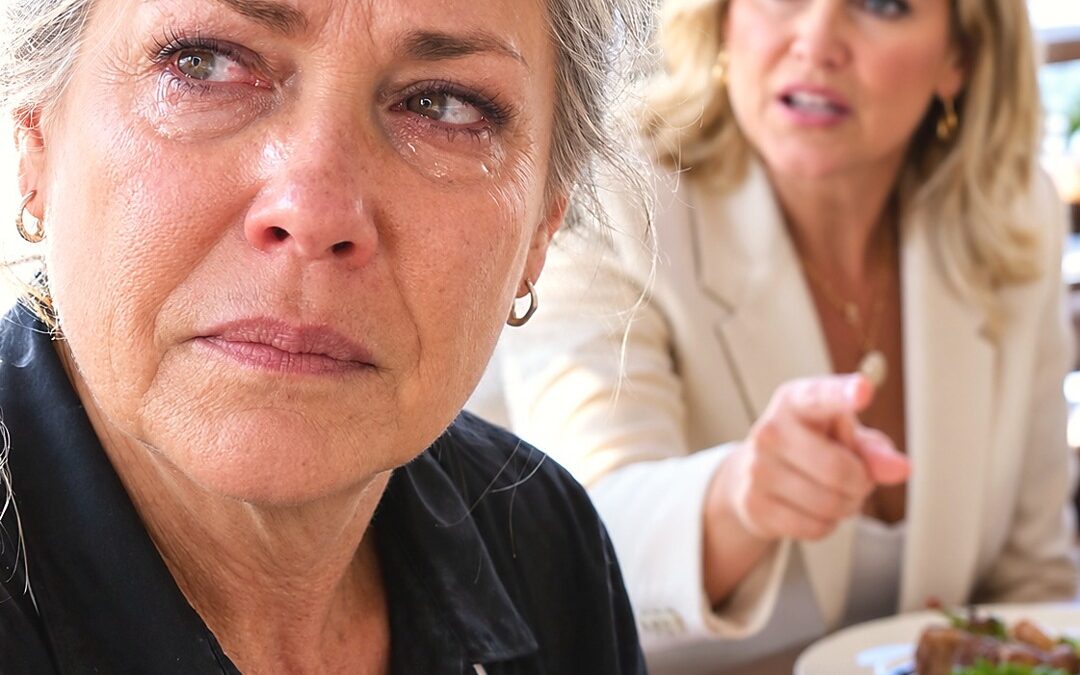
Brooke Vandermolen pushed Arne's plate across table nine, and the prime rib I'd cut into bites for him in the kitchen came apart in front of forty-some people while she said, "Somebody cut this man's meat for him. Todd, this is a window table, not a high chair. Put him at the bar with his baby plate." Ten minutes later Todd Pfeiffer took my apron off me in the middle of the dining room, and at fifty-eight, after thirty-four years on that floor, I knew the little apartment over the kitchen went with it. Brooke wanted that window for a man she'd been chasing for eleven months and had never once laid eyes on, and it never crossed her mind to wonder who the old man sitting in it was.
That was a Thursday in the middle of April, prime rib night at the Tamarack Supper Club, $28.95, with rotten gray ice still on the lake out that big window.
Arne Halvorsen had come in at 5:45, same as always, in his brown work coat and Tamarack Co-op cap. Everybody in town knew Arne. He drove the milk truck for the co-op forty years, he lived in the little house on Elm Street, and he mowed out at the Point for the Minneapolis people. I'd served him and his wife twenty-some years and couldn't have told you one thing more, except how he took his coffee.
I wrote his ticket.
"T9 — ARNE — PR MED — CUT — HALF CUP"
In the kitchen I trimmed the fat, cut the prime rib into bites with the good knife, and laid the pieces back together so from across the room it looked like a slab nobody'd touched. Then the coffee, half full in the heavy white mug with the green pine tree so it wouldn't slosh, handle turned to four o'clock. His hands had been going bad five years. Ingrid used to do the cutting herself, under the edge of the table, quick as dealing cards, and if you didn't know to watch you'd never have caught it. She died two Februaries back, and when Arne came in again after eleven weeks and sat down at table nine by himself, I went in the kitchen and did what I'd watched her do. That was about a hundred Thursdays ago. Neither one of us has said a word about it since.
When I set down his relish tray he looked up from his placemat, the paper kind with the lake map, SATHER POINT printed right across the water from his elbow.
"I've got business at seven. Rather eat first. Nobody wants to watch me eat."
"You've got all night, hon."
Todd Pfeiffer came through the kitchen door jingling, the manager's keys on a ring at his belt, running the place while his mother healed up from a new hip down in Mesa. At Christmas Marlys had told him she meant to sell when she got home, and Todd didn't have the money to buy it.
"Hurry up table nine, Carol. Somebody wants that window at seven."
"Then somebody can have it at seven. He's eating."
Arne's plate went down. He got hold of his fork on the second try.
At 6:10 Brooke Vandermolen came in the front door with an easel under her arm.
Brooke sold lake houses. She'd come up from Eau Claire six years back and built herself a glass one on the south shore that you can see from table nine on a clear night, lit up like a bait shop. She was president of the Chamber of Commerce. She called our place "quaint" to Todd's face, and Todd took it as a compliment. Behind her a young man from her office carried a rendering in shiny plastic about the size of a storm door, THE RESERVE AT SATHER POINT across the top and under it a row of big houses with docks, painted onto the far shore where right now there's pasture and woods and one old white farmhouse. She had a gold box in her other hand. She opened it on the bar so Todd could admire it. A Cross pen.
"Where's my window?"
"We've got a regular finishing up."
She looked over at table nine. Then she leaned in to Todd, but Brooke is a woman who leans loud.
"Some Sather cousin from Edina is driving up to sell me the prettiest shoreline in Wisconsin, and I'm not pitching it next to that."
She pointed at Arne with two fingers. "Remember who's backing you when your mother sells, Todd."
Arne heard it. I know he did because he quit chewing. He looked at the rendering on its easel a long time, the docks and the little painted people on their decks with their little painted wine, and then he turned and looked out the window at the Point, where the real farmhouse was sitting in the last of the light, and he didn't turn back for a while.
Todd came over and bent down. "Mr. Halvorsen, could we get you moved to the bar? We've got a business meeting coming in."
"Suppose I could," Arne said, and put both hands flat on the table to push himself up.
"He was seated first, Todd," I said. "He's eating his supper."
"Carol."
"He'll be done by seven. He's always done by seven."
That's when Brooke came over herself and looked down at his plate and saw the pieces.
When the plate went across the table, the slices I'd laid together slid apart, and a little juice ran out onto the map of the lake about where the public landing is. At table four Bud Gunderson got halfway up out of his chair, and his wife put her hand on his sleeve and kept it there. Shirley Dahl had a brandy bottle tipped over an old fashioned glass behind the bar, and she just held it tipped. In the pass window the cook stood with a plate of walleye in each hand.
Arne reached out toward the meat. His fingers started going and he stopped.
"I wasn't finished," he said. He didn't say it to anybody.
"I know, hon."
He drew the placemat toward himself with the side of his wrist, trying to get the paper over the spilled juice before somebody else had to look at it. Then he put his hands under the table.
"Ma'am," I said, "you don't talk to my customer like that."
Brooke already had her phone up. "Say it again for my followers."
So I said it again, same words, same volume, into the little lens. I've been hollered at by a Bears fan on New Year's Eve with gravy on his shirt. A phone doesn't do much to me.
Out of the side of my eye I could see Nate Ostrowski, our busboy, nineteen, holding his own phone low behind the bus cart with the dirty glasses, steady as a deer hunter.
"Do you normally tell paying guests how to behave?" Brooke asked her screen.
"I ask people to leave my customers alone while they eat."
"He's not eating, hon. Somebody already did that for him." She swung the phone at Arne. "Sir, are you being mistreated here?"
"Leave him out of your movie."
"Brooke," Bud said from table four, "that's enough now."
"You want to be in this too, Bud?" She didn't wait. "Todd. Either the waitress goes or my party goes."
Todd looked at her and then out at the lake, as if the ice might tell him something. His hand was on that key ring and he kept turning it.
Then he stepped behind me. I thought he was reaching past me for the plate. I felt the bow at the small of my back give, and then the other tie, and Todd Pfeiffer, who I taught to roll silverware when he was nine years old, lifted my apron off over my head in front of the whole Thursday crowd.
"Off the floor, Carol. Go on upstairs."
My order pad was in the pocket. Three pens, and the five I keep for change. I'd worn an apron on that floor since 1992, back when Marlys still had an ashtray going by the register and her husband Gene's bowling trophy sat on the shelf over it. Todd folded mine in half and held it against his shirt.
"Good," Brooke said. "That's handled." She went back to angling her easel.
I picked up Arne's plate. "He paid for it," I told Todd, before he could open his mouth, and I carried it through the kitchen door.
At 6:35 I walked Arne out the side door into the gravel lot with his supper in a clamshell box. His green '97 Ranger was parked by the dumpster with the same milk crate in the bed it's had since Clinton. The wind came straight off the ice and made my ears ache.
He set the box on the bench seat and went at the latch, and his fingers wouldn't do it, so I snapped it open for him and laid a plastic fork across the potato.
"You eat that when you get home."
"Probably will."
He'd left the price of his supper under his placemat, and his two fives for me. I said I'd see Todd got his change right. He shook his head. Then he looked across the lake at the dark line of trees out on the Point.
"I was supposed to meet somebody at seven. I think I already did."
I laughed, because I took it for one of his dry ones about Brooke. "Well, I hope the next one's got better manners."
He looked at me a second longer than I expected him to. "Take care of yourself, Carol."
"Mind that curve on County K."
The Ranger coughed twice and caught. At the end of the lot he turned left, toward the lake road, not right toward Elm Street, and I figured he was headed out to the Point like most nights, to sit on that porch he mows around and eat cold prime rib with a plastic fork.
I went up the back stairs at 6:45.
The apartment over the kitchen is one bedroom, a living room you can vacuum from the doorway, and a kitchen with cupboards painted so many times the doors won't shut flush. I'd been up there since my divorce in 2007. Marlys took $350 a month out of my check for it. Anything in town runs about $1,100, if you can find it, and mostly you can't till somebody's nephew moves out.
I was halfway across my kitchen before I noticed I was holding Arne's mug.
The heavy white one with the pine tree, still half full. I must've picked it up off table nine with the plate and had it in my other hand the whole time, out to the lot with Arne and back in, and up fourteen stairs, and never once set it down. Coffee had slopped over the rim onto my wrist and dried there.
I washed the four breakfast dishes in my sink. I dried them and put them away, and then I took them back out and washed them again. Then I held his mug under the faucet and got my hand on the cold handle and stood there. There was a brown ring inside, right at the halfway mark, where the coffee had sat all through supper and he never got to it. Ingrid always sent that mug back to the kitchen with one swallow left in the bottom, every Thursday, so I'd know he'd had some.
I didn't turn the water on. I set the mug on the windowsill facing the lake and turned the handle to four o'clock. I don't know who for.
There's a heat register in my kitchen floor by the refrigerator, an old iron grate, and whatever gets said in that dining room comes up through it, table nine loudest because it sits about right under. Nineteen years I've listened to proposals and breakups and Bud Gunderson explaining the Packers' offensive line to people who didn't ask. That night I listened to Brooke.
At seven she ordered a brandy old fashioned sweet and asked Todd had the man from Edina called.
She ordered another one. Then she sent Todd out to check the lot. His keys went across the floor and came back.
At 7:40 her phone rang. I only got her end of it.
"This is Brooke." Then a while. "Eleven months of letters and the old goat stands me up." Then a longer while. "Next Thursday? Six-thirty. Same table."
I sat down on a kitchen chair. I'd never been fired in my life. I got written up once, back when Gene was alive, for calling in sick to a Friday fish fry with pneumonia, and Gene said I should've known better than to schedule pneumonia on a Friday. Marlys tore it in half the next week and dropped it in that ashtray. I didn't call her. She was seventy-two and two and a half weeks out from a new hip, and the last time we talked she said getting from the recliner to the bathroom was about all the adventure she could stand.
Danny had texted a picture of Owen's new Lego truck with one wheel missing. I wrote back that it looked like my Buick and left it at that.
Around half past nine Brooke's heels went across the floor and the front door shut behind her.
At 9:40 I went down the back stairs in my socks with five placemats out of the stack I keep in a kitchen drawer to set under my leaky geranium.
Bud and his wife were still at the bar finishing their grasshoppers, and two of the Thursday regulars, and Shirley was wiping down, and Nate was collecting glasses off the far end. I put a placemat in front of Bud, blank side up.
"What's this?"
"Write down what you saw tonight. Your own words. Then sign it."
"For Marlys?"
"For whoever needs it."
He took the pen Shirley handed him and bent over that paper and took his time, and his wife moved her drink so he'd have elbow room. Shirley took one down to the end of the bar where the light's better. One of the regulars asked was there anything special I wanted them to put. I said just put what happened, and don't fix it up for my sake. He wrote a long time. The other one wrote three lines and signed it so big it ran off the edge.
Nate came over wiping his hands on his jeans. "Mrs. J, I got all of it. From before she even had her phone out."
"I saw you."
"Should I put it up? Because hers is gonna be—"
"Don't post it. Keep it."
"Just keep it?"
"The whole thing, hon. Don't trim anything off the front or the back." He wrote his on a placemat too, about standing behind the bus cart, and signed it with his middle initial.
I'll tell you why I said keep it. Hers was going to be everywhere by morning no matter what I did, and I've watched enough Facebook fights from behind that bar to know the second video only looks like the other side of an argument. I wanted the whole thing in front of somebody who'd have to do something about it.
Todd was in the office doorway with his tie pulled loose. "What are you doing, Carol?"
"Collecting what people saw."
"You're making this worse."
"She pushed his plate, Todd. I'm not making anything."
"I told you to go upstairs."
"And I went. Now I came down."
Bud swung around on his stool. "She asked me what I saw, Todd. I was sitting right there." Todd looked at Bud, and then at the five placemats in my hand, and went back in his office and shut the door harder than it needed.
Shirley reached under the bar and handed me half a cheese sandwich in waxed paper. "I ate the other half already," she said, which was a lie, and I took it anyway.
Upstairs I put the placemats in my mother's Bible, the old King James with the cracked spine, between Ruth and First Samuel, because that's where it falls open and I wasn't about to argue with a Bible over where it keeps things.
When I lay down my braid still smelled like prime rib. You can wash gray hair twice and it holds on to a kitchen. I don't know why that is.
At 11:58 my phone lit up on the nightstand. Nate. "She posted it, Mrs. J. She cut out the part where she pushed his plate."
Part 2
At nine Friday morning the chairs were still up on the tables, legs in the air, and Shirley was behind the bar counting the till in that whisper she uses so she won't lose her place. Todd had a typed sheet waiting for me by the register. He'd put it in a plastic sleeve, which tells you he'd been up a while thinking about it.
"You're done here, Carol. For good."
I read down to the bottom, where he'd put the part he cared about.
"Employer-provided housing ends with employment. Vacate by Thursday, April 30."
"Does your mother know?"
"You call my mother two weeks after her hip and I swear—"
He didn't finish it. Shirley stopped counting at eighty and left her hand flat on the bills.
"You swear what, Todd?" I said.
He didn't have anything for that, so he went back to the paper. "It's insubordination. It says so right there."
"That's a big word for asking a woman to leave an old man's supper alone."
"Don't do this, Carol."
I slid the notice out of its sleeve and folded it in thirds, the way you fold a guest check to tuck under the salt shaker, and put it in my cardigan pocket.
"I'll want my last check Tuesday. And Arne left cash under his placemat last night, plus two fives for me."
"I'll look into it."
Shirley reached under the drawer and came up with a ten. "Set it aside last night," she said, and handed it across the bar to me, and Todd opened his mouth and then shut it again.
Upstairs I set an empty box on my bed and stood there looking at it. I hadn't packed one thing since 2007, when Danny was sixteen and the two of us hauled a secondhand dresser up those back stairs and he swore at it the whole way in words I didn't know he knew. The bottom drawer still sticks in August.
I filled the box with winter sweaters, and when I picked it up the bottom let go and they landed in a pile by the dresser. I was halfway down the back stairs for the packing tape in the storeroom before I remembered I didn't work there anymore. I came back up and sat on the bed a while.
Then Shirley texted me a screenshot.
Brooke had put her video up on the Vandermolen Lake Homes page and shared it into the Tamarack Lake Community group, which is mostly lost dogs and who's selling a dock. LOCAL WAITRESS VERBALLY HARASSES PAYING GUEST AT PRIVATE BUSINESS DINNER. It opened on my face. "Ma'am, you don't talk to my customer like that." Then it jumped to Todd behind me with my apron strings. Somewhere outside the frame a chair scraped, and that was Arne, but you couldn't see Arne, and you couldn't see the plate. You'd never have known there was a plate.
By noon it had thirty-one thousand views.
I should have quit reading the comments sooner than I did. A woman whose anniversary supper I served in November wrote that she'd eaten at the Tamarack twenty years and was just sick about it. Her husband sent his steak back twice that night. The second time it was the same steak, and he said it was better.
That afternoon I drove the Buick down to Marketplace Foods for bread and packing tape. The checkout girl, whose folks I've served fish fry since she was in a car seat, scanned my bread, looked over at the next register, and decided the tape needed a price check. The price was printed right on it. I stood there with my loaf going nowhere on the belt while a man in a Packers sweatshirt behind me read every candy bar in the rack front and back. Going out the door I heard her say, "That was her." I sat in the lot with the engine off and the bread on the seat beside me until a woman I'd never seen in my life rapped on my window to ask was I leaving, because she wanted the spot.
Saturday morning I drove over to Elm Street to see was Arne all right. The Ranger was gone, the porch light off, a snow shovel still leaning by the door though we hadn't needed one in three weeks, and Ingrid's wind chime, the one made out of old spoons, still up on its hook over the step. The neighbor lady came out in her housecoat with a watering can.
"Looking for Arne? Rochester. The Mayo. Back Tuesday, I think."
"Is he sick?"
"His hands. He's had that booked since January. Left yesterday, seven in the morning."
Arne doesn't own a cell phone that I know of. Ingrid tried to show him Facebook once and he asked her why all these people were telling strangers what they had for lunch. I dug a Kwik Trip receipt out of my glove box and wrote on the back of it, Arne, just checking you're OK, call me when you're home, Carol, and my cell number under that, and wedged it in his storm door by the handle.
Saturday night Shirley came up the back stairs on her break with a plate of meatloaf and set it in front of me.
"Some lawyer called down here for you yesterday," she said. "Ten-something in the morning. A woman."
"Brooke's?"
"Didn't say whose. Asked for Carol Janke. Todd took it at the bar." She sat down, which Shirley doesn't do. "He told her, 'She doesn't work here. Went to her son's in Duluth, I think.'"
"I haven't been to Duluth since Christmas."
"I told him that. He told me to mind the bar." She took a pickle off my plate. "And Thursday, after you went up, Brooke was by the coat room with her coat on and she told him, 'Anybody calls about that waitress, she's gone.' I heard it plain as I'm hearing you."
So that was Brooke's lawyer, I decided, checking whether I'd gone and hired one of my own. With what, I'd like to know.
"Bud wants to call Marlys," Shirley said.
"Tell Bud to let that woman heal."
"You can't keep the whole town quiet, Carol."
"I can ask nice."
She ate another pickle. "Brooke was in for lunch. Asking Todd had you been talking to people. Who you'd been talking to."
"People were there, Shirley. They'll talk without any help from me."
Shirley looked at the boxes. "Twelve days doesn't sound right to me, Carol. My nephew's a deputy. He says they can't put you out on a typed sheet. They need a court order."
"I know it. I called the legal aid number in Eau Claire yesterday afternoon and a nice girl told me the same thing."
"So?"
"So I'm not dragging Marlys's boy in front of a judge while she's learning to walk again. Not yet."
Danny called at six. Somebody had sent him the video, because his wife's cousin is in that group and his wife's cousin is in every group.
"Mom. Come stay with us."
"Where, in Owen's toy room?"
"Owen can keep his toys in the garage."
"Danny, I'm fifty-eight. I'm not moving into your basement till I know what I'm doing."
"You don't have to know tonight."
"I've got till the thirtieth."
He was quiet long enough that I could hear Maisie in the background wanting to know where her purple marker went. "Did they really fire you for sticking up for an old man?"
"That's about the size of it."
"What's Marlys say?"
"Marlys doesn't know, and you're not going to be the one who tells her."
"Mom."
"Danny."
"Then at least send me the video."
"There's two. Hers, and a whole one the busboy took."
"Send me the whole one."
"When I get it."
Sunday the Tamarack opened for supper and I sat on top of it, which is a strange thing to do over a place you've worked thirty-four years. I could tell what the cook was prepping from the smell in the stairwell, onions and then the horseradish. At four I caught myself putting my shoes on to go down and fill salt shakers, and I took them back off. I had the Ledger open to the classifieds on my table. I circled one apartment over in the bigger town, then crossed it out when I got to the rent.
Around 8:30 Brooke's voice came up through the register. She'd ordered the walleye and was telling Todd it was dry, which it wasn't, because our cook has never once in his life sent out dry walleye. I got down on the linoleum next to it with a dish towel folded under my knee.
"Who was that old man Thursday?"
Todd didn't even have to think. "Arne Halvorsen. Drove milk for the co-op forty years. Mows out at the Point for the Minneapolis people."
Brooke laughed, one note. "The caretaker. At my table."
A glass set down. Her nails on her phone. "Listen to what Joan Ekstrom sent me yesterday." She read it out to him like it was a wedding toast.
"My client is ready to conclude the matter Thursday."
"Well, that's good," Todd said. "Isn't it?"
"That's eleven months, Todd. I'm having the bank. The families with deposits. The Ledger can bring a camera. They can all watch him sign."
"What if the fella changes his mind?"
"Todd. He's had eleven months to change his mind. His lawyer says he's ready."
I didn't know what families or what deposits. I lay there with my cheek about on the grate trying to make it come out to something, and the furnace kicked on and blew warm dust in my face.
"And Todd," Brooke said, right under my kitchen floor, "if that waitress is still up there Thursday night, you can find somebody else to buy your mother's restaurant for you."
Part 3
Todd fired Nate by text at 8:06 Monday morning. We're closed Mondays, so he couldn't even send the boy home. He just told him not to bother coming in Tuesday, on account of "filming guests."
Nate called me at 8:20 sounding about twelve years old. His mother wanted him to delete the video so nobody could say he'd done anything wrong.
"Don't you delete one thing. I'm coming over."
Birch Court is the trailer park out past the Cenex, eleven single-wides around a gravel loop and a dumpster with a bear latch. Nate and his mother have the last one, plywood laid over the front step and a plastic flamingo leaning on the skirting with its head chewed half off. His mother was going out the door in her scrubs. "He's been up since five staring at that phone," she said. "Make him eat something."
He put two cereal bowls in the sink, opened his laptop on the kitchen table and played it for me.
Two minutes and fourteen seconds. It started before Brooke ever got her phone out. There was Todd bent over Arne. There was Arne's hand flat on the table, pushing to get up. There was Brooke walking over and looking down at the plate, and then her hand, and the plate going, and the meat coming apart, and Arne's fork stopping halfway and coming back down. You could see Bud half out of his chair at table four. You could see Shirley's bottle stopped in the air. You could see my back, and then my face, and then Todd behind me with my strings.
Nate hit pause right on Arne, with his hands going under the table, and I reached over and hit the space bar myself so it would go on.
I sounded flatter than I remembered being.
"She didn't start filming till after," Nate said. "Hers makes it look like you just walked up and started yelling."
"I didn't yell in either one."
"So can I put it up? Everybody's sharing hers. Like four hundred shares."
"Not on her Facebook. Somewhere it counts."
He chewed on that. "Like the Ledger?"
"Maybe like the Ledger."
"My mom says lawyers cost money. Do you have one?"
"I haven't got a lawyer, Nate. I've got enough trouble paying the electric bill."
He copied it onto a flash drive out of the junk drawer, and since he couldn't find the cap he zipped the drive into a sandwich bag and handed it over. "I sent it to my cousin in Superior too," he said. "So it's in three places." I told him three was a good number, and I drove home with my hand around it in my coat pocket.
At noon I was filling up at the Kwik Trip when Brooke's new post came up on my phone. Her in a camel coat next to her rendering, teeth and all. This Thursday we're taking an exciting step toward bringing beautiful new homes to Tamarack Lake! Signing ceremony with our partners! And down at the bottom: Reserve your homesite at our County K sales office.
I didn't know she had a sales office. I didn't know you could sell a homesite on land you hadn't bought yet. I hung up the pump and drove out County K.
It was a white construction trailer on a gravel turnout, a little sedan by the steps, and a sign out front you could read at fifty-five.
"SATHER POINT HOMESITES — UNDER CONTRACT — RESERVE YOURS — $25,000 REFUNDABLE"
There was a plastic box of brochures screwed to the railing. I took one. Glossy, heavy paper, the lake on the front printed bluer than it has ever been in April. Inside was a site map, thirty-one lots with white lines between them, a sheet cake somebody'd already sliced. Lot one was the farmhouse. I knew it was the farmhouse because they'd drawn the porch swing in, and across the roof in black capitals it said TO BE REMOVED.
Lot fourteen sat right behind it, where Ingrid Halvorsen used to keep her garden. She brought me tomatoes from it once in a Marketplace sack with one handle torn off. She said the rabbits had taken their share and she'd decided to get hers before they invited relatives.
The woman in the trailer was very pleasant. Lot one was "a premium building site." The farmhouse was "part of the acquisition." Had the owner agreed to that? "Our contracts are being finalized." Finalized with who? "The Sather family trust. The owners are down in the Cities." And who lives out there now? "Oh, nobody lives there." I said somebody greases that porch swing every spring, and she smiled at me like I'd asked about the weather in Phoenix. She gave me a price sheet I didn't ask for and a mint.
I folded the brochure onto the passenger seat. Before I started the car I looked one more time at that little drawn porch swing with the black letters across the roof over it.
On the way home I stopped at Fleet Farm for windshield washer fluid, and Mike Olstad was behind the service counter. Mike's a mechanic there, thirty-nine, a good kid who still calls me Mrs. Janke when his wife's around, and she's an aide over at the elementary. He gave me the look people were giving me that week. Then he lowered his voice.
"We put money down on one of those Sather Point lots, Carol."
"Which one?"
"Fourteen. Right behind the old farmhouse."
"That's Ingrid Halvorsen's garden."
"The what?"
"Nothing. How much?"
"Twenty-five." He looked out the window at his truck. "They said we'd get it back if the deal fell through. Don't tell my wife I sound nervous. She's nervous enough for both of us. She's already got the kitchen picked out."
"You get a receipt?"
He pulled his wallet out and unfolded a pink carbon copy he'd been carrying around like a lottery ticket. VANDERMOLEN LAKE HOMES. LOT 14, SATHER POINT. PARCEL UNDER CONTRACT. Brooke's initials at the bottom in gold ink.
"Can I take a picture of that, Mike?"
"What for?"
"So there's two of it."
He held it flat on the counter for me, and his hand wasn't any steadier than Arne's.
I wasn't going to stand in Fleet Farm telling a man what to do with his house money when I couldn't hang on to a room over a kitchen.
At three a FedEx envelope was waiting at the bottom of my stairs, from a law office in Eau Claire. If I published "any recording" concerning Mrs. Vandermolen or her company, they would see me in court. Todd had watched me collect those placemats, and he'd seen Nate behind the bus cart. Upstairs I checked the Bible. All five were still between Ruth and First Samuel. I put the lawyer's letter in there with them, and the brochure, and the picture of Mike's receipt printed out on my old printer, which took three tries and most of the cyan. Whatever Brooke was building, I was building a pile too, and I meant to set it down in front of somebody who couldn't scroll past it.
Shirley came up at four with two empty boxes from the liquor distributor, SMIRNOFF on the sides. She read the letter standing up.
"Well, isn't that rich."
"Nice paper, though. Feel it."
"Carol, I've got a couch."
"You've got a one-bedroom and a cat that hates me."
"Todd's been in that office all day with the door shut," she said. "Ate a whole sleeve of saltines. Didn't even share with the cook."
She looked over at my kitchen door frame, where the pencil marks go up, and she let the couch drop.
Tuesday afternoon the ice went out. I watched it from my window, big gray plates cracking loose and sliding off toward the narrows, and by supper the lake was open water with the sky lying flat on it. I packed all day.
At 7:45 Brooke was back at table nine, and up came her voice.
"Todd. Listen to this. Joan sent another one." She read it out.
"My client will sit down Thursday at six-thirty on two conditions: the window table, and Mrs. Janke pours his coffee. He takes it half full."
It got quiet down there.
"Half full. That's Arne," Todd said. He said it in the same voice he'd used reading the specials when he was twelve.
I had a roll of packing tape in my hand and I set it down on the stove, careful, like it might go off.
"The caretaker went crying to his boss." Her chair scraped. "That old man complained, and now the owner wants the waitress back to hold his hand. Fine. Unfire her for one night."
"I gave her notice, Brooke. She's packing."
"Then she can unpack. Go find out if she's still up there."
Todd said something too low for me. He didn't say a thing about Duluth. I'd have heard it. I was on my knees with my ear an inch off that grate and I would have heard it.
At 8:10 somebody knocked at my door at the top of the back stairs. That door gets me, Shirley, and the furnace man once a year.
Brooke Vandermolen stood on my landing in a cream-colored coat with her phone in her hand. In six years she'd never been above the dining room. She looked past me at the boxes stacked by my bedroom door, and she stepped into my kitchen without being asked.
"Your caretaker friend went crying to the man who owns that Point," Brooke said, "and now the owner wants you pouring his coffee Thursday. So you and I are going to make a deal, Carol."
Part 4
She didn't take her coat off. She stood between my table and the stove with the toes of her boots on the edge of my rag rug, as if it might be catching.
"Thursday at six-thirty you come downstairs and pour that man's coffee. You smile. You don't say one word about last week. Todd tears up your notice and you've got your job back."
"And if I don't?"
"Then the letter from my attorney turns into a lawsuit. And your housing ends with your employment, Carol, you've read it. The thirtieth you're out, and if you're not, I'll have Todd take it to the county."
The kettle started to rattle on the burner behind me. I turned it off before it could whistle.
"The Sather family has been negotiating with me for eleven months," Brooke said. "Their caretaker complained to them about Thursday, so now the owner wants you. That's all this is. A little customer service."
"Did you tell the owner you pushed Arne's supper off the table?"
"I'm not going over that again."
"Did you tell him you filmed me and cut the plate out?"
"Are you agreeing or not?"
I looked at her a while. I was thinking about Arne, in some lawyer's office or on the phone with one, telling a man from Edina he'd like his coffee poured by me.
"I'll pour his coffee."
"Six-thirty." She was already turning around. "And wear something presentable. The bank will be there."
"I've poured for bankers, hon. They drink it the same as anybody."
I listened to her heels all the way down the stairs and out the bottom door.
At nine Todd knocked and came in before I said to. He stood behind one of my kitchen chairs and held on to the back of it.
"Brooke says you're coming down Thursday."
"To pour coffee."
"And then you're back. That's the deal."
"Will you write that down for me?"
He looked over at my table, where the other thing he'd written down was still sitting, folded in thirds.
"Mom's going to sell, Carol. You know she is. I've been in this building since I was in diapers and I can't buy it, not without somebody standing behind the loan. Brooke said she would."
"I heard her remind you Thursday."
"So I can't have another scene."
"Todd, I worked for your mother thirty-four years. How many scenes have I made?"
He didn't answer, so I asked him again, and he looked up at the clock over my stove, which runs four minutes fast and always has.
"I'll bring an apron up Thursday afternoon."
"Leave it on the hook."
After he went down I stood at the sink and let the water run till it came cold, and didn't fill anything with it. Then I went and stood by his mug on the windowsill, the brown ring still in it, and after that I lay awake till about two.
Wednesday morning I was up at five filling boxes. I wrapped my rummage-sale plates in old copies of the Ledger and left out the chipped one, because it always caught the dish towel and I wasn't going to miss it.
Then I got to the door frame.
Every Fourth of July Danny brings the kids down for the parade and the fireworks off the Tamarack's dock, and before they eat one bratwurst they stand against my kitchen door frame and I put a pencil line on top of their heads. "MAISIE 4 — 7/4." "OWEN 2 — 7/4." And on up from there. Maisie climbs straight. Owen's are crooked, because he always turns his head to watch the pencil.
I got a butter knife in behind the trim and pushed. The paint cracked along the edge. The knife bent. I tried lower down and it bent worse.
I sat on the floor with the bent knife across my knees. Owen's lowest mark was about even with my ankle. Danny had to hold him up for that one because he kept wanting to sit down, and the two is backward because Maisie wrote it. I put my finger on that line one time. Then I laid the knife down on the linoleum and left it there.
At 9:30 the phone rang.
"Carol." It was Arne. "Got in late last night. Found your receipt in the storm door."
"Arne. How was Rochester? What'd they say about your hands?"
"New pills. Tests. Wants me back in the fall." He took one of his pauses. "You all right?"
"Managing."
"Come out to the Point this afternoon. Four o'clock."
"I was going to come out anyhow," I said. "There's something out there you need to see."
"Then bring it."
At ten Danny called again. I told him Shirley's couch was the plan, and her cat was against it.
"Mom." I heard him let his breath out. "Just go pour the man's coffee, Mom."
"I'm going to. But first I'm taking him a brochure."
"A brochure."
"Somebody's fixing to knock down that house he takes care of, and I don't think he knows."
At 3:30 I drove out County K. The lake was open now, chopping up against the rocks, and there was still snow under the pines on the north side where the sun can't get at it. The lane to the farmhouse is gravel and potholes, and I drove the Buick half on the grass to get around the puddles.
The house is two stories, white, with a porch that goes around three sides and needs paint on the west end. The swing hangs at the far corner. I could see the grease shine on the chains from the car. Arne was on the swing with his coat buttoned to the neck, and at the porch table sat a woman about sixty in a navy blazer with a stack of folders by her elbow.
"Carol. Come on up." He started to get up.
"Stay put, hon. I've got legs."
The woman stood and put her hand out. "Joan Ekstrom. Rice Lake. I've handled Arne's affairs for twenty years."
Ekstrom. I'd heard Brooke say that name up through my kitchen floor twice. I looked at her and then at Arne, and I got it wrong. The owner's lawyer had driven up to tell the caretaker his mowing days were done, and here I was with worse news in my purse.
"Then I guess you both better see this," I said.
I unfolded the brochure on the porch rail. The wind got hold of a corner, and Joan held it down with her reading glasses.
"That's this house," I said. "Lot one."
Arne took it from me. The paper rattled in his hands. He held it closer, then farther, and then he read out loud what was printed across the roof. "To be removed."
I told them about the sign on County K, UNDER CONTRACT and the twenty-five thousand, and about Mike Olstad's house money on lot fourteen.
Joan took the brochure from Arne and looked at it a long time, glasses back on and down her nose.
"She's selling lots she doesn't own on a contract that doesn't exist," she said. "That's fraud. Plain."
"Then somebody had better tell the owner," I said. "Does he even know? The Minneapolis people?"
Joan looked at Arne.
Arne took off his Co-op cap and set it on the swing beside him.
"Ingrid was born in this house, Carol."
"I know that."
"Her dad put the whole place in a trust in '89 so it wouldn't go through probate. It was for her."
"Ingrid had the benefit of the trust," Joan said. "When she died, it passed to Arne. I'm the trustee. He's the man who decides whether I sell."
I looked across the yard at the garden, where there wasn't anything yet but last year's tomato stakes.
"All of it?"
"All of it," Arne said.
"What about the cousins in Minneapolis?"
"Ingrid let the town tell that one. Her mother got pestered every time lakeshore went up a dollar, and Ingrid didn't care to be looked at. So we let 'em talk."
Thirty-seven years he'd let them talk. I'd been one of them, and I'd talked plenty.
He turned the cap around in his hands.
"We started eating Thursdays at the Tamarack in '73. When my hands went, she'd cut my meat under the edge of the table so nobody'd stare. Half a cup of coffee. Handle at—"
"Four o'clock."
"Four o'clock." He looked down at the porch steps. "When I came back after she died, you brought me supper all cut up, laid back together. Sat in my truck awhile afterward. Kept thinking she ought to be coming out behind me with her purse. She always forgot something at the table."
There was a curl of white paint lifting off the porch rail by my hand. I worked it loose with my thumbnail and broke it in half, and then in half again.
"Arne. Thursday, that woman stood right there and told Todd who she was. Why didn't you say anything?"
"She told me who she was. Didn't need to tell her who I was."
Then he gave me the week, in about four sentences, the way Arne gives you anything. He'd driven straight out here Thursday night and called Joan off Ingrid's kitchen phone, had her move the meeting a week, and asked her to find me. Friday at seven he drove to Rochester, because that appointment was three months coming and you don't hand back a Mayo appointment for anybody. Joan called the Tamarack Friday morning.
"Your manager told me you'd gone to your son's in Duluth," Joan said. "There's no Carol Janke in Duluth. I looked."
"So Tuesday I told her," Arne said. "'If she's in Duluth, they'll have to go get her.'"
I told them about the notice, and the thirtieth, and nineteen years over that kitchen. Arne didn't say one word through any of it. When I got done he got up off the swing, which took him a minute, and went inside, and through the screen door I heard him dialing the old wall phone in Ingrid's kitchen.
"Marlys. It's Arne Halvorsen." Then a long while of listening. "…Thursday. I'll pay for the ticket, Marlys, don't argue."
Joan and I sat at the porch table with the brochure between us and didn't look at each other. A pair of mallards came in low over the open water and landed hard, like they'd forgotten how over the winter.
Arne came back out and sat down on the swing with the brochure on his knee. "Thursday you pour my coffee, Carol," he said. "Half a cup. Then I'm going to tell thirty-one families whose land they bought."
Part 5
At 6:20 Thursday I came down the back stairs in my blue church sweater, the one with the pearl buttons, and no apron.
The lake out the big window was open water, dark blue, with the sun low enough to lay a stripe all the way across to the Point. A week before there'd been ice shoved up on the rocks over there.
There were sixty people in that dining room if there was one. The Thursday regulars at their usual tables. Table four. Our bartender of twenty-eight years making old fashioneds two at a time. The cook with his whole head through the pass window, not even pretending about his tickets. Nate Ostrowski, the busboy Todd fired by text, sat up on a bar stool with a Coke he'd paid for himself, and when he saw me he lifted it about an inch.
Brooke had a long banquet table pushed right up against the side of table nine. Down one side sat a loan officer from Northwoods State Bank, fifty-something, with a folder as thick as a Sears catalog. Next to him were Mike Olstad in a clean plaid shirt and his wife in earrings, and past them eight or nine more couples dressed for a christening. The editor of the Ledger had his camera hung around his neck. The easel stood in the window, angled so the painted houses lined up with the real Point behind them. The gold pen was out of its box and lying across a stack of papers.
Todd was standing by table nine in a better tie than he wears to work.
"Your apron's on the hook, Carol."
"I'm pouring coffee, Todd. I'm not on your clock."
I went around behind the service station, took down one of the heavy white mugs with the green pine tree and set it by the urn.
Brooke saw me from across the room. "Carol. Good. You came." She tapped the corner of her own mouth and smiled at me, in case I'd forgotten how it goes, and turned back to her bank man.
At 6:24 Brooke stood up and lifted her old fashioned.
"Biggest deal in Tamarack County history."
The long table clapped. A couple of regulars at the bar swiveled around on their stools to see what for.
"Thirty-one homesites," Brooke said. "And I especially want to welcome the Olstads. Our lot fourteen family." Mike's wife smiled. Mike looked down at the papers. "Just hoping it all gets signed," he said. Brooke said that's what tonight was for, and she turned the easel one more inch toward the window.
At 6:28 the front door opened and Arne came in. Brown work coat, Co-op cap, and Joan Ekstrom behind him with a leather folder under her arm. He stopped on the rubber mat and knocked one boot against the door frame, and then he did the other one too, though Todd was already walking at him.
Brooke set her glass down. "Todd. Not again. Not tonight."
"Mr. Halvorsen," Todd said, "we've got a private—"
Joan stepped up beside Arne. "Mrs. Vandermolen, this is Arne Halvorsen. He's the sole beneficiary of the Sather Point Land Trust. You've written him eleven letters."
Brooke looked at Arne. Then at the rendering she'd paid somebody in Minneapolis to print. Then out the window at the Point. Then she put her hand on the back of the empty chair at table nine, and she left it there. Eleven months she'd been mailing letters to a lawyer's office in Rice Lake, and the courthouse doesn't have a thing on that land but the name of a trust. You can't look up a man nobody wrote down. She'd taken the town's word for who he was, the same as I had.
Todd unhooked the key ring from his belt and stood holding it out in front of him, as though he'd forgotten what any of them opened.
"You told me he mowed," Brooke said to him.
"He does," Todd said.
Arne took his cap off. "You had my table last Thursday. I'd like it back."
He went past her and sat down at table nine facing the lake. Joan took the other chair, and Brooke had to let go of it. I brought the mug over, poured it half full and turned the handle to four o'clock, and he got it on the first try. "Thank you, Carol," he said. "You bet, hon."
Brooke came back fast. I'll give her that much, she's quick on her feet. She came around the end of the long table with her hand out.
"Mr. Halvorsen, I owe you an apology for last week. There was a misunderstanding. I was told you were the caretaker."
"I mow there."
"Well. Regardless." She opened a leather portfolio and slid the purchase agreement across to him and laid the gold pen on top, clip up. "Eleven months. I think we're both ready to put this to bed."
Arne didn't touch the pen. He looked past her at the long table.
"Mike Olstad?"
"Sir?"
"What'd you give her for lot fourteen?"
Mike looked at Brooke before he answered. "Twenty-five thousand. It's our down payment."
"Lot fourteen's my wife's garden."
Mike's wife slid the site map out of the pile in front of her and found fourteen with her finger.
The loan officer opened his folder. "Brooke, you told the bank that agreement was signed and sitting with his attorney."
"It's sitting with the trustee," Joan said. "Unsigned. And the trustee is me. I sign nothing he hasn't said yes to."
"Joan, we agreed on a price."
"You offered one."
Brooke turned back to Arne. "Could we talk about this privately?"
"We're talking."
"There are families at this table who've put their savings into this project."
"That's why they ought to hear it." He set his mug down. "I never told Joan yes, and I'm not going to."
Mike pushed his chair back. "You told us this land was under contract."
"It was proceeding toward contract," Brooke said.
"You took twenty-five thousand dollars off me and my wife."
Joan took a letter out of her folder and laid it on table nine next to the brochure I'd carried out to the Point. "Your seventh letter, Mrs. Vandermolen." She read one line out loud. "The farmhouse will be preserved as the heart of the Reserve." Then she put her finger on the brochure, on the little drawing of the porch with TO BE REMOVED printed over it, and tapped twice.
The loan officer took his glasses off and leaned in. Mike stood up to see. The Ledger's editor lifted his camera, and Brooke said, "Would you put that down, please," and he lowered it to about his chin.
"Those are preliminary drawings," Brooke said.
"You handed them to people with checkbooks," Joan said.
Brooke turned back to Arne and put her voice down where you'd put it for a horse. "Mr. Halvorsen, I understand there's an attachment. We could keep elements of the house. The porch. We could incorporate it into the clubhouse."
"My wife was born in that house."
"I understand that, and—"
"No, ma'am."
He looked past her to Mike. "How long'd you save that money?"
Mike had to clear his throat. "Seven years, sir."
"We gave our landlord notice in March," his wife said, to nobody, to the site map. "We told the kids they'd get their own rooms."
Then Brooke turned around and found me by the service station with the coffee pot in my hand.
"You," she said. "This is your doing. You drove out there with my brochure and stuck your nose in a private transaction. Two years you've been buttering him up, cutting his steak for him like he's—"
"It's a window table, Brooke, not a high chair. Take your pen to the bar."
She picked the gold pen up off the agreement and went to put the cap back on. She missed. She tried again, and the cap skipped off the end and rolled across the table and dropped over the edge and went under table nine, and she stood there holding a pen with no cap on it and didn't bend down for it.
Mike's wife, closest, folded the site map in half and then in half again. The loan officer put his glasses back on. At table four the wife let go of her husband's sleeve, a week late. Up at the bar Nate set his Coke straight down on the wood without a coaster, which in twenty-eight years I have never seen Shirley allow, and she let it sit. In the pass window the cook pulled his head back in and went to his tickets.
The loan officer shut his folder. "The commitment runs out the thirtieth, and it still needs a signed purchase agreement. Loan committee's Monday, Brooke. Bring a signature or don't come."
He tucked the folder under his arm and stepped back from the table. Brooke reached after it and got air.
Mike's wife stood up. "We want our deposit back. Tonight."
A husband two chairs down stood up too. "Us too." Then a woman at the far end, with her purse already on her arm. Brooke asked could they please discuss individual accounts in private, and Mike said, "We've done plenty of talking in your office." The camera clicked.
Arne looked over at the bar. "Would you mind putting that thing in the coat room?"
Shirley came out from behind the bar wiping her hands. She folded the easel up with the rendering still clamped on it and carried it the long way, past every table in the room, thirty-one painted docks going by at hip height, and stood it in the coat room with the umbrellas.
"That's company property," Brooke said.
"Then the company can come get it," Shirley said. "With its claim check."
At 6:50 the front door opened again. I heard the cane on the tile before I saw her.
Marlys Pfeiffer stood in the entry in her traveling coat with her purse strapped across her chest, a little shorter than I remembered and a good deal grayer, straight from the Minneapolis airport with her sister driving.
"Mom?" Todd said.
Brooke got to her first. "Marlys. This really isn't the time."
"I've been in a car since Minneapolis, Brooke. I've had all the time there is."
Then she turned to her son and held out her hand, flat. "Keys, Todd."
He was already holding them. He walked them to her across the whole dining room and laid them in her palm, and she put them in her coat pocket without looking down.
Todd turned and looked at the long table, and at Brooke, and at me last.
"She said she'd back me to buy the place from Mom. I'm sorry, Carol." He swallowed. Then, to Joan: "And Friday, when you called. I thought you were Carol's lawyer. Brooke said if anybody called, Carol was gone."
"You sent me looking for her in Duluth," Joan said.
"I know it."
Marlys came across to table nine on her cane, and Arne watched her come the whole way. Then he reached in his coat pocket.
Arne set an old brass key on table nine, on a loop of baler twine with a cardboard tag that said POINT HOUSE in a woman's handwriting. "Joan," he said, "show her page two before she says no."
Part 6
Joan opened her folder on table nine and turned it so I could read it, and when I couldn't, because my glasses were upstairs on the bread box, she read it out to me.
The Point would go into the Tamarack Lake Land Trust. Wild for good, no houses, not ever, and a public path down to the water so anybody in the county could walk out there and look. That was page one, give or take. Page two had my name on it.
"Point House and two acres," Joan said, "leased to Carol Janke for her lifetime. One dollar a year."
"Absolutely not," I said.
Arne took a drink of his coffee.
"You can't give a person a house for cutting your steak, Arne."
"You didn't cut a steak." He set the mug down with the handle back at four. "You cut about a hundred of 'em and never once told me."
"That doesn't mean you owe me one thing."
"I know it."
Brooke was still standing in the window where her easel used to be. "You can't just give away two hundred and twelve acres," she said.
"He can tell his trustee what to do with them," Joan said, "and he has."
"And our deposits?" Mike's wife said.
"That's between Mrs. Vandermolen and the State of Wisconsin," Joan said, "and I'd make the call first thing in the morning."
Then Joan turned back to me. "It still has to be signed and recorded, Carol. But that's what it'll say."
I looked at the key on the table, the twine gone soft and gray. I knew that handwriting on the tag. Ingrid used to leave notes in the tip jar at Christmas, and she made her capitals the same way, the P like a flag on a pole.
"I pay the taxes," I said. "And I still pour his coffee Thursdays."
"Joan, put that in."
Joan uncapped her own pen, a Bic, and wrote it in the margin.
Arne pushed the key across the table at me with two fingers. I picked it up. It was warm from his coat. I put it in the pocket of my church sweater, about where my order pad used to ride, and kept my hand on it.
Marlys lowered herself into a chair and hooked her cane on the edge of the table. "Since we're putting things in. I'm not selling. I decided somewhere over Iowa. Carol, you've got Thursdays and Saturdays, starting this Saturday, if you want them." She pointed her chin at the bar. "And that young man with the Coke is hired back, and you're training him. Todd. You tell him first."
Todd looked over at the bar. "I'm sorry, Nate. You didn't do anything wrong."
Nate about knocked his stool over getting down off it.
Todd stood by the kitchen door. His mother didn't look at him, and I've known Marlys long enough to know that was worse than if she had. "Todd," she said, still not looking, "go see does the cook need a hand with those dishes."
He went. The kitchen door swung behind him twice and stopped.
Brooke had picked up her purse.
"Before you go," Joan said. "Your attorney sent Mrs. Janke a letter."
"That letter stands."
"Carol," Joan said, "do you still have what you collected last Thursday?"
I went up the back stairs and got my Bible off the shelf and came down with it. Carry a Bible through a supper club on prime rib night and you'll get looked at. Shirley said, "Well, Lord," to the muskie. I opened it between Ruth and First Samuel and laid the five placemats out on table nine, lake map side down, Bud's block capitals on top. Nate came over and set his phone beside them with the video ready.
Joan read Bud's to herself. Then she played the whole two minutes and fourteen seconds with the sound turned low, and everybody near enough leaned in to watch it: the plate going across, Arne's fork stopping, Todd's hands at the small of my back.
"The letter's finished," Joan told Brooke. "You cut a video to say a woman did something she didn't, and here's the whole tape and five signed witnesses. That's defamation, and your attorney will know it by morning. He'll withdraw the letter this week."
"And I've got one condition," I said. "You say what happened, in this room, out loud."
Brooke didn't answer either of us. She hitched her purse up on her shoulder and walked out, and she squeezed out sideways between her own banquet table and the window. Past the Olstads. Past table four, where Bud Gunderson stood at his chair. Past the bar and the muskie and the cook in his window, and out the front door to her white Range Rover parked across two spaces.
Nate got down on his hands and knees under table nine. "Found it," he said, and held up the cap of the gold pen.
"Somebody bring me a cup of coffee," Marlys said. "And find out is there any prime rib left."
On Saturday, May 16, the Chamber of Commerce had its breakfast at 7:30 in our dining room, same as the third Saturday of every month. About thirty members, scrambled eggs and pancakes, and the coffee urn I'd scrubbed the night before till you could see yourself.
That week's Ledger was on every table. On the front page, below the fold, there was a photograph of five placemats laid side by side with the handwriting showing, and next to it a box that said CORRECTION. On the paper's website they'd put up the whole two minutes fourteen seconds.
Brooke's lawyer had called Joan the Monday after. That's all I know about that, and all I needed. The cut video was gone off Facebook by that Wednesday, and the Vandermolen Lake Homes page went with it.
Brooke came in at 7:40 with her coat still on and stopped inside the door when she saw the Ledgers. Somebody had left one on her chair. She moved it to the next chair over and sat down.
When it was her turn she got up at the head table with one sheet of paper. She didn't look up from it once.
"On April sixteenth I posted a video that was cut to make Carol Janke look like she mistreated a customer. She did not. I pushed Mr. Halvorsen's plate. I'm sorry."
She sat down. Bud Gunderson got up, Chamber treasurer, seventy-four years old, hitching his belt. "Then I move we remove Mrs. Vandermolen as president. Effective this morning."
"Bud," she said. "We've worked together six years."
"We have. I was at table four."
Somebody seconded it. Hands went up around the room, and Bud counted them out loud with one finger, the way he used to count milk cans onto the co-op dock, and got twenty-four for, four against, and two that sat on their hands. He took the president's folder off the head table and set it down by his own plate. Then Mike Olstad stood up from a table by the window and said the state consumer protection people had opened a file on the deposits and all thirty-one families had filed, and he sat back down and ate his eggs.
When Brooke went past the service station I moved the coffee pot so she'd have room.
Back in the kitchen Todd was at the dish pit in an apron with his sleeves rolled, running the sprayer over syrup plates. His mother kept him on. She didn't keep him in charge. When I brought him a rack of dirty mugs he shut the sprayer off. "I should've called Mom that first night, Carol." "Yes, you should've," I said, and handed him the rack.
On Thursday, October 1, I was out on the porch of Point House before the sun came up, in the swing, when I heard the Ranger coming down the lane.
I moved out here in June. Before I left the apartment, Marlys sent the cook up with a pry bar, and he got the trim off my kitchen door frame in one piece without so much as cracking the paint, and drove it out here himself and nailed it up inside the kitchen door at Point House. All the old marks came with it. This July we put the new ones on under the farmhouse light. "MAISIE 7 — 7/4." "OWEN 4 — 7/4." Owen made his own four this year, and he got it facing the right way.
Across the lake the Tamarack's sign was still lit from the night. Down the south shore there was a SOLD sign out front of Brooke's glass house. The Olstads got their twenty-five thousand back in August, and so did the other thirty families, and Vandermolen Lake Homes is gone.
Arne parked behind my Buick and got out with a thermos under his arm and two of the Tamarack's heavy white mugs with the green pine tree hooked on one finger by the handles.
"You stole those," I said.
"Borrowed 'em."
"Shirley know?"
"She counted 'em."
"You'll have to bring them back."
"Figured I'd bring 'em back Thursday. Full."
I put tomatoes in Ingrid's garden this summer, lot fourteen, behind the house. The rabbits took their share. I got mine before they could invite the relatives, and I brought Arne a Marketplace sack of them with both handles on.
He sat down on the swing next to me. His hands are better than April and worse than they used to be. Some mornings the new pills help and some mornings they don't, and he doesn't say which kind of morning it is, and I don't ask.
I never did give back the mug from that night in April. It's on my kitchen windowsill in there behind us, still facing the lake, which from this side of the water means it faces the Tamarack.
Arne got the top off the thermos, which took him a while, and I let it take him a while. He set the two mugs on the rail.
He poured mine first, half a cup, both hands around the thermos, and slid it across the porch rail to me with the handle turned to four o'clock.



