At the Church Luncheon Honoring Her “Secret Kindness,” My Future Daughter-in-Law’s Stepmother Held Out a Catering Apron and Said, “Dewey’s Short a Pair of Hands, Treva, and Yours Know the Work”—112 Guests Watched Me Tie It On, and She Never Asked What Marnie Kept Folded in Her Pocket Bible
Part 1 — THE APRON
PART 1 — THE APRON
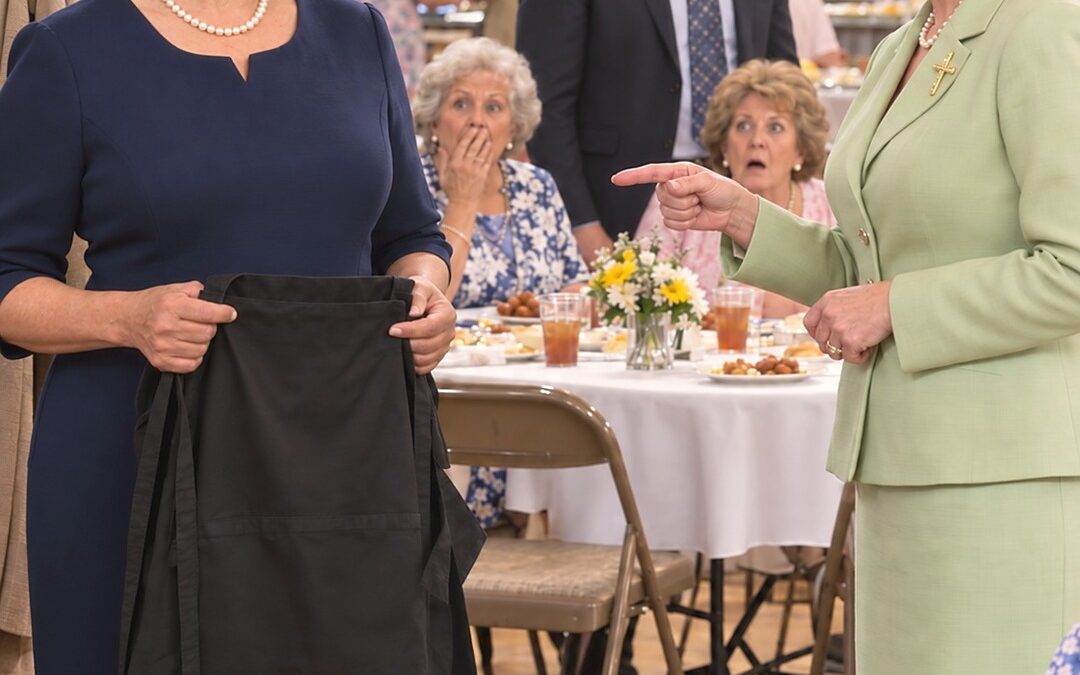
At 12:05 Saturday afternoon, Gayle Ledbetter stood beside the coat rack at Tillman Street Baptist and held a black catering apron out to me by the neck loop, CATO'S CATERING printed in white across the bib. “Dewey's short a pair of hands, Treva, and yours know the work.” Behind her, 112 guests were taking their seats for the luncheon honoring Gayle’s “secret kindness,” with my son fifteen feet away and the woman he planned to marry in May still working the front doors.
“You do this for a living, Treva. The rest of us just do it for the Lord.”
She said it loud enough for Tables Four and Five.
Gayle, Marnie’s stepmother, had dressed for the luncheon in a pale green suit with a gold cross on the lapel. The blue velvet box holding the gold Hands of Mercy pin rested on the head table near a water pitcher. She reached over and touched the box with two fingers, then brought her hand back to the apron.
Two Guild women raised their napkins almost together. One made a sound into hers before lowering it. The other studied the butter packet beside her salad plate.
Cal stood near Judd holding two identical luncheon programs and reading both fronts as if one might contain different news.
I pressed my left thumb along the crease of my own program, once. I was still deciding.
My purse went on the empty chair by the wall.
“I've worn one for thirty-eight years, Gayle. It's never embarrassed me yet.”
Gayle smoothed both apron strings until they hung straight.
“Good. Dewey will appreciate it.”
“I expect Dewey can speak for himself.”
I took the apron. The fabric was heavier than the aprons I kept at the Back Porch, and the white lettering crossed the bib in block letters big enough to read from several tables away. I slipped the neck loop over my head and drew the strings around my waist once.
The black apron covered most of the front of my good navy dress.
Two minutes earlier, I had come through those same double doors with my purse and program. Marnie had waved to me from the greeting table while somebody beside her searched a sheet for missing name tags.
A pocket New Testament stuck out of her cardigan. Behind the front cover, the corner of a square of wax paper showed like a bookmark.
I had noticed it because people who use wax paper notice wax paper.
Then Gayle had caught me before I reached Cal.
“Marnie,” she called.
Marnie turned partway from the doors.
“Stay at the doors until the last ones are in. Ouida has the Guild pictures.”
“Oh. Okay.”
Ansley Sims moved beside her with the name-tag sheet and the pencil that had lost its eraser. Marnie faced the lobby again while Gayle crossed toward the head table.
Ouida Birdsong was arranging women near the stage, shifting one person a little left and another closer to the lectern. Gayle stepped into the open spot beside her.
Marnie stayed up front with her back to the room.
The two women at Table Four who had hidden behind their napkins were familiar to me. They had been at the engagement supper in Atlanta in August, where they asked whether the Back Porch Kitchen was a “cute little café.”
One had asked whether I still cooked every day myself.
“Yes,” I had told her.
She had blinked as if seventy came with a county ordinance against biscuits.
I tied the apron. The rolling coffee cart stood against the side wall where people had been drifting around it since I came in.
Judd Ledbetter sat near Cal with his salad already in front of him. He moved one tomato half aside with his plastic fork and studied the plate.
Ansley glanced back from the doors while I tightened the knot. Her pencil stopped over the name-tag sheet when she saw the apron.
I gave her nothing to carry back to Marnie.
At the Back Porch, if somebody spills tea during the noon rush, you put down a towel before it reaches the customers’ shoes. You do not stand there discussing whether the tea meant to spill.
I had come to Valdosta for Marnie. She was twenty-eight and worked on a pediatric floor in Atlanta. She worked nights when somebody was out, took her coffee with milk, and had learned how to listen to Cal talk about drainage work without checking for an exit.
They were getting married Saturday, May 1. I was not going to turn their church luncheon into a fight beside the coat rack.
Gayle was already posing with the Guild women.
“Closer together,” Ouida said.
Gayle shifted, and another woman moved in beside her.
At the doors, Marnie greeted an older couple while Ansley checked their names. The little Testament still showed from Marnie’s cardigan pocket.
I took my program and started farther into the hall.
A woman from Table Five stopped me near the aisle.
“Treva, isn’t it?”
“Yes, ma’am.”
“You’re Cal’s mother.”
“I am.”
Her eyes dropped to CATO'S CATERING across my chest.
“Helping today?”
“Seems so.”
She opened her mouth as if there might be more to ask, but the woman beside her wanted the salt. I moved on.
By 12:08, Ouida was still arranging pictures. Gayle stood with the Guild women, the gold cross catching the overhead light.
The award pin had not reached her yet. Its velvet box remained on the head table between the water pitcher and a short stack of programs.
I had heard enough about the Hands of Mercy award to know why everybody had come.
Years earlier, Gayle had supposedly done something kind for Marnie without putting her name on it. The story had made its way through the Guild. Ouida had nominated her, and the pin came with a mission gift Gayle could direct somewhere deserving.
I knew a piece of those years that had never been discussed at one of these tables.
Cal noticed the apron when I was halfway to him. He stopped talking to Judd and watched me come through the chairs.
“Mama?”
Cal was thirty-four, six feet tall, and still had the cowlick he fought through eighth grade. He wore a blue shirt under a jacket that fit better than anything he owned in college.
“I thought you were sitting with us.”
“So did I.”
“Gayle said you volunteered.”
“She said Dewey needed hands.”
Cal lowered his voice.
“She asked, Mom. It's one lunch.”
I rested my left hand on the back of the empty chair beside him.
“No. She handed me an apron.”
Cal glanced toward Gayle, then back at me.
“She told me you offered because somebody called out.”
“That isn’t what she told me.”
“I’m not saying she handled it right.”
“That sentence usually ends with me carrying the tray.”
Cal stared at me, then shifted closer so people at the next table could not hear as easily.
“I don’t want this turning into something.”
“What are you calling this?”
“Gayle and Judd are carrying the twenty-two-thousand-dollar deposit for May. She’s told me four times she has it handled, and I don’t want to start something over serving lunch.”
The chair beside him had been set for me. A napkin sat above the plate and a water glass waited on the right.
“Did Marnie ask me to serve?”
“No.”
“Did Dewey?”
“No, but Gayle said—”
“I know what Gayle said.”
Cal rubbed one thumb against the edge of the table.
“All I’m asking is, can we get through today?”
“We’ll get through lunch.”
His shoulders eased.
“So you’re helping?”
“I’m going to find Dewey.”
“Calvin.”
He stopped.
Judd cleared a space beside his salad plate for his water glass.
“Dewey’s usually back through the pass-through.”
It was the first thing Judd had said to me since I reached the table.
“Thank you.”
Cal stayed beside his chair.
“Just tell me you’re okay.”
“I’m seventy years old.”
“That wasn’t my question.”
“No. It was the question you ask when you don’t like the answer to the first one.”
He breathed through his nose.
I kept my voice low.
“I am not going to make a scene at Marnie’s luncheon.”
“All right.”
“But Gayle did not ask me to help.”
His hand came away from the table.
At the doors, Marnie called his name.
“Cal?”
He turned toward her.
“Ouida wants you when you’re done.”
“I’m coming.”
Cal pushed his chair under the table and went toward the lobby.
I stayed where I was long enough to watch him reach her.
I had always driven myself to Atlanta when the two of them wanted supper, found someplace with chairs my hip could tolerate, and driven back to Tifton afterward. Cal had never brought Marnie to the Back Porch, so my restaurant was still just “Mama’s place” to her.
Tifton carried different furniture in Marnie’s head. Her mother had been treated there and died there, and Cal learned years ago that asking her to visit usually ended with another weekend filling up.
Near the lobby, Marnie pointed to the edge of Cal’s collar where it had turned under. He fixed it while she faced the doors.
Eleven years earlier, another woman with Marnie’s dark hair had sat across my counter in Tifton and asked me for something before going back to the clinic for the last time. I watched Cal bend toward Marnie so she could check his collar and kept that memory to myself.
— continue reading from here —
The rolling coffee cart stood between me and the doors. Judd rose to let somebody pass behind his chair, and his shoulders filled the gap beside it.
Marnie kept facing the lobby.
Gayle could see me from across the room.
She moved closer to Ouida and pointed Cal toward a place for the next photograph.
I slid my empty chair under the table.
A man carrying a tea pitcher passed through the aisle. I stepped aside until he cleared and continued toward the kitchen.
The hall smelled of coffee and butter. People were finishing salads while hot food started moving out, and several tea glasses had already sweated dark rings onto the paper place mats.
The woman from Table Five who had spoken to me earlier passed a roll basket across to her husband. Her eyes followed me until the basket reached him.
I kept walking.
The serving window sat halfway down the wall under a laminated DO NOT BLOCK sign.
Through it, I could see a boy in a black catering shirt carrying a pan toward the sink. A broad man with gray at his temples counted plates beside a scarred prep table.
That had to be Dewey. Gayle had used his name enough for the introduction to feel late.
The swinging kitchen door opened as somebody came out with rolls. I held it long enough for the tray to pass, then went inside at 12:18.
The floor drain had a rust ring around it. One fluorescent tube was dimmer than the one beside it, and years of casserole pans had left gray scratches across the steel. A warming cabinet stood near the wall with hotel pans stacked inside.
The broad man was moving another pan into place.
The boy beside him could not have been more than sixteen. Flour marked one sleeve of his catering shirt, and his black bow tie sat crooked under his collar.
Both stopped.
The man took in CATO'S CATERING across my apron and the navy dress below it.
“Ma’am?”
“Treva Quarles.”
He wiped his fingers once on a side towel.
“Dewey Cato.”
“I know your name.”
The boy shifted a tray to the counter.
“That’s Marcus,” Dewey said. “My nephew.”
Marcus gave me a quick nod.
“Ma’am.”
At the far end of the prep table sat the lemon pound cake. A hundred and twelve slices lay bare on white cardboard, crumbs scattered along the cuts.
Beside the flat sat an opened commercial roll of wax paper with a metal cutting edge screwed to the carton. A second sealed roll stood on the pantry shelf.
A roll of ribbon rested farther down, untouched.
Dewey followed my eyes to the cake.
“Favors.”
“I see that.”
“Mrs. Ledbetter wanted old-fashioned.”
Marcus slid one slice back from the cardboard edge with his spatula.
Dewey checked the clock above the refrigerator.
“I’m sorry. I knew Cal’s mother was coming, but I didn’t figure you’d walk in dressed for the luncheon and end up back here.”
I turned toward him.
“What did you know?”
“Mrs. Ledbetter told me Friday that Cal’s mother runs a restaurant and had offered to pitch in if we got short.”
I let the apron bib hang where he could read his own company name.
“She told you I offered?”
“That’s what she said.”
Dewey rubbed his fingers once against the side towel.
“I figured she was being polite.”
“She handed me your apron.”
His hand stopped.
“The one I’m wearing.”
Dewey took that in, then glanced toward the swinging door.
“She said you were coming to the luncheon. I expected you at a table.”
“So did I.”
Marcus kept working with the cake.
Dewey put the towel on the counter.
“We’ve got lunch going out in a few minutes.”
“I gathered.”
He shifted a hotel pan closer to Marcus.
“I can still manage the food.”
I nodded toward the bare cake.
“That needs managing too.”
Dewey followed my gesture.
“That’s the part I’m behind on.”
He pointed toward a hook beside the pantry door. A second black CATO'S CATERING apron hung there.
“You can put that one there if you want.”
I reached behind myself and found one waist string loose from the walk across the hall.
Outside the serving window, chairs scraped and someone tested the microphone with two dull taps.
Ouida’s voice carried through.
“Is Gayle’s box still up here?”
Another voice answered too softly for me to catch.
Ice struck the inside of a glass.
I untied the loose string.
Dewey rested one hand on the edge of the warming pan while I pulled the apron straight, centered the bib over my dress, and wrapped the strings around my waist again.
Then I tied the knot properly.
“I need to get this out,” Dewey said.
“Go ahead.”
Marcus took the other end of the pan, and they carried it through the swinging door.
I stayed beside the prep table.
The opened wax-paper roll had barely been used. I slid the carton toward me with my right hand.
The loose paper whispered against the steel.
I caught the edge with my left and drew it over the cutter.
The sheet came free with a clean rasp.
I laid it flat, the old burn scar pale across the back of my left hand.
Out in the hall, applause rose and stopped.
I could see Ottis at our prep counter years ago, turning paper around because my left hand kept fighting his fold.
My left hand brought the paper over, rolled the bottom edge once, and tucked the end into the tab on the left.
Part 2 — OFFERED
PART 2 — OFFERED
At 12:20, Dewey Cato came back through the swinging kitchen door carrying an empty hotel pan against his hip, saw the folded wax paper under my left hand, and stopped beside the prep table.
“Mrs. Ledbetter said you'd offered, Miss Treva.”
The packet in front of me was small and square, its tab tucked to the left. I pressed it flat with two fingers.
“No, sir.”
Dewey set the pan on the counter. “Friday she made it sound settled. Said Cal’s mother runs a restaurant and would pitch in if we got short.”
“She didn’t ask me.”
Marcus came in behind him carrying a tray of empty tea glasses. He set them beside the sink and started lining them up.
Dewey rubbed the rim of the pan with his side towel. “I figured she was being polite until you walked in wearing my apron.”
From the hall came the scrape of folding chairs and two soft thumps against the microphone. The black CATO'S CATERING bib covered the front of my navy dress.
“I can manage,” Dewey said.
“How many hands you got?”
He pushed the empty pan aside. “Lindy called in sick at eleven. Her little girl’s running a fever.”
“That’ll do it.”
“We were supposed to have three today. Me, Marcus, Lindy. Before September I brought five for a room this size.”
“September?”
“Mrs. Ledbetter cut it back. Said the Guild could save nine hundred dollars if I brought three instead of five.”
Marcus carried the empty glass tray to the sink.
Dewey pulled fresh wax paper from the carton. “Friday she’d already figured you into the gap if we got short. Lindy calling out just made the gap bigger.”
I had run a lunch counter long enough to know what happened when somebody saved money by removing the people who carried the plates.
“I didn’t mean for you to get dragged into it,” Dewey said.
“You didn’t drag me.”
“I can tell her you’re sitting down.”
“No. I’m already standing.”
Dewey rested his palms against the counter. “You don’t owe me anything. I can get lunch out.”
I nodded toward the bare cake. “What about those?”
“That’s where I’m behind.”
“How many are wrapped?”
“Hardly any.”
At the far end of the prep table, the lemon pound cake sat in thick slices on white cardboard. Crumbs had gathered along the cut edges. The opened wax-paper carton was beside it, and the second roll remained sealed on the pantry shelf.
Dewey lifted a slice with the spatula. “Gayle wants every guest leaving with one.”
“That’s a hundred and twelve.”
“Yes, ma’am.”
Marcus came over from the sink. “Show me that fold.”
I pulled a fresh sheet from the roll. “You left-handed?”
“No, ma’am.”
“Watch from this side, then.”
I set the paper flat. My left hand brought one side over and folded it in half, then in half again. I turned one corner inward, rolled the bottom edge once, and tucked the end into the opening on the left.
Marcus tried beside me. His fingers worked slower at the last tuck, and when he flattened the packet, his tab sat on the right.
“That’s not where yours is,” he said.
“No. That’s where yours wants to go.”
Dewey put a cake slice in the middle of another sheet. “Does it matter?”
“Not to the cake.”
Marcus held his packet beside mine. “Why does yours go left?”
“My husband changed the fold for me.”
“Ottis?”
“Yes.”
I pulled another sheet free. “He cut meat at the Piggly Wiggly twenty-six years. At home he got tired of watching me reach across myself to finish his right-handed fold, so he reversed it.”
Marcus turned his packet over once, then put it down.
“He made it fit your hand.”
“He had to live with me.”
Dewey slid another slice within reach. “Keep moving. Pretty can come after lunch.”
Marcus reached for the next sheet.
We worked.
Dewey kept cake coming whenever the food line gave him a free hand. Marcus stopped trying to mirror my fingers and settled into his own rhythm. My finished packets collected along one side of the prep table with left tabs, his beside them with right tabs.
After several more pieces, Marcus nodded toward the lettering across my bib. “How’d you wind up wearing Uncle Dewey’s apron?”
I finished the packet under my palm.
I told him because he asked and I saw no harm in it. Gayle had stopped me at the coat rack, said Dewey was short a pair of hands, and held the apron out until I took it. She had never asked whether I wanted the job.
Marcus kept one hand on the next sheet. “She told Uncle Dewey you offered.”
“So I’ve heard.”
Dewey returned from the food line and planted one hand beside the wax-paper carton. “She told me Friday you knew about it. I should’ve asked you myself when you walked in.”
“You were carrying hot food.”
“I can ask now.”
“All right.”
“Do you want to sit down?”
“No.”
That settled it.
Dewey carried two trays toward the swinging door and pushed through with his shoulder.
Marcus and I kept our hands moving.
The kitchen had warmed from the ovens. One fluorescent tube above the sink blinked before settling, and the old scratches in the prep table caught crumbs when I shifted the packets closer together.
Marcus placed another finished slice in the row.
Dewey came back through the door. “Tea station needs ice.”
Marcus crossed to the machine near the pantry and filled a metal bucket.
“I can take it,” I said.
“You sure?” Marcus asked.
“Unless ice got heavier since Tifton.”
Marcus put the handle into my hand.
I carried the bucket into the hall.
At 12:25, lunch was underway. Plates covered the tables, tea had reached nearly everybody, and Marnie was still at the front doors greeting late arrivals with her back to the room.
Ansley stood beside her checking names.
The drink table was along the side wall near the kitchen door, so I crossed only a short stretch of the hall in the black apron.
Gayle sat at Table Four between Ouida Birdsong and another Guild woman. Table Five was directly behind them.
The two women who had raised their napkins when Gayle handed me the apron were eating chicken.
I moved a sleeve of plastic cups aside and set down the ice bucket.
Gayle was talking.
I heard Marnie’s name.
My fingers stayed around the metal handle.
“I wrapped every one of those envelopes in wax paper, folded the way my grandmother folded sandwiches. That child never knew.”
Gayle turned enough in her chair for both Guild tables to hear.
Ouida rested her fork across her plate.
Gayle reached toward the head table and touched the blue velvet award box with her fingertips. Then she settled back into her chair.
The woman beside Ouida leaned nearer.
I picked up the scoop.
Eleven years earlier, I had stood under the fluorescent lights at the Tifton post office with a plain envelope in my purse and a restaurant to open.
The scoop handle pressed hard into my palm.
I poured ice into the drink tub. The cubes struck the plastic sides.
Ouida lifted her chin toward me. “Treva, honey, are you helping Dewey?”
Gayle turned. “This is Cal's mama, she keeps a lunch counter over in Tifton.”
The woman nearest Ouida raised two fingers in greeting. “Back Porch Kitchen, right?”
“That’s it.”
“I think my sister stopped there once.”
“Hope we fed her.”
I tipped another scoop of ice into the tub.
Ouida shifted her plate to make room for Gayle’s water glass. “You sit down when you can, Treva. We’ve got plenty.”
“I’ll tell Dewey.”
I set the scoop inside the bucket and headed back.
Gayle was talking again before I reached the kitchen door.
Marcus came through carrying clean tea glasses, so I held the door with my elbow until he passed. Back inside, I returned the bucket to the machine and went to the cake.
A minute later Marcus joined me. “Table Five drinks are good.”
“Then fold.”
He pulled another sheet loose.
Dewey moved between the food line and the kitchen while Marcus and I worked on the favors. Finished packets spread along the prep table.
At 12:30, Cal appeared at the door.
I finished the tuck under my fingers before turning.
“Mama.”
Dewey was arranging rolls nearby.
Cal gave him a nod. “Everything okay?”
“We’re getting there,” Dewey said.
Cal stayed near the threshold. “You sure you’re okay doing this?”
“Yes.”
“You don’t have to.”
“I know what I told you out there,” I said.
Cal stepped into the kitchen. His jacket lapel had folded under near the button.
“I know what you said. I just…” He rubbed two fingers over the edge of his jacket. “Gayle and Judd still have the wedding deposit hanging over everything. I’m trying to get through today without making that worse.”
“Hold still.”
I went to him and straightened his lapel with two fingers.
He let me flatten it against his jacket.
“There.”
“Marnie’s waiting on you.”
Cal stayed by the door. “I’m trying not to mess today up.”
“I know.”
“You’ll come sit down when you’re finished?”
“If there’s a chair left.”
“There is.”
“Then go eat.”
Cal nodded to Dewey and returned to the hall.
I went back to the table.
Marcus waited until the door swung closed. “Your son?”
“Only one I have.”
He put another slice in the center of his paper.
By then the wrapped cake covered most of one side of the prep table. Marcus started counting under his breath until Dewey shifted several packets to clear space.
“Don’t worry about the number yet,” I said. “Keep your hands going.”
Marcus did.
A few minutes later, Ansley appeared at the serving hatch carrying an empty water glass.
“Can I get plain water? Marnie’s had two teas already and says she’ll float away.”
Marcus filled the glass at the sink and passed it back to her.
Ansley started to leave, then stopped when she saw the rows of cake and CATO'S CATERING across my navy dress.
“Y’all got recruited?”
“Miss Treva did,” Marcus said.
I kept folding.
Ansley stayed at the window. “What do you mean?”
Marcus rested his fingers on the edge of his paper. “Mrs. Ledbetter told Uncle Dewey Miss Treva offered. Miss Treva said Mrs. Ledbetter gave her the apron at the coat rack because Dewey was short-handed.”
Ansley held the water glass against her palm. “She gave her that apron?”
“At the coat rack.”
I placed another finished packet in the row.
Ansley’s eyes stayed on the black bib before she turned into the hall.
Dewey came over with an empty tray. “How many?”
Marcus counted the finished pieces, moving one finger along the rows.
I kept my hands off the completed packets while he reached the end.
“Sixty-one.”
Dewey nodded. “That’ll help.”
He left the wrapped cake on the prep table.
Marcus reached toward the next bare slice, but through the serving window I saw Ansley crossing the room toward the front doors.
She reached Marnie, put a hand on her arm, and Marnie turned around with the luncheon program still in her hand.
Part 3 — THURSDAYS
PART 3 — THURSDAYS
At 12:38, Marnie Ledbetter pushed through the church kitchen door with her cardigan still buttoned over her dress, and Ansley came in behind her carrying the water glass she had forgotten to deliver.
Dewey was near the food line. Marcus stood beside the prep table, where sixty-one wrapped cake slices waited in close rows, their wax paper catching the fluorescent light.
Marnie saw me in the black CATO'S CATERING apron and stopped. “Treva?”
I kept one hand on the paper in front of me.
She turned to Ansley. “I asked Gayle where you were sitting. She said she’d taken care of it. I thought she meant she’d put you beside Cal.”
Ansley set the water glass by the sink.
Marnie’s eyes dropped to the apron strings around my waist. “What happened?”
“Marcus told me what she said,” Ansley said.
Marnie waited.
Ansley repeated it. “Dewey's short a pair of hands, Treva, and yours know the work.” She moved the glass farther from the edge of the sink. “She held out an apron.”
Marnie still had the luncheon program in one hand. Its bottom corner had bent where her fingers held it.
Marcus shifted a tray farther from the edge of the counter. Dewey carried an empty pan past us and set it near the sink.
“Gayle said you offered,” Marnie said.
“No.”
“She told me you wanted to help because Dewey was short.”
“So I heard.”
Dewey stopped beside the counter. “We were already running three instead of five because Mrs. Ledbetter cut the staff in September, and Lindy called in sick at eleven.”
Marnie turned toward him.
Dewey lifted the empty pan again. “That left me and Marcus.”
“Thank you,” she said.
He carried the pan toward the far counter and gave us room.
Marnie faced the wrapped cake. Marcus had done plenty of it, but mine were easy to pick out because the tabs sat on the left.
She stepped closer and reached into her cardigan. The little New Testament came out in her right hand.
I had noticed it when I arrived at the church. Up close, the black cover had gone soft at the corners, and one edge bowed outward from years in a pocket.
A piece of old wax paper showed behind the front cover. Marnie opened the book and eased the paper free.
She laid it on the prep table beside one of my cake packets.
The paper had yellowed slightly. Its folds had been pressed flat and opened enough times that the creases stayed put. The tab sat on the left.
My left thumb moved along the old crease. Once.
“Where did you learn that?” Marnie asked.
“Ottis. He cut meat. I'm left-handed.”
She touched the edge of the old paper with one fingertip. “You fold it exactly the same.”
I pulled a fresh sheet from Dewey’s open roll. “Paper remembers.”
Marnie stayed beside the table while I showed her with my hands. The sheet came over, then over again. I turned the corner, rolled the bottom edge, and tucked the end beneath the opening on the left.
I set the fresh fold beside hers. The creases nearly covered each other.
Marcus had stopped with his fingers on the next sheet.
“Leave the cake where it is,” I said.
He took his hands away and leaned back against the counter.
Marnie drew the old square closer. “Treva.”
I set the cutter down. “What?”
“Did my mother ever eat at your restaurant?”
The refrigerator motor started behind us. A chair scraped in the hall, followed by the clatter of somebody setting down a plate too hard.
“What did your mama tell you?” I asked.
“She used to say she ate at a little lunch counter near the clinic.”
“She did.”
Marnie laid her program beside the Testament. “Where did she sit?”
“Third stool from the register.”
Her fingers came away from the wax paper. “What did she order?”
“Thursday was chicken and rice.”
“Every Thursday?”
“Near enough.”
She leaned against the table. “What did she do with the saltines?”
I put both palms against the edge of the counter. “A cracker at a time, with her thumb.”
Marnie sat on the empty milk crate beside the pantry wall. “My mom did that at home.”
“She did it at my counter too.”
The Testament remained open on the table.
“When?”
“Thursdays.”
“How long?”
“Eleven months.”
Marnie lowered the bent program onto her knee.
The first Thursday Roslyn Ledbetter came into the Back Porch Kitchen was November 6, 2014, after treatment in Tifton. She chose the third stool from my register because it was close to the door and far enough from the grill that the smell bothered her less.
Thursday was chicken and rice.
I set a bowl in front of her and a sleeve of saltines beside it. She crushed each cracker with her thumb and let the pieces fall into the broth.
I never took a dollar for those meals.
By winter she wore scarves. Some Thursdays she ate half the bowl. On better ones, I warmed more rice and slid it toward her without asking.
Marnie rubbed the bent corner of her program. “She never told me your name.”
“She didn’t need to.”
Dewey passed behind us carrying a tray toward the hall. He slowed when he saw Marnie on the crate, then kept moving through the swinging door.
On October 8, 2015, Roslyn came through my door wearing a blue scarf with a red Folgers can tucked under one arm. She sat on her usual stool.
I put chicken and rice in front of her. She ate four spoonfuls before she pushed the bowl away and placed the Folgers can on my counter.
Marnie stopped rubbing the program.
I popped the plastic lid loose. Inside was $3,600 in twenties.
“Mail it a month at a time, so Judd can't put it all on the hospital. Don't tell Marnie. If she ever finds you on her own, you can say yes.”
I snapped the lid back on. Roslyn pushed the can across the counter toward me.
“What did you say?” Marnie asked.
“That I would.”
Roslyn died the next morning.
The kitchen settled around us with the refrigerator humming and voices moving beyond the serving window.
In November, the Folgers can sat beneath my counter while I counted out the first three hundred dollars before opening. Ottis’s wax paper was on the prep surface beside me.
I folded a sheet around the bills, left tab tucked flat, slipped the packet into a plain white envelope, and pressed the flap closed.
Before the breakfast crowd came in, I put the envelope in my purse.
On the way to open the restaurant the next morning, I mailed it from Tifton. The Folgers can went back beneath the counter with the rest of Roslyn’s money.
I repeated that trip once a month until twelve envelopes had gone out. The last one was mailed in October 2016.
Marnie sat forward on the milk crate. “Every one postmarked Tifton?”
“Yes.”
“And every one wrapped that way?”
“Yes.”
She pulled the old wax paper toward herself. “Why didn’t you tell me?”
“I gave your mother my word.”
Marnie closed the Testament against her knee. “I thanked Gayle.”
I rested my hands on the edge of the table. “For years.”
Ansley stayed beside the sink.
Marnie flattened the old paper carefully. “When the envelopes stopped, I told Gayle I wished I knew who had sent them. She said her sister Fran mailed them for her from Tifton, and I told her about the wax paper and the fold.”
I had never heard of Fran.
Marnie ran her fingertip down one crease. “She said, ‘Oh, sugar, I didn’t want you to know.’”
I pulled my hand away from the wax-paper roll.
“She let me thank her.”
“Yes.”
Marnie raised her head. “And today they’re giving her an award for it.”
“Yes.”
“And she told the Guild she folded them.”
“She said what she said.”
Marnie leaned forward. “Did she know you knew?”
“I couldn’t tell you what Gayle knows inside her own head.”
“Treva.”
“That’s all I’ve got.”
She stood, and the milk crate scraped backward across the floor. “Come out there with me.”
“No.”
“Why not?”
“Because your mother asked me not to tell you unless you found me.”
“I found you.”
“You did.”
“Then come tell them.”
“Not today, honey.”
Her voice dropped. “She’s about to stand on that stage and take a pin.”
“I know.”
“She has me reading a thank-you after her speech.”
I rested my fingertips beside the untouched cake.
Marnie came around the end of the table. “She wrote part of it for me.”
My hands stopped. “What part?”
“The part about the envelopes.”
Ansley pushed the forgotten water glass deeper into the sink.
Marnie continued. “She told Ouida I’d speak about what it meant to have somebody quietly help me after Mama died. She gave me three sentences Thursday night and said I could change whatever I wanted.”
“Did you?”
“Not yet.”
Marnie picked up the old square. “I have thanked the wrong woman for ten years.”
Marcus lowered his hands from the counter. Dewey came back through the kitchen door and stopped near the pantry when he heard her.
Marnie opened the Testament and slid the old square behind the cover.
“What are you going to do?” Ansley asked.
Marnie closed the book. “I’m going to give the thank-you Gayle asked for.”
Ansley stepped away from the sink. “Marnie.”
“She wants me at the microphone.”
“You don’t have to do anything because she wants it,” Ansley said.
“I know.”
Marnie returned the Testament to her cardigan pocket.
Dewey came closer. “Do I need to stop anything out there?”
“Keep lunch moving,” Marnie said.
He nodded toward the wrapped cake. “These stay here?”
“Yes.”
Dewey set both hands against the edge of the counter. “They’ll start the award soon.”
“I know.”
Marnie turned to me. “You really won’t come say it?”
“I already answered you.”
She stood there while a burst of conversation came through the serving window. Then she moved behind me and lifted the neck loop of the black catering apron over my head.
I loosened the strings at my waist and stepped free. The apron came away from my navy dress.
Marnie folded it once over her arm. Flour marked one side of my dress near the hip. I brushed it once, which only spread it thinner.
The sealed roll of wax paper stood on Dewey’s pantry shelf beside the foil. Marnie took it down.
Dewey watched her tuck it beneath her arm. “Marnie, what’s going on?”
“Lunch.”
He rested one hand on the empty tray beside him. “That doesn’t answer much.”
“It answers enough for now.”
Marcus shifted away from the wrapped packets, leaving the sixty-one exactly where they were.
Marnie faced him. “How many cake slices are wrapped?”
“Sixty-one.”
“Leave those here.”
Marcus nodded.
Dewey tapped the rim of the tray with one finger. “All of them?”
“Yes.”
“What about the favors?”
“Leave the wrapped ones here until I come back.”
Dewey studied her, then stepped away from the table.
From the hall came two taps against the microphone. Ouida’s voice carried through the serving window.
“Ladies and gentlemen, if y’all will finish up, we’re about ready for the reason we gathered today.”
Chairs shifted outside. A fork struck a plate.
Through the window, Gayle rose near Table Four and adjusted the front of her pale green jacket before moving toward the lectern.
Marnie stood with the black apron over one arm and Dewey’s sealed roll beneath the other.
Ansley picked up the water glass from the sink. “You want me with you?”
“Yes.”
Marnie took two steps toward the swinging door, then faced me.
I stayed beside the cake.
She put her hip against the door and pushed it open. “Then stand where I can see you.”
Part 4 — THE PIN
PART 4 — THE PIN
At 12:52, I came out of the church kitchen because Marnie had told me to stand where she could see me, and I took a place against the Fellowship Hall wall in my navy dress while Ouida Birdsong carried the blue velvet box toward the lectern.
The black CATO'S CATERING apron was gone from my waist. Marnie had brought it out folded over one arm with Dewey’s sealed roll of wax paper beneath the other, then draped the apron over the back of her chair beside Ansley.
Cal sat at Table Three with Judd. The chair meant for Marnie stood empty between the table and the aisle.
Cal saw me against the wall. His right hand went to the lapel I had straightened in the kitchen, touched the edge once, and came back down.
Ouida adjusted the microphone, which gave one low pop through the speakers before settling. She was seventy-two and had spent enough time running church meetings to know that people eventually quieted themselves if you stood there long enough.
Gayle moved beside the lectern in her pale green suit. The gold cross sat on one lapel, leaving her left shoulder open for the pin.
Marnie put Dewey’s wax-paper roll beneath her chair and sat next to Ansley. The apron stayed over the chair back.
Ouida opened the blue velvet box.
Even from the wall, I could see the gold cupped hands under the fluorescent lights.
“The Hands of Mercy award is meant for somebody who does the work before anybody knows there’s work being done.”
A woman at Table Five turned toward Gayle.
Marnie pressed her thumb once against the little Testament through her cardigan pocket.
Ouida continued, “Some kindness gets announced. Some gets put in the bulletin. The kind we’re honoring today was done quietly, over time, for one young woman in our own church family.”
Gayle lowered her chin.
At Table Three, Judd moved a piece of lettuce away from his fork. He had spent most of lunch giving that salad more study than I had ever seen him give anything green.
Ouida stepped closer to Gayle.
“Gayle Ann Ledbetter, the Women’s Mission Guild thanks you.”
She fastened the Hands of Mercy pin to Gayle’s left shoulder.
Applause rose across the room while Ouida was still closing the clasp. Gayle smiled toward the tables and touched the gold pin once.
Cal clapped.
Ansley kept her hands in her lap.
Marnie watched Gayle.
Ouida returned to the microphone. “There is also a five-hundred-dollar mission gift, and Gayle will choose where that goes.”
People applauded again.
Gayle stepped behind the lectern and faced the room. She had practiced the speech enough that she never once had to search for where she was going next.
“Thank you, Ouida.”
Her voice carried clearly to the back.
“This means more than I can say. I’ve been part of this Guild a long time, and most of what we do is ordinary. We cook when somebody’s sick. We send cards. We sit with families when they need somebody in the room.”
Gayle turned toward Marnie.
“Years ago, somebody I loved was seventeen and had just lost her mama.”
Judd set his fork beside his plate.
Gayle continued, “She had hospital bills around her family and a future she was trying to figure out. I wanted to help without putting her in a position where she had to thank anybody.”
She smiled at Marnie.
“Y'all will notice the cake is wrapped in wax paper. That is no accident.”
Several people turned toward the cake table at the rear, where the bare serving platters waited.
Gayle let their eyes travel before she continued.
“Twelve months, three hundred dollars, wax paper, no name. I carried that child, and I would do it again.”
Ouida took a tissue from her sleeve and wiped beneath one eye.
Judd bent over his salad again.
Gayle thanked the Guild and the church, then stepped away from the lectern while applause filled the room.
From my place at the wall, I could see Marnie sitting beside Ansley with the Testament making a small square against her cardigan. Her hand rested on her knee now.
Gayle returned to Ouida’s side.
At 1:03, she reached for the microphone again.
“I want Marnie up here too.”
Marnie stayed seated long enough to put both feet squarely under her chair, then stood. She bent for Dewey’s sealed roll of wax paper and carried it toward the front.
Gayle smiled across the tables.
“She was the one on the receiving end, so I think she ought to have the last word.”
Marnie stopped beside the lectern.
Gayle opened her arms.
Marnie paused, then stepped in and hugged her before moving back to the microphone.
Gayle passed it to her.
“Thank you,” Marnie said.
Her words carried cleanly through the speakers.
Gayle moved beside Ouida.
Marnie faced the room with the wax-paper roll under one arm and the microphone in her hand.
“I want to say one thing first.”
Gayle watched her.
Marnie turned toward her stepmother.
“Gayle drove me to the ACT in Valdosta and sat in the parking lot until I finished.”
Gayle lifted her chin.
Marnie nodded to her. “I have always been grateful for that.”
She placed the microphone into the lectern clip and set Dewey’s sealed wax-paper roll on top.
The carton made a dull knock against the wood.
Ouida’s eyes dropped to it.
Gayle gave a little laugh. “What are you doing, sugar?”
“Just something I want everybody to see.”
Marnie pulled the paper forward and tore off a fresh sheet. The metal edge rasped against the wax paper as she cut another and laid both flat.
She cut two more.
Four clean squares rested on the lectern.
The little Testament stayed inside her cardigan.
“I was seventeen when those envelopes started coming,” Marnie said.
Gayle smiled. “Yes, honey.”
“I opened every one at our mailbox.”
Cal leaned forward at Table Three.
Marnie ran two fingers along the edge of the nearest fresh square. “There wasn’t a return address.”
Gayle shifted one foot beneath her.
Marnie picked up the sheet by two corners.
“You said today that the wax paper mattered.”
“Well, it did,” Gayle said.
“So I thought we could show everybody.”
Several guests turned their chairs toward the lectern. Through the kitchen window, Marcus and Dewey had stopped near the opening where they could see the front of the room.
Marnie laid the square back down.
Gayle glanced toward Table Four. “What exactly are we showing them?”
“The fold.”
“The fold?”
“The one you used.”
Gayle gave Ouida a quick look. “Oh, honey, I don’t know that anybody wants to watch me wrap paper.”
A woman at Table Five leaned forward. “I do.”
Another Guild woman moved her chair so she could see around the person in front of her.
Marnie slid one fresh square toward Gayle.
“You said you folded all twelve.”
“I did.”
“Then show me.”
A few forks continued moving near the rear, but most of the room had turned toward the lectern.
Gayle pressed her fingertips against the paper.
“You’ve got everybody wondering what this is about.”
“I know.”
“Well, I haven’t wrapped money in eleven years.”
“That’s okay.”
Marnie pushed the square closer. “You remember enough to tell the story.”
Gayle rubbed her thumb against one corner of the sheet. “I remember how it went.”
Ouida moved closer to the lectern.
Gayle picked up the wax paper, then put it down again and smoothed the crease her fingers had made.
Marnie waited beside her.
“You kept the paper?” Gayle asked.
“Yes.”
“All of it?”
“I kept twelve squares.”
Ouida turned her head toward Marnie.
Gayle’s fingers paused over the fresh sheet. “You kept them all these years?”
“Yes.”
The coffee urn clicked near the side wall.
Gayle pulled the sheet square with the front edge of the lectern.
Marnie moved a second piece away, leaving only one in front of her stepmother.
“Mom.”
Gayle raised her head.
Marnie kept her hands beside the lectern.
“Fold one for us, Mom. The way the first one came.”
Cal’s chair shifted against the floor.
Gayle stared at Marnie.
The gold Hands of Mercy pin caught the overhead light when she moved her shoulder.
Ouida stood near enough to see every movement of Gayle’s hands, and the women at Tables Four and Five had turned their chairs toward the front.
Gayle drew the square closer.
“All right.”
Her fingers pressed the wax paper flat.
“If this is what you want.”
“It is.”
Gayle picked up the sheet and held it between both hands.
Marnie stepped away from the lectern.
Gayle Ledbetter picked up the square of wax paper, and nine women from the Guild leaned in to watch her do it.
Part 5 — THE TAB
PART 5 — THE TAB
At 1:06, Gayle Ledbetter set the first fresh sheet of wax paper flat on the lectern while the room that had applauded her pin watched her hands.
The gold Hands of Mercy pin still sat on her left shoulder.
Marnie stood beside her with the microphone resting in its clip. The pocket New Testament stayed inside her cardigan.
Gayle folded the sheet in half. She turned it, brought the other side across, bent one corner inward, and rolled the bottom edge until she had a packet small enough to hold folded bills.
Her right hand made the final tuck.
The tab landed on the right.
Gayle held it up between two fingers.
“There.”
Marnie kept her hands beside the lectern.
“Do another.”
Gayle’s eyebrows rose.
“What?”
“Another square.”
A Guild woman at Table Five lowered her coffee cup to its saucer.
Gayle placed the first packet on the lectern and took the next clean sheet.
This time she worked more slowly. Her right thumb pressed the first crease, then she turned the paper the opposite direction and opened one fold to make it again.
The wax paper crackled near the microphone.
She rolled the lower edge and tucked the end.
The second tab sat on the right too.
At Table Three, Judd stopped with his fork near the edge of his plate. He had spent enough time studying lunch that day to qualify for a minor degree in salad.
Gayle flattened the crooked packet with her palm.
“There are only so many ways to wrap something.”
Marnie slid the third sheet toward her.
“One more, Mom.”
“Marnie.”
“One more.”
Ouida Birdsong leaned toward the lectern.
Gayle picked up the third sheet and moved faster. She brought the paper over, pressed the corner down, rolled the bottom edge, and pushed the final tuck into place.
The packet came out crooked.
The tab still sat on the right.
A fork at Table Four stopped against a plate.
Gayle left her fingertips on the paper while all three packets lay across the lectern, every tab facing the same side.
She lifted the last one.
“Anybody can fold a piece of paper.”
Marnie nodded once.
“Then fold the next one, Mom.”
Gayle’s fingers tightened around the packet.
“I just folded three.”
“Do it the way the first envelope came.”
“You were seventeen.”
“I opened every one myself.”
“That was eleven years ago.”
“I kept them.”
Gayle’s eyes moved to Marnie’s cardigan pocket.
Ouida followed the movement.
Marnie left both hands on the lectern.
Gayle faced the room with the packet still between her fingers.
“I don’t understand why we’re making this some kind of test.”
Marnie answered her.
“Because you said you did it.”
The woman in the red blouse at Table Five moved her chair closer.
Ansley sat beside the aisle.
Gayle set the packet down.
“I don’t know what you want me to prove.”
Marnie turned toward the wall.
“Treva?”
I left my place.
The walk to the lectern took me past Table Five, where one of the women who had laughed behind her napkin at noon moved her water glass out of my path even though it sat several inches from the aisle.
Church people can clear an aisle very efficiently when they suddenly wish they had been sitting somewhere else.
At Table Three, Judd’s salad remained unfinished.
Cal watched me come forward.
I reached the lectern.
Marnie placed one clean sheet in front of me.
“Would you fold one?”
“Yes.”
I put my left hand on the paper.
The sheet felt thin and dry beneath my fingers. Thirty-eight years around a lunch counter had taught my hands plenty of things before my head got around to them.
Half over, then half again. The corner turned in, and the bottom edge rolled once.
My left thumb found the opening.
The end tucked beneath it.
I set the packet flat in under five seconds.
The tab sat on the left.
Ouida bent closer.
Gayle gripped the lectern edge.
Marnie reached into her cardigan and took out the pocket New Testament.
She opened it and drew out the old wax-paper square.
Its edges had softened from years of handling. The paper had yellowed, but the old creases still held.
Marnie opened it carefully and laid it directly over the packet I had just folded.
The creases matched.
The tab sat on the left.
Marnie put one fingertip on the old paper.
“Is this yours?”
I lowered my eyes to Roslyn’s wax paper.
“That's Roslyn's. I only wrapped it.”
My hands came away from the lectern.
Marnie held the old square in place, then took the microphone from its clip.
Gayle stepped toward her.
“Marnie, honey, whatever you think—”
Marnie raised the microphone.
Gayle stopped with one hand against the lectern.
“I have thanked the wrong woman for ten years.”
Her voice carried to the rear tables.
Judd put his palm flat beside his plate.
Marnie continued.
“My mother ate at a lunch counter in Tifton after treatment. Third stool from the register.”
Several people turned toward me.
“She went on Thursdays. Chicken and rice.”
Gayle’s fingers curled against the wood.
Marnie faced her.
“You told me you wrapped the money.”
“I did help you.”
“I thanked you for the ACT.”
“I was there for more than that.”
Marnie kept the microphone close.
“I asked who sent the envelopes.”
Gayle turned her head toward Judd.
His hand stayed beside his plate.
“You told me it was you.”
“Marnie, this is not the place.”
Marnie swept her eyes across the tables and brought them back to Gayle.
“It’s where they gave you the award.”
Ouida studied the folds spread across the lectern.
Marnie touched the edge of her old square.
“She fed my mother on Thursdays.”
At Table Three, Cal stood.
His chair legs rasped across the floor.
He faced my left hand and then the old wax paper beside it.
“She's left-handed. Daddy cut her that fold so the tab tucks left.”
That was all he said.
I appreciated brevity from my son when it finally arrived.
Gayle shifted beside the lectern.
Ouida examined Gayle’s three folds first, then mine and Marnie’s old square.
Gayle’s right hand went to the gold pin on her left shoulder.
Her fingers searched behind the little cupped hands and missed the clasp.
She tried again.
The pin pulled against the pale green fabric.
“Ouida, please.”
Ouida straightened.
“Gayle. The pin.”
Gayle worked at the clasp once more. Her fingertips slipped from it.
Ouida stepped closer and put her fingers only on the pin.
She opened the clasp herself and eased the gold hands free.
A tiny puncture remained in Gayle’s jacket.
Ouida carried the pin to Table Four. Her purse hung from the back of her chair.
She opened it, placed the pin inside, and closed the purse.
One of the women who had laughed behind her napkin at noon took that napkin from her lap and set it beside her plate.
Gayle stayed beside the lectern with the small puncture showing on her shoulder.
The blue velvet box remained empty on the head table.
Marnie returned the old square to the Testament and closed the little book.
Then she walked to her chair.
The black CATO'S CATERING apron hung over the back.
She lifted it and returned to the lectern.
Marnie stopped in front of Gayle and held the apron out at arm’s length by the neck loop.
CATO'S CATERING faced the room.
“Dewey's short a pair of hands, Mom, and yours know the work.”
Gayle caught the lectern edge with her right hand.
At Table Five, the woman who had hidden behind her napkin earlier sat with that napkin flat beside her plate and her eyes fixed on the apron.
Marnie kept it extended.
“Marnie.”
“You cut Dewey’s staff.”
Gayle turned toward the serving window.
Dewey stood behind it with Marcus beside him.
Gayle faced Marnie again.
“Lindy called out.”
“Yes,” Marnie said.
“I didn't know that would happen.”
“I know,” Marnie said.
Gayle shifted toward Ouida.
“Surely you’re not asking me to serve lunch after everybody’s already eaten.”
Ouida’s voice came from beside Table Four.
“You ordered the favors, Gayle.”
Marnie turned slightly toward the kitchen.
“The cake favors aren’t done.”
Gayle followed her eyes.
Marcus disappeared from the serving window.
The swinging kitchen door opened, and he came through carrying the large cardboard flat of remaining lemon pound cake against his chest.
He crossed behind Gayle and set it on the cake table.
Fifty-one bare slices remained.
Dewey came through after him carrying the open roll of wax paper from the kitchen counter.
He set it beside the cake.
Gayle stared at the table.
“The rest are already wrapped,” Dewey said. “These are what’s left.”
Gayle pressed her fingers into the lectern edge.
Marnie continued holding out the apron.
“You wanted every guest to leave with cake.”
Gayle turned toward Cal.
He stood beside Table Three with his hands at his sides.
Judd remained seated.
Ouida waited near her closed purse.
Gayle reached for the apron.
Her fingers closed around the black bib below the white lettering.
Marnie released it.
Gayle held the apron in front of herself, neck loop facing her.
Then she lifted it over her head.
The loop caught briefly against her hair before settling crooked across her collar.
She pulled the bib straight.
CATO'S CATERING covered the front of her pale green suit.
Gayle reached behind herself for the waist strings.
Her fingers found one and brought it around.
The second string hung behind her.
She reached farther and missed it.
Gayle twisted at the waist and tried again.
The string brushed her jacket and dropped behind her.
Marcus came around the cake table.
Gayle reached once more, caught only the edge of the apron, and lowered her hand.
Marcus stepped behind her and reached for the loose string.
Part 6 — THE FAVORS
PART 6 — THE FAVORS
At 1:30, Marcus Cato stood behind Gayle Ledbetter at the cake table and tied the black CATO'S CATERING apron strings she could not reach herself.
Gayle kept her arms close to her sides.
“Not too tight.”
Marcus loosened the knot slightly, checked it with two fingers, and stepped away.
Dewey came through the kitchen door carrying the sixty-one packets Marcus and I had wrapped and set them at the far end of the cake table. Fifty-one bare slices remained on the cardboard flat beside the open roll of wax paper.
Gayle pulled a sheet across the cutter.
The edge tore crooked.
She turned the paper and put a slice in the middle.
Her right hand folded around the cake, and the final tab landed on the right.
Marcus moved the next slice within reach.
“I can handle the cake.”
“Yes, ma’am.”
He stepped back.
The Guild women at Tables Four and Five were gathering purses for their two o’clock meeting. They had been close enough at noon to hear Gayle hand me the apron, and CATO'S CATERING now stretched across the front of her pale green suit.
Gayle pulled another sheet.
Dewey moved her first packet toward the finished stack.
“People are getting up.”
“I see them.”
A line started at the cake table.
Some guests reached for the sixty-one packets already wrapped. Others waited while Gayle worked through the bare slices.
The woman in the red blouse from Table Five came forward.
Gayle finished a packet and held it out.
“Thank you for coming.”
The woman took the cake. Her eyes paused on the black apron before she moved toward the side door.
Gayle watched her go, then caught the next sheet against the cutter too hard.
The paper tore.
Dewey reached toward the roll.
Gayle put her palm over it.
“I have it.”
He drew his hand back.
I stood near Table Three while the line moved.
Marnie had returned her old wax-paper square to the Testament. My fresh left-tabbed fold and Gayle’s three right-tabbed attempts still lay on the lectern.
Cal sat beside the empty chair meant for me.
Ouida came over with her purse hanging from her forearm. The Hands of Mercy pin was inside it.
“The newsletter runs a correction Monday, and Gayle comes off the Mission Sunday list.”
“All right.”
Ouida turned toward the cake table.
Gayle was smoothing the torn edge of another sheet with her fingertips.
Church committees can take all afternoon deciding where to put a flower arrangement. Ouida had managed this in one sentence.
She went back toward Table Four.
The Guild women joined the cake line before leaving.
Gayle handed one favor across, then another.
Ouida came through last.
Gayle finished the packet in her hands and held it toward her.
“Your meeting.”
“We know.”
Ouida took the cake and tucked it beneath her purse.
She followed the others through the side door.
Gayle stood facing the closed door until the next guest reached the table.
Then Judd joined the line.
He waited with his hands empty while Gayle pulled another sheet from the roll.
The paper tore across one corner as she wrapped his slice.
Gayle opened it again, slid the damaged sheet aside, and started over.
Judd stayed across from her.
The second packet held.
Gayle offered it.
He took the cake from her hand.
His fingers closed around the wax paper, and he walked toward me.
“Treva.”
I turned.
He glanced back toward Gayle, who was already pulling another sheet.
“Treva, I watched her hand you that apron, and I picked up my fork.”
“Yes.”
Judd rubbed his thumb along the edge of the packet.
“I should’ve asked what was going on.”
“You didn’t.”
“No, ma’am.”
He stood beside me while another guest took cake.
Then he spoke again.
“I heard her say it to you. I let myself decide it was easier if you were fine.”
I shifted my purse farther under the chair.
“That was easier.”
“For me.”
He nodded toward Marnie.
“I owe her one too.”
Marnie had come from the lectern by then.
Judd turned to her.
“Marnie.”
She stopped.
“I should’ve asked you what you knew before I sat there and let all that happen.”
Marnie held the Testament against her cardigan.
“You can ask me now.”
Judd gave one nod and carried his favor toward the doors.
Marnie came to Table Three instead of following him.
She pulled out the empty chair beside Cal.
“For you.”
I sat.
Marnie took the chair on Cal’s other side.
Cal waited until I was settled before taking his seat.
He rested his hands near his water glass.
“Mama.”
I turned toward him.
“I should have looked up, Mama.”
I picked up the glass and drank.
That was six words more useful than most speeches I had heard from a lectern.
Across the room, Gayle kept folding.
At 1:55, the cardboard flat was empty.
Dewey collected scraps from the cake table while Marcus carried the empty tray back toward the kitchen.
Gayle stood behind the table with the apron still tied around her waist.
She gathered the loose end of the wax-paper roll around the carton.
Dewey came back through the door.
“We’ve got the rest.”
Gayle gave him the roll.
He carried it inside.
At 3:10, I found Gayle alone in the church kitchen wiping the prep table.
The hall beyond the serving window had emptied. Folding chairs sat pushed under tables at uneven angles, and the lectern stood bare.
Dewey had set my purse beside the pantry hook when he cleared the hall.
The black catering apron hung above it.
Gayle still wore her pale green suit. A tiny puncture from the award pin showed on her left shoulder when she bent toward the sink.
She rinsed the dishcloth and dragged it across the scarred metal.
I picked up my purse.
Gayle kept working.
“I drove her to the ACT in Valdosta and sat in that parking lot four hours. That part was me.”
“Yes.”
“She was seventeen.”
“I remember.”
Gayle rinsed the cloth again.
“She wouldn’t eat breakfast. I bought crackers from the machine at the testing center.”
She shut off the water and wrung out the cloth.
“I did things for her.”
“I know.”
She pushed the cloth across the prep table until it reached the wax-paper cutter.
The last clean sheet from the open roll lay beside it.
I took the paper and put it flat.
Gayle rested the dishcloth near the sink.
My left hand brought one side across. I turned the paper, tucked the corner, rolled the bottom edge, and slipped the end into the opening on the left.
I set it between us.
Gayle stared at the fold.
“Then that's the part you say.”
“What?”
“The ACT.”
Her fingers tightened around the wet cloth.
“That’s the part you did.”
Gayle rubbed one thumb across the cloth.
“Nobody ever mailed me a thing.”
I picked up my purse.
She reached toward the folded paper and stopped with her fingertips short of it.
The refrigerator came on behind us.
Gayle drew her hand back and put the cloth against the table.
The black apron stayed on the hook while she wiped along the metal edge.
Sunday at 11:40 in the morning, the bell over the Back Porch Kitchen door rang while I was ladling chicken and rice into a bowl.
I had chicken and rice on the stove on a Sunday because Cal had called ahead and said he was bringing Marnie.
He came through the door first.
Marnie followed.
The Back Porch had twelve counter stools and six booths with patched brown vinyl. The pie case Ottis bought used in 1997 still stood near the register.
Marnie stopped just inside.
“So this is Mama’s place.”
Cal closed the door.
“This is it.”
I set the bowl on the counter.
Marnie came toward the stools.
She passed the first two and sat on the third one from the register.
Cal saw where she had chosen and took the stool beside her.
I put the chicken and rice in front of Marnie with a sleeve of saltines.
She touched the wrapper.
“You made this today?”
“I knew you were coming.”
Marnie pulled the plastic open.
I filled Cal’s tea.
Behind me, a cracker snapped.
Marnie held a saltine over the bowl and broke one corner with her thumb. Crumbs fell into the rice.
She broke another corner and picked up her spoon.
The white Guild van pulled into the parking lot after she had eaten a few bites.
The bell over the door rang again.
Ouida Birdsong came in carrying an envelope, with several Guild women behind her.
They moved toward an open booth and the remaining stools.
Ouida stayed at the register.
“Morning, Treva.”
“Morning.”
She put the envelope on the counter.
“The Guild voted by phone last night to let you name where the five hundred dollars goes.”
Marnie held her spoon over the bowl.
I faced Ouida.
“Give it to the next one who does it for real.”
Ouida picked up the envelope.
“I can do that.”
She joined the other women.
Marnie took another saltine and crushed a corner over her chicken and rice.
I pulled a sheet of wax paper from beneath the counter for a Sunday biscuit.
My left thumb pressed along the crease.
Marnie watched my hands.
I set the biscuit in the middle of the sheet.
I folded the corner under, left side, the way Ottis taught me, and slid it across the counter to my daughter-in-law.



