My Son Kicked Me Out Of His Wedding Reception In My Own Hall — Then I Said No
Chapter 1: The Chair Beside Mine
My son had me escorted out of his wedding reception after his wife said I made him look dependent on me.
I had rented him that hall cheaply for eight years.
He ran the bookings, but I owned the building, and he still needed my signature for another five years.
“Mom, you should go.”
Grant stood close enough to speak quietly.
He didn’t.
I was beside my chair, with my purse against my hip and a folded document in my hand. Across the room, the tables were still neat, the glasses still full, and people were turning toward us.
“Go where?”
“Home.”
He motioned toward an attendant near the doorway.
The young man started across the floor.
I looked at Elise.
She smoothed the front of her dress and glanced toward the space where the family pictures were supposed to happen. She had wanted me away from that space before Grant came over.
Not shifted sideways.
Gone.
I had asked whether I should stay beside my chair for the pictures.
“We need this area for our family pictures,” she’d said.
“I’m his mother.”
“I know.”
Then she had turned away from me.
“Please handle this. I don’t want another conversation about what she needs.”
I hadn’t needed anything.
Not a ride.
Not help with my purse.
I had driven myself to the hall outside Columbus, Ohio, where my son was getting married in the building I owned outright.
Now an employee of his business was coming to escort me out.
“Is there something you want me to move?” I asked.
Elise looked past me toward the tables.
“She makes it seem like everything has to stop for her.”
“What has stopped?”
“Vera, please.”
That was Grant.
He said my name as though I were a customer causing trouble over a seating arrangement.
I put my fingertips on the back of my chair. My napkin was still on the seat where I had left it. I picked it up, folded it, and laid it beside my plate.
The attendant stopped nearby.
He looked at Grant, not me.
That was his employer.
I understood.
Beth came closer from the tables. My sister was 66, and she had known me long enough to recognize when I was waiting for somebody to correct himself.
She looked at Grant.
Then at me.
“Maybe give them some room.”
“I’m standing beside my own chair.”
“It’s their wedding.”
“I know whose wedding it is.”
Elise turned slightly, putting her shoulder toward us.
Grant let out a breath through his nose.
Nobody asked the attendant to leave.
I was 69, a retired payroll clerk. I had spent enough working days sorting out what somebody requested from what somebody actually authorized.
Those were not always the same thing.
The folded document rested against my skirt.
Grant had asked me to bring a different document.
Two weeks before the reception, he had sent me a proposal for another five years in the hall. He wanted the same monthly rent and the same comfortable arrangement.
I had read it at my kitchen table.
I hadn’t signed.
When he asked whether I would bring it to the reception, I told him we could talk after dinner.
That was all.
I hadn’t said yes to the renewal.
I hadn’t told him to treat it as finished.
The week before the reception, an established event operator named Maren had sent me a written rental offer. She was interested in the building when Grant’s current term ended.
I had brought her offer instead.
Not to embarrass him.
Not to show Elise.
I wanted to put it between us during a private conversation and explain that we needed to discuss the rent as adults.
His proposal was still at home.
The paper in my hand had stayed folded and below my chest all evening.
Grant hadn’t asked about it.
Apparently, he had assumed anything I carried would be something he expected me to sign.
“Grant, can we step aside?”
“We’re not doing this now.”
“You’re already doing it.”
His eyes went toward Elise.
She folded her arms.
“I just want us to have our own evening,” she said.
“You are having your own evening.”
“Then stop making us responsible for you.”
I looked down at my purse strap.
It had twisted around the handle. I straightened it before looking back at her.
“What responsibility have I asked you to take?”
Grant shifted his feet.
He was standing between me and the tables now.
I could have walked around him, but that would have meant pretending he wasn’t deliberately blocking the way back to my seat.
He was.
“I can get home myself,” I said.
“Good.”
That was his answer.
I picked up my purse.
The attendant moved with me, careful to leave space between us. He never touched my elbow or reached for anything I was carrying.
He didn’t need to.
People were already moving aside.
I walked toward the doorway, hearing shoes behind me.
Grant followed.
So did Beth.
Elise stayed close enough that I could hear the fabric of her dress when she stopped.
My sister leaned toward me.
“Vera, don’t let this turn into a business problem.”
I stopped walking.
“I haven’t mentioned business.”
“He asked you to bring the renewal.”
“He did.”
The attendant glanced at the exit and waited.
Beth lowered her voice.
“You should still renew. Elise has already started advertising next season’s weddings.”
I looked at my sister.
She knew whose building this was.
She had known before Grant ever booked a reception in it.
“Did you hear him tell me to leave?”
“Yes, but—”
“And that’s what you’re worried about?”
“I’m worried about all of you.”
I believed her.
That made it worse in a different way.
She was worried enough about Grant’s business to ask me for another five years while I was still being walked out of his wedding.
Grant checked the room behind him.
A guest had stopped near the chairs. Other faces turned away when he looked over.
He leaned closer, impatient to finish.
“Leave, Mom. You’re making us look bad.”
Chapter 2: The Paper I Raised
“Look bad?”
I turned toward Grant with the offer still held beside my leg.
“You always make everything about yourself, Mom.”
“I asked about a picture.”
Elise stood behind him.
She didn’t correct him.
Beth stayed near my shoulder, her mouth pressed closed now.
The attendant moved toward the door and left room for me to pass. I took the remaining step to the doorway.
Then I stopped.
Grant was looking at the exit.
Waiting.
“Then let’s clear something up.”
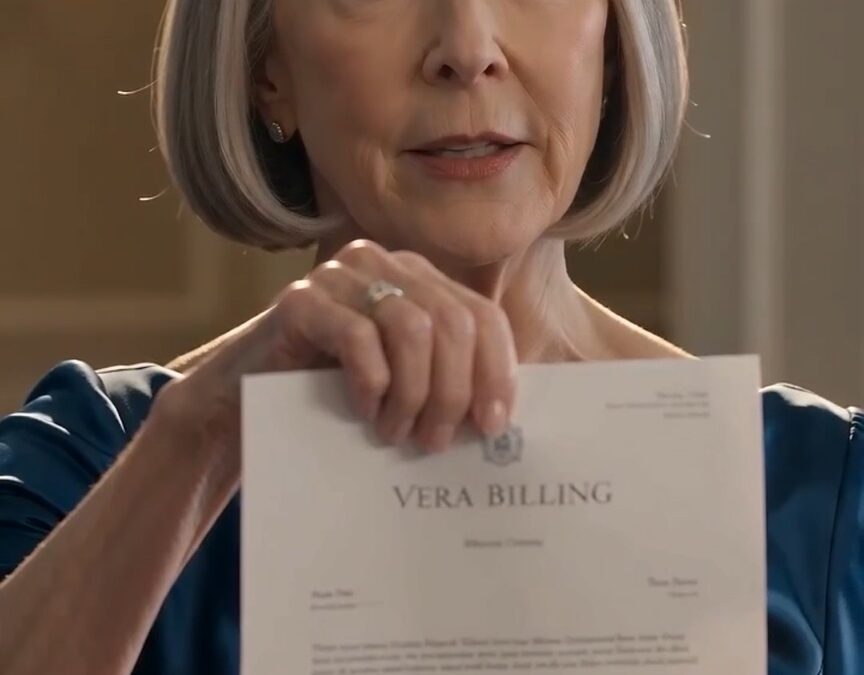
I raised the folded paper to chest height and turned it so he could read the heading.
RENTAL OFFER.
“Grant, this building belongs to me, not you.”
His eyes dropped.
“You got another rental offer?”
“Yes. And I haven’t signed for five more years.”
He took half a step back.
Beth leaned enough to see the paper.
Elise looked at Grant.
For the first time that evening, my son looked at the competing rental offer instead of the door.
He had never seen it before.
That mattered.
Until then, he had been speaking as though I had no choice except to leave the party and return later with my signature.
Now he read the amount.
“Who is Maren?”
“An established event operator.”
“You’ve been talking to another business?”
“She made an offer for the building.”
“At my wedding?”
“The offer came the week before.”
I kept my voice ordinary.
My mouth felt dry, and I wished I had taken a drink before leaving the table, but I wasn’t going back for my glass.
Grant reached slightly toward the paper.
I held it where it was.
He stopped.
I wasn’t offering him possession of it.
Only a look.
The rent in his current lease was $2,400 monthly. Maren had offered $3,600.
A difference of $1,200 each month.
Grant could read those figures as easily as I could.
He had built his business around the lower amount.
I had allowed that for eight years.
“You should have brought this to me privately,” he said.
“I asked to speak privately.”
His jaw moved.
He looked toward Elise.
She looked toward the tables.
Nobody had asked for this conversation in front of the guests except by refusing the private one I requested.
Beth touched the side of my purse.
“Can we lower the paper?”
I lowered it.
The people nearest us had already seen enough.
Grant knew what it said.
So did my sister.
I had rented him that hall cheaply for eight years. He paid the agreed rent, hired the help, handled his bookings, and decided how his receptions ran. I stayed out of those decisions because they belonged to his business, not mine. I dealt with the building responsibilities that belonged to me, kept my own records, and never presented his customer payments as my income. When people praised what he had made of the hall, I let him receive the praise. I had expected ordinary family consideration in return, not a public thank-you and certainly not a place in every business discussion. At his wedding, I had thought being his mother would be enough to keep me from being treated like an unwanted interruption.
Grant rubbed the side of his face.
“The rent has always been manageable.”
“For you.”
“You agreed to it.”
“I did.”
I wasn’t going to pretend he had stolen anything.
The discount had been my decision.
Continuing it would also be my decision.
“You’re changing everything without telling me,” he said.
“No. Your current agreement still has four months.”
He glanced at the paper again.
There was no automatic renewal.
No option that let him demand another term.
He knew that.
That was why he had sent a proposal instead of simply announcing he was staying.
Elise stepped closer.
“Can you put that away now?”
I folded the offer along its existing crease.
“I’m leaving.”
Beth looked relieved, but Grant didn’t.
He was no longer concentrating on how quickly I could disappear.
“Where’s the renewal I sent?”
“At home.”
“You didn’t bring it?”
“No.”
“I asked you to.”
“You asked me to sign it after dinner. I hadn’t agreed to sign.”
His shoulders stiffened.
The distinction bothered him.
It had never bothered him when he made distinctions with his own customers.
Beth spoke quietly.
“Vera, next season is already being advertised.”
“I heard you.”
“They’ve put work into it.”
“And I haven’t signed a renewal.”
She looked down at my folded paper.
I tucked it against my purse, not inside it.
I wanted to leave without hunting through my belongings at the car.
The attendant moved farther aside.
He was clearly waiting to learn whether his task was finished.
“You can go back to work,” I told him.
He looked at Grant.
Grant nodded.
The attendant returned toward the room without touching me or saying anything that would make this worse.
Elise watched him go.
Then she lowered her voice.
“This is exactly what I meant.”
I looked at her.
“What?”
“Everything becomes about what you’ve done for him.”
“I didn’t bring up the building until I was being put out of it.”
Grant made a small impatient motion.
“Not now, Elise.”
She stopped.
That was new.
He wanted the conversation about the building kept separate now that it wasn’t going his way.
I stepped outside.
The reception sounds softened when the door moved behind me. I could still hear voices, but not the words.
My keys were caught under the handle of my purse.
I pulled them free.
Grant came through the doorway after me.
Beth remained inside with Elise.
I didn’t turn back toward them.
My son stood between the door and the path toward the parking area, no longer directing me anywhere.
He looked at the folded offer again.
Then at my keys.
“You’re still signing my renewal, aren’t you?”
Chapter 3: The Weddings Already Booked
“Not tonight.”
I closed my hand around my keys and waited for Grant to move away from the path.
He stayed where he was.
“What is that supposed to mean?”
“It means I’m not signing anything tonight.”
“You can’t make a business decision because you’re upset.”
“I haven’t made one here.”
That was true.
I had shown him an offer.
I hadn’t accepted it.
I hadn’t served notice.
I hadn’t promised Maren the building.
Grant looked back toward the door, then stepped farther outside so it could close.
The reception carried on without us.
“You know what this place means to me.”
“Yes.”
“I’ve spent eight years building the business.”
“Yes.”
He seemed to be waiting for those answers to turn into a promise.
They didn’t.
I moved toward my car.
He walked beside me now instead of blocking the way.
The difference was noticeable.
Inside, he had wanted me gone.
Outside, he wanted to keep me talking.
“Tell me what you want changed,” he said.
“I need to review the rent and the term.”
“You could have said that.”
“I asked to speak privately.”
He pulled at his cuff.
For a moment, neither of us spoke.
I reached the car and put my purse on the roof while I found the correct key. The folded offer stayed in my hand.
Grant watched me place it on top of the purse.
“Don’t leave it sitting there.”
“I see it.”
He had told me to go home.
Now he sounded concerned that I might drive away with the paper on the roof.
I picked everything up and opened the door.
He put his hand on the upper edge.
Not to hold it shut.
To keep the conversation going.
“I have couples depending on this place.”
I looked at him over the door.
“Your current bookings can continue.”
“I’m not talking about just the current term.”
I stopped arranging my purse on the seat.
“What are you talking about?”
He looked away.
“Next season.”
Beth’s words came back to me.
Advertising.
I had understood that to mean invitations for inquiries, tours, tentative discussions. Businesses advertised future services before every detail was settled.
That wasn’t the same as promising this building.
“What have you committed to?”
“Weddings.”
“In this hall?”
“Yes.”
“Beyond your lease?”
He exhaled.
“Mom, that’s how advance booking works.”
I left the car door open.
“Have you guaranteed this particular building?”
He looked irritated that I had made the question specific.
“They booked the hall.”
“Have you taken deposits?”
“Yes.”
I put my keys in my purse.
I wanted my hands free.
“How were you planning to guarantee a building you haven’t rented yet?”
“I was planning to renew.”
“That isn’t an agreement.”
“We’ve always worked things out.”
“We’ve always signed what we agreed to.”
He turned toward the hall.
Through the glass, I could see movement, but I couldn’t tell whether Elise was looking for him.
He was missing his reception now.
That was his choice.
I hadn’t asked him to follow me.
“Are these tentative reservations?” I asked.
“No.”
“Subject to your getting another lease?”
“Not worded that way.”
I rested my hand on the car door.
Grant had accepted money based on a permission he didn’t have.
I understood that much now.
I still didn’t know what his agreements said or what he had told the couples about the building.
“You should have told me.”
“I’m telling you.”
“After you took deposits.”
He didn’t answer.
He was looking toward the reception again.
“Those people have invitations to plan,” he said. “They have relatives traveling. They have other vendors.”
“I understand weddings involve other arrangements.”
“Then you understand why you can’t pull the hall out from under them.”
“I haven’t rented it to them.”
“You know what I mean.”
“I need to know exactly what you mean.”
He drew a hand over his mouth.
This wasn’t the conversation he had expected after dinner.
He had apparently expected to place his renewal beside my plate, have me sign, and return to his wedding knowing his business costs would stay comfortable.
Instead, he had told me something I couldn’t ignore.
“Were you going to mention the deposits before I signed?”
“There was no reason to make it a problem.”
“There was a reason to tell me.”
He looked at the offer on my passenger seat.
“Maren doesn’t have customers expecting this place.”
“I haven’t discussed your customers with Maren.”
“You’re considering her anyway.”
“I’m considering an offer.”
He leaned back from the open door.
His expression changed.
He stopped arguing about whether he had committed beyond the lease and began arguing about what those commitments should require from me.
“If you say no, I have to fix all of this.”
“Yes.”
“That’s a lot to put on me.”
“You accepted the bookings.”
I said it quietly.
He stared at me.
For a moment I wanted to soften it, to explain that I wasn’t wishing trouble on him.
Then I looked at the hall behind him.
I had been standing beside my own chair when he decided I was too much trouble for his wedding pictures.
I didn’t need to apologize for asking what he had sold.
“I need copies of whatever you expect me to be responsible for,” I said.
“You aren’t responsible for dealing with them.”
“Then don’t tell me I have to renew because of them.”
He looked down at the car door.
I picked up my purse and settled into the driver’s seat without closing it.
He stepped back.
“Let me get through tonight,” he said.
“I’m going home.”
“We’ll talk when you’ve calmed down.”
“We’ll talk when we both know what you’ve promised.”
He started toward the hall, and I called him back before he reached the door.
“Did you tell them your lease wasn’t renewed?”
Chapter 4: The Pages On My Table
“They booked my business, Mom.”
Grant answered without coming back to the car.
“That wasn’t what I asked.”
He looked toward the reception door.
“No. I didn’t tell them.”
Then he went inside.
I closed my car door and sat with the keys in my lap.
The offer lay on the passenger seat.
I flattened the crease with my palm before starting the car.
At home, I put my purse on a kitchen chair and left my shoes beside it. I didn’t turn on anything for background noise.
I wanted to read.
The unsigned renewal was where I had left it.
I brought out the current lease, too, and placed the papers separately on the table.
Grant’s proposal.
Our existing agreement.
Maren’s offer.
I had worked in payroll long enough to dislike loose pages mixed together. Something harmless could become confusing simply because it ended up behind the wrong cover.
I found a pencil.
Then I read the current lease from the beginning.
Not just the ending date.
All of it.
Grant’s business was the tenant.
I was the owner.
The building was not his business, and his business was not mine.
There was no automatic renewal.
No tenant renewal option.
The notice provision required ninety days’ written notice of nonrenewal, delivered in the way the lease specified.
Four months remained.
There was time to do it correctly.
I marked the relevant language with a strip of paper rather than writing on the original.
Then I read his proposal.
Another five years.
The same rent.
No place where my signature appeared, because I had never put it there.
I turned it over anyway.
Blank.
I felt foolish doing that.
Then I left it faceup where I could see it.
Grant had spoken so confidently that I wanted the physical reminder of what I had actually done.
Nothing on that page committed me.
I put the proposal beside the message he had sent with it.
His wording requested a renewal.
It didn’t confirm an existing agreement.
That mattered.
I saved the messages about bringing it to the reception. I read my own replies carefully, including the ordinary ones about talking after dinner.
I hadn’t promised renewal.
I hadn’t promised the same rent.
I hadn’t said his future bookings were safe.
I printed what I needed and kept the originals saved as well.
My printer made its familiar uneven feeding noise.
I stood beside it in my reception clothes until the pages finished coming through.
Only then did I change.
The next morning, I set a clean notepad beside the documents and wrote down the questions I needed answered.
Could I decline renewal?
What had to be delivered?
How did I preserve proof?
What could I do without interfering with Grant’s remaining term?
I wasn’t looking for a way to punish him.
I wanted to stop being treated as though his assumptions had already become my obligations.
I contacted my own attorney.
Not someone working for Grant’s business.
When we spoke, I had the lease open in front of me.
“I need you to review the notice provision,” I said. “I want every requirement followed.”
I explained the proposal, the competing offer, and the bookings Grant had disclosed outside the reception.
I also explained what I hadn’t done.
No signature.
No oral promise.
No guarantee to his customers.
The attorney asked me to send the relevant documents and communications.
I did.
I didn’t send an account of every hurtful thing Elise had said.
Those words explained why I had stopped overlooking the arrangement. They did not change what our lease required.
The attorney made that distinction plain.
So did I.
“His business keeps operating through the existing term,” I said.
“Yes.”
“I don’t want anyone telling him he has to leave early.”
The attorney confirmed that nonrenewal was not an immediate termination.
Grant would retain access.
His existing events could continue.
I couldn’t use the building systems or the locks to force him out before the agreement ended.
“I’m not planning to.”
I wrote that down anyway.
I wanted the plan on paper, not carried around in my head.
When the review came back, it matched what I had read.
The notice had to go out correctly.
The ending date had to be accurate.
Proof of delivery had to be kept.
I could choose a different tenant after Grant’s term.
I sat at the table and moved Maren’s offer out from underneath my notepad.
It was still only an offer.
I hadn’t signed it at the reception.
I hadn’t signed it afterward.
I would not commit the building to somebody else until the notice had been delivered as required.
Maren received a short message from me explaining that I was reviewing the existing tenancy and would contact her when I could discuss the next step.
She didn’t press.
That helped.
I put the attorney’s comments beside the lease and clipped the saved messages together.
There was a place for everything now.
The offer from Maren stayed on top.
Every time I saw the heading, I remembered Grant stepping back from it.
He had understood the amount immediately.
He had understood that someone else could rent the building.
What he hadn’t understood was that I might actually choose that.
My phone rang while I was putting the papers away.
Beth’s name showed on the screen.
I answered with the folder still open in front of me.
“He says you already gave your word.”
Chapter 5: The Contract They Forwarded
“I did not give my word.”
I held the phone against my ear and pulled Grant’s saved message back out of the folder.
Beth went quiet.
“He says this was understood.”
“It was requested.”
“Vera—”
“He sent a proposal. I said we could talk.”
I read her my reply.
Exactly as written.
I didn’t add an explanation about what he ought to have understood.
The words were enough.
Beth sighed.
“I wasn’t there when you discussed it.”
“There was no other agreement.”
“He thinks you’re using the wedding against him.”
“I’m reviewing a lease he asked me to renew.”
She started to say something, then stopped.
I could hear her moving a cup or saucer.
That familiar household sound made the conversation feel stranger.
We had talked through ordinary family matters while washing dishes for most of our lives. Now she was repeating my son’s claim that I had promised away another five years of my building.
“Did you tell him I agreed?” I asked.
“No.”
“Did you hear me agree?”
“No.”
“Then please don’t repeat it as if it happened.”
She said she wouldn’t.
I believed her.
Beth hadn’t invented the claim.
She had accepted Grant’s version because keeping his business in place seemed easier than making him change what he had already planned.
“What about the couples?” she asked.
“I asked him what he promised them.”
“He’s worried.”
“I know.”
“Can you at least talk about a solution?”
“I will talk about what I’m actually responsible for.”
I ended the call without discussing the reception again.
I had already asked whether she heard him tell me to leave.
She had.
I didn’t need to make her hear it another time.
Later, a message arrived from a concerned couple.
They had contacted me as the building owner.
I read it standing at the kitchen counter, then sat down before answering.
They had booked with Grant’s business for a wedding beyond his current lease term. They wanted to know whether use of the hall was secure.
I didn’t know what had prompted their concern.
I didn’t guess.
I wrote that Grant operated the wedding business and handled its bookings, and that I could not confirm a commitment without seeing what they had received.
They forwarded their agreement.
I opened the attachment.
There was the hall’s address.
There was the promised use of the building.
There were the payment and refund terms.
And there was the name of Grant’s business as the party responsible for providing the venue.
Not mine.
I read it again.
The agreement didn’t say Vera would provide the hall.
It didn’t have my signature.
It didn’t identify me as a guarantor.
The promises about the venue and any required refunds belonged to the business that had accepted the booking.
I put my glasses down beside the keyboard.
Grant had been careful about whose business received the deposits.
He was now trying to make me treat those business commitments as my reason to keep renting to him.
I saved the attachment.
Then I printed it without writing on it.
The forwarded message stayed with it so I could show where the copy had come from.
I sent both to my attorney.
My question was narrow.
Did this document make me responsible for providing the building beyond Grant’s term?
The answer, based on the agreement and my lack of any separate guarantee, was no.
The attorney also reminded me not to offer the couple advice about their particular refund rights.
Those depended on their agreement with Grant.
I wasn’t taking over his customer service.
I wrote back to the couple.
I told them I owned the building, but Grant’s business was responsible for their booking and for discussing any replacement venue or refund under their agreement.
I didn’t tell them their wedding was canceled.
I didn’t make a promise about another venue.
I directed them to him.
Then I put the phone down and made myself something to eat.
I hadn’t eaten since looking at the attachment.
The bread stayed on the counter while I reread my reply.
It was brief.
Civil.
Accurate.
I sent Grant a message telling him the couple had contacted me and that I had referred them back to his business.
I did not attach their contract.
He already had his own agreement.
I didn’t need to send him the evidence as an accusation.
He called instead of replying.
“What did you tell them?”
“That their booking is with your business.”
“Did you tell them I’m losing the hall?”
“I told them to speak to you.”
“You shouldn’t discuss my customers with anybody.”
“They contacted the owner about the building.”
He paused.
I could hear him breathing into the phone.
“What exactly did they send you?”
“Their agreement.”
That changed the conversation.
He didn’t deny the deposits now.
He didn’t suggest the bookings were tentative.
He knew what his own form said.
“Then you know I have obligations.”
“Yes.”
“I can’t just tell everyone to forget their plans.”
“I haven’t asked you to.”
“You’re saying I have to move them.”
“I’m saying you need to address your commitments.”
He stopped for a moment.
When he spoke again, he sounded less angry and more deliberate.
“Then let me keep the building until those weddings are done.”
Chapter 6: The Notice I Sent
“I’m not extending the lease until an unspecified set of weddings is finished.”
I sat down before Grant could turn that into another argument about what I had promised.
“I can give you the bookings,” he said.
“That doesn’t make them my obligations.”
“You’d have an ending point.”
“Your current lease already has an ending point.”
He was trying a different approach now.
Not another five years on the same terms.
Just enough time to finish what he had sold.
It sounded smaller.
It wasn’t a small request if new bookings kept appearing or if every customer problem became a reason to stay.
“I need certainty, too,” I said.
“You own the place. You have certainty.”
“I own a building with an agreement that ends.”
He went quiet.
“I could pay more.”
“What are you offering?”
He proposed a smaller increase than the amount in Maren’s offer.
He framed it carefully, as something that would help me while leaving him room to handle the customer arrangements.
I listened.
Then I looked at the existing proposal lying unsigned on my table.
Another five years had been treated as a family formality until he saw that someone else valued the building differently.
“I’m declining renewal.”
He didn’t answer right away.
I didn’t fill the pause.
The decision needed a plain sentence.
That was mine.
“You haven’t thought this through,” he said.
“I’ve reviewed the agreement with my attorney.”
“Of course you have.”
“Yes.”
I heard something move on his end.
A chair, perhaps.
I didn’t ask.
“Are you trying to get me out now?”
“No. Your full term remains.”
“And the events already scheduled?”
“You can hold events during your term.”
“The staff?”
“Your business decisions stay yours.”
I wasn’t touching his bookings, employees, decorations, equipment, or customer payments.
I was declining a new lease.
He ended the call without saying goodbye.
I left the phone on the table and pulled the notice instructions toward me.
The first business day after the reception, I went through the notice with my attorney before authorizing it.
The ending date matched the lease.
The notice period satisfied the ninety days required.
The delivery method matched the contract.
I checked the building address and the tenant information against the original agreement.
Not against something Grant had typed in his renewal proposal.
Against the signed lease we were actually ending.
I read the notice aloud once.
It didn’t mention the wedding.
It didn’t call Grant ungrateful.
It didn’t accuse Elise of anything.
It stated that I would not renew and that possession was to be returned when the existing term expired.
That was the business decision.
I signed where I needed to sign.
Then I personally authorized the required delivery and sent the notice by the method our lease required.
I kept the copy.
I kept the sending record.
I kept the delivery proof when it became available.
I did not rely on an ordinary conversation or a message saying he probably knew what I meant.
I wanted the same care I had used when somebody’s wages depended on a correct entry.
The folder got thicker.
The facts got simpler.
Grant had time to complete the term.
I had given notice before making another commitment.
The building would not remain his business location simply because changing locations was inconvenient.
Beth called while I was checking the delivery record.
“Did you send it?”
“Yes.”
“Is there any way you could wait?”
“I’ve sent it.”
She took a breath.
“I wish this had gone differently.”
“So do I.”
That was the part we could agree on.
She didn’t ask me again whether I had promised him.
I didn’t bring it up.
“I’m not telling you to cut him off,” she said.
“I haven’t said I’m cutting him off.”
“It feels that way to him.”
“He still has his lease. He still has his mother.”
“And after the lease?”
“He will still have his mother.”
I meant it.
I also meant that those were separate things.
Beth said she understood.
I couldn’t tell whether she did yet.
After the call, I put the notice copy behind the current lease.
I left a space for the delivery confirmation so it wouldn’t end up loose in my purse or buried beneath unrelated mail.
There was no pleasure in any of this.
There was relief in having done it correctly.
When the delivery was confirmed, I checked the proof against the requirement one more time and saved it with the notice.
Only then did I contact Maren about moving forward.
I told her Grant’s current term would be respected completely.
The building would not be available early.
She said that was understood.
We arranged to discuss the lease for her business to begin after his expired.
I set my notepad beside the phone.
Before that discussion happened, Grant called.
He had received the notice.
This time, he didn’t argue that it was meaningless.
He knew I had followed the agreement.
“You really sent it.”
“Yes.”
“And you’re talking to her.”
“Yes.”
I heard him draw a long breath.
“You’d really rent it to somebody else?”
Chapter 7: The New Tenant’s Questions
“Yes.”
I let Grant hear the answer without adding anything to soften it.
“What does she know about running that place?”
“She runs events for a living.”
“So do I.”
“I know.”
He wanted me to compare them as people.
I wasn’t doing that.
Maren had offered market rent for a building.
Grant had asked for another discounted term while treating my consent as something he already possessed.
“Does she know there are bookings?” he asked.
“She knows your business remains responsible for your bookings.”
“She can’t just walk into an empty room and pretend none of this happened.”
“She isn’t taking over your business.”
That stopped him.
He had been moving toward another possible solution: let the new operator absorb whatever he could not resolve.
I hadn’t offered that.
Neither had Maren.
“She’s renting the building,” I said. “Not buying your customer agreements.”
He asked whether I had signed.
“Not yet.”
“Then you can still stop.”
“The notice stands.”
I ended the call when we began going over the same point again.
Then I checked that I had the delivery proof before leaving for my meeting with Maren.
I brought the offer.
The current lease ending information.
My questions.
I didn’t bring Grant’s customer contract for her to browse through.
His customers’ private information wasn’t something I needed to circulate to find a new tenant.
Maren arrived with notes of her own.
She was 47 and had the practical manner of someone used to checking a room before promising an event in it.
She asked about the building.
Access.
Maintenance responsibilities.
The beginning of her tenancy.
She didn’t ask what Elise had said to me.
I appreciated that.
“This begins after his lease expires,” I said.
“Yes.”
“Not while he’s moving through his last events.”
“I wouldn’t expect otherwise.”
“He owns business equipment and other items inside.”
“We should be clear about what belongs to the building.”
We were.
We went through the space and separated fixtures from business property in our discussion. I didn’t promise her decorations or supplies that belonged to Grant.
I didn’t make a bargain out of anything I couldn’t deliver.
Maren checked the service areas and looked at the entrance from inside.
I watched her make notes.
For years, business conversations about the hall had drifted toward what Grant needed from me.
This conversation stayed on what each side would provide.
“The monthly rent is $3,600,” I said.
“That’s what I offered.”
“No family adjustment later.”
She looked up.
“No.”
There was no smile attached to it.
Just agreement.
We sat down with the lease after the terms had been reviewed.
The notice had already been delivered.
Grant’s ending date remained unchanged.
Maren’s right to occupy would begin after his term expired.
I read before signing.
So did she.
Neither of us acted offended by that.
I put my signature where it belonged and made sure I had my complete copy.
Maren kept hers.
Her written offer came home with me.
It was no longer a possibility I had carried into a difficult family conversation.
There was now a signed agreement behind it.
I placed the offer in front of the new lease while I checked that everything was there.
Grant’s current lease went in a separate folder.
I wasn’t mixing the tenancies together.
That evening, I made dinner without keeping my phone beside the stove.
When I checked it afterward, Elise had called.
I returned the call.
She answered with no greeting.
“You signed with her.”
“Yes.”
“Grant told me.”
“All right.”
“You understand we’re married now.”
“I attended the wedding.”
She went quiet.
Then she began again, more carefully.
“This affects our household.”
“I understand that.”
“We can’t plan anything if you change the business underneath us.”
“The existing lease is ending as written.”
“We were advertising.”
“Beth told me.”
“You knew we were planning next season.”
“I didn’t authorize bookings beyond the lease.”
She said Grant had expected a renewal.
I told her an expectation wasn’t my agreement.
She didn’t repeat that argument.
Instead, she asked whether Maren would honor their bookings.
“No such arrangement has been made.”
“Why not?”
“She is renting the building for her own business.”
“So she gets the place and we get all the problems?”
“Grant’s business made the agreements.”
Elise breathed sharply.
For the first time, she sounded less concerned with how independent they appeared and more concerned with what independence required them to handle.
I didn’t say that to her.
It would have started another argument.
“Can we at least keep giving tours?” she asked.
“For events within the existing term, that is Grant’s business.”
“And after?”
“You cannot promise my building after your right to use it ends.”
She didn’t like the answer.
But she understood it.
I could tell because she stopped asking about what they could advertise and moved to the people already booked.
“Are you going to tell our couples they can’t come?”
Chapter 8: The Calls He Made
“No. Grant’s business needs to speak with its customers.”
I moved my plate to the counter while Elise began listing reasons those conversations would be difficult.
I listened until she stopped.
“I understand they will be upset,” I said.
“Then help us explain.”
“I won’t manage agreements I didn’t make.”
“You own the hall.”
“Yes.”
“That’s who they’ll blame.”
“I will answer questions about the building accurately.”
She wanted more.
A shared announcement.
A phone call where I would explain that circumstances had changed.
Something that made the loss of the venue sound like my business decision had altered their customer agreements.
I wouldn’t do that.
Grant had guaranteed the hall before securing permission to remain.
That was what needed to be addressed.
“I’m not telling anybody their wedding doesn’t matter,” I said. “I’m telling you who has to handle it.”
Elise ended the call abruptly.
I finished cleaning the plate.
Then I checked my own calendar for the end of Grant’s term, not for the dates of his customers’ weddings.
Those weren’t mine to manage.
During the remaining months, Grant kept running events at the hall.
His staff came and went.
His customers used the building during the term they had booked.
The lights stayed on.
The locks stayed as they were.
I didn’t turn up at receptions to make sure people knew I owned the place.
I had made that statement when I needed to.
Now the lease governed what happened.
When a building matter required attention, I handled it through the same practical channels I had used before.
Grant received the access he was entitled to.
He couldn’t truthfully tell anyone I had shut down his business before the end.
Beth asked me about that when we spoke.
“He says you’re being very formal.”
“I’m being clear.”
“Has he been able to hold everything already scheduled?”
“During his term, yes.”
She sounded relieved.
I was relieved, too.
There were people with weddings who had nothing to do with what happened at my son’s reception.
I didn’t need them disrupted to prove that I could say no to him.
Grant began sending brief updates about the future bookings.
At first, they included explanations of how hard the work was.
I answered only what required an answer.
He had contacted alternate venues.
Some couples were willing to move if their arrangements could be made acceptable.
Others wanted the refund their agreements required.
He had to work through those choices individually.
I didn’t approve substitutes on anyone’s behalf.
I didn’t tell a couple that a different room was “just as nice.”
That was for them to decide.
When Grant said a replacement was accepted, I acknowledged the update.
When he said a refund had been handled, I saved the message.
He was doing the work now.
Not happily.
But doing it.
One afternoon, he called about access while preparing for an event still within his term.
I answered the building question.
He paused afterward.
“You’re really not going to help me with these refunds?”
“I’m not paying your business obligations.”
“I didn’t ask you to pay all of them.”
“I’m not taking them over.”
He had shifted from asking for the building to asking for money.
It was a more limited request.
It was still his attempt to keep the cost of those commitments from remaining with his business.
He went quiet.
I waited.
Then he told me he had another replacement arrangement nearly finished.
I said I hoped the couple was satisfied with it.
That was all.
I didn’t pretend I felt nothing.
Afterward, I opened the drawer where I kept household bills and stood looking into it without taking anything out.
For years, helping Grant had often meant making a small decision that grew into another expectation.
I closed the drawer.
There was no payment for his business in it.
As the ending of the term approached, the updates became more definite.
Accepted replacement venue.
Refund completed under the agreement.
Customer confirmed.
He stopped adding long explanations about why I should reconsider.
He began giving me information needed for the move.
I asked when he expected to remove his business property and when we could inspect the building together at the end.
He answered.
The work was unpleasant, but it was possible.
That mattered to me.
He had presented renewal as the only way to avoid ruining other people’s plans.
Once he knew the building wasn’t available, he found alternatives or made refunds.
Not every customer got the original plan.
They did get their commitments addressed.
Grant sent a final set of updates before we arranged the walk-through.
He said the remaining future bookings had been resolved through agreed replacements or refunds.
I saved that message with the earlier ones.
Then he asked to speak rather than keep exchanging messages.
I answered when he called.
His voice was tired.
“I’ve done everything you wanted.”
“You’ve handled your customers.”
“I’ve paid for this.”
“I know it has cost your business.”
He paused.
“I’m asking you to sign a withdrawal of your notice.”
Chapter 9: The Empty Storage Room
“No.”
I put Grant’s proposed withdrawal beside my phone without signing it.
He had sent it over after our call.
It was another page he hoped I would treat as a family obligation.
“I’ve fixed the bookings,” he said.
“That doesn’t change the new lease.”
“You could talk to Maren.”
“I’m not breaking my agreement with her.”
He knew that answer was stronger than a renewed argument about the rent.
I had already signed with another tenant.
Her rights weren’t a family matter Grant could negotiate through me.
He went quiet.
Then he asked what I expected at the walk-through.
We discussed the building.
Cleaning.
His business property.
The keys to be returned when his term ended.
I kept my notes in front of me and answered each question.
We agreed to inspect together.
There was no demand that he disappear overnight.
No threat to have him removed while he still had lawful possession.
He had stayed through his term.
Now he was preparing to leave it.
When I arrived at the hall for the last walk-through, Grant opened the door.
He was wearing work clothes.
The formal jacket from his wedding was nowhere in sight.
Neither was Elise.
The reception tables had been cleared of his business materials. The front area looked much the same, but the ordinary clutter that had identified his workday was missing.
A stack of empty hangers sat near his things.
His office door was open.
“Start here?” he asked.
“Yes.”
I took out my checklist.
He watched me for a moment.
Then he turned on the office light.
We moved through the rooms together.
I checked the condition of the building.
He pointed out what had been removed and what remained because it belonged to the property.
When something needed clarification, we discussed it in place.
No speeches.
No accusations.
The storage room was nearly empty.
I remembered standing there when he first began operating eight years earlier, listening to him describe where he would keep supplies.
He had been excited.
I had been happy to help.
I looked at the bare shelving now and checked it against my notes.
The memory didn’t change the ownership.
It did make me stop writing for a moment.
Grant saw me looking.
“I didn’t think I’d be leaving like this.”
“I didn’t either.”
He leaned against the doorframe.
“I thought we’d always work it out.”
“We did work through the end of your lease.”
“You know that isn’t what I mean.”
I did.
He meant that I had always found a way for his plans to continue.
This time, he had needed to change the plans.
We went back toward the main room.
He showed me that the business items he intended to remove were packed and ready.
I didn’t claim them.
I didn’t hold them until he apologized.
They were his.
The move was completed before he gave up possession.
I waited until the removal was finished to check the remaining areas.
He kept access until the term ended.
The handover happened as agreed, without a lockout or a court eviction.
Grant’s final rent obligations belonged to the term he had actually rented.
The next tenant’s rent would belong to the next tenancy.
I checked the keys when he handed them over.
Not dramatically.
Just to make sure the return was complete.
He stood across from me at the counter where he used to keep event paperwork.
“The couples are all handled,” he said.
“I saw your updates.”
“I don’t have anybody still expecting to come here under my agreements.”
“All right.”
“Some moved. Some took refunds.”
“I understand.”
He wanted me to say more.
I could see it.
Perhaps that the cost meant he had suffered enough.
Perhaps that resolving his commitments earned him the building back.
I was glad he had finished the work.
I wasn’t reopening the lease.
I made a note that the inspection was complete and gave him the information he needed from it.
He took his copy and folded it.
Then he looked around the room.
This was the same room where he had told an attendant to walk me out.
Now he was leaving with his own belongings because his rental term had ended.
There was no audience.
I hadn’t wanted one for this.
“Will you tell Beth everything’s finished?” he asked.
“I can tell her the handover is complete.”
“Not the rest of it?”
“I’m not discussing your customers’ details with her.”
He nodded.
That seemed to settle something.
I put the keys in my purse and closed my folder.
Grant followed me toward the entrance, then stopped short of the door.
“Mom.”
I turned.
For once, he didn’t look at the folder.
He looked at me.
“Does this mean you’re done being my mother?”
Chapter 10: The Cabinet Beside My Desk
“No, Grant.”
I set my folder on the counter so I could answer without holding paperwork between us.
“I’m done renting you the building.”
He looked down.
“That sounds easy when you say it.”
“It hasn’t been easy.”
“Then why does it have to be so final?”
“Because the lease is over, and I’ve made another agreement.”
He pressed his lips together.
I waited.
I wasn’t going to negotiate the new tenancy in response to a question about whether I loved him.
Those questions could stay separate even if he disliked it.
“You can call me,” I said. “You can ask how I am.”
He gave a small, unhappy nod.
“I know how to call you.”
“I mean without needing something for the hall.”
He looked toward the empty room.
Then back at me.
“All right.”
I picked up my folder.
We left through the same entrance.
He went to his vehicle, and I went to mine.
I didn’t ask him to come over for dinner that night.
I didn’t need to prove the business decision hadn’t made me his mother’s opposite.
I needed time without another proposal in front of me.
Maren took possession after Grant’s lease expired.
I met her at the building with the keys and the completed handover information.
She checked what she needed to check.
I answered questions about the property, not about my son’s marriage.
There was work for her to do before her own operations settled into the space.
It was her work.
Her staff arrangements.
Her customers.
Her business name.
She did not inherit Grant’s customer obligations, and there were no unresolved couples arriving expecting his business to provide the hall.
He had arranged accepted alternatives or completed refunds before leaving.
Maren’s tenancy began the way we had agreed.
The rent was $3,600 monthly.
When the first payment arrived, I checked it against the agreement and entered it in my records.
The amount was correct.
I sat there longer than the entry required.
For eight years, I had recorded $2,400 and treated the difference as something I was willing to contribute to my son’s business.
Now another operator was paying what she had offered.
I wasn’t secretly returning part of it to Grant.
I wasn’t setting aside the increase for the next emergency he might bring me.
The building income belonged in my accounts, just as the building belonged to me.
Maren contacted me when something fell under my responsibilities as owner.
She didn’t call because a customer disliked a centerpiece or because she needed somebody to absorb a business expense.
When a question was hers to handle, she handled it.
That changed my mornings.
I could make coffee without checking whether a message from Grant required me to solve something before I finished it.
I still kept my records carefully.
I still answered legitimate building questions promptly.
But I no longer carried his booking calendar in the back of my mind.
Beth came over while I was putting household papers in order.
She looked at the space on my table.
“No hall folders?”
“They’re put away.”
“How is Maren doing?”
“She pays the rent and runs her business.”
Beth sat down.
Then she said she should not have pushed the renewal while I was being escorted out.
I left the papers where they were.
“Thank you for saying that.”
“I was trying to keep everybody from having trouble.”
“I know.”
“I should have asked what you needed.”
I didn’t give her a speech.
I got another cup from the cupboard.
We had coffee.
Grant and I stayed in contact, but it was limited.
Civil exchanges.
A returned call.
A brief message about ordinary family matters.
If he began circling back toward the hall or what the discount had meant to him, I didn’t start the argument again.
“The building is leased,” I would say.
Then we either changed the subject or ended the conversation politely.
Elise did not become warm toward me.
I didn’t pretend otherwise.
There was no family dinner where everybody admitted everything and agreed I had been right.
Grant had lost the discounted location he wanted to keep.
He had also met the obligations he had taken on by arranging other venues or making refunds.
Both things remained true.
I could recognize the work he had done without paying him back for it.
At home, I finally dealt with the unsigned renewal.
It had stayed in the folder through the notice, the customer questions, and the handover.
I took it out and laid it flat.
Another five years.
The same rent.
My signature line empty.
I checked that the messages showing I had made no commitment were saved with it. Then I put the proposal in my own cabinet beside the desk.
Not Grant’s office.
Not a drawer at the hall where someone might assume it was waiting for me to finish it.
My cabinet.
I closed the file and left it there.
Maren’s written offer was still on my desk.
The fold from the reception had never quite flattened.
I could see the place where my thumb had pressed into the edge while the attendant waited for me to leave.
I smoothed it once.
Then I opened the cabinet again and placed the offer in its own folder, in front of the lease Maren and I had signed.
My phone sounded from the kitchen.
It was a brief message from Grant asking how I was.
I answered that I was well.
I didn’t ask whether he needed anything for the business.
He didn’t ask me to sign anything.
I put the phone down and finished filing.
The last page I touched was the one I had raised at his wedding, with the plain heading still clear above Maren’s written rental offer.
You Might Also Enjoy


My Daughter-In-Law Pushed Me From The Microphone In My Own House — Until I Held Something Up




My Daughter-in-Law Listed My House Without Asking — Then I Called Security At Christmas Dinner