My brother handed our 61-year-old mom an apron and called her “kitchen help”—Until his investor read her filing and laid the $250,000 check face down.
Complete story · 7 parts · about 31 minutes · ending included
Part 1 · Part 2 · Part 3 · Part 4 · Part 5 · Part 6 · Part 7
Part 1 of 7
At 5:40 p.m., I held Mom’s phone over the ironing board and read the message Dustin had sent at 3:12.
“If you come tonight, wear your kitchen whites and use the back door. Please. I’ll explain later.”
The iron stood upright near my elbow. Mom’s blue church dress covered half the board, the collar still waiting for me.
Mom sat at the kitchen table with her hands folded beside an empty coffee cup.
I carried the phone back to her.
She took it and left the message where it was.
“Iron the collar, Carly-girl.”
That was Mom.
Deanna Tackett had managed the cafeteria at Pecan Grove Elementary for twenty-two years. She could stop a lunch line with one raised finger, settle a biscuit argument before second bell, and tell me what needed doing without wasting a word.
I laid the collar flat.
Steam rose when the iron touched the blue fabric.
Mom opened the lower cabinet and pulled out her canvas work bag. A dish towel went inside first. Then she took her own pair of tongs from the drawer by the stove.
“In case they’re short-handed,” she said.
I ran the iron along the last edge of the collar.
Five days earlier, she had planned to wear that dress to Dustin’s grand opening.
Nothing about the plan changed.
When I finished, Mom carried the dress down the hall to her bedroom. I unplugged the iron and wound the cord loosely around my hand.
She came back wearing the blue dress and low black shoes.
Her bag waited by the table.
I picked it up.
The weight pulled harder against my fingers than I expected.
I did not open it.
She slipped her phone into her purse, and we left.
I set the bag on the floor behind the driver’s seat of my car.
Mom took the passenger seat.
I drove while she watched the road.
Friday traffic crawled west toward Brookside, brake lights stacking ahead of us. I kept two hands on the wheel. Driving Route 14 for the school district had taught me more patience than any sermon I ever heard.
Sunday dinner came back to me near the light at Yale.
October 18.
Roy Bynum had sat with us at Mom’s table after the plates were cleared. Dustin had not been there.
Years before Dustin ever owned a smoker worth bragging about, Roy had cooked beside Mom in the school cafeteria. He still spoke the same way he had then: spare words, no decoration.
“Your mama’s money is in that pit. She ought to see it lit.”
Mom had looked at me.
I had nodded to Roy.
That had settled Friday night.
Two years earlier, Mom had handed Dustin her whole savings.
Over supper that evening, she told me about it the way other people talk about the light bill.
She made no speech and asked for no thanks.
Just Mom taking care of Dustin again.
Beside me, she kept her face toward South Peoria.
“I’m not going in the back of anything I paid for.”
We rode the last mile without talking.
At 6:05 p.m., I pulled up near the front patio of the new Tackett Smokehouse.
String lights hung above the tables.
Dad’s old smoker sat where everyone coming through the front could see it.
Larry Tackett had welded it himself in 2003, when Dustin and I were still young enough to complain about the smoke getting in our clothes. Dad had died eleven years ago, but the firebox door still carried the shallow marks from his work.
Tonight, the metal had been cleaned until the light ran across it.
Four empty screw holes showed on that same door.
I stopped near them.
At Dustin’s first restaurant opening on East 11th Street, he had screwed a brass plate there himself.
BUILT ON MOM’S HEART — D.T. 2024
I had watched him tighten the screws and hug Mom in front of the guests.
Now the plate was gone.
Only the holes remained.
Roy worked at the smoker with a sauce brush in one hand. His gray head stayed bent over the ribs.
He did not look up.
A well-dressed family sat at the far patio table. I had never seen them before.
Near the entrance, a hostess stood behind the host stand with a stack of menus.
Dustin stepped out beside her.
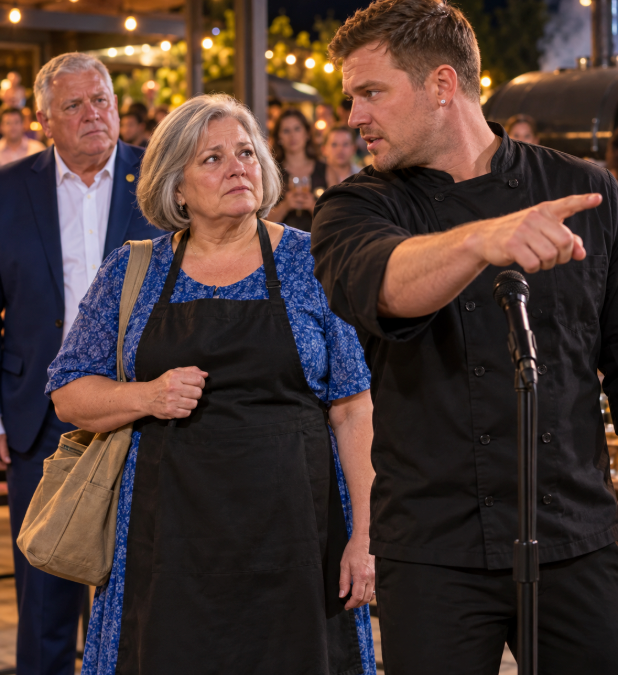
My brother wore a black chef coat.
He had always looked right in one. Even when he was twenty and burning chicken quarters in Dad’s backyard, Dustin could stand near a pit and make people believe supper was under control.
Mom stopped in front of him.
He held out a black apron folded into a square.
“Kitchen help uses the back door, Dee.”
Roy was about ten feet away.
The hostess heard.
So did the early guests nearest the stand.
In front of other people, Mom had never argued with anyone.
Her hands stayed at her sides.
I faced Dustin.
“Next stop.”
His eyes moved to me.
“You can stay, Carly. At the bar. Don’t call her Mom tonight.”
She took the apron from him.
The folded square opened in her hands, and she tied it over her church dress.
Her phone came out of her purse and went into the apron pocket.
Then she lifted the bag onto her shoulder.
Dustin got no word from her, and neither did I.
She walked around the side of the building toward the back door.
Roy kept brushing sauce across the ribs.
He said nothing.
I stayed where I was until Mom disappeared beyond the corner.
Dustin had already turned back to the hostess.
A couple walked up behind me, dressed for opening night. I moved aside so they could pass.
The patio smelled like oak smoke and barbecue sauce.
Dad’s smoker shone under the lights with four holes in its firebox door.
I crossed the patio alone.
The front entrance stood a few steps ahead.
I stopped in the doorway, still outside.
A chalkboard was propped against the wall beside the door frame, facing the patio.
Dustin’s capital letters filled it:
“BUILT FROM NOTHING. — DUSTIN TACKETT, PITMASTER & OWNER”
Part 2 of 7
At 6:20 p.m., Mom passed my bar stool carrying a tray of brisket, the black apron tied over her blue church dress.
She was heading straight for a big table along the glass up front, where the well-dressed family from the patio now sat with white napkins across their laps.
Dustin planted himself beside them like he belonged in the center of the picture.
Mom reached the end of their table.
“This is Dee,” he said. “She’s the kitchen help — runs our line.”
His voice carried easily across the room.
The older woman turned toward Mom.
“Sandra,” Dustin added, touching the back of her chair.
She smiled the way a person does when introductions are already moving too fast.
“Oh, wonderful.”
Her water glass was empty. Sandra picked it up and set it on the edge of Mom’s tray beside the brisket.
Mom steadied the load with one hand.
She kept walking toward the kitchen.
I watched her disappear through the swinging door.
Dustin stayed at Sandra’s table.
The bartender asked whether I wanted another iced tea.
“No.”
I left my stool.
Outside, the October air had cooled enough to sharpen the smoke coming off Dad’s old pit.
Roy stood where I had left him, working sauce over a rack of ribs with the same brush. String lights threw pale circles across the patio boards.
I stopped beside the firebox.
“What is going on?”
He dragged the brush once over the meat, then rested it against the metal rim.
“At two-fifty this afternoon, Dustin saw your names on my guest list.”
I waited.
His gaze went to the restaurant door.
“He told me, ‘She comes as kitchen help or not at all.’”
Noise from inside reached us through the wall in short bursts: pans, voices, a door opening and closing.
“Why?”
Roy picked up the brush again.
“Ask him.”
“He told me not to call her Mom.”
That stopped Roy’s hand.
For a second, the bristles hung above the ribs. Then he finished the stroke.
“He used to call her every night.”
“Dustin?”
“After closing up. First place.” Roy wiped the brush against the edge of the pan. “Ten-thirty, eleven. Sometimes later.”
I looked through the front windows.
My brother crossed behind the bar with a clean white towel over one shoulder. Nobody at the big table had moved.
Roy tipped his chin toward the restaurant.
“The Langfords are raising a check for him at eight-thirty, right here by the pit.”
“Langford?”
“That family.”
I glanced back inside.
So Sandra was a Langford.
That gave me one last name and nothing else.
“What check?”
He went back to the ribs.
“Don’t know the particulars.”
Dad’s smoker stood between us, black steel under the string lights.
I touched one of the empty screw holes with the tip of my finger.
“Where’s the brass plate?”
Roy followed my hand.
His face did not change.
“Ask your mama about that plate.”
“That’s it?”
“All I’ve got.”
He bent to look at the coals.
I took my phone from my purse and stepped away from the heat.
The search bar in my email opened under my thumb.
If the Langfords were handing Dustin a check, I wanted to see Mom’s claim first, so I typed UCC.
A message from November 15, 2024, rose near the top.
“Filing acknowledgment — UCC-1 — Debtor: Tackett Smokehouse LLC — Secured Party: Deanna Tackett”
It was in my inbox because Mom had filed through my email address.
The date pulled me back to Mom’s kitchen table the night before.
November 14, 2024.
That afternoon, Dustin had gone to Janet Lusk’s office in downtown Tulsa. He signed a promissory note and a security agreement there.
I had not been with them.
Mom told me about the signing over supper that evening.
After the dishes were cleared, she put Janet’s paper beside my laptop and sat across from me.
I typed the online filing.
The secured party and the filer were the same person: Deanna Tackett.
All I did was work the keyboard.
Mom read each line back from the screen before I moved to the next box.
When I reached the collateral field, I copied Janet’s wording exactly:
“all equipment, now owned or hereafter acquired”
Mom leaned closer to check it.
I moved the laptop toward her.
She read the completed filing herself and pressed submit. Six days later, Janet’s office mailed her a two-page copy, stamped as recorded. Mom slid both pages into a blue folder marked SMOKEHOUSE on top of her refrigerator while I watched.
Since then, as far as I knew, Dustin had paid her on time every month.
I opened the acknowledgment.
Her name sat right there beside Secured Party.
Inside the restaurant, somebody laughed loudly.
Over at the pit, Roy turned another rack.
I closed the email and checked the time.
By 7:05 p.m., I had moved to the quiet end of the patio near the wall and found Janet Lusk’s office number.
I called.
A recorded voice answered.
The message said they were “closed until Monday at 8.”
A tone sounded.
“This is Carly Tackett. Please call me Monday morning about the Tackett Smokehouse loan papers you drew up for my mother.”
I gave my number and ended the call.
Roy glanced over.
“Janet?”
“Yes.”
He nodded once.
I kept the phone in my hand instead of dropping it into my purse, and went back inside.
The room had filled since I left. Chairs scraped across the floor, servers moved between tables, and oak smoke clung to jackets near the entrance.
My stool was still open.
I sat down.
At 7:12 p.m., Sandra walked up beside Dustin at the bar.
They stood less than an arm’s length from me.
Sandra rested her fingers against the polished edge.
“You’ve done a beautiful job with the place.”
“Thank you.”
“You must be proud.”
Dustin smiled.
I kept my eyes on my iced tea.
Behind Sandra, the front door opened. Past her shoulder, I saw the younger woman from their table out by Dad’s smoker, holding up her phone to take pictures.
Sandra turned slightly toward Dustin.
“Is your mother coming tonight?”
The kitchen door opened about six feet away.
Mom stepped through with a tray of meat.
She crossed to the nearest service stand and lowered the tray onto it.
Dustin laughed.
“My mom? She’s out in Mesa. We don’t really talk.”
Part 3 of 7
At 7:20 p.m., Roy came through the dining-room door carrying a shallow pan against his hip and caught my eye at the bar.
He tipped his head toward the hallway and said, low, “Dustin’s bringing your mama papers to sign,” then walked off without waiting for me.
I followed.
That was how I ended up behind Mom’s shoulder in the kitchen, close enough to see the black apron over her blue church dress and the shine of the steel counter under her hands. Eight minutes after my brother put her in Mesa, she was right here.
Roy set his pan down beside me.
Two dishwashers worked at the far sink, rinsing trays under running water.
Dustin came in from the front with a clipboard.
He stopped at the end of the counter beside Mom and held it out with a pen.
“Payroll paperwork, Dee. Everybody on the line signs tonight.”
She took it from him.
In her whole life she had never signed anything without reading it first. Grocery delivery forms, school cafeteria invoices, permission slips when we were kids. If her name went on paper, her eyes went over the paper.
Page one was a blank W-4.
She lifted it.
The next sheet turned into view.
Across the top, in black type, it said:
“Authorization of Secured Party to File UCC-3 Termination Statement”
Below that was Mom’s signature line.
The date had already been filled in.
“October 23, 2026”
A yellow sticky note covered part of the lower margin. Dustin’s handwriting slanted uphill across it.
“Mom — sign by 8. It’s just paperwork. Love, D.”
The pen stopped above the signature line.
I knew one part of that page.
UCC.
I had typed those letters for Mom at her kitchen table when she made the filing.
“Mom, that’s not payroll.”
Dustin reached over and snatched the clipboard from her hands.
The pen stayed with Mom.
His other hand closed around my elbow.
“Roy, walk my sister out. She’s off the list.”
Roy did not move.
Dustin released me and looked at Mom.
“You never let me down once, Dee. Don’t start tonight. Sign before the check. Trust me,” he said, low and warm.
Mom said nothing.
She had never refused him.
Money she had saved for years paid for Dustin’s first restaurant.
When East 11th Street opened, she gave his company Dad’s old smoker, and every Saturday she worked the line there for no paycheck.
With Roy and both dishwashers in earshot, she would not push back on her son in his own kitchen.
I looked at my brother.
“Next stop.”
Dustin set the clipboard down on the pass beside Mom and walked back through the swinging door.
She slid the pen into the pocket of her apron.
No signature.
She crossed to the shelf by the back door, took down the canvas work bag, and carried it to the near sink, the one nobody was using. Lowered beside the stacked trays, it hit the tile with a thud, heavier than any Friday shift called for.
Then she turned on the tap and leaned in so the running water covered her voice.
“He’s three months behind, honey. Since August.”
My fingers tightened around the counter’s edge.
She touched the phone through her apron pocket.
“He texted me July thirty-first. ‘Opening costs.’”
My eyes went to the pass.
The clipboard still lay where Dustin had left it.
She picked up the first greasy tray waiting beside the sink.
“Let him have his night. Go on home.”
I stared at her back, at those black apron ties.
“Mom.”
She turned the water up.
That was the answer I got.
Roy opened the back door for me.
I went outside with him.
At 7:40 p.m., I had moved my car from the front curb to the back lot, and I sat behind the wheel with the keys in my lap.
I had driven Mom here.
I was not leaving without her.
From the lot, the kitchen window framed the top half of the sink against the wall. Mom bent over a tray, straightened, reached for another, then bent again.
Her church dress showed beneath the apron.
Cars passed along South Peoria beyond the building, headlights moving across the pavement and away.
I stayed where I was.
Eight minutes later, Roy tapped two knuckles against my window.
I lowered it.
He rested one hand on the roof.
“She didn’t sign. Pen’s in her apron. He left that clipboard on the pass.”
“I saw.”
“Got ribs on.”
Roy took his hand off the roof and walked back inside.
Now I knew why Dustin had let her come at all. Kitchen help signed with everybody else on the line, and a blank W-4 on top made page two look like it belonged there. Her name on that page would let him wipe her filing off the record any day he chose, tonight or next spring. His note said eight. His mouth said before the check. Whatever the Langfords were raising by the pit at eight-thirty, he needed Mom’s claim gone first, and I did not know why.
At 7:49 p.m., I opened the browser on my phone and typed “Tackett Smokehouse”.
Dustin had never kept good news to himself; he had chalked BUILT FROM NOTHING beside his own front door. If tonight was worth bragging about, he would have bragged where customers could see it.
The restaurant’s own page came up first, and I opened it.
A post sat pinned at the top, signed by Dustin and timestamped 4:02 that afternoon.
“Tonight at 8:30, right by the pit, Langford Family Investments puts $250,000 into Tackett Smokehouse for a 30% stake. We close Monday morning, and I’ll be CEO of Langford–Tackett Hospitality. Randy has one rule: ‘Show me the paper.’ Ours is clean. No loans, no handouts. Built from nothing. — Dustin”
The clock on my dashboard read 7:51.
Part 4 of 7
At 7:52, behind the wheel in the back lot, I texted Roy.
“Keep the back door open. Twenty-five minutes.”
I reached Mom’s house east of Yale Avenue at 8:03 and let myself in with my own key.
From the blue folder marked “SMOKEHOUSE” on top of her refrigerator, I took both pages of her recorded filing: file number 2024-018733, Mom’s name in the Secured Party box, “all equipment” typed underneath. The email on my phone was only a receipt, and Randy wanted paper.
By 8:06 the folder was back where Mom kept it and I was pulling out of her driveway, the copy folded in half in my jacket pocket.
At 8:17, I parked in my old spot in the back lot beside the kitchen door; Roy opened the back door.
Mom watched from the sink and asked nothing.
At 8:18, one step into the hallway, I heard Dustin call from the bar end.
“Jeff.”
Roy stepped in my way.
He planted himself halfway between me and the bar, broad shoulders filling most of the narrow passage, his back toward me.
Dustin could not see past him.
I could.
Beyond Roy’s right shoulder, my brother was with a stranger in a dark suit. The man’s face meant nothing to me.
Dustin held out a brown leather folder.
“Here it is, signed, like you asked.”
Jeff opened it about an inch.
His eyes dropped to the top page.
“Good. Monday at nine, then.”
Then he closed the cover and slid the whole thing under his suit coat.
That was enough.
Dustin’s post had said they would close Monday morning.
My brother had brought his paper first.
Whatever it said was inside Jeff’s jacket; Mom’s copy was inside mine.
Roy stayed exactly where he was until Dustin and Jeff turned toward the patio.
Their footsteps faded away.
Only then did Roy move.
I stepped back beside the kitchen shelf by the back door, half hidden behind Roy’s shoulder.
They had gone out the way I would have to go, and Dustin had already put me off the list once tonight.
Before I handed Mom’s filing to a stranger, I wanted to know whether she would sign.
At 8:25, the door from the hall swung inward.
Dustin came into the kitchen.
Mom stood at the sink in the black apron over her blue church dress. Water ran over a stainless-steel pan beneath her hands. Her phone and Dustin’s pen were still in the apron pocket.
The clipboard had not moved from the pass.
Dustin picked it up.
He crossed to Mom and pushed the board into her hands.
“Last chance, Dee.”
He turned and went straight back through the swinging door.
Mom watched that door settle.
The black plastic board rested against her palms.
With one thumb she lifted the W-4. From beside the shelf, I could see page two.
The signature line was still empty.
Mom bent, slid the clipboard into the canvas work bag at the foot of the sink, then hoisted the bag onto her shoulder. The strap pulled that side lower than the other.
Heavy.
It had been heavy all night.
She reached for a tray of burnt ends on the counter and carried it toward the dining room.
My hand pressed Mom’s two folded pages inside my jacket pocket.
Mom had told me what she wanted.
Let him have his night.
Janet Lusk’s office opened Monday at eight, and I would call as soon as it did.
I kept my hand on the paper and waited.
Five minutes later, I followed Mom’s path and stopped just inside the threshold.
Guests packed the doorway and spilled across the boards outside. I kept behind a cluster of people near the chalkboard, far enough back that nobody on the patio looked my way.
String lights crossed above 120 heads.
Dad’s old smoker stood beneath them.
Dustin already had the microphone.
The older man from the Langford table waited near the firebox, a younger woman at his elbow, with Jeff on the far side and the folder hidden under his coat.
Dustin turned and swept his free hand toward the two of them.
“Everybody, this is Randy Langford.”
Applause rolled across the patio.
Then Dustin offered his open palm to the woman at Randy’s side.
“And my fiancée, Lindsey.”
My fingers closed around the pocket lining.
Fiancée.
I had seen her at the Langford table earlier, but until he said that word, I had not known my brother planned to marry her.
Lindsey smiled toward the crowd.
With one finger, Dustin pointed at the chalkboard beside the front door.
BUILT FROM NOTHING.
His voice boomed from the speakers.
“No loans, no handouts. Just me and this pit.”
Lindsey clapped harder than anybody near her.
Jeff did not.
From the smoker, Dustin looked toward the doorway.
“Dee! Bring out the burnt ends.”
People shifted to make room.
Mom came through the open door carrying the tray, the canvas bag still dragging one shoulder down. The apron covered most of the front of her blue dress.
She walked between the guests until she reached the smoker.
Without a word, Dustin took the tray from Mom.
He raised the microphone.
“Thank you, Dee. Kitchen help uses the back door.”
A few people laughed.
The sound carried to where I stood.
Dustin passed the tray to a server.
Mom did not look at him.
Beside Dad’s smoker, she stayed where she was once the platter was gone.
Her right hand lifted.
Mom laid her palm flat against the firebox door, directly over the four empty screw holes.
By then Dustin had turned to face the investor.
Randy bent and raised the oversized check.
The white board was wide enough to span his chest.
Across the front, in thick lettering, it read:
$250,000 — Langford Family Investments
Phones rose around the patio.
Randy held the check higher.
“I’m proud to put my money in a place with no debt and no baggage.”
My fingers went still on the folded pages.
Monday was sixty hours away. Tomorrow was Saturday, and Mom would be alone at East 11th with Dustin and another clipboard.
Randy had not handed over the check yet.
But 120 people were watching.
Once that foam board went into Dustin’s hands, the deal would look finished to everyone standing there.
And the next time anybody looked for Mom’s name, it might already be gone.
I stepped out of the front doorway, pulled Mom’s two pages from my jacket pocket, and walked straight through the crowd toward Randy.
Part 5 of 7
At 8:34 p.m., I reached Randy at the pit while the foam check still rested against his chest, and pressed the folded copy of Mom’s filing into his open palm.
“Mr. Langford, before you hand that over — page one.”
Dustin’s voice cracked through the speakers.
“She’s not supposed to be here.”
Randy read the top line, his lips moving slightly.
His forehead tightened, and the smile he had worn for the cameras slipped.
Then he passed the pages across the firebox.
“Jeff?”
For one beat, I could feel Mom watching me from the other side of the smoker door.
Let him have his night.
I had done the one thing she asked me not to do.
I kept my eyes on Randy.
And I said nothing else.
Jeff took the papers and pulled out his phone.
His thumb moved across the screen.
“OKCC.ONLINE.”
A few raised phones around us began to lower.
Jeff typed, then spoke as he worked.
“Debtor name. Tackett Smokehouse.”
He checked the filing number on the first page of the copy against his screen.
“2024-018733.”
Dustin still had the microphone.
Nobody had taken it from him.
Jeff read from his phone.
“Debtor, Tackett Smokehouse LLC. Secured party, Deanna Tackett. All equipment, now owned or hereafter acquired. Filed November 2024. Still active.”
The little laugh that had followed Dustin’s kitchen-help line was gone.
Jeff slipped his phone lower and reached inside his suit jacket.
The brown leather folder came out.
He opened it and found the page near the front.
His finger stopped on one sentence.
“The Company has no loans from family members.”
Randy turned his head.
Across the packed patio, beside the front door, the chalkboard was still standing under the string lights.
BUILT FROM NOTHING.
Dustin brought the microphone closer.
“That’s an old family IOU. She gave me that money. It’s paid off.”
Mom’s hand went to her apron pocket.
Her fingers closed around the phone and drew it free.
She tapped the screen and found what she wanted.
“July thirty-first.”
Then Mom read aloud.
“Can’t do the thousand this month, Mom. Opening costs. You understand.”
The word “Mom” carried across the hushed patio, farther than Dustin’s joke had.
Mom raised her eyes to him.
“Paid off, son? That was July. Not a dime since.”
Lindsey’s grip tightened on Randy’s arm, and the color left her face.
Dustin answered at once.
“She’s confused. She’s kitchen staff — she signs whatever we hand her.”
From her shoulder, Mom swung the canvas work bag forward and dug through it.
The clipboard came out.
She turned past the blank first page and held the second toward Jeff.
A yellow sticky note sat above the signature line.
Mom — sign by 8. It’s just paperwork. Love, D.
Jeff leaned close enough to read without touching the board.
“That’s an authorization to terminate her lien. Dated tonight.”
Randy did not move.
Lindsey did.
She let go of her father’s elbow and crossed the few steps of patio to stand close.
The phone was still lit in Mom’s palm.
Dustin’s fiancée bent toward the screen.
“May I?”
With a small nod, Mom thumbed down to the newest text and held it out at an angle.
The younger woman read the message stamped 3:12 p.m.
“If you come tonight, wear your kitchen whites and use the back door. Please. I’ll explain later.”
Lindsey straightened.
“You told me your mother was in Mesa.”
Dustin’s mouth opened.
No answer came through the microphone.
At the cook-chamber end, Roy set his sauce mop down.
He stepped into the open middle of the patio.
“I stood right there when he handed her that apron, and I didn’t say a word. I’m saying it now.”
Roy looked toward Randy.
“That’s his mama. Her money lit this pit.”
Mom reached behind her neck.
She untied the black apron.
The fabric slid away from the blue church dress I had ironed for her that afternoon.
Holding the black cloth loosely at her side, Mom faced Randy squarely.
“I’m not the kitchen help, Mr. Langford. I’m the secured creditor on every pit and oven on this property.”
Randy stared down at the foam board still stretched between his hands, his knuckles pale on its edges.
The $250,000 lettering faced the crowd.
He lowered it.
Then he turned it over and laid it face down on the patio boards at the foot of Dad’s old smoker.
The money side met the wood.
Randy looked at Jeff.
“Cancel Monday.”
Jeff closed the leather folder.
The two-page copy did not leave his grip.
Dustin had not moved from the firebox end, the microphone still raised near his chin.
In Mom’s hands were her phone and the clipboard, the apron draped over one wrist.
Lindsey remained beside her.
Sandra said nothing.
Neither did I.
Tucking the phone and the board under one arm, Mom folded the apron carefully, once lengthwise and once across.
The pen stayed in its pocket.
She bent low and laid the neat square of cloth on the back of the face-down check.
Then Mom looked at Dustin.
“Kitchen help uses the back door, son. Lenders use the front.”
Mom walked off the patio by the front steps, and I followed her.
Part 6 of 7
At 9:10 Monday morning, the desk phone rang in the kitchen office at Pecan Grove Elementary just as Mom raised her mug, and the unfamiliar 918 number on the display made her set it back down.
I sat beside her desk between my two bus routes, my own coffee cooling near my elbow.
Mom answered.
“Pecan Grove kitchen. Deanna Tackett.”
A man’s voice came through.
“Mrs. Tackett, Randy Langford.”
The speaker button lit under her thumb.
“I’m here.”
“This is about Friday.”
“I figured.”
Randy cleared his throat.
“Roy gave me this number after everybody left. I hope that was all right.”
“It was.”
“At eight this morning, Jeff sent your son a letter ending our term sheet. There won’t be a closing. There won’t be a joint company. And your son won’t be running anything of mine.”
My cup stopped halfway to my mouth.
On the patio Friday, Randy had killed the deal with “Cancel Monday.”
Now Monday had arrived.
Her fingers settled flat on the desk beside the phone.
“All right, Mr. Langford.”
“There’s something else.”
Randy’s voice lost the business edge it had carried on the patio.
“I spent weeks talking about that restaurant, and I never once asked him who his mother was. I should have.”
Her eyes went through the office window to the empty serving line.
“Thank you for saying that.”
“That’s all I called for.”
“I appreciate the call.”
After they hung up, Mom reached into her apron pocket and took out her phone.
“Roy sent me something.”
She opened the message and kept the phone in her hand as she turned the screen toward me.
I leaned closer.
Quit this morning. Keys are on Dustin’s desk. Fifteen years on a school line beside you was enough to know which side of this I’m on.
I looked up.
She took one sip of coffee.
“Second bell’s in seven minutes, Carly-girl.”
That was all she said.
Thursday at 4:45 p.m., Janet Lusk pushed a yellow legal pad aside in her downtown Tulsa office and placed two documents squarely in front of Mom and me.
I had finished my afternoon route, changed out of my district jacket, and driven us straight there.
Janet tapped the first page.
“You have two roads. Take back the equipment under the security agreement, or sue for the balance.”
In the chair next to mine, Mom held her purse low against her shoes.
“How much?”
“Sixty-six thousand.”
The office door opened.
Dustin came in alone.
He wore work boots and the gray quarter-zip he saved for meetings with investors.
His gaze went to Janet.
Never to the chair beside me.
Janet pointed to the far end of her desk.
“Sit there.”
Dustin pulled out the chair and sat.
Janet slid the first document across with a pen.
“This is the forbearance agreement. Three thousand dollars past due, payable within eleven days, no later than Monday, November ninth. The November first payment moves to the end of the schedule. Your regular monthly payments, the same amount as before, resume December first.”
Dustin looked down the page.
The pen moved.
Janet took the signed sheet back and placed it in her file.
She brought out the next paper.
“This transfers the old smoker to Mrs. Tackett after default. Six-thousand-dollar credit against the debt. Roy Bynum will pick it up from the Brookside patio Saturday, November seventh.”
Another signature.
That page went into the file too.
Dustin capped the pen and set it near her legal pad.
“I’ll sell the truck.”
He said it to Janet.
He never turned toward Mom.
Janet closed the file.
Saturday at 5:30 p.m., Mom opened her front door with a bowl of fun-size candy balanced at her waist as three children in plastic masks hurried down the east Tulsa sidewalk.
Lindsey Langford stood on the front steps.
No ring flashed on her left hand.
For a second, nobody spoke.
Then Randy’s daughter pushed a strand of hair behind one ear.
“I gave Dustin the ring back this morning. Roy told me where you live.”
At Mom’s hip, the bowl shifted.
The words kept coming.
“I canceled December twelfth. My parents aren’t taking his calls anymore.”
A little girl dressed as a witch raced past the driveway, her orange bucket knocking against one knee.
Our visitor looked at Mom.
“Dad says he won’t sit at a table with a man who moved his own mother to Arizona.”
Nothing changed in Mom’s face.
Eyes lowered, Lindsey studied the welcome mat.
“I’m sorry I believed him before I met you.”
A small boy in a superhero cape stopped at the bottom step and held up a pumpkin bucket.
With a faint smile, Mom passed the bowl over.
“Here, baby.”
Lindsey took it.
The little superhero climbed two steps.
“Trick or treat.”
Into his plastic pail, Lindsey tipped two chocolate bars.
“There you go.”
He sprang back toward the sidewalk.
The bowl went back into Mom’s hands.
Then Lindsey turned to face Mom.
“Could I meet you properly, Mrs. Tackett?”
The door swung wider under Mom’s hand.
“Deanna Tackett. And there’s chili on the stove.”
Twenty minutes later, the three of us sat around Mom’s kitchen table with steaming bowls in front of us.
The leftover candy waited by the front door.
Outside, children called to each other along the block.
Lindsey broke a cracker over her chili.
“I asked Dustin about the brass plate once.”
Mom lifted her spoon.
“What did he say?”
My spoon paused above my bowl.
Across the table, Lindsey looked from Mom to me.
“He said it fell off in the move.”
Slowly, Mom set her spoon down.
Lindsey drew her thumb along the wood as if marking a row.
“But Friday night I saw four screw holes in the firebox door. Clean ones. Plates that fall off don’t take their screws with them.”
A chair scraped back, and Mom stood.
She crossed to the kitchen door.
The canvas work bag still hung from its hook there, the same one she had carried into Brookside Friday night.
She slid the strap free and brought the bag to the table.
Neither Lindsey nor I reached for it.
At last Mom pulled the top apart.
Her hand went inside and came back with a folded dish towel, the kind she kept stacked by the stove.
Something flat and hard pressed through the fabric.
She laid the bundle between our chili bowls.
Then Mom unfolded the towel.
Brass caught the kitchen light.
The plate lay across the cloth, scratched around the four corner holes.
BUILT ON MOM’S HEART — D.T. 2024
Mom turned it over.
Four screws were taped flat against the back.
Beside them was a small piece of paper in her handwriting.
Aug. 1. First one he missed. Goes back on when he says my name.
Part 7 of 7
At 10:15 Saturday morning, Roy Bynum backed his trailer into Mom’s east Tulsa backyard with Dad’s old smoker strapped over the axle and nobody from Brookside behind him.
Roy said the restaurant door had stayed shut the whole time he was loading up.
Nobody said Dustin’s name.
Roy climbed down from his truck and unhooked the straps.
“Where do you want her, Dee?”
With one hand, Mom pointed to the back fence.
“Right there.”
The trailer tilted under Roy’s boots.
I stood clear until the smoker came down, then Roy eased it across the grass and settled the legs where Mom had pointed.
Dad had welded that pit in 2003.
Now it sat behind the house where his widow still kept a screwdriver in the kitchen drawer.
A minute later, Mom came back outside with hers.
I had the brass plate.
“Hold it straight, Carly-girl.”
I pressed the brass flat against the firebox door, its corners lined up over the four empty holes in the steel.
Mom had already peeled the tape off the back.
Four screws waited in her palm.
Roy stood beside the smoker with one hand resting on the trailer rail.
“Looks right from here.”
Mom fitted the first screw into the upper-left corner.
The screwdriver turned under her wrist.
Metal caught metal.
She tightened the screw, then set the second one into the upper-right hole.
I kept my fingertips along the edges and watched the words stay level.
BUILT ON MOM’S HEART — D.T. 2024
The third screw went into the lower-left corner.
Then the fourth.
One more turn on that last one, and Mom lowered the screwdriver.
The brass sat square on the steel again.
Old tape lay curled in the grass by Mom’s shoe.
All four screw heads were flush and tight.
The folded note that had waited for his word was gone from the back.
Mom ran one finger beneath the words.
“He never said it. So I’ll say it myself.”
Roy looked toward his truck.
“I’ll get my trailer out of your grass.”
Bending down, Mom picked up the loose strip of tape.
“Thank you, Roy.”
He nodded once.
“Ask me when you need wood.”
Janet Lusk called at 4:30 Monday afternoon, while Mom’s pen was still uncapped over her spending ledger.
I had finished my Route 14 run and was sitting across from her with my district jacket over the chair.
Mom answered and tapped the speaker button.
“Hello, Janet.”
Janet’s voice filled the kitchen.
“The cashier’s check for the three thousand past due arrived today.”
The pen in Mom’s hand stayed still.
“All right.”
“I’d guess the truck paid for it, like he told us in my office.”
The refrigerator motor clicked off.
Janet continued.
“No letter came with the check. He didn’t call.”
Without looking up from the open ledger, Mom replied.
“Thank you for letting me know.”
“I’m keeping your file open until his December first payment clears.”
“Then we’ll wait.”
The call ended.
Mom left the phone face up by her elbow.
She wrote November 9 in the spending ledger, added one short entry beside the date, and closed the cover.
I watched her put the pen across the top.
Outside the kitchen window, a squirrel ran along the fence where the smoker waited beyond the glass.
Pushing back her chair, Mom stood.
“Bus again tomorrow?”
“Six twenty.”
“Iron the collar, Carly-girl.”
“Next stop.”
The fall-festival line in the Pecan Grove Elementary parking lot stretched halfway to the flagpole at 3:00 Saturday afternoon when Mom opened the smoker’s firebox.
My Route 14 bus sat parked a few yards away.
Kids I drove five mornings a week were running between the cakewalk and the beanbag toss with paper wristbands around their sleeves.
Lindsey Langford stood behind the bean pot with a ladle.
Roy worked at the cutting board, his knife passing through the smoked meat in steady strokes.
He had cooked beside Mom on the school kitchen line for fifteen years.
Today they were side by side again, only the serving window was gone.
Mom struck the lighter.
The flame caught under the kindling.
A gray thread rose out of the open door.
She kept her attention on the fire.
“I told you to let him have his night.”
I said nothing.
Crouching, Mom nudged one piece of wood farther in.
The fire brightened around the edge.
A girl in orange sneakers ran past my bus with two tickets clenched in one fist.
I studied the plate fastened to the steel.
Then I looked at Mom.
“Lending your kid money doesn’t make you a bank, Mom. Asking for it back doesn’t make you a bad mother.”
She reached into the supply bin beside her and took out her own tongs.
I recognized the pair from the drawer by her stove.
She had packed them opening night in case Brookside was short-handed.
Mom turned the handles my way and held them out to me.
“First rack.”
I took the tongs.
Roy brought the rack over from his board and set it within reach.
I caught one end, lifted, and laid the meat across the grate.
The first faint smoke curled up around the edges.
With a clank, Mom closed the smoker.
By four, the line had reached the flagpole.
Lindsey set out paper bowls in rows and left the ladle resting in the pot.
Roy sliced.
I carried pans from the folding table to Mom’s station and kept the walkway clear when children cut between the bus and the smoker.
A second-grade boy in a pumpkin T-shirt reached the front.
He stopped instead of stepping toward the food.
His lips moved over the engraved words.
“Built on Mom’s heart.”
Then he tipped his head back to look up at us.
“Whose mom?”
I put Mom’s tongs back into her hand.
Mom tapped the brass with her tongs. “Mine,” she said, and handed him the first plate.
THE END
More stories
My fiancé demanded my $210,000 for a house I wouldn’t own—Then bank records exposed who paid for my ring, and prosecutors charged him with identity theft.My brother-in-law claimed our 60-year-old store at my husband’s funeral lunch — Then a hidden envelope helped me reclaim it, and a judge ordered him to repay $23,780.My daughter-in-law gave me 30 days to leave my house at Sunday dinner—then her own realtor read a county record aloud, and her planned sale collapsed.My HOA president sent two men with shovels into my late husband’s memorial garden and fined me $2,400—Then her own financial records cost her the presidency.








