My dad’s girlfriend asked a court to put her son in charge—But Dad’s saved captions exposed the cabin plan and left them owing $6,500 in attorney fees.
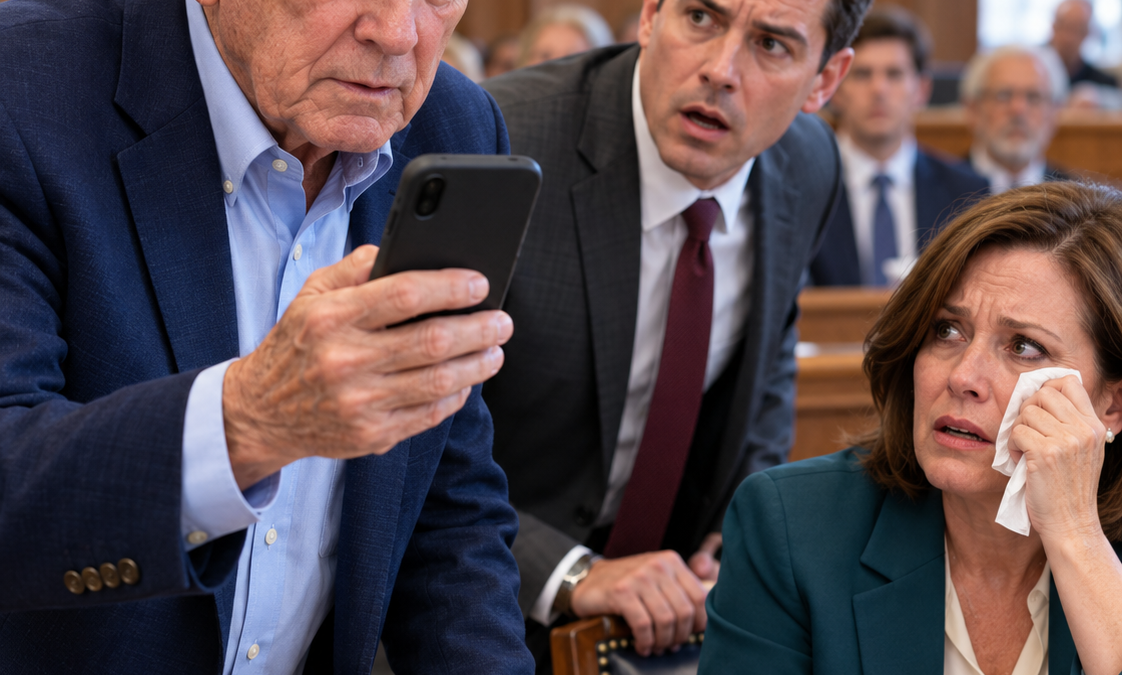
Complete story · 7 parts · about 29 minutes · ending included
Part 1 · Part 2 · Part 3 · Part 4 · Part 5 · Part 6 · Part 7
Part 1 of 7
“Talk all you want, honey. He can’t hear a word of it anymore,” Cheryl said, her knife already cutting Dad’s steak into neat squares on the plate she’d pulled to her side without asking.
At 12:41 p.m. on Sunday, Aug. 16, 2026, I was leaning toward my father to tell him about the cabin roof when Bev laughed.
Kyle smirked from his seat on his mother’s other side. At our family table by the window, in the country club on the mountainside east of Ogden, Dad kept eating.
My shop work shirt was creased from an overtime shift at an avionics bench at the Air Force base south of Ogden. For 24 years, I’d been a civilian technician there. My badge was off for lunch, its lanyard rolled up in my pocket.
I set down my knife and fork.
“Say again?”
I lowered my eyes. Dad’s phone lay face up on the tablecloth beside his plate, the live captions from his hearing-aid app running; Cheryl’s words had rolled onto the screen the moment she stopped talking.
At Christmas dinner, I’d watched that same scrolling text follow our conversation.
My father tore off a piece of bread without looking down at the display. His jaw worked beneath the edge of his cheekbone.
Cheryl finished the last square and pushed the steak back in front of him.
“Oh, don’t stop your lunch on my account.”
Then Cheryl caught me reading and waved a hand at Bev.
“He leaves that thing running and never looks at it. Half of it comes out wrong anyway.”
“I saw what you said.”
“Well, you were sitting right here, honey.”
Bev pressed her napkin to the corners of her mouth. “Oh, Cheryl.”
Dad swallowed. With the side of his fork, he cut one of the squares in two before lifting the smaller piece.
“He asks the same thing three times now,” Cheryl told her friend. “You answer, and then you repeat yourself.”
“Dad. I was talking to Dad.”
“And I’m right beside him. You can talk to me, too.”
I kept my utensils down.
“The roof isn’t your lunch conversation, Cheryl.”
“That cabin’s too much for him. All those steps.”
Kyle rested his forearms along the edge of the cloth. His mother reached for her water glass and took a drink before continuing.
“You come straight from work and want to talk about another job. Let him eat.”
“He is eating.”
“Then eat yours, honey.”
My father drew a piece of steak through the juice on his plate. The small wires of his hearing aids curved behind his ears; neither hand went near them.
Bev tipped her chin in my direction. “You must be tired, coming up here after a shift.”
“I’m fine.”
“Nobody said you weren’t,” Cheryl said. “We’re having lunch.”
I waited until Dad had lowered his fork.
“The cabin is his.”
Kyle’s smirk flattened. He rubbed his thumb along the seam of his cuff.
“Sure it is.”
Cheryl spoke past my father to her friend again.
“Kyle knows a man who’ll look at it.”
“Look at what?”
“The cabin, Tracy. We were just talking about it.”
“Dad can ask for somebody.”
“Honey, I live with him.”
The next bite stopped short of my father’s mouth while he separated a strand of meat from the tines. Then he set it on the rim and carried on eating.
“He can ask,” I said.
Cheryl folded her napkin across her lap.
“You don’t need to tell me how to have a conversation with him.”
At 12:43, a busboy brought the member check and a pen to Dad.
My father took the pen himself. He signed the check, wrote in a $20 tip, and handed it back to the boy.
“Thank you, sir.”
Bev watched the exchange and shrugged. Cheryl was smoothing a crease out of her napkin when the busboy walked away.
Dad returned to his lunch.
At 12:45, Bev rose and went to the dessert table. Her chair stayed empty.
Kyle picked up his water glass. I started on my steak, and Cheryl asked, “Are you going to finish before everything gets cold?”
“Yes.”
My father ate what was left, then set his fork beside his knife.
At 12:50, my phone rang in my pocket. The shop’s duty line was calling about a part.
I stepped out onto the terrace.
“What have you got?”
The technician on shift answered over the hum of the shop. For eight minutes, I stood at the rail and worked through the problem with him, waiting during the pauses while he checked what I asked.
“Read me that voltage once more.”
The numbers came in short pieces, with a scrape against the receiver between them.
“Copy.”
At 12:58, I came back in. Dad was slowly tapping one finger on the phone screen.
“He’s playing with that thing again,” Cheryl said to Kyle.
I drew my chair out. Bev was still away getting dessert.
My father finished tapping and rested his hand on the tablecloth.
“Ready, Dad?”
Cheryl stood before I had pushed my chair in. Kyle followed his mother toward the doors, then came alongside my father as we reached the parking lot.
Dad lowered himself into the car while Kyle steadied his elbow and kept the passenger door open. On the far side, Cheryl stopped and spoke to me across the roof.
“Don’t plan on Thanksgiving at the cabin this year, Tracy. Kyle’s handling the cabin now.”
Part 2 of 7
When I called Dad’s phone from my place at 9:40 p.m. on Friday, Aug. 21, Cheryl answered and cut me off before I could ask for him.
“He’s asleep. Don’t call this late, Tracy. It confuses him,” she said.
Then she hung up.
A letter from Cheryl and Kyle’s lawyer was in my mailbox Saturday morning, Aug. 22. Inside was a single page, without the filing itself. Across the top, the heading read “Notice of Hearing”.
Beneath that were the words “Petition for Appointment of a Guardian for an Adult”, followed by “In the matter of Dean Halvorsen”.
The hearing was set for 9:00 a.m. on Tuesday, Sept. 8, at the Second District Court in Ogden.
I drove straight to my father’s house with the notice.
Dad was in his armchair in the living room. Blocking the kitchen doorway, Cheryl watched me come in without moving aside.
“I want to see the full petition,” I said.
“It’s Kyle’s paperwork, honey. You’d only upset him.”
Her shoulder nearly touched the frame. A dish towel hung from one hand.
“I’m asking to read what was filed.”
“You got your letter.”
“That isn’t what I asked for.”
Cheryl folded the towel lengthwise and pressed the fold flat with two fingers.
“You can ask Kyle.”
My father sat with his hands on the chair arms. I stood where he could see me without having to lift his chin.
“Dad, do you know what they filed?”
Dad said, “Let them talk, Trace.”
After drawing the towel through her palm, she laid it over her shoulder.
“We’re trying to take care of things,” she said. “You don’t have to come over here and make everything harder.”
“I asked him a question.”
“And he answered you.”
Cheryl held out her hand.
“Dean, give me the cabin key. Kyle’s man is going up Tuesday to measure.”
My father reached into his trouser pocket and took out his key ring. Between his thumb and forefinger, he caught the brass head.
The red leather tag was folded in half and snapped shut. Mom had hooked it on in 2009, and I’d never seen it open; since she died in January 2019, Dad hadn’t let the key out of his hands.
“Tuesday morning,” Cheryl added. “He needs to be able to get inside.”
Dad worked the brass free, taking his time at the split in the ring. His thumbnail stayed under the metal until the last turn.
“You can give that to me now, Dean.”
Dad returned the rest of the ring to where it came from. My father dropped the key into his shirt pocket and pushed the button through its hole.
“Later.”
For another moment, Cheryl’s palm stayed open. Then she turned to me.
“See? He doesn’t even know what I asked.”
“You asked for the key.”
“I know what I said, Tracy.”
In his armchair, Dad rested one hand flat over the key.
I stepped out onto the front porch and called Robin Nyberg on my cell. She’d been Dad’s lawyer since 2010.
“It’s Tracy Halvorsen,” I said. “I got a hearing notice this morning.”
“Where are you?” Nyberg asked.
“At Dad’s house. Sorry to call you at home on a Saturday.”
“Go on.”
“I asked to see what they filed,” I said. “Cheryl won’t show me.”
“Is your father in the house with you?”
“Yes.”
“Utah says he has to have a lawyer at this hearing. If he wants me, I’m his. He has to tell me himself.”
“I’ll take you inside.”
Beside him again, I handed Dad my phone.
“Robin,” I told him.
My father brought it to his ear.
“Robin. It’s Dean. Yes. You.”
Then Dad gave the phone back to me.
Before I hung up, Nyberg said, “Come to my house at two.”
Cheryl pulled the towel off her shoulder.
“Was that necessary?”
“Yes.”
“You could have talked to Kyle first.”
“I came to see Dad.”
She turned back through the doorway she’d been blocking. Beside his armchair, his phone sat on the side table.
My father tapped one finger on the screen.
At 2:10 p.m., I was at Nyberg’s kitchen table while she printed the whole petition with the doctor’s report attached. Her printer stopped, and she handed me the printout.
“Your father sent me every page. If they win, Kyle signs for the sale and holds the money, and Kyle decides where Dean lives — which means Cheryl does.”
I spread the printout across the table.
“Does Dad have to leave his house?”
“That’s one of the decisions they’re asking to make for him.”
“And the cabin?”
Nyberg extended her hand and pointed to paragraph 12.
“Read that before you go.”
I ran a finger down the margin to the last pages, where Dr. Kimball’s report was attached.
“How many times did he examine Dad?”
“It lists one examination.”
“How long?”
“The doctor put the time in writing.”
Nyberg withdrew her hand. Between us, the printout showed Dr. Kimball’s signature beneath the report dated Aug. 17.
“Respondent was examined at his home on August 13, 2026, for approximately 25 minutes. Respondent could not follow a conversation.”
Paragraph 12 of the petition read:
“Petitioners request authority for the guardian to sell the respondent’s real property in Huntsville, Utah.”
Part 3 of 7
On Monday, Aug. 24, I sent Cheryl a text from my place: “I’m filing an objection. Dad has his own lawyer.” At 9:12 p.m., her reply lit my phone: “Drop it or I call your base this week. Debt. Divorce. Unstable. Watch that clearance go.”
I didn’t answer.
Before my shift on Tuesday, Aug. 25, I signed a one-page self-report in my unit security manager’s office on the base. At 7:30 a.m., I put the page on the desk, with 12 months of statements showing every payment on time and a printed photo of Cheryl’s text.
The credit card balance and the car loan left from my divorce were listed beneath my name. My signature ran along the bottom.
The security manager pulled the stack closer.
“These go with your report?”
“They do.”
“Do you have anything to add?”
“I don’t.”
The date beside my signature got a careful look. I left the papers there and went to work.
At 7:52 a.m., an email arrived on my phone: “Received and noted in your file, 8/25.”
I opened the message with my thumb. The acknowledgment showed the date beneath the subject heading.
At 5:40 p.m. on Wednesday, Aug. 26, I carried the Wednesday grocery bag to Dad’s front door, the way I had every week since 2019. The keypad rejected my code.
I entered the numbers once more, pressing each square in the center. The lock didn’t release.
Cheryl answered through the closed door: “Dean doesn’t want visitors before the hearing. Doctor’s orders.”
The bag’s handles had drawn together over my fingers.
“I brought his groceries.”
“You can leave them.”
“I want to see Dad.”
“This isn’t a good time, honey.”
“I can wait.”
“He’s resting.”
She never raised her voice.
“He isn’t having visitors.”
I shifted the weight to my other hand.
“Tell him I’m here.”
“He needs quiet, honey.”
“Ask him if he wants me to go.”
“I’m not disturbing him.”
“Then let me ask.”
“I’ve already told you what the doctor said.”
The groceries brushed my knee as I moved far enough along the porch to see through the front window. Dad sat in his armchair in the living room. He did not look up.
I waited for his chin to lift.
Cheryl spoke just as pleasantly. “Go home, Tracy. You have enough to explain at work.”
“Let me talk to him.”
“You heard me.”
The door never opened.
I carried the bag back to my car and put the groceries on the passenger seat. From the driveway, I dialed Dad’s number.
His voicemail answered without a ring.
“Dad, it’s Trace.”
I ended the message and lowered my phone against the steering wheel, then tried again.
The same greeting began.
I hung up before the tone.
Across the windshield, the porch was empty. My objection was still a half-typed draft, with an unfinished sentence at the bottom.
I opened the document. The keyboard covered the lower part, and the cursor blinked after the last word I’d entered.
My finger rested on the delete key.
I didn’t press it.
Not one word left the screen. The last line still stopped at Dad’s name.
I closed the draft.
The bag stayed beside me in the car.
All evening, my calls to Dad went straight to voicemail. I left no more messages.
At 8:30 p.m., the same security manager phoned me at home: “A woman named Cheryl Pratt called about you this afternoon. It’s logged with your report. You’re fine.”
I pressed my heel against the floor.
“Do you need anything else from me?”
“We don’t.”
“Will this go to my supervisor?”
“Not from this office.”
“I appreciate it.”
When the line went quiet, I lowered my arm. The edge of the case had left a mark against my cheek.
On Thursday morning, Nyberg reached me at home: “Your father wants to see you. Four o’clock, my office. He’s driving himself. He told Cheryl it’s a haircut.”
“I’ll be there.”
“Come straight in.”
I put the appointment in my calendar. Beneath the time, I typed 25th Street.
At 4:00 p.m. on Thursday, Aug. 27, I took one of the two chairs in front of Nyberg’s desk. My father occupied the other, his hair freshly cut above his ears.
Behind the blotter, the lawyer balanced her pen across her fingers.
Dad rubbed a loose clipping from his collar.
Nyberg replaced the cap.
My father reached into his trouser pocket and set his phone on the desk.
“I was letting them talk, Trace. You can’t catch a man saying it if you stop him.”
I brought my feet back under my chair.
Dad opened his notes app. His thumb moved once, and the display filled with writing.
Nyberg didn’t speak. From my seat, I could make out the heading, but the smaller type ran away from me.
My father rotated his phone until the words were upright for me. His fingertip rested along the top edge.
The note was titled “Club 8/16 — saved 1:05 PM”.
In the middle of the screen, I read:
“12:52 PM Kyle: Kimball saw him Thursday. He’ll sign that Dean’s confused.”
“12:53 PM Cheryl: We file Wednesday. The cabin’s listed by October.”
Part 4 of 7
Nyberg said, “The standard is clear and convincing, Dean. If you freeze on the stand, or the judge decides the app wrote this and not you, Dr. Kimball’s report is all he has.”
Dad spoke from the chair beside mine. “Don’t send it to them first. I want Kimball in the room when I read it.”
“Then you stand up and read it yourself. Every time stamp. I’ll list it as an exhibit, nothing more.”
From behind her desk, Nyberg took out her own phone. My father enlarged the type with two fingers, then withdrew them from the screen.
“Can you read that size?” the lawyer asked.
“I can.”
“Will you need your glasses?”
Dad tapped the case in his jacket. “I’ve got them.”
Nyberg photographed each line of the note. At the edge of the blotter, my father used his thumb to bring the next part into view.
Dad leaned back. “Do you have what you need?”
“I do. You take yours home.”
The lawyer checked her photos, then sent them to the printer behind her chair. Dad watched the sheets feed into the tray.
“Will they get those?”
“These copies are for my office file.”
Nyberg collected the printout and checked that the writing was readable before putting the pages away. My father locked his screen and returned his phone to his trouser pocket.
“They said they’d call your base.” Dad’s voice was quiet.
“I called first.”
He pressed his lips together, then turned to speak to me.
“That Thursday morning she took both my hearing aids to clean them. Kimball came while they were gone.”
My jaw tightened.
Cheryl drove Dad to his regular follow-up at the ear clinic Friday, Aug. 28, and waited outside in the car; only my father and the clinician were inside the office. On Monday, Aug. 31, Nyberg filed Dad’s objection with the audiologist’s letter: “With his hearing aids and captions on, he hears and follows conversation.” That same Monday, I filed my own as his daughter.
At the front door on Labor Day, Sept. 7, Cheryl buzzed me in with relatives standing close enough to hear her greeting.
“Family’s welcome on a holiday.”
I crossed the threshold.
“Where’s Dad?”
“He’s out back with everybody. You can go right through.”
About 14 guests had come for the barbecue. My uncle raised his paper cup from a lawn chair, and I lifted a hand to him before stopping near the grill.
Bev stood with two friends from the club. Beside them, Cheryl separated a stack of paper plates with her thumb.
“Just say he asks the same thing three times. That’s all.”
A burst of laughter came from the other end of the yard. Before anyone beside me answered, Cheryl’s phone rang.
She checked the display and took her lawyer’s call.
“What have you heard?”
His words did not reach me.
“A phone note from August sixteenth? That’s his caption app. Garbage. Half of it’s made up. Fine, object to it.”
Cheryl ended the call and addressed the people gathered around her.
“Tomorrow’s a formality. Kyle’s been Dean’s executor since 2023 anyway.”
One of the club friends spoke to me. “Are you going to court, Tracy?”
“I’ll be there.”
“I suppose we all will.”
Kyle shut the grill lid. “We ought to be done before lunch.”
Bev collected a plate but took no food. Dad was talking to his brother when Cheryl held out her hand in front of the guests.
“Key, Dean. After tomorrow it won’t matter.”
My father patted his buttoned shirt pocket over the brass key with the red leather tag.
“Tomorrow, then.”
Kyle laughed. “Tomorrow you won’t be signing anything, Dean.”
Dad finished his conversation with my uncle.
At 9:00 a.m. on Tuesday, Sept. 8, the bailiff brought us to our feet in the courtroom of the Second District Court in Ogden. I rose in the second row while Dad pushed his chair back beside Nyberg at the respondent’s table.
Across the aisle, Cheryl stood between Kyle and her lawyer. Bev and the two club friends occupied seats in the gallery.
When we sat, my knees touched the bench ahead of me.
Cheryl took the witness stand and swore to tell the truth. Her lawyer let her unfold a tissue before beginning.
“How long have you cared for Mr. Halvorsen?”
Her voice shook.
“I’ve cared for him every day for four years. Dean can’t follow a conversation anymore. He hasn’t for a year. This is about his safety. Nobody’s talking about money.”
The tissue went beneath one eye, then the other. Between dabs, Cheryl searched the benches until she found me; her mouth trembled before the next words came.
“I hate saying this. Tracy’s buried in debt and unstable. Her own base has questions about her.”
I sat with my feet flat on the floor.
Dr. Kimball came up to testify with his own copy of his report. After taking the oath, the doctor spread the pages against the wooden rail.
“In my examination, Mr. Halvorsen could not follow a conversation.”
The judge addressed Nyberg. “Do you wish to cross-examine?”
“I’ll reserve my questions, Your Honor.”
Dad’s lawyer made no mark on the pad beside her. At the other table, Kyle whispered to Cheryl’s counsel.
The judge consulted the papers.
“I have objections from the respondent and from his daughter. Is Ms. Halvorsen present?”
From my seat, I stood up.
“I’m here, Your Honor.”
Beside Nyberg, Dad reached up and pressed the volume button on his left hearing aid, then braced one hand on the table and rose, his phone in the other hand.
Part 5 of 7
Nyberg stood beside Dad and said, “My client wants to answer for himself, Your Honor.”
The clerk swore my father in at the respondent’s table, where he would face the petition to put Kyle in charge of his life.
In an ordinary voice, the judge asked, “Mr. Halvorsen, can you tell me why we’re here today?”
Dad touched his buttoned shirt pocket over the key.
“Because Cheryl and her son want this court to say I can’t run my own life, so they can sell my cabin in Huntsville. I am saying no. And I want to read you what they said about it. I was at the table.”
Cheryl’s lawyer rose. “Objection, Your Honor. That’s a phone app, not a witness.”
“Overruled. He was at the table. He may read it.”
Nyberg addressed her client. “Mr. Halvorsen, who put the speakers’ names in your note?”
“I put the names in myself. I copied the captions in the parking lot at 1:05 on August 16.”
“Did you hear those words spoken?”
“I heard them.”
With twenty-two people in the courtroom, Dad raised his phone to reading height.
“12:41 PM. Cheryl, to my daughter: ‘Talk all you want, honey. He can’t hear a word of it anymore.'”
My fingers closed around the bench back. The varnish pressed against the pads below my knuckles.
Cheryl’s lawyer bent toward his client. Before either spoke, my father continued.
“12:52 PM. Kyle: ‘Kimball saw him Thursday. He’ll sign that Dean’s confused.'”
Behind the petitioners’ table, the doctor lifted his chin.
“12:53 PM. Cheryl: ‘We file Wednesday. The cabin’s listed by October.'”
Dad sat down. Across the aisle, Kyle gripped the edge of his chair.
Nyberg spoke to the judge. “Your Honor, I’d like to recall Dr. Kimball for my reserved questions.”
The request was granted. He came back to the stand with his own copy.
“Doctor, your report is dated August 17. On August 16 Mr. Pratt said you would sign. Who told you what to find?”
Kimball looked down at the pages in his hands.
“I was told the family had concerns. I saw him once.”
“When did you examine him, and for how long?”
“I examined him August 13, for about twenty-five minutes.”
“Was he wearing his hearing aids?”
“No. Mrs. Pratt said they were being cleaned.”
My jaw locked before I could swallow. Across from us, Cheryl burst out without waiting for the next question.
“That app makes things up! Half those captions are garbage.”
Dad laid his phone face down on the table in front of him.
“Then I’ll say 12:54 without it. You said, ‘He’ll never sign it, so we don’t ask him.'”
The judge spoke directly to my father.
“Turn it over, Mr. Halvorsen.”
Dad turned his phone face up and lifted it. His thumb rested below the words as he read.
“12:54 PM. Cheryl: ‘He’ll never sign it, so we don’t ask him.'”
The clerk’s pen moved across the page as the judge gave the next order.
“The note is marked as an exhibit. Ms. Nyberg, file a printout before noon.”
“I will, Your Honor. I request permission to recall Mrs. Pratt.”
The judge allowed it and excused Dr. Kimball. Cheryl left her place beside Kyle and took the stand again.
Nyberg opened her copy of the filing.
“Mrs. Pratt, you testified nobody’s talking about money. Paragraph 12 of your own petition: ‘Petitioners request authority for the guardian to sell the respondent’s real property in Huntsville, Utah.'”
Cheryl gripped the wooden rail.
“He told me himself he wanted that cabin sold. He said the steps were too much.”
“Then why, at 12:54, did you say he’d never sign it? Mr. Halvorsen, the next line.”
Dad read from his phone.
“12:55 PM. Kyle: ‘And if Tracy fights it?’ Cheryl: ‘One call to her base. Debt, unstable. She folds.'”
The judge shifted toward the second row.
“Ms. Halvorsen, you filed an objection. You may respond to what was said about you.”
I stood at my seat and held up my own phone. Cheryl’s text carried the date Aug. 24 and the time 9:12 p.m. I read the message word for word.
“Drop it or I call your base this week. Debt. Divorce. Unstable. Watch that clearance go.”
Cheryl opened her mouth.
“I reported it to my security office at seven-thirty the next morning. You called them the day after. It’s in my file, with twelve months of statements. All current.”
I sat down.
Cheryl stepped down, and her lawyer put Bev up in rebuttal.
Bev came forward from the gallery and took the oath. Counsel asked, “Does Mr. Halvorsen ask the same thing three times?” Bev looked at Cheryl.
“I was at that table, Cheryl. He paid the check and tipped the boy twenty. I laughed. I’m not saying he’s confused.”
My shoulders dropped against the wood behind me. Beside Kyle, his mother pulled the tissue tight between her fingers.
Bev left the stand. Her two club friends rose, joined her in the aisle, and walked out of the courtroom with her.
Cheryl watched the door close.
“The petition is dismissed. The court finds it was brought without merit. Petitioners will pay the respondent’s attorney fees.”
Nyberg spoke from beside my father.
“Six thousand five hundred to date, Your Honor. I’ll file the fee affidavit today.”
“File it. So ordered.”
Cheryl pivoted toward Dad.
“Dean, honey, you know I only wanted—”
My father laid his hand over the shirt pocket with the cabin key and looked straight at her.
“I heard every word, Cheryl. I just let you finish.”
Part 6 of 7
Cheryl signed the move-out agreement in the courthouse hallway at 11:00 a.m. Tuesday, Sept. 8, 2026, promising to clear all her belongings out of Dad’s house by Thursday, Oct. 8. The two lawyers had drafted the terms, and Nyberg put a fingertip beneath the deadline before taking the signed page.
My father’s name alone was on the house. There had never been a lease.
Cheryl’s lawyer checked the date beside her signature. Kyle stood next to his mother and read over her shoulder.
“I’ll need to get my clothes,” Cheryl said.
Dad answered her. “They’re yours to take.”
She reached toward the folder. Her lawyer tapped that line once more while Nyberg slid the signed agreement inside. “You have until October eighth to remove everything you own,” he told her.
My father walked beside me to the elevator, the pocket holding Mom’s key still buttoned shut.
That night Dad called me and said, “Cheryl went to Kyle’s apartment in Riverdale this evening.”
“Did you eat?”
“I made supper.”
On Thursday, Sept. 10, Nyberg emailed me a copy of the written order the judge had signed that day. The original was in the court file.
I opened the attachment. The petition was dismissed as brought without merit; the petitioners were to pay six thousand five hundred dollars in attorney fees within 30 days.
At the bottom, beneath the judge’s signature, the date matched the one in the email. I printed it out and clipped it to my hearing notice.
Friday, Sept. 11, Dad brought me to the office on 25th Street. Nyberg placed the new will before him and read the first line aloud: “I revoke every earlier will, including the one I signed in 2023 naming Kyle Pratt executor, allowing Cheryl Pratt to live in my house for life, and leaving her son my pickup and tools.”
I stopped at the words about the house. My father put his finger on the paragraph below.
“Keep going, Robin.”
Nyberg read my name as executor. I pulled my chair closer and followed the print from the margin.
Dad spoke before the next provision.
“Write the cabin the way June wanted.”
The lawyer marked that clause for revision. My father watched the pen finish, then gave instructions for the notice to go out from her office.
“Tell Kyle he won’t be handling my estate, and his name is out of the will.”
Nyberg lifted her pen from the pad.
“An executor does nothing while the man is breathing.”
Dad answered without raising his voice.
“I signed that one in 2023 to keep the peace. Kyle doesn’t handle anything of mine.”
The attorney read back the instructions for the letter. My father corrected nothing.
Two staff members came in as witnesses after the revised pages were ready. One reviewed the signature line before sliding the stack within Dad’s reach; the other brought a pen.
My father signed his name and added the date where the lawyer pointed. Each witness then completed the lines below his.
Nyberg checked the finished document from the beginning through the last signature. The signed will went into her office safe before we left.
The letter to Kyle went out from there that day.
On Sunday, Sept. 13, Dad called late that morning and said, “We’re going to the club.”
“We can eat here.”
“I’ll pick you up.”
At the family table by the window, my father pulled out the same chair he had used on Aug. 16. I took the place beside him.
Cheryl arrived alone and went to the women’s eight-seat table, where she ran the Sunday luncheon. Bev and her two friends remained on their feet at their seats.
The server approached with a pitcher. Water went into a single glass before the women collected their purses.
Bev lifted her own name card and the ones belonging to her friends. Walking past Cheryl, Bev said, “We all heard 12:41, Cheryl.”
The cards came to us.
“May we join you?” Bev asked Dad.
“Sit wherever you like.”
The other two drew their chairs in, and a waiter brought additional menus. Their three name cards now stood at our places, facing the window.
Cheryl patted the seat beside her. “Bev, you sit with me.” The server had already begun pouring water for the women who had joined us.
Only Cheryl remained at the luncheon table. She unfolded her napkin, then straightened the empty setting at her right.
Near the serving station, a guest who had started to rise stopped to watch, the linen halfway off her lap.
Cheryl slipped the strap of her purse over her shoulder and left. A busboy collected the unused menu and removed the card with her name.
Our food had not arrived.
Dad opened his napkin over his knees. Across from me, Bev pushed her name card farther from the edge as the first plate came through.
That evening at the house in Ogden, Cheryl’s drawers in the hall dresser stood half empty. My father pressed one shut with the heel of his hand.
At the front door, I opened the keypad’s reset instructions. Dad read along until I reached the entry for a new code.
“Use your mother’s birthday, November ninth,” he said.
I put my finger above the first button.
He said the digits aloud, one at a time. I pressed one, then one, then zero, then nine, as he gave me each number. The confirmation light came on.
My father worked the lock from inside. Outside, I entered the new sequence and pushed the door open.
Dad made two cups of coffee in the kitchen. He brought mine to Mom’s place at the table and slid the handle toward me.
My heel caught on the chair rung as I sat.
I stirred in sugar, wiped a drop from the rim, and let him drink before I spoke.
“Sell the cabin, Dad. It’s yours. I don’t need it.”
My father lowered his cup.
“I told Robin to leave it the way June wanted. You’ll see what that means.”
I pushed the sugar bowl back between us.
Dad unbuttoned his shirt pocket and placed the brass key in my palm. My thumb pressed against the teeth hard enough to leave marks.
“Read the tag first.”
I snapped the red leather tag open for the first time. Inside, Mom had written in ballpoint:
“Tracy’s — for when Dean can’t climb the steps. Make her take it. — June, July 4, 2009”
Part 7 of 7
Kyle was loading the last of Cheryl’s boxes into his own truck on Thursday, Oct. 8, 2026, the deadline for clearing her things out of Dad’s house in Ogden. On the kitchen counter, next to the garage door opener, Cheryl left a check for six thousand five hundred dollars made out to Nyberg’s office.
I had let the two of them in that morning. My father stood beside the refrigerator while her son came back for one more box.
The cardboard bowed under the weight. Kyle shifted his grip beneath the corners and carried it sideways through the entry, clearing the frame with an inch to spare.
Cheryl pressed a crease out of the check with two fingers. Her purse caught against a drawer pull as she passed; she freed the strap and followed her son outside.
From the opening, I saw Kyle push the tailgate up until the latch clicked. Cheryl climbed into the passenger seat without looking back at the house.
I closed the front door behind them and worked the lock from inside. The bolt slid fully into the frame.
At 8:00 a.m. Saturday, Oct. 10, I drove Dad through Ogden Canyon toward the cabin in Huntsville. The wooden handrail rode in the bed of my pickup with the mounting brackets and the drill.
My father checked the tie-down through the rear window when we rounded a bend. I eased off the gas for the next curve, then followed the road into the valley.
At the gravel pullout, Dad pulled his seat belt clear. The brass key with the red leather tag went into my jacket before I unfastened the tailgate.
The eleven wooden steps rose to the porch. My father stopped at the foot of them while I released the straps and carried the handrail over.
Near the supports, I tore open the package of screws. Dad cupped them together while I took out the tape measure.
From the bottom tread, I measured up to the mounting height, then got a second reading at the upper end. The metal hook slipped off the edge once. I caught the blade before the tape snapped back and started that measurement over.
A pencil line crossed each support at the same height above the stair slope. I verified the angle against the handrail before making the marks dark enough to work from.
My father pointed to the lowest one. I brought the bracket up to that line and traced the centers through the openings, then did the same at the other mounting points.
The drill bit entered the first mark square to the wood. Pale shavings curled onto my sleeve; I brushed them off before lining up the next opening.
At the upper support, I backed the bit out partway to clear the cut, then finished to depth. My father watched from the ground beside the stairs, his fingers closed around the screws.
I came down for the first one. Dad passed the head toward me, and I fitted the point through the lowest bracket before driving the threads into the pilot hole.
The metal settled against the timber. I stopped short of clamping the mounting plate tight and inspected the pencil line at the edge.
My father supplied the next screw when I reached him. I secured the other side, felt for play, and worked upward along the remaining supports.
Each time, I came back to Dad for what I needed. He separated the threads with a fingernail and passed me one at a time.
With the brackets mounted, I lifted the handrail onto their arms. The lower end slid beyond its mark; I brought the length back, checked the overhang, and fitted the first attachment beneath it.
I ran a fingertip along the underside to locate the opening, then marked the wood through the metal. After lifting the handrail clear, I bored the pilot holes from below and brushed the sawdust off the bearing surfaces.
Everything settled into position again. I checked each pencil mark against the mounting points and pressed down at either end before reaching for the drill.
Dad handed me another screw. “Torque it down, Trace. All the way.”
I drove the head flush, released the trigger, and tested the joint with my fingers. The wood met the metal without a gap.
Starting near the ground, I tightened the attachments in order. My father followed the work with his eyes as I changed position along the slope.
The last connection was within reach of the sixth step. There I sat, the drill across my knees and my boots braced on the tread below.
I turned toward him. “Why didn’t you tell me in August, Dad? I thought they’d already taken you.”
My father answered from the ground, looking up at me. “If I’d said one word at that table, she’d have called it confusion. If I’d told you, you’d have walked into her kitchen, and she’d have had my phone by supper.”
“You let me guess for eleven days.”
“I know. Was I wrong?”
I reached out and took the last screw from his hand. My lips pressed together as I set it in place and brought the bit up beneath the head.
The threads caught. As I tightened the final connection, I said, “People talk over you because you’re quiet, Dad. Quiet isn’t gone.”
I stopped the driver once the head seated, then tried the other attachments by hand. At the bottom, I pulled outward on the handrail and put my weight against the wood. Nothing lifted from the supports.
The drill went back into its case. I gathered the empty packaging, retracted the tape, and stepped clear of the stairs.
Dad put one hand on the new rail and climbed.
His first foot settled flat before the other followed. At the sixth tread, my father paused, adjusted his grip farther up, and continued.
From the foot of the steps, I counted the rest as his shoes met the wood. He climbed all eleven and stopped on the top step.
I wiped my palms down the fronts of my jeans. Dad pressed the volume button on his left hearing aid.
I called up to him. “Welcome back up, Dad.”
My father smiled. “Say again?”
So I said it again, louder, because he wanted to hear it twice.
THE END
More stories
My sister’s new mother-in-law charged $6,400 to my sister’s card for her own trip—then the check-in agent announced that all three tickets had been canceled.My ex-husband told his new wife $1,150 monthly supported our son—until I read the state’s closing letter beside his birthday cake, and she told 30 guests she’d filed for divorce.My sister-in-law called me “the hired help” while taking my 74-year-old dad’s phone — Then six lock codes exposed her secret rental, and she canceled before 14 guests.My brother-in-law used a $180 drill in Mom’s purse to push care-home papers—Until the store owner checked his cameras and my sister tore up the forms.My 34-year-old boss ordered me to sign a $300,000 mortgage from 40 employees’ retirement fund—Then a page his own father folded 25 years earlier froze every signature he had.My fiancé demanded my $210,000 for a house I wouldn’t own—Then bank records exposed who paid for my ring, and prosecutors charged him with identity theft.








