My Daughter-In-Law Locked Me Outside At 71 While My Son Carved Turkey — Then Police Arrived
Chapter 1: The Pan Outside
My daughter-in-law padlocked my kitchen door while I stood outside holding the roasting pan.
I had just poured cooled grease into the metal can beside the porch steps. The pan was awkward, with a bent handle that caught against my sweater.
“Wait,” I called. “I’m coming right back.”
Vanessa pulled the storm door shut.
I could see her through the glass. She looked at me, then reached toward the old exterior hasp.
We sometimes secured that entrance when it wasn’t being used. Never with somebody outside. Never during a dinner with people coming through the kitchen.
The padlock clicked.
For a moment, I thought she had caught her sleeve or dropped something. Then she stepped away from the door.
“Vanessa. Open that.”
She walked down the porch steps instead.
Her shoes made a scraping sound on the concrete path. She went around the side of the house, toward the front entrance.
My coat was hanging on its hook inside. My purse was beneath it, with my keys in the side pocket.
I had gone outside to empty a pan.
That was all.
Through the kitchen glass, I could see Patrick standing over the turkey. My son had rolled his sleeves above his elbows.
I knocked with the knuckles of my free hand.
He raised his head.
I lifted the pan a little, as if that explained everything.
“Open the door.”
He looked toward the dining room.
Vanessa appeared behind him. She had let herself through the front entrance and come back into the kitchen.
She stopped close enough for me to hear.
“Find somewhere else.”
I thought she meant somewhere else to put the pan.
“There’s grease on the bottom,” I said. “I need the sink.”
“You heard me.”
Patrick pressed the carving knife against the turkey.
He cut a slice, lifted it carefully, and laid it on the platter.
I watched him do it.
“Patrick.”
He did not look up again.
There were twelve relatives inside, eating the dinner I had bought and cooked. Somebody reached for the bowl of potatoes.
Somebody else turned in a chair.
“Is Elaine outside?”
Vanessa moved out of my view.
“Please eat,” she said. “Everything’s getting cold.”
I brought the pan closer against my stomach. The metal was losing its warmth.
I was 71. My husband was dead. My house was full of people, and I could not get through my kitchen door.
I went around to the front.
The path was narrow beside the house. I turned sideways to keep the roasting pan from scraping the siding.
At the front steps, I shifted it against my hip.
I rang the bell.
I heard it sound inside.
Then I heard a chair move.
Nobody came.
I tried the handle anyway.
Locked.
“Patrick,” I called through the door. “Get my coat.”
I waited with my ear close to the wood.
There were voices inside, but no footsteps coming toward me.
Across the small space between our houses, Denise stood on her porch. She had a dish towel over her shoulder.
“Elaine?”
I turned.
“What happened to your back door?”
“She locked it.”
Denise came down her steps.
“With you outside?”
“Yes.”
She looked at the roasting pan, then at my sleeves.
“Where’s your coat?”
“Inside.”
Denise had lived next door long enough to know which bedroom was mine. She had watered my plants after my husband’s funeral. She had brought my mail over when it landed in her box.
She did not ask whether I was visiting.
“I saw her put that lock on,” she said.
“Then you saw more than Patrick wanted to.”
Denise took out her phone.
At first, I raised my hand.
I had spent so much time preventing embarrassment. I did not want patrol cars outside while relatives sat around my table.
Then a gust went under my sweater.
I put my hand back beneath the pan.
“Please call.”
Denise gave the address clearly.
She said an older resident had been deliberately locked outside her own home. She said she had watched it happen.
I stood beside her porch rail while she answered questions.
“Do you need to sit down?” she asked afterward.
“I need to get inside.”
“I know.”
She offered to take the pan.
I shook my head.
There was nowhere I wanted to put it except my sink.
The responding officers were nearby. We had barely finished talking when their vehicle turned onto our street.
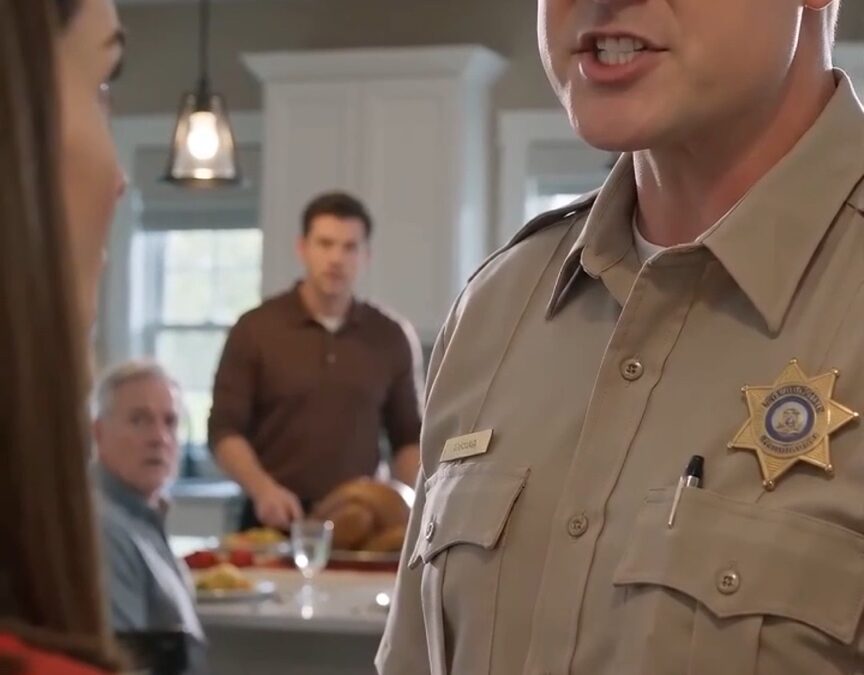
A sergeant got out, followed by another officer.
He introduced himself as Sergeant Martin.
I pointed toward my kitchen entrance.
“My things are inside. My son is inside.”
“Is anyone hurt?”
“Not hurt. Locked out.”
Denise stepped beside me.
“I watched her daughter-in-law fasten the lock.”
Martin asked us to stay near the front steps.
He rang the same bell I had rung.
This time, the door opened immediately.
Vanessa stood there with a folded dish towel.
She smiled at the officers.
“Oh, good,” she said. “I can explain what’s really going on.”
Chapter 2: What She Told Them
Vanessa held the front door partly closed behind her.
It kept the officers from seeing the dining room. It also kept me standing outside while she spoke.
“This is our house,” she told Sergeant Martin.
I moved the pan from my stomach to my hip.
“She transferred the deed to us last spring,” Vanessa continued. “She’s only visiting today.”
For a moment, I could not speak.
Not because I doubted myself.
I was trying to understand how she could say that while looking directly at me.
“No,” I said. “I did not.”
Vanessa turned slightly toward the sergeant.
“She gets confused about arrangements.”
“I’m not confused.”
Martin looked at me.
“Do you live at this address?”
“Yes. I sleep here. My clothes are here. My medication is in my bedroom.”
“Do you have identification inside?”
“In my purse, beside my coat.”
Vanessa began to answer for me.
The sergeant raised his hand.
“I’m asking her.”
Denise stood close enough that her shoulder brushed mine.
“I’ve lived next door throughout this,” she said. “Elaine lives here. I saw Vanessa put that padlock on while Elaine was outside.”
“Did you hear anything?”
“I heard Elaine ask to come back in.”
Vanessa’s smile tightened.
“This is a family disagreement.”
“That doesn’t answer what happened at the door,” Martin said.
He asked the other officer to check the property information. Then he asked me whether anyone else had a lease.
“My son and his wife rent shared space,” I said. “Month to month. I kept my bedroom and the kitchen.”
“Is that in writing?”
“Yes. In my desk.”
Vanessa put the dish towel beneath her arm.
“Then this is civil.”
“The ownership dispute may be civil,” Martin said. “Locking an established resident outside is what we’re addressing now.”
He was careful about it.
He did not announce that he could decide every property question at my front door. He did not tell Vanessa that tenants had no rights.
He asked about my access.
He asked about my belongings.
He asked where I had slept the previous night.
“My bedroom,” I said. “The same bedroom I always use.”
Patrick appeared behind Vanessa.
He still had a serving fork in his hand.
“Mom lives here,” he said.
Vanessa turned toward him.
He looked at the fork, then put it on the hall table.
The other officer came back from checking the county record.
My deed had been recorded July 9, 2012.
The recorded owner was Elaine.
There was no recorded transfer to Patrick and Vanessa.
My house had no mortgage. I had never signed a deed giving it away, never agreed to sell it, and never given either of them permission to describe me as a visitor.
Vanessa had never asked to see that record.
She had assumed an officer would hear “family property dispute” and leave us to sort it out after the holiday.
Instead, the officer stated what the county record showed.
Vanessa’s mouth opened, then closed.
“That doesn’t explain our whole arrangement,” she said.
“No,” Martin agreed. “It doesn’t. Your shared living agreement can be reviewed separately.”
That answer seemed to surprise her.
He was not going to throw her out.
He was also not going to leave me outside.
“Restore her access,” he said.
Vanessa glanced toward Patrick.
He stepped away from the door.
She went through the kitchen and out to the padlock. I followed around the side of the house with Denise.
The sergeant came through the kitchen.
Vanessa removed the lock.
She opened the storm door, but kept herself in the entrance.
I raised the roasting pan.
“I need to put this down.”
“Not everything has to happen right now,” she said.
I took a step.
She pressed the door toward my shoulder.
It was not enough to knock me down. It was enough to stop me.
Martin’s voice changed.
“Clear the doorway.”
Vanessa stepped back.
I entered my kitchen.
The table was crowded with dishes. The turkey sat beneath the light, and the dressing had a serving spoon stuck in its center.
My plate was still empty.
The sergeant took the open padlock from the counter where Vanessa had dropped it.
He lifted it above the kitchen table.
It was heavy enough to pull his hand slightly downward.
“This entrance stays available to her,” he said.
Vanessa’s smile disappeared.
Patrick finally put down the carving knife.
Denise remained near the doorway.
“She cooked this dinner,” she said. “I watched her carrying groceries in. And I watched you lock her outside.”
Nobody reached for another serving.
I set the roasting pan in my sink.
Behind me, Patrick asked the question he should never have needed to ask.
“So Mom doesn’t have to go anywhere?”
Chapter 3: The Dinner Went Cold
“No,” Sergeant Martin said.
He looked at Patrick, then at Vanessa.
“She is an established resident. You don’t get to remove her by putting a lock on the door.”
Vanessa folded the dish towel until it became a small square.
“We live here, too.”
“Yes,” he said. “And that is not being decided by throwing anyone out today.”
I was grateful he said it plainly.
I did not want an unlawful shortcut just because she had tried one first.
I wanted my kitchen entrance open.
I wanted my coat where I could reach it.
I wanted the fact that I lived in my own home to stop being treated as something we needed to vote on.
The other officer asked to see my identification and the shared-occupancy agreement.
I retrieved my purse.
Everything was where I had left it. My keys were in the side pocket. My identification was behind my grocery money.
In my desk drawer, the rental agreement lay beneath the household appliance manuals.
I brought it to the kitchen.
Vanessa looked at the familiar pages.
She had signed a rental agreement. She knew that.
What she had not seen was my recorded deed, or the speed with which the officers could check her claim about a transfer.
The agreement named the bedrooms they used and the rooms we shared. It did not give them exclusive possession of the house.
It did not promise a future purchase.
It did not contain an ownership option.
Martin read the relevant portions, then returned it.
The officers took our accounts separately.
Denise repeated what she had seen from her porch. She described Vanessa fastening the padlock and leaving me outside.
She did not exaggerate.
She did not say Vanessa struck me or made threats she had not heard.
That made her account harder to dismiss.
“I saw Elaine try the door,” she said. “Then I saw her go around front. Nobody admitted her.”
Vanessa said she had wanted space during a disagreement.
Martin asked what disagreement required leaving me without my coat.
She did not answer that directly.
The officers documented what had happened. They made clear that any future dispute over continued occupancy would need lawful handling.
There was no arrest at my table.
There was no order telling Patrick and Vanessa to leave that night.
There was simply an open door and a record of why it had been locked.
After the officers left, nobody seemed sure what to do with dinner.
A relative offered to warm my plate.
Another began putting serving spoons beside their bowls.
Vanessa said, “I think everyone should give us some privacy.”
Denise looked at me.
“Do you want me to go?”
“No.”
That was the first answer I gave without checking Patrick’s face.
She pulled out a kitchen chair.
I sat beside her.
My food was barely warm.
I ate some dressing because I had made it that morning with Patrick. The bread had held its shape. The broth had not been too much.
I remembered steadying his bowl while he stirred.
“Easy,” I had told him. “You’ll mash the bread.”
He had smiled then.
Now he stood near the stove, rubbing a thumb along the seam of his trousers.
As relatives began leaving, I thanked them for coming.
I did not apologize for the police.
Vanessa went upstairs.
Patrick remained in the kitchen until the last guest had gone.
Then he closed the dishwasher without starting it.
“Mom, I didn’t know she’d use the lock.”
“What did you know?”
He glanced toward the stairs.
I waited.
“She thought you’d stay with somebody for a while.”
“Who?”
“I don’t know.”
“Where was I supposed to take my medication?”
He rubbed his forehead.
“I didn’t work that out.”
Denise stood to leave, but I asked her to stay.
Patrick pulled out a chair.
Vanessa had been talking about getting me settled somewhere smaller, he said. After I was out, they would discuss transferring the house.
“She thought it would be easier once you weren’t here every day.”
“Easier for whom?”
He did not answer.
The house was estimated at $286,000.
Vanessa wanted it without having to persuade me while I still lived in it. She wanted my departure to happen first, then the pressure, then the signature.
There had been no completed legal plan to remove me.
There had been a plan to make staying unbearable.
“And you kept carving,” I said.
Patrick looked at the empty platter.
“I thought getting involved would make her worse.”
I folded my napkin and put it beside my plate.
“You were already involved.”
He began to cry quietly.
I did not get up to comfort him.
I asked Denise to sit with me while I made a note of what he had said.
Then I opened the drawer where I kept Beth’s card.
Chapter 4: The Drawer Beside My Bed
I did not call Beth while everybody was still moving through the house.
I took her card into my bedroom instead.
I put it on the bed beside the rental agreement.
Then I closed my door.
My coat still smelled faintly of the kitchen. I had finally put it on after the officers left, even though I was indoors.
I took it off and hung it over my chair.
There was a legal pad in the drawer beside my bed.
I used it for grocery lists and appointment questions.
I wrote November 27, 2025, at the top.
Then I wrote what had happened in order.
The grease can.
The padlock.
The front door.
Patrick cutting turkey.
Denise calling.
Vanessa’s claim.
The county record.
I stopped when I reached the part about Patrick.
I had to go back and write his actual words.
Not what I thought he meant.
Not what I wished he had said.
What he had said.
Denise knocked softly.
“Can I bring you some tea?”
“Just water, please.”
She set a glass on my nightstand.
I asked whether she would write down what she had seen while it was fresh.
“Yes.”
“You don’t have to make it sound worse.”
“I won’t.”
She sat at my desk and wrote her own account.
I did not dictate it.
When she finished, she read it aloud.
It began with her standing on her porch. It ended with the officers restoring my access.
There was nothing about conversations she had not heard.
I put her account beside mine.
Then I found my deed copy.
The folder also held old insurance documents and the papers from when I first took possession. I had kept them because I keep household papers.
I had never hidden them from anyone.
I had simply never expected to defend them over Thanksgiving dinner.
When I reached Beth, I told her I was safely inside.
That was her first question.
Her next question was whether Patrick and Vanessa were still there.
“Yes.”
“Don’t change their locks,” she said.
“I wasn’t planning to.”
“Don’t shut off anything. Don’t put their belongings outside. We’ll review the agreement.”
I looked toward my bedroom door.
The television was on downstairs.
Vanessa was watching something at a normal volume.
It bothered me more than shouting would have.
Beth asked me to explain the rental arrangement.
They had moved in February 1, 2024.
They paid $650 monthly.
The tenancy ran by calendar month.
The agreement described shared occupancy and reserved my continued use of the home.
“They’re tenants,” Beth said. “We need to treat them as tenants, even after what happened.”
“I understand.”
“Do you want the arrangement to continue?”
I looked at the coat over my chair.
“No.”
There was a pause while she made notes.
She explained that ending a month-to-month tenancy was different from removing someone who refused to leave.
Proper notice came first.
If they remained after termination, an eviction case would require its own steps.
No holiday police visit could replace that.
I asked whether she could handle delivery.
“Yes. We’ll use a termination date that gives more than the required notice.”
We settled on December 1 for delivery and January 31 for the end of the tenancy.
I wrote both dates beneath her name.
The interval felt long when I first saw it.
Then I thought about what I had nearly done outside.
I had almost told Denise not to call because I did not want embarrassment.
I could live through a lawful notice period.
I could not keep pretending there was no problem.
After the call, I photographed the rooms I used.
Not their private drawers.
Not their personal papers.
My bedroom, the shared kitchen, the exterior door, and the old hasp.
I saved the pictures with my written account.
I put my deed and agreement in a folder in my room.
I did not search Vanessa’s belongings.
I did not need to.
My proof concerned my home and what had happened to me.
Later, Patrick knocked.
“Can we talk?”
“About what?”
“Getting things back to normal.”
I opened the door.
He stood in the hall with his phone in his hand.
“Normal is not available tonight,” I said.
He looked past me at the folder.
“Are you calling somebody?”
“I spoke with Beth.”
His shoulders dropped.
“Mom, please don’t make a decision while you’re upset.”
“I made it after I got warm.”
He waited for me to soften the sentence.
I did not.
“I’m ending the rental arrangement,” I told him.
Chapter 5: The Notices Arrive
Beth came on December 1 with separate notices.
I had cleared a place on the kitchen table.
The roasting pan was clean and put away. The holiday tablecloth had been washed and folded.
There were no relatives there to distract from what happened.
Patrick was home.
Vanessa came downstairs when she heard Beth introduce herself.
“I thought we were going to talk as a family,” Vanessa said.
“We can talk,” I said. “The tenancy is still ending.”
Beth gave Patrick his notice.
Then she gave Vanessa hers.
She identified the termination date and explained what the notice did.
January 31, 2026.
It did not mean they had to leave that afternoon.
It did not authorize me to remove their possessions.
It ended the month-to-month arrangement on the stated date.
Beth retained copies and documented delivery.
Vanessa read hers from beginning to end.
She did not tear it up.
She did not pretend the paper meant nothing.
She asked a practical question.
“What if we can’t find somewhere suitable?”
“Then you should obtain advice promptly,” Beth said. “But Elaine is not agreeing to extend the tenancy.”
“You can’t just have the police remove us.”
“No,” Beth said. “That is not what this notice says.”
Vanessa looked at me.
For the first time since Thanksgiving, she seemed to understand that I was not depending on a dramatic scene to solve this.
I had a process.
I intended to follow it.
Patrick sat down.
“Could we raise the rent?”
“No,” I said.
“We could help more.”
“I’m not negotiating a different arrangement.”
Vanessa placed her notice flat on the table.
“What about buying the house?”
I looked at Beth.
She waited for me to answer.
“It isn’t for sale to you.”
“You don’t even want this much house.”
“I want the home I live in.”
Vanessa pressed her lips together.
She had changed tactics.
She was no longer claiming a transfer had happened.
She was trying to make a future transfer sound like the reasonable way to avoid inconvenience.
Beth asked whether there was any existing purchase agreement.
“No,” I said.
Vanessa did not contradict me.
There was nothing to produce.
No signed sale contract.
No option.
No deed waiting in an office.
Just her wish and the assumption that Patrick could get me to agree.
Beth explained that any genuine future proposal would need independent review.
Then she repeated that I was not offering the property for sale.
Patrick turned his notice over.
The back was blank.
He kept looking at it anyway.
After Beth left, Vanessa remained at the table.
I began putting away the clean mugs.
She watched me open the cupboard.
“You’ve been talking to Denise about us.”
“She saw what happened.”
“She doesn’t know our whole situation.”
“She knows you locked the door.”
Vanessa stood.
“You’ve made me sound dangerous.”
“I told Beth what happened.”
Patrick interrupted.
“Can we please stop?”
I put the last mug on the shelf.
“Yes. We can stop discussing whether I was entitled to come inside.”
He stared at the table.
Vanessa picked up both notices, then gave Patrick his back.
“Keep track of your own,” she told him.
That was a small thing, but I noticed it.
She was already dividing responsibility for what came next.
I went upstairs and placed my copies in the folder.
Then I wrote down that delivery had occurred.
I was not collecting evidence because I wanted a court fight.
I wanted to avoid confusion if there was one.
Downstairs, their voices became sharper.
I could not hear every word.
Then Vanessa said something clearly enough that I stopped at the landing.
“You need to decide whose side you’re on.”
Patrick did not answer immediately.
I waited long enough to hear what he said.
“I need to find us somewhere to live.”
Vanessa said, “That isn’t what I asked.”
I went back into my room.
I did not stand there listening for a better answer.
Later, Patrick came to my doorway.
He held his own notice now.
“Will you tell everybody we’re being evicted?”
“You haven’t been evicted,” I said. “Your tenancy is ending.”
“People won’t understand the difference.”
“Then explain it accurately.”
He folded the paper carefully.
I watched him put it in his pocket.
At dinner, I cooked enough for myself.
I asked whether they needed the stove afterward.
Vanessa looked up sharply.
“You’re not making ours?”
“No.”
The groceries I had bought were still in the refrigerator.
I had not hidden them.
I had not denied access to food they owned.
I was simply no longer standing at the stove, preparing dinner for people who wanted me elsewhere.
Patrick opened the refrigerator.
For once, he had to decide what happened next.
Chapter 6: A Shared Kitchen Again
Living together after the notice required more care, not less.
I did not want another argument at a doorway.
I also did not want a careless mistake to turn into a separate dispute.
Beth had been clear.
Keep the living arrangements lawful.
Keep records.
Do not retaliate.
I left the utilities working.
I did not touch their bedroom doors.
I did not move their belongings into the hall.
When rent came due under the existing arrangement, I handled it normally.
It was rent for continued occupancy during the notice period.
It was not a payment toward ownership.
That distinction had always been true.
Now I made sure my records remained clear.
Vanessa began buying groceries in separate bags.
I gave them space in the refrigerator.
She wrote no dramatic messages on containers.
She was too practical for that.
Instead, she started using the kitchen later, after I had eaten.
It reduced contact.
I welcomed that.
I washed my dishes and left the sink available.
If something belonging to them sat on the counter, I worked around it unless it prevented ordinary use.
Then I asked for it to be moved.
My voice sounded unfamiliar to me at first.
“Please clear the stove.”
“I need the sink now.”
“That cupboard holds my baking pans.”
Ordinary sentences.
I had stopped saying them because I expected an argument every time.
Now I said them and waited.
Sometimes Vanessa complained.
Sometimes she moved the object.
Either way, I no longer left the room automatically.
Patrick noticed the meals before he noticed anything else.
He came home expecting the smell of dinner.
Instead, he found me eating soup at the kitchen table.
“Did you already cook?”
“Yes.”
“What is there?”
“For you? Whatever you’ve bought.”
He opened a cupboard.
There was nothing theatrical about it.
I did not bang a pan or list everything I had done.
He stood with a package in his hand and read the instructions.
Then he asked where the large saucepan was.
“In the same cupboard.”
He found it.
The meal took him longer than he expected.
I heard him turn the stove down after something boiled over.
In the morning, he cleaned the burner.
I noticed that, too.
Denise visited without coming in through the kitchen automatically.
She rang the front bell.
When I opened it, she lifted her eyebrows.
“Am I invited?”
“Yes. Come have coffee.”
I knew why she had asked.
She wanted me to be the person deciding who came into my home.
We sat at the kitchen table.
The old hasp was still on the exterior door, but the padlock was no longer used there.
I had put it away.
I did not need to leave it sitting out as a warning.
Denise asked whether I was sleeping.
“Better when the hall is quiet.”
“Any more trouble at the door?”
“No.”
She nodded.
We talked about ordinary things after that.
A plant in her window.
The cold patch beneath my back door.
The hem she needed to fix.
I had missed conversations that were not about managing Patrick and Vanessa.
Later, Patrick asked whether Denise had told the neighborhood.
“Ask her,” I said.
“I just don’t want people thinking—”
“Thinking what?”
He pressed his thumb against the table edge.
“That we don’t care about you.”
I looked at his hand.
I remembered it holding the carving knife.
“You need to deal with what you did,” I said. “Not what somebody might think.”
He sat down across from me.
“I should have opened the door.”
“Yes.”
“I knew you were out there.”
“I know.”
That was the first time he had said it without explaining Vanessa first.
I let the sentence stand.
He asked whether there was any way to repair things.
“There may be,” I said. “It won’t include staying here.”
He nodded slowly.
Then he asked whether I would meet with both of them.
“About what?”
“A family settlement. Something everyone could live with.”
I set my cup down.
“Send the proposal to Beth.”
His expression changed.
“I thought we could keep the lawyer out of it.”
“No.”
He stood and pushed in his chair.
That evening, Vanessa came downstairs with a folder.
She placed it on her side of the table.
“We need to discuss what you actually want,” she said.
Chapter 7: What They Asked Me To Sign
I did not touch Vanessa’s folder.
“My attorney can review a proposal,” I said.
“You could at least listen.”
“I’m listening.”
Patrick stood near the refrigerator.
He had not sat beside her.
Vanessa opened the folder.
It held notes about possible housing arrangements and a proposed discussion of buying the house over time.
Nothing had been signed.
Nothing changed ownership.
She wanted my signature on an agreement to begin negotiating and to delay their departure while those negotiations continued.
She called that a compromise.
I called Beth before agreeing to anything.
Vanessa objected to the call.
“I’m not trying to trick you.”
“Then independent advice shouldn’t hurt.”
Beth asked me not to sign anything during a kitchen conversation.
I put the phone away.
“I’m not signing.”
Vanessa tapped the folder.
“You haven’t even considered what this would cost us.”
“I’ve considered that you need to move.”
“There are deposits. Moving costs. Applications.”
“Yes.”
Patrick finally spoke.
“We knew that when we moved in.”
Vanessa turned toward him.
“We were supposed to be saving.”
“You were paying rent,” I said.
“I know what we paid.”
“Then please stop treating it as ownership.”
She closed the folder.
Her next argument was different.
She talked about my age.
She said I might need help later.
She said having family nearby could prevent problems.
All of those things could have been part of a reasonable conversation in another house, on another day.
Not after she had used my need for shelter against me.
“If I need help,” I said, “I’ll decide how to arrange it.”
Patrick looked up.
“Would you let me help?”
“Not by taking over.”
He nodded.
Vanessa leaned back in her chair.
She did not keep insisting the house was already theirs.
That claim had failed in front of police and relatives.
Now she was trying to make refusal seem irresponsible.
I kept returning to the actual question.
They had a notice.
They needed to leave by January 31.
My future care did not change either fact.
Denise arrived later to return a dish.
She had called first.
Vanessa went upstairs when she heard the doorbell.
Patrick remained in the kitchen.
He looked tired.
Denise put the dish on the counter.
“I can come back.”
“No,” I said. “We’re finished.”
Patrick rubbed his face.
“I need to say something with somebody else here.”
Denise glanced at me.
I nodded.
He sat down.
“Vanessa thought if Mom stayed somewhere else, she’d get used to it.”
I had already heard part of this.
I had not heard him say it without trying to soften it.
“She wanted me to tell Mom that keeping the house was too much. Then we’d ask about transferring it.”
Denise looked toward the closed kitchen door.
“And you went along with that?”
Patrick swallowed.
“I didn’t stop it.”
“That wasn’t my question.”
“No,” he said. “I went along with the conversations.”
I kept my hands around my cup.
It had gone cold.
“Did you know she would tell the officers I’d transferred the deed?”
“No.”
“Did you correct her?”
“Not until they asked whether you lived here.”
Denise said nothing.
She did not need to.
Patrick’s face had gone red.
“I thought if I could keep everybody calm, it would pass.”
“You watched me through the glass,” I said.
“Yes.”
I set the cup down.
“I’m not agreeing to a purchase discussion.”
He nodded.
“And I’m not delaying the move.”
He nodded again.
This time, I believed he understood the sentence.
After Denise left, he took Vanessa’s folder upstairs.
I heard them talking.
There was no shouting.
The next morning, they began looking for rentals in earnest.
They went out together and returned carrying ordinary application materials.
I did not ask to inspect them.
Their housing search belonged to them.
Vanessa stopped discussing my future care.
Patrick began asking practical questions about which furniture was theirs.
I answered without argument.
Then he approached me while I was putting clean towels away.
“If the place we find isn’t ready,” he asked, “could we stay beyond January 31?”
Chapter 8: Packing Without Permission
“No extension,” I told Patrick.
He looked at the towels in my arms.
“I’m asking in case something falls through.”
“Then you need a backup plan.”
“That sounds harsh.”
I put the towels on the shelf.
“I spent Thanksgiving outside without my coat.”
He closed his eyes briefly.
“I know.”
“I’m not using that to get something from you. I’m explaining why I need the arrangement to end.”
He stepped away from the cupboard.
I finished putting the towels away.
Then I called Beth.
I wanted the answer communicated clearly enough that there would be no later dispute about something I had supposedly promised in the hall.
Beth confirmed in writing that I had not agreed to extend the tenancy.
The termination date remained January 31.
She reminded me that if they stayed, I would need the next lawful step.
I understood.
I did not tell Patrick the police would drag him out.
I did not threaten to put his clothes on the lawn.
I prepared for either possibility.
I gathered my notice copies and delivery record.
I kept the rental agreement together with them.
I saved the photographs I had taken after Thanksgiving.
Denise’s account remained in the folder.
If I needed court, I would go through court.
I hoped I would not.
Packing began unevenly.
Vanessa packed her clothes first.
Patrick left his things until later.
Boxes appeared in the rooms they used.
I asked them not to block the hallway or exterior doors.
They moved the boxes against the wall.
We made a list of furniture ownership.
My kitchen table stayed.
Their bedroom dresser went.
The serving dishes I had owned before they moved in stayed.
The dishes Vanessa had brought went.
When we were unsure about something, we discussed the object itself.
I did not claim a possession because I was angry.
Vanessa did not get to claim a possession because she had used it.
That approach prevented more arguments than I expected.
Patrick found my sewing basket behind a stack of stored belongings.
He brought it downstairs.
“I didn’t know this was up there.”
“I asked where it went.”
He set it beside my chair.
“I remember.”
I picked up the small unfinished piece inside.
The needle was still tucked through the fabric.
I had stopped looking for it because every request seemed to become a discussion of whether I was being difficult.
Patrick stood beside the chair.
“Can I apologize?”
“You can.”
He took a breath.
“I saw you outside. I knew you wanted me to open the door. I kept carving because I didn’t want Vanessa angry with me.”
I looked at him.
He did not add anything about confusion.
He did not blame the guests.
“I left you out there,” he said.
“Yes.”
“I’m sorry.”
I smoothed the fabric in the basket.
“Thank you for saying what happened.”
“Does that mean—”
“It means I heard you.”
He nodded.
I was not ready to offer more.
An apology did not make sharing a house safe again.
It did not require me to cancel the notices.
He seemed to understand that better than he had earlier.
Vanessa came downstairs carrying a closed box.
“We have somewhere,” she said.
I looked up.
“It’s arranged?”
“Yes.”
“Then let Beth know your moving plan.”
Her expression tightened.
“I can tell you.”
“You can tell me, too. I want the arrangements clear.”
She gave me the plan.
They intended to leave January 31.
There would be a moving vehicle.
Their belongings would go directly to their new place.
I did not ask what it cost.
I did not ask whether she liked it.
The consequence was not that she had to live somewhere miserable.
The consequence was that she could no longer live in my house after trying to remove me from it.
On the evening before the move, I checked the hallway.
The boxes were stacked safely.
My bedroom door opened freely.
The kitchen entrance was clear.
I put the folder on my desk.
Then I set out ordinary breakfast things for myself.
I slept badly, listening whenever someone walked upstairs.
By morning, the house was already noisy.
Patrick came to my bedroom door.
“The moving vehicle’s here,” he said.
Chapter 9: The Last Walk Through
I put on my shoes before going downstairs.
I wanted to be dressed for the day.
Not watching from my bedroom.
Not waiting to learn whether somebody else considered me in the way.
The front door stood open.
Cold air moved through the hallway.
Patrick carried a box toward the vehicle.
Vanessa stood near the stairs, checking the rooms they had used.
I made coffee.
I offered some because I wanted coffee in my own kitchen without turning every ordinary act into a contest.
Patrick accepted.
Vanessa declined.
The move took time.
I stayed out of the carrying path.
When a large piece of furniture passed through the hall, I stepped into the kitchen.
I did not stand over the movers.
I did not inspect sealed boxes.
Patrick asked before taking something from a shared room.
“Is this ours?”
“That one is.”
“What about the lamp?”
“Mine.”
He put the lamp back.
There was no argument.
Denise came over after calling.
She sat with me at the kitchen table.
She did not photograph the move or comment on every box.
She kept me company.
That was enough.
Vanessa brought down the last things from their room.
She had dressed carefully.
Her hair was brushed, her face composed.
She did not look like somebody defeated in a movie.
She looked like a woman finishing a move she had not wanted.
That was what had happened.
She had not lost her clothing or her money to me.
She had not been denied access to her possessions.
She had lost the ability to stay in my house on her own terms.
When the rooms were empty, Patrick asked me to walk through.
Denise stayed in the kitchen.
I went upstairs with him.
The bedroom floor showed pale rectangles where furniture had stood.
There were small ordinary marks from living.
Nothing that required a shouting match.
I checked the closets.
They were empty.
Patrick opened the drawers of the built-in cabinet.
“Nothing left.”
We went downstairs.
Vanessa stood near the front door.
She held their keys.
Beth had told me to make sure surrender was clear.
I asked the question plainly.
“Are you both finished moving out and returning possession?”
Vanessa looked at Patrick.
He said yes.
Then she said yes.
They placed the keys on the hall table.
I noted that they had left voluntarily on January 31, 2026.
No eviction case had been filed.
No officer was there to remove them.
The notices had done what they were meant to do.
Vanessa adjusted the strap of her bag.
“I hope you’re happy with the house to yourself.”
I looked toward the kitchen.
Denise was rinsing her cup.
“I’m staying in my home,” I said.
Vanessa waited.
I did not add anything.
She opened the front door.
Patrick remained behind her.
“I’ll come out in a minute.”
She went to the vehicle.
He stood beside the hall table, looking at the keys.
For years, I had carried keys for him.
Forgotten keys.
School keys.
Keys dropped in the wrong coat.
Now he had returned the keys to my house, and I did not pick them up to give them back.
“Can I call you?” he asked.
“Yes.”
“Can I visit?”
“Ask first.”
He nodded.
“I mean it, Patrick.”
“I know.”
“No bringing Vanessa over without discussing it.”
“I understand.”
He looked toward the kitchen doorway.
I wondered whether he was remembering the glass.
I did not ask.
He hugged me carefully.
I let him.
It was not forgiveness completed in a hallway.
It was a hug before he left.
When he stepped outside, I closed the door.
I did not lock it immediately.
I watched through the window until the vehicle moved away.
Then I checked the empty rooms again.
Not because I expected them to hide somewhere.
Because the rooms were mine to enter without negotiating.
Denise came into the hall.
“Want me to stay?”
“For a little while.”
We sat at the table.
I called Beth and confirmed the voluntary departure.
Then I put the keys in a drawer.
The house sounded different.
No television upstairs.
No conversation stopping when I entered.
No footsteps approaching my bedroom to ask whether I had reconsidered.
My phone rang before Denise left.
Patrick’s name appeared.
I answered.
He did not ask to come back.
He asked whether I might be willing to arrange a visit.
Chapter 10: My Oven On Again
On February 1, 2026, I opened my bedroom door and left it open.
I had started closing it automatically.
Even when I went downstairs for water.
Even when there was nothing private on my desk.
That morning, I noticed my hand reaching for the knob.
I let it go.
Sunlight reached the hallway carpet.
The upstairs rooms were empty.
I did not rush to fill them.
Patrick had suggested I could use one for sewing.
I told him I would decide later.
It was a harmless suggestion.
I still wanted time without somebody planning my rooms.
I went downstairs and made breakfast.
There was no need to check whether Vanessa had finished with the stove.
There was no covered dish waiting for me to wash because everybody assumed I would.
I ate at my kitchen table.
Afterward, I put my sewing basket beside the living room chair.
Not tucked behind it.
Beside it, where I could reach it.
I took out the unfinished piece and worked until I wanted to stop.
Then I left it in the basket.
Nobody needed that chair for deliveries.
Nobody asked whether my things could go somewhere else.
Patrick called after breakfast.
We discussed a visit.
He asked what would work for me.
I gave him an answer.
He accepted it without suggesting that I was being unfair.
That was new.
It did not erase Thanksgiving.
It made the next conversation possible.
He said he had been thinking about his father.
I sat down.
“What about him?”
“That he would have opened the door.”
I pressed my lips together.
“Yes,” I said.
Patrick began explaining how badly he felt.
I stopped him gently.
“I can’t be the person who makes that feeling go away.”
He was quiet.
Then he said, “I understand.”
I hoped he did.
We ended the call without arguing.
I did not invite him to dinner that evening.
I had invited Denise.
She had asked whether I wanted to go out somewhere.
“I want to cook,” I told her.
“Are you sure?”
“Yes. For somebody I asked to come.”
I went to the cupboard where I kept the roasting pan.
It was still the same awkward pan.
The bent handle had not straightened itself.
There was a worn place along the bottom where I had scrubbed too hard over the years.
I carried it to the counter.
For a moment, I remembered holding it outside.
The weight against my sweater.
My bare wrists.
Patrick looking down.
I set it in the sink and rinsed it, though it was already clean.
Then I dried it carefully.
Cooking had never been the thing I resented.
I liked knowing when something needed another spoonful of broth. I liked checking a dish by smell before the timer sounded.
I liked putting food in front of somebody who was glad to be there.
What I had stopped doing was cooking because I was afraid of the argument if I did not.
I prepared dinner at my own pace.
I used the counter space I needed.
I left a cupboard open while I searched for the right dish.
Then I closed it because I was finished.
Denise rang the front bell.
I dried my hands and answered.
She waited on the step until I invited her in.
“You can come through the kitchen,” I told her.
“I know. I wanted you to answer your own door.”
I smiled then.
Not because everything was repaired.
Because there she was, waiting instead of deciding.
She came inside and put her dish on the counter.
I showed her where I wanted it.
She set it there.
We talked while I finished preparing dinner.
Not about eviction.
Not about how to punish Vanessa.
Not about what the relatives might be saying.
Denise asked about the sewing in my basket.
I brought it over and showed her.
She held it carefully, then gave it back.
The kitchen entrance was visible from the table.
The old hasp remained outside.
The padlock was put away.
I had no reason to hold it up again.
Vanessa had somewhere else to live.
Patrick knew he needed permission before coming over.
Beth had confirmed that the tenancy had ended with their voluntary departure.
There was nothing unfinished about who occupied the house.
There were feelings still unfinished.
I could live with those without letting anybody move back in.
Denise offered to help with dinner.
“Would you set the table?”
“Where are the plates?”
“In the cupboard by the stove.”
She opened the right door.
I heard her placing the plates down.
I turned the oven on.
Then I picked up my roasting pan with both hands.
I carried it across my kitchen and slid it back into my oven.








