My Daughter Slapped Me At Her Wedding After Draining My Savings — Then Her Husband Stepped In
Chapter 1: The Chair Beside Mine
My daughter slapped my hearing aid onto the reception floor.
“You heard me. Forgive the money.”
Her palm had landed beside my right ear.
I caught the tablecloth before pulling it loose.
My hearing aid bounced near an empty chair.
“Move your foot,” I told her.
Tessa looked down but did not move immediately.
I was afraid she would step on it.
The music kept playing behind her.
Without the aid, the nearest voices blurred together.
I bent toward the chair, holding its back.
My knees touched the floor before my fingers did.
At 74, I could still get down there.
Getting up required more planning.
My navy dress caught beneath one knee.
I pulled it free and looked under the seat.
Eighty guests had come to the reception.
The people nearest us had stopped eating.
A fork rested halfway across somebody’s plate.
My daughter stood over me in her wedding dress.
She was 38, not a child losing her temper.
“Tessa, please move.”
Paula reached the chair before Tessa answered.
My niece crouched and slid her hand underneath.
“I have it, Aunt Vera.”
She held the hearing aid by its curved casing.
I took it and brushed away some dust.
“Is it broken?” she asked.
“I don’t know yet.”
Paula glanced toward the dance floor.
Then she leaned close to my left side.
“Please don’t involve police until after the first dance.”
I stopped checking the little tube.
“After the first dance?”
“Just let them have that first.”
She was 46.
She had seen me on the floor.
I closed my fingers around the hearing aid.
“Help me get up.”
Paula pulled the chair closer.
I used the seat, then the back, to stand.
My right ear felt hot.
I touched it with two fingers.
Tessa watched me straighten my dress.
“You could have just said yes.”
“Don’t touch me again.”
She crossed her arms over her waist.
“You’re making everybody stare.”
I looked at the people already staring.
Then I fitted the hearing aid behind my ear.
The tubing sat differently than it had before.
Still, I could hear her next sentence.
“This was supposed to be a happy day.”
It was December 20, 2025.
We were in a rented reception hall in Milwaukee.
There were holiday decorations near the entrance.
I had arrived expecting dinner and photographs.
I had even brought a safety pin in my purse.
After years as an alterations seamstress, I usually did.
Before dinner, Tessa had checked her dress hem with me.
I had told her it looked fine.
Now I looked at that same hem beside my chair.
Before the slap, she had pulled out the empty seat.
She had not sat down.
She leaned close and mentioned their honeymoon.
Nothing had been booked.
She wanted Owen to use his separate savings.
Those were also the savings he intended for repayment.
She called forgiving the money a wedding present.
I told her we would not discuss it there.
She mentioned my monthly retirement income.
I said that money covered rent and ordinary bills.
It did not replace the savings I had advanced.
She told me I would manage.
I said I needed my money back.
Then she gave the order.
Then she struck me.
That was how dinner had become this.
Across the aisle, Owen stopped speaking to a guest.
He looked from Tessa to my hand beside my ear.
“What happened?”
Tessa answered before I could.
“She’s refusing to discuss anything.”
“She hit me,” I said.
Owen looked down at the floor near my chair.
Then he looked at Paula.
Paula nodded.
He did not ask me to lower my voice.
He turned toward the sideboard behind the head table.
His document case was sitting there.
I knew he had brought papers.
I had a signed copy at home.
Tessa followed him with her eyes.
“Owen, leave that alone.”
He opened the case.
“What are you doing?” she asked.
He took out the settlement and closed the case.
At 41, he had owned his house for years.
He had purchased it before their relationship.
The downstairs renovations had gone into that house.
My money had gone into those rooms.
My hands had worked on the cabinet doors.
He came back carrying the agreement without folding it.
“Your mother paid for the work,” he told Tessa.
“She helped us.”
“She paid, and she did work herself.”
I remembered one door resting across two padded chairs.
I remembered sanding its edge until my fingertips hurt.
Tessa had checked it with her fingertip.
Then she had asked me to smooth it again.
I had done it.
Owen stopped at the head table beside us.
He moved a place card out of the way.
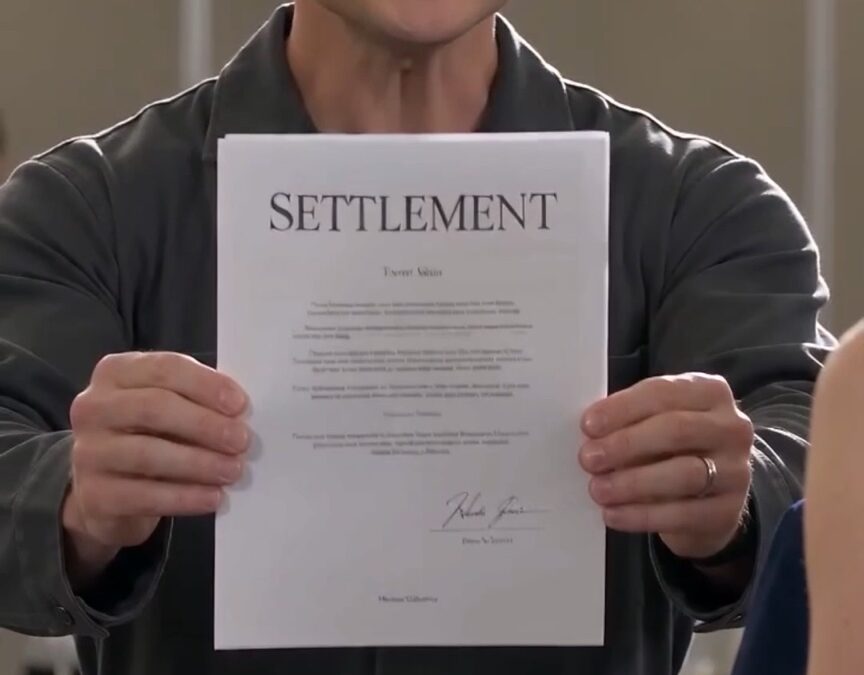
Then he spread the settlement flat.
The heading was printed plainly.
“SETTLEMENT.”
Tessa stepped closer.
She reached toward the lower edge of the page.
Owen lifted his hand so nothing covered it.
“Read it.”
Her eyes moved down the page.
Then she saw our signatures beneath the heading.
Her hand stopped reaching.
She backed away and caught her skirt against a chair.
Paula moved closer to me.
Tessa looked at Owen, then at me.
I had arranged repayment.
I had not arranged any part of this scene.
“You brought this here?” she asked.
“Payment was scheduled for today.”
A nearby guest pushed back a chair.
Someone farther away asked for the music to be lowered.
Tessa kept one hand on the chair behind her.
She looked at the signatures again.
Then she turned toward her husband.
“Why did you bring that to our wedding?”
Chapter 2: The Page Between Us
“Because I agreed to pay her today,” Owen said.
Tessa looked toward the occupied tables.
“Could we not announce this?”
“You asked her in front of everybody.”
“I asked my mother a question.”
“You hit her after she answered.”
She turned away from him.
I pulled my chair back and sat down.
My knees were aching from the floor.
The tablecloth had slipped crookedly across my place setting.
I straightened it without moving the agreement.
Owen kept the page facing us.
It was not a document for the guests.
It belonged to the people whose signatures were there.
Mine was on the left.
His was beside it.
Tessa had not signed.
She leaned over the table again.
“This says you’re paying her.”
“Yes.”
“It doesn’t say I agreed.”
“You aren’t the one making this payment.”
He pointed to the paragraph without touching her hand.
On December 2, 2025, he had personally assumed the obligation.
He agreed to pay me $31,800 directly.
Payment was due by December 20, 2025.
Once paid, the settlement would resolve the renovation advances.
It would release those renovation claims against both of them.
Until payment, the agreement remained something he owed me.
Only my signed written agreement could amend his obligation.
Only my signed written agreement could release him.
I had signed no amendment.
I had signed no forgiveness.
Tessa read the paragraph twice.
“She can still change her mind.”
“She can,” Owen said. “You can’t change it for her.”
I pressed my thumb against the edge of my napkin.
The words were familiar.
I had read them before signing.
I had asked what happened if Tessa disagreed.
The attorney had explained that Owen was assuming repayment himself.
We were settling disputed renovation advances.
We were not asking Tessa to admit my account.
The payments had begun in March 2025.
At first, I kept the paperwork in an envelope.
There were contractor invoices and transfer records.
I added each one when money went out.
By October 2025, the total reached $31,800.
I had used savings, not my monthly living income.
Rent still had to be paid.
So did electricity, groceries, and my ordinary appointments.
Tessa treated that distinction as proof I could afford everything.
“You’re not behind on anything,” she had said.
I was not behind because I watched my spending.
That did not mean the emptied account was unnecessary.
I lived alone in my Milwaukee apartment.
My husband was gone.
If something expensive happened, there was no second income.
There had been savings.
Then there had been renovation invoices.
Owen had called the money advances from the beginning.
We discussed repayment while work was still being done.
Tessa started calling it gifts near the end.
She said I had wanted to help.
That much was true.
I had wanted to help without giving away everything.
One afternoon, I was sanding a downstairs cabinet door.
The room smelled of wood dust.
I had folded sandpaper around a small scrap.
Tessa stood beside me holding a paint sample.
She ran her fingertip along the door’s edge.
“Can you make this smoother?”
I checked where she pointed.
“Along here?”
“Yes. You can still feel it.”
I rubbed the edge and brushed the dust away.
She tried it again.
“A little more.”
I changed the sandpaper’s angle and kept working.
My wrist had already begun to ache.
She went upstairs to answer her phone.
I stayed until the edge felt even.
I remembered liking how useful I felt there.
I also remembered washing dust from my hands at home.
There had been nobody in my apartment to ask about it.
When Tessa disputed repayment, I brought out the envelope.
I sorted the records across my sewing table.
Then I submitted copies to an attorney.
I wanted someone to review what had actually happened.
I did not want to keep arguing from memory.
Owen wanted the dispute settled before the wedding.
We signed on December 2.
Tessa was not a party to that agreement.
She never received the executed document.
That was why seeing our signatures surprised her now.
At the reception, she tapped the table beside it.
“You said you were handling this.”
“I did,” Owen answered.
“You didn’t tell me you’d signed this version.”
“I told you I was settling the advances.”
“I thought we were still discussing forgiveness.”
“You were asking for it. Vera hadn’t agreed.”
Tessa looked directly at me.
“You had someone write this against your own daughter.”
“I had someone explain an agreement before I signed.”
“You could have spoken to me.”
“I did speak to you.”
“You kept asking for the same thing.”
“Yes. Repayment.”
She glanced at Paula.
Paula kept her eyes on the document.
A server approached and stopped outside the aisle.
I moved my chair inward so there was room.
Nobody needed to stand holding dishes because of us.
Tessa watched that small movement with a tight mouth.
“We should do this somewhere private.”
“We can move,” I said.
“But the answer isn’t changing.”
Owen gathered the pages without folding them.
He laid them beside his place setting.
Tessa seemed encouraged by that.
She lowered her voice and stood closer to him.
“The date is today. Today isn’t over.”
“The payment is arranged.”
“Arranged isn’t the same as paid.”
“No,” he said. “It isn’t.”
She touched the back of his chair.
“Then you can still wait.”
Chapter 3: The Payment Already Prepared
“I’m not going to wait,” Owen said.
Tessa looked toward the nearest guests again.
She lowered her voice almost to a whisper.
“We’ve both had a long day.”
“So has your mother.”
“We need to discuss this as a married couple.”
“We can discuss our plans. This payment is hers.”
He walked toward the sideboard.
Tessa moved after him, then stopped.
The document case was still where he had left it.
He opened it and took out a cashier’s check.
When he returned, he put it beside the settlement.
He did not hold it up for anyone.
He placed it where I could read it.
Tessa stared at the amount.
“You already went to the bank?”
“Yesterday.”
December 19, 2025.
He had obtained the scheduled payment before the wedding.
The funds came from his separate premarital savings.
The check was payable only to me.
It was for the full $31,800.
No one had called a bank during the reception.
No payment instructions had changed because she slapped me.
The money had already been prepared.
I reached for my glasses.
They were beside the plate I had barely touched.
Owen turned the check slightly toward me.
“Please check the name.”
I read my name carefully.
Then I read the amount.
The printed date was the day before.
I checked everything a second time.
After months of invoices, there was finally a payment.
Tessa watched my finger move along the check.
“Mom, don’t take it yet.”
“It’s payable to me.”
“That doesn’t mean you have to deposit it.”
“I intend to.”
“Could you wait until we’ve calmed down?”
I lifted my eyes from the check.
“I’m able to read it.”
She looked at Owen.
“You should have told me you’d done this.”
“I told you the agreement would be honored.”
“You didn’t say you were getting a cashier’s check.”
“I wasn’t leaving the payment until after the wedding.”
She placed her hand on the table.
Not on the check, but close enough that I noticed.
I moved it nearer my plate.
Paula pulled out the chair beside mine.
“Do you need some water?”
“Yes.”
She brought my glass within reach.
I drank before saying anything else.
The hearing aid felt wrong behind my ear.
I adjusted it without taking it off.
Owen noticed.
“Is it working?”
“It is. It doesn’t fit properly now.”
Tessa looked down at the settlement instead.
“You know what this does to our trip.”
Owen kept his attention on her.
“I know what not paying does to her.”
“She has her monthly checks.”
I put down the water.
“They cover my monthly bills.”
“You keep saying that.”
“Because you keep treating them like savings.”
My voice carried farther than I intended.
I lowered it.
I did not want to explain my grocery budget there.
I did not want strangers imagining my bank balance.
But Tessa had brought it into the room.
Now she wanted the discussion quiet.
Owen drew the settlement closer to the check.
“Paying her and asking her to forgive it are different.”
“She can still choose to forgive it.”
“She already answered you.”
“She’s upset.”
“I was saying no before you hit me,” I said.
Tessa stared at me.
I could see her deciding what to answer.
She chose not to answer that part.
Instead, she smoothed the front of her dress.
“We don’t need to do this with people listening.”
I agreed with that much.
My right knee hurt when I moved it.
I wanted fewer eyes and a place to gather myself.
I did not want privacy used to erase the conversation.
Owen asked if I wanted him to put the check away.
“No. Leave it with me.”
He nodded.
I took it and placed it inside the folded settlement.
There were still things I wished he had done sooner.
He could have interrupted when her voice rose.
He could have noticed how close she was leaning.
Repaying me did not change where he had been standing.
But he was not calling the strike an accident.
He was not asking me to protect the reception.
He was honoring the agreement he had signed.
I could recognize that without excusing everything else.
Tessa bent toward him.
“Can we talk without an audience?”
He looked at me rather than deciding for me.
I checked where Paula was sitting.
She had not left my side.
“Somewhere close,” I said. “I’m not walking far.”
“There’s a small room beside the hall,” Owen said.
I nodded.
Tessa reached for the settlement.
I put my palm over the folded pages.
“I’ll carry it.”
“I was only helping.”
“I have it.”
She withdrew her hand.
I put on my glasses again to check the fold.
The check was secure inside.
Then I stood using the chair.
Paula stood too.
Tessa looked between us.
“Just the three of us.”
“No,” I said. “Paula comes.”
“She doesn’t need to hear our finances.”
“She heard you ask me to give up my money.”
Paula picked up my purse from beside the chair.
“I’m coming,” she said.
Tessa’s face tightened, but she moved toward the small room.
Owen waited while I settled the purse strap.
Before we moved, Tessa turned back to him.
“If we talk privately, can you at least reconsider?”
Chapter 4: The Room Beside Dinner
The room held a table and several chairs.
We left the door open.
I chose the nearest seat and sat carefully.
Paula put my purse beside my hand.
Owen placed the settlement in front of me.
The check remained inside it.
Tessa stood where she could see the reception.
A server carried dishes past the doorway.
She watched until the server was gone.
Then she turned toward Owen.
“You’re letting this ruin our whole day.”
“I’m paying what I agreed to pay.”
“You promised we would decide things together.”
“Not by keeping her money.”
“I’m not saying she should get nothing.”
Nobody spoke.
Tessa pulled out a chair but remained standing.
“I’m saying our plans should matter too.”
“We had a plan,” Owen said.
“You wouldn’t discuss changing it.”
“I answered your request.”
She looked at me, then back at him.
“Not properly.”
He sat across from me.
“On December 3, I told you no.”
I looked up.
That conversation had not involved me.
Tessa stopped moving the chair.
“You knew what I was asking.”
“Yes. You wanted a forgiveness amendment.”
“I wanted us to talk about it.”
“I rejected it in writing.”
She glanced toward the open door.
“I didn’t read that whole exchange.”
“You didn’t open my reply.”
“I knew you were annoyed.”
Owen kept his hands on the table.
“My answer said the payment would proceed.”
He explained it slowly enough for me to follow.
After we signed on December 2, Tessa requested a change.
She wanted me to forgive the advances instead.
He responded in writing on December 3.
He expressly rejected that request.
He also told her my signed consent would be required.
She had avoided opening his response.
She had assumed her requested change would somehow be accepted.
Nothing had changed the agreement.
Nothing had changed his payment instructions.
“You should have spoken to me again,” she said.
“I told you repayment was settled.”
“I thought we’d discuss it after the wedding.”
“You demanded her answer during dinner.”
Paula moved her cup away from the table’s edge.
I noticed because I needed something ordinary to look at.
Tessa turned toward me.
“You could have told him you wanted more time.”
“I didn’t want more time.”
“You could have let us enjoy tonight.”
“I was sitting quietly when you came over.”
She opened her mouth, then closed it.
For a moment, I thought we might reach the slap.
Instead, she returned to the money.
“He has other savings.”
Owen answered before I could.
“Those aren’t available for replacing this payment.”
“We’re married now.”
“Yes.”
“So we have to consider both of us.”
“We do. Your mother’s savings aren’t ours to consider.”
Tessa pressed her fingers into the chair back.
“If she takes all of it, we don’t go.”
“Then we don’t book the trip.”
“You can find a way.”
“I’m not allocating replacement funds for the honeymoon.”
She looked at me immediately.
“Are you happy?”
“No.”
“Then why are you doing this?”
“I need my savings back.”
“You have enough to live.”
“I had enough to live before the renovation.”
She looked away.
The room was quiet enough to hear the hall.
Someone laughed outside at something unrelated.
A chair scraped.
Dinner was still happening a few steps away.
I touched the hearing aid again.
Tessa followed my hand with her eyes.
“Is that going to be a whole other issue?”
“It needs to fit properly.”
“I didn’t mean to break it.”
“You hit me beside my ear.”
“I knocked it off.”
“It was attached to me.”
Owen looked directly at her.
“Stop describing it like it fell off a shelf.”
Her face reddened.
“Are you going to correct everything I say?”
“Not everything. That.”
I moved the settlement away from the table’s edge.
I did not want the check near anybody’s cup.
Tessa noticed the movement.
“You’re acting like I’ll take it.”
“I’m keeping it safe.”
“I’m your daughter.”
“I know who you are.”
Paula looked down.
I waited, wondering whether she would ask me to soften that.
She did not.
Tessa turned toward her instead.
“Can you explain this to her?”
Paula lifted her eyes.
“Aunt Vera needs to go home.”
“That isn’t what I asked.”
“I know.”
Tessa pulled the chair back sharply.
She finally sat, then immediately stood again.
Her skirt caught beneath the chair leg.
She freed it with an impatient tug.
I had done the same thing on the reception floor.
I watched her smooth the fabric.
Then I looked toward the doorway.
I was finished sitting in that room.
Owen asked whether he should arrange transportation.
I turned to Paula.
“Will you drive me?”
“Yes.”
Tessa stepped closer to the door.
“People will ask why you left.”
“You can tell them I went home.”
“They’ll think something happened.”
Paula stood beside my chair.
“Something did happen.”
Tessa moved aside.
I gathered the settlement and check.
My purse strap had twisted around the handle.
I worked it loose before standing.
Owen offered his arm.
I used the chair instead.
Tessa watched us prepare.
“At least stay for the first dance.”
I shook my head.
Then I looked at Paula.
“Please take me home before they announce it.”
Chapter 5: Before The Music Changed
Paula went to collect our belongings.
I waited near the small room with Owen.
Tessa stayed inside.
Part of her white skirt showed through the doorway.
I could see her hand resting on the table.
She did not come out to ask about my ear.
Owen stood far enough away to give me room.
“I’m sorry,” he said.
I looked at him.
“What are you apologizing for?”
“I should have come over sooner.”
“Yes.”
He nodded.
He did not explain who had been speaking to him.
He did not say he missed the beginning.
I was glad not to hear an excuse.
“Do you need medical help?” he asked.
“I need to see my ear properly.”
“Should we have someone look at it now?”
“I’ll have it assessed. First I want to leave.”
He asked whether Paula knew where my apartment was.
“She’s been there.”
“Of course.”
He looked tired suddenly.
I did not comfort him.
I was tired too.
We had guests looking in our direction.
Some quickly turned away when I noticed.
Others gave small, uncertain nods.
I did not stop to explain.
There was no explanation that belonged to all eighty people.
What they had seen was enough for that evening.
Paula returned carrying our things.
“Restroom first?” she asked.
“Yes.”
Inside, I stood close to the mirror.
The light showed redness beside my right ear.
I turned my head and checked from another angle.
Paula stood behind me.
“Can you see it?” I asked.
“Yes.”
I took off the hearing aid.
The casing looked intact.
The little tube had shifted and would not settle comfortably.
I did not pull at it.
I had made enough repairs to know when to stop.
I put it back carefully.
Then I washed my hands.
There was dust along the side of one finger.
I rubbed until it was gone.
Paula handed me a paper towel.
“I’ll help with pictures when we get home.”
I looked at her in the mirror.
“Yes. Thank you.”
She did not ask me to wait for anything else.
We walked toward the exit together.
I heard the music change behind us.
Nobody had announced the first dance yet.
I kept walking.
In the car, Paula waited until I was buckled.
Then she checked that I had the paperwork.
I touched my purse.
“It’s here.”
She pulled away from the hall.
For several blocks, we said nothing.
I watched the familiar Milwaukee streets pass.
Holiday lights showed in apartment windows.
People were having ordinary evenings behind those windows.
I wanted to be inside mine.
Near my building, Paula cleared her throat.
“I shouldn’t have asked you to wait.”
“No.”
“I thought if everyone calmed down—”
“You asked me to wait for a dance.”
“I know.”
I turned toward her.
“Did you think I was going to spoil it?”
She kept looking at the street.
Her answer took long enough.
“I was thinking about the wedding.”
“I was on the floor.”
“I know. I’m sorry.”
At my apartment, she carried what I could not manage easily.
I put the settlement and check on my sewing table.
Then I moved a fabric basket away.
I did not want payment papers mixed with scraps.
Paula helped photograph the redness.
She asked me to turn slightly.
Then she showed me the pictures.
I checked that they were clear.
I did not need them made worse.
I needed them to show what was there.
Afterward, I sat with a sheet of paper.
I wrote the date and the place.
I wrote the demand as I remembered it.
“You heard me. Forgive the money.”
I described the strike beside my right ear.
I described where the hearing aid landed.
I included getting down beside the chair.
Then I wrote what Paula had said.
She stood nearby while I did it.
“I’m putting the first-dance request in here.”
“I understand.”
I also wrote that she retrieved the hearing aid.
Both things had happened.
I would not leave out the helpful part.
I would not leave out the other part either.
I wrote about Owen bringing the settlement.
Then I stopped.
The repayment details belonged with the financial papers.
I wanted the account of the strike kept clear.
Paula made tea while I changed my dress.
The sleeve caught around my wrist.
I worked it loose instead of yanking.
Then I hung the dress where I could inspect it later.
I put the hearing aid back on.
At the kitchen table, the tea was still warm.
Paula asked whether I wanted her to stay overnight.
“No. Call me tomorrow.”
“I will.”
Before leaving, she checked that my door latched.
I listened to her footsteps move down the hall.
Then I sat beside my phone.
There was a message from Tessa.
I opened it expecting something about my ear.
She said people were asking questions.
She said the evening was becoming impossible.
She said I had bent down too quickly.
I read those sentences twice.
Then I reached the part she wanted.
“Please just tell them you fell.”
Chapter 6: The Account I Gave
I did not answer that message.
I saved it with the time showing.
Then I put my phone beside the written account.
For a while, I sat without doing anything.
The tea had gone cold.
I carried it to the sink and rinsed the cup.
I checked the door once before going to bed.
The next morning, my ear was still tender.
I looked at it in the bathroom mirror.
The redness had not disappeared completely.
I took another photograph without trying to make it dramatic.
Then I read what I had written the night before.
There were a few places where my handwriting crowded together.
I copied those words clearly without changing them.
I kept the original.
On December 21, 2025, I reported the incident.
I explained that my daughter had struck beside my ear.
I said my hearing aid landed on the reception floor.
I described kneeling to retrieve it.
I explained that Paula picked it up.
I gave her name as a witness to the aftermath.
I said guests were nearby.
I did not claim to know what every guest saw.
I had been looking at my daughter, then the floor.
That was what I knew.
I described the money demand because it preceded the strike.
I explained there was a written repayment agreement.
But I kept the two matters separate.
The settlement established the financial obligation.
It did not prove the movement of her hand.
The photographs showed redness.
My account described what had happened.
The saved message showed what she asked afterward.
I answered questions as directly as I could.
When I did not know something, I said so.
I was not promised that she would be arrested.
I was not told there would definitely be charges.
I had no court result to report afterward.
I had reported what happened.
That was the step I chose to take.
When I returned home, I wrote down the report information.
I put it in a separate folder.
The renovation papers went back in their own file.
I did not want to search through invoices for photographs.
I did not want the assault account mixed with repayment calculations.
My right ear still felt uncomfortable under the aid.
I called about having it checked.
I explained that it had hit the floor.
I described the tubing sitting differently.
I was told to avoid forcing it into position.
An assessment confirmed it remained functional.
It needed a tubing adjustment.
No other injury was diagnosed.
There was no hidden fracture or sudden emergency.
There was tenderness and a device that needed attention.
I was relieved about that.
I was also tired of thinking about my ear.
I had worn the aid to make conversations easier.
Now every time I adjusted it, I remembered the floor.
Paula called as promised.
“How does your ear feel?”
“Still tender.”
“Have you eaten?”
“Yes.”
She paused before asking about anything else.
I told her I had made a report.
“I gave your name.”
“That’s all right.”
“You can say exactly what you saw.”
“I will.”
“And exactly what you said.”
Her breathing changed.
“I know.”
I did not repeat the first-dance sentence.
She remembered it.
She asked whether I needed a ride anywhere.
“Not today.”
“Will you tell me if you do?”
“Yes.”
That was a useful offer.
I did not have to accept it immediately for it to matter.
After our call, I checked the cashier’s check again.
The amount had not changed overnight.
Neither had the name.
I read the settlement’s payment paragraph.
Owen had delivered payment on schedule.
I would take the check to the bank when it opened.
For the rest of that day, I stayed home.
I put away the dishes.
I folded the clothes left over a chair.
I made a small space on the sewing table.
I did not start sewing yet.
The room felt crowded with papers, even after filing them.
Tessa sent more messages.
The first asked whether I had spoken to anyone.
The second said Paula was making things worse.
The third said she wanted her mother back.
I stared at that one longer.
I had been her mother while sanding doors.
I had been her mother while advancing savings.
I had been her mother on the reception floor.
I did not send any of that.
I answered only the practical question.
“I have reported what happened.”
Her reply came quickly.
“You really did that?”
I left the phone on the kitchen counter.
There was nothing useful to add immediately.
Later, I wrote that I would not call it a fall.
I asked her to keep further contact in writing.
She tried calling after that.
I watched the screen until it stopped.
Then I checked that her messages were saved.
I did not erase her number.
I did not erase the photograph beside my sewing basket.
I simply did not answer the call.
Before bed, I set out what I needed for banking.
The check was secure.
My identification was with my purse.
I placed the signed settlement nearby, just in case.
Then a new message appeared.
“Before you deposit anything, we need to talk.”
Chapter 7: The Check At The Bank
On December 22, 2025, I took the check to my bank.
I brought my identification and the relevant paperwork.
I had not replied to Tessa’s demand to talk first.
There was nothing left to negotiate about the payment.
Owen had signed.
The due date had passed with payment delivered.
My daughter had not become part of the agreement overnight.
At the bank, I waited behind another customer.
Someone near the entrance was struggling with a wet umbrella.
I stepped aside to give her room.
Nobody knew about the reception.
Nobody was watching my ear.
I found myself relaxing while studying the deposit slip.
When it was my turn, I handed over the check.
The employee checked the name and identification.
I asked how the funds availability would work.
I did not assume cashier’s meant immediate access.
The employee explained the process.
I listened, then asked for the expected availability information again.
My hearing aid worked.
I simply wanted to be certain.
I kept the deposit receipt.
Before leaving, I checked the amount printed on it.
Then I put it into my purse separately from loose papers.
Outside, I stood a moment before walking homeward.
There was no urge to buy anything.
I had not thought of a treat or celebration.
I wanted the savings restored to the account.
That was all I had wanted since the dispute started.
At home, I put the receipt beside my settlement copy.
I wrote “deposited” on a separate note.
I did not write directly on the agreement.
Then I made lunch.
Halfway through eating, Tessa messaged.
“Did you deposit it?”
“Yes.”
Her answer arrived before I put the phone down.
“Could you send some back temporarily?”
I looked toward the drawer holding the renovation records.
Temporary had been the original understanding.
The money went out to get the work done.
Repayment would follow.
Then she had called the advances gifts.
Now she was offering another temporary arrangement.
I finished chewing before answering.
“No. I am not lending or giving it back.”
She wrote that she was not asking for a gift.
She wrote that marriage came with expenses.
She wrote that I knew how much the honeymoon mattered.
I did not answer each sentence.
That was how arguments had kept me occupied for weeks.
Every answer produced another explanation.
Every explanation became something else I needed to defend.
I replied to the request itself.
“The payment stays with me.”
She called immediately.
I let the phone ring.
Then I repeated that contact needed to be written.
Her next message said I was making communication impossible.
I looked at the words already exchanged.
She was communicating quite clearly.
I was simply not agreeing.
I put the phone face down and finished lunch.
Afterward, I washed the plate.
I wiped the table.
Then I checked the deposit receipt again.
The funds were still going through the bank’s availability process.
I had no reason to expect a problem.
But I was not going to promise money anywhere else.
Not to Tessa.
Not to myself for some purchase I did not need.
I put the receipt away.
Later, Owen contacted me to confirm delivery.
He wanted to know whether I had what I needed.
“I deposited the check today.”
“Good.”
“The bank hasn’t confirmed availability yet.”
“Let me know when it does.”
“I will.”
He did not ask what Tessa had written.
I did not read her messages to him.
He already knew what she wanted.
The disagreement about the honeymoon was theirs.
He asked whether I wanted a copy of anything else.
“No. I have the executed agreement.”
“And the payment.”
“Yes.”
That conversation ended without an argument.
I sat for a moment noticing the difference.
There had been a question.
There had been an answer.
Neither person had tried to change what the other meant.
Paula called later.
She asked how the deposit went.
I told her it was done, with availability pending.
“Do you want me to check in tomorrow?”
“Yes. But not just about the money.”
She was quiet, then understood.
“How’s the sewing table?”
“Almost uncovered.”
“I’m glad.”
I told her about the hearing aid needing adjustment.
She offered transportation for the service visit.
I said I would let her know.
Then I asked whether she had heard from Tessa.
“Yes.”
“What did you tell her?”
“That I won’t say you fell.”
I leaned back in my chair.
“Thank you.”
“I should never have made you wonder.”
I did not disagree.
After the call, I took fabric from my basket.
It had a deep crease from being folded.
I spread it flat and smoothed it with my palm.
The table lamp made a warm oval over the work.
I checked the edge, considering where to begin.
Then the phone lit up again.
Tessa said Owen would not change his mind.
She said there had to be something I could do.
I set the phone beyond the fabric.
The payment had been delivered.
The deposit had been made.
But the bank had not yet confirmed the money available.
I checked the receipt once more before closing the drawer.
Chapter 8: The Savings Back In Place
On December 24, 2025, the bank confirmed availability.
I checked the balance against the receipt.
Then I checked the receipt against the settlement.
The full $31,800 was there.
I sat at the kitchen table with the papers aligned.
For months, I had been calculating what might go wrong.
A repair.
An appointment.
Something ordinary that could become expensive.
Now I could restore the emergency savings I had used.
My monthly income would still cover ordinary bills.
The returned money could stay where it belonged.
I moved it into place and checked the confirmation.
Then I closed the account information.
I did not need to keep reopening it that morning.
I called Owen.
“The funds are available.”
“Thank you for telling me.”
“I’ll confirm receipt in writing.”
“That would be helpful.”
The agreement said payment resolved the disputed renovation advances.
It released those renovation claims against both him and Tessa.
He had paid as promised.
I was not going to pretend the claims remained unpaid.
I wrote a short acknowledgment.
I stated the payment amount and that it had been received.
I kept a copy with the executed settlement.
The financial part was complete.
That did not make the strike disappear.
I made sure my files did not confuse those matters.
The report folder stayed separate.
So did the photographs and the saved messages.
When Owen called later, he asked if anything remained outstanding.
“Not under the settlement.”
“All right.”
He hesitated.
I waited rather than helping him finish.
Then he mentioned the honeymoon.
He was not replacing the repayment with another allocation.
They would not book the trip they had discussed.
I did not ask where they had wanted to go.
There was no reservation to cancel.
There was no travel company holding a deposit.
There had been plans dependent on money she wanted forgiven.
He had refused to redirect the payment.
He was refusing replacement funds too.
“That’s between you and Tessa,” I said.
“I know.”
I asked about the sewing supplies left at the house.
He said he could gather them.
There were needles, thread, and some fabric pieces.
Nothing urgent, but I wanted them home.
“I won’t be doing more work there.”
“The downstairs is finished.”
“I mean any work.”
He paused, then answered plainly.
“I understand.”
I was glad I had said it that way.
A finished renovation could still produce small requests.
Curtains could need hemming.
A cover could need shortening.
Someone could say it would only take a minute.
I had spent enough afternoons there already.
My hands were not included in repayment.
I had never submitted an invoice for sanding doors.
I was not starting another argument about those hours.
I was deciding what happened next.
That afternoon, Tessa wrote that the trip was off.
She called the situation embarrassing.
She said people knew they had wanted a honeymoon.
She said Owen was being stubborn.
I set the phone beside the kettle.
I made tea before answering.
Then I wrote that I would not discuss returning the payment.
I would provide no further renovation money.
I would provide no further unpaid labor.
Contact needed to remain in writing.
If she wanted to discuss the reception, she needed to describe it honestly.
I read the message twice.
It did not call her names.
It did not threaten to tell every guest.
It said what I would and would not do.
I sent it.
She replied that I was treating her like a stranger.
I looked at her photograph beside my sewing basket.
She was much younger in it.
Her hair was tucked behind both ears.
I left the photograph where it was.
Then I put the phone down.
Paula called before evening.
I told her the bank had confirmed the funds.
“I’m glad your savings are back.”
“So am I.”
She started another sentence, then stopped.
“What?” I asked.
“I was going to say now you can relax.”
I waited.
“That wouldn’t be fair,” she added.
“No. Not about everything.”
She told me she had spoken honestly to Tessa.
She had described retrieving the hearing aid.
She had also admitted asking me to delay police.
“I didn’t call it a misunderstanding.”
“What did you call it?”
“Something I should never have asked you.”
I leaned back in my chair.
She was not asking me to edit her part anymore.
That made it easier to keep talking.
We discussed bringing my supplies home.
Paula offered to collect them from Owen.
I agreed.
She asked before setting a visit.
I noticed that too.
After the call, I moved the sewing basket back.
The table was finally clear enough to work.
I filed the bank receipt and written acknowledgment.
Then I placed my glasses beside the lamp.
For a few minutes, I sorted thread by color.
It was an ordinary task.
I had missed doing ordinary tasks without interruption.
My phone lit up beside the basket.
Tessa had sent one short message.
“Can I come over?”
Chapter 9: My Own Sewing Chair
I looked around the apartment before answering.
The kitchen counter was clear.
My sewing chair faced the lamp.
The payment papers were put away.
I did not want to prepare the room for another argument.
“Not now,” I wrote.
She asked when.
“I will tell you when I’m ready.”
She called after that.
I let it ring without picking it up.
Then I repeated that contact needed to stay in writing.
There was no court order keeping her away.
There was no need to invent one.
I was not inviting her into my apartment.
That was a decision I could make.
She wrote that I was punishing her.
I did not answer the accusation.
I had already told her what I was doing.
I saved the messages and put the phone aside.
Later, Paula came after asking first.
She carried the sewing supplies Owen had gathered.
She set them on the table.
“Would you like to check?”
“Yes.”
The needles and thread were in their little container.
The fabric pieces had been folded together.
Everything I remembered leaving there was present.
I put them back in my own basket.
Paula held the empty bag.
“Where does this go?”
“Beside the kitchen door.”
She put it there.
She did not ask whether I might finish something for Tessa.
She did not suggest bringing a peace offering.
We sat at the kitchen table with tea.
For a while, we talked about the supplies.
Then Paula looked down at her cup.
“I keep thinking about what I said.”
“I have too.”
“I saw the dress and the guests.”
She stopped and started again.
“I was thinking about the wedding. Not you.”
I rubbed the cup’s handle with my thumb.
It was the first explanation that sounded complete.
She was not saying she had tried to protect everybody.
She was saying whom she had overlooked.
“I needed you looking at me,” I said.
“I know that now.”
“I was worried about the hearing aid.”
“I should have asked what you needed.”
“Yes.”
She nodded and stayed quiet.
I did not tell her everything was fine.
I told her I appreciated her being honest afterward.
She did not ask whether that meant forgiveness.
She drank her tea.
Eventually, we talked about ordinary things.
A noisy heater in my building.
A piece of fabric I had been saving.
The empty bag waiting by the door.
I was glad we could change subjects without changing facts.
After December 24, I had the hearing aid serviced.
I explained again that it had hit the floor.
The tubing was adjusted.
The casing remained functional.
When I put it on, it sat correctly.
I turned my head in both directions.
There was no awkward pull behind my ear.
Someone spoke from the other side of the room.
I heard without leaning forward.
Then I asked a question without needing repetition.
That was the result I had wanted.
I took the aid home in place.
I no longer kept touching it every few minutes.
My ear stopped being the first thing I checked.
I still kept the photographs and account.
I still kept the report information.
Those papers stayed in their folder.
The settlement and payment acknowledgment stayed in another.
I did not lay them out for visitors.
I wanted to find them if needed.
I did not need to look at them every day.
The savings were restored.
My rent continued coming from monthly income.
Groceries still required a list.
I still checked a price before buying something unnecessary.
Having the money back did not make me wealthy.
It meant I could handle an emergency without borrowing.
That had been the reason for saving it.
Tessa continued sending occasional messages.
Some were angry.
Some were more careful.
I answered practical questions when an answer was needed.
I did not answer calls.
I did not send any of the payment back.
I did not call the strike a fall.
I did not return to sanding cabinet doors.
I did not take on sewing for their house.
The honeymoon remained unbooked.
I did not claim to know what would happen in their marriage.
Owen had honored the agreement he signed with me.
What followed between them was not mine to arrange.
One afternoon, I took the navy dress from its hanger.
I inspected the hem where it had caught under my knee.
A small section needed tidying.
I held it for a moment, considering putting it away.
Then I carried it to the sewing table.
I cleared enough room for the skirt.
The fabric spread beneath the lamp.
I found matching thread in my basket.
I threaded the needle and checked the knot.
For years, I had done this for other women.
I knew how to keep a repair from showing.
I worked slowly around the loose section.
Nobody stood beside me checking the edge.
Nobody asked whether I could do it again.
When I finished, I held the hem toward the light.
It lay properly.
I hung the dress and returned to the chair.
There was another small sewing job in my basket.
I took it out and settled the fabric across my lap.
A neighbor closed a door down the hall.
Water moved through the pipes behind the kitchen wall.
I could hear the thread slide through the cloth.
I reached behind my right ear and checked the fit.
My serviced hearing aid sat comfortably in place.








