My Husband Dropped A Padlock Into My Pregnant Lap Before Wedding Guests — Then A Deputy Arrived
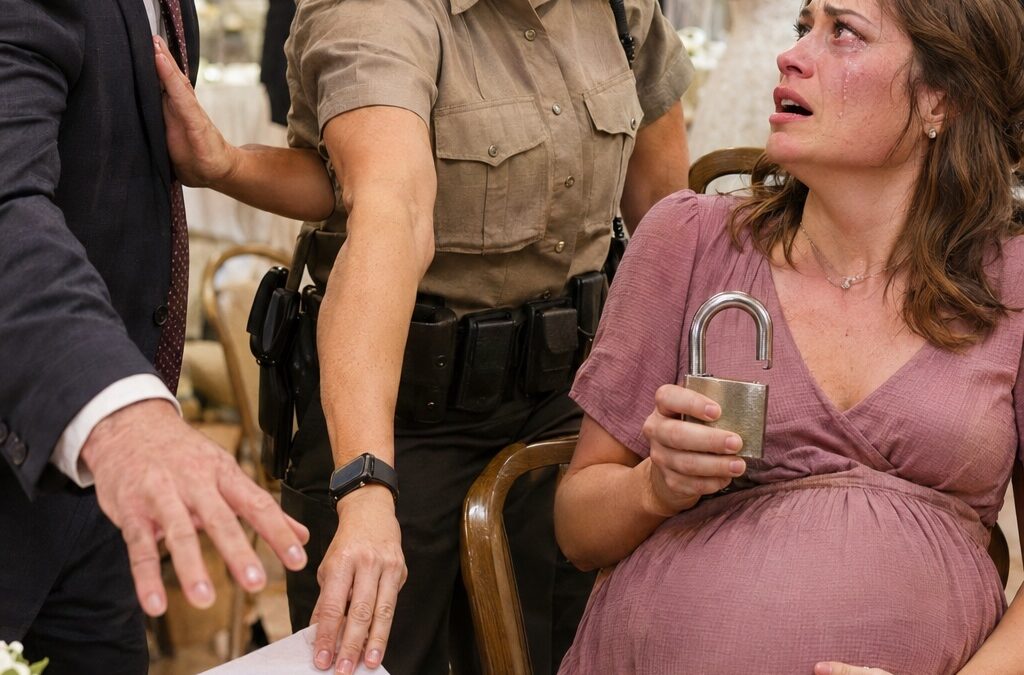
Part 3: The Paragraph He Had Missed
“That part applies to the house,” Tessa said.
Brent put his fingertip against the paragraph.
The court had granted the order on March 6, 2025.
It was already in effect before his luncheon speech.
It gave me temporary exclusive possession of our home.
It also ordered him to stay away from me.
He could not return while those provisions remained effective.
The full hearing was scheduled for March 18, 2025.
He had the hearing notice in the same packet.
“This was yesterday?” he asked.
“Yes,” Tessa said.
He looked at me across the service copy.
“You went to court without telling me.”
“I asked the court for protection.”
“You didn’t even give me a chance to answer.”
“You have a hearing date,” Tessa told him.
She pointed to it without leaning against his chair.
“You can appear and present your response there.”
He read the paragraph again, pressing the paper flat.
Nobody had warned him about my court appearance.
He knew I had spoken with a lawyer.
He did not know I had filed for protection.
I had not called him after leaving the courthouse.
I had not sent him pictures of the order.
My lawyer had explained how service would work.
I followed those instructions instead of contacting Brent myself.
The judge had heard me privately the previous day.
I had answered questions and provided the preserved message.
The temporary order came after that hearing.
Brent would have his opportunity at the full hearing.
Tessa tapped the notice again.
“The date and location are here.”
“So she gets everything before I say anything?”
“This is temporary protection,” she said.
“Read the order and speak with your attorney.”
He looked past her toward the reception-room door.
Twenty guests had heard his announcement about my clothes.
Now those same people were watching him read.
A paper napkin had fallen beside his chair.
He pushed it beneath the table with his shoe.
“You can’t give her my house,” he said.
“I’m serving the court’s order.”
“Our house,” I said.
He turned toward me.
“We both signed for it.”
We bought it on June 12, 2019.
Both names were on the title and mortgage.
I had contributed wages from my dental-assistant job.
For nearly six years, I had cleaned and maintained it.
There was no separate bill for those hours.
There was no invoice for washing his work clothes.
But my name had not disappeared from the deed.
The order did not decide our eventual property division.
It did decide where I could sleep that night.
I loosened my fingers around the padlock.
Its little keys were hooked around the open shackle.
Brent had dropped those into my lap with it.
I set it beside his untouched sandwich plate.
He looked at it, then at my phone.
“You made it sound like I hurt you.”
“I told the judge what you said.”
“This is what I mean,” he told the table.
“She takes something and makes it into something else.”
My phone lay beside the water glass.
The saved message was already open.
I checked the volume and pressed play.
His voice came through the small speaker.
“If you’re still there when I get back, I’ll drag you out.”
There was a short breath.
“I don’t care how pregnant you are.”
Then the message ended.
Janelle stopped smoothing the paper napkin across her knee.
Wesley looked at the remote beside his place setting.
Brent stared at the phone.
He had left that message on March 4, 2025.
I had been folding baby clothes when it arrived.
A small cotton shirt was spread across my lap.
After listening, I put it down and checked the doors.
On March 5, I saved a backup.
I kept the original message on my phone.
The backup went into an account only I controlled.
I preserved the date and the complete message.
I had not cut words from a longer conversation.
There were no words afterward explaining he meant something else.
At court, I had identified his voice.
At lunch, nobody needed me to identify it.
“I wasn’t going to do that,” Brent said.
Janelle moved her chair closer to mine.
“You said she invented it.”
“I was angry.”
“You said she invented your threats.”
He pulled his shirt cuff below his jacket sleeve.
“I didn’t mean she invented every word.”
I stopped the recording before it could play again.
Once was enough for the luncheon.
Tessa did not ask the guests to vote.
She brought him back to the order.
“Do you understand the restrictions?”
“I can read.”
“Do you understand them?”
“Yes.”
He said it while looking at his plate.
Then he lifted his head.
“My things are in that house.”
“You cannot return on your own,” Tessa said.
“Property retrieval needs to be arranged appropriately.”
She pointed out the applicable restrictions.
He was not to contact me through Wesley.
He was not to send instructions through relatives.
He needed to read the entire packet.
His lawyer could address questions through the proper process.
I shifted against the back of my chair.
Janelle noticed and reached toward an empty chair nearby.
She took its cushion and handed it to me.
I tucked it behind my waist.
Tessa asked whether anything obstructed my access.
Brent gave a short laugh.
“It’s a padlock. You’re looking at it.”
“Where did you put it?”
“Front entry. On the hasp.”
“Is it still locked?”
“No. Obviously.”
“Does the rear door work normally?”
He hesitated before saying yes.
My rear-door key was inside my purse.
The old exterior hasp had already been there.
We had never used it while living together.
He had bought a new padlock that morning.
Then he had removed it to bring to lunch.
The bags of clothes were still on the porch.
“My hospital bag?” I asked.
“Inside.”
“Did you touch the nursery?”
“No.”
Tessa glanced toward me.
She had seen that room on February 23.
She had stopped by while I finished cleaning paint.
I had been kneeling beside the baseboard.
Brent had left instead of holding the curtain bracket.
Tessa had brought food and moved the drop cloth.
“I saw Mara finishing that room,” she said.
“She was getting it ready for the baby.”
Then she returned to the access questions.
She did not claim that friendship decided ownership.
She did not say my nursery work changed the order.
She simply knew what I had been doing.
Brent pushed his chair backward a few inches.
Then he reached inside his jacket.
Tessa told him to keep his hands visible.
“It’s paper,” he said.
He withdrew a folded document and a pen.
He opened the paper beside the service packet.
My name was typed beneath a blank signature line.
“If she wants this handled properly, she signs this.”
Part 4: What He Wanted Signed
I left the paper where he put it.
The pen rolled against the edge of my plate.
Brent stopped it with one finger.
“It would save us both some trouble.”
“What does it do?” Janelle asked.
“It settles the house.”
I leaned forward enough to see the first page.
It said I would surrender my interest.
It also called for my cooperation with later transfer documents.
There was language saying I had left voluntarily.
I looked for a payment amount.
There was none.
“How much are you offering me?” I asked.
“We’ve talked about this.”
“Where is the amount?”
He smoothed the fold in the page.
“There isn’t an amount.”
“So I leave, and you keep the equity.”
“You’re making it sound ugly.”
I moved my water glass away from the document.
“No.”
“You haven’t even read the whole thing.”
“I’m not signing anything at this table.”
Tessa indicated the space between us.
“Do not move toward her.”
Brent had begun pushing the paper closer.
He stopped, leaving his arm across his place setting.
He looked at the service copy again.
Then he drew his arm back.
His smile had disappeared when he first recognized it.
Now he kept checking the paragraph about the house.
“This doesn’t give you ownership,” he told me.
“I know.”
“You still have to deal with me.”
“Through our lawyers.”
He looked toward Wesley.
“Can you tell her how much this will cost?”
Wesley kept his eyes on the table.
Janelle answered instead.
“You brought that paper to our wedding lunch?”
“It was supposed to be simple.”
“For whom?”
Brent folded the proposal along its existing crease.
My signature would not have transferred title by itself.
There would have been further paperwork and legal requirements.
But he wanted my agreement to giving up the claim.
He wanted something his lawyer could try to enforce.
He had brought the first page of that plan.
The padlock had been the part intended for the guests.
I looked at the empty space beside his plate.
It had held both objects a minute earlier.
One was supposed to keep me outside.
The other was supposed to make me agree.
“My lawyer can review anything you want to propose.”
“She’ll charge you to tell you the same thing.”
“Then send it to her.”
I picked up my fork, then put it down.
The sandwich on my plate had gone dry.
I could not remember taking more than one bite.
Tessa made sure Brent had the service packet.
He could not make service disappear by leaving it behind.
She explained that her assignment would be documented.
Her supervisor knew she was my oldest friend.
She had disclosed that before accepting the assignment.
She was there under official authority, not my invitation.
Brent had questioned that already.
He seemed ready to question it again.
Instead, he asked about his car.
He could take it and leave.
He needed to comply with the listed restrictions.
He was not being arrested at the luncheon.
He was being personally served with an existing court order.
He gathered both sets of papers.
His proposed agreement went on top.
Then he checked his pockets for his car keys.
He glanced toward the padlock.
I thought he might collect it.
He left it beside his sandwich instead.
The reception-room door closed behind him.
Someone near the cake put down a fork.
Janelle took my water glass while I adjusted the cushion.
Then she handed it back.
“I’m sorry,” she said.
“You didn’t do this.”
“I know. I’m still sorry.”
Tessa asked how I felt physically.
I told her the baby was moving.
My back hurt, but I was not having contractions.
She told me to say if that changed.
Then she stepped away to contact her office.
We needed a safe return arranged.
I was not going alone to check for Brent.
While she made that call, I called my lawyer.
I described the service and the proposed surrender.
I explained that Brent had taken his paper.
My lawyer asked who had seen it.
I named Janelle and the others nearest our table.
I also described the voicemail playback.
“Keep the original message,” my lawyer said.
“Don’t edit it or delete anything.”
“I haven’t.”
“Write down what happened while you remember.”
I opened a note on my phone.
I wrote the date and location first.
March 7, 2025.
The rented civic-hall reception room in Delaware, Ohio.
Wesley and Janelle’s courthouse wedding luncheon.
Then I listed what I could recall accurately.
Brent’s announcement.
The padlock.
His denial.
His voice on the recording.
I did not describe every expression as proof.
I wrote what people had done and said.
Wesley finally pushed the garage remote across the table.
“Here.”
I put it in my purse.
“Why didn’t you hand it back before?”
“I didn’t want everybody fighting.”
“You heard me ask.”
“I know.”
“You put it in your pocket.”
He rubbed a wet spot on the tablecloth.
Janelle waited beside him.
Nobody helped him produce a better answer.
“I thought it would calm things down.”
I looked at the remote inside my open purse.
It was not a deed or a house key.
It could not decide who owned anything.
But he had withheld something I had asked him for.
Brent had watched him do it.
“I’m going home,” I told him.
He nodded without looking up.
Tessa returned with the arrangements.
Another deputy would meet us at the house.
Brent was not to be there.
She would drive me, and my car could wait.
I called my lawyer once more about documenting the house.
Then I put the phone away.
The padlock was still beside Brent’s plate.
I picked it up by the body.
I did not want Janelle sorting it with wedding decorations.
It dropped heavily into the bottom of my purse.
Janelle brought my coat.
She held it open while I worked my arms inside.
There was frosting on one sleeve of her dress.
She wiped at it with a damp napkin.
“I’ll call you later,” she said.
“Please do.”
Outside, Tessa waited while I lowered myself into her vehicle.
I settled the belt beneath my belly.
She checked that I was comfortable before driving.
At the house, another deputy was already there.
I could see the covered porch from the street.
The hasp hung loose against the front entry.
Bags were piled beneath it.
A sleeve I recognized had slipped through torn plastic.
Part 5: The Door I Came Through
It was my work cardigan.
One sleeve lay against the porch boards.
A shoe pressed against the torn plastic above it.
Brent had packed them into the same bag.
Tessa asked me to remain seated during the check.
The other deputy checked around the house.
They confirmed Brent was not there.
Then Tessa came back to open my door.
I needed a moment to stand fully upright.
I held the door frame and straightened slowly.
“You don’t need to carry anything,” she said.
I nodded toward the torn bag.
“That’s the sweater I wear at work.”
“We’ll bring it inside.”
I took out my rear-door key.
The metal felt warm from my hand.
We walked around the house instead of forcing the front.
The rear lock turned normally.
The kitchen smelled like the dish soap I used.
A clean bowl sat upside down beside the sink.
The oven towel hung crooked from its handle.
My hospital bag was still beside the nursery doorway.
I stopped just inside the kitchen.
Tessa waited behind me without pushing past.
“I need to check that bag.”
“Go ahead.”
I carried it to the bedroom chair.
The zipper caught on the folded handle.
I freed it and opened the main compartment.
My clothes were inside.
The toiletries were inside.
The baby’s going-home outfit was in its small bag.
I pressed my palm across the fabric.
Nothing seemed missing.
I zipped the bag and set it down again.
I did not have to find a different place for it.
It could stay beside the nursery.
That afternoon, I checked it twice more.
The deputies brought the porch bags through the rear.
I asked them to put everything in the laundry room.
I did not want dirty shoes beside the crib.
Before unpacking, I photographed the bags.
I photographed the torn plastic and exposed cardigan sleeve.
I took pictures showing where they had been placed.
Then I photographed the front entry from both sides.
The door opened normally from inside.
Brent had removed his new padlock before lunch.
The loose hasp still hung across part of the entry.
It needed to be moved aside, not broken.
There was no dramatic forced entry.
There was no damaged door to replace.
His claim of a permanent lockout had depended on me accepting it.
The order gave me possession while it remained effective.
It did not require me to leave his hardware untouched.
A locksmith later removed the unused hasp with my authorization.
The locksmith also checked the doors and changed the cylinders.
I kept the receipt for that work.
My lawyer knew what I was having done.
I did not throw away Brent’s property or change the deed.
I secured the house I was authorized to occupy.
Tessa reviewed what to do if he returned.
I was not to meet him on the porch.
I was not to open the door to explain.
I should call for help and preserve any prohibited contact.
She checked that my phone had a charge.
My charger was still beside the kitchen counter.
I plugged it in while she watched.
She gave me the contact information I needed.
Her personal number was not a replacement for emergency services.
She had other duties after leaving my house.
I understood that.
It was easier than pretending she could stay indefinitely.
The other deputy finished the check and left.
Tessa asked whether I needed medical attention again.
“No. I need lunch and clean clothes.”
“Start with the lunch.”
Before leaving, she looked toward the nursery.
“Do you want the curtain open?”
“Yes, please.”
She pulled it aside without touching the bracket.
The bracket stayed firm.
I watched the curtain settle above the heating vent.
On February 23, I had worked beneath that window.
I had knelt beside the baseboard with a damp rag.
There had been paint on the floor.
I cleaned it before it could harden.
Then I asked Brent to hold the curtain bracket.
He had said he had something else to do.
He left me kneeling beside the screw packet.
I finished it myself, standing carefully on the floor.
Now Tessa checked the window latch and stepped back.
“The room looks ready,” she said.
“I still need to wash the sheets again.”
“They look clean.”
“I know.”
She did not argue about the sheets.
After she left, I sat in the nursery chair.
My coat was still on.
The room smelled faintly of paint.
I watched the curtain until my stomach growled.
Then I went to the kitchen and heated soup.
I ate at the table instead of standing at the counter.
The order copy lay beside my hospital information.
I moved it away before setting down the bowl.
That evening, my lawyer called back.
We discussed accounts, passwords, and records.
I changed the passwords on my individual accounts.
I checked my location-sharing settings.
I made sure medical calls reached my own number.
I did not empty the joint bank account.
I did not hide mortgage papers from financial disclosure.
I listed the accounts I knew about.
My lawyer would address the joint money properly.
I backed up the house photographs and my luncheon notes.
The original voicemail stayed on my phone.
Then I called the hospital about the protection order.
They explained their visitor and patient-information procedures.
I asked how to provide a copy.
I asked what would happen if someone requested my room.
I wrote down the answers instead of guessing.
By then, the first laundry load was finished.
I pulled the cardigan from the washer.
Its sleeve was no longer stiff with porch dust.
Janelle called while I moved clothes to the dryer.
“Are you inside and settled?”
“I’m inside. Settled might take longer.”
“Wesley wants to explain.”
I closed the dryer door.
“He can talk with you there.”
She put the phone on speaker.
Wesley started by saying the day had been difficult.
I sat on the edge of the laundry-room stool.
“What did Brent ask you to do?”
He stopped talking for a moment.
“He said not to give you the remote.”
Janelle made a short sound beside him.
She had not known about that instruction.
“He said you’d come back and start packing.”
“Packing for where?”
“He thought you would stay somewhere else.”
“Why did you help him?”
Wesley breathed into the phone.
Then he said there was something else Brent had told him.
Part 6: What Stayed In The Record
I put the phone on the laundry shelf.
The dryer hummed behind me.
Janelle asked Wesley to say it clearly.
“He thought you’d give up after the baby came.”
I looked toward the nursery doorway.
“Give up what?”
“The house money.”
“Did he say that?”
“Yes.”
“What did he say about paying me?”
Wesley took another breath.
“He said you wouldn’t keep asking for equity.”
Brent had expected the baby to make me hurry.
He expected me to need a place immediately.
He wanted me carrying bags between borrowed rooms.
Then his paper would arrive with a pen.
I pressed my heel against the floor.
“Did you see the agreement before lunch?”
“No.”
“Did he tell you to get me to sign?”
“No. He said to keep the remote.”
I wanted to keep those answers separate.
Wesley had helped with the remote.
He had not said he wrote the proposal.
I would not add that because I was angry.
“Why did you think that was acceptable?”
“He’s my brother.”
Janelle answered before I could.
“She was asking you for her own remote.”
“I know that now.”
“You knew whose remote it was then.”
I stopped them before it became their argument.
“I’m telling my lawyer what you said.”
Wesley said he understood.
“I’m not negotiating with Brent through you.”
“I wasn’t trying to negotiate.”
“Then don’t bring me messages from him.”
He agreed.
After we hung up, I wrote the conversation down.
I put exact statements in one part of the note.
My own understanding went in another.
Then I sent the account to my lawyer.
The days before March 18 passed in small tasks.
I washed crib sheets.
I went to work as scheduled.
I checked my bag before appointments.
I kept the court papers where I could find them.
There were times I wanted to ignore the hearing date.
I would open the refrigerator and forget why.
Then I would find the appointment reminder on the counter.
I met with my lawyer before the full hearing.
We reviewed the original voicemail and the backup.
We reviewed the photographs and my account of the luncheon.
We discussed who could testify about what they saw.
Tessa’s service record concerned her official actions.
Janelle had heard Brent’s denial and the playback.
Wesley’s statements had to be handled for what they were.
My lawyer did not promise every detail would be admitted.
We prepared the evidence through the proper process.
That was slower than telling friends what happened.
It also required more precise answers.
When had the message arrived?
Where had I been?
Did I recognize the voice?
Had I altered the recording?
I answered each question more than once while preparing.
Sometimes I wanted to explain six years of marriage.
My lawyer brought me back to the question.
I could explain what mattered without adding everything.
The hearing was not about who loaded the dishwasher.
It was about the threats and the requested protection.
On March 18, 2025, I went to court.
I wore shoes I could remove without bending much.
My lawyer met me before we entered.
Brent was there with his attorney.
He looked at my stomach, then away.
He did not approach.
Court staff directed us where to wait.
I kept my phone inside my bag.
The original voicemail was still preserved.
The backup was available if needed.
When I testified, I identified Brent’s voice.
I explained receiving the message on March 4.
I described saving it on March 5.
I answered questions about the complete recording.
There were no missing words making it a joke.
There was no later sentence saying he meant furniture.
He had threatened to drag me out.
He had specifically referred to my pregnancy.
The voicemail was admitted through the hearing process.
I listened to his voice again inside the courtroom.
This time, nobody was holding a wedding fork.
Nobody could dismiss it by changing the subject.
Brent had his chance to respond.
His attorney emphasized that he had not carried it out.
People said angry things during marital disputes.
That was the position they presented.
My lawyer addressed the threat and the later conduct.
The clothes had been placed outside after the message.
The public lockout announcement was not something I imagined.
Brent had brought a padlock and proposed surrender.
He could dispute what those facts meant.
He could not make the dates disappear.
After the full hearing, the court continued protection.
The exclusive-possession provision remained effective.
Property division would still be decided through divorce.
The order did not award me all his belongings.
It did not erase his lawful equity.
It did prevent him from returning contrary to its terms.
My lawyer reviewed the paperwork with me afterward.
I asked which provisions required me to do something.
I asked how permitted property retrieval would work.
I did not want to violate instructions by guessing.
Then I went home and washed the baby clothes again.
They were already clean.
I folded them into the same drawer.
Two days later, Ada was born.
March 20, 2025.
I watched that date appear on her hospital card.
The nurses confirmed my visitor instructions.
They had the protection-order information I had provided.
I did not spend labor answering calls about the house.
My phone stayed charging beyond my reach.
When Ada was placed against me, I checked her fingers.
I rubbed one tiny knuckle with my thumb.
Then I looked at the crease beneath her lower lip.
She was safe, and the medical staff kept checking us.
I drank water through a straw.
I asked for help positioning her.
I did not call Brent from the bed.
Information went through the permitted arrangements.
Parenting questions would be addressed separately and safely.
The house was not admission to the hospital.
The baby was not something to exchange for equity.
Tessa helped us get home after discharge, off duty.
She carried the hospital bag while I carried Ada.
I brought my daughter through the rear door.
The bag went beside the nursery again.
I laid Ada down and washed my hands.
Then I stood beside her until she stirred.
In the following weeks, counsel handled the house discussions.
Necessary property retrieval was arranged without a private confrontation.
Financial disclosure began.
One afternoon, I was feeding Ada when my lawyer called.
Brent had changed what he was demanding.
“He wants the house sold,” she said.
Part 7: The Numbers On The House
I moved the phone onto the table.
Ada had fallen asleep against my arm.
“Does that mean we have to leave?”
“Not simply because he requested it.”
My lawyer explained the choices we needed to consider.
Joint ownership had to be resolved in the divorce.
Keeping the house required a financial plan.
The protection order could not qualify me for a mortgage.
It could not make Brent remain on the loan forever.
I looked toward the kitchen cabinet with the loose hinge.
I had a list of repairs beside the refrigerator.
Before that call, replacing the hinge had seemed important.
Now I needed a house value and mortgage payoff.
I asked my lawyer to explain the refinance possibility.
I wrote the steps in the margin of my notepad.
Obtain a valuation.
Confirm the debt.
Review our other financial information.
Find out whether I could qualify alone.
Negotiate terms that could actually be completed.
None of that could be settled by keeping the remote.
We obtained the valuation and current mortgage information.
The value used in our property agreement was $264,000.
The mortgage payoff was $136,000.
That left $128,000 in net equity.
Our agreed shares were $64,000 each.
I wrote the subtraction beneath Ada’s feeding schedule.
Then I checked it with a calculator.
The amount Brent wanted me to abandon was $64,000.
It was my portion of the eventual net equity.
I had not been asking for his half too.
Keeping the house would preserve my share through ownership.
It would also require paying him his lawful share.
“How does the mortgage fit?” I asked.
“The existing loan has to be paid off.”
“And his name comes off?”
“With the completed refinance, yes.”
I put a line beneath the total.
I did not want a promise that left us jointly liable.
Brent could not simply remove me from the old loan.
I could not simply remove him either.
The lender would need to approve a new borrower.
I had to be that borrower on my own.
After my leave, I returned to my dental-assistant job.
I arranged Ada’s care around my work schedule.
I carried my lunch in a container from home.
On breaks, I returned calls about the application.
The mortgage lender requested pay records and account statements.
I gathered the documents after Ada went to sleep.
Sometimes she woke before I finished scanning a page.
I would leave the paperwork flat and pick her up.
Then I came back later and checked the page again.
I did not want numbers entered while I was half asleep.
There were questions about continuing employment.
There were questions about debts and available funds.
I answered them from records, not memory.
I did not describe the luncheon to the loan officer.
The lender needed income, credit, and a workable loan.
My nursery painting did not count as a down payment.
My hours of unpaid housework had no separate price.
That did not make those hours imaginary.
It meant the application required different information.
I supplied that information one document at a time.
When the lender requested something twice, I sent it twice.
I wanted the loan completed more than I wanted to complain.
My lawyer and Brent’s lawyer discussed the deadline.
He wanted his name off the existing mortgage.
He wanted his payment without waiting indefinitely.
Those were legitimate issues to resolve.
I did not have to like him to understand them.
We negotiated a plan with an actual refinance deadline.
If I could not complete it, there were further steps.
I would not get to keep everything by refusing.
My lawyer explained the consequences before I agreed.
I asked the lender about the timeline again.
Then I compared it with my savings and wages.
The numbers were possible, but they required care.
I stopped buying things because the room looked unfinished.
Ada did not need another set of curtains.
I did need funds for closing expenses.
I kept those savings apart from ordinary spending.
I was not concealing money from disclosure.
The accounts and balances were provided through counsel.
I wanted closing money available when the time came.
Parenting arrangements were addressed through the proper process too.
They were not included as favors in the house negotiation.
I did not offer different parenting terms for less money.
Brent did not receive house access because he was Ada’s father.
The written arrangements addressed communication and safe exchanges.
I followed them instead of inventing casual exceptions.
When questions arose, I asked my lawyer.
That was sometimes inconvenient.
It was still better than arguing at the nursery door.
Janelle checked on us without requesting private case details.
She brought dinner once and stayed while I ate.
Ada slept beside the table.
Janelle noticed the calculator near my plate.
“More mortgage paperwork?”
“Yes.”
“Do you need me to hold her while you finish?”
“I need ten minutes to eat first.”
“Then eat.”
She moved the folder so I had room.
Later, Wesley asked to apologize in person.
I agreed to a public place with Janelle there.
He did not bring papers from Brent.
He did not bring a message.
He set his own car remote on the table.
Then he noticed it and moved it away.
“I should have given yours back.”
“Yes.”
“I thought I could stay out of the fight.”
“You weren’t staying out.”
He nodded.
Janelle kept her hands around her cup.
“I know,” he said.
I did not tell him it was fine.
It had been my home and hospital bag.
I could hear an apology without giving him access again.
He did not ask for another garage remote.
I did not offer one.
By autumn, the property terms were ready for the decree.
I reviewed the figures with my lawyer again.
The home would be awarded to me conditionally.
I had to refinance and pay Brent his $64,000.
He would retain his lawful share, not mine.
The divorce decree was entered November 14, 2025.
My lawyer called after confirming entry.
I opened the copy she sent and checked the date.
Then I found the section about the home.
I read it twice before calling the lender.
There was a deadline now.
Part 8: The Papers On The Table
I put the decree inside the folder with my application.
Then I made a second copy for the lender.
Ada was on the nursery rug beside me.
She had worked one sock halfway off her foot.
I pulled it back on before returning to the papers.
The decree did not complete the refinance by itself.
There were still loan documents and closing requirements.
The title work needed to match the court-approved arrangement.
The existing mortgage had to be paid.
Brent’s equity payment had to be handled correctly.
My name alone would be on the new title and loan.
That would happen through closing, not through my announcement.
I asked my lawyer to explain the order of events.
She explained what documents counsel would coordinate.
I asked what I should sign and when.
I asked what happened if the lender changed a requirement.
Then I wrote the answers where I could find them.
I did not want to arrive at closing confused.
The proposed new loan principal was $200,000.
Of that, $136,000 would pay the existing mortgage.
The other $64,000 would pay Brent’s equity share.
My closing expenses would be paid separately from savings.
They were not deducted from his agreed payment.
They were not added quietly to the equity calculation.
I checked those numbers every time a new estimate arrived.
I checked the spelling of my name too.
I checked the property address.
After nearly six years together in that house, details mattered.
A blank line did not mean I could assume.
An unfamiliar fee did not mean someone was cheating.
It meant I needed to ask what it covered.
I called the loan officer with a short list.
She went through each item with me.
I crossed them off one by one.
Then she asked for updated account statements.
I had already provided earlier statements.
The lender needed current ones before completing the loan.
I downloaded them after work.
Ada was asleep, and my dinner was getting cold.
I sent the files before reheating the food.
The next morning, I checked whether they were received.
They were.
For a day, there was nothing more to supply.
I used that evening to tighten the kitchen cabinet hinge.
The screwdriver had been in the drawer all along.
I set the screws in a bowl where Ada could not reach.
The repair took less time than finding the paperwork folder.
When the door closed straight, I opened it again.
Then I closed it once more.
That was enough work for that evening.
The legal documents stayed on the table.
I kept them away from Ada’s feeding space.
A spilled cup could ruin more than one afternoon.
The occupancy terms going forward came from the divorce decree.
My lawyer explained how those terms fit with other orders.
I did not assume the divorce erased every restriction.
I did not agree to changes over family phone calls.
I followed the documents that were actually in effect.
Brent’s questions went through the appropriate channel.
Some concerned the timing of his payment.
Others concerned belongings already identified for transfer.
I answered through counsel when that was required.
I did not tell him about my loan application nerves.
He did not need to know every underwriting request.
He needed the information the process required.
There were no more papers pushed toward me at lunch.
There were no more threats about porch bags.
The conversations were recorded in ordinary legal correspondence.
They could still be unpleasant.
At least I did not have to respond instantly.
I could put Ada down before reading.
I could ask my lawyer what an unfamiliar demand meant.
I could check a statement before answering.
Janelle called one evening while I sorted closing estimates.
She asked whether I had eaten.
“I’m about to.”
“You said that an hour ago in your message.”
“I got another document request.”
“Will it expire before you finish dinner?”
“No.”
“Then put the folder down.”
I put it on the counter.
She stayed on the phone while I warmed my plate.
We talked about Ada’s clothes needing a bigger drawer.
We talked about the frosting stain on her wedding sleeve.
It had finally come out.
She said that without pausing for me to react.
I was glad she could mention the wedding.
I did not want every part of her day replaced.
I also did not want to discuss Brent that evening.
She did not ask me to.
Wesley had begun checking before visiting with her.
If I said it was not a good time, they stayed away.
He did not ask what the house was costing me.
He did not offer advice from his brother.
Once, he asked whether I wanted help moving a box.
I told him where to put it.
He put it there and left the doorway clear.
That was the kind of help I could accept.
I still had the old garage remote in my drawer.
After the security changes, its settings had been updated.
I knew where the functioning access devices were.
Nobody received one because they used to have one.
I did not make a speech about that.
I simply kept them put away.
As the proposed closing date approached, I checked my savings.
The money for closing expenses was there.
I compared the amount with the latest figures.
Then I checked my identification and work schedule.
I asked about time away for signing.
The office manager told me how to submit it.
I followed the usual procedure.
My mortgage application was important to me.
It did not stop the dental office from having patients.
I kept doing my job and checked messages during breaks.
Some mornings, I wanted to call the lender before work.
I waited until business hours instead.
I made a note so I would not forget.
The lender confirmed receipt of another final document.
The title work was moving through the closing process.
The date they were working toward was January 9, 2026.
I marked it on the calendar in pencil first.
I wanted confirmation before arranging everything around it.
Then a message arrived during a work break.
I read it beside my unopened lunch container.
One item was still outstanding.
“We need final employment verification before closing.”
Part 9: The Box By The Steps
I called the office manager from the break room.
She knew the mortgage paperwork was nearly finished.
I explained what the lender still needed.
“Forward the request,” she said.
“I’ll send it right now.”
I stayed seated until the message went through.
Then I checked the attachment.
The correct form was there.
I did not need an unusual favor.
I needed a routine verification completed correctly.
The office manager contacted the appropriate person.
The lender received the information and reviewed it.
I waited for confirmation instead of assuming it was done.
When the closing was confirmed, I opened my calendar.
Ada needed care while I signed.
I needed my identification and the required closing funds.
My time away from work needed final approval.
I checked each arrangement.
Then I changed the pencil mark to ink.
The closing took place January 9, 2026.
I arrived with my folder and identification.
The closing agent checked the documents with me.
I read the amounts even though I recognized them.
The old mortgage payoff was $136,000.
Brent’s court-approved equity payment was $64,000.
The new loan principal was $200,000.
My saved funds covered the separate closing expenses.
Nothing was being taken from Brent’s lawful share.
Nothing required me to surrender my own share for nothing.
I checked the names on the ownership documents.
The new title and loan would be solely mine.
The transfer documents were handled through the closing process.
Recording would follow through the normal channels.
I signed where the closing agent directed.
When I did not understand a line, I asked.
Then I put my copies inside the folder.
Outside, I checked my phone for news about Ada.
She had eaten and was asleep.
I stood near the exit and read that message again.
Then I called my lawyer’s office to confirm I had signed.
The financial obligations were completed through the closing.
The existing joint mortgage was paid.
Brent received the $64,000 required by the decree.
The recorded title and new mortgage were in my name.
I filed the final copies with the rest.
Brent did not receive the house without compensating me.
He did not lose the equity that lawfully belonged to him.
He had to accept the division approved in the divorce.
There was no signature obtained from me at the luncheon.
There was no agreement saying I had left voluntarily.
His proposed surrender never became our property settlement.
The padlock had remained in my kitchen drawer.
I had placed it there after emptying my purse.
At first, I thought someone might need it for evidence.
Then there was court, Ada’s birth, and the loan.
It stayed behind spare batteries and a screwdriver.
Sometimes it knocked against the wood when the drawer stuck.
I would move it aside and reach for something else.
After the refinance, Tessa came by off duty.
She brought dinner in a container she wanted returned.
“Don’t send this home through three different people,” she said.
“I still have another one of yours.”
“I know.”
I found the other container and washed it.
Ada watched from her chair beside the table.
Tessa sat while I dried the lid.
We talked about my work schedule and the weather.
We talked about the cupboard hinge I had fixed.
She did not make the visit about serving Brent.
She had documented that assignment months earlier.
Her friendship had not granted the protection order.
The court had granted it after hearing my evidence.
Her official assignment had placed it in Brent’s hands.
The full hearing had followed.
I kept those documents because they still mattered.
I did not need them spread across the kitchen anymore.
Janelle visited without Wesley unless I had agreed.
When he came, he rang the bell and waited.
He did not walk inside because he was family.
He did not ask for another remote.
Once, he carried groceries from Janelle’s car.
I told him to set them beside the counter.
He did, without going farther into the house.
When I said Ada needed her nap, they left.
We were not suddenly close.
There were no long talks about getting everything back.
There were ordinary visits I could end when necessary.
Janelle later sent one photograph from outside the courthouse.
She and Wesley were standing near the steps.
I was beside her, supporting the underside of my belly.
Brent was not beside me in the photograph she chose.
I saved it without putting it on the wall.
My phone had many newer pictures by then.
Ada asleep against a clean towel.
Ada on the nursery rug while I folded laundry.
Ada reaching toward the curtain before I moved her away.
The original voicemail remained preserved separately.
I did not delete it.
I also did not need to open it every week.
My hospital bag was empty in the closet.
Ada’s clothes filled the drawers I had cleaned.
The curtain still hung from the bracket I installed.
Sometimes sunlight reached her face while she slept.
I would adjust the fabric and leave the room.
There was still a little dried paint near the baseboard.
I had missed it while kneeling there pregnant.
Usually, I noticed it while carrying a hungry baby.
Usually, I left it for another day.
One afternoon, I emptied the sticking kitchen drawer.
The padlock lay beneath a folded instruction sheet.
Its little keys were still hooked around the shackle.
I set it on the table and tested it.
The mechanism worked smoothly.
Ada dropped a spoon from her high chair.
I picked it up and put it in the sink.
Then I wiped her hands and gave her a clean one.
There was a garden storage box beside the back steps.
It held gloves, small tools, and bags of potting soil.
Its fitted latch needed a simple padlock.
I had been meaning to buy one.
Instead, I carried this one outside.
Ada watched through the kitchen window from her chair.
The window was open enough for me to hear her.
I checked that the box lid closed properly.
Then I slid the shackle through its hasp.
There was no clothing on the porch.
There was no bag waiting beside the door.
I could see the kitchen chair through the window.
Ada was tapping her clean spoon against its tray.
I closed the padlock with my thumb.








