My Husband Threw Me Out While I Was Pregnant — Then I Told His Loan Lawyer No
Part 3: The Question On Speaker
“Read it,” Russell said.
Judith explained that the guarantee covered existing debt, too.
Wade already owed his father $18,000.
My signature would have guaranteed that debt alongside the new loan.
“That would be $58,000 in principal,” she said.
I looked at the empty chair beside mine.
Someone had left a folded memorial program on it.
I moved the program before setting my purse down.
“His earlier loan?” I asked.
“Yes. The loan from November 2023.”
I knew Russell had helped Wade open the shop.
Wade had called that help a family arrangement.
He had never said I would repay it.
“I wasn’t part of that loan,” I said.
“You aren’t obligated under this unsigned guarantee,” Judith answered.
“But signing would have made me responsible for it?”
“Under the draft as written, yes.”
Wade bent toward the phone, speaking over the table.
“It’s all going into the same business.”
I turned my chair enough to face him.
“That doesn’t make it the same agreement.”
He put both hands against the table’s edge.
“The first loan paid for things we still use.”
“Then you still owe him for those things.”
“We’re married, Nora.”
I looked toward the phone instead of answering that.
Judith asked whether I needed the amounts repeated.
“No. Eighteen thousand already owed. Forty thousand proposed.”
“That is correct. Those are principal amounts.”
I pressed my thumb against my purse clasp.
I had read the cover email Thursday evening.
I had not opened the attachment before the brunch.
That mistake had almost cost more than I earned.
But not opening something wasn’t agreeing to it.
I needed everyone around that table to understand that.
“I haven’t signed anything,” I said.
Judith confirmed that she had no completed guarantee from me.
She spoke carefully, leaving space after each answer.
Wade kept trying to fill those spaces.
“The shop pays things at home,” he said.
“You’ve benefited from it, too.”
“I also have a payroll job.”
“You know what I mean.”
“I need you to say what you mean.”
He glanced at Russell, who remained standing beside him.
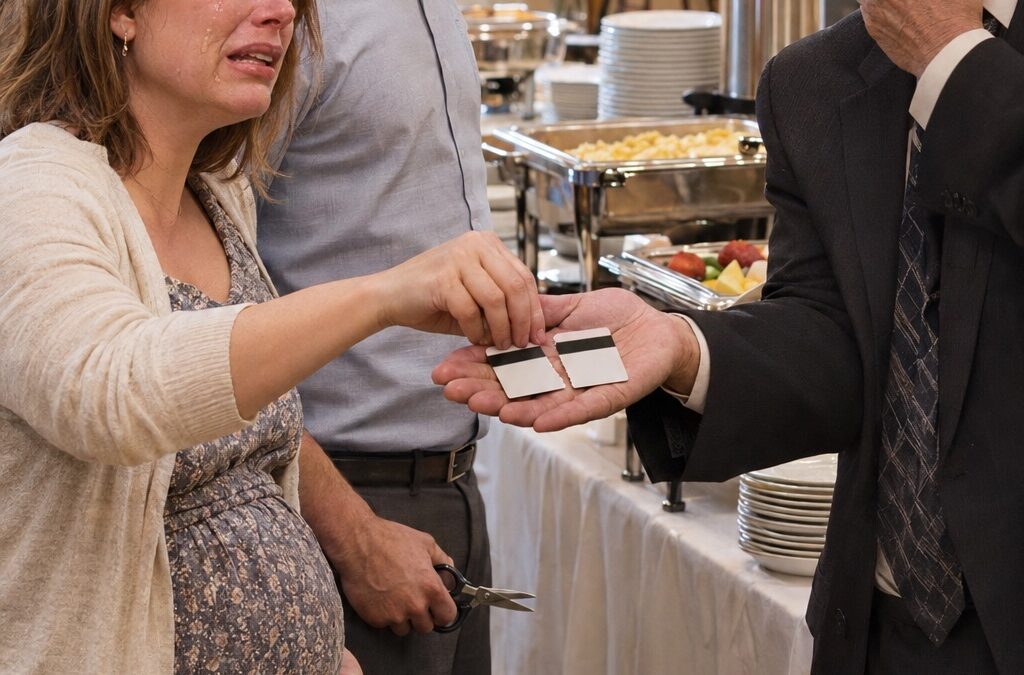
Russell’s fingers were closed around my ruined debit card.
I could see one corner pressing against his thumb.
Wade lowered his voice, but not enough.
“We were building something together.”
“I’ve been doing the books without pay since October.”
“We agreed you’d help.”
“We didn’t agree I’d repay your father.”
Judith interrupted before Wade could answer.
“Marriage does not execute this proposed guarantee.”
Wade looked at the phone.
“I’m not saying it does.”
“You’re discussing household benefits. That doesn’t answer my question.”
She asked whether I authorized the guarantee as drafted.
“No,” I said. “Not any part of it.”
I moved the phone closer to my side.
Wade’s hand twitched, then stayed on the table.
His earlier reach toward it was still on my mind.
I wanted to hear every word myself.
Judith said she represented Russell, not me.
She could explain his proposed documents and their status.
She could not advise me about my marriage.
“I understand,” I said.
“You may wish to obtain your own advice.”
“I will. But I’m refusing this now.”
“Yes. You may refuse without further review.”
Wade straightened and looked around the reception room.
People were still standing near the coffee table.
Nobody was reaching for another cup.
He seemed more bothered by their listening than my refusal.
“This doesn’t need to become everybody’s business,” he said.
“You cut my card in front of everybody.”
“That was about spending.”
“My card accesses my checking account. My wages go there.”
I said it slowly enough that Russell heard.
The card had never accessed my inherited savings.
Wade had no authority over either account.
Destroying the plastic hadn’t changed that.
He had made it harder to buy groceries.
He had not gained the right to decide anything.
“We could leave your savings out,” he said again.
Judith answered before I did.
“A guarantee is not limited by omitting an account number.”
“So write that she keeps her inheritance.”
“I cannot make her personal obligation disappear that way.”
Wade rubbed his forehead with two fingers.
I looked at the pale strip under my wedding ring.
My hands had swollen enough to leave marks.
I had been worrying about taking the ring off soon.
Now I could barely stand looking at it.
“My inheritance arrived in February 2023,” I said.
“That was before we married.”
Russell nodded, but Wade kept watching Judith’s phone number.
“There’s twenty-six thousand left,” I continued.
“It has stayed in my separate savings account.”
“I know where you keep it,” Wade said.
“That doesn’t mean you can promise it.”
He opened his mouth, then closed it.
Judith explained that I had pledged no account.
More importantly, I had undertaken no personal guarantee.
She could tell us what signing would have meant.
She could not treat an unsigned draft as my agreement.
I picked up the folded memorial program.
Lucille’s name was printed beneath her photograph.
She had been seventy-nine when she died.
I set it faceup beside my purse.
There were serving dishes behind us getting cold.
I hated discussing money beside her photograph.
But Wade had selected the place and the audience.
I wasn’t going outside to let him finish without me.
“Why is the older loan in there?” I asked.
Wade dragged the chair beside mine a few inches.
He didn’t sit.
“To put everything under one arrangement.”
“For whom?”
“For us.”
“You owed it before I kept your books.”
“The business needed it.”
“I’m asking who decided I would guarantee it.”
Judith didn’t answer immediately.
I heard a faint tapping through the phone.
She was checking something before she spoke.
Wade looked down at the screen, then at Russell.
“I don’t think we need drafting details here.”
“I do,” I said.
Russell shifted the card pieces into his other hand.
“Was this your requirement?” I asked him.
He looked toward the phone.
“I required both signatures for the new money.”
“That wasn’t my question.”
“No,” he said. “It wasn’t.”
Judith came back on the line.
“I have the relevant correspondence in front of me.”
Wade pushed the empty chair back again.
“Dad, we should talk first.”
Russell didn’t turn toward him.
Judith asked whether she had permission to explain the instructions.
She reminded him that she was discussing his matter publicly.
Russell looked directly at his son.
“Tell her who asked you to include it.”
Part 4: What He Had Told Them
“Wade asked me to include the existing balance.”
Judith’s voice remained level through the small speaker.
I looked at Wade.
He picked up a program and straightened its edges.
“When did he ask?”
“During preparation, before I circulated the June twelfth package.”
“Did he say he had discussed that with me?”
Wade put the program down.
“I said we were handling the financing together.”
Judith paused again before answering my question.
“He indicated that you would participate in the guarantees.”
“Would participate,” I repeated.
“Yes. That is different from having completed one.”
Russell pulled his phone from his pocket.
He tapped the screen, then looked up.
“You told me she had signed electronically.”
Wade’s shoulders lifted.
“I thought she did.”
“When?”
“After the email went out.”
“What made you think that?”
“She said she saw it.”
“I saw the cover email,” I said.
“I told you we needed to discuss it.”
Wade turned toward me.
“You knew we needed the money.”
“That isn’t a signature.”
Judith asked us to give her a moment.
Nobody spoke while she checked her completion records.
The refrigerator in the adjoining kitchen started humming.
I heard a spoon scrape against a serving dish.
Russell kept his phone open in his other hand.
I wondered whether Wade’s message was still on it.
Then Judith returned.
“There is no completed electronic guarantee from Nora.”
“Could she have started?” Wade asked.
“I did not,” I said.
Judith would only confirm what her records established.
There was no executed document bearing my completed signature.
There was no completion certificate for my guarantee.
Wade had not received her records confirming otherwise.
He hadn’t asked to inspect them before telling Russell.
“You didn’t know,” Russell said.
“I expected her to do it.”
“That wasn’t what you told me.”
Wade stared at the tabletop.
The distinction seemed to irritate him more than anything.
He had expected my cooperation and reported it as completed.
He had also requested terms he hadn’t read through afterward.
Judith confirmed that when Russell asked about the final draft.
Wade had given instructions, then assumed the rest would happen.
I took a slow drink of water.
The plastic cup bent slightly beneath my fingers.
“I refuse liability for either amount,” I said.
“The eighteen thousand and the proposed forty thousand.”
Judith repeated the amounts and my refusal.
I confirmed that she had understood me.
Wade pushed the water pitcher away from his elbow.
“So now we’re shutting the shop down at a memorial.”
“We’re discussing an unaccepted loan proposal,” Judith said.
Russell turned his body away from Wade.
Then he put the card pieces carefully into his jacket pocket.
He pulled out my chair and held its back.
I had been sitting forward on its edge.
“Sit properly, Nora. Give yourself some room.”
I moved my purse and eased back.
My lower back had started aching before the call.
I loosened one shoe without taking it off.
Wade watched his father help me settle.
“Dad, she’s made this sound worse than it was.”
Russell kept his hand on the chair.
“I was standing beside you.”
“I cut a card. I didn’t touch her.”
“You took scissors from the supply basket.”
Wade’s face tightened.
“You cut something that belonged to her,” Russell continued.
“Then you ordered her out.”
“I meant outside for a minute.”
“You said we could finish without her.”
I looked down at the cup again.
He remembered the exact words.
I didn’t have to argue that part alone.
“And you laughed,” Wade said.
Russell nodded once.
“I did. I was wrong.”
That answer stopped Wade for a moment.
He couldn’t use the laugh as permission anymore.
Russell turned toward the phone.
“I withdraw the forty-thousand-dollar proposal.”
Wade put his palm flat against the table.
“Don’t decide that while everybody’s upset.”
“The required guarantee has been refused.”
“We could change the terms.”
“I’m not offering another arrangement today.”
Judith confirmed that no funds had been advanced.
There was no new money to repay.
She would close the unsigned signing package.
She would send written confirmation of the withdrawal.
Wade looked toward the relatives gathered near the doorway.
Some stepped away, giving us more space.
None interrupted Russell.
“She’s been helping you for months,” Russell said.
“I never denied that,” Wade answered.
“You called it fussing with the computer.”
“It was a joke.”
“She worked after her own workday.”
I felt my throat tighten at that plain sentence.
Russell had seen me at the counter with repair tickets.
He had seen the stacks separated across the floor.
He remembered the prepaid part Wade couldn’t locate.
“That customer had already paid,” he said.
“Nora found the payment and matched the ticket.”
I remembered the evening too well.
My dinner had sat untouched beside the keyboard.
Wade kept asking whether I could stay another hour.
I had written pickup instructions so he wouldn’t charge twice.
“I made the note clear,” I said.
“You said you couldn’t find the original receipt.”
Wade rubbed his jaw.
“Fine. She did the work.”
“For eight months,” I said.
“I’ve received zero dollars.”
“You weren’t an employee.”
“I’m not agreeing to more unpaid work either.”
Judith asked whether anything else required immediate attention.
I requested confirmation at my own email address.
She agreed and again reminded me of her role.
I thanked her for explaining the document.
Russell ended the call after confirming his instructions.
Then Wade changed the subject without taking a breath.
“I have repairs promised for Monday.”
Russell stayed beside my chair.
“You’ll have to decide how to handle them.”
“I can’t place orders without cash.”
“You don’t have this proposed loan.”
Wade looked from his father to me.
Then he looked at my purse.
“What about the records?”
“I’ll arrange an orderly handoff.”
“No. Before you leave, I want the shop files.”
Part 5: The Work In My Bag
“My laptop isn’t in my purse,” I said.
Wade looked at it anyway.
My purse contained keys, tissues, my phone, and antacids.
It did not contain a business rescue.
I closed the zipper before he could reach toward it.
“The shop records belong to the shop,” I told him.
“You’ll receive them. I won’t delete anything.”
“They’re on your computer.”
“Some working copies are. The business system has records too.”
“You know how everything is organized.”
“I can explain the folders.”
He shook his head as if I’d missed something obvious.
“Explaining folders won’t handle customers.”
“No. You’ll need to handle them.”
He looked at Russell, waiting for him to intervene.
Russell pulled another chair over and sat down instead.
The reception room was beginning to empty around us.
People carried serving dishes toward the kitchen.
Nobody asked me to help clean up.
For once, I let a room be cleaned without me.
I called April from my chair.
She answered with water running in the background.
“Can you come get me?”
The water stopped.
“Are you hurt?”
“No. I need a ride from the memorial.”
“What happened?”
“I’ll explain when you get here.”
She asked whether I was sitting somewhere comfortable.
I told her I was.
Then I sent the address and the correct entrance.
Wade stood close enough to hear my side.
“You don’t need April involved.”
“I need somebody to pick me up.”
“I drove us here.”
“And I’m choosing a different ride.”
He turned away and called someone about a repair.
His voice changed as soon as the call connected.
He sounded patient, practical, almost cheerful.
He promised to look up a part and call back.
I watched him make a note on a memorial program.
There was still work he could do himself.
The canceled proposal hadn’t erased his tools or customers.
It had removed money he had counted on.
And I was removing work he had counted on.
While he talked, I opened Judith’s June twelfth email.
I saved the original message with its attachment.
Then I saved the separate electronic signing invitation.
I didn’t crop the dates or replace the subject lines.
I wanted to preserve exactly what had been sent.
Russell watched without asking to see my screen.
“Are you sending that to someone?” he asked.
“I’m keeping it.”
He nodded.
I made a note of the call while it was fresh.
I included my refusal and Russell’s withdrawal.
I also recorded that no new funds had advanced.
I did not guess at what Wade had intended.
His actual requests and statements were enough to remember.
Wade ended his call and looked over my shoulder.
“Who are you writing to?”
“Myself.”
“You’re making a whole case out of this.”
“I’m recording what happened.”
He pulled a chair out but didn’t sit.
“I need to know what you’re taking from the computer.”
“My personal information stays mine.”
“Nora, I don’t want your payroll job files.”
“Then that part should be simple.”
We agreed I would copy the existing business records.
I would not delete business records from shop systems.
I would separate shop access from my personal devices afterward.
We would identify unfinished work instead of pretending it was complete.
I said each point slowly enough for him to answer.
He agreed, though every answer sounded reluctant.
Then his phone rang again.
He stepped toward the hall to take it.
Russell waited until Wade was out of earshot.
“I should have asked you about signing,” he said.
“Yes.”
“I believed what he told me.”
“You watched the part that happened today.”
His hand went toward his jacket pocket.
“I did.”
“You laughed before he even cut it.”
“I know.”
I looked toward the supply basket on the serving table.
The scissors were back among tape and unused programs.
“I was standing right there,” I said.
Russell looked at the basket too.
“I don’t have an excuse.”
I didn’t tell him it was fine.
I checked my phone instead.
Judith’s written confirmation had arrived.
She had closed the unsigned electronic package.
No new funding would proceed under the withdrawn proposal.
I had executed no guarantee in that package.
I read the message twice.
Then I saved it beside the original invitation.
April arrived carrying only her keys and her phone.
She came directly to my chair.
“What do you need to take?”
“Just my purse from here.”
She glanced at Russell before looking back at me.
“Do you want to leave now?”
“Yes.”
Wade returned from the hall as I stood.
He greeted April like she had stopped in for coffee.
She asked whether I had my keys.
I checked the inside pocket and showed her.
Then Wade asked his father for a private conversation.
Russell said they could speak after I left.
“Dad, this affects Monday morning.”
“I understand what day it affects.”
“I need help finding another way.”
“I’m not financing a reconciliation,” Russell said.
Wade looked sharply toward April.
“I didn’t ask you to do that.”
“You keep connecting her coming home to business help.”
I held the chair while I adjusted my shoe.
April waited without rushing me.
The baby shifted hard beneath my ribs.
I took a breath and picked up my purse.
Russell asked whether I wanted the card pieces now.
“Keep them for the moment,” I said.
“I need both hands free.”
He nodded and left them in his pocket.
On the way out, I stopped beside Lucille’s photograph.
Its frame had tipped against the flower arrangement.
I straightened it and moved a napkin away.
Then April opened the reception room door.
Wade followed us into the entrance area.
His voice dropped now that the room was behind us.
“Come home with me, Nora.”
He looked at April, then back at me.
“We need to discuss this without an audience.”
Part 6: What Coming Home Meant
“I’m going with April,” I told him.
“She can take you home.”
“She’s taking me to her place.”
Wade held his keys against his palm.
“How long?”
“I don’t know yet.”
“That’s not a plan.”
“It’s where I’m staying tonight.”
April stayed beside the door without answering for me.
I could hear dishes being stacked behind us.
I wanted to get outside and sit somewhere cool.
Instead, I made myself finish the immediate arrangements.
“I need clothes and my work things,” I said.
“Then come get them.”
“With April.”
He looked at her and gave a short nod.
Nobody needed a court order for that agreement.
He was consenting to us collecting my necessities.
I was choosing somewhere else to sleep.
Those were the facts I could handle that afternoon.
April drove with the air turned toward me.
She handed me a bottle of water at a stoplight.
I held it against my wrist before opening it.
She waited until we were moving again.
“Tell me what happened.”
I started with the extra rolls Wade had requested.
Then I told her about his accusation.
I repeated what he had said about my pregnancy.
April pressed her lips together.
“He said that in front of his father?”
“Yes.”
“And Russell laughed?”
“Before looking at the pieces.”
She kept both hands on the steering wheel.
I told her about calling Judith and refusing the guarantee.
Then I explained the extra eighteen thousand dollars.
“That was already owed?”
“Since November 2023.”
“And Wade asked to put it in?”
“Yes.”
April exhaled slowly through her nose.
She didn’t ask why I hadn’t opened the attachment sooner.
I had already asked myself that several times.
I would read things sooner from then on.
That didn’t change who had falsely reported my signature.
At the house, Wade had left the door unlocked.
He stood in the kitchen when we entered.
I went to the bedroom with April beside me.
She opened a bag on the bed.
I gathered work clothes and things that still fit comfortably.
Some pants had already become useless with my belly.
April folded shirts while I collected toiletries.
I took my identification and personal documents.
My work laptop went into its own case.
The personal laptop with shop copies came with me too.
I told Wade exactly what I was taking.
He stopped outside the bedroom doorway.
“I need access to the records.”
“You’ll receive the business files.”
“Why take the computer?”
“Because it’s my computer.”
He looked at April, then back at the bag.
I did not keep explaining after that.
In the kitchen, I sat down to call the bank.
The broken debit card might still have been active.
Cutting plastic wasn’t the same as reporting damage.
I locked the card through my bank’s application first.
Then I called about a replacement.
The employee asked the questions she needed answered.
I explained that someone had deliberately cut the card.
I didn’t describe Lucille’s brunch or the unsigned loan.
The damaged card was canceled, and a replacement was ordered.
My checking account remained open in my name.
I checked the recent transactions while we were connected.
The rolls appeared exactly where I expected.
There were no withdrawals I didn’t recognize.
Afterward, I checked my separate savings account.
The twenty-six thousand dollars was still there.
I hadn’t transferred it into household spending.
I wasn’t moving Wade’s money or touching business funds.
I was checking the accounts that belonged to me.
I changed my personal banking password from my own phone.
Then I checked how to receive the replacement securely.
Wade watched from across the kitchen table.
When I finished, he pulled out a chair.
“We could start over with a budget,” he said.
I put my phone beside my bag.
“What would that fix?”
“You wouldn’t feel like I was watching your spending.”
“You cut my card.”
“I was angry.”
“You told me to leave a memorial.”
“I shouldn’t have done it there.”
I looked at him until he shifted in the chair.
“You shouldn’t have done it anywhere.”
He rubbed his palms against his jeans.
“We’re both under pressure.”
“I didn’t tell your father you signed something.”
For a moment, he said nothing.
Then he tried to return to the budget.
He offered separate categories for baby expenses.
He offered to stop questioning grocery purchases.
He offered everything except a reason to trust his word.
“I’m not discussing spending categories today,” I said.
“I won’t guarantee business debt.”
“And the books?”
“I’m ending the unpaid work.”
He pushed his chair back.
“You’re doing everything at once.”
“The loan discussion was happening today.”
“That doesn’t mean you had to leave.”
“You told me to.”
April appeared in the doorway with the lighter bag.
She asked whether I was ready.
I checked the table and the counter for my things.
Then I picked up the computer case.
Wade stood but didn’t move toward the door.
“Are you saying we’re finished?”
“I’m saying we’re separated.”
“For how long?”
“I can’t answer that today.”
I hadn’t spoken with my own lawyer yet.
I wasn’t promising a filing date or a reconciliation.
I was pregnant, tired, and leaving with clothes.
That was enough to explain for one afternoon.
At April’s, she cleared an empty drawer for me.
We agreed to discuss household expenses after I rested.
She put a clean towel on the bed.
I placed my documents in the drawer before sitting.
Later, my phone lit up beside the pillow.
It was a message from Russell.
He asked permission to visit April’s house.
He said he wanted to return something of mine.
Part 7: His Father Came Over
I knew what he meant, but asked anyway.
“Your card,” he wrote. “Both pieces.”
I told him April would be there.
He answered that he understood.
When he arrived, he waited until she opened the door.
He held a small envelope without a stamp.
He handed it to me before taking a chair.
I opened it over April’s kitchen table.
The two pieces slid into my palm.
For a moment, I fitted the cut edges together.
The card looked almost ordinary from that angle.
Then I separated them and put them down.
Russell watched without offering to throw them away.
April set three glasses of water on the table.
She sat beside me, leaving him across from us.
“I came to apologize for laughing,” he said.
I kept my eyes on the pieces.
“Specifically when he said pregnancy made you careless.”
I looked up.
He had not called it an unfortunate misunderstanding.
He had named the sentence and his response.
“I treated it like he was making a joke.”
“He was talking about me.”
“Yes.”
“With me standing there.”
“Yes.”
I moved my water glass away from the card.
“Why didn’t you tell him to stop?”
Russell looked down at his hands.
“At first, I expected him to hand it back.”
“You watched him get the scissors.”
“I did.”
“So you had time.”
“Yes.”
April didn’t rescue him from the pause.
Neither did I.
A lawn mower started somewhere outside.
Russell waited until I looked at him again.
“I don’t have a good answer.”
I took a drink of water.
“I believe you’re sorry,” I said.
He nodded, starting to lean forward.
“That doesn’t mean I want family gatherings right now.”
He settled back.
“I understand.”
“And I don’t want messages through Wade.”
“I can contact you directly, if that’s all right.”
“You can ask. Sometimes I won’t answer immediately.”
He agreed without asking how long that would last.
I put the card pieces back into the envelope.
Russell asked whether Judith’s written confirmation had reached me.
I told him I had saved it.
“The proposal is closed,” he said.
“I won’t ask her to send a different version.”
“Not one leaving my savings out?”
“No.”
“Not one just covering the new loan?”
“No.”
I needed those answers said plainly.
He gave them without looking offended.
Then I asked about his old loan.
“That remains between Wade and me.”
“What does that mean?”
“We need to address repayment under the existing agreement.”
“Without my wages.”
“Without your wages or your savings.”
He didn’t promise to forgive the debt.
He didn’t threaten an immediate seizure of tools either.
He had lent Wade eighteen thousand dollars.
Wade still owed him eighteen thousand dollars in principal.
That needed handling without making me a new borrower.
Russell asked whether I needed money for the baby.
I shook my head.
I still had my job and my own savings.
April and I were arranging my share of household expenses.
I didn’t want that connected to the shop dispute.
“I’m not asking you to go back,” Russell said.
“I’m glad you aren’t.”
“I shouldn’t have assumed that was mine to settle.”
“No.”
He looked at the envelope beside my glass.
“Do you want me to take those away?”
“No. They belong to me.”
He nodded.
When he left, he thanked April for having him.
He didn’t ask her to persuade me about anything.
I watched from the window until his car pulled away.
Then I sat back at the table.
April carried the water glasses to the sink.
“How was that?”
I rubbed the envelope’s corner with my thumb.
“Better than arguing over whether he saw it.”
She nodded and turned on the water.
I put the envelope in my drawer that evening.
Not buried under clothes, but beside the saved correspondence.
I wanted to know where it was.
Wade’s messages became more practical afterward.
He stopped suggesting a smaller guarantee.
He stopped asking me to talk his father around.
Instead, he described changes he was considering at the shop.
Fewer jobs requiring expensive parts kept in stock.
More repairs he could complete without extra help.
A conversation with his landlord about leaving the premises.
He said he was looking at mobile work.
I read the message on April’s porch.
It was the first plan he had sent without my money.
I read it a second time to be sure.
There was no request for a transfer at the bottom.
There was still a request for bookkeeping help.
I replied about that part only.
He would receive the existing files.
He needed someone else for ongoing accounting work.
He asked whether I would train that person.
I told him to describe the request in writing.
He answered that he could pay for transition work.
I stared at the screen longer than I wanted.
Eight months of work had been treated as family help.
Now he was offering money because it might stop.
I didn’t agree or accuse him in response.
I asked for the exact tasks and expected time.
Then I put my phone facedown.
April came outside carrying folded laundry.
She set my stack on the empty chair.
“You don’t have to take the work.”
“I haven’t said yes.”
“You’re sitting like you’re already late doing it.”
I uncrossed my ankles and stood up.
We carried the clothes inside.
I put shirts in the drawer beside the envelope.
The phone stayed outside until I had finished.
When I returned, Wade’s proposed task list had arrived.
He called it a paid transition.
I brought the phone inside to read on the computer.
Then I opened the proposed scope.
Part 8: The Last Shop Handoff
The request was longer than his message suggested.
He wanted open jobs reviewed and balances reconciled.
He also wanted new repair tickets entered first.
Those were the same tasks I had been doing.
Calling them transition work didn’t change the work.
I read the list through before answering.
Then I made a shorter list of my own.
I would deliver existing business files and paper records.
I would explain the folders already created.
I would identify work I had left unfinished.
I would not enter or reconcile new transactions.
I would not train someone indefinitely.
I would not sign financial documents of any kind.
April listened while I read my response aloud.
“Does that say what you mean?”
“Yes.”
“Then send that.”
I deleted a paragraph explaining why I was tired.
He knew how many weeks pregnant I was.
He also knew I had a full-time job.
I didn’t need to earn permission to stop.
I sent the message and closed the computer.
Wade accepted the narrower handoff the next morning.
We agreed to meet at the shop with April present.
I would provide the existing records and explain their location.
There would be no ongoing bookkeeping arrangement.
Before going, I prepared the files carefully.
The business’s records were copied in readable formats.
My personal documents were not included.
I kept the original correspondence showing what I had delivered.
I also gathered paper tickets still at the house.
They belonged with the shop, not in my room.
At the shop, Wade was waiting behind the counter.
The printer sat beside a stack of blank tickets.
The same customer chair stood near the entrance.
I had spent evenings sorting receipts in that chair.
This time, I put my bag beside it deliberately.
Wade asked whether I wanted to sit.
“Yes.”
He moved a carton away from my feet.
April stayed near the door with her phone.
She wasn’t recording us.
She didn’t need to pretend she wasn’t listening.
Her presence had been part of the agreement.
I started with the existing folder structure.
Completed jobs were separated from open repairs.
Payments had reference notes where I had matched them.
Unresolved items were marked as unresolved.
I wasn’t going to label everything complete for convenience.
Wade took notes on the back of a blank ticket.
“Where are the deposits?”
I showed him.
“And the part orders?”
I showed him those too.
Then he asked about a disputed customer balance.
I opened the note already attached to that job.
It explained what had been checked before I stopped.
“You’ll need to contact the customer,” I said.
“Can you just compare it with the bank?”
“That would be new reconciliation work.”
He looked at me, then at April.
I kept the file open so he could read it.
After a moment, he wrote the customer’s name down.
We continued without arguing.
The prepaid part from that long evening was gone.
I noticed the empty space on the shelf.
“Did that customer collect it?”
“Last week.”
I nodded.
I had found the payment, matched the repair ticket, and written instructions.
That small job was finally finished.
I didn’t ask about every other repair in the building.
Wade asked who he should hire for the records.
“Someone with bookkeeping experience,” I said.
“Can you recommend what they should use?”
“They’ll need to review what the business needs.”
He tapped his pen against the paper.
I could have answered several more questions than that.
I could also have spent another evening doing it.
Instead, I let him write his questions down.
Halfway through, he stopped taking notes.
“I shouldn’t have told Dad you had signed.”
I kept my hands beside the keyboard.
“No, you shouldn’t.”
“I expected you to do it.”
“I know.”
“That wasn’t the same thing.”
“No.”
He looked at the screen for several seconds.
“The debt is mine.”
“Yes.”
I didn’t soften the answer because he sounded ashamed.
I also didn’t repeat the whole confrontation.
We had reached an accurate statement.
I wanted it to remain there without an argument.
He told me more about leaving the premises.
His landlord had agreed to a written surrender arrangement.
Wade still had obligations to complete under that agreement.
He would remove his equipment and address the remaining terms himself.
He wasn’t simply walking away from a lease.
He wasn’t asking me to guarantee the exit either.
He planned to keep a smaller set of tools.
Mobile repair work would cost less to operate.
He would take fewer jobs and manage parts more carefully.
I asked where future business correspondence should go.
He gave me the address for the handoff note.
I added it without offering to manage the mail.
Then I asked him to acknowledge receiving the records.
He sent an email from the shop account.
It listed the files and paper tickets delivered.
It identified the unresolved items we had discussed.
It did not describe me as continuing staff.
I saved it before closing my personal laptop.
Then I removed stored shop access from my personal device.
The shop’s accounts and records remained available to Wade.
Nothing business-owned was deleted.
Before leaving, we discussed necessary household arrangements.
I still had personal belongings at the house.
We would schedule another collection rather than argue over access.
He would contact me about practical separation matters directly.
Business questions needed to go to his next bookkeeper.
Neither of us signed a rushed agreement about marital rights.
I would get independent advice before making those decisions.
Wade asked whether we could speak alone.
“Not today,” I said.
He looked disappointed but stepped away from the counter.
April opened the door while I lifted my bag.
Outside, I realized it was lighter than when I arrived.
The paper records were no longer inside it.
At April’s, I changed clothes and washed my hands.
Then I sat down without opening the bookkeeping program.
For a while, I kept reaching toward the computer.
I felt as if I had forgotten a deadline.
Instead, I sorted the emails I needed to retain.
The handoff receipt went beside Judith’s confirmation.
Then I found the original draft still in my inbox.
Part 9: A Place For The Pieces
I opened the attachment on my own computer.
Not because I was reconsidering signing it.
I wanted to read the full document for myself.
The older debt appeared where Judith had described it.
The proposed new loan appeared beside it.
The signature space assigned to me remained blank.
I read the guarantee twice, slowly.
Then I saved it with the written completion status.
One document showed what had been proposed.
The other established that I hadn’t executed it.
Deleting the draft would have made the folder prettier.
Keeping both made the record complete.
By August 9, 2025, the signing package remained closed.
I had requested written confirmation for my own records.
Judith confirmed again that no executed guarantee existed from me.
No funds had advanced under Russell’s withdrawn proposal.
There was no replacement package waiting for my signature.
I saved that final confirmation with the earlier messages.
Then I printed it and checked every page.
April watched me straighten the stack against the table.
“Does it say what you needed?”
“Yes.”
I put it in the folder without rereading it again.
Wade had surrendered the shop premises under his landlord agreement.
He was doing mobile appliance repairs on a smaller schedule.
He and Russell were addressing the old debt separately.
I wasn’t copied on their repayment discussions.
I did not ask to be added.
Sometimes Wade told me business was slow.
Sometimes he said a repair had gone well.
I answered practical messages when an answer was needed.
I did not offer to organize receipts or check balances.
He had received the existing records.
The documented handoff was finished.
He could hire someone, learn the work, or change his system.
I wasn’t the person responsible for deciding which.
He still asked occasionally whether I would come home.
I hadn’t agreed.
We were separated, not instantly divorced by a family argument.
There was no court order deciding our future that summer.
I was getting independent legal advice about the next steps.
Judith remained Russell’s lawyer, not mine.
I kept those conversations separate.
When Wade asked what I had decided, I answered honestly.
“I’m still staying with April.”
He didn’t like that answer.
It was still the answer.
I had kept my payroll job.
My wages continued going into my sole-name checking account.
The separate savings remained intact, with twenty-six thousand dollars.
None of that money had funded Wade’s shop.
The replacement debit card sat in my wallet.
The first time I used it for groceries, I checked twice.
Not because I doubted the bank had replaced it.
I was expecting a conversation afterward about what I’d bought.
There wasn’t one.
April helped carry the bags inside.
We put groceries away and discussed dinner.
She asked whether I’d bought enough peaches.
That was the entire money conversation.
We had agreed on my contribution to her household.
We also talked about space, laundry, and quiet hours.
If something needed changing, we discussed it at the table.
Nobody called my wages family money while spending them elsewhere.
I kept my work bag beside the same chair.
My documents had their own drawer.
There were baby clothes folded on the dresser now.
April helped me clear more room one Saturday morning.
We moved a shelf and measured the remaining space.
I sat down between tasks when my back hurt.
She passed me folded clothes instead of telling me to hurry.
I still didn’t know exactly where everything would be after delivery.
I knew where I was staying that night.
I knew my job and accounts were still mine.
For now, those were arrangements I could make.
Russell asked before visiting.
Sometimes I agreed.
Other times I told him I needed a quiet evening.
He accepted both answers.
He stopped calling the brunch a misunderstanding.
When someone brought it up, he acknowledged laughing.
He also acknowledged watching Wade cut the card.
I didn’t ask him to repeat that at every visit.
I needed him not to replace it with something easier.
The people at the brunch had heard the financing facts.
Family members who asked afterward received the same plain explanation.
I had not signed the guarantee.
Russell had withdrawn the unadvanced proposal.
I had ended my unpaid bookkeeping.
There was no online campaign or family message demanding sides.
I wasn’t pretending Wade had lost everything either.
He still had tools, customers, and repair skills.
He had work to do and debts to address.
I wasn’t funding either one.
One afternoon, he sent a photograph of his mobile setup.
His tools were arranged in fitted boxes.
He wrote that he was trying to make it work.
I answered that I hoped he handled it responsibly.
Then I put the phone down.
There was a basket of baby clothes beside my chair.
I folded a small white shirt and matched two socks.
April called from the kitchen about tea.
I told her I’d be there in a minute.
The correspondence folder was still on the table.
I decided to put everything away before dinner.
The original draft went behind the final written confirmation.
The handoff receipt went into the next pocket.
Then I opened the drawer holding Russell’s envelope.
The two pieces were still inside.
I took out a fresh envelope from April’s supplies.
On its front, I wrote June 14, 2025.
I would put the pieces inside and seal it.
I had already made room beside the other records.
April carried the empty laundry basket into the hall.
“Do you want me to leave the light on?”
“Yes,” I said. “I’ll be right there.”
I picked up both pieces before closing the envelope.
For a moment, I held them where I could see them.
The cut edges rested together in my open palm.








