My Husband Told Funeral Guests I Was A Freeloader While I Held Our Newborn — Then Someone Pressed Play
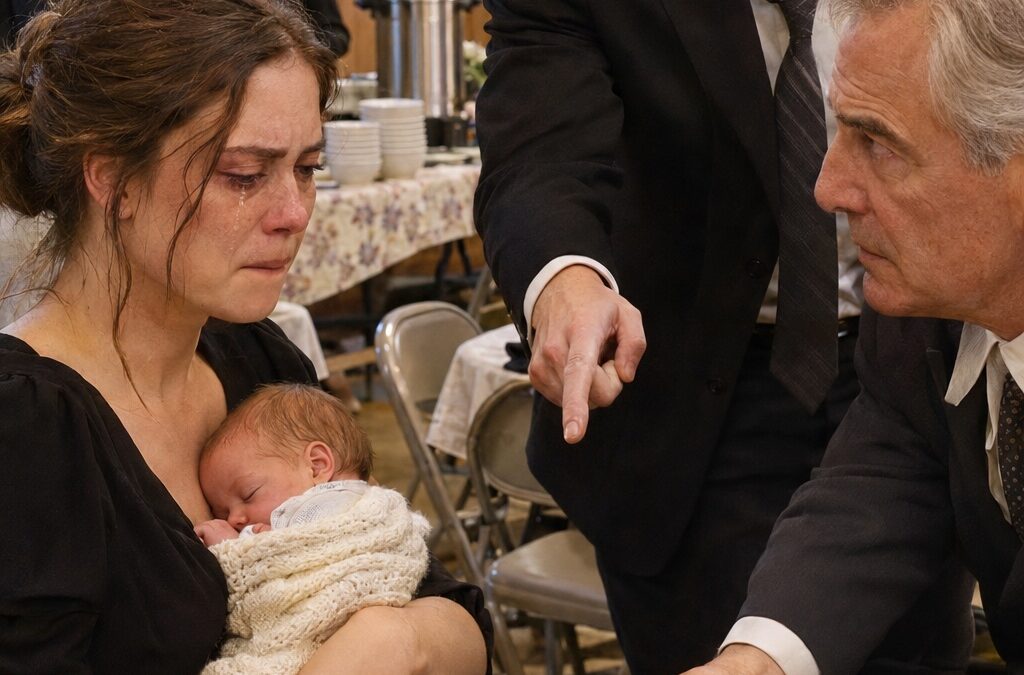
Part 3: The Voice Beside My Plate
“Paul is here, and my sister June is here.”
Martin cleared his throat on the recording.
“They watched Leah and me sign this agreement.”
Eric turned toward his aunt.
June kept her eyes on the recorder.
Martin continued in the same careful, slightly breathless voice.
“Leah is doing work I would otherwise hire somebody to do. She is not paying me back for meals. She is not living here for free.”
I pressed my lips against the baby’s hair.
“I agreed to pay her twenty dollars an hour. We’re recording the actual care she provides. Payment comes from my estate when I die.”
The little speaker crackled when he shifted.
“That is my debt. It is not Eric’s money.”
Paul let the recording keep running.
His own voice asked Martin to explain the arrangement.
Martin described help getting settled, preparing food, and personal care. He explained that ordinary visits would not count.
Then he named the date: January 8, 2025.
He said he understood payment would reduce his remaining estate.
“Yes,” he said. “That is what paying someone does.”
There was a small laugh on the recording.
I remembered that laugh better than the formal language.
Martin had looked embarrassed by all the attention.
He had asked whether he sounded like a businessman.
June had told him he sounded like himself.
Now her recorded voice confirmed she had watched him sign.
Eric’s chair scraped backward.
“You never told me about this.”
June finally looked at him.
“Your father asked me to witness his agreement.”
“And you didn’t think his son should know?”
“He was making his own arrangements.”
Paul stopped the recorder after the explanation ended.
He didn’t replay Martin’s last sentence for effect.
He turned the device off and left it beside me.
The room began moving again, but more quietly.
Someone carried the bread basket to another table.
The coffee urn clicked behind Eric’s shoulder.
Paul drew the agreement closer to himself.
“Your father was my client,” he said. “He instructed me to prepare this.”
Eric rubbed his mouth with the back of his hand.
“You’re saying this recording makes her a creditor?”
“No. The signed agreement creates the obligation.”
Paul touched the paper without lifting it.
“The recording supports his intentions and understanding.”
He explained that Martin had spoken voluntarily.
Everyone present had known the recorder was running.
Martin had asked Paul to keep the original device.
He wanted the explanation available if questions came later.
Nothing had been recorded secretly in a bedroom.
Nobody had caught him during a confused conversation.
I remembered Martin checking the batteries before Paul arrived.
He had laid them beside his reading glasses.
“Can’t have this dying halfway through,” he had said.
At the luncheon, Eric looked toward the other tables.
Some guests had turned their chairs away.
Others were making no attempt to hide their attention.
“Dad was embarrassed about needing help,” Eric said.
“He might have promised more than he could afford.”
Paul answered without discussing Martin’s entire bank balance.
“His obligations will be reviewed through the estate.”
June placed both hands around her coffee cup.
“I received authority to act as executor on December 12, 2025.”
Eric nodded as though that helped him.
“Then you decide whether to pay this.”
“I have duties,” she said. “Not permission to ignore a debt.”
She explained that the will left him the residue.
That meant what remained after proper obligations were handled.
It did not turn every estate dollar into his property.
No one said he had lost his inheritance.
No one threatened to remove him from the will.
His father had already made that decision himself.
The issue was how much would remain afterward.
Lois drew a folded tissue from her purse.
“Martin always made things more complicated than necessary.”
June looked directly at her.
“He arranged payment for someone doing his care.”
Lois unfolded the tissue over her lap.
I watched her flatten its corners with her fingertips.
She had been divorced from Martin long before this.
She wasn’t waiting for a surviving spouse’s inheritance.
She was watching the amount her son expected shrink.
Eric looked back at the agreement.
“Did you ask him to do this?” he asked me.
“Your father asked how I could keep helping.”
“That’s not what I asked.”
“I told him I couldn’t keep leaving paid work indefinitely.”
Paul had advised Martin to put the arrangement in writing.
June had insisted I read it away from the table.
I had taken it into the kitchen with cold tea.
I remembered the hum of Martin’s refrigerator.
I remembered rereading the part about actual hours.
At that point, I still expected Eric to be relieved.
His father had found a way to receive care.
I would eventually be paid for providing it.
There had seemed no reason for a family argument.
Eric had never asked what made that possible.
He had asked whether I could cover another night.
Paul slid a second folder from his bag.
He kept it closed while he spoke.
“The agreement alone doesn’t establish the final amount.”
Eric leaned forward at that.
“Exactly.”
“The services have to be documented.”
I knew what was in the folder.
I had written those entries at Martin’s kitchen table.
Sometimes I wrote with a spoon cooling beside me.
Sometimes I corrected an end time after June arrived.
I hadn’t rounded every tired night into a full shift.
I hadn’t counted being asleep as continuous hands-on work.
The agreement described what qualified and what did not.
Paul had explained it before I signed anything.
Eric reached for the folder, then stopped himself.
“How many hours is she claiming?”
Paul looked at June before answering.
She nodded for him to continue.
“Let’s review the records rather than guess.”
Eric pushed his untouched cup toward the table’s center.
“Then show me every hour she says she worked.”
Part 4: The Hours He Never Counted
Paul did not scatter my records across the luncheon table.
He opened the folder toward June and Eric.
I could see the tabs from where I sat.
They were the same tabs I had helped organize.
“People are still eating,” June said.
Eric looked around as though noticing the room again.
A church volunteer offered us the adjoining meeting room.
It had a table, folding chairs, and an empty coat rack.
I stood carefully with the baby against my chest.
My legs had stiffened beneath the luncheon table.
Paul carried the recorder rather than leaving it behind.
I picked up my napkin with the spoon inside.
At the doorway, the volunteer touched my elbow.
“You can bring your soup if you want.”
I thanked her but left the bowl where it was.
Eric entered the smaller room ahead of everyone.
He chose the chair beside the head of the table.
June sat at the head without commenting on it.
Paul laid the folder in front of her.
I took the seat nearest the door.
Lois followed us in and closed it softly.
The baby woke when I loosened her blanket.
I fed her while Paul explained the records.
Martin had wanted entries made close to the work.
He had not wanted a rough estimate afterward.
I used a notebook kept in his kitchen drawer.
The agreement identified the care eligible for payment.
My entries described tasks and the time they required.
They did not charge for every hour under his roof.
Paul had reviewed the system before I began.
June checked it when she covered for me.
Martin had reviewed entries while he remained able.
When writing tired him, he confirmed them aloud.
I still kept the original pages.
I also sent copies to Paul for safekeeping.
That had started before Martin’s condition became worse.
Eric tapped the edge of the folder.
“Anybody can fill out a notebook.”
“Yes,” Paul said. “That is why supporting records matter.”
June brought her own calendar out of her bag.
She had used it to plan relief and appointments.
The entries matched the times I had stopped charging.
There were no miraculous additions after Martin died.
There were gaps where other people took over.
Eric turned several pages without saying anything.
I recognized one page by a small oatmeal stain.
Martin had spilled his spoon while I was writing.
I had moved the bowl before the paper soaked through.
“Here,” Eric said, holding that page down.
He pointed to care recorded before breakfast.
“You were already sleeping there.”
“I still had to get up.”
“You would have gotten up anyway.”
I shifted the baby higher against my shoulder.
“Your father needed help before he could stand.”
I described that morning without making it worse.
Martin’s drainage bag needed emptying before he moved.
The tubing had caught against the recliner’s side.
I knelt, freed it, and checked its position.
He held the chair arms and waited.
He was afraid of pulling something loose.
“I’m sorry,” he had told me.
“You don’t need to apologize.”
Then I put his slippers under his feet.
I stayed while he stood and found his balance.
Only afterward could I start his breakfast.
Eric stared at the stain on the page.
He had arrived later with a bag of groceries.
He had set it on the clean kitchen counter.
To him, the morning had started there.
June turned to a later section.
“These are the relief entries,” she said.
She explained where her own care began and ended.
The paid relief had its own separate records.
Those hours did not appear in my claim.
Neither did my stay in the hospital having our baby.
Eric looked up sharply.
“She was barely there after the birth.”
“That is reflected,” Paul said.
I had been expecting that accusation for weeks.
After the birth on November 25, 2025, I rested.
June and paid relief covered Martin’s needs.
When I later visited, I logged only qualifying care.
Holding the baby while talking to him wasn’t work.
Neither was sitting beside him watching the weather.
I had wanted those visits even without payment.
The notebook did not turn every kindness into wages.
Eric checked the totals again.
“What does this add up to?”
“1,230 hours,” Paul said.
He waited while Eric looked at the calculation.
“At $20 per hour, the claim is $24,600.”
Lois pulled her chair closer.
“That much?”
“That is the documented contractual amount,” Paul said.
I watched Eric multiply it on his phone.
He did not show anyone the screen.
He put the phone facedown beside the folder.
“And she gets all that before I get anything?”
“Valid debts are addressed before the residue,” June said.
“Subject to ordinary administration,” Paul added.
Nobody was handing me a check in that room.
There were estate expenses and procedures still ahead.
The funeral bill had not disappeared because we argued.
The contract did not excuse proper review.
Eric could ask questions and obtain legal advice.
He could not erase the agreement by being surprised.
I was glad Paul said all of that.
I didn’t want a promise made just to silence Eric.
I wanted a payment the estate could properly make.
Paul showed how the notebook totals had been checked.
The amounts matched the copies already in his file.
There were no missing pages suddenly produced by me.
June’s relief calendar supported the handoffs.
The paid help’s records supported the excluded periods.
Eric’s voice became quieter as the pages kept matching.
He stopped saying I had invented the work.
He began asking what should reduce its price.
“What about everything Dad provided her?”
I adjusted the baby’s blanket over her sleeping hand.
“What specifically?”
“Meals,” he said. “Utilities. A place to stay.”
June closed her calendar but kept it on the table.
Eric pulled the agreement toward him again.
“If you’re counting work, we should count benefits.”
Paul asked him to identify a contractual deduction.
Eric glanced through the pages, then looked at me.
“Start with room and board,” he said. “That ought to come off the top.”
Part 5: What Was Never My Rent
I took our apartment keys from my purse.
I laid them beside the baby’s folded blanket.
“We still pay rent on our apartment.”
Eric looked at the keys, then away.
“That doesn’t mean you weren’t staying with Dad.”
“I stayed when he needed overnight help.”
“You had clothes there.”
“Yes. Clean clothes for the morning.”
Lois shifted in her chair.
She knew about the overnight bag.
Sometimes she had moved it off Martin’s kitchen chair.
It had never contained everything I owned.
My work shoes remained in our apartment closet.
My mail still came to the same apartment.
Eric and I had never surrendered our lease.
Martin had not been supporting a separate household for me.
He had been receiving care in his rented home.
Paul opened the agreement to the compensation terms.
“There is no room-and-board deduction.”
Eric started to answer, but Paul continued.
“The agreement expressly distinguishes family hospitality from compensation.”
That language had seemed unnecessarily careful when I signed.
Martin was offended that anyone might count his oatmeal.
“I can feed someone without buying their whole day,” he’d said.
At the luncheon meeting, Eric rubbed his forehead.
“So every sandwich is just a gift?”
“It is not a contractual wage offset,” Paul said.
I watched Eric search for a different route.
He couldn’t make the notebook disappear.
He couldn’t make my apartment stop existing.
Now he wanted family membership to cancel the arrangement.
“Most daughters-in-law wouldn’t charge,” he said.
I placed a clean cloth beneath the baby’s chin.
“Your father chose to pay.”
“Because you told him you needed money.”
“I needed to keep earning money.”
Lois looked at Paul instead of either of us.
“Does she have to accept it?”
He took care with his answer.
“A creditor can choose to release a claim.”
Lois immediately turned toward me.
“Then that’s still possible.”
June sat back in her chair.
“Lois.”
“I’m asking her, not you.”
Lois leaned forward until her purse touched the table.
“I know you were up with him,” she said.
“I know you handled things Eric couldn’t stomach.”
Eric stared at her.
She continued before he could interrupt.
“You were good to Martin. Nobody is denying that.”
I looked toward the closed meeting-room door.
He had denied it in front of everybody.
That was why we were sitting there.
Lois touched the agreement with one fingertip.
“But you could forgive this. Eric would inherit more.”
She said it plainly, without pretending it helped me.
She knew about the overnight work.
She understood the debt would reduce his share.
She still wanted me to give it away.
I moved the agreement out from beneath her finger.
“I’m not forgiving it.”
“You don’t have to decide while you’re upset.”
“I’ve had months to know what the work cost.”
Eric folded his arms across his coat.
“There it is.”
I waited for him to explain.
“You’ve been keeping score this whole time.”
“I kept the records your father requested.”
Paul closed his folder before the argument circled again.
“The claim will be submitted and reviewed properly.”
June nodded.
“Nothing needs to be signed away today.”
There was relief in hearing that sentence.
I had been holding the baby with one stiff arm.
I loosened my grip and changed her position.
She made a small protesting sound, then settled.
Paul asked if I wanted a copy of everything.
“Yes,” I said.
Eric looked at me as though I’d accused him.
Paul explained that both claimant and beneficiary could receive information.
June would keep the estate records organized.
No one had to rely on a funeral conversation.
I wrote down what I needed before leaving.
The agreement, the logs, and the relief documentation.
I wanted the recording preserved in its original form.
Paul already had it safely retained.
He would also preserve a working copy.
That had been Martin’s instruction, not a new trick.
The original recorder went back into Paul’s bag.
I watched him fasten the pocket over it.
The meeting ended without anyone hugging me.
Eric walked out first to find his coat gloves.
Lois followed him into the hall.
June stayed while I packed the baby’s things.
“I’m sorry he said that in there,” she told me.
“He knew I worked.”
“I know.”
She didn’t ask me to excuse him.
She held the door while I carried the baby.
The fellowship hall was mostly cleared by then.
A volunteer was wiping circles from our table.
My soup had been taken away.
I looked down and found the spoon in my napkin.
“I carried this off,” I said.
The volunteer waved toward the kitchen.
“Keep it. We have plenty.”
I thanked her and put it in my bag.
It was such a small, ordinary permission.
After all the arguments, I almost cried over it.
Eric was waiting beside the coat rack.
He offered to take the baby carrier.
I let him carry it, but kept my bag.
We walked outside without speaking about his father.
He checked the straps before putting the carrier in.
That careful motion made my stomach tighten.
He could be gentle with something right in front of him.
He had still called me a freeloader before his family.
On the drive, he turned the heater down.
“We need to stop discussing finances with everybody.”
“You started discussing me with everybody.”
“I was grieving.”
“So was I.”
He drove past the turn toward Martin’s rented home.
I had taken that turn so often automatically.
My overnight bag was still in our apartment.
There would be no call asking me to come back.
Eric stopped at a light and looked toward me.
“If this gets paid, we need a plan.”
“I’ll make decisions after the claim is settled.”
He tightened his fingers around the steering wheel.
“Have them send it to my account,” he said. “I’ll handle it from there.”
Part 6: The Account He Picked
“No,” I said.
Eric looked back at the road.
“You haven’t even heard what I’m proposing.”
“You proposed putting my payment in your account.”
“So I can manage the bills.”
“We already have a way to pay rent.”
He waited until we reached our apartment before answering.
I carried the diaper bag while he brought the carrier.
Inside, he set it down beside the couch.
Then he stood between me and the kitchen doorway.
He wasn’t blocking me from leaving the apartment.
He was waiting for the conversation he expected to win.
“We’re married, Leah.”
“I know.”
“You’re talking like you’re on your own.”
“I’m talking about payment for work I did.”
He said marriage meant we should combine everything.
I asked whether that included decisions about his inheritance.
He took off his coat before answering.
“That’s different. Dad left that to me.”
I carried the baby into the bedroom.
She needed changing, and I needed a minute.
I laid a clean sleeper beside the changing pad.
My fingers kept catching the snaps in the wrong order.
I started again rather than pulling harder.
Eric spoke from the doorway.
“I didn’t say you couldn’t have any of it.”
I looked up at him.
“It isn’t yours to allow.”
He left before I finished dressing her.
That evening, I made a folder of my own.
I used the kitchen table after the baby settled.
I gathered the copies already stored in my email.
Then I requested the remaining originals through Paul.
I did not take anything from Eric’s phone.
I did not access accounts that weren’t mine.
I saved my service records and the agreement.
I also saved the messages arranging relief care.
They showed who had been present when I wasn’t.
The next step was finding independent legal advice.
Paul had been careful about whom he represented.
He was handling the estate with June.
He could explain its process and provide documents.
He was not my personal marriage lawyer.
I made an appointment with another attorney.
I took the baby and the folder with me.
The waiting room had a chair with washable arms.
I remember that because she spit up on one.
I wiped it twice before anyone called us in.
The attorney read the agreement before discussing Eric.
Then we talked about the formal claim procedure.
We also talked about where any payment should go.
I wasn’t promised that marriage made every issue simple.
The attorney explained that separation finances needed individual review.
A separate account would keep records clear.
It would not magically decide every future marital question.
I appreciated hearing what it could not do.
By then, I distrusted anyone offering instant solutions.
I submitted the claim through the proper estate process.
My supporting materials matched Paul’s preserved copies.
The amount was not increased because Eric insulted me.
It stayed $24,600.
I did not add a punishment charge for his behavior.
I did not charge the estate for my legal consultation.
June acknowledged receiving the submission.
She explained that administration would take time.
The estate had expenses, required notices, and tax matters.
Her job was to address those properly.
No one could promise a distribution immediately.
I went back to caring for the baby.
There were bottles drying beside my service-log folder.
There were evenings when I resented that folder.
I wanted it settled and out of sight.
I also knew why I had kept it.
Eric began making calls instead of arguing with me.
He contacted June about her role as witness.
He said witnessing made her unable to be fair.
June told him he could obtain independent advice.
She did not argue her legal position over dinner.
Paul arranged for the claim materials to be reviewed.
He also kept a record of the concerns raised.
The agreement had been prepared before any dispute.
The hours had contemporaneous supporting documentation.
June’s role did not turn those records into inventions.
If Eric wanted to challenge the debt, he could.
But he would have to challenge what actually existed.
He could not rely on his funeral description anymore.
At home, he stopped using the word freeloader.
He started using words like process and exposure.
He said he was protecting the estate from mistakes.
I told him to send questions through the appropriate people.
That annoyed him more than answering his questions had.
“You’re making us sound like strangers.”
“I’m keeping the claim separate from dinner.”
He pushed his plate away without finishing.
I wrapped the leftovers and put them away.
The baby was asleep against my shoulder again.
I was learning how many things could happen one-handed.
June called after the professional review was complete.
There were no missing signatures to repair afterward.
No one had backdated a page.
Paul’s original remained in his file.
The recording remained preserved with its source documented.
The relief records still matched my excluded hours.
Eric’s questions had been considered rather than ignored.
The claim continued through the normal administration.
He did not file a case and lose overnight.
There was no judge waiting behind June’s kitchen door.
Mostly, there were letters and careful replies.
There was waiting.
There were decisions I had to make while waiting.
I looked at rental listings when the baby slept.
I wrote down what part-time reception work might pay.
I called about childcare without promising a start date.
I kept the spoon in the kitchen drawer.
Whenever it caught beneath another utensil, I recognized it.
I hadn’t used it since the funeral.
One evening, Eric came home without his usual argument.
He set his keys down and sat across from me.
“I asked for a meeting,” he said.
“With whom?”
“June. Paul. You.”
I closed the rental listings on my phone.
“What do you want to discuss?”
He looked toward the baby sleeping in her carrier.
“This time,” he said, “I want to talk without her in the room.”
Part 7: A Meeting Without The Baby
I did not agree to meet him alone.
“I’ll arrange care,” I said. “The meeting stays professional.”
Eric said that was what he wanted, too.
I confirmed the purpose through my own attorney.
Then I arranged for someone I trusted to watch the baby.
I left feeding instructions on the kitchen counter.
Writing those instructions took longer than choosing my clothes.
It was the first important conversation without her against me.
My arms felt strangely unused when I entered Paul’s office.
Eric was already sitting beside a conference table.
June had a folder open in front of her.
Paul offered water before anyone discussed the estate.
I took a glass but left it untouched.
Eric had brought a sheet of notes.
He looked more prepared than he had at the funeral.
“I want to resolve this without wasting money.”
June nodded once.
“So do I.”
He turned toward me.
“I’m not disputing that you helped Dad.”
That was the first time he had said it plainly.
I waited for the rest.
“But the arrangement affects the whole family.”
“It affects the residue,” Paul said.
Eric glanced at him, then continued.
He proposed that I accept less than the documented debt.
In return, he said, everyone could stop fighting.
He described it as a clean settlement.
He did not offer to acknowledge the funeral statement.
He did not offer any contribution of his own.
The savings would all come from my claim.
“What disputed work would I be removing?” I asked.
He looked down at his notes.
“It isn’t about individual entries.”
“Then what would the reduction be for?”
“For getting this over with.”
Paul explained that no immediate distribution could be guaranteed.
Estate administration still had to be completed properly.
My reducing the claim would not erase those requirements.
Eric pressed his lips together.
He had expected speed to make the offer attractive.
I had expected the meeting to be worse.
Having the records in front of us helped.
Nobody could change what had already been signed.
June asked whether I wanted time to consider.
“No,” I said. “I’m requesting the documented amount.”
Eric set his notes flat against the table.
“You know what this does to me.”
“It reduces what remains after a debt is paid.”
“That’s a very convenient way to say it.”
“It’s what happened.”
Paul gave us a moment without filling the quiet.
I took a drink of water.
My lipstick left a faint mark on the glass.
I had put it on in the car.
At the funeral, I hadn’t remembered to bring any.
Eric turned toward June.
“Dad wanted me taken care of.”
“He left you his remaining estate,” she said.
“He knew I had a family.”
“He also knew Leah was doing his care.”
June did not claim Martin loved one of us more.
She did not turn his death into a competition.
She stayed with what he had arranged while alive.
That made it harder for Eric to redirect her.
He asked about the money available in the estate.
Paul explained that early balances were not distributable cash.
Expenses and administration had to be accounted for.
Appropriate reserves had to be considered.
The amount available before my claim would be confirmed.
Eric could review an accounting rather than assume.
My claim was not a claim against an imaginary fortune.
Martin had rented his home.
There was no hidden house waiting to be sold.
There was no extra inheritance Paul had concealed.
What existed needed to cover actual obligations.
Eric listened more closely when the discussion became specific.
He asked about costs and the expected process.
Those were reasonable questions.
June answered them without punishing him for asking.
I was relieved she could do that.
I did not want reasonable questions treated as cruelty.
The cruelty had been telling people I contributed nothing.
The financial question was whether the estate owed me.
The documents and records answered that.
After the estate discussion, Paul ended the meeting.
He did not mediate our marriage.
June gathered her folder and left with him.
Eric and I remained seated across the table briefly.
He looked at my empty glass.
“Are you actually looking for somewhere else to live?”
“Yes.”
“Because of one thing I said?”
I put the glass on its paper coaster.
“Because you knew what I did and said it anyway.”
“I was upset.”
“Then you asked me to give the payment back.”
“I asked us to make a plan.”
“You picked your account before asking what I needed.”
He leaned back and looked toward the closed door.
I could see him deciding whether to argue again.
“I don’t want you taking the baby away.”
“I’m getting legal advice about separation and parenting.”
That sentence had been carefully prepared before the meeting.
I was not going to threaten custody across a table.
I was not going to promise arrangements I couldn’t keep.
We needed a proper plan for our child.
Our marriage and his father’s debt were different matters.
I told him I wanted communication kept practical.
Feeding, medical visits, supplies, and time with the baby.
Not arguments passed through his mother.
He nodded without agreeing to everything.
It was more than I expected that morning.
When I collected the baby, she was sleeping.
Her clean sleeper had been folded beside her carrier.
I held it against my wrist before packing it.
I wanted a home where these tasks stayed ordinary.
Not every bottle beside another financial argument.
I continued gathering rental information and work possibilities.
My attorney helped me understand the separation process.
Nothing was finalized just because I had decided to leave.
We still had notices, agreements, and practical arrangements ahead.
I stayed focused on steps I could actually complete.
Then June called about the estate.
The expenses had been reconciled.
The available funds and proposed distributions were ready for review.
“I have the settled figures,” she said. “You should see them before anything is paid.”
Part 8: The Figures On The Table
June sent the accounting through the proper channels.
I read it after putting the baby down.
Then I read it again with my attorney.
The amount available before my claim was $91,000.
That was after the other estate expenses and adjustments.
It was not Martin’s original gross account balance.
It was not money sitting untouched since his death.
There had been ordinary administration before that figure emerged.
My claim appeared separately at $24,600.
The proposed residue for Eric was $66,400.
I wrote the subtraction on scrap paper anyway.
I wanted to understand every figure without anyone prompting me.
The numbers matched the hours I had documented.
There was no bonus for being publicly humiliated.
There was no deduction because I had married Martin’s son.
It was the amount agreed upon for actual care.
The estate’s accountant handled the required tax reporting.
I asked questions about that before accepting payment.
I did not want surprise paperwork left for later.
My own records would show what the payment represented.
Eric received the accounting as beneficiary.
He called me after looking at his proposed distribution.
“So that’s it,” he said.
“That’s the accounting.”
“It’s less than I planned on.”
“I know.”
He waited, perhaps expecting me to apologize.
I checked the baby’s sleeve where it had twisted.
Then I put the phone on speaker beside me.
“I have expenses too,” he said.
“So did I while I was working unpaid.”
“I didn’t make Dad sick.”
“I didn’t say you did.”
He was quiet long enough that I checked the screen.
The call was still connected.
Finally, he asked whether I would reconsider part of it.
Not because the care records were wrong.
Not because the agreement had been improperly signed.
He wanted a larger amount left for himself.
I was tired enough to recognize the request immediately.
“No,” I said.
He let out a breath close to the phone.
“Mom thinks this is going to keep us apart.”
“The estate claim is not what I’m discussing with her.”
“I’m telling you what she said.”
“I heard you.”
I ended the call when there was nothing new.
Then I wrote down the conversation for my attorney.
Not every unkind sentence needed a legal response.
I did want an accurate record of financial pressure.
I had stopped trusting my memory during exhausting weeks.
The same ordinary habit had protected my caregiving claim.
Write down what happened while you can remember it.
I kept doing that without turning it into another job.
June arranged the final settlement through the usual process.
Eric had received the documents and opportunities for advice.
He did not pursue a court challenge to the debt.
That mattered to the timing.
This was not a contested lawsuit resolved by one recording.
It was an estate paying a documented contractual obligation.
The recording had prevented his public account from becoming ours.
The agreement and service records established what was owed.
The professional review left him little practical ground to deny it.
On April 20, 2026, the settlement was completed.
The estate paid my $24,600 claim.
Eric received the remaining $66,400.
I checked the payment in the account I controlled.
Then I saved the confirmation with the settlement paperwork.
I did not send him a screenshot.
I did not call Lois.
I called my attorney to confirm the next steps.
We discussed keeping the records and handling the separation.
The payment was documented rather than quietly moved around.
It did not turn me into a person without obligations.
I still had rent to arrange and childcare to budget.
I still needed work.
The amount was earned over eleven months.
It could disappear quickly if I treated it carelessly.
I made a practical list at the kitchen table.
Housing first, necessary reserves, and the costs of restarting.
I kept space for advice about taxes and separation.
I did not promise money to anyone while feeling relieved.
That afternoon, I took the baby for a walk.
The stroller wheel caught on a raised sidewalk edge.
I backed it up and tried a different angle.
At the corner, she woke and looked toward the trees.
I stopped because there was no reason to hurry.
For months, stopping had meant something needed doing elsewhere.
Someone needed help standing.
Someone needed the breakfast dishes cleared.
Someone wanted to discuss what I should surrender.
That afternoon, the only immediate problem was her crooked sock.
I fixed it and continued walking.
Eric’s payment did not make him disappear.
He remained our child’s father.
We continued discussing practical arrangements through appropriate channels.
He still disliked the amount he received.
He could dislike it without changing the settlement.
June sent a brief note confirming completion.
She thanked me for helping keep the records clear.
I wrote back and thanked her for honoring them.
I also thanked her for saying what she knew.
She hadn’t saved her support for a private hallway.
She had corrected her nephew in front of people.
That was different from Lois saying I was appreciated.
Appreciation had come with a request to erase payment.
June’s acknowledgment had come with action.
I kept both notes in the estate folder.
Then I closed it and put it away.
The rental I chose was modest and close to work possibilities.
I reviewed the lease before signing.
I asked questions instead of apologizing for asking them.
My attorney knew what I was doing.
The parenting arrangements were handled separately and carefully.
I did not change locks on Eric’s apartment.
I did not pretend a lease settled our separation.
It gave me a place I could afford.
The day I collected the keys, the baby slept through it.
The rental agent slid them across the desk.
I picked them up and held them in my palm.
Part 9: My Own Kitchen Drawer
I took the baby to see the rental before moving.
There was no furniture yet, only the empty rooms.
Her carrier sat beside me on the kitchen floor.
I checked the window latches and opened every cupboard.
One drawer stuck unless I lifted it slightly.
I pulled it out far enough to see why.
A small piece of old liner had folded underneath.
I removed it and tried again.
The drawer closed properly.
I stood there opening and shutting it for a moment.
Then the baby began complaining about her empty view.
I picked her up and showed her the window.
She stared at the light on the bare wall.
That was our inspection.
Moving required more planning than I had expected.
Baby supplies spread into every available corner.
I packed documents before dishes.
The estate folder went beside my personal papers.
I kept the separation paperwork apart from both.
I did not want Martin’s agreement mixed into every decision.
It had done what it was supposed to do.
The next decisions needed their own records.
Eric helped arrange collection of things without another public scene.
We used written lists so nothing became an argument later.
There were still disagreements.
They concerned ordinary belongings and future arrangements.
I let my attorney handle the legal questions.
I handled the baby’s clothes and medical supplies.
When Eric asked where a serving bowl belonged, I answered.
When he started on his inheritance, I stopped answering.
“That was settled through the estate.”
He disliked that sentence.
I continued using it because it was accurate.
There was no need to review the funeral at every pickup.
There was also no need to pretend it hadn’t happened.
The separation process remained unfinished when I moved.
I did not call myself divorced.
I did not tell people a judge had chosen sides.
We were living separately and obtaining proper legal advice.
Our child needed arrangements that were safe and workable.
Those arrangements deserved more care than our worst argument.
I returned to part-time reception work once childcare was arranged.
It was familiar in ways I hadn’t expected.
The appointment screen, the ringing phone, the stack of forms.
I could answer a question and finish the task.
Nobody asked whether answering phones counted as being useful.
On my first shift, I brought an extra blouse.
The baby had spit up before I left home.
I changed in the restroom and folded the other carefully.
Then I went back to the desk.
My pay was modest, but it arrived regularly.
I checked it against the hours I had worked.
After everything, I still did not mind keeping records.
I minded being told the work had never happened.
The care money stayed accounted for.
Some paid necessary housing costs and moving expenses.
Some remained reserved while the separation continued.
I did not turn it into a shopping celebration.
I bought what the baby needed when she needed it.
I replaced things only when replacement made sense.
The apartment slowly began looking occupied instead of borrowed.
There was a towel near the sink that stayed mine.
There were groceries where I expected to find them.
I could plan a morning without waiting for Eric’s opinion.
June visited after I had unpacked the kitchen.
She brought food in a container she wanted returned.
I liked that she said so plainly.
It gave us something ordinary to discuss.
We sat while the baby slept in the next room.
For a while, neither of us mentioned Martin.
Then June noticed his old kitchen notebook in my folder.
“You don’t have to keep that out anymore.”
“I know.”
I moved it into the cupboard with the other records.
She watched me close the door.
“He knew you cared about him,” she said.
I nodded because I could not answer immediately.
I remembered how Martin waited before standing.
I remembered setting his slippers in place.
I missed his way of asking whether I’d eaten.
Those memories did not belong to Eric’s accusation.
They also did not need to be used as proof anymore.
June stayed until the baby woke.
Then she washed her cup before leaving.
Lois called later, after speaking with Eric.
She said he was still disappointed about the estate.
I waited for her to ask something.
Eventually, she said, “I know you did the nights.”
“You said that at the luncheon.”
“I shouldn’t have asked you to give it up.”
I sat down on the edge of the couch.
“No, you shouldn’t have.”
She began explaining how worried she had been for him.
I let her finish without making her feel better.
Then we discussed when she could see the baby.
Her acknowledgment did not settle everything between us.
It did make the next conversation less false.
I did not need to tell her the debt was forgiven.
It had been paid.
Eric kept his inheritance.
Not the $91,000 he had expected, but $66,400.
He had not been disinherited or secretly punished.
His father’s estate had paid his father’s obligation first.
Eric knew that before the money reached him.
He had heard Martin explain it himself.
What he did with his distribution was his decision.
I no longer made plans based on his promises.
Our conversations became shorter and more specific.
Some were awkward.
Some were perfectly ordinary discussions about our child.
I preferred the ordinary ones.
One evening, after the baby was asleep, I made soup.
I ate at the small kitchen table without my phone.
When I opened the drawer, the luncheon spoon was there.
I had finally washed away its faint water marks.
There was a tiny bend near the bowl.
I recognized where my thumb had rested that day.
I used it instead of reaching for another.
The soup was still hot when I began.
Afterward, I washed the bowl and wiped the counter.
There was no overnight bag waiting beside the door.
No notebook lay open for me to total.
I dried the spoon slowly, checking the curved edge.
Then I stood at my own kitchen drawer, holding it.








