My Mother-In-Law Gave Her Daughter My Stall While I Was Pregnant — Until Security Checked The Camera
Part 3: The Cart In The Hallway
Kelsey folded her arms across her apron.
“I was getting things ready,” she said.
The officer let the recording run.
My inventory cart stood outside the staging room. Kelsey had pulled it into the hallway before I arrived.
She lifted a quilt and turned its corner outward.
Then she took small scissors from her apron.
I watched her clip off my fabric maker label.
She did the same thing to another quilt.
Each label disappeared into her apron pocket.
I recognized the little folded tabs immediately. I had stitched them into the binding myself.
The officer paused again.
Nobody needed to read anything on the screen. Her hands and the scissors were clearly visible.
“Those are my labels,” I said.
Kelsey looked toward Darlene.
Darlene didn’t look back at her.
“I thought they were price tags,” Kelsey said.
“They were sewn into the binding.”
Paula asked whether she still had them.
Kelsey stood without answering.
She emptied a handful of fabric tabs onto the desk.
There were clipped threads sticking from their folded edges.
I reached for them, then stopped.
“May I take those?”
Paula nodded after the officer photographed where they lay.
I put the labels inside my coat pocket.
I had ordered them when I first started selling. Arthur liked to check whether I had remembered them.
He would feel along the quilt edge with his good hand.
“Got your name on this one?”
I had always shown him the corner.
Now Kelsey stared at the empty space on the desk.
“I wasn’t trying to steal anything.”
Paula didn’t argue about what to call it.
“You cannot sell here under Nora’s reservation.”
Darlene moved closer to the desk.
“All that work happened in my house,” she said. “Our family helped make it possible.”
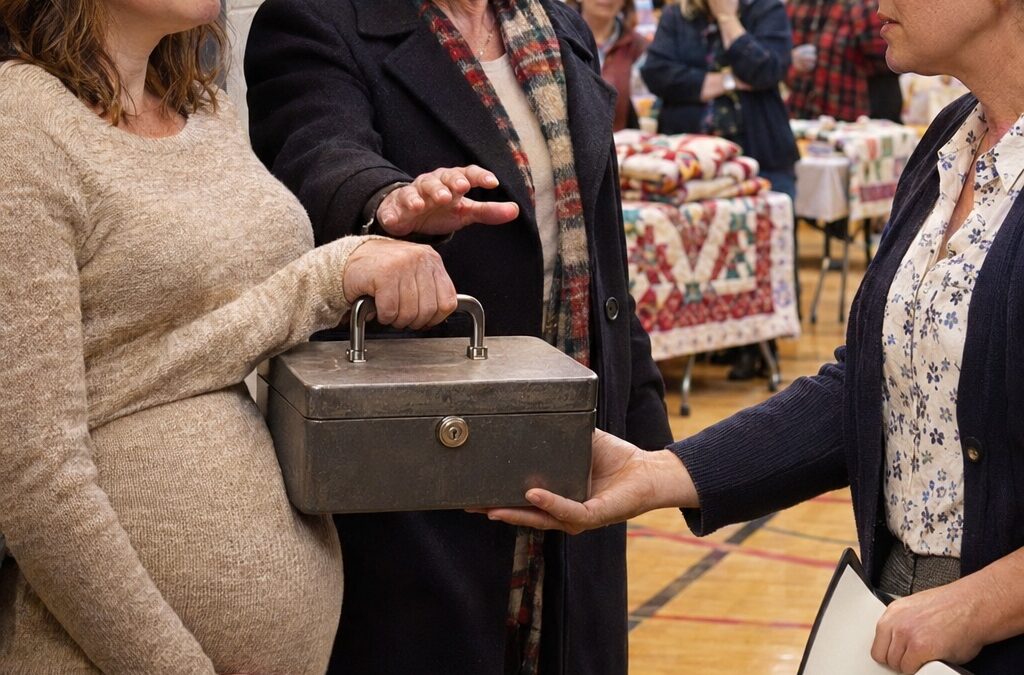
I set the cash box beside my chair.
“The fabric was mine. The sewing was mine.”
“We fed you while you were there.”
“I was there feeding Arthur.”
Caleb’s shoe brushed mine beneath the desk.
He pulled his foot away.
Paula kept her attention on the agreement.
“Providing a place to work doesn’t make someone a vendor.”
Darlene pressed her lips together.
Then she stopped claiming the quilts belonged to everyone.
“Kelsey covered the table,” she said. “She should be paid.”
I looked through the office window toward the gym.
My empty chair was still behind the display.
“She took it while I was being pulled away.”
Paula asked me to describe the sales before that happened.
I took my notebook from my bag.
The morning entries were in my handwriting.
I had sold 12 quilts at $230 each.
That was the $2,760 in my locked box.
The customers had paid exact cash. There was no change float mixed into it.
I had written each sale down before locking the lid.
Kelsey had not been behind the table for those sales.
She had been walking around with Darlene.
Paula turned to Kelsey.
“What did you sell after Nora left?”
“Just the runners.”
“How much did you collect?”
Kelsey looked down at the envelope.
“$240.”
Those were the two runners I had priced at $120 each.
Paula asked permission to count the envelope.
Kelsey nodded.
The money matched what she had just said.
Paula put it back and laid the envelope apart from my box.
“This is not the same money,” she told Caleb.
He rubbed his palms against his jeans.
“I know that. I meant they could work it out.”
But he had offered away everything I had earned.
Not a share of Kelsey’s envelope.
Not payment for some agreed help.
My whole morning.
I opened my business email on my phone.
My fingers kept hitting the wrong letters.
I rested the phone on the desk and tried again.
The district’s September 12, 2025 email was still there.
I opened the signed attachment and the delivery instructions.
Then I found the inventory photographs I had sent.
The photos showed my cart before it left home.
The quilts were folded with their labeled corners facing outward.
The remaining runners were rolled beside them.
I handed the phone to Paula.
“Please compare these.”
She looked from my photographs to the clipped labels.
Then she checked the agreement again.
Darlene had never received that agreement.
Her volunteer folder contained assignments and setup instructions.
She had mistaken access to the building for authority over vendors.
Now she was reading the actual terms.
The stall was assigned to me.
A replacement seller needed written district approval.
There wasn’t any.
Paula asked the officer to preserve the footage through the district’s usual process.
He wrote down the relevant portion and confirmed it.
I asked whom I should contact for an incident record.
Paula gave me her district email address.
I sent the inventory photographs while we sat there.
Then I sent my own account of the arm grab.
Darlene watched me press send.
“You’re really putting all this in writing?”
“Yes.”
“What about Arthur?”
The question made me lift my head.
She knew exactly where to press.
Arthur still needed help opening containers and fastening buttons.
He had apologized whenever I had to stop sewing.
I had never wanted him to feel like a burden.
“His care is separate from my sales,” I said.
Paula closed the folder.
She told Darlene the vendor issue was settled.
She still needed to handle the unauthorized purchases.
Kelsey asked whether she could at least finish the afternoon.
Paula said she could attend as a shopper.
She could not operate my stall or another one.
Darlene began gathering her tote from the floor.
“Then give us something to take home,” she said.
Caleb leaned forward before I could answer.
He pointed toward my notebook, not Kelsey’s envelope.
“Could you sign the morning money over to her anyway?”
Part 4: Back Behind My Own Table
“No,” I said.
Caleb waited as though I might add a condition.
I put my notebook back in my bag.
“That money belongs to my business.”
Darlene pulled on her coat without fastening it.
Kelsey asked when she would get the envelope back.
Paula explained that the customers needed to be offered refunds.
The runners were mine, not Kelsey’s inventory.
She couldn’t keep selling them or keep those proceeds.
Kelsey stared at the envelope.
Then she asked whether returning the money would end it.
“It resolves those purchases,” Paula said.
It didn’t make her an approved vendor.
It didn’t restore Darlene’s authority over my table.
Paula asked everyone except me to wait outside.
The officer stepped into the hallway with them.
For the first time, I could put my feet flat.
I took the cash-box key from my pocket.
Paula turned away while I opened the lid.
The bills were exactly where I had stacked them.
I counted them against my notebook.
The total was still $2,760.
I checked it again before closing the lid.
Paula didn’t tell me I was being fussy.
She waited until I locked it.
Then she asked whether I wanted to leave.
I looked at the clipped labels in my pocket.
Some quilts were already gone to customers’ homes.
The runners and remaining inventory were still at the table.
“I want my stall back.”
“Then we’ll go back together.”
I asked her not to discuss Arthur’s medical details.
She said she wouldn’t.
I also asked her to explain who owned the work.
I didn’t want the teachers remembering only Darlene’s version.
Paula opened the office door.
Caleb reached toward my box, offering to carry it.
“I have it,” I said.
He let his arm drop.
We walked back into the gym.
A teacher was keeping customers away from my table.
Someone had set my chair against the wall.
Paula moved it back behind the display.
Then she spoke where the nearby vendors could hear.
“Nora is the contracted vendor for this stall.”
Darlene stood beside the aisle with her tote.
Paula didn’t raise her voice.
“These are Nora’s handmade goods and Nora’s sales.”
A teacher looked from Paula to me.
“I’m sorry,” she said.
I put my box beneath the table beside my feet.
Paula continued before Darlene could interrupt.
“Nora made this inventory while providing months of family care.”
She didn’t mention the footage or Arthur’s condition.
She didn’t need to.
“This was not a transfer of a family business.”
Kelsey started to speak, then stopped.
Paula told her directly that she could not sell there.
Then she asked Darlene to return her volunteer assignment folder.
Darlene held it against her chest.
“I still have people waiting for instructions.”
“The office will handle those assignments.”
Darlene looked toward the teachers who had watched me leave.
None of them stepped forward to support her.
She put the folder on the table.
Paula carried it away.
The teacher helping at my stall found the runner customers.
They were still shopping inside the school.
Paula explained the problem without turning it into a spectacle.
Both customers agreed to return the runners.
Each received her $120 back.
I checked the fabric before putting it on my display.
One woman smoothed the runner across her forearm first.
“I thought she was your helper,” she told me.
“She wasn’t.”
The woman handed it over without arguing.
Paula recorded the refunds and gave me written confirmation later.
Kelsey left with Darlene after the money was returned.
Neither took a quilt, a runner, or my cash.
I sat down behind the table.
My water bottle had rolled beneath the display stand.
Caleb retrieved it and set it beside me.
“Can we talk?”
“Not while I’m working.”
He looked toward the gym doors.
Then he sat in a visitor chair across the aisle.
I didn’t ask him to stay.
I also didn’t ask him to cover my table.
When I needed the restroom, I asked the teacher.
She helped Paula find an approved break arrangement.
My remaining inventory stayed covered until I came back.
I finished the market from my own chair.
I answered questions about washing and fabric.
I folded quilts across my forearms.
When customers paid, I wrote the sales down myself.
The clipped labels stayed in my coat pocket.
At closing, I packed my remaining work into my cart.
The teacher held the door while I wheeled it out.
Caleb carried the empty display stand.
He asked whether we could take his mother home.
“She can arrange her ride,” I said.
He called her from beside the car.
I sat in the passenger seat with my box.
The baby pressed against my ribs while I waited.
I loosened my coat and rested my palm there.
At home, Caleb finally asked about my arm.
There was a tender place beneath my sleeve.
I showed it to him.
He looked at it without speaking.
“I should have stopped her,” he said.
“Yes.”
“I thought giving Kelsey something would get us out.”
“You offered my earnings. You didn’t offer yours.”
He sat at the kitchen table while I unpacked.
I didn’t tell him everything was fine.
I took my notebook and box into my sewing room.
The following week, Paula sent the incident confirmation.
It listed my restored vendor access and the refunded sales.
It also confirmed Kelsey’s removal as a seller.
Darlene would no longer coordinate that market.
Future vendor changes would go through the district office.
I saved the message in my business records.
Then I changed my business email password.
Caleb had known it for helping print shipping labels.
I removed his convenience access to my supply account.
Neither account had ever belonged to Darlene or Kelsey.
They would not be getting access now.
Caleb noticed when he couldn’t open the email.
“If we’re working things out, why change that?”
“Because you offered money you didn’t earn.”
He didn’t ask again.
We arranged marriage counseling.
I kept the appointment confirmation in my own calendar.
I also stopped being Arthur’s unpaid weekday caregiver.
I called him myself before Darlene could explain for me.
“I’m not angry with you,” I told him.
“I know,” he said.
We talked about the soup he liked.
Then I told Darlene she needed another care arrangement.
I gave her the routine I had written for Arthur.
Caleb helped her contact home-care providers.
They arranged and paid for his continuing help.
I still visited Arthur, but I didn’t bring my sewing.
I sat with him as family, then went home.
The labels Kelsey clipped off went into my mending drawer.
I repaired the damaged corners on the remaining quilts.
When Caleb asked about another family gathering, I checked my own calendar.
I didn’t cancel a customer pickup to make it.
My cash box no longer sat on the kitchen counter.
I cleared a shelf in the sewing-room cabinet.
Before putting it away, I checked the latch.
Then I lifted the locked metal box in both hands and set it on my shelf.








