My Mother-In-Law Grabbed My Collar Four Days After My Sister’s Funeral — Then I Stopped Her
Part 3: What Martin Had Seen
“I watched Elise sign the adoption agreement,” Martin said.
Beverly’s arms came unfolded.
“On April 8, 2025,” he continued. “I drove her there.”
He put his phone beside my water glass.
“Willa was his foster,” he said. “She wasn’t his owner.”
The coordinator confirmed that before Beverly could interrupt.
Pip had been surrendered to the rescue on January 15, 2025. The rescue placed him with Willa on February 10, 2025. Its foster agreement did not transfer ownership to her.
When Willa became too sick, I took over his care.
The rescue approved that temporary arrangement on March 18, 2025.
After her death, I completed its adoption process.
The final agreement was between the rescue and me.
I paid the $175 adoption fee on April 8, 2025.
“He belongs to Elise now,” the coordinator said.
Beverly looked toward Adam.
Adam was staring at Martin’s phone.
“No one told me anything about an adoption,” she said.
“No,” Martin answered. “We didn’t.”
He didn’t make it sound like a secret operation.
It hadn’t been one.
He had offered to drive because I was exhausted.
I had asked him to come inside with me.
I wanted someone there while I answered the coordinator’s questions.
He witnessed my signature at the end.
Then he drove me home with Pip beside me.
Beverly knew Martin had taken me somewhere that Tuesday.
She had assumed we were handling another funeral errand.
Neither of us had corrected an assumption she never voiced.
I hadn’t thought my mother-in-law needed notice.
I certainly hadn’t expected her to claim Pip afterward.
“He came from her sister’s place,” Beverly said.
“That was his foster placement,” the coordinator answered.
“So this wasn’t something Willa could leave to anybody?”
“No. The rescue still owned him then.”
Beverly pressed her lips together.
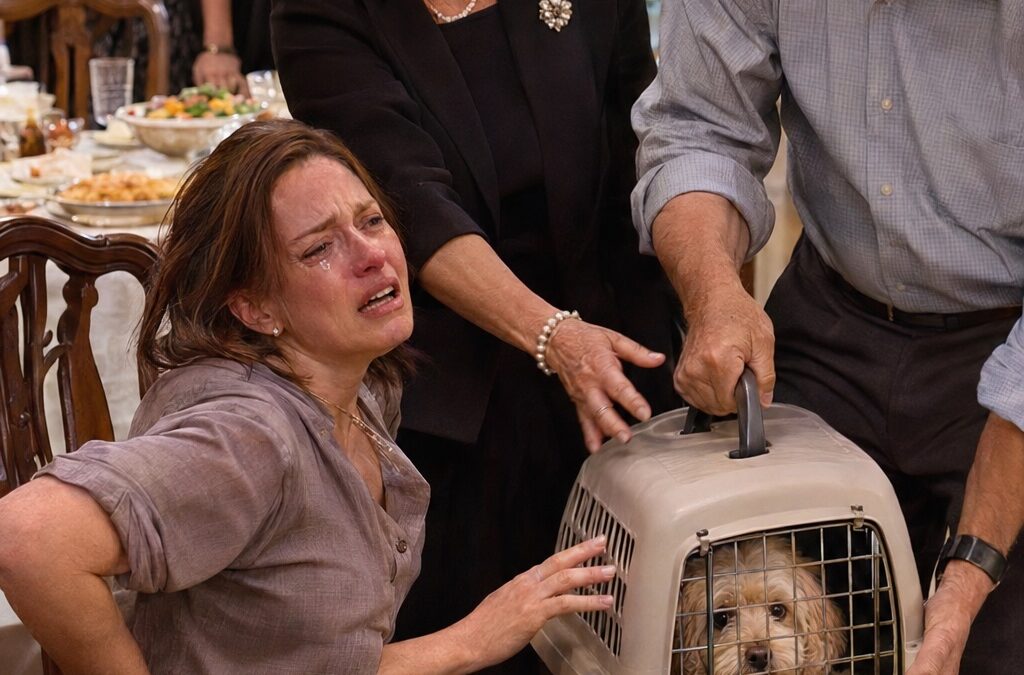
She finally looked down at the carrier beside me.
Pip had tucked himself against the back wall.
Only the tips of his front paws showed.
I wanted everybody out of my dining room.
I wanted to take off my torn blouse.
Instead, I checked the latch with my thumb.
The coordinator asked me to confirm my email address privately.
I took the phone off speaker long enough to answer.
She told me which agreement she was viewing.
It matched the saved copy Martin had opened.
Then I put her back on speaker.
“With Elise’s permission, I’ve confirmed the completed adoption,” she said.
There was nothing ceremonial about the confirmation.
She wasn’t making a ruling or awarding me anything.
She was explaining a transaction already finished.
That was what Beverly hadn’t understood.
She had arrived expecting a disagreement over my sister’s belongings.
There wasn’t any ownership question left to negotiate.
Martin turned his screen back toward himself.
“The appointment wasn’t about collecting Willa’s things,” he said.
“I didn’t say it was,” Beverly answered.
“You called it errands.”
“That’s what you said you were doing.”
“I said I was driving Elise.”
They stopped speaking.
I could hear somebody moving a glass in the kitchen.
Paige stood beside the stacked plates without touching them.
Adam finally pulled out a chair.
He sat, then stood again almost immediately.
Beverly watched the movement.
“Fine,” she said. “Then we’re discussing what’s sensible now.”
I held the carrier handle without lifting it.
“What does that mean?”
“It means paperwork doesn’t tell you whether someone can cope.”
The coordinator asked what concern she was raising.
Beverly’s voice became softer.
“She just buried her sister. Look at this house.”
I looked too.
There were serving spoons on folded towels.
There were flowers beside the windows.
There were extra chairs borrowed for the supper.
My sister’s photograph stood near a bowl of green beans.
Nothing in the room explained Beverly’s hand on my collar.
“I see a memorial supper,” Martin said.
Beverly ignored him.
“She works. Her husband works. She’s already overwhelmed.”
“I haven’t missed his medicine,” I said.
“No one accused you of that.”
“You’re saying I can’t care for him.”
“I’m saying you might need a break.”
The coordinator didn’t promise to send somebody immediately.
She didn’t threaten to take Pip away.
She asked whether there was a specific problem with his care.
Beverly glanced at the carrier.
“He’s shut in there, for one thing.”
“He was being moved away from the guests,” I answered.
I explained that he had been restless.
His bed and water were in the quiet bedroom.
I had been carrying him there when she stopped me.
Martin nodded.
“I watched her start toward the hallway.”
Beverly looked annoyed at the additional detail.
“You were in the kitchen.”
“I was carrying glasses through the doorway.”
He pointed to the glasses still on the counter.
It was such an ordinary thing to point at.
Nobody could pretend he had arrived after the incident.
He had been there with wet glass rings on his hands.
The coordinator asked me whether Pip was injured.
“I don’t think so. The carrier didn’t fall.”
“Keep him somewhere quiet while we finish talking.”
I asked Adam to open the bedroom door.
He started toward the carrier instead.
“Just the door,” I said.
He stopped, then did what I had asked.
I stayed seated while Martin lifted the carrier for me.
He held it steady until I could stand.
My hip hurt when I straightened.
My aunt moved a chair out of my path.
Beverly took a step toward us.
Martin turned his body without touching her.
“He’s going with Elise.”
“I understand the paperwork,” Beverly said sharply.
She looked toward my phone.
“But I’m asking you to review whether this placement is suitable.”
Part 4: The Care She Hadn’t Seen
The coordinator let Beverly finish.
Then she asked for a concrete concern.
Beverly mentioned my job again.
She mentioned the funeral and the crowded house.
She mentioned how tired I looked.
None of those things was a discovery.
I had discussed all of them during my application.
“My work schedule is in the file,” I said.
“So is the care plan,” the coordinator answered.
Beverly looked toward Adam again.
He stayed near the open bedroom door.
I carried Pip inside and set him beside his bed.
Martin remained at the doorway while I opened the carrier.
Pip came out slowly, sniffing along the rug.
He went straight to his water bowl.
I left the carrier open beside him.
The bedroom was only steps from the dining room.
Everyone could still hear the call.
I didn’t shut myself away.
The coordinator asked whether his medicine was available.
“Yes. In the kitchen cabinet, out of his reach.”
“And the follow-up appointment?”
“May 8, 2025.”
I could answer without looking anything up.
I had made the appointment before the supper.
Beverly leaned against the hallway wall.
“I’m not saying she doesn’t love him.”
I looked back at her.
“She’s saying I shouldn’t keep him,” I told the coordinator.
“I understand,” the coordinator said.
Her voice stayed plain and careful.
She explained that concerns could be recorded.
A relative’s preference did not cancel a completed adoption.
Neither did an offer of a different household.
If someone had evidence of neglect, that was different.
Beverly had not described any.
Pip finished drinking and shook his ears.
Some water landed on my shoe.
I bent to straighten the towel beneath his bowl.
That small job reminded me of Willa’s room.
Her carpet had sloped near the bedside table.
Pip’s bowl always slid toward the bed frame.
I used to wedge a folded washcloth underneath.
Willa would watch while I moved things around.
“He likes it where he can see me,” she said.
So I kept his bowl near her.
When she couldn’t sit up easily, I brought him closer.
He would settle while I changed her pillowcase.
She never called him an inheritance.
She called him her little visitor.
She knew the rescue would need to approve his next home.
Before she died, she asked whether I had spoken to them.
I told her I had.
She nodded and asked me to adjust her blanket.
That was the whole conversation.
There hadn’t been a dramatic bedside promise.
There had been a sick woman checking something important.
Now Beverly was studying the bedroom from the hallway.
“He needs more than bowls and a bed,” she said.
“I know.”
“He needs someone with patience.”
“I know that too.”
The coordinator asked about the transition from Willa’s home.
I explained the approval from March 18, 2025.
I had called before bringing him home.
I wanted his records and care instructions handled properly.
The rescue knew Willa was ill.
Its coordinator helped arrange the temporary change.
Later, she walked me through the adoption application.
I did not become his owner by taking his carrier.
I became his owner through the completed agreement.
Martin came farther into the doorway.
“She asked questions at that appointment,” he said.
Beverly gave him a tired look.
“Of course she did.”
“She asked what would happen if he stopped eating.”
I remembered holding my pen above the form.
I had been afraid of overlooking something obvious.
Willa’s death had made every forgotten chore feel dangerous.
Martin had waited while the coordinator explained.
He hadn’t rushed me or checked his watch.
“She asked about his follow-up,” he continued.
“And she wrote down where to call.”
The coordinator remembered that too.
“She had his medication information with her,” she said.
Beverly rubbed the side of her neck.
Now she knew Martin hadn’t merely signed as a favor.
He had sat through the questions.
He could describe the appointment without reading a document.
He had also driven us home.
Pip had scratched the carrier door at a stoplight.
I had put my fingers against it, just as I had tonight.
Martin had pulled over when I asked him to check.
The carrier latch was secure.
Pip had settled after hearing us speak.
That wasn’t proof of every future good decision.
It was proof that Martin knew the actual arrangement.
He wasn’t guessing because I looked upset.
The coordinator asked whether I needed anything else from her.
“Please send another copy of the completed agreement,” I said.
She agreed to send it to my saved address.
I also asked her to note that I had not authorized a transfer.
“I can note your call and your instruction,” she said.
Beverly straightened.
“No one was arranging a sale.”
“I didn’t say sale.”
“I don’t want that written down incorrectly.”
“Then stop saying I agreed to send him away.”
She looked toward the dining room.
Paige had come into the hallway.
Her hands were empty now.
“I could help,” Paige said carefully.
I turned toward her.
“If you need someone during work,” she added.
Beverly immediately stepped closer to her daughter.
“That’s what I’ve been trying to explain.”
Paige looked uncomfortable.
“I’m offering now. I thought something else was already settled.”
The coordinator waited without interrupting.
I told Paige I wasn’t asking for another caregiver.
She nodded, looking at Pip beside his bed.
“He’s smaller than I expected.”
Beverly made a little impatient sound.
“You said you liked that kind.”
“I do. That doesn’t mean I’m taking him.”
For the first time, Beverly seemed unsure where to stand.
Her husband was in my doorway.
Her daughter was no longer standing beside her.
Adam was watching us from behind the dining chairs.
I thanked the coordinator for checking the file.
She repeated that Pip’s adoption remained completed.
There was no new application to decide that night.
I ended the call and put down my phone.
Paige looked directly at Beverly.
“Who told you Elise had agreed?”
Part 5: The Promise At The Table
Beverly glanced toward the remaining guests.
“Could we not do this with an audience?”
Paige didn’t move.
“You brought it up with an audience.”
I stayed beside Pip’s bed.
He had curled into the blanket, his nose tucked down.
The open carrier stood between my feet and the dresser.
Beverly lowered her voice.
“I said I thought Elise would appreciate the help.”
“That isn’t what you told me.”
Paige spoke slowly, as though checking each word.
“You told me I could bring him home.”
Beverly touched her daughter’s elbow.
Paige stepped back before the touch became a grip.
“You said Elise had enough to handle,” Paige continued.
“You said she’d agreed.”
I looked toward Adam.
He closed his eyes briefly, then looked away.
I didn’t know whether he had heard that promise before.
I needed an answer instead of another expression.
“Did you know about this?”
“No,” he said.
Beverly answered at the same time.
“Adam knew she needed support.”
“That wasn’t my question.”
Adam looked at his mother.
“I didn’t know you promised Paige the dog.”
Paige nodded.
“Because she told me this afternoon.”
There it was.
Before supper, before Beverly asked me anything, Pip had been promised.
Not offered as a possibility.
Promised as though he were waiting beside the door.
Beverly pulled her hand back to her side.
“I was trying to make something easier.”
“For whom?” Paige asked.
No one answered immediately.
Beverly looked at my sister’s photograph across the room.
Then she looked at me.
“You’ve been keeping yourself so busy.”
“I’ve been feeding a dog.”
“That’s not all I mean.”
“I know what I’ve been doing.”
I had answered calls from relatives.
I had chosen which photograph to use at the funeral.
I had stood in Willa’s apartment holding empty grocery bags.
I had also come home and washed Pip’s bowl.
Those chores did not make him available for taking.
Paige faced me.
“I’m sorry. I thought you wanted this.”
“I didn’t.”
“I understand.”
She didn’t ask to hold him.
She didn’t explain how good her home would be.
She went back to the dining room and picked up her purse.
Beverly followed her as far as the table.
“Don’t leave upset with me.”
“I’m upset because you used my name.”
“I was thinking about you.”
“Then you should have asked me too.”
Martin had said nothing during that exchange.
He stood beside the hallway, not blocking anybody.
Beverly turned toward him.
“You could have told me about Tuesday.”
“You could have asked Elise about Pip.”
“That would have prevented all this.”
“No,” Martin said. “Not pulling her would have prevented this.”
I watched Beverly’s face.
She didn’t try to dispute that he had seen it.
Instead, she reached for the back of a chair.
“I was trying to steady the carrier.”
My aunt spoke from beside the kitchen counter.
“You had her collar in your hand.”
Beverly looked down at the chair.
My aunt didn’t embellish.
She described the pull, the chair, and Pip scratching inside.
That was all.
Adam came toward the hallway.
“Mom, please stop.”
Beverly looked almost relieved.
“Yes. We all need to stop.”
He rubbed his forehead.
“I mean stop explaining it away.”
I wanted that sentence to have come earlier.
I wanted it before Martin’s phone and the rescue call.
I didn’t reward him for finally saying it.
Beverly sat down without being invited.
She seemed to expect supper to resume around her.
Her napkin was still folded beside her plate.
“I’ll apologize for upsetting you,” she said.
“You pulled me down.”
“I didn’t mean for you to hit the chair.”
“You still pulled.”
She looked at Adam.
He stayed where he was.
I put my palm flat against the door frame.
My hip had begun to throb more steadily.
“I need you to leave.”
Beverly stared at me.
“There are still people eating.”
“The supper is over for you.”
Martin picked up her purse from the chair beside her.
He didn’t hand it over immediately.
He waited until she stood.
“You’re coming with me?” she asked.
“I’m driving you home.”
“So you’re leaving her with this version of things?”
“I saw what happened.”
She took the purse from him.
Adam stepped aside as she passed the dining table.
Then she stopped beside him.
“I’m your mother.”
“I know.”
“Tell your wife this has gone far enough.”
I could see the front door behind his shoulder.
For a moment, he looked like he might turn toward me.
I rested my hand against my sore hip.
Paige stood near the entry with her own purse.
She wasn’t offering Beverly an argument anymore.
She was waiting to see what Adam would do.
“I meant until dinner was over,” Adam said.
He was speaking to me now.
“When I said she could take him.”
“She was walking toward the door.”
“I know.”
“You told me to let her.”
“I know.”
“You saw her pull me.”
“Yes.”
Beverly shifted her purse onto her shoulder.
“Adam, we don’t have to keep repeating it.”
He looked at the collar of my blouse.
The seam had stretched near the back.
I had felt it catch against my skin earlier.
He hadn’t looked at it until now.
“I’m asking you to open the door,” I told him.
Beverly waited behind him, her chin lifted.
Adam put his hand on the front door.
Part 6: After The Guests Went Home
He opened it for his mother.
He didn’t ask me to step outside with her.
He didn’t suggest that I apologize before she left.
“Mom, go home,” he said.
Beverly stayed on the threshold.
“We’ll talk when everyone has calmed down.”
“We can talk later,” he answered. “You still need to leave.”
Martin waited beside her.
Before following her out, he looked back at me.
“Pip stays here,” he said.
“Yes.”
“And you’ve got the coordinator’s number.”
“I do.”
He nodded toward my hip.
“Please get that checked if it keeps hurting.”
Then he went outside with his wife.
Paige left after them, stopping near me first.
“I’m not taking him,” she said.
“I understand.”
“I’ll tell Mom myself too.”
She didn’t try to hug me.
I was grateful not to have another person reach toward me.
When the door closed, I stayed in the hallway.
I could still hear forks moving in the dining room.
Nobody knew whether to resume eating.
My aunt began collecting plates.
I asked her to leave them.
“I don’t need you doing dishes right now.”
“I can put food away.”
“That would help.”
She found containers without asking me to direct everything.
Other guests began gathering their coats.
They spoke quietly, not looking toward Willa’s photograph.
Some apologized for what had happened.
Some said they hadn’t known what to do.
I didn’t have an answer prepared for them.
I thanked them for coming to remember my sister.
Then I let them leave.
Adam stood beside the entry as each person passed.
He accepted leftover dishes and returned borrowed towels.
Those were familiar jobs.
They didn’t require him to contradict his mother.
I watched him do them without feeling grateful yet.
When the last guest left, the house looked half dismantled.
Chairs stood at odd angles around the table.
A serving spoon lay in a puddle of gravy.
Willa’s photograph had been moved to avoid a spill.
I picked it up and wiped the frame.
There was a fingerprint on the corner.
I couldn’t tell whose.
Adam came toward me with a dish towel.
“I’m sorry.”
“Not while I’m holding this.”
He stopped.
I carried the photograph to the living room.
I set it where I could see it from the couch.
Then I went back to the bedroom.
Pip lifted his head when I entered.
I sat on the floor beside his bed.
My hip objected as soon as I bent.
I changed position and leaned against the mattress instead.
Adam stayed in the doorway.
“Can I bring you something?”
“My phone. And the carrier stays here.”
“It’s already here.”
“I know. Don’t put it in the garage.”
He nodded and brought my phone.
I opened the rescue’s new email.
The completed agreement was attached.
I saved it somewhere I could find easily.
Then I saved the coordinator’s message with it.
I didn’t send either document around the family.
I wanted them preserved, not turned into another argument.
Next, I photographed the stretched collar of my blouse.
Adam watched me check the pictures.
“Are you documenting it?”
“Yes.”
He sat on the edge of the bed.
I asked him to move so I could stand.
He stood immediately.
In the bathroom, I checked the red mark near my collar.
There was another tender place against my hip.
I photographed both without trying to make them look worse.
Then I wrote down what had happened.
I included my own words where I remembered them.
I included Adam’s suggestion about finishing dinner.
I wrote down who stood where.
I wrote that the carrier had not fallen.
I didn’t want later recollections replacing the details I knew.
When I finished, I put the blouse aside.
I changed into something loose around my neck.
Adam had cleared a space on the kitchen counter.
He hadn’t touched my phone or notes.
“Do you want to call somebody?” he asked.
“I’m going to have my hip checked tomorrow.”
“Okay.”
“And I’m going to report what happened.”
He swallowed.
“To the police?”
“Yes.”
He looked toward the front window.
I could almost see the phone call he expected from Beverly.
“I’m not asking you to decide that,” I said.
“I know.”
For once, he didn’t add a request.
We had never given Beverly a house key.
But Adam had often told her she could stop by.
That arrangement needed to end plainly.
“I don’t want her coming in here,” I said.
“She won’t.”
“Not because you think she probably won’t.”
He nodded.
“I’ll tell her she needs our agreement before visiting.”
“Mine too.”
“Yes. Yours too.”
I asked him to put that in a message.
He wrote it while standing beside the counter.
He showed me before sending.
It said there would be no unannounced visits.
It said she was not to collect Pip.
It said any future visit required my agreement.
There were no threats and no invented legal terms.
Just instructions about entering our home.
He sent it.
I asked for a copy, and he sent that too.
Then I returned to the bedroom.
Pip followed me, pausing to sniff the carrier.
He went inside even though the door stood open.
I sat near him and finally drank some water.
Adam stayed outside the room until I looked up.
He had folded a blanket over his arm.
“I can sleep somewhere else tonight,” he said.
I put the glass on the dresser.
He waited, then asked, “Do you want me to stay?”
Part 7: The Morning After Supper
“I want to sleep without explaining anything else,” I said.
Adam looked down at the blanket.
“I’ll use the couch.”
“Leave the bedroom door where it is.”
He left it partly open.
That was how I wanted it.
Pip could hear the house without being in its middle.
I could see the hall light without getting up.
I didn’t sleep much.
Whenever I turned, my hip woke me.
At some point, Pip left the carrier for his bed.
I heard his collar shift against the blanket.
That ordinary sound kept me from checking him repeatedly.
On April 11, 2025, I called for a medical evaluation.
I described where I hurt and what had happened.
I didn’t call it an accident.
I didn’t ask anyone to write a conclusion for me.
I said my mother-in-law had pulled my collar.
I said I had struck the chair.
The examination didn’t uncover an emergency.
It did document the tenderness and visible marks.
I followed the care instructions I received.
That mattered more to me than obtaining dramatic language.
I wanted to sit and walk without bracing first.
Adam offered to drive.
I accepted the ride, not a conversation about his mother.
He understood enough not to start one.
When we returned, I gave Pip his medicine.
I tucked it into his food and waited.
Adam stood near the sink.
“He took it?” he asked.
“Yes.”
I showed him the empty spoon.
It was the same movement Willa used to watch.
I washed it before I started crying.
Adam reached for a towel, then stopped.
“Would you like me to leave you alone?”
“Stay over there.”
He stayed beside the sink.
I cried while the water ran over the spoon.
Then I turned off the faucet.
There wasn’t a useful sentence to say afterward.
I dried my hands and called the police nonemergency number.
I asked how to make a report.
I followed the instructions I was given.
When I gave my account, I stayed with what I knew.
I described the pull and the impact.
I identified the people who had witnessed it.
I said Martin had recovered the carrier.
I explained that the dog had remained with me.
I offered the photographs and my written notes.
I did not say Beverly had injured Pip.
I had no evidence of that.
I did not say a court had barred her from our house.
No court had done anything.
I was told the report would be documented.
I understood there could be follow-up.
I did not receive a promise of an arrest.
I did not ask Adam to call anyone to influence it.
Afterward, I saved the report information with my notes.
Then I checked Pip’s practical arrangements.
The rescue coordinator confirmed my adoption contact details.
I asked how emergency pickup permissions should be recorded.
I didn’t want a relative mistaken for my authorized representative.
She explained what her organization could note.
She also told me to speak directly with the veterinary office.
One set of records did not automatically update another.
So I called the veterinary office too.
I confirmed the adoption information they needed.
I asked them to note who could collect Pip.
I made clear that Beverly was not authorized.
I also checked that his follow-up remained on the calendar.
Those calls took longer than the confrontation’s final reveal.
There were questions to answer and information to verify.
No one pressed a button that secured every record everywhere.
I wrote down what each office had confirmed.
Then I put my notebook away.
Adam had been clearing the supper dishes.
He had wrapped the remaining food and washed the serving spoons.
He left Willa’s photograph where I had placed it.
When I came back into the kitchen, he turned off the water.
“I need to say what I actually did,” he said.
I pulled out a chair carefully.
He stayed standing.
“I saw her grab you.”
“Yes.”
“I told you to let her take Pip anyway.”
“Yes.”
“I wanted the room to stop watching us.”
I looked at the table’s bare patch where my plate had been.
“So you wanted me to give her what she wanted.”
“Yes.”
He didn’t say he had been caught between us.
He didn’t say he was trying to protect me.
That made it possible to keep listening.
“I made you deal with her and with me,” he said.
I rubbed my thumb along a scratch in the tabletop.
“I asked you for help.”
“I know.”
“Your father had to take the carrier.”
“Yes.”
I didn’t tell him everything was fine.
I told him I wasn’t willing to continue as before.
We discussed counseling as something to arrange, not announce.
He offered to find available appointments.
I said I wanted to participate in choosing someone.
We agreed not to use family members as messengers.
We also agreed that Pip’s routine would stay unchanged.
For the moment, Adam would keep using the couch.
I needed space to sleep and decide what I wanted.
He accepted that without bargaining over how long.
Later, Martin checked on my hip by message.
I answered only what I wanted to share.
He didn’t ask whether I regretted the police report.
He didn’t ask me to reassure Beverly.
He said he would provide his own truthful account if contacted.
That was enough.
Paige sent a separate message.
She had told Beverly she would not accept Pip.
She had also corrected the claim that I had agreed.
I thanked her.
I didn’t invite either of them to discuss Beverly’s feelings.
Near the end of the day, my phone lit up again.
This time, Beverly’s name was on the screen.
Part 8: What The Apology Included
I didn’t open it immediately.
Pip was eating, and I wanted to watch him finish.
Adam noticed the phone but didn’t reach for it.
When I finally read the message, it began politely.
Beverly asked how I was feeling.
Then she asked that we keep “family business” private.
She wanted to come over and explain.
There was no mention of my collar.
There was no mention of the chair.
There was a sentence about everyone misunderstanding her intention.
I put the phone facedown.
Adam waited until I looked toward him.
“Do you want me to answer?”
“No.”
I reread it later, after Pip settled.
Then I wrote a response and left it unsent.
I took out everything I couldn’t prove.
I removed a sentence guessing what she thought of me.
I didn’t need to explain her personality.
I needed to describe what she had done.
My final answer was plain.
She had pulled my collar and tried to take Pip.
I had not agreed to give him to Paige.
The completed adoption was not open for family negotiation.
She could not visit without my agreement.
I was not available for an in-person explanation.
I sent that and stopped typing.
Beverly responded with a question about the police report.
I answered that I had reported what happened.
I did not promise to withdraw anything.
I also did not claim the report gave me powers it didn’t.
It was an account for the authorities to handle.
She could give her own truthful account if contacted.
Adam read my reply only after I offered it.
He said it was clear.
Then his phone began ringing.
He took the call in the living room.
I could hear his words without hearing hers.
“Yes, I knew she was making a report.”
A pause.
“No. I didn’t ask her not to.”
Another pause.
“Mom, I saw you pull her.”
He didn’t raise his voice.
He also didn’t move outside to hide the conversation.
When he came back, I asked whether she had threatened anything.
“No. She wants me to talk you into seeing her.”
“And?”
“I said that wasn’t my decision.”
He sat at the far end of the table.
There was still a lot between us.
A correct answer on a phone call didn’t remove it.
But it was different from telling me to surrender Pip.
Over the next several days, the family account became clearer.
Martin told Beverly he would not call the pull an accident.
He had seen her hand on my blouse.
He had also seen where I was standing.
He did not claim to know what she had intended.
He kept his account to the visible actions.
Paige made her correction separately.
She told relatives she had never asked for Pip.
She explained that Beverly had told her I agreed.
She did not describe me as confused or undecided.
I didn’t organize either conversation.
I heard about them because Martin and Paige told me.
I asked them not to relay every reaction afterward.
I couldn’t spend my days answering a supper that was over.
There were still Willa’s things to sort.
There were still messages from people who had loved her.
I wanted room for those without another carrier argument.
Adam and I looked for a counselor together.
We compared appointment availability and practical information.
We didn’t choose someone to decide who won.
I wanted help discussing what he had done when I needed him.
He said he wanted to understand why his first response had been compliance.
That was his work to do honestly.
I couldn’t do it for him.
On April 17, 2025, we had an appointment arranged.
We put it on our shared calendar.
That same day, Beverly sent another message.
This one was longer but less defensive.
She wrote that she had grabbed my collar.
She wrote that pulling me was wrong.
She acknowledged that I had not offered Pip to Paige.
She said she had promised something that wasn’t hers to promise.
I read those sentences carefully.
They did not include “if you felt hurt.”
They did not say we had both behaved badly.
They did not ask me to pretend the adoption happened later.
Then came a sentence about Pip’s supposed value.
She admitted that she had compared him with dogs for sale.
She had allowed that estimate to make him seem like an opportunity.
There had never been an appraisal.
There had never been a buyer.
Just Beverly deciding a desirable dog should go to her daughter.
I appreciated the distinction because it mattered.
She had not exposed some hidden financial scheme.
She had used a guessed price to justify taking him.
She also said she had corrected the arrangement with Paige.
I already knew Paige had rejected it.
Still, Beverly needed to write that correction herself.
At the end, she offered to pay any medical expense connected to the pull.
I did not send her an amount or accept a settlement.
I hadn’t finished deciding what to do about that.
I saved the message with my other records.
Then I read it again without looking for a reason to forgive her quickly.
Adam asked what it said.
I showed him.
He sat with it for a while.
“That’s more honest,” he said.
“Yes.”
“Does it change what you want right now?”
“Not about visiting.”
He nodded.
The apology did not bring back the memorial supper.
I couldn’t replace that evening or invite Willa into another one.
I could decide who came through my door next.
Beverly’s final sentence asked whether she could visit soon.
I left that question unanswered while I took Pip outside.
Part 9: The Carrier By The Door
I answered Beverly after we came back inside.
“Not yet. I’ll contact you when I’m ready to discuss a visit.”
I didn’t give her a date.
I didn’t promise that the answer would change soon.
She replied that she understood.
Then she stopped messaging me about it.
That was the first part of her apology I could watch.
She did not appear on the porch.
She did not send Paige with an invitation.
She did not ask Martin to borrow the dog for her.
Pip stayed where his records said he belonged.
His routine became ordinary again before mine did.
He still wanted breakfast when I wanted more sleep.
He still stood by the door while I found my shoes.
He still scattered food beside his bowl.
I swept it up without anybody estimating his value.
Adam began handling some of the morning chores.
At first, he asked me where everything belonged.
Then he started checking for himself.
He learned which towel went under the water bowl.
He learned to wait while Pip finished swallowing his medicine.
I didn’t hand over the whole routine immediately.
I showed him, then stayed nearby.
He didn’t call that mistrust unfair.
He understood why I wanted to see the follow-through.
We began counseling after arranging the appointment.
I told the counselor about the plate Adam put down.
That was the detail I kept returning to.
He had taken care not to spill his dinner.
Then he had asked me to let his mother leave with Pip.
Adam listened without telling me I was focusing on something small.
He explained the pressure he felt around Beverly’s anger.
I listened to that too.
But an explanation wasn’t the same as an excuse.
We talked about what he could do differently in the actual moment.
Not what he should have wished afterward.
Not how to sound supportive once someone else intervened.
He needed to recognize an unsafe action and respond.
He needed to stop making my agreement the easiest solution.
That conversation wasn’t finished in an appointment.
It became part of our regular life.
When Beverly called him, he no longer carried requests back to me.
If she asked about visiting, he repeated our existing answer.
He did not announce that I was “still upset.”
He said we had not arranged a visit.
That wording mattered.
It described a decision, not a mood he expected to pass.
Martin came by only after asking.
He brought a serving dish we had overlooked after supper.
I invited him inside.
He stood in the entry until I told him where to put it.
Pip recognized his voice and trotted over.
Martin crouched and let Pip approach.
He didn’t scoop him up.
I watched that before asking whether he wanted coffee.
We sat in the kitchen, away from the dining chair.
I had moved that chair to the other side of the table.
Not to erase what happened.
It was easier to pass without thinking about my hip.
Martin looked toward Pip’s bed.
“I’m glad he’s settled.”
“He likes the quiet mornings.”
“So do I.”
We didn’t spend the visit discussing Beverly.
I asked whether he remembered Willa from a family cookout.
He did.
He remembered her helping carry dishes when she was already tired.
I told him she had always hated people noticing that.
For a while, we talked about my sister.
That was what I had wanted the supper to allow.
Later, Paige sent me a picture of an empty corner in her living room.
She said she had moved a chair there instead.
There was no request for Pip attached.
I answered that the chair looked comfortable.
Our conversation stayed ordinary.
I was glad she had not made me manage her disappointment.
The police report remained a report.
I was not given a courtroom ending to tell people.
I had documented the incident and provided truthful information.
If there were questions, I would answer them.
I didn’t need to invent an arrest for Beverly to have lost something.
She had left without Pip.
Her promised arrangement with Paige had ended publicly.
Her husband had contradicted her in front of the family.
She could no longer enter our home on an open invitation.
Those were real changes that continued after the supper dishes dried.
By May 8, 2025, my hip no longer hurt when I bent.
Pip’s veterinary follow-up was that morning.
I set the carrier in the bedroom with its door open.
He inspected it, then walked past it toward his bed.
I waited instead of pushing him.
Adam stood in the doorway holding the care information.
“Do you want me to drive?”
“Yes.”
“Do you want me inside for the appointment?”
“Yes. Let me handle the carrier.”
He nodded and put the information beside my bag.
There was no argument about who needed to be in charge.
I coaxed Pip inside and checked the latch.
Then I lifted the carrier by its handle.
It felt different without somebody reaching for it.
At the appointment, I answered the questions about his routine.
Adam added details when I asked him to.
The office had the updated ownership information.
There was no confusion about who could make decisions for Pip.
We finished without an incident or a family phone call.
On the way home, Adam asked whether I wanted company for lunch.
I said I did.
I wasn’t promising that everything between us had been repaired.
I was agreeing to lunch.
That was an honest answer I could give.
Back home, he carried my bag and opened the front door.
I stepped past him with Pip.
Willa’s photograph stood where I had put it after supper.
I stopped beside it before going down the hallway.
Pip shifted inside, impatient to be let out.
“I know,” I told him.
I carried him to the bedroom and opened the door.
He stepped out, stretched, and went to his water.
I kept the handle in my hand while I watched him drink.
Then I set the empty carrier beside his bed.








