My sister sent my 2 children to the garage after I paid Dad’s mortgage 74 times—Then my late mother’s signature ended her plans for his house.
Complete story · 13 parts · about 54 minutes · ending included
Part 1 · Part 2 · Part 3 · Part 4 · Part 5 · Part 6 · Part 7 · Part 8 · Part 9 · Part 10 · Part 11 · Part 12 · Part 13
Part 1 of 13
“Real family eats inside.”
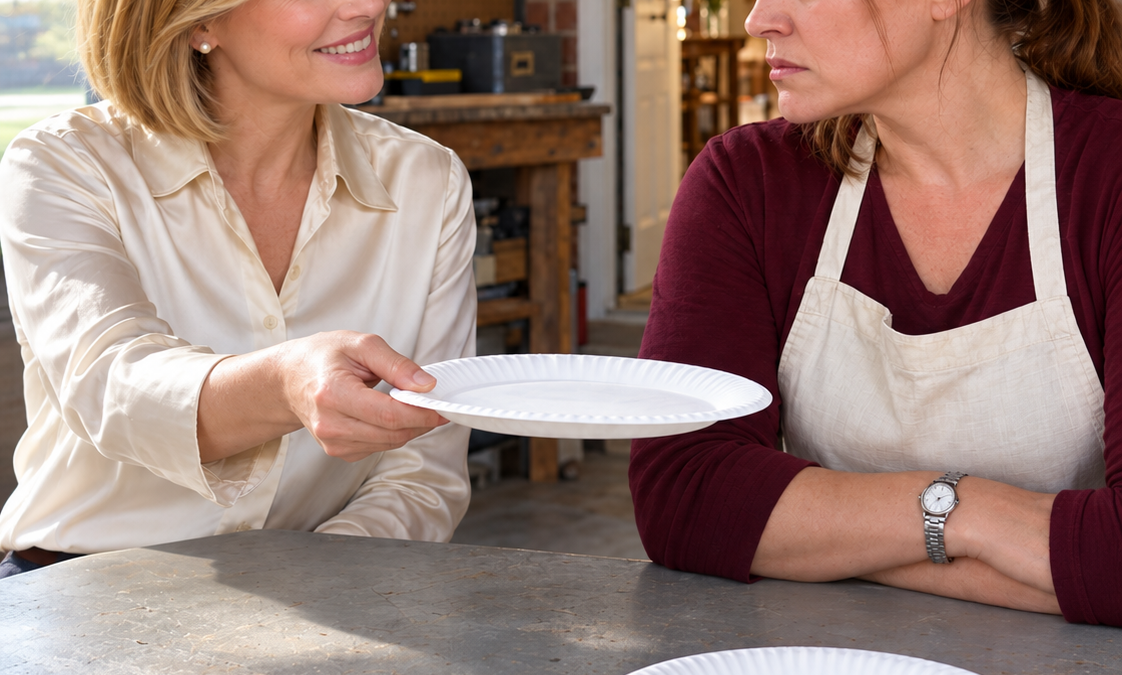
Kristen said it sweetly, smiling toward the dining room as she set two paper plates on the folding card table. She hadn’t brought one for me.
Maddie’s shoulders went rigid. Owen glanced from his sister to the empty place in front of my chair.
“Pie’s almost ready,” I said.
At the dining table, Uncle Ray lowered his eyes to his dinner plate rather than meet Kristen’s gaze.
By 3:40 that Thursday afternoon, nineteen people, Dad among them, filled the red-brick ranch house at 611 Mockingbird Lane in Tyler. My children and I had three chairs in his double garage, with an electric space heater on the concrete floor.
“But the pie’s right there,” Owen said.
He pointed through the open door to the kitchen. The pumpkin pie I’d baked sat on the counter a few feet away. It needed another half hour before I could cut it cleanly.
“It has to cool,” I said.
“Are we eating out here?” he asked.
“Looks that way,” I said.
Maddie stared at her paper plate. At thirteen, she knew the difference between a children’s table and being sent away. She pulled her sleeves over her wrists.
“We can go home,” she said.
“After Grandpa eats,” I said.
In the dining room, Dad sat at the head of the table. Before his stroke, he had always carved the turkey from that chair. His white shirt was buttoned at the collar. The seat at his right was Kristen’s. There were green beans in Mom’s oval dish, rolls under a towel, and sweet potatoes with pecans.
Owen reached into his jeans pocket and brought out two peppermints wrapped in clear plastic.
“I saved these for Grandpa,” he said.
“He’ll like that,” I said.
“Can I take them to him?” Owen asked.
My sister had stopped at the kitchen end of the doorway, where she could hear every word.
Kristen said, “We’ll see. Daddy’s busy with his guests.”
She gave Owen a pleasant nod, then walked back into the dining room, sat down next to Dad, and smoothed her skirt beneath her.
At the words “real family,” Dad had turned his head. Now he looked across the kitchen toward us and raised his left hand from the armrest.
“Kids. Here,” he said.
“Now, Daddy, let people settle,” Kristen said, smiling at the relatives nearest her. “Heath’s got them comfortable. I’ll fix your plate.”
His right hand stayed on the table, the fingers slow to move. Kristen’s seventeen-year-old son, Brayden, set his water glass down without taking a sip. Next to him, my brother-in-law, Todd, flipped his fork over by his napkin.
Mom had served Thanksgiving on Mockingbird Lane from 1988 through 2023. Thirty-six dinners, and she always found another chair when a cousin brought a guest. Dad sharpened the carving knife while Mom warned he was wearing it down to a toothpick.
That morning, I’d reached for Mom’s red tin recipe box on the kitchen shelf. A cardinal perched among winter branches on its lid. Her instructions slanted uphill whenever she ran out of space.
My sister caught the box before I could lift it.
“Mom left that to me,” Kristen said.
“All right,” I said.
The lid popped open a crack as she pulled it away. On the top card, I saw Mom’s handwriting. My mother made the P in pumpkin taller than every other letter. Kristen shut the tin and put it back out of my reach.
At one o’clock, I measured cinnamon and ginger from memory, beat eggs into the filling, and poured it into a crust I’d rolled at my duplex. For years, Mom managed a school cafeteria. She could tell a pie was ready by the faint movement at its center, and she’d taught me how to look.
Back in the workshop, Owen twisted one peppermint between his fingers and studied Dad’s pegboard. The old radio rested on the workbench under a jar of screws. Even after the stroke, Dad liked to sit here while Uncle Ray sorted what needed fixing.
“Grandpa says the garage is where the good stuff gets built,” Owen said.
“He’s right,” I said.
“Could we eat at his workbench instead?” Owen asked.
“You’d have to clear thirty-eight years of projects first,” I said.
Owen examined a wooden birdhouse on the shelf, its roof still missing. Dad had started it with him in the spring. My son had insisted on making the entrance wide enough for a bird the size of a chicken. Dad answered, “Big bird,” and handed him the sandpaper.
I reached into the pocket at my waist and felt a stiff, squared corner. I left it alone.
From the house came the scrape of a serving spoon against a dish. Through the kitchen, I could see Dad looking toward our table again. An empty seat remained beside Uncle Ray, but nobody called us in.
I loosened the ties behind my back and knotted them tighter. Owen gathered his peppermints. Maddie hooked her sneaker around one leg of my chair and pulled it closer to hers.
“Will Grandpa come out after dinner?” Owen asked.
“We’ll ask him,” I said.
The envelope in my apron pocket had the Smith County seal on it.
Kristen didn’t know it existed.
Sixteen days ago, neither did I.
Part 2 of 13
On October 19, thirty-eight days before Thanksgiving, I drove from the ER to Dad’s house at seven in the morning and found his mailbox hanging open at the curb.
The sun was coming up over Tyler. I had a crease across my cheek from my mask and a paper cup of hospital coffee that tasted like hot water. My twelve-hour shift was over. My feet hadn’t received the news.
At 611 Mockingbird Lane, the porch light was still on.
Glenda’s car stood in the driveway. Inside, she was putting away clean dishes while Dad sat at the kitchen table over a page covered in blue boxes.
“Morning, Miss Heather,” Glenda said. “He’s checking my hours.”
Three visits were marked off in tidy blue ink. Dad had the pen in his left fist. He steadied the page with the fingers of his weaker right hand, then drew each letter slowly, lifting the tip between strokes.
F LOCKHART.
Straight block capitals. He checked the result, handed Glenda the sheet, and looked at me.
“Heath. Good.”
“Good morning, Dad.”
He reached for his mug. It was empty, so I took it to the counter.
“That writing’s clearer than mine after a long shift,” I said.
Glenda slipped the timesheet into a folder. “He won’t let me hold the paper for him. Says it’s his job.”
Dad gave her a look. Glenda smiled and zipped it shut.
I set water to heat and measured grounds into the filter under Mom’s wedding photograph. She’d worn a short lace veil, and Dad had worn the expression of a man who’d rather be fixing an engine than posing.
Mom died in March 2024. Her picture hung a little crooked. Dad nudged it straight with one finger most mornings, but the frame always tilted back.
While the coffee brewed, I opened the banking app on my phone. An automatic mortgage payment of $1,140 was listed for October 1.
The money had come from my checking account, just as it had on the first of every month since October 2020. Mom had stood beside me when I set it up, while Dad recovered from his stroke and hospital bills covered the counter.
He’d asked me not to tell Kristen. He didn’t want his younger daughter knowing he couldn’t make his own house payment.
Now Mom was gone, and apart from Dad, nobody knew.
I put the phone face down when Glenda asked how my shift had gone.
“Nobody threw a chair,” I said. “I’ll take that as a win.”
“Lord, honey.” Glenda reached for her coat. “There’s oatmeal in the pot if he wants more.”
Dad shook his head.
“Suit yourself,” Glenda said. “I’ll see you at my next visit, Mr. Lockhart.”
I walked her to the front door. Dad came up behind me, one hand against the doorframe.
He tipped his chin toward the eaves above the porch.
“Roof. 2015.”
“I remember.”
That was the year Mom and Dad refinanced the house. The new shingles stopped the leaks, and part of the loan helped Kristen open her boutique. The crew’s truck had parked in this same driveway for a week.
Dad studied the gutter, checking a job finished eleven years earlier.
“Looks sound,” I told him.
He tapped the trim with his left knuckle and went back inside.
In the kitchen, an index card hung from a thumbtack beside this year’s wall calendar. Mom had written it in November of ’23, for the last Thanksgiving she’d ever host.
“Thanksgiving — all of us”
Her letters climbed slightly at the end. The card had curled at one corner, but Dad had never taken it down. He brushed the loose edge smooth as he passed.
My phone buzzed against the countertop.
Kristen was in Gatlinburg with Todd. They’d left on October 16. Last night she’d sent a photograph of herself beside a cabin fireplace. Now her name sat above a message.
“Don’t touch Daddy’s mail. I have a system.”
I looked toward the window. Out at the curb, the mailbox door still gaped.
A second text followed.
“You’re sweet to want to help, Heath, but you’re just a night-shift nurse. Daddy’s paperwork needs someone who knows what she’s doing. Get some sleep, honey!”
I locked the screen. I’d had patients with more gracious things to say while I was removing their stitches.
“Coffee?” I asked Dad.
“Yes. Please.”
I filled his mug halfway, the way Glenda did, and set it where his left hand could reach. Through the glass, a catalog had slid partway out of the overstuffed box. One good gust would put it in the street.
Kristen had been gone three days. She picked up Dad’s mail every afternoon, and evidently hadn’t asked anyone else to do it.
I went outside in my scrubs.
The little metal door scraped against the stack as I pulled it wider. Grocery coupons, a utility notice, two catalogs, and several business envelopes came free in my hands. I tucked them under one arm so I could close the latch.
At the bottom was a white envelope addressed to Frank D. Lockhart, 611 Mockingbird Lane, Tyler, Texas.
The return address said Pineywoods Community Credit Union.
Dad had never banked there. I’d driven him to his longtime bank after the stroke when the teller needed to see him in person.
I didn’t open it.
Back in the kitchen, Dad was working the handle of his mug around with two fingers. He watched me set the stack on the table. I separated the advertisements, then laid the credit union letter in front of him with the address facing up.
“Did you ask them to send you something?” I said.
He looked at the name printed in the corner. His mouth tightened, but he didn’t reach for the paper.
“Should I leave it for Kristen when she gets back?”
“No.”
Dad put his left hand flat on the envelope and pushed it across the table toward me.
Part 3 of 13
Dad’s left palm stayed flat on the credit union envelope.
“Open?” I asked.
He nodded once and moved his hand aside.
I worked a finger beneath the flap. One corner caught, and Dad nudged his coffee farther from my elbow so I could pull the contents free.
There were two sheets.
The notice was dated October 16. An application in Frank D. Lockhart’s name for a $75,000 home equity line of credit had been “not approved.”
No explanation followed. A paragraph said he could request the specific reasons within 60 days. Below that was Pineywoods Community Credit Union’s mailing address.
Dad touched the amount with his left forefinger.
“Seventy-five thousand dollars,” I said.
He pressed the number again, hard enough to wrinkle the paper.
“I see it,” I told him.
He turned his hand toward the other sheet.
The confirmation page was a copy of an application dated September 21. Near the bottom, neat, slanted cursive spelled out Frank D. Lockhart.
Dad stared at the writing. Since his stroke in August 2020, he had used his left hand to print his name in capitals. He’d done it on Glenda’s timesheet that morning while I stood beside him.
He pointed toward the drawer next to the stove.
“Pen,” he said.
I found the notepad there beneath a couple of takeout menus. Dad’s blue ballpoint lay across its yellow cover. I placed both in front of him.
He closed his left fist around the pen. His weaker right fingers held the page in place. Each letter required him to stop and lift the tip before making the next one.
F LOCKHART.
I laid the confirmation page beside the notepad.
The letters on the copy leaned together in loops. Dad’s capitals stood apart like fence posts. My father looked at both, then set his forefinger on the cursive.
“Not me.”
I left them side by side. Beyond the window, a lawn crew’s trailer rattled past the neighboring house and faded down the block.
“The notice says they’ll give you the reasons if you ask,” I said. “Do you want to?”
“Yes.”
Dad turned the notepad to a clean page. I reached to steady the corner, but he tugged the page away.
“Mine,” he said.
“All yours.”
He squared the notepad against the table’s edge. The clock over the stove ticked while he copied SPECIFIC REASONS off the notice, a few letters at a time, then finished the rest on his own. He did not ask me for a single word.
SEND SPECIFIC REASONS. SEPT 21 APPLICATION.
Beneath the request, he printed F LOCKHART.
I watched the final T appear. When his hand stopped, he eased the ballpoint down and flexed his fingers against the tabletop.
“Mail,” he said.
“I will.”
While he rested, I moved the catalogs from the morning’s stack. Underneath lay three envelopes from a collection agency. Each was addressed to Kristen’s Closet, 611 Mockingbird Lane.
The boutique had closed last year. It had never occupied a room of Dad’s house, much less the whole place.
I set all three faceup beside the papers from Pineywoods. Without opening them, I photographed their fronts, the notice, and the confirmation page within the same minute.
Dad watched me put the phone down.
I copied the credit union’s mailing address onto a plain envelope. In the upper left corner, I wrote Frank D. Lockhart, 611 Mockingbird Lane, Tyler, Texas. I tore only the second sheet from the notepad, folded it once, and tucked it inside.
The first page remained on the table beside the cursive copy. Dad laid his palm across the two names.
“Go,” he said.
I pressed a stamp onto the plain envelope, sealed it, and walked to the blue mailbox at the corner. I photographed the addressed side against the painted metal, then fed the letter through the slot. The flap struck its frame with a sharp clang.
On the way back, I checked my phone. Kristen’s last message was still the one calling me just a night-shift nurse. I put the screen away without replying.
Dad was at the kitchen table when I returned, turning the ballpoint between his left fingers. Nothing in front of him had moved.
The clock showed eleven forty-seven.
A key turned in the front door. Kristen never rang. She came down the hall with her purse on her shoulder and nothing in her hands.
“We drove all night. Todd dropped me off and went home.”
She walked straight into the kitchen, and her eyes went to the opened credit union envelope on the table.
“Well, Heath,” Kristen said, all sugar.
Her smile held while her voice went flat and quiet.
“I asked you not to touch his mail. I have a system.”
Dad slid the notepad nearer to his elbow. Kristen swept the notice, the confirmation page, and the three collection envelopes into one pile without looking at them.
“Who signed Dad’s name?” I asked.
Kristen didn’t answer. She folded the notice, put it in her purse, and said, “You opened Daddy’s mail, Heath. That’s a federal crime. I’d think real hard about who you want to call first.”
Part 4 of 13
On October 20, a little after nine, Kristen still had the papers, but I had the photos.
I sat at Dad’s kitchen table in the scrubs I’d worn all night at East Texas Regional. Dad took the chair at the head, with me on his right. My phone lay faceup between us.
The notice dated October 16 listed the credit union’s phone number at the bottom. I enlarged the image until I could make out the last digit, dialed, and chose the option for reporting fraud.
Dad watched my thumb switch on the speaker.
A recorded voice thanked us for our patience. The hold music sounded like a church organ playing through a clogged drain. Dad pushed a cup of coffee toward me and tapped the rim twice.
The line clicked.
“Darren Fields, fraud investigations, Pineywoods Community Credit Union. How may I help you?”
“I’m Heather Lockhart, calling with my father, Frank Lockhart, about a $75,000 home equity application dated September 21. He didn’t request it, and the credit union denied it on October 16.”
“I’ll need to hear from your father himself, ma’am,” Darren said.
Dad leaned toward my phone.
“No. Not me.”
Before anything else, the investigator had Dad confirm his street address and the last four digits of his Social Security number. Dad gave them one piece at a time.
“Mr. Lockhart, I have a few questions. Yes or no is all I need. Did you submit this application?”
“No.”
“Did you sign the confirmation page?” Darren asked.
“No.”
“Did you authorize anyone to request credit on your behalf?”
“No.”
Dad’s weaker right fingers curled against the table edge. His left hand lay open beside the notepad and his blue ballpoint. He looked down at the space between his hands, then back at the speaker.
“Thank you, sir,” Darren said. “I’m marking the file for review. That does not determine what happened. It makes sure the paperwork receives the appropriate examination.”
“Dad already mailed a written request to learn why the loan was denied,” I said.
“The specific reasons will be sent in writing once that’s processed, ma’am. I cannot give them over the telephone.”
The coffee had gone lukewarm. I wrapped my fingers around the cup anyway.
“What can we do while you examine it?” I asked.
“Keep the documents you have. Do not alter them. I’ll compare the material in our file and contact Mr. Lockhart when that review is complete.”
Dad tilted his head, the way he did when the old radio cut out halfway through a weather warning.
Darren asked for a callback number. Dad pointed one finger at my phone. I read off my cell.
“Mr. Lockhart, do I have your permission for Heather to be on the line when I call back?”
“Yes. Heather.”
“I’ll call the day after tomorrow, ten fifteen,” Darren said. “Please have him available to confirm that permission again.”
“He’ll be here,” I said.
Afterward, Dad drew the notepad closer without touching the blue ballpoint.
I worked another night shift and slept on the duplex couch. At a red light on the way to Mockingbird Lane, I checked that my ringer was on.
On October 22, at 10:15 a.m., my phone rang precisely when Darren had promised. Dad was already at the head of the kitchen table, and I sat at his right with the speaker on.
“Darren Fields, Pineywoods Community Credit Union. Mr. Lockhart, are you there?”
“Here.”
“May Heather remain on this call?” Darren asked.
“Yes.”
There was a short rustle, like a folder being opened.
“I’ve compared the documents in our file,” Darren said. “The application was submitted using a Texas Statutory Durable Power of Attorney. It bears the date September 14, 2023.”
Dad slapped his left palm flat on the table. His coffee cup jumped against its saucer.
“Carol. Saw.”
“Mom saw it?” I asked.
Dad nodded once. He opened his mouth, took a moment, and tried again.
“Len…”
The sound broke apart before another word came. He shook his head and let it go. I stayed quiet; I had no way to tell what he’d been trying to say.
“Mr. Lockhart?” Darren said.
“Here.”
“I can give you a moment.”
Dad flicked two fingers toward my phone.
“Please continue,” I said.
“The document identifies Deb Kessler as the notary,” Darren said. “It was recorded with the Smith County Clerk on September 18 of this year.”
Deb was Todd’s cousin. She kept her stamp at an insurance office and said bless your heart even when someone had merely sneezed.
My father stared at the spot where his palm had struck the table.
“Our branch file shows that the agent signed in person,” Darren said. “It is now flagged as suspected fraud. That status isn’t a finding against any individual.”
“Since his stroke in August 2020, Dad signs only in block capitals, left-handed,” I said. “Does he need to come in?”
“Not at this stage, ma’am. If we require anything further, we’ll contact him at the number you gave us.”
The refrigerator motor stopped. Through the screen above the sink came the thin buzz of a neighbor’s leaf blower.
“Who was the agent?” I asked.
A few keys clicked at the other end. Then nothing.
“I don’t normally read a third party’s name aloud over the telephone,” Darren said. “Mr. Lockhart, you’re still there?”
“Here.”
“Since the application was made in your name, and you’ve given permission for Heather to hear this call, I can disclose the name on the submitted document.”
Dad reached across the table and rested one finger against my phone.
“The agent of record is Kristen Ames. The signature on the power of attorney is in cursive, ma’am.”
Part 5 of 13
The house key slid into the storm door’s handle lock and would not turn.
It was October 24, 8:40 a.m. I’d come straight from my night shift at East Texas Regional, and a locksmith’s van was pulling away from Dad’s driveway as I walked up from the curb.
The key had gone all the way in. I tried once more. Nothing.
Yesterday, October 23, I’d texted Kristen while folding laundry.
“I reported the application to the credit union.”
“Withdraw the power of attorney yourself, or tomorrow at nine I’ll take Dad to the notary at my bank to sign a revocation. Dad has agreed.”
In the family group chat, she posted, “Everybody, protect Daddy and give him some space.”
Then came a private message: “I called APS. Let’s see how you explain $1,140 a month.”
One more: “You’re the help, Heath. You always were.”
I held Owen’s jeans by the cuffs until the fabric cooled.
That $1,140 was Dad’s mortgage payment, taken automatically from my own account on the 1st since October 2020. It cost me about two extra night shifts a month.
I’d bought my car used in 2015, and only the passenger side got cold air. Maddie and Owen hadn’t been on a trip since my divorce in 2019.
Mom and Dad knew about the payments. Nobody else was supposed to. I couldn’t tell where my sister had found the amount, and I never answered her texts.
Behind the storm door, the wooden door swung inward.
Kristen stood on the other side, dressed for a boutique she’d closed last year. She held the power of attorney flat against the glass.
“Attorney-in-fact. APS is looking into you, Heath, so you come by when I say.”
“Did you have the lock changed?” I asked.
“Daddy needs to know who’s coming in.”
“I’m here to take him to the notary. Our appointment’s at nine.”
“Daddy’s had a long week. He’s not up for an outing.”
“Can I see him?”
“Not today, honey. You understand.”
Mom’s recipe box, the red tin with a cardinal on its lid, sat on the kitchen shelf behind her.
“Does he know I’m here?”
“He needs his rest.”
“Where’s Dad’s phone?”
Kristen tipped her head toward the study. “Switched off, in the desk drawer. Scammers call old men.”
“He can decide whether to talk to me.”
“That’s enough for this morning, Heath.”
She shut the door. Dad hadn’t appeared.
From my car, I called my bank and canceled the notary appointment.
Dad used to sit on that porch with a hammer in his left hand, showing Owen how to straighten bent nails instead of throwing them out.
On the night of October 25, at my duplex, I searched the Smith County Clerk’s online records for anything new Kristen had filed under Lockhart or Ames, with the dates set from September 1 to that day. One result appeared: the power of attorney recorded September 18. I closed the laptop.
On October 26, I called Tyler police for a welfare check.
“My father had a stroke in August 2020,” I told the dispatcher. “He has aphasia. He understands what you’re saying, but he needs time to answer. Please tell the officer that.”
“Is he alone in the house?”
“My sister is there. She’s keeping me out, and she says his phone is switched off.”
The dispatcher took the address.
I drove to Mockingbird Lane and left my car at the curb in front of the house. When the patrol car arrived, I stayed in the driver’s seat. There were no flashing lights.
Kristen met the officer at the front door. Before he went inside, I saw her hold up the notarized pages she’d pressed to the glass two days earlier.
Several minutes passed. A squirrel ran along Dad’s fence. The air in the car grew warm on my side.
The officer returned alone and approached my open window.
“Mr. Lockhart seems fine, ma’am.”
“Did he ask for me?”
“He didn’t. I spoke with him alone. He understood my questions. I gave him plenty of time.”
I folded my arms, then unfolded them.
“He signs in block capitals now, left-handed,” I said. “That document has a cursive signature. The credit union’s fraud investigator is reviewing it.”
“I understand why you called,” the officer said. “But your sister tells me the loan was denied, so no money was taken from your father. The power of attorney is notarized and on file with the county. A dispute about what an agent can do is a civil matter, ma’am, unless someone can prove the agent took advantage.”
“And the lock?”
“I can’t order her to give you a key. I can tell you he was able to respond to me.”
He took a business card from his shirt pocket, wrote the state adult protective services hotline on the back, and handed it through the window.
“Make a report here,” he said. “Tell them what you told me about his signature.”
After the officer left, I called the number he’d written down.
“My father didn’t sign the power of attorney. My sister used it to apply for a $75,000 loan against his house.”
The woman asked for Dad’s full name and birth date. Her keyboard clicked. She read a report number aloud, and I wrote the digits on an old gas receipt from the console.
I worked the key off my ring and crossed the lawn toward the porch one last time.
Through the front window, I could see Dad in the armchair.
His left hand lifted off the armrest, stayed there a moment, and fell back.
I stood on the steps of the house I’d paid for every month for six years, holding the house key that no longer opened its door.
Part 6 of 13
On October 27, Glenda Hobbs sent me one message and went quiet.
“She changed my days. Says if I talk to you, I’m done. I’m sorry, Heather.”
At sixty-one, she had helped Dad three days a week since 2021. Her voicemails came in that slow East Texas drawl, covering his prescriptions, the leaking faucet, and whether he was eating enough.
I left the message unanswered. Kristen had already shut me out of the house. I wouldn’t risk Glenda’s paycheck.
After my shift at East Texas Regional, I sat in the hospital parking lot until eight, then called a lawyer.
“My rate is $350 an hour,” he said. “Power of attorney disputes take months. I’d need to meet your father in person.”
I pictured the new lock on Dad’s door and his phone switched off in a drawer.
“Thank you,” I said, and hung up. I wrote the date and the lawyer’s rate on the back of the old gas receipt, under my APS report number.
On November 3, I cleared the duplex kitchen table before Lisa Ortega arrived from Adult Protective Services. I moved the kids’ homework and set down the bank statements, held together with a binder clip.
Ms. Ortega looked about fifty. Her questions were measured. She sat in the chair Mom used to pull up beside Owen for his spelling words.
The report against me said I took $1,140 a month from Dad. Ms. Ortega asked where that money went and whether he had agreed to it.
“None of it comes to me,” I said. “That’s what I pay on his house.”
I slid the bank statements toward her. Each month’s withdrawal was marked in yellow, beginning October 2020 and ending November 1. Seventy-four payments of $1,140 from my own checking account.
“Dad asked me to keep it between us,” I said. “Mom knew.”
She followed the highlighted rows with one finger. At the bottom of the last page, she paused until the refrigerator switched on.
“We look at everything.”
She made a note, closed her folder, and left her business card beside my coffee mug.
After the door shut, I added the payments one more time. $84,360. My phone’s calculator gave me the same number it always did.
I squared the stack of statements and slid it beneath the fruit bowl.
On November 4, I parked at the end of Mockingbird Lane and saw a state car in front of Dad’s house. It remained there about twenty minutes, then drove away. I stayed where I was, too far down the street to see who had opened the door.
Owen turned ten on November 7.
I put ten candles into chocolate cupcakes at our duplex and brought them to the kitchen table on a baking sheet. One chair stood empty. Dad always sat there, holding the paper napkins down while Owen made his wish.
This year, my son set the biggest cupcake on a plate right there.
“Grandpa likes extra frosting,” he said.
“He does.”
After we ate, Owen curled onto the couch with Mom’s tablet. She’d let him play games, and we’d never signed out of her email. The email app showed 214 unread messages.
A banner dropped from the top of the screen: college savings plan.
“Mom, can you put the code in?” Owen asked, passing it to me with a gift card.
I swiped the banner away and entered the numbers under the silver strip. Owen took Mom’s tablet back, but he didn’t start the game.
“Is Grandpa mad at me?” he asked.
“No, sweetheart.”
“Then why doesn’t he come?”
I sat beside him until he pressed the start button. The biggest cupcake stayed on its plate in the kitchen.
Later, Maddie stood at the sink rinsing frosting from a spoon. She was thirteen, and she had washed all the dishes without being asked.
“Why don’t you fight back?” she asked.
The dish towel was damp where I’d been twisting it around my wrist. “I am. Just not loudly,” I said. I straightened it, folded it across the oven handle, and took the clean spoon from her hand. A drop of water slid down my forearm and into my sleeve.
On November 9, my night off, someone knocked at the duplex door after dark.
Glenda stood outside in her work cardigan, her purse clasped against her ribs. She wouldn’t cross the doormat.
“Miss Heather, your daddy made me promise,” she said. Her usual drawn-out vowels came quickly now. “He heard Kristen talking on the phone to Magnolia Gardens. I was in the kitchen. I heard her say, ‘The house will cover it.'”
Glenda withdrew a plain white recipe card from her purse. Dad’s left-handed block capitals ran across the front. He’d made her hide it and carry it out.
Her thumb rubbed back and forth along the strap. “And when that APS lady came on November 4, she asked to talk to him alone. Kristen said, ‘He can’t communicate without me,’ and stayed right there.”
“Did Dad get to answer anything?” I asked.
“He got hold of her notebook for a minute. Wrote HEATHER GOOD. Lord, that’s all he had time for.”
Glenda stepped backward. “I got to go. Don’t tell her I came.”
I kept the door open until her footsteps reached the sidewalk. Then I tilted the card beneath the kitchen light.
CALL LEN TEAGUE
Below it, a phone number was spaced out in Dad’s careful lettering.
“Len.”
The word he’d been unable to finish on the speakerphone. I didn’t know who Len Teague was.
At 9:02 p.m., I dialed. An old man’s voice answered on the first ring.
“Teague. I wondered when Frank would send you.”
Part 7 of 13
“How did Frank look the last time you saw him?” Len Teague asked.
“On October 26, he sat upright and moved his left arm. I couldn’t assess his speech through the glass.”
The sealed manila envelope lay beneath my flat hand on the lawyer’s desk. Teague had written: For Heather. To be opened at Frank’s death or at Frank’s request.
“Dad had Glenda bring me your name,” I said.
“Frank’s card is the request. You may open it.”
Teague looked past seventy. He kept a semi-retired estate practice in the office above an old drugstore. I’d climbed a steep staircase to reach its door, where faded gold letters marked the glass. A radiator clicked below the window overlooking Tyler’s downtown square.
That morning, November 10, I’d slept two hours before arriving at eleven. My ER shift started again at seven that evening.
Teague tapped his pen.
“On September 12, 2023, Kristen brought Frank what she called insurance papers, and he refused to sign,” Teague said. “Carol looked through them and found a power of attorney. Kristen said it was ‘just in case’ and took it home.”
“What did they do?”
“Two months later, your parents came up these stairs together.”
I broke the seal.
The deed came first: Gift Deed with Reservation of Life Estate, signed November 9, 2023, recorded with the Smith County Clerk on November 13, 2023. Its instrument number was 2023-00041187.
Dad’s block capitals, F LOCKHART, sat beside Mom’s round cursive, Carol Lockhart. My thumb stopped at the last letter of her name.
“Mine?” I asked.
“Yours, since that fall. Frank keeps the right to live at 611 Mockingbird Lane for the rest of his life, as Carol did, and nobody else can sell it.”
I still had the house key Kristen’s new lock wouldn’t take.
“The revocation,” Teague said. “Frank signed it the same day, and we filed it together with the deed. It canceled every previous authority to act for him.”
“Was he able to make that decision?”
“The doctor’s letter is from Dr. Denise Shore, his neurologist. Written two days earlier, it confirms Frank could make his own decisions.”
Since the stroke, Dad had printed with his left hand. The final T stood apart from the rest, just as it did on Glenda’s timesheets.
The memo contained Teague’s typed account of that meeting. Under Carol’s name was one sentence:
“She’d try to split it with her sister, and we want peace at our table while we’re alive to sit at it.”
Both parents wanted me told only when Dad died or asked.
“Carol still hoped to tell you herself at Christmas,” Teague said. “Then came her diagnosis.”
My thumb remained against the edge of Mom’s name. A delivery truck crossed the square outside.
Teague gathered the documents into the folder.
“Who else has seen this?” I asked.
“Your parents and I. Anyone can see the county filings, but I don’t know who else has looked.”
“Can Kristen undo it?”
“No.”
Teague turned the screen so I could watch him enter Frank Lockhart’s name in the county’s online records. He left the date fields empty. The results ran back to the 1988 purchase.
Near the top stood the deed and the revocation. Above both was the power of attorney Kristen had filed on September 18, dated September 14, 2023, with Deb Kessler’s notarization.
“On October 25 I filtered from September 1,” I said. “The earlier entries weren’t visible.”
“Her paper was dead before Kristen ever recorded it,” Teague said.
“Can she put Dad in a home?”
“Even a valid one would cover finances. It wouldn’t decide where Frank lives or who provides his medical care.”
I pulled up the contact and held out my phone.
“Darren Fields at Pineywoods Community Credit Union has the $75,000 application.”
“Then let’s call.”
Teague dialed from his desk telephone and switched to speaker. Darren recognized my voice, then asked why a lawyer was involved.
“Frank Lockhart’s deed is instrument number 2023-00041187,” Teague said. “Please compare it with the title report attached to the loan.”
Keys clicked over the line.
“I have the report,” Darren said. “Ms. Lockhart is listed as the titleholder. That entitles her to review what was submitted against the house.”
“Did you tell Kristen that?” I asked.
“The reasons letter states, ‘The applicant is not the sole vested owner of record,'” Darren said.
“Kristen picks up Dad’s mail,” I said.
“I can’t confirm who received it,” Darren said. “I’ll need a signed written request from the titleholder through her lawyer before I can release the submitted materials.”
Teague typed it right there. I added my signature, and he sent the document to Darren.
“That includes the identification your sister supplied,” Darren said.
After the call, Teague tapped his pen once.
“Kristen read that and decided Carol’s name was still on the house.”
Before we left, Teague received Darren’s email and turned his screen toward me. The license showed Dad’s old photograph and an expiration date of 2012. Teague clicked his mouse, and the machine behind his desk started up.
The courthouse bell struck noon. The printer fed out two sheets, and Teague laid Dad’s ID beside the recorded power of attorney.
Both showed Frank D. Lockhart in cursive. The tall F, the hooked final t, the slope between letters matched.
Dad hadn’t written that way since August 2020.
Teague added both copies to the folder.
“I can send Kristen a letter today,” Teague said. “This can end now.”
My phone buzzed with a message from Glenda. Before bed, I’d asked her to find out quietly what Dad wanted me to do.
“He said give you this.”
The photo showed the second card, white, with Dad’s block capitals across its face.
THANKSGIVING. ALL OF THEM.
“That’s sixteen more days with Kristen holding his keys,” I said.
“It’s Frank’s house to live in,” Teague said. “And Frank’s news to tell.”
I turned my phone facedown.
Teague pushed the folder across the desk.
“Your sister can’t sell what your father doesn’t own, Heather. That house has been yours for three years.”
Part 8 of 13
At 6:12 p.m. on November 10, Len Teague reached me while I was packing a sandwich for my shift.
“Your father is competent. If he signs Magnolia’s admission himself, nobody but him can undo it. And Kristen holds his keys.”
I put the bread back in its bag.
“And if he refuses?” I asked.
“Then it’s a no. Our problem is making sure Kristen lets him say it.”
That night, Teague filed his own online report with Adult Protective Services about the revoked power of attorney. The law, he said, didn’t let a lawyer sit on that.
On November 11, I took Ms. Ortega’s business card off my refrigerator and addressed an envelope to her office. Copies of Dad’s revocation and Dr. Shore’s letter went in the mail for the file on the complaint against me.
Two days later, Glenda called just after I’d brought Owen home from school.
“Miss Heather, that lady came back,” Glenda said. “Ms. Ortega. Kristen was over at the hair salon. Your daddy got to see her alone.”
“Where?”
“In the study. Shut the door and everything. I stayed in the hallway.”
I sat on the bottom step, still holding one of Owen’s sneakers.
“When they came out, Ms. Ortega’s notepad was open against her arm, and I could see your daddy had printed MY PHONE. Then he walked back to his desk and opened the drawer himself. Took his cell out with both of us watching. Nobody can say I handed it to him.”
For almost three weeks Dad’s phone had sat switched off in the study. It wasn’t locked away, but Kristen checked on it whenever she stopped by and had threatened to fire Glenda if it moved. Scammers called old men, my sister had explained.
“Where is it now?” I asked.
“By his chair. I got the battery charged. He won’t let it out of his sight.”
At 8:46 that evening, during a lull between ER arrivals, my cell rang with Dad’s number.
I ducked into the empty supply alcove. The connection hissed softly. I could hear the old clock at his house marking the seconds.
“Dad?”
“MY PHONE. MINE.”
Neither of us spoke for a while. The plastic wrapper around my sandwich had caught beneath my wrist, and I kept smoothing the same crease with my thumb.
“I hear you,” I said. “I’ll call tomorrow.”
“Good. Tomorrow.”
Later that night, Glenda told me Kristen had spotted Dad’s phone on the armrest of his chair.
“I told her he took it himself,” Glenda said. “She looked at me a good long minute. Didn’t take it away.”
With an APS case open and Glenda as a witness, Kristen couldn’t risk a tug-of-war over it.
A message from my sister arrived before midnight.
“He can’t say anything on it anyway.”
I arranged and paid for Glenda’s daily visits through Thanksgiving; Kristen opened the door for her every time. Each evening, Dad answered, even when all he wanted to say was, “Here. Good.”
On November 18, Maddie came to me while I was sorting socks at the kitchen table. Her face was tight, but she held out her cell without a word.
Brayden had written to his cousin in the lowercase shorthand he used when he didn’t want to sound worried.
“is grandpa moving? mom has a date on the calendar”
Then: “dad’s closing at the parts store till nine. i took this.”
Brayden’s photo showed Kristen’s kitchen counter, including a plate of cookies with one missing. The light above the stove made a pale stripe across the papers behind it.
I enlarged the far end with two fingertips, bringing the tiny lettering close enough to read.
A Magnolia Gardens move-in schedule had December 1 circled in thick ink. Beside it lay a listing agreement on Shelby Raines’s letterhead. Shelby sold houses all over Tyler and had been Kristen’s friend for years.
Under the coffee maker, the drawer hung half open, and a rubber-banded stack of unopened collection envelopes sat on the counter in front of it. The address on the top envelope was clear: Kristen’s Closet, 611 Mockingbird Lane.
Those were the same words I’d photographed on Dad’s mail on October 19. The boutique had been closed for a year; its bills were still being sent to his home. Dad’s mortgage statements came to that same mailbox, each showing a $1,140 payment marked “paid.” Kristen had been going through what arrived for him, so she might have found the number there.
Maddie held out her hand. I sent Brayden’s photo to my own phone, saved it with the October picture, and returned her cell.
On November 20, I was scraping burnt toast into the trash when Ms. Ortega called.
“The report against you is closed as ‘Invalid,'” she said.
After we hung up, I turned Teague’s envelope over and wrote Lisa Ortega, November 20, and the case number on its back.
That afternoon Kristen posted in the family group chat, the one that included everyone who had eaten at Mom’s table over the years.
Kristen: “Hey, y’all! Come celebrate the LAST Thanksgiving in this house. We’ve got big family news!”
Kristen: “Deb’s coming and bringing her stamp. Daddy needs to sign some cleanup paperwork now that Mom’s gone. It’ll be lovely having everyone together.”
Aunt Judy: “I’ll bring the rolls, honey.”
Hearts from two more aunts followed. Cousins started volunteering drinks and extra folding chairs. Nobody asked what Daddy would be signing with a notary watching him eat turkey.
The private message came a minute later.
“kids can eat at the card table in the garage, we’re short on chairs.”
I looked at it until the timer on Owen’s frozen pizza went off, then took the pan out of the oven.
On November 25, I went to the Smith County Clerk’s office on East Ferguson, a block off Tyler’s downtown square, and paid for certified copies. I walked out with the county envelope tucked under my arm, its seal facing the street.
Back in the family group chat, beneath Kristen’s invitation, I typed one line and sent it.
“We’ll be there. I’ll bring the pie.”
Part 9 of 13
Kristen’s knife rang against her water glass, three bright notes from the dining room.
Out in the garage, my children ate off paper plates at the folding card table, next to the humming space heater.
I was in the kitchen with three forks. I’d come for them a minute earlier, after Owen tried lifting turkey with the corner of his bread.
Mom’s red tin recipe box was on its shelf, the cardinal hidden behind a plastic clamshell of store-bought rolls. Kristen had pushed it there that morning. I left it alone.
The pumpkin pie rested on the counter. I nudged the pan. The faint movement at its center, the test Mom had taught me, was gone. Cutting could wait.
The clock over the stove showed 4:15.
Through the opening, I could see Kristen standing in the dining room, knife still in hand. Her chair to my father’s right was vacant. Dad sat at the head of the table, his white shirt buttoned at the collar.
“Y’all, just a quick announcement,” Kristen said. “I wanted Daddy to have everybody together for our good news.”
Aunt Judy stopped mid-bite. Uncle Ray looked at his older brother. Todd put down his water, and Brayden pushed his plate an inch away.
“The house is going on the market,” Kristen said. “Daddy moves into Magnolia Gardens on December 1. They’re wonderful with stroke patients. He’ll have somebody there whenever he needs help.”
She spoke the way she’d greeted customers at her boutique, with room between the words for everybody to admire the service.
“This is the last Thanksgiving in this house. And we’re just cleaning up the paperwork after Mom.”
A cousin near the sideboard began to clap. Two more joined in, their applause brief and uncertain. Kristen dipped her chin to accept it.
Ray kept his fork clenched in one fist. He did not bring his hands together. Judy glanced at him, then laid her napkin next to her plate.
An unused chair remained beside my uncle, its wooden back plainly visible from the kitchen. Mom would have found someone to fill it.
Kristen set her knife and glass on the sideboard.
I carried the forks into the garage and gave one each to Maddie and Owen. The third went beside my place. My daughter put hers down without using it.
“Are they taking Grandpa’s tools?” Owen whispered.
The pegboard hung behind him, each wrench in the spot Dad had outlined in pencil. Owen’s unfinished birdhouse waited on the shelf.
“They’re here today,” I said.
Maddie pressed her lips together. I went through the open doorway to the kitchen before she could ask anything.
Deb Kessler was rising from the dining table. Todd’s cousin had brought a flowered tote, which hung from her chair. She took out two documents and her notary stamp box, then walked around the relatives near Dad.
“This one’s the house paper, Mr. Lockhart,” Deb said. “And here’s the one for Magnolia Gardens. Bless his heart, this’ll take two minutes.”
She laid the sheets in front of my father, between his dinner plate and his water glass. Their corners overlapped. He looked down, then up at Deb.
Someone cleared his throat behind Todd. Dad did not touch either document.
Deb lifted the lid of her stamp box with a small snap.
Kristen came to his side before the sound faded. She took a pen from her purse and thumbed the button. The cousins nearest the head of the table leaned forward. Nobody offered to read anything aloud.
“Just like you used to, Daddy,” Kristen said.
She pushed the pen into his right hand.
I had watched Dad learn to button a shirt after his stroke. His left could manage now, if given time. The right still struggled to close its fingers around a fork.
Kristen folded those fingers over the barrel, one at a time.
Dad’s arm shook. The tip dragged across the top sheet and left a crooked mark near its edge.
His left hand lay flat on the tablecloth.
Nobody at the dining table spoke. Brayden lowered his eyes to his dinner. Todd looked at his wife, then at the mark.
Something scraped on the concrete in the garage. I glanced back through the doorway and saw Maddie on her feet beside the card table. Owen stayed in his seat across from her, fork in hand. My daughter gripped her chair back.
Dad opened his mouth. His eyes went from the trapped pen to his good hand. He tried to move his wrist away from Kristen, but she followed it, keeping the tip over the page.
“There you go,” Kristen said softly. “We’ll help.”
I walked to the opening between the kitchen and the dining room. The boards creaked beneath my shoes.
Kristen looked up and smiled toward the cousins behind her.
“Heath, sugar, this is for real family. Be a dear and go sit with the kids in the garage.”
“Pie’s almost ready,” I said.
Back at the counter, I looked across to the dining table and saw Deb’s stamp still sitting in its open box. Then I took a clean knife from the drawer. I lifted the pie in my left hand and carried the blade at my side to Dad’s place.
Kristen slid the pen out of his grip. She held it between thumb and forefinger, working the metal clip back and forth.
I set the pie in front of Dad. I cut the first slice through the browned crust and placed it on his empty dessert plate.
Kristen’s thumb stopped moving.
I reached into my apron pocket, took out the envelope, and laid it beside the slice, the Smith County seal facing up.
“Before you sign anything, Dad, you might want to open this.”
Part 10 of 13
Dad’s left hand drew the county envelope toward him. His right rested on the tablecloth, inches from the mark on the house paper.
He worked his thumbnail along the flap until it gave. The pan sat near my elbow, one wedge missing.
He spread the top sheet beside his plate. The Smith County Clerk’s stamp marked the corner. Above it were two familiar names.
Aunt Judy leaned forward from her chair next to Uncle Ray.
“That’s Carol’s hand. Same as on her recipe cards.”
She pointed to the round cursive spelling Carol Lockhart. Next to it stood Dad’s block capitals: F LOCKHART.
“A gift deed?” Judy said. “November 9, 2023.” Her eyes traveled farther down. “Heather owns the house? And Frank lives here for life?”
“Recording number 2023-00041187,” I said, reading it from the bottom.
A cousin set down the serving spoon. Overhead, the ceiling fan made its slow circle.
Kristen’s smile narrowed.
“Daddy had a stroke. He didn’t know what he was signing. She tricked him.”
I drew Dr. Denise Shore’s letter from behind the deed and laid it on top.
“Dr. Shore. Two days before he signed.”
Dated November 7, it confirmed Dad could make his own decisions. Judy read the sentence, pushed up her glasses, and kept one finger on the line. The aunt beside Todd withdrew her fork from the serving dish without taking anything.
Dad took a bite of pie. Across from him, Todd watched the documents instead of his wife.
Kristen reached into her purse and pulled out the power of attorney. She raised it high enough for the cousins behind the chairs to see.
“I’m his attorney-in-fact. I can sign for him.”
I turned the second certified copy toward the guests: Revocation of Powers of Attorney. It bore Dad’s November 9 signature and canceled every earlier authorization to act for him.
Aunt Judy moved back in her chair to give the relatives a clearer view.
Kristen’s arm dipped an inch, then rose again.
Dad extended his left hand, palm up. Kristen held the pen near her shoulder.
He waited while the kitchen clock ticked.
At last she passed it to him and lowered her document to the tablecloth. Dad steadied its edge with his weaker right fingers, then printed with his left beside the cursive Frank D. Lockhart.
F LOCKHART.
“Dad has written only with his left hand since 2020,” I said. “Kristen copied that signature from his old driver’s license, which expired in 2012.”
Deb studied both names, closed her stamp box with a click, and stepped back from Dad’s chair. Nobody moved to stop her.
“Even a real power of attorney for money wouldn’t let anyone decide where Dad lives,” I said.
Kristen braced one palm against the table’s edge.
“She’s been bleeding him dry for years!”
I took my phone from my apron pocket and opened photographs of the bank statements, each line highlighted in yellow. Every withdrawal went directly from my checking to the lender.
“From October 2020 through November 1, I paid Dad’s mortgage seventy-four times, $1,140 each, out of my account. That’s $84,360.”
An aunt leaned closer as I scrolled down the dates. There were no transfers back to me. Ms. Ortega had seen the same pages at my duplex.
“Adult Protective Services closed your report on me. Invalid.”
Dad tapped his left fingers on the tablecloth.
“Heather. Good.”
Aunt Judy’s chair creaked when she shifted forward. “Six years, Heather? And you never told any of us?”
“Dad didn’t want anyone to know.”
The kitchen clock showed 4:30. Uncle Ray pushed aside his untouched roll. Nobody reached for the gravy.
I opened the photograph of the Pineywoods notice, walked around the table, and handed my phone to Todd. He studied the October 16 denial of a $75,000 home equity line of credit. I tapped the next image as Todd held it. The September 21 confirmation page bore the same cursive Frank D. Lockhart. Todd reached for his water, stopped halfway, and kept reading.
“Seventy-five thousand?” Todd said. He swallowed. “Against this house?”
I swiped to the photo I’d taken of Dad’s mail on October 19. A collection envelope appeared, the printed lines large enough to read.
Todd raised my phone closer to his face.
“Kristen’s Closet. Six-eleven Mockingbird. The store closed last year.”
Brayden sat stiffly beside his father.
“I sent Maddie a picture. Mom keeps a stack of these in the drawer under the coffee maker.”
Todd turned toward Kristen. My sister opened her mouth, but her lips closed again. One knuckle pressed white against the strap of her purse.
Uncle Ray rose from his chair. He faced the relatives near the sideboard.
“Carol told me. September of ’23. Kristen brought him insurance papers that weren’t insurance.”
Dad put the pen down. He pushed back his chair, planted both feet, and stood while everyone watched. Then he picked up his plate and walked through the kitchen.
I followed only as far as the doorway to the garage.
Maddie pulled my chair out for him. Dad set his plate down and sat at the card table, beside Owen and the electric space heater. The unfinished birdhouse waited on the shelf above them.
Owen dug into his jeans pocket and held out one of the two peppermints he’d saved all afternoon. Dad took it with his left hand.
“Good stuff.”
The clear wrapper crackled under his thumb. He set the candy next to the slice, then glanced toward the dining room.
“Real family eats inside.”
Dad rapped his knuckles on the card table.
“Inside here.”
Uncle Ray picked up his plate. Then Aunt Judy. Then Brayden.
Part 11 of 13
By five, the first dining room chair scraped over the lip of the garage floor.
Aunt Judy carried it sideways past the doorjamb, protecting Mom’s painted trim with her elbow. Two cousins followed with turkey, sweet potatoes, and a pitcher of tea. A third came with a stack of plates.
Dad stayed between Maddie and Owen at the card table. His slice of pumpkin pie sat near the unopened peppermint. My daughter moved over so his weaker right arm had room, while I shifted the electric space heater away from his shoes.
“Grandpa, you can have both,” Owen said, showing him the second candy.
“Save yours,” Dad said.
“For Christmas?”
“Yes. Christmas.”
Owen put it carefully back into his pocket.
Uncle Ray took the old radio and jar of screws off the workbench. He rolled up a greasy shop rag, then covered the wood with clean dish towels so everyone could eat there.
“Your brother’s going to charge you rent,” I told him.
“He knows my rates,” Ray said.
Dad raised an eyebrow. My uncle checked that the gravy was nowhere near the tools.
Brayden brought another seat from inside and joined his cousins. Maddie passed him a roll. They talked quietly about school.
Through the open doorway I could see Kristen alone at the big dining table, surrounded by empty chairs. Her cream-colored place cards still leaned against the water glasses.
Deb Kessler picked up her flowered tote and disappeared into the hall. A moment later the front door shut without a goodbye.
Todd glanced toward Brayden, then went to Kristen and held out his hand.
“They belong to him, Kristen,” he said, and the dining room was quiet enough for me to hear.
Kristen took the house keys and the mailbox key off her ring, letting them fall against his wedding band. Todd crossed the kitchen, stepped into the garage, and set them in Dad’s left palm.
“Here, sir.”
Dad closed his good hand around them.
“Thank you.”
Todd nodded to Brayden. The boy touched his grandfather’s shoulder, then followed his father out to go home. I heard their car pull away. When I carried a water glass into the kitchen, Kristen passed the hall opening with her purse; I stepped to the living room window and watched her back out of the driveway.
Uncle Ray collected the last serving dish.
“I’m sleeping on Frank’s couch tonight.”
“Good,” I said.
Nobody rushed to leave. Aunt Judy asked Owen about his unfinished birdhouse, and he pointed to the shelf. When he explained that its opening needed to fit a chicken, my uncle told him to start saving his allowance for feed. Even Dad smiled around another bite of pie.
At 11:20 that night, after I’d taken my children home, Todd sent one photograph. The drawer under the coffee maker was pulled open, and collection envelopes lay spread across his kitchen counter with their flaps torn, beside a handwritten slip marked $48,112.
His message said, “I didn’t know. I’m sorry.”
I placed the phone facedown on my nightstand.
By the following Friday, December 4, Uncle Ray had changed the front-door lock the morning after the holiday. On Tuesday, December 1, my father had signed a new power of attorney naming me before a notary at Teague’s office. That was the date Magnolia Gardens had reserved for Dad’s move. Kristen had hired a lawyer, Shelby Raines had withdrawn the listing, the care home had mailed its cancellation, and a complaint against Deb Kessler had gone to the Texas Secretary of State. Teague sent me a copy of each letter, and I kept them in an envelope next to my work shoes.
But on Thanksgiving night, at half past nine, none of that had happened yet.
Maddie and Owen had fallen asleep in the den beneath one of Mom’s old quilts. Uncle Ray was in the garage putting the tools away, and the other relatives had gone home with leftovers.
After the dishes, Dad stayed at the kitchen table while I dried the last spoon. On the shelf above the counter, Kristen’s store-bought rolls still hid something from view.
He rose without asking for help. His weak right arm stayed near his side while his left reached past the plastic container and brought down Mom’s recipe box, a red tin with a cardinal on the lid.
Dad set it at my place and waited while I sat down. Then he nudged it toward me and tapped the bird with his left forefinger.
“Pie. Card. Carol said.”
“She told you to give it to me?”
“Yes. February.”
I lifted the lid. Inside were uneven rows of handwritten instructions, softened at the corners by years of use. A gravy stain marked the biscuit recipe. Across another was her warning to use real butter, underlined three times.
The pumpkin pie card was near the front. Its tall P rose above the title, just as I’d remembered. When I drew it out, a sheet folded in four slipped onto the table.
Dad lowered himself into his seat. He didn’t ask me to read aloud.
I smoothed the letter along its creases. Mom had dated it February 2024, her slanted writing growing lighter toward the bottom. I slid my tea mug aside.
“Heather, I opened a college savings account the day each grandchild was born. Brayden first, then Maddie, then Owen.
“I handed Kristen the paperwork on purpose, to give your sister one more chance to do right.
“She could sell raincoats in a drought. I hoped she’d remember whose money this was.
“I hid this behind the big P because you’re the only one who’d ever pull this card out.
“If Kristen hasn’t told you about the college money by the time you read this, call the number on the back. And don’t let her make you the help.”
Part 12 of 13
Owen held out Mom’s tablet across Dad’s kitchen counter.
“That school-money alert keeps popping up.”
It was 7:40 p.m. on Friday, November 27, and I still wore my ER scrubs. I’d dropped the children at Dad’s before work, and Uncle Ray had stayed with them. I’d swapped my Thanksgiving night for Friday’s 7 a.m. to 7 p.m. day shift. My socks had left red grooves above my ankles.
The email app icon still showed a count of unread messages. I remembered the banner I’d swiped away on Owen’s birthday. I opened the inbox and scrolled past coupons.
The email from the state college savings plan was dated October 9. An October 2 request to change the beneficiary on two accounts had been submitted by an agent under a power of attorney. Mom’s letter had said only “college money.” It hadn’t said anything was waiting.
A line near the bottom read:
“pending, awaiting agent certification; once received, processed within 7 business days.”
After yesterday, Kristen could finish it any day.
Dad sat at the kitchen table with untouched tea. I angled the screen toward him. He studied the date.
At 7:50 I dialed the number on the back of Mom’s letter and switched to speaker. The recording gave the hours: Monday through Friday, 8 a.m. to 6 p.m. Central. The connection ended. We had the weekend to get through.
Saturday morning, Dad took his blue ballpoint from the drawer. His weak right fingertips pinned the notepad while he printed in block capitals with his left hand.
NO CHANGE.
He tucked the paper under the sugar canister. I photographed the certified copy of the revocation from the county clerk’s office, keeping the seal visible so the image was ready to upload.
Brayden came alone that afternoon. Through the glass I watched him press the curled doormat flat with his sneaker. I opened the back door and led him to the sink.
He turned the faucet on and off without putting his hands beneath it.
“I didn’t know about the papers,” he said.
“I know.”
Brayden kept his eyes on the drain. “Can I still come for Christmas?”
“Yes.” I set a clean glass beside his elbow.
He filled it halfway, drank, and rinsed it. Before leaving, he asked Dad whether they could work on the old radio at Christmas. “Yes,” my father said.
On Sunday I checked for glare. The photograph was legible, and Dad’s objection hadn’t moved from beneath the sugar canister.
At 8:00 a.m. on Monday, November 30, I sat across from Dad with my phone on speaker. We spent forty minutes on hold, listening to a piano tune that never reached its final note.
The woman on the line verified Dad by asking for his birthday and address. She waited through his answers and asked whether I could speak for him.
“Yes. Heather.”
“Thank you, Mr. Lockhart,” she said. “I have the October 2 request here. Kristen Ames submitted it as your agent, sir.”
Dad lifted his eyes toward mine. My pen rested above a grocery list.
“Maddie’s account has $19,400. Owen’s has $17,800. Both would name Brayden Ames as beneficiary.”
“Has anything changed already?” I asked.
“No, ma’am. Nothing has gone through. I need the revocation on file before I can stop it.”
I opened the secure page she’d sent and selected the photograph. A progress bar crept across the screen.
Kristen’s name lit up on Dad’s phone beside his tea. Without answering, he turned it facedown. The woman on the line confirmed the document had arrived.
“Mr. Lockhart, do you authorize these changes?”
“No.”
I marked the time on the grocery list, leaving an impression on the sheet beneath.
“Kristen’s certification never came in,” she said. “The request is canceled. I’m adding a possible-fraud note to the accounts.”
“Could the same thing be tried again?” I asked.
“We’ll review anything new. Mr. Lockhart, where do you want the statements and email notices to go?”
“Heather. Both.”
“You’re the owner, sir, so I can change that today,” she said. “If we need it on paper, I’ll mail a form.”
I gave my mailing address at the duplex, then spelled out my personal email slowly. The woman confirmed both.
“Should Brayden’s account be flagged too?” she asked.
“No,” I said. “That one’s his. He didn’t do anything.”
After we hung up, Dad turned his tea mug slowly until the handle pointed toward him. I folded the grocery list into my bag.
That evening, Maddie and Owen sat with us at the kitchen table while I read Mom’s letter aloud to Dad. He listened with his fork set down.
“Carol. Knew.”
From his shirt pocket, Dad took out the new keys. The brass copies clicked together as he slid one to Maddie and the other to Owen.
“Stay here.”
Maddie ran her thumb along the cut edges. Owen threaded his through the zipper pull on his backpack, then lifted it to show Grandpa. Dad nodded.
I walked into the hall and called my landlord about the duplex. Behind me, Owen asked whether his unfinished birdhouse could stay on the workshop shelf.
“I need to move out,” I said into the phone.
“Your lease runs another seven months, Heather.”
“I know. We’ll settle that.”
“Found somewhere else?”
“The children and I are moving to 611 Mockingbird Lane to live with Dad,” I said. “The house is mine.”
Part 13 of 13
At the Christmas table, Dad drew out the chair on his right, looked at me, and waited until I sat. That seat had belonged to Kristen at every holiday. His fingers stayed on the wooden rail a moment longer.
Between December 5 and 24, the children and I moved into 611 Mockingbird Lane, a nurse from my unit took over the rest of our duplex lease, and Maddie and Owen started using their own brass keys. Every Saturday night, my daughter practiced the pumpkin filling and crust from Mom’s card.
The dining table ran through the doorway into the living room. Uncle Ray passed out forks while Aunt Judy unpacked her good serving bowl, carefully checking the rim for chips.
“You could leave it,” Ray said.
“Then you’d have to cook,” Judy answered.
At four thirty, Glenda Hobbs came in from the porch with a covered dish. She crossed to the folding table that had stood in the garage at Thanksgiving; Dad and Owen had sanded and repainted it, and now it held the pumpkin pie. After tasting a sliver, she faced Maddie.
“Well, sugar, somebody finally got that ginger right.”
My daughter hid her grin behind a napkin. The recipe tin, red with a cardinal on its lid, stood near the stove. Mom’s handwriting was still easy to find inside it, right down to the crooked little stars she put next to her best recipes.
Dad had signed a Christmas card for each grandchild, printing in block capitals with his left hand. Maddie’s said LOVE, and Owen’s said GRANDPA. The one waiting for Brayden read PROUD OF YOU.
Owen kept drifting to the kitchen door that opened into the garage, pressing his nose to its glass to see whether the workshop light was on.
I walked to the entryway when the bell rang.
Brayden came alone with Kristen’s card. He handed it to Dad. The only words were “Merry Christmas, Daddy.” Dad read them and fixed the paper to the refrigerator with a magnet. Nobody commented.
My father gave Brayden his own envelope. He studied PROUD OF YOU, then slipped the greeting into the inside pocket of his jacket and smoothed the fabric.
Aunt Judy made room for the green beans while Uncle Ray searched for a trivet. He found one under the napkins.
Owen produced a peppermint from his pocket. My father unwrapped it while his grandson watched, and the candy clicked against his teeth.
“Ready?” Dad asked.
My son was already at the garage door. His sneakers squeaked when he stopped short to wait for his cousin.
I followed Dad, Brayden, and Owen out to the workshop before dinner.
The radio sat on the workbench, its ridges gray with dust. Above it, the birdhouse waited on a shelf, still missing its final coat of paint. Owen looked from the unfinished roof to the machine below, then at his grandfather.
My father cleared a space for Brayden and indicated the fasteners at the rear.
“Open it.”
The teenager picked up a tool from the pegboard and began turning them out of the back panel. He dropped each screw into Owen’s cupped palm as it came free. The boy kept his fingers curled until the last small piece was safe.
With the cover removed, one wire hung loose inside. Dad touched it.
“That one.”
Brayden pressed it back onto its post, checked the connection, and fitted the panel into place. Owen returned the screws one by one, waiting until his cousin was ready. Each turn of the tool brought the casing snug again.
They paused before trying the switch. Owen glanced toward the window, then at Dad, eyebrows raised. My father reached for the knob.
“Try it.”
Static crackled first. Brayden adjusted the dial until a station with a Christmas song came through, thin at first and then clear. Owen leaned in so close his sleeve brushed the bench.
“Grandpa says the garage is where the good stuff gets built,” he told his cousin.
Dad smiled. “Good stuff. Inside.” He tipped his head toward the house.
I stepped into the kitchen and held the door wide.
Brayden and Owen carried the radio in together, one at either end. My father followed with a hand under the case, ready to help without taking its weight.
“Living room,” Dad said.
I went in behind them. They set it beside Mom’s photo on the sideboard. Owen turned the music down until conversation could pass over it, and my father straightened the picture frame with two fingertips. Aunt Judy called us to eat.
After dinner I filled the sink with hot water.
Uncle Ray stacked plates, Aunt Judy held the dish towel, and Maddie washed the pie knife. Owen brought the cups one at a time, checking the music between trips before returning for another.
I cut a generous slice for Brayden to take home to Kristen, settled it inside the white bakery box, and closed the lid. I carried it into the hall and put it in his hands at the front door.
“For your mother,” I said.
He set it on the hall table beside his keys and turned toward the sound of water at the sink. Judy was warning Ray not to make the stacks so tall.
I walked back into the kitchen, and he followed.
Six years of payments on the first of every month had counted, even when nobody said so. I handed Brayden a second towel. He wiped the water from a glass while Owen brought another cup, both hands around its handle.
In this house, real family stays to dry the dishes.
THE END
More stories
My Sister Gave Mom’s Bedroom to Her In-Laws and Put Mom on a Cot in the Sewing Room, Then Threw Them a Party, Until Mom Showed Everyone the Credit Cards Opened in Her Name.My boss gave his daughter until Friday to leave her home after 16 years—then the folder he left on my counter helped stop his auctionMy sister-in-law called me “the hired help” while taking my 74-year-old dad’s phone — Then six lock codes exposed her secret rental, and she canceled before 14 guests.My brother-in-law used a $180 drill in Mom’s purse to push care-home papers—Until the store owner checked his cameras and my sister tore up the forms.My 34-year-old boss ordered me to sign a $300,000 mortgage from 40 employees’ retirement fund—Then a page his own father folded 25 years earlier froze every signature he had.My fiancé demanded my $210,000 for a house I wouldn’t own—Then bank records exposed who paid for my ring, and prosecutors charged him with identity theft.








