My Son Announced He Was Taking My Home After I Retired — Then He Looked Inside My Office
Chapter 1: The Bags at My Door
MY SON LOCKED ME OUT OF THE HOUSE I OWNED, THEN RETURNED TO CLAIM IT—BUT NEVER EXPECTED WHO WAS WAITING INSIDE.
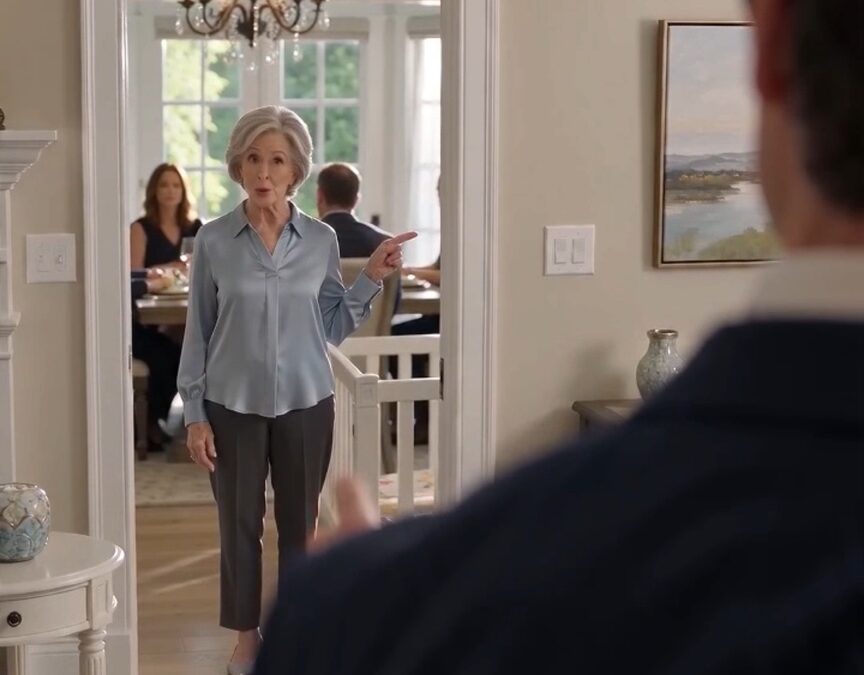
“We’re moving in, and that settles what I owe you,” my son announced before fourteen guests at my retirement lunch. At 67, widowed, I held my grandson’s empty car seat beside the nursery doorway. My remaining savings had gone into my son’s property, and now he stood in my living room wearing a new suit while his family brought in luggage.
For a moment, I kept holding the seat.
Paige had handed it to me upon entering.
Ben was against her shoulder, his cheek turned outward.
He was six weeks old.
I had hoped they were stopping to congratulate me.
Three days earlier, Russell had locked me out.
He had put bags of my clothes outside.
A locksmith had restored access that evening.
Now Alice came through pulling a rolling suitcase.
Another bag stood beside Paige’s shoes.
Russell left the front door open behind them.
My lunch had been underway before they arrived.
Someone had just asked about my final workday.
There were flowers beside the dishes on my table.
I had been retired for three days.
Now every guest was looking toward the hallway.
“Put those upstairs,” Russell told Alice.
My granddaughter looked toward the staircase.
She was 8, and the suitcase looked awkward beside her.
“Leave it there, sweetheart,” I said.
She stopped pulling.
Russell gave me an irritated little smile.
“We don’t need to discuss every bag.”
“We need to discuss why they’re here.”
“I just told you.”
He gestured toward the rooms beyond the living room.
“You’ve got all this space.”
Paige adjusted Ben against her shoulder.
She was 36, and she looked tired.
But she didn’t look surprised by Russell’s announcement.
I looked from her face to the luggage.
They had planned this before coming through my door.
Nobody had asked them to move in.
I had told Russell that explicitly.
He knew his household wasn’t invited to lunch.
He had come anyway.
“You’re retired now,” he said.
“You’ll have plenty of time with the children.”
My arm was getting sore from the car seat.
I shifted its handle into my other hand.
“This room is for visits.”
I tipped my head toward the nursery.
“That’s what we’re doing,” he said.
“We’re making family work.”
My guests were close enough to hear every word.
Some sat at the dining table.
Others stood with plates they had stopped eating from.
Russell looked around at them before continuing.
“You can babysit instead of collecting.”
Paige laughed.
It was brief, but everyone heard it.
She looked toward the nursery as though he’d suggested something convenient.
I stared at the little cloth cover on Ben’s seat.
I had washed the crib sheet myself.
I had cleared drawers for diapers and spare clothes.
I hadn’t prepared the room to pay myself back through babysitting.
“I alone own this home,” I said.
Russell’s smile tightened.
“Nobody said you didn’t.”
“You just announced that you were moving into it.”
“We’re not strangers, Mom.”
“No. You’re my son.”
“Exactly.”
“And you still owe every dollar.”
He raised his arm toward the staircase again.
For a moment, I thought he might tell Alice to continue.
I moved a little closer to her suitcase.
She took her hand off the handle.
“You haven’t done anything wrong,” I told her.
She looked up at me, then toward Paige.
My granddaughter shouldn’t have needed that reassurance.
This was supposed to be a lunch with cake.
Russell drew a breath through his nose.
“Can we not do this in front of everybody?”
“You made the announcement in front of everybody.”
“I thought you’d be happy.”
I looked at the luggage again.
He had counted on my embarrassment.
He expected me to smile, offer food, and argue later.
By later, the bags would be upstairs.
Alice would have chosen a bed.
Ben’s things would be spread across the nursery.
Then refusing would become another injury I supposedly caused.
“No bags are going upstairs,” I said.
Paige’s expression changed.
“Elaine, the children are right here.”
“Yes,” I said. “They are.”
I kept my voice low enough for Alice.
“That’s why we’re going to finish this calmly.”
Russell glanced toward the dining room.
He knew several of my guests.
They knew I had worked as a public-school secretary.
They knew I had been looking forward to retirement.
He wanted one of them to soften the situation.
Nobody told me to let him stay.
A coworker quietly offered Alice some fruit.
Paige nodded, and Alice went to the table.
I set the empty car seat just inside the nursery.
Then I pointed toward my adjoining office.
“Go speak with the people waiting in there.”
Russell looked toward the open doorway.
“Who’s waiting?”
“People who can help keep this accurate.”
He lowered his pointing arm.
For the first time, he looked past me.
From his position, he could see my desk.
He couldn’t see the chairs beside it.
“Mom, what have you done?”
“I asked for help.”
He straightened his new jacket.
“Fine. Let’s get this over with.”
He crossed the living room without looking at Paige.
I followed, leaving the nursery door open behind me.
He reached the office doorway first.
Then he stopped so suddenly that I nearly reached him.
He recognized Judith.
But it was the man beside her who made him ask, “Why is he here?”
Chapter 2: Someone He Had Already Met
Martin stood when Russell reached the doorway.
He was 58, and he looked uncomfortable.
I understood that.
He had accepted an invitation to a retirement lunch.
He had also agreed to explain a conversation.
Neither task should have required standing opposite my angry son.
“You know why,” Martin said.
Russell looked from him to Judith.
“This is a setup.”
Judith remained beside my desk.
At 61, she had handled enough family loans to recognize that accusation.
“Your mother asked us to be available,” she said.
“She didn’t ask you to arrive with luggage.”
“I’m talking to Martin.”
“Then let him answer.”
Russell’s jaw moved, but he said nothing.
Martin kept his hands at his sides.
“We’ve been discussing your duplex.”
“I’m aware.”
“You asked me not to include her mortgage.”
“Not in an early draft.”
“In our preliminary purchase agreement,” Martin said.
“That’s what I told your mother.”
Paige had come closer with Ben.
She stopped outside the office, where I could see her.
Her eyes went directly to Russell.
“What mortgage?”
Russell answered too quickly.
“The loan paperwork. You know about that.”
I sat in the chair near the door.
My knees had begun to hurt.
I wanted to stay standing beside my son.
I also wanted this conversation finished without falling apart.
Judith pulled another chair away from the desk.
“Russell, you can sit.”
“I’m fine.”
Martin sat instead.
He didn’t look pleased with himself.
That helped me trust him.
He wasn’t enjoying being the person Russell recognized.
He simply wasn’t going to change his account.
“You said your mother wasn’t expecting payment,” Martin continued.
“I said we would handle it.”
“You asked me to leave the lien out.”
Russell turned toward me.
“Did he tell you there would be title review?”
“Yes,” I said.
“Then you know nobody could hide a recorded mortgage.”
“I know a proper closing would find it.”
“Exactly.”
“That doesn’t explain what you told him.”
He looked at Judith, then away.
Judith opened the file she had brought.
She didn’t slide papers across the desk dramatically.
She checked the note, then looked up.
“Your mother’s loan is secured by a recorded mortgage.”
“I signed it. I know.”
“Then none of this should surprise you.”
His surprise wasn’t about the mortgage.
He had known about it for eighteen months.
He had signed the note and the mortgage himself.
Judith had recorded the mortgage in Hennepin County immediately after closing.
What surprised him was finding Martin in my office.
He hadn’t known Martin had searched the public record.
He hadn’t known Martin had called me afterward.
And he hadn’t expected me to ask what happened.
Russell folded his arms across his new suit.
“You’re making a draft sound like a crime.”
Martin shook his head.
“I’m describing why I didn’t sign it.”
Nobody had accused Russell of completing a secret sale.
He hadn’t.
The duplex still belonged to him.
Martin remained a prospective buyer.
But Russell had tried to make my secured loan seem unimportant.
He had wanted agreement before full discussion.
Martin had refused to proceed that way.
“I’m still interested in the property,” Martin said.
“That hasn’t changed.”
Russell looked at him more carefully.
“Then why come here?”
“Because your mother deserved an accurate answer.”
I pressed my fingers against the chair cushion.
Hearing that made my eyes sting.
I didn’t want to cry in the office.
I wanted my son to stop treating my savings as something awkward everyone should avoid mentioning.
“I lent you $94,000,” I said.
“I know the amount.”
“That was my remaining liquid savings.”
“You wanted to help.”
“I did help.”
He opened his mouth, then closed it.
“My pension covers ordinary expenses,” I continued.
“It doesn’t replace that money for emergencies.”
Paige looked down at Ben.
From the dining room came the small scrape of a chair.
The guests weren’t crowding the doorway.
They could still hear enough to understand.
Russell had offered my grandchildren’s company as repayment.
Now the amount he owed was being said aloud.
He looked embarrassed.
I wished the loan itself had embarrassed him less than collecting it.
Judith explained that my home was separate.
Russell’s mortgage gave him no interest in it.
The security ran against his duplex, not my house.
I had not transferred or pledged my home.
Russell waved a hand.
“Nobody thinks I own this house.”
“You announced that you were taking possession,” I said.
“I announced a family arrangement.”
“One I refused.”
He stared at me.
Then he turned slightly toward the dining room.
“We talked privately about other options.”
“We did.”
“Tell them you were open to something different.”
I reached for the phone on my desk.
“I’ll tell them what I actually agreed to.”
Chapter 3: What I Actually Agreed To
I found the messages without searching very far.
I had read them too often already.
Three weeks before lunch, Russell proposed a “family arrangement.”
That was his phrase.
He said combining households would solve several problems.
His family needed more space.
I would be home after retirement.
The children would keep me company.
And I could stop asking about the loan.
I had read his message at my kitchen table.
Then I had put the phone down.
I knew what I wanted to say.
I also knew how he might describe it afterward.
So I had answered in writing.
Now I read my response aloud.
“I am not agreeing to anyone moving in.”
Russell looked at the window.
“The loan still needs to be repaid.”
“That wasn’t all you said,” he interrupted.
“No,” I answered. “It wasn’t.”
I read the rest.
I had offered to discuss repayment arrangements with Judith.
I had said I wanted a workable plan.
I hadn’t demanded money appear that afternoon.
I hadn’t refused all discussion.
But I had refused occupancy and cancellation.
Judith looked at Russell.
“Do you dispute receiving that?”
“No. I dispute how she’s presenting it.”
“How should I present it?” I asked.
“As a conversation, not a legal proceeding.”
“It was a conversation where I said no.”
Paige shifted Ben to her other shoulder.
He made a soft sound against her blouse.
She rubbed his back without looking at Russell.
I set my phone down.
“Two days before lunch, I told you again.”
“I remember.”
“I specifically said not to bring moving bags.”
His eyes moved toward the hallway.
The luggage remained where they had left it.
Nothing about it looked accidental.
He couldn’t pretend he had misunderstood a dinner invitation.
He hadn’t received one.
He had arrived with his entire household anyway.
Judith let that point settle before continuing.
“The payment became due six weeks before today.”
Russell breathed out impatiently.
“I’ve been trying to arrange a sale.”
“Then a lawful sale may resolve it.”
“That’s what I’ve been saying.”
Martin leaned forward in his chair.
“You told me the mortgage wouldn’t be an issue.”
“It wouldn’t, if everybody acted reasonably.”
I looked directly at my son.
“Reasonably means I don’t get repaid?”
“It means flexibility.”
“I lent you the money interest-free.”
He looked down.
I hadn’t wanted interest from my son.
I had wanted his renovations completed and my principal returned.
The balloon note had given him time.
That time had ended before my retirement.
Nobody had changed the due date.
Judith explained the default notice.
It had gone out ten days before lunch.
She had used certified mail and ordinary mail.
Those were the delivery methods in our agreement.
Russell had received it.
He didn’t deny that either.
“The contract gives thirty days to cure,” she said.
“That period hasn’t expired.”
“So you can’t do anything today,” Russell replied.
Judith answered without matching his tone.
“No foreclosure is happening at this lunch.”
He almost smiled.
Then she continued.
“Your mother is following the required notice process.”
She explained that further enforcement would require lawful steps.
There was no court order waiting in my drawer.
There would be no instant transfer of his duplex.
She was not threatening to send someone over that afternoon.
I was relieved she said it plainly.
I wanted Russell to understand the truth.
Not a version designed to scare him.
Martin wanted the same thing.
“I would still consider buying,” he said.
“Through ordinary title review and closing.”
Russell looked toward him.
“With the mortgage dealt with.”
“With the secured debt paid,” Judith clarified.
“There’s a difference.”
Martin nodded.
Any legitimate closing would need to address my lien.
That did not prevent a sale.
It meant the proceeds would first satisfy the secured debt according to the closing arrangements.
Russell couldn’t promise the buyer a clear title by declaring that his mother wouldn’t mind.
He had to actually resolve it.
For a moment, nobody spoke.
I heard Alice ask about a piece of fruit.
A guest answered her gently.
I was glad she had something ordinary to do.
Russell looked toward the dining room, then back at me.
“You’ve told everybody our business.”
“You announced a debt cancellation in my living room.”
“I was trying to help you.”
“I didn’t ask for that arrangement.”
He pulled at his jacket sleeve.
“You make it sound like we’re using you.”
I looked toward Ben, then back at his father.
“I’m not accepting childcare as repayment.”
Paige’s face reddened.
Russell stepped away from the desk.
“If you push this, I can refuse to sell.”
Judith closed the file.
“That is your decision.”
He seemed to expect me to contradict her.
To beg him to keep Martin interested.
To offer a concession before he walked away.
I felt sick.
I knew collection could become expensive and slow.
But agreeing now would leave me without my savings and without control of my home.
“I’m not canceling the debt,” I said.
He looked toward the nursery.
“Then where are we supposed to go?”
Chapter 4: The Room I Had Prepared
Their rented home was still available.
Russell knew that when he asked the question.
They had not lost their place to live.
They had not reached the end of their lease.
Nothing required them to sleep under my roof.
“You can go home,” I told him.
He glanced toward Paige, but she didn’t contradict me.
I looked past them toward the nursery.
The crib sheet was fitted neatly around the mattress.
Alice and I had worked on it the evening before.
That visit had been arranged.
Paige brought the children, and they went home afterward.
There had been no luggage.
I had been sorting the nursery when Alice joined me.
She noticed the sheet bunched near one corner.
“Does that go like that?”
“No,” I told her.
“I need to fix the elastic.”
I brought my sewing basket beside the crib.
Then I knelt down to inspect the loose section.
Alice crouched beside me, holding the fabric.
She wanted to help without being told every step.
I understood that feeling.
At school, I had spent years making myself useful.
Papers needed sorting.
A telephone needed answering.
Someone always needed a form or an explanation.
Retirement had left me with fewer small tasks.
Preparing a room for Ben was something I enjoyed.
It wasn’t something I regretted.
I showed Alice the loose stitching.
She held the edge while I repaired it.
Then we fitted the sheet over the mattress together.
She tried to leave one corner folded underneath.
I helped her pull it snug.
“Ben needs a smooth sleeping surface,” I explained.
“No loose fabric around him.”
She ran her palm across the middle.
“Like this?”
“Exactly like that.”
She looked pleased with herself.
I checked the corners again before standing.
My knees complained, and Alice reached for my elbow.
I laughed and thanked her.
It had been an ordinary, sweet visit.
I had thought about it after they left.
I hadn’t imagined the finished room would become Russell’s argument.
The nursery had held stored things before Ben’s birth.
Some were mine from school.
Some had belonged to my husband.
He had died two years before the lunch.
Moving his belongings had taken longer than I expected.
I could open a box with no trouble.
Deciding where its contents should go was harder.
I kept what I wanted.
I moved what I wasn’t ready to sort.
Eventually, there was room for a crib and chair.
That room did not mean my house needed occupants.
I had bought the house myself before marrying.
I owned it alone, free of a mortgage.
It had remained mine after my husband died.
Russell understood the ownership perfectly well.
What he didn’t understand was why I might want space I wasn’t filling with his family.
The loan had been different.
Eighteen months before lunch, he brought me his renovation plans.
His separately owned duplex needed work.
He believed the improvements would help its value.
He said he could repay me when the work was finished and the property was ready.
I wanted to help him succeed.
I also knew what I was risking.
My pension would cover groceries, utilities, and ordinary bills.
It wouldn’t make a large repair painless.
Judith advised a signed note and recorded mortgage.
Russell agreed.
There had been no secret condition.
He knew the loan wasn’t a gift.
He knew the principal had to come back.
But when repayment came due, he asked for patience.
Then he started talking about my spare rooms.
I began keeping the conversations in writing.
After Martin called, I took the loan folder to Judith.
That call had come twelve days before lunch.
Martin had searched the public property records.
He found my recorded mortgage against the duplex.
Then he called to check Russell’s description.
I was standing beside my kitchen counter.
Clean dishes were drying on a towel.
While he spoke, I kept straightening its folded edge.
I asked whether Russell had said I forgave the debt.
Martin described the request to omit the mortgage.
Then he agreed to tell Judith himself.
We did not plan to interfere with a sale.
We planned to make sure a sale paid what it should.
Ten days before lunch, Judith sent the required notice.
Then came my final workday, three days before lunch.
I came home carrying flowers from the school office.
Bags of my clothes stood on the porch.
My key would not open the front door.
The lock hardware was different.
I tried the key again before checking my phone.
Russell had sent a message while I was driving.
“Stay somewhere else until you accept the arrangement.”
I called him.
He answered as though I had interrupted something ordinary.
“How did you get inside?”
“The delivery code still worked.”
I had given him that temporary code for the crib delivery.
I had not given him permission to return whenever he wanted.
He had entered my empty house, packed my clothes, and replaced the lock.
“Come back and open my door,” I said.
“We need to settle this first.”
I ended the call.
I was terrified.
I photographed the bags without moving them.
Then I saved his messages and called police.
I reported the unauthorized entry and lockout.
I explained that Russell did not live there.
His household had never moved in.
Nobody was inside.
The report did not give me a court order.
It documented what I said had happened.
A locksmith checked my identification and ownership records.
After confirming the house was empty, he restored access that evening.
He also disabled the temporary code.
Inside, my bedroom drawers stood open.
Some clothes had been pushed into bags inside out.
I put my work flowers in the kitchen sink.
Then I called a coworker.
I stayed with her that night.
The lock had been fixed, but I couldn’t sleep there alone.
Two days before lunch, I repeated my refusal.
I also prohibited further unarranged entry.
Judith told me to preserve everything about the lockout.
By then, I suspected Russell might appear anyway.
Judith was already invited to celebrate my retirement.
I invited Martin too.
I told them I wanted accurate answers if Russell came.
They agreed to wait in the adjoining office if needed.
Neither would pretend to have authority they lacked.
Neither would threaten an instant foreclosure.
I wanted help, not theater.
Now Russell stood beside that same office.
The nursery sheet was still smooth.
The bags were still by my door.
He looked toward the staircase once more.
“Can we at least put those upstairs while we finish talking?”
Chapter 5: Nothing Goes Upstairs
“No,” I said.
Russell looked at me as though I was being petty.
“They’re blocking the hallway.”
“Then take them back to the car.”
Paige adjusted Ben’s blanket.
He had begun making unhappy little sounds.
The adults had been talking too long.
I stepped away from the office doorway.
“Paige, you can use the nursery chair.”
She looked uncertain.
“To settle him,” I added.
“For this visit.”
“I understand.”
She went into the nursery with Ben.
I left the door mostly closed for her privacy.
Russell watched as though the room might still help him.
It wouldn’t.
I could offer a chair without offering residence.
I could love Ben without accepting his father’s terms.
Alice was at the table with her plate.
She looked toward the nursery, then at me.
“Your mom is taking care of him,” I said.
She nodded.
I didn’t explain the mortgage to her.
She didn’t need a list of her father’s mistakes.
She needed the adults to stop making her worry.
Russell waited until I turned back.
“You’re making this humiliating.”
“I asked you not to bring bags.”
“You could have handled this privately.”
“I tried.”
He looked away.
Judith came to the office doorway.
Martin stayed seated inside.
There was no need for everyone to surround Russell.
“Your mother has not authorized occupancy,” Judith said.
He rubbed his forehead.
“We’re family. It’s not occupancy.”
“What would you call moving in?”
He didn’t answer.
They had never lived in my home.
They had never paid rent there.
They had no permanent keys.
The temporary delivery code no longer worked.
They had no agreement giving them rooms.
They had not received permission to move in.
I would not have tried to remove established residents by simply declaring ownership.
That was not what was happening.
These were visitors I had not invited.
Now I was asking them to leave.
Russell seemed to understand that distinction.
He stopped discussing his right to stay.
Instead, he looked toward the lunch table.
“Everybody’s going to remember this.”
I followed his glance.
The flowers still stood beside the serving dishes.
The cake hadn’t been cut.
My coworkers had come to celebrate my retirement.
“Yes,” I said. “I imagine they will.”
He waited.
I didn’t offer to improve their memory by surrendering.
Judith asked whether he had independent legal advice.
He said he would get it.
She encouraged him to do that.
She also reminded him she represented me alone.
I was glad she made it clear.
I didn’t want him taking instructions from her as though she worked for both of us.
He needed his own advice.
I needed mine.
Paige came out with Ben calmer against her shoulder.
“We should take the children home,” she said.
Russell looked irritated.
“We’re still talking.”
“Then finish without them waiting here.”
She called Alice over.
My granddaughter left her plate neatly beside the others.
She reached for the suitcase handle.
“Let your dad carry that,” I said.
Russell gave me a look.
Then he picked it up.
Paige asked for Ben’s car seat.
I brought it from beside the nursery doorway.
I set it on the entry rug.
She settled Ben and checked his straps.
I watched the familiar movements.
There was no reason to rush her.
The baby still needed to travel safely.
Russell carried one bag outside.
Then he returned for the other.
No one followed him to argue.
No one blocked the doorway.
They were leaving voluntarily.
When he lifted the last bag, he stopped.
“Are you really choosing this?”
I looked at him.
“I’m asking you to repay your loan.”
“You know what I mean.”
“I know what you asked me to accept.”
He stared at the floor.
Then he took the bag outside.
Alice hugged me before leaving.
I bent and kissed her head.
“We can arrange another visit.”
She looked up.
“Can Ben come too?”
“Of course.”
She seemed relieved.
Paige lifted the car seat.
“I’ll call,” she said.
I nodded.
After the front door closed, I checked the nursery.
Nothing had been unpacked.
No clothes lay in the drawers.
No suitcase stood beside the crib.
I sat in the chair and rested my hands.
I was tired enough to stay there.
But I had guests waiting.
When I returned, someone asked whether I wanted my plate.
“Yes,” I said. “I haven’t eaten.”
I explained only what needed correcting.
The money was a loan.
I had not agreed to exchange it for babysitting.
Nobody was moving into my home.
I also told them about the earlier lockout.
My coworker had already heard that part.
She had given me somewhere to sleep.
Russell’s arrival had not been an innocent misunderstanding.
Judith confirmed the legal arrangement without discussing private details.
Martin said a proper sale was still possible.
Then a guest passed me the salad.
We cut the cake.
The lunch wasn’t what I had imagined.
It was still my lunch.
After everyone left, I checked my phone.
Russell had sent another proposal.
He wanted to know whether I would accept less.
Chapter 6: The Answer I Sent Back
I read Russell’s message beside the kitchen sink.
The lunch dishes were stacked on a towel.
There was cake wrapped in my refrigerator.
His message made the whole gathering feel unfinished again.
He said he wanted to put the dispute behind us.
He said a smaller payment would let everyone move forward.
He didn’t mention arriving with luggage.
He didn’t mention the bags Alice had carried.
I started typing an answer.
Then I erased it.
I knew what would happen if I called.
He would explain his expenses.
I would explain mine.
He would say I was treating him like a stranger.
I would spend the evening proving that I loved him.
None of that would resolve the loan.
So I finished the kitchen first.
I put away the serving dishes.
I wiped crumbs from the table.
I checked that the nursery window was latched.
Then I forwarded his message to Judith.
She called after reading it.
“What do you want to accept?”
“The principal.”
“Do you want to consider a reduced settlement?”
“No.”
She didn’t tell me I was wrong.
She asked whether I understood that collection could involve cost and delay.
I said I did.
She explained that a settlement was an option.
So was enforcing the agreement through proper steps.
Neither choice guaranteed a pleasant relationship with Russell.
I looked at the empty place where his suitcase had stood.
“I’m not paying to make this seem all right.”
“We can keep the answer about the loan.”
“That’s what I want.”
I wasn’t adding a charge for his behavior.
The note had been interest-free.
I wasn’t inventing interest because he embarrassed me.
I wasn’t asking Paige to pay for laughing.
I wanted the $94,000 principal returned.
Judith prepared the response.
I reviewed it before she sent it.
It declined the reduction.
It left room for a documented sale and repayment plan.
It did not discuss who loved whom more.
That was a relief.
Russell answered by describing the money differently.
He said family help was rarely so exact.
He said he had understood that circumstances could change.
Judith directed him back to the signed note.
The circumstances could change.
The debt did not become a gift on that basis.
I read the exchange without answering separately.
That was harder than I expected.
I wanted to correct every unfair sentence.
I wanted him to acknowledge what I had actually done.
But a long message from me would give him another conversation to bend.
So I let the documents answer the financial questions.
When he asked again about living together, I answered that part myself.
“No occupancy arrangement is being considered.”
He wrote that he hadn’t meant immediately.
“My answer is the same.”
He suggested that shared living expenses could count against the balance.
I forwarded that to Judith too.
There would be no exchange of debt for housing.
There would be no automatic childcare credit.
I had not asked for those services.
He could not decide their value for me.
After that, he sought his own legal advice.
I was glad when Judith told me.
For once, I would not be the person explaining every consequence.
His adviser could review the note.
His adviser could explain the mortgage.
His adviser could tell him what a legitimate sale required.
Martin continued discussing the duplex with Russell.
He did not call me to bargain over price.
He did not ask for a benefit because he had spoken up.
When he contacted Judith, it concerned the mortgage.
When he contacted Russell, it concerned the sale.
That separation mattered.
I didn’t want another informal arrangement built around gratitude.
I wanted a normal transaction.
At home, I began putting retirement things in order.
I emptied my work bag.
There were pens, paper clips, and a folded sweater.
I found the small notebook I had used for office reminders.
Its pages still held tasks somebody else now handled.
I put it in a drawer rather than throwing it away.
I wasn’t ready for every change at once.
Some mornings, I missed having somewhere to report.
Other mornings, I ate breakfast slowly and enjoyed it.
I did not need Russell to solve that adjustment.
Paige sent me a picture Alice had drawn.
I thanked her and asked her to tell Alice.
I didn’t attach a message about her father.
The children were not part of collection.
They were not a reason to forgive the loan either.
I could keep those matters separate.
Then Judith called with news from the sale discussions.
Martin remained interested.
A legitimate agreement was becoming possible.
But it would not be completed before the cure period ended.
Russell wanted more time.
Chapter 7: A Little More Time
I asked Judith what she recommended.
She didn’t answer immediately.
First, she explained where the transaction stood.
Martin had not withdrawn.
Russell had begun cooperating with the ordinary purchase process.
The property would go through inspection and title review.
A licensed title company would handle closing.
My mortgage remained recorded against the duplex.
Nothing had been released.
Nothing had been forgiven.
Then Judith explained the timing.
The contractual cure period was expiring.
The principal remained unpaid.
If I chose to pursue foreclosure afterward, that would require the proper legal process.
It would not produce immediate money.
It would also involve expense.
A real sale might repay me more directly.
I listened with a pad beside the phone.
I wrote down questions rather than interrupting.
“Does giving him time cancel the default?”
“Not if the agreement preserves your rights.”
“Does it release the mortgage?”
“No.”
“Does he get to keep extending it?”
“Not without your agreement.”
Those answers mattered more than reassurance.
Russell had already treated patience as permission.
I did not want a new version of that.
Judith proposed a narrow written collection extension.
It would be time-limited.
It would be tied to the pending sale.
It would not waive the debt.
It would not release my lien.
It would not require me to negotiate occupancy again.
His own legal adviser could review it.
I asked her to prepare it.
When the cure period expired, I granted only that extension.
I didn’t call Russell to make him feel better.
I didn’t add a private promise that the written terms didn’t contain.
I signed after Judith explained the effect.
He signed after getting independent advice.
Then we waited for the sale process.
Waiting was easier with something specific underway.
There were documents to review.
There was title work to complete.
There were ordinary seller obligations Russell needed to meet.
Judith kept me informed about what concerned my mortgage.
She did not send every disagreement about the property.
I appreciated that.
I didn’t need to become a second seller.
I wanted to remain the lender being repaid.
The title review found the mortgage exactly where it belonged.
It had been recorded in Hennepin County after the original loan closing.
There were no other mortgages ahead of mine.
Russell’s duplex was separately owned.
My Minneapolis home was not part of the sale.
Sometimes I repeated that last fact to myself.
Not because I doubted it.
Because Russell had spoken so confidently in my living room.
He had made a proposal sound settled.
I still checked the front lock before bed.
The paperwork made the distinction plain.
He owned his property.
I owned mine.
He could sell his duplex.
He could not offer my rooms in place of paying me.
Martin accepted the ordinary title requirements.
He needed clear title at closing.
My mortgage would be addressed through payment.
He did not expect me to remove it as a favor.
That should have been unremarkable.
After everything, it felt welcome.
Russell became more practical in his messages.
He asked whether Judith had received information.
He asked whether the title company had the payoff details.
I sent those questions through her.
I answered ordinary family messages myself.
I was not refusing to speak to him.
I was refusing to conduct loan negotiations through scattered calls.
Paige asked whether Alice could call me.
I said yes.
My granddaughter told me about her drawing.
She asked whether the nursery sheet was still fixed.
“It’s still snug,” I told her.
She sounded pleased.
I didn’t ask what her parents had said.
I didn’t question her about their home.
I wanted her call to remain hers.
Afterward, I went into the nursery.
I checked the sheet out of habit.
Then I left the room and worked on my sewing.
I could prepare for visits without preparing for occupancy.
The difference was no longer something I needed Russell to approve.
As closing preparation continued, another request arrived.
Russell wanted the mortgage satisfaction released early.
He said doing so would simplify the transaction.
I read the message carefully.
Then I called Judith.
“Do they need me to give up the lien first?”
“No.”
“Then why is he asking?”
“I can’t answer for him.”
She explained that documents could be prepared and held under proper instructions.
That was different from releasing the mortgage before repayment.
The title company could coordinate payment and release.
I did not need to trust another private promise.
“Tell them I’ll follow the ordinary closing procedure,” I said.
“Nothing early.”
Judith agreed.
But the request left me staring at the loan folder again.
The sale was close enough to plan around.
My savings still weren’t in my account.
Chapter 8: Until the Money Arrived
I brought the loan folder to Judith.
I wanted her explanation face-to-face.
She cleared space on her desk.
Then she walked me through the closing arrangements.
A satisfaction could be prepared in advance.
It could be held for release under proper instructions.
That would allow the title company to clear the mortgage when the debt was paid.
It would not require me to surrender security beforehand.
“So signing isn’t always the same as releasing?”
“Correct.”
“And you’ll check the instructions?”
“Yes.”
I asked questions until I understood.
I wasn’t embarrassed about that anymore.
I had worked in a school office for years.
People asked me to explain forms every day.
Now I needed somebody to explain mine.
Judith did it without making me feel foolish.
She reviewed the payoff amount.
The full principal remained outstanding.
There had been no principal payments.
There was no interest to calculate under our agreement.
The amount due was $94,000.
The title company received the information through the proper channels.
Russell’s adviser reviewed the closing requirements for him.
Martin continued with his purchase.
I did not need to negotiate directly with either man.
My role was to receive payment and release the mortgage afterward.
Keeping it that simple helped.
There were ordinary corrections before closing.
A document needed to match the property information.
The buyer needed confirmation the lien would be satisfied.
The seller needed the transaction completed.
Those questions went where they belonged.
They did not come with luggage.
They did not require me to babysit.
I had begun to notice how strange Russell’s original proposal really was.
A normal real estate transaction had a way to pay secured debt.
He had offered my own house instead.
I didn’t call him to point that out.
We were finally proceeding correctly.
I wanted to keep it that way.
At home, I took out the repair notes I had postponed.
I checked what needed attention first.
I didn’t authorize spending before the payment arrived.
But I could begin making decisions.
That felt different from waiting for Russell to answer another message.
I also opened my household records.
I checked my insurance information and emergency contacts.
My husband’s handwriting was still on an old envelope.
I kept it.
Then I put the current papers in order.
Some parts of retirement were exactly that ordinary.
A drawer.
A phone call.
A task finished without having to leave for work.
I missed my husband while doing them.
I was relieved to have time.
Both things could be true in the same afternoon.
Russell sent a brief message as closing approached.
He asked whether I had approved the final arrangements.
I told him Judith had reviewed what concerned me.
He answered with a simple acknowledgment.
No appeal to family.
No suggestion that I take less.
No claim on my nursery.
I didn’t know whether he had changed his mind about fairness.
I knew he had stopped arguing with the procedure.
For now, that was enough to complete the transaction.
Eight weeks after the lunch, the duplex sale closed.
The licensed title company handled the funds.
My secured debt was paid from the seller’s proceeds.
Judith told me when to expect confirmation.
I waited until the transfer cleared.
Then I opened my bank account.
The full $94,000 was there.
I read the balance more than once.
I checked the transaction information.
Then I set my phone on the kitchen table.
For a while, I just sat.
I had imagined a dramatic feeling.
Instead, I wanted to make sure I hadn’t missed something.
I called Judith.
She confirmed receipt and the next step.
After payment, the satisfaction was released for recording.
My mortgage would no longer remain against Martin’s property.
That was how the process was supposed to end.
Debt paid.
Security released afterward.
No favors left hanging.
I thanked her, then made tea.
While the water heated, I started crying.
I was relieved.
I hadn’t realized how often I had been calculating emergencies.
A repair.
A medical expense.
Anything that would force me to ask Russell again.
Now I could stop doing that calculation.
Russell sent a message confirming the loan was paid.
I answered that the money had arrived.
He said he was glad it was finished.
I waited for another sentence.
There wasn’t one.
I put the phone down.
I didn’t want to turn repayment into another argument.
Later, Martin called to confirm everything had cleared.
I thanked him for speaking honestly.
He thanked me for answering his original call.
We did not discuss what kind of son Russell was.
The transaction was complete.
That evening, Paige called.
“Could we arrange a visit?”
Chapter 9: The Visit We Discussed
I didn’t answer immediately.
Paige must have noticed.
“Just a visit,” she added.
“I understand.”
“I don’t want you thinking we’re trying again.”
I looked toward my front hallway.
There was no suitcase beside the wall.
The absence still gave me relief.
“What did you have in mind?”
“Bringing the children over.”
“And Russell?”
“He would come too.”
“Then he should call me.”
She went quiet.
I wasn’t asking her to persuade him.
I didn’t want her promising cooperation on his behalf.
He had announced the move.
He could arrange the visit.
“All right,” she said.
Before we hung up, I asked about Alice and Ben.
She answered without turning the conversation toward childcare.
I was glad to hear about them.
I had missed ordinary family news.
But missing them did not mean I regretted refusing occupancy.
I could want a visit and still want my own home.
Russell called afterward.
His voice was careful.
“Paige said you wanted me to call.”
“Yes.”
“We’d like to bring the children.”
“I’d like to see them.”
He waited for me to offer an open invitation.
I gave him a time that suited me.
He asked whether it would work for everyone.
I said he could check and call back.
I did not rearrange my plans before he asked.
He accepted the arrangement.
No bargaining.
No comment about how much free time I had.
That was different enough to notice.
I told him it would be a short afternoon visit.
He said he understood.
I hoped he did.
Before they came, I continued with my ordinary routines.
I bought groceries for myself.
I worked on the sewing I had left unfinished.
I considered the repairs my restored savings could support.
I no longer felt compelled to keep every room ready for Russell’s convenience.
The house had been mine before the argument.
I was beginning to use it without anticipating another demand.
I put linens where I wanted them.
I left a project on my dining table.
I sat in the bright chair near the window and read.
Sometimes I still reached for the telephone to tell my husband something.
Then I remembered.
That grief had not disappeared because the loan was paid.
Neither had the pleasure of having my own afternoon.
I was learning what I wanted to do.
I did want to see my grandchildren.
I did not want every available hour assigned to babysitting.
I wrote the visit in my household notebook.
Seeing it there helped.
It had a beginning.
It had an end.
It was something I had agreed to do.
Paige sent a message confirming the arrangement.
She asked whether they should bring what Ben needed.
“Yes,” I answered.
There were supplies in the nursery.
They still needed to arrive prepared to parent their child.
I had spent years making things easier without thinking.
Now I noticed when help became expectation.
I didn’t intend to stop being generous.
I intended to choose what I offered.
On the arranged afternoon, I checked the crib.
The sheet remained snug.
I straightened the chair cushion.
Then I left the room alone.
I didn’t prepare every corner of the house.
Nobody was moving in.
I made room on the kitchen wall for Alice’s drawing.
Paige had said she wanted to bring it herself.
That was the kind of preparation I enjoyed.
When the knock came, I was ready.
Russell stood beside Paige and the children.
He waited for me to open the door.
He no longer had an entry code.
He did not push past me.
He did not announce what would happen next.
Paige held Ben’s car seat.
Alice held her drawing flat against her chest.
There were no suitcases.
I noticed that first.
Then Alice stepped forward and hugged me.
I held her close.
“I brought it,” she said.
“I saved a place.”
We went to the kitchen together.
She showed me which part belonged at the top.
I let her help position it.
Behind us, Russell set the baby bag beside Paige.
Not upstairs.
Not in a bedroom.
Beside her.
They were small things.
I wasn’t going to pretend they were an apology.
But they made the visit possible.
Alice wanted to inspect the nursery.
Paige went with her to settle Ben.
Russell remained in the living room.
I offered coffee.
He accepted.
When I returned with the cups, Paige had joined him.
She looked at Russell, then at me.
“Before we do anything else, I need to apologize for laughing.”
Chapter 10: What We Carried Outside
I sat down across from Paige.
Russell kept his eyes on his cup.
She folded her hands together.
“I heard what he said about babysitting.”
She paused, then continued.
“And I laughed like that was fair.”
“Yes,” I said.
“It wasn’t fair. I’m sorry.”
I waited because I needed to hear whether she meant it.
She didn’t say I had misunderstood her.
She didn’t blame being tired.
She didn’t tell me the laugh meant nothing.
“You had made that room for Ben,” she said.
“You were helping us.”
“I wanted him to have somewhere safe during visits.”
“I know.”
“And then you laughed when Russell offered my help as repayment.”
Her eyes filled, but she kept looking at me.
“I’m sorry for that.”
“I was hurt,” I told her.
It was plain enough.
I didn’t need to make it sound smaller.
She nodded.
I accepted the apology.
I didn’t tell her I had forgotten.
I hadn’t.
But I was willing to have the afternoon we arranged.
Russell rubbed his thumb along his cup handle.
“The debt is paid,” he said.
“Yes.”
“I made sure the sale went through.”
“The sale paid the money you owed.”
He looked at me then.
“I understand.”
I waited.
I wanted him to say he was sorry.
Not just sorry about the trouble.
Sorry about arriving with bags after I refused.
Sorry about locking me out of my own home.
Sorry about putting Alice in the middle.
Sorry about telling a buyer not to worry about my mortgage.
He did not say those things.
I was disappointed.
I wasn’t surprised enough to argue.
I had spent too much time supplying better words for him.
This time, I let his own words stand.
Then I explained the arrangements going forward.
Visits needed to be agreed upon.
Childcare needed to be requested.
I would sometimes say yes.
Sometimes I would already have plans.
Overnight stays would require a separate invitation.
Nobody would arrive assuming a room was available.
Russell looked toward the nursery.
“All right.”
“I mean it,” I said.
“I know.”
I would judge that by what happened afterward.
There was no need to announce it.
Alice came back carrying a book.
She stopped beside my chair.
“Can we read this?”
“Yes.”
I moved to the sofa, and she sat against me.
She pointed to a picture before I began.
I listened to her explanation.
Then I read.
For a while, the visit was ordinary.
Paige checked Ben.
Russell carried the cups to the kitchen.
Alice turned pages before I was ready.
I asked her to wait, and she grinned.
I had missed that.
I had not needed to surrender my house to have it.
When Ben woke, Paige brought him out.
She asked whether I wanted to hold him.
I put the book aside.
“Yes, I do.”
She settled him carefully in my arms.
His eyes moved toward the light from the window.
Alice stood beside us, telling him about the book.
Russell sat across from me.
Nobody mentioned the duplex.
There was nothing left to negotiate about it.
The principal had been repaid in full.
The mortgage had been satisfied afterward.
My savings were back where I could use them.
I could consider repairs without asking my son when he intended to pay.
I could handle an emergency without first pleading with him.
Those practical facts mattered.
I didn’t need him to praise my decision.
After holding Ben for a while, I grew tired.
I handed him back to Paige.
She took him without asking me to continue.
Then she began gathering their things.
The afternoon was ending when we had agreed.
Russell picked up the baby bag.
Alice took one last look at her drawing.
“Can I leave it there?”
“Of course.”
“Even when I’m not visiting?”
“It belongs right there.”
She smiled and hugged me.
At the door, she asked about coming again.
“We’ll arrange it with your parents.”
Russell said they would call.
I nodded.
That was how it would work.
There would be no luggage waiting in my hallway.
There would be no automatic claim on my mornings.
If I watched the children, it would be because I had agreed.
If they visited, I would welcome them as guests.
Paige carried Ben toward the car.
Russell followed with the baby bag.
The empty infant car seat stood beside the nursery doorway.
I picked it up by its handle.
It was the same seat I had held during my retirement lunch.
This time, nobody was telling me what I owed them.
I stepped outside carrying it because I had offered.








