My Stepmother Accused Me Of Stealing At Christmas With My Newborn In My Arms — Then She Texted
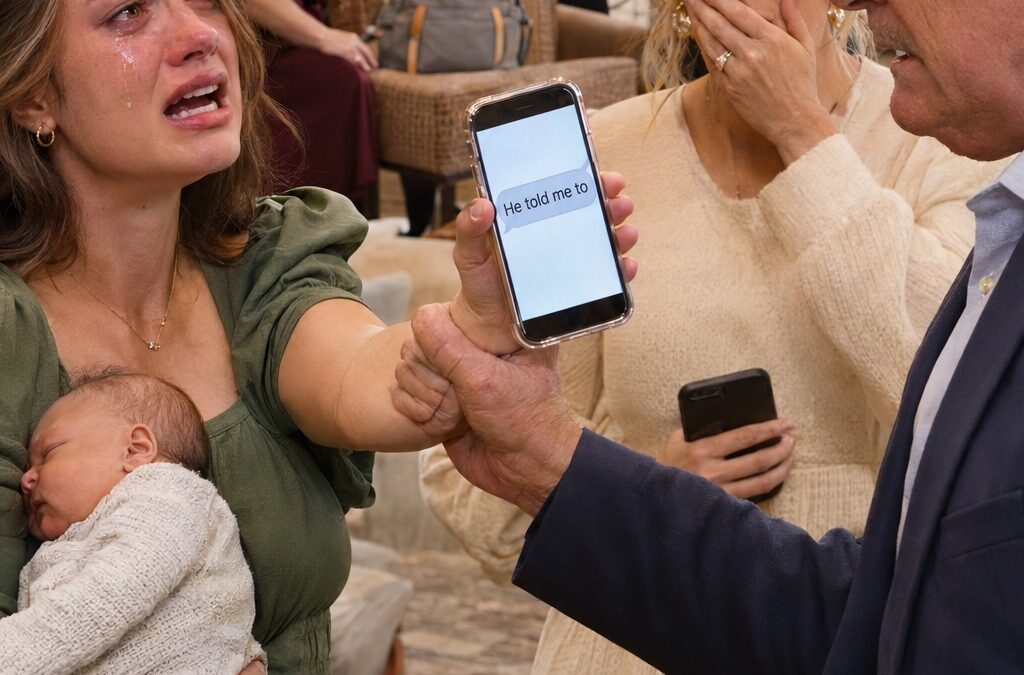
Part 3: The Message Below His Name
I opened Brianna’s next message with my thumb.
“I took the sapphire bracelet and pearl earrings from your suitcase. They’re in my room.”
I read it again, keeping the screen close.
Nora’s foot pushed against the inside of her blanket.
“Those are my mother’s,” I said.
“I know that now.”
Dad stepped between Brianna’s chair and mine.
“Don’t start making statements when you’re confused.”
She leaned sideways so she could see me.
“I’m not confused about what I picked up.”
The manager asked us to lower our voices.
Celia pointed toward the quieter end of the lounge. We moved there without going upstairs or leaving the public area. Paige carried my diaper bag, after asking my permission.
I kept Nora and my phone.
Brianna sat across from me, twisting her wedding ring.
The first message still said, “He told me to.”
Now I understood what she had meant.
“Did he tell you to call me a thief?”
She nodded, then looked toward the manager.
“I said the estate wasn’t settled because he said that. He told me she wouldn’t let anybody check.”
Dad pulled a chair away from the table.
“You’re leaving out the conversation.”
“Then explain it,” Celia said.
He sat without answering her.
Brianna spoke toward me rather than toward him.
“He said you took things before the inventory. He said making you show the bag would settle it.”
“And you went into my suitcase?”
“Yes.”
“Not to get Nora’s cardigan.”
“I got that, too.”
I looked down at the cardigan folded beside me.
She had carried it downstairs with the sleeves tucked together. I had thought she was trying to help.
The manager asked whether anything dangerous was upstairs. I said no, but personal property had been removed without permission.
He explained that he couldn’t decide an ownership dispute. He could help secure my room and preserve relevant recordings.
“If you want police assistance, we can call,” he added.
“I want the recording preserved first,” I said.
Celia asked him to note the corridor and our rooms.
He wrote down the information without reading my messages. Then he went to speak with the front desk.
Dad watched him leave.
“This is getting ridiculous.”
Celia turned her phone back toward him.
“Elaine’s will specifically left the jewelry to Allison.”
“I know what the will said.”
“The delivery happened June 18, 2025.”
He rubbed a finger along his collar.
“You were there, Grant.”
Dad looked at her, then at Paige.
Celia didn’t raise her voice.
“You helped carry the empty cabinet afterward. You watched me give Allison the pouch.”
Paige looked at him.
“So you knew?”
“I knew she had possession.”
Celia enlarged the image of the filed receipt.
“Possession after a completed estate distribution. Not borrowing.”
I could see Mom’s name above the description.
The document wasn’t new to Dad in substance. The fact that Celia could produce it there, before he could change the conversation, was new.
His chair creaked as he leaned back.
Brianna stopped turning her ring.
“You said Celia hadn’t finished.”
“There are other estate matters.”
“That doesn’t make this property yours,” Celia said.
She explained that estate administration could continue after a specific distribution. The jewelry had been delivered under Mom’s will, with the delivery recorded in the estate file.
Dad pointed toward my phone.
“She shouldn’t be sending accusations while we’re upset.”
I saved screenshots without replying.
Then I backed up the conversation and kept the original messages.
“What are you doing?” he asked.
“Keeping what was sent to me.”
Brianna didn’t ask me to delete anything.
She stared at the table’s wood grain.
The manager returned with a front-desk employee. They could replace my room key and deactivate the previous access credential.
I had given Brianna my actual key, not a spare.
She had returned it with the cardigan.
Until that afternoon, I would have thought changing it was unnecessary.
“Please replace it,” I said.
Dad pushed his chair backward.
“You think I’m going into your room?”
“I’m changing access to my room.”
I didn’t answer the question he wanted to argue about.
Paige offered to hold Nora while I went upstairs.
I looked at her hands, then at Celia.
“Will you come with me?”
Celia nodded immediately.
The manager accompanied us while Paige stayed in the lounge. Brianna remained seated, and Dad stood beside her chair.
Upstairs, the corridor camera faced the stretch outside my door.
It couldn’t see inside the room.
The manager made that clear before unlocking anything.
Inside, my suitcase sat where I had left it.
The zipper on the jewelry pouch was partly open.
I put Nora in her travel bassinet and washed my hands. Then I laid the remaining pieces on a clean towel.
Celia watched while I photographed them.
The spaces where the bracelet and earrings belonged were obvious.
There wasn’t damage to the pouch.
There didn’t have to be.
I had let Brianna into the room myself.
I counted the remaining pieces against the saved inventory. Then I photographed the pouch and closed it.
The manager stayed by the open doorway.
He didn’t handle the jewelry or offer legal conclusions.
He said the relevant corridor recording would be preserved under the resort’s procedure. Any further release would need appropriate authorization or legal process.
That was enough for the moment.
I put the jewelry in my locked luggage.
Celia sat beside Nora while I fed her.
From the lounge, my phone kept lighting up.
Dad wanted to know whether we were coming down.
He wanted to know why I was involving employees.
He wanted me to tell Brianna to stop talking.
I didn’t answer him.
When we returned, Brianna was standing beside the window.
“I should tell you the rest,” she said.
Dad said her name so sharply that Nora startled.
Brianna looked at the blanket in my arms.
“He already knew where he wanted to take it.”
Part 4: What He Called A Loan
“Take what?” I asked.
“The jewelry. He wanted to sell it.”
Dad pulled his phone from his pocket.
“I asked about an appraisal.”
Brianna shook her head.
“You asked what it could bring.”
Celia moved a chair so I could sit.
My dress had a damp patch beneath Nora’s cheek. I tucked a cloth between us and waited for Brianna to finish.
She said her credit-card debt was $18,000.
Dad had told her Mom’s collection was worth $22,000.
He had suggested that the collection could cover most of the debt, depending on what a buyer offered.
The difference between an appraisal and a sale price had apparently mattered to him.
My permission hadn’t.
“Was I supposed to get anything back?” I asked.
Dad put his phone on the table.
“It would have been a family loan.”
“You never asked for one.”
“We were trying to have that discussion.”
“By searching a diaper bag?”
He looked toward the manager, who was standing nearby.
“I’d prefer not to discuss finances with staff present.”
The manager stepped away after confirming how to reach him.
Celia stayed where she was.
Dad lowered his voice further.
“Brianna thought you had already agreed.”
She stared at him.
“No, I didn’t.”
“You said you could speak to her.”
“That isn’t the same thing.”
For the first time, he seemed unsure which person to address.
He turned back to me.
“You brought the whole collection here. We understood there was a reason.”
“There was. My heating system failed.”
“You could have left it with Celia.”
“I didn’t give you permission to take anything.”
Celia placed her phone flat on the table.
“Grant, stop trying to turn access into consent.”
He folded his arms.
“I’m not stealing from my daughter.”
Brianna pressed her palms against her knees.
“Then why did you tell me not to ask her?”
He stared at her without speaking.
She looked at me.
“He said asking would make you hide it.”
I pulled Nora’s blanket away from her mouth.
There was a little white thread caught on my finger.
I wound it around itself while Brianna talked.
She said Dad had described me as difficult since Mom’s death. He had said I was keeping things that should have helped the whole family.
That was why she had agreed to retrieve the cardigan.
The errand gave her access without an argument.
It also gave her something ordinary to bring downstairs.
“Why send me the messages?” I asked.
“Because he started saying I was confused.”
She glanced at Dad.
“And because you said you stayed with your mother.”
Her answer didn’t make the suitcase any less opened.
It did explain why she had stopped following his plan.
“I need the pieces returned,” I said.
“Of course,” Dad answered quickly.
Brianna started toward the elevators.
“Not like this,” Celia said.
She looked at me before continuing.
“We need a clear record of what comes back.”
I nodded.
I didn’t want Brianna reaching into another pouch upstairs. I didn’t want Dad later claiming something else had been returned, or that I had accepted a payment.
“We’ll arrange a documented handover,” I said.
He gave a short laugh.
“You’re treating us like strangers.”
I checked that Nora’s foot was still covered.
“You accused me of theft in front of strangers.”
Paige returned with water I hadn’t requested.
She set it beside my elbow.
“I heard him tell you to empty it,” she said.
Dad looked at her.
“I was there,” she added.
That was all she said then.
It was more than she had said when her hand hovered over my bag.
The manager returned after checking the recording system.
He could let me view a limited clip relevant to my room. He couldn’t hand me unrestricted guest footage.
Celia stayed with Nora while I went to the office.
The clip showed Brianna walking down the corridor with my room key.
She entered my room.
Later, she came out carrying the cardigan.
One hand also held a small pouch.
I recognized the soft pouch from inside my suitcase.
The camera didn’t show its contents.
It didn’t need to do work it couldn’t do.
Brianna’s messages identified the bracelet and earrings. The recording supported her account of where she had gone and what she had carried away.
I asked the manager to preserve the full relevant segment.
He confirmed that the request had been noted.
I wrote down what I had viewed and where.
When I returned, Dad asked whether I was satisfied.
“I’m keeping the records,” I said.
He reached for his phone.
“We should all stop texting about this.”
“I’m not deleting anything.”
Brianna looked down.
Neither of them joined our dinner table.
Celia asked the restaurant staff for a quieter place where I could feed Nora. Paige carried the diaper bag again, this time without touching its zipper.
I ate with my necklace tucked inside my dress.
The food had cooled before I finished.
Later, I packed everything I could carry myself.
Celia stayed while I checked the room.
I looked inside the suitcase lining and underneath the chair. I checked Nora’s clothing because Brianna had handled the cardigan.
I disliked doing that.
I disliked needing to do it more.
After Christmas, I contacted a Michigan attorney who handled probate and civil disputes.
I sent the will provision, filed receipt, inventory, appraisal, original messages, and my written account of the corridor clip.
The attorney didn’t promise an arrest.
She didn’t promise an immediate court order, either.
She explained that ownership and return were the immediate civil issues. The saved admissions and corroborating footage mattered because this wasn’t simply a disagreement about a family keepsake.
She asked me to stop negotiating by phone.
“If they call, let it go to voicemail.”
I changed the way I answered Dad.
Before, I would have tried explaining until he sounded less angry.
Now I sent him the attorney’s contact information.
He replied that lawyers would waste everybody’s money.
I forwarded that message, too.
Then the attorney called me.
“They’re offering to return the pieces,” she said.
“There’s a condition attached.”
Part 5: The Return Appointment
Dad wanted a written promise that I wouldn’t discuss Christmas.
He also wanted the messages deleted after the return.
I was standing at my kitchen counter when the attorney told me.
The heating system was working again.
Nora slept nearby while I unfolded a clean dish towel.
“No,” I said.
The attorney asked whether I wanted her to reject both conditions.
“Yes. They can return my property without those.”
She explained the difference between a negotiated settlement and using someone’s belongings as leverage.
We could consider appropriate civil terms later.
First, we needed the bracelet and earrings back.
She sent a written demand identifying the pieces exactly. It referenced the estate distribution and requested preservation of relevant messages and recordings.
It did not claim the corridor camera showed inside my room.
It did not exaggerate Brianna’s admission.
I read the draft before it went out.
For once, Dad’s version wasn’t the first version somebody heard.
He called while I was feeding Nora.
I watched his name remain on the screen.
Then I turned the phone facedown.
His voicemail said he couldn’t believe I was doing this after everything he had done for me.
He didn’t identify anything I had agreed to lend.
He didn’t explain why Brianna had opened my suitcase.
I saved the voicemail without replying.
The attorney arranged the property handover for December 29, 2025.
I asked Celia to come.
She brought the estate photographs and the appraisal descriptions.
I brought the empty travel pouch.
Before leaving home, I checked its zipper several times.
Nora stayed beside us in her carrier at the office.
There was no family table to keep pleasant.
There was a clean desk and a written list.
Grant and Brianna arrived with the pieces wrapped separately.
Brianna put them down.
Dad kept his hands in his jacket pockets.
“All this for jewelry,” he said.
The attorney directed the conversation back to the return.
Celia compared each item with the estate photographs.
I recognized the bracelet’s clasp before she finished checking.
Mom used to turn it toward the inside of her wrist.
The pearl earrings had the same small backs shown in the photographs.
I looked for damage without rushing.
Dad shifted his weight by the door.
“We’ve brought them. Can we go?”
My attorney held up a hand.
“Allison is confirming receipt and condition.”
There were no missing stones or obvious new marks.
We documented the returned pieces and the date.
My signature acknowledged the return of those items.
It did not say the Christmas accusation was true.
It did not give either of them ownership.
It did not require me to erase the messages.
Brianna watched me settle the bracelet into its place.
“I’m sorry I went in your suitcase,” she said.
I pulled the zipper closed.
“You also accused me in front of my family.”
“I know.”
Dad looked at her sharply.
She didn’t take the apology back.
I didn’t tell her we were fine.
We weren’t.
The attorney discussed the remaining civil issues separately. I waited with Celia and Nora rather than arguing across the desk.
There were legal expenses from recovering property that should never have been taken.
There was also a continuing ownership claim Dad needed to stop making.
My attorney proposed a written acknowledgment that the collection belonged to me, along with a contribution toward documented legal expenses.
She explained that a settlement could resolve specified civil claims.
It couldn’t erase what happened.
It wouldn’t bind a prosecutor or buy criminal immunity.
I hadn’t asked for either.
I wanted my belongings back, a clear written record, and no further claim that I was holding somebody else’s property.
After we left, Celia came home with me.
She washed her hands before lifting Nora.
I took the jewelry out again at my kitchen table.
Not because I doubted the inspection.
Because I wanted to see everything in my own house.
Celia waited while I checked the compartments.
Then she asked whether I wanted tea.
“Yes,” I said.
It was the first ordinary question I could answer easily.
Paige came over after asking permission.
She left her coat on until I offered her a chair.
“I thought if I checked the bag, he’d stop.”
I kept folding Nora’s laundry.
“You thought I needed to prove it.”
“Yes.”
She didn’t add that Dad was difficult.
She didn’t say she had been caught in the middle.
“I’m sorry I put my hand over the zipper.”
I set a little sleeve flat against the towel.
“You didn’t ask him for proof.”
“No.”
“You asked me to be searched.”
“I did.”
I finally looked up at her.
“That can’t happen again around my daughter.”
“It won’t.”
I didn’t ask her to promise she would always choose me.
I asked her not to touch our belongings without permission. I asked her to say something when she heard an accusation, rather than offering me up for inspection.
Those were things she could actually do.
She stayed and folded the laundry I handed her.
I watched her ask before opening the drawer.
Over the following days, I changed practical things.
Dad was no longer someone I would leave alone in my home.
Brianna wouldn’t collect anything from a bedroom.
I removed them from plans that required me to depend on their transportation or access.
I didn’t announce those decisions to the whole family.
When an invitation came through, I answered directly.
If Dad was hosting, I declined.
If Paige wanted to visit, she could arrange it with me.
Celia didn’t tell me to hurry up and forgive.
She asked whether I had eaten.
She asked whether the furnace was still working.
She helped me put Mom’s estate documents into a folder I could find.
The attorney sent a proposed settlement for my review.
The ownership acknowledgment was plain.
So was the $1,200 contribution toward documented legal expenses.
I read every paragraph while Nora slept against me.
Then my phone rang.
The attorney said Dad had rejected the ownership acknowledgment.
“He says signing that makes him look like a thief.”
Part 6: The Photograph I Kept
“Does he still claim the jewelry belongs to him?”
The attorney paused before answering.
“His response doesn’t identify a legal basis for ownership.”
“Then I’m not changing that paragraph.”
She said she would communicate my position.
I put the phone down beside Nora’s clean bottles.
There had been so many opportunities for Dad to stop.
He could have refused to accuse me.
He could have corrected Brianna about the estate.
He could have returned the pieces without conditions.
Now he wanted the written record softened because it embarrassed him.
I reread the proposed agreement.
It said the jewelry collection belonged to me.
It identified the returned pieces and their return date.
It resolved specified civil claims without pretending the events had never happened.
The attorney had already explained its limits.
I wasn’t signing an agreement that could prevent law enforcement from doing its work. No one was promising criminal immunity.
We were settling a civil property dispute with documented terms.
That distinction mattered to me.
I didn’t want to make a threat I couldn’t control.
I also didn’t want to sign something I didn’t understand.
The attorney sent Grant and Brianna the evidence-backed civil demand and the proposed resolution.
The filed estate records established my ownership.
Brianna’s messages described the fabricated accusation and removal.
Her public explanation had witnesses.
The preserved corridor footage corroborated her access and departure.
No single blurry image had to prove everything.
The pieces fit together because they described the same afternoon.
Dad couldn’t turn it into an unsettled inheritance anymore.
He couldn’t call it a loan without my agreement.
And he couldn’t deny the removal while Brianna’s own messages remained saved.
On January 9, 2026, Grant and Brianna signed.
The agreement acknowledged my ownership of the collection.
They agreed to the $1,200 contribution toward my documented legal expenses.
The attorney sent me the completed copy.
I downloaded it and saved it with the estate records.
Then I printed a copy.
I didn’t hold it up for a family photograph.
I put it where I could find it.
On January 12, 2026, the payment cleared.
My attorney confirmed that the agreed civil obligations were complete.
There was no dramatic phone call from Dad afterward.
He sent a message asking when he could see Nora.
I read it while changing her diaper.
Then I finished fastening her clothes before answering.
“We aren’t arranging a visit right now.”
He replied that the dispute was settled.
“The property issue is,” I wrote.
I didn’t continue after that.
I had spent years answering until he decided the conversation was over.
Now I could stop after answering the actual question.
That was different in small, inconvenient ways.
I had to arrange visits myself.
I couldn’t pretend the next family holiday would be easy.
When relatives called, I sometimes had to repeat what happened.
I stayed with what I could prove.
Dad demanded a search.
Brianna removed the bracelet and earrings.
The estate had already distributed the collection to me.
The pieces were returned through counsel.
I didn’t forward private messages to every person who asked.
I kept them for the people who needed them.
Paige stopped trying to organize a reconciliation lunch.
She asked whether she could bring dinner instead.
I told her what time worked around Nora.
When she arrived, she put the food on the counter and waited for me to hand her the baby.
She didn’t reach into the diaper bag.
Once, she asked where I kept the burp cloths.
“In the side pocket,” I said.
“May I get one?”
“Yes.”
It was a small exchange.
I noticed it anyway.
Celia came by when she could.
She showed me how Mom used to fasten the necklace without turning the clasp around first.
I tried it, missed, and handed it back.
“Your mother missed sometimes, too,” she said.
That made me laugh while I was still looking down.
I had begun remembering Mom in moments that weren’t about papers.
The way she held her hair up.
The washcloth beneath the tangled chain.
Her request that I try a little longer.
I didn’t have to bring those memories into another argument with Dad.
They could stay in my kitchen with Celia.
I returned to my work routine as maternity leave ended.
The mornings were ordinary and crowded.
I packed Nora’s clothes, checked the diaper supply, and looked for my keys.
The inherited jewelry stayed secured at home unless I chose to wear something.
I updated the insurance information to match the appraisal and my ownership records.
I kept the original estate documents separate from the copies I carried.
I no longer lent out a room key because a relative said she was helping.
Those changes didn’t require anybody else’s approval.
Dad sent occasional messages about birthdays and family plans.
I answered the practical ones when I was ready.
I didn’t send him photographs just because he demanded them.
Brianna sent an apology that didn’t mention the debt.
She wrote that she should have asked me directly.
I read it while Nora napped.
Then I put the phone down and folded the blanket across my lap.
I wasn’t ready to invite her into my home.
I told her that plainly.
There was no second argument about it.
The bracelet and earrings remained mine.
So did the decision about where they went.
One afternoon, Celia came over while I was sorting photographs.
I wanted a picture of Nora with something of Mom’s.
Not wearing the jewelry.
Just beside it, safely out of reach.
Celia spread a blanket and sat close enough to help.
I placed the closed jewelry pouch near Nora.
Then I changed my mind and opened it.
The necklace lay across its lining.
The sapphire bracelet and pearl earrings rested in their compartments.
Everything was back where I had put it.
Nora turned toward Celia’s voice.
I moved the pouch farther from her reaching hand.
Celia laughed softly and kept her beside the blanket’s edge.
My phone lit up with a message from Dad.
I dismissed the notification without opening it.
Then I switched to the camera.
On the screen, Nora had her fist against her cheek.
Beside her lay Mom’s open jewelry pouch.
I held my phone steady and took the picture.








