My wife put a $1,200 sticker on my mother’s jewelry box before the funeral—Then Mom’s lawyer made her peel it off with thirteen of us watching.
Complete story · 7 parts · about 27 minutes · ending included
Part 1 · Part 2 · Part 3 · Part 4 · Part 5 · Part 6 · Part 7
Part 1 of 7
Chapter 1
At 8:32 Thursday night, Crystal pressed a round orange price sticker onto the door of the pine cabinet Dad built in 1979.
“Three-fifty.”
The funeral wreath still stood on its easel outside Mom’s front door.
I watched from the living room doorway with the bag of sympathy cards from the viewing in my hand. My work shirt still smelled faintly of cooler water from a service call that morning.
Another sticker came off the sheet under Crystal’s fingers.
She crossed to the stack of Mom’s blue glazed bowls and fixed “$60” to the top one.
For two years, Crystal, our daughter Hannah, and I had lived in Mom’s one-story adobe house on the east side of Las Cruces.
We always said we were here to take care of Mom.
“Copper Lantern does the sale next Friday and Saturday,” Crystal said. “Let’s be practical.”
I looked at Dad’s cabinet.
“I’ll take a look at it.”
I set the cards down.
That was all I said.
Aunt Bev and Aunt June were still at the kitchen table after the viewing.
Bev, Mom’s younger sister, held a coffee cup between her hands. June, my aunt on Dad’s side, had hers near one elbow.
Crystal came down the hall carrying Mom’s turquoise-inlay jewelry box from Mom’s vanity.
She placed it in the middle of the table.
“Tammy got Sundays. We got the other six days. She can have whatever we don’t tag.”
Aunt Bev lowered her cup to the table.
She said nothing.
I stayed in the kitchen doorway.
Crystal held the orange sticker sheet toward Hannah.
“Do this one.”
Hannah took the sheet.
At fifteen, she could give you a whole answer by the way she gripped something. Her fingers tightened along the paper’s edge, but she never peeled a sticker loose.
“Grandma said the blue box is Aunt Tammy’s. She said it’s written down.”
Crystal pulled the labels away from her daughter.
“Your grandmother told everybody a lot of things, Hannah.”
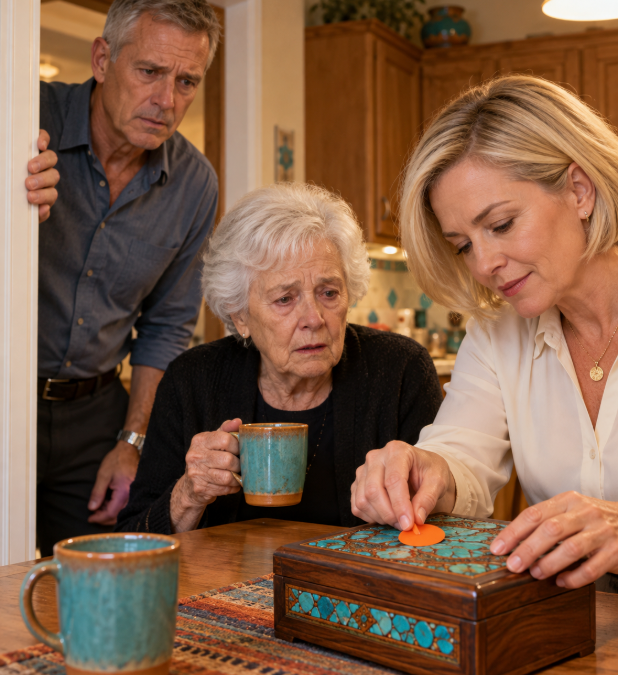
She peeled off a price sticker marked “$1,200” and pressed it flat across the lid of Mom’s jewelry box.
Aunt June looked down at her coffee.
Bev kept her hands beside her cup.
The box stayed where Crystal had put it.
She carried the rest of the labels toward the back of the house.
“Shane, I need the bed pulled out.”
Mom’s bedroom was at the end of the hall.
I followed her in.
The room still looked like Mom had stepped out to make tea. Her reading lamp stood beside the bed. A pad of blue letter paper rested nearby.
Crystal tapped the headboard with one finger.
“I can’t get to the back corner.”
I took hold of Mom’s bed frame and drew the bed away from the wall.
Something small rolled against the baseboard.
Crystal leaned past me and pressed “$75” onto the headboard.
I bent down.
Mom’s turquoise-ink pen lay uncapped beneath the bed, close to the blue stationery pad.
Hannah had stopped at the bedroom door.
“Grandma kept asking for that pen.”
I picked it up.
Mom used the turquoise pen for her crosswords. If she filled a square wrong, she drew one hard line through the letter and wrote the new one small beside it.
I clipped the pen into my shirt pocket.
Crystal glanced at what I’d put away, then toward the door.
“Come on. I want to get the paperwork done.”
The blue letter pad remained in Mom’s room.
At 9:40, Crystal and I sat across from each other in the kitchen.
The coffee cups were gone. So were Bev, June, and Hannah.
Mom’s blue box hadn’t moved, the “$1,200” tag still on its lid.
Crystal opened her work bag and removed a listing agreement.
She slid it across to me.
The price near the top was $410,000.
I knew the number. Crystal had been talking for months about what nearby houses were bringing.
The typed signature line near the bottom read:
Shane Tolliver, son and heir.
I looked toward the hallway.
From the 2019 copy in Mom’s filing cabinet, I believed Mom had put the house in a living trust and named me successor trustee.
Paperwork in this house had always been Crystal’s job.
“Sign so I can put it up tonight,” Crystal said. “Coming soon — nobody sees it till the open house.”
I put one hand on the agreement.
Mom used to say, “Read it twice, sign it once.”
The words came through my head in her classroom voice.
Crystal placed a ballpoint pen from her office beside my hand.
I should have turned the paper over.
I should have checked what came next.
Instead, I saw the clock, thought about the funeral at ten the next morning, and told myself I could deal with the details after we got through it.
I signed on the typed line with Crystal’s office ballpoint.
Shane Tolliver.
Crystal picked up the original before I turned to page two.
She squared the pages against the tabletop and slipped the signed agreement into her tote.
“Good,” she said.
I touched Mom’s pen through the pocket of my work shirt.
The zipper ran shut under Crystal’s hand.
That orange circle on Mom’s jewelry box faced me across the table.
Twelve hundred dollars.
I got up.
Crystal began gathering her things for the night, and I went down the hall alone.
At 10:15, I switched on Mom’s bedside lamp.
Her bed still stood several inches from the wall.
I reached for Mom’s blue stationery pad.
The top sheet had been torn away.
I tilted the pad toward the lamp, but the marks pressed into the page underneath were shallow. Most of them crossed and disappeared unless I held the paper at exactly the right angle.
I shifted it once.
Then again.
One indentation became dark enough to make out.
“Shane—”
Part 2 of 7
Chapter 2
At 1:30 Friday afternoon, church guests ate off paper plates beside Mom’s blue glazed bowls, and the top bowl still wore Crystal’s orange “$60” sticker.
Crystal stood with the pastor’s wife near the end of the table. Mom’s turquoise-ink pen was clipped in the pocket of the dress shirt I’d worn to the funeral after I moved it from my work shirt that morning.
At the table, Crystal tipped the bowl just enough to show the orange circle.
“Everything’s priced, if anything catches your eye.”
The pastor’s wife pulled her hand back from the bowls.
“I’m just looking.”
Crystal set the bowl level again.
Price tags still showed on the things marked Thursday night. She spoke to guests in the same quick voice she used at an open house, with each object attached to a number.
By 3:10, Tammy had me in the kitchen.
My sister held out her own phone. Crystal was in the living room with the guests.
The message on Tammy’s screen said:
“Pick ONE box of Mom’s things by Saturday noon. Everything else is tagged for the sale.”
Tammy lowered the phone.
“Can I get a copy of Mom’s trust?”
Crystal stepped into the kitchen doorway before I answered.
“After the sale. Shane signed the listing last night. We’ll mail you a copy and a check.”
I said nothing.
Then my wife went back to the guests.
Tammy kept her phone in one hand. The screen went dark under her thumb.
My sister worked at a clinic in Albuquerque and drove the long stretch of I-25 to Mom’s house. Sundays had become Tammy’s day here so gradually that I had stopped treating the trip like a trip.
Crystal’s text made that drive look like a claim to one box of Mom’s things.
A few minutes later, Crystal’s voice carried from the hallway.
“Your appraiser takes the jewelry box and the pine cabinet Sunday at ten.”
A pause followed.
“The five-hundred-dollar deposit is on my card.”
Tammy looked at me.
I opened the fridge door for the milk.
The calendar on the door had been in front of me for months, but I hadn’t studied the squares in a long time. Across the top, in Crystal’s block print, was:
SUNDAYS — TAMMY (I have open houses)
September 2026 was showing under the magnet.
Older sheets were clipped behind the September page, which nobody had turned since Mom died.
Tammy’s handwritten “T” marked every Sunday but the last.
The square for Sunday, Sept. 27, was empty.
I kept looking at the marks before it. Those letters were Tammy’s, written in the same kitchen where Crystal had just promised her a check later.
I had walked past that calendar every day. Tammy had lived three hours away.
She put one fingertip on the last “T,” dated Sept. 20.
“I never missed one. She was gone by the next.”
Tammy left her finger there for a second, then picked up her phone.
At 4:05, Connie Montoya met me on Mom’s front porch.
The carnations on the funeral wreath had started to brown at the edges.
Connie was seventy-four and lived across the street. She had spent years sewing hems, taking in dresses, and noticing details other people stepped past.
Then she pressed a business card into my hand.
Martin Lowry, Attorney at Law.
“Your mother had me sign something for her lawyer in September. I didn’t read it. Call him before you sign anything.”
I turned the card once between my fingers. The stock was plain white, the name black and centered.
Connie folded her arms.
“That’s what she asked me to do, mijo.”
Crystal called from inside the house.
“Shane, bring those folding chairs in.”
I tucked the card into my shirt pocket, next to Mom’s pen.
Two at a time, I hauled the stack inside.
Connie crossed back to her own yard.
Every time I bent for another chair, the card edge pressed against the barrel of Mom’s pen.
I did not call the number.
Crystal’s work bag, with the signed original in it, was somewhere in the house with her.
At 10:05 that night, I sat alone in the garage with my phone.
The guests were gone. Even the dishwasher had stopped running.
I opened the email with the subject “Your signed listing agreement.”
The PDF came up on my screen.
Page one showed the same $410,000 price I’d seen at Mom’s kitchen table. I swiped to page two, the page I never turned to last night.
At the bottom was a footer.
Prepared 09/08/2026.
Eighteen days before Mom died.
My thumb stayed near the lower edge of the screen.
I closed the PDF and opened the Tortugas Peak Realty website.
The house appeared under a wide exterior photo.
COMING SOON — $410,000 — Listing agent: Crystal Tolliver
I moved through the listing photos until photo 4 of 22 filled my screen.
The image showed Mom’s living room.
Her backup oxygen concentrator, the one she used every afternoon, stood beside her armchair. A crossword book and her reading glasses sat on the small side table.
Below the photo was the date field.
Photos taken 09/12/2026.
Mom was still alive down the hall in her bedroom with her portable oxygen tank.
Part 3 of 7
At 11:00 Saturday morning, Oct. 3, 2026, Tammy lifted Mom’s jewelry box off the vanity with both hands.
The orange “$1,200” sticker was still on the lid. Crystal had carried the box in from the kitchen Thursday night.
I stood in the bedroom doorway at the end of the hall.
Tammy kept both elbows close to her sides.
Crystal stood beside my sister. “That one’s twelve hundred. Family price, nine. The appraiser takes it tomorrow at ten anyway.”
Tammy lowered the box to its old spot. “I came for what you said I could have. You didn’t say I had to buy my mother’s things.”
My wife smoothed the edge of the sticker with a fingernail.
Mom’s straw church hat lay on the bed. Tammy picked it up by the brim. “That’s all I’m taking.”
Only the hat had no price tag. I stepped aside to let my sister through.
Tammy passed me with her chin down.
On the front porch, I braced the screen door open with my palm.
Tammy held Mom’s hat against her middle. “You signed it, Shane. Don’t call me Sundays.”
After going down the steps, Tammy opened her car with her free hand and drove to Aunt Bev’s house across town, where she was staying. I waited on the threshold until she turned off the street.
At 1:00 that afternoon, I sat on Mom’s bed. The orange “$75” sticker was still on the headboard.
I took out Mom’s turquoise-ink pen.
Crystal was at the bedroom door with her work bag on her shoulder. My wife was on her way to show houses until five.
I held the pen across my palm. A spot of turquoise ink marked the base of my thumb.
Without coming in, she said, “You signed. It’s done. Don’t make me look like a fool at my office. And toss that pen, it leaks.”
I made a fist around the barrel.
Crystal left for her showings. I clipped the pen back into my shirt pocket, beside Martin Lowry’s card.
Alone in Mom’s bedroom, I opened the family group chat “Tolliver Table” on the phone in my hand.
I scrolled backward, looking for a photo of Mom. My thumb stopped on a gin rummy hand spread across the kitchen table.
Crystal had posted the message that Thursday, Sept. 10, at 8:41 p.m.:
“Your mother just beat me at gin rummy AGAIN. Sharp as a tack. 🙄”
I could hear Mom announcing another win.
At 3:20, I sat alone in the cab of my work truck in the driveway. Martin Lowry’s card was in my left hand, my phone in my right.
I called the cell number printed below his name.
He answered on the second ring. “Shane, I was hoping you’d call.”
“I’m at Mom’s house,” I said. Martin told me he could be there in twenty minutes.
The card had a soft bend where the corner met my thumb. I tucked it next to Mom’s pen again.
At 3:40, Martin Lowry stood with me outside the front door. He was 64, Mom’s estate lawyer from downtown Las Cruces.
Mom’s 2019 trust named me her successor trustee. I was supposed to handle the house and the things inside after she died.
Martin said, “Connie called me Thursday night about the price stickers.”
I held out my phone with the email “Your signed listing agreement” open. “This is what I put my name on. Can you tell me what I’ve agreed to?”
Martin leaned closer. I opened the attachment to the signature line, “Shane Tolliver, son and heir.”
He read from the top of the page to the bottom. I scrolled through the rest at Martin’s pace.
“Crystal set the agreement in front of me Thursday night,” I said. “I signed without turning to page two.”
Next, I pulled up the “COMING SOON” listing. Her name appeared with the $410,000 price.
My wife had scheduled the first open house for Saturday, Oct. 17.
He lingered over the description. I kept my phone angled toward him until he finished.
“The Copper Lantern appraiser comes Sunday morning at ten,” I said. “Crystal booked the pickup for the jewelry box and the pine cabinet.”
Through the screen door, Martin looked into the house.
“I’ll read your mother’s trust to the family tomorrow at two, in that living room, the way she asked. Your sister too. Until then, nothing leaves this house. If that box goes to a shop, it can be sold and gone before anyone hears a word, and I’d be chasing it through strangers.”
I lowered my phone to my side.
From his pocket, Martin pulled his own phone. He called Copper Lantern right there on the porch.
The weekend voicemail picked up. Martin left his message after the tone.
“This is Martin Lowry, attorney for Dorothy Tolliver’s trust. Please do not remove anything from her house tomorrow. Call my office Monday.”
He hung up. “Don’t let that box out of your sight. And keep this between us until the reading. Your mother wanted everyone to hear it at once.”
I tightened my grip on my phone. “On whose say-so?”
Martin rested one hand on the porch railing.
“Hers. She heard your wife book a photographer for this house on September eighth. The next morning, she called me. She amended her trust on September tenth, sixteen days before she died, with her doctor’s note, two witnesses and me in the room. I’m her successor trustee now, Shane, not you. That paper you signed sells nothing.”
Part 4 of 7
“Martin Lowry’s coming at two tomorrow to read Mom’s trust to the family,” I told Crystal at ten past five that Saturday.
My wife stood at Mom’s kitchen counter with her work bag still on her shoulder. She thumbed her phone awake. “Good. Let him say it in front of everybody. Then nobody calls me a vulture.”
I buttoned my shirt pocket over Mom’s pen and the lawyer’s card.
Crystal opened the family group chat, “Tolliver Table.” She sent Aunt Bev an invitation for two o’clock. Under the time, she typed, “Family preview of Mom’s things after.” My wife phoned Aunt June. “You’ll get first choice after the reading.” She dialed my cousin from Deming next. Crystal made a separate call to invite the pastor and the pastor’s wife. “You can look around after Martin finishes. I already have everything priced.”
“What do you need?” Tammy asked at eight Sunday morning, Oct. 4.
I stood in Aunt Bev’s kitchen across town. Tammy’s car keys lay on the table between us.
“I saw Crystal’s message about a family preview,” Tammy said. “Does she think I stayed in town to shop? I was going to be back in Albuquerque before lunch.”
“Will you come to Mom’s house at two?” I asked.
Tammy gripped the back of the chair in front of her. “Why should I?”
I took my hands out of my pockets. “Because Mom asked for it. Martin said so.”
Tammy pushed the chair under the table. She picked up her car keys. “For Mom.”
The Copper Lantern appraiser backed his empty hand truck up onto the front porch at ten that morning. He had left his van at the curb.
In the doorway, Crystal stayed put. “The box and the cabinet.”
“Your lawyer left us a voicemail,” the appraiser said. “He asked us not to remove anything.”
“That’s just paperwork,” my wife said. “I paid the deposit. I have people coming at two. This pickup was supposed to be finished before they got here.”
Crystal moved out of my way, and I walked down the hall to Mom’s bedroom. I lifted Mom’s jewelry box off the vanity.
The base had left a pale rectangle in the dust. I closed my fingers around the bottom corners. The appraiser pulled his dolly clear of the porch steps. I carried Mom’s box past them to my work truck in the driveway.
My truck keys stayed in my pocket. The passenger door was unlocked. I set the box on the seat.
The lock clicked down under my thumb. I shut the door.
“He’s here now, Shane,” Crystal said.
I laid my hand against the glass above Mom’s box. “I’ll take a look at it,” I said.
The pine cabinet still had the orange “$350” sticker on the front. I pointed back inside. “That piece stays where it is until after the family meeting,” I said.
“House going on the market too?” the appraiser asked.
Crystal answered, “I didn’t list a thing until she was gone. Out of respect.”
For a moment, he looked at her. He rolled the hand truck, still empty, back down the steps to his van by the curb.
Crystal said, “Fine. Monday.”
I pulled on my truck’s passenger door handle.
At half past one, Crystal laid printed price sheets on the dining table. She had put “Family Preview — 25% off before Friday” across the top.
Aunt Bev came through the front door with Aunt June. I shut the screen behind them.
“I didn’t list a thing until she was gone,” Crystal told both aunts, tapping the heading.
“The reading’s in the living room,” I said.
Beside the table, Aunt Bev kept her hands on her purse.
Tammy went straight into the room. Neil came in behind her. Tammy chose a place facing the hall.
I let my cousin from Deming in next. The pastor stepped in from the porch. His wife followed him inside.
At the dining table, Crystal slid the sheets closer to the edge. “Browse before you leave. I can hold something if you put your name beside the price.”
Hannah came down the hall. Crystal pointed toward Mom’s armchair. Hannah shook her head.
I opened the front door for our son Josh, up from El Paso. He stopped just inside.
Hannah went to Josh. He put his arms around her. She kept hold of his shirt after the hug.
Aunt June settled onto the sofa. I carried a dining chair over for Hannah. Aunt Bev followed me.
Martin came with his paralegal, Monica Baca, and Connie. He took a chair near the coffee table. His brown accordion folder stayed closed on his knees.
Monica sat on his left. Connie took a seat beside her.
I sat down.
My wife straightened the sheets. She put her phone away.
Josh drew his shoes back under his chair. Hannah rested her hand on Mom’s empty armchair.
Crystal stood beside the corner fireplace at eight minutes past two. She faced Martin. “Shane’ll sign whatever you need. Signing what I hand him is the one thing he’s good at.”
Nobody laughed. Josh looked down at the floor.
Tammy sat forward. Neil put his hand on her wrist.
I stood up, walked out to my truck, unlocked the cab, carried Mom’s turquoise-inlay box inside with the orange “$1,200” sticker still on its lid, and set it on the coffee table right in front of Martin.
Part 5 of 7
“First Amendment to the Dorothy J. Tolliver Living Trust, signed September tenth, 2026,” Martin read at a quarter past two that Sunday, October fourth.
Crystal stood by the corner fireplace, thumbing through the photos of Mom’s house on her phone. Her work bag lay open at her feet with the listing agreement I had signed inside.
The amendment had come out of his brown accordion folder. It named Martin Lowry successor trustee in place of Shane Tolliver.
Crystal swiped to the next photo without looking up.
“My home and everything in it I leave to my daughter, Tammy Pierce,” Martin read.
I looked at Mom’s box on the coffee table. Crystal’s price was still on the lid, facing the woman Mom had left the house to.
He read that the rest of the trust would be split equally between Mom’s children. He held up the signature page. Mom had signed in turquoise ink, her name clear across the line.
I touched Mom’s pen through the cloth of my shirt pocket.
Hannah looked at her mother. “It’s written down,” she said.
“She was confused by then,” Crystal said. “Half the time she didn’t know what day it was.”
“I was there at ten,” Martin said. “Monica and Connie signed as witnesses. Dr. Ortiz examined her at eight-thirty and wrote this.”
He held the doctor’s note up beside the amendment so the room could see the date.
“Your mother asked for that exam herself,” Martin added.
I took out my phone and scrolled the family group chat back to the night Mom signed. My wife’s photo of her cards was still there, sent at 8:41 p.m.
I read her message aloud: “Your mother just beat me at gin rummy AGAIN. Sharp as a tack.”
Aunt Bev said, “I got that one too, Crystal.”
Crystal turned her phone face down against her thigh.
“Tammy came for Sunday dinner,” Crystal said. “Shane and I did everything else. And Mom wanted it sold. She told me.”
I walked into the kitchen. The Sunday calendar hung on the refrigerator door. I slid Crystal’s magnet off the paper and set it on the bare steel.
Previous months remained clipped behind the top one. I lifted the stack clear of the refrigerator and carried the calendar back into the living room.
Crystal stayed at the fireplace as I stopped in front of her. I held up the pages with her block letters facing her.
I said, “SUNDAYS — TAMMY (I have open houses). Your handwriting, Crys. A hundred and seven Sundays. Not dinner. Every Sunday, all day, so you could do open houses.”
Tammy found the last T, the one from September twentieth, and pressed her hand over her mouth.
I flipped the older sheets forward under the clip, month after month, a T in every Sunday box.
My phone still showed the group chat. I opened the agreement and enlarged the preparation date at the bottom. My name was back on page one, on the line Crystal had given me to sign. I held up the screen. “Prepared September eighth. Photos September twelfth. Mom’s oxygen machine is in picture four. You told the aunts you didn’t list a thing until she was gone.”
I showed everyone the fourth photo on my phone. The machine stood beside Mom’s armchair, with her crossword on the side table. I put my phone in my back pocket and looked at Crystal. “’Tammy got Sundays. We got the other six days. She can have whatever we don’t tag.’ That’s what you told Bev and June.”
Aunt Bev said, “I was in that kitchen, Crystal. I heard you.”
Martin took Mom’s key ring out of the folder. The turquoise bead hung below the keys. Tammy held out her palm, and he set the ring there.
Her fingers closed around it.
Martin retrieved the trustee’s letter and held it out to Crystal. My wife slid her phone into her bag. Crystal left the fireplace. She took the paper next to Mom’s box.
“The estate sale is canceled,” Martin said. “Nothing leaves the house. Tomorrow morning I notify your office. You and Shane have thirty days to move out.”
Crystal read the letter. She lowered the paper just enough to speak over the top.
“This is my business you’re talking about,” Crystal said.
He answered, “It’s her trust. I’m just reading it.”
My name was on that listing too. I held the calendar steady.
Martin nodded at Mom’s box. “You put that sticker on, Crystal. Take it off,” he said.
Crystal turned to the lid. She worked the orange “$1,200” sticker loose at a corner. The paper lifted unevenly from the inlay. Crystal eased another edge up, leaving the price stretched across the part that still clung to the wood.
Thirteen of us watched her peel the price off.
The pastor’s wife pressed her lips together.
Crystal pulled the rest free. She pushed Mom’s box across the table to Tammy.
Tammy lifted the lid. Mom’s silver squash-blossom necklace lay on the velvet.
The letter remained in Crystal’s hand. The sticker was stuck to the tip of her finger.
“Mom tagged everything first, Crystal. In turquoise ink,” I said.
Part 6 of 7
“Joan took my name off it,” Crystal said.
I read the letter Crystal had left on the kitchen table at Mom’s house that Monday evening, Oct. 5, 2026. Joan Harmon, the qualifying broker at Tortugas Peak Realty, had signed at the bottom. My wife had set it on the spot where I used to sign whatever she brought home.
Martin had sent Joan the trustee’s letter and the trust certification at eight that morning. Joan had called Crystal into the office. The listing had come off the Tortugas Peak site at eleven.
A second paragraph named the problem: paperwork signed “son and heir.” I was the son who had signed. I was not the trustee who could authorize a sale.
Crystal had put the agreement in front of me, and that had been enough. I had not asked whether Mom’s trust still named me.
The listing side of the fee, $12,300, was gone. From now on, any trust property Crystal handled needed Joan’s signature first. Crystal could bring the business into the office; Joan would decide whether the paperwork was ready.
Joan ended the letter with these words: “The listing did not go past ‘coming soon’; there were no showings and no offers. This reprimand remains in your file.”
I laid the page back down. Mom’s pen stayed in my shirt pocket. I had nothing to sign.
Copper Lantern Estate Sales canceled the Oct. 9–10 sale on Tuesday, Oct. 6, under Martin’s letter. The company kept the $500 deposit. Crystal’s own card still carried the charge. Nobody would be taking that amount out of Mom’s trust.
My wife peeled the orange price stickers off Mom’s things that evening and dropped the scraps into a trash bag. Crystal returned to the job the next night. I had let her price them in front of me. Bare pine and blue glaze showed again wherever she had worked.
The dishes would stay. I had agreed to let strangers carry out the furniture too. This time I left everything where Mom had used it.
Crystal and I signed a lease on Saturday, Oct. 10, for a two-bedroom apartment near Telshor Boulevard. The rent was $1,450 a month. I read every page first. Her name went on the line under mine.
Aunt Bev spoke to Crystal in the church fellowship hall after the service on Sunday, Oct. 11. The women who had cooked Mom’s funeral meal were close enough to hear.
“Thanksgiving’s at Dot’s house this year. Tammy’s hosting,” Aunt Bev said.
I had heard Crystal decide what Tammy could have in Mom’s kitchen. Aunt Bev had heard her too. Nobody asked Crystal to approve the holiday or make arrangements for the house.
“Can I go to Grandma’s on Sundays? With Aunt Tammy?” Hannah asked from beside her mother.
Crystal walked out to the car alone. Hannah crossed to Aunt Bev. I did not ask my daughter to change the question. Hannah had called the place Grandma’s, and nobody corrected her.
Josh and I loaded the last boxes onto my truck in Mom’s driveway on Saturday, Oct. 31. Halloween had arrived before the deadline Martin gave us. Tammy and Neil had driven down from Albuquerque again. Neil made room in the truck for what Josh and I carried out.
I went back through the kitchen. Tammy took a cold root beer from Mom’s refrigerator and gave the drink to me.
“Mom always had one ready on moving day,” Tammy said.
I drank half of it at the counter. Tammy wiped the wet ring off the tile with her sleeve, the way Mom used to.
Mom’s box had ridden back from Albuquerque on Tammy’s front seat, and Tammy set it on the vanity in Mom’s bedroom. The glue mark from the “$1,200” sticker still showed faintly on the lid.
Hannah taped a paper pumpkin to the screen door for the trick-or-treaters. She kept it low, at the height of a kid in a costume.
I gave Tammy the Sunday calendar, folded in quarters. Tammy opened the pages along the creases I had made and taped them back on the refrigerator door.
Tammy wrote an “S” under the Sept. 20 square with a ballpoint pen.
“Your turn’s coming,” Tammy said.
I looked toward the roof when I went outside. Dust coated Mom’s swamp cooler pads, and nobody had shut off the water for winter. I knew how to do that job.
Martin met us on the front porch at 4:00 p.m. I gave him the house keys and the garage door remote. He passed them straight to Tammy in front of Neil, Josh and Hannah.
“The house and everything in it, Tammy. The way she wrote it,” Martin said.
Tammy hung the ring on the nail just inside the door.
Martin took a blue stationery envelope out of his folder. Mom had addressed the front in turquoise ink: “Shane — after you give back the keys.”
“Connie brought it to my office on September eleventh. Sealed,” Martin said.
He handed it to me, and I opened the flap on the porch step. The first word was the one I had seen pressed into Mom’s notepad.
Shane— I didn’t take the house from you. I took it out of reach. You never could say no to her, and I never wanted you to have to. Tammy will need help with that cooler every fall. This pen keeps rolling off the bed. If you find it, keep it. — Mom
Part 7 of 7
Mom’s pen rode in my shirt pocket at 9:00 a.m. on Sunday, Nov. 1, 2026, when Hannah and I pulled into a driveway that was Tammy’s now.
Tammy came down the front porch steps with two cups of coffee and said, “Roof first? Neil put the ladder up on the east side.”
I took mine and set it on the porch rail.
Hannah accepted her cup and held it in both hands.
Connie set marigolds along her gate on the other side of the street for Día de los Muertos. She crossed over and laid one bunch beside Mom’s photo on a porch table.
A bloom fell across Mom’s face. Hannah lifted it away.
Connie said to me, “She’d want you up on that roof, mijo.”
I bit the inside of my cheek.
“Winter shutdown,” I said. “It won’t take long.”
“Then get up there,” Connie said. “That water won’t shut itself off.”
Hannah brought a cooler cover out from the garage. Tammy held the ladder as I went onto the roof and shut off the water valve. I unhooked the bleed-off line.
Then I pulled the plug and emptied the pan into the gutter.
“The stream coming out looks pretty cloudy,” Hannah said.
“Hard tap water leaves a chalky layer stuck to the pan,” I said. “The blade will clear every bit of that.”
I scraped the white scale out of the pan with a putty knife.
Tammy said, “Does the house still have water?”
I nodded toward the valve. “Only that line is closed. The faucet in the house still runs.”
I lifted the pump out of the pan by its molded handle.
Hannah called, “What’s the pump for? I thought a fan did it.”
My eyes met Hannah’s as I looked straight down. “It wets the pads. The fan moves the air.”
I picked a mat of cottonwood fluff off the pump’s screen.
Hannah climbed three rungs of the ladder Tammy steadied, then she leaned forward and took a closer look at the pump.
“Stay right there,” Tammy said. She gripped both side rails and held them still.
“That was packed tight against the whole thing,” Hannah said.
“All that fluff keeps the pump from getting enough water,” I said. “The motor burns out if it runs dry for long.”
I handed her the pump, rust stain and all.
Hannah wrapped both arms around it and held her elbows close to her sides. “Why does the pump go in the garage?” she asked.
I said, “Water left in it freezes and splits it. Grandma’s sat on the shelf out there every winter.”
“I’ll put it on that same shelf,” Hannah said.
Once she stepped down, she set it in the dirt by Tammy’s feet.
She came back up with the cover against her chest.
I took the cover from her and shook it open.
“Can I come up and help next year?” Hannah asked.
I tightened my grip on the cover. “Next fall you come up. Grandma left this job to me now, and I’ll want a hand every fall.”
I hooked the bungee cords over the cover.
“Do I need to find somebody next fall?” Tammy said. She looked up the ladder.
“Don’t find anyone,” I said. “I’ll be here every fall.”
Neil met me in the living room.
Tammy showed me Dad’s pine cabinet. I found a pale patch where the “$350” sticker used to be.
I rubbed the wood beside the mark with my sleeve. The side that had stood against the wall was still raw pine, and the front had gone dark under Mom’s lamp.
“Dad built it,” Tammy said. “It goes with the one who fixes things.”
“This one’s mine to take care of now,” I said.
“I’ll take the heavy end,” Neil said.
Neil, Tammy and I lifted the cabinet onto my truck.
At the table, Tammy poured me a fresh cup of coffee. She looked around Mom’s kitchen, then through the doorway toward the rest of the house. Tammy said, “We’re keeping it. Weekends for now.”
I rested my elbows on the table. “That’s still three hours from Albuquerque.”
“The road hasn’t gotten shorter. We’ll come when we can,” she said.
The Sunday calendar hung on the refrigerator door. I put my thumb on the first T that Tammy had marked, the one from Sept. 8, 2024.
Tammy tapped the column of T’s and said, “Two years. Three hours each way, every Sunday. Nobody ever said it counted.”
I said, “It counted. I should have said it out loud a long time ago.”
On the kitchen table, Tammy set down a blank service tag and a coil of wire. I took out Mom’s pen.
The first stroke of turquoise ink caught on the surface, then ran cleanly into the opening letter. I stopped and swallowed.
“Go ahead,” Tammy said. I wrote on the tag: “Winterized 11/1/26. Next visit: Sunday.”
Tammy braced the ladder at its foot again. I went back up and tied the tag to the cooler with wire, writing side out. I checked the date on the tag, signed it once, and climbed down for Sunday dinner.
THE END
More stories
My fiancé demanded my $210,000 for a house I wouldn’t own—Then bank records exposed who paid for my ring, and prosecutors charged him with identity theft.My brother-in-law claimed our 60-year-old store at my husband’s funeral lunch — Then a hidden envelope helped me reclaim it, and a judge ordered him to repay $23,780.My daughter-in-law gave me 30 days to leave my house at Sunday dinner—then her own realtor read a county record aloud, and her planned sale collapsed.My HOA president sent two men with shovels into my late husband’s memorial garden and fined me $2,400—Then her own financial records cost her the presidency.








