Byron Told Me to Sit Beside the Rental SHOES at My Husband’s Bowling Alley, but He Went PALE When the Deputy Arrived to Speak to Me
Part 1 of 5
“Sit beside the rental shoes!”
Byron Sykes shouted across the Fort Wayne bowling alley.
All 54 league members watched him lift my husband’s brass plaque.
The reserved table stood beside lane one, beneath the daylight windows.
My stepson carried the plaque between two fingers.
He set it beside the rental counter, facing the wall.
“You’re a guest now. Act like one.”
I walked over without moving the chair he indicated.
At seventy-four, I still preferred choosing where my feet landed.
“The deputy has the paperwork,” I said.
Byron’s smile stayed put, but his eyes checked the entrance.
A woman near the ball return lowered her coffee.
Someone stopped pulling a zipper halfway up a bowling bag.
Nobody laughed.
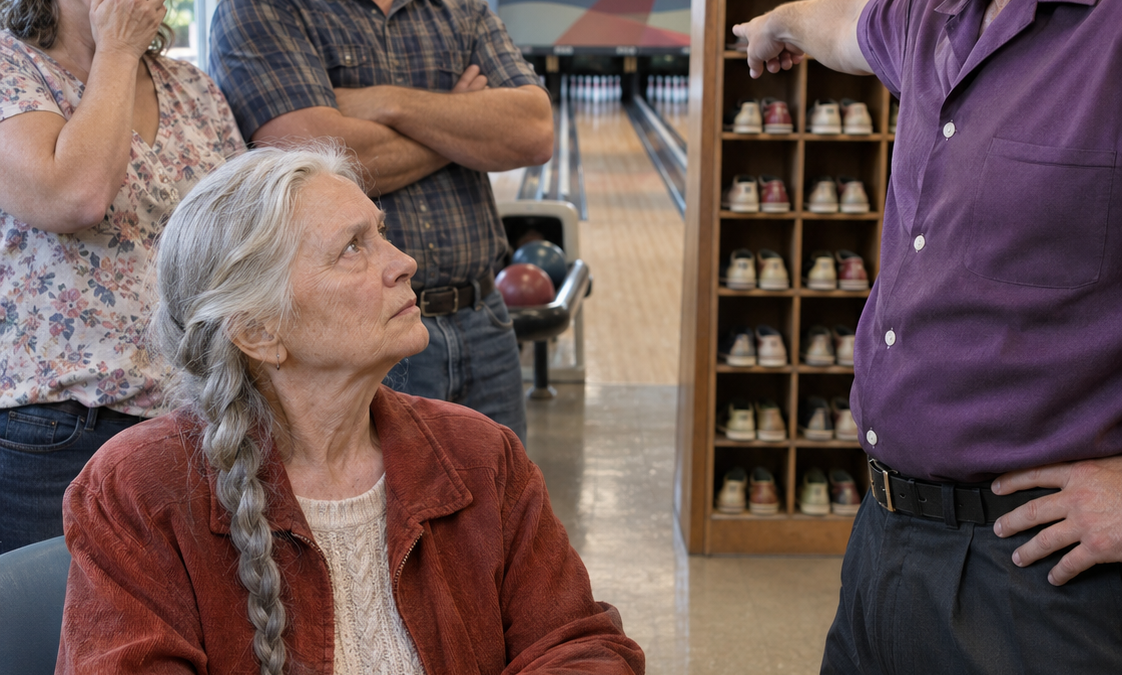
I sat beneath the shoe chart in my rust-colored jacket.
My silver braid caught briefly against the chair back.
The closed envelope rested flat across my knees.
Byron looked at it, then at the people watching.
“Personal business can wait until after my opening remarks.”
“Then keep them brief,” I said.
A chair scraped.
He straightened his purple bowling shirt and faced the lanes.
The new electronic sign flashed through the front windows.
Its colored light touched the brass at my elbow.
My husband, Clement Rudd, had polished that plaque every Sunday.
We had built this place together, mostly after other work.
I had spent my shifts directing airplanes through crowded skies.
Afterward, I had painted walls and balanced the alley’s books.
Clement had installed benches while I sorted mismatched rental shoes.
When he died, I became a widow with unfinished repairs.
Byron promised he would keep league night feeling like home.
That promise was why I had kept helping him.
No applause came.
Byron tapped the microphone mounted beside the scoring desk.
He didn’t need it. The room had gone quiet enough.
“Some people have trouble letting a business move forward.”
He looked directly at my jacket, then my sensible shoes.
I slid the envelope beneath my purse on the table.
Its corner stayed visible against the scratched brown laminate.
“Your microphone is already on,” I said.
Several bowlers glanced toward the ceiling speakers.
Byron pulled his mouth away from the microphone.
“That sign cost thirty-eight thousand dollars,” he said.
He pointed through the glass at his blinking name.
Then he looked down at the plaque beside me.
“That old thing is twelve dollars’ worth of scrap.”
His father’s name was engraved beneath the words LANE ONE.
I turned the plaque so those words faced the room.
Just that.
No speech.
No answer.
A man near lane four took off his bowling glove.
Byron stepped closer, blocking the light from the front window.
“You don’t have to make everyone uncomfortable.”
“I’m sitting where you told me.”
“You know what I mean.”
“I generally prefer people to say it.”
His jaw worked once beneath his cheek.
Behind him, the league members stayed beside their empty lanes.
Nobody had rolled the ceremonial first ball he had advertised.
The pins waited under their white lights.
Byron had promised free coffee and a fresh beginning.
The coffee smelled burned, and nobody reached for another cup.
“Please enjoy yourselves,” he told the room.
Still nobody moved.
He came back toward my chair, lowering his voice.
I could hear the shoe refrigerator humming behind the counter.
It wasn’t a refrigerator, naturally, just an old ventilation cabinet.
Clement had called it that for years.
That ordinary memory steadied the hand resting on my purse.
“You could have stayed home,” Byron said.
“You advertised a public reopening.”
“For customers.”
“I’ve been one longer than most.”
His gaze dropped to the envelope again.
Outside, tires crunched over the loose gravel near the entrance.
Byron turned before I did.
Through the glass, a tan sleeve crossed the morning sunlight.
I kept both feet flat against the floor.
The entrance opened, bringing in cool air and street noise.
A newcomer stepped inside and paused beneath the exit light.
The deputy looked directly at my chair.
“We’re ready to restore possession,” the deputy said.
Byron’s mouth stayed open, but nothing came out.
The color drained from the skin above his collar.
Several league members turned fully away from the lanes.
The deputy approached without touching his belt or raising his voice.
His uniform nameplate read Nathaniel Price.
He had given me his name during our telephone arrangements.
I had told him to look for a silver braid and a rust-colored jacket.
“Good morning,” I said.
Byron stepped between us, leaving enough space for the deputy.
“This is a reopening,” he said.
“I understand,” Deputy Price said.
“Then you understand we’re conducting business.”
“I need to establish who controls these premises.”
Byron spread his arms toward the lanes.
“You’re looking at him.”
The deputy didn’t answer that claim.
Instead, he checked the wall clock beside the shoe sizes.
The minute hand moved toward ten.
I recognized that habit.
For thirty-one years, I had watched clocks while pilots waited.
Clear instructions kept crowded places from becoming dangerous ones.
“Would you like a chair?” I asked.
“Thank you. I’ll stand.”
Byron gave a quick laugh toward his audience.
Nobody returned it.
A woman stepped away from lane three and approached us.
Susannah Bell had organized Thursday league for almost two decades.
She stopped beside the plaque without picking it up.
“Dorothea,” she said, “should we wait outside?”
“Not yet.”
Byron turned sharply toward her.
“This has nothing to do with league.”
Susannah looked at the deputy instead.
“Then why is he here?”
Part 2 of 5
“Ask her,” Byron said.
Susannah kept her eyes on him.
“I just did.”
The deputy asked everyone to leave the entrance clear.
People moved their bags without being asked again.
No one left.
I was Dorothea Finch before I married Clement.
I had kept Finch on my work credentials and bank records.
Byron had taken his mother’s surname years before our marriage.
People occasionally needed those details explained.
That morning, the names would need to be exactly right.
I checked the envelope beneath my purse.
Still closed.
Byron watched my fingers settle against its edge.
“You’re enjoying this,” he said.
“I would rather be bowling.”
“You never bowled more than two games.”
“My knees have always had excellent judgment.”
A small sound escaped someone near the coffee station.
Byron turned, and the sound stopped.
Twenty-two years earlier, the alley’s roof had leaked above lane six.
The repair estimate had been $8,400.
Clement had sat at our kitchen table with both hands open.
I remembered the green estimate sheet beside his dinner plate.
I remembered him asking whether we should simply close.
We hadn’t.
When he worked nights, I handled the morning deliveries.
When he lost sleep, I took the calls.
When he ran out of answers, I brought the calculator.
Byron had been twenty-seven then.
He had carried ceiling tiles through this same front door.
For a while, all of us had worked together.
That was true, too.
I wouldn’t erase it just to make him easier to dislike.
Years later, after Clement’s funeral, Byron wanted new scoring screens.
I paid $6,200 toward those screens.
He wanted the old benches refinished before the fall leagues.
I spent three Saturdays sanding them with my own hands.
The cushions beneath those watching bowlers were still the same ones.
Byron had changed the sign.
He had changed the advertisements.
He had changed the way he spoke to me.
The deputy waited while I settled my purse beside the plaque.
Byron noticed the brass facing outward again.
He reached toward it.
“Leave that there,” Susannah said.
His hand stopped above the table.
“It doesn’t belong in the new design.”
“Your father’s name does,” she said.
A shoe dropped somewhere behind the rental counter.
The young employee who had dropped it crouched out of sight.
Byron lowered his hand.
I hadn’t asked anyone to defend me.
Still, I was glad Susannah had spoken.
The deputy looked from Byron to the envelope.
“I have the office copy,” he said. “Do you have yours?”
“Yes.”
Byron’s eyes went to the deputy’s copy, then away.
The wrong expression.
It wasn’t surprise at a stranger’s paperwork.
It was the look of someone seeing an expected appointment arrive.
Susannah noticed, too.
“You knew he was coming?”
“This is administrative,” Byron said.
“Then explain it.”
“Not in front of customers.”
He had chosen customers now, rather than guests.
I remembered when he had called them family in his advertisements.
The reopening flyer lay beneath a sugar dispenser.
His photograph filled most of its front.
Below it, he had promised a new era for the alley.
I hadn’t been mentioned.
That omission had hurt less than the printed date.
I had already known what was scheduled for that morning.
Byron had known, too.
The deputy’s arrival wasn’t a coincidence or something I had arranged during the insult.
It had been scheduled before Byron mailed the flyers.
I had kept my appointment.
So had Deputy Price.
“Can we take this into the office?” Byron asked.
“You may speak here or nearby,” the deputy said.
“I want privacy.”
“The entrance still needs to stay clear.”
Byron looked at the watching league members.
Then he leaned toward me, speaking slowly enough for everyone.
“You’re a guest now. Act like one.”
I squared the envelope with the edge of the table.
One calm, practical thing.
His voice could move around the room.
My papers didn’t need to.
Susannah pulled out the empty chair beside me.
She sat without asking Byron’s permission.
Three bowlers near the counter watched him point toward the shoes.
I remained low between the table and their standing shoulders.
“Move over there,” he told Susannah.
“I can hear from here.”
Deputy Price asked Byron to lower his voice.
Byron looked at the tan uniform, then swallowed.
“I’ve put everything into this place.”
I glanced at the brass plaque.
That was a large word, everything.
It covered a roof he hadn’t paid for.
It covered benches he hadn’t sanded.
It covered years when his father and I had worked alone.
I didn’t list any of that aloud.
The deputy checked his watch.
“Mrs. Finch, please have your copy ready.”
I moved my purse off the envelope.
Byron’s shoe pressed against the table leg.
“Don’t,” he said.
It was the first time he had asked instead of ordered.
Susannah looked at him over the closed flap.
“What exactly is in there?”
He didn’t answer.
The deputy stepped closer to the table.
Part 3 of 5
I opened the envelope and laid my certified judgment before Deputy Price.
The certified judgment bore my name as plaintiff and Byron’s as defendant.
Deputy Price compared it with the copy he had brought.
He placed one finger beside the property address without covering it.
The address matched the bowling alley.
Not the parking lot next door.
Not an office we had once rented.
This building, these lanes, the rental counter behind my chair.
Susannah leaned forward enough to see the line herself.
Byron pulled his foot away from the table.
“This is between family,” he said.
“The court file identifies the parties,” Deputy Price said.
His voice hadn’t changed since he entered.
He checked the enforcement notice attached behind the judgment.
“The enforcement date is today,” he said. “Ten o’clock.”
The wall clock clicked over while he spoke.
Byron looked up at it.
I had watched that clock through birthday parties, league finals, and the afternoon we served sandwiches after Clement’s funeral.
I had never watched Byron look at it that way.
Deputy Price read the operative sentence aloud.
“Possession of the premises is awarded to the plaintiff.”
Susannah’s hand settled flat against the table.
One of the men by the coffee station quietly repeated my name.
Byron shook his head before anyone asked him anything.
“She’s making this sound different from what it is.”
I turned the judgment so its caption faced him.
“Then say what it is.”
He looked at the paper without bending closer.
“I was going to straighten it out.”
“You had the hearing date.”
“I had other things going on.”
“You had the notices.”
“You knew I was reopening.”
“Yes,” I said. “I saw the advertisement.”
The deputy looked toward the waiting bowlers.
“Please give us a little space.”
They stepped back, but they could still hear.
I didn’t raise my voice to compensate.
Twenty-two years earlier, Clement’s business had gone through bankruptcy.
That was the part Byron had edited out of his speeches.
The building had been sold through that process.
I had purchased it myself.
My retirement savings supplied the down payment. A commercial loan covered the balance.
The deed had been recorded in my name.
Clement knew. He had signed no secret agreement and made no promise that contradicted it.
For the rest of his life, we had worked there together.
Our marriage had survived him needing help.
It hadn’t required me to pretend I hadn’t given it.
Byron stood with his back to the flashing sign.
“Dad built this.”
“We built it,” I said.
“You know what I mean.”
“Yes. You mean the part you can say without mentioning me.”
His eyes went toward Susannah.
She didn’t look away.
After Clement died, I had given Byron an operating lease.
Not the building.
Not an inheritance.
A favorable lease so he could run the business without carrying a market-rate building expense.
The rent was $1,250 a month.
For several years, he paid it.
Then the payments became late.
Then they stopped.
I had called, written, and offered to discuss a payment plan.
Byron had answered with pictures of renovations.
When I asked about rent, he sent a picture of the sign.
The sign had cost $38,000.
That number now seemed to occupy every empty space between us.
“I was investing in the business,” he said.
“You were spending money owed elsewhere.”
“You would have gotten it back.”
“I asked when.”
He rubbed the seam of his shirt against his thumb.
The deputy let the exchange end before speaking.
“The judgment has not been stayed. I’m here to enforce it.”
Byron’s mouth tightened.
“I didn’t think she’d go through with it.”
He said it to the deputy, but Susannah answered.
“She didn’t arrive here with a surprise court.”
Byron turned toward her.
“You don’t know anything about this.”
“I know you called me yesterday to confirm coffee.”
He looked down.
“And you knew this was scheduled?”
He didn’t answer her.
That was the secret he had kept from the reopening guests.
There had been no confusion over which building the order covered.
No mistake over the date.
He had invited the league anyway.
He had placed himself beneath the new sign and put me beside the shoes.
I looked at the plaque between us.
Its edges had gone dark where polish never quite reached.
Clement had once suggested replacing it with something bigger.
I had told him the size was right.
People standing close enough would be able to read it.
Byron finally looked at the deputy.
“What happens to the people I invited?”
“Mrs. Finch decides whether they may remain,” Deputy Price said.
Every face turned toward my chair.
“League can stay,” I said.
A zipper closed near lane four.
No one moved toward the door.
Byron’s phone began ringing in his pocket.
Part 4 of 5
He pulled the phone out, checked the screen, and silenced it.
For a moment, he held it beside his leg as though waiting for another instruction.
Deputy Price looked at the office door behind the rental counter.
“Do you have personal belongings you need to collect?”
“My whole business is in there.”
“Identify what you need for today.”
Byron stared at him.
The deputy explained that the order concerned possession of the premises. Any dispute about particular equipment could be handled separately through proper channels.
He wasn’t going to settle ownership of every ball return in front of the league.
Nor was he going to let Byron empty the office because he was angry.
“Wallet, coat, personal medication,” Deputy Price said. “Things you need to leave with.”
“Leave.”
Byron repeated the word without making it a question.
I kept the judgment on the table.
It would have been easy to fill that pause with all my unanswered letters.
I didn’t.
Susannah stood, giving the deputy room to accompany Byron toward the office.
“I’ll stay right here,” she told me.
“Thank you.”
The office door remained open.
From my chair, I could see the corner of Clement’s old desk.
Byron had painted it black.
A paper shopping bag sat beneath it, filled with things removed from the walls.
There was the framed photograph of our first league champions.
Beside it lay the little wooden thermometer that had never been accurate.
Byron came out carrying his jacket and a black lunch bag.
He stopped when he saw me looking through the doorway.
“I wasn’t throwing those things away.”
“Bring the photograph out, please.”
He glanced toward Deputy Price.
The deputy waited.
Byron returned to the office and brought the frame to my table.
He set it down carefully enough that the glass didn’t rattle.
For the first time that morning, I saw the boy who had helped carry ceiling tiles.
He had once been able to do a small decent thing without requiring an audience.
I wished he had practiced that longer.
“Dad asked me to keep this place going,” he said.
“He asked both of us.”
“He wanted me running it.”
“I helped you do that.”
“You could have waited.”
I moved the certified judgment away from the photograph.
“There was a hearing you could have attended.”
“I didn’t understand it would come to this.”
“The notice explained it.”
“You know I don’t read those things the way you do.”
I looked up at him.
In my working life, people had sometimes made mistakes with terrible consequences.
The useful question had always been what they did when someone called attention to the mistake.
Byron had stopped opening envelopes.
Then he had bought a sign.
“I can’t read your mail for you,” I said.
A bowler near the far end of the rental counter nodded once.
Byron saw it and looked away.
Deputy Price asked whether any locked interior areas remained.
“The utility closet,” I said. “And the side storage room.”
Byron’s gaze returned to me.
“You’ve still got the old keys.”
“I’m answering his question.”
The deputy asked Byron which keys on his ring opened those doors.
Byron kept his hand in his pocket.
For the first time, the room seemed to be waiting for a very small movement.
Not a speech.
Not an apology.
Just metal coming out of cloth.
Instead, he looked toward the league.
“You all know what I’ve done in here.”
People shifted, but nobody stepped forward.
Susannah rested a hand on the back of my chair.
“We know you invited us to bowl,” she said.
“And now she’s taking that away.”
“I said league could stay.”
He turned toward me so quickly his jacket slipped against his arm.
“You can’t run this place alone.”
“I don’t intend to.”
I had spoken to the service company about the machines and asked our longtime bookkeeper about returning temporarily.
Both arrangements were contingent on getting the premises back.
I told him that plainly.
There was no mystery benefactor and no rescue arriving at the last second.
There had been calls to make, and I had made them.
“The lanes won’t open until the equipment check,” I added.
Susannah nodded toward the coffee station.
“We can wait.”
Byron looked at the bowling bags lined beneath the benches.
They weren’t leaving with him.
That was when his shoulders finally dropped.
He took the key ring from his pocket but kept it closed in his fist.
Deputy Price held his gaze.
“The time for arranging another day has passed.”
Outside, the electronic sign changed colors again.
Blue light ran over Byron’s face.
He looked younger without the microphone in front of him.
For a second, I thought he might ask me something that wasn’t a demand.
He swallowed instead.
“Can I at least turn my sign off?”
Part 5 of 5
“Yes,” I said. “You can turn it off.”
Deputy Price accompanied him behind the counter.
Byron pressed the switch inside the electrical cabinet.
Through the front windows, his bright name disappeared.
Morning sunlight remained on the glass.
The alley looked much as it had before he spent $38,000 announcing himself.
He closed the cabinet and came back to the table.
Nobody clapped.
I would have stopped them if they had.
This wasn’t the first ball of a tournament or a strike in the tenth frame.
It was a man leaving a place because he had refused every earlier chance to stay properly.
Deputy Price stood where Byron could see him without turning.
“You must leave the premises now and surrender the keys.”
Byron stared down at his fist.
The brass edges pressed pale marks into his palm.
“Every building key,” the deputy said.
He opened his hand.
The ring made a small, hard sound against the table.
There were keys to the front entrance, the side door, the utility closet, and storage.
The deputy asked whether Byron had copies elsewhere.
“One in my truck.”
“Bring that back before you leave.”
Byron looked toward me.
I didn’t answer a question he hadn’t asked.
Deputy Price went with him to the parking lot.
Through the window, I watched Byron unlock his truck and reach into the console.
They returned with the spare.
Byron laid it beside the ring.
The league members who had watched him carry away the plaque now watched him place down the final key.
His mouth moved once before he spoke.
“I thought you’d back down.”
“I know.”
That was all I had left to say about it.
He picked up his jacket and lunch bag.
At the entrance, he stopped beneath the exit light.
For a moment, his reflection overlapped the dark electronic sign outside.
Then he pushed through the door.
The latch caught behind him.
Deputy Price waited until Byron’s truck pulled out of the lot.
He came back and placed the keys beside my certified judgment.
“You have possession,” he said.
I thanked him.
He gave me the incident information and reminded me to arrange new locks promptly.
I had already booked a locksmith for that afternoon, subject to the enforcement being completed.
I told him so.
He nodded, checked that I had no immediate concern, and left.
The room remained still after the door closed.
All 54 league members were still there.
Some had known Clement before Byron had been tall enough to see over the rental counter.
Others had joined after my husband died.
They had all heard the same insult that morning.
They had all seen the same keys come back.
I stood slowly because my knees deserved notice, even on a day like that.
Susannah moved the chair out of my way.
“What would you like us to do?” she asked.
“First, somebody tell me whether that coffee is drinkable.”
A man near the urn shook his head.
“Not without a repair crew.”
A few people laughed.
An ordinary laugh, short and relieved, with nobody shrinking underneath it.
“Then we’ll start there.”
Susannah carried the urn toward the little kitchen.
I picked up the brass plaque.
It was heavier than Byron’s two-finger grip had made it look.
The underside held a square of old green felt.
Clement had glued it there after the plaque scratched a table during our second season.
I ran my thumb across the edge, then carried it back to lane one.
The reserved table stood empty beneath the windows.
I set the plaque in its usual place.
LANE ONE faced the room again.
Beside it, I put the photograph Byron had brought from the office.
Clement stood at one end of the old team picture with his sleeves rolled up.
I stood at the other, holding a score sheet.
Neither of us occupied the center.
That seemed right.
Susannah returned with a clean pot and stopped beside me.
“Are we still having league Thursday?”
“Yes.”
“What about today?”
“The service company will inspect before anyone bowls. You’re welcome to stay while we wait.”
People began moving toward the tables.
Coats came off.
Someone opened the curtains over the second window.
The room filled with the familiar sounds of people making themselves comfortable without asking who deserved the best chair.
I put the judgment back into its envelope.
It belonged in the office now, not on display.
The keys went into my jacket pocket.
Before I walked behind the rental counter, I looked once at the place Byron had told me to sit.
There was nothing shameful about that chair.
Clement and I had sat there many nights, waiting for the last league member to find a missing scarf or finish a story.
The shame had been in how Byron expected me to accept it.
“Dorothea,” Susannah called.
She had poured the first fresh cup.
This time, she set it at the table beside the brass plaque.
I sat down.
At ten thirty-seven, the service company called to say its technician was outside.
THE END
More stories
My Uncle Ordered Me Out of the Family Row at a Fire Station Tribute, but When a Man Gave Me the FLOOR, His Claim to My Father’s Rescue Began to UnravelMy Ex-Wife Called My Daughter’s Memorial a “Sad Little Tribute,” Then Went PALE When the Drive-In Manager Restored My EveningMy Niece Belinda Said I Didn’t Live There Anymore Before 32 Neighbors, but She Went PALE When a Biker Asked Who Changed My LocksMy Brother Ross Mocked My Cheap Key Before 34 Relatives, Then FROZE When a Uniformed Guest Walked In and Greeted MeMy Ex Blake Renshaw Mocked Our Daughter’s Purple Halter While Selling Her Mare, Until One Name on a Certificate Cost Him a $48,000 SALE in PublicMy Brother Raymond Said Someone “Respectable” Should Present My Father’s Flag at My Daughter’s Reception, but a Woman’s BUS STATION Remark Stopped His Smile Before Our Mother’s Instructions Cost Him the Honor
You Might Also Enjoy

My Daughter-In-Law Told Me To Stay Elsewhere While Strangers Took My Condo — Then I Pushed Back







