I Was Pouring Coffee When My Father Gave Me Three Days to Pay $72,000—Then He Read the Owner’s Line on My Deed, and Grandma’s Notebook Showed Who Really Paid His Debt
Complete story · 7 parts · about 31 minutes · ending included
Part 1 · Part 2 · Part 3 · Part 4 · Part 5 · Part 6 · Part 7
Part 1 of 7
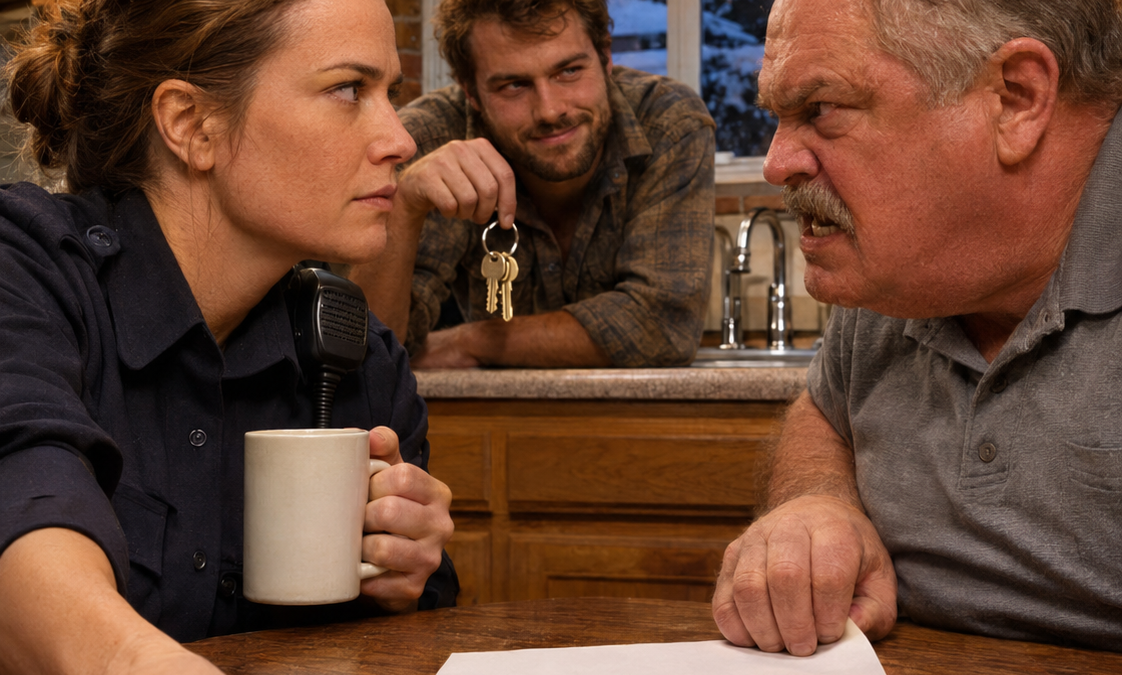
“Seventy-two thousand dollars, or you’re out,” my father said as he slammed a three-day notice onto Grandma’s wooden kitchen table.
The page demanded $72,000 for six years of rent on the house I owned.
Coffee rose toward the rim of my insulated cup. I set the glass pot back on the warmer before anything spilled.
At 6:40 p.m., the small kitchen glowed under a yellow ceiling light. I had already changed into my dark-blue Lyon County dispatcher uniform, and my hair was tied back for the night shift.
Gordie Brandvold stood across from me in a gray polo shirt stretched over his stomach. At sixty-five, my father still used the same posture he had used at his car lot: feet spread, chin raised, as if the room belonged to whoever took up the most space.
My brother, Colt, leaned against the counter.
He was thirty-four, an insurance salesman with a wife, two kids, and a habit of smirking when Dad did his dirty work. A ring of keys turned around Colt’s index finger.
“Seventy-two months,” Gordie said. “December 2019 through November 2025. One thousand a month.”
“You left off this year,” I said.
“I stopped at six years to be fair.”
The paper had a bold heading.
3-DAY NOTICE TO PAY RENT OR QUIT.
Gordie had signed the bottom as the property owner.
He tapped the amount with one thick finger.
“You’ve lived off this family for six years.”
I set my cup on the table.
“Go ahead.”
Colt’s keys kept circling.
“Go ahead with what?” Gordie asked.
“Whatever you think that paper lets you do.”
My father gave me a patient smile, the kind he used on customers who had noticed a bad transmission.
“Be glad we kept the lights on for you this long,” he said. “Your grandmother wanted this house kept in the family. Colt has children. You’re one person taking up three bedrooms.”
I opened the kitchen drawer beneath the counter and took out a manila envelope. The recorded deed had been inside since November 15, 2019.
I slid the document from the envelope, left the empty envelope beside my cup, and pushed the deed across the table.
“Read the name.”
Gordie bent over the page.
The keys stopped in Colt’s hand.
I picked up my coffee and took a sip.
The deed bore the stamp of the Register of Deeds, Lyon County, Kansas. The recording date appeared beneath it. So did the legal description of the small one-story brick house in Emporia.
Gordie’s gaze reached the line naming the owner.
Picking up where the Facebook post left off
His face went stiff.
“Bree Brandvold,” Colt said.
“That’s my name,” I said.
Gordie straightened without touching the document.
“Mom was confused.”
“She signed before a notary.”
“Old people sign things.”
“It was recorded at the county office that day.”
“Then you rushed her over there before anyone could stop you.”
I kept the cup near my chest.
Grandma had been eighty-one in 2019. She balanced her checkbook to the penny, remembered birthdays without a calendar, and could tell whether someone had moved a comb on her bathroom counter.
Gordie knew that.
He also knew she had never liked being spoken for.
“Grandma sold me the house,” I said.
“Mom left her property to me.”
“A will can’t transfer a house she no longer owned.”
Colt closed his fist around the keys.
“Dad said you were staying here because Grandma needed help.”
“I did help her.”
“And after she passed, you just kept living here.”
“I was living in my own house before Dad moved in.”
Gordie looked toward the hallway.
My mother, Jolene, had appeared in the doorway. She wore slippers and held the edge of her cardigan closed with one hand.
Dad and Mom had arrived on March 8, 2025, with suitcases and two cardboard boxes. They needed a place “for a few weeks.”
Twenty months later, their boxes were unpacked, their clothes filled Grandma’s closet, and they had paid me nothing.
“You told us this was Mom’s house,” Gordie said.
“I told you that you could stay for a few weeks.”
Jolene’s mouth tightened.
“Your brother has a family,” she said. “Those children need a yard.”
“They have a home.”
“It’s an apartment,” Colt said.
“It’s still a home.”
Gordie slid the three-day notice closer to my side of the table.
“You can take your little deed to Wendell. He’ll tear it apart.”
Wendell Haverkamp was Dad’s golf friend, a retired lawyer who treated Gordie’s stories like sworn testimony.
“The deed stays recorded whether Wendell likes it or not,” I said.
“You think one stamp makes you smarter than everyone else?”
“No.”
“I handled money my whole life. I ran a car lot for twenty-seven years. When the lender came after me in 2019, I beat the bank.”
The used-car lot had closed before Christmas that year. Gordie had spent the years since telling people he had outsmarted a lender with one tough letter and a steady hand.
He never told the story quietly.
“You couldn’t even afford this place without Mom,” Gordie said. “She carried you.”
I looked past him.
Grandma’s tin sewing box sat on top of the hutch. Its faded lid showed red roses around a gold thimble. She had kept a green notebook inside and written in it on the first day of each month.
I had never asked what she wrote.
Colt pointed toward the deed with the hand holding his keys.
“How much did you supposedly pay?”
“That’s between Grandma and me.”
“So nothing,” Gordie said.
“The county record says otherwise.”
“Mom was confused,” he repeated. “Any judge will see that.”
My work bag rested on a chair near the back door. I hooked the strap over my shoulder with my free hand and left the deed on the table between the notice and the empty envelope.
Gordie glanced at the document.
“You walk out now, you’re agreeing to the notice.”
“No, I’m going to work.”
Jolene stepped away from the doorway.
Colt resumed turning the keys around his finger.
“Dad says we’ll have this settled before New Year’s,” he said.
I opened the back door.
Behind me, Gordie said, “Wendell will be calling.”
I looked at my father across the kitchen he had just tried to evict me from.
“Tell him to leave a message.”
Then I carried my coffee and work bag to the car.
The recorded deed remained on the table.
So did my father’s demand for $72,000.
Part 2 of 7
At 8:12 a.m. on Saturday, November 7, Gordie posted, “Bree conned my mother out of her house,” in the family group chat.
The accusation appeared above a photograph of my recorded deed, with my name circled in red.
I had just finished a night shift.
My phone buzzed on the nightstand while I sat on the edge of my bed and untied my work shoes. The original deed had disappeared from the kitchen table before I returned Friday morning.
Now I knew who had it.
Coral Ashworth, Dad’s younger sister, answered first.
“That is a serious accusation, Gordie. State exactly what Bree did.”
Dad replied within a minute.
“She slipped a deed in front of Mom when Mom wasn’t capable of understanding it.”
Colt added, “Bree never told anyone.”
I watched the typing dots appear and vanish beneath his message.
An aunt asked whether Grandma had signed the deed. A cousin posted a question mark. Gordie ignored them and announced a family meeting for Sunday, November 22, at 2:00 p.m.
He called the address “Mom’s house.”
I did not answer.
In the kitchen, Jolene stood at the sink rinsing a plate. She looked toward me when I entered, then turned back to the faucet.
“Good morning,” I said.
My mother set the plate in the dish rack.
I poured water into a clean glass. Jolene dried her hands, folded the towel over the oven handle, and walked into the hallway without speaking.
That became her method.
If I entered the living room, she found laundry to move. If I asked whether she needed anything from the grocery store, she checked her phone. At dinner, she passed bowls around me without meeting my eyes.
Dad kept the original deed somewhere in the bedroom he and Mom used. I asked once for its return.
“You’ll get your papers after Wendell fixes them,” he said.
On Monday, November 9, a white envelope waited in the mailbox.
Wendell Haverkamp’s name appeared in raised blue letters at the top of the page inside. His letter demanded that I sign a quitclaim deed transferring the house to Gordie before the November 22 meeting.
If I refused, Wendell wrote, Gordie would sue me for “taking advantage of an elderly woman.”
I stood beside the kitchen counter with the envelope in one hand and the letter in the other.
Dad sat at the table eating toast.
“Wendell says you have until the meeting,” Gordie said.
“He’s retired.”
“He still knows the law.”
“So does the Register of Deeds.”
Gordie spread strawberry jam to the edge of his toast.
“A county clerk records what you hand over. That doesn’t make fraud legal.”
“Which part was fraud?”
“You know what you did.”
That answer had sold plenty of bad cars.
I slipped the letter back into its envelope and carried it to my bedroom. A folder in my desk already held Grandma’s purchase agreement, canceled checks, and tax records. I placed Wendell’s envelope inside and closed the drawer.
On Saturday, November 14, a metal click woke me shortly after noon.
I left my bedroom and found Colt in the spare room across the hall. He had extended a tape measure along the wall beneath the window.
“What are you doing?” I asked.
“Checking for bunk beds.”
“Put it away.”
Colt held the metal strip in place with one hand and read the measurement.
“The kids can share this room. We’ll use Grandma’s room, and the other bedroom can be my office.”
“This house isn’t available.”
“Dad says it’ll be settled next Sunday.”
“The deed settled it in 2019.”
Colt released the tape. The strip snapped back into its case, and he clipped the case onto his belt.
“You can get an apartment close to dispatch,” he said. “You work nights anyway. It’s not like you need a whole house.”
He walked past me into the hallway.
Six years earlier, I had sat with Grandma at the same kitchen table where Dad later served me his false notice.
It was Friday, November 15, 2019.
A cashier’s check lay between us, payable to Ione Brandvold for $26,000. The money had come from overtime shifts, holiday pay, and years of taking my lunch to work in a brown paper sack.
Grandma picked up the check and studied the amount.
“Twenty-six thousand down,” she said. “Then one thousand each month for sixty-six months.”
“That makes ninety-two thousand.”
“Correct.”
At eighty-one, Grandma did the calculation without reaching for the pencil beside her.
She placed the check on the table and brought down her tin sewing box from the hutch. After lifting the lid, she removed the green notebook and rested it on top of the closed box.
“I’ll pay on the first,” I said.
“I know you will.”
Grandma tapped the notebook with one finger.
“If Gordie ever says you took this house, show him the book.”
“Why would Dad say that?”
Her eyes stayed on mine.
“Your father hears what suits him.”
Grandma opened her purse, slid the cashier’s check into an inner pocket, and snapped the purse closed.
“Do not discuss what I do with your payments,” she said. “That is my business. You may speak if Gordie says you took the house.”
“I promise.”
She returned the notebook to the tin and closed the lid.
On Tuesday morning, November 17, I came home from work and heard cardboard scraping across the garage floor.
Jolene carried a carton through the connecting door and set it on a folding table beside a row of price stickers. Grandma’s scarves, framed photographs, and ceramic hairdresser figurines filled the carton.
The tin sewing box sat on top.
“What is this?” I asked.
Jolene picked up a black marker and wrote on a sticker without looking at me.
Gordie stood near the open garage door with his hands in his jacket pockets.
“Your mother’s cleaning out Mom’s things,” he said. “We’re selling what nobody wants.”
“I want the sewing box.”
Dad glanced at the faded roses on the lid.
“Take it. Saves us from pricing the junk.”
I lifted the tin from the carton with both hands.
Jolene pressed the sticker onto one of the figurines.
She never said a word.
I carried the sewing box through the kitchen, down the hallway, and into my bedroom. After setting it on my desk, I released the small metal latch and raised the lid.
The green notebook was still inside.
Part 3 of 7
The green notebook accounted for all sixty-six of my $1,000 checks.
Beside each payment from me, Grandma had written where the money went: “for Gordie’s lot: $1,000.”
I lifted the notebook from the open sewing box and set it on my bedroom desk.
The cover had softened at the corners. Grandma’s name appeared inside in the narrow handwriting I had seen on birthday cards and grocery lists since I was a child.
The first dated page began December 1, 2019.
“Bree: $1,000.”
On the line beside it:
“for Gordie’s lot: $1,000.”
January 1, 2020, showed the same pair.
So did February.
March.
The entries continued through the year, written on the first day of each month. Grandma had drawn a straight vertical mark down the center of each page, keeping my payment on the left and her payment on the right.
I pulled open my desk drawer and removed the folder containing my canceled checks. After setting the folder beside the notebook, I matched check dates to Grandma’s entries.
The amounts were identical.
Her book continued through 2021, then 2022. I turned the pages by their lower corners.
For 2023, the ink changed from blue to black, but the words did not.
“Bree: $1,000.”
“For Gordie’s lot: $1,000.”
Dad’s used-car business had closed in 2019. He had spent the years since telling anyone who would listen that its lender had tried to ruin him.
According to Gordie, one letter from Wendell had made the debt disappear.
“I beat the bank in 2019,” he liked to say.
Grandma’s book told a different story.
The final paired entry was dated May 1, 2025.
My check number appeared beside my name. On the opposite side of the page, Grandma had written the lot’s account number and the same $1,000 amount.
Sixty-six monthly payments from me.
Sixty-six monthly payments for Gordie’s lot.
The checks I had given Grandma to buy this house had gone out again to save my father’s business debt.
A notation inside the front cover completed the amount.
“Bree down payment: $26,000.”
Beneath it, Grandma had written:
“November 18, 2019: Gordie’s lot lender: $26,000.”
I put my index finger beneath the figures.
My $26,000 down payment, plus sixty-six checks of $1,000, came to $92,000.
That was the purchase price of the house.
It was also the amount Dad had owed the lender.
A folded sheet protruded slightly beyond the notebook’s final page. I eased it free and opened it on the desk.
The lender’s address appeared at the top. The letter was dated May 13, 2025, twelve days after Grandma recorded the last payment.
Across the middle, in bold capital letters, were the words:
PAID IN FULL.
The letter identified the debt as the remaining obligation connected to Gordie’s car lot. Near the bottom, a separate line named the payer.
Ione Brandvold.
Not Gordie.
Not Wendell.
Ione Brandvold, eighty-seven years old at the time, had finished paying her son’s debt with the money I gave her for this house.
My fingers started trembling against the page.
I laid the letter flat before I bent an edge. Then I pressed my palms to the desk until the shaking eased.
Dad had stood in my kitchen and said Grandma carried me.
For twenty months, he had stayed in the house without paying me anything. Then he demanded $72,000 in rent and called himself generous for leaving this year off the bill.
Meanwhile, Grandma’s ledger showed that my money had been carrying him since December 2019.
A soft knock sounded against my bedroom door.
I closed the notebook, placed the lender’s letter on top, and covered both with the lid of the sewing box. The metal latch clicked under my thumb.
“What?” I said.
Gordie spoke from the hallway.
“Colt needs to know when he can start moving furniture.”
“He can’t.”
“You’re making this harder than it needs to be.”
“I’m not moving.”
Dad’s shoes shifted on the hardwood outside my door.
“Wendell says that deed won’t hold up,” he said. “Once a judge hears what you did to Mom, you’ll be lucky if we don’t make you pay our legal costs.”
I kept one hand on the sewing box.
“Go ahead.”
Gordie waited, perhaps expecting more.
Then his footsteps moved down the hallway.
I listened until the bedroom door at the far end opened and shut.
My phone lay near the edge of the desk. A new message from Colt glowed on the screen.
Need wall measurements today. Kids’ beds won’t fit otherwise.
I turned the phone facedown.
The tin box had a small keyhole, but no key had come with it. I did not need one. Nobody in the house knew what sat beneath the faded roses, and I was not going to announce it in a text message.
Grandma had been precise about when I could speak.
“If Gordie ever says you took this house, show him the book.”
He had said it.
First in my kitchen.
Then in the family group chat.
I reopened the sewing box and removed the lender’s letter. Using my phone, I photographed the front and back, making sure the date, account reference, and payer’s name were clear. I saved the images in a folder labeled November 2026.
Next, I photographed the notebook pages in order. I held the book open with one hand and used the other to take each picture. When I finished, I returned the letter behind the final page and placed the notebook inside the tin.
The box went into my closet beneath folded blankets.
I sat at the desk and wrote one equation on a yellow legal pad.
$26,000 + $66,000 = $92,000.
Below it, I printed the dates.
November 15, 2019: I bought Grandma’s house.
November 18, 2019: Grandma paid $26,000 toward Gordie’s debt.
December 2019 through May 2025: My checks paid the remaining $66,000.
May 13, 2025: The lender named Ione Brandvold as the payer and declared Gordie’s debt paid in full.
I set down the pen.
My father had not beaten the bank.
His mother had paid it with the money I paid her for my house.
Part 4 of 7
A certified copy of my deed cost $13, and I needed it before the family meeting on Sunday.
At 8:17 a.m. on Wednesday, November 18, I stood at the Lyon County Register of Deeds counter and asked for the record filed under my name.
The clerk searched the computer while I kept my work bag against my leg. I had driven there after finishing my night shift, still wearing my dark-blue uniform.
“November 15, 2019?” the clerk asked.
“Yes.”
She turned the monitor enough for me to see the record.
Owner: Bree Brandvold.
The recording information matched the original deed Gordie had taken from Grandma’s kitchen table.
“I need a certified copy,” I said.
“That will be thirteen dollars.”
I took my wallet from my work bag, handed the clerk a ten and three ones, and returned the wallet to the bag. She gave me a receipt, printed the deed, and applied the county certification.
The raised seal left a clean impression near the bottom.
Gordie could hide my original in his bedroom.
He could not hide a public record.
The clerk slid the certified deed across the counter. I picked it up and placed it in the document folder I had brought from home.
“Anything else?” she asked.
“No, thank you.”
I closed the folder and put it inside my work bag.
The previous evening, Aunt Coral had called me shortly after seven.
Her voice was clipped and exact, as if she were reading minutes at a school board meeting.
“I saw Gordie’s photograph of the deed,” she said. “He omitted the recording stamp when he described it to me.”
“He omitted several things.”
“Did you ask him to return the original?”
“Yes.”
“And he refused?”
“He said Wendell would fix it.”
Coral paused.
“Wendell cannot unrecord a lawful deed because your father dislikes the grantee.”
I sat at my bedroom desk with the sewing box in front of me. The lid stayed closed.
“Were you with Grandma when she signed?” I asked.
“I drove Mother to the bank on Friday, November 15, 2019.”
That was the first time Coral had told me.
“What happened there?”
“The notary reviewed the deed with her. I was present as the witness.”
“Did Grandma explain what she was doing?”
“Clearly.”
Coral’s answer came without hesitation.
“The notary asked Mother to state the transaction in her own words. Mother said, ‘I am selling my house to Bree for $92,000. She is paying $26,000 now and $1,000 a month for sixty-six months.’”
I touched the sewing box latch but did not lift it.
“Did anyone prompt her?”
“No. The notary asked whether anyone had pressured her. Mother said no. Then she explained that the house was hers to sell and that you had earned the money.”
Coral’s voice sharpened.
“Your grandmother was eighty-one, Bree. She was not confused. When the notary misstated the monthly payment date, Mother corrected her.”
“What did she say?”
“‘The first of the month, not the fifteenth.’ Then she pointed to the paragraph.”
That matched the notebook.
Grandma had entered each payment on the first, just as she promised.
“Why didn’t Dad know you were there?” I asked.
“Mother asked me for transportation and a witness. She did not ask me to report her private business to Gordie.”
Coral let the sentence sit for a moment.
“After the deed was signed, Mother made certain it was sent for recording that day,” she continued. “She would not leave the bank until the arrangement was confirmed.”
“Will you say that on Sunday?”
“I will state precisely what I saw.”
“Thank you.”
“Are you hiring an attorney?”
“If Dad files a lawsuit, I’ll speak to one.”
“Wendell’s letter threatens a lawsuit.”
“Wendell’s letter also demands that I sign away my house before the meeting.”
Coral made a quiet sound through her nose.
“He is representing friendship as legal analysis.”
“I’m not arguing with him in private.”
“What do you intend to do?”
“Dad accused me in front of seventeen relatives. He called those same seventeen to my living room.”
Coral waited.
“I’ll answer in front of them.”
“I will be there at two o’clock,” she said.
After leaving the county office Wednesday morning, I drove home and carried my work bag through the kitchen.
Jolene sat at the table with a grocery circular. She looked at my bag, then lowered her gaze to the coupons.
Gordie’s coffee cup rested in the sink, but Dad was not in the room.
I continued to my bedroom and shut the door.
The certified deed went on my desk. I took the tin box from the closet, removed the notebook, and laid it beside the county copy.
My phone showed new activity in the family group chat. I opened it long enough to see another message from Dad.
Sunday will settle who the house belongs to.
I did not post the deed.
I did not post the lender’s letter.
A photograph would have given Gordie four days to invent another explanation. The notebook belonged in Grandma’s house, open beneath the same yellow kitchen light where Dad had called me a thief.
I opened my laptop and created a spreadsheet.
The first column held the payment date.
The second repeated Grandma’s entry for me.
The third repeated her matching entry for Gordie’s lot.
I transcribed the ledger from December 1, 2019, through May 1, 2025. Each row showed $1,000 received from Bree and $1,000 paid for Gordie’s debt.
When the sixty-six rows were finished, I checked each date and amount against Grandma’s handwriting.
Then I saved the file.
That afternoon, after sleeping for several hours, I carried my laptop and document folder to a copy shop on Commercial Street. At a self-service station, I printed the spreadsheet in landscape format on one 11-by-17-inch sheet.
The type was small but readable.
The first row began with December 1, 2019.
The last ended with May 1, 2025.
I placed the sheet behind the certified deed. The lender’s letter would remain tucked inside the original notebook until Sunday.
Wendell expected a signed quitclaim.
Gordie expected a confession.
I was bringing Grandma’s accounting.
Part 5 of 7
The quitclaim deed would transfer my $92,000 house to Gordie for nothing.
At 2:00 p.m. on Sunday, November 22, he placed it on my coffee table with a black pen.
Seventeen relatives filled my living room. Wendell Haverkamp was the only person present who was not related to us.
I sat in a straight-backed chair near the coffee table with my document folder across my knees. Grandma’s tin sewing box rested beside my right foot.
Gordie occupied the middle of the sofa. Jolene sat rigidly at one end, while Colt stood near the hallway with his arms crossed.
Aunt Coral had taken the armchair by the front window.
Wendell sat beside the coffee table with a leather folio open on his lap. A copy of his November 9 threat letter was clipped inside.
Gordie tapped the quitclaim deed.
“Sign it, and we can stop embarrassing this family.”
“I’m not signing.”
“You took advantage of your grandmother.”
“No.”
His mouth curved into the patient smile he had used in my kitchen.
“You’ve lived off this family for six years.”
I opened my folder.
The certified deed came out first. I set it beside the quitclaim.
“This was recorded on November 15, 2019,” I said. “It names me as the owner.”
“We’ve seen your paperwork,” Gordie said. “That doesn’t prove Mom understood what you did.”
I removed the 11-by-17-inch spreadsheet and unfolded it across the table. Sixty-six rows ran down the page.
Colt leaned forward from the hallway.
“What is that?”
“Grandma’s accounting.”
I closed the folder, placed it beneath my chair, and lifted the sewing box onto my lap. The metal latch released under my thumb.
Nobody spoke while I took out the green notebook.
I set the open tin on the floor and turned to the first payment page.
“December 1, 2019,” I said. “‘Bree: $1,000.’ Beside it, Grandma wrote, ‘for Gordie’s lot: $1,000.’”
Dad’s smile disappeared.
I moved down the page.
“January 1, 2020. ‘Bree: $1,000.’ Then, ‘for Gordie’s lot: $1,000.’”
Jolene looked at Gordie.
I turned several pages.
“July 1, 2022. Same entries. October 1, 2024. Same entries.”
“Mom could write anything she wanted in a notebook,” Gordie said.
“She recorded the check numbers.”
I opened to the final page.
“May 1, 2025. ‘Bree: $1,000.’ Across from that, ‘for Gordie’s lot: $1,000.’”
My fingers remained steady on the paper.
“The first entry was December 2019. The last was May 2025. My $26,000 down payment went to your lender on November 18, 2019. After that, every monthly check I gave Grandma became a monthly payment on your debt.”
Colt lowered his arms.
“You said Wendell got the debt forgiven,” he said to Dad.
“He did,” Gordie said. “He sent the lender a letter.”
Wendell looked up from his folio.
“I disputed certain fees and asked the lender to delay collection,” he said. “My letter did not erase $92,000.”
Gordie turned toward his friend.
“You told me you handled it.”
“I told you I wrote to them. You later said the matter had been resolved.”
“It was resolved.”
“Yes,” I said. “Grandma resolved it.”
A folded page remained tucked behind the notebook’s back cover. I removed it, opened it, and placed it on the end table beside Wendell’s right hand.
“I paid for this family for six years. Sixty-six checks, Dad. They paid your debt.”
Wendell picked up the letter.
His eyes moved from the date to the account reference, then down to the line near the bottom.
“Dated May 13, 2025,” he said. “‘Paid in full.’”
He stopped.
Gordie stared at the letter in Wendell’s hands.
“Read the payer,” I said.
Wendell adjusted his glasses.
“Payer: Ione Brandvold.”
One of my uncles shifted in his folding chair.
“So Gordie didn’t pay it?” he asked.
Wendell kept his attention on the lender’s page.
“This letter says Ione paid the obligation.”
“With Bree’s money,” Coral said.
Dad pushed himself up from the sofa.
“Mother could spend her money however she wanted.”
I stayed seated with the notebook open in my hands.
“Yes. She sold me her house. The purchase money belonged to her.”
“That doesn’t make it right,” Gordie said.
“It makes it a sale,” Wendell replied.
Gordie faced him.
“You’re supposed to be representing me.”
“I was trying to resolve a family property dispute. I did not know about this ledger or the lender’s letter.”
Wendell set the paid-in-full letter on the end table. He removed his threat letter from the clip inside his folio and folded the page once.
“There’s no case here, Gordie.”
“You haven’t heard Coral yet,” I said.
Coral rose from the armchair.
Dad pointed toward the hallway.
“You don’t need to pile on.”
“I will state what happened,” Coral said. “You may sit down or remain standing.”
Gordie stayed beside the sofa.
Coral faced the room.
“On November 15, 2019, I drove Mother to the bank. I witnessed the signing. The notary asked Mother to describe the transaction without assistance.”
“What did she say?” one of my aunts asked.
“She said she was selling her house to Bree for $92,000. She identified the $26,000 down payment and the sixty-six monthly payments of $1,000.”
Coral glanced at Gordie.
“The notary misstated the due date. Mother corrected her. She said the payments were due on the first of the month, not the fifteenth.”
“Mom was eighty-one,” Gordie said.
“She was also competent,” Coral replied. “She answered the notary’s questions, signed voluntarily, and made sure the deed was recorded that day.”
Wendell returned the folded threat letter to his folio.
“A deed signed for money before a notary, witnessed by Coral, and recorded the same day is not evidence that Ione was confused,” he said. “The payment history supports the sale.”
Gordie looked at Jolene.
My mother stared at the quitclaim on the coffee table.
Colt stepped away from the hallway.
“What about the room measurements?” he asked.
“They are measurements of Bree’s room,” Coral said. “They have nothing to do with you.”
Gordie snatched the quitclaim deed and pen from the table.
“This was private family business.”
One of Dad’s brothers gave a dry cough.
“You put Bree’s name in the family chat,” he said. “You made it public.”
I closed Grandma’s notebook.
Gordie looked around my living room, but nobody asked him how he had beaten the bank.
Part 6 of 7
The $92,000 debt had been paid, and Gordie had produced no proof that he contributed a dollar.
Before anyone left my living room, Wendell made clear that the house was not part of Grandma’s estate.
Dad remained standing beside the sofa with the quitclaim deed and pen in his left hand. His right hand rested on the back cushion.
Wendell closed his folio.
“Ione’s 2010 will leaves you what she owned when she died,” he said. “She did not own this house on August 13, 2026.”
“She lived here until she died,” Gordie said.
“With my permission,” I said.
“She was your grandmother.”
“Yes.”
“You’re going to use that against me now?”
“No.”
Gordie waited for an argument I did not give him.
Wendell removed a single-page estate inventory from the back of his folio and held it out. Dad took the inventory with his right hand.
“The estate consists of her 2011 sedan and $3,100 in savings,” Wendell said.
Gordie scanned the page.
“What about her furniture?”
“Ordinary household contents have minimal estate value. Some of those items were already carried into the garage for sale.”
Jolene’s fingers curled around the edge of the sofa cushion.
“I was cleaning,” she said.
Coral looked at the open tin sewing box near my chair.
“You nearly sold Mother’s records,” she replied.
“I didn’t know what was in there.”
“That is why you ask before putting a price sticker on another person’s belongings.”
Jolene stood and walked into the hallway.
Dad held the estate inventory in his right hand and the quitclaim with the pen pressed against it in his left.
“Mom wanted me to have everything,” he said.
“She left you everything she owned,” Wendell said. “That is the sedan and the savings.”
“The house should count.”
“It was sold nearly seven years before her death.”
Gordie turned his head toward me.
“You knew the will favored me.”
“I knew Grandma sold me the house.”
“And you never thought your father deserved to know?”
“Grandma told me the sale was private.”
Dad’s older brother rose from a folding chair and buttoned his jacket.
“So the story about beating the bank was a lie,” he said.
“I never lied,” Gordie replied. “I said the lender backed off.”
“Your eighty-one-year-old mother paid them $26,000 three days after the house sale.”
Gordie looked down at the inventory.
His brother continued.
“Then she sent Bree’s $1,000 checks to them for sixty-six months. That is not a lender backing off.”
Another uncle pushed his chair toward the wall.
“We heard that bank story at Christmas for years.”
“Then you heard it wrong,” Dad said.
“You told it,” Coral replied.
Relatives began collecting coats from the bed in the spare room. They left in small groups, speaking quietly near the front door.
One aunt stopped beside my chair.
“I’m sorry we let him say those things about you,” she said.
I placed the notebook inside the sewing box.
“You know the truth now.”
She touched my shoulder, then joined her husband near the entry.
Colt stayed by the hallway while his cousins passed him. Nobody asked about his plans for the bedrooms.
Wendell picked up the paid-in-full letter from the end table and offered it to me. I took the page, folded it along its original crease, and returned it behind the notebook’s back cover.
“The letter I sent you should not have demanded a quitclaim without a full review of the records,” he said.
“It shouldn’t have.”
“I will not pursue this matter for Gordie.”
Dad’s head came up.
“You’re walking away because they ganged up on me?”
“I am stepping back because the documents establish ownership, payment, and your mother’s intent.”
Wendell lifted his folio from his lap and stood.
“Do not use my name on another demand concerning this house.”
“You were happy to help before Bree put on her little show.”
Wendell glanced at the spreadsheet on the coffee table.
“An account ledger is not a show.”
He carried the folio toward the front door. Coral followed him and paused beside Dad.
“Mother protected you from the consequences of your debt,” she said. “Bree kept her promise to Mother. You repaid them by accusing Bree of theft.”
“You always took Mom’s side,” Gordie said.
“She was right.”
Coral left with Wendell.
I slid the certified deed and spreadsheet into my document folder, then tucked the folder beneath one arm. With my free hand, I closed the lid and lifted the sewing box from the floor.
Only Dad, Colt, and I remained in the living room. Jolene had not returned from the hallway.
Colt looked at the tin.
“Did Grandma ever write that she wanted you to keep the house?”
“She signed the deed.”
“I mean personally.”
“The deed is personal enough.”
Dad folded the quitclaim around the pen.
“You think one meeting changes how people see you?”
“I showed them Grandma’s records.”
“You humiliated me.”
“You called me a thief.”
He shoved the folded quitclaim and pen into his pants pocket.
“You could have told me privately.”
“You accused me in front of the family.”
Dad looked toward the front door, where his brothers had just left.
“This isn’t over.”
“Go ahead.”
I carried the sewing box and folder to my bedroom.
After setting the tin on my desk, I put the folder in the drawer and closed it. The box returned to the closet beneath the folded blankets.
My phone stayed quiet through the evening.
No relative posted another message in the family group chat. Gordie’s accusation remained on the screen beside the photograph of my deed, but now everyone who had seen it knew where my purchase money had gone.
The man who claimed he beat the bank would inherit a 2011 sedan and $3,100 from the woman who paid his $92,000 debt.
Part 7 of 7
My written notice gave Gordie and Jolene 30 days to leave the house they had occupied without a lease or rent.
On Tuesday, December 1, I handed it to Dad across the same kitchen table where he had demanded $72,000 from me.
Jolene sat near the window with her hands around a mug. Colt leaned against the counter, but he had no keys to spin.
Gordie took the notice and checked the date.
“December 31?”
“Yes.”
“You can’t throw your parents into the street in winter.”
“It is a lawful 30-day notice.”
“You said family was welcome here.”
“I said you could stay for a few weeks.”
Jolene looked into her mug.
Dad read the termination paragraph.
“No locks changed. No utilities shut off,” he said.
“I know the law.”
“Then you know we have rights.”
“That notice respects them.”
Colt pushed away from the counter.
“What are we supposed to do now?”
“You have an apartment.”
“Not after December.”
Dad lowered the notice.
“What does that mean?”
Colt rubbed the back of his neck.
“I told the landlord we’d be out by December 31. I thought we were moving here before New Year’s.”
“You gave up your apartment before Bree signed anything?” Jolene asked.
“Dad said it was handled.”
Gordie placed the notice on the table.
“It should have been.”
Colt looked at me.
“My wife and kids are involved now.”
“I never offered your family this house.”
“My sister said we can use her basement in Topeka,” Jolene said. “Until something opens.”
Dad turned toward her.
“The basement?”
“It has a bathroom and a separate entrance.”
“For how long?”
“She said all of us can stay while Colt finds another apartment.”
Gordie looked from Jolene to Colt, then back to me.
“You’re forcing your brother’s children into a basement.”
“Colt gave notice on his apartment.”
“You could stop this with one word.”
“No.”
Dad pushed the written notice away from himself. It traveled several inches across the table and stopped.
I picked it up and held it out again.
“You need to keep your copy.”
He stared at the page before taking it.
“You’ve always been cold, Bree.”
“December 31,” I said.
On Thursday, December 31, a rented box truck backed into my driveway at 8:10 a.m.
Colt carried boxes from the hallway while his wife arranged them inside the truck. Their children waited in the heated cab with activity books across their knees.
Jolene moved through the kitchen with her purse over one shoulder and a suitcase in her right hand. She stopped beside the table.
“I left the bathroom clean,” she said.
“Thank you.”
“You could have given us another month.”
“The notice was for 30 days.”
“That isn’t what I asked.”
I did not answer.
Jolene carried the suitcase through the back door. Colt took it from her on the step and loaded it into the truck.
Gordie entered the kitchen holding a cardboard file box against his chest. He set the box on the counter, opened its lid, and removed a red folder.
My original recorded deed came out of that folder.
He laid the deed flat beside the coffee maker.
“You left this on the table,” he said.
“You took it.”
“I kept it safe.”
I checked the county stamp without lifting the page.
“It belongs with me.”
“The house never should have.”
Dad put the red folder back into his file box and closed the lid.
“Mom would hate what you’ve done.”
“Grandma signed the deed.”
“She wanted to save my business.”
“She did.”
His jaw tightened.
“That money was hers once you gave it to her.”
“Yes.”
“You don’t get to claim you paid my debt.”
“The lender’s records say where the payments went.”
Dad lifted the file box.
“I don’t owe you anything.”
“I didn’t ask you for repayment.”
That stopped him near the doorway.
For a second, he seemed to search for another charge to make. Then he carried the box outside.
At 4:35 p.m., Jolene returned to the kitchen. She placed the house keys on the counter beside the original deed.
“Colt says we need to leave now if we’re going to reach Topeka before dinner,” she said.
“Drive safely.”
Mom looked toward the hallway.
“This was my home too.”
“For almost twenty-two months.”
Her mouth tightened. She walked through the back door without saying goodbye.
Gordie did not come inside again.
Colt backed the box truck out of the driveway, and Dad followed in Grandma’s old sedan. Jolene rode in the passenger seat beside him.
They were headed to her sister’s basement in Topeka: Gordie, Jolene, Colt, Colt’s wife, and their two children.
I left the keys where Mom had placed them.
The heat remained on. So did the porch light.
On Friday, January 1, 2027, I carried Grandma’s tin sewing box from my bedroom closet to the kitchen table.
Morning sun reached across the wood where the three-day notice, the recorded deed, and the quitclaim had each rested.
I opened the tin and removed the green notebook.
Grandma’s final entry was dated May 1, 2025. Beneath it, she had recorded my last $1,000 check and the matching payment for Gordie’s lot.
I turned to the next blank line and picked up a pen.
Grandma had written in the book on the first day of each month. I did the same.
“January 1, 2027 — Bree is home.”
Under that, I added the words Grandma had earned.
“Paid in full.”
THE END
More stories
My Husband Tapped the $1,067 Payment Line on My Paid-Off House—Then the Loan Officer Asked One Calm Question and Put Two Cancellation Notices in My HandsMy 72-Year-Old Former Mother-in-Law Mocked Me Over the Arena Speakers Before 412 People—Then the Manager Walked Past Her Son With the Pen, and the $200,000 He’d Collected Had to Go BackMy 71-year-old mother-in-law drove a moving truck onto my lawn and claimed my cottage—Then my late husband’s sealed envelope led me to the deed that ended her ownership story.My Landlord’s Son Ordered 43 Households Out by March 31—Then His 81-Year-Old Mother Refused to Sign, and All 43 Households Bought the Land Themselves Instead
You Might Also Enjoy

My Daughter-In-Law Told Me To Stay Elsewhere While Strangers Took My Condo — Then I Pushed Back







