My 71-year-old mother-in-law drove a moving truck onto my lawn and claimed my cottage—Then my late husband’s sealed envelope led me to the deed that ended her ownership story.
Complete story · 7 parts · about 31 minutes · ending included
Part 1 · Part 2 · Part 3 · Part 4 · Part 5 · Part 6 · Part 7
Part 1 of 7
The rented moving truck backed across my lawn and folded three tomato cages under its right rear tire.
Joyce Lund leaned over the wheel, braked beside the garden, and looked straight at me through the open window. “I sold my house for a hundred and ninety thousand dollars, and this is where I’m going to live. Eric promised me.”
It was 9:40 Sunday morning.
I still had my coffee mug in one hand. Six neighbors were coming up Tioga Street from Grace Lutheran, church bulletins tucked under arms, when my seventy-one-year-old mother-in-law opened the driver’s door and jumped down from the cab she had driven herself.
The back of the truck stood open behind the crushed wire frames. A white refrigerator had been strapped near the edge, with a mattress upright beside it.
Joyce held up her old key.
“Did Eric say that, or did you?” I asked.
Her chin lifted toward the fence.
Russ Aho had stopped on the other side, still wearing his brown church jacket. The other five neighbors slowed with him.
Joyce raised her voice so they could all hear.
“You married into this dirt, Kerri. You don’t own a blade of it.”
I set my mug on the flat cap of the fence post.
“Mind the step.”
The one-bedroom cottage stood behind the main house, past the row where my tomatoes had been. Eric had built the place himself, right down to the narrow porch and the one crooked step under the door.
I walked ahead of Joyce and took the spiral notebook from my cardigan pocket. On a clean page, I wrote 9:47 beside one short line.
Moving truck. Joyce arrived with old key.
“If it isn’t charted, it didn’t happen.”
As the school nurse, I had said that to new aides for years. Bandages, inhalers, playground falls, pickup calls. If I wrote the time, I did not have to argue later about when something started.
Ben, my eleven-year-old, stood at our back door in his socks, one hand on the frame. He stared past us at the open truck.
“Why did Grandma bring a whole refrigerator?”
Joyce did not answer him.
She came up the cottage walk and pushed the key into the lock.
The metal went halfway in and stopped.
She pulled the old key out, tried again, then put one palm against the door and twisted harder. The cylinder did not move.
I had the lock replaced after the last tenant left.
With her back to the door, she faced the neighbors.
“She changed my locks.”
The first drops of rain marked the porch boards.
Russ stayed where he was. One woman folded her church bulletin lengthwise. Another neighbor looked from the jammed lock to me.
Nobody said a word.
I did the math the way I did when two children arrived in the health office at once. Joyce was seventy-one. Rain had started. Six people remained at the fence. The cottage was dry.
My new key sat on the key ring clipped inside my cardigan.
I worked the key free and placed it in Joyce’s open hand.
“For tonight.”
Her fingers closed around the key.
Then she faced the fence again.
“For good.”
I stepped back from the door.
The key turned on the first try.
Joyce walked inside with her purse, and I went in behind her. She looked around the front room as if someone had asked for an inspection. The cottage was small enough that you could see the kitchen counter from the sofa, and the bedroom door opened beside the single clothes closet.
Above us, Eric’s wooden canoe hung from two padded hooks screwed into a rafter.
Eric and Ben had built it together, and Eric had been dead three years.
Joyce pointed overhead.
“That takes up too much room.”
Ben had followed us as far as the crooked step, still in his socks. “Dad made that.”
“I know who made it, sweetheart.”
She walked under the canoe without looking up again. “Go put your shoes on, Ben,” I said. He went.
I stayed beside the cottage door while rain tapped against the windows.
The main breaker had been off the whole time the place sat empty. Joyce had already crossed into the bedroom when she called from out of sight.
“Why’s there no power in my house?”
“The breaker is off.”
I went to the closet.
Inside were an empty wooden rod, two wire hangers, and the breaker box on the back wall. I opened the little door and pushed the handle upward.
It stuck halfway, so I set the heel of my hand against it and shoved.
The bulb came on.
The inner cover, held by two loose screws, popped free.
I caught it before it hit the floor.
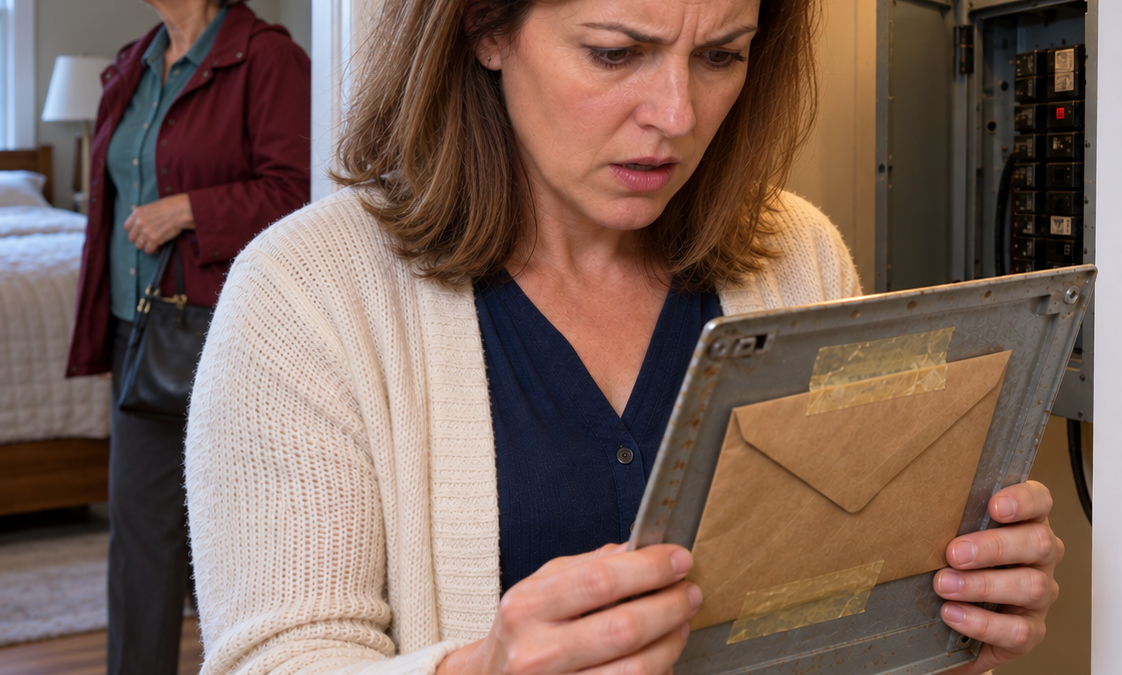
A brown envelope was taped to the back.
Beyond the wall, Joyce’s shoes kept moving around the bedroom.
I held the metal cover under the bulb. The tape had gone yellow, and the flap was still sealed.
On the front, in my late husband’s ballpoint handwriting, was one line.
“K — when Mom comes for it.”
Picking up where the Facebook post left off
I peeled the envelope off, shut it inside my spiral notebook, and pressed the cover back over its two screws.
“Power’s on, Joyce.”
Part 2 of 7
I set the brown envelope beside my spiral notebook on the main-house kitchen table.
Eric’s ballpoint still said, “K — when Mom comes for it.” Joyce had come for it that morning, and she was behind my house now with my key.
The flap was sealed.
My medical scissors sat in the top kitchen drawer with the tape and thermometer batteries. I took them out and snipped the short end of the envelope. I left the flap alone.
One paper slid into my hand, folded in thirds.
QUIT CLAIM DEED.
Below that were Joyce’s name, Eric’s name, a notary seal, and a Recorder’s stamp dated September 18, 2017.
The first line read, “Grantors Joyce M. Lund and Eric Lund hereby convey and quitclaim to Eric Lund and Kerri Lund, as joint tenants, real property in St. Louis County, Minnesota.”
I knew my own name.
I did not know “Grantors.”
The words after my name meant nothing to me either.
I folded the deed back along its old creases, returned it to the envelope, and put that inside my notebook. Then I told the school I needed a long lunch the next day.
Monday, at the County Recorder’s office in Room 101, I paid $10 for a certified copy and carried it back to work.
Tuesday, I put the envelope on real estate attorney Dale Niemi’s desk.
He drew the paper out through the snipped end.
“Start here,” I said, pointing to the words. “Grantors.”
“The people giving the land up.”
“Joyce and Eric?”
“Yes.”
I moved my finger farther down. “Joint tenants.”
“Two names on one piece of land. Whichever one lives keeps all of it.”
I looked at him. “So after Eric was gone?”
“When Eric died it came to you whole.”
“My name on the tax bill is real, then.”
“It is.”
“Joyce said that was only paper for the county.”
Dale kept one finger on the deed.
“Your mother-in-law gave up her share nine years ago, so she could get off the loan.”
“She signed this?”
“Her signature is notarized.”
“And you knew?”
“I filed your name in ’23 on the strength of that deed. You never read it.”
“I filled out loan papers in 2017.”
“On another day. The loan file shows that.”
I shook my head.
Dale tapped the Recorder’s stamp.
“The county’s had this deed since 2017. What I never saw was this envelope.”
I looked at the yellowed tape still stuck to the brown paper.
“Why did Eric put my name on it and say nothing for six years?”
Dale opened the old loan file on his desk.
“The new loan had both your names, so the bank wanted both on the land. That’s what the file says. It doesn’t say what he thought.”
I laid the certified copy beside my notebook.
“Can I put Joyce out?”
“You put a key in her hand in front of witnesses. No lock changes. No shutting off that breaker.”
“So what can I do?”
“Written notice, three months, on paper, Kerri.”
I slid the original into its envelope and the copy into my work folder. Neither paper stayed behind in Dale’s office.
I called the police non-emergency line from his parking lot and was told it was a “civil matter.”
That afternoon, I brought the notice to the cottage.
Joyce opened the door with my new key hooked on one finger.
“This ends December 15,” I said.
She skimmed the page, walked to the refrigerator, and pinned it to the front with a square magnet.
“I found the deed you signed in 2017.”
Joyce turned back.
“The quit claim deed. Your signature. Eric’s. Recorder’s stamp.”
I handed her nothing.
Joyce did not blink.
“That was bank paperwork, sweetheart. Eric promised me this dirt.”
The next morning she walked into my kitchen without knocking.
I had just rinsed a white plate and set it in the rack. Joyce picked it up, washed it again, and stood it back in the same slot.
Then she turned every mug handle to the right.
“Eric never liked it that way.”
I took my notebook from the cardigan pocket and wrote the time.
Saturday, a white work truck stopped behind the house, and a surveyor began driving wooden stakes across the backyard. Pink ribbon snapped from each one.
I went outside.
“Who hired you?”
He rested the mallet against his boot.
“The owner hired me.”
“What name?”
He paused. “I was told she was the owner.”
I wrote that in the notebook and called Dale.
He sent the surveyor a letter barring him from the land, then phoned me back.
“Stakes aren’t a filing. Leave them be. I’ll ask Planning if there is one.”
At the fence, Russ watched Joyce inspect the pink ribbon.
She gave him a small smile.
“Just tidying up what’s mine.”
I wrote that down too.
Later, Ben came into the kitchen carrying the family tablet.
He had been looking for pictures of the canoe. The screen showed my own account.
“It’s on Grandma’s page. What room’s robin’s egg blue?”
I took the tablet.
Joyce’s post was dated Sunday, August 9.
“Picked my paint for my new room at Shelby’s! Robin’s egg blue!”
Back in 2023, I had unfollowed Joyce’s page.
I had never seen the post.
My notebook lay open on the table. I wrote the date and the words exactly.
Sunday night at 10:15, Neil Ostby called. He was married to Eric’s sister, Shelby.
His voice was low. A garage door shut behind him.
“She wired Shelby one seventy-two in July, Kerri. That blue room’s been ready since August. She doesn’t need your cottage.”
“Say that to the neighbors.”
“I can’t.”
The line went dead.
Part 3 of 7
Saturday, September 26, Joyce drove a wooden post into my front lawn and nailed a Zoning Notice sign to it.
The notice named Tuesday, October 13, for a Planning Commission hearing on a request to split the lot at 41 Tioga Street.
Russ Aho knocked before lunch with a city letter in his hand.
The first line named “Joyce Lund, owner” as the applicant.
“Well, now. Joyce showed me her 2012 deed. Says it’s always been hers, and you want her out by Christmas. Is that so?”
“Did the city send me one?”
Russ glanced at the address block.
“I figured you got one too.”
The city’s copy for this lot would have gone to the applicant at 41 Tioga, which meant Joyce.
Russ held the envelope against his jacket.
“The neighborhood association meets Tuesday the sixth. Folks are going to ask.”
My $10 certified copy was inside the house.
I left it there.
When the Zoning Notice went up, I had called Dale. Planning had not answered him yet.
“Don’t wave paper in a yard. Every fight gets her more audience. Read it once, where somebody’s taking minutes.”
Russ waited on the step.
“Ask me at the meeting, Russ.”
He tucked the city letter under his arm.
“All right.”
Across the yard, Joyce stood beside the wooden post.
She was brushing sawdust off her gloves, in no hurry.
That afternoon, Ben came home from Russ’s with his face gone white.
“Dad’s canoe is in Mr. Aho’s garage.”
I put down the dish towel.
“What did he say?”
“He paid Grandma fourteen hundred dollars for it. I didn’t say anything. He was so happy about it, and he said it was Grandma’s to sell.”
Russ did not know the canoe belonged to Ben.
“Did Dad ever say Grandma could sell it?” Ben asked.
“No.”
I crossed the yard to the cottage.
Through the side window, the hooks where Eric’s canoe had hung were empty.
Joyce opened the door with the new key in her hand.
“You sold Ben’s canoe to Russ.”
“It’s Lund property, and I needed the room.”
“It was Eric’s. Ben gets it.”
Joyce leaned one shoulder against the frame.
“Then you can be the one who explains it to him.”
I went back to the house and called Dale with my jacket already on.
“I’m walking over there.”
“Write it down. Russ bought it in good faith, and it’ll keep in his garage. Ask now and he has to pick a side before he runs that meeting.”
I ended the call.
From the kitchen window, I looked toward Russ’s place.
I could still walk over.
I hung my jacket on the chair instead.
The spiral notebook came out of my cardigan pocket.
Canoe $1,400.
Ben sat at supper with his small paddle laid across his knees. It belonged in his room, beside the dresser.
He did not speak to me through meatloaf, green beans, or the glass of milk he usually finished first.
When I stood to clear the plates, he finally lifted his head.
“Are you really kicking Grandma out in the snow?”
I set his plate beside the sink.
Ben carried the paddle upstairs with him.
Monday, September 28, before classes, I printed Joyce’s August 9 post in the school nurse’s office and put the page in my work folder.
At the Planning counter, I handed Heidi Sandvik the certified copy.
“She filed as owner,” I said. “The county record is in my name.”
Heidi checked the ownership entry on her screen, printed one search sheet, and clipped the copy and that sheet into the application file.
“I can flag it for the city attorney today. I can’t rule on title across a counter. The notices are out, and only the applicant can withdraw.”
My copy stayed in Heidi’s file as I left.
Upstairs in Room 318, I filled out the City Clerk’s form asking for the whole application file.
The clerk took the request.
“Planning has to pull the file. Try Friday.”
Outside, I phoned Dale.
“The earliest Joyce has to leave is still December 15?”
“Still December 15.”
I put the phone away.
If the hearing went ahead and Joyce stayed, I would come out of winter still headed to court against my son’s grandmother, with the whole street already on a side.
I noted that in my notebook before I returned to school.
Wednesday, September 30, a parent from Tioga Street collected her daughter at the pickup line and spoke only to the teacher beside me.
She would not look at me.
A petition lay on the bench by the school gate.
LET JOYCE STAY.
Twenty-two signatures filled two pages.
That night I pulled up a real estate agent’s number and stopped before making the call.
On the way home I had picked up a listing form for the whole house and land.
Address: 41 Tioga Street.
Three bedrooms.
One backyard cottage.
The box for asking price stayed blank.
I completed part of the next section, then set the listing form on the kitchen table.
Friday, October 2, at noon, I picked up the copy of the file and sat alone in my parked car.
I read each sheet the way I read a student’s chart.
Date.
Name.
Claim.
Attached papers.
The variance section said the request would be judged on “practical difficulty.”
Joyce must have written something herself to ask for sympathy.
I kept turning pages.
Near the end was a contract.
The back lot had been sold for $96,000 to North Ridge, a small local builder.
I turned that page over.
Clipped behind it was a typed statement attached to the application, with Planning’s received stamp and Joyce’s signature: “Daughter’s funds are gone. Must close by November 13.”
Part 4 of 7
Joyce carried a plate of waffles to the Koskis’ front door Saturday morning, October 3, with the “Let Joyce Stay” petition tucked under her arm.
She had twenty-two signatures. Now she wanted bodies in the chairs at Tuesday’s neighborhood meeting, with every face turned my way.
I watched from the kitchen while Mrs. Koski accepted a waffle wrapped in a paper napkin.
Joyce pointed at my house, then toward Grace Lutheran. Mrs. Koski nodded.
By the time Joyce crossed to the next driveway, two neighbors had come outside to hear her.
Shelby pulled up in a new silver car before lunch. She parked along the curb and hurried across the lawn to hug her mother.
Mrs. Koski was still outside.
“Mom just wants a little peace,” Shelby said.
Joyce kept an arm around her daughter’s waist until the neighbor went inside.
Then Shelby drove away.
My mother-in-law came to my kitchen door carrying the nearly empty plate.
“Tuesday evening, sweetheart. I’m inviting the whole block.”
“I know about the meeting.”
“Good. Bring your son Tuesday. He should see how a family keeps what’s theirs. Sign what I bring you before the hearing, sweetheart, and all of this goes away. Or sit in front of forty people.”
She smiled as though she had offered me a choice of desserts.
“Forty?”
“That’s what I’m expecting. This neighborhood cares about its own.”
She had not finished the block yet.
“What do you want me to sign?”
“You know what needs fixing.”
“Bring it in writing.”
She carried the plate back across the yard.
I opened my spiral notebook on the counter.
October 3. Joyce needs my signature by the 13th.
Russ stopped by that afternoon.
“Well, now. She’s telling every door your paper’s just bank paperwork. Showing the petition, too.”
“Did she show you anything from 2017?”
“Only what I told you about. Her old deed.”
“Ask me Tuesday, Russ.”
He studied the front step.
“I will.”
When Russ left, Joyce was sitting outside the cottage, speaking to another neighbor over the fence.
I had named the 2017 deed to her face. She knew I had spoken with an attorney.
Still, she was collecting people.
Joyce did not care what her signature said as long as the neighbors believed her.
On Friday afternoon, right after reading the file, I had emailed Dale a picture of the $96,000 contract. Dale was in court and promised to call back.
He phoned Sunday morning, October 4.
“Why is the city still going ahead when it already has the paper?”
“City attorney has it. It goes in the staff report for the hearing. Nobody pulls a hearing over title in a week.”
“But Heidi has my certified copy.”
“I know what she has. On paper, Kerri, you’re the owner. The application still has to be handled properly.”
I sat at the dining table with my own copy of the city file closed beside me.
“Why hasn’t North Ridge been told?”
“A letter now gives her time to change her story. Let her say it where somebody’s taking minutes.”
“She told me to sign something.”
“Did she give you anything?”
“No. She said she would.”
“Then you haven’t received a document. Write down exactly what she said.”
“I did.”
“Don’t touch her things. Don’t argue title. Read what’s on paper, once.”
“Will you be there Tuesday?”
“Yes. I’ll sit near the door. You need to do the talking.”
I wrote that down too.
After the call, I made sure the printed post was in my work folder and slid my notebook in beside it.
The brown envelope went separately into my jacket pocket. Eric had written my initial on the outside. The flap remained sealed, and the short end I had snipped was open.
I checked that the deed was still folded in thirds, then put it away without opening it.
At school, a parent could dispute what I had recorded about a child’s injury. I could show the time, the treatment, and who had been called.
This was different.
Joyce could tell forty neighbors that someone had tricked her into signing. Twenty-two people had already put their names behind her. The room might stand with her anyway.
Sunday night, I called Neil.
His voicemail answered.
“Tuesday, seven.”
I ended the call without adding anything.
On Tuesday, October 6, folding chairs filled two sections of Grace Lutheran’s basement, with an aisle between them and a long table at the front.
A coffee urn stood beside a stack of paper cups.
Russ held the sign-in book by the entrance. He asked each person to write a name before taking a seat.
Ben had asked to come. His former teacher was there, and I found them together in the back row.
“You can sit with her,” I told him.
He moved his chair closer to hers.
I stayed among the others, with my folder closed beside my feet and my jacket on.
At seven, Russ checked the final entry.
“Forty of us.”
The association secretary opened the minutes and wrote the date.
Dale sat without a briefcase in the chair he had said he would take.
When I passed him on my way back from getting water, he spoke quietly.
“It’s your name. You read it.”
“Are you speaking?”
“No.”
He stayed in his seat.
Heidi sat at the front table with the application file closed in front of her. The copy I had delivered and the county-record sheet were inside.
“I’m here to explain the process,” she said. “Nothing gets decided tonight.”
Joyce nodded.
I saw Neil sitting beside Shelby in the second row. One hand rested over his shirt pocket.
The edge of a folded paper showed above the fabric.
I couldn’t tell what it was.
Neither of them spoke to me.
Russ introduced Joyce as the applicant and asked her to explain what she wanted.
She rose with a paper cup in her hand. The cottage key made a small shape in her pocket.
“This has been Lund land since before she picked out a curtain, and I never gave it up.”
Two women near the aisle nodded.
Next came the move into the little house Eric had built. She mentioned her age and the notice I had given her.
“I sold everything. I have nowhere else to go.”
Someone near the coffee urn said that was terrible.
I kept my folder shut.
Heidi watched from the table without interrupting.
Joyce continued.
“I’m not selling anything. I want a corner to grow old on.”
Russ glanced toward the front as if he expected Heidi to confirm something.
The planning staffer only reminded everyone that the city hearing would consider the lot-split request and variance.
Joyce turned toward my chair.
“Sweetheart, you hand out bandages and ice packs. Leave land to the people who paid for it.”
A short laugh went around.
The secretary’s pen kept moving across the page.
Russ cleared his throat.
“Kerri, you want to say anything?”
I stood.
The envelope came out of my jacket.
I walked up the aisle between the folding chairs while Joyce waited with her paper cup.
At the front, I slid the stamped deed through the snipped short end, leaving the flap sealed.
I unfolded the paper right in front of Joyce.
Part 5 of 7
I held the stamped deed open between Joyce and the front table, with the recorder’s mark facing the room.
“Grantors Joyce M. Lund and Eric Lund hereby convey and quitclaim to Eric Lund and Kerri Lund, as joint tenants, real property in St. Louis County, Minnesota.”
I lowered the sheet enough to see Joyce over it.
“Your 2012 deed is real. This one came after. First grantor, Joyce M. Lund. Signed September 15, 2017. Her signature, her notary.”
The coffee urn gave one metal tick behind the chairs. Nobody reached for a cup.
Heidi opened the application file in front of her and turned to the ten-dollar certified copy I had delivered. The county sheet sat behind it.
She kept both pages inside the file while she checked the names and recording date.
“The recorder’s copy matches. The county has Ms. Lund, Kerri, as sole owner since 2023.”
Russ leaned forward from the end of the table.
“So the old deed she brought doesn’t make her the owner now?”
“I’m telling you what the county record shows,” Heidi said. “The current name is Kerri Lund.”
Joyce kept her paper cup in one hand.
“That was bank paperwork. Eric told me it didn’t mean a thing.”
I tilted the page toward the front row.
“The stamp’s dated three days later. Nobody stamps nothing.”
Dale had told me to read what was on the page, once. I had done that.
I went down the aisle to my empty chair, picked up the work folder from the floor beside it, and returned to the front.
The printed post came out first.
“August ninth. ‘Picked my paint for my new room at Shelby’s.’ Robin’s egg blue. You told these people you had nowhere else to go.”
Mrs. Koski took out her phone. Her thumb moved over the screen and stopped. She looked up and nodded at Russ.
The woman beside her leaned over to see.
Russ still held the sign-in book.
“Heidi, what does her application say?”
Heidi turned a page in the file.
“It includes a contract with North Ridge for $96,000.”
Russ glanced toward Joyce.
“That’s a sale?”
“Yes,” Heidi said.
Joyce’s mouth tightened.
Heidi moved to the typed page with Planning’s received stamp.
“This statement was filed with the application,” she said. “‘Must close by November 13.’”
I looked at Joyce. “You said, ‘I’m not selling anything.’ That’s what you told this room.”
Joyce pointed at the file under Heidi’s hand.
“That contract was Shelby’s idea. Nobody reads the fine print at my age.”
Shelby finally spoke from the second row.
“Mom—”
She got no further.
Neil stood beside her and drew the folded paper from his shirt pocket. The edge I had noticed earlier opened into a credit-line statement in his hand.
“You read it at my kitchen table, Joyce. Twice. And there’s no money left. It’s gone.”
Shelby stayed seated and pulled at his arm.
Neil did not sit.
“I co-signed that line, Shel. That’s our house.”
Every face in the basement had turned toward Neil. Not one looked at me or Shelby.
Joyce stared at her son-in-law as though nothing else existed.
Russ shifted the book against his palm.
“Who can withdraw an application?”
“The applicant,” Heidi said. “In writing. Any time before a decision.”
A small stack of printed meeting agendas lay near Heidi’s elbow, beside the secretary’s minutes and the “Let Joyce Stay” petition pages.
Joyce lifted her chin.
“No, sweetheart. Nobody in this room can make me sign anything about this dirt. Nobody.”
The room gave her no answer.
She looked from one section of folding chairs to the other. Some of the twenty-two who had signed her petition were among the forty names Russ had checked at the door.
Mrs. Koski put her phone face down on her lap. A man in the back row studied the toe of his boot.
Joyce set the cup down.
She took an agenda from the stack, turned it over, and picked up a pen.
On the back, in her own handwriting, she wrote: I withdraw my application. Below that, she signed and dated it.
She handed the page to Heidi.
“I’ll log it when the office opens,” Heidi said.
Dale remained in his chair near the door. He had not come forward all night.
“North Ridge gets my letter and a copy of that deed in the morning.”
His voice carried across the basement.
I put the printout back in my work folder and took out the spiral notebook.
I read the entries in order, plainly and fast.
“September 13, 9:47. Moving truck, old key. The 19th, pink stakes. The 26th, canoe to Russ Aho, $1,400.”
Russ lowered his eyes to the book.
I closed the notebook. “If it isn’t charted, it didn’t happen.”
The secretary kept writing.
Joyce reached into her pocket.
The cottage key came out between two fingers. She put it on the table without looking at me or Heidi.
Mrs. Koski looked at the floor. A man across the aisle turned his cap over. Two more signers watched the petition pages on the front table as if their names had changed since they wrote them.
A low voice behind me said, “Still, at her age.”
I picked up the key and met Joyce’s eyes.
“‘You married into this dirt, Kerri. You don’t own a blade of it.’”
I folded the deed in thirds and slid it back through the snipped short end of the brown envelope. The flap stayed sealed.
I tucked the whole thing into my jacket pocket. The key remained in my hand.
“You signed away every blade of it, Joyce.”
Part 6 of 7
Russ gathered the “Let Joyce Stay” petition pages from the front table and carried them to the trash can by the basement stairs.
He dropped them in without a word.
People were pulling on coats and moving toward the church doors. I kept the cottage key in my hand until Ben and I were outside. The brown envelope stayed in my jacket pocket.
When we got home, the Zoning Notice was gone from the front lawn.
The sign lay flat on my front step, wooden post and all, and Russ was crossing back to his own yard, wiping dirt off his hands.
Ben stopped beside me.
“Did he do that?”
“Looks like it.”
Heidi’s email came to my phone Wednesday before lunch.
The application was withdrawn, and the Planning Commission hearing set for Tuesday, October 13, was canceled.
I stood beside the nurse’s desk with my thumb over the screen.
Joyce could no longer speak for this land.
On my wall calendar, October 13 still had PLANNING HEARING in black ink. I crossed it out, put the pen down, and went back to charting a scraped knee.
Friday, Neil called while I sat at the kitchen table with my spiral notebook open.
His voice was low.
“North Ridge emailed her yesterday, right after Dale’s letter came. They want the five thousand back. And Mom…”
He stopped.
“Where’s the deposit now?”
“Shelby has it. Mom handed her the check the day North Ridge wrote it.”
I marked $5,000 on a clean line.
“She sold for one-ninety and wired Shelby one seventy-two. So North Ridge comes out of her last eighteen thousand.”
“Yeah. Leaves thirteen.”
I put $18,000 under the first figure, then $13,000 below that.
Neil kept talking.
“The other money… I checked everything. It all went to the credit line.”
“The hundred seventy-two thousand?”
“All of it.”
I wrote $172,000 in the margin and drew one line through it.
Neil cleared his throat.
“We’re listing the lake house. Shelby and me. We have to get that line paid off. Otherwise…”
“The one you live in.”
“Yeah.”
The blue room went with the property once it sold.
Before we hung up, he added one more thing.
“The women at Grace took Mom off the Thanksgiving dinner committee. She ran it fourteen years.”
My pen stopped over the paper.
“She knows?”
“Yeah.”
I closed the notebook.
“Thank you for calling.”
This time, Neil stayed on the line until I said goodbye.
Saturday morning, Neil backed his pickup into the old tire marks on my lawn, exactly where the rental truck had sat in September.
No neighbor crossed over to carry a box.
Russ stayed on his side of the fence.
I stood in the yard at the foot of the crooked step while Neil hauled loads from the cottage. Joyce moved slowly from room to room. Nobody ordered her out. Only Neil handled her things.
Through the open door, I watched her slide my termination notice out from under its square magnet on the white refrigerator.
Joyce carried the sheet to the table, set it flat beside the salt shaker, and left it there.
Last of all, Neil walked the fridge out on a dolly and strapped it in the pickup bed.
Neil came around to the passenger side and opened the door.
“Your room’s ready.”
Joyce stood on the porch above me and studied the little building behind her.
“Who’s going to live out here?”
“Mind the step.”
She came down carefully.
Neil helped her into the passenger seat, shut the door, and drove away without waving.
Russ remained by his fence until Neil’s truck turned off Tioga Street.
The cottage key was still in my pocket. I had never used it to lock her out.
I had won.
At the school pickup line the day before, nobody looked at me. The bakery still called my house “Joyce’s place.”
The deed gave me ownership. It did not give me Eric’s reason.
Dale had said it plainly.
“It doesn’t say what he thought.”
Eric had ducked every fight with his mother, so maybe he had simply signed what the bank put in front of him and gone back to work.
I went into the kitchen.
The listing form I had started ten days earlier was still on the table. My handwriting stopped halfway down the page where I had left it.
I completed the rest for the whole house and land. Baths. Parcel size. Garage. Taxes.
At the bottom, I wrote the asking price.
I left the number on the page and called the real estate agent. Her voicemail picked up, so I asked if she could meet Monday.
Eric’s handwriting lay face up on the brown paper beside the form.
I drew the deed out through the snipped short end, flattened the folds, and clipped it to the listing for the agent.
The empty envelope remained on the table.
I had fought to prove the place was mine. Now the proof was fastened to the paper I would use to give it up.
On Sunday afternoon, I was carrying the trash out when Russ called over from his driveway.
“Ben around?”
“He’s upstairs.”
Russ nodded toward his garage.
“Tell him to come check the varnish.”
That was all he said.
Ben came home before supper with the smell on his clothes and did not mention the canoe.
I did not ask.
That evening, the finished listing form still lay on the table with the deed clipped to it. Ben picked up the empty brown envelope from beside the lamp and studied the ballpoint on the front, his dad’s handwriting.
K — when Mom comes for it.
He held the brown paper up to the light.
“Mom. There’s pencil under here.”
I took it from him.
I had only ever snipped the short end. The flap had been sealed since 2019, the fall Eric finished the cottage.
Ben moved the lamp closer and held it steady.
I opened the top kitchen drawer and took out my medical scissors.
One blade went under the brown envelope’s sealed flap.
I cut along the edge a quarter inch at a time.
The flap lifted.
K — Mom signed this in ten minutes so she could co-sign for Shelby. She’ll come back for the dirt someday. Don’t fight her in the yard. Read her one line. You earned this place. — E.
Part 7 of 7
Ben watched me slide the clip off the finished listing form on Monday morning, October 12, and set the deed beside my coffee cup.
The page still had my asking price at the bottom.
He kept eating his cereal. I folded the form once through the middle, tore it down the crease, then tore the halves again.
The deed stayed whole.
I called the real estate agent before I could stack the pieces.
“I won’t need to meet today.”
She asked if I wanted to reschedule.
“No. I’m keeping the property.”
I ended the call and put my phone beside the sugar bowl.
After rinsing his dish, Ben came over and stopped next to me.
“What are those?”
“The listing.”
He pointed at the torn pieces.
“What does that mean?”
“We’re staying.”
His eyes went to the deed lying near my coffee.
“All of it?”
“Every blade.”
He gave one small nod, the kind he used when I had already answered the question.
I put the deed back in my folder.
The paper scraps went in the kitchen trash.
Thanksgiving came six weeks later.
A FOR SALE sign stood in front of Shelby and Neil’s lake house on Thursday, November 26. The house had not sold.
Neil had asked me to bring Ben for the cousins’ sake, so we came with a pie and left our coats by the blue room.
Joyce no longer had the Grace Lutheran dinner to run. She sat at Shelby’s table instead.
Shelby’s children, Mia and Jack, carried plates from the kitchen. Their mother poured water. Neil sliced turkey. Ben sat directly across from his grandmother.
We had made it through gravy before he asked.
“Grandma, why’d you sell Dad’s canoe?”
Jack’s spoon stopped against his plate.
Joyce held her fork above a piece of turkey. Then she put it down.
Shelby’s hand stayed on the water pitcher.
“Ben,” she said.
He waited.
Joyce looked at him, then at Mia and Jack.
“Because I wanted that land for Shelby, and I told people it was mine. It wasn’t. I’m sorry, Kerri.”
Across from Joyce, Ben kept his hand around his water glass.
“Did you know it was Dad’s canoe?”
“Yes.”
“Then why did you sell it?”
Joyce picked up her fork but did not use it.
“I thought I had the right.”
Ben set his glass down.
Nobody hugged anybody.
I nodded once.
The potatoes were in my hands. I passed the dish to Joyce.
“Here.”
Joyce set it beside her plate.
Ben ate two more bites of turkey and asked Mia about school.
We left before dessert.
In the car, he did not ask whether I forgave her.
I did not supply an answer.
The week after Thanksgiving, a woman from Tioga Street stopped me beside the canned tomatoes at the grocery store.
She carried a basket over one arm and asked with half a smile.
“People still ask, you know. Should you have let a 71-year-old stay rather than read that paper aloud?”
I set two cans in my cart.
“I gave her a key in the rain and a bed for four weeks. Wanting my own name on my own yard doesn’t make me cruel.”
She shifted the basket to her other arm.
“Well.”
I moved on to coffee.
By the end of the aisle, she was studying soup labels and I was checking my list.
On Saturday, May 15, 2027, Lake Superior was still cold enough to keep people off the water.
Neil had told me the lake house finally sold. Joyce used her remaining $13,000 to rent a one-bedroom apartment for seniors.
That morning, Russ opened his garage and rolled Eric’s canoe into the light.
Fresh varnish covered the wood. The hull shone where the old finish had gone dull.
Ben took one end. Russ took the other.
They carried the canoe down Tioga Street toward the rocky beach at the end of the block.
I followed with a check for $1,400 in my hand.
At the water, I held it out.
Russ looked at the amount and pushed my wrist gently back toward me.
“Well, now. I bought it off the wrong person.”
“You paid for it.”
“Wrong person.”
He would not take the check.
I folded it once and put it back in my pocket.
Ben had brought a short strip of pink ribbon from one of the old surveyor’s stakes. He tied it around the bow as a marker.
The color snapped once in the lake wind.
Russ and Ben lowered the canoe until the bottom touched the water.
With one hand still on the gunwale, Ben said it to nobody in particular.
“Dad’s canoe is home.”
That afternoon, a young new teacher from my school stood inside the cottage with a signed lease on the counter.
Her name was on one line.
Mine was on the other.
In the closet, I opened the breaker box and pushed the main off. The inner cover still had the two loose screws Eric had left.
I backed them out, lifted the cover free, and set it on the closet floor.
A new brown envelope waited beside my tape.
I slid a copy of the lease inside, sealed the flap, and taped the packet to the back of the metal cover.
On the front, I wrote:
K — on paper.
Then I put the cover back, tightened the two screws enough to hold, and pushed the stiff breaker handle up.
The ceiling bulb came on.
The teacher looked from the light to me.
“Good?”
“Good.”
I shut the metal door.
We walked through the little front room and out onto the narrow porch.
Her boxes were still inside. One lamp sat on the floor waiting for a table.
I took the cottage key from my pocket.
It was the same one Joyce had left on the church basement table.
The teacher held out her hand.
I put the key in it.
She curled her fingers around the metal and turned toward the yard.
I pointed down at the crooked step Eric never got to fix.
“Mind the step,” I told her. “The rest of it is mine.”
THE END
More stories
My husband hid my sister’s letters for 7 years — Then a mailman brought envelope “#29,” and he was served divorce papers at work with employees and customers present.My Sister Gave Mom’s Bedroom to Her In-Laws and Put Mom on a Cot in the Sewing Room, Then Threw Them a Party, Until Mom Showed Everyone the Credit Cards Opened in Her Name.My boss gave his daughter until Friday to leave her home after 16 years—then the folder he left on my counter helped stop his auctionMy brother-in-law used a $180 drill in Mom’s purse to push care-home papers—Until the store owner checked his cameras and my sister tore up the forms.My HOA president sent two men with shovels into my late husband’s memorial garden and fined me $2,400—Then her own financial records cost her the presidency.
You Might Also Enjoy

My Daughter-In-Law Told Me To Stay Elsewhere While Strangers Took My Condo — Then I Pushed Back







