My 72-Year-Old Former Mother-in-Law Mocked Me Over the Arena Speakers Before 412 People—Then the Manager Walked Past Her Son With the Pen, and the $200,000 He’d Collected Had to Go Back
Complete story · 7 parts · about 30 minutes · ending included
Part 1 · Part 2 · Part 3 · Part 4 · Part 5 · Part 6 · Part 7
Part 1 of 7
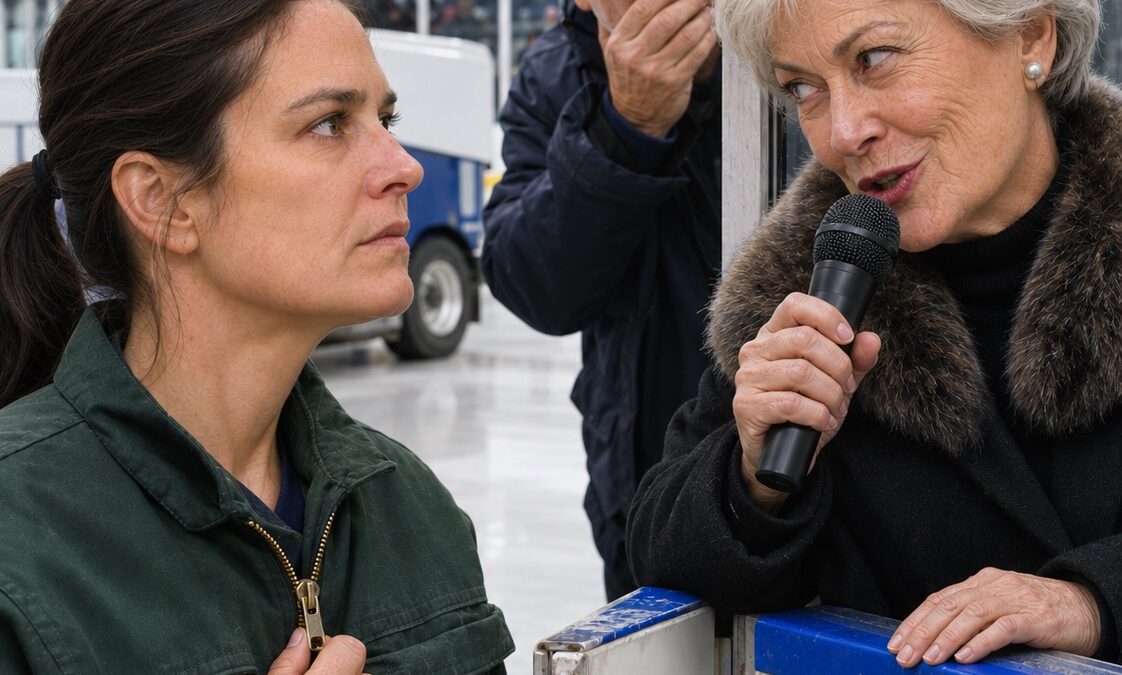
“Let’s thank our Zamboni girl, my former daughter-in-law. Twenty-five years, and she’s still cleaning up everybody else’s mess.”
Four hundred twelve spectators laughed.
The sound climbed the packed stands under the white arena lights and came back off the steel rafters.
I stood at the resurfacing-machine gate in the far corner, wearing my dark-green work jacket. The machine waited behind me, its engine ticking as it cooled.
Rosalind Fenwick stood in the middle of the front row in a black, fur-trimmed coat, holding the microphone near her satisfied little smile.
At seventy-two, my former mother-in-law knew how to pause for a laugh.
She had been practicing on me since 2001.
Kenna Fenwick raised her phone from the end of the front row. She tilted it past Garrick so the screen captured Rosalind, the ice, and me in the corner.
A red dot glowed near the top of Kenna’s screen.
My key ring pressed against my hip from inside my jacket pocket. The ring held nine keys, including the long-cut master key to the whole arena.
I slid the zipper higher with my right hand.
That was my answer.
Garrick stood in the aisle beside his mother, smiling toward the crowd as if he had written the joke himself. He was forty-eight now, with expensive glasses and the same habit of rocking onto his heels when he wanted people to notice him.
On the home bench, our sixteen-year-old son stared down at the rubber floor.
Beckett wore his high school jersey and held his helmet against his stomach. His thumb moved over one scuffed spot in the plastic.
Rosalind looked toward him.
“Don’t be embarrassed, sweetheart,” she said into the microphone. “Honest work is honest work.”
A few parents near center ice laughed harder.
Beckett’s thumb stopped.
I kept my eyes on Rosalind.
She had called me a rink rat before she ever called me family.
In 2001, Garrick had brought her to Pine Hollow for a Saturday game. I was twenty-two and had just finished clearing snow from the resurfacing-machine blade.
Rosalind looked at my work pants, then turned to her son.
“You didn’t tell me she was a rink rat,” she said.
Garrick laughed.
I had been driving the machine since 1995, when I was sixteen. The black-and-white photograph from that year still hung in the lobby, three frames down from the trophy case.
In it, I sat high on the old resurfacer with my sleeves rolled over my wrists. My hair was tied back with a plain elastic, and the number 1995 had been written along the white border in black ink.
Rosalind had passed that picture for years without asking why it was there.
By 2022, she had stopped pretending her insults were jokes.
Garrick had left me for Kenna, the front-desk receptionist who used to call our house when she needed somebody to cover her shift.
The divorce became final on Tuesday, March 15, 2022.
That afternoon, Rosalind called me.
I put the phone on the kitchen counter and listened while she said, “Try not to make this ugly, Cory. Garrick has finally chosen happiness.”
I had looked at the divorce papers beside the phone.
“He chose the receptionist,” I said.
Rosalind ended the call.
Now Kenna stood thirty feet away, filming me while Rosalind entertained a full arena.
Some families had driven through January slush from towns outside Manchester. They had bought hot chocolate, raffle tickets, and five-dollar programs. They were there to see their children play hockey.
Rosalind had decided they also needed a public lesson about my place.
She extended the microphone toward Garrick.
He climbed down one step, took it from her, and turned so Kenna could film his better side.
“Thank you, Mom,” Garrick said.
Rosalind smoothed the front of her coat.
Garrick looked across the ice at me. His smile had the clean, practiced shape he used with insurance clients.
“Tonight, right after the anthem, we sign with the owner of this building.”
Picking up where the Facebook post left off
Parents clapped.
A man behind the penalty box called, “Granite Edge!”
Garrick lifted one hand to accept the cheer.
His new academy logo had appeared on banners around town that winter. Granite Edge Hockey Academy promised elite coaching, serious development, and a path beyond ordinary school hockey.
Garrick liked the word elite.
It gave him permission to treat ordinary people as obstacles.
He handed the microphone back to Rosalind. She took it and turned toward the raffle table without looking at me.
Kenna kept filming.
I could see my small image on her phone screen, alone beside the gate.
The machine behind me smelled faintly of warm rubber and shaved ice. Meltwater ran from the blade assembly into the drain.
I had finished the surface exactly on schedule. The ice lay clean from end to end, reflecting the lights in long white bars.
Across the rink, Lucien Marchand stood near the visiting bench.
His navy jacket carried a rectangular manager’s badge over the left pocket. He had one hand resting on the top of the boards and the other hanging at his side.
Lucien did not laugh.
He looked toward Garrick, then toward Kenna’s phone.
Finally, he looked at me.
The public-address speakers clicked as Rosalind began reading the winning 50/50 number. Spectators checked their tickets, and the attention moved away from the corner gate.
Kenna lowered her phone but did not stop recording.
Garrick leaned close to her and said something I could not hear. Kenna smiled at the screen.
Beckett remained beside the home bench. When he raised his head, his eyes found mine across the ice.
I gave him the smallest tilt of my chin.
His shoulders lowered half an inch.
The wall clock above the lobby doors changed to 6:53.
Four minutes remained before Lucien was supposed to bring out the lease.
My right hand slipped into my jacket pocket and closed around the key ring. The master key settled against my palm.
Across the ice, Lucien gave me one small nod.
Part 2 of 7
“You have until next Sunday to make the smart choice,” Garrick told Beckett on January 10. He stood outside the school locker room, blocking half the hallway while our son held his hockey bag.
I stopped near the water fountain.
Rosalind stood beside Garrick in a camel-colored coat, watching Beckett as if he were an employee about to disappoint management.
Beckett shifted the strap higher on his shoulder.
“What choice?” I asked.
Garrick looked past our son at me.
“Granite Edge over the school team,” he said. “This is about Beckett’s future.”
“My future is with my team,” Beckett said.
His voice was quiet, but it carried down the cinder-block hallway.
Garrick’s mouth tightened.
“The school team is comfortable,” he said. “Comfortable doesn’t get you anywhere.”
Beckett glanced toward the lobby. Several teammates were waiting near the vending machines, pretending not to listen.
“I play with my friends,” Beckett said.
“You can see your friends at lunch.”
Rosalind stepped closer to her grandson.
“Your father has built an academy for serious players,” she said. “You should listen to the parent who understands hockey.”
Beckett looked at me.
Rosalind followed his eyes and smiled.
“Your mom drives a lawnmower on ice.”
The hallway went quiet except for the vending machine compressor.
I looked at Rosalind’s polished boots, then at her face.
“It doesn’t have a grass setting,” I said.
One of Beckett’s teammates coughed into his sleeve.
Rosalind’s smile disappeared.
Garrick pointed toward the lobby.
“This is exactly the attitude I’m trying to get him away from.”
Beckett started walking. Garrick had to step aside or be hit by the hockey bag.
I followed our son toward the front doors.
Behind us, Rosalind said, “That boy needs ambition.”
Beckett pushed through the first glass door and held it until I reached him. We entered the small space between the inner and outer doors.
His cheeks were red, though the hallway had been warm.
“Do you want to leave the school team?” I asked.
“No.”
“Then don’t.”
He looked through the outer door at the salt-streaked parking lot.
“Dad says I’ll regret it.”
“Your father says many things.”
That earned a brief pull at one corner of Beckett’s mouth.
We crossed the parking lot to my car. He put his hockey bag in the back, closed the hatch, and climbed into the passenger seat.
He did not mention the academy during the drive home.
The following Sunday was January 18.
Pine Hollow’s free Sunday skate ran from 1 to 3 p.m. I had started it because hockey families were not the only people who needed the ice.
Some parents could not pay for lessons, league fees, and new skates every year. At the free skate, a child could borrow a pair from the equipment room and spend two hours learning to stand up.
That afternoon, a girl in a purple helmet moved along the boards with her father’s hands under her elbows. Two middle school boys raced from blue line to blue line until Lucien pointed at the SLOW sign.
Near center ice, Beckett showed a younger boy how to stop without falling backward.
I watched from the gate with my work jacket open and my hands resting on the top of the boards.
At 2:55, Lucien made the closing announcement over the speakers.
Skaters drifted toward the exit. Blades clicked over the rubber mats, and parents searched under benches for gloves.
Beckett returned the loaner skates he had helped collect. Then he carried his hockey bag through the lobby while I locked the equipment-room door.
The master key stayed in the lock until the dead bolt turned. I removed the ring, put it in my jacket pocket, and zipped the pocket closed.
We walked outside at 3:07.
Garrick’s silver pickup was parked along the curb. Its tires rested against a ridge left by the plow.
He opened the driver’s door and stepped down.
“You’re late,” Garrick said.
“The skate ended seven minutes ago.”
“That isn’t my problem.”
Beckett walked to the passenger side. He opened the rear door, placed his hockey bag across the back seat, and shut the door.
Garrick looked past me at the rink entrance.
“Enjoy it while it lasts.”
I waited.
He tucked his gloves under one arm.
“I met with Lucien about the academy lease,” Garrick said. “He keeps repeating the same ridiculous line.”
I raised my eyebrows.
Garrick changed his voice, making it lower.
“‘The owner signs in person.’”
He smiled at his imitation.
“Apparently the owner signs in person, like the rest of us need an audience.”
“Maybe the owner wants to know what is being signed.”
“It’s a standard lease, Cory. Twenty hours a week. Serious money for a place that could use it.”
That was the first time Garrick had given me the number of weekly hours.
I looked through the glass doors behind him. A mother was helping her son carry his borrowed skates to the return counter.
“Which hours?” I asked.
Garrick pulled his gloves apart and put them on.
“The academy needs a consistent schedule.”
“That wasn’t my question.”
“You don’t handle scheduling.”
“No,” I said. “Lucien does.”
Garrick pressed his lips together.
He disliked answers that left him nowhere to push.
“Saturday, this gets settled,” he said. “Your little free-skate thing is done.”
Through the lobby glass, the boy handed his skates across the counter.
I looked back at Garrick.
“Did the owner tell you that?”
“The owner will see the numbers.”
“Then I suppose you’ll find out Saturday.”
Garrick gave a short laugh.
“You should be grateful somebody is turning this rink into something.”
Behind him, Beckett opened the passenger door and climbed into the pickup.
I did not answer.
Garrick walked around the hood, opened the driver’s door, and got inside. He pulled the door shut, started the engine, and eased away from the curb.
Beckett sat rigid behind the passenger window.
He looked at me until the pickup turned out of the lot.
He did not wave.
Part 3 of 7
The draft lease committed Pine Hollow Arena to $136,800 a season for three seasons. Its schedule erased the high school team’s Tuesday and Thursday practices and the free Sunday skate from 1 to 3 p.m.
Lucien handed me the folder at 4:18 on Thursday, January 22.
I sat across from him in the manager’s office, where a narrow window looked over the ice. Youth practice had ended, and two employees were moving nets near the far boards.
“Garrick sent the revised version this morning,” Lucien said.
I opened the folder on my lap.
Twenty hours a week.
Two hundred eighty-five dollars an hour.
Twenty-four weeks per season.
The arithmetic came to $136,800, exactly as Garrick had advertised it to Lucien. The three-season term sat in bold type beneath the payment schedule.
Then I reached the proposed ice calendar.
“Tuesday and Thursday,” I said.
“The school team’s practice blocks,” Lucien said.
“And Sunday.”
“One to three.”
Garrick had not found unused ice for his academy. He had taken a pencil to the hours that belonged to teenagers and families, then written Granite Edge over them.
I turned to the signature page.
PINE HOLLOW ICE LLC, OWNER.
The line beneath it was blank.
That line belonged to me.
I had bought Pine Hollow Arena for $1,450,000 on Friday, April 12, 2024. My share of the house after the divorce covered part of it. My savings covered another piece, and a bank loan covered the rest.
At the closing table, the lawyer had pushed a stack of documents toward me and asked if I understood what I was taking on.
I understood the old roof, the temperamental boiler, the insurance premiums, and the electric bill that arrived with unpleasant regularity.
I also understood what would happen if the building went to someone who saw youth hockey as a spreadsheet.
So I signed.
The deed went under Pine Hollow Ice LLC. My lawyer handled the filings, and I hired Lucien to manage the arena.
Nobody else knew.
I still drove the resurfacing machine on Saturday nights because I liked the work. A clean sheet of ice did not care who had the best coat or the loudest voice.
Lucien leaned back in his chair.
“Does Mr. Fenwick know who owns the LLC?”
“He has never asked.”
“For months, I have told him the same thing.”
“The owner signs in person.”
“Precisely.”
I closed the lease but kept the folder on my lap. The key ring in my jacket pocket rested against my right thigh.
“Did he say why he thinks these hours are available?”
“He said the academy takes priority because it will generate more revenue.”
“The high school pays for its ice.”
“I told him that.”
“The free skate was never meant to generate revenue.”
“I told him that, too.”
Lucien reached for a printed packet beside his keyboard. He placed it on the desk and turned it toward me.
“He sent financial support materials with the lease,” Lucien said. “He wanted to demonstrate that Granite Edge could meet its obligations.”
I set the lease folder on the empty chair beside me. Then I took the packet from the desk.
The first sheet carried the Granite Edge logo.
Below it, eight family names appeared in a neat column. The payment status beside each name said RECEIVED.
The amount was $25,000 per family.
I looked at the total printed at the bottom.
$200,000.
“He already collected it?” I asked.
“That is what this says.”
“For a lease that does not exist.”
Lucien tapped a paper beneath the payment sheet.
“One family contacted the arena to ask when private locker access would begin. The parent forwarded the sales email.”
I lifted the payment sheet and found the printed message.
Garrick had written that each $25,000 founding-family fee secured academy placement, priority coaching, and guaranteed practice time.
His final sentence was short.
The Pine Hollow ice is locked in for three seasons.
I returned the packet to Lucien’s desk.
“He told eight families it was locked in.”
“Yes.”
“And none of them called before paying?”
“One called afterward.”
Lucien aligned the papers with the edge of his desk.
“He has also been telling people the signing is a formality.”
“Has he used that word with you?”
“Twice.”
I looked through the office window. An employee pushed a net through the open gate, and the metal frame scraped across the rubber mat.
Garrick had collected $200,000 before the owner had agreed to give him a single hour.
Worse, he had sold hours that were already in use.
Lucien opened the lease to the schedule and pointed to the Sunday block.
“Do you want me to reject it?”
“Not yet.”
His finger remained on the page.
“When does Mr. Fenwick expect an answer?”
“Saturday,” I said.
Lucien watched me for a moment, then closed the document.
I picked up the folder from the chair and stood. Lucien took the printed packet from his desk and slipped it into the folder while I held it open. I closed the cover and tucked it under my left arm.
In the lobby, the black-and-white photograph from 1995 hung beside the trophy case.
Sixteen-year-old me sat on the old resurfacing machine, one hand on the steering wheel. The rink had changed its boards, lights, and scoreboard since then.
The girl in the picture had stayed.
I carried the folder to my car.
That evening, Beckett sat at the kitchen table with a school laptop open in front of him. His backpack rested against the chair leg.
I set the folder on the counter and hung my jacket over the back of an empty chair. The key ring remained zipped inside its pocket.
Beckett glanced toward the folder.
“Is that from the rink?”
“Yes.”
I sat across from him.
“Did your father ask you to sign an academy list?”
Beckett’s fingers stopped over the keyboard.
“Who told you?”
“Did he?”
Beckett lowered the laptop screen halfway.
“Tuesday after practice.”
“What happened?”
“He had a clipboard with the Granite Edge roster. My name was at the top.”
“Did you sign it?”
“No.”
His answer came fast.
Beckett looked toward the dark kitchen window.
“Dad kept saying it was only a commitment list. He said being his son meant I should be the first player on it.”
“What did you tell him?”
“That I’m staying with the school team.”
Beckett ran his thumb across the laptop’s rim.
“He said I was making him look foolish in front of the academy families.”
I waited.
“Then he said the choice wouldn’t matter after Saturday,” Beckett said.
“Why?”
“He said the school team was losing its Tuesday and Thursday ice. He said I could stay loyal to a team with nowhere to practice.”
The folder sat on the counter behind him.
Inside it, the signature line was still empty.
Part 4 of 7
Garrick’s lease still lacked the only signature that could give him one minute of ice. He had promised 20 hours a week to eight families who had already paid him $200,000.
I did not call him.
I did not warn Rosalind, Kenna, or the families whose names appeared on his payment sheet.
At 8:05 Friday morning, I carried the folder into Lucien’s office. He sat behind the desk reviewing the weekend schedule.
I closed the door and took the chair across from him.
“Set the signing in person, Saturday, right after the anthem,” I said.
Lucien removed his glasses.
“You want Mr. Fenwick to come to the gate?”
“Yes.”
“Do you want the agreement on the ice?”
“I want him where he said he would be.”
Lucien put his glasses beside the keyboard.
“He will assume you are signing.”
“Garrick has assumed quite a lot.”
Lucien studied my face.
“Should I tell him the lease remains under review?”
“You have told him the owner signs in person.”
“For months.”
“Tell him once more.”
Lucien reached for the office phone and pressed Garrick’s number. He tapped the speaker button and withdrew his hand.
Garrick answered after the third ring.
“Marchand.”
“Mr. Fenwick,” Lucien said. “The owner will meet you Saturday immediately after the anthem.”
There was a pause.
“For the signing?” Garrick asked.
“The owner signs in person.”
Garrick laughed.
“I know. You’ve made that painfully clear.”
“The meeting will be at the resurfacing-machine gate.”
“Fine. My mother will have the microphone, so we’ll announce it before the anthem.”
Lucien looked at me.
“That was not requested,” he said.
“It’s my academy,” Garrick replied. “The families deserve a little ceremony after what they paid.”
“The owner has not approved a ceremony.”
“The owner will appreciate the publicity.”
Garrick’s confidence came cleanly through the speaker.
“Bring a pen that works,” he added. “I don’t want eighty people standing around while somebody searches a desk.”
“The pen will be there,” Lucien said.
Garrick ended the call.
Lucien pressed the speaker button, then set the receiver squarely in its cradle.
“He said eighty people.”
“Eight families can bring a crowd.”
“He did not mention the rest of the arena.”
“He does not consider the rest of the arena his concern.”
Lucien picked up his glasses and put them on.
“What will you offer him?”
“Open ice.”
“How much?”
“The posted rate. No exclusive blocks.”
“Twenty hours?”
“If twenty open hours exist.”
“They do not.”
“Then he cannot rent twenty.”
Lucien nodded once.
I lifted my canvas work bag from the floor beside my chair and set it on my lap. My laptop was inside. I removed it, placed it on the edge of Lucien’s desk, and opened a blank document.
At the top, I typed:
PINE HOLLOW ARENA OPEN-ICE OFFER
The school team’s Tuesday and Thursday practice hours would remain as scheduled.
The free Sunday skate would continue from 1 to 3 p.m.
Remaining open hours could be rented at $285 an hour by any qualified organization, subject to availability. Granite Edge could apply for those hours under the same terms as anyone else.
No priority.
No exclusive control.
No removal of a school program that had practiced at Pine Hollow for years.
I kept the offer to one page.
Lucien read it from across the desk.
“This leaves him some ice,” he said.
“If he wants what is open.”
“And if he refuses?”
“The open hours remain open.”
Lucien turned the laptop slightly toward himself and checked the schedule.
“He could have Monday mornings, two late blocks on Wednesday, and some weekend time when there is no tournament.”
“He will hate Monday mornings.”
“Monday mornings will recover.”
Lucien’s mouth twitched.
I printed the offer on the office printer. When the page slid into the tray, I stood, crossed to the printer, and picked it up.
The signature line at the bottom named Pine Hollow Ice LLC.
I left it blank.
At the desk, I set the page on top of Garrick’s draft and closed the folder around them. Then I returned the laptop to my work bag and lowered the bag to the floor beside my chair.
Lucien rested his forearms on the desk.
“Your lawyer knows you are doing this?”
“My lawyer knows I do not have to sign a lease I do not want.”
“That is the entire issue.”
“Yes.”
There would be no lawsuit over imagined promises from an owner Garrick had never met. No board vote could take the building from me. No speech from Rosalind could create a contract.
A lease of Pine Hollow’s ice required the owner’s signature.
Mine.
Lucien slid a black pen across the desk. It stopped near the folder.
“He requested one that works,” Lucien said.
I picked up the pen and clipped it inside the folder.
Then I put the folder into my canvas bag beside the laptop.
Saturday afternoon, Beckett packed his hockey bag near our front door. He checked his gloves, helmet, and skates before pulling the zipper closed.
I put on my dark-green work jacket.
The key ring pressed against my hip in its usual pocket. I zipped that pocket shut, lifted my canvas bag from the floor, and slipped its strap over my left shoulder.
Beckett looked at the work jacket, then at me.
“Are you going to the game tonight?”
“I’m working.”
“Dad says the owner is signing his academy lease after the anthem.”
“I heard.”
Beckett adjusted the strap on his hockey bag.
“Does that mean we lose practice next week?”
“No.”
He searched my face.
“What about the free skate?”
“It opens Sunday at one,” I said.
Part 5 of 7
At 6:57 p.m., Garrick’s three-season lease waited in Lucien’s folder without the owner’s signature. Garrick had already promised its 20 weekly hours to eight families who had paid him $200,000.
The anthem had ended moments earlier.
The same 412 spectators who had heard Rosalind call me the “Zamboni girl” settled back into their seats.
Garrick came down the aisle toward the resurfacing-machine gate. Rosalind followed, still carrying the microphone, and Kenna walked behind them with her phone raised.
The red recording light remained on.
Across the ice, Lucien left the visiting bench. He carried the folder under his left arm and the black pen in his right hand.
Garrick stepped onto the rubber apron outside the gate.
“This way, Lucien,” he called.
I reached into my jacket pocket, pulled out the key ring, and found the long-cut master key by touch. The lock turned. I returned the ring to my pocket, zipped it closed, and pulled the narrow gate inward.
Lucien stepped off the ice.
Garrick extended his right hand.
Lucien walked straight past it.
The first rows went quiet as Lucien stopped in front of me.
“Ms. Vashaw, they’re ready for your signature.”
He held out the pen.
Garrick’s hand remained suspended near Lucien’s shoulder.
Rosalind lowered the microphone from her mouth, but she did not switch it off. The speakers carried the scrape of a skate from the home bench and the low hum of the refrigeration system.
I took the pen from Lucien.
Kenna moved her phone slightly to keep me centered.
Garrick dropped his hand.
“What are you doing?” he asked Lucien.
“Presenting the lease to the owner,” Lucien said.
Garrick looked from Lucien to me.
I spoke loudly enough for the front rows to hear.
“I’ve owned this building since April 2024, Garrick.”
Rosalind’s live microphone caught each word.
They came through the arena speakers with a faint echo.
A murmur moved up the stands. Parents turned toward the corner. On the home bench, Beckett rose with his helmet held against his side.
Kenna lowered her phone.
The red light stayed on, recording the rubber floor near her boots and every word around her.
Garrick stared at me.
“No,” he said.
“Yes.”
“You work here.”
“I do.”
“You drive the machine.”
“Also true.”
Rosalind stepped closer. Her microphone picked up the rustle of her coat.
“You expect people to believe a machine operator bought an arena?” she asked.
The speakers delivered her question to the same crowd that had laughed five minutes earlier.
I held Lucien’s pen in my right hand.
“Your Zamboni girl owns the building, Rosalind.”
Nobody laughed.
Lucien removed the folder from under his arm and offered it to me. I took it with my left hand and placed the pen on the machine’s flat metal fender.
Then I opened the folder.
Garrick reached for it.
I moved the folder out of his reach.
“You had no business keeping this from me,” he said.
“You never asked who owned Pine Hollow Ice LLC.”
“I negotiated with Lucien for months.”
“And he told you the owner signs in person.”
Rosalind lifted the microphone.
“This is a private business matter,” she told the crowd.
Her voice came through the speakers, polished and stern.
A man near center ice called, “You made it public.”
Several parents answered him at once.
Rosalind’s mouth tightened.
I removed Garrick’s draft lease from the folder. The signature line beneath PINE HOLLOW ICE LLC remained empty.
Garrick pointed at it.
“Sign it.”
“No.”
The word traveled through Rosalind’s microphone.
Garrick looked toward the stands, then lowered his voice.
“We have an agreement.”
“You have a draft.”
“I have families depending on those hours.”
“You have families who paid you before you had those hours.”
Rosalind turned the microphone away, but her hand was too slow. The words had already reached the rafters.
Near the blue line, a woman in a Granite Edge sweatshirt stood up.
“How much did he collect?” she called.
I kept my eyes on Garrick.
“Twenty-five thousand dollars from each of eight families.”
The woman pressed one hand to her mouth.
Another voice rose from behind the penalty box.
“He said the ice was locked in.”
“It was never locked in,” I said.
Garrick’s face darkened.
“That money covered startup expenses.”
“You sold guaranteed practice time before the owner agreed to rent it.”
“This lease brings in $136,800 a season.”
“It also takes the school team’s Tuesday and Thursday practices.”
Beckett stood motionless at the bench.
I held the draft out to Garrick.
He took it with his right hand.
“Not the high school’s ice. Not Sunday.”
“The free skate costs you money,” Garrick said.
“Yes.”
“Then this is personal.”
“The school team pays its rate. The Sunday skate stays free.”
“You’re sabotaging my academy to prove a point.”
“You offered hours you did not own.”
Garrick looked at the blank signature line, then at me.
Rosalind raised the microphone again.
“My son has put months into creating an opportunity for serious hockey families,” she said. “Cory is allowing old resentment to hurt children.”
A voice in the front row answered her.
“Those school players are children.”
Another parent said, “So are the kids at free skate.”
Rosalind faced the stands. For once, the microphone did not give her control of the room.
I removed my one-page offer from the folder.
“The school practices stay,” I said. “The free Sunday skate stays from one to three. Granite Edge may rent available hours at $285 an hour under the same terms as any qualified organization.”
Garrick shifted the draft into his left hand. I held out the offer, and he took it with his right.
His gaze moved down the page.
“Monday mornings?”
“Some are open.”
“Late Wednesday blocks?”
“Some are open.”
“This schedule is useless.”
“Then do not rent it.”
I picked up the pen from the fender and returned it to Lucien. He took it in his right hand.
Garrick crumpled neither document. He stood holding one in each hand, surrounded by the families he had promised something he could not deliver.
Kenna glanced down at her phone and stopped the recording.
The scoreboard changed to 6:59.
Lucien turned toward the home bench and signaled to the officials.
I closed the folder and tucked it beneath my left arm. Then I pulled the master key from my pocket, locked the narrow gate, and put the key ring away.
Beckett stepped onto the ice with his teammates.
At 7:00 p.m., the referee dropped the puck.
My signature line stayed blank.
Part 6 of 7
The motion on Monday night’s agenda called for Rosalind Fenwick’s immediate removal as president of the hockey parents’ association. Paper ballots and a five-minute discussion stood between her and the office she had controlled for eleven years.
I sat in the back row of the high school library.
Rosalind occupied the center chair at the long table beneath the whiteboard. She wore her fur-trimmed coat despite the warm room and kept one hand on the wooden gavel beside her binder.
Garrick sat to her right.
Kenna was absent.
The eight founding families had representatives in the first two rows. I recognized their names from the payment sheet Lucien had shown me.
At 7:06, Rosalind struck the gavel.
“This meeting will come to order,” she said. “I understand certain members wish to punish volunteer leadership over a private family dispute.”
Dana Mercer stood from the front row. She was the parent who had worn the Granite Edge sweatshirt Saturday night.
“This is about what happened over the arena microphone,” Dana said.
“The microphone comments were lighthearted.”
“You humiliated the owner of the rink in front of 412 spectators.”
Rosalind opened her binder.
“Cory concealed her position to engineer a spectacle.”
I remained seated.
Dana looked toward me, then back at Rosalind.
“Cory did not take the microphone.”
Garrick leaned toward the table.
“She deliberately let people believe the contract would be signed.”
“The contract required her approval,” Dana said. “Did you have it?”
Garrick’s jaw tightened.
“We had a good-faith understanding with management.”
Lucien was not present, but his sentence had already reached half the hockey families in town.
The owner signs in person.
Dana removed a printed email from her purse.
“You told my husband and me the Pine Hollow ice was locked in for three seasons.”
“The lease was in final form,” Garrick said.
“Was it signed?”
“It would have been if Cory hadn’t used the situation to settle an old score.”
I spoke from the back.
“The high school’s practice hours were never available.”
Heads turned toward me.
Rosalind tapped the gavel once.
“You are not recognized.”
I folded my hands in my lap.
Dana held up the email.
“Our $25,000 was accepted six weeks before Saturday.”
Garrick shifted in his chair.
“Founding fees funded the launch.”
“They bought guaranteed ice,” Dana said. “Your own email says so.”
Other parents began speaking.
One wanted a refund deadline.
Another asked where the money had gone.
A father near the windows said his daughter had been told to leave her current team before Granite Edge had secured a rink.
Rosalind struck the gavel harder.
“This meeting concerns association business.”
“It does,” Dana said. “You used the association microphone to promote your son’s private academy.”
Rosalind’s face sharpened.
“I have devoted eleven years to these families. A single tasteless joke does not erase that.”
“It was not one joke,” a woman near me said. “It was how you treated someone when you thought she had no power.”
Rosalind looked toward the back row.
“Cory has always enjoyed playing the victim.”
I said nothing.
The secretary rose beside the whiteboard with a stack of ballots.
“The removal motion has been made and seconded,” she said. “Voting members, please mark retain or remove.”
Rosalind leaned back.
“This association will regret surrendering to a mob.”
Ballots moved down the rows.
When a paper reached me, I passed it along. I was not a voting member.
The secretary collected the folded slips in a cardboard equipment box. Another board member stood beside her while she counted.
Garrick whispered to Rosalind.
Rosalind kept her eyes on me.
At 7:31, the secretary returned to the front.
“The motion carries.”
Nobody applauded.
Rosalind closed her binder and stood.
“You will discover how much work I did when no one else bothers to do it.”
She picked up the gavel and put it into her purse.
“The gavel belongs to the association,” the secretary said.
Rosalind stared at her, then pulled it out and placed it on the table.
Garrick rose and buttoned his coat.
Dana stepped into the aisle, blocking his path to the door.
“We want the $200,000 returned.”
“You will receive an accounting,” Garrick said.
“We want refunds.”
“The academy has expenses.”
“You do not have ice.”
“I have an alternative offer.”
“Monday mornings and late nights are not what you sold us.”
Garrick looked toward me.
“Cory made sure of that.”
I met his eyes.
“You wrote ‘locked in.’”
Dana held the printed email between them.
“Refund deadline is Friday,” she said.
“You don’t dictate my cash flow.”
“The founding families paid for guaranteed ice. Deliver it or repay us.”
Garrick stepped around Dana and walked toward the library doors. Rosalind followed him without looking back.
The doors closed behind them.
On Tuesday morning, an email from Granite Edge reached the hockey parents’ group.
ACADEMY OPERATIONS SUSPENDED.
The message blamed “unexpected facility interference.”
Underneath it, Dana posted Garrick’s promise that the ice was locked in.
Nobody needed me to explain the difference.
Part 7 of 7
By Friday, the eight founding families had demanded the return of the full $200,000. Granite Edge had stopped operating, and Kenna’s chief operating officer title no longer came with a salary.
The closure notice had removed her name from the academy letterhead.
Her video remained.
On Saturday morning, my phone buzzed while I stood near the arena’s equipment counter. Dana had added Kenna’s recording to the hockey parents’ group.
The clip began with Rosalind smiling into the microphone.
“Let’s thank our Zamboni girl.”
Laughter filled the audio.
Kenna’s camera zoomed toward me at the corner gate.
The recording continued past 6:57.
It caught Lucien walking past Garrick’s outstretched hand. It carried my voice through Rosalind’s microphone, and the picture dropped toward the floor right after I said I owned the building.
The sound stayed clear.
Eight families.
Twenty-five thousand dollars each.
No signed lease.
Within an hour, parents had shared the full clip throughout the group. Someone added the caption:
SHE FILMED HERSELF LAUGHING. THEN SHE KEPT RECORDING.
Kenna replied beneath it.
Kenna wrote that Dana had shared the clip without asking and that it ignored everything that happened earlier.
Dana answered with one sentence.
The missing context is your ice.
Kenna left the group.
Later that afternoon, Garrick arrived for Beckett’s handoff in an older blue sedan. I stood at the curb outside Pine Hollow while Beckett removed his hockey bag from the back seat.
The silver pickup was gone.
Garrick got out of the sedan and shut the driver’s door.
“I assume you’re pleased,” he said.
“With what?”
“You know I had to sell the truck.”
“I saw that you brought a different car.”
“The boat is listed, too.”
I had not known about the boat.
Beckett stood beside me with the hockey bag strap over his shoulder.
Garrick looked at our son.
“Tell your mother what her decision cost.”
Beckett’s grip tightened on the strap.
“Her decision kept my team’s practices.”
Garrick’s face changed.
“I was talking about what it cost this family.”
“You mean the academy families,” Beckett said.
Garrick opened the sedan door.
“You have no idea how business works.”
He got inside and drove away.
Beckett watched the sedan turn onto the road.
“I told Coach I’m staying,” he said.
“What did Coach say?”
“He said my spot was always mine.”
Beckett shifted the bag on his shoulder.
“Dad says Granite Edge would have made me better.”
“Do you want to be there?”
“No.”
“Then we have covered the important part.”
Three weeks after the game, Dana met me beside the arena office. She held a folder containing copies of the refund confirmations.
“The pickup sold first,” she said. “The boat sold Thursday.”
“Did the families get their money?”
“Each received $25,000.”
The refunds totaled $200,000.
Garrick had repaid what he collected, though his final email blamed me for “destroying a promising development program.”
Kenna’s salary ended with the academy. Her title disappeared with it.
Neither of them apologized.
Rosalind stopped attending association meetings, but she sent the new president long emails about improper procedure and declining standards.
Pine Hollow kept its schedule.
The high school team practiced Tuesday and Thursday.
On Sunday, February 15, I started the resurfacing machine at 12:42 p.m. Beckett climbed into the passenger seat wearing jeans, a gray sweatshirt, and work gloves Lucien had found in the maintenance room.
“You said the skate starts at one,” Beckett said.
“It does.”
“Then why are we early?”
“Ice has its own schedule.”
He fastened the safety bar across his lap.
I eased the machine through the gate.
The rink was empty except for Lucien, who stood near the boards checking the clock. Beckett watched the first ribbon of water settle behind us.
“This is slower than hockey,” he said.
“That is one of its strengths.”
He smiled.
We made the first turn along the end boards. Beckett looked back at the glossy strip widening behind the machine.
“Grandma made it sound like this job was nothing.”
I kept one hand on the steering wheel and adjusted the water with the other.
“Years of unglamorous work are not small just because nobody notices them.”
Beckett watched the ice for the next lap.
At 12:56, families began gathering behind the glass. The girl in the purple helmet stood near the gate with her father, her borrowed skates already laced.
Beckett raised one gloved hand to her.
She waved back.
I completed the final pass, lifted the blade, and drove onto the rubber apron. Beckett unfastened the safety bar and stepped down after I stopped the engine.
At 1:00, Lucien opened the gate for the free Sunday skate.
Children moved onto the fresh surface. Some pushed away cleanly. Others clung to the boards, knees bent and ankles uncertain.
Beckett stayed near the entrance to help the smaller skaters.
When the session ended at 3:00, we walked through the lobby together. Beckett stopped beside the trophy case.
The black-and-white photograph still hung three frames down.
Sixteen-year-old me sat on the old machine in 1995, sleeves rolled over my wrists and one hand on the steering wheel.
Beckett slipped his hand into mine.
The girl in the photograph had company now.
THE END
More stories
My 71-year-old mother-in-law drove a moving truck onto my lawn and claimed my cottage—Then my late husband’s sealed envelope led me to the deed that ended her ownership story.My Landlord’s Son Ordered 43 Households Out by March 31—Then His 81-Year-Old Mother Refused to Sign, and All 43 Households Bought the Land Themselves InsteadMy Food Services Director Mocked the 14 on My Spiral Notebook After 22 Years and Told Me to Take It Home—Then 14 Kids Cost Him His $15,000 BonusI Pulled My Orange Gloves Out of the Trash Before 11 Drivers—Then My Brother-in-Law Took My Seat—Until the Hidden Bank Packet’s Loan Made Me Owner, and His Promotion Vanished
You Might Also Enjoy

My Daughter-In-Law Told Me To Stay Elsewhere While Strangers Took My Condo — Then I Pushed Back







