My Brother Raymond Said Someone “Respectable” Should Present My Father’s Flag at My Daughter’s Reception, but a Woman’s BUS STATION Remark Stopped His Smile Before Our Mother’s Instructions Cost Him the Honor
Part 1 of 5
“Let someone respectable present it!”
My brother Raymond’s voice carried across the Pensacola naval museum reception room.
All 78 guests could hear him.
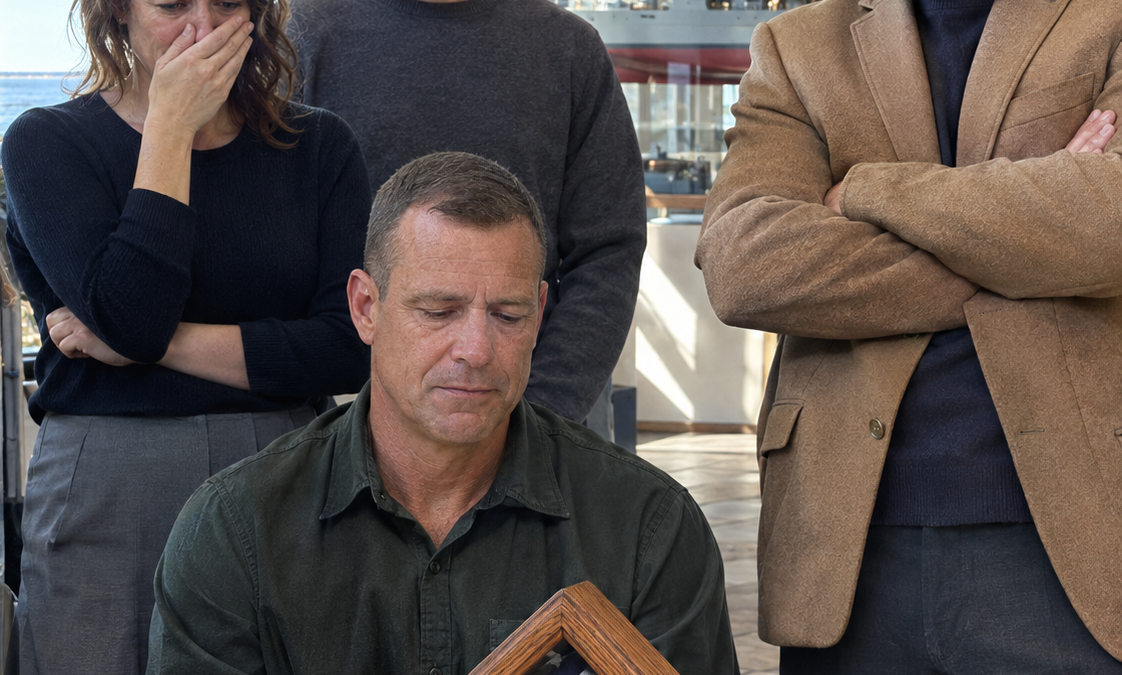
My father’s folded burial flag rested in its oak case before me.
Raymond stood beside my chair, his camel jacket brushing the tablecloth.
“He’s the family’s grease monkey,” he said.
A spoon struck a saucer somewhere behind him.
I kept both feet flat beneath my chair.
“Read our mother’s instructions,” I said.
His smile stayed fixed, but his jaw worked once.
We were supposed to be celebrating my daughter’s commission that afternoon.
Instead, my older brother had found himself an audience.
Again.
The flag case sat between an empty water glass and my program.
Sunlight crossed its glass front, catching the white points of stars.
I had polished the oak before leaving home.
There was still a dark crescent under my thumbnail.
Raymond noticed.
He looked toward the nearest guests before looking back at me.
“We can spare everybody the workshop discussion.”
Across the room, my daughter stopped beside the cake table.
I gave her the smallest shake of my head.
Stay there.
Let me handle this.
Don’t rescue me.
A woman in a white dress uniform watched from the aisle.
I couldn’t place her face.
Raymond could see her watching, too.
His shoulders straightened beneath that expensive jacket.
For years, he had practiced standing as though photographers were expected.
I had practiced finding cracks too small for anybody else to notice.
Different trades.
My name was Kenneth Raines. I was fifty, an aircraft mechanic in Pensacola.
Raymond Croft was fifty-eight, my mother’s son from her first marriage.
He consulted for defense contractors and owned shirts requiring special laundry instructions.
My shirts required checking before they went into the family washer.
That distinction had entertained him since we were boys.
Our mother had never found it funny.
Dad’s flag had come home after his funeral nine years earlier. Mother had kept it above her sewing cabinet.
During her last winter, I drove over after work.
I changed furnace filters, filled pill organizers, and checked the porch step.
Raymond sent flowers from wherever his client meetings had taken him.
Mother thanked us both.
She never confused the deliveries.
That was enough history.
Raymond put his program beside the case without touching the oak.
“I’m presenting this,” he said. “Mother entrusted it to me.”
His voice had become smooth again.
The room had started listening instead of merely overhearing.
“I asked for the instructions,” I said.
“And I heard you.”
He glanced toward my daughter.
“She deserves something dignified.”
My daughter’s lips pressed together.
I watched her thumb flatten the edge of her program.
She had used that same movement before spelling tests.
I wanted to tell her she owed him no performance.
Instead, I looked at the brass keyhole beneath the case.
The key lay beside my water glass.
Small brass key.
Our mother had tied blue thread through its round head.
I had left the thread exactly as she had.
Raymond followed my eyes.
“You don’t need to make a scene with old papers.”
“No scene,” I said.
A chair scraped near the aisle.
The woman in white had moved closer.
She studied my face, then the name printed on my place card.
I shifted my chair slightly so she could pass.
She didn’t pass.
Raymond gave her the pleasant smile he saved for useful introductions.
“We’re settling a little family matter.”
The woman looked at the flag case.
Then she looked at my work shirt’s carefully pressed collar.
I had nearly bought a suit for this reception.
My daughter had asked me to wear something that looked like me.
So I had chosen dark green and ironed it twice.
Raymond turned back toward the room.
“I sponsored today so she wouldn’t have to worry about appearances.”
Nobody answered him.
His laugh came out alone.
The woman stopped directly beside my chair.
“I never forgot that bus station.”
Raymond’s smile disappeared.
The color drained from the strip of skin above his collar.
He looked from her face to mine, searching for an introduction.
I looked up.
Her eyes held mine with a steadiness that made the room seem smaller.
“Do we know each other?” I asked.
“We do.”
She glanced toward my daughter before continuing.
“I’d like your permission to explain.”
Raymond lifted his chin.
“We have a schedule.”
“There’s time,” my daughter said.
Her voice reached us clearly.
The woman waited for me, not for him.
I nodded once.
She did not immediately speak.
Instead, she looked at the program beside the oak case.
“May I see that?”
Raymond slid his copy toward her.
The smile returned halfway, as though he could still repair its shape.
The woman read the last page.
Her expression stayed still.
My daughter began walking toward us.
I had seen her uniform that morning, but not like this.
Now she crossed the room without asking anybody to make space.
People moved anyway.
Raymond lowered his voice.
“Kenneth, don’t turn somebody’s pleasant memory into a production.”
“I haven’t said anything.”
“You know what I mean.”
I did.
He wanted me to help him recover the room.
He had mistaken my silence for that kind of help before.
The woman turned the program so I could read it.
The printed program listed Raymond as the flag’s presenter.
Part 2 of 5
“That isn’t what I submitted,” my daughter said.
She stood beside my chair without touching my shoulder.
Raymond adjusted the cuff beneath his camel sleeve.
“The sponsor received the final proof. Someone needed to approve it.”
“You changed the family portion?”
“I corrected an omission.”
My daughter looked down at the program.
Her name was Madeline Keene. She had taken her husband’s name when she married, and she had planned this reception herself.
She had asked me to bring the flag.
Not Raymond.
Not a courier.
Me.
The printed line was wrong.
I set my own program beside his.
Both copies carried the same change.
For a moment, I thought about every place where money could enter a room before a person did.
The flower arrangements had his firm’s name on small cards.
The dessert table had a sponsor plaque.
Raymond had paid $12,000 for the reception.
I knew because he had told me before I had finished congratulating my daughter.
“Twelve thousand buys a decent afternoon,” he had said.
Apparently, he believed it bought a father’s place, too.
The woman in white stayed beside us.
She had not asked anybody to leave.
Nobody did.
A museum employee near the doorway lowered a stack of plates onto a cart and stepped back.
Raymond watched that movement.
“We should keep personal disagreements away from the staff.”
“Then stop announcing them,” Madeline said.
He looked at her as though she had addressed the wrong adult.
I reached for the water glass and moved it away from the oak.
One practical thing.
The case had belonged to Dad, but I had built the stand beneath it in 2017.
The lumber had cost $46.
Raymond had said he could order something better.
I had asked him for the measurements.
He never sent any.
When he bought a larger house, I repaired Mother’s leaking sink.
When he upgraded his car, I replaced her porch light.
When he offered to hire somebody, I was usually already there.
None of that made him incapable of loving her.
It did make him unfamiliar with her kitchen drawers.
He would not have known which drawer held the spare key.
Or why she had wrapped its teeth in tissue.
Or what she had asked me to check beneath the case.
Not yet.
“Mother wanted the family represented properly,” Raymond said.
“She told you that?” I asked.
“She trusted my judgment.”
“That wasn’t my question.”
His eyes narrowed just enough for me to notice.
A man at the nearest table looked down at his coffee.
The woman beside my chair looked at Raymond instead.
Raymond softened his voice.
“You worked hard, Kenneth. Nobody is disputing that.”
There was the tone he used for waiters who caught an error.
He continued before I could answer.
“But this is a public occasion. People remember how things are presented.”
Madeline glanced toward the flag case.
“They certainly do.”
I could have told the room about the Saturday Mother’s air conditioner failed.
About Raymond saying his contribution would arrive Monday.
About the $318 I put on my card at the parts counter.
But my daughter had not invited people to watch brothers compare receipts.
I wanted one set of instructions read aloud.
Nothing else.
The woman asked, “Who has the original?”
“I do,” I said.
Raymond’s eyes moved to my shirt pocket.
There was no envelope there.
He looked beneath my chair next.
I let him look.
Mother had returned to her maiden name, Dolores Wexler, after Dad died.
She had signed bills that way, birthday checks that way, and the last birthday card she ever gave me.
Her handwriting had become smaller near the end.
It had never become uncertain.
I remembered her tapping a page with the capped end of a pen.
“Make them read it,” she had said.
That was all I had promised her.
Across the room, the cake knife lay untouched beside white plates.
The photographer lowered her camera.
Even Raymond could see that nobody wanted another sponsor speech.
He tried anyway.
“I think everybody understands the intention here.”
“No,” Madeline said. “I don’t.”
His smile thinned.
“I wanted to give you something memorable.”
“You already gave us a reception.”
He glanced at the guests.
She did not lower her voice.
“That doesn’t make the family part yours.”
The woman in white turned slightly toward Madeline.
“Would you mind if I spoke first?”
Madeline nodded.
“Please.”
Raymond looked toward the microphone on its stand beside the table.
It had carried his first remark farther than he had intended.
The microphone was still on.
Part 3 of 5
The woman moved close enough to speak without raising her voice.
Raymond remained standing beside me.
I stayed seated, with the oak case squarely in front of my place.
Her eyes returned to mine.
“May I tell them?”
“Yes,” I said.
She rested her gaze on the room.
Then the woman began explaining what she remembered about that bus station.
“Twenty-eight years ago, this man bought me a nineteen-dollar bus ticket when I had nowhere safe to wait.”
Her voice carried through the room.
“I was twenty, a young sailor headed back to my duty station after emergency leave. My wallet had been stolen.”
I looked at her again.
Not at the silver in her short hair.
At the small notch in her left eyebrow.
A girl in a blue sweatshirt had worn that same notch beneath a piece of drugstore tape.
“I remember,” I said.
The woman nodded.
“You asked whether I’d eaten.”
Raymond turned his head toward me.
I barely noticed.
“I’d finished a late repair,” I said. “I stopped for coffee.”
“And found me counting change at the counter.”
The room stayed quiet enough to hear the air conditioning.
“I had enough for part of the fare,” she continued. “He paid for the whole ticket. Then he waited.”
“The next bus wasn’t until morning.”
“You had work.”
“Everybody has work.”
She looked toward Madeline.
“He sat on a plastic chair all night. When I tried to pay him back, he told me to get aboard before the driver closed the door.”
I remembered that part exactly.
The driver had already lifted a hand toward the lever.
She had been trying to write down my address on the back of her ticket sleeve.
I had waved her toward the steps.
The woman turned back to me.
“Do you still refuse repayment for bus fare?”
“I suppose interest would hurt by now.”
A laugh moved gently across the room.
She smiled.
Only then did I understand why her face was on the reception program.
Michelle Talley, the rear admiral serving as my daughter’s guest speaker.
Madeline had invited her through a commissioning mentorship program. Michelle had accepted before seeing the family guest list.
That was why she was here.
Recognition had waited until she saw my face and my place card together.
“You never gave me a last name,” Michelle said. “Only Kenneth.”
“I didn’t think you’d need it.”
“I wanted to send the money.”
“You needed to get home.”
Raymond cleared his throat.
“A generous memory,” he said. “But we really should finish the presentation.”
Michelle looked at the oak case.
“Yes,” she said. “We should establish who was asked to make it.”
I picked up the key with the blue thread.
The glass front did not open. It never had.
Dad’s flag stayed protected inside.
I unlocked the shallow document compartment built into the wooden base.
Raymond leaned forward.
I removed a cream envelope and laid it on the table.
Mother’s handwriting crossed the front.
For the flag presentation.
My brother’s mouth opened, then closed.
Inside were her signed letter and a copy she had asked me to keep with it.
I offered the original to Michelle.
“Would you read it?”
She checked the signature before looking at me.
“Aloud?”
“Please.”
Madeline moved to my other side.
Michelle began.
“My name is Dolores Wexler. This letter records my wishes for the care and presentation of my late husband’s burial flag.”
Raymond stepped back from the table.
The jacket sleeve that had brushed the linen no longer touched anything.
Michelle continued.
“I name my son Kenneth Raines as its custodian. If Madeline accepts a commission and wishes to receive her grandfather’s flag, Kenneth is to present it.”
My daughter covered her mouth.
Mother had written the letter during Madeline’s first year of college, before the commission was certain.
The next paragraph was shorter.
“This responsibility is not connected to anyone’s financial contribution. Kenneth has cared for the flag and knows why I kept it.”
Raymond stared at the cream page.
There was a date beneath the signature.
There was also the stamp of the notary at her bank, who had witnessed Mother sign.
Nobody needed a handwriting contest.
I knew that tight little loop in the capital D.
So did my brother.
Michelle lowered the page.
“Is there another instruction we should consider?”
Raymond looked toward Madeline.
“Mother was ill.”
Madeline’s hand dropped from her mouth.
“She wrote that before hospice.”
His eyes flicked to the date again.
For once, he had spoken before checking the page.
Michelle waited.
I did, too.
Raymond rubbed a thumb along his jacket seam.
“I may have misunderstood what she expected.”
“You said she entrusted it to you,” I said.
He looked at me, but gave no answer.
Madeline took her phone from her pocket and opened her saved ceremony email.
Part 4 of 5
“I submitted the instructions six weeks ago,” Madeline said.
She turned the screen toward Michelle.
The message showed a date, an attachment, and the subject line she had used for the family presentation.
I had never asked to see it.
I had trusted her to arrange her own afternoon.
Now she read the relevant part aloud.
“My father, Kenneth Raines, will present my grandfather’s burial flag in accordance with my grandmother’s signed instructions.”
Raymond looked at the door.
Nobody stood in his way.
Nobody had asked him to leave.
Somehow, staying had become harder.
Madeline scrolled once.
“I attached a scan of Grandma’s letter. The original stays with the case.”
Michelle compared the screen with the cream page.
“They match.”
My daughter looked at her uncle.
“You had the same attachment when you approved the final program.”
“I received a lot of material.”
“You replied to that email.”
Raymond’s heel shifted against the carpet.
Madeline read his reply.
“Received. I’ll make sure the family presentation is handled.”
She lowered the phone.
There was no accusation left for her to add.
He had supplied it himself.
I looked down at the key on the table.
Blue thread, worn almost white at the knot.
Mother had tied it there because small brass keys vanished against the brown lining of her purse.
For years, I had thought of it as one of her practical fixes.
Today it looked like a way to find what belonged where.
Michelle returned the letter to me.
“Thank you for keeping this.”
“It was what she asked.”
Raymond lifted his chin.
“I paid for the setting. Surely I can be permitted to stand with them.”
Madeline shook her head.
“This isn’t a purchased role.”
“I wasn’t buying a role.”
“The program says you had one.”
He looked at me then.
Not toward my shirt, or my fingernails, or the chair that kept me lower than him.
At me.
“Tell her I was trying to help.”
I slid Mother’s letter back into its envelope.
That was the only movement I made.
“You changed her instructions.”
“I improved the arrangement.”
“Whose?”
His lips pressed together.
A server near the wall stared at the carpet.
The same guests who had heard him call me a grease monkey now waited for an answer he could not make sound respectable.
Michelle spoke without taking a step toward him.
“Your sponsorship will be acknowledged for what it funded.”
He nodded quickly.
“Yes. Thank you.”
“The reception,” she said.
His nod stopped.
Michelle turned toward Madeline.
“Your family’s written wishes are clear. Your submitted instructions are clear.”
My daughter stood straighter.
The room had been watching her uncle for so long that I had nearly forgotten who should have occupied its attention.
Michelle gave it back to her.
“This afternoon belongs to the person who earned her commission.”
Raymond looked toward the sponsor plaque near the cake.
It was still there.
His money had not disappeared.
Only the extra thing he had expected to receive with it had been taken away.
Or, more accurately, never granted.
“I should at least introduce the flag,” he said.
Madeline answered before I could.
“No.”
One syllable.
No raised voice.
My brother’s fingers curled against his jacket seam.
Michelle looked toward the microphone, then across the same 78 guests.
“Her father will present the flag.”
The sentence needed no explanation afterward.
A woman at the nearest table straightened the unused place card in front of her.
The man beside her set down his cup.
Raymond had spent the afternoon arranging himself near the center.
Now there was nowhere to stand that did not look like somebody else’s space.
He took one step back.
Then another.
I closed the document compartment and turned the key.
Madeline watched my hands.
“Dad,” she said, “you don’t have to keep sitting.”
I looked up at her.
There was a little tremor at the edge of her mouth.
She had not let it reach her voice.
I stood.
My knees objected, as they usually did after an hour in a banquet chair.
I waited until they settled.
Michelle moved aside.
Raymond stayed where he was, two steps beyond the table.
Nobody applauded yet.
I was grateful for that.
There were still words my daughter deserved to hear before anyone made noise.
I took the case with both hands.
The oak was warm where the sunlight had reached it.
For a second, I saw Mother’s sewing cabinet, the doily beneath the wood, the empty space after we carried her things out.
Then Madeline placed her program flat on the table.
She turned to face me.
Michelle moved the microphone toward my daughter’s table.
Part 5 of 5
I had prepared three sentences at my kitchen counter.
They were on an index card in my pocket.
I left the card where it was.
“Your grandfather would have liked this room,” I told Madeline.
Her eyes moved toward the aircraft suspended beyond the reception windows.
“He would have checked every bolt he could see.”
A few guests laughed.
“He would have asked questions until somebody made him stop.”
“That sounds familiar,” she said.
“He believed taking care of something was a form of respect. Tools. Promises. People waiting for a ride.”
Michelle stood at the edge of my sight.
I did not turn toward her.
That nineteen-dollar ticket had never felt like a story worth telling.
A young person had needed a way out of a bus station.
I had been twenty-two, with enough money in my wallet and no good reason to leave her there.
That was the whole calculation.
Until that afternoon, I had never known whether she reached her destination.
Now I could see that she had gone considerably farther.
I looked back at my daughter.
“Your grandmother kept this flag because she wanted you to understand that a life can leave something useful behind.”
Madeline swallowed.
“It isn’t a demand that you become him,” I said. “You get to be yourself.”
Her chin trembled once.
“You’ve always let me do that.”
“I’ve tried.”
“You did.”
I placed the oak case before my newly commissioned daughter.
The base settled squarely on the linen.
No wobble.
I had checked that at home, too.
Madeline rested her fingertips along the wooden edge, away from the glass.
“Thank you, Dad.”
Then she came around the table and hugged me.
I put my arms around her carefully, mindful of the uniform she had spent so long earning the right to wear.
The applause began behind us.
It spread through the same 78 guests who had heard my brother’s first demand.
Raymond remained beside his empty chair.
He did not clap at first.
I saw him when Madeline stepped back.
His eyes were fixed on the case.
There was no need to ask what he was looking at.
Our mother’s instructions were inside.
My daughter’s hands were beside it.
My place was no longer available.
Michelle waited until the room settled.
“Thank you, Kenneth,” she said.
Then she addressed the guests.
“We will continue with the program submitted by Madeline.”
That was the final consequence.
No invented speech for the sponsor.
No flag introduction bearing his name.
No family photograph with him standing where I belonged.
The museum employee quietly removed the unused program from the small presentation stand.
Raymond watched it go.
His $12,000 had paid for flowers, food, chairs, and a room.
It had not purchased the right to rewrite our mother.
Madeline asked the photographer to come forward.
“Dad stays beside me,” she said. “Please include the flag.”
Michelle joined us when Madeline invited her.
The photographer checked the light.
Raymond took half a step toward the table.
Madeline looked at him.
“This one is the presentation photograph.”
He stopped.
His mouth tightened, and he went back to his chair.
The camera clicked.
Afterward, he waited until Michelle moved toward the cake table before approaching me.
His voice was low enough that it belonged to our conversation, not to his audience.
“You could have warned me about the letter.”
“I asked you to read the instructions.”
“You knew what I meant.”
“Yes.”
He looked past me toward Madeline.
She was showing the flag to two guests, explaining which ship her grandfather had served aboard.
Raymond adjusted his cuff again.
“I made myself look foolish.”
I did not soften it for him.
For once, he had chosen the right subject.
He stood there another moment.
“I shouldn’t have called you that.”
“No,” I said. “You shouldn’t.”
He nodded, but I did not offer him a shortcut through the rest.
An apology could begin something.
It could not go backward and unsay a roomful of words.
Madeline returned before he found another sentence.
“Uncle Raymond,” she said, “thank you for paying for the reception.”
He looked up.
She kept her voice level.
“But don’t change my instructions again.”
“I understand.”
She waited until he met her eyes.
Then she nodded and turned to me.
“Can you show me the little compartment later?”
“Anytime.”
“And how the lock works?”
“The key turns left first. It sticks if you rush it.”
“That also sounds familiar.”
I smiled.
Near the cake table, Michelle caught my eye and lifted her empty coffee cup a fraction.
No grand debt.
No promised favor.
Just an acknowledgment between two people who had once waited for morning in a bus station.
Madeline slipped her hand through my arm.
The blue-threaded key lay beside the oak case.
I gave it to her.
THE END
More stories
My Stepmother Veronica Told Me to Stay in My Place at Dad’s Grave, but Her Smile Vanished When the Cemetery Owner Asked to Let His DAUGHTER FinishMy Brother Mitchell Called Me an UNEDUCATED Driver in Front of 72 People, but He Went PALE When a Woman Walked In and Said, “Ms. Ralston, I’ll Take It From Here”I Was Serving Funeral Lunch When My Sister-in-Law Told Me to Pack My Husband’s Fishing Gear, Then Our Lawyer Found the Date That Undid Her Cabin ClaimMy Niece Called Me “Too Old” in Front of 21 Relatives and Tried to Take My Granddaughter at Thanksgiving, but When Six Women Walked In, She FROZEMy Niece Felicia Declared My Little Boat OUT at Our Marina Meeting, but When My Attorney Walked In, She FROZE Before the Same Owners Who Had Watched Her Humiliate MeCecily Said I Stole $600 From Our Church Pantry Before 38 People, but When the AUDIT Arrived, My Red LEDGER Held a Secret She Never Saw Coming
You Might Also Enjoy

My Daughter-In-Law Told Me To Stay Elsewhere While Strangers Took My Condo — Then I Pushed Back







