My Brother Ross Mocked My Cheap Key Before 34 Relatives, Then FROZE When a Uniformed Guest Walked In and Greeted Me
Part 1 of 5
“Keep your cheap key out of this!”
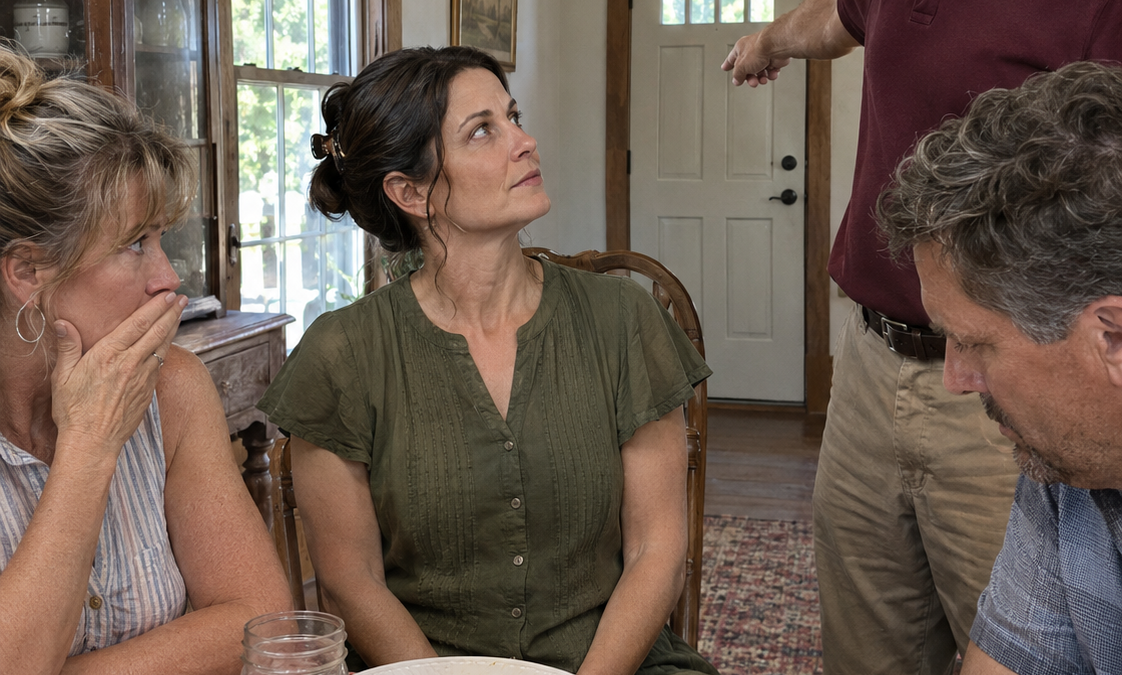
My brother Ross stood beside our Ohio farmhouse table.
Thirty-four relatives watched him laugh at the brass key beside my plate.
“Your three-dollar key doesn’t buy you a say.”
He wore a burgundy polo tucked into pressed khakis.
His printed sales brochures sat beside the potato salad.
I left the battered key where I had placed it.
“Mother gave me more than a key.”
My voice barely reached the far end of the table.
A serving spoon stopped halfway across the checkered cloth.
Ross smiled toward our relatives, waiting for their permission.
Nobody gave it, but nobody challenged him either.
Not yet.
“The place is going on the market,” he said.
“Six hundred twenty thousand dollars. That’s a sensible retirement cushion.”
He tapped the photograph on the top brochure.
Our front porch looked freshly painted in the listing picture.
I had paid for that paint the previous September.
He had never mentioned that part to anyone visiting.
“Whose retirement?” I asked.
He glanced at my olive blouse and travel-wrinkled slacks.
“Some of us stayed here and did the work.”
A cousin lowered her paper cup.
Another relative studied the butter dish with remarkable concentration.
I was Stephanie Hollander, forty-six, visiting from Colorado Springs.
Ross Pennington, my fifty-one-year-old brother, sold real estate in Ohio.
Different fathers had given us different last names.
Our mother had given us the same kitchen table.
Apparently, only one of us belonged at it.
The old arrangement.
Eighteen years earlier, Mother had mailed me that brass key.
It arrived wrapped in a dish towel inside a padded envelope.
Her note said I would always have a place here.
After she died, I kept the envelope in my desk.
I came home when leave allowed, sometimes only overnight.
Ross called those visits convenient appearances by an absent daughter.
He never asked what the trips cost or required.
A chair scraped, bringing me back to the table.
“Let’s not spoil lunch with sentimental claims,” Ross said.
“You can take the old photographs before the buyers come.”
“The buyers?”
“People who appreciate a property with this much potential.”
He said it like I had asked a foolish question.
I watched his thumb straighten the brochures.
His thumbnail had the same white ridge as Mother’s.
One familiar detail.
“Have you already promised them anything?” I asked.
“They’re qualified. That’s what matters.”
“Have you promised them possession?”
He gave a small laugh toward the table’s far end.
“Listen to her. A few years shuffling Army paperwork.”
“Now she thinks she conducts the closing.”
That version of my career had followed me for decades.
Temporary office work, he called it, whenever anyone asked.
I had stopped correcting him at holiday dinners.
Being heard should not require presenting a résumé beside gravy.
A relative started asking whether I still lived out west.
Ross answered before I could open my mouth.
“She moves wherever they need another desk filled.”
I folded my napkin once across my lap.
“I’m stationed near Colorado Springs.”
“Exactly. You don’t live here.”
The screen door clicked against its spring outside.
Footsteps crossed the porch, then paused at the entrance.
Ross didn’t turn.
He moved a brochure away from my water glass.
The printed porch faced me upside down.
A small omission.
The brochure had no owner’s signature or listing number.
For a broker, he had skipped some important preparation.
“Put the key away,” he said, lowering his voice.
“You’re making this awkward for everyone.”
“It’s beside my plate.”
“Then leave it there and let adults handle business.”
A cousin’s chair shifted sharply against the wooden floor.
Someone set down a fork without taking a bite.
I kept my hands below the table’s edge.
Outside, one of the visitors spoke too softly to hear.
They were family friends I had invited weeks earlier.
Their afternoon commitment nearby explained the dress uniforms.
They had promised to stop in afterward for pie.
Ross had been told two guests were coming.
He had never bothered asking anything else about them.
The front door opened behind my chair.
Two uniformed guests stopped just inside the dining room.
“Good afternoon, Colonel,” the gray-haired guest said.
Ross’s smile stopped before the rest of his face did.
The younger guest gave me the same respectful greeting.
Several relatives turned from the doorway to look at me.
“Good afternoon, Lawrence,” I said. “You found us.”
Lawrence Bixby, fifty-four, stepped clear of the screen door.
Terrence Hodge followed him into the crowded dining room.
They were new arrivals, not part of the thirty-four relatives.
Both had known our mother through a longtime family friend.
Ross looked from Lawrence’s uniform to my olive blouse.
“Colonel?”
I nodded once.
“For several years.”
Nobody reached for the potato salad.
I introduced our guests without reciting assignments or awards.
Lawrence thanked me and accepted an empty chair near the doorway.
Terrence remained beside him until somebody found another seat.
A longer pause.
“I thought you handled administration,” Ross said.
“I handle what I’m assigned.”
Lawrence looked from my untouched lunch to the sales brochures.
He had heard enough from the porch to leave them alone.
Ross pulled his shoulders back.
“Well, that doesn’t change the house situation.”
“What house situation?” Lawrence asked.
“My house. I’m selling it.”
At the seat nearest the kitchen doorway, our family attorney set down her fork.
Miriam Sedgewick had heard that claim.
Part 2 of 5
Miriam had come for lunch, not a consultation.
Mother had invited her to reunions long before hiring her.
After Mother died, we kept sending the invitation.
She always brought a lemon cake in the same covered carrier.
Her fork rested against the edge of her plate.
“Ross,” she said, “what exactly have you offered?”
“A showing. I haven’t signed a purchase contract.”
“Have you signed a listing agreement?”
He looked toward the doorway instead of answering.
An empty space.
I knew that look from childhood.
It usually appeared just before he blamed someone else.
“Nothing requires a family legal seminar,” he said.
“I’m simply letting everyone know what’s coming.”
Miriam stayed where she was.
I reached into the bag beside my chair.
Then I brought the tablet onto my lap.
Ross noticed.
“Are you taking notes?”
“I’m checking something.”
“You could have called before showing up with objections.”
“You invited me to a reunion.”
“And you arrived prepared to question everything.”
I touched the edge of the key with one finger.
Still beside me.
For eighteen years, I had kept a folder labeled Farmhouse.
Every January, a new tab went behind the previous one.
Roof repairs: $11,840.
Furnace replacement: $6,275.
A cracked supply line beneath the kitchen: $940.
Those were things Ross knew I had paid.
He had called each one an emergency when asking.
When he needed shingles, I postponed replacing my car.
When he wanted new windows, I worked through my leave.
When he stopped returning calls, I checked with the contractors.
I never expected applause at a reunion.
A thank-you in a text would have done.
Instead, he sent photographs of finished work without a message.
Sometimes his own truck blocked half the picture.
Eighteen years.
My monthly budget had carried an Ohio column beside Colorado.
Ross described my contributions as occasional help from his little sister.
I let that description stand longer than I should have.
It seemed cheaper than arguing across time zones.
Then Mother’s old neighbor called about strangers measuring the porch.
That was six days before the reunion.
She asked whether I had finally decided to sell.
I told her I had not decided anything.
That evening, I checked my records.
The next morning, I confirmed that Miriam would attend lunch.
I wanted a witness who understood what she was seeing.
I still hoped I would not need one.
That hope ended beside the potato salad.
Ross pulled an empty chair away from the table.
He didn’t sit in it.
“Everybody’s making too much of an ordinary transaction.”
“Then an ordinary question should be easy,” Miriam said.
“Who authorized you to market the property?”
He glanced at me.
“I’ve maintained this place since our mother passed.”
“That wasn’t my question.”
“You know what I mean.”
Miriam folded her napkin into a small square.
“No,” she said. “I need you to say it.”
Three untouched plates.
The windows behind Ross showed the pasture turning summer green.
His mower sat outside the shed with a flat tire.
He had once sent me a repair estimate for that mower.
The replacement part appeared on a different receipt the next week.
I had asked about the difference.
He said I didn’t understand rural expenses anymore.
Now he leaned toward the guests near the door.
“She’s always liked making simple things complicated.”
Lawrence did not answer him.
Terrence shifted his chair to let a cousin pass.
The cousin carried nothing into the kitchen.
She simply needed somewhere else to stand for a moment.
I kept the tablet balanced on my knees.
The county website took several seconds to load.
One practical thing.
“Stephanie,” Ross said, “put that away.”
I entered the parcel number from my saved records.
“You’re embarrassing yourself.”
A relative at the far end pushed back her chair.
“Maybe let her finish.”
He looked wounded by that small interruption.
His hands settled against the back of the empty chair.
“I gave up plenty to stay here,” he said.
“You stayed rent-free,” I said.
The words came out level.
His fingers tightened around the chair back.
“Mother wanted family in this house.”
“Yes,” I said. “She did.”
I remembered her standing at the sink after her diagnosis.
She had asked whether a house could keep siblings close.
I had said we could try.
She had looked at me a long time before answering.
Trying had become my default setting.
Ross had mistaken it for a permanent obligation.
“Your three-dollar key doesn’t buy you a say.”
The exact same sentence.
This time, nobody even attempted a smile.
I looked toward Miriam.
She moved closer, leaving her plate behind.
“Would you like me to look at something?” she asked.
“In a minute.”
Ross reached for his brochures.
“I can explain this privately after the showing.”
“What showing?” Miriam asked.
He glanced at the clock over the pantry door.
For the first time, his neat stack of papers slipped.
Ross had scheduled the buyer tour for four o’clock.
Part 3 of 5
“It’s three fifteen,” he added. “Let’s keep some perspective.”
I stayed seated while he gestured toward the front door.
Three relatives exchanged looks across the narrow end of the table.
One pressed her fingers against her mouth.
Another stared at the key beside my plate.
Miriam waited beside my chair.
I adjusted the screen brightness until the county seal appeared clearly.
“Tell me what you see,” I said to her.
I opened the county record on my tablet.
The recorded deed named me, Stephanie Hollander, as the farmhouse’s sole owner.
Miriam leaned down to read the recording information.
I opened the scanned instrument beneath the parcel summary.
Mother’s signature appeared above the notary’s acknowledgment.
The recording stamp was dated eighteen years earlier.
Ross stopped moving the brochures.
“That’s an old document.”
“It is,” I said.
“Before she died.”
“Yes.”
He glanced around the table, as if the date might rescue him.
Several people were already leaning forward.
Miriam asked permission to take the tablet.
I handed it to her and left the key beside my plate.
She checked the parcel description against the tax record.
Then she enlarged the signature page.
“I handled this transfer,” she said. “I recognize the instrument.”
Ross shook his head.
“You’re saying she wrote something down and never told me?”
“I’m saying she executed and recorded a deed,” Miriam said.
“She was sick.”
“She was competent. I met with her privately before she signed.”
I watched my brother’s mouth open, then close again.
Miriam turned the screen toward him.
“The farmhouse was transferred outright to Stephanie eighteen years ago.
Your mother retained no ownership interest after the transfer.”
He did not look at the screen.
“Then why have I been here all this time?”
“Because I allowed you to live here,” I said.
The chair under my brother’s hands gave a small wooden creak.
“I didn’t charge rent. I paid every property-tax bill.
I wanted you to have time to get back on your feet.”
He stared at me now.
“All of them?”
“Every bill.”
I opened the folder of payment confirmations.
The most recent annual total was $4,386.
He recognized the county treasurer’s letterhead immediately.
He had forwarded that envelope to me in February.
A cousin near the window said, “You told us you paid those.”
Ross looked at her.
“I handled the property.”
“That isn’t what you said,” she answered.
Miriam lowered the tablet just enough to face him.
“Your sister owns this house; you cannot sell it.”
No one moved.
Outside, a gust lifted the loose corner of the porch mat.
The screen door clicked twice against its frame.
Ross’s cheeks lost the color they had carried through lunch.
“I’ve put years into this place.”
“You have a right to discuss your belongings and your occupancy,” Miriam said.
“You do not have a right to sell someone else’s property.”
He looked toward Lawrence, then back at me.
“So this was a setup.”
“No,” I said. “Lunch was lunch until you announced a sale.”
“You invited people in uniform.”
“They had an event nearby. You knew guests were coming.”
Lawrence spoke from his chair.
“We came because Stephanie invited us to a family meal.”
That was all he offered.
He did not need to make my brother smaller.
Ross had managed that without assistance.
I placed the tablet flat on the table.
“Did you take any money from the prospective buyers?”
“No.”
“Did you give them a code or a key?”
“No. They’re coming with me.”
Miriam watched him.
“Have you represented yourself as the owner in writing?”
His eyes went to the brochures.
“Those are preliminary.”
“Have you?” she asked again.
“Yes.”
A relative pushed her glass away from the papers.
The scrape of its base sounded much louder than it should have.
I had expected denial.
Hearing him admit it left a clean space where excuses had been.
“What did you tell them about me?” I asked.
He swallowed.
“That my sister was coming to collect a few things.”
I looked down at the brass key.
The worn bow had left a pale crescent in the tablecloth.
“So I wasn’t invited to a reunion,” I said.
“I was invited to clear the shelves.”
“The family was already coming.”
“And you decided I could be managed in front of them.”
He didn’t answer that.
Miriam set the tablet beside my water glass.
“Before anyone arrives, the showing needs to be canceled.”
Ross rubbed his lips together.
He looked at the clock again, measuring how much could still be hidden.
I slid my phone from my bag.
“I’ll speak to them with you present,” I said.
“You don’t have their number.”
“Then you can provide it.”
The table seemed to draw closer around us.
Nobody offered to rescue him with a change of subject.
I waited without reaching for his phone.
Finally, Ross unlocked his screen and opened the message thread.
The buyers were already on their way.
Part 4 of 5
Ross turned the phone so I could read the latest message.
They expected to arrive at three forty-five.
Their afternoon appointment had ended early.
I looked at Miriam.
“Will you stay while I make this call?”
“Yes.”
Ross gave me the number.
I entered it myself, then placed my phone on speaker.
The key remained beside my plate.
I wanted both hands free, though there was nothing to defend.
A woman answered on the fourth ring.
I introduced myself as the property owner and gave the address.
“My brother arranged a tour this afternoon,” I said.
“He did not have my permission to offer the house for sale.”
Ross’s eyes closed.
The woman asked whether I was referring to the farmhouse listing.
I explained that no authorized listing existed.
There was a pause, followed by the faint sound of a turn signal.
“Are you saying the house isn’t available?” she asked.
“That’s correct. I’m canceling the buyer tour.
Please don’t drive farther on the strength of his invitation.”
Miriam identified herself as the attorney present.
She offered to provide written confirmation of my ownership.
The woman said they would stop for coffee instead.
Her disappointment stayed courteous, which made my brother’s behavior harder to excuse.
Before hanging up, she asked one more question.
“Does he actually live there?”
“Yes,” I said. “He does.”
I did not tell a stranger anything more about him.
There would be enough consequences without turning his life into entertainment.
The call ended.
Ross stared at the dark phone screen.
“You could have let me call them.”
“You could have asked me before promising them my home.”
He dragged the empty chair out and finally sat.
The legs caught on a seam between floorboards.
For a moment, he looked like the boy who had hidden a broken kitchen window.
Only this damage had required years of practice.
Miriam took the chair nearest mine.
“Stephanie, what do you want done now?”
That was the first question anyone had asked about what I wanted.
I looked past the table toward the hallway.
Mother’s pencil marks still showed on the pantry trim.
Mine stopped lower than Ross’s.
Neither set had been painted over.
“I’m coming home,” I said.
My brother looked up sharply.
“Today?”
“I’m on approved leave through next week.
My retirement orders take effect at the end of next month.”
Lawrence nodded because I had discussed that decision with him already.
Nobody else at the table had known.
I had planned to tell them over dessert.
I had imagined a simpler kind of attention.
Ross pressed his palms against his knees.
“You’ve planned this for a while.”
“I planned to retire. I hadn’t planned to remove you.”
“Remove me?”
“You tried to sell the house while I was visiting.”
He glanced at the relatives seated nearest him.
No one softened the statement.
Miriam spoke before he could argue about the word.
“Your occupancy needs a proper written end date.
Stephanie will not change locks or put your belongings outside.”
“I never thought she would,” he said.
It was the closest he had come to naming what he had relied on.
I turned toward him.
“You may stay for sixty days under a written arrangement.
No buyers. No contractors. No new promises in my name.”
His gaze moved to the key.
“And after sixty days?”
“You’ll need another place.”
He breathed through his nose and looked away.
Miriam asked whether I wanted to discuss repayment.
I looked at the folders on my tablet.
There were years of proof there.
There were also years I could never purchase back.
“Not today,” I said. “Today we stop the sale.”
“Then I’ll prepare the occupancy notice,” she said.
“I’ll also notify his brokerage that there is no authority to market this parcel.”
Ross jerked his head toward her.
“You don’t need to involve the office.”
“You used your professional role to solicit buyers,” Miriam said.
“They need accurate ownership information immediately.”
His lower lip trembled once before he pressed it still.
For eighteen years, I had answered requests ending in the word immediately.
Now the deadline belonged to him.
He pulled the brochures into a stack.
“Can we please finish this without everybody watching?”
I looked around the table.
The same thirty-four relatives who had heard his insult were still there.
The kitchen doorway had filled, but nobody had left.
“You announced the sale to everyone,” I said.
“They need to hear that it isn’t happening.”
A cousin near the pantry nodded.
Someone farther down the table murmured agreement.
Ross lowered his head.
I did not ask for an apology.
An apology offered to shorten an audience would have served him, not me.
Miriam set her phone beside the cake carrier.
“Ross, give me the contact information for your managing broker.”
He stared at the table for several seconds.
Then he opened his contacts and read it aloud.
For the first time that afternoon, he followed instructions without correcting the person giving them.
Miriam’s call connected to his managing broker.
Part 5 of 5
Miriam kept the call short.
She identified the parcel, explained the recorded ownership, and stated that Ross had no authorization to market it.
Then she offered to send the deed and my written confirmation.
Ross sat within hearing distance.
His hands stayed flat against his thighs.
The broker asked to speak with him privately.
Miriam looked at me first.
I nodded, and she passed him the phone.
He stood but did not leave the dining room.
His answers became smaller with each question.
“No.”
“That’s correct.”
“I understand.”
He listened for nearly a minute, his eyes fixed on the porch photograph at the top of the brochure stack.
When he returned the phone, he couldn’t quite meet Miriam’s face.
She listened again, then thanked the broker.
After ending the call, she addressed Ross clearly.
“Your broker will withdraw every advertisement connected to this property.
You are not to contact the prospective buyers about another showing.”
Ross nodded.
“The office will review what you represented to them.
That is separate from Stephanie’s decision about your occupancy.”
“Am I being fired?”
“That decision belongs to your employer,” Miriam said.
“I won’t invent an answer. The unauthorized sale stops today.”
I appreciated the distinction.
I had not come home to destroy his livelihood.
I had come home to stop financing my own disappearance.
Miriam asked me to send the county record to her.
I attached the deed and the parcel page from the tablet.
She showed Ross the drafted message before sending it.
There would be no room later to claim the family had misunderstood.
The farmhouse was not for sale.
Ross had no authority to offer it.
All scheduled tours were canceled.
Three plain sentences.
His thumb moved against the seam of his khakis.
“I didn’t think you’d care about living here anymore.”
“You never asked.”
“You always had somewhere else.”
“I had assignments.”
He looked toward Lawrence and Terrence, then back at my blouse.
“All those years,” he said.
“I was still your sister during all those years.”
His eyes filled, though he blinked until nothing fell.
I let him manage his own face.
The cousin who had challenged him earlier pulled the bread basket toward her.
That ordinary movement gave everyone permission to breathe and move again.
A fork touched a plate.
Someone poured water into a nearly empty glass.
Nobody pretended the afternoon had returned to normal.
Miriam turned her attention back to the practical terms.
“I’ll send the written notice tomorrow,” she said.
“The sixty days will run from proper delivery.”
Ross nodded again.
“Your belongings remain yours.
You’ll arrange removal without damaging the house or interfering with Stephanie’s return.”
“I understand.”
“Do you agree there will be no more advertisements or buyer visits?”
“Yes.”
Miriam looked at me.
“Does that reflect your instructions?”
“It does.”
That was the consequence I had wanted: a house no longer being offered behind my back, and a door I could use without asking.
Ross looked at the brass key.
“I thought that was just something she sent you.”
“It was something she sent me.”
“You could have told me.”
“I told you I was paying the bills.
I told you we needed to discuss the arrangement.
You said there was nothing to discuss.”
He stared at his untouched lunch.
I could have listed the dates.
They were saved in the same folders as the receipts.
Instead, I moved my plate slightly away from the edge.
“The key wasn’t the problem, Ross.”
He nodded without looking up.
For once, I did not soften the sentence afterward.
Lawrence asked whether anyone wanted the window opened.
A relative said yes, and Terrence lifted it a few inches.
Air moved through the dining room, carrying the smell of cut grass.
Miriam retrieved the lemon cake.
She asked where Mother used to keep the cake knife.
“Second drawer beside the stove,” I said.
Ross started to answer at the same time, then stopped.
It was a small thing, knowing my way around my own kitchen.
I stood and got the knife myself.
On the way back, I paused beside my brother’s chair.
“You’ll have time to find a decent place,” I said.
“I’ll keep my word about that.”
“I know.”
For the first time that afternoon, the words sounded like an acknowledgment instead of an expectation.
I returned to my seat.
The key was still beside my plate, its teeth pointing toward the center of the table.
I left it there while cake went around to the same relatives who had watched him laugh.
Miriam checked her phone when it lit beside the carrier.
She turned the screen toward me, then read the message aloud.
“The brokerage confirms the property has been withdrawn from marketing.”
Ross lowered his eyes and folded the first brochure in half.
This time, nobody looked away.
Before dessert was finished, the cancellation confirmation arrived in writing.
THE END
More stories
My Ex Blake Renshaw Mocked Our Daughter’s Purple Halter While Selling Her Mare, Until One Name on a Certificate Cost Him a $48,000 SALE in PublicMy Brother Raymond Said Someone “Respectable” Should Present My Father’s Flag at My Daughter’s Reception, but a Woman’s BUS STATION Remark Stopped His Smile Before Our Mother’s Instructions Cost Him the HonorMy Stepmother Veronica Told Me to Stay in My Place at Dad’s Grave, but Her Smile Vanished When the Cemetery Owner Asked to Let His DAUGHTER FinishMy Brother Mitchell Called Me an UNEDUCATED Driver in Front of 72 People, but He Went PALE When a Woman Walked In and Said, “Ms. Ralston, I’ll Take It From Here”I Was Serving Funeral Lunch When My Sister-in-Law Told Me to Pack My Husband’s Fishing Gear, Then Our Lawyer Found the Date That Undid Her Cabin ClaimMy Niece Called Me “Too Old” in Front of 21 Relatives and Tried to Take My Granddaughter at Thanksgiving, but When Six Women Walked In, She FROZE
You Might Also Enjoy

My Daughter-In-Law Told Me To Stay Elsewhere While Strangers Took My Condo — Then I Pushed Back







