My Daughter-in-Law Told Me to Serve Champagne at the Gala Where I Was a Guest, Then My Signature Cost Her the Head-Table Chair and Her Museum Job
Part 1 of 5
“Since you clean for our biggest sponsor, you might as well make yourself useful.”
Danielle pressed the champagne tray into my hands before I could set down my purse.
Six glasses trembled. I steadied them with my thumb against the silver rim.
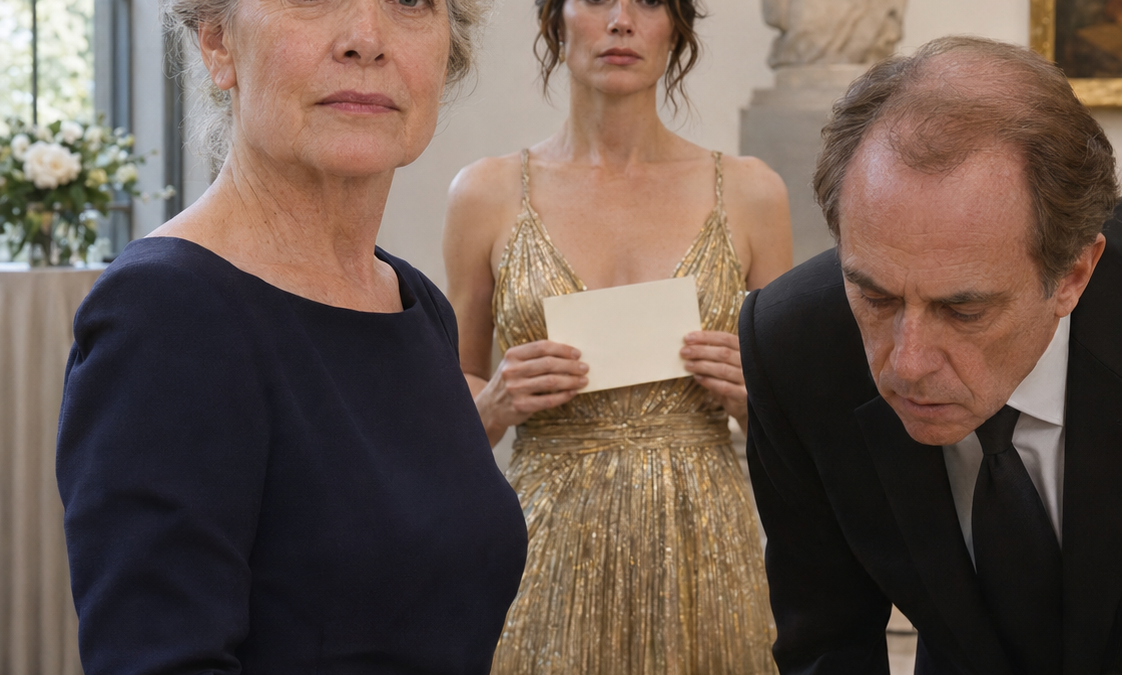
My daughter-in-law wore a gold gown with a little train that kept catching beneath other people’s shoes.
I had already freed it twice.
“Danielle,” I said, “I’m here for dinner.”
“And we’re all here to support the museum.”
Her smile stayed in place as she turned toward the head table.
Eighty donors had come to the reopening gala at the Bellcourt Museum in Richmond, Virginia.
Several were close enough to hear her. One woman lowered a bread roll without taking a bite.
I was sixty-one. I had cleaned houses for thirty-four years.
That afternoon, I had scrubbed toothpaste from a basin before changing into my navy dress.
The dress was new. My silver hair had cost forty-eight dollars to have pinned up.
My invitation was inside my purse.
Danielle lifted my place card between two polished fingers.
SUSAN FENNER.
She slipped it beneath her dinner plate.
Then she pulled out my chair for Douglas Talbot.
“Right here,” she said. “You belong at the center of everything tonight.”
Douglas was sixty-five, gray-haired, and wearing a tuxedo I had seen hanging in his dressing room.
I cleaned his house every other Thursday.
He looked at the tray, then at me.
“Susan? Are you helping tonight?”
“I was invited.”
Danielle laughed softly.
“We’re being flexible. Reopening nights always require a few adjustments.”
Douglas stayed half out of the chair.
“Then where are you sitting?”
“I’ll find something for her,” Danielle said.
A server carrying water stopped beside us.
Danielle pointed toward a narrow door behind the coat check.
“Staff can eat through there when service settles.”
“I’m not staff tonight,” I said.
Her smile narrowed.
“A useful person doesn’t need a place card.”
The server looked down at his water pitcher.
I shifted the tray to my left hand. My right wrist had been stiff since cleaning a staircase that morning.
“Please give me my card.”
“We can discuss seating afterward.”
Danielle touched Douglas’s sleeve and guided him down.
He sat because she had begun introducing him to the couple on his left.
Then Danielle took the chair beside him.
Her own place card had been moved there already.
That small detail told me this wasn’t a mistake made over too many guests and too few seats.
Someone had carried her water glass, folded napkin, and untouched salad to that exact spot.
My son, Joseph, was not at the gala.
His plumbing company had sent him to repair a broken water line at an assisted-living building in Petersburg.
At 5:42, he had texted that he would miss dinner.
Danielle knew I would be coming alone. And she had called Douglas our biggest sponsor. I knew that wasn’t true.
I set my purse on an empty side table and took out the cream envelope I had brought.
She watched me over Douglas’s shoulder.
“If you need your reading glasses, there’s better light in the service hall.”
“I have them.”
A photographer lifted his camera near the covered bronze plaque.
Danielle immediately turned toward him.
“Get the table before the speeches,” she said.
I walked away with the tray.
A young server approached with both hands extended.
“I can take that, ma’am.”
“Thank you. In a minute.”
Across the room, museum director Martin Keene stood beside a portable microphone.
I knew him from a photograph on the museum’s website.
He was fifty-eight, with thinning brown hair and a black suit that needed pressing at one cuff.
He was checking a folded program against his watch.
I had not met him in person.
Our business had been conducted by mail and telephone while his staff oversaw the renovation.
He had signed my invitation himself.
Near him, the covered plaque stood on a low easel beneath a velvet cloth.
A brass rail surrounded it, as though someone might steal the surprise.
Danielle’s name appeared in the program beside “Director of Development.”
Mine did not appear anywhere in the printed program.
That part had been my request.
I stopped beside Martin.
“Mr. Keene?”
“Yes?”
I balanced the tray on the edge of his empty podium and held up my envelope.
“Before you unveil that plaque, could you check page four?”
His eyes went first to the champagne.
“Is there a problem with service?”
“Only seating. The paper is more important.”
Behind me, Danielle’s heels stopped clicking.
“What paper?” she asked.
I slid the envelope’s flap free.
“The copy I was told to bring.”
Martin took one step away from the microphone.
“Let’s have a look.”
Danielle came around my right shoulder.
“We’re three minutes behind, Martin. The kitchen needs us seated.”
“Then three more minutes won’t ruin dinner,” I said.
I drew out the document without handing it to her.
Danielle glanced at the first page.
Her fingers closed around the stem of an empty champagne glass.
“That’s administrative material,” she said. “We can review it Monday.”
Martin put down his program.
“Whose copy is this?”
“Mine.”
He looked at me properly then.
“Your name, please?”
“Susan Fenner.”
His hand paused above the paper.
“Mrs. Fenner. You’re at the head table.”
“I was.”
Danielle moved nearer the podium.
“We’ve had a seating adjustment.”
Martin glanced toward the table. Douglas had turned in his chair to watch us.
“My invitation said head table,” I said. “I didn’t write that myself.”
“Certainly,” Martin said. “Let me find out what happened.”
“Start with page four.”
Danielle set her glass on the podium with a sharp little click.
“There’s no reason to hold up eighty people over a chair.”
I kept the envelope flat beneath my palm.
“Then this should be quick.”
Martin reached for the document.
Danielle reached for it too.
“Let me explain it first,” she said.
Part 2 of 5
Martin kept his hand extended.
“I’ll read it.”
Danielle withdrew hers, but remained close enough that the edge of her gold gown brushed his cuff.
The server returned for the tray.
This time I let him take it.
“Thank you,” I said.
He nodded toward my purse.
“Would you like me to keep that behind the desk?”
“I’ll hold it.”
I had been widowed for nine years. Carrying my own things was a habit, not a statement.
Martin opened the document at the beginning.
I watched him read the heading without saying it aloud.
Danielle watched the room.
At the head table, Douglas spoke to a waiter and pushed back his chair.
“Stay seated,” Danielle called. “We’re almost ready.”
He stood anyway.
Martin looked up from the first page.
“Were you expecting to speak tonight, Mrs. Fenner?”
“Only if somebody asked me a question.”
“I sent a note with the invitation.”
“I received it. I sent my answer back.”
He rubbed the corner of the paper between his fingers.
“Yes. I remember.”
Danielle leaned toward him.
“The board chair is waiting for your signal.”
“The board chair can have some bread.”
I had not expected that from him.
Neither had Danielle. Her chin lifted a fraction.
A waiter approached with a question about the first course.
Martin held up two fingers.
“Give us a few minutes. Keep serving water.”
The waiter left.
Douglas reached us with his napkin still in his hand.
“Is Susan missing a seat?”
Danielle answered before I could.
“We’re sorting it out.”
He looked at me.
“You should have said something.”
“I did.”
His eyes went to the envelope.
“Has there been some confusion with your invitation?”
“No,” I said. “The invitation was clear.”
Danielle shifted between Douglas and the document.
“Why don’t you enjoy your wine? I have this handled.”
“I’d rather know whether somebody was displaced for me.”
I had dusted the photographs on his mantel for six years.
There were grandchildren, fishing trips, and a wife who sometimes left a thank-you note beside my check.
He had never asked me to serve at one of his parties.
That didn’t make him a saint. It made this evening his first chance to choose what to do.
Danielle touched his elbow.
“You’re our principal guest.”
“Am I?”
She looked at the covered plaque.
The photographer had moved closer.
Martin closed the document halfway, keeping one finger between the pages.
“Could we have a little space?” he asked.
The photographer lowered his camera.
Danielle smiled toward the nearby tables.
“Just a procedural question. Please enjoy yourselves.”
Nobody resumed the conversation nearest us.
A woman adjusted her chair so she could see around a centerpiece.
I picked up my purse.
The clasp caught on the edge of the envelope, and I had to work it loose.
Those ordinary little difficulties always arrive when you would prefer steady hands and a clean exit.
Danielle bent toward me.
“We could have discussed this at home.”
“You gave away my chair here.”
“I’m talking about your behavior.”
“So am I.”
Martin turned another page.
His lips moved over a line, but he still said nothing.
A volunteer brought him a pen.
He accepted it, then handed it back.
“I’m not signing anything.”
“No, sir. For your remarks.”
“Later, please.”
Danielle’s phone lit up in her hand.
She silenced it without looking.
I knew that phone case. I had bought it for her birthday in April.
She had said the leather was exactly the right shade.
At Christmas, she had given me a grocery-store candle and asked whether I could clean before her office luncheon.
I had gone.
Family made plenty of arrangements that never appeared on an invoice.
Martin looked toward the museum office beyond the gallery doors.
“Is the executed copy in tonight’s packet?” he asked Danielle.
“Everything relevant is in your folder.”
“That wasn’t quite my question.”
“The office copy is filed.”
“Where?”
“In the development cabinet.”
He nodded once.
“Thank you.”
She straightened the program beneath his hand.
“Martin, the caterer charges overtime.”
He moved the program aside again.
“I’m aware.”
Douglas’s napkin had become a tight white rope between his fingers.
“Susan, would you like my chair until this is settled?”
“I’d like the one assigned to me.”
He looked back at the table.
“I think those may be the same chair.”
“They are.”
Danielle gave a small laugh meant for the people listening.
“We’re making this sound so much more dramatic than it is.”
Martin turned the next sheet.
The paper scraped against the microphone cord.
I could see the page number now.
Four.
Danielle saw it too.
She put one hand flat on the podium.
“Martin, please don’t read that aloud.”
He stopped turning pages.
“Why?”
Part 3 of 5
Danielle glanced at Douglas.
“Private terms. We should respect everyone’s privacy.”
“The guests are waiting,” he said. “Can we settle this in your office?”
Martin studied the bottom of the page.
“Possibly.”
I set my glasses on my nose.
“Before anything is unveiled,” I said.
“Certainly,” Martin said.
Danielle began gathering the loose program sheets, although nobody had asked her to.
A fork struck a plate somewhere behind us.
The little noise carried farther than it should have.
Martin moved the document under the podium light.
He touched the signature line with one fingertip.
Then he looked from the ink to my face.
“Mrs. Fenner, is this your signature?”
“Yes.”
He looked at it again.
“I recognize it now. You signed the final authorization.”
“I did.”
“You’re the chair of the Lantern Steps Foundation.”
“Yes.”
Danielle stopped aligning the programs.
Martin turned back to the first page, then returned to page four.
“Your foundation provided the renovation gift.”
“One million six hundred thousand dollars,” I said. “Paid in three installments. The last cleared in February.”
Douglas loosened his grip on the napkin.
Danielle’s lips parted, then closed.
Martin checked the signature against the name printed beneath it.
“I owe you an apology,” he said. “I should have recognized your name immediately.”
“You’ve had a busy evening.”
“That doesn’t excuse it.”
He stood straighter and read the paragraph above my signature.
“‘In consideration of the gift, the renovated east gallery shall be named the Rose Fenner Gallery.’”
My sister’s name sounded plain and proper in his voice. Fenner was our family name; I had gone back to it after my husband died, and Rose had never married.
He continued.
“‘No alternative naming designation shall be installed, announced, or offered without the foundation’s prior written consent.’”
Danielle moved her hand off the podium.
Martin read the last sentence himself, then looked at me.
“Did your foundation approve a change?”
“No.”
“Was one requested?”
“No.”
He placed the agreement flat.
Then he looked toward the covered plaque.
Until that second, the cloth had seemed to belong to the evening’s decorations.
Now everyone nearest us was looking at it.
“Danielle,” he said, “what is under that cover?”
“The plaque.”
“Whose name?”
She looked toward Douglas.
Martin walked to the easel.
I followed, carrying the agreement. Douglas came beside me.
Danielle stayed half a step behind.
“We should do this privately,” she said.
Martin lifted the velvet cloth.
Bronze caught the light.
THE TALBOT FAMILY GALLERY.
Underneath were smaller words about generosity, vision, and the future.
None mentioned Rose.
Martin held the cloth in his hand.
Douglas took a step closer.
“Why isn’t that what we discussed?” he asked.
Danielle spoke quickly.
“It is. Your family name, just as promised.”
He turned to Martin.
“My pledge was one hundred thousand dollars.”
Martin said nothing.
Douglas continued.
“She told me that amount secured the gallery name.”
The document in my hands had begun to bow. I laid it on the nearby display table.
Martin looked directly at Danielle.
“Did you promise naming rights for that pledge?”
“I presented an opportunity.”
“Did you promise them?”
“Yes, with the understanding that we would finalize the paperwork tonight.”
Douglas took a cream folder from beneath his arm.
I hadn’t noticed him carrying it.
He opened it to a pledge form with an empty signature line.
“This is what she brought me at the table.”
Martin examined the sheet.
“This does not convey naming rights.”
“The name is already on the wall,” Douglas said.
“On a temporary easel,” Martin said. “And it should not be.”
Danielle raised one finger.
“We can solve this with a recognition adjustment.”
“No,” Douglas said.
She reached toward the folder.
He closed it before her hand arrived.
“I asked whether the gallery was available. You told me it was.”
“We were expanding the donor package.”
“You sold me something the museum had already promised to someone else.”
His voice wasn’t loud. The guests at the next table stopped pretending to eat.
Martin set the cloth back over the bronze.
“Your pledge is unsigned,” he said. “You are under no obligation to proceed.”
Douglas pulled the form from its folder.
“Then I withdraw the pledge.”
Danielle looked at the paper.
“Please don’t make a decision over a misunderstanding.”
“I asked a direct question. I received a direct answer. The answer was false.”
He handed the unsigned form to Martin.
“Record it as withdrawn. No announcement, no photograph, and no reference to my family as a committed donor.”
Martin accepted it.
“I will confirm that in writing tonight.”
Danielle’s place card lay exposed now beneath the plate at the head table.
Mine was still trapped under hers.
I pointed toward them.
“There’s one more thing you can correct before dinner.”
Part 4 of 5
Martin looked where I was pointing.
“Yes,” he said.
Danielle stepped toward the head table.
“I’ll arrange another place.”
“Restore the assigned one,” Martin said.
“Douglas is sitting there.”
Douglas pulled out the chair himself.
“Not anymore.”
He moved his water glass to an open place farther down the table, where a canceled guest’s setting had remained untouched.
A waiter brought his bread plate over.
Danielle reached beneath her dinner plate and removed my card.
One corner had a small crescent of butter on it.
She rubbed it with her thumb.
“Here,” she said.
I didn’t take it.
“Please put it where it belongs.”
Her eyes went briefly toward the guests, then back to the table.
She placed it beside the seat Douglas had vacated.
Martin checked the seating chart lying beneath his program.
“Mrs. Fenner was assigned beside me,” he said. “Your place tonight is at the development staff table, Danielle.”
“The chart was preliminary.”
“The chart I approved this afternoon.”
She held the back of the chair.
For a moment, I thought she might argue over six inches of polished wood in front of all those people.
Instead, she picked up her clutch.
Martin asked a waiter to return her setting to the development staff table near the side wall.
Danielle’s napkin slid from her lap and fell under the chair.
She had to bend to retrieve it.
I waited until she stood, then sat down.
My feet had begun to ache.
Martin moved to the microphone.
The speakers gave a brief squeak.
“Before dinner,” he said, “I need to correct an error in tonight’s program.”
Danielle remained beside the table, clutch pressed against her waist.
“The plaque presentation is postponed. The plaque prepared for tonight does not comply with our signed gift agreement.”
He glanced toward me, but didn’t ask me to stand.
“The renovated east gallery will bear the name of Rose Fenner, a Richmond public-school art teacher.”
A woman near the windows put a hand over her mouth.
Martin continued.
“The correct plaque will be installed before we hold any dedication. We will announce that date after the foundation approves it.”
He did not announce Douglas’s withdrawn pledge.
He did not describe me as a housekeeper who had somehow managed to become a donor.
For that much, I was grateful.
Then he said, “Mrs. Fenner, I apologize for how you were received tonight.”
I nodded.
He put down the microphone and sat beside me.
The first course arrived. Mine had wilted at the edges, but I ate it.
Across the table, Douglas unfolded a fresh napkin.
“Susan,” he said, “I didn’t know.”
“Neither did the server.”
He looked down.
“I should have listened when you said you were invited.”
“Yes.”
He didn’t try a second explanation.
Martin waited until the waiter moved away.
“May I ask how our development office missed your role?”
“I asked that the gift be credited to the foundation. Your office dealt mainly with our treasurer.”
“That correspondence was in the renovation file.”
“The invitation came through that same file.”
He nodded.
“I saw the signature many times. I attached it to a foundation, not a person I expected to meet tonight.”
“Now you have both.”
At the staff table, Danielle was speaking into her phone.
I could guess who she had called.
My own phone vibrated three minutes later.
Joseph.
I answered with my hand cupped around the screen.
“Are you all right, Mom?”
“I’m eating dinner.”
“Danielle says you accused her of mishandling a donation.”
“The director is checking the records.”
“What happened?”
“Your wife gave me a tray and took my chair. Then we found a problem with the plaque.”
He said nothing for several seconds.
“I’m leaving Petersburg now.”
“Finish your repair. Those people need water.”
“Mom.”
“I’ll talk to you tomorrow. Ask Danielle to tell you exactly what she said to me.”
I ended the call before he could begin sorting his marriage over my soup.
Martin had kept his eyes on his plate.
“Would you prefer to leave?” he asked.
“No. I bought a dress.”
He pushed the bread basket within reach.
“Then stay.”
After the main course, he asked whether I would meet with him and two board officers before I went home.
“Yes,” I said. “Bring the original agreement.”
“And the plaque order.”
“Bring that too.”
Danielle appeared beside us, holding her purse with both hands.
“Martin, I’d like to explain before anyone else gets involved.”
He set down his fork.
“The board officers are already waiting in my office.”
Part 5 of 5
The office smelled of coffee that had been sitting on a warmer too long.
I took the chair nearest the door.
Martin laid the original agreement beside my copy. The signatures and dates matched.
Two board officers examined page four before either spoke.
Danielle sat across from me, her gold skirt folded tightly around her knees.
Martin opened the plaque order on his laptop.
It had been approved six weeks earlier.
Danielle’s authorization appeared beneath the proof.
“The vendor asked whether the name had final approval,” he said.
“I approved the donor recognition,” Danielle said.
He turned the screen toward her.
“You wrote that the naming agreement had been amended.”
Danielle stared at the screen.
“Where is the amendment?” one board officer asked.
“There isn’t a signed amendment.”
“Was there a verbal agreement?”
“No,” I said.
Danielle turned toward me.
“I thought you’d understand once you saw the larger opportunity.”
“You never asked.”
“You don’t need your family name on a room.”
“It’s Rose’s name.”
The director closed the laptop halfway.
“Did you know Mrs. Fenner chaired the foundation?”
Danielle shook her head.
“I knew the foundation’s name. I didn’t know it was connected to her.”
“Would that have changed how you treated the agreement?” he asked.
She pressed her lips together.
Nobody filled the space for her.
I took my copy from the desk.
“Rose taught art in public schools for thirty-seven years,” I said. “She bought supplies out of her paycheck.”
Danielle looked at the paper in my hands.
“Our parents left us a small property outside Richmond. Rose kept her share until a buyer wanted the whole parcel.”
Martin listened without reaching for his pen.
“She sold it, invested the money, and left most of it to a foundation for art education.”
“And appointed you chair,” he said.
“Yes. She trusted me to ask what things cost.”
I still cleaned houses because I liked my clients, needed earned income, and had never considered my sister’s money mine.
The foundation had three trustees, an outside accountant, and more rules than my mop closet had bottles.
There was no hidden mansion waiting for me after work.
There was a sister whose name belonged on a gallery.
“I’m not asking you to dismiss anyone for insulting me,” I said. “I’m asking you to enforce what you signed.”
“We will,” Martin said.
One board officer asked Danielle to surrender her museum purchasing card and office keys pending a review.
She placed both on the desk.
The card made a small plastic tap.
Martin walked me to the front entrance.
Behind us, staff had removed the covered plaque from the gallery.
“Will you come back for the dedication?” he asked.
“When the correct name is here.”
“It will be.”
Joseph came to my house the next evening.
He put a bag of takeout on the kitchen counter and asked me to tell the whole story before he spoke.
I did.
He stood beside the sink afterward, turning his wedding ring around his finger.
“I knew she could be sharp,” he said. “I kept calling it stress.”
“That was convenient for both of you.”
“Yes.”
He didn’t ask me to make peace for his sake.
I told him his marriage was his to address. My boundary was simpler: no more free cleaning, and no more being volunteered.
He nodded and took plates from the cupboard.
Eleven days later, Martin sent the board’s findings.
Danielle had approved the false plaque proof and offered rights the museum had already granted elsewhere.
Her resignation had been accepted.
The museum paid for the replacement plaque from its operating budget, not the foundation’s gift.
Douglas received written confirmation that his unsigned pledge was withdrawn. His family name never appeared in a donor announcement.
He kept his Thursday cleaning appointment.
The first time I returned, he met me at the kitchen door.
“I owe you a proper apology,” he said.
“You gave one at dinner.”
“I gave half of one.”
Then he finished it without mentioning how awkward the evening had been for him.
Danielle sent a letter three weeks later.
It named the tray, the chair, and the false promise. I put it in my desk rather than answering immediately.
An apology could arrive in one envelope. Access to my home would take longer.
The correct plaque arrived in October.
Martin sent a photograph before approving installation. I checked every letter of Rose’s name.
At the smaller dedication, twelve former students came.
One brought a clay bowl Rose had helped her repair in eighth grade.
There was no champagne tray in my hands.
My place card stood beside Martin’s, with a clean corner and my name facing the room.
Before the cloth came off, he handed me the cord.
I pulled it.
Then I set the little clay bowl beneath my sister’s name.
THE END
More stories
I Was Brooke’s Unpaid Kitchen Helper at My Grandson’s Christening Until Her Father Recognized My Scar and Discovered the House Deed She Wanted Me to SignMy Sister Dropped My Daughter’s 42-Square Memory Quilt Into a Birthday Fire—Then a Teenager’s Phone Captured the Proof That Made Her Hand Back the KeysMy 72-Year-Old Former Mother-in-Law Mocked Me Over the Arena Speakers Before 412 People—Then the Manager Walked Past Her Son With the Pen, and the $200,000 He’d Collected Had to Go BackMy Husband Tapped the $1,067 Payment Line on My Paid-Off House—Then the Loan Officer Asked One Calm Question and Put Two Cancellation Notices in My HandsI Let the Owner’s Son Call Me “Just the Phone Girl” Before 90 People—Then His Own Messages Stopped the Three-Year Contract He Wanted Most at the PartyMy Landlord’s Son Ordered 43 Households Out by March 31—Then His 81-Year-Old Mother Refused to Sign, and All 43 Households Bought the Land Themselves Instead
You Might Also Enjoy

My Daughter-In-Law Told Me To Stay Elsewhere While Strangers Took My Condo — Then I Pushed Back







