My Ex-Wife Ordered Me Out of the Theater’s Reserved Row Before 63 Patrons—but When a Gray-Haired Man Promised to Follow My INSTRUCTIONS, She Went PALE
Part 1 of 5
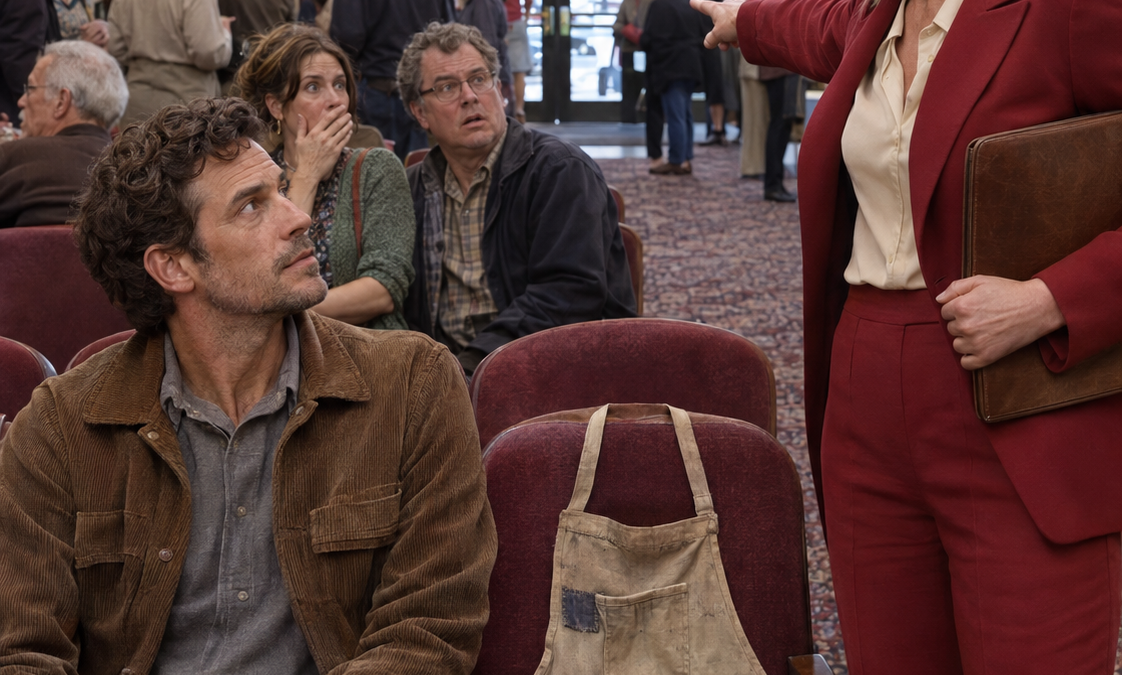
“Get out of the reserved row!”
Nicole Fenmore stood over me in the sunlit lobby of the Juniper Theater in Erie, Pennsylvania.
All 63 patrons heard my ex-wife say it.
My father’s patched canvas ticket apron lay across the neighboring seat.
Nicole pointed toward the doors, her red jacket pulling tight.
“This section is for people supporting the theater’s future.”
I stayed seated.
“Where is the owner’s signature?”
A woman across the aisle stopped folding her child’s jacket.
Nicole looked at the apron instead of answering.
“Your father worked for $4.25 an hour. My clients pay $8,000 a night.”
A paper popcorn bag crackled behind me.
Nobody ate.
The lobby chairs faced a microphone beside the auditorium doors.
These were anniversary remarks, not the movie itself.
The families would move inside when the short presentation ended.
That had been the plan.
I was Adam Wexford, forty-one, a speech therapist here in Erie.
Nicole was forty-five, a developer whose signs filled vacant lots.
We were divorced. Our marriage had ended two years earlier.
She knew which sentence would carry across a room.
I knew how long a person needed before answering.
“Would you show everyone the owner’s signature?” I asked.
Nicole tapped the leather folder beneath her elbow.
“You’re interrupting a sponsored presentation.”
A boy in blue headphones pressed both palms against his knees.
His mother leaned close, speaking where only he could hear.
I lowered my voice.
“The presentation can wait.”
For a beat, Nicole looked toward the microphone.
Then she smiled at the families.
“Some people have trouble accepting that places change.”
My father had worked those aisles until his knees failed.
He had patched that apron with canvas from an old grocery bag.
When he counted tickets, I counted beside him.
When he stayed late, I waited beneath the lobby clock.
His free screenings gave families permission to make noise.
He had died three years before this anniversary matinee.
I brought his apron because the invitation mentioned honoring former staff.
That was all.
Nicole’s company had paid for refreshments and the anniversary banner.
Her name appeared beneath the theater’s name on the invitations.
Now she spoke as though one line had swallowed the other.
“Today marks a transition,” she told the room.
A father near the doors lifted his head.
“What transition?”
Nicole shifted toward him, grateful for a fresh audience.
“The building will become my private event venue.”
The mother beside the boy stopped whispering.
“And the Saturday screenings?” she asked.
“Your last complimentary sensory-friendly screening is today.”
I watched the boy’s mother fold his jacket again.
This time, she folded the sleeves inside.
Nicole noticed.
“Private rentals will provide a more appropriate use of the space.”
“Appropriate for whom?” I asked.
“For people who can sustain it.”
The apron’s lower pocket had a crooked square of stitching.
Dad had repaired it after a loose nail caught him.
Nicole’s polished shoe rested inches from the apron’s hanging tie.
I moved nothing.
“Please finish your remarks without taking services away,” I said.
“You don’t set the program.”
A man near the concession counter glanced toward the office.
Nicole followed his look, then lifted her chin.
“The operating company understands the direction.”
One small detail bothered me.
She said direction.
Not agreement.
I could see a white tab protruding from her folder.
Proposed lease.
Those words were printed large enough for the front row.
Nicole tucked the tab under the leather flap.
“You should leave before this becomes uncomfortable,” she said.
A patron shifted aside as someone approached from the office corridor.
I recognized the cropped gray hair above a black sweater.
Samuel Bexley had received my accessibility notes that morning.
I had asked that the lights stay raised during the movie.
He had replied that the staff would be ready.
Now he came through the lobby without a microphone.
Nicole straightened and gave him a quick, practiced smile.
Samuel stopped beside my chair.
“We’ll follow your instructions, sir.”
Nicole went pale.
The smile stayed in place, but its corners stopped moving.
Across the aisle, the mother unfolded her child’s jacket.
Samuel looked toward the boy’s headphones, then back at me.
“The sound check is finished,” he said. “House lights at the agreed level.”
“Thank you.”
Nicole gave a brief laugh that nobody joined.
“Adam has always been particular about sound.”
Samuel didn’t answer that.
He was sixty, president of the company that operated the theater.
He had come from the office because he heard the shouting.
“Are we still starting on time?” he asked me.
“That’s what these families were promised.”
“Then we’ll keep that promise.”
Nicole stepped between his line of sight and mine.
“We need a moment to clarify the transition.”
Samuel looked at her folder.
“Yes,” he said. “We do.”
He turned toward the office corridor again.
“I’ll bring the reservation.”
Nicole watched him leave, then faced the room.
“That concerned technical accommodations. Nothing more.”
I let her explanation stand.
The families hadn’t come to hear adults trade credentials.
They had come because this was one place they could enter without apologizing.
At the concession counter, an employee stopped filling paper cups.
Nicole adjusted her jacket and opened her folder halfway.
“You’re making a misunderstanding look deliberate,” she told me.
“I asked to see a signature.”
“You’re not involved in these discussions.”
“Then showing it should be easy.”
Her thumb pressed against the folder’s spine.
The boy in headphones looked toward the auditorium doors.
His mother checked her watch.
I checked the lobby clock instead.
We still had time to give him the afternoon he expected.
Nicole pulled a white packet from her folder.
Part 2 of 5
“This,” Nicole said, lifting the packet, “is the proposed lease.”
She turned so the families could see its cover.
Her company’s name filled the top line.
Below it was the theater’s street address.
I recognized the format, but I couldn’t see the final page.
“Proposed,” I said.
“The paperwork reflects a negotiated direction.”
“That isn’t what I asked.”
Nicole lowered the packet to her waist.
For years, she had used that tone when a bill came.
First the expense became an investment.
Then a question about it became a failure of imagination.
I knew the sequence.
During our marriage, I paid the household utilities from my clinic income.
My therapy sessions started before school and continued after dinner.
A canceled appointment left an empty square I couldn’t resell.
Nicole called that thinking small.
She preferred properties photographed without the neighboring buildings.
Dad had preferred the seats nobody photographed at all.
When he found a torn cushion, I helped him replace it.
When he bought extra ear protectors, I carried the box.
When he waived admission, I watched families come back.
The old ticket price had been $6.
For some households, four tickets meant choosing which errand could wait.
Dad didn’t pretend a free movie solved that.
He just opened the doors.
Nicole tapped the packet against her palm.
“Your father worked for $4.25 an hour.”
The same words.
This time, a man near the back said, “We heard you.”
Nicole looked past him.
“I’m explaining the difference between sentiment and a viable business.”
The mother across from me raised her hand slightly.
“Could you explain where we’re supposed to go instead?”
“There are other entertainment options.”
“Where my son can walk around?”
Nicole glanced at the blue headphones.
“I don’t maintain a list.”
The mother lowered her hand.
I put my phone flat on my knee.
One practical thing.
I opened the email containing the anniversary schedule.
The screen showed the promised start time and the accessibility arrangements.
Nicole leaned closer.
“Are you recording this?”
“No.”
“Then put your phone away.”
“I’m checking what the families were promised.”
She looked at the apron again.
“Bringing that was unnecessary.”
I smoothed one corner without lifting it.
A stitch had come loose beside the pocket.
Dad had done that repair himself, sitting at our kitchen table.
His surname was Quade; I used my mother’s surname.
He had married her when I was small.
I never needed another word for him besides Dad.
Nicole knew that, too.
A fresh breeze came through the outer doors.
Nobody left.
The boy’s mother opened a small snack container on her lap.
Her son selected one cracker and held it without eating.
I could see the work she was doing to keep him ready.
Waiting could consume the whole afternoon before a movie even started.
“Nicole,” I said, “tell them the screening is still happening.”
“The screening will happen after I finish.”
“And the next one?”
“That’s not today’s subject.”
“You made it today’s subject.”
Nicole pulled out her phone.
She scrolled, then displayed a photograph of the auditorium without seats.
A digital rendering.
Round tables stood where the wheelchair spaces had been.
Cream fabric covered the walls beside the exits.
A new bar occupied the concession area.
She held it toward the nearest patrons.
“This is the standard the building deserves.”
The mother with the headphones didn’t reach for it.
“Where’s the ramp?”
“The rendering isn’t a construction drawing.”
“Where’s the space for wheelchairs?”
“We’re discussing atmosphere.”
I watched Nicole turn the phone back toward herself.
The picture disappeared.
She had shown the families their own absence.
No one applauded.
A man in a knit cap folded his program into quarters.
The concession employee set the unfinished cups down.
Nicole raised the lease packet again.
“I have clients expecting access to this venue.”
“Did you promise them exclusive access?” I asked.
“That is the product.”
“Before today?”
Her eyes narrowed.
“You don’t get to audit my business in public.”
“You announced it in public.”
Nicole stepped nearer my chair.
Her voice dropped, though the front rows could still hear.
“You always did hide behind people who couldn’t push back.”
I didn’t answer.
The boy had begun tapping his cracker against the container lid.
His mother placed a napkin beneath it to soften the sound.
I closed the schedule and opened my saved property records.
The screen stayed against my knee.
Nicole couldn’t see it.
Behind her, the office door opened a few inches.
Someone spoke quietly inside, then the door closed again.
Nicole turned the packet over.
Its back page was tucked beneath a translucent cover.
“Would this satisfy you?” she asked.
“Show everyone.”
She stripped the cover away.
The paper made a dry snapping sound.
Her thumb covered the bottom margin.
I waited until she moved it.
Nicole turned the last page toward the waiting families.
The owner-approval signature line on Nicole’s proposed lease was blank.
I stood slowly so the people behind me could see.
“That page requires the property owner’s approval,” I said. “There isn’t a signature.”
Daisy Pembroke, the house manager, came from behind the concession counter.
She looked directly at me.
“Adam, as the owner, do you want me to keep the auditorium open?”
Nicole lowered the page.
“You called him what?”
Daisy stayed beside the counter.
“The owner.”
Nicole’s mouth opened, but no words came.
I lifted my phone from my knee.
The county’s recorded deed opened beneath my thumb.
Part 3 of 5
My name appeared on the deed, followed by the theater’s address.
Nicole stared at the screen without moving closer.
“That’s a saved image.”
“It’s the county’s recorded document.”
I opened the browser address and refreshed the page.
Then I enlarged the recording stamp and the legal description.
Daisy stepped beside me, leaving room between us.
“The parcel number matches our building records,” she said.
She kept the insurance files in the office. She didn’t need to guess.
Nicole’s packet sagged against her thigh.
I held the phone where she could read without taking it.
The deed had been recorded eight years earlier.
Eight years before this matinee.
Three years before our wedding.
Nicole looked from the date to my face.
“You bought this?”
“Yes.”
“With what?”
“The sale of my speech-therapy software business.”
The boy’s tapping stopped.
I hadn’t meant to make the room wait through my history, but Nicole had left that question hanging in front of everyone.
At thirty-three, I sold a small company that made practice software for speech therapists.
The program let clinicians build exercises for children who couldn’t find the same words at the same speed.
I had written the first version after clinic hours.
A larger educational company bought it.
I kept my patients and stopped maintaining servers at midnight.
When the theater’s former owner decided to sell, Dad told me over breakfast.
He hadn’t asked me for money.
He had asked whether I knew anyone who might keep the place running.
I did.
Nicole looked back at the screen.
“You never told me you owned a theater.”
“It was listed as my separate property in our divorce papers. You signed the page.”
“You said you weren’t involved in development.”
“I wasn’t.”
She shook her head once.
“That’s a distinction.”
“It’s an old movie theater.”
I hadn’t bought it to become its public face.
The Juniper’s longtime operating company knew how to book films, maintain the equipment, and keep staff paid through a winter.
I kept that company in place.
Samuel ran it. Daisy managed the house.
My father kept working the aisle until he couldn’t.
His apron hadn’t become more valuable when I bought the building.
His time had always been worth more than the wage Nicole kept quoting.
A patron near the doors leaned forward.
“Does that mean the free shows are staying?”
“Yes.”
The answer traveled through the lobby in small movements.
A jacket settled onto a seat back.
A program unfolded.
The mother across from me put the snack lid away.
Nicole heard those movements, too.
“We can discuss this privately,” she said.
“You made an announcement to these families. They need the correction.”
Her gaze went toward the office corridor.
“Samuel negotiated with my staff.”
“For what?”
“The venue.”
“Which dates?”
“I don’t have the calendar in front of me.”
Daisy spoke from beside the concession counter.
“You reserved the lobby for today’s anniversary presentation.”
Nicole turned on her.
“My company sponsored this event.”
“Yes,” Daisy said. “That reservation included the presentation space and refreshments.”
“And the future arrangement?”
“That was a proposal.”
Nicole lifted the packet again, as though its thickness might answer for it.
I looked at the front page.
“May I read the paragraph above the signature line?”
She didn’t hand it over.
Instead, she laid it across the back of an empty chair.
I bent far enough to read without touching it.
Owner approval was required before any exclusive possession, alterations, or change of use.
The language wasn’t buried.
It occupied a short paragraph directly above the blank line.
“You brought a condition and announced it as a conclusion,” I said.
Nicole’s eyes stayed on the paper.
“My clients don’t care about technical distinctions.”
“They’ll care whether you can give them the building.”
Daisy glanced toward the auditorium.
The projection light had come on behind its small window.
We were nearing the promised start.
I put my phone away.
That screen had done its job.
The room didn’t need another exhibit. It needed an answer about what happened next.
Nicole straightened the packet’s corners.
“If the numbers are wrong, we can adjust them.”
“No.”
“You haven’t heard my final offer.”
“I heard you tell a child’s mother to find another place.”
Nicole looked toward the front row, then quickly away.
The mother met her glance without speaking.
A soft chime sounded from Nicole’s phone.
She looked down.
Whatever appeared there made her pull the device closer to her jacket.
I didn’t ask to see it.
The people waiting for a movie weren’t entitled to her private messages.
They were entitled to know whether her public promise was true.
“Tell them,” I said.
Nicole swallowed.
“The long-term lease is not fully executed.”
“The owner hasn’t approved it,” I said.
She pressed her lips together.
“The owner hasn’t approved it.”
Daisy picked up the microphone from its stand.
Before she could speak, Nicole’s phone rang.
She silenced it.
Then it rang again.
Samuel came through the office doorway carrying the reservation folder.
Part 4 of 5
Samuel stopped beside the same row where Nicole had ordered me to leave.
He set the folder on the concession counter.
Nicole moved toward him.
“Can we handle this away from the guests?”
“The guests heard your announcement,” he said. “They need the correction here.”
He opened the folder to a single-page reservation.
I stayed by my chair.
The apron remained across the neighboring seat, its long ties resting against the cushion.
Nothing in that room needed to move faster than the families could follow.
Samuel looked at Nicole.
“You booked this lobby for a sponsored anniversary presentation.”
“My company funded the event.”
“Your sponsorship paid for refreshments, printed invitations, and the presentation period.”
Nicole glanced toward the banner above the counter.
Her company’s name was still there.
It hadn’t disappeared when the deed appeared on my phone.
Nor had the coffee or the paper cups.
What had disappeared was the certainty she had borrowed from them.
Samuel kept one finger on the reservation.
“This did not authorize you to end public screenings.”
“We were discussing a transition.”
“You announced exclusive control of a property you haven’t leased.”
Nicole’s phone vibrated again.
She silenced it without looking.
“I have made commitments.”
Samuel waited.
She looked at me.
“There are people counting on this venue.”
I glanced toward the boy with the blue headphones.
“Yes,” I said.
Nicole’s jaw tightened.
For the first time that afternoon, she didn’t have a sentence ready.
Samuel turned the reservation so she could read it.
“The operating company can end an event reservation when the sponsor misrepresents its authority or interferes with public admission.”
Nicole read the paragraph.
She had brought her own pages to display.
Now she stood over someone else’s.
“I didn’t stop admission.”
“You ordered a patron out of a reserved row.”
“That was a personal disagreement.”
“He had an invitation and a seat,” Samuel said.
Nicole looked toward me again.
“You could have told me before I came up here.”
“You could have asked before you told everyone.”
A cup tipped on the concession counter.
Daisy caught it before it spilled and set it upright.
That small sound gave the room somewhere else to look for a second.
Samuel closed the folder.
He didn’t raise his voice.
There was no need.
“Your venue reservation is canceled.”
Nicole’s shoulders drew back.
“You can’t cancel the anniversary.”
“I’m canceling your sponsored presentation. The theater’s matinee will continue.”
“The banner has my company’s name.”
“We’ll remove it.”
“My guests—”
“Everyone with a matinee ticket is welcome to stay.”
Nicole looked across the rows.
No one stood to follow her.
Samuel continued before she could turn that into another argument.
“We’ll refund the unused presentation portion. Your proposed long-term lease is declined.”
She stared at him.
Then she looked at me, waiting for a softer version.
I had spent years softening sentences before children practiced them.
I wasn’t going to soften this one until it meant the opposite.
“The Juniper isn’t becoming your private venue,” I said.
Nicole’s lips parted.
She shut them again.
The mother across the aisle laid her son’s jacket over her arm.
Her hands had stopped folding it.
Samuel stepped away from the counter.
“Please collect your presentation materials.”
Daisy switched off the microphone in her hand and set it back on its stand.
Nicole watched the cable settle against the floor.
There was no grand sound attached to losing that room.
A switch clicked.
A paper edge scraped wood.
Somewhere beyond the auditorium doors, the projector fan continued turning.
Nicole gathered the proposed lease.
She put the last page in backward, noticed, and pulled it out.
Nobody helped her straighten it.
I didn’t take any satisfaction in the awkwardness.
I watched the families instead.
They had absorbed enough of our history without volunteering for it.
A man in the back raised his program.
“So the movie starts?”
“In a few minutes,” Daisy said.
“The same one?”
“The promised one.”
Nicole looked toward the banner again.
“Leave that until my staff can collect it.”
Samuel shook his head.
“We’ll fold it and have it ready at the counter.”
He wasn’t asking the room to punish her.
He was ending the permission she had mistaken for possession.
Nicole slid the packet into her folder.
Her red sleeve caught on the zipper.
She tugged once, then freed it carefully.
For a moment, her gaze settled on Dad’s apron.
I couldn’t tell what she saw.
She didn’t speak about his wage again.
At the outer doors, she stopped.
“I expect the refund in writing.”
“You’ll receive it today,” Samuel said.
That was the last exchange she got from the room.
Nicole pushed through the doors alone.
Daisy lifted the folded anniversary banner off its hooks.
Part 5 of 5
Daisy placed the banner behind the concession counter, with Nicole’s company name folded inward.
All 63 patrons were still there.
They had watched Nicole claim the theater.
They had watched her proposed lease fail at its empty signature line.
Now they watched Samuel put the reservation folder away.
He faced them without taking the microphone.
“The matinee is going ahead as advertised,” he said.
“Today’s screening is free. The sensory-friendly series will continue.”
The boy’s mother rubbed her thumb along the edge of his jacket.
“Next month, too?”
“Next month, too,” I said.
She looked at me.
I understood why she wanted something more useful than a reassuring voice.
“The schedule will be posted at the counter before you leave,” I added.
“Same light level?”
“Yes.”
“Can he still step into the lobby?”
“Whenever he needs.”
She nodded once and turned to her son.
He had been waiting for a simpler answer than any lease could offer.
“We’re staying,” she told him.
He ate the cracker.
Daisy opened both auditorium doors.
The families began gathering bags and jackets, but nobody rushed them.
Samuel stood beside the entrance, leaving the full width clear.
I picked up the apron by its shoulder strap.
The old canvas bent easily where Dad’s waist had worn it soft.
A few paper tickets remained inside the pocket.
I had found them when I took the apron from its box that morning.
They were unused stubs from a long-ago screening, their corners rounded by his hand.
I left them where they were.
The man with the knit cap paused beside me.
“I knew your dad.”
I waited.
“He once stopped the previews because my wife couldn’t manage the volume.”
The man looked toward the open doors.
“He didn’t ask us to leave.”
“That sounds like him.”
“I should have said something sooner.”
“You’re here.”
He nodded and followed the families inside.
I didn’t need the patrons to defend me.
I did need them to believe the place still belonged in their lives.
That had been the point of buying it.
For eight years, I had let the operating company’s name sit on the programs and invoices.
It employed the staff, booked the films, and answered the telephone.
The ownership had never been a trick waiting for Nicole.
It was simply a part of my life I hadn’t put on a banner.
Keeping that quiet had spared Dad a hundred conversations he wouldn’t have wanted.
After he died, I kept the same arrangement.
Now it was public.
I would live with that.
Daisy waited until the last family had passed through, then came beside me.
“Would you like his seat in the usual row?”
Dad’s old place was near the side aisle, where he could see the exit and the screen without turning his head.
“Yes,” I said. “If it isn’t taken.”
“It’s reserved for you.”
I looked at the canvas over my arm.
“For him, then.”
Daisy walked with me into the auditorium.
The house lights remained raised enough to see every step.
There were no sudden trailers booming through the speakers.
A child tested the aisle, walking halfway down and back again.
Nobody hushed him.
I laid Dad’s apron across the reserved seat.
Its pocket faced the screen.
The patched square rested where his knee would have been.
I took the chair beside it.
Across the aisle, the boy’s mother helped him settle his headphones.
He looked toward the empty seat next to me.
“Is somebody coming?”
“My dad used to work here,” I said. “That was his apron.”
The boy studied the patch.
“Did it break?”
“A little.”
“Who fixed it?”
“He did.”
The boy considered that, then turned toward the screen.
His mother mouthed a thank-you.
I nodded and left it there.
Samuel came down the side aisle before the lights changed.
He bent close enough that I could hear without making the front rows wait again.
“The declined lease and cancellation notice have been sent,” he said.
“Thank you.”
“Daisy has next month’s schedule printing.”
That was the part I wanted the families to carry home.
Something they could pin to a refrigerator.
A date they could plan around.
Not a story about a developer and an unsigned page.
Samuel returned to the back.
The projector brightened, throwing a pale rectangle over the curtain.
Around me, paper bags opened.
A wheelchair wheel clicked into place.
Someone near the rear asked whether the lobby door could remain cracked.
Daisy said yes.
The first image filled the screen at the promised time.
I rested my hand on my own armrest, beside the apron’s dangling tie.
Dad’s seat stayed empty.
Every family had kept theirs.
At the counter, Daisy set out the printed schedule for next month’s free screening.
THE END
More stories
My Daughter-in-Law Gretchen Shouted That I Didn’t Make the Quilt Before 57 Spectators—but When the RIDER Walked In, Her Claim Unraveled and She Lost Her Shot at a $25,000 ContractMy Stepmother Called Me an ABSENTEE Father Before 68 Wedding Guests—but When Two Marines Walked In and Greeted Me, She FROZE Beside My Daughter’s ChairMy Ex Duncan Called Me a “Discount Parent” at Our Daughter’s Roller Party—but His Smile Disappeared When the Man Beside My Bench Announced My Usual TABLE Was ReadyMy Son Glen Tried to Move Me Into His Spare Room Before 43 Picnic Guests, but My PAID Residency Agreement Was Only the First Paper He RegrettedMy Sister Offered Me MOTEL Money Before 67 Lodge Guests—but When the Owner Said My Right to Stay Stood, She Went PALE and Lost Her Management ContractMy Uncle Shouted “Stop Asking for Charity!” at Dad’s Memorial Luncheon—but When a Man in a Black Jacket Ordered Him Away From the Microphone, He Went PALE
You Might Also Enjoy

My Daughter-In-Law Told Me To Stay Elsewhere While Strangers Took My Condo — Then I Pushed Back







