My Father Took My Funeral Home Keys in Front of 30 Relatives—Then the Buyer Read My Brother’s Claim Aloud, and He Lost the Sale in Front of 200 People
Complete story · 7 parts · about 32 minutes · ending included
Part 1 · Part 2 · Part 3 · Part 4 · Part 5 · Part 6 · Part 7
Part 1 of 7
Eleven hours before my father asked for my keys in front of thirty relatives, the night phone rang.
At 2:04 a.m., I drove out to the Aune farm outside Cedar Bend and brought Mr. Arvid Aune into my care. I run Sandstrom Funeral Home, and I am its licensed funeral director. After that, I wrote his name in my late mother’s blue-covered burial book, took him to the cooler on Elm Street, then drove back to sit with his widow, Mrs. Aune, until nearly noon.
She held my sleeve at the door.
“Will you be the one with him?”
“I’ll see to it.”
By 1:40 that afternoon, thirty relatives were already seated at my father’s Thanksgiving table.
I came in late with the burial book tucked under my arm and my key ring still in my hand.
The dining room smelled of turkey, onion dressing, and coffee that had been sitting too long.
Dad did not ask about Mr. Aune or the widow I’d just left.
My father, Orville Sandstrom, tapped his fork against his water glass.
The first strike rang across the table. He struck the glass again, and thirty faces turned his way.
He kept his eyes on his plate.
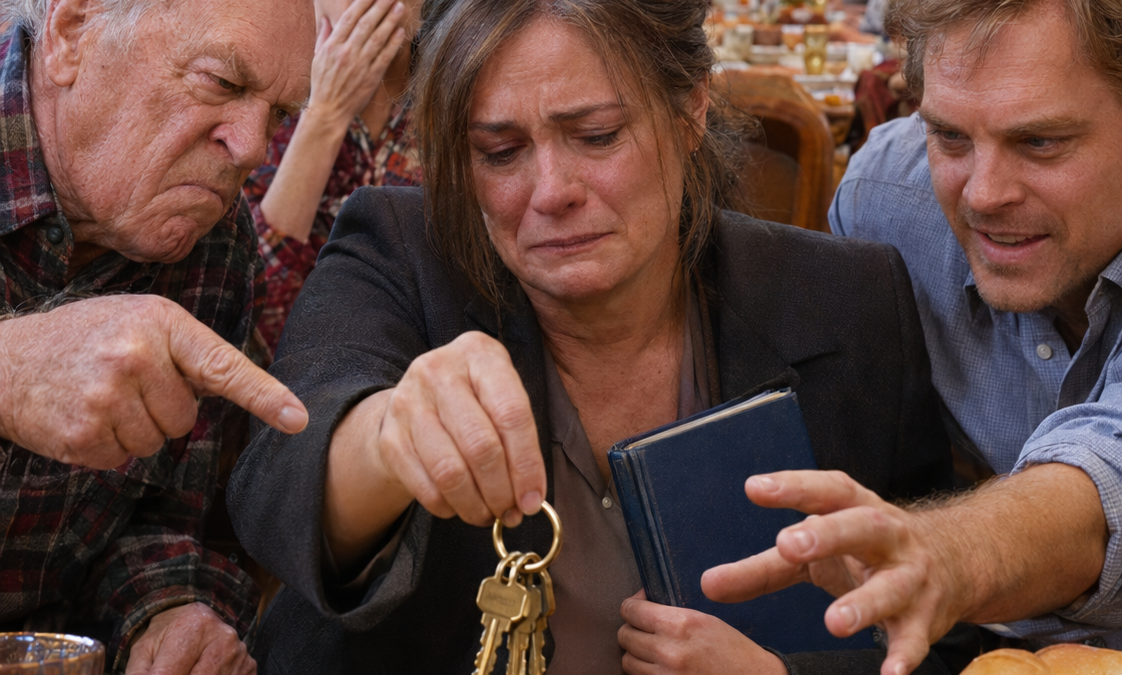
“Keys, June. Your brother’s home. It’s time this family had a Sandstrom man running the place.”
At the head of the table, my brother Kip smiled at me from Dad’s usual chair.
Kip was forty-three and had been back from Scottsdale since October, after years away and a string of jobs that never seemed to last long enough to need forwarding addresses.
He lifted his coffee cup like somebody had just introduced him.
Nobody had pulled out a chair for me.
“Dad, the deed was supposed to—”
“Fifteen years of rent doesn’t buy you a doorknob.”
Dad said it loud enough for the whole table.
My thumb stopped on the oldest brass key.
Across from Dad sat my aunt Lorna, my father’s sister, who had kept the ledgers at Sandstrom’s for years. She looked down at her turkey and stayed there.
Most of the people at that table had known me since I was a girl, and not one of them said a word.
Forks rested beside mashed potatoes. A serving spoon stuck up from a bowl of sweet corn. Somebody at the far end had a roll halfway to his mouth and left it there.
Then Lorna’s granddaughter Haley, 9, leaned around her mother’s shoulder.
“But Aunt June answers the phone at night. Who answers the phone at night?”
Her mother put a hand on Haley’s wrist.
“Sweetheart, hush.”
Kip grinned.
“We’ll get an app, kiddo.”
A few people shifted in their chairs.
I studied the key ring in my hand.
It held the front-door, back-door, chapel, and basement keys.
I slipped the ring off my finger and set the keys on the table beside the gravy boat.
The metal touched the wood with a small, clean sound.
“I’ll see to it,” I said.
My left hand closed on the spine, and my right palm came down flat over the blue cover.
Dad lowered his fork and pointed at the book.
“That’s your mother’s. Leave it.”
“It’s a burial record, Dad. Mr. Aune’s in it.”
He looked at me then.
My mother, Alma, had kept the last page set apart from the rows of names, and I could feel it through the back cover, thicker than the rest. I gripped the book until the blue edge pressed into my skin.
Dad held out two fingers toward the table.
“The keys are enough.”
Kip reached across and took the keys.
The book stayed against my ribs, and no one else’s hand came near it.
My cousin cleared his throat and asked for the cranberry sauce.
Conversation started in pieces. A chair scraped. Someone passed the rolls. Haley’s mother bent close and whispered something into her ear.
Kip had not let go of the ring.
Dad picked up his fork.
I had been in the room less than five minutes.
I nodded once to Lorna. She did not raise her head.
Then I turned toward the front hall.
Behind me, Kip said, “June.”
I opened the door.
Cold air came across the porch.
Kip followed me out alone, pulling the door nearly shut after him. He stayed on the top step in his shirt sleeves with the keys looped over one finger.
“You don’t have to make this weird, buddy.”
I faced the driveway.
His pickup sat crooked near the mailbox, cleaner than anything else parked there.
The ring clicked behind me.
Kip worked one key free.
“Back door. You’ve still got the license, buddy, so you still do the work. Help uses the back.”
He tossed it as I turned around.
I caught the back-door key one-handed.
For a second, the cold metal sat in my palm, its teeth biting lightly.
I gave him nothing back, not for the door and not for “Help.”
Kip was still smiling when I stepped off the porch.
I walked past his pickup, carrying the book against my side and the key closed in my fist.
Something white lay on the dashboard under the windshield.
It was a visitor pass, dated nine days ago.
“HARBORLIGHT MEMORIAL GROUP / VISITOR / NOV 18”
Part 2 of 7
The last page held a $180,000 promise in my father’s handwriting.
In the car, I opened the burial book across my lap. A sheet of Sandstrom Funeral Home letterhead sat flat under four photo corners, and I read the note aloud.
“I, Orville Sandstrom, sell to my daughter June this building and business for $180,000, $1,000 a month. When she has paid in full, the deed is hers.”
His signature ran underneath, pressed hard into the paper.
I had come back to work for Dad in 2006. In September 2008, he wrote those words at the kitchen table, signed them, and pushed the sheet toward me.
I read it.
Mom picked it up.
“I’ll keep this one.”
The next day I saw it mounted on the final page of her blue-covered book, already tucked under those four corners.
On the first of each month, I wrote Dad a check.
After I made the last payment, I asked for the deed three times.
“After the first of the year,” he told me each time.
The next month, I stopped writing checks.
Dad never asked me for another dollar.
I closed the book carefully enough that the note did not shift and drove to De Smet.
Sheila Tollefson, a lawyer who worked alone there, answered her kitchen door in socks. Years earlier, I had buried her father.
She saw the book under my arm.
“Show me the paper.”
I opened it to the note on her table.
Sheila leaned over it.
“Anything on the back?”
“Blank. I watched him write it.”
She touched one dry, brittle photo corner with the tip of her finger and stopped.
“Seventeen years old. Don’t pull it. A torn original is a gift to his lawyer. Shoot it where it sits.”
She took out her phone and photographed the front.
Then she enlarged the image on her screen.
“A signed writing. South Dakota wants exactly that.”
“The checks are the problem.”
“Where are they?”
“The originals never came back to me.”
She waited.
“My credit union statements printed both sides of each check. Tiny images. About the size of a stamp.”
“Memo lines?”
I nodded.
“Something like ‘Note 14 of 180.’ The number changed each month.”
Sheila looked at the note again.
“Statements?”
“Fifteen boxes in the basement at the funeral home. One box of business records for each year. The account papers are inside.”
“Anything at the credit union?”
“I don’t know. I remember hearing they keep check images about seven years, but I wouldn’t swear to it.”
Sheila set her phone beside the book.
“Then I need better than ‘I remember hearing.'”
“Can we record the note with the county Register of Deeds?”
“No. It wasn’t notarized, and Alma was the only witness. She’s dead. You still have plenty of time to sue.”
She tapped the table once.
“I won’t sign a complaint on the note alone. Without proof you paid, his side says you never paid a dime. Bring me all 180, then we file. Until then that note stays in the book and your mouth stays shut, or he signs a deed first.”
“He’s my father.”
“He’s a signature.”
Friday at 8:00 a.m., a locksmith had the front-door cylinder out of Sandstrom Funeral Home.
Another lock waited on his cart for the basement door.
I came in through the back using the one key Kip had given me. Mom’s book stayed tucked against my side.
Mr. Aune was in my care, and Mrs. Aune would be arriving to make arrangements.
Kip stood in the front hall beneath my framed funeral director’s license.
He had one hand on the bottom edge.
“What are you doing?”
“Fresh start, buddy.”
He lifted the frame slightly.
I took out my phone.
Sheila answered.
“Kip is taking down my license.”
“That’s all he’s removing?”
“Yes.”
“Tell him this word for word.”
I listened.
Then I faced my brother.
“My lawyer says that stays on the wall or no family comes through that door.”
Kip’s hand stopped.
Behind him, the locksmith glanced over and went back to his tools.
Kip lowered the frame until it rested straight on the wall.
“Fine. Hang there. You work for me.”
The door opened before I answered.
Mrs. Aune stepped inside holding her purse against her coat.
Kip turned toward her with a smile.
“We’re under new management. June’s great help.”
I walked past him.
“Mrs. Aune, come with me.”
She followed me into the family room.
I pulled out a chair for her.
“One minute, Mrs. Aune.”
Kip went outside to pay the locksmith.
I crossed the hall, entered the preparation room, shut the door, and set the inside latch.
Then I called Sheila back.
“I couldn’t say this in front of Kip.”
“What?”
“They’re changing the lock on the door to those fifteen boxes.”
“Same basement as Thursday?”
“Yes.”
She was quiet long enough for me to hear the ventilation fan above the sink.
“Do you have that key?”
“Kip has the ring.”
“And the locksmith is there now.”
“Yes.”
“Leave them for now. I’ll ask first for whatever check images they still keep. Ask for those boxes and he learns what’s in them.”
I looked toward the closed door.
“All 180 statements should be down there.”
“I heard you.”
“What if they don’t have them?”
“Then we deal with that when they tell us.”
I slipped the phone into my pocket.
“I have Mrs. Aune waiting.”
“Then go take care of Mrs. Aune.”
I opened the latch.
“I’ll see to it.”
That afternoon, I was at the office desk finishing Mr. Aune’s paperwork when I saw Kip’s pickup through the window.
The same pass still lay on the dashboard.
HARBORLIGHT MEMORIAL GROUP.
VISITOR.
NOV 18.
The phone on that desk rang.
I picked it up.
“Sandstrom Funeral Home. This is June.”
A woman’s voice answered, polite and businesslike.
“This is Kristin Kerr with Harborlight. I’m calling for Kip, the incoming owner, about our letter of intent. You must be the licensed gal. He says you come with the building.”
Part 3 of 7
Monday, Sheila mailed Dad a certified demand for my deed.
She phoned from the De Smet post counter right after sending it, holding her postal receipt and her file copy.
“I wrote ‘your agreement with June.’ Not one word about paper. Let him deny it in writing.”
Thursday afternoon, her number came up while I was at the office desk.
“He answered.”
“What did he say?”
“Handwritten. Funeral home letterhead. I have the original here.”
“What does it say?”
“Listen.”
Paper moved near her receiver.
“There is no agreement. June rents. Rent is rent. O. Sandstrom.”
I put my hand on Mom’s blue-covered burial book beside the phone.
“Does he even remember the note?”
“Maybe. Maybe not.”
“My mother had a locked box of private letters. She asked that nobody ever open it and that it be buried with her. Dad put it in her casket himself.”
Sheila paused.
“He must think it went in the ground with your mother.”
Friday, a notice was taped across the door of my upstairs apartment.
I had lived there fourteen years.
The paper said I had to be out by January 31. Dad had signed the bottom. I took the notice down and kept it.
Downstairs, a fresh stack of year-end memorial programs sat on the front hall table. I had started that service in 2011 and read the name of each person we had cared for that year.
My name was gone.
HOST: KIP SANDSTROM, OWNER.
My framed license still hung on the wall nearby. Nowhere else in the building showed my full name anymore.
They were taking my home.
They had taken my service.
Standing beside the programs, I phoned Sheila.
“Don’t move out. Nobody has a court order.”
Saturday morning, my phone rang while I still had my coffee.
“The credit union confirmed it. Nothing before 2018.”
My fingers tightened around the mug.
“What about what they still have?”
“Printed images are waiting on the mail. End of the month, they say. I have not one page in hand.”
“So the first ten years are mine against his.”
“That’s exactly what it is.”
I had already called Aunt Lorna, Dad’s sister, who kept the funeral home books until 2015.
She had not picked up.
I went downstairs anyway.
The basement lock still took a key I no longer had. A white Harborlight sheet had been taped beside the handle.
PRE-CLOSING: CLEAR BASEMENT OF OLD RECORDS.
Through the narrow glass panel, I could see the landing.
The fifteen boxes were stacked there, one year of records in each.
Each one had a red label in Kip’s handwriting.
SHRED — MON.
The buyer was the reason for the cleanup. Kip was not targeting me.
That did not make Monday any farther away.
I went out to the back lot and sat in my car with the engine off.
Sheila answered on the second ring.
“The boxes are marked for shredding Monday.”
“How do you know?”
“I can see them through the glass.”
“What exactly does the sign say?”
I read it to her.
She was quiet for one beat.
“The courthouse is closed till Monday morning, and that truck comes first. And the minute I ask a judge for those boxes, he learns what’s in them and signs a deed.”
“So I leave them there.”
“For tonight.”
After the call, I carried Mom’s book to the back steps.
This year’s burial list ran to sixty-one names. I read each one slowly and checked the spelling out of habit.
A car door shut in the lot.
Mrs. Aune, Arvid Aune’s widow, came around the corner holding the casserole dish I had sent home with her after his arrangements.
“I brought your dish back.”
“You could have kept it.”
“I know.”
She put it beside me, then took my hand.
“Arvid said you never once let a family see you tired.”
I looked at our joined hands.
“Thank you, Mrs. Aune.”
None of my relatives reached out.
At 11:40 Sunday night, the on-call line rang.
Mr. Bruns had died at the nursing home.
I pulled on my coat, picked up Mom’s book, and drove out for him. By 12:20 a.m., I was back, opening the rear entrance with the key Kip threw me at Thanksgiving.
Inside, the loading dock hallway was different.
All fifteen stood along the wall by that door, ready for the shredding truck. Sometime that evening, they had been moved up from the landing.
I did not touch them.
Mr. Bruns came first.
I brought him into the preparation room, closed the door, set the inside latch, and cared for him the way I had cared for every person who came through my hands.
His name went on the case sheet.
I listed his personal effects.
His wedding ring stayed where it belonged.
When I finished, I washed my hands, put the room in order, and opened the latch.
The hallway was empty.
The boxes were still there.
I carried the first one to my car.
Then the next.
Each was heavy with old statements, receipt copies, tax work, and the business records I had boxed away year after year.
I opened none of them.
By the fourteenth, my arms were shaking.
The fifteenth scraped my coat as I lifted it from the floor.
At 1:30 a.m., I slid it into my SUV with the rear seats folded flat.
A door opened behind me.
Kip stepped out of the back room wearing a coat over his pajamas. He had been sleeping there since the locks changed.
He looked at the empty stretch of wall, then at my loaded car.
Instead of reaching for a box, he smiled.
“Taking the archives, buddy?”
I shut the car door.
Kip came down off the dock and rested one forearm on the roof.
“Take your old statements. A thousand a month is what rent looks like. No paper, no case. Sue him. You’d be suing a seventy-eight-year-old man who’s got nothing.”
Kip had never balanced anything; he thought a statement was a column of numbers.
I kept the note to myself.
His smile widened.
“You really think those boxes save you?”
My thumb stayed on the car key.
He leaned a little closer, easy and certain.
“Where’d you think your thousand went, June? It went to Scottsdale for ten years, starting 2013. Dad signed them right over. You paid my rent.”
Part 4 of 7
Check 52 had Dad’s handwriting on the back.
Below “Pay to Kip Sandstrom,” my brother had signed his name.
Sheila moved the glass over the stamp-sized image, then slid the statement aside.
The first fifty-one checks had gone into Dad’s own account. Starting with my January payment in 2013, each back carried the same direction in his hand, Kip’s signature, and the stamp of a small bank in Scottsdale.
“A little bank that knew his face,” Sheila said.
The front had not changed.
Note 52 of 180.
The next one read Note 53 of 180.
I sat across the long table with Mom’s burial book beside my elbow. The fifteen boxes filled one wall of Sheila’s office.
“I balanced these to the penny every month. A paid check was a paid check. I never once looked at the back.”
Her calculator clicked.
“Hundred twenty-nine checks. A thousand dollars each.”
She marked each back for enlargement and kept the copies as they came off her printer.
I said nothing for a while.
Then I asked, “What day can you file?”
Tuesday morning, the office phone line at the funeral home gave one ring and switched to the fax.
I was covering it while Kip was out.
A sheet came through with Harborlight’s name at the top and a closing calendar underneath.
Kristin had sent it to the number Kip had listed as the owner’s contact.
$640,000.
$25,000 earnest money received.
At 9:00 a.m. Monday, December 15, Dad was scheduled to sign the deed over to Kip.
The date had not moved.
Dad had not called me.
I drove the sheet to De Smet and put it in front of Sheila.
She read it once and set it beside her printed tally.
“Kip must not have told him. One word about those checks and your father gets cold feet, and Harborlight already set the date.”
“What happens if they record first?”
She tapped the line with the signing time.
“If the buyer knows nothing about your claim, you may end up owed money instead of keeping the building.”
I looked at the number at the top of the page.
Six hundred forty thousand dollars for the place I had already paid for.
“So we file first.”
“And record notice first.”
Sheila slid the fax into a folder.
Then she went back to the boxes.
She would not file from a pattern. She wanted all 180 payments matched to a statement, a date, and an image before she put my name on a lawsuit.
By Thursday afternoon, she had them.
Fifty-one to Dad.
One hundred twenty-nine endorsed to Kip.
The enlargements sat in Sheila’s hands in a thick stack, each one big enough to make the handwriting plain.
Kip spent the same week preparing for Sunday.
He hung a banner across the chapel doors.
A NEW CHAPTER.
An invitation addressed to Kristin Kerr went out with the memorial mail.
By the front desk, he set a new brass sign bearing his own name where families would see it when they entered.
My framed funeral director’s license remained on the front hall wall.
Friday afternoon, I called Sheila before she left for the courthouse.
“I’m not doing this in the chapel. Families come for their dead.”
“Then it happens Monday, in a hallway. I’ll sit up front anyway.”
At 3:40 p.m., eighty minutes before closing, Sheila filed the case at the Kingsbury County courthouse.
From there, she went down the corridor to the Register of Deeds office and recorded the notice against the property.
Dad did not know.
Neither did Kip.
Kristin had not been told.
The stamped copies remained with Sheila.
A process server would hand Dad the papers Monday morning.
Sunday, Kip arrived early enough to test the microphone himself.
“Check. Check. Welcome, everybody.”
Dad stood beside him near the lectern, listening as if his son already owned the place.
Kip adjusted the stand.
Dad clapped him on the shoulder.
“Sounds good.”
Haley found me near the candles.
She wore a dark green dress and had both hands tucked behind her back.
“Aunt June?”
“Yes?”
“Can I hold one this year?”
I promised her the taper.
“You stay next to me.”
“I will.”
Kip walked past us on his way to the lectern.
He pointed at the taper in my hand.
“You light the candles, then you stand by the back door. Help uses the back.”
The words were as easy for him on Sunday as they had been at Thanksgiving.
“I’ll see to it.”
By three, two hundred people had signed the guest book, Kristin among them.
It was her first visit to the building.
Instead of entering the chapel, she stopped just outside it.
Her gaze settled on the frame.
JUNE SANDSTROM.
She stood close enough to read the smaller lines underneath.
Then she looked through the open chapel doors and caught Kip’s attention.
“A word about the license before we start?”
He gave her a quick smile.
“After, buddy.”
Kristin did not smile back.
She carried her document case to her seat.
Sheila was already up front.
Mrs. Aune sat in the first row.
When the hour came, I took Haley to the candles and put the taper in her hand.
I did not hurry her.
She touched the flame to the first wick while I read the first name.
Then the next.
The chapel stayed quiet except for my voice and the small sounds of people shifting when they heard a name that belonged to them.
Haley did not leave my side.
Halfway down the list, I said, “Arvid Aune.”
Mrs. Aune lowered her chin.
The flame caught.
We continued.
I read every name from the year.
When the last candle was lit, Haley returned the taper to me and went to sit with Lorna.
I carried it and Mom’s book to the rear of the chapel.
The back door was beside me.
The service was over.
People remained seated.
Kip walked to the microphone.
Dad came with him, smiling at the room.
Kip put one hand on the lectern.
“Starting tomorrow, I’m your new owner. Licensed and ready. June stays on as help.”
Mrs. Aune turned in her seat.
Her eyes found me at the back.
Kip kept going.
“Kristin from Harborlight, come on up and say hello to the families.”
She rose.
The case came with her.
Halfway up the aisle, she opened it and took out a folded letter.
Kip moved aside to give Kristin room.
Dad was still beaming.
I set the taper down.
Then I turned my back on the back door and stepped into the center aisle with the book in my hand.
Part 5 of 7
Kristin reached the lectern with the letter of intent open in her hand, less than a day before Dad was due to sign the deed.
I kept walking toward them with Mom’s blue burial book against my palm.
Two hundred people stayed in their chairs behind me.
Kip leaned toward the live microphone.
“June, back door, buddy. Staff doesn’t —”
Kristin lifted the page an inch.
“Help me with the paper first, Kip. Your letter says,” she said, and read from it.
“‘licensed funeral director and, on recording of the December 15 deed, sole owner.’ South Dakota requires a licensed person to run this place. Whose license is that in the front hall?”
Heads turned toward the open chapel doors.
The frame was visible from the aisle if you knew where to look.
I stopped beside the first row.
“Mine. Since 2001. The establishment’s been on my license since 2008.”
Kristin’s glance went to me, then back to the letter.
Kip gave the room the smile he used when he wanted a mistake to sound small.
“It’s a formality. Dad owns it, Dad’s giving it to me.”
Beside him, Dad kept his arms loose at his sides.
Kristin faced my father.
“Sir, is anything going to stand in the way of tomorrow’s deed?”
Dad did not look at me.
“I own this building. She’s a tenant. It was rent.”
My thumb found the last page.
I opened Mom’s book where the old sheet of funeral-home letterhead lay flat under four photo corners.
The paper had stayed there seventeen years.
My fingers never touched an edge.
“‘I, Orville Sandstrom, sell to my daughter June this building and business for $180,000, $1,000 a month. When she has paid in full, the deed is hers.’ Your hand, Dad. September 14, 2008.”
Dad stared.
His face went gray.
“That went in the ground with your m—”
His mouth closed.
Kip looked from Dad to the open page.
He had no joke ready.
Mrs. Aune remained in the first row, her program folded across her lap.
No one got up.
Sheila did.
Dad pointed at the book.
“That’s kitchen-table scribble. Nobody notarized that.”
Sheila stepped out carrying Orville’s handwritten letter and a printed photograph of the note’s front.
She stopped where Kristin could see both.
“Same hand that wrote me ‘There is no agreement’ ten days ago.”
The two samples sat inches apart.
One denied the deal.
The other carried his signature under the price.
Her voice stayed dry.
“The law asks for a writing he signed. He signed it. Here are a hundred eighty paid checks, front and back, on the statements from fifteen boxes, every memo line marked ‘Note’ and a number. Filed Friday, recorded notice, 3:40 p.m. And in two years he never asked for another dollar of this ‘rent.'”
Dad’s gaze dropped.
“Fifteen boxes?”
Sheila did not fill the pause for him.
He looked at Kip.
“The basement records?”
Kip glanced toward the floor.
“They’re safe,” I said, and kept the book open on my palm.
Dad’s mouth flattened.
“You let her take them?”
My brother did not answer.
Sheila laid the printed tally on the lectern beside Kristin’s hand.
One row, a third of the way down, faced me.
Note 52 of 180.
Nothing followed it but the date, the amount, and the next payment.
She placed the stamped copies from Friday beneath her palm.
Kristin bent enough to read the first page.
Her eyes moved across the filing stamp, the names, and the property line.
She kept one finger on the letter of intent while she checked the stamped copy against it.
Nothing in her face changed.
“Is this the same 412 Elm property?”
“Yes.”
Kip shifted closer.
“What did you record?”
Sheila tapped the second stamp.
“Notice of pending action.”
The speakers carried the scrape of Kip’s shoe when he moved back.
Dad bent over the tally.
His finger stopped near the bottom.
“One hundred eighty?”
Sheila nodded once.
“Paid.”
I watched him look at the last line.
He had never asked me for payment 181.
Kristin kept hold of the letter of intent.
“So tomorrow’s deed has a lawsuit in front of it.”
Sheila answered with two words.
“Recorded Friday.”
Kip’s smile disappeared.
Sheila gathered the stamped pages and set the stack of enlarged check backs on the lectern.
She said nothing else.
The top sheet showed Dad’s handwriting large enough to read from where I stood.
Kip saw it.
His words came before anyone had named the person who received the money.
“Dad was just helping me get started. Those checks were family money.”
A few heads turned toward him.
Lorna’s did too.
Sheila lifted the top enlargement.
Dad’s endorsement filled the center of the page.
I read it aloud.
“‘Pay to Kip Sandstrom.’ A hundred twenty-nine of them, in Dad’s hand. Kip, you told me I paid your rent. You were right.”
A murmur rolled from the front rows to the back. On the lectern, the next sheet showed the same line, and so did the one after.
Sheila kept the rest squared beneath her palm.
Kip watched the stack without touching it.
Kristin’s eyes stayed on my brother, not the papers.
Dad said nothing.
Up front, Mrs. Aune set her folded program on the empty chair beside her.
Kip’s jaw tightened.
Dad looked at the sheet, then at his son.
Neither man turned my way.
From the second row, Haley leaned forward beside Lorna.
“So who owns the keys?”
Kip reached toward his trouser pocket, then stopped.
He did not take the ring out.
My back-door key stayed in my own pocket.
Lorna glanced at Haley for one beat, then stood.
She raised one hand and counted on her fingers as she spoke.
“I kept those books till 2015, Orville. You told me, ‘Put June’s thousand down as house payment.’ I wrote it down because you said it.”
Her last finger stayed raised.
No one in our family looked at Dad.
I walked up to my father.
The book stayed open against my left palm.
When I spoke, I used the same voice I used with families when the next thing had to be made plain.
“You told thirty people, ‘Fifteen years of rent doesn’t buy you a doorknob.'”
Dad’s fingers tightened against the edge of the lectern.
I turned to Kip and held out my right hand.
“Keys, Kip. Fifteen years bought every doorknob in this building.”
Part 6 of 7
The key ring struck the lectern, and the live microphone carried the clatter. Kip had taken it from his trouser pocket with a shaking hand. I picked it up.
Kristin slid the letter of intent into her document case and closed it. “Harborlight withdraws. I’ll need our $25,000 back within ten days, Kip, as your letter says.”
Kip turned away from Kristin, and the chapel speakers caught every word. “There goes your two hundred, Dad.”
Color climbed my father’s neck. Kristin addressed the guests still in their chairs. “My apologies. You’re with the right person.”
Sheila gathered the stamped pages near the front row. I closed Mom’s blue burial book with my left hand. The key ring stayed in my right. From then on, Kip could not open a single door in the building.
Mrs. Aune rose and put on her coat. Behind her, the rows began to empty. Kip did not leave Dad’s side.
I carried the book to my office and set the keys beside the first-call sheet while I finished the work waiting for me.
At 9:00 the next morning, nobody signed anything. Sheila called my cell at 9:20, while I was booking a visitation on the business line.
“The process server handed Orville the papers on his porch,” she said. “Your notice is still on record. Nothing gets signed over to Kip this morning.”
I penciled the family in on my calendar before answering. “All right. I’ll see to it here.”
Two afternoons later, Sheila called again. “Orville’s lawyer has seen your note, the ‘no agreement’ letter, and the 129 check backs.”
I set an arrangement sheet aside. “What did he say?”
“He told Orville to sign. Kip had promised your father a two-hundred-thousand-dollar cut of that sale. That’s gone now.”
“I heard.”
“So did half of Cedar Bend.” A drawer closed on her end. “His lawyer asked for a clean copy of the agreement and the tally. I sent both.”
“What happens next?”
“Either he signs, or we keep going.”
By Friday I was sitting across from Dad in Sheila’s office. His lawyer sat beside him, and the warranty deed lay between us.
My father read the first page without raising his head. “This ends it?”
Sheila kept one hand on her file. “Once the county accepts it, the building is June’s. Then I withdraw the case.”
His lawyer turned the last page toward him. Dad signed where Sheila marked and never once looked my way.
She notarized it, ran a finger down the legal description, and stood. “I’ll take this over before five.”
His lawyer gathered his folder. My father put the pen down and left with him.
The county recorded the deed at 4:35, and Sheila withdrew the case within the hour. Before supper she called the funeral home.
“One more thing. Kristin had word from Kip. He sold his pickup to a used-car dealer out on the highway for less than it was worth.”
“The deposit?”
“All $25,000 is back. He met the ten-day clause early.”
I wrote the amount in the margin of my file. Sheila hung up without another word about it.
Saturday, I unlocked the loading-dock door for Kip and went upstairs. From my window, I watched him carry his things into a rented van.
He stayed down at the dock. On his last trip, he paused where his pickup had always sat and checked the van latch.
When he finished, he pulled the dock door shut from outside. The van went south through Cedar Bend. Nobody stood there to see him off.
After church on Sunday, our relatives gathered in the churchyard before heading to their cars. My father waited alone by the gate.
Lorna walked into the middle of the group and raised her voice. “Christmas is at my house. Orville, I’ve counted chairs. You’re not on my list.”
He did not answer. Lorna turned toward the parking lot and started talking to Haley about what time to come.
That afternoon Mrs. Aune arrived at the chapel with twelve families who had not been at the memorial. Each brought one dish.
A casserole went on the long table in the hall. Someone set a pan of rolls next to it.
Haley found me beside the candle stand. “Can we light them again?”
“We can.”
The eviction notice had stayed in my office drawer since I took it down from my apartment door. I brought it out, tore it into narrow strips, and handed one to Haley.
She held hers to the flame I started. We used the pieces until the leftover candles were burning again.
Mrs. Aune set a covered dish near the coffee urn and touched my sleeve. “Arvid liked this room.”
I nodded. “He was cared for here.”
She went to help with the plates. I packed the leftovers into the refrigerator before locking the front entrance.
That night Lorna waited near the foyer while her granddaughter pulled on her coat. The night phone rang, and Haley looked up.
“That’s me,” I said.
I checked the clock, wrote the time on the first-call sheet, and answered. The woman on the line gave me the address, and her voice shook over the house number.
“Has a doctor been called?” I asked.
“Yes.”
“I’ll see to it.”
I wrote the name beneath the time, hung up, and took the key ring from beside the form. Lorna buttoned Haley’s coat while I reached for mine.
At the house, the family waited just inside the door. A woman held it open when she saw my case. “Are you the owner?”
“Yes, ma’am.” She moved aside, and I went in to do the work.
The following Monday, Sheila had the recorded warranty deed on her desk when I arrived. She pushed it toward me.
“Originals go in your file.”
I read my name at the top, then put it down. Mom’s blue burial book rested against my arm.
I handed it to Sheila. She opened to the last page.
The note still lay flat in place. “You said it’s never been out?”
“Not since Mom put it there.”
Sheila bent close. With a fingernail, she lifted all four photo corners and took it out whole for the first time in seventeen years.
It stayed flat in her hand. She turned it over, stopped, and slid it across the desk.
Words in pencil crossed the back. I knew Mom’s hand.
“Orville — when she’s paid, you put the keys in her hand yourself. At the table, where they can all see. — Alma”
Part 7 of 7
I had one copy to make, and Dad would not get it. By the end of the week, Lorna would have Mom’s pencil line in my handwriting.
That night I sat at my kitchen table upstairs with the blue burial book beside me and the note lying flat on a clean sheet of paper.
I kept looking at the pencil.
Mom knew.
She had known what Dad might do after I finished paying. Mom had guessed he might need to finish his part at a family table, in front of everyone.
I did not call him.
The next morning, I copied Mom’s line by hand, word for word. I put the page in an envelope for Lorna.
The original stayed with the book.
My recorded deed was in my own file. The case was dismissed. I filed nothing else against anyone.
The checks had said enough.
That spring, a sign painter set his ladder outside 412 Elm and covered the old lettering one careful stroke at a time.
By noon it read, “June Sandstrom Funeral Home.”
I stood on the sidewalk long enough to check the spacing, then went inside because the office phone was ringing.
The brass sign with Kip’s name, the one he had set by the front desk, had lasted longer than Kip had.
I carried it downstairs and wedged it under the basement door. It held the door open while I put record boxes back onto their shelves.
A few weeks later, I took on a trainee who had finished mortuary school and was registered with the State Board of Funeral Service. She worked under my supervision and rode along on night calls.
I still answered the night phone myself.
Mrs. Aune came by once a month with something baked under foil. She never stayed long.
“Coffee cake,” she said one Tuesday, setting a pan near the coffeemaker.
“Thank you.”
“Arvid liked cinnamon.”
“I remember.”
She touched the rim of the pan, nodded, and went home.
The next Thanksgiving, Lorna found room for 31 people.
Dad was thinner.
He lived alone. Lorna told me nobody in the family had asked him anywhere before this dinner.
His place was the last chair at the far end.
He ate without telling anyone how the potatoes should have been made or which cousin ought to have a better job.
Nobody praised him.
He did not ask them to.
After the plates were cleared, Lorna sat beside me with my handwritten copy in her hand.
“I called him last week,” she said.
Dad sat with both hands around his coffee cup, not looking our way.
“What did you say?”
Lorna smoothed the page against the cloth. “Bring your old key. Alma left you one job.”
I looked at her.
“You sent me the words,” she said. “Somebody has to say them out loud.”
She rose from her chair.
Then my aunt picked up her fork and tapped it against her water glass.
The ringing carried down both sides of the table.
Dad raised his head.
Lorna held up the sheet. “This is what Alma wrote.”
Hands stopped moving near the serving dishes.
She read, “Orville — when she’s paid, you put the keys in her hand yourself. At the table, where they can all see. — Alma”
My father stayed where he was for several seconds.
Then he stood.
One hand went into his trouser pocket before he started toward me.
People pulled their elbows close as he passed. He walked the length of the table without speaking.
When he reached my chair, he opened his palm.
An old brass key rested there, dark along the ridges from years of use.
I recognized it before he set it in my hand.
He had carried that front-door key since 1971.
His fingers closed mine around it.
No apology came.
I did not ask for one.
“I’ll see to it,” I said.
His mouth tightened once.
Lorna pointed her fork toward the far end. “Your chair’s still there, Orville.”
He walked back and sat down.
Dessert came out.
A cousin beside me leaned close enough that the rest of the family did not have to hear.
“June, can I ask you something?”
“You can.”
“Was the memorial too much? Making him answer in front of two hundred people?”
I set the key beside my plate.
“Wanting your name on what you paid for isn’t greed. And they picked that room, not me.”
She glanced toward Dad.
“I suppose that’s true.”
I took a bite of pie.
She did not ask me to soften it.
When people pushed their dessert plates aside, Lorna sent Haley to gather the place cards.
Haley worked her way around the table while coats and purses piled up near the doorway.
She stopped at my chair, took a black marker from the counter, and wrote JUNE on a fresh card in letters larger than anyone else’s.
I looked at it.
“It fits,” she said.
“Mostly.”
She grinned and placed it in front of me.
Before moving to the next chair, she asked, “Who answers the phone at night?”
I looked toward my coat.
My regular key ring was in the pocket.
Haley waited a second.
I said nothing.
She shrugged and went on collecting the rest of the cards.
Dad finished his coffee and stayed until relatives started carrying dishes into Lorna’s kitchen.
He left without a speech.
Late that night, I was back in the apartment above the funeral home.
I hung Dad’s old brass key on the upper hook beside my door, above the place where my regular ring had always gone.
Then I carried Mom’s blue burial book to the kitchen.
The original lay flat between two clean sheets of paper where I had kept it since Sheila removed it.
I opened the book to the last page.
The four photo corners were brittle, so I worked slowly.
I lifted the first edge and guided the paper beneath it.
Three corners remained.
I eased each one into place without bending the sheet.
When I finished, Mom’s pencil faced up.
All four corners held, so I closed the book.
I set it on the shelf by the door, beside my case for night calls.
The apartment was quiet above 412 Elm.
I turned off the kitchen light and went to bed.
At 2:04 the phone rang. I took my keys off my own hook and went.
THE END
More stories
My Food Services Director Mocked the 14 on My Spiral Notebook After 22 Years and Told Me to Take It Home—Then 14 Kids Cost Him His $15,000 BonusI Pulled My Orange Gloves Out of the Trash Before 11 Drivers—Then My Brother-in-Law Took My Seat—Until the Hidden Bank Packet’s Loan Made Me Owner, and His Promotion VanishedMy Parents Spent Christmas on Brett’s Two Kids While My 8-Year-Old Shook an Empty Stocking—Then Grandma Hazel’s Tin Exposed Dad Before He Could Give Brett the HouseMy sister’s new mother-in-law charged $6,400 to my sister’s card for her own trip—then the check-in agent announced that all three tickets had been canceled.My ex-husband told his new wife $1,150 monthly supported our son—until I read the state’s closing letter beside his birthday cake, and she told 30 guests she’d filed for divorce.My husband hid my sister’s letters for 7 years — Then a mailman brought envelope “#29,” and he was served divorce papers at work with employees and customers present.
You Might Also Enjoy

My Daughter-In-Law Told Me To Stay Elsewhere While Strangers Took My Condo — Then I Pushed Back







