My Husband Called It One Signature and Took My 72-Year-Old Mother’s Spare Keys—Until the Police Chief Read Her Shift Log to 80 Guests and His Trucking Company Took Him Off the Road
Complete story · 7 parts · about 30 minutes · ending included
Part 1 · Part 2 · Part 3 · Part 4 · Part 5 · Part 6 · Part 7
Part 1 of 7
The envelope showed one line through its window.
“Sign it, Rita. Nobody blinks when a seventy-two-year-old puts a Buick in a ditch.”
At 3:58 p.m. on Thursday, May 21, I stood on Mom’s front porch with a box of hair color tucked under my left arm and the Prairie Shield envelope in my right hand.
The line in the window read, “Claim Acknowledgment — Date of loss: 05/19/2026”.
I did not open it.
Jared’s voice came through the screen from the kitchen.
“It’s one signature.”
Mom answered him before I reached the latch.
“It’s one lie.”
I pushed inside.
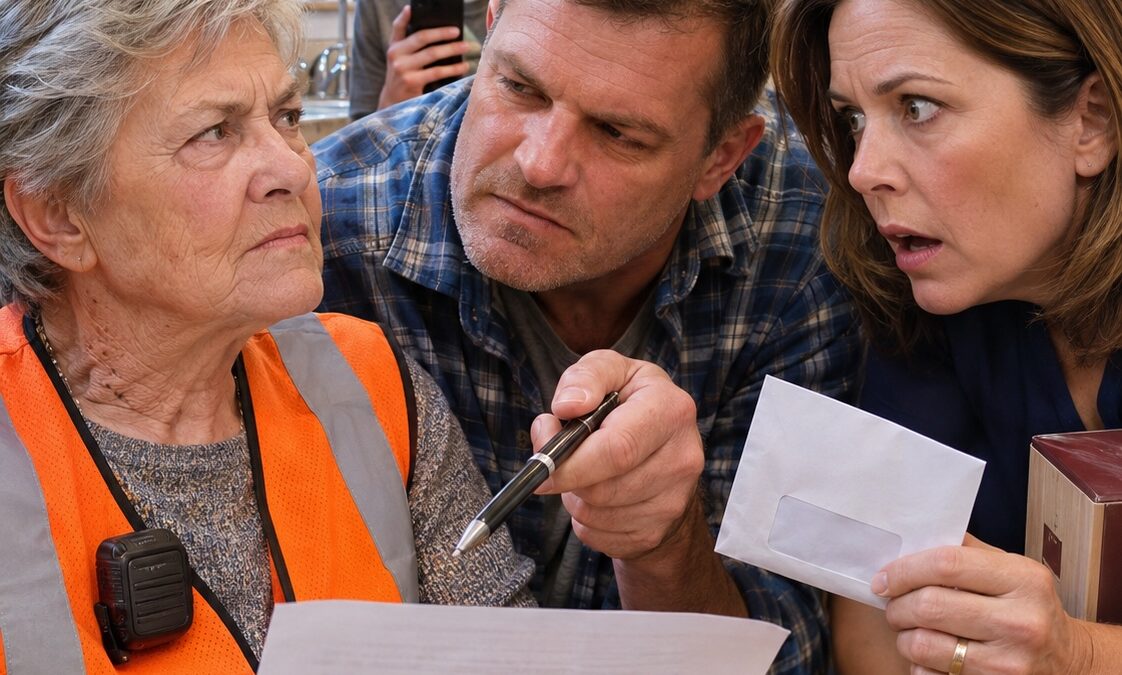
Mom sat at the table in the orange safety vest she had worn on her four-block walk home from her school corner. She had no car to drive there or back.
A printed Driver Statement lay under her hands. Her name was already typed on it.
Jared stood close to her shoulder with a pen extended toward her.
Logan was at the counter with his phone open to a batting clip he had meant to show his grandmother. One hand had stopped halfway up.
He was not filming.
“I wasn’t in that car, Jared,” Mom said.
“You don’t have to write a story. Sign your name.”
“I said no.”
He lowered the pen closer to the paper.
Mom kept both palms flat.
The orange vest bunched at her elbows.
I set the hair color on the counter and laid the envelope beside it.
Then I took off my wedding ring and placed it on the windowsill over the sink, where I put it every Thursday before I did Mom’s hair.
“That’s my mother, Jared.”
He turned toward me.
“Tell her, Monica. Your mom’s done driving.”
“Timer’s running.”
I stepped between the table and Jared.
The pen was still in his hand.
“She already answered you,” I said.
“She answered wrong.”
“You asked for her signature. She said no.”
Jared kept his eyes on me.
“You came in halfway through this.”
“I came in for the part where you were holding a pen over my mother.”
“She doesn’t remember Tuesday right.”
Mom’s fingers spread against the paper.
“I remember enough to know I wasn’t in that Buick.”
Jared gave a short shake of his head.
“This is exactly why she shouldn’t be driving.”
“You can talk about the car without making her sign something.”
His mouth flattened.
I kept my voice even.
“Move back.”
“She needs to sign it.”
Mom spoke past my shoulder.
“No.”
Jared looked at me as if I should translate.
I didn’t.
He took one step back.
His elbow caught the STOP sign hanging by the back door.
The wooden handle Dad had made in 2002 struck the floor first. It split along the grain.
The red face of the sign knocked Mom’s mug off the edge of the table.
The mug dropped and broke.
Nobody caught either one.
Coffee spread across the linoleum between pieces of white ceramic.
Logan’s raised hand fell to his side.
Mom did not move her palms from the Driver Statement.
Jared stared at the mess.
I looked at the pale split running down Dad’s handle.
“That was Lloyd’s,” Mom said.
Jared clipped the pen into his shirt pocket.
“I know whose it was.”
Mom’s mouth tightened.
He turned toward the second hook by the back door.
The spare key ring hung there.
Jared lifted it free.
A rubber truck-shaped keychain swung below the keys.
GAS CITY, INDIANA was stamped across the front.
He let the keys jingle once in his hand.
“Car’s at Aaron’s. She won’t need these.”
“Those are mine,” Mom said.
“The car isn’t here.”
“That doesn’t make them yours.”
Jared looked at me.
“See what I’m dealing with?”
I said, “I see it.”
His fingers closed around the spare key ring.
He put it in his jeans pocket.
Mom looked at the keychain until it disappeared.
She never looked at him.
Jared stepped back to the table.
He slid the Driver Statement out from under Mom’s hands.
She let him take the paper.
He folded it and put it into his shirt pocket behind the clipped pen.
“Your mom put Lloyd’s Buick in the ditch on Mill Road Tuesday and doesn’t remember,” he said.
He said it as if he were reporting the weather.
“It’s handled. Paperwork’s my department.”
Logan set his phone on the counter and crouched beside the broken mug.
“Leave it, baby,” Mom said. “You’ll cut yourself.”
Logan stopped.
His fingers stayed above the floor.
I crossed to the windowsill and put my ring back on.
Then I picked up the envelope beside the hair color.
The paper inside shifted when I lifted it.
I kept the flap sealed.
“What did Prairie Shield send her?” I asked.
Jared’s eyes dropped to the envelope.
“Claim stuff.”
Picking up where the Facebook post left off
“You’ve seen it?”
“I handle it.”
“That wasn’t my question.”
He gave me a small look.
“Monica, the car is wrecked. Rita can’t remember doing it. The form is what matters.”
Mom’s hands stayed on the bare tabletop now.
“I remember where I was,” she said.
Jared faced her.
“You’re seventy-two.”
“That’s still my age.”
“You walked home in a safety vest.”
“Because I don’t have my car.”
His jaw moved once.
I watched his right hand touch the outside of his jeans pocket where the spare key ring sat.
He looked at me instead.
“You want Logan hearing this?”
Logan was still crouched by the mug.
He looked down.
I said, “He already is.”
Mom reached one hand toward him, stopping short of the broken pieces.
“Stand up, baby.”
Logan rose and went back to the counter.
At 4:30 p.m., Jared crossed to the back door.
He went out to his pickup in the driveway.
Through the window over the sink, I watched a cruiser roll to the curb in front of the house.
Police Chief Tim Lehman stepped out.
Jared saw him too.
He called across the yard, loud enough to carry toward the sidewalk.
“Chief. Family stuff. We’re getting Mom off the road.”
Mom.
Tim lifted one hand in greeting.
Jared got into his pickup and drove away before Tim reached the front walk.
A knock sounded at the front door.
I went to answer it, the envelope pressed against my hip.
Tim stood there holding a proof copy of the party program.
“Afternoon, Monica.”
“Chief.”
He followed me back and stopped in the kitchen doorway.
His eyes dropped to the STOP sign on the floor.
The broken mug still lay beside it.
Tim did not ask about it.
He turned to Mom.
“Brought your proof.”
Mom held out one hand.
Tim crossed only far enough to give her the program, then returned to the doorway.
She looked down at the cover.
“You make me sound official?”
“You’ve been official since 2002.”
The corner of her mouth lifted.
Mom rested the program on the table.
“I’ll bring it back tomorrow.”
Tim stayed where he was.
“Bring me the book after your last crossing tomorrow. Saturday night I read your last week out loud, like every guard since ’87. Your corner, your days, your times.”
The envelope stayed sealed in my hand.
Part 2 of 7
Mom pointed at the Prairie Shield envelope in my hand the second the front door shut behind Tim at 4:40 p.m.
I sat across from her, opened it, and read aloud.
“Date of loss: 05/19/2026, approx. 3:10 p.m., Mill Road. Driver at time of loss: Rita A. Yoder. Reported by: Jared Kolb (son-in-law), by telephone, 05/20/2026, 8:12 a.m. Contact on file: Jared Kolb.”
I took my phone from my back pocket and photographed the page.
Mom pulled the shift log from her vest pocket and opened it at her elbow.
In her handwriting, the Tuesday line said, “Tue 5/19 — radio on 2:50, off 3:25 — 212 crossed — R.Y.”
The program lay on the table between us.
“Were you driving, Mom?”
“I was on my corner.”
I set my phone beside the letter and tapped the number printed on the page.
Mom covered the screen with her hand before the call could start.
“Not Prairie Shield. Not Tim. Not before my party. It’s my party, and it’s your marriage.”
I left my fingers where they were for one second.
Then I drew them back.
The broken mug was still on the floor near Dad’s STOP sign.
I got the dustpan from under the sink and swept the pieces into it.
I slipped my ring off and set it on the windowsill.
The color box was still on the counter.
I mixed the color there.
Mom shrugged out of the orange vest and hung it on her chair.
I put a towel around her shoulders and stood behind her.
I parted her hair with the tail of the comb.
My fingers kept the sections narrow.
The brush stayed close to her roots.
Logan crossed to the drawer by the back door.
He took out Dad’s roll of black electrical tape, then went back to the counter.
He lifted the STOP sign from the floor and laid the cracked wooden handle across his forearms.
“Can I fix this for now?”
Mom looked over from her chair.
“For now.”
Logan wrapped the electrical tape around the crack.
He turned the handle a quarter turn after each pass, pulling the tape snug.
When he finished, he carried the sign to the back door and hung it on its hook.
The black band sat halfway down the handle.
I kept working.
Mom did not talk about Jared.
Neither did I.
At 6:00, I put my comb and brush back in the color box.
Mom took the shift log from the table and slid it into her vest pocket.
I picked up my ring from the windowsill and put it back on.
Then I folded the letter into the envelope and placed the envelope in my purse.
Mom watched me do it.
She did not stop me.
At 9:00 Friday morning, Beverly Mast sat in my salon chair on Main Street with a cape fastened at her neck.
I stood behind her and handed her my phone.
She enlarged the photo with two fingers.
Beverly had spent thirty-one years handling auto insurance claims.
She read without moving her mouth.
“The Buick’s at Gant Towing & Body,” I said.
Beverly handed my phone back.
“Car went straight to Aaron’s and there’s no report number anywhere on this. Somebody called a tow, not 911. He put himself down as the contact, so every call goes to him.”
I laid it face down on my station.
Beverly turned her head a little.
“Only one thing fixes it: your mom, in writing, ‘I was not the driver.’ Keep a copy. And anything with a time on it that puts her somewhere else.”
The Tuesday line in Mom’s shift log came back to me.
I kept that to myself.
“Should I call a lawyer?”
Beverly snorted once.
“For what? It’s her policy. She has to be the one.”
I picked up my comb.
“That simple?”
“That procedural.”
She faced the mirror again.
“In writing, honey. Always in writing.”
At 12:15, I drove to Gant Towing & Body on my lunch break.
The Buick stood inside the shop with its front end smashed.
I stopped outside the driver’s door and looked in through the window.
A yellow tow ticket lay on the dashboard.
“Pickup: Mill Rd ditch — 5/19 3:30 PM — Customer: J. Kolb”
Beside it was the repair order.
Jared’s signature sat under the line, “Customer is responsible for any amount not paid by insurance”.
Footsteps came from the back of the shop.
Aaron Gant walked in wiping his hands on a rag.
He saw me by the Buick.
He looked at the Buick, not at me.
Aaron opened the driver’s door, reached across the dashboard, and took the tow ticket.
He folded it once and put it in his shirt pocket.
The repair order stayed where it was.
“That’s shop paper, Monica. Talk to your husband.”
He shut the door.
I kept my hands at my sides.
Aaron walked back toward the work bays.
I did not ask who had been driving.
At 12:40, I sat in my car outside the shop gate.
My lunch bag was unopened on the passenger seat.
I opened my text thread with Jared and scrolled back to Tuesday afternoon.
That Tuesday, I had been in the middle of a perm and had read only the last words.
“Back by 5.”
Now I read the whole text from 2:31 p.m.
“Truck’s at Aaron’s for brakes. Took your mom’s Buick to run to Wabash for a part. Back by 5.”
Part 3 of 7
“Our Rita had a scare Tuesday. She put Lloyd’s Buick in the ditch on Mill Road and doesn’t remember it. The family’s taking her keys. If she seems confused at her last crossing today, please be kind.”
Jared had posted it in Alder Falls Community.
At 1:15 Friday afternoon, I stood at my station on Main Street between clients with my phone in my hand.
A text came in before I could close Facebook.
“Heard you went to Aaron’s. Don’t make this worse for your mom.”
Only one person at Gant Towing had seen me standing by the Buick.
I knew who had passed it along.
By 2:30, I was alone in my car near Fifth Street and Cherry Street, in front of Alder Falls Elementary.
I opened Jared’s post again.
It had 140 comments.
One read, “Bless her. My dad was the same.”
I put my phone in the cup holder.
At 2:50, Mom came up the sidewalk from the direction of Linden Street after her usual four-block walk.
Her orange vest was zipped.
The STOP sign was in her hand.
The black tape Logan had wrapped around the wooden handle showed below her fist.
She stopped beside my car and held her phone through the open window.
A message from the school parent group filled the screen.
“Today’s goodbye line is canceled to keep things calm for Mrs. Yoder.”
Mom lowered her phone.
I got out and shut my door.
She walked to Post 4.
I stayed beside the car.
Parents began gathering before the 3:05 dismissal.
A woman near the curb saw Mom lift the STOP sign.
She caught her son by the shoulder and pulled him back a step.
The boy stared at the orange vest.
Mom kept the sign up and stepped off the curb.
She walked the first group across Fifth Street.
Another group followed.
She said nothing.
Cars stopped.
Children moved past her in pairs and small knots, backpacks bouncing against their shoulders.
For twenty-four school years, that corner had been her job.
On the last afternoon, parents watched her as if they were waiting for her to forget where she stood.
Mom kept crossing children.
At 3:25, the last group was gone.
She pressed the radio on her vest.
“Post 4 off. Last time.”
The radio stayed quiet for one beat.
“Copy, Rita.”
Mom came back to my car.
I opened the passenger door.
She got in, then turned and laid the STOP sign across the back seat.
I drove away from the school.
We made it half a block before she spoke.
“Tuesday night, six o’clock, he came into my kitchen.”
My hands stayed on the wheel.
“He asked me to say it was me. One more on his record and he’s off the trucks.”
She watched the street ahead.
“I told him I won’t sign a lie.”
I turned toward the police station.
Fifteen minutes later, Mom walked into Chief Tim Lehman’s office.
I stopped in the doorway.
Tim sat behind his desk.
Mom took the shift log from her vest pocket and set it on his desk.
“This stays with you.”
Tim put one hand on the cover.
“All right.”
He said nothing about the post.
Mom turned toward me.
We walked out without it.
I drove her back to Linden Street.
At the house, she opened the rear door of my car and took the STOP sign from the back seat.
Mom carried it inside and slid the loop of its handle over the nail beside the back door.
The taped handle faced the wall.
Friday evening, Logan was upstairs.
I stood at our kitchen sink rinsing color brushes.
Jared came in and kept his voice low.
“If your mom tells Prairie Shield I was driving, I lose the truck.”
Water ran through the bristles.
“My paycheck is this house — sixteen-forty a month. You want Logan in an apartment over the laundromat?”
I turned the next brush under the faucet.
“Timer’s running.”
Jared laughed once.
Then he went upstairs to shower.
At 9:30, my phone rang while I sat at the kitchen table.
Mom was calling.
Her words came slowly, with a breath between them.
“Maybe I am too old. Let him have the car. Don’t lose your house over a Buick.”
I ran my thumbnail along the seam in the tablecloth.
“Mom.”
“That’s all.”
She hung up before I could answer.
Saturday morning, Jared was downstairs.
At 9:00, I stood beside our bed.
I wanted Mom’s spare key ring back on her hook before the party.
I had watched Jared pocket it Thursday.
The drawer in the nightstand on his side was closed.
I opened it.
The key ring lay on top of a Ridgeline envelope I had never seen.
The rubber truck-shaped keychain read “GAS CITY, INDIANA.”
I lifted the key ring with my left hand.
The flap beneath it was already open.
With my right hand, I took out the letter and unfolded it.
It was dated 02/24/2025.
Near the top were “Gas City yard” and 02/15/2025.
I knew that Saturday.
Jared had told me he was taking Logan to a batting clinic in Fort Wayne while I did a bride’s hair all day.
The keychain in my left hand named the same town as the letter.
I read farther.
At the bottom, two handwritten signatures sat on separate lines.
One was Jared’s.
I placed the key ring on the bedspread and took my phone from my pocket.
I photographed the letter.
Then I folded it along its old crease and returned it to the Ridgeline envelope.
I put that back where it had been.
The key ring went on top exactly where I had found it.
I shut the drawer.
Standing beside the bed, I opened the photo on my phone.
I spread two fingers across the screen until the warning filled it.
“Final Written Warning — Preventable Collision. Gas City yard, 02/15/2025. A second preventable collision within 36 months in any vehicle, or failure to report any collision in any vehicle within 24 hours, will result in removal from driving duties.”
“Jared Kolb”
“Dave Shively, Terminal Manager.”
Part 4 of 7
Mom held my phone with the Ridgeline warning open.
The 24-hour rule and the 36-month rule filled the screen.
At noon Saturday, May 23, we sat in her kitchen on Linden Street.
She spread two fingers over the photo until the words grew larger.
Her thumbs rested against the edges of the case.
Then her right hand tightened around one corner.
She moved her fingers down to the sentence about removal from driving duties.
Her left thumb stopped under “within 36 months.”
She said nothing.
Logan sat at the counter.
Mom handed my phone back to me.
She opened the kitchen drawer, took out a sheet of writing paper, and closed it.
A pen lay near her place.
She picked it up and started at the top of the page.
“I was not driving my car on May 19.”
She wrote until one page was finished.
At the bottom, the pen hovered over the paper without touching it.
Mom set it down.
She folded the draft once, then folded it again.
Mom opened the drawer and laid it inside, unsigned.
“Monday. After my party. Let me have my night.”
I set my phone beside me.
“If he talks first, eighty people hear ‘confused.’ And till you sign that, Prairie Shield has you as the driver.”
Mom pushed the drawer shut with two fingers.
“Then let Tim read my week. That’s all I want read.”
The keychain I had seen that morning was still in my head.
I turned toward Logan.
“Grandma’s spare key has a Gas City keychain. Where’d that come from, bud?”
“A truck stop.”
He looked down.
I let the answer stand.
The party was six hours away.
The proof copy of the party program Tim had given Mom Thursday lay on the kitchen table.
On the back, he had written the guests who had said yes.
Dave Shively and his two daughters were coming.
I tapped his name once.
“Should I tell Dave?”
Mom shook her head. I put the program down. “That’s his job to tell, not mine,” I said.
Logan slid off his stool.
The STOP sign hung on the nail beside the back door.
He took it down and brought it to his grandmother.
Her orange vest was draped over the next chair.
Logan put the sign in her hands.
“You have to carry it in, Grandma.”
Mom closed her fingers around the taped wooden handle.
Then she set the sign beside her chair.
At 6:00, eighty guests filled the community room at the police station.
Mom carried the sign in herself.
A banner on the wall read “24 Years at Post 4.”
At table 1, she held the taped handle upright in both hands.
Logan was on one side of her.
I sat on the other.
Jared took the chair beside me.
Dave Shively and his two daughters were at table 6.
Beverly Mast sat at table 3.
Aaron Gant stood by the coffee urn at the back of the room.
Tim was at the podium.
The shift log lay beside the microphone.
A printed program sat at every place.
The last item read “Reading of the last week — Chief Lehman.”
My purse rested beside my chair.
The Prairie Shield letter was inside it.
My phone lay beside my plate with Jared’s 2:31 Tuesday text on it.
At 6:20, Jared pushed his chair back and got up.
He walked to Tim and asked for two minutes “for the family.”
As he crossed the front of the room, the rubber “GAS CITY, INDIANA” keychain stuck out of his jacket pocket.
It swung once as he stopped beside Tim.
That morning, the same key ring had been in his nightstand drawer.
Now it had come to the party with him.
Tim glanced down at the program.
Then he nodded.
At 6:25, Jared stood at the microphone with an index card in one hand.
“Mom has stopped traffic for twenty-four years. Tuesday, ten after three, right after her corner let out, she put Lloyd’s Buick in the ditch on Mill Road. She called Prairie Shield herself Wednesday, then forgot she did. I was at Aaron’s all afternoon waiting on my brakes when Aaron got the call. So we’re selling the Buick. She’s too old to drive, and that’s okay.”
He smiled toward table 1.
“Monica cuts hair. Paperwork’s my department. Right, babe?”
A few guests laughed.
Beverly set her fork down.
At table 6, Dave looked up.
Aaron looked down into his cup.
Mom lowered the sign to her lap.
Logan stared at his plate.
My thumb pressed into the strap of my purse.
Jared kept the microphone for fifteen more minutes, thanking the dispatchers by name and reading jokes off his index card.
At 6:40, I stood.
I picked up my phone and my purse in the same hand.
Then I walked straight to the podium.
I stopped beside Tim and rested my free hand beside the shift log.
“Tim, read her last week now. All five days, with the times.”
Part 5 of 7
Tim opened the shift log.
The Tuesday entry put Mom at Post 4 until 3:25, fifteen minutes after the time Jared had just named.
At 6:42, Jared still stood at the front, his index card pinched in his right fingers. He stepped aside one pace so Tim could use the microphone.
I stayed on Tim’s left with my phone in my right hand and my purse in my left.
Tim held the cover flat and read slowly.
“Monday, May eighteenth. Post 4, Fifth and Cherry. Radio on two-fifty, off three-twenty-five.”
A chair creaked near table 3.
Beverly sat with her hands folded in front of her.
Tim moved his finger to the next line.
“Tuesday, May nineteenth. Radio on two-fifty, off three-twenty-five. Two hundred twelve kids crossed.”
He stopped and looked at Jared.
“At ten after three Tuesday, Rita was holding a stop sign in front of the elementary. Dispatch logged her both ends.”
Jared’s smile stayed in place, but the index card bowed between his fingers.
Tim returned his attention to the page.
The police department had read the last week of shifts at every crossing-guard retirement party since 1987. Tim had promised Mom he would do the same for her, and he did not skip a line.
“Wednesday, May twentieth. Post 4, Fifth and Cherry. Radio on two-fifty, off three-twenty-five.”
A fork touched a plate, then stopped.
“Thursday, May twenty-first. Post 4, Fifth and Cherry. Radio on two-fifty, off three-twenty-five.”
No one reached for the coffee.
“Friday, May twenty-second. Post 4, Fifth and Cherry. Radio on two-fifty, off three-twenty-five. Last time.”
The room went quiet.
At table 1, Mom closed her right hand around the taped wooden handle. She rose, carried the sign to the front, and took her place on Tim’s right.
Her orange vest caught the fluorescent light.
For 24 school years, she had taken that corner before the children came out and stayed until the last one crossed. The final week sat open under Tim’s hand.
Jared lifted his chin.
“Those books get filled in ahead of time. She’s seventy-two, Tim.”
Tim kept his palm on the page.
“Dispatch doesn’t fill in ahead.”
At the coffee urn, Aaron set his cup down.
He walked out into the aisle between tables 4 and 5, with nothing in his hands.
“I pulled that Buick out of the Mill Road ditch at three-thirty Tuesday. You were the only one standing there, Jared. You signed my ticket.”
Several guests turned toward Aaron.
Then their faces swung back to the front.
Jared glanced at the tables, one row at a time.
Mom held the sign upright. The split in Dad’s wooden handle showed at the edge of the black tape.
Jared spoke toward the guests.
“I was protecting this family. You know what one more claim does to—”
He stopped.
I raised my phone and opened my messages to Tuesday. The time above Jared’s text was 2:31 p.m.
I read his words aloud.
“Took your mom’s Buick to run to Wabash for a part. Back by 5.”
Jared’s mouth tightened.
“You sent that while I was curling a client’s hair,” I said. “You gave me the car, the town, and the reason you had it.”
I hooked my purse over my left wrist and shifted my phone to that hand.
With my right hand, I unzipped my purse and took out the folded letter. I laid the paper against the podium and opened it with my fingertips.
The Prairie Shield heading faced the room.
I lifted the page and read the line beneath the date of loss.
“Reported by: Jared Kolb, son-in-law, by telephone, May twentieth, 8:12 a.m.”
The corner of the paper rested against the wood.
“You called it in, Jared. Not Mom.”
His index card dropped to his side, still caught between his fingers.
At table 6, Dave set his fork down. His daughters sat on either side of him.
“Jared. My office, Tuesday, seven a.m. Bring your fuel card.”
Jared turned his head toward Dave.
No answer came.
Logan pushed back his chair at table 1 and stood. He walked to the front, passed Jared, and came to his grandmother’s left side.
Mom kept the sign in her right hand.
Logan took her free hand and lowered his eyes to the floor.
I slid the letter back into my purse.
Jared faced me again.
“Monica, this isn’t the place.”
“You chose the place,” I said.
“Think about what you’re doing.”
“Timer’s running.”
His eyes moved to Mom, then to the 80 guests who had come to thank her.
I used the sentence Jared had given me Thursday in her kitchen.
“‘Nobody blinks when a seventy-two-year-old puts a Buick in a ditch.’ Eighty people just blinked.”
At table 3, Beverly unfolded her hands and laid them flat on the tablecloth.
Every Thursday before I colored Mom’s hair, I took off my ring and left it on her windowsill. When I finished, I always put it back on.
This time, I pulled my ring from my finger with my right hand.
I set it on the podium, directly in front of the microphone.
“She was holding a stop sign, Jared. You were driving her car.”
Part 6 of 7
Mom touched her pen to the draft.
The page would put her own words into Prairie Shield’s file.
She wrote, “I was not driving my car on May 19. I was on duty at Post 4 from 2:50 to 3:25.”
Beneath that, she signed her name and dated it May 24, 2026.
She had said, “Monday. After my party.”
Instead, she signed it on Sunday morning and set the pen beside her statement.
A knock sounded at the back door.
Tim came into the kitchen carrying the true copy of Tuesday’s shift-log page. The department stamp crossed the bottom margin, with his signature beneath the words “true copy.”
Mom pushed her statement across the table.
I took it in my right hand.
Tim gave me the true copy, and I held it in my left.
“Prairie Shield gets the originals,” Tim said. “You keep photocopies.”
“I will.”
Before leaving, Tim crossed to the hook by the back door. He lifted down the sign with its cracked, taped handle.
“I’m fitting it with new wood at the station,” he said. “Lloyd’s handle lasted longer than most people would’ve managed.”
Mom ran one fingertip along the black tape.
“Dad made it to work,” I said.
“He did,” Tim said.
He carried the sign out through the back door. The hook was empty.
I placed Mom’s statement and the true copy in a manila folder.
Sunday evening, I packed Jared’s clothes into a canvas bag and set it on our front porch.
When his pickup rolled into the driveway, I stood inside at the front window.
Jared got out, saw the bag, and looked toward the house. He did not knock.
He carried the canvas bag to his pickup, put it inside, and drove east toward Wabash and his brother’s house.
Monday, May 25, was Memorial Day. The post office was closed.
On Tuesday morning, I sat at my kitchen table and scanned Mom’s statement and the true copy. I uploaded the files to Prairie Shield’s claim portal, then printed a photocopy of each page.
The photocopies went into the folder.
I put the originals in a mailing envelope and drove to the post office when it opened. The clerk sent the envelope by certified mail and handed me the receipt.
I tucked that receipt into the folder.
At 8:10, as I sat in my car outside the post office, my phone buzzed.
Jared’s first text said, “Happy now?”
A second message appeared beneath it.
“Dave had my Gas City warning letter on his desk. I turned in my fuel card and my truck keys and I’m off the trucks. He said, ‘Policy’s policy. You had a collision a week ago and didn’t report it. You told eighty people the day and the time.’”
I darkened the screen and tucked my phone inside my purse.
I sent no answer.
On Tuesday, June 2, Mom sat across from me at her kitchen table with an envelope beside her elbow.
She drew out the denial letter and laid it flat, keeping her fingertips on the top edge.
Prairie Shield had denied the claim because the driver had been misreported. The final paragraph said the file had been referred to the Special Investigations Unit.
Mom folded the paper and returned it to the envelope.
I opened the Alder Falls Community group on my phone.
Jared’s post about Mom not remembering the crash was gone. In its place, the admin had pinned a photo of Mom at Post 4, standing at Fifth Street and Cherry Street in her orange vest.
The caption read, “Thank you, Rita Yoder, for 24 years of getting Alder Falls children safely across.”
Mom looked at the screen.
“That’s a better picture of the vest than it is of me,” she said.
On Saturday, June 6, I reached Linden Street at about 4:45 and found the repaired Buick parked at the curb.
Aaron stood beside the driver’s door with the main key.
Mom came down the front walk as I got out of my car. Aaron placed the main key in her palm.
She closed her fingers around it.
“I sent Jared the bill on Thursday,” Aaron said. “It was $6,850 under the repair order he signed. He sold his fishing boat this morning and paid me in full.”
Mom studied the Buick’s repaired front end.
“Insurance didn’t pay you anything?” she asked.
“No, ma’am. Jared signed that the customer was responsible for whatever insurance didn’t cover.”
Aaron nodded toward the car.
“It’s fixed right. Alignment too.”
“Thank you,” Mom said.
She tucked the main key into the pocket of her slacks.
Aaron walked to a company pickup parked behind the Buick, climbed into the passenger side, and rode away.
At five, Mom sat in her kitchen chair with color in her hair while I worked behind her in gloves.
I had no ring to take off and set on the windowsill.
Logan sat on his stool at the counter, turning a paper cup between his hands.
“What was Grandma’s first year like?” he asked.
Mom adjusted the towel around her shoulders.
“In 2002, I had a line of first graders who crossed holding on to the hem of my orange vest,” she said. “They thought if they let go, they might miss the school.”
Logan smiled down at his cup.
“Did they?”
“Not one.”
Mom laughed.
She had not laughed like that since Tuesday of her last week at Post 4.
At 5:30, someone knocked on the screen door.
I set the tint brush across the bowl, pulled off my gloves, and dropped them into the trash can by the counter. Then I crossed the kitchen.
Jared stood on the porch. He did not come in.
I opened the screen door a few inches.
He held out the spare key ring.
“Tell her I’m sorry about the car.”
Before I could take it, the stool scraped behind me.
Logan walked to the door and stepped beside me. He reached through the opening and took the spare key ring straight from his father’s hand.
Jared lowered his arm.
Logan turned the rubber truck over.
He studied the back for a long time, then raised it toward me.
Scratched into the rubber with the tip of a key were the characters “2-15-25 L.”
Logan kept the back of the keychain facing me.
“I got this at Gas City, Mom. I was in the truck when Dad hit the post. He said if you found out, we’d lose the house. Grandma’s the only one I told.”
Part 7 of 7
Jared’s threat had kept Logan quiet since February 15, 2025.
Jared turned from the porch and walked to his pickup without a word.
I shut the screen door, turned, and wrapped my arms around Logan. The spare key ring pressed against my back from his closed hand.
Mom sat in her chair with color in her hair and the towel around her shoulders.
“You were twelve. I promised you I’d never make you lie for anybody. So I couldn’t lie for him either.”
Logan’s forehead rested against my shoulder.
Mom looked at me.
“That’s why I wouldn’t sign, honey. Not for the car.”
I loosened my arms.
“You never had to save our house,” I said to Logan.
“I thought I did.”
Logan walked to the kitchen table and set the spare key ring in front of Mom. She covered it with her palm.
“I should’ve told Mom,” Logan said.
“You told the person you could tell,” I said. “The grown-ups were supposed to protect you after that.”
Mom lowered her eyes to the rubber truck.
“I kept your confidence,” she said. “I wish it hadn’t cost you so much.”
Logan pulled out the chair across from her and sat down.
Mom left her chair and bent over the kitchen sink. I rinsed the color out afterward.
On Monday, June 8, I carried a completed Petition for Dissolution of Marriage into the county clerk’s office.
At the counter, I added my request that Logan not ride in a truck cab. Beneath it, I wrote one sentence in my own hand.
“I request this because his father took him into a truck cab at age twelve and told him to hide a collision from me.”
I signed my name and passed the petition through the opening beneath the glass.
The clerk pressed a date stamp onto the document, made a copy, and handed the stamped copy back to me.
“Sixty days minimum from today.”
I held the paper against my folder.
“Timer’s running,” I said to myself.
Then I smiled.
On Tuesday, June 9, Mom and I were drinking coffee in her kitchen when someone knocked at the back door.
Tim stood on the porch carrying the sign.
Mom crossed the room and opened the screen door. Tim held it out horizontally, and she received it with her hands beneath the new handle.
A brass plate had been fitted near the base.
“R. Yoder — Post 4 — 2002–2026.”
Mom traced Dad’s last name with one finger.
“I matched the new wood as closely as I could,” Tim said. “The town council had something else done this morning.”
Mom raised her head.
“They put up a second sign at Fifth Street and Cherry Street,” Tim said. “It reads ‘Yoder Crossing.’”
“At my corner?” Mom asked.
“At your corner.”
Tim touched the brim of his department cap and walked down the porch steps.
Mom carried the sign through the kitchen. She lifted it onto the hook by the back door, where it had always hung.
The brass plate faced the room.
Almost six weeks later, at 9:15 a.m. on Saturday, July 18, Mom’s spare key ring rested on the kitchen counter.
The rubber truck was gone.
Logan had removed it himself and replaced it with a plastic tag he had made. In black block letters, it read “POST 4.”
Mom picked up the keys and tucked them into her slacks pocket. Then she lifted the sign off the hook with her hands around the new handle.
We followed her outside.
At the Buick, Mom held it in her left hand and opened the rear passenger door with her right. She laid it across the back seat and closed the door.
Mom took the driver’s seat. I sat beside her, and Logan climbed into the back holding his baseball glove, with the sign next to him.
She drew the spare key ring from her pocket and started the Buick. The plastic tag hung below the ignition.
Once we were moving, Mom kept her hands at ten and two. She drove past the elementary school and turned toward Alder Falls Park.
“Being the one in the family who won’t lie doesn’t make you the problem,” I said.
Mom watched the road.
“Took me seventy-two years to hear somebody say it.”
The tag swayed beneath the steering column as she turned onto Park Street.
At 9:30, Mom parked the Buick in the lot at Alder Falls Park, where Logan’s 13U team played.
Cars rolled slowly past the crosswalk leading from the parking lot to the ball fields. A group of children from a 10U team waited at the curb with bats and gloves.
Mom shut off the engine and unfastened her seat belt. She turned, reached over the back seat, and took the sign.
Holding it in her right hand, she opened the driver’s door with her left and got out.
I stepped from the passenger side and walked to the curb. Logan climbed out behind me with his glove.
Mom approached the painted stripes with the new handle resting against her palm. She stepped into the crosswalk the way she had for 24 years and held the red face toward traffic.
The 10U players filed past her.
When the last player reached the painted lines, Mom walked behind the group. Logan joined at the end, holding the hem of her shirt the way he had at her corner in first grade.
Mom raised the stop sign, and every car on Park Street stopped.
THE END
You Might Also Enjoy

My Daughter-In-Law Told Me To Stay Elsewhere While Strangers Took My Condo — Then I Pushed Back







