My husband used a $4,180 returned check to blame my memory before four customers—Then the camera he called dead recorded him practicing my signature, and he lost his 50% of the store.
Complete story · 7 parts · about 32 minutes · ending included
Part 1 · Part 2 · Part 3 · Part 4 · Part 5 · Part 6 · Part 7
Part 1 of 7
Clyde Whitlow laid a check on my counter at Kerr’s Feed & Ranch in front of four waiting customers and kept two fingers on one corner.
“Your check came back, Amos’s girl. Forty-one eighty for my hay.”
The check was for $4,180, and my name was on the signature line.
I was fifty-four, I co-owned the feed store my late father, Amos Kerr, had opened, and I knew what sat in our operating account.
“That account’s got sixty-some thousand in it.”
Lowell had read the figure out to me himself at our quarterly tax session the week before.
Nobody in line moved.
Beyond the front windows, afternoon glare lay across the road along the Mesilla Valley. Inside, the air smelled of feed dust and the rubber mats beside the stools.
The office door opened behind me.
My husband came out carrying nothing.
Lowell owned the other half of the store, and he kept the books and handled the banking. He stopped beside me and rested his hand on my shoulder.
His voice went soft.
“Sweetheart, you wrote it off the old account. Again.”
The whole counter could hear him.
Then he smiled at Clyde.
“She’s been forgetting things.”
I kept my eyes on Lowell.
“There is no old account.”
His hand stayed on my shoulder.
“I want to see the ledger. Right now.”
Lowell reached across me and picked up the check. He held it by the top edge, turned it toward the light, then brought my name close enough that I could see the blue ink I had used Tuesday.
“Sweetheart, you couldn’t pick your own signature out of a lineup.”
One of the customers behind Clyde gave a strained little laugh.
Through the open doorway, Ruben Lujan, our yard hand, stood with a sack balanced on his shoulder. He had worked for the store longer than some of our customers had been alive.
Ruben lowered his eyes to his boots.
Lowell handed the check back to Clyde.
I did not argue.
I pulled my ticket pad across the counter and wrote Clyde Whitlow at the top. Under it, I entered $4,180 for hay and dated it that afternoon.
Then I took my personal checkbook from my purse.
Clyde watched me fill in the amount.
“You don’t need to do that today,” he said.
“Yes, I do.”
I signed the check, tore off his copy, and slid both across to him.
“Put it on the ticket.”
Clyde took that check too. The returned one stayed in his other hand.
Lowell gave my shoulder one small squeeze before taking his hand away.
Any time I asked him about money lately, his voice did the same thing. It got quieter. Kinder.
Then came sweetheart, and after it, whatever I had forgotten.
At the far end of the counter, my granddaughter Ellie sat on a salt block with her sneakers knocking lightly against its side.
She was nine and spent her afternoons at the store.
Ellie tipped her chin toward the high shelf behind me and waved.
“Hi, camera.”
I had installed it up there after eighteen sacks of bran disappeared from the warehouse a year and a half earlier. Everybody in the family said it had died in last year’s storm, so Ellie’s wave had become a game.
I turned to the next customer.
He had been buying feed from us since his oldest boy was in middle school.
“Same mix?” I asked.
“You remember what I’m feeding?”
“Your cows went to the higher-protein ration in 2009 after that dry summer. You cut the rolled corn in spring, add it back after the first cold week, and you don’t want molasses unless the calves start leaving fines in the bunk.”
He rested his forearms on the counter.
“That’s it.”
I reached for a fresh sheet from the pad.
Behind me, Lowell said nothing.
The screen door opened.
Brandi Nunn, our delivery driver, came in and stopped on the office side of the counter.
“Got my south-route ticket?”
Lowell took the paper from the desk ledge and held it out. “Sorry. Meant to walk that out to your truck.”
Brandi reached for it.
Their hands touched.
“No worries, boss.”
She left with the paper.
I finished writing the feed order and tore off the customer’s copy.
The next man stepped forward.
Through the front window, Clyde sat in his truck, still looking at the returned check.
At closing, Lowell came to the register while I straightened the day’s tickets.
“The ledger,” I said.
He pulled the cash drawer toward himself.
“It’s at the accountant’s.”
“You took it there?”
“Yes.”
“When?”
He counted a stack of bills before answering.
“You’ll have it Monday.”
“The blue-covered ledger?”
Lowell stopped counting.
His eyes came up to mine.
“How many ledgers do you think we have?”
“One.”
“Then yes, Thea. That one.”
I put the ticket pad in its usual place under the counter.
The ledger had never gone to the accountant before.
It stayed in the bottom drawer of the office desk.
I knew which corner of its blue cover caught when you pulled it out too fast. On humid days that drawer needed lifting half an inch to close. I had been opening it since before Lowell started keeping the books.
He gathered the deposit bag.
“Monday,” he said again.
His voice was soft.
I said nothing else.
Later, I stood inside the darkened store with the front door locked and listened to Lowell’s truck start outside.
The engine moved across the lot and faded toward the road.
I waited until I could no longer hear it.
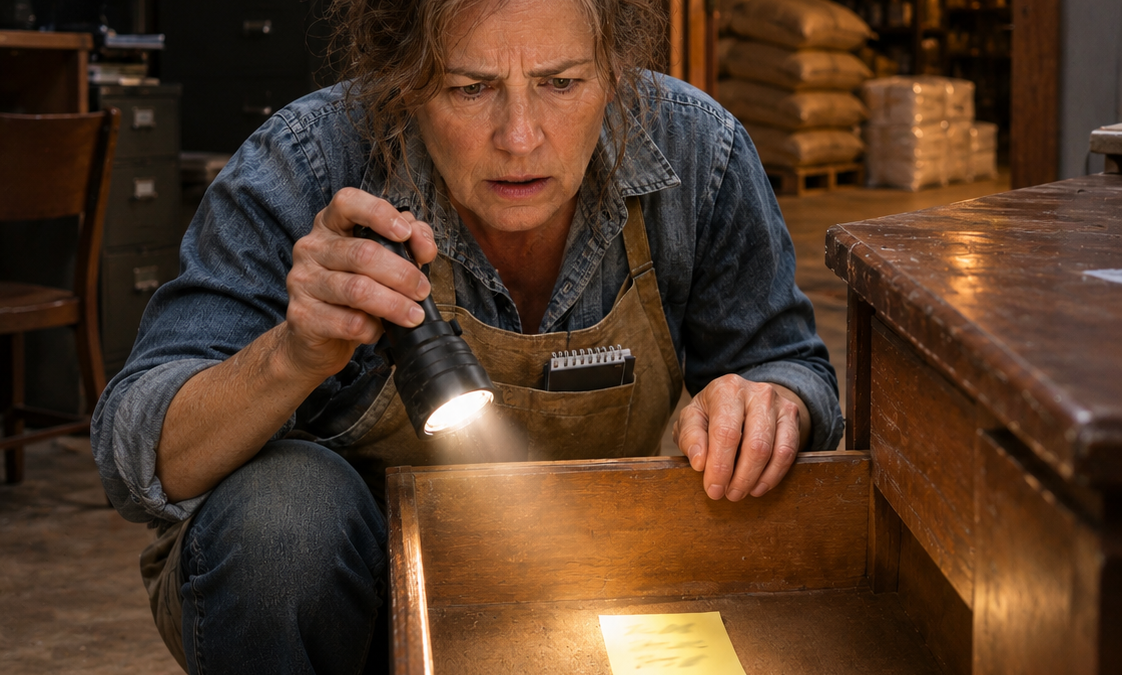
Then I took a flashlight from beneath the counter and went into the office.
I crouched, shifted the light to my left hand, and pulled that drawer.
It opened with its usual scrape.
Empty.
Where the ledger always lay, there was a yellow scrap of paper in Lowell’s handwriting.
“T — You moved this. Think hard. — L.”
Part 2 of 7
Lowell had given me two stories about one ledger, and the second was in my hand, in his writing.
I took the small notebook from my apron pocket and opened it under the flashlight.
In March, I believed I had somehow left the key ring in the bran bin instead of on its hook.
Come June, I thought I might have entered the salt order twice in the order book.
Either one could have been mine.
I put the pen to the paper.
“Ledger. Blue. Bottom drawer. I did not move it. He said the accountant has it. His note says I moved it.”
I closed the notebook and put it back in my pocket.
The note went with me.
Friday morning, Ruben Lujan was beside his truck in the lot, pouring fence staples from a cardboard box into a red coffee can on the dashboard.
From where I stood, the can held nothing but staples.
“Ruben.”
He stopped.
“Have you seen the ledger?”
His eyes stayed on the coffee can.
“Not my side of the counter.”
I waited.
Ruben closed the box and set it on the seat.
“Tell Lowell I need my early-leave slip signed today. Rosa’s got dialysis.”
Rosa was his wife. Her health insurance came through Ruben’s job with us.
“What time do you need to leave?”
“Two-thirty.”
“I’ll tell him.”
Ruben pressed the plastic lid onto the can.
I walked back inside carrying his problem instead of an answer to mine.
By midmorning, three customers stood at the counter while Lowell worked the register beside me.
“The ledger,” I said.
He kept his eyes on the cash drawer.
“You said the accountant had it.”
“That’s right.”
“I want it back.”
Lowell shut the drawer and pointed over my shoulder toward the high shelf.
“You want to look at something, look at that dead camera you paid two hundred bucks for. Fried in the storm. You forgot that too?”
The rancher nearest me stopped folding his receipt.
I looked up.
The camera sat where it always had, aimed over the counter.
Then I faced Lowell again.
“Ruben’s slip still needs signing.”
“I heard you.”
“He needs to take Rosa to dialysis.”
“I said I heard you, sweetheart.”
The rancher took his receipt and stepped away without looking at either of us.
Friday afternoon, I took my cell phone out behind the warehouse, where Lowell could not hear me, and called Mesilla Valley State Bank.
“I need the balance on the Kerr’s Feed & Ranch account.”
The young teller asked for my name, put me on hold, came back, and hesitated.
“I’m going to transfer you to Ms. Tafoya.”
Yolanda Tafoya, the assistant branch manager, answered.
“Mrs. Stroud?”
“Yes.”
“A new file came in this morning. Any request concerning this account has to go through an attorney now.”
“What file?”
“I can’t discuss it with you directly.”
“I own half that store.”
“Understood.”
“My father opened it. I’ve worked that counter most of my life, and I can’t get one number out of you.”
Yolanda’s voice did not change.
“That’s a form, not a feeling, Mrs. Stroud. Have your attorney call me.”
The line ended politely.
That night Lowell cut his pork chop into small pieces while I pushed green beans around my plate.
“I called the bank.”
His knife stopped once against the plate.
“Why?”
“Because I can’t get the books from you.”
He took another bite.
“You need rest, sweetheart.”
I set my fork down.
“The ledger comes back Monday.”
“It will.”
His voice stayed soft.
Monday, September 28, came, and it did not.
That morning I called the accountant’s office. They said they could not discuss the store’s work with me because Lowell was the client contact, and they would not say whether they had the ledger. Then I went to the bank’s branch counter myself, asked for the balance in person, and got the answer Yolanda had given me on the phone.
By ten, I was sitting across from Sandra Sena, my attorney in Las Cruces.
“My husband won’t let me see the company books, the bank won’t give me the balance, and all I have is one piece of paper.”
Sandra held out her hand.
“Show me the paper.”
I laid the note on her desk.
She picked it up, read Lowell’s handwriting, and handed it back.
“A note saying you moved it, in his own hand. Show that around and he says he had to remind you because you keep moving things. It helps him. Keep it.”
I folded it once and put it beside the notebook in my pocket.
“I own fifty percent.”
“Then you’re a member of the company. You have the right to inspect and copy its records.”
“The statements don’t come to me.”
“Where do they go?”
“Lowell’s email. The banking app too. It’s been that way since 2019.”
Sandra pulled a legal pad toward her.
“I’ll write the demand.”
“What do you need from me?”
“The signature card. Find your copy if you have one. I want to see who can sign on that account.”
That afternoon, at home, I opened the box of my father’s papers.
Tax notices. Old equipment receipts. Copies of company records he had kept long after he stopped needing them.
The card was inside a folder dated 2003.
My name was on one line.
Lowell’s was on another.
Along the margin, my father had written in his blocky hand:
“Two signatures over $10,000. Nobody’s fault. Just two.”
I kept the card.
Tuesday morning, I was behind the counter writing a ticket for a rancher when the screen door opened.
It was 10:20.
Customers filled the stools, with more standing close by.
Lowell was not at the store.
Outside the door, Ruben stopped what he was doing.
A man I did not know walked in wearing a name tag on a neck lanyard and no uniform.
He came straight to me.
“Thea Stroud?”
“Yes.”
He held out a stack of papers.
“You’ve been served.”
I took them.
The top sheet said Lowell Stroud was asking the court to appoint him conservator of his wife’s property.
My thumb held the pages at the lower corner while I read down.
Paragraph 12:
“She signs things and later denies signing them.”
Part 3 of 7
“It’s with the accountant, and the court’s looking at who should be reading it.”
Lowell held Sandra’s demand for the company books in one hand while he said it, the two of us alone in the store. Sandra had also asked the bank for copies of the account’s transaction records, and the bank said its legal department had to handle that first because a petition was pending.
So the records stayed where they were, and nobody had to hurry.
Saturday, October 3, I was counting cash at the counter when Lowell reached for the safe key in my hand.
Brandi stood by the register with two customers waiting behind her.
Lowell closed his fingers around the key.
“For your own good, sweetheart. Just till the judge is done.”
I kept hold of it.
“I’m working the counter.”
“Not anymore.”
He pulled once, gently enough that anybody watching could call it gentle.
I let go.
Lowell put the key in his pocket.
Then he turned to Brandi.
“Cash comes to me from now on. Same for everybody.”
Brandi glanced at me.
“No worries, boss.”
The staff obeyed because Lowell kept the books and signed their paychecks.
One of the customers had three twenties folded in his hand.
I reached for them.
He hesitated, leaned past me, and put the money into Lowell’s palm.
Lowell smiled at him.
“Appreciate it.”
I walked out to the parking lot with my cell phone and called Sandra.
She answered on the third ring.
“He took the safe key out of my hand in front of Brandi and two customers. He told them not to give me money.”
“Write down the time.”
“I’m going back in and taking that key.”
“Every scene goes in his next filing. Let him take it. Record who saw.”
I stared through the front window.
Lowell was behind my counter.
“Why is he still living in my house? My father left that house to me.”
“Putting him out of your house takes a filing and an order. Not yet.”
I took the notebook from my apron pocket.
“What time?” Sandra asked.
“You’re asking me?”
“I want to make sure.”
Sandra waited while I checked my phone.
“Eleven forty-six.”
“Write it.”
I wrote 11:46, Brandi Nunn, and the names of the two customers.
Then I put the notebook back in my pocket and went inside without asking Lowell for the key.
That afternoon, I spread the petition across the counter.
Behind those pages was a separate numbered list.
Fourteen incidents.
Each had a date and a time.
Number 9 on the list was Thursday, April 9.
Ellie had waited at school for fifty minutes because I never came for her.
The description said the wall calendar showed no pickup.
I remembered Jenna calling.
The drive there had been too fast.
Then there was the office, and Ellie with her backpack between her shoes.
What I could not remember was writing her pickup time on that calendar.
Maybe I had not.
Jenna Rusk, my daughter and Ellie’s mother, came into the store after her clinic shift. She was a nurse and still had her hair pulled back the way she wore it at work.
Ellie climbed onto the salt block at the far end while Jenna came to the counter.
I handed Jenna the petition.
“Read the list.”
She read Number 9 longer than the others.
Her thumb stayed beside the date.
“Mom, you left her there.”
“I know.”
“Fifty minutes.”
“I know how long.”
Jenna read farther, then set the petition down on the counter.
“Dad’s just scared for you, Mom. Ellie stays with me till this is over.”
I kept my hands flat beside the papers.
“Jenna.”
“I can’t take the chance.”
Ellie slid off the salt block.
She looked up toward the high shelf behind me and waved at the camera as she always did.
“Bye, Grandma.”
“Bye, honey.”
Jenna took her hand.
Behind them, the screen door shut.
The salt block was empty.
That night, like every night since the papers came, I locked my bedroom door.
Lowell slept elsewhere in the house, and the notebook lay on the table beside me.
On Thursday, October 8, the visitor appointed by the court came to the house.
Lowell was not in the room when she asked me.
“Mrs. Stroud, do you feel safe here?”
I looked at my locked bedroom door down the hall.
“I sleep separately.”
“That wasn’t my question.”
“Yes. I feel safe.”
The court had also appointed a guardian ad litem, a lawyer who would read the medical report.
On Tuesday, October 13, Dr. Amaya sat across from me in an exam room and gave me three words.
“Apple. Table. Penny.”
I repeated them.
Five minutes later, after questions and drawings and numbers, Dr. Amaya asked for the words.
I knew there had been three.
My mind gave me none of them.
I rubbed my thumb over the edge of the chair.
“I’m sorry.”
Dr. Amaya waited.
I tried again.
Nothing.
Then the doctor read them back to me.
“Apple. Table. Penny.”
My score was 27 out of 30.
I walked to my truck, climbed in, and took out the notebook.
My hand rested on the page before I could make myself write.
Then I wrote every word.
“Apple. Table. Penny. I lost them. Maybe he’s right.”
I closed it.
The keys lay in my lap.
Cars left the medical building one by one.
It got dark, and I still could not start the truck and drive home.
Sandra had the report when I went to her office.
She read it with one finger resting beside the last paragraph.
“No evidence of impairment. Anxiety and insomnia noted.”
I watched her face.
“Twenty-seven’s a normal score, Thea. He needs clear and convincing. He won’t get it from three words.”
Sandra put her hand on the file.
“But if he’s hiding what I think, you only get one shot. Don’t swear to anything we can’t show.”
“If the judge believes him, Lowell gets the money, the store, and the right to sign for me.”
“Yes.”
Tuesday, October 20, I was back in Sandra’s office.
The bank had finished sending the records she requested.
Sandra took one sheet from the file.
She slid it across the desk and said nothing.
I pulled the slip toward me.
At the top was the date.
Monday, September 21.
I read down.
$62,000.00.
Transfer to: Brandi L. Nunn.
Sandra let me keep going.
At the bottom were two signature lines.
Lowell’s name was on the first.
Under the second line was my signature, right in almost every stroke.
I had never seen this paper.
Part 4 of 7
Sandra’s letter to the bank said I disputed the $62,000 transfer and that anything over $10,000 had to be signed in front of an employee.
The bank’s records showed Lowell had carried the slip to the window himself, with my line already filled in, and a new teller had noted on it that Mr. Stroud said his wife did that part at home. That broke the bank’s own rule, but it did not prove whose hand had made my name. Sandra laid the copy beside her letter and would not let me swear to a forgery yet.
Wednesday, October 21, I sat across from her and kept my hands off both papers.
The hearing was set for Wednesday, November 4.
“What keeps us from putting the slip in front of the judge?”
“Today that’s ‘she signed it and forgot,’ with Paragraph 12 and your twenty-seven behind it. And he’d know we have it.”
“What about the police?”
“Police get your word against a petition that says you forget.”
“Someone who studies handwriting?”
“Handwriting men say ‘inconclusive,’ and not by the fourth.”
“Divorce him now?”
“File for divorce and he’s served before the hearing, so he knows you’re swinging back. This letter already stops new transfers.”
Sandra sent the notice that day.
The same bank records showed Lowell moving store receipts into the account just ahead of each paycheck and vendor check so they cleared. Clyde’s check had reached the bank before Lowell caught up.
I took my copy of the slip home.
I did not sign an affidavit.
Paragraph 12 said I signed things and later denied signing them. Lowell had written the sentence before I ever saw the paper carrying my name.
On Wednesday, November 4, he stood in the Doña Ana County district court without a lawyer and gave the judge all fourteen incidents from memory.
His voice caught exactly where a husband’s voice ought to catch.
“Thirty-two years. I’m not here to hurt her.”
I sat beside Sandra.
Lowell remembered dates, errands, misplaced keys, the school pickup. He needed no notebook for any of it.
Jenna testified about Number 9.
She said Ellie had waited fifty minutes.
According to Jenna, the calendar had nothing written for collecting Ellie.
She did not look at me.
Back on his feet, Lowell lifted Dr. Amaya’s report.
“Twenty-seven out of thirty.”
The judge closed the file.
“You’ll have my written order by the end of the week.”
Outside, Sandra and I started down the courthouse steps.
Ruben sat behind the wheel of his truck across the parking lot.
The red coffee can was on the dashboard in front of him.
I went down two more steps toward the truck.
Ruben put it in gear and drove out of the lot.
I stopped on the bottom step.
The courthouse door opened behind me.
Lowell came out smiling like somebody had already handed him paper.
“Your own daughter. Monday it’s done, sweetheart.”
That afternoon at the store, two ranchers had left messages asking about Clyde Whitlow’s bounced hay check.
One said he would ask Lowell himself at customer appreciation day on Saturday.
The phone rang again while I was sorting feed tickets.
Lowell answered.
“Saturday I’ll tell everybody at once.”
He hung up, took a black marker from the cup by the register, and crossed to the calendar on the side wall, next to the key hook.
In letters big enough to read from the feed aisle, he wrote:
Mon 9:00 bank — new card
On Thursday, November 5, Ellie begged to help clean up for Saturday the way she did every year, so Jenna drove her over.
“The hearing’s over. Just the yard, and I’m staying.”
Jenna went back outside with a trash bag.
Ellie ran to the salt block at the far end of the counter, climbed up, and waved toward the high shelf.
Then she looked at me.
“It winks back, you know. Grandpa says it’s dead, but it winks.”
My eyes went up to the camera.
Nothing.
Ellie slid down and ran outside after her mother.
I sat down exactly where she had been.
From that low angle, between two layers of black tape on the camera, a thin red slit blinked once.
At 9 p.m., I was alone in the dark store except for the office light.
I brought over a wooden ladder, went up it, opened the camera, and took out the memory card.
The file list on the store computer began at Aug 1.
I left the early files unopened and went straight to the night before the transfer slip.
The picture filled the screen.
Sunday, September 20, 11:07 p.m.
No sound.
Lowell sat alone at the counter.
He laid six of my old checks in a row.
Then he pulled the ticket pad toward him and wrote my name down it, line after line.
He kept doing it for 22 minutes.
After that, he drew the slip over.
He signed his line.
Then he signed mine.
He turned off the light.
I copied the clip to my phone.
The card itself went into my pocket.
I opened the notebook and wrote one sentence.
I did not sign it.
Friday morning, November 6, in Sandra’s office, I played the clip for her, then swore the affidavit before a notary.
Sandra put the sworn paper beside the slip.
“Nobody hears about this till the bank has it. Not your daughter.”
“Why not take it straight to the bank?”
“Today it goes to legal and sits with his petition. We walk in with the order in the same folder.”
“The order isn’t signed. Can we give the clip to the judge?”
Sandra folded her hands.
“My read? The hearing’s closed. File this now and he gets a copy, he knows, and that order can get held up. I don’t think he won in there. If I’m wrong, Monday this goes in with an emergency motion.”
At 3:40 p.m., the judge signed.
By 4:12, the order had reached Sandra through the court’s filing system.
She called me.
“Petition denied.”
With no lawyer on file, Lowell would get his copy by mail.
The branch had closed at 4:00.
Before 5:00, Sandra handed me the printed order, and I clipped it into the folder with the affidavit and the slip.
Then I called Yolanda Tafoya at the bank.
“The judge denied the petition. I have the order and a sworn affidavit. When can I bring them in?”
“Our bank’s buying your breakfast burritos tomorrow. Ten o’clock, in your office, with my stamp. Bring the paper.”
Sandra was beside me.
“I’ll be there before ten.”
Every year, the microphone stayed off until the noon raffle.
Lowell had said he would tell everybody Saturday.
I expected noon.
Saturday, November 7, at 9:40 a.m., the yard was already crowded and 150 tickets had been punched.
I stood by the coffee urns with the folder under my arm and the clip saved on my phone.
Yolanda was at the burrito table, due in the office with me in twenty minutes.
Jenna and Ellie were at the pastry table.
Lowell climbed onto the trailer.
He took the microphone before anybody called a raffle number.
“Most of you know my wife. Thea isn’t well. She doesn’t remember writing your checks. The court’s taken care of it. Starting Monday I sign for this store.”
He held a hand out toward me, tenderly.
“Every dime went to keep this place alive — vendors, feed, freight.”
The yard started murmuring.
A man near the front took off his hat.
Yolanda’s face tightened. She knew the judge had ruled against Lowell, but she stayed where she was.
Ellie turned her face up to Jenna, and her voice carried across the yard.
“Is Grandma sick?”
I set my coffee cup down and walked through the yard toward Yolanda with the folder in my hand.
Part 5 of 7
Lowell jumped down from the trailer and came after me with the microphone still in his hand and still on.
“Sweetheart, sit down, you’ll hurt yourself.”
His voice rolled out of the speakers over the whole yard.
I kept walking.
A paper plate stopped halfway to a man’s mouth. Somebody waiting for food lowered a foam cup.
Yolanda stood behind the burrito table with her purse tucked under one arm.
I held out the folder.
“I’m reporting a forged signature on the store account. It’s sworn. Top sheet’s from the judge.”
She took it.
Her eyes flicked once toward Lowell’s hand.
“Mrs. Stroud, you want this read out here?”
“Read it.”
Yolanda opened the folder.
One finger moved down the page before she looked up at Lowell.
“Mr. Stroud, this says petition denied. Signed yesterday, three-forty.”
A woman near the coffee urns folded her arms.
Lowell stopped two steps behind me.
“That’s not — I didn’t get any —”
Sandra had come up at my back.
“It’s in the mail. You didn’t hire a lawyer, remember?”
His mouth stayed open for a second.
My phone went from my hand to Yolanda’s.
She pressed play.
Clyde stood beside her. He pulled his glasses from his shirt pocket and put them on.
Yolanda angled the phone toward him.
Clyde leaned closer.
“Sunday, September twentieth. Eleven-oh-seven p.m. That’s Lowell. He’s got checks laid out in a row, writing on a ticket pad.”
Yolanda slid the clip forward, and he went on.
“Now he’s signing a slip. Twice.”
One man in front lowered his raffle tickets to his thigh.
A woman beside him turned her body away from Lowell and toward the picture.
My hands were empty now.
I looked at my husband.
“Paragraph 12: ‘She signs things and later denies signing them.'”
I pointed at the screen.
“There’s who signs things.”
The microphone came up to Lowell’s mouth without him seeming to notice.
“That camera’s dead. I pulled the plug on it myself.”
“You just told a hundred and fifty people why you thought nobody was watching.”
Ruben had been standing near the raffle table.
Now he came around it and crossed the open dirt to my side.
He spoke without reaching for the microphone.
“I plugged it back in. Next morning. Fifteen months ago. Forty-one years I’ve been here, since she was thirteen and counting sacks for Amos. She never forgot a load.”
Lowell looked at him as if at a stranger.
Ruben met his eyes, then dropped his own.
Lowell swung back to Yolanda.
“I practiced so I could sign for her when she can’t. That’s what a husband does.”
She kept my phone in one hand and laid the open folder on the burrito table with the other.
“Two signatures, Mr. Stroud. Her father’s rule. One hand. And this says vendors?”
She pulled out the slip.
Then she read the payee line.
“Brandi L. Nunn.”
Heads turned toward the truck lot.
Brandi stood at the truck door with her hands hanging at her sides.
She did not move.
Lowell did.
One half step toward Yolanda.
Sandra shifted closer behind me.
Yolanda returned the slip to the folder, clamped it under her elbow, and set my phone face up on the lid of a feed bin, the clip paused on Lowell’s hand.
Then she took out her own phone and dialed the bank’s fraud line right there beside the breakfast burritos.
Lowell tried to speak.
She held up one finger while she listened.
His breathing came through the speakers.
A child stopped swinging his legs from a folding chair.
Her name and branch went down the line first, then the account name.
She ended the call and took her stamp from her purse.
The affidavit came out onto the same lid, and the stamp came down once.
RECEIVED.
She slipped the sheet back into the folder and spoke into the air in front of Lowell’s microphone.
“Until the fraud desk finishes, this bank won’t take your signature on that account. Your nine o’clock Monday is canceled.”
Lowell’s stare stuck on the stamp in Yolanda’s hand.
Clyde reached into his wallet.
He took out the returned check, stepped forward, and put it into my hand.
“This one was never yours to answer for, Amos’s girl.”
The paper felt soft at the folds.
I closed my fingers around it.
At the pastry table, Jenna held Ellie against her side.
Tears ran down my daughter’s face.
She stayed where she was.
Ellie looked from Jenna to me, then toward her grandfather.
No one called a raffle number.
Ruben had already walked back to his truck at the edge of the yard.
His hand rested through the open window on the red coffee can sitting on the dashboard.
He was looking at me as if he had not finished.
I did not know what he meant, and I did not guess.
My phone lay screen-up on the feed-bin lid beside Yolanda, Lowell’s hand frozen in the picture.
The microphone was still in Lowell’s hand.
I turned to him and stepped close enough for it to carry my voice.
“Sweetheart, you couldn’t pick your own signature out of a lineup.”
Then I motioned toward the frozen picture on the phone.
“I can pick my own signature out of a lineup, Lowell.”
Part 6 of 7
By Monday, the bank had locked Lowell’s signing authority, but the $62,000 he had moved out of Kerr’s Feed & Ranch was still gone. Yolanda changed the store statements into my name before noon.
Lowell had not come home since Saturday night.
Clyde stopped at my counter and told me he had seen Lowell’s truck outside a motel off the highway.
I said, “Put your order on the ticket, Clyde.”
Then I drove to the Las Cruces police station with copies of the signature card and the slip, plus the clip from September 20.
The detective watched Lowell sign my name and said, “That’s a serious felony.”
Sandra filed the divorce petition with a temporary order that same day.
By the time I got back to the store, Brandi was standing in the lot beside the delivery truck.
She had the truck key pinched between two fingers.
Ruben stood by the loading rail.
Brandi walked straight to him and put the key in his palm.
“I quit.”
Ruben closed his hand around it.
She looked toward me, then back at him.
“He said it was our down payment. In Hatch, closing the sixteenth. Thirteen-five already went to hold it. I never saw that paper.”
Her face looked smaller without the easy smile she wore on deliveries.
Three days later she walked into the branch and wired the remaining $48,500 back. The detective called her in as a witness, and she lost the house.
On Friday, Lowell sat across from me in Sandra’s office with a lawyer beside him and the agreement between them.
He signed.
Its terms required the full $62,000 to be back in the store account by December 11. He would sell his truck and trailer to cover the missing $13,500. He gave up his 50% of the store and agreed to remove everything he owned from my house before noon Saturday.
Lowell set the pen down.
“Can the police report be dropped?”
Sandra did not touch the agreement.
“That’s between you and the district attorney. This paper is only about money.”
Then she drew it back to her side of the desk.
That afternoon, the county livestock association sent a letter removing Lowell as treasurer.
Three of our biggest ranch accounts called me before closing.
Each said it plainly: they would deal only with me.
Saturday morning, Lowell came from the motel in a borrowed truck and loaded his things from my house.
I was at the store, so nobody came outside to see him off.
After he drove through the gate, he called Jenna three times.
She told me later she sat at her kitchen table without a word, her phone face down in front of her while Ellie ate eggs across from her.
Jenna did not answer him.
That afternoon, she brought Ellie to the store.
Jenna stopped in the doorway.
“She asked. Saturdays, if you’ll have her. I still swore to that Thursday in April, Mom. I don’t know what to do with that yet.”
My hands stayed flat on the ticket pad.
“You don’t have to do anything with it today.”
Ellie slipped past her mother and climbed onto the salt block at the end of the counter.
It had been empty since the day she helped clean the yard.
She swung her legs.
“Grandma, I need to know tickets.”
“Need?”
“Yes.”
I took the notebook from my apron pocket and laid it on the counter.
Then I untied my small apron and tied it around Ellie.
It hung nearly to her knees.
I put a pen in her hand and pointed to the first box on the ticket pad.
“Name.”
She printed it.
“Next box.”
“Account?”
“You tell me.”
She frowned at the paper as if it had challenged her personally.
“Account.”
“Good.”
I showed her where the quantity went, then the price.
“What if they change the order?” she asked.
“Cross it out once. Keep it readable.”
Jenna stayed in the doorway a little longer.
Then she came inside.
Near closing, Clyde returned.
He laid my personal check from September 24 on the counter, still uncashed.
“Store owes me, not you. Pay me when the money’s home, Amos’s girl. Put it on the ticket.”
Ellie pulled the pad closer.
Her letters came slowly, each one pressed hard enough to mark the sheet underneath.
CLYDE WHITLOW.
HAY.
$4,180.
I showed her where to carry the amount.
We added it together.
Then I picked up my notebook and opened it.
I wrote small:
Keys. March. Did I?
Ellie leaned over.
“You spelled March right.”
I laughed.
The sound surprised me enough that I shut the book.
The yellow note was still tucked in the cover.
T — You moved this. Think hard. — L.
I opened the notebook again.
On the next line I wrote:
Card only goes back to Aug 1. Older must be recorded over. The signature was him. The other fourteen, I still don’t know.
I closed it and kept it in my hand.
Half the lights in the front of the store were off when Ruben came in from the lot.
The red coffee can was in his hands.
He walked straight behind the counter.
“I waited until he signed away the store.”
Ruben set the can down in front of me and kept both hands around it.
“I saw him pull that cord. I taped the light so he wouldn’t see it. I saw what was on the cards in August. I sat outside that courthouse with these and I didn’t get out of the truck. Rosa’s dialysis is on the store plan. One word from him and I’m out, and the plan goes with me. That’s the reason. It isn’t an excuse.”
Ruben lifted the lid.
Fence staples filled the top.
He reached in and moved them aside.
Underneath were two memory cards wrapped in tape.
His pencil writing crossed the tape in three lines.
“MAR 14 KEYS — HIM.”
“APR 9 CALENDAR — HIM.”
“JUN 2 ORDER BOOK — HIM.”
“You never forgot one thing, Thea.”
Part 7 of 7
The two old cards could answer all fourteen entries on Lowell’s list, including Number 9, the one Jenna had sworn to in court. I put the list beside the store laptop, slid in the first card, and opened my notebook.
There was no sound.
Only the counter, the key hook, the calendar, and the date stamp in the corner.
I watched until the dates on Lowell’s paper became pictures.
The first card ended in February. The second gave me March 14.
Lowell walked behind the counter, lifted the keys from the hook, and dropped them into the bran bin. Later, I came into view. He pointed toward the empty hook and spoke to me.
The camera could not give me his words.
I remembered them anyway.
Sweetheart, where did you put them?
I wrote one word beside Number 6.
Him.
June 2 showed the order book open on the counter.
Lowell bent over it and wrote a second salt order beneath the one already there. His hand rested on the page afterward as if he were checking my work.
Beside Number 11, I wrote:
Him.
I kept going.
One date after another.
One word after another.
Him.
The store went dark around the laptop screen. Trucks passed on the road now and then, their headlights moving across the front windows and disappearing.
One file was left on that card. I had skipped it on purpose.
Thursday, April 9.
The wall calendar hung at the edge of the picture, behind Lowell’s shoulder.
I enlarged that corner until the writing showed.
His finger found the line.
Ellie 3:15.
He turned over the pencil hanging on its string and rubbed until the words disappeared. Then he brushed the crumbs from the paper with the side of his hand and blew the last few away.
My pencil stopped above the notebook.
I put it down.
One tear struck the page beside Number 9 and spread through the paper. I wiped my cheek with the heel of my hand, picked up the pencil, and wrote the same word.
Him.
By Sunday morning, every one of Lowell’s fourteen entries had it beside the number.
I carried the laptop to Jenna’s house.
Ellie was outside in the yard. She never saw me come through the kitchen door.
Jenna sat across from me at the table.
I said nothing.
I opened the laptop and pressed play.
She watched the keys.
Then the salt order.
I clicked back to the file I had skipped.
When April 9 appeared, Jenna moved both hands off the table.
Lowell erased Ellie’s pickup time.
Jenna watched the empty place on the calendar after he walked away.
The clip ended.
She did not reach for the laptop.
I played the rest.
When the last file stopped, Jenna closed the lid.
“I sat in that chair and swore to it, Mom.”
Her thumb worked once along the edge of the laptop.
“All this time I pictured Ellie waiting at school for fifty minutes. I thought you left her there.”
I kept my hands around my coffee cup.
“Being told you forgot isn’t the same as forgetting. It just costs you the same.”
Jenna lowered her eyes to the lid.
From outside came Ellie’s voice calling at something in the yard.
Neither of us moved toward the door.
Jenna pushed the laptop back across the table to me.
On December 11, the store statement came addressed to me.
I stood at the counter with it open in my hands.
The full $62,000 was home.
That same day, I paid Clyde’s $4,180 from the store account. Then I took Ellie’s careful ticket from the stack and marked it paid.
In early February, Lowell’s name was in the local paper.
He had pleaded guilty to one count of forgery and received three years’ probation.
I folded the paper, put it beneath the counter, and served the next customer.
The first Saturday in March brought spring and trays of chicks to the yard.
Their noise carried through the open door while people moved between the bins and the loading rail.
“Ruben.”
He came to the counter.
The new signature card lay there. Yolanda stood beside it with her stamp.
I had already signed the bank’s paper naming Ruben as a signer.
Next to the new card, I placed my copy of the 2003 card with Daddy’s handwriting across it.
“Two signatures over ten thousand. Daddy’s rule. Yours is the other one.”
Ruben stared at the old ink.
Then at me.
“After what I didn’t do?”
“Because of what you did after.”
I held out the pen.
He took it.
His hand shook enough that the point touched the paper once before he started. Then he signed slowly, one letter at a time.
Ruben’s job and Rosa’s coverage on the store plan stayed where they were, and nobody could threaten them now.
Yolanda drew the signed card toward her and set her stamp down.
Jenna leaned against the counter, looking out at the yard.
“Should you have shown the camera to Dad privately before the customer day? People still ask me.”
I took the pen back from Ruben.
“He had fourteen chances at private.”
Jenna turned her head toward me.
I put the pen beside the ticket pad.
Ellie came around the end of the counter carrying my old notebook.
It had been hers since Christmas.
I had torn out my written pages first.
The yellow note went with them.
Ellie opened the book.
Cows filled every page in pencil.
Fat cows.
Skinny cows.
Cows with horns too big for their heads.
One had four legs on one side.
I turned the page.
“That one could tip over.”
“No. She’s running.”
“All right.”
Ellie tucked the notebook under her arm.
Behind us, the camera sat on the high shelf.
The black tape was gone.
Its red light blinked in the open.
She climbed onto the salt block and looked up.
Ellie waved at the camera. This time I waved too.
THE END
More stories
My sister’s new mother-in-law charged $6,400 to my sister’s card for her own trip—then the check-in agent announced that all three tickets had been canceled.My Sister Gave Mom’s Bedroom to Her In-Laws and Put Mom on a Cot in the Sewing Room, Then Threw Them a Party, Until Mom Showed Everyone the Credit Cards Opened in Her Name.My boss gave his daughter until Friday to leave her home after 16 years—then the folder he left on my counter helped stop his auctionMy husband hid my sister’s letters for 7 years — Then a mailman brought envelope “#29,” and he was served divorce papers at work with employees and customers present.My ex-husband told his new wife $1,150 monthly supported our son—until I read the state’s closing letter beside his birthday cake, and she told 30 guests she’d filed for divorce.My Parents Spent Christmas on Brett’s Two Kids While My 8-Year-Old Shook an Empty Stocking—Then Grandma Hazel’s Tin Exposed Dad Before He Could Give Brett the House
You Might Also Enjoy

My Daughter-In-Law Told Me To Stay Elsewhere While Strangers Took My Condo — Then I Pushed Back







