My Sister Dropped My Daughter’s 42-Square Memory Quilt Into a Birthday Fire—Then a Teenager’s Phone Captured the Proof That Made Her Hand Back the Keys
Complete story · 7 parts · about 31 minutes · ending included
Part 1 · Part 2 · Part 3 · Part 4 · Part 5 · Part 6 · Part 7
Part 1 of 7
The forty-two-square quilt had been on the folding chair for three seconds when Tawny said, “Let me see.”
Within four more seconds, my daughter’s eleven-month gift was in the fire.
Thirty-one guests gasped under the string lights in my parents’ backyard.
Pippa stood beside the chair in her pink sweater, her arms still around her grandmother Inga. A moment earlier, people had applauded when Pippa opened the red-and-blue flannel quilt. Darla Kopecky had wiped her cheek with a napkin. My father had studied his shoes.
Brynn Kopecky held up her phone to film Pippa’s reaction.
Tawny had been talking to two cousins near the stone fire pit.
“Guy at the shop says that truck would bring eighteen grand,” she said.
I caught only part of it because Pippa was showing everyone the center square. It had the chest pocket from one of Nils’s shirts, complete with the dark ballpoint stain he had never managed to wash out.
Then Pippa set the quilt on the folding chair and turned to hug Inga.
Tawny crossed the space in her white puffer jacket. Her dyed blond hair caught the yellow light as she lifted the quilt with both hands.
“Let me see,” she said.
She took two steps toward the stone ring.
Then she opened her hands.
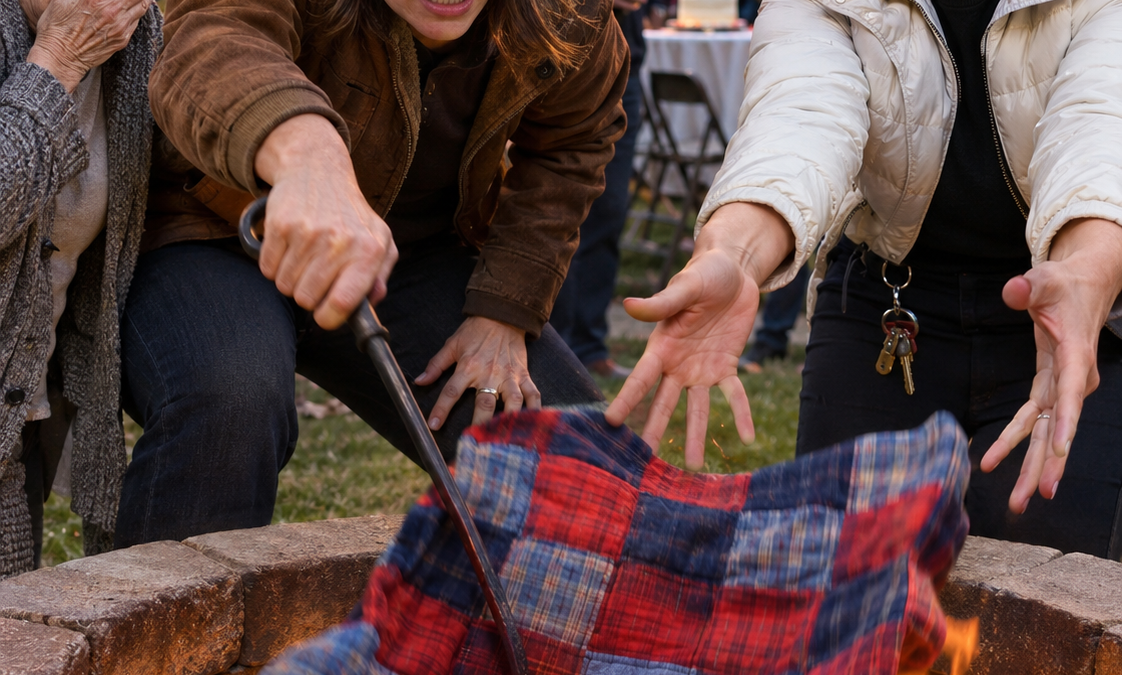
The quilt folded in on itself as it fell. One red corner struck a burning log, and the fire ran along the flannel seam.
Pippa backed away with one hand over her mouth.
Brynn’s phone remained raised.
I grabbed the iron poker leaning against the stones. The handle burned cold against my palm as I hooked it through a blue square and dragged the quilt over the rim.
Flames followed it onto the grass.
I pinned one edge with my boot, flipped the burning section with the poker, and stamped until the orange disappeared. Smoke curled around my brown jacket and stung my eyes.
Nine squares remained connected.
The rest had blackened, split, or stayed behind in the pit.
The pocket square was still there. One corner had curled inward, but Nils’s ink stain showed through the soot.
Under the gasps, when the flannel first caught, Tawny had said something too softly for me to make out.
Pippa stared at her aunt’s mouth.
The Ford keys clipped to Tawny’s belt flashed under the string lights.
I planted the tip of the poker against the ground and looked at them.
“Keep the keys,” I said. “For now.”
Tawny touched the clip at her waist.
“What is that supposed to mean?”
I set the poker across the stone rim. Then I crouched beside the quilt without touching the hot edges.
“It means you stepped toward the fire before you dropped it.”
Tawny gave a short laugh.
“Oh, please. It slipped.”
“You carried it away from the chair.”
“I was looking at it.”
“With your back to Pippa?”
Tawny’s mouth tightened.
My father pushed through the circle of relatives. Duane had spent forty years working around live wires, but he stopped several feet from the smoking fabric as if it might shock him.
“It was an accident,” he said. “Take your girl and go home.”
Pippa lowered her hand.
“Grandpa,” she said.
Duane looked past her toward the patio door.
My mother came out of the house carrying Pippa’s winter coat. Sherri held it open without looking at the fire.
“Put this on, honey,” she said.
Pippa did not move.
Inga released Pippa and walked over to the scorched quilt. She bent near the surviving squares, careful to keep her hands away.
“That was my son’s shirt,” Inga said.
Sherri pressed her lips together.
“Nobody meant for this to happen.”
Tawny folded her arms.
“Exactly. Thank you.”
I touched the edge of the pocket square with two fingers. It was warm rather than hot, so I lifted the connected remains and laid them across the folding chair.
Tawny watched me straighten the singed fabric.
“You’re making a whole production out of a blanket.”
“It belonged to Pippa.”
“It was old shirts.”
Inga stood upright.
“They were Nils’s.”
Tawny rolled her eyes toward the string lights.
“You people save everything.”
Darla stepped beside Brynn and put one hand on her daughter’s shoulder. Brynn lowered the phone, but she did not put it away.
I picked up the surviving section from the chair and folded the least damaged squares over the burned ones.
Tawny pointed at the bundle.
“You can buy another blanket.”
“No,” I said.
“A nice one. A new one.”
“No.”
Her voice sharpened.
“You stamp paper at the DMV, Annika. Stop acting like you’re the only person who understands what things are worth.”
I worked at the County Treasurer’s office, not the DMV. Tawny knew that. Accuracy had never improved a sentence she meant as an insult.
Pippa walked to my side.
Smoke had settled into her hair.
“Mom, can we go?”
“Yes.”
Sherri moved closer with the coat still open. Pippa turned, and my mother helped her slide her arms into the sleeves. Sherri pulled the zipper to Pippa’s chin, then stepped back.
No hug.
No apology.
The relatives around the fire began examining paper plates and plastic cups. One uncle carried his drink to the patio table. Someone moved a gift bag away from the smoke.
Duane pointed toward the side gate.
“Go cool down. We’ll talk when you’re reasonable.”
I held the folded remains against my left side and took Pippa’s hand with my right.
“I’m reasonable now.”
That made my father look at me.
I led Pippa through the gate.
Gravel scraped behind us. Tawny had followed as far as the opening, one hand resting near the keys on her belt.
My car was parked along the curb. At the end of my parents’ driveway sat the 2019 F-150 Nils used to drive, its silver hood reflecting the string lights.
Picking up where the Facebook post left off
Tawny’s truck now, according to the way everyone spoke.
Her keys still, according to the clip at her waist.
I tucked the quilt under my left arm, took my car key from my jacket pocket with my right hand, and unlocked the passenger door.
Pippa climbed in. I placed the folded squares across her lap.
She put one palm over the damaged pocket.
Tawny called from the gate.
“Are you seriously leaving before cake?”
I closed Pippa’s door.
Through the window, my daughter kept watching her aunt.
Tawny turned back toward the yard, and the Ford keys struck her belt buckle with a bright metal click.
Behind the fence, someone turned the music back on.
Part 2 of 7
“Apologize to your sister or don’t come Thursday,” my mother texted.
Thanksgiving was eighteen days away, and Sherri had already made my seat conditional.
Her message arrived Sunday afternoon while Pippa sat at our kitchen table with the nine surviving squares spread across a clean towel.
I had asked one question.
Are you saying Pippa and I aren’t welcome at Thanksgiving?
My mother’s answer glowed on the screen.
Apologize to your sister or don’t come Thursday.
A second message appeared.
At dinner. In front of everyone.
I set the phone facedown beside the sugar bowl.
Pippa traced the seam around the pocket square. The ballpoint stain remained, a crooked blue mark near the lower corner.
“Will the smoke smell come out?” she asked.
“Some of it.”
“Can you fix the black parts?”
“I can secure the edges.”
“That isn’t what I asked.”
I took the chair opposite hers and lowered myself into it.
“No,” I said. “I can’t make it what it was.”
Pippa nodded once. She preferred a hard answer to a soft lie.
My phone vibrated against the table.
The family group chat had started before breakfast.
An aunt wrote that I had “ruined a child’s party over an accident.”
One cousin sent, Maybe everyone needs to calm down.
Duane wrote, Your sister is having a hard time.
Nobody specified which child’s party I had ruined.
Pippa was the child.
Tawny had dropped Pippa’s gift into a fire, yet the family had somehow assigned me the cleanup and the blame.
Another notification appeared. This one came from my payment app.
Tawny had sent me a request for $40.
The note said: for the drama.
Under it, she had pasted a link to a plaid blanket from a big-box store.
Pippa leaned forward.
“Is that from Aunt Tawny?”
I turned the screen toward the table.
“Yes.”
“What did she say?”
“Nothing you need to carry.”
Pippa looked at the burned fabric in front of her.
“I’m already carrying it.”
I moved the phone beyond her reach and brought the sewing basket from the counter. The wooden lid still had a faint chalk line across it from the work Inga and I had started the previous December.
We had spent eleven months at Inga’s kitchen table turning fourteen of Nils’s flannel shirts into forty-two squares.
On our first afternoon, Inga had placed a cutting mat between us and handed me a rotary cutter.
“Measure before your hand gets brave,” she said.
“That sounds backward.”
“Your hand is always brave. The measurement keeps it honest.”
Inga had sewn quilts for most of her adult life. Her stitches ran straight even when she talked. Mine wandered whenever she mentioned Nils.
We cut three usable squares from each shirt.
Some carried pieces of a cuff or a faded button line. One blue square had a pale stripe where Nils’s work suspenders had rubbed the fabric. The center came from the chest pocket of his favorite red flannel.
I had nearly cut around the ink stain.
Inga stopped my wrist before the blade touched cloth.
“He always put his pen back without clicking it shut,” she said.
“I washed that shirt six times.”
“And the stain won.”
We kept it.
By spring, rows of red, navy, and gray covered Inga’s table. Pippa would visit after school and sort scraps into piles while pretending she did not know what we were making.
The quilt was supposed to be something she could touch when photographs felt flat.
Instead, she had nine squares on a towel.
My phone vibrated again, but I left it facedown.
The last time Tawny had asked me for something that belonged with Nils’s memory, I had said yes.
On August 1, 2024, Tawny stood in my driveway with her purse over one shoulder and looked at the F-150.
“I need it until I’m back on my feet,” she said.
Her job at the nail salon was forty miles away in Kearney. She spoke as if the distance settled the matter.
I held the Ford keys in my palm.
“Take care of it.”
“I take care of my things.”
“It isn’t your thing.”
Tawny held out her hand.
“You know what I mean.”
I placed the keys in her palm.
“Nils would’ve wanted it driven,” I said.
She closed her fingers around them.
“That’s what I keep telling people.”
I should have paid closer attention to that sentence.
At the kitchen table, Pippa gathered the surviving squares into a bundle.
“Can I take these to bed?”
“They still smell like smoke.”
“I know.”
That Saturday night, she slept with the folded fabric against her chest.
She did the same on Sunday.
On Monday, the third night in a row, I found her sitting upright under her comforter at 9:18 p.m. The nine squares rested in her lap, with Nils’s pocket under her right hand.
I sat on the edge of the mattress.
“You need anything?”
Pippa rubbed her thumb across the old ink mark.
“Aunt Tawny said something.”
“At the party?”
“When the quilt caught.”
I kept my hands folded.
“What did she say?”
Pippa’s eyes stayed on the pocket.
“She said it quiet.”
“Could you hear her?”
“I was right there.”
Her thumb stopped moving.
“Tell me exactly.”
Pippa lifted her head.
“Oops. Now it’s ash, like him.”
The furnace clicked on in the hallway.
I looked at my daughter’s face and kept mine still.
“Did you tell anyone else?”
Pippa shook her head.
“Just you.”
“Why did you wait?”
“Grandpa said it was an accident.” She pulled the fabric closer. “I thought he’d say I heard wrong.”
“You didn’t.”
Pippa studied me.
“You believe me?”
“Yes.”
No pause. No condition.
She leaned against my side, still holding the nine squares. I put one arm around her shoulders and stayed there until her breathing slowed.
Before I turned off the lamp, she caught my sleeve.
“Brynn was close to us,” Pippa said.
“I know.”
“She had her phone up.”
I remembered Brynn standing under the string lights, her screen pointed straight at Tawny’s smiling face.
Part 3 of 7
The video Brynn sent me on Saturday came with one request: Please don’t post this.
Before I could answer, my sister’s voice came through my earbuds.
“Oops. Now it’s ash, like him.”
At the kitchen table I held my phone in my right hand. Pippa was upstairs putting away laundry, so I kept the volume inside the earbuds.
Brynn had started recording when Pippa lifted the quilt from its gift box.
The picture shook as relatives moved closer. Someone applauded. Darla’s voice said, “Look at that pocket.”
Pippa held up the center square with Nils’s ballpoint stain.
Then she laid the quilt on the folding chair and turned toward Inga.
Tawny entered the frame from the left.
Her white puffer jacket was unzipped. The Ford keys hung from the clip on her belt. Tawny looked toward Brynn’s phone, saw the camera, and smiled.
Then she reached for the quilt.
“Let me see,” Tawny said.
She carried it two steps.
Her hands opened over the fire pit.
The flannel caught, and the guests gasped.
That sound had covered Tawny’s words where I stood. Brynn’s phone had been closer.
“Oops. Now it’s ash, like him.”
Tawny’s smile remained as the first flame climbed a red square.
The picture swung toward me grabbing the poker. Brynn’s breathing grew fast behind the phone. The final image showed Pippa with her hand over her mouth.
I paused the video there.
My daughter had told me the truth on Monday night. I had believed her without evidence.
Now I had Tawny’s face, voice, and smile in one frame.
I removed the earbuds and set them beside the phone. Then I typed to Brynn.
I won’t post it. Does your mother know you sent it?
The three dots appeared, vanished, then returned.
No. Please don’t tell her yet. I don’t want Mom fighting with Aunt Sherri.
Darla would have gone straight to my mother’s house with the phone in her hand. Brynn knew it.
I wrote, I’ll protect your name as long as I can. Keep the original file.
Her answer came at once.
I will. There’s something else.
A screenshot arrived.
The Facebook Marketplace listing had gone up Monday, November 16. Tawny’s profile picture appeared above a photograph of the silver Ford parked beside the nail salon in Kearney.
The caption read:
2019 F-150, clean title, $18,500 — my late brother-in-law’s, I’m the owner now.
Below the description, the listing was marked pending.
A comment from Gus Wendling said, See you Friday.
I enlarged the picture of the truck.
The Ford had been in my parents’ driveway on Pippa’s birthday. Tawny had stood beside the gate with its keys against her belt buckle while the quilt smoked in my arms.
Guy at the shop says that truck would bring eighteen grand.
I had half-heard her bragging near the fire pit. At the time, the number had floated past me with the other party noise.
Now it sat on a sales listing with another $500 added.
I texted Brynn.
How did you find this?
It showed up when I searched local truck listings for my automotive class. I recognized Uncle Nils’s Ford.
Brynn had called him Uncle Nils since she was little, though he had technically been her cousin by marriage. Nils had never corrected children who gave him a closer place in the family.
Did Tawny tell you she was selling it? I asked.
No. I didn’t ask her. I thought you should see it.
You were right.
I saved the video and screenshot to a private folder on my phone. Then I emailed copies to myself without adding a subject line.
Footsteps crossed the upstairs hallway.
I locked the screen before Pippa came down carrying an empty laundry basket against her hip.
“Can I have popcorn?” she asked.
“Yes.”
“Are those work earbuds?”
“Yes.”
Pippa set the basket beside the stairs and went to the pantry. She had already carried enough adult ugliness for one week.
While the microwave ran, I went to the desk in my bedroom and opened the bottom drawer. A green document folder lay beneath our tax records.
I took it to the bed and opened it.
The Nebraska certificate of title was inside a clear sleeve. The owner section carried one name.
Annika Fosberg.
The purchase file showed June 12, 2021. The receipt behind the title recorded the amount I had paid for the used truck: $31,400.
Paid in full.
Nils had driven it because he was the farm-equipment mechanic who needed the bed and the towing capacity. Marriage had never required us to pretend the name on a legal document was decorative.
After he died on March 14, 2023, I kept the Ford insured.
When Tawny borrowed it on August 1, 2024, I kept paying.
The premium was $96 a month. From August 2024 through November 2026, the charges totaled $2,688.
Tawny had contributed nothing.
No insurance payment. No purchase payment. No written agreement giving her an ownership interest.
She had asked for temporary help in my driveway and closed her hand around my keys.
Now her listing said, I’m the owner now.
The microwave beeped in the kitchen.
I returned the certificate to its sleeve and closed the folder. Then I carried it to the desk and locked the drawer.
Pippa called, “Do you want some?”
“No, thank you.”
I went back to the kitchen. She had poured popcorn into a blue bowl and was sprinkling cinnamon over it the way Nils used to.
My phone lay where I had left it beside the earbuds.
On the frozen video frame, Tawny was smiling at the fire.
She had treated Nils’s shirts as trash in front of his daughter. Nine days later, she had put a price on his truck and called herself its owner.
I sent one final message to Brynn.
Don’t confront her. I’ll handle the truck.
Part 4 of 7
Gus Wendling had paid Tawny a $500 deposit and expected to give her the remaining $18,000 on Friday.
“I’m picking up the truck with the title,” he told me Monday morning.
I had found his business number through the roofing page linked to his public profile. After leaving Pippa at Inga’s house, I parked at the far end of a grocery store lot and called from my car.
“Have you seen the certificate of title?” I asked.
“No. Tawny said she’d have it Friday.”
“Did she send you a picture of it?”
“She sent pictures of the truck.”
“That isn’t the same thing.”
Gus paused.
“Who did you say you were?”
“Annika Fosberg. Tawny’s sister.”
“I’m not getting in the middle of family trouble.”
“You’re already holding a place in it for five hundred dollars.”
His voice cooled.
“She wrote me a receipt.”
“Keep it.”
“I planned to.”
“Keep the messages too.”
A shopping cart rolled across the next row and struck an empty cart corral. I watched a store employee retrieve it while Gus breathed into the phone.
He said, “Tawny told me the title was clean.”
“The phrase ‘clean title’ doesn’t mean the seller can sign it.”
“She said the truck was hers.”
“Only the owner named on the certificate can transfer it.”
“Is that your legal opinion?”
“It’s the rule at the County Treasurer’s office. A buyer needs a properly assigned title to register the vehicle. A bill of sale does not replace the owner’s signature.”
Gus grew quiet.
I spent my workdays watching people discover that a handshake, a payment, or a family promise did not change the name printed on a vehicle title.
At the counter, my instructions stayed the same.
Owner signs. Nobody else.
I was not ready to say those words to Tawny yet.
Gus cleared his throat.
“Are you telling me she can’t sell this truck?”
“I’m telling you not to hand her another $18,000 without seeing a valid title.”
“That sounds careful.”
“It is.”
“It also sounds like you know exactly what’s on that paper.”
I looked through the windshield at the cart employee pushing a row toward the store.
“I know she cannot give you what she promised.”
Gus muttered something away from the receiver. Then his voice returned.
“I gave her the deposit Wednesday. She said it held the truck until Friday.”
“Did the receipt identify the Ford?”
“The message says deposit on 2019 F-150. I have her name, the date, and the amount.”
“Save it somewhere besides your phone.”
“You title people always talk like a house is about to burn down?”
“Paper survives arguments better than memory.”
That earned a rough sound that might have been agreement.
“What happens Friday?” Gus asked.
“You don’t pay the balance.”
“I want the truck.”
“You want a truck you can register.”
“I want my five hundred back if she can’t deliver.”
“Tell her that.”
“When?”
“Friday was your agreed pickup date.”
Gus considered it.
“I’ll give her until Monday to return the deposit.”
“That is between you and Tawny.”
“You’re sure I shouldn’t drive out there Friday?”
“That is your decision. Do not drive away in the Ford without a signed title.”
Gus repeated my name and wrote down my number.
Before ending the call, he said, “If this is some sister feud, I’m sending you my gas bill.”
“If the title is valid, you won’t need me.”
He ended the call.
I placed my phone in the cup holder and rested my hands on the steering wheel.
I had not called the police.
I had not uploaded Brynn’s video or sent it to the family group chat.
A private message would have given my parents room to call the recording unclear. A quiet phone call would have allowed Duane to say Tawny was having a hard time and Sherri to ask what good the truth would do now.
They had called it an accident in front of thirty-one guests.
The relatives gathering Thursday needed to hear what Tawny had said. They also needed to see what she had tried to sell.
I drove home and opened my laptop at the kitchen table.
Brynn’s video played clearly from the saved file. I copied it onto the laptop, then connected an HDMI cable and tested the picture on my television. Tawny’s face filled the screen above the mantel.
I stopped the video before her whisper carried through the house.
Next, I opened the Marketplace screenshot and printed it. The sheet slid onto the tray with Tawny’s name above the $18,500 price.
I logged into the insurance account.
The payment history showed twenty-eight charges of $96 from August 2024 through November 2026. I printed the history showing the $2,688 total.
Then I typed a notice.
Effective November 26, 2026, I terminate the permission given to Tawny Stohlmann on August 1, 2024, to use the 2019 Ford F-150. The vehicle and keys must be returned immediately.
I printed the notice and signed my name at the bottom.
From the locked desk drawer, I removed the green folder. I slid the certificate of title from its clear sleeve without touching the blank assignment section.
My name stood alone in the owner box.
I put the unsigned title into a white envelope and sealed it. The notice, Marketplace printout, and insurance history went into a manila folder.
The laptop and HDMI cable fit inside my black work tote. I added the folder and the sealed envelope, then zipped the bag.
At 1:20 p.m., I drove to Inga’s house.
Pippa sat at the kitchen table beside her grandmother. The nine burned squares lay on a white cloth between them. Inga was binding the raw edge of a navy piece while Pippa held the thread spool.
No one had tried to make the damage invisible.
Inga looked up.
“Did you finish what you needed to do?”
“Yes.”
Pippa studied my face.
“Are we going to Grandma Sherri’s on Thursday?”
“You aren’t.”
Her fingers tightened around the spool.
“Are you?”
“Yes.”
Inga set down her needle.
Pippa asked, “Do I have to apologize to Aunt Tawny?”
“No.”
“Do you?”
“No.”
That answer loosened Pippa’s hand.
I turned to Inga.
“Can she stay here Thursday from two until I call?”
“She can stay as long as she needs.”
I nodded.
Pippa had already stood inside one circle of adults who chose Tawny’s comfort over the truth. I would not ask her to watch them make that choice again.
Back home, I set my work tote beside the front door and took out my phone.
I texted Sherri.
I’ll be there Thursday.
My mother answered less than a minute later.
Good. Dinner is at 3:30. Your father will give you a chance to apologize before we eat.
A second message appeared.
Make it sincere. Tawny deserves that.
I locked the screen and placed the phone in my pocket.
My apology had been scheduled.
My papers were already packed.
Part 5 of 7
The unsigned title in my tote gave Tawny zero authority to sell the F-150. At 3:30 p.m. on Thanksgiving, my father pointed to me and said, “Go ahead. Apologize.”
Twenty-four relatives crowded my parents’ dining room and the card tables extending into the living room.
Pippa was at Inga’s house.
Before Inga dropped me off, Pippa had placed the burned pocket square in a clear food-storage bag.
“Make them look at it,” she had said.
Now I stood behind an empty dining chair with my black tote over my shoulder. Tawny sat across from me in a cream sweater. The Ford keys were clipped to her belt, half-hidden below the table.
Platters of turkey and ham waited beside green bean casserole, mashed potatoes, and dinner rolls. Nobody had served a bite.
Sherri folded her hands.
“Your father spoke to you.”
“I heard him.”
“Then do what you came to do.”
I slipped the tote from my shoulder and set it on the floor beside my chair. After opening the zipper, I took out the clear bag. I removed the pocket square and laid it beside the turkey platter.
A blackened edge framed Nils’s ballpoint stain.
Tawny glanced at it.
“This again?”
“You called it old shirts.”
“It was an accident.”
Several relatives nodded. They had watched the quilt burn and accepted the easiest explanation offered to them.
Duane leaned back at the head of the table.
“You came here to apologize, Annika.”
“No. You assumed that.”
Sherri’s serving spoon struck the side of the mashed potato bowl.
“You said you would be here.”
“I am.”
I reached into the tote and removed my laptop and HDMI cable. Carrying them into the living room, I set the computer on the console beneath the television. I connected the cable, picked up the remote from the console, and turned on the screen.
Tawny pushed her chair back.
“What are you doing?”
“Showing what happened.”
“Turn that off.”
I opened the saved video and pressed play.
Pippa appeared on the television holding up the forty-two-square quilt. Applause came through the speakers. Darla’s voice pointed out the pocket, and the camera moved close enough to catch Nils’s ink stain.
Chairs turned toward the living room. Relatives at the card tables stood so they could see.
Onscreen, Pippa laid the quilt on the folding chair and hugged Inga.
Tawny entered the frame.
Her face tilted toward Brynn’s phone. She saw the camera.
Then she smiled.
“Let me see,” the recorded Tawny said.
She lifted the quilt with two hands, carried it to the stone ring, and opened her fingers.
Flannel struck fire.
The room heard the guests gasp.
Then the television speakers carried Tawny’s whisper into my parents’ house.
“Oops. Now it’s ash, like him.”
Nobody moved.
The video showed Tawny smiling while Nils’s shirts caught fire.
I paused on her face.
Tawny gripped the back of her chair.
“That was taken out of context.”
Darla stared at her.
“What context makes that sentence acceptable?”
“It was a joke.”
“A joke to whom?” I asked.
Tawny turned toward me.
“You know how people say stupid things under their breath.”
“You dropped the quilt on purpose.”
“I dropped it, okay?” Tawny snapped. “I thought it would be funny. I didn’t know the whole thing would catch that fast.”
Sherri looked toward Boden at the card table. He had lowered his eyes to his empty plate.
“This is Thanksgiving,” my mother said. “Can we discuss it privately?”
“You called it an accident in front of the family,” I said. “The correction belongs in the same room.”
Duane rubbed his forehead.
“You have made your point.”
“I haven’t started.”
I left the video paused on the television. Then I returned to the dining room and crouched beside my tote.
From the manila folder, I removed the printed Marketplace listing and placed it beside the pocket square.
Tawny’s name appeared above the words:
2019 F-150, clean title, $18,500 — my late brother-in-law’s, I’m the owner now.
A cousin near the doorway said, “You’re selling Nils’s truck?”
Tawny’s voice rose.
“It isn’t doing anybody any good sitting around.”
“You drove it to Kearney,” I said.
“I maintained it.”
“You put gas in a vehicle you used.”
“That counts.”
I took the white envelope from my tote, broke the seal, and removed the certificate of title. I laid it beside the listing.
The owner box read ANNIKA FOSBERG.
The issue date was June 12, 2021.
“I bought the truck for $31,400,” I said. “I paid in full, and the title has been in my name alone since that day.”
Duane looked down at the paper.
“You let Tawny have it.”
“I loaned it to her on August 1, 2024, until she got back on her feet.”
Tawny pointed at the title.
“Nils drove it.”
“Yes.”
“So it was partly his.”
“No.”
“It should stay in the family.”
“It is in the family.”
Color rose above Tawny’s collar.
“You stamp paper at the DMV.”
“I work at the County Treasurer’s office,” I said. “And the rule is simple.”
I placed my finger under my printed name.
“Owner signs. Nobody else.”
Tawny looked toward our father.
Duane said, “Maybe you could sign it and let her finish the sale. She needs the money.”
I pulled the insurance history from the folder.
“For twenty-eight months, I paid $96 a month to insure the truck she used. That is $2,688. Tawny paid none of it.”
“I was going to settle with you after the sale,” Tawny said.
“You listed yourself as the owner.”
“You have a car.”
“And you promised Gus Wendling a truck you cannot transfer.”
Tawny’s chin jerked upward.
“You called him?”
“He paid you a $500 deposit. He is waiting to get it back.”
“He can wait.”
“Until Monday.”
I took out the signed notice and walked around the table. Tawny remained behind her chair as I handed her the page.
She took it with her right hand.
“This ends your permission to use the F-150,” I said. “The truck and keys are due back immediately.”
Sherri stood.
“Annika, do not strand your sister.”
“Tawny planned to sell my truck and leave me with an insurance bill.”
“She needs it for work.”
“She needed it to be hers so Gus would hand her $18,500.”
Tawny glanced at the notice, then crushed it against her palm.
I held out my right hand.
“The keys.”
“No.”
“The title is mine. The insurance is mine. The truck is mine.”
Duane stared at the paused image on the television. He did not repeat that it was an accident.
Tawny looked around the room for someone willing to defend her.
Nobody offered.
She shoved her chair hard against the table. With her left hand, Tawny unfastened the clip from her belt.
Then she dropped the Ford keys into my open palm.
Part 6 of 7
The $500 deposit had to be returned by Monday, but Darla was finished waiting for Tawny to become decent. Before Sherri could order me to return the keys, my cousin pushed back her chair and stood.
“Brynn, get your coat,” Darla said.
Sherri looked at her.
“You haven’t eaten.”
“I lost my appetite when Tawny said burning a dead man’s shirts was funny.”
Tawny still held the wrinkled notice.
“Annika came here to humiliate me.”
Darla picked up her purse from the floor beside her chair.
“No. You supplied the material.”
Brynn rose from the card table and slipped through the kitchen doorway to retrieve her coat. She avoided looking at me.
I kept the keys closed in my right hand.
Tawny pointed the notice toward Darla.
“You’ve always taken her side.”
“I took the side with a video and a title.”
Darla walked around the table and stopped beside the pocket square. Her finger hovered above the ink stain without touching it.
“Nils fixed the display case at my bakery without charging me,” she said. “He spent half a Saturday on it.”
Tawny looked toward the ceiling.
“Now we’re making him a saint.”
“No,” Darla said. “I’m remembering that he was a person.”
Brynn returned wearing her coat and carrying Darla’s. She handed the second coat to her mother.
Darla put it on, then faced Tawny.
“Do not come to my house at Christmas.”
Sherri stepped away from her chair.
“Darla, that is unnecessary.”
“It is my house.”
Darla guided Brynn toward the front hall.
More chairs moved.
An aunt collected her purse and told Sherri she would call later. Two cousins carried their coats from the hall without saying goodbye to Tawny. Another relative covered a casserole dish with foil and left it on the counter before walking out.
The front door opened and closed in quick succession.
Duane remained at the head of the table.
“Look what you’ve done,” he said to me.
I returned the title to its envelope and slid the listing, insurance history, and my copy of the notice into the manila folder.
“I played a video.”
“You broke up Thanksgiving.”
“Tawny burned the quilt.”
“This isn’t about the quilt anymore.”
“It became about the truck when she took $500 for something she didn’t own.”
I picked up the pocket square and returned it to the clear bag. After placing the bag and folder in my tote, I walked to the living room.
The paused image of Tawny remained on the television.
I shut down the laptop, turned off the TV, and disconnected the HDMI cable. The laptop and cable went back into my tote.
When I returned to the dining room, Sherri was standing beside Tawny.
“You can leave the truck here tonight,” my mother said. “We will sort this out when people are calmer.”
“The permission ended today.”
“Tawny has to work tomorrow.”
“She should have considered that before trying to sell it.”
Tawny tossed the crumpled notice onto the table.
“You act like you’ve won something.”
“I recovered something.”
I put the keys in my coat pocket and lifted the tote onto my shoulder.
Inga had dropped me off, so my car was not in front of the house. The F-150 was parked at the end of the driveway, exactly where I had seen it after Pippa’s party.
This time, the keys were mine to use.
On Sunday afternoon, Sherri called while I was washing dishes. I dried my hands and answered.
“Your sister lost her shifts,” she said without greeting me.
“What happened?”
“The salon reassigned her Friday and Saturday hours when she said she had no transportation to Kearney.”
“Tawny knew the truck was a loan.”
“Your father was not making an eighty-mile round trip before breakfast and another after closing.”
“That was his decision.”
My mother lowered her voice.
“Tawny has a child to support.”
“So do I.”
“She cannot repay Gus without those shifts.”
“She took his money on Wednesday, November 18. Her paycheck was never the title.”
Sherri made a sharp sound into the phone.
“We are lending her the $500.”
“Then Gus will be repaid.”
“You could stop this by giving back the truck.”
“No.”
“It has been in her driveway for more than two years.”
“Time did not transfer ownership.”
“Tawny says you never asked for it back.”
“She tried to sell it.”
My mother paused.
“She says she would have paid you something.”
“The listing said she was the owner.”
“You are determined to think the worst of her.”
“I watched the video.”
Sherri’s voice thinned.
“She was upset.”
“It was Pippa’s birthday.”
“I’m talking about the truck.”
“I’m not separating what Tawny did into small pieces so each one looks harmless.”
From somewhere near my mother, Duane said, “Tell her Tawny’s sunglasses are still in that truck.”
“They’re in a bag on my porch,” I said. “She can get them anytime.”
Sherri returned to the deposit.
“We are giving Tawny the money tonight. I hope you are satisfied.”
“This is not my debt.”
My mother ended the call.
At 7:06 that evening, Gus called.
“I got my five hundred back,” he said.
“Good.”
“Tawny told me the sale fell through because her sister stole the truck.”
“The certificate of title is in my name.”
“That is what I figured.”
“Keep the receipt showing the deposit was returned.”
“I will.”
After the call, I set my phone on the kitchen counter.
Outside, the F-150 sat under the porch light.
For twenty-eight months, Tawny had treated my silence like a signature.
At 7:40, my mother texted again. Christmas is at our house. If you and Pippa want seats, there will be a condition.
Part 7 of 7
My mother gave me until Sunday, December 13, to say whether Pippa and I would attend Christmas dinner. The invitation came with one condition: I had to “move on.”
Sherri called that afternoon while Pippa was upstairs reading.
“Tawny will be here on Christmas,” my mother said. “We expect you to be civil.”
“Has she apologized to Pippa?”
“She says she regrets how the party ended.”
“That is not an apology.”
“She lost her shifts and had to borrow $500 from us. She has suffered consequences.”
“She returned money she took from Gus.”
“You got the truck.”
“It was already mine.”
Duane’s voice came through in the background.
“Put her on speaker.”
A click followed.
My father said, “This family cannot stay divided over a quilt and a pickup.”
“The quilt belonged to Pippa. The pickup belongs to me.”
“You know what I mean.”
“I know what you keep leaving out.”
Sherri spoke louder.
“Christmas is not the time to punish your sister.”
“What did Tawny say when you asked her to apologize?”
Neither parent answered.
I waited.
Duane finally said, “She thinks the recording made it sound worse than she intended.”
“The recording showed what she intended.”
“You made your point at Thanksgiving,” Sherri said. “Now move on.”
I looked toward the stairs. Pippa had stopped reading. I could see her pink socks behind the railing at the top.
“You told us to go,” I said. “We went.”
I ended the call and set my phone on the kitchen counter.
Pippa came down and stopped on the last step.
“Are we going to Grandma Sherri’s for Christmas?”
“No.”
“Is Aunt Tawny going?”
“Yes.”
Pippa considered that.
“Can we go to Grandma Inga’s?”
“If she’ll have us.”
“She always has us.”
Pippa walked into the kitchen, poured herself a glass of water, and carried it upstairs.
The phone remained quiet on the counter.
On Saturday, December 19, Inga covered her kitchen table with a cutting mat and laid out the nine surviving squares.
The burned edges had been cleaned and bound, but nobody had covered the dark marks. Red, blue, and gray flannel formed a three-by-three pattern.
Pippa stood at one side of the table. I sat across from Inga with a spool of navy thread near my right hand.
The pocket square waited beside Pippa.
“Center?” Inga asked.
Pippa nodded.
“Definitely.”
She picked up the square with both hands and placed it in the middle of the layout. Nils’s ballpoint stain curved beneath the pocket opening.
Inga adjusted one corner.
“If we put the darkest edges inward, the seams will hold them better.”
Pippa shook her head.
“I want some black to show.”
Inga looked at her.
“How much?”
“Enough so nobody thinks it was easy.”
“That is a useful measurement,” Inga said.
We shifted the pieces until Pippa approved.
Inga pinned the top row while I worked on the bottom. Pippa handled the center, placing pins along the pocket square with careful fingers.
When the rows were ready, Inga moved to her sewing machine by the window. She guided the first seam while Pippa watched the needle.
I joined the next row.
The machine hummed through flannel that had once covered Nils’s shoulders, elbows, and chest. A scorched red edge tried to curl under the presser foot. I stopped, flattened it with my fingertip, and continued.
Pippa inspected the seam.
“Will it hold?”
“Yes,” I said.
“How do you know?”
Inga answered from beside me.
“Your mother used enough thread to repair a sailboat.”
“I wanted it secure.”
“You succeeded.”
By late afternoon, the small quilt lay finished on the table. Inga had added navy backing and narrow binding, leaving the nine shirt squares visible.
Pippa ran her palm across the center.
The pocket still opened.
She slipped her fingers inside, then looked at me.
“Dad used to keep pens in here.”
“He forgot to click them shut.”
“That was a bad habit.”
“It was.”
Pippa smiled down at the stain.
Inga folded the quilt once and handed it to her.
“This is yours.”
Pippa held it against her pink sweater.
“It was always mine.”
Inga glanced at me over Pippa’s head.
Neither of us corrected her.
Outside, the silver F-150 waited at the curb. I had driven it to Inga’s house that morning, and frost had begun to form along the windshield.
I carried my sewing basket in my left hand and unlocked the truck with my right. After setting the basket on the rear floor, I closed the back door.
Pippa climbed into the passenger seat with the small quilt in her arms. I walked around the hood, got behind the wheel, and started the engine.
As the heater warmed, Pippa spread the quilt across her lap.
“Will Aunt Tawny ever get this truck back?” she asked.
“No.”
“Even if Grandma asks?”
“No.”
Pippa pressed her thumb against the ink stain.
“Good.”
I pulled away from the curb and headed home through Grand Island. Christmas lights glowed on porch rails, and the truck’s heater carried the faint scent of old flannel from Pippa’s lap.
At a red light, she tucked one hand into her father’s pocket.
We had nine squares, and his pocket was safe in the middle.
THE END
More stories
My 72-Year-Old Former Mother-in-Law Mocked Me Over the Arena Speakers Before 412 People—Then the Manager Walked Past Her Son With the Pen, and the $200,000 He’d Collected Had to Go BackMy 71-year-old mother-in-law drove a moving truck onto my lawn and claimed my cottage—Then my late husband’s sealed envelope led me to the deed that ended her ownership story.My Landlord’s Son Ordered 43 Households Out by March 31—Then His 81-Year-Old Mother Refused to Sign, and All 43 Households Bought the Land Themselves InsteadMy Food Services Director Mocked the 14 on My Spiral Notebook After 22 Years and Told Me to Take It Home—Then 14 Kids Cost Him His $15,000 BonusI Pulled My Orange Gloves Out of the Trash Before 11 Drivers—Then My Brother-in-Law Took My Seat—Until the Hidden Bank Packet’s Loan Made Me Owner, and His Promotion VanishedMy Parents Spent Christmas on Brett’s Two Kids While My 8-Year-Old Shook an Empty Stocking—Then Grandma Hazel’s Tin Exposed Dad Before He Could Give Brett the House
You Might Also Enjoy

My Daughter-In-Law Told Me To Stay Elsewhere While Strangers Took My Condo — Then I Pushed Back







