My Stepmother Veronica Told Me to Stay in My Place at Dad’s Grave, but Her Smile Vanished When the Cemetery Owner Asked to Let His DAUGHTER Finish
Part 1 of 5
“Stay in your place!”
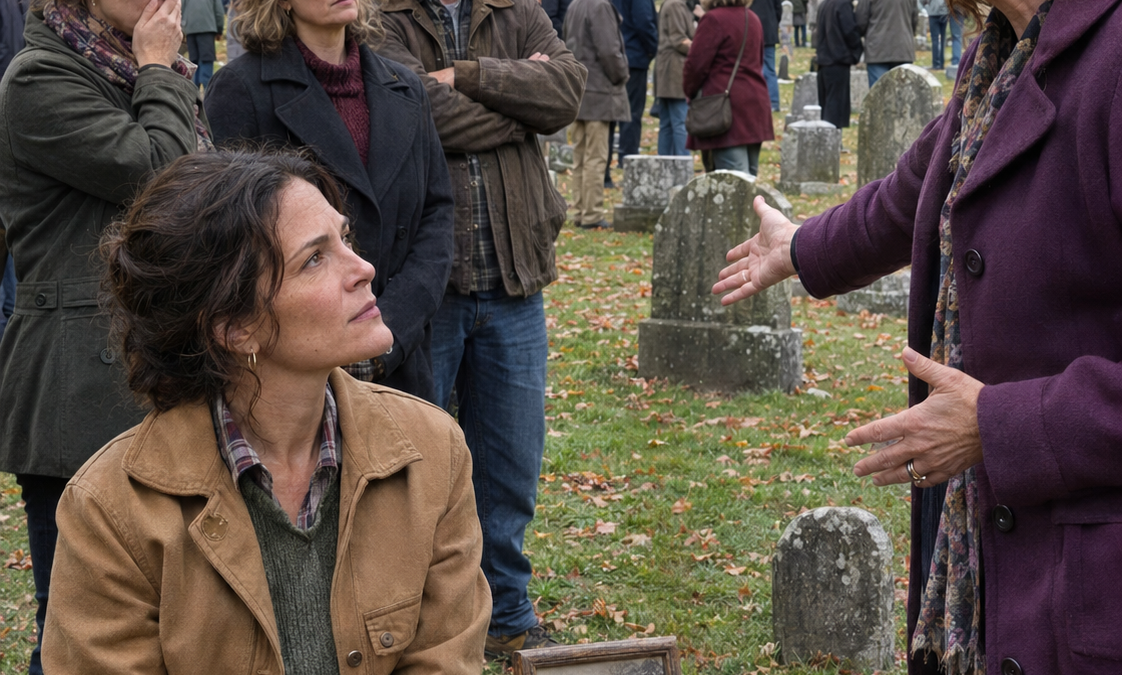
Veronica Slater stood over my bench at the Scranton cemetery’s heritage open house.
Twenty-six relatives and visitors watched her point toward the lower burial section.
Beside me sat my six-year-old daughter, Zoey Finch, and a framed photograph.
The frame cost two dollars.
Inside it, my father carried a soot-covered boy toward daylight.
“I’ve arranged to move him,” Veronica said. “The lower section is perfectly adequate.”
A visitor folded her open-house program against her knee.
My daughter stopped swinging her feet.
“You weren’t his real family at the end.”
Veronica said it clearly enough for the people behind the bench.
I stayed seated.
“His resting place is protected.”
My voice carried without help. An older cousin lowered her eyes.
Veronica smiled toward the witnesses, as though translating an awkward child.
“Protected from what? Sensible decisions?”
I moved my daughter’s cardigan away from the damp bench edge.
“From decisions made without checking.”
Three people looked toward the little office across the gravel drive.
Nobody answered her.
I was April Fenton, forty-eight, an architectural historian who worked in Scranton.
Buildings taught me to check foundations before trusting a handsome front.
My father had taught me something similar about people.
When he lost his driving privileges, I drove his grocery route.
When he needed the bathroom widened, I paid the contractor $4,600.
When he asked for quiet, I stopped asking about his breathing.
That was my last winter with him.
Veronica had married him six years earlier. She was fifty-seven and now widowed.
My parents’ hillside space had been settled long before that marriage.
I hadn’t brought those years to the cemetery for an argument.
I had brought daisies.
And the photograph.
“Everyone has somewhere else to be,” Veronica said.
A man beside the gravel path checked his watch, then lowered his wrist.
“The people interested in this location understand its value,” she continued.
“What people?” I asked.
“A local family. They’ve offered thirty-eight thousand dollars for the hillside rights.”
My daughter looked up.
“Is Grandpa going somewhere?”
“No,” I said.
Veronica’s mouth tightened.
“You cannot promise that.”
“I can promise we’ll check everything.”
The bench faced my parents’ matching stones. My mother’s inscription had softened with weather.
My father’s lettering still held sharp white edges.
I kept looking at those edges.
Veronica turned halfway toward the visitors, making them her audience again.
“She has always confused paying for things with being present.”
A woman in a blue raincoat shifted away from her.
I didn’t list the nights.
I didn’t name the bills.
I didn’t reach for applause.
My daughter pushed her pink sweater cuff above her thumb.
“Can we leave the picture here?”
“Only while we visit,” I said. “The weather would ruin it.”
Veronica glanced at the frame.
“That old newspaper photograph again.”
“It’s his open-house contribution.”
Visitors had been invited to bring pictures connected to local history.
That was why ours sat on the memorial bench.
That was why strangers had stopped beside it.
Veronica tapped her folder against her violet coat.
“I’ve already submitted the relocation request. This isn’t a family discussion.”
The folder had a yellow routing slip across its front.
I could see one unchecked square.
“What did the office tell you?” I asked.
“That they would review it.”
“Then it’s being reviewed.”
Her auburn waves moved against her collar as she shook her head.
“You make everything difficult.”
I put my canvas document case beside my shoes.
There was no reason to open it yet.
Across the drive, the office door swung outward.
The cemetery owner came down the steps in a dark green jacket.
His cropped gray hair caught the thin October sunlight.
He had been greeting visitors near the entrance earlier.
Now a volunteer directed him toward our bench.
Veronica straightened.
“The owner can explain this to you.”
I recognized him from the printed welcome sheet.
I had never met him.
My daughter watched him approach, then looked back at the photograph.
The owner stopped beside the memorial bench.
“Please let his daughter finish.”
Veronica froze, her smile still arranged across the wrong expression.
The owner stood still beside the gravel path.
“I wasn’t finished either,” Veronica said.
“I could hear that from the office.”
A program rustled behind us.
“I’m Cecil Drummond,” he said to me. “I own the cemetery.”
“April Fenton.”
He glanced toward my daughter without asking her to introduce herself.
“This is Zoey Finch,” I said. “My daughter.”
Veronica lifted her folder.
“You have my paperwork.”
“The office received a request,” Cecil said.
“That is what I said.”
“No,” he said. “It isn’t.”
I watched his gaze drop to the frame.
He looked away, then back again.
The photograph showed my father younger and broader through the shoulders.
One sleeve had torn at the elbow.
The person against his chest had his face turned partly away.
Cecil stepped closer, but didn’t touch the picture.
“Where did you get that?”
“Dad’s kitchen drawer,” I said. “After his funeral.”
Veronica made a small impatient sound.
“We’re discussing a burial, not sorting keepsakes.”
Cecil looked at her.
“We’re discussing a person.”
My daughter leaned against my arm.
Her eyes moved from the photograph to his face.
Something about his attention had made her sit very still.
A volunteer arrived carrying the office’s blue visitor folder.
Part 2 of 5
The volunteer placed the folder on the bench’s far end and returned to the entrance.
Cecil left it closed.
Veronica watched it as though it might announce a winner.
“I chose today so the family could understand together,” she said.
“You invited them to watch,” I said.
“I invited them to hear the practical facts.”
“The facts can wait until everybody has them.”
A cousin standing behind Veronica rubbed a thumb along her program’s fold.
Nobody moved toward the refreshments table.
The twenty-six witnesses remained around the bench and the adjoining path.
The owner had joined them.
My father’s photograph sat between my daughter and my document case.
Under the cheap glass, the newspaper clipping had curled at one corner.
I had flattened it with a cookbook the night before.
Zoey had watched me.
She asked why Grandpa looked dirty.
I told her the little I knew: there had been a mine collapse, and he had helped someone out.
Dad had never supplied the person’s name.
The caption had remained folded behind the photograph until that morning.
I hadn’t read it yet.
That bothered me now.
I spent my working days identifying what people had covered, altered, or forgotten.
At home, I had mistaken a closed drawer for a complete history.
Veronica adjusted the folder under her arm.
“Your father hated waste.”
“He hated being talked over.”
“He also hated this hillside walk. You know that.”
“He asked to be here.”
“With your mother,” Veronica said.
“Yes.”
The word required no decoration.
My mother, Louise Gannon, had died eighteen years earlier.
Dad had chosen the view with her before she became too sick to visit.
They could see the ridge from the bench, even sitting down.
I had been thirty when the invoices came.
The burial spaces cost $5,800. Installation of the bench cost another $725.
Dad offered to repay me from his pension.
I told him to keep buying decent groceries instead.
We never made a ceremony of it.
Veronica hadn’t known him then.
She knew the newer kitchen, the recliner, the oxygen tubing.
I knew those things too.
There was room for both versions of him until she demanded that mine disappear.
“When he couldn’t climb the porch steps, I arranged the ramp,” I said.
“When he forgot appointments, I called before work.”
Veronica looked past me.
“When he asked for you, I called you too.”
Her eyes returned sharply.
“I was there.”
“I know.”
That stopped her for a moment.
I wasn’t going to erase the meals she made or the nights she stayed awake.
I wouldn’t let those nights erase everyone else either.
The blue folder remained closed.
That didn’t fit.
If the move had been arranged, why hadn’t the owner brought a schedule?
Why hadn’t anyone set a date for the reinterment?
Veronica had announced a completed decision.
Cecil kept calling it a request.
My daughter whispered, “Do we have to ask him?”
“Ask him what?”
“The picture question.”
I looked toward the owner.
He was studying the worn corner of the frame.
“You can ask politely.”
Veronica stepped toward the bench.
“We are not turning this into children’s story time.”
Cecil raised his eyes.
“She’s allowed to speak.”
“She’s six.”
“And standing beside her grandfather’s grave.”
Veronica stepped back, but only far enough to face the audience again.
“You weren’t his real family at the end.”
The same words.
Less steady now.
A man in a charcoal sweater shook his head once.
I bent down and unzipped my canvas case.
I took out a clear document sleeve and laid it facedown beside my knee.
That was all.
No announcement.
No flourish.
No invitation to choose sides.
Veronica stared at the blank backing.
“What is that supposed to prove?”
“It isn’t your turn to decide what something proves.”
My daughter’s shoes brushed together under the bench.
Cecil lowered himself slightly so she didn’t have to crane her neck.
“What would you like to ask me?”
Zoey studied his face with the plain concentration children give a puzzle.
“Are you the boy Grandpa said he wouldn’t leave underground?”
Cecil’s lips parted.
For a moment he made no sound.
Veronica’s folder slipped against her coat, catching at the elbow.
I had heard Dad’s phrase before.
He used it whenever Zoey asked about the photograph.
I had thought it was simply the way he told a child a difficult story.
Cecil looked at me.
“May I see that more closely?”
I turned the frame on the bench so he could study it without picking it up.
A narrow crack ran through its plastic stand.
Two dollars at the church rummage sale, and it barely stayed upright.
Veronica looked toward the office.
“Could someone please deal with my actual request?”
Cecil didn’t answer her.
His gaze settled on my father’s torn sleeve.
Then he touched the small scar beneath his own chin.
I could see the calculation crossing his face.
The hillside grass stirred against the base of my father’s stone.
My daughter waited.
So did everyone else.
The owner turned the frame toward the light.
Part 3 of 5
“That’s me in your father’s arms,” Cecil said.
His voice broke on the last word.
My daughter looked from him to the picture.
“But you’re big.”
“I was big then too. Thirty-five. Your grandpa called me a boy anyway.”
He swallowed and tried again.
“He was older than I was. To him, I suppose I counted.”
The man in the charcoal sweater stepped nearer, staying behind the bench.
Veronica stood perfectly still.
Cecil looked at the clipping folded behind the photograph.
“Is the caption still there?”
“I think so.”
I opened the frame’s cheap metal tabs against my knee.
The backing came away with a little cardboard dust.
I unfolded the newspaper strip and laid it across the photograph.
The date was October 17, 1998.
Twenty-seven years earlier.
The caption named Edwin Renshaw as the man carrying an injured worker from a collapsed mine passage near Scranton.
It identified that worker as Cecil Drummond.
Below it, a second sentence said my father had declined an interview.
I read the words aloud once.
Cecil nodded before I finished.
“That’s the photograph they took at the service entrance.”
“What were you doing underground?” I asked.
“Measuring an old drainage passage for a property survey. I was working for my uncle then.”
He looked toward the ridge rather than at the witnesses.
“The passage wasn’t supposed to be unstable. It was.”
Dad had worked on pumps and ventilation equipment for years.
He knew old workings the way I knew old foundations.
Cecil said someone had gone to fetch him when the survey crew failed to come back.
“He could have waited for better equipment,” Cecil said. “Nobody would have blamed him.”
My daughter pressed her palm against my sleeve.
“He said you couldn’t wait.”
“No,” Cecil told her. “I couldn’t.”
Veronica drew her folder closer.
“How touching. I’m sure Edwin helped plenty of people.”
Cecil didn’t turn toward her.
“I went to the hospital. By the time I could ask questions, he was gone.”
“Dad hated fuss,” I said.
“The newspaper wanted a follow-up. He told them to write about the rescue crew.”
That sounded like him.
He had once repaired a neighbor’s furnace and asked to be paid in tomatoes.
I had spent years trying to persuade him that accepting thanks wasn’t the same as asking for attention.
Cecil rubbed the scar beneath his chin again.
“Years later, I finally mailed a letter to his old address. It came back. After that, life got busy.”
“Dad moved after Mom died,” I said. “The forwarding expired.”
There was our missed connection, ordinary and sad.
No secret arrangement had brought Cecil to our bench.
A volunteer had fetched the owner because a woman was announcing an unapproved relocation.
He had recognized a photograph only after he arrived.
“I bought this cemetery twelve years ago,” he said. “I didn’t connect the burial name with the man I remembered.”
Dad’s funeral had taken place while Cecil was away recovering from surgery.
The office manager had handled the arrangements.
Cecil looked at the stone.
“Edwin Renshaw,” he said quietly. “I should have looked.”
Veronica made a tight little nod.
“Well, now you know. Can we return to the business?”
“Yes,” I said.
I turned over the clear sleeve beside my knee.
Inside was the original burial-rights certificate.
I held it flat so Cecil could read it.
“This is what I purchased for my parents.”
Veronica glanced at the seal.
“You paid a bill. That doesn’t mean you own the cemetery.”
“I haven’t claimed to own the cemetery.”
“The spaces were for them.”
“Yes.”
Cecil read the certificate without speaking.
The paper had yellowed around its edges, but my name remained dark.
April Fenton.
I had bought the rights after my first divorce and kept that married surname.
Zoey carried the surname of her father, my second husband. There was nothing mysterious about either name.
The certificate listed the hillside plot, both interment spaces, and the adjoining memorial bench privilege.
It didn’t list Veronica.
She stepped closer.
“Let me see that.”
“You can see it from there,” Cecil said.
“I was his wife.”
“I understand.”
“I made his medical decisions.”
“This isn’t a medical decision.”
My daughter leaned against me, her hair warm beneath my chin.
I had brought the certificate because the open-house invitation mentioned helping families update ownership records.
A routine errand.
I thought I might add my mailing address and ask about eventually naming a successor.
Instead, the paper lay beside a photograph that had just changed the owner’s face.
Cecil placed one fingertip beside the certificate number.
“I need to check our register.”
Veronica gave a quick breath through her nose.
“Finally.”
He looked directly at her.
“Against the original certificate.”
The distinction reached the people behind her.
One cousin opened her mouth, then shut it.
Cecil lifted the blue folder from the bench and opened its cover.
“The plot record is already here.”
Part 4 of 5
Cecil set the folder flat on the bench’s empty end.
I moved the daisies so their wet stems wouldn’t touch the paper.
Veronica watched his eyes travel down the register copy.
“This should settle it,” she said.
“It should,” he replied.
He compared the plot designation with my certificate.
Then he checked the original purchase date.
His finger stopped beneath the ownership entry.
“April Fenton is the sole rights holder.”
Nobody spoke.
“The record has no transfer, no added holder, and no authorized sale.”
Veronica’s shoulders lifted beneath her coat.
“That cannot be current.”
“It is the current record.”
“He married me.”
“He did.”
“Then surely his property passed to his wife.”
Cecil looked at my certificate again.
“These burial rights were never his property to leave.”
I kept my hands around the frame backing so the tabs wouldn’t catch my daughter’s sweater.
Veronica stared at the paper.
I could almost see her looking for an expense she could dismiss, an omission she could use.
“What about the funeral forms?” she asked.
“You signed as the person arranging his burial,” Cecil said. “That’s a different responsibility.”
He stopped there.
No lecture.
Just the distinction she had tried to step across.
The woman in the blue raincoat slowly unfolded her program again, though she didn’t look at it.
Veronica glanced toward the lower section.
“The other family has already agreed on a price.”
I looked up.
“Have you accepted money?”
“No.”
The answer came quickly enough that Cecil lifted his eyes.
“They made an offer,” Veronica added. “I said it was acceptable.”
“Did you tell them the rights were yours?” I asked.
“I said I was handling it.”
Cecil turned one page.
The yellow routing slip appeared beneath his hand.
The relocation request.
Veronica moved before she seemed to notice herself moving.
“That’s private correspondence.”
“You submitted it to this office,” Cecil said.
“It contains personal information.”
“Then I won’t read any address or telephone number aloud.”
He looked at me.
“You’re the recorded holder. You need to see the basis of the request.”
He angled the page toward me.
The top section identified my father’s grave.
The proposed destination was a less expensive space near the lower maintenance lane.
The next box was labeled Applicant’s relationship to burial rights.
Veronica had written owner.
Below it, her signature filled the authorization line.
She hadn’t misunderstood a blank.
She had completed it.
Cecil spoke carefully.
“This request describes you as the owner.”
“I was his wife.”
“You’ve said that.”
“What was I supposed to write?”
“The truth.”
The man in the charcoal sweater looked away from her.
Veronica’s mouth worked before any sound came.
“I assumed the certificate was a keepsake. People frame these things.”
“Mine was in a file cabinet,” I said.
A cousin made a small sound that might have become a laugh elsewhere.
I didn’t look back.
This wasn’t a chance to make Veronica smaller for sport.
It was the moment to stop her moving my father.
“Did you know about my certificate?” I asked.
“I knew you paid for the spaces.”
“Did you ask whether I had transferred them?”
“You were barely speaking to me.”
“You could have asked the office.”
Cecil closed the register copy but left the request exposed.
“She didn’t,” he said.
Veronica looked toward the people she had invited.
A few had come because she promised a family announcement during the open house.
Others had stopped because she raised her voice.
All twenty-six had heard her sell certainty she didn’t possess.
“I cared for him,” she said.
I nodded.
“You did.”
Her eyes flicked toward mine.
“I never said you didn’t.”
“Then why are you doing this?”
“Keeping him where he asked to be.”
My daughter slid closer until our shoulders touched.
“Can the picture go back together now?”
“In a minute.”
Cecil looked at the split plastic stand, then at the newspaper strip in my lap.
“Your father wouldn’t give them a speech,” he said. “The reporter told me that much.”
“He wouldn’t have enjoyed this one either.”
Cecil nodded.
Veronica pulled her folder open.
There was a typed offer inside, visible beneath a loose envelope.
The offered amount was $38,000.
She looked at it, then at the stones behind me.
I wondered how long she had been seeing a price instead of the place.
“I have expenses,” she said.
“So do I.”
“You don’t understand what it costs to start over.”
“I’m divorced,” I said. “I understand a little.”
That was the most personal thing I offered her.
Cecil picked up the request again.
“The application cannot go forward on this representation.”
Veronica’s fingers tightened around the folder’s cardboard edge.
“Then I’ll submit another.”
Cecil laid her signed application beside my certificate.
Part 5 of 5
“No relocation. These rights belong to his daughter.”
Cecil said it beside the two-dollar frame.
Veronica looked at the photograph instead of at him.
For the first time since she approached my bench, she seemed to have nowhere useful to put her eyes.
“The request is denied,” he continued. “There will be no transfer or sale through you.”
The words carried to the same twenty-six people who had heard her announcement.
Nobody needed to lean closer.
Cecil took a pen from the folder’s spine and marked the office copy.
Then he slid it beneath the register sheet.
“The record will note the false ownership claim. Any future request must come from April.”
Veronica’s lower lip drew inward.
“You’re making this sound criminal.”
“I’m telling you what the office will do.”
“Because he rescued you.”
“No.”
Cecil’s answer came without heat.
“The certificate establishes the rights. The register confirms them. The photograph tells me who I failed to thank.”
He let that remain separate.
So did I.
Dad hadn’t earned a protected grave by rescuing the owner.
I hadn’t earned ownership by making the better speech.
The papers had been true before anyone recognized the picture.
Veronica looked toward me.
“You brought all this to embarrass me.”
“I brought the photograph for the heritage display.”
“And the certificate?”
“To update my address.”
A woman behind the bench nodded toward the canvas case.
“She had that out before any of this,” she said.
Veronica turned, searching for someone willing to restore the scene she had planned.
Nobody stepped forward.
The cousin with the folded program came around the bench.
She stopped far enough away that my daughter didn’t have to move.
“I’m sorry I stood here,” she said to me.
“You can still sit.”
The cousin shook her head, looking at Veronica.
“I thought we were hearing a family plan.”
“So did I,” said the man in the charcoal sweater.
Veronica pressed the folder against her chest.
“I’m not discussing my marriage with spectators.”
“Then you shouldn’t have invited spectators,” the cousin said.
I watched a small muscle move beside Veronica’s mouth.
There was no applause.
No triumphant noise.
Only the gravel crunching when she changed her stance.
Cecil returned my certificate in its clear sleeve.
“Would you like the mailing address updated today?”
“Yes.”
“Nothing else changes unless you instruct us.”
“I’d like that written in the file.”
“It will be.”
Veronica looked toward the lower section one last time.
Then she faced the witnesses.
“The offer is withdrawn,” she said.
Cecil didn’t let the wording pass.
“You cannot withdraw an offer on rights you don’t hold. You can tell the interested family that.”
Her cheeks colored above the violet collar.
“I will tell them.”
“Today,” he said.
Veronica nodded once.
That was the end of her arrangement.
No grave moved.
No sale remained pending.
The office had my certificate number, my current address, and a clear instruction requiring my written authorization.
Veronica walked toward the gravel drive with the unused offer inside her folder.
The same people who had watched her arrive made room for her departure.
Nobody followed.
My daughter looked after her, then up at me.
“Was Grandpa’s place ever not protected?”
“It was protected,” I said. “We had to make sure everyone understood.”
“Even her?”
“Even her.”
Cecil sat briefly at the far end of the bench.
He asked first.
I moved the daisies, and he left a comfortable space between himself and my daughter.
“I kept thinking I’d find him someday,” he said.
“You found where he rests.”
“That isn’t the same.”
“No.”
He nodded, accepting the small answer.
I slid the newspaper caption behind the photograph, leaving the date visible beneath the image.
The metal tabs bent reluctantly back into place.
Cecil watched my hands.
“Could our history room have a copy? Only with your permission.”
“A copy,” I said. “This one goes home.”
“That’s right.”
He offered to make it while we visited the grave.
I told him I would scan it and send it with the caption, so nothing would be lost.
Before leaving the bench, Cecil turned toward my father’s stone.
“Thank you, Edwin,” he said.
His voice held this time.
My daughter waited until he stood.
“Grandpa said you kept your eyes open.”
Cecil touched the scar below his chin.
“I tried.”
“He said that helped.”
He looked at her for several seconds.
Then he nodded.
The relatives and visitors began moving again, quieter now, some toward the history room and others down the hillside path.
My cousin placed the daisies in the stone vase.
I tucked the certificate safely inside my case.
Zoey helped settle the frame upright between us for one last minute.
The cracked stand held.
Then Cecil returned with a corrected ownership confirmation bearing my name.
THE END
More stories
My Brother Mitchell Called Me an UNEDUCATED Driver in Front of 72 People, but He Went PALE When a Woman Walked In and Said, “Ms. Ralston, I’ll Take It From Here”I Was Serving Funeral Lunch When My Sister-in-Law Told Me to Pack My Husband’s Fishing Gear, Then Our Lawyer Found the Date That Undid Her Cabin ClaimMy Niece Called Me “Too Old” in Front of 21 Relatives and Tried to Take My Granddaughter at Thanksgiving, but When Six Women Walked In, She FROZEMy Niece Felicia Declared My Little Boat OUT at Our Marina Meeting, but When My Attorney Walked In, She FROZE Before the Same Owners Who Had Watched Her Humiliate MeCecily Said I Stole $600 From Our Church Pantry Before 38 People, but When the AUDIT Arrived, My Red LEDGER Held a Secret She Never Saw ComingI Paid for the Engagement Dinner Sylvia Draper Turned Into My Wine-Serving Shift, Until the Restaurant Owner Asked One Question and Her Plan to Take My House Collapsed
You Might Also Enjoy

My Daughter-In-Law Told Me To Stay Elsewhere While Strangers Took My Condo — Then I Pushed Back







