My Brother Mocked My Gift While I Paid His Rent — Until I Saw His Message
Chapter 1: The Birthday Envelope
My brother left me alone greeting guests at his birthday dinner while he and Mom claimed they were picking up his cake.
I was standing beside a table in a restaurant’s private dining room in Louisville, Kentucky, holding the envelope I had brought for him.
Aaron pointed toward the doorway.
“Just tell everybody where we are. We’ll be right back.”
Mom already had her purse over her shoulder.
I looked at the empty chairs, then at my brother.
“Are we waiting to order?”
“Until we get back,” he said.
That sounded simple enough.
I put his card beside my place and checked with the server about the checks. Everyone would pay separately. She confirmed it, and I thanked her before setting my phone next to my menu.
I had come to eat dinner.
Instead, I ended up standing near the entrance with my coat still over my arm, explaining where people could sit and where they could put their things.
Wanda arrived wanting to know where Aaron was.
“Getting the cake with Mom.”
She handed me her coat while she adjusted her chair.
I laid it over the back for her.
Beth came into the room and glanced around for Aaron. Their children weren’t with her. She had come expecting a birthday dinner with adults, not an explanation from me about why the birthday boy wasn’t there.
“They should be back soon,” I said.
She sat down.
I kept checking the doorway.
People wanted to know whether they could order drinks, whether the seats were assigned, whether Aaron wanted everybody together before the server took our food orders.
I didn’t know.
That became my answer more than I liked.
I sent Aaron a message asking where they were. Then I sent Mom one.
Neither answered.
My menu had been moved to make space while somebody settled in. I retrieved it, put it back beside my phone, and finally slipped out of my coat.
The server appeared at my shoulder.
“When would you like us to bring out the cake?”
I looked at her.
“They’re picking it up.”
“It’s already here. We have it in the kitchen.”
I asked whether she was sure it was ours.
She nodded.
The cake had been delivered. There was nothing for Aaron and Mom to collect.
I thanked her because she hadn’t done anything wrong, then went back to my chair and picked up my phone.
Still no reply.
At 41, I worked as a payroll coordinator. I spent my workdays checking whether money went where it was supposed to go. At home, apparently, I was willing to stop asking questions as soon as my brother said he needed help.
Six months before that dinner, Aaron’s work hours had been reduced. He called about rent, speaking quietly, and I asked what he needed. He said $1,800 would get him through the month. I had savings, and I could help without leaving my own bills unpaid, so I sent it. When the next month came, we discussed it again. That was how the arrangement continued: a message, a conversation, another decision by me. Nothing automatic. Nothing promised forever. His children lived in that house, and I wanted them to stay settled while he worked things out. I didn’t ask him to tell everyone. I also never agreed to let him pretend he was doing it alone.
The completed monthly payments came to $10,800.
I knew the total.
I had watched my savings balance shrink.
That birthday morning, I had been sitting at my kitchen table with his card open beside my coffee. I had decided to give him some breathing room instead of another object he might not need.
I sent $5,400.
The bank screen said “TRANSFER SENT.”
Then I opened our messages and wrote, “Happy birthday. This covers the next three months’ rent.”
His answer came back while I was still at the table.
“Thanks. That helps.”
I read it and felt relieved.
He knew what the gift was. He had received it. For the next three months, he wouldn’t have to ask me when I could send rent money.
Inside the birthday card, I wrote that the transfer had been made. I slid the card into its envelope and pressed the flap shut.
There was no cash.
No check.
He already had the money.
Now, in the restaurant, I looked from that envelope to the doorway while people waited for someone to make a decision about dinner.
Aaron and Mom finally came in through the door adjoining the patio.
Neither carried anything.
I met them before they reached the table.
“The cake’s been here.”
Mom shifted her purse.
“The restaurant has everything handled.”
“That isn’t what I asked.”
Aaron glanced past me.
“Everybody here?”
“Yes. They’re waiting to order.”
He nodded as though I had given him a useful report and went around the table accepting birthday wishes. Mom followed him without explaining why neither of them had answered me.
I stood there holding my phone.
Then I put it down.
I wanted to eat, give him his card, and stop managing a dinner I hadn’t offered to manage.
When he settled into his chair, I handed him the envelope.
“Happy birthday.”
He opened it with his thumb, pulled out the card, and looked inside.
Then he turned the envelope upside down over his plate.
He gave it a little shake.
I waited for him to read what I had written.
Instead, he looked around the table.
“An empty envelope. Guess an actual present was too much.”
Wanda laughed.
It wasn’t a startled sound. She thought he was funny.
I reached toward the card, but Aaron kept it in his hand. Mom smiled and began gathering the cards beside his plate into a tidy pile.
“The money’s already—”
Aaron turned toward Beth before I finished.
He said that was the problem with handling everything yourself. People couldn’t think of anything you needed.
Beth smiled at him, then looked over at me.
I had stopped reaching for the card.
He was 36, sitting in front of a birthday gift that could pay his rent, making me explain why I hadn’t brought him something better.
Mom glanced at the envelope.
“It’s a nice card, Denise. Helping out isn’t quite the same thing as a present.”
I looked at her.
She kept straightening the cards.
Nobody said the money counted. Nobody asked what the note inside meant. The server came to the doorway with her order pad, took in our faces, and stepped back out.
I pulled my napkin off my lap and folded it beside my plate.
I had been careful with that gift.
I had checked my own expenses before sending it. I had thought about the coming months and decided what I could afford.
Aaron had thanked me.
Now he wanted the table to believe I had given him nothing.
I picked up my phone.
“What are you doing?” he asked.
I opened my bank app.
Chapter 2: Who Paid the Rent
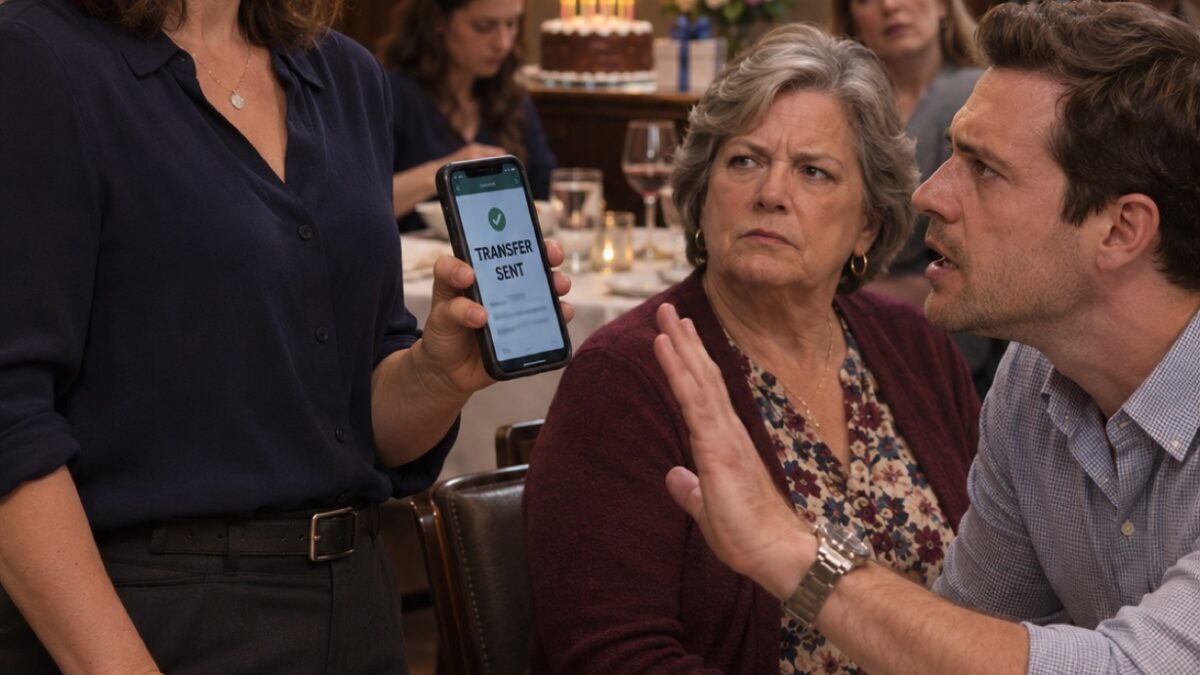
The confirmation filled my screen.
“TRANSFER SENT.”
I turned the phone so Aaron and Beth could see it without having to leave their chairs.
“That is your birthday present.”
Aaron looked at the screen, then at me.
I kept it there.
“It went to your account this morning. The card tells you that.”
Beth leaned toward the table.
I opened the earlier payments next. Then I brought up the messages in which Aaron had asked me for help with rent.
“This has been coming from my savings.”
My voice sounded ordinary.
I was glad of that. I didn’t want to have to start again because everyone had decided I was too upset to understand my own bank account.
Beth read quietly.
Aaron moved his hand toward the phone, but I kept hold of it.
“She doesn’t need to look through that.”
“She can read what you’re saying isn’t a present.”
Beth looked from the payment to him.
“You told me you paid the rent yourself.”
He pushed his chair back.
Not far enough to leave.
Just far enough that the phone wasn’t directly in front of him anymore.
“That’s private,” he said to me. “You don’t bring private family help out for everybody to examine.”
He wasn’t claiming the payments didn’t exist now.
He was objecting to the witnesses.
I placed the phone on the table, angled toward Beth, and rested my hand beside it.
“You opened the envelope in front of everybody.”
Mom looked toward the doorway.
“Can we please talk somewhere else?”
I didn’t move.
She said people had come for a celebration, not a discussion about our finances. Her purse was on her lap, and she kept tightening her fingers around the handle.
“I agree,” I said. “That’s why I gave him a card.”
I hadn’t greeted anyone by announcing what I had sent. I hadn’t asked the server to bring out a receipt with the cake.
Aaron had chosen to make the gift a subject for the table.
He tapped the card against the edge of his plate.
“So what now? You want it back because you didn’t like a joke?”
“No.”
He stopped tapping.
“The money already sent stays with you.”
I wanted that clear.
I had given it to him. Being angry didn’t turn a completed birthday gift into a debt, and I wasn’t going to pretend I could reach into his account and take it.
“But I’m not sending any more rent money.”
Mom pulled the vacant chair beside mine away from the table and sat down.
“Denise.”
I moved my phone before she could set her purse over it.
She lowered her voice, though everyone nearby could still hear.
“Helping your family isn’t something you quit because your feelings got hurt.”
“This is my savings.”
“And he’s your brother.”
“I know.”
That was why the money had been sent in the first place.
Wanda leaned forward.
She had stopped laughing.
“What about the children? They live there too. You can’t just forget that because you and Aaron are arguing.”
I looked at her hands around her water glass.
She had laughed when he called the envelope empty. Now the money inside it was important enough that I was expected to keep supplying more.
“The children haven’t done anything wrong,” I said.
“Exactly.”
“Neither have I.”
Wanda put her glass down.
I explained that the birthday gift covered the next three months’ rent. Aaron and Beth had that time to work out what would happen afterward.
I wasn’t putting anyone out that night.
I wasn’t calling their landlord.
I didn’t own their home, and my name wasn’t on anything making me responsible for their rent. I had sent money to my brother because I chose to help him.
That choice hadn’t given him access to the rest.
Aaron leaned forward again.
“I’m talking about another three months after that. That’s all.”
I looked at him.
Another $5,400.
He said it as though we were confirming an arrangement I had forgotten.
“You knew my hours weren’t back,” he continued. “You must have allowed for that.”
“I didn’t promise that.”
“I’m saying you knew.”
“Knowing isn’t promising.”
He glanced toward Mom.
She began telling me we should finish dinner before deciding anything. I could think about it later, when nobody was watching.
I picked up my phone.
For a moment, I wondered whether she expected me to apologize just to make the server comfortable enough to come back in.
Instead, I saved the confirmation.
Then I saved the messages attached to the earlier rent payments and Aaron’s acknowledgment from that morning.
I wasn’t secretly recording anyone.
I was keeping copies of my own transfers and conversations, the same way I kept information at work when a question came up about what had been paid.
“What’s that for?” Aaron asked.
“So I have it together.”
“You already have it.”
“Now I can find it.”
His eyes stayed on my hands.
There was no shared account to untangle. He couldn’t withdraw anything himself. Every payment had required me to open the app, choose the amount, and send it.
I would simply stop doing that.
Mom watched me save the last message.
“We can discuss this when you’ve calmed down.”
“My decision is made.”
Aaron pressed his lips together.
I put the phone beside my plate.
He could still have dinner. The cake could still come out. Nobody had asked the restaurant to stop his birthday.
But the money after this gift was no longer something he could plan to spend.
Beth hadn’t joined the argument.
She was still looking at my screen.
Finally, she asked, “Did he know this morning that it was for rent?”
“Yes.”
“Did you actually say that?”
I opened the conversation again and turned it toward her.
My message about the next three months’ rent sat directly above his reply.
“Thanks. That helps.”
Beth read it without touching the phone.
Then she looked at Aaron.
“You answered her.”
He rubbed the edge of the birthday card between his fingers.
“She knows I appreciated it.”
“That isn’t what I asked.”
Mom shifted in the chair beside me.
Beth reached into her bag.
“He gave me a different explanation,” she said.
Aaron lowered the card.
“Beth, don’t start bringing our messages into this.”
She took out her phone anyway.
I could see her searching their conversation, moving her thumb carefully instead of scrolling past in a hurry.
The server appeared at the doorway again.
Mom turned toward her, but Beth didn’t look up.
She had found the message.
Chapter 3: What He Called the Money
Beth turned her phone toward me.
Aaron’s name was above the conversation. I could see a reference to the birthday money before she brought the screen close enough for me to read the rest.
“Read what he told me the money was for,” she said.
I took my hand off my own phone.
His message said my birthday gift would provide the down payment for a fishing boat.
I read it again.
A fishing boat.
The message had been sent after he thanked me that morning and before we came to dinner.
He had known the purpose.
Then he had given Beth a different one.
I looked up at him.
“You told her I was buying you a boat?”
“A down payment,” he said.
It came out quickly.
Beth pulled her phone back toward herself.
“That doesn’t make it different.”
“I didn’t buy anything.”
He was careful about that.
He wasn’t going to claim the money had never arrived or that he hadn’t read my message. We had already seen both.
Now he wanted us discussing something he hadn’t done.
“The boat isn’t the problem,” I said. “What you told her is.”
Aaron pushed the card away from his plate.
“I thought I could work it out.”
Beth looked at him.
“Work what out?”
He didn’t answer immediately.
She turned to me, holding her phone against the edge of the table.
“I thought rent was covered from his pay.”
She was 34, and until that evening she had believed the man beside her when he described what he paid for their home.
I could see her checking each thing before she said it.
“He talks like he’s carrying the household. He told me your gift meant he could finally do something for himself.”
I glanced at the birthday card.
That was what he had made out of the money I had moved from savings while my coffee cooled.
Not rent relief.
Something extra.
Beth said she hadn’t seen my transfers before. She hadn’t known about the monthly requests, either. When Aaron mentioned my gift, she understood it as money left over after the ordinary responsibilities were handled.
“He said you wanted him to have it,” she said.
“I did. For rent.”
I opened my message again, though she had already read it.
Not to prove it twice.
I needed to look at what I had actually written instead of listening to Aaron turn it into something loose and uncertain.
There it was.
The next three months’ rent.
No mention of a boat. No suggestion that I was paying for recreation while quietly agreeing to cover another stretch of housing afterward.
Aaron looked at my phone.
“You sent it as a gift.”
“Yes.”
“So it’s mine.”
“Yes.”
Beth turned toward him.
“Then why did you make her show everybody that it existed?”
He looked away from her.
Mom reached for her water.
I left my phone flat on the table.
“The completed gift is yours,” I said. “I’m not claiming otherwise.”
Aaron watched me, waiting.
“But there is no later payment from me.”
He began to say my name.
I let him finish it.
Then I repeated the part he needed to hear.
“No more rent money.”
He rubbed his face.
“This is getting bigger than it needs to be.”
Beth set her phone beside mine.
“You told me she gave you boat money. You told her you needed rent.”
He looked toward the doorway, where the server had disappeared again.
“I needed help.”
“You got help,” I said.
The amounts were already on my screen. Six months of $1,800, then the $5,400 that morning. Altogether, $16,200 had left my savings for his account.
I had never added it up aloud in front of our family.
I did then.
Wanda stared at the table.
Mom put her glass down without drinking.
Aaron didn’t dispute the amount.
There wasn’t any reason he could.
He had requested the monthly payments, received them, and acknowledged the birthday gift before deciding an empty envelope would get a laugh.
Beth pushed his card back toward him.
“Read what she wrote.”
“I read it.”
“Then you knew.”
He didn’t answer that.
I could hear dishes being handled outside our room. Somewhere beyond the door, people were having an ordinary dinner without checking bank messages between courses.
I wanted mine to be ordinary too.
That didn’t mean I was going to help put his story back together.
Beth asked whether the birthday money was still available.
Aaron nodded.
“It’s there.”
“All of it?”
“It hasn’t gone to a boat.”
She watched him for a moment.
“Then it can pay the rent.”
I didn’t tell her she had to monitor him. That was their household, and I wasn’t going to assign her a job because he had lied.
But I was relieved she knew.
He could no longer tell me one thing and rely on her believing another.
Aaron lifted the envelope from beside his plate.
“There wasn’t any reason to do this here.”
I looked at the envelope in his hand.
“You chose here.”
He put it down.
Mom began smoothing her napkin across her lap. She looked annoyed now, but not at the message about the boat.
She was watching the doorway.
“The food,” she said. “We haven’t even ordered.”
I picked up my menu.
Then I put it down again.
“Before we do, where were you?”
Mom looked at me.
“What?”
“You and Aaron. You said you were getting the cake.”
“The restaurant had it.”
“I know. The server told me while I was answering everybody’s questions.”
Aaron leaned back.
Mom looked at him before answering me.
It was a small movement, but I saw it.
I had spent the whole beginning of the dinner looking for them. Now they were both at the table, and neither seemed eager to explain where they had been.
Beth glanced from Mom to Aaron.
“You were on the patio?”
Mom adjusted the strap of her purse.
“We were talking.”
“While I handled the arrivals,” I said.
Nobody corrected that.
Wanda shifted her chair.
I remembered Mom walking in without a cake, acting as though the restaurant’s competence explained why she hadn’t answered her phone.
“Did you know it was already here when you left me?”
Mom’s fingers stopped moving on the strap.
For a moment, she watched Aaron instead of me.
Then she said, “We need to clear this part up too.”
Chapter 4: The Patio
Mom stayed in the chair beside me.
She didn’t move toward the patio or suggest that we step outside anymore.
“Yes,” she said. “We knew the cake was here.”
I rested my menu against the table.
“So why did you say you were getting it?”
Aaron answered before she did.
“We needed a little time.”
“You could have said that.”
He glanced around at the guests.
Apparently, asking me directly would have required admitting that I was being assigned the part of the evening neither of them wanted.
Mom reached toward her purse, then stopped.
“We knew you’d know what to do.”
I looked at her.
That was supposed to improve it.
I had known how to direct people. I knew how to answer politely when I didn’t have the answers. I knew how to stand near a doorway so nobody arriving felt ignored.
None of that meant I had volunteered.
“Then you could have asked,” I said.
Mom pressed her napkin against her knee.
Aaron said he hadn’t expected it to take as long as it did. He and Mom had stayed outside talking, and once people began arriving, he assumed I had things handled.
I turned my phone over.
My unanswered message was still there.
“You could have checked.”
He looked at it.
“I wasn’t watching my phone.”
Mom looked at him again.
Then she said, “Show her what you sent me.”
Aaron’s shoulders moved against his chair.
“Why?”
“Because I’m not going to be the only one explaining it.”
He stared at her.
She held out her hand, not asking to take his phone, just insisting he bring it out.
“Show her.”
Until that moment, I hadn’t known there was a message.
I hadn’t gone looking through his things. Beth hadn’t either. Everything on the table so far had come from conversations we were part of ourselves.
Aaron took out his phone.
He opened his messages with Mom and held the screen low.
She leaned closer.
“The earlier one,” she said.
He scrolled.
Then he turned it so I could read.
The message told Mom to stay on the restaurant patio with him and let me handle the arrivals.
It wasn’t a misunderstanding about how long a cake errand might take.
They had planned it.
I read the message without reaching for his phone.
Beth could see it from beside him. Wanda leaned forward enough to follow what was happening, then sat back again.
Mom watched my face.
“I should have told you,” she said.
“Yes.”
“But it wasn’t meant to hurt you.”
“It was meant to leave me doing it.”
She didn’t answer.
I looked at Aaron.
He put the phone beside his plate, facedown.
There was no longer any reason to argue about whether they had been fetching a cake. The server had told me it was there, they had entered from the patio, and now his own message explained why.
Aaron changed the subject.
“Can we just get dinner moving?”
I lifted my menu.
“You can.”
He looked at me.
“You’re the one who’s been talking to the server.”
“Because you weren’t here.”
Mom moved as if she might stand.
I thought she was going to ask me to help her organize the meal, or tell me this was becoming unpleasant for everyone else.
Instead, she took her purse from the chair.
“The server needs to know we’re ready.”
I nodded toward the doorway.
“Aaron can tell her.”
He stared at me a moment longer, then got up.
I stayed seated.
It was such a small thing.
The birthday dinner could proceed without me being the person who solved every pause.
Beth picked up her menu. Wanda did the same.
Mom returned to her place.
When Aaron came back with the server, he stood beside his chair while she asked who was ready to order. I gave my order when she reached me.
My own meal.
That was all I was responsible for.
Mom interrupted to ask whether we should decide when the cake would come out.
The server looked at Aaron.
He answered her.
I took a drink of water.
For the first time since arriving, I wasn’t listening for someone to ask where he was or what he wanted.
He was there.
He could speak.
The meal wasn’t cheerful after that.
I won’t pretend it was.
Wanda asked a harmless question about work, and I answered that payroll had been busy. Mom commented on the food when it arrived. Aaron thanked people for coming, but he no longer made jokes about my gift.
Beth ate quietly.
Every so often, she looked at the envelope near his plate.
I kept my phone beside my own.
When the cake came, the server placed it where Aaron could see it and asked what they wanted done with the plates.
Mom began to look toward me.
Then she stopped.
Aaron answered.
I joined the birthday wishes. I hadn’t stopped being his sister because I refused to pay more rent.
But I didn’t gather everyone into place, direct the serving, or make sure he looked properly celebrated.
He and Mom could manage that.
Later, the checks arrived separately, exactly as the server and I had arranged when I came in.
I found mine.
Nothing else.
I paid for my meal and put the receipt in my bag.
Aaron watched me put on my coat.
“You’re really leaving it like this?”
I checked the table for my phone.
“The gift is yours. The later money isn’t coming.”
Mom stood up.
“We’ll talk when everybody’s had some sleep.”
I didn’t agree to reopen the decision.
I said goodnight to Wanda. Beth looked up when I reached her chair.
“I’m sorry,” she said quietly.
“You didn’t make him say it.”
She nodded.
Aaron had put the birthday card back into its envelope. It lay beside his phone now, flat and ordinary.
I walked out through the main dining room.
Outside, I stopped long enough to button my coat and check that my keys were in my bag.
My phone lit up in my hand.
The screen opened to the conversation where Aaron had thanked me for the rent gift.
I looked at those words again.
Before I went home, I knew I needed to put my answer in that same place.
Chapter 5: Nothing Else Is Scheduled
At home, I left my coat over the back of a kitchen chair.
The room was quiet.
I put my phone on the table where I had made the birthday transfer that morning, then took the card’s receipt from my bag and set it beside my dinner receipt.
I didn’t need either receipt to prove the rent payments.
I was just emptying my bag.
My hands kept finding small jobs before I sat down.
I put my keys away. I rinsed the cup I had left near the sink. I folded the restaurant receipt instead of leaving it curled against the table.
Then I pulled out the chair.
The bank app opened where I expected it to.
My savings balance hadn’t changed since that morning.
There wasn’t a new loss to discover. The money had already gone, with my approval, and I wasn’t trying to reverse it.
I opened the birthday transfer confirmation.
“TRANSFER SENT.”
I saved it where I could find it without scrolling through months of ordinary activity.
Then I opened the earlier transfers.
Each had been a separate action.
Each had come from my savings.
I checked the amounts against the messages, not because I doubted what had happened, but because I wanted the record complete before I told Aaron anything else.
Payroll had made that habit familiar.
If somebody questioned a payment, I didn’t rely on being sure I remembered. I checked the entry and the conversation around it.
So I did that for myself.
I saved the rent requests beside their confirmations.
There was the month he had thanked me as soon as the payment arrived. There was the exchange where I had asked whether his hours had improved before deciding to send more help.
Temporary.
Discussed each time.
I hadn’t hidden a promise inside any of it.
Still, I read carefully.
At dinner, Aaron had said I must have allowed for another funded period. Mom had treated stopping as though it required a family agreement.
I wanted to know whether there was anything I had said that could reasonably have led him there.
I found concern.
I found questions.
I found decisions about the payment being discussed.
I didn’t find a promise to pay indefinitely, or a promise to send another $5,400 after the birthday gift was used.
I put the phone down and rubbed the spot above my eyebrow.
I had spent so much time making sure he could manage that I had stopped checking how he described the arrangement to himself.
That didn’t make his expectation mine.
I got a glass of water and sat down again.
Next I checked for scheduled transfers.
There weren’t any.
I hadn’t set up a repeating rent payment. There was nothing waiting for the next month that I needed to stop, no instruction that would move money while I slept.
I checked anyway.
Then I checked that I was looking at my own account, with my own control over it, just as I always had.
Aaron couldn’t initiate a withdrawal.
There was no shared account.
I hadn’t guaranteed his rent or signed onto his lease. Helping him had not made his landlord my responsibility.
The screen looked almost boring.
That helped.
At the restaurant, everyone had talked as though stopping required a dramatic act. At my kitchen table, it meant leaving my money where it was.
I closed the bank app.
Then I opened Aaron’s messages.
My birthday note was still above his thanks.
I began writing a long explanation.
I mentioned the joke, the patio, and what Beth had shown me. I got as far as trying to explain how it felt to hear Wanda laugh.
Then I deleted it.
He had been there.
He didn’t need a description of the evening in order to understand what I would pay.
I wrote that the $5,400 already sent remained his birthday gift, intended to cover the next three months’ rent.
Then I wrote that I would make no further rent payments and had not agreed to fund the period after that.
I read it aloud.
It sounded plain.
I added that he and Beth needed to plan their household expenses without future money from me.
No threat.
No demand for repayment.
No promise to reconsider if the conversation became friendlier.
I sent it.
For a while, I watched the screen.
Then I set the phone facedown and carried my water to the sink.
I hadn’t sent that message to make him admit everything. I had sent it so he couldn’t reasonably leave the dinner believing I had only postponed a decision.
When I returned to the table, I checked that it had gone through.
It had.
I saved that too.
My coat was still over the chair. I hung it up, washed my face, and came back to turn off the kitchen light.
The phone was the last thing I picked up.
I almost opened the conversation again.
Instead, I carried it with me without checking.
The next time I sat at that table, I brought out my own expenses.
Not an ambitious new plan.
Ordinary things I had been paying around his requests.
I opened the notices I usually checked and compared them with what was available. I could meet them, but the cushion I had once been comfortable with was smaller.
I had known that in pieces.
Seeing it together made me sit still.
Six months of help, followed by the birthday gift, had come from savings I had built by working and not spending everything I earned.
I was 41.
I had my own home to keep running and my own reasons to want money left after the bills were paid.
I entered what I needed to keep available for myself.
Then I closed the screen before I could start calculating what Aaron might ask for next.
The phone stayed beside the papers while I finished.
I didn’t hear an apology that would make the figures different. I didn’t need one before deciding where my next paycheck would go.
When the screen lit again, Aaron’s name appeared.
I looked at it without picking it up right away.
Then I opened his message.
He wanted to discuss what would happen when the birthday money ran out.
Chapter 6: Another Request
Aaron asked privately this time.
No dinner guests.
No envelope held upside down.
His message said the next rent deadline after the gifted period would arrive before he had caught up, and he needed another $5,400 to get through it.
He wasn’t calling the birthday money a boat fund now.
He was using the purpose we had all agreed it had.
I read the message at my kitchen table with my own bills still beside me.
Then I scrolled up.
My written answer was there, clear enough that he couldn’t have missed it.
No further rent payments.
I put the phone down while I finished checking an expense for my own home. I didn’t want to answer while pretending my responsibilities could wait until his were settled.
When I picked it up again, I kept my reply short.
“I’m not sending another $5,400. Please plan from the message I already sent.”
He answered that he understood I was angry.
I looked at that for a moment.
Anger was easier for him to discuss than a decision about my savings. Anger might cool. A decision could remain even after I no longer wanted to argue.
“This isn’t waiting for me to calm down,” I wrote. “I’m not paying rent after the gift.”
He called.
I let the phone ring while I took a drink of water.
Then I answered.
“I’m trying to plan,” he said.
“That’s good.”
“I can’t plan around nothing.”
“You can plan without money from me.”
He exhaled sharply.
I could hear him moving, though I didn’t know where he was and didn’t ask.
He said the reduced hours hadn’t been something he chose. I agreed. I had agreed when he first called for help, and the payments proved that I had taken him seriously.
“I helped with that,” I said.
“I know.”
“Then don’t tell me I haven’t.”
He stopped.
That was different from the dinner.
He couldn’t argue about whether the help existed, and he wasn’t doing it in front of Beth anymore. He was trying to get me to treat the coming deadline as a reason my answer couldn’t stand.
I asked whether he had read my written statement.
“Yes.”
“Then you know what to plan on.”
He said he only wanted me to think about it.
“I have.”
We ended the call without an agreement.
I didn’t send money afterward to make the ending less uncomfortable.
I went back to my own papers.
Later, Mom called.
She asked how work was before she mentioned Aaron, and I answered her work question. I wasn’t going to turn every conversation with her into an argument before she had even started one.
Then she said he was worried.
“I know.”
“He says he’s trying to work things out.”
“I hope he does.”
She paused.
“Could you help him get past this last stretch?”
I pulled my chair closer to the table.
“What amount are you asking me to send?”
She didn’t say it immediately.
I waited.
“The $5,400.”
“The same money I’ve already refused.”
“Denise, I’m trying to help both of you.”
“Are you offering to pay it?”
She was quiet.
I could hear something being set down on her end of the call.
“I can’t take that on.”
“Neither will I.”
She said our circumstances weren’t the same.
I didn’t argue that they were.
I had never needed Mom to have my exact income or savings balance to understand that the money belonged to me.
“You don’t have to fund it,” I said. “But you can’t volunteer mine.”
“I’m not volunteering it.”
“You’re asking me to send an amount you won’t send.”
She said that sounded harsh.
I looked at the expenses on my table.
“It’s what we’re discussing.”
Mom tried another approach.
What if the money went through her, so nobody had to feel awkward about asking me? She could make sure it was understood as family help rather than something between Aaron and me.
“No.”
I didn’t need to think about that.
Moving it through her account wouldn’t change whose savings it came from.
“I’m not sending it directly or through you.”
She sighed.
“I wish we could get back to normal.”
“I can talk to you without paying his rent.”
“That isn’t what I meant.”
“It’s what I need you to understand.”
She didn’t agree, but she stopped asking for the transfer.
When we hung up, I stayed seated.
There had been no shouting. No threat that she would never speak to me again. Just a familiar attempt to make my refusal the problem everyone else needed solved.
I saved Aaron’s new request beside the answer I had already given.
Then I left it alone.
At work, I kept doing payroll.
People still needed their hours checked. Ordinary errors still needed correcting. My phone stayed in my bag while I finished what I was being paid to do.
I was glad to have something concrete in front of me.
When I checked my messages afterward, I didn’t search for a reason to send an advance, a smaller amount, or money labeled for something other than rent.
That would have been the same payment with a different description.
I went home.
At the kitchen table, I opened my banking app to pay an expense of my own. I checked the recipient before sending, then put the confirmation with my own records.
No money went to Aaron.
No money went to Mom for Aaron.
I was still able to dislike the conversation and keep the decision.
That took some getting used to.
I had expected relief to feel cleaner than it did. Instead, I kept reaching for the phone whenever it lit up, wondering whether the next message would require another explanation.
Most didn’t.
Some were ordinary.
I answered those ordinarily.
When Beth’s name appeared, I set down the dish towel I was holding and opened her message.
It wasn’t another request.
She wanted to tell me what had happened with the birthday money.
Chapter 7: The Rent Comes Due
Beth said the gift was going toward rent.
I read her message standing beside the kitchen counter.
Then I sat down before answering.
“Thank you for letting me know.”
I didn’t ask her to send a picture of an account or a receipt from their landlord. She wasn’t responsible for proving her honesty because Aaron had been dishonest.
She had chosen to tell me.
I could accept that without turning her into the person who reported on him.
She said the boat plan was off.
Aaron hadn’t made the down payment.
The money I had given him for the coming months was being used for those months.
I set my phone on the table and looked at the blank screen after it went dark.
There wasn’t a payment for me to make.
There wasn’t an emergency I needed to solve.
For a while, I just sat there.
Then I got up and finished what I had been doing.
The first stretch after the dinner had been full of explanations. Why the envelope wasn’t empty. Why I wasn’t taking the gift back. Why stopping future support didn’t mean I had done something to the children.
Now the proof was less dramatic.
Rent was being covered by the money already sent.
My savings stayed in my account.
When the next month came, I opened the bank app at my kitchen table as part of checking my own expenses.
The old habit was there.
I could have found Aaron’s name without searching.
Instead, I checked what I owed, paid what was mine, and closed the app.
Nothing had to be canceled.
Nothing had to be redirected.
The absence of a new transfer was the whole change.
Aaron didn’t have to approve it.
Mom didn’t have to announce that she understood.
I put my phone beside my plate and ate before the food went cold.
Later, Beth and I spoke.
She told me Aaron was taking additional paid shifts.
I asked whether that meant the rent after the gifted period would come from his earnings.
“That’s the plan,” she said.
I let her finish without offering to fill a gap.
She sounded tired, but she wasn’t asking me for money. She was describing what their household was doing.
“He knows you’re not sending it,” she added.
“I told him.”
“I know. I’ve seen that message.”
I didn’t ask why he had shown her.
It was enough that the answer wasn’t being kept separate from the person who shared his rent.
Beth said she wished she had known about the earlier help.
“I didn’t know he was telling you he paid it alone.”
“I believe you.”
She was quiet for a moment.
Then she asked whether I was upset with her.
“No.”
I meant it.
She hadn’t laughed at the envelope and asked me to keep paying afterward. She had looked at the proof, asked a direct question, and brought out the message that explained why she had understood my gift differently.
I wasn’t going to punish her for believing someone she lived with.
We ended the call without making a new arrangement.
She didn’t become my intermediary.
I didn’t become their budget manager.
The following weeks were ordinary in ways I had forgotten to appreciate.
I bought what I needed for my own place without first checking whether Aaron might need that portion of my savings. I paid my expenses when they came due.
I still looked at prices.
Stopping the transfers hadn’t made me careless with money.
It meant the money I kept could stay available for me.
Sometimes my phone would light up while I was dealing with something at home, and I would finish the task before looking.
That was new.
Before the birthday, Aaron’s name could make me stop in the middle of anything. I would open the message ready to calculate what I could spare.
Now I read the words before deciding what they required.
Often they required nothing.
Mom and I spoke too.
She didn’t offer to fund the $5,400 she had wanted me to send, and I didn’t revisit the question to embarrass her.
I also didn’t give her money to pass along.
When she talked about Aaron being busy with work, I said I was glad he had paid shifts available.
I left it there.
She could tell me about her son without turning the conversation into a request.
That made it easier to keep talking.
Wanda’s laugh stayed with me longer than I expected.
Sometimes, when I saw an envelope on my table, I remembered the way she had reacted before she knew how much was inside it.
I didn’t call her to argue about it.
Her appeal at dinner had already received my answer.
The children had done nothing wrong.
Neither had I.
And there had been time for their parents to make a plan.
As the gifted months passed, that plan became ordinary work and ordinary rent instead of another withdrawal from my savings.
Aaron took the additional shifts.
The boat remained something he hadn’t bought.
I didn’t receive a grand announcement that everything had been settled. The change showed up in smaller ways: a message answered after work, Beth mentioning that he was on a paid shift, no request for me to replace the birthday money.
I stopped checking for a crisis between those details.
One evening, I opened the saved confirmations again.
Not because anyone had challenged them.
I was looking for a payment of my own and saw the folder where I had kept Aaron’s.
I opened it.
The total was still $16,200.
No new transfer had joined it.
I closed the folder and returned to what I had actually been doing.
There was no reason to keep presenting the evidence to an empty kitchen.
The birthday gift had done what I intended it to do. It had covered rent while they prepared to cover what came afterward.
My part was finished.
As the end of the gifted period approached, I checked my own upcoming expenses.
I moved down the list slowly.
Then I reached the space where I used to leave room for Aaron.
I didn’t enter anything.
I set the phone down, made myself dinner, and left that space empty.
The next time I opened the app at my table, the gifted months would be over.
Chapter 8: My Own Phone
Three months later, I sat at my kitchen table with my phone beside a cup of coffee.
The house was quiet.
I had my own expenses in front of me and enough time to check them before work without rushing through somebody else’s request first.
I opened the bank app.
No rent transfer was scheduled.
There never had been one, but I checked the screen as part of checking everything else, not because I expected a hidden payment to appear.
Nothing was waiting to go to Aaron.
I looked through the completed activity.
There was no new rent help from me after the birthday gift.
No payment through Mom.
No smaller transfer sent under another description because I had felt guilty after a phone call.
The record matched what I had said.
I put the phone down and pulled my own expenses closer.
That was what the money beside my name was for now.
I paid the things I needed to pay for my home. I checked that the payments had gone through and kept the confirmations with my own records.
Then I looked at what remained.
I didn’t immediately calculate how much of it I might be able to send Aaron.
I took a drink of coffee.
It was still warm.
At the birthday dinner, I had thought mostly about getting through the room without letting him turn my gift into nothing.
I hadn’t imagined this part clearly.
There was no audience at my table. Nobody needed convincing. I could use my own savings for my own expenses without preparing a speech first.
I opened the next item and finished it.
Then I closed the app.
Beth had confirmed that the birthday gift covered the rent it was meant to cover. Aaron had dropped the fishing-boat plan and taken additional paid shifts to pay rent afterward.
Their household had not required another $5,400 from me.
There had been work to do.
Aaron did it.
I didn’t turn that into a reason to scold him. I didn’t send a message asking why he couldn’t have done more sooner or demand that he thank me for every month.
I had already given what I chose to give.
I wanted the next ordinary conversation to be an ordinary conversation, not another hearing about that dinner.
My phone lit while I was gathering the papers.
I finished putting them away before checking it.
That was one of the changes I noticed most.
A lit screen no longer meant I had to stop what I was doing and find out whether my brother needed money.
I could wash my cup first.
I could finish breakfast.
I could answer when I had time.
I still cared what happened to him. I still cared about Beth and the children. Nothing about keeping the next rent payment in my own account required me to stop caring.
It required me not to send it.
That was all.
I carried my cup to the sink and rinsed it.
The kitchen table had room on it again.
For months, I had opened banking messages there while telling myself that once Aaron caught up, I would stop having to think about rent that wasn’t mine.
Now I had stopped because I had decided to stop.
He had made the adjustments afterward.
I dried my hands and returned to the chair.
The phone was where I had left it.
I checked my own payments once more, then made a note of what I needed to keep available until my next pay came in.
My job had always required attention to other people’s earnings.
At home, I could finally give that same attention to what happened to mine.
I wasn’t planning a reward large enough to make the whole experience worthwhile. I wasn’t replacing his boat with something expensive for myself.
I was covering my own ordinary life.
There was satisfaction in that, even if it didn’t look like much from outside my kitchen.
An expense came due.
I paid it.
The money left was still mine to decide about.
I no longer left a place in every calculation for a request that hadn’t arrived.
Later, when I got ready for work, I put the phone in my bag without opening Aaron’s conversation.
I knew what was in it.
The rent designation.
His thanks.
My statement that future payments would not be made.
His later request and my refusal.
Those messages were saved if I ever needed them. I didn’t need to reread them to keep my answer the same.
At work, I did payroll.
I checked hours, reviewed entries, and handled the ordinary questions that came with the job. My family’s dinner wasn’t part of anyone else’s workday, and I was grateful for that.
When I took my phone out later, I used it for the things I actually needed.
No bank transfer to my brother.
No calculation about whether I could afford to postpone something of my own.
I went home with my pay still assigned to my life.
That evening, I sat at the table again.
I opened the bank app only long enough to confirm that my own expenses had been handled. Then I closed it instead of drifting into the saved rent payments.
I didn’t delete the confirmations.
Keeping them didn’t mean I had to keep looking at them.
The birthday card was with Aaron. So was the completed gift. I had left both alone, exactly as I said I would.
What remained with me was the ability to decide what happened next.
I had used it.
Not by making him return money.
Not by calling his landlord or pretending I owned the house his children lived in.
I had simply stopped sending more.
Aaron was paying rent with the money he earned. Beth knew where the earlier help had come from. Mom could no longer tell herself that another transfer was already arranged.
And I could sit at my kitchen table without waiting for someone else to approve what I kept.
I put the papers away.
Then I brought my dinner over and sat down before checking anything else.
There was no rent payment to make.
No explanation to type.
Beside my plate, on the kitchen table, rested my phone.
You Might Also Enjoy




