My Daughter-in-Law Ordered Me Outside at 70, Then My Friend Raised the Loan She Signed
Part 3: The Pages Adam Brought
Adam slid the papers out beside my glass.
The heading described an agreement to sell business assets. Below it was a purchase price of $260,000.
I read the amount again before looking at him.
“You’re selling the shop?”
“The business assets,” he said. “The buyers are taking over.”
“When?”
“The closing is scheduled for November 21, 2025.”
Taryn reached across him, but he kept the pages down.
“The buyers want this disagreement resolved,” he said. “That’s why we wanted the release.”
I looked from the sale agreement to the release beneath her plate.
“You told me repayment would destroy the business.”
“It would destroy our plans,” she said.
Adam stared at the table.
“What plans?”
Taryn glanced toward the employees. Nobody had started eating again.
“We were going to use the proceeds toward a larger house.”
I moved my glass away from the agreement.
A wet circle marked the tablecloth underneath it.
I covered the circle with my napkin.
“You wanted to buy a house with my money.”
“We weren’t putting it that way,” Taryn said.
“How were you putting it?”
She looked toward the employees instead of answering.
June lowered herself into the chair beside mine.
Her open bag rested against her ankles.
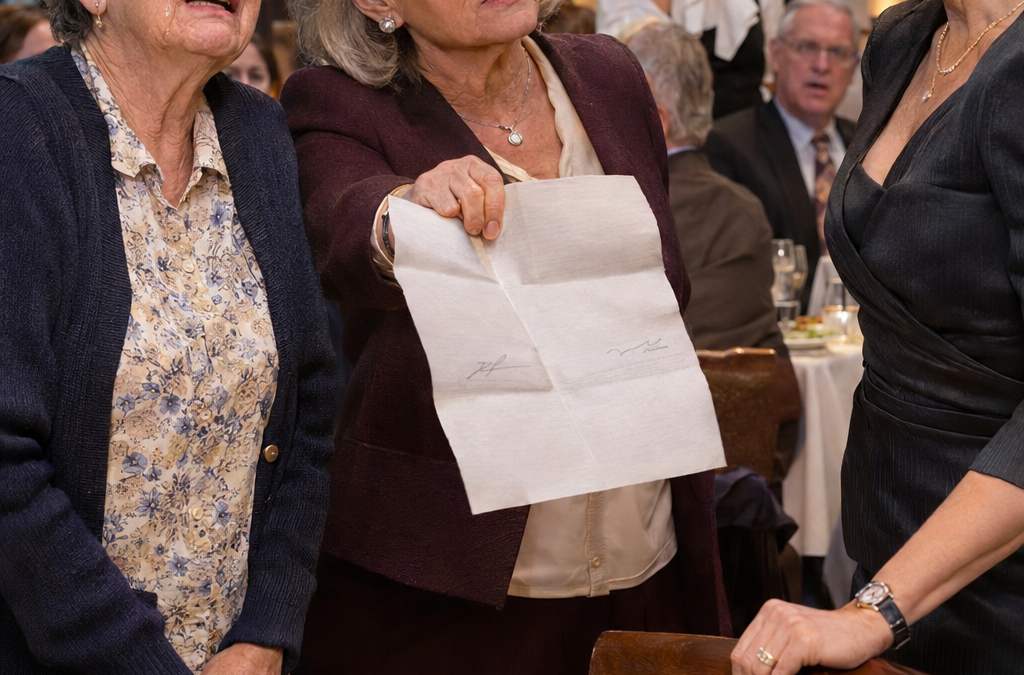
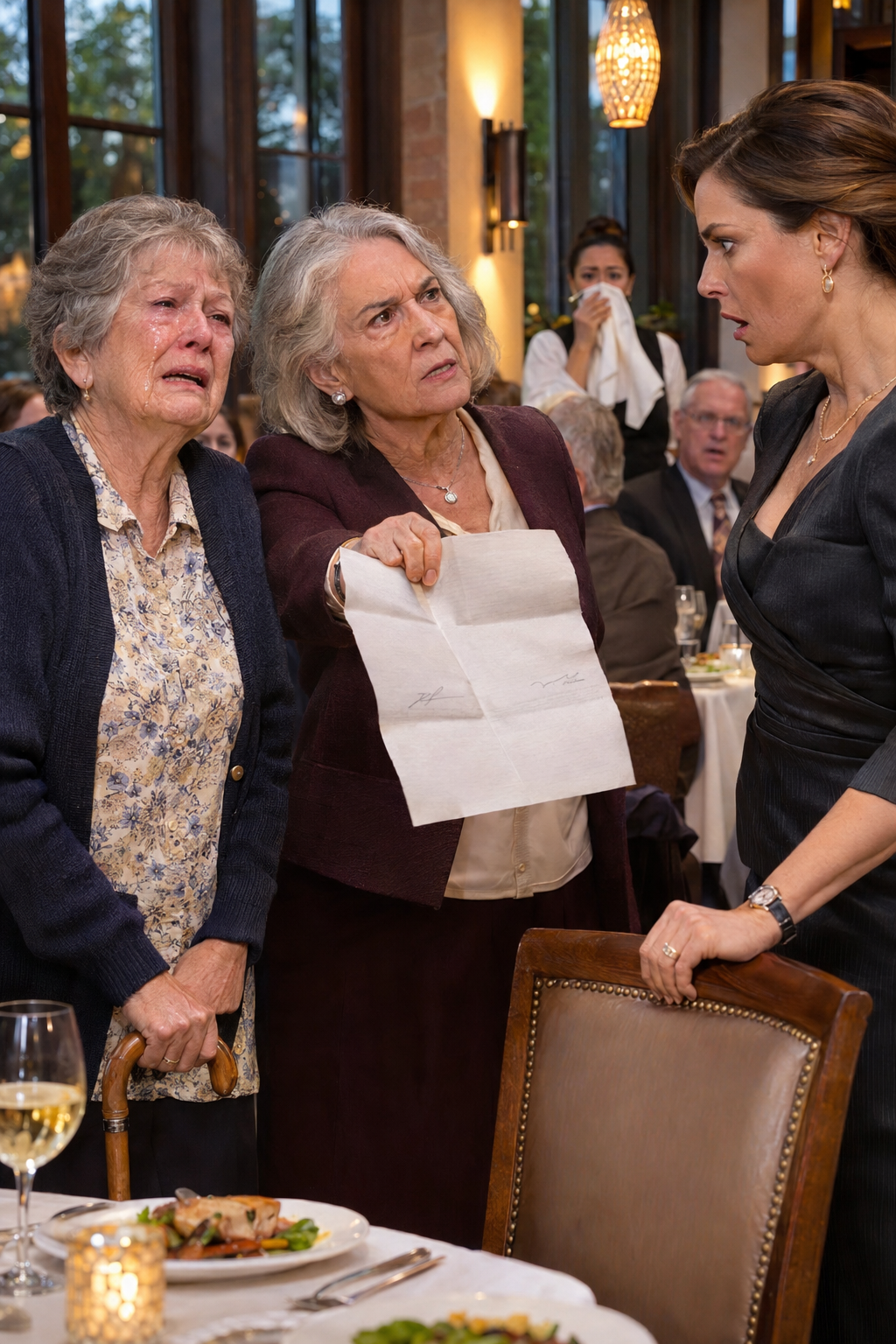
The original note was still in her hand.
Adam pointed at the agreement, but I watched him.
“The buyers asked about debts and possible claims.”
“Did you mention mine?”
“Yes.”
“Did you tell them it was overdue?”
“Yes.”
Taryn reached for the edge of the paper.
“That doesn’t mean you control the sale, Ruth.”
“I haven’t said that.”
“You can’t stop everything because you’re upset.”
“I’m asking about money you owe me.”
My cane had slipped against the table leg.
I brought it closer before she could answer.
Esther had explained my position before this dinner.
The loan did not make me a business owner.
It gave me no lien on their equipment.
I couldn’t take their sewing machines or fabric.
I couldn’t order the buyers to pay me.
I had a personal promise signed by both borrowers.
That promise was now overdue.
“The buyers want a clear understanding,” Adam said.
“They want your mother to sign it away,” June said.
Adam rubbed the corner of the sale agreement.
“They want the disputed claims resolved before proceeding.”
“Is the debt disputed?” I asked.
He looked at Taryn.
I waited until he looked back.
“No,” he said.
“Then tell them that.”
Taryn pulled the release from beneath her plate.
“I brought something that would settle it.”
“It would forgive it.”
“That would settle it.”
I looked at the paper without touching it.
I had already read enough to understand its purpose.
There was no repayment attached.
There was no promise to help me buy anything.
There was only my signature giving up the debt.
“I won’t sign that,” I said.
She folded it along the crease.
The waiter approached with a serving dish.
He stopped when he saw nobody reaching for anything.
The manager quietly spoke to him near the doorway.
I could smell the food.
My plate remained empty.
I wished the employees could finish their anniversary dinner.
They hadn’t asked to hear about my housing fund.
But I hadn’t asked to be removed from dinner.
The manager came back to my chair.
“Would you like us to resume service?”
“Yes, please.”
He looked toward Adam, then nodded at me.
I appreciated that he had asked me directly.
Adam moved the agreement away from the place setting.
“I can make sure Esther gets a copy.”
Taryn turned toward him.
“That’s confidential.”
“She can receive it through your lawyer,” I said.
“You already have a lawyer?”
“I asked for advice.”
“Before coming here?”
“Before agreeing to give up my money.”
She pressed the folded release beneath her hand.
June slipped the original note into its protective sleeve.
“Shall I put this away?”
“Keep it nearby.”
I didn’t need her to hold it up again.
Taryn had recognized her signature.
Her hand had stopped on my chair when she saw it.
Now I wanted her to answer the question.
“What made you think I would agree?”
“You’ve always wanted Adam to do well.”
“I still do.”
“You offered to help us.”
“I offered the loan you signed.”
Adam leaned forward.
“Mom, we thought the sale would change things.”
“It gives you a way to repay me.”
“We were hoping to start something different.”
“With the money from your business.”
“Yes.”
“After paying the money you borrowed.”
He looked down.
The waiter began setting food in front of us.
June lifted her bag so he could pass.
“Thank you,” I told him.
He nodded and straightened my fork.
That small, ordinary gesture made me look away.
I didn’t want to cry while he stood there.
Taryn waited until he moved farther along.
“You don’t understand everything involved in selling.”
“No,” I said. “That’s why Esther will read it.”
“There are expenses.”
“Then your attorney can explain those.”
“There are taxes.”
“I haven’t asked for your entire sale price.”
She pushed her plate away without eating.
Adam’s plate remained untouched too.
I picked up my fork, then set it down.
“Have you told the buyers I agreed to forgiveness?”
“No,” Adam said.
“We said it was likely,” Taryn said.
He turned toward her.
“I told you we couldn’t promise that.”
“You didn’t object when we discussed it.”
I looked between them.
“I told you I had not agreed.”
“We thought you’d see what it would mean for us.”
“I know what it means for me.”
June set her napkin across her knees.
“Ruth would lose her housing money.”
Taryn looked at her.
“She has somewhere to live.”
I moved my plate closer.
“I rent a room.”
“You’ve said you’re comfortable there.”
“I said the room was comfortable.”
Adam ran his thumb along the envelope’s opening.
“Mom, nobody wants you without somewhere to live.”
“Then stop planning to spend the money for it.”
He laid the envelope flat.
I took a bite of dinner and swallowed carefully.
It had cooled while we argued.
Around the table, employees began eating again.
Their lowered voices helped me finish another bite.
Taryn stared at the release in her hand.
I looked at Adam.
“Who knew this was a loan?”
He raised his eyes.
“We both signed it.”
“That isn’t what I’m asking.”
He waited.
“Who knew I expected the money back?”
“I did.”
“And when she said I had offered everything?”
He glanced toward Taryn.
I left my fork beside the plate.
“Did you think I had forgotten my own agreement?”
“No.”
“Did you think I wouldn’t ask?”
“I hoped we could work something out.”
“You could have offered repayment before bringing a release.”
“I know.”
I looked at the sale agreement again.
They had arranged a buyer and chosen a closing date.
They had discussed a larger house.
They had brought my forgiveness paper to dinner.
I still lived among boxes in a rented room.
“You knew what I gave up, Adam.”
He moved his plate away.
“Mom, I helped you pack that house.”
Part 4: What Adam Had Known
“Yes,” I said. “You did.”
He nodded and kept looking at me.
He had opened the empty wardrobe beside my bed.
He had carried the boxes I couldn’t lift.
He knew which furniture would fit my rented room.
He knew which pieces I had to leave behind.
I hadn’t needed to describe any of that tonight.
He had been there.
“You saw the house after everything was gone.”
“Yes.”
“You knew the proceeds weren’t extra spending money.”
“Yes.”
Taryn pushed her chair back slightly.
“Nobody is denying the paperwork exists.”
“You called it reassurance,” June said.
“That was what it meant within the family.”
“It meant you would repay me,” I said.
Adam put his hand over his eyes.
For a moment, I watched that hand.
During the business setup in 2019, he had crushed it.
I had watched him struggle to hold a spoon.
The memory had nothing to do with the sale papers.
Still, there it was, while he sat across from me.
“I thought the business would be worth more,” he said.
“That doesn’t explain the gift story.”
“I didn’t call it a gift.”
“Did you correct her?”
He lowered his hand.
“No.”
“Did you hear her say I had offered everything?”
“Yes.”
“And you knew that wasn’t true.”
“Yes.”
Taryn looked toward the employees.
“Do we really have to discuss all this here?”
June turned toward her.
“You discussed Ruth here.”
“I was upset.”
“You asked the waiter to put her outside.”
Taryn’s mouth tightened.
I touched June’s sleeve.
I didn’t need them arguing over me.
“I want Adam to answer.”
He straightened in his chair.
“What do you want to know?”
“Why you let people believe it.”
He looked at his plate.
“It was easier.”
I waited.
“When Taryn talked about how we started, I let her.”
“Without mentioning the loan.”
“Yes.”
“Without mentioning my home.”
“Yes.”
June placed her folded napkin beside her plate.
“The people here heard something different tonight.”
Adam looked up.
“I know.”
“Then correct it where they heard it.”
She didn’t raise her voice.
She didn’t claim authority over him.
She simply waited.
Taryn reached toward his arm.
“This isn’t necessary.”
Adam looked at her hand, then moved his arm.
“It is.”
He turned toward the employees.
I kept my eyes on my plate.
“I need to correct what was said.”
The nearby conversations stopped.
“My mother lent us the money to start.”
His voice was steady, though he cleared his throat.
“She sold her home to make that loan.”
I looked up then.
“The money was not a gift,” he continued.
“Taryn and I both promised to repay it.”
He glanced at me before finishing.
“It was due November 1, 2025. We haven’t paid.”
Nobody applauded.
I would have hated applause.
The employees had already been made uncomfortable enough.
June nodded toward him.
“Thank you for correcting it.”
He turned back to me.
“I should have said it sooner.”
“Yes.”
I didn’t reach across the table.
I didn’t tell him it was all right.
The waiter came to refill the water glasses.
Adam moved the sale papers out of his way.
Taryn sat with her hands in her lap.
I took a drink before speaking again.
“You knew the terms from the beginning.”
“Yes.”
“You didn’t discover them because June brought the note.”
“No.”
“You didn’t think I had changed my mind.”
He looked down at the folded release.
“No.”
That answer hurt more than uncertainty would have.
I had been trying to allow for a misunderstanding.
He was telling me there hadn’t been one.
Taryn lifted her glass.
“We still don’t need lawyers making this worse.”
“Advice doesn’t make the debt larger,” I said.
“We can decide something here.”
“No.”
Adam leaned toward me.
“We could at least agree on what you want.”
“Full repayment of the principal.”
“And then?”
“And then the loan is paid.”
Taryn watched my face.
“What about the family?”
“That isn’t written on the note.”
“We’re still your family.”
“I know who you are.”
I folded the edge of my napkin inward.
The fabric was damp where I had held it.
“I’m not signing anything else at this table.”
Adam nodded.
“I’ll get Esther the agreement.”
“Through your attorney.”
“All right.”
Taryn picked up her release again.
“So that’s it?”
“For tonight.”
She put the paper into her bag.
The manager returned to ask whether dinner was satisfactory.
I told him the food was good.
He looked relieved to discuss the food.
I asked him to thank the waiter.
Taryn stared at me as he walked away.
“What?” I asked.
“Nothing.”
I didn’t ask again.
We finished what we could.
Around us, the employees resumed their own conversations.
I heard someone discussing work, quietly and carefully.
I was grateful for that ordinary subject.
Adam tried to tell me about the buyers.
I stopped him before he explained their plans.
“Send Esther what she needs.”
“I thought you might want to know.”
“I don’t need another explanation over dinner.”
He put the papers back into the envelope.
June closed her bag.
I reached for my cane and checked its position.
When I moved to stand, the waiter approached.
He held my chair without making a fuss.
“Thank you,” I said.
June stood beside me.
Adam rose too.
“I’ll walk you out.”
“June is taking me.”
“I can still walk with you.”
“You can send the papers.”
He stayed by his chair.
I could see he wanted something else from me.
A softer goodbye, perhaps.
I couldn’t manage that while passing the chair Taryn had pulled.
June put her hand lightly against my elbow.
We headed toward the doorway together.
Taryn spoke before we reached it.
“We can’t leave this unsettled until closing.”
I turned carefully.
“Answer Esther when she contacts you.”
“Ruth, we have plans depending on that money.”
“So did I.”
Adam looked down at the envelope.
Taryn put her bag on the table.
“If you insist on full payment, everything changes.”
I waited for her to finish.
She glanced at Adam, then faced me.
“We need your answer before closing.”
Part 5: At Esther’s Desk
On November 10, 2025, I visited Esther’s office.
I brought the original note in its sleeve.
Adam had sent the asset-sale agreement through counsel.
The forgiveness paper was there for Esther to review.
I had brought my cane and my glasses too.
June drove me but waited outside the meeting.
I wanted to answer the questions myself.
Esther pointed toward a chair beside her desk.
I sat, then shifted to ease my hip.
“Would the firmer chair be better?” she asked.
“Yes, thank you.”
We changed chairs before opening the envelope.
That simple accommodation settled me enough to begin.
Esther read the note and the proposed release.
Then she looked over her glasses.
“Did you sign anything at the dinner?”
“No.”
“Did you tell either borrower you forgave the debt?”
“No.”
“Did you agree to accept anything instead of repayment?”
“No.”
She placed the release beside the note.
“Then this proposed release changes nothing.”
I looked at the blank signature line.
“She acted as though I was being difficult.”
“You declined to give up a matured debt.”
I took my glasses off and cleaned them.
“What can I actually do?”
“We can demand payment.”
“And if they refuse?”
“We can discuss a lawsuit to collect.”
I put my glasses back on.
“Can I require payment through the business sale?”
“Not under this note alone.”
She moved the sale agreement closer.
“You have no lien on these assets.”
“I know.”
“You also have no ownership interest to sell.”
“I don’t want the business.”
“Then our letter should be clear about that.”
She explained the loan terms without hurrying.
Adam and Taryn had signed personally.
The obligation was joint and several.
Either could be responsible for the full unpaid principal.
That did not mean I could collect it twice.
It meant they couldn’t divide responsibility without my agreement.
“No interest,” she said, following the page.
“No installments.”
I nodded.
“No collateral and no forgiveness provision.”
“That’s how we arranged it.”
“The fixed repayment date has passed.”
“Yes.”
She set her pen beside the original.
“There is nothing here permitting you to seize property.”
“I haven’t tried.”
“Good. We’ll keep this within what you can enforce.”
I appreciated hearing the limits with the rights.
I didn’t want an argument based on something untrue.
Taryn had already supplied enough of those.
Esther asked what outcome I wanted her to seek.
“The $180,000.”
“Anything beyond that?”
“No.”
“Do you want me to address the restaurant incident?”
“Not in the demand.”
She waited while I considered the question.
“I want the loan dealt with,” I said.
“The rest is something I’ll have to decide.”
“That’s a sensible separation.”
I rubbed the cane handle with my thumb.
“I don’t want a promise of a room.”
“We won’t ask for one.”
“Or an allowance they can stop later.”
“We won’t ask for that either.”
“I need the money returned to me.”
She made a note.
The pending sale offered a possible practical solution.
It did not make repayment automatic.
Their attorney would need to review the available proceeds.
The closing attorney would need proper written instructions.
The borrowers would have to agree voluntarily.
The buyers would not become my borrowers.
I listened, then asked her to explain it again.
She did, without making me feel foolish.
“So I’m offering a way to pay,” I said.
“Correct.”
“Not ordering their closing attorney around.”
“Correct.”
“And if the sale fails?”
“The loan remains due.”
I leaned back against the firmer chair.
That was the part I needed to hear.
Another promised payment date wouldn’t replace the original obligation.
Esther drafted a demand while I sat there.
It identified the note and the unpaid principal.
It stated that repayment was overdue.
It offered a voluntary payoff through the scheduled closing.
It did not threaten to shut down the business.
It did not claim a right to stop the buyers.
I read the draft before approving it.
The wording was plain enough for me to follow.
At the payment paragraph, I stopped.
“When would I mark the note paid?”
“After we confirm receipt of the funds.”
“Not when they sign the instructions?”
“No.”
I read that part again.
“I want that kept clear.”
“It will be.”
She asked whether I authorized her to send it.
“Yes.”
I said it before she finished picking up her pen.
Outside the office, June stood when she saw me.
“How did it go?”
“I told her to seek repayment.”
June took the envelope while I managed the doorway.
“Are you comfortable with the plan?”
“I understand the plan.”
She nodded and handed the envelope back.
The original note stayed with me this time.
In the car, I rested it across my lap.
I looked at the signatures through the sleeve.
I had spent years protecting that paper.
Now someone had finally asked the borrowers to honor it.
During the exchanges that followed, Esther kept me informed.
Adam and Taryn obtained independent legal advice.
Their lawyer requested confirmation of the balance.
Esther supplied the note and the relevant records.
There had been no principal payments.
There was no interest to add.
Adam called while the lawyers were communicating.
“Could we talk about this ourselves?”
“We can talk about family.”
“I meant the payment.”
“Put that through Esther.”
“I don’t want everything to become formal.”
“The agreement was formal when you signed it.”
He went quiet.
I could hear him handling something near the phone.
“I know,” he said.
I didn’t fill the silence for him.
Later, Esther called while I was sorting laundry.
“Their attorney has sent proposed closing instructions.”
I put a folded towel on the bed.
“Are they agreeing to pay?”
“They’re proposing payment,” she said.
“Then what’s wrong?”
“There are additional conditions we need to review.”
Part 6: The Terms They Sent
Esther placed the proposed instructions beside her revised draft.
I could see markings throughout the pages.
She started with the payment amount.
It was still $180,000.
Then she showed me what had been added.
The release language went beyond the loan.
There was also language about preserving family contact.
I read that paragraph and started again.
“What does family cooperation mean here?”
“It isn’t defined clearly.”
“Would I be promising visits?”
“That is something their wording could invite disagreement about.”
I put the page down.
“Then I’m not signing it.”
Esther nodded.
“We can reject that language.”
“Without giving up repayment?”
“Yes. The debt is still due.”
I looked at the amount at the top.
“They owe this without being invited to my table.”
“They do.”
“Then those things need to stay separate.”
She drew a line through the family-contact provision.
The motion was small and practical.
I watched until the pen stopped.
The broad release bothered me too.
I didn’t understand everything it might cover.
Esther explained why that was a reason to narrow it.
I could acknowledge full payment of the specific note.
I did not need to release unrelated matters.
I did not need to describe the family as reconciled.
“What happens after payment?” I asked.
“You sign a debt satisfaction.”
“What does that say?”
“That the identified loan has been paid in full.”
“And nothing about dinner?”
“Nothing about dinner.”
“Nothing about visiting?”
“Nothing about visiting.”
I moved the revised draft toward me.
“That’s the version I can understand.”
Esther read it aloud before I approved it.
The borrowers would authorize the closing disbursement.
The closing attorney would confirm the payment arrangements.
I would acknowledge satisfaction after the funds were verified.
Until then, the original obligation remained in place.
She sent the revisions through their lawyer.
I went back to my room and made lunch.
The legal language stayed in Esther’s office.
My lunch dishes stayed in the small sink.
I still needed to manage ordinary things.
My pension covered my usual expenses.
I still paid rent for the same room.
The unpaid loan hadn’t excused any of those bills.
I sorted the mail after eating.
Taryn called while the envelopes were spread out.
“Your friend has made this much harder.”
I moved an envelope away from my plate.
“June witnessed the loan.”
“She made us look terrible.”
“You asked the waiter to put me outside.”
“I know what I said.”
“Then stop blaming June.”
She breathed out sharply.
“We’re agreeing to repay you.”
“I’m glad you are.”
“You could sound a little more pleased.”
“I’ll be pleased when it arrives.”
“That makes it sound like you don’t trust us.”
I looked at the unsigned satisfaction beside my folder.
“I’m following Esther’s advice.”
Taryn was quiet for a moment.
“Do you intend to shut us out afterward?”
“I’m not agreeing to visits as payment terms.”
“That isn’t what I asked.”
“It’s what your proposal included.”
“Our lawyer put the papers together.”
“Then discuss the changes with your lawyer.”
I didn’t argue about who had chosen the words.
Someone had sent them on the borrowers’ behalf.
Esther had answered them on mine.
Taryn said she needed to go.
I said goodbye and returned to the mail.
I opened an envelope without reading it.
Then I put it down and washed my plate.
When June came by, she noticed the unopened mail.
“Would you like some help?”
“Not with the mail.”
She held up the container she had brought.
“With lunch, then?”
“I’ve eaten.”
“Save it for later.”
She put the container in the refrigerator.
I told her about the family-contact language.
She didn’t tell me what visits to allow.
“Did Esther take it out?”
“She sent back a version without it.”
“Good.”
I appreciated that she left the decision there.
June had stood up beside me at dinner.
She didn’t expect to manage my life afterward.
We talked about the room’s troublesome window.
She helped me move the chair away from it.
That was enough conversation about my living arrangements.
Esther called when the revised proposal came back.
The borrowers’ lawyer had accepted the debt-only approach.
The family-contact language was removed.
The broad release had been narrowed.
I asked her to check it again anyway.
“I already have,” she said. “We’ll review the final.”
“Thank you.”
There were still practical steps to complete.
The closing attorney needed the correct authorizations.
The business sale had its own documents and requirements.
My payment instructions could not replace those.
Esther explained that I would not attend the closing.
“That’s a relief,” I said.
“You have no reason to sign as a seller.”
“I don’t want to be mistaken for one.”
“You won’t be.”
I was receiving repayment of a personal loan.
I was not acquiring assets or selling them.
I wrote that distinction in my own notes.
It helped me keep Taryn’s accusations out of it.
Adam called after speaking with his attorney.
“The revised instructions are reasonable,” he said.
“Are you signing them?”
“Yes.”
“Is Taryn?”
“Yes.”
He paused long enough for me to look at the phone.
“Could we meet before the closing?”
“About the papers?”
“No. About what happened.”
I set the phone against my ear again.
“Not at a restaurant.”
“Where would you be comfortable?”
“Somewhere private, without a meal attached.”
Esther agreed to make her conference room available.
She would remain nearby for legal questions.
She would not conduct a family mediation.
I told Adam there would be no new release.
“No papers slipped in front of me.”
“Agreed.”
“And I’ll leave when I need to.”
“Of course.”
I didn’t promise forgiveness or a longer conversation.
I promised to come and listen.
Later, Esther sent the final borrower authorization for review.
The payment amount remained unchanged.
The family conditions were gone.
The debt satisfaction was separate and limited.
Below her message was Adam’s request about the meeting.
He wanted Taryn to come with him.
Part 7: The Meeting Without Dinner
I agreed that Taryn could attend.
June drove me and waited outside the conference room.
She offered to sit beside me.
“For the ride,” I told her. “Not the talking.”
She helped me with my coat, then stepped away.
Adam stood when I entered.
Taryn remained seated, her hands folded together.
There were water glasses on the table.
There were no menus or celebration programs.
I checked the chair before sitting down.
Adam noticed but said nothing.
I put my cane where I could reach it.
“Thank you for coming,” he said.
“You wanted to discuss dinner.”
“Yes.”
Taryn looked at the empty place beside me.
“June isn’t joining us?”
“No.”
Adam pulled his chair closer to the table.
“I should have stopped what happened.”
“Yes.”
“Before June had to stand up.”
“Yes.”
He rubbed his palms against his trousers.
“I should have answered you before the loan was due.”
I looked at him without offering help.
“I knew you expected repayment,” he said.
“You knew that when you signed.”
“I did.”
“And when you helped empty my house.”
“Yes.”
Taryn looked down at her folded hands.
“I shouldn’t have asked the waiter to remove you.”
I waited until she looked up.
“Why did you?”
“I was angry.”
“Because I refused to sign.”
“Yes.”
I took a drink of water.
She watched the glass while I set it down.
“I thought you’d change your mind at dinner.”
“You thought I wouldn’t refuse in front of people.”
She didn’t answer immediately.
Adam turned toward her.
“Taryn.”
“Yes,” she said. “I thought that.”
I moved my chair back slightly.
I needed room to straighten my leg.
Neither tried to continue while I adjusted it.
When I was comfortable, I looked at the table.
“You planned the release before inviting me.”
“Yes,” Adam said.
“And the larger house.”
“We had been looking.”
“With all the sale proceeds available.”
“That was what we hoped.”
“What did you expect me to use?”
Taryn pressed her hands together again.
“We thought you were settled.”
“In the room I rent.”
“You said it was comfortable.”
“It is comfortable for a rented room.”
Adam nodded before she could answer.
“That didn’t mean you wanted it permanently.”
“I had told you why the loan mattered.”
“I know.”
I looked toward the closed conference-room door.
There was nobody waiting to serve dinner.
Nobody needed me to make the occasion pleasant.
I could let them sit with the answer.
Taryn finally spoke again.
“The larger house would have given us more room.”
“I’m sure it would.”
“We thought the sale would make that possible.”
“After repaying me, it might still make something possible.”
“Not the house we wanted.”
I looked at Adam.
He kept his eyes on me.
“We wanted more than we could afford after repayment.”
I put my hand around the water glass.
That was the plainest answer he had given.
It explained the release without blaming my rented room.
It explained the dinner without calling it a misunderstanding.
“Then you needed to change your plans,” I said.
“Yes,” he answered.
Taryn wiped beneath her eye.
I didn’t know what she wanted me to do.
I left the water glass where it was.
“Would you ever have forgiven part of it?”
“I didn’t offer that.”
“I’m asking now.”
“And I’m asking for repayment.”
She nodded, though she looked disappointed.
I let her be disappointed.
I had spent enough time trying to prevent it.
Adam leaned forward.
“I also let people think we had done everything ourselves.”
“You did the work at the shop.”
“But we needed your money to start.”
“Yes.”
“And I should have said that.”
“You corrected it at dinner.”
“After being told.”
“Yes.”
He accepted that without adding an excuse.
I could listen more easily when he did that.
Taryn turned her glass in place.
“I don’t know what to say to the employees.”
“Don’t call the loan a gift again.”
“I won’t.”
“And don’t blame June for showing the note.”
She looked up.
“All right.”
I didn’t ask for a gathering or another speech.
The employees had heard Adam’s correction.
I wanted the false story to stop spreading.
That was something she could actually do.
Adam asked about my housing plans.
“Will you buy somewhere?”
“That’s what I intend.”
“Near us?”
“I haven’t chosen anything.”
“We could help you look.”
“I’ll ask if I need help.”
His mouth moved as though he had another suggestion.
Then he nodded instead.
Taryn looked at the cane beside my chair.
“You’ll need somewhere without difficult stairs.”
“I’ll be considering that.”
I didn’t discuss a neighborhood or a budget.
Neither was necessary to this conversation.
We turned to the payment arrangements only afterward.
Adam said their attorney had explained the instructions.
Taryn confirmed that she had signed voluntarily.
They were directing payment from the business sale proceeds.
I was not becoming an owner or a seller.
The payment would satisfy the unpaid principal.
“That’s what I asked for,” I said.
Adam requested clarification about the satisfaction document.
Esther came in and explained its limited purpose.
I would acknowledge payment after the funds were confirmed.
The document would not address family visits.
Their independent lawyer had reviewed the arrangement.
Taryn looked between Esther and me.
“So Ruth could still refuse to see us.”
Esther waited for me before answering.
“Family contact is not part of the transaction.”
“I came today,” I said.
Taryn looked down.
“I know.”
“I’m not making promises about every visit afterward.”
Adam pushed his chair back.
“We understand.”
We left without a family photograph or a hug.
Adam held the door while I reached for my cane.
June stood when she saw me.
“Ready?”
“Yes.”
Outside, I took her arm to manage the curb.
She waited until I was settled in the car.
“How was it?”
“They finally said what they wanted.”
“The house?”
“Yes.”
“And?”
“They’re signing the payment instructions without family conditions.”
She nodded and started the engine.
As closing approached, Esther verified the payment details.
She told me how her office would confirm receipt.
I wrote down whom to call about any changes.
I would not act on an unfamiliar payment message.
Then she called with the last update before closing.
“The signed directions are in place,” she said.
“The closing attorney is waiting for the buyers’ funds.”
Part 8: The Closing Call
On November 21, 2025, I stayed in my room.
June had offered to take me out.
I told her I wanted to be near my papers.
She understood without asking why that mattered.
I cleared the small table after breakfast.
The original note rested inside its protective sleeve.
The proposed satisfaction was in the same folder.
My cane leaned against my chair.
Esther had told me a scheduled closing could change.
Documents might need correction.
Funds might not arrive when expected.
Nothing was finished simply because the date had arrived.
I tried to keep that in mind.
I washed my breakfast dishes and folded laundry.
Then I checked whether the phone was charged.
It was.
I checked the sound anyway.
There was nothing useful about doing that again.
I put it down and opened my sewing things.
The needle stayed on the table.
I couldn’t concentrate well enough to thread it.
When Esther called, I pushed the chair back.
“The sale has closed,” she said.
I held the phone tighter.
“And my payment?”
“The closing attorney has disbursed the agreed amount.”
I looked at the folder.
“Can I sign now?”
“Not yet. We still need receipt confirmed.”
I repeated that back to her.
“Not until it’s confirmed.”
“Correct.”
After the call, I made tea.
I forgot about it while it cooled.
June arrived and hung her coat near the door.
I was still wearing mine.
“You can take that off,” she said.
“I might need to go somewhere.”
“Has Esther asked you to?”
“No.”
She held the coat while I eased my arm out.
Then she hung it beside hers.
We sat across from each other.
June didn’t ask whether I felt excited.
She could see I was listening for the phone.
She picked up a piece of fabric instead.
“Is this something you’re working on?”
“It needs mending.”
“Do you want me to put it away?”
“Please.”
She folded it into the sewing basket.
I was grateful she found something ordinary to do.
The phone rang while she was moving the basket.
I answered and stood without meaning to.
Esther spoke slowly enough for me to follow.
“The full $180,000 has been received and verified.”
I looked at June.
She put the basket down.
“Would you say that again?” I asked.
Esther repeated the amount and confirmed receipt.
I sat before my hip made the decision for me.
“Thank you,” I said.
“We’ll complete the satisfaction next.”
“I understand.”
I wrote down what she told me.
The writing looked uneven, but I could read it.
After the call, June stayed where she was.
“It’s there,” I told her.
“All of it?”
“All of it.”
She reached across the table and held my wrist.
I looked at her hand instead of her face.
Then I got up to empty the cold tea.
I started crying while I rinsed the cup.
June brought a towel without making a speech.
I pressed it against my face.
“I’m sorry,” I said.
“Your cup needs another rinse.”
I laughed a little, then finished washing it.
She took it from me and dried it.
Later, Esther reviewed the debt satisfaction with me.
It identified the note and acknowledged full payment.
There was no interest added.
There was no restaurant penalty.
There was no extra payment for what had happened.
I had received the principal I lent.
That was the amount I had authorized her to pursue.
I signed after she confirmed the funds again.
The original note was marked satisfied.
I kept the document with the related records.
Esther provided the acknowledgment through the borrowers’ counsel.
No lawsuit had been filed.
There had been no court order.
Nobody had transferred the upholstery business to me.
Adam and Taryn had voluntarily directed repayment at closing.
The business assets had sold for $260,000.
My $180,000 came from those proceeds under their instructions.
That left $80,000 before other sale expenses and taxes.
I did not call that their profit.
I didn’t know what their final accounting would show.
I wasn’t entitled to their remaining proceeds.
I was no longer waiting for my principal.
Adam called after the documents were completed.
“Did everything arrive?”
“Yes.”
“And the note?”
“Paid and marked satisfied.”
He let out a long breath.
“I’m glad, Mom.”
“So am I.”
“Would you like to have dinner?”
“Not yet.”
“All right.”
He asked whether I needed anything that afternoon.
“No, thank you.”
He accepted the answer.
That made the call easier to finish.
Taryn sent a message after the closing.
She acknowledged that repayment had been completed.
She also said she was sorry about the restaurant.
I read the message beside the satisfied note.
There was no request to forgive the money.
There was no demand for a visit.
I replied that I had received her message.
I wasn’t ready to write more.
June asked what I wanted to do next.
“Find somewhere to live.”
“Right away?”
“Carefully.”
My pension still covered my ordinary expenses.
I didn’t have to buy the first available place.
I wrote down what I needed before contacting an agent.
An entrance I could manage with my cane.
A bathroom I could use comfortably.
Room for my sewing things.
A table that could stay a table.
The agent asked who would help make the decision.
“June may come to the showings.”
“And anyone else?”
“No. The decision is mine.”
She made a note and continued.
We visited places that looked better in photographs.
We saw steps described as easy to manage.
I stood at those steps and disagreed.
The agent began checking entrances before arranging visits.
June watched while I tested the routes myself.
She didn’t tell me I would get used to them.
I asked for condominium records when something seemed suitable.
I wanted to understand the regular costs and rules.
I asked questions and waited for answers.
Adam offered to drive me to a showing.
“Thank you, but it’s arranged.”
He didn’t press.
Eventually, the agent found an accessible condominium.
She had checked the entrance and the parking route.
She thought the kitchen might work for me.
June came but let me approach the door first.
I tested the threshold with the cane tip.
The agent waited until I was ready.
Then she turned the knob and opened the door.
Part 9: A Place I Chose
I went straight to the bathroom.
The agent moved aside without trying to redirect me.
I looked at the shower entrance.
I checked the space around the toilet.
Then I walked back through the hallway with my cane.
There was room to turn without bumping anything.
June waited near the living-room window.
“Well?”
“I can use it.”
She smiled and let me keep looking.
I tried the kitchen next.
The cupboards I needed were within reach.
There was room to set down a hot dish.
I could picture a chair without blocking the walkway.
I opened a cupboard and closed it again.
The agent stayed quiet.
I liked that she let me examine things.
I wasn’t shopping for a photograph to show people.
I was checking whether I could make breakfast here.
I stood where a table would go.
June moved past me toward the kitchen.
Neither of us had to squeeze against a wall.
That settled something I had been wondering about.
“I’d like an inspection,” I told the agent.
“And the condominium records.”
“We’ll arrange those.”
I didn’t call Adam from the showing.
I wanted to understand the property before discussing it.
The inspector went through the unit carefully.
I followed where I could and asked questions.
There were ordinary maintenance items to consider.
I wanted them explained in words I understood.
The inspector showed me rather than waving them away.
I reviewed the written report afterward.
I also reviewed the association records and regular costs.
Esther helped clarify the ownership documents where I needed advice.
Nobody told me I was asking too much.
Nobody asked me to trust a family promise instead.
When I was ready, I proceeded with the purchase.
On January 9, 2026, I bought the condominium.
The price was $142,000.
Closing costs were $4,000.
That left $34,000 of the recovered principal.
I wrote the amounts down and checked the calculation.
The remainder stayed in an account under my name.
My other savings stayed mine too.
The condominium title belonged to me alone.
Adam was not an owner.
Taryn was not an owner.
Neither had authority over my account.
I kept copies of the documents together.
Then I called June and told her it was done.
She asked whether I had the keys.
I took them out and looked at them.
“Yes.”
“Then we should see how they work.”
We went over without bringing anything elaborate.
I unlocked the door myself.
June waited until I stepped inside.
The empty room sounded different without furniture.
I walked through it and checked the windows.
Then I put the keys on the kitchen counter.
I didn’t need to ask where they belonged.
I told Adam and Taryn after closing.
Adam called as soon as he saw the message.
“Congratulations, Mom.”
“Thank you.”
“Can I see it?”
“When I’m ready for visitors.”
He paused, then answered.
“Of course.”
He offered to help carry boxes.
I accepted the help I needed.
I told him what to bring and where.
June came because she knew which boxes mattered first.
Adam carried my sewing things to the window.
“Here?” he asked.
“Yes.”
He set them down without suggesting another spot.
I watched him straighten the box.
He looked toward the folder on the counter.
“Do you want that put somewhere?”
“Leave it, please.”
He did.
He didn’t ask to review my purchase documents.
He didn’t suggest putting his name on anything.
When the hallway was clear, I thanked him.
He asked whether there was more to carry.
“Not today.”
He put his coat on without arguing.
Taryn hadn’t come to help move.
She sent a message asking to visit after I settled.
It was an invitation request, not an announcement.
I left it until the boxes were unpacked enough.
Then I suggested a time that suited me.
Before the visit, June helped put dishes away.
She handed them over while I chose shelves.
“You could put these higher,” she said.
“I want to reach them easily.”
She lowered her hand.
“Here, then.”
I laughed while taking the plates.
She laughed too and handed me the next thing.
I chose a table that fit the room.
I checked the space around it with my cane.
I sat down and stood again before moving it.
The chair near the kitchen worked best for me.
That was where I put my place mat.
When Adam and Taryn visited, I made coffee.
There was no meal to finish before anyone left.
Adam waited for me to show him the coat hooks.
Taryn looked around the living room.
“This is nice, Ruth.”
“It works for me.”
“I’m glad.”
We sat at the table.
My cane rested where I could reach it.
Taryn looked at it, then looked at me.
“I’ve thought about the restaurant.”
I waited.
“I was angry you wouldn’t give us what we wanted.”
Adam kept his eyes on her.
“I kept calling it help,” she continued.
“I didn’t want to say we owed you.”
I held the cup by its handle.
“You did owe me.”
“Yes.”
“And I needed it returned.”
“Yes.”
She didn’t add that I had embarrassed them.
She didn’t mention June until I did.
“June brought what I asked her to bring.”
“I know.”
“She didn’t make the decision for me.”
“I understand.”
Taryn looked down at her cup.
“I’m sorry I told the waiter to put you outside.”
“Thank you for saying that.”
She looked relieved, but I wasn’t finished.
“I still need time.”
“All right.”
“Visits need to be arranged with me.”
Adam nodded.
“We’ll ask.”
“And sometimes I’ll say I’m not available.”
Taryn looked at me again.
“We understand.”
I didn’t promise a regular dinner or unrestricted visits.
They had come because I had invited them.
The next visit would need another invitation.
When my hip began to ache, I said I needed rest.
They carried their cups to the sink.
Adam asked before taking out the trash.
Taryn put her coat on without proposing another stop.
At the door, Adam asked whether he could hug me.
I said yes.
After they left, I checked the latch.
Then I returned the satisfied note to my file.
The condominium papers went beside it.
I put away the cups and cleared my table.
My wooden-handled cane rested beside my own chair.
You Might Also Enjoy




