My Daughter Shoved Me After Hip Surgery—Then Her Husband Learned What I Had Done
His finger stopped at the purpose clause.
“Loan proceeds,” he read, then glanced at Dana.
I asked him to finish the whole paragraph.
The agreement named me as the lender.
Dana was the sole borrower of $48,000.
That money had come directly from my savings. It had gone to Lorna’s home-care provider, not into Dana’s checking account.
There was no gift language in the agreement.
There was no promise that I would forgive it.
Paul read the paragraph again without speaking aloud.
“Your mother paid for the home care?” he asked.
Dana pulled her napkin off her lap.
“We arranged it together. You know I handled everything.”
“That isn’t what I asked you.”
I kept the page flat against the table.
“I paid the provider,” I told him. “Dana agreed to repay me.”
He looked down at her signature beneath mine.
The agreement was dated March 1, 2023.
He had never seen it before that dinner.
“Dana said she used her own savings,” he said.
“She told me she wanted to do that.”
“I know what she told you,” I answered.
“I heard her say it at your house.”
He looked toward the relatives still holding their forks.
Nobody tried to resume the meal.
Dana pushed her plate away from her.
“You got your money every month,” she told me.
I lifted the payment record from behind the agreement.
“Yes. And I recorded every payment you made.”
The arrangement was interest-free, with payments of $600 monthly.
Those payments had begun on April 1, 2024.
Through November 1, 2025, she had paid $12,000.
The unpaid balance was $36,000.
I showed Paul the column without pushing it toward him.
“I’m not saying she missed payments,” I explained.
“She hasn’t. I’m saying what those payments were.”
Dana looked at him rather than at the page.
“I told you I was paying her.”
“You told me you paid her to help Mom.”
His chair scraped against the floor when he moved.
I pointed to the sentence beneath the payment terms.
“My personal care was separate,” I told him.
“Unpaid. We put that in writing from the beginning.”
Paul read that sentence out loud.
Then he put the payment record back down carefully.
“Those transfers were repayments,” he said to Dana.
“They weren’t wages for taking care of my mother.”
Dana folded her napkin into a narrow strip.
“It all came out of the same household.”
“That doesn’t make it the same thing,” he answered.
I hadn’t asked him to judge their household finances.
I needed him to stop repeating something that wasn’t true.
“Lorna never owed me for those mornings,” I said.
“And I never charged her for staying.”
He rubbed his thumb along the edge of his plate.
“I thanked the wrong person for that money.”
“You could have thanked us both for different things.”
Dana looked up quickly when I said that.
“I’m not denying you arranged the care,” I continued.
“You made calls. You handled schedules. That happened.”
She opened her mouth, but I wasn’t finished.
“What didn’t happen was you paying me for mine.”
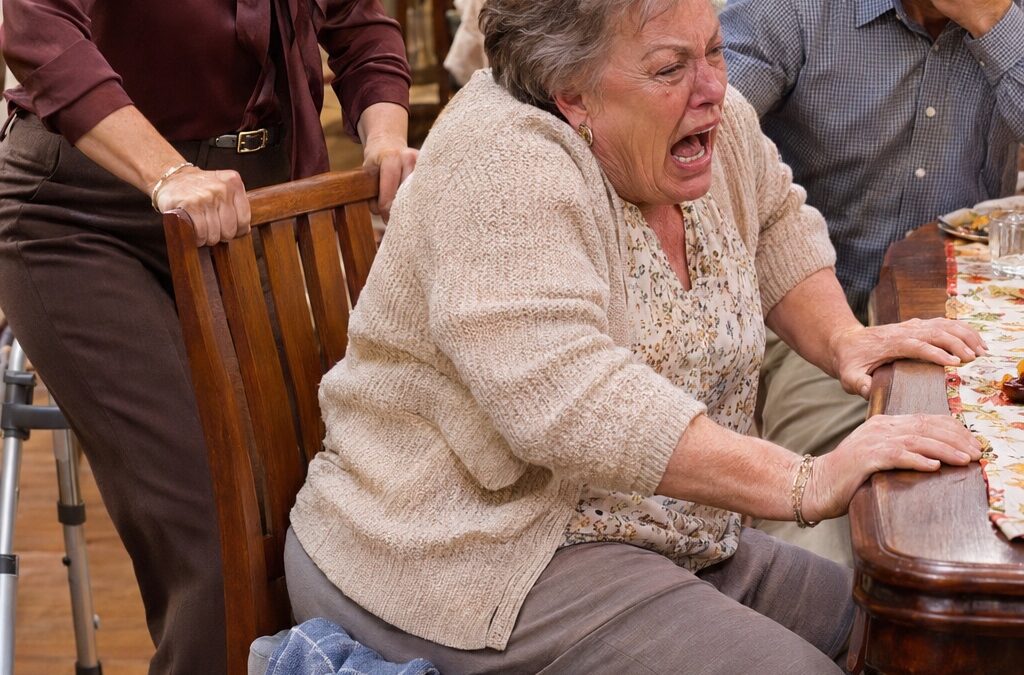
Beth stood beside me with her hand resting on the chair.
She hadn’t moved it after I asked her not to.
“Beverly needs her walker,” she told Paul.
He looked down at my leg beneath the table.
Then he stepped around Dana’s chair and retrieved it.
Dana reached toward his sleeve as he passed her.
“Will you please not make this a production?”
He moved his arm away without touching her.
“Your mother asked you not to move her chair.”
“She was getting up.”
“You shoved it while she was in it.”
He placed the walker squarely in front of me.
Then he pulled a chair alongside mine and sat.
Dana remained standing behind her place at the table.
Paul had always tried to settle disagreements quickly. Usually he did it by asking me to let something go.
I had heard variations of that request for years.
“She’s tired, Beverly.”
“She didn’t mean it like that.”
“Can we just get through dinner?”
This time, he didn’t ask me for anything.
He looked at my face and then my hands.
“Do you need to be checked?” he asked.
“I need to stand safely first.”
He glanced at Beth before moving closer.
“Tell us how to help,” she said.
I moved my foot carefully beneath my knee.
The pain made me stop and reposition it.
Dana watched from the other side of the table.
“I didn’t mean to hurt you,” she said.
“You still pushed the chair,” I answered.
Paul moved a nearby chair out of my path.
Beth held my bag where I could reach it.
Nobody grabbed my arms or pulled me upright.
I stood using the walker as I’d been taught.
Then I waited before taking a step.
The cushion had tipped sideways behind my back.
My folded blue dish towel was caught beneath it.
Beth lifted both and tucked them against her side.
Dana looked at the papers still beside my plate.
“So we’re really doing this now?”
I asked Beth to put them in the envelope.
“Yes,” I said. “We’re settling what you brought up.”
“You told me we could talk about forgiving it.”
“I told you we could discuss your request.”
“That’s what I’m trying to do.”
“No. You told everyone I was paid for care.”
She turned toward Paul again.
“After everything we’ve had going on, you understand.”
He didn’t move back toward her.
“I understand that you lied about this,” he said.
“I also watched you push her.”
Dana’s eyes moved around the table.
A relative quietly gathered the water glasses near my elbow.
Another shifted the sideboard chair to clear our way.
Nobody offered her the agreement back.
“I’m not forgiving the balance,” I told her.
“You still owe $36,000 under the existing agreement.”
“So you want all of it right now?”
“No. That isn’t what the agreement says.”
I wasn’t going to invent terms because I was angry.
Her next payment wasn’t suddenly overdue.
The loan didn’t become immediately payable because she hurt me.
She could keep paying according to the signed schedule.
Or she could arrange to pay it off sooner.
What she could not have was my forgiveness on demand.
“I need that money for my own life,” I said.
“I’m not discussing whether I deserve to keep it.”
She looked down at my walker.
“You’re making us sound like we robbed you.”
“I’ve said your payments are current.”
“Then why embarrass me?”
I tightened my grip and shifted my weight carefully.
“You asked me to explain what I took.”
Beth opened the dining room door into the hallway.
“Let’s get you sitting somewhere safe,” she told me.
I didn’t answer Dana’s next attempt to argue.
Walking required enough attention without doing both.
Paul followed us with my coat.
He set it beside me in the front room.
“Can I drive you?” he asked.
“Beth will take me,” I said.
“I want someone to check this hip.”
He nodded and handed Beth my bag.
Dana stayed in the dining room while we left.
I could hear silverware being gathered, then set down again.
Nobody called after me to come finish dinner.
Beth drove me for a medical evaluation.
I described the surgery and exactly how the chair moved.
I didn’t say I had slipped.
I didn’t call it an accident to shorten the explanation.
The clinician examined me and checked the operated hip.
There was no new injury from the shove.
I was given instructions for worsening pain and sent home.
Beth listened with me so I wouldn’t miss anything.
At my house, she set the walker by my chair.
Then she heated something simple for us to eat.
Neither of us wanted another holiday plate.
“Do you want me to stay?” she asked.
“Until I’m settled, if you don’t mind.”
She put the envelope on the table beside me.
My cushion went back where I normally sat.
The blue dish towel needed washing after the dinner.
Beth dropped it into the laundry basket without comment.
Dana called while we were finishing our food.
I let the call go unanswered.
Then a message appeared asking whether I was home.
I wrote back that I had been medically checked.
I told her there was no new injury.
I also told her I wasn’t discussing dinner by phone.
She replied that Paul was upset with her.
I set the phone face down beside my plate.
Beth didn’t ask what the message said.
She washed our dishes and checked my walkway instead.
Before she left, she moved a small rug aside.
I had meant to do that before surgery.
The next day, I wrote Dana a longer message.
I read it over before sending it.
I confirmed the outstanding balance and existing payment schedule.
I said I would accept repayment under those terms.
I also said there would be no loan forgiveness.
Then I addressed the part that wasn’t about money.
I wouldn’t provide unpaid family care anymore.
I wouldn’t attend meals in her home.
Any necessary arrangements could be made in writing.
I didn’t attach conditions for an apology.
I wasn’t asking her to find the correct sentence.
I needed to recover without another argument beside my chair.
She replied that I was shutting her out.
I answered only the practical question in her message.
The agreement remained in effect as written.
Paul contacted me separately after that.
He asked permission before calling, and I agreed.
“I should have stopped her sooner,” he said.
“I saw her move your walker.”
“I asked her to leave it close.”
“I heard you.”
I looked at the walker beside my kitchen doorway.
There was nothing I needed to add to that.
He asked whether he could tell the relatives what he’d learned.
“Only what’s true,” I said.
“Don’t turn it into anything bigger.”
He sent a message to the adults who’d attended.
He corrected the story about his mother’s care.
He said my money had funded the professional help.
He said my personal help had been unpaid.
He also said he had witnessed Dana shove my chair.
He didn’t ask anyone to choose a household.
He didn’t call it a misunderstanding between women.
Beth showed me the message after she received it.
I read it, then handed her phone back.
“That’s accurate,” I told her.
Later, Dana asked to discuss paying the loan off.
I agreed to a conversation with Paul present.
I stayed at home, with my cushion behind me.
They sat where I could see them without turning.
Dana had brought the agreement copy I’d sent her.
“We could sell the camper,” she said.
I didn’t answer until she finished explaining.
The camper belonged to both her and Paul.
They had discussed selling it and using the proceeds.
Dana wanted to pay the balance instead of continuing installments.
Paul said he agreed to the sale.
I looked directly at him before responding.
“That’s between the two of you,” I said.
“I’m not asking you to take over her debt.”
“I understand,” he answered.
“And I’m not ordering you to sell anything.”
“We know,” Dana said, more sharply.
I asked her to let me finish.
“If you keep the camper, the schedule stays.”
“If you sell it, that decision is yours.”
She looked down at the copy in her lap.
“I want the loan finished,” she said.
“So do I. Finished means paid, not forgiven.”
We agreed she would contact me when funds were available.
I wouldn’t sign a release based on a proposed sale.
I would acknowledge payment after the money had cleared.
That was all the agreement we needed.
Dana lingered after Paul stood to leave.
“I never thought you’d do this over dinner.”
I folded the edge of my blanket back down.
“You pushed my chair during dinner,” I said.
“The debt existed before we sat down.”
She looked toward the hallway, where Paul was waiting.
“I meant bringing out the papers.”
“You asked me what the payments were for.”
She picked up her bag without answering.
I didn’t follow her to the door.
Getting up just to make leaving easier for her wasn’t necessary.
The camper sale took longer than Dana wanted.
I didn’t call for updates or contact any buyer.
I continued my recovery and followed my rehabilitation plan.
Dana handled the sale with Paul’s consent.
When she said it had closed, I checked my account.
The repayment was $36,000, the full remaining balance.
I waited until the funds had cleared.
Then I prepared a paid-in-full acknowledgment for her.
It identified the original agreement and confirmed nothing remained due.
I kept a copy with my own records.
Dana received hers without coming to my house.
I didn’t add interest, fees, or a penalty.
I didn’t withhold the acknowledgment to demand an apology.
She had repaid what she owed.
The loan was finished, exactly as I had promised.
For a while, I kept expecting another argument.
I would hear my phone and check the screen.
Sometimes it was Beth asking about groceries.
Sometimes it was a rehabilitation reminder.
Eventually I stopped expecting every message to concern Dana.
Paul brought back a casserole dish I’d left years earlier.
He asked first instead of arriving at my door.
We sat in the kitchen while the kettle warmed.
“I keep thinking about Mom,” he said.
“She knew you weren’t just stopping by.”
“I liked being there with her.”
“I should have asked you what you were doing.”
I took the mugs from the cupboard within easy reach.
“I would have told you,” I said.
He nodded and let that answer stay as it was.
He didn’t ask me to call Dana afterward.
He didn’t suggest inviting us both to another dinner.
We talked about Lorna without turning it into a defense.
He remembered her complaints about the home-care schedule.
I remembered how particular she was about her oatmeal.
“She always wanted it thinner than I made it.”
“She told me yours was right,” he said.
I laughed and put the spoon beside his mug.
“She told me yours was too thick.”
He laughed too, then looked down at his cup.
It was the first easy conversation we’d had since Thanksgiving.
Dana still hadn’t apologized by February 2026.
She sent messages about ordinary family arrangements instead.
I answered what required an answer.
I didn’t resume doing things she could arrange herself.
When someone asked whether we were speaking again, I explained.
“We can communicate. I’m not going to her house.”
I didn’t need them to carry that message back.
Dana already had it in writing from me.
By then, I had completed my prescribed rehabilitation.
I could move around my kitchen without planning every turn.
I still followed the advice I’d been given.
I wasn’t interested in proving how quickly I could recover.
I invited Beth and Paul for lunch.
Neither asked whether Dana was coming too.
Paul offered to bring food, but I declined.
“I feel like cooking,” I told him.
“I’ll let you carry it to the table.”
Beth arrived while I was finishing the potatoes.
She washed her hands and asked what needed doing.
“Get the bowls down, please.”
“The usual ones?”
“Yes. Those are fine.”
Paul set the table without moving my chair.
He asked where I wanted the water pitcher.
“Near you,” I said. “It’s heavy when it’s full.”
He put it beside his own place.
The loan papers were put away in the cabinet.
There was no envelope beside my plate.
I sat down before anyone started serving.
Beth passed the bread, and Paul lifted the warm bowl.
“Where do you want this, Beverly?”
“Right there in the middle.”
Beneath it lay my folded blue dish towel.
You Might Also Enjoy




