My Daughter Shoved Me at Open House Over My Retirement Income, Until My Property Manager Arrived
Chapter 1: The Classroom Door
My daughter pushed me through the classroom doorway.
“Don’t question me here.”
Sherri’s hands struck high against my arms.
I stepped backward before I could catch myself.
My back reached the hallway wall.
Inside, parents stood beside their children’s science projects.
A woman holding a project stopped outside the door.
I pressed my lips together and straightened my knees.
I was 66, and my daughter had shoved me.
Owen was watching from beside his classroom table.
“Keep showing them your project, honey.”
He looked at Sherri before turning toward his display.
I waited until his attention moved away from us.
Then I brought my elbow against my side.
The place where Sherri had pushed felt tender.
Celia stepped over from the edge of the doorway.
Her brown ponytail brushed her solid gray dress.
For a moment, I expected her to come outside.
Instead, she planted herself across the opening.
“Family bookkeeping should stay private,” she said.
I looked at the space she was blocking.
“Then why am I the one outside?”
“Please don’t make a scene, Mom.”
“You saw her push me.”
“I saw both of you getting upset.”
“I didn’t put my hands on anybody.”
Celia glanced behind her, but she stayed there.
Parents in mustard and blue dresses watched from inside.
Neither spoke or returned to the classroom tables.
Sherri stood beside Celia, still inside the doorway.
She squared herself toward me and lifted her chin.
“I handle it. I keep it.”
She meant the rent from my duplex.
Not her property, and not money we shared.
Mine.
I kept my hands down beside my legs.
I had come to hear Owen explain his project.
Now I couldn’t even get back to his table.
The invitation was folded inside my pants pocket.
Its edge pressed against my leg when I moved.
Before leaving home, I had taken it off my refrigerator.
Owen had brought it over and watched me unfold it.
“Are you coming, Grandma?”
“I wouldn’t miss your project.”
He had waited while I smoothed the paper flat.
Then he showed me where the classroom information was.
I put it where I would see it daily.
That afternoon, I folded it along its original crease.
I checked that it was safely in my pocket.
I wasn’t taking it because I needed directions.
Owen had given it to me himself.
At school, the hallway looked like an ordinary open house.
Classroom doors stood open along the corridor.
Families paused to read the work on the walls.
I followed Owen inside and let him lead me.
He showed me exactly where he wanted me standing.
His display needed room along the classroom table.
“Don’t touch that part yet, Grandma.”
I put both hands behind my back.
“All right. You tell me when.”
He explained his project while I leaned closer.
When I asked a question, he started explaining again.
I let him finish without helping him find words.
After years working in a school cafeteria, I knew that look.
Children wanted adults to wait until they were finished.
I had retired from serving trays and wiping tables.
I still knew how important those classroom evenings felt.
Owen was 10, and proud of what he’d made.
I wanted him to have the whole conversation.
Then Sherri arrived beside the table.
She looked at me, then toward the hallway.
“Did you bring your rent questions?”
“No. I came to see Owen.”
“Then keep it that way.”
I looked down at the display instead of answering.
Owen adjusted something and started telling me another detail.
Sherri stayed close enough to hear everything I said.
I had owned the duplex since 2017. Both units were solely in my name. I still paid the taxes, insurance, and authorized repairs myself.
Starting in January 2025, Sherri had been helping.
We put her responsibilities in a written family agreement.
She collected rent and coordinated repair appointments for me.
She had offered to handle those telephone calls.
“You shouldn’t have tenants interrupting your dinner anymore.”
That had sounded thoughtful when she first said it.
I wasn’t looking to sell either rental unit.
I wasn’t asking her to take over my income.
I wanted help making appointments and receiving payments.
The money was supposed to reach my account.
For a while, it did.
Then the transfers stopped arriving.
At the classroom table, Sherri watched me watching Owen.
“Not everything has to be about your money.”
He looked up from his project.
“Can we talk afterward?” I asked her.
“There’s nothing to talk about.”
“Yes, there is. Call me after we leave.”
She stepped between me and the display.
“I handle the repairs. I handle the tenants.”
“I know you arrange appointments.”
“Then you know why I keep the rent.”
A parent nearby stopped folding a worksheet.
I looked at Owen before I answered.
“Please don’t do this beside his project.”
Sherri accused me of starting it by coming.
“What do you mean by that?”
“Like I owe you an explanation.”
I moved toward the doorway to lower our voices.
She followed so closely that I stopped walking.
That was when she put her hands on me.
Now she stood inside, and I stood outside.
Celia kept the doorway blocked between us.
“You can’t expect me to do everything for free,” Sherri said.
“We agreed what you would handle.”
“You’re embarrassing me at my son’s school.”
I looked past her toward Owen’s table.
He had someone else listening to his explanation.
I stayed where he wouldn’t need to watch us.
“Let me back inside,” I told Celia.
“Not while this is going on.”
“This started beside his project.”
“Then stop talking about it.”
I pressed my elbow against my side again.
Nobody asked whether I had hurt myself.
I could hear Owen talking, but not his words.
I had missed the rest of his explanation.
Sherri lowered her voice and leaned toward the opening.
“We can discuss whatever you think is missing later.”
“I’ve already asked you for that.”
“This isn’t the place.”
“No. It isn’t.”
I looked down the hallway instead of answering further.
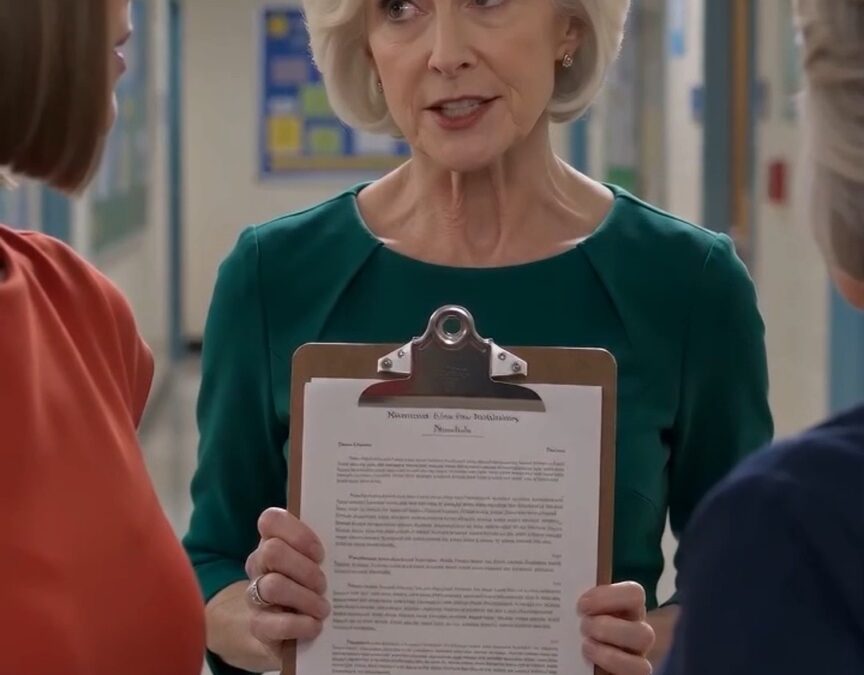
Paula was coming toward us, carrying a clipboard.
Chapter 2: What Paula Carried
Our agreement allowed me to end Sherri’s collection authority immediately.
I only had to give her written notice.
I did not have to sell either rental unit.
That provision was already in the agreement we had signed.
Until the day before open house, I hadn’t used it.
Paula had shown me the paragraph at my kitchen table.
She kept her finger beside it while I read.
“Read the whole section, Irene.”
I did, then went back over the final sentence.
“No waiting for a sale?” I asked.
“No sale is required.”
She turned the agreement so I could read comfortably.
“It’s your duplex. This ends her collection authority.”
I put my reading glasses back on my face.
That distinction mattered more than Sherri seemed to understand.
Keeping my property and keeping her arrangement were different decisions.
I had bought the duplex in 2017.
I had been cleaning between tenants ever since.
During a turnover that year, Owen came along.
I spread a dry towel outside the bathroom doorway.
“Stay on the dry towel, honey.”
He settled where I could see him from the tub.
I knelt beside the bathtub with a scraper.
Old caulk gathered against the edge as I worked.
I wiped the tool and started on another section.
“Are you done yet, Grandma?”
“Not until this edge is clean.”
He stayed on his towel while I worked.
I checked on him whenever I changed my position.
The old material had to come away properly.
Someone else would soon be bathing a child there.
I wanted the bathroom ready for that family.
When the edge was clean, I washed my hands.
Then I helped Owen up from his towel.
That was the work Sherri later called “just cleaning.”
“You wiped things down. I deal with people.”
I never told her dealing with tenants was nothing.
I asked why their rent hadn’t reached my account.
When we signed the January 2025 agreement, she seemed pleased.
She read it across from me at the table.
The arrangement was unpaid family assistance for my owner-managed duplex.
Sherri wasn’t advertising herself as a property manager.
She didn’t manage rental property for other people.
She would collect rent and coordinate authorized repairs.
She would forward all the rent she collected.
I would continue paying the property expenses directly.
We signed and kept the written agreement.
The earlier rent payments came through as expected.
When June’s transfer didn’t arrive, I asked about it.
Sherri said she needed the weekend.
I left the question alone until she could respond.
Then she needed everything together before she could explain.
“Explaining what?” I asked during a call.
“You won’t understand it over the phone.”
“Come over, then. We can look at it.”
She reminded me she had a child and a schedule.
By then, July’s payment was missing too.
I kept opening my account and checking the deposits.
My rental expenses continued whether she answered or not.
The combined monthly rent was $2,400.
By August, she had withheld $7,200.
She would answer questions about almost anything else.
Owen needed supplies for school.
Pickup instructions had changed.
A repair appointment needed to be moved.
I listened, then returned to the same question.
“When are you forwarding the rent?”
She said we needed a better time to talk.
On August 26, 2025, I stopped waiting for her accounting.
I opened my bank records at the kitchen table.
I checked the deposits against the months involved.
Then I contacted each tenant privately.
I didn’t accuse either household of missing a payment.
“I’m checking my rental records,” I explained.
“Please confirm when you paid Sherri.”
Both tenants supplied payment confirmations.
Both had paid on time.
I saved what they sent with my bank records.
Then I laid the agreement beside those pages.
There was no tenant delinquency for Sherri to explain.
On August 27, 2025, I called Paula.
She was 67, an old friend, and Oregon-licensed.
I wanted her help as a property manager.
I didn’t want her calling as an angry friend.
She came over and reviewed what I had.
She read the agreement before offering any advice.
Then she checked the bank records and tenant confirmations.
“Do you want me to handle this professionally?”
“Yes.”
“Then we’ll put my appointment in writing too.”
I retained her and gave her authority to prepare immediately.
Her authority to collect rent would begin after termination delivery.
She didn’t send tenants competing instructions that afternoon.
She prepared the notice and had me review it.
I signed the operative text on the reverse.
The camera-facing cover carried only its large title.
MANAGEMENT TERMINATION NOTICE.
Paula attached the letter-size notice flat to her clipboard.
“We’ll speak away from the children,” I told her.
“That’s what we’ll do.”
We agreed to meet after I viewed Owen’s project.
Sherri knew I had requested an accounting.
She knew nothing about Paula’s appointment or the prepared notice.
She also didn’t know I had decided to end collection authority.
At school, Paula checked in properly as my guest.
She wasn’t school staff, and she wasn’t an officer.
She carried the clipboard with its document facing inward.
I went to Owen’s classroom while she waited elsewhere.
Our plan was a private conversation afterward.
Sherri started the public confrontation before that could happen.
Now Paula approached while Celia still blocked the doorway.
She stopped beside me and turned the clipboard outward.
She held it flat with both hands at chest height.
The large title faced squarely toward Sherri.
“Irene owns those rentals,” Paula said.
“She cleaned them between tenants for years.”
Sherri looked away from me.
“This isn’t your family business.”
“Irene requested my professional help.”
Paula kept the notice steady and fully visible.
“Sherri, we need to discuss this.”
She indicated the paper without lowering it.
“We need to discuss this notice.”
Sherri turned toward the document, then looked at Paula.
Her smile disappeared, and she lowered the shoulder she had pressed against the doorway.
Chapter 3: The Agreement I Had Signed
For a moment, Sherri stayed where she was.
Her eyes moved from the title to my face.
“What did you tell her?”
“I gave her our agreement and my records.”
Celia looked at the clipboard over Sherri’s shoulder.
“What is that supposed to mean?”
“It means we need to leave this doorway.”
I kept my voice low enough for Owen’s sake.
I wasn’t going to explain a contract beside his project.
Paula lowered the clipboard without hiding the notice again.
“There’s room farther along the hallway,” she said.
“We can speak there without standing over the children.”
Sherri looked back into the classroom.
Then she stepped away from the doorway.
Celia followed her, leaving the opening clear at last.
I glanced inside before moving with them.
Owen was still beside his display.
I didn’t call him away or ask him anything.
He didn’t need to come settle adult business.
We stopped farther down the same hallway.
People still passed between classrooms, carrying papers and projects.
Nobody had to step around us to reach Owen’s room.
Paula stood beside me, not in front of me.
She turned the clipboard so the operative side was visible.
“This is Irene’s written notice terminating your collection authority.”
Sherri didn’t reach for it.
“You can’t just show up and do that.”
“I signed it,” I said.
Paula offered her the notice for delivery.
Sherri took it and looked down at the reverse.
The public title had gotten her attention.
Now she was reading my actual decision.
Celia shifted closer to her sister.
“Mom, couldn’t you have waited until we were home?”
“We planned a private conversation after the project.”
“You brought this to school.”
“Sherri brought the rent into his classroom.”
I didn’t point back toward Owen.
I kept my hands beside my legs.
Sherri ran her eyes down the page again.
“You’ve made this sound like some business arrangement.”
“It is a written arrangement.”
“I’m your daughter.”
“You’re also collecting rent from my property.”
Paula kept her copy with the other records.
She noted that delivery had occurred.
There was no demand for Sherri’s signature accepting it.
The agreement didn’t make termination depend on her approval.
Sherri held the paper against the clipboard’s edge.
“So what happens to the tenants?”
“They stay in their homes,” I said.
“And who’s going to deal with everything?”
“Paula is taking over management.”
That was the first time I said it plainly.
Sherri looked at Paula instead of answering me.
“You’ve already hired her?”
“Yes,” I said.
Paula explained the limit without adding a threat.
“My preparation was authorized before tonight.”
“Rent collection changes now that this has been delivered.”
Sherri’s mouth tightened.
She turned back to the notice and read again.
I remembered sitting across from her in January.
She had wanted something written so nobody misunderstood.
I had agreed for exactly that reason.
Now I was glad we had both insisted on paper.
“Our agreement permits immediate termination by written notice,” I said.
“You agreed to forward all the rent.”
“I’ve been doing all the work.”
“We can address your accounting separately.”
Sherri folded the edge of the paper, then flattened it.
“All right. But there has to be a transition.”
“Paula will handle the transition.”
“You can’t leave tenants confused while you find a buyer.”
“I’m not finding a buyer.”
She glanced at Celia as if I had missed something.
“Mom, you can’t manage this anymore.”
“I’ve hired someone who can.”
“I should keep collections until the property sells.”
“No sale is required.”
She looked down at the agreement language again.
Paula pointed to the relevant paragraph on her retained copy.
She didn’t hand Sherri a different interpretation.
She showed the words we had already signed.
The termination provision stood apart from any sale decision.
Both units would remain in my individual name.
The tenants’ leases weren’t ending with Sherri’s assistance.
Their rent obligations remained the same.
Only the authorized recipient was changing.
Celia crossed her arms and watched Sherri read.
“Couldn’t she just finish out what she started?”
“She collected rent she hasn’t forwarded,” I said.
“I’m not authorizing more collections.”
Sherri stopped reading and faced me.
“You don’t understand what calls I get.”
“I understand you coordinate repair appointments.”
“There’s more to it than that.”
“Then account for it in writing.”
Paula opened the folder beneath the clipboard.
She didn’t spread private tenant information along the wall.
She kept the pages turned toward us.
“We can provide verified replacement instructions directly,” she said.
“Nobody needs to guess where the rent should go.”
Sherri’s attention moved to the folder.
“What else is in there?”
“My records,” I said.
She looked at the classroom doors, then back at me.
“Have you been telling people I stole from you?”
“I asked tenants to confirm their payments.”
“You went behind my back.”
“I checked income belonging to me.”
My elbow still felt sore against my side.
I loosened my arm and let it hang naturally.
I didn’t want to keep holding it like that.
Celia noticed the movement and looked away.
Sherri glanced down at the notice once more.
“You’re making this bigger than it is.”
“Then the accounting should be straightforward.”
“It isn’t that simple.”
“Both tenants said they paid.”
She stopped smoothing the paper.
For the first time, she asked about the records themselves.
“Exactly what did they send you?”
Chapter 4: The Rent They Already Paid
I didn’t hand Sherri my whole folder.
Paula separated the payment confirmations from the other records.
She held them where Sherri could read without taking them.
“These are the confirmations Irene obtained before tonight.”
Sherri leaned closer.
Celia moved beside her and looked down too.
The names and payment information belonged to the tenants.
We kept the pages away from passing families.
“Both households paid on time,” Paula said.
Sherri didn’t dispute the names or the payments.
Instead, she pointed at the dates.
“That doesn’t show everything I was handling.”
“It shows they paid you,” I said.
The combined rent was $2,400 each month.
June, July, and August had all been collected.
None of those transfers appeared in my bank deposits.
The missing total was $7,200.
Paula placed my bank record beside the confirmations.
She had marked the relevant entries for my review.
The earlier forwarded payments were there.
The later ones weren’t.
There was no need to guess which month we meant.
Sherri looked between the pages.
“I told you I needed to put things together.”
“You’ve had the payments.”
“I’ve had responsibilities too.”
I felt for the invitation through my pocket fabric.
I didn’t pull it out.
Owen was still inside his classroom, having his evening.
I wanted this conversation done without bringing him into it.
“What repair costs are you claiming?” I asked.
Sherri lifted her head.
“All the appointments. All the arrangements.”
“Which costs did you pay?”
“You know repairs don’t happen by themselves.”
“Which invoices did you pay from your own money?”
She looked toward Paula.
“You’ve obviously decided what you think.”
Paula didn’t argue with her about motives.
“I reviewed the expense evidence Irene provided.”
She brought out the repair invoices and payment records.
The vendor payments had come directly from my account.
I had authorized the repairs and paid the bills.
Sherri had coordinated the appointments.
That was useful work.
It wasn’t a payment she had made for me.
Paula set each invoice beside its matching payment evidence.
Sherri followed the pages without touching them.
“Coordinating takes time,” she said.
“Yes,” I answered. “We agreed what you would do.”
“You don’t get to decide my time means nothing.”
“I didn’t agree to give you all the rent.”
“You expected me to do it for nothing.”
“The agreement says unpaid assistance.”
Paula opened the signed agreement to that section.
Sherri had a copy at home.
She wasn’t seeing our original arrangement for the first time.
What she hadn’t seen was this assembled accounting.
Her collected rent, my missing deposits, my paid expenses.
Celia read over the section beside her sister.
She lowered her arms.
“There isn’t any payment listed?” she asked.
“No management fee,” Paula said.
“And no unreimbursed repair expense in these records.”
Sherri pulled the notice closer against herself.
“You’re making me sound like I did nothing.”
“I’m asking for the rent,” I said.
She looked at me without answering.
I had heard that same diversion during our calls.
Any question about money became a judgment about her effort.
This time, the written terms lay open between us.
I could acknowledge the work without surrendering the income.
“You arranged access for repairs,” I told her.
“I paid for those repairs directly.”
Paula gathered the invoice pages back into their folder.
She left the agreement available for another look.
Sherri didn’t ask to read it again.
Her next question was different.
“When do you expect me to get this together?”
“Send the rental records to Paula.”
“I mean the money.”
“The whole $7,200 is missing.”
“I can’t sort out everything standing in a hallway.”
“We aren’t asking you to settle it here.”
That was true.
I hadn’t brought a demand for an immediate bank transfer.
I had brought a signed termination notice.
The missing money would need its own proper recovery process.
But I wasn’t going to leave future collections with her.
Sherri looked toward the classroom again.
“I need time.”
“Then respond in writing,” Paula said.
“We need the records and a complete accounting.”
Celia rubbed the side of her arm.
“Can we please stop talking out here?”
“Yes,” I said.
I was ready to leave the hallway discussion too.
I had gotten the answer Sherri had avoided giving.
The rent hadn’t been delayed by the tenants.
It hadn’t been spent paying my repair vendors.
It hadn’t become an agreed management fee.
Sherri had kept it because she believed she deserved it.
Now she wanted time rather than claiming it was hers.
Paula closed the folder and held it against her clipboard.
“The tenants will receive verified instructions privately.”
Sherri looked up sharply.
“Don’t tell them our family business.”
“They need to know where to pay rent.”
“You don’t need to explain anything else.”
“We won’t,” Paula said.
I was grateful she answered without adding anything.
The tenants deserved correct instructions, not our family argument.
Sherri looked at me again.
“Are you really going through with all of this?”
“The collection authority has ended.”
For a moment, she seemed ready to argue again.
Then she looked down at the notice she held.
She couldn’t make the printed words disappear by delaying.
We moved back toward Owen’s classroom without discussing money further.
I stayed near the open doorway, clear of Celia.
I waited until I could catch Owen’s attention.
“I’m glad I got to see your project, honey.”
He gave me a small wave from his table.
I waved back and didn’t ask him about the hallway.
Before we left, Paula spoke quietly beside me.
“We should prepare the tenant instructions before September rent.”
Chapter 5: New Instructions Before September
At my kitchen table, the school invitation came out first.
I laid it beside the folder without unfolding it.
Then I sat down with Paula and the tenant instructions.
She had prepared separate communications for each household.
Neither included the missing-money dispute or Sherri’s conduct at school.
The message concerned ownership, management, and future payment directions.
I was still the owner of both rental units.
Paula was now authorized to manage and collect rent.
The change would apply to September 2025 rent.
I read every line before signing.
“Will they think they have to pay again?”
“No,” Paula said.
“We’re acknowledging the payments they already made.”
She showed me where that was stated.
June through August had been paid by the tenants.
Sherri’s failure to forward those payments wasn’t their delinquency.
Neither household owed that rent again.
Nobody was being evicted or asked to leave.
I ran my finger beneath that part as I read.
I had spent enough time getting those units ready.
I didn’t want families frightened by an unclear message.
“Make sure they know they can call me.”
“That verification needs to happen directly with you.”
Paula checked the contact information against my existing records.
She wasn’t asking anyone to trust an unfamiliar message alone.
Each tenant would independently verify the change with me.
Then they could follow the owner-signed replacement instructions.
I signed and put the pen beside the folder.
Paula contacted each household privately.
I stayed available to answer their direct calls.
When a tenant reached me, I confirmed my appointment of Paula.
“Yes, those instructions are mine.”
“Yes, Paula is authorized.”
“No, you don’t owe those earlier payments again.”
I answered plainly and let them finish their questions.
I didn’t tell them what happened outside Owen’s classroom.
They didn’t need to carry that information.
They needed their rent credited and their repair requests handled.
After the calls, I opened my separate deposit records.
The security deposits were where they had always been.
Sherri had never controlled that account.
Paula checked the balances against the existing rental records.
Nothing needed to be recovered from her for deposits.
“Keep these separate,” Paula said.
“They already are.”
“I know. We’ll keep the records that way too.”
We placed the deposit information with the tenant files.
Then we worked through the maintenance contacts.
I had names and records from authorized repairs.
Sherri had handled appointment details during her collection arrangement.
Paula needed those details without interrupting ongoing maintenance.
I wrote down which contacts I had used directly.
She matched them to invoices and existing work records.
When I couldn’t remember something, we checked the paperwork.
I didn’t have to make the whole history sound impressive.
I only had to make the files accurate.
Paula requested the rental records from Sherri in writing.
Sherri responded to the request rather than calling the tenants.
She returned the records from her collection period.
We checked them against the copies I already had.
The payment entries matched the tenant confirmations.
The appointment information helped complete the maintenance files.
There was no hidden repair reimbursement waiting in the records.
There was no agreed fee schedule attached.
Paula noted what had arrived and what it covered.
I saved the correspondence with the termination notice.
Sherri’s return of the records didn’t settle the missing rent.
It did let the property work continue without her.
“She can’t collect through your appointment now,” I said.
“No. The tenants have the replacement instructions.”
“What if somebody contacts her out of habit?”
“They can be directed to me.”
Paula kept the answer practical.
She didn’t promise nobody would ever dial an old number.
She made sure everyone knew the current authorized contact.
Sherri no longer had rent-collection authority for either unit.
She had no access to my receiving account.
Her old collection method was no longer authorized for rent.
The verified instructions replaced it.
I checked the owner signatures again before filing my copies.
Then I moved the folder off my eating space.
For a while, I stood beside the table.
I had been used to seeing Sherri’s name in every discussion.
Now there were written instructions that didn’t depend on her answering.
I put away the repair invoices and washed my cup.
The school invitation stayed folded beside my papers.
I picked it up, then set it in the drawer.
I wasn’t ready to put it back on the refrigerator.
Paula’s work continued through calls and written confirmations.
She confirmed receipt of the instructions from each tenant.
She kept the verification records with the files.
When a maintenance question came through, she handled the contact.
She asked for my approval where owner approval was needed.
I could read the request before saying yes.
I didn’t have to ask Sherri what had been arranged.
I didn’t have to wonder whether an expense was being withheld.
The system wasn’t complicated.
It was written down, and I could see it.
Before September rent came due, I checked with Paula again.
“Everything is ready?”
“Both households have verified the change.”
“And the deposits?”
“Unchanged and separately held.”
I closed the folder after reading her confirmation.
There wasn’t anything else I needed to send Sherri.
She already had the termination notice.
The tenants already had the current instructions.
The collection arrangement had ended, whether she liked it or not.
When September 2025 rent arrived under the new arrangement, Paula contacted me.
I opened the payment record while she was available.
The proper credit was there under the tenant’s file.
Then I checked the corresponding owner record.
For once, I wasn’t looking at a promise to forward money.
I was looking at a payment received.
Paula waited while I read it through.
Then she asked, “Are you ready to address the $7,200?”
Chapter 6: A Written Demand
I took the recovery folder out of the drawer.
The folded invitation came with it, caught beneath the edge.
I separated the paper carefully and put it back.
Then I checked what I had prepared for the attorney.
The signed assistance agreement came first.
The termination notice followed, with its delivery record.
I included both tenants’ payment confirmations and my bank statements.
The repair invoices had their matching payment evidence attached.
I didn’t include guesses about where Sherri spent money.
I didn’t know, and I wasn’t going to guess.
I knew she collected $7,200 that belonged to me.
I knew the rent hadn’t reached my account.
I knew I had paid the authorized repairs directly.
Those were the facts I could document.
At the attorney’s office, I put the folder down.
“I want the rent returned,” I said.
“I’m not selling the duplex to solve this.”
The attorney asked about ownership and the written arrangement.
I explained that both units were in my individual name.
Sherri had been providing unpaid assistance under our agreement.
She had forwarded payments until the missing months.
I described the termination and Paula’s current appointment.
The attorney read instead of immediately dictating a demand.
I waited while the pages were turned.
When asked about expenses, I showed the matching records.
When asked about deposits, I explained the separate account.
When asked what I wanted, I repeated the amount.
“The full $7,200.”
I didn’t ask for an arrest or a public accusation.
I wasn’t there to invent penalties for my daughter.
I wanted a formal recovery demand supported by documents.
The attorney explained that a demand wasn’t a court judgment.
Sending it wouldn’t make money appear automatically.
It would clearly state my claim and request repayment.
Any settlement would need terms I could review.
If Sherri had counsel, communications could go through counsel.
That sounded better than more calls around school schedules.
I authorized the attorney to proceed.
The demand described the collected rent and missing transfers.
It addressed the unpaid terms and my direct repair payments.
It did not accuse the tenants of anything.
It did not demand a sale of either unit.
I reviewed it before it went out.
I corrected nothing because the records supported what it said.
Still, I read it again before giving approval.
My daughter’s name appeared opposite my own.
I set the paper down and took off my glasses.
Then I put them back on and approved it.
Sherri received the demand and obtained legal advice.
She didn’t return to insisting the notice was ineffective.
She didn’t send the tenants new collection instructions.
Her next effort concerned the amount I should accept.
She called me rather than discussing figures at Owen’s school.
“This could get really embarrassing,” she said.
“It can be resolved through the attorneys.”
“We’re still family.”
“Yes.”
“You don’t have to take every bit of it back.”
“The claim is for rent you collected.”
“I’m asking you to be reasonable.”
“What amount do you believe wasn’t my rent?”
She didn’t identify a payment that belonged to her.
Instead, she talked about what other people might think.
Celia would hear more about it.
Owen might notice that everyone was upset.
A legal disagreement could make family gatherings uncomfortable.
I listened without agreeing to reduce anything.
Then I pulled the folder closer across my table.
“I’m not discussing this through Owen.”
“I didn’t say through him.”
“You’re asking me to consider his reaction to the debt.”
“I’m asking you to keep this from getting worse.”
“Have your attorney communicate with mine.”
She paused long enough that I checked the phone.
Then she spoke more quietly.
“You really won’t accept less?”
“I’m asking for the full $7,200.”
I didn’t try to make the answer sound kinder.
I also didn’t add anything about the push.
That was another matter she still hadn’t addressed.
After the call, I wrote down the request she had made.
I sent the substance to my attorney.
I didn’t forward a complaint about her tone.
The point was that she wanted a reduced repayment.
My instruction remained the same.
I would consider written repayment terms for the full amount.
I wasn’t accepting another verbal promise to explain later.
Paula kept managing the duplex while counsel handled recovery.
That separation made the days easier to organize.
A repair question went into the rental file.
A legal communication went into the recovery folder.
I didn’t need to ask Sherri about either one.
When Paula sent a routine report, I read it.
I could see incoming rent and owner-paid expenses together.
The missing money was still missing.
But future rent was no longer accumulating in Sherri’s hands.
I put the report with the current property records.
Then I checked the attorney correspondence before making dinner.
There was no signed settlement yet.
I wasn’t going to tell myself it was finished early.
The demand had been received.
Sherri had counsel.
The records were available for review.
Now the discussion had to become specific.
Before I heard more from either attorney, Celia called.
“Mom,” she said, “we need to talk about Owen.”
Chapter 7: Celia Calls Me
I stayed beside the kitchen table with the phone.
“What about Owen?”
“He doesn’t need all this tension around him.”
“I agree.”
“Then you need to stop pushing this money thing.”
I sat down instead of answering immediately.
The recovery folder lay closed near my elbow.
I moved my drinking glass away from its edge.
“His visits and the rent are separate,” I said.
“You can’t pretend none of this affects him.”
“I’m not pretending.”
“Sherri is upset.”
“She has an attorney advising her.”
“That doesn’t make it easier for Owen.”
I looked toward the drawer holding his invitation.
I hadn’t forgotten whose classroom we had stood outside.
I had been the one asking for a private conversation.
Celia had seen that part too.
“What are you asking me to do?” I said.
“Let it go before it changes everything.”
“The full $7,200?”
“She’s your daughter.”
“So are you.”
Celia stopped talking for a moment.
I let her have the pause without filling it.
She had called to discuss Owen.
I wanted her to say exactly what she meant.
“I just think there’s a point where you move on.”
“I’m willing to resolve it by written agreement.”
“That isn’t what I mean.”
“I know.”
I pulled a blank sheet beside the folder.
There was nothing I needed to calculate.
I just wanted something under my hand while listening.
Celia started describing how difficult Sherri’s days had become.
I didn’t argue about whether her sister was busy.
I had never claimed she didn’t have responsibilities.
I had claimed the rent belonged to me.
“Sherri can discuss repayment through her attorney,” I said.
“And we can discuss Owen without asking him to carry it.”
“He isn’t carrying anything.”
“Then let’s keep it that way.”
“What does that mean?”
“No messages through him. No questions about the money.”
“And visits?”
“Adult disputes stay separate from visits.”
I wanted to see my grandson.
I didn’t want every invitation connected to a repayment concession.
I wouldn’t question him about his mother’s finances.
I wouldn’t ask him what she said about me.
I expected the adults to leave him out too.
Celia sighed into the phone.
“You’re making rules now?”
“I’m telling you what I’ll participate in.”
“I was trying to keep things private at school.”
That brought us back to the doorway.
I looked down at the blank paper.
I had pressed a corner under my thumb.
“You blocked me after she pushed me.”
“I didn’t want parents staring.”
“They were already staring.”
“I know.”
“Did you see her put her hands on me?”
Celia didn’t answer right away.
I could hear her moving on the other end.
Then she stopped moving.
“Yes,” she said.
I kept my thumb on the paper.
“You saw the push?”
“Yes, Mom. I saw it.”
“Then why did you say we were both upset?”
“Because I wanted it to stop.”
“You stopped me from going back inside.”
“I thought keeping you apart would help.”
“Sherri was inside.”
“I know where she was.”
That answer sounded different from the doorway excuse.
I didn’t rush past it.
Celia had said she knew.
She knew who had pushed and who had been excluded.
“Did you choose to block me anyway?” I asked.
“Yes.”
The word was quiet, but it was clear.
I put the blank sheet flat on the table.
For days, I had remembered her telling me not to make a scene.
I hadn’t raised my hands to anybody.
I hadn’t brought up rent beside Owen’s project.
Yet I had been treated like the problem to remove.
“I needed you to move,” I said.
“I understand that now.”
“I’m not asking you to argue with Sherri for me.”
“I know.”
“I’m asking you not to call that protecting privacy.”
Celia breathed out and didn’t answer immediately.
Then she asked whether I was still angry.
“I’m still addressing what happened.”
“That’s not much of an answer.”
“It’s the answer I have.”
I wasn’t ready to turn her admission into an apology.
She hadn’t offered one yet.
She had admitted a choice she could no longer describe vaguely.
That mattered, but it didn’t finish our conversation.
We spoke about how future contact would work.
Adult conversations would happen directly between adults.
Owen wouldn’t carry messages or explain anyone’s feelings.
Visits wouldn’t be used to bargain about the missing rent.
I would not restore financial access to smooth things over.
Celia didn’t like every sentence.
She didn’t interrupt them either.
“Will you at least talk to Sherri?” she asked.
“About Owen, yes.”
“And the repayment?”
“Through counsel.”
After we hung up, I stayed at the table.
I flattened the corner of the paper beneath my hand.
Then I put it aside.
I opened the drawer and took out Owen’s invitation.
I unfolded it just long enough to look at his classroom information.
Then I followed the existing crease and folded it again.
I wasn’t throwing it away.
I wasn’t ready to display it yet.
I returned it to the drawer beside my family papers.
Later, the attorney sent word about the negotiations.
Sherri’s attorney was discussing written repayment terms for the full amount.
I opened the message and read it again.
There was finally an agreement to review.
Chapter 8: The Settlement
I printed the proposed settlement and cleared the kitchen table.
I moved the rental reports into their own folder.
Then I set the original agreement beside the new document.
I wanted to read without mixing the purposes.
The January agreement explained Sherri’s collection responsibilities.
The new settlement would resolve repayment of the missing rent.
It wasn’t a new management appointment.
It wasn’t permission to resume collecting.
It wasn’t a promise that either rental unit would be sold.
I read the repayment amount before anything else.
$7,200.
The full missing principal was there.
Then I looked for when it had to arrive.
October 17, 2025.
I put my finger beside the date and called my attorney.
“I want to make sure I understand this correctly.”
The attorney went through the document with me.
The settlement required full repayment rather than a reduced amount.
It set a deadline instead of another open-ended promise.
It recorded the agreed terms without inventing criminal penalties.
There would be no lawsuit if the negotiated resolution was completed.
We weren’t arranging an arrest or a punitive collection.
Sherri was receiving advice from her own attorney.
I could ask questions without negotiating directly with her.
“What happens to my ownership?” I asked.
“Nothing in this transfers your property.”
“And Paula’s appointment?”
“This repayment agreement doesn’t restore Sherri’s collection authority.”
I underlined nothing until the explanation was finished.
Then I marked the provisions I wanted to reread.
The attorney answered questions without telling me to hurry.
I had signed papers with Sherri before.
That wasn’t a reason to stop reading papers now.
It was a reason to read all of them.
When I reached the end, I went back to the beginning.
I checked the names against the earlier documents.
I checked the amount against the payment evidence.
I checked the deadline against the attorney’s explanation.
There was no allowance for an imagined management fee.
There was no expense deduction hiding in the repayment figure.
There was no requirement that I keep the matter from my adviser.
The claim was being resolved for its full principal.
That was what I had instructed counsel to seek.
Negotiations didn’t mean every conversation had been easy.
Sherri had asked me to accept less.
I had declined without turning it into a family vote.
Celia’s concern about Owen didn’t change the bank records.
The attorneys kept the proposed resolution tied to those records.
I appreciated not having to answer the same personal questions again.
Was I willing to embarrass my daughter?
Did I think arranging repairs took no effort?
Couldn’t I just be generous?
The document asked a different question.
Would the collected rent be returned, and by when?
That was something I could actually review.
I set my glasses beside the pages and made lunch.
While I ate, I left the settlement where it was.
I didn’t call Sherri for reassurance.
A reassurance wouldn’t improve the written terms.
I didn’t call Celia to ask whether she approved.
It wasn’t her money or her signature being requested.
Afterward, I returned to the table and read again.
Then I told my attorney I approved the repayment terms.
The signing was handled through the attorneys.
Sherri signed on October 10, 2025.
I received the completed written settlement for my records.
I checked that the version matched what I had reviewed.
The full $7,200 remained due by October 17, 2025.
The paper didn’t mean the money had already arrived.
I kept that distinction clear when Paula asked how things stood.
“We have a signed settlement,” I told her.
“Not cleared repayment yet.”
She nodded and kept discussing the rental report.
That was another thing I appreciated about her.
She didn’t turn every property conversation into family commentary.
She showed me the income received under her appointment.
She showed me the expenses needing owner attention.
The duplex continued operating while the settlement waited for performance.
I still owned both units.
The tenants still had their homes.
The security deposits remained separately held.
None of that depended on Sherri’s next phone call.
I filed the settlement behind the written demand.
The notice and original agreement stayed ahead of both.
The order helped me find what I needed.
It also stopped me from scattering papers across the house.
At dinner, I could clear the table completely.
I left the folder closed until I needed it.
Sherri didn’t ask to begin collecting again.
Her attorney had the settlement terms.
My attorney had the signed document.
There was no reason for either daughter to handle the rental accounts.
When my phone rang, I no longer expected an accounting excuse.
Sometimes it was Paula asking about maintenance.
Sometimes it was an ordinary call unrelated to the duplex.
I could answer without opening my bank account first.
Still, as the payment deadline approached, I checked the settlement.
I confirmed the date without changing my instructions.
I wasn’t extending it through a casual family conversation.
If anything needed discussion, it belonged with counsel.
On October 17, 2025, I opened my banking information.
The payment record had changed.
A credit for $7,200 appeared under the repayment information.
I reached for the attorney’s number before calling it finished.
Chapter 9: The Money Arrives
I didn’t close the folder when I saw the credit.
I checked the amount against the signed settlement.
Then I checked the payment information again.
Sherri had paid the full $7,200 on October 17, 2025.
The funds came from her personal savings.
They didn’t come from September rent.
They didn’t come from another collection she had kept authorized.
There had been no sale of either rental unit.
I still owned the entire duplex in my individual name.
I called my attorney and reported what appeared.
Then I followed the instructions for confirming receipt.
A payment showing on a screen wasn’t the only check.
I wanted confirmation that the funds had cleared.
I contacted the bank and verified the status.
Only after that did I send the final confirmation to counsel.
“The full amount has cleared,” I wrote.
I attached the relevant payment record.
Then I put the phone down beside the folder.
For a while, I didn’t do anything else.
The attorney confirmed that repayment satisfied the settlement obligation.
The recovery matter could be closed through counsel.
There was no lawsuit to withdraw because none had been filed.
There was no arrest, forced sale, or punishment added afterward.
The agreement had required repayment.
Sherri had paid.
I saved the closing correspondence with the settlement.
Then I moved the folder out of my daily workspace.
I didn’t destroy anything.
I wanted the records available without keeping them beside every meal.
The kitchen table had been covered with evidence for too long.
I wiped it down after putting the papers away.
That was familiar work, and I didn’t mind it.
I made a cup of tea and sat back down.
This time, there wasn’t a document waiting under my hand.
Paula’s next report arrived as part of her regular work.
I read it without searching for a missing transfer.
The rent entries matched the current collection records.
The owner expenses were clearly identified.
Any maintenance item had its own description and status.
I could see what required approval and what was complete.
She didn’t ask me to accept a general explanation.
She gave me the records I needed.
When something needed clarification, I called her.
“Is this appointment confirmed?”
“Yes. The tenant has the information.”
“Do you need my approval for anything else?”
“Not on that item.”
That was the whole conversation.
No accusation that I didn’t appreciate her time.
No suggestion that answering questions entitled her to all incoming rent.
Her professional compensation and responsibilities were handled through our appointment.
The tenants didn’t need to know about the settlement.
Their payment histories already reflected that they had paid.
Paula kept their files current and contacted them privately.
Their deposits remained in the separate deposit account.
There was no new charge because of Sherri’s conduct.
There was no demand that they make up my loss.
I had wanted those points clear from the beginning.
They stayed clear after the money came back.
Maintenance calls changed too.
A tenant could reach the authorized manager directly.
Paula documented the request and checked the necessary details.
If my approval was needed, she asked before proceeding.
I paid the authorized vendor directly, as I had before.
The difference was that I could see the process.
I didn’t have to call Sherri for an explanation afterward.
I didn’t have to wait until she was in the mood.
When Paula sent an invoice, the repair record accompanied it.
I filed both and continued with my day.
The old turnover work was still part of the property history.
I hadn’t imagined the years spent scrubbing and preparing units.
But I didn’t need to recite those years for every decision.
I had an ownership record, an agreement, and current management reports.
Those documents did the work they were supposed to do.
At home, I started leaving the banking screen closed longer.
I checked when there was something to review.
I didn’t refresh it waiting for Sherri’s promised transfer.
That habit took a while to stop.
Sometimes I reached for the account out of routine.
Then I remembered the cleared repayment and closed it again.
I put my family papers in order afterward.
Owen’s folded invitation was still in the drawer.
I lifted it out and rested it on the table.
The crease was worn from my pocket and repeated unfolding.
I remembered him telling me not to touch his display.
I had kept both hands behind my back.
He had been so serious about explaining everything correctly.
I wanted another ordinary afternoon with him.
Not a conversation about school-hallway witnesses.
Not a visit arranged around a financial concession.
Just Owen, with whatever he wanted to show me.
I folded the invitation again and left it near my family papers.
I didn’t put it on the refrigerator yet.
The money had been returned.
The apologies were still another matter.
I hadn’t told either daughter that repayment erased the shove.
Celia’s admission hadn’t erased her choice at the doorway either.
When Sherri contacted me, I let her speak.
She didn’t ask about the settlement or Paula’s collection work.
She said, “I need to apologize for what I did at school.”
Chapter 10: Owen Comes Over
I sat down before answering Sherri.
“All right. I’m listening.”
She didn’t begin with the missing rent.
She began with the doorway.
“I pushed you at Owen’s open house.”
“Yes.”
“I shouldn’t have put my hands on you.”
I looked at the place on my arm where they had struck.
There wasn’t anything left to see.
I still remembered stepping backward toward the wall.
“You pushed me in front of him,” I said.
“I know.”
“And then I couldn’t get back inside.”
“I know that too.”
She paused before continuing.
“I’m sorry I did that, Mom.”
I let her finish without supplying easier words.
She hadn’t said she was sorry I felt embarrassed.
She hadn’t described us as equally upset.
She had named what she did.
“I needed to hear you say that,” I told her.
“I can’t have anything like that happen again.”
“It won’t.”
“I’m not agreeing to arguments during visits.”
“I understand.”
We talked about Owen without discussing the rental accounts.
Sherri asked whether I would see him.
“Yes. We can arrange a visit.”
She didn’t ask for access to the rent in return.
I wouldn’t have agreed if she had.
The repayment matter was closed.
The management arrangement wasn’t being reversed.
Paula would continue handling the duplex.
I still needed room to speak directly with my daughter.
I didn’t need her between me and my tenants.
Before we ended the conversation, I made that clear.
“The property arrangements stay as they are.”
“I know.”
“And Owen won’t be asked about any of this.”
“I agree.”
That was enough to begin arranging a visit.
It wasn’t a declaration that everything felt normal.
I didn’t have to make that declaration.
Celia spoke to me separately.
This time, she didn’t begin with what I should forgive.
She began with her own place in the doorway.
“I saw Sherri push you,” she said.
“You already told me that.”
“I know. I need to apologize for what I did.”
I waited.
“I blocked you from going back inside.”
“Yes.”
“I called it keeping things private.”
“That’s what you said.”
“But I left you outside after she shoved you.”
Her voice caught, and she stopped briefly.
I didn’t tell her to hurry through it.
“I’m sorry, Mom.”
I looked toward the hallway in my own house.
There was nothing blocking it.
At school, I had asked her to move.
She had made me keep asking.
“I needed help,” I told her.
“I understand.”
“I wasn’t asking you to choose who got the rent.”
“I know.”
“I needed you not to stand across that door.”
“I won’t do that again.”
We didn’t turn the conversation into a debate about intentions.
She had explained her intention before.
Now she was acknowledging what she had actually done.
I accepted the apology without reopening the property decisions.
Neither daughter would receive financial access to make visits easier.
My bank records remained mine.
Paula’s reports continued coming directly to me.
The tenants kept using their verified payment instructions.
Those things weren’t subjects for family bargaining anymore.
When Owen’s visit was arranged, I cleared the kitchen table.
There were no settlement papers or bank printouts on it.
I put his invitation in the drawer until afterward.
I didn’t want the open-house argument waiting in front of him.
I wanted him to arrive without an adult problem to solve.
Sherri brought him over as we had agreed.
I greeted him without looking past him for an apology repeated.
We had already had that conversation separately.
He came inside and started talking before I sat down.
There were school details he wanted to tell me.
I listened and let him choose where to begin.
When he mentioned his project, I asked about the part I’d seen.
He reminded me of the instruction he’d given at the table.
“I told you not to touch that part.”
“You did. I kept my hands behind me.”
He looked pleased that I remembered.
Then he explained something else I hadn’t understood that evening.
I asked him to go through it again.
He did, patiently at first, then with more enthusiasm.
I stayed with his explanation until he finished.
Nobody interrupted to ask whether I was bringing up money.
Nobody told me where I was allowed to stand.
At the kitchen table, I could lean closer when I wanted.
When he needed room, I moved my cup.
The visit wasn’t long because it had to prove anything.
It lasted as we had arranged.
We talked, spent time together, and left the dispute alone.
I didn’t ask what his mother had said about me.
I didn’t tell him how the money had come back.
He wasn’t there to hear an accounting.
Before he left, I checked our next contact with Sherri.
We discussed it directly, without making Owen deliver a message.
Then I said goodbye to him at the door.
Afterward, I returned to the kitchen and cleared his place.
I washed the cup and dried the table.
Paula’s latest rental report was waiting with my property records.
I filed it where I could find it later.
Both rental units were still mine.
The missing $7,200 had been returned.
My daughter no longer collected the rent.
I opened the drawer and took out the folded paper.
I smoothed it carefully along the worn crease.
Then I put Owen’s folded open-house invitation back on my refrigerator.
You Might Also Enjoy




