My Ex Forced a Pen Into My Hand at 69—Then My Lawyer Stopped Him
Part 3: What He Had Received
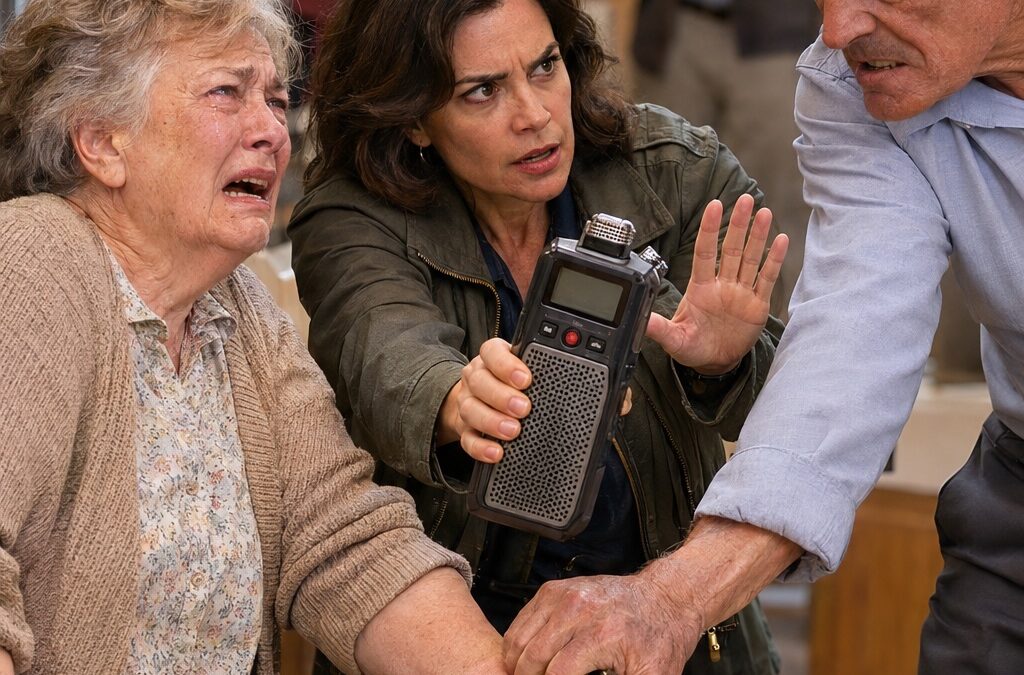
“I got your revocation,” the recording said.
Wade’s voice sounded flat through the little speaker.
“I know I can’t sign for you anymore.”
Nobody moved toward the recorder.
Then my own recorded voice came through.
“Then don’t tell anyone you still handle my money.”
Lena stopped playback.
“That conversation was recorded on April 18, 2025,” she said. “June was taking part in it.”
She placed the written revocation beside the recorder.
“She delivered this to you that day. You acknowledged receiving it.”
Wade looked toward Peter.
“There’s more to that conversation.”
“Yes,” Lena said. “We have the complete recording.”
She offered to play the rest.
Wade did not ask her to.
April pulled out the chair she had brought me. I lowered myself carefully, keeping my sore wrist against my stomach.
She stood close enough to steady the chair.
Lena waited until I was seated.
“The power of attorney was revoked before today,” she said. “You cannot use it to sign a sale contract for June.”
Wade pointed at the paper by the recorder.
“That’s why I brought a new authorization.”
“You were holding her wrist,” Lena said.
“I was helping her with the pen.”
I turned my arm so April could see it.
The marks were still there.
“I told you to let go.”
Wade opened his mouth, then shut it again.
Peter pulled his own papers from a slim case. He put them on the table, away from Wade’s authorization.
“I was told you wanted a quick sale,” he said.
“I didn’t want any sale.”
“He told me you had trouble managing the place.”
“I need help carrying laundry,” I said. “That isn’t permission to sell my house.”
Peter nodded and looked embarrassed.
He had walked through my front door expecting a business appointment. Instead, he had watched a man squeeze my wrist.
“I should have asked you directly before coming,” he said.
“Yes,” I told him. “You should have.”
Lena asked whether he had paid a deposit.
“No.”
Had a title company approved anything?
“No. We hadn’t gotten that far.”
She asked him not to treat anything Wade said as my authorization. Peter agreed without arguing.
He started gathering his papers.
Wade put a hand on the table.
“Don’t let her scare you off.”
Peter looked at me instead.
“Do you want me to leave?”
“Yes, please.”
He gave Lena his contact information before putting away his case. She asked him to preserve every message about the visit.
“I will.”
Then he looked at my wrist again.
“I’m sorry I was here for this.”
Otis walked him to the front door. I heard them speaking quietly in the hall.
Wade stayed by the counter as though the appointment might resume.
Lena pulled the unsigned authorization toward her.
“June, may I keep this?”
“Yes.”
Wade said it belonged to him.
“You handed it to her for a signature,” Lena answered. “She’s keeping what you asked her to sign.”
April finally looked directly at her father.
“You told me Mom couldn’t stay unless you helped.”
“She can’t,” he said. “Ask her what’s in her accounts.”
The skin around April’s mouth tightened.
I could have answered him with the empty savings balance. I could have told her exactly how frightened that balance had made me.
Instead, I said, “You know why.”
Wade looked away.
Lena sat at the table beside me. She kept her bag on the floor, where nobody had to reach over my chair.
“Your mother owns this home,” she told April. “Her inheritance bought it. Her divorce decree confirms that it remained hers.”
“I knew it was in her name,” April said.
“Then you should have asked me,” I said.
“I thought Dad meant there was some agreement.”
“There wasn’t.”
April pressed her lips together.
Wade made a small impatient noise.
“She lived here while I worked.”
I looked at the sink.
My chipped spoon rest sat beside a damp dishcloth. Wade had pushed it there like something left behind by a tenant.
Lena had heard enough of my history to understand that look.
“June worked, too,” she said. “And she cared for your mother in this house.”
“That has nothing to do with this.”
“It has something to do with your claim that she contributed nothing.”
He stared at her.
Lena kept speaking, plainly enough for everyone to hear.
“She prepared meals, helped your mother wash, and stayed here when your mother couldn’t be left alone. You don’t get to erase that because June needs help after surgery.”
April sat down across from me.
“I remember the basin,” she said.
I looked up.
“The one you kept under the bathroom sink.”
“Yes.”
“I remember Grandma asking for you.”
Wade reached toward his papers again.
“We’re getting distracted.”
“No,” April said. “I think I’ve been distracted.”
She did not make a speech after that. She simply stayed at the table instead of moving back beside him.
Otis returned from the front door.
“Peter’s gone,” he said.
Wade blamed him for interfering.
Otis took the chair near the doorway.
“You invited me.”
“I invited you to help.”
“You didn’t tell me she’d said no.”
My wrist had begun to ache more than sting. I rested it on a folded towel April brought from the drawer.
Lena asked whether I wanted medical attention.
“Not right now.”
She asked permission to photograph the marks.
I agreed, and April moved the towel aside.
Wade stared at the phone.
“This is getting ridiculous.”
Lena finished without answering him.
Then she put the phone away and opened a separate envelope.
“June asked me to address the money as well.”
Wade’s attention shifted immediately.
“That’s between us.”
“It is her money,” Lena said. “And she asked me to help recover it.”
April looked between us.
“What money?”
I had not told her the full amount before that afternoon. I had been trying to say it without hearing myself sound foolish.
Lena looked at me before removing the page.
I nodded.
She laid a transfer confirmation on the table.
“This shows where your savings went.”
Part 4: Where My Savings Went
The payment had gone toward Wade’s condo mortgage.
It had not paid a caregiver.
It had not paid for my rehabilitation.
It had not purchased anything for my house.
On April 9, 2025, he had used my power of attorney to move $46,000 from my savings.
That was what I had left in liquid savings.
The confirmation identified the mortgage payment and its destination. Lena had obtained it while tracing the transfer from my account.
April bent closer to the page.
“Your condo?” she asked her father.
Wade folded his arms.
“I was going to straighten that out.”
“When?”
“When she stopped making everything difficult.”
I pressed the towel against my wrist.
He had used almost the same complaint when I asked about the missing money. Back then, he said recovery expenses were complicated.
I had been sitting in my recovery chair.
My walker had been just beyond my reach.
He told me not to worry about the details.
I had worried enough to call the bank.
That was how I learned the money had left.
At first, I thought I had misunderstood the explanation. I asked the employee to repeat it while I wrote on the back of an appointment envelope.
Then I called Lena.
She did not tell me to confront him alone. She told me what records to request and how to end his authority.
I signed the written revocation.
I delivered it personally on April 18, 2025.
I recorded our conversation because I had started writing down things he later denied saying.
My bank received notice that day, too.
Now the explanation sat on my kitchen table.
Wade had used my recovery as the reason for access. He had used that access to reduce his own debt.
Lena tapped the transfer description without covering it.
“You described this as care expenses.”
“I took care of her.”
“You paid your mortgage.”
“I had expenses while I was helping.”
“You weren’t authorized to give yourself her savings.”
He looked at me.
“Are you really going to let her talk to me like this?”
“You paid your condo with my money.”
“I said I’d straighten it out.”
“You told me it was for my care.”
April pushed her chair back a little.
“Dad.”
He turned on her before she could finish.
“You don’t know what things cost.”
“Then tell me what part of Mom’s surgery paid your mortgage.”
He did not answer that.
Otis remained near the doorway, hands on his knees. He was not staring at the paper anymore.
He was watching Wade.
Lena explained the difference between handling my bills and helping himself.
The power of attorney had allowed financial assistance. It had not allowed gifts to himself or payment of his personal debts.
Wade said we had always shared money.
“We were divorced,” I said.
“You still asked me to help.”
“I asked you to pay my bills.”
He pointed toward the unsigned authorization.
“If you sign that, we can settle everything from the sale.”
There it was again.
My house would solve the problem he had created.
He would take charge of the sale, and I would wait to see what remained for me.
“No.”
“You haven’t even read it.”
“I’m not selling.”
April moved the paper farther from my towel.
Wade watched her do it.
“You’re taking sides now?”
“I’m keeping the paper away from her arm.”
He gave a short laugh.
“She’s got all of you trained.”
Otis stood up.
“That’s enough.”
Wade looked surprised to hear it from him.
Otis had lent him tools and helped carry furniture. He had listened to Wade talk about how difficult I supposedly was.
He had also seen me bring my trash bins in slowly after surgery. He knew whose porch I sat on and whose grass I hired someone to cut.
He was not confused about where I lived.
Lena asked me what I wanted next.
“I want him out of my kitchen.”
She turned toward Wade.
“June is withdrawing permission for you to be here.”
He said he still had things in the house.
“Identify them through counsel,” Lena said. “No returning without arrangements.”
I had kept an old box of his repair manuals in the utility room. That box did not give him permission to walk through my door.
He reached into his pocket.
For a moment, nobody spoke.
Then he set his house key on the counter.
It landed beside the spoon rest.
“You’ll call when something breaks.”
“I’ll call somebody who charges me openly.”
April looked down at the table.
Wade collected the papers that were unquestionably his. Lena kept the unsigned authorization he had handed me.
He tried again to make Peter’s visit my fault.
“You could have told me not to bring him.”
“I did.”
“You could have been clearer.”
“I said no.”
Otis opened the front door.
Wade walked past him without saying goodbye.
We heard his car start in the driveway. April stayed at the kitchen window until it pulled away.
Then she turned toward me.
“I should have stopped him.”
“Yes.”
“I thought you were just arguing about moving.”
“You saw his hand.”
“I know.”
She sat down again, slowly this time.
I did not tell her it was all right. My wrist hurt, and my house had just been shown to a buyer I had never called.
It was not all right.
Lena asked whether I wanted April and Otis to hear the next discussion.
I said they could stay.
She explained that retrieving the money would take more than a demand at my kitchen table.
Wade might agree to return it.
He might deny owing it.
He might say he no longer had cash available.
“He has his condo,” April said.
Lena nodded, but did not promise a quick result.
“We can pursue a civil claim. We can seek restrictions against further interference.”
I looked at the transfer confirmation again.
“What if he says he has nothing?”
“We will document what he owns and what happened.”
I was tired enough that even lifting the towel felt like work.
But I understood the next question.
Getting him out had protected my afternoon.
Getting my savings back would require dealing with the property he had paid for using them.
Lena closed the envelope.
“To recover this, we may have to put his condo into the case.”
Part 5: The House He Had
I asked Lena to explain that without legal shorthand.
She drew the transfer confirmation closer.
“We’re not taking his property today,” she said. “We’re making a claim for the money he wrongfully used.”
“And if he refuses?”
“Then we pursue a judgment. The evidence matters.”
She listed what we already had.
The power of attorney.
The transfer.
The written revocation and proof he received it.
The recording.
The paper he tried to make me sign.
The people who saw what happened.
For the first time that afternoon, I could see the work ahead in ordinary steps.
I did not have to persuade Wade to admit everything.
I had to tell the truth and keep the records.
April offered to take the envelope home for safekeeping.
“No,” I said.
She stopped reaching for it.
“Okay.”
Lena helped me make copies instead.
That small exchange stayed with me. April had meant to help, but she had asked with her hands before asking with words.
She noticed when I said no.
On May 5, 2025, Lena filed the civil action.
Wade obtained his own lawyer.
An agreed temporary court order followed. It prohibited him from entering my property or acting under the revoked power of attorney.
It did not decide every disputed issue.
It did mean the rules no longer depended on whether Wade felt like listening to me.
Lena sent me the entered order.
I kept a copy in the kitchen drawer.
Another stayed with the papers by my telephone.
Otis helped me arrange a locksmith.
I paid for it myself.
I did not give April the new key immediately.
She did not ask why.
Wade’s repair manuals went into a box by the door. Their pickup was arranged through counsel so I did not have to meet him.
Otis was present when the box left.
I stayed in my kitchen.
There was no argument on the porch.
There was no reason for one.
The money claim moved more slowly.
Lena requested records.
Wade’s lawyer sent explanations.
Some repeated what he had said at my table. Others made it sound as though I had given him broad permission to reimburse himself.
Lena asked me to read those carefully.
“Tell me what is accurate,” she said. “Even when you don’t like it.”
So I did.
I had voluntarily given his business $40,000 in 2019.
That had not been a loan.
There was no promise to repay it.
I told her not to pretend otherwise.
The money was gone, and I regretted giving it. Regret did not turn the gift into a debt.
Lena agreed.
The claim stayed focused on the $46,000 he had taken.
Together, the gift and withdrawal amounted to $86,000. But the legal claim was not a total of everything I resented.
It was a claim we could document.
That distinction mattered to me.
I did not want papers that sounded like Wade’s version of our marriage, with inconvenient facts left out.
April wrote down what she remembered from my kitchen.
She included her own silence.
She described the pen and his grip.
She wrote that I had said no.
Before sending it to Lena, she brought a copy for me.
“I didn’t know whether to include that I just stood there.”
“Did you?”
“Yes.”
“Then include it.”
She nodded.
I read the account at my table while she waited.
She had not described herself stepping between us. She had not claimed to have challenged him before Lena arrived.
I handed it back.
“That’s what happened.”
She began coming over with groceries.
At first, she tried putting everything away herself.
I asked her to leave the bags on the counter.
“I know where my food goes.”
“Of course.”
She stayed and handed me things instead.
I could manage the cupboard near the stove. She handled the shelf that required stretching.
It was useful help.
It did not require giving her control of my kitchen.
Wade sent a message asking whether I wanted to discuss things privately.
I forwarded it to Lena.
She answered through his lawyer.
After that, I stopped checking my phone every time it made a sound.
The settlement discussions centered on the condo.
Its mortgage records matched the payment from my savings. The ownership records showed it belonged to Wade alone.
He could not honestly call the payment an expense for my home.
His position shifted.
He said he intended to repay me eventually.
He said a lawsuit would cost everyone money.
He said I should accept installments without security.
I asked Lena what happened if he stopped paying.
“We would have to enforce the agreement.”
“Then I don’t want another promise by itself.”
We discussed the choices until I understood them.
I was not promised that every possible court fight would end exactly as I wanted. I was shown what the settlement would require.
On August 22, 2025, we reached it.
Wade agreed to a $46,000 consent judgment.
A recorded lien secured it against his condo.
Each side would pay its own legal fees.
I would not recover the cost of every conversation or every night spent worrying. I would recover the money he had taken, with a legal means of collecting it.
Lena asked whether I wanted time before signing.
I read the agreement again.
Then I signed it without anybody touching my hand.
Wade signed separately.
I did not see him that day.
The condo went toward a sale that would pay the judgment from his proceeds.
Lena explained that the closing still had to happen.
A proposed closing date was not a payment.
A buyer’s signature on an offer was not money in my account.
I understood that better than I wished to.
When the sale reached escrow, Lena sent the payment instructions through the proper closing channels. She checked the amount with me before confirming them.
I took out the paper where I had first written down the missing savings.
The figure matched.
I folded it and put it away again.
Then we waited for the closing to finish.
Part 6: The Kitchen I Kept
The condo sale closed on September 12, 2025.
Lena called after receiving confirmation from escrow.
“The judgment payment has been sent,” she said.
I was at the kitchen table.
My walker was against the wall, within reach.
I asked her to repeat the amount.
“$46,000.”
I wrote it down even though I already knew it.
Then I called my bank through the number on my own account records.
I did not use a number forwarded in a message. I did not ask anybody else to check for me.
The deposit was there.
I thanked the employee and ended the call.
For a while, I kept the confirmation open on the table.
I had imagined feeling excited when the money returned.
Mostly, I wanted to sit still.
I did not have to calculate whether I could afford help after my recovery appointments. I did not have to consider borrowing against the house Wade had tried to sell.
The money was back where I could use it.
Lena handled the judgment satisfaction and release of the lien after the funds were confirmed.
I asked why that paperwork mattered.
“He paid the judgment,” she said. “The records need to show that accurately.”
So we finished that, too.
I had wanted my money returned, not an unpaid debt left on his property records after payment.
His condo was sold.
The judgment had been paid from his proceeds.
He no longer had authority over my accounts, and he did not have permission to enter my home.
Those were concrete things I could check.
I did not need to ask April what she thought he might do next.
The agreed restrictions had given me room to handle my recovery without another visit from him. Any future arrangements could go through proper channels.
There was nothing of his left in my utility room.
There was no reason to keep a spare key for him.
I went through my financial paperwork with Lena’s guidance.
The revoked power of attorney was clearly marked in my records. My bank had the revocation.
I updated the contact information I wanted used.
I reviewed who could receive information.
I did not sign a replacement document at the kitchen table simply because somebody said it would be convenient.
When I had questions, I asked them.
When I did not understand an answer, I asked again.
Nobody hurried me toward a signature.
Otis came by after hearing that the money had arrived.
He knocked instead of opening the back door.
I liked that more than I expected.
“Come in,” I called.
He brought the empty dish I had sent home with him earlier.
We stood by the counter while I put it away.
“I should’ve said something sooner that day,” he said.
“You said something when he lied about inviting you.”
“I saw him grab you.”
“Yes.”
He rested his hand on the back of a chair.
“I won’t stand there next time.”
“I don’t want a next time.”
“Neither do I.”
We left it there.
I did not need him to promise to supervise every person who came near me. I needed him to remember what he had seen.
He had given Lena his account when she requested it.
He had preserved the message.
That had helped.
Peter had also provided the messages he received. His account confirmed that Wade had presented himself as authorized to arrange the visit.
The sale he had discussed never happened.
There had been no deposit to return and no completed closing to undo.
My house stayed in my name.
Sometimes I stood in the doorway and looked through the rooms he had planned to show.
There was the chair I used after surgery.
There was the cupboard where I kept baking dishes.
There was the window over the sink where the latch stuck in damp weather.
I arranged to have that latch repaired.
I paid the person who repaired it.
The price was explained before the work began.
That was all the arrangement required.
April asked whether she could come over on September 20, 2025.
“Do you want me to bring lunch?” she asked.
“Yes.”
“Anything you don’t want?”
“Don’t bring food I need to cook.”
She laughed a little, then stopped.
“I won’t.”
She arrived carrying containers and a paper bag.
She left them on the counter until I told her where to put them.
I sat at the table while she got plates.
Then she sat across from me without opening her own container.
“Mom, I need to apologize properly.”
I put down my fork.
“All right.”
“I believed Dad because he sounded certain.”
I waited.
“And because believing him meant I didn’t have to ask what you needed.”
She looked at the towel folded beside the stove.
“I watched him grab you. I said his name instead of telling him to stop.”
“Yes.”
“I’m sorry.”
I let her finish without helping her find nicer words.
“I also told people you were considering moving,” she said. “I repeated what he told me.”
“Have you corrected that?”
“Yes. I told them you never agreed.”
“Good.”
She rubbed her thumb along the edge of her container.
“I don’t expect you to forget it.”
“I’m not going to.”
She nodded.
We ate while the food was still warm.
Later, she asked whether I wanted help clearing up.
“You can wash. I’ll dry what I can reach.”
She ran the water and checked the temperature.
I brought my chair close enough to the counter.
We worked slowly.
She did not move my cups into different cupboards. She asked where the lids belonged.
When the dishes were finished, she picked up the pear-shaped spoon rest.
The chipped stem caught against the dishcloth.
“Do you still want this?” she asked.
“Yes. That stays.”
She dried it carefully and handed it to me.
I checked the bottom for water.
Then I set the chipped ceramic pear beside my stove.
You Might Also Enjoy




