My Father Ordered Me Out While Pregnant, Until My Son Made Him Listen
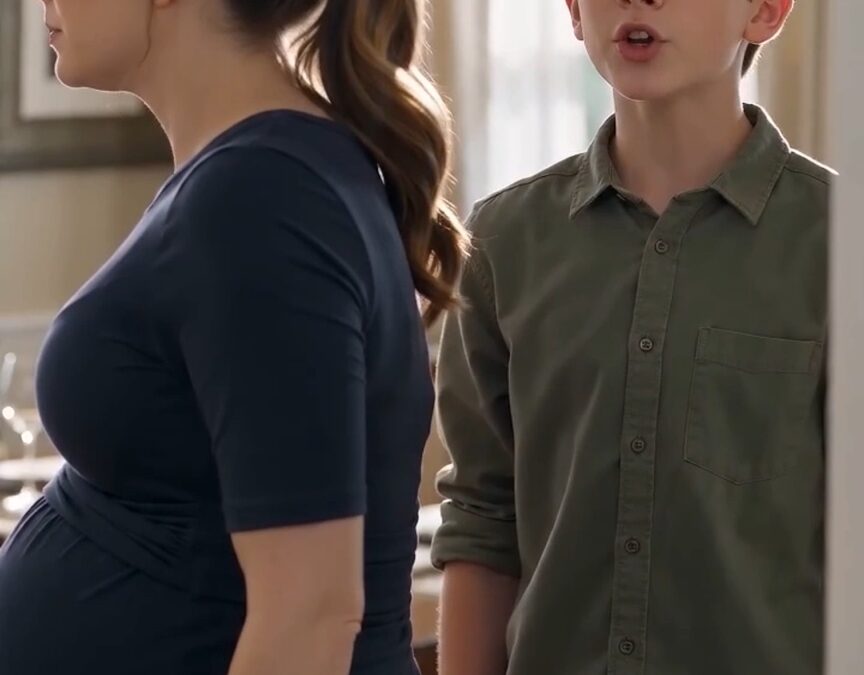
Chapter 1: The Chair By The Door
My father blocked the dining-room doorway while I stood there, 34 weeks pregnant.
“Get out. You’re ruining my dinner.”
His new wife watched from the retirement table.
My son was still seated beside his empty chair.
I held a blue cushion against my stomach.
“Dad, I need room to get through.”
He planted his hand against the doorframe.
“You don’t belong at this table.”
My purse was behind him, beside my chair.
So were my car keys and my comfortable shoes.
I had slipped those shoes off beneath the table.
My feet had swollen during the drive into Richmond.
Now I stood in stocking feet on restaurant carpet.
There were 16 guests in that private dining room.
Every one of them had heard him.
I looked past his shoulder toward Caleb.
My son had worn the shirt I’d pressed that afternoon.
He was 16, old enough to understand an insult.
He was also young enough to look briefly confused.
His grandfather had invited him to sit beside him.
Now that same man was ordering his mother out.
Brooke adjusted the napkin across her lap.
“Martin asked for one nice evening,” she said.
I looked at the plates behind her.
My dinner had arrived less than ten minutes earlier.
I hadn’t taken a bite.
“I asked to discuss this privately,” I said.
Dad moved his hand higher on the doorframe.
“You had your chance to be reasonable.”
I was 36, divorced, and expecting another child.
My father was 61 and announcing his retirement.
His wife was 29.
For most of that evening, she had explained his needs.
Apparently, mine were the problem.
We had arrived at the restaurant shortly before dinner.
It was May 17, 2025.
Caleb carried the cushion through the entrance for me.
I carried my purse and watched the polished floor.
The private room had heavy curtains and upholstered chairs.
Water glasses stood beside folded white napkins.
Everything smelled of warm bread and butter.
I had been hungry enough to enjoy it.
“Near the door?” Caleb asked.
“Somewhere I can stand without moving six people.”
He pulled out the nearest chair.
I settled the cushion behind my lower back.
Dad called Caleb toward the other end immediately.
“Come here. You can sit beside me tonight.”
Caleb looked at me first.
I nodded and reached for my water.
I wasn’t going to make seating into an argument.
Brooke watched me adjust the cushion.
“Hopefully, you’ll be comfortable enough to enjoy yourself.”
“I brought what I needed,” I told her.
Ruth arrived carrying a slim closing folder.
She was 58, Dad’s real-estate attorney and longtime friend.
I had known her since I was a girl.
That didn’t mean she was my attorney.
I knew whose sale she was handling.
Dad had asked her to bring the folder.
He wanted a discussion about a release at dinner.
I had already told him I wasn’t signing his proposal.
I hoped having Ruth there would keep things clear.
Owen, Dad’s 54-year-old shop manager, raised his glass.
He talked about upholstery jobs and delivery deadlines.
Dad laughed when Owen mentioned his demanding standards.
Brooke rested her hand on Dad’s arm.
“That’s why everything always got finished,” she said.
Caleb glanced down the table toward me.
I straightened the napkin over my lap.
I had finished plenty of those jobs myself.
Dad owned the upholstery business and its commercial building.
For three years, I had helped after my alterations work.
That evening wasn’t supposed to be about my contribution.
I had come to eat dinner and congratulate him.
Then Brooke asked whether his retirement arrangements were finally settled.
Dad turned directly toward me.
“Did you bring what I asked for?”
“I brought my papers,” I said.
“Signed?”
“No. We can talk afterward.”
He put down his fork.
“What exactly is there left to discuss?”
“I’m not signing the agreement you sent.”
Brooke leaned back in her chair.
“Tonight, Leah? You’re doing this tonight?”
“I didn’t bring it up.”
Dad looked toward Ruth, then back at me.
“It’s a simple family matter.”
“Then please stop discussing it across the table.”
The server came in with the remaining plates.
Nobody spoke while the food was set down.
I thought Dad might let it wait.
Instead, he pushed his chair back.
“Come here.”
My back needed a change of position anyway.
I stood slowly and picked up my cushion.
Dad walked toward the doorway.
I followed, thinking we might finally speak privately.
He stepped into the opening and turned around.
That was when he ordered me out.
Now I needed my purse and shoes.
He seemed determined to make both difficult.
“Move aside, please,” I said.
“You should have thought about this before embarrassing me.”
Behind him, Caleb pushed back his chair.
“Sit down,” Dad told him.
My son didn’t argue from his seat.
He stood and walked around the table.
Dad looked almost amused for a second.
Then Caleb passed his empty chair without stopping.
He crossed the room and stood beside me.
“Grandpa, let her finish.”
I rested my free hand against Caleb’s shoulder.
Across the table, Ruth pulled the folder closer.
Dad looked over my son’s head.
His brief smile disappeared when she opened it.
“Martin,” she said, “we need to discuss the recorded loan.”
Chapter 2: What Caleb Had Seen
Dad took his hand off the doorframe.
“That isn’t dinner conversation.”
“You requested a discussion about the release,” Ruth said.
“I requested help getting it handled.”
“Then Leah needs to be allowed to answer.”
He looked toward the other guests.
Nobody offered to change the subject for him.
I put the cushion on an empty chair.
Caleb stayed close without leaning against me.
“Would you like me to explain the payoff?” Ruth asked.
“Yes,” I said. “Please explain the actual agreement.”
Dad made a small, impatient sound.
Ruth turned a page inside her folder.
“Leah is the sole lender on the promissory note.”
Brooke looked from Ruth to me.
“What exactly does that mean?”
“It means Dad borrowed my money,” I said.
“How much?”
“Eighty-four thousand dollars.”
She turned toward him so quickly her chair shifted.
“You said she helped with the business.”
“I did help,” I said.
Dad spread his hands.
“It was family money.”
“It was my inheritance.”
“From your grandmother.”
“Yes. Left to me.”
My grandmother had left me a house.
I sold it rather than move Caleb across town.
I planned to use the proceeds for our housing.
Dad knew that before he asked for help.
In 2022, the upholstery business was having trouble.
There were repairs, operating bills, and work waiting for materials.
Dad owned the business and the commercial property outright.
He didn’t want to sell the building in a hurry.
He said a rushed sale would cost him money.
He asked whether I could lend him time.
That was how he first described it.
We sat in his shop office with the figures.
I brought a notebook and wrote down my questions.
“How soon could you pay it back?” I asked.
“When I sell, at the latest.”
“What if you don’t sell?”
He tapped the desk with his pen.
“Then we put a date on it.”
I told him I couldn’t afford an unsecured promise.
He said he understood.
He said he would want the same protection.
On May 20, 2022, we signed the loan documents.
The note was interest-free.
No monthly installments were required.
The full $84,000 was due when the commercial property sold.
Otherwise, it came due June 1, 2025.
Whichever happened first controlled the repayment.
A recorded deed of trust secured the note.
I was the sole lender and beneficiary of that security.
I had no ownership share in his shop.
I certainly owned nothing in the restaurant around us.
I was his daughter and his secured lender.
Those were two separate facts.
Ruth explained the security in plain language.
“The property sale requires this obligation to be addressed.”
Brooke frowned at the folder.
“Does that mean she owns part of the building?”
“No,” Ruth said. “It secures repayment of the loan.”
Dad looked toward Caleb.
“This is more complicated than it sounds.”
Caleb kept his eyes on him.
“I remember when Mom started going there after work.”
“That’s not the same subject.”
“No,” Caleb said. “That was extra.”
I touched his shoulder again.
“You don’t have to explain my work.”
“I know,” he said.
Then he looked at Dad.
“But I was there.”
He had been there for a damaged booth cushion.
I remembered that evening without needing to check a date.
Dad called while I was putting away alterations.
A restaurant delivery was scheduled, and a cushion needed rebuilding.
“Just the front seam,” he told me.
“It won’t take long.”
I packed our supper in two containers.
Caleb brought homework and a sweatshirt.
At the shop, the cushion covered most of a worktable.
The fabric had torn beyond the original stitching.
A quick seam wouldn’t hold once someone sat down.
I showed Dad the weakened material.
“It needs a replacement strip.”
“Whatever makes it deliverable,” he said.
I removed the cover and measured the damaged section.
Caleb ate at the desk while I cut fabric.
He asked whether he should warm my supper.
“Not yet. I’ll get this fitted first.”
The replacement needed to follow a rounded corner.
I pinned it, checked it, and unpinned it.
Dad came back holding his delivery list.
“Can you finish that tonight?”
“That’s why I’m here.”
“They’re expecting it.”
“I heard you.”
I guided the thick fabric under the machine.
The material dragged unless I supported its weight.
My forearms pressed against the table edge.
Caleb finished his homework and curled up nearby.
His sweatshirt made a thin pillow.
By the time I fitted the cover, he was asleep.
Dad inspected the finished front seam.
“Good. Put it with the delivery.”
I woke Caleb and gathered his papers.
My supper was still unopened beside the machine.
At the dinner table, Owen cleared his throat.
“I remember that cushion,” he said.
Dad gave him a quick look.
Owen kept speaking.
“She stayed until it was ready.”
Brooke folded her arms.
“Are we adding up every favor now?”
“No,” I said. “We’re explaining what already happened.”
Ruth looked back at the closing papers.
“There’s another point we need to clarify.”
Dad reached for his water glass.
Ruth waited until he set it down.
“What retirement gift did you tell the buyer Leah had promised?”
Chapter 3: The Gift Never Discussed
I looked at Ruth before looking at Dad.
“What retirement gift?”
Dad’s jaw tightened.
“The arrangement I’ve been trying to discuss.”
“You sent an agreement. I refused.”
“We hadn’t finished talking.”
“I had finished answering.”
Brooke pulled her chair closer to the table.
“I thought this was settled.”
Dad didn’t look at her.
“It should have been.”
Ruth kept one hand on the closing folder.
“The buyer was told the debt would be forgiven.”
I looked down at my blue cushion.
A loose seam showed near one corner.
I pressed the edges together with my thumb.
“Who told the buyer that?”
“I did,” Dad said.
“You told them I agreed?”
“I told them what we planned.”
“What you planned.”
He lowered his voice, but everyone could hear.
“I knew you would understand once we talked properly.”
“We talked on May 15.”
“That wasn’t much of a conversation.”
“You emailed me a debt-forgiveness agreement.”
“And you immediately decided to be difficult.”
“I read it before I answered.”
Brooke stared at him.
“Martin, did she agree or not?”
He pulled out his chair without sitting.
“She knew we needed this resolved.”
I looked directly at Brooke.
“I never agreed to forgive any part of the loan.”
Dad shook his head.
“You make it sound like I deceived somebody.”
Ruth answered before I did.
“The information needs correcting.”
She wasn’t accusing him across the table.
She was identifying what his closing file required.
That seemed to bother him almost as much.
He wanted the folder to support him.
Instead, it contained his signed obligation.
I remembered opening his email two days earlier.
The subject line mentioned the retirement dinner.
The attachment was a proposed debt-forgiveness agreement.
I read it at my kitchen table.
Caleb was looking for a school paper nearby.
Dad’s message asked me to bring it signed.
There was nothing about receiving repayment first.
The document would give up the debt itself.
I called him after reading every page.
“I’m not signing this,” I told him.
“Read the whole thing.”
“I have.”
“It will simplify the sale.”
“It will erase my loan.”
“It will help me retire.”
“Those aren’t the same thing.”
He told me to think about it until dinner.
I told him my answer wasn’t waiting for dinner.
After that call, I took out the original file.
Caleb helped scan it at my request.
He kept the pages straight and checked the images.
He didn’t decide what any document meant.
He simply helped me make a complete copy.
At the restaurant, Ruth addressed the difference clearly.
“A release after payoff acknowledges a satisfied obligation.”
Dad rubbed the back of his neck.
“The forgiveness agreement gives up repayment,” she continued.
“They are not interchangeable.”
“I know what a release is,” Dad said.
“Then we need to stop treating them as equivalent.”
Brooke looked down at her untouched plate.
“Could she sign now and get paid afterward?”
“No,” I said.
Ruth turned slightly toward her.
“The arrangements must protect the actual transaction.”
“I’m trying to find a simple solution.”
“The simple solution is paying the loan,” I said.
Dad leaned forward.
“You know what Brooke and I planned after this.”
They had discussed buying another property.
Something smaller, he said, with less daily work.
He had talked about it while I finished shop sewing.
I assumed the plan used his money after repayment.
Apparently, it also used mine.
“Your replacement purchase isn’t part of our agreement.”
“It all comes from the same sale.”
“That doesn’t make it the same obligation.”
Brooke put her napkin on the table.
“You’re leaving him short.”
“He’s selling for $310,000.”
“That isn’t what he gets to keep.”
“I understand expenses come out.”
“And this comes out, too.”
“Yes,” I said. “Because he owes it.”
Dad looked toward Caleb again.
“Your mother is making this very unpleasant.”
My son shifted his feet.
“Don’t ask me to be against her.”
“I didn’t ask that.”
“You keep saying it to me.”
“Leave Caleb out of it,” I said.
“He got involved himself.”
“He stood beside me. That isn’t permission.”
Ruth closed one page over another.
“Martin, I represent you in the property sale.”
He nodded quickly.
“That’s what I’m trying to explain.”
“She needs independent advice about her own interests.”
His nod stopped.
I looked at Ruth.
“I’ll get separate counsel.”
“That would be appropriate.”
Dad laughed once without smiling.
“You need another attorney to talk to your father?”
“I need an attorney who represents me.”
For years, I had tried to avoid sounding ungrateful.
I had softened requests and explained ordinary bills.
This time, I asked for the paperwork.
“Please send the proposed payoff arrangements.”
Ruth nodded.
Dad picked up his fork, then set it down.
“What exactly do you want tonight?”
“An accurate closing statement,” I said.
“And no more claims that I promised a gift.”
Chapter 4: Leaving With My Son
The server appeared in the doorway carrying a pitcher.
He paused when he saw us standing.
“Should I come back?”
“Yes, please,” Ruth said.
Dad turned sharply toward her.
“I didn’t say dinner was canceled.”
“He asked whether to return,” she answered.
Brooke looked toward the doorway, then at me.
“Can everybody please sit down?”
I stayed where I was.
My shoes remained beneath my original chair.
My purse hung from its back.
Dad had moved enough that I could reach them.
I wasn’t going to squeeze past him without speaking.
“Caleb, would you bring my purse?”
He walked around the table immediately.
Dad followed him with his eyes.
“Your mother can get her own purse.”
“I asked him to help,” I said.
Caleb returned with it and my shoes.
He set the shoes beside me without making a show.
I rested one hand on the chair while stepping in.
My swollen feet barely fitted.
Owen pushed his own chair back.
“Martin, you should ask her to sit.”
Dad gestured toward the table.
“There’s her chair.”
“You told her she didn’t belong here.”
“I was angry.”
“She heard you.”
“So did everybody,” Brooke said.
Owen looked at her, then back at Dad.
“That’s why he should address it.”
Dad’s mouth tightened.
He wasn’t used to Owen speaking that way.
At work, Owen usually kept deliveries moving.
If Dad snapped, Owen found another practical subject.
This time, he stayed with the one in front of him.
“Leah helped us get orders out,” he said.
Dad waved one hand.
“Nobody said she didn’t.”
“You called her unreasonable over money you borrowed.”
Brooke drew in a breath.
“Owen, you don’t know everything about this.”
“I know she wasn’t on the sewing payroll.”
I stood still beside my chair.
Owen looked directly at me.
“You worked after your own customers were handled.”
“Yes.”
“And Caleb waited through plenty of those evenings.”
My son studied the carpet.
He didn’t want applause for sleeping at the shop.
I didn’t want him made into evidence any longer.
“He’s heard enough about it,” I said.
Owen nodded.
“I’m sorry, Caleb.”
“It’s okay.”
Dad sat down heavily.
“Can we stop acting like I forced anyone?”
I adjusted my purse strap.
“I came because you asked for help.”
“That’s what family does.”
“And now I’m telling you I can’t continue.”
Brooke looked up.
“What does that mean?”
“It means you need to arrange your own shop labor.”
“We’re talking about the loan.”
“You were talking about what I contributed.”
Ruth slid her papers back into the folder.
“The financial details can be handled through the offices.”
“That sounds best,” I said.
Dad pointed toward my plate.
“You haven’t eaten.”
“No.”
“Then sit down and eat.”
I looked at the chair he had offered after expelling me.
I could sit there and pretend the meal had restarted.
Caleb could return to his place beside him.
Brooke could ask whether we wanted dessert.
I picked up my cushion instead.
“I’m going home.”
Dad pushed his chair back again.
“Don’t walk out just to make a point.”
“You told me to get out.”
“I was trying to make you understand.”
“I understood what you said.”
He stood, but Owen was already moving aside.
There was a clear path to the doorway.
Ruth rose as we passed her chair.
“I’ll send the transaction information,” she said.
“Thank you.”
She didn’t ask me to smooth things over first.
She didn’t promise that Dad would settle down.
I appreciated both omissions.
Caleb carried the blue cushion into the main restaurant.
I followed with my purse against my side.
We walked past tables where people were eating normally.
Someone was choosing dessert near the entrance.
The hostess held the outer door.
“Have a nice evening.”
“Thank you,” Caleb told her.
Outside, I stopped beside the car.
Standing had made my lower back ache.
Caleb waited with the cushion under his arm.
“Are you hurt?”
“No. Just sore.”
He unlocked the passenger door for me.
I lowered myself carefully and shifted my feet inside.
“Did I make things worse?” he asked.
I looked across at him.
“No.”
“He looked really mad when I stood up.”
“He was already mad.”
Caleb adjusted the cushion behind my back.
I waited until he had fastened his seat belt.
“What made you get up?”
He looked through the windshield.
“He was talking like you’d done something wrong.”
“I know.”
“And I was sitting right beside him.”
“You didn’t have to solve it.”
“I wasn’t trying to solve it.”
He rubbed one finger along his shirt cuff.
“I just didn’t want to stay there.”
I reached over and squeezed his shoulder.
“I’m glad you came.”
At home, he warmed food while I changed clothes.
I put the cushion beside my sewing machine.
We ate in the living room.
Halfway through supper, my phone began ringing.
Dad’s name filled the screen.
I answered after swallowing my food.
“Are you really going to hold up my sale?” he asked.
Chapter 5: The Call After Dinner
“No,” I said. “I’m expecting repayment.”
“That isn’t what I asked.”
“It’s what the sale requires.”
I put my plate on the side table.
Caleb reached for it.
I shook my head and kept my fork.
I wasn’t letting another conversation take away my supper.
Dad sounded farther from the restaurant noise now.
A door closed near him.
“Brooke is very upset.”
“I heard her.”
“She thinks you dislike her.”
“This isn’t about liking Brooke.”
“She’s my wife, Leah.”
“I know.”
“You could show her some consideration.”
“I won’t discuss my loan as a test of affection.”
He paused, then tried a softer voice.
“We made plans based on what would be available.”
“You made plans before asking me.”
“I thought you would help.”
“I lent you the money three years ago.”
“Now you’re just repeating yourself.”
“So are you.”
Caleb stood and took his own plate away.
He stayed in the kitchen doorway afterward.
I could see him listening for his name.
Dad said Ruth needed a payoff figure.
“The principal is still $84,000,” I said.
“I know the original amount.”
“There haven’t been payments reducing it.”
“That’s because payments weren’t required.”
“Correct.”
“Then why say it like I failed?”
“I’m explaining why the full balance is due.”
He let out a long breath.
Behind him, Brooke said something I couldn’t understand.
Then her voice came clearly through the phone.
“Ask whether she can leave part of it.”
I answered before Dad repeated her request.
“I’m not leaving money in the property.”
Brooke took the phone.
“Do you understand we had arrangements?”
“Yes.”
“We’re not asking you to have nothing.”
“You’re asking me to give up my housing fund.”
“You always make it sound so extreme.”
“That is what the money was saved for.”
“You still have years to work.”
I looked toward the garment hanging beside my machine.
It needed a sleeve adjustment before its owner returned.
My next week already had customer appointments.
Having years to work didn’t make that work free.
“I’m still paying rent,” I told her.
“And preparing for a baby.”
“We have expenses, too.”
“Then your budget needs to include your expenses.”
She went quiet briefly.
When she spoke again, her tone had changed.
“What about another loan after this one is paid?”
“No.”
“You haven’t heard what we’d offer.”
“I’m not financing the replacement purchase.”
“It could be temporary.”
“So was the first loan.”
Dad came back on the phone.
“Nobody needs to decide anything tonight.”
“I’ve decided about another loan.”
“You’re upset.”
“I’m also not lending you more money.”
He tried talking about family occasions next.
He said Caleb didn’t need this disagreement between us.
I looked toward the kitchen doorway.
My son lowered his eyes when he heard his name.
“Don’t use Caleb to change my answer,” I said.
“I’m worried about him.”
“Then apologize for what he watched.”
“I lost my temper.”
“You can tell him that yourself.”
Dad didn’t answer.
I took another bite while he waited.
For once, he had to listen to me finish eating.
“Send the payoff information,” I said.
“I’ll have independent counsel review it.”
“Everything has to be formal now?”
“The loan already was.”
He asked whether I would reconsider overnight.
“No.”
I said goodnight before ending the call.
Then I placed the phone facedown beside my plate.
Caleb came back into the room.
“Was Grandpa mad at me?”
“He’s responsible for his own temper.”
“That’s not exactly what I asked.”
I set down my fork.
“He didn’t ask me to tell you off.”
“Okay.”
“He did mention you. I told him not to involve you.”
Caleb sat on the sofa arm.
“Am I allowed to stay mad?”
“Yes.”
“Even if you talk to him again?”
“Yes.”
He picked at a loose thread on his cuff.
“I don’t want another dinner like that.”
“Neither do I.”
We sat for a minute without deciding every future holiday.
He had schoolwork waiting.
I had dishes and a tired back.
Those were enough for the rest of the evening.
Later, I took out the original loan file.
Caleb glanced over from the table.
“Do you need me to scan anything again?”
“Maybe check that the file opens.”
He pulled the chair closer and opened the saved scans.
Every page appeared in order.
The signatures were clear.
The recording information was readable.
He enlarged one page to check the bottom margin.
“Nothing got cut off.”
“Thank you.”
Dad sent a message asking whether we were home safely.
I replied that we were.
His next message asked whether I’d reconsidered.
I left it unanswered.
Ruth’s office sent the available closing information.
Her message stated that she represented Martin.
It did not say I had agreed to forgive anything.
I saved it with the rest.
Then I contacted separate counsel for an independent review.
The reply asked for the original loan and the proposed payoff.
I had both ready.
The review could be scheduled for May 19.
Chapter 6: The Papers At Home
The morning after dinner, I left my phone charging.
I made breakfast before opening any messages.
Caleb came into the kitchen wearing yesterday’s tired expression.
“Did Grandpa call again?”
“Not this morning.”
“Are you going to call him?”
“Not about the money.”
He took a bowl from the cupboard.
I watched him pour cereal, then checked my calendar.
Two alterations needed finishing before the week began.
I could work on those sitting down.
The shop jobs Dad usually asked about weren’t listed.
I wasn’t adding them.
After breakfast, I spread the loan file on the table.
The attorney reviewing it needed a complete set.
I compared the original pages against our scans.
Caleb sat across from me.
“Do you want help?”
“You can check the page numbers.”
He drew the laptop closer.
We had done this same task on May 15.
That time, I had been trying not to alarm him.
He could tell something was wrong anyway.
Dad’s forgiveness request had arrived while I was working.
The unsigned document sat open beside a pinned sleeve.
Caleb asked whether it was something for his school.
“No. It’s about Grandpa’s property sale.”
“Does he need something copied?”
“I need my own documents copied.”
He had looked at the stack I brought out.
“Is that why you look annoyed?”
“I’m reading something I’m not going to sign.”
He didn’t ask to decide it for me.
He cleared room beside the laptop.
I removed staples carefully to avoid tearing a signature page.
He checked each scan as it appeared.
When the note reached the screen, he recognized Dad’s signature.
“Is this when you gave him the money?”
“Lent it.”
“Right. Lent it.”
That correction had mattered to me.
Not because Caleb needed a lesson about lending.
Because Dad’s email had already blurred the words.
At the dinner, he called it family money.
Before dinner, he called forgiveness a simple signature.
I wanted the file to say exactly what happened.
Now, on the morning after, Caleb compared another page.
“This one matches.”
I slid it into the original stack.
The May 20, 2022 date was printed above our signatures.
Dad had signed without anyone standing over him.
He had asked questions then.
He had wanted confirmation that no installments were required.
He had understood the property would secure repayment.
I remembered him turning the note around toward me.
“This gives me breathing room,” he said.
“It gives me a repayment date,” I answered.
He nodded.
“Fair enough.”
Outside the office, he thanked me twice.
I had carried that memory through many shop evenings.
When a delivery ran late, I remembered his relief.
When my own alterations waited, I told myself things would improve.
For three years, I had found extra hours.
Caleb had done homework beside upholstery samples.
I had brought sandwiches and packed spare thread.
Dad had grown used to seeing us arrive.
He stopped asking whether I had other work.
Instead, he asked when I could get there.
At the kitchen table, Caleb clicked to the last scan.
“That’s everything.”
I counted the originals one more time.
“Good.”
“Do you think he knew you’d kept all this?”
“He signed the same paperwork.”
“That’s not what I mean.”
I looked up.
“Maybe he hoped I wouldn’t insist.”
Caleb shut the laptop gently.
“I don’t like that.”
“Neither do I.”
I didn’t ask him to judge his grandfather.
He could dislike what happened without deciding everything else.
I put the originals into their folder.
The separate attorney received secure copies for review.
I included the unsigned forgiveness proposal.
I included Ruth’s message and the closing information.
Then I wrote a short account of the relevant facts.
The loan amount had never changed.
No principal payments had been made.
I had never agreed to forgiveness.
I was willing to cooperate with payment and proper release.
I left out the restaurant’s curtains and cooling food.
Those details mattered to me.
They didn’t change the payoff calculation.
Dad called while I was checking a hem.
I let the call go unanswered.
A message followed.
“Ruth says we need your cooperation.”
I set down my pins before replying.
“You will have it for an accurate payoff.”
He answered almost immediately.
“So there’s no room to discuss anything?”
“Not debt forgiveness or another loan.”
There was no reply after that.
I returned to the garment on my lap.
Caleb looked over from his homework.
“Is he still asking?”
“Yes. I’m handling it.”
He nodded and looked back at his page.
I was glad he believed me enough to continue.
By evening, the documents were ready for review.
My attorney had confirmed the appointment.
The next morning’s conversation would follow the written terms.
Chapter 7: The Numbers In Order
On May 19, I cleared the kitchen table completely.
I put away the pins, thread, and folded fabric.
The blue cushion went behind my back.
My original loan papers lay beside a notebook.
I wanted room to write without moving a plate.
My separate attorney began with the promissory note.
We checked the names and the principal.
We checked the payment terms against the closing schedule.
No monthly installments had been required.
That meant Dad hadn’t missed installments he never promised.
It did not mean the loan had become a gift.
The full balance remained $84,000.
There was no interest to calculate.
I wasn’t adding fees because dinner had been ugly.
I wasn’t demanding extra money for unpaid sewing.
Those were separate matters.
For this transaction, I wanted the note paid correctly.
The attorney read the maturity provision back to me.
Payment was due upon sale of the commercial property.
If no sale occurred first, June 1 controlled.
The scheduled May 20 closing came earlier.
That would trigger the full payoff.
Next came the recorded deed of trust.
We checked the recording information and the secured obligation.
It did not make me an owner of Dad’s business.
It did not entitle me to all his sale proceeds.
It secured the amount he had borrowed from me.
I wrote that down in plain words.
I didn’t need a larger claim.
I needed the actual one honored.
The forgiveness document was reviewed as well.
I confirmed that I had never signed it.
I had not agreed orally to forgive the debt.
Dad’s statement to the buyer wasn’t my authorization.
My attorney would communicate my position clearly.
I didn’t need to call the buyer myself.
I didn’t need to send angry messages around town.
The title and settlement work already showed the recorded security.
The closing needed an accurate payoff and appropriate release.
We discussed how those steps would be coordinated.
I would not surrender the security without payment protection.
I also would not keep it after receiving full payment.
Any necessary release documents would be handled properly.
The Virginia procedures would be followed through the transaction.
I asked the attorney to explain the sequence again.
Not because the first explanation was unclear.
I wanted to stop using Dad’s vague word, “release.”
He had used it for more than one thing.
Forgiving the debt meant giving up repayment.
Releasing satisfied security meant acknowledging payment.
The distinction was written into my notes.
The proposed settlement statement listed $310,000 as the sale price.
My $84,000 payoff appeared against Dad’s proceeds.
Ordinary closing expenses were separate deductions.
I wasn’t calculating his exact remainder.
That figure belonged to his side of the transaction.
I only checked that my payoff was correct.
Ruth’s office received the reviewed information.
My attorney handled questions about my interests.
Ruth continued representing Dad.
Her longtime friendship with our family didn’t change that.
I didn’t call her privately for advice against him.
She didn’t ask me to rely on friendship instead of counsel.
By afternoon, Dad had seen the corrected figures.
He called while I was making tea.
“This changes the next purchase.”
“I understand.”
“You don’t sound like you understand.”
“You expected more available cash.”
“I expected my daughter to help.”
“I did help. This is repayment.”
He started explaining what Brooke had found.
I let him finish describing the replacement property.
Then I returned to the actual question.
“I’m not financing it.”
“You could at least think about it.”
“I have.”
“Everything is final with you now.”
“The loan terms were agreed three years ago.”
He asked whether we could arrange a partial payoff.
“No.”
“Some now, some later.”
“No.”
He paused long enough that I checked the screen.
The call was still connected.
“Please speak to Ruth about your closing,” I said.
“My attorney has the payoff ready.”
After we hung up, I verified the receiving instructions.
I used a trusted contact rather than an unexpected email.
Any account information went through the proper settlement arrangements.
Dad had no reason to handle my banking details.
I kept copies of what had been confirmed.
Then I put the notebook beside the file.
Caleb came home while I was pinning a hem.
“Did the attorney say it’s okay?”
“The documents are right.”
“Does that mean it’s done?”
“Not until closing and payment.”
He considered that, then set down his school bag.
“Do you have to sit with Grandpa tomorrow?”
“No. We don’t need to be in the same room.”
He looked relieved.
So was I.
Before evening, Ruth’s office sent an update.
Martin had accepted the corrected settlement statement.
I read it twice before saving it.
The next message still had to confirm the closing.
Chapter 8: The Payment Came Through
On May 20, 2025, Caleb checked before leaving for school.
“Will you tell me when it’s finished?”
“Yes.”
“Even if I can’t answer right away?”
“I’ll send a message.”
He adjusted the strap of his bag.
“Okay.”
Then he looked toward the folder on the table.
“You’re not going to change your mind?”
“No.”
He nodded and left.
I moved the folder away from my sewing area.
A customer’s alteration needed my attention.
I had checked the measurements the night before.
Now I needed a clean line of stitching.
The blue cushion slipped behind my back.
I pulled it upward and felt the open seam.
A little filling had worked loose.
I tucked it back through the gap.
That repair could wait until the paid work was finished.
My phone stayed nearby with the sound turned on.
I didn’t hold it between every stitch.
There was nothing I could do to hurry settlement.
The approved payoff instructions were already in place.
My attorney had checked what needed checking.
Dad had accepted the accurate statement.
He had not sent a signed forgiveness agreement.
There wasn’t one.
When the closing confirmation arrived, I stopped the machine.
I read the message carefully.
The property sale had closed.
The settlement arrangements were being completed as approved.
I contacted my attorney to confirm the next step.
Then I waited for the actual disbursement.
A notice about money wasn’t the same as receiving it.
I made lunch and ate at the table.
The phone stayed beside my water glass.
When the funds appeared, I checked the amount.
Eighty-four thousand dollars.
No interest added.
No amount held back as an unpromised retirement gift.
I verified receipt through my own account information.
Then I confirmed it with my attorney.
The release process proceeded through the proper Virginia procedures.
I didn’t retain the security to punish Dad.
Once the debt was paid, it was finished.
I wanted the public record handled correctly.
I wanted the final confirmation in my file.
That was all.
I sat at the table after the calls ended.
My lunch plate was still in front of me.
I looked at the account balance once more.
For three years, the money had been tied to Dad’s property.
Now I could use it for housing again.
I texted Caleb.
“The sale closed. I received the money.”
His answer came later.
“Good.”
I didn’t need anything longer.
I called the customer whose alteration was ready.
Then I returned to the machine.
The rest of that hem still needed finishing.
Dad called before Caleb came home.
“It went through,” he said.
“Yes. I received the payoff.”
“Ruth says the release is being handled.”
“My attorney confirmed the arrangements.”
He paused.
I waited without offering a new subject.
“The replacement purchase is off.”
“I understand.”
“We’re not taking on more borrowing.”
“That’s your decision.”
“It would have worked if you’d helped us.”
I set down the scissors I was holding.
“I didn’t agree to fund that purchase.”
“You know what I mean.”
“Yes. My answer is still no.”
He said Brooke had canceled their plans.
They had chosen cancellation rather than additional borrowing.
I didn’t ask for the new property’s paperwork.
I didn’t offer to review a smaller loan.
I didn’t calculate how much I could spare.
The sale had paid the debt Dad already owed.
His remaining proceeds belonged to him.
The amount wasn’t mine to criticize or manage.
It also wasn’t my responsibility to increase it.
Dad changed subjects.
“Are you coming to help clear the workroom?”
“No.”
“There’s still material everywhere.”
“You’ll need to arrange help.”
“Owen can’t do everything.”
“Then you’ll need paid help.”
His voice sharpened.
“You’ve always helped before.”
“I’m not doing unpaid shop work anymore.”
“That’s a different issue.”
“Yes. It is.”
He waited, perhaps expecting me to explain an exception.
I didn’t have one.
The loan payoff wasn’t payment for future sewing.
It hadn’t purchased my evenings.
I had paid alterations to finish and a child coming.
The next late delivery would need another arrangement.
Dad cleared his throat.
“I shouldn’t have said you didn’t belong.”
“No. You shouldn’t have.”
“I was under pressure.”
I looked at the finished hem beside my machine.
“I heard the apology before that part.”
He stopped speaking.
Then he tried again.
“I shouldn’t have ordered you out.”
“Thank you for saying that.”
He asked whether I’d been telling everyone.
“I haven’t called people to report the dinner.”
“People are talking.”
“They were there.”
“I know.”
I didn’t offer to change their accounts.
I said goodnight when the conversation ended.
Later, my phone rang again.
Dad sounded less certain this time.
“Does this mean family visits are over, too?”
Chapter 9: What A Visit Meant
“No,” I told him. “It means they need to be visits.”
He was quiet for a moment.
“What’s that supposed to mean?”
“No money requests hidden inside an invitation.”
“I don’t always ask for money.”
“And Caleb isn’t asked to persuade me.”
“He’s my grandson.”
“Yes. Not a messenger.”
I could hear Brooke moving near the phone.
Dad lowered his voice.
“You’re making rules for the whole family.”
“I’m telling you what I’ll agree to.”
“What if I just want dinner?”
“Then ask for dinner.”
“And you’ll come?”
“Depending on the day and how I feel.”
He started to answer, then stopped.
I rubbed the place where the cushion pressed my back.
Pregnancy had made long evenings harder.
I wasn’t promising attendance to settle his nerves.
“I’m not doing another dinner like Saturday,” I said.
“That won’t happen again.”
“I need you to mean that.”
“I said it.”
“I heard you.”
He asked when he could speak to Caleb.
“I’ll ask whether he wants a call.”
“You have to ask him?”
“He was upset by what happened.”
“He’s sixteen.”
“Exactly. He remembers it.”
Dad sighed.
“Tell him I’m sorry.”
“You can tell him yourself when he’s ready.”
I wasn’t refusing contact.
I was refusing to make Caleb receive an apology on command.
Dad could wait for a quieter conversation.
He had required everyone to wait for his retirement plans.
He could give his grandson some time.
We ended the call without discussing another loan.
I put the phone on the kitchen counter.
Caleb came in carrying a glass.
“Was that Grandpa?”
“Yes.”
“Is he still trying to get money?”
“Not in that call.”
“What did he want?”
“To know whether visits were over.”
Caleb rinsed his glass.
“What did you say?”
“That visits can happen without financial requests.”
He kept his back toward me.
“Do I have to go soon?”
“No.”
“Are you mad if I don’t?”
“No.”
He turned around then.
“I don’t hate him.”
“You don’t have to hate him.”
“I just don’t want to sit there again.”
“I understand.”
His cuff still had the loose thread from dinner.
He caught it with his thumbnail.
I reached for the scissors in the drawer.
“Hold still a second.”
He extended his wrist.
I clipped the thread without pulling the seam.
Then I put the scissors away.
“I kept thinking I should’ve stood up sooner,” he said.
“No.”
“When he first said you were embarrassing him.”
“You were trying to understand what was happening.”
“Everybody else stayed sitting.”
“I know.”
He leaned against the counter.
“I thought if I got up, maybe he’d stop.”
“He did stop long enough to listen.”
“Ruth made him.”
“She explained the loan.”
“And you had all the papers.”
“Yes.”
“So I didn’t really do anything.”
I looked directly at him.
“You came and stood beside me.”
He shrugged, looking away.
“I wanted to.”
“I know. I’m glad you did.”
I didn’t make a speech about the man he would become.
He was a boy who had wanted his grandfather to listen.
He still had homework and a shirt needing washing.
I asked whether he wanted to talk to Dad soon.
“Not tonight.”
“Okay.”
“Maybe when he’s not asking about everything.”
“I can tell him you need some time.”
That was enough for him.
He took his glass and went back to his room.
I started rinsing the dishes.
My phone vibrated beside the sink.
Brooke had sent a message about the canceled purchase.
She said retirement would look different now.
I read it once before drying my hands.
The replacement purchase was canceled.
They had decided against more borrowing.
Those facts didn’t require a new decision from me.
I replied that I understood the purchase wasn’t proceeding.
I didn’t defend my loan again.
She didn’t answer.
Owen sent a separate message later.
He thanked me for the sewing I’d done.
He said he should have spoken sooner.
I answered that I appreciated what he said at dinner.
I didn’t ask him to report on Dad.
He was still managing shop matters.
I wasn’t going to make him carry our family conversations.
After supper, I checked the final documents again.
The payoff matched the receipt.
The release process had the proper confirmation.
I put each item into the loan file.
The unsigned forgiveness agreement stayed there, too.
I didn’t tear it up.
I didn’t mail it back with a note.
It showed what had been proposed and never accepted.
I wanted the record complete.
Caleb appeared beside the table.
“Is that finally going away?”
“The file?”
He nodded.
“Yes. I’m finished with it for tonight.”
I closed the folder and stood slowly.
Then I opened the drawer where important papers belonged.
There was room for the loan file now.
I put it inside and shut the drawer.
Chapter 10: The Blue Cushion At Home
The next time I opened my accounts, I moved carefully.
I transferred the repaid money into my housing savings.
I checked the destination and amount before confirming.
Then I saved the record with my other financial papers.
I wasn’t buying a house just to prove a point.
I wanted somewhere that suited my children and me.
There would be measurements, expenses, and practical decisions.
I could make those decisions without Dad’s property involved.
For now, the $84,000 was available again.
I sat back and put my water beside the laptop.
Caleb came through carrying laundry.
“Did you move the money?”
“Into the housing account.”
“Are we moving right away?”
“No. We’re going to choose carefully.”
He nodded, then looked toward the sewing machine.
“Can you fix that shirt sometime?”
“The blue one?”
“Yeah. Not tonight if you’re busy.”
“Put it in the mending basket.”
He set it there without dropping everything else.
I appreciated that he had asked.
I also appreciated that he accepted my answer.
The paid alterations stayed on my calendar.
I still had customers needing hems and repaired closures.
I still checked measurements before cutting fabric.
Getting my money back didn’t mean quitting my work.
It meant my work paid for my household again.
I didn’t leave an open evening for shop emergencies.
When Dad sent a question about leftover fabric, I answered briefly.
“Owen can help you find someone for that.”
There was no offer tucked behind the sentence.
He replied, “All right.”
I put the phone away.
That exchange took less than a minute.
For once, it didn’t become an evening at his machine.
Caleb noticed when I stayed home.
“No shop tonight?”
“No shop tonight.”
“Are you sure he won’t ask again?”
“He might.”
“What happens then?”
“I give him the same answer.”
He considered that while opening his school notebook.
Then he asked where we kept spare paper.
I pointed toward the drawer.
We got on with what we were doing.
Dad and I did speak again.
It was a short call without a closing statement involved.
He asked how I was feeling.
“Tired. My back’s sore.”
“Are you working too much?”
“I’m keeping my appointments manageable.”
He asked about Caleb.
“He’s doing homework.”
“Tell him I called.”
“I will.”
He paused, but didn’t add a request for money.
I didn’t add one on his behalf.
We said goodnight.
Afterward, I told Caleb his grandfather had asked about him.
He looked up from his paper.
“Okay.”
“He said to tell you he called.”
“Okay.”
I didn’t push him toward the phone.
He could decide when he wanted that conversation.
There would be room for family contact when it was welcome.
There would not be another loan attached to it.
That evening, Caleb started supper while I finished a garment.
He called from the kitchen about seasoning.
I told him which cupboard to open.
Then I stopped sewing and went to help.
The customer’s garment was finished enough to put away.
My supper didn’t need to wait beside a machine.
We ate at the kitchen table.
Caleb talked about a school project.
I asked what materials he still needed.
He made a short list on scrap paper.
My phone stayed in the other room.
After supper, we cleared the dishes together.
I wiped the table while he put food away.
Then he carried his notebook back to his room.
I returned to my sewing corner.
The blue cushion sat crookedly on my chair.
Its open seam was wider than it had been.
A small tuft of filling showed at the edge.
I had brought it to the restaurant for my back.
Caleb had carried it out beside me.
Now I turned it over beneath the work light.
The fabric was still sound.
Only the stitching needed attention.
I took a seam ripper from the drawer.
Slowly, I removed the damaged stitches.
I kept the point angled away from the cloth.
Then I tucked the filling evenly inside.
The two edges met without stretching.
I found matching thread and threaded a needle.
This wasn’t a delivery Dad had promised somebody.
There was no unpaid job waiting behind it.
It was a cushion for my own chair.
I used it while working and when my back hurt.
When my child arrived, it would still belong here.
Caleb stopped in the doorway.
“Are you doing more work?”
“Just fixing this.”
He looked at the blue cover.
“For Grandpa?”
“No. For us.”
He nodded toward the open seam.
“That’s been bothering you for a while.”
“I finally have it in my hand.”
He smiled and went back to his room.
I folded the edges neatly together.
Then I made small stitches along the opening.
I checked that the filling stayed clear of the thread.
When I reached the end, I secured it carefully.
I clipped the loose thread and pressed the seam flat.
Then I put the repaired blue cushion on my chair and sat down.
You Might Also Enjoy




