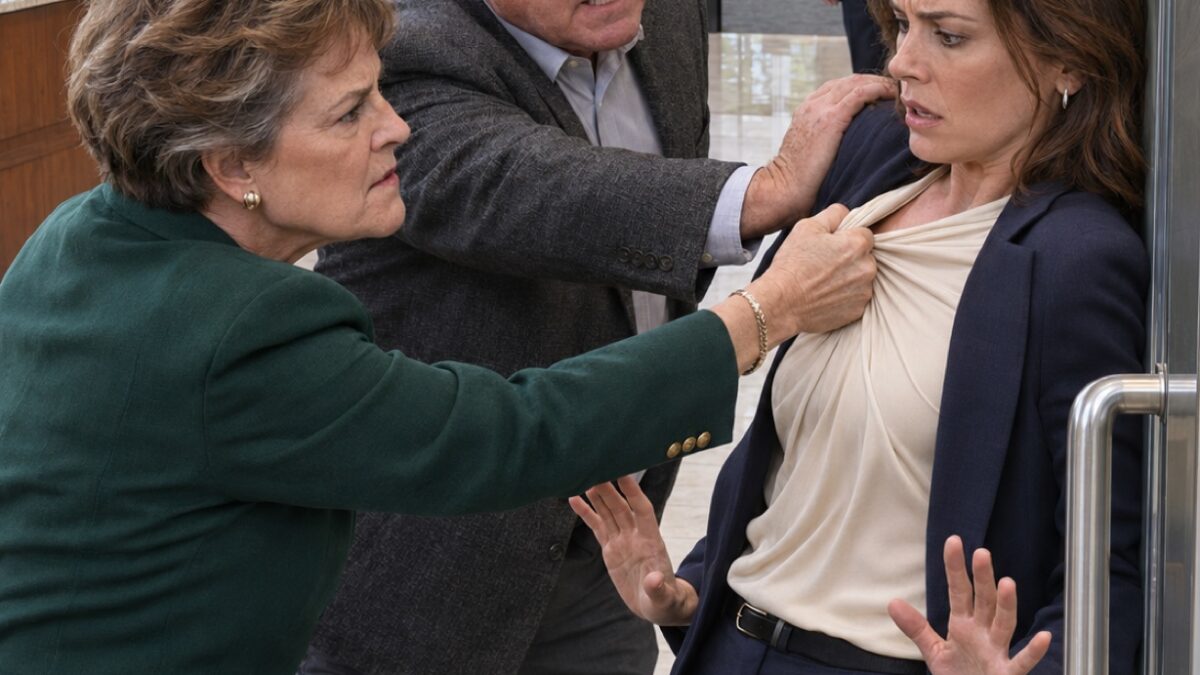
My father shoved me against the lawyer’s office door over a $58,000 offer while my mother held the collar of my blouse.
Part 3: The Spaces They Sold
“I’ve been paying your parents to park my landscaping vehicles there,” Joel said. “They told me I could keep those spaces.”
My father pulled his chair away from the doorway.
He sat down.
Joel kept looking at me, waiting for some sign that this was familiar. I had none to give him.
“Paying them?” I asked.
“Yes. For parking.”
My mother reached across the table, palm down, as though she could get him to lower his voice.
He wasn’t speaking loudly.
“They handle the lot,” he said. “That’s what I understood. I knew their vehicles were there, and Russell told me where mine could go.”
I looked at my father.
He adjusted his chair instead of answering.
“Did you tell him you owned it?”
“I told him we had the use of it.”
“That isn’t what I asked.”
Joel glanced between us. Nathan moved his writing pad closer but let me ask the questions.
My father finally said, “We never claimed the ground belonged to us.”
He knew that mattered. He also knew I had never given him permission to collect money from somebody else.
Joel took his phone out.
“I asked because somebody mentioned the property might be sold. I needed to know who could actually tell me whether my parking was secure.”
“That’s why you called Nathan?”
“Yes.”
Nathan nodded. “He asked about ownership. I told him we should speak with you directly.”
Until then, Nathan had known about an inquiry. He hadn’t known my parents were charging someone to use my property.
Neither had I.
Joel unlocked his phone and scrolled with his thumb. My mother watched the screen from across the table.
“Those conversations won’t explain all the work involved,” she said.
“What work?” I asked.
“Coordinating. Making sure people leave room. Keeping everybody out of each other’s way.”
My father leaned forward.
“We weren’t charging for your dirt, Meredith. We were handling an arrangement.”
“On my lot.”
“That we were already using.”
I put my palms flat beside my chair. The stretched edge of my collar touched my neck when I swallowed.
Joel turned his phone toward me.
The messages showed my father telling him where to park. Farther down, my mother had answered questions about access and keeping spaces available.
I read slowly.
They weren’t just passing along directions. They had promised that he could continue bringing his vehicles there.
“May I save copies of these?” I asked.
Joel looked at Nathan, then back at me.
“If it helps establish what happened, yes.”
“I want your permission. They’re your messages.”
“You have it.”
Nathan explained how Joel could send the conversation without cutting away the surrounding exchanges. Joel did it while we sat there.
My father watched him tap the screen.
He had wanted to explain this at home. Now I understood why.
When the messages arrived, Nathan opened them where I could read them. Joel checked that they matched what was on his phone.
My mother’s mouth tightened.
“That’s private business correspondence.”
“It concerns my property,” I said.
“It concerns work we did.”
I turned toward Joel.
“Did anybody tell you I had approved this?”
“They said they handled parking there. I thought that included permission.”
“Did you ever pay me?”
“No.”
“Did they tell you any of your money came to me?”
He hesitated.
“They didn’t explain what they did with it.”
“I received none of it.”
My father lifted his chin.
“Nobody said you did.”
He had stopped disputing the arrangement. Now he wanted the money separated from the land that made it possible.
Nathan asked Joel whether he had brought anything else that helped explain his use of the lot. Joel checked his phone again, then described how he had followed the parking directions my parents gave him.
I listened without interrupting.
His explanation was ordinary. That was what made it worse. He had paid people who sounded entitled to offer what they were selling.
When Nathan asked whether I wanted a brief break, I said yes.
I stepped into the hall.
The receptionist looked at my blouse, then quickly back at my face.
“Do you need anything?”
“Just a moment.”
I went into the restroom and looked at the collar in the mirror. It wouldn’t lie flat. I dampened my fingertips and pressed the fabric down anyway.
It sprang back.
For six years, I had thought the arrangement was simple. My parents could park their own hauling vehicles while I decided what to do with land I had bought for myself. I kept paying the taxes. There was no promise that they could stay forever, and no permission to bring in paying customers. I had never asked for a share of their business because I wasn’t part of it. Now I needed to make that distinction clear without letting them turn Joel into the problem.
I dried my hands and went back.
My father was speaking to him.
“We could have sorted this out without all of this.”
Joel had his phone in his hand.
“I called because I needed an answer.”
“You did the right thing asking who owned it,” I said.
Patrice looked up sharply.
“Your parents were trying to make the place useful.”
“They could use it,” I said. “They couldn’t sell parking.”
My mother pushed her chair back a little.
“We didn’t sell the property.”
“I know what you sold.”
Nathan asked my parents whether they disputed receiving Joel’s payments.
My father answered carefully.
“We received money for coordinating his parking.”
My mother agreed.
There it was, in front of Joel, Patrice, and Nathan. Not a misunderstanding about whose lot it was. An arrangement they had made without telling me.
I asked Nathan to keep the messages with my property information so we could review everything before I made any decision about ending access.
Joel leaned toward his phone again.
“There’s another part you need to read,” he said.
My father put his hand on the table.
“Joel, let’s not turn a practical arrangement into something it wasn’t.”
Joel didn’t put the phone away.
He found the exchange he wanted, held his place with his thumb, and looked directly at me.
“They also told me what they would do if I couldn’t keep parking there.”
Part 4: Their Own Promise
“They promised to refund the unused time,” Joel said. He slid his phone toward me.
The exchange was plain.
If the spaces became unavailable, my parents would return the money covering the time he could no longer use them.
I read it again, including what came before and after.
My mother folded her arms.
“That was assuming everybody behaved reasonably.”
Joel looked at her.
“I paid because you said I could keep using the spaces.”
My father started to answer, then stopped when Nathan asked whether there was another exchange changing that promise.
Joel checked.
There wasn’t.
“I didn’t make that promise,” I said. “And I didn’t receive your payment.”
“I understand that now,” Joel said.
My father rubbed his forehead.
“You’re discussing repayment before you’ve even decided to sell.”
“I’m finding out what you promised on my property.”
The difference mattered to him. If everything stayed where it was, he could avoid explaining why he had taken payment for access he didn’t control.
Nathan didn’t tell Joel what to demand. He explained that Joel’s arrangement with my parents was separate from my decision about the lot.
Joel nodded.
He wanted enough time to move his vehicles without losing access unexpectedly. I wanted that handled properly, too.
“No surprise lockout,” I told him. “We’ll confirm how this needs to be done.”
My father looked relieved.
He shouldn’t have.
I hadn’t agreed to keep the arrangement. I had agreed not to deal with it carelessly.
Before we left the conference room, I asked Nathan to review the actual situation with me privately. My parents could send anything they thought mattered.
My mother asked whether I meant they were supposed to leave.
“For this conversation, yes.”
Patrice gathered her purse.
My father lingered beside his chair, waiting for me to soften it.
I stayed seated.
After they left, Nathan asked me to start at the beginning of my permission, not the beginning of the argument.
I told him what I had allowed.
Their own business vehicles. Free parking. No fixed term. No authority to charge anybody else.
He wrote that down.
“Anything promising they could stay until they retired, or until the business ended?”
“No.”
“Anything giving them control over other people’s access?”
“No.”
He asked me to look through the messages I still had rather than rely only on memory.
I agreed.
At home, I sat at my kitchen table with my phone plugged in beside me. I searched the old conversations about the lot.
There were questions about where to leave vehicles. Requests to make room. Discussions about getting in and out.
Nothing gave them the right to sell spaces.
I saved the relevant conversations without editing them, including my own replies. Then I put the phone down and ate the dinner I had let go cold.
The next visit was to the lot.
I stood where I could see the parked vehicles and made a record of what was actually there. I didn’t open anything, move anything, or leave a warning on a windshield.
Joel helped identify which vehicles belonged to him.
I checked that against what he had told Nathan.
My parents’ hauling vehicles occupied the familiar places. His landscaping vehicles were tucked into the arrangement my father had described in the messages.
It had been organized.
That bothered me more than I expected.
There had been conversations, directions, and payments while I kept thinking I was doing a favor for my parents.
Joel stayed beside his vehicle.
“I don’t want to be in the middle of your family.”
“You’re not responsible for their permission,” I said. “I just need accurate information.”
He gave it.
Back at Nathan’s office, we went through the records together. I brought the original permission messages, the information about the vehicles, and the exchanges Joel had allowed us to save. Nathan asked about access, how the parking had worked, and whether anybody had claimed the right to stay under a separate agreement. He reviewed what was there instead of assuming that calling the place vacant made the people using it disappear. I wanted the sale. I also wanted notice that fit the actual circumstances, not something my father could dismiss because I had rushed it.
Nathan explained the proposed end to permission.
Everyone would have sixty days to move.
There would be written notice. No towing during that period. No locking anybody out while they were entitled to arrange removal.
“Does that end all parking permission?” I asked.
“That is what we’ll make clear.”
“Then prepare it.”
He asked whether I wanted more time before deciding about the buyer.
I looked at the offer.
The buyer still wanted an empty lot and was willing to close after clearance. The offer remained open through the following week.
Nothing about Joel’s disclosure made keeping the lot a better choice for me.
A week after the office incident, I accepted the $58,000 offer myself.
Nathan walked through the terms with me, including the requirement that the lot be empty before closing. I asked my questions and gave my answer.
“Yes. I want to proceed.”
Then we sent the lawyer-reviewed notice ending permission and allowing sixty days to move.
I kept my copy.
My father called after receiving it.
He didn’t claim I had failed to give notice. He asked whether I understood how difficult it was to relocate vehicles while keeping hauling jobs scheduled.
“I understand you need another place.”
“You make it sound like we can just point them somewhere.”
“I’m giving you time to arrange it.”
He said available places had restrictions. Some weren’t suitable. Others cost more than he wanted to pay.
I listened without offering to search for him.
Then he asked whether I had already told the buyer yes.
“Yes.”
He went quiet long enough that I checked whether the call had dropped.
When he spoke again, he sounded less angry.
That made me sit down.
“Meredith, we cannot move everything in time, so you need to withdraw from this sale.”
Part 5: Find Another Place
“I’m not withdrawing,” I told him. “You have the full sixty days.”
My father exhaled hard into the phone.
“You’re choosing the buyer over us.”
“I’m selling my property.”
He said the hauling schedule couldn’t simply stop while they hunted for parking. I told him nobody had asked them to stop working.
They needed to arrange another location.
“That sounds easy when you aren’t doing it.”
I moved the notice beside my phone and looked at the period we had allowed.
“If you need to coordinate pickup access, send it through Nathan.”
“You want me to ask a lawyer when I can move my own vehicles?”
“No. I want the arrangements in writing so nobody misunderstands them.”
He didn’t like that.
But he had asked me to abandon the sale, not to clarify an access problem. I wasn’t going to let those become the same conversation.
After the call, I wrote down what he had requested and sent Nathan a factual account. No description of his tone. No argument about whether I was being a good daughter.
Just what he had asked, and my answer.
Nathan confirmed that practical arrangements could be coordinated through his office. I wasn’t asking him to run their business. I wanted a clear record of access while the notice period ran.
When my parents sent questions, they got answers.
Could they retrieve vehicles while work continued? Yes, consistent with the existing access and the notice.
Could the remaining vehicles stay beyond the deadline because they were busy? I did not agree to that.
I read each reply before it went out when my decision was needed.
The paperwork wasn’t exciting.
That helped.
There was no doorway to block and no collar to hold. A request arrived in writing, and I could read it before answering.
Patrice contacted me while I was at home.
She wanted to talk in person. I told her she could write what she needed to say.
Her message was long.
She said my parents had built their work around that lot. Finding another place meant changing routes, arranging access, and spending money that should go into the hauling business.
I read it standing at the counter.
Then I set the phone down and finished washing my plate.
When I picked it up again, she had sent more.
She said she wasn’t defending what happened at the office. She was asking me to be practical.
I answered the practical part.
“They have to pay for a place themselves now.”
Her reply came quickly.
“You know the business depends on having somewhere to park.”
“Yes. They need to arrange that somewhere.”
She wanted me to see their dependence as a reason I couldn’t sell.
I had seen it that way for years, even without admitting it to myself. Whenever I considered using the property, I started by calculating how much trouble it might cause them. Their vehicles were already there. Their work was already scheduled. My plans could wait. Letting them park had been my choice, but continuing had gradually stopped feeling like a choice I was allowed to make. I left Patrice’s messages on the screen until I had answered only what she actually asked.
She tried again.
“What am I supposed to tell your mother?”
“That I’m proceeding with the sale.”
I didn’t ask her to persuade them.
She had watched what happened at the office. I wasn’t giving her another job between us.
Joel’s arrangements were different.
He sent Nathan a message explaining when he expected to remove his landscaping vehicles. He wasn’t asking me to postpone closing or cover his costs.
He wanted to avoid being in my parents’ way.
I went to the lot while he was moving things out. He checked the area around his vehicles before leaving, making sure he hadn’t left anything that belonged to his business.
“Is there anything else you need from me?” he asked.
“Just confirm when you’re finished.”
He nodded.
He had found somewhere else to park.
I didn’t ask what it cost. That wasn’t my business, and I didn’t want him thinking I was preparing to offer money.
Before he left, he mentioned the refund.
“I’ve asked Russell and Elaine about the unused time.”
“What did they say?”
“They’re working it out.”
He watched my face as if checking whether I was about to join that negotiation.
“You’ll need to handle that with them,” I said.
“I know.”
He said he had the messages and wanted to give them a chance to follow through.
That was his choice.
When his vehicles were gone, he confirmed it in writing. Nathan kept the confirmation with the other occupancy information.
My parents still had vehicles there.
I drove past only when I had a reason to check progress. I didn’t sit nearby watching them, and I didn’t call to ask whether they had moved enough that day.
They had the notice.
They had access.
They also had the responsibility for finding paid space.
My mother sent a message about how much strain this was putting on them. I read it after work, sitting with my shoes still on.
She mentioned transportation between locations, parking restrictions, and the refund Joel expected.
Then she said my father wasn’t sleeping well.
I started typing a reply about what had happened to me at Nathan’s office.
I deleted it.
That wasn’t what her message was asking about, and I didn’t need to submit the same facts for another argument.
I wrote that the sale was proceeding and that practical removal questions should go through Nathan.
She answered that I was making everything formal.
I left that alone.
Later, my phone lit up with another message from her.
She said they were spending money finding somewhere suitable. Paying Joel at the same time would make everything harder.
I read it carefully.
She wasn’t claiming I had received his payment. She knew I hadn’t. She was asking me to absorb the cost because I could, the same reason she had used for keeping the lot.
Then the request came plainly.
“Will you pay Joel back for us so we can concentrate on getting our vehicles moved?”
Part 6: Before Closing
“No,” I wrote. “That refund is yours to pay.”
My mother answered that I could settle it now and discuss the money with them later.
I knew what later usually meant.
There would be another expense, another slow stretch, another reason not to bring it up.
I didn’t write any of that.
“I never made the promise, and I never received the money.”
She said I was benefiting from the sale.
“That doesn’t make Joel’s payment mine.”
I put the phone on the table and took off my shoes. Then I sent the exchange to Nathan so the request wouldn’t become something different when my father described it.
Nathan asked whether I wanted him to answer.
“I’ve answered,” I said. “I just want it kept with the rest.”
He confirmed that I wasn’t agreeing to assume their obligation.
That was enough.
I didn’t need a longer argument dressed up as a letter. My mother had asked for money. I had said no.
Joel contacted the office about the saved messages.
He still had his conversation, but he wanted the copies he had shared preserved together so there would be no confusion about which exchanges we had reviewed.
With his permission already on record, Nathan helped return copies of those same messages to him.
I checked that nothing unrelated was included.
“These are what you gave us,” I told Joel.
“Thank you.”
“I’m not negotiating the refund for either side.”
“I understand.”
He sounded tired rather than angry.
He had moved his vehicles and asked for the unused portion back. He didn’t want to keep spending time on parking he could no longer use.
I told him I hoped they resolved it directly.
If he needed to pursue his own claim, that would be his decision. I wasn’t going to tell him to forget it because my parents were unhappy.
I also wasn’t going to claim the money they had collected.
That money had come from him under their arrangement. My part was ending permission to use the ground, not taking over their dealings.
My father wrote that Joel was being impatient.
I read it and left the accusation unanswered.
There was no reason to debate Joel’s character. The messages already showed what had been promised.
A later message from my mother was shorter.
They were returning the unused portion directly to him.
She didn’t apologize or ask me to thank them for doing it.
I didn’t.
Joel confirmed that he had received the refund.
I forwarded the confirmation to Nathan, then closed the conversation. My parents had chosen to repay him rather than prolong the dispute.
There was nothing for me to reimburse.
The next practical message concerned their vehicles.
They had obtained paid parking elsewhere and were arranging to remove what remained on my lot.
My father described the restrictions at the new place. Access had to be planned. Vehicles couldn’t simply be left wherever they fit.
I understood those were ordinary business problems.
They sounded inconvenient.
They still weren’t mine to solve.
Nathan’s office coordinated the access questions without extending the notice. My parents continued using the lot during the allowed period while they moved their vehicles out.
I did not change the terms midway through.
No locks appeared. Nothing was towed.
When a question came about retrieving a remaining vehicle, it was answered in writing. I kept those messages with the notice instead of leaving them scattered through family conversations.
My mother tried to add a personal question to a business message.
Did I really intend to keep treating them this way after everything was finished?
I answered the removal question.
Then I wrote that I wasn’t discussing further business arrangements with them.
She said that wasn’t what she meant.
I let the message stand.
Before the deadline, Nathan received confirmation that their remaining vehicles had been removed. I didn’t tell him to take their word for it and close immediately.
“I want to see it empty,” I said.
He agreed that clearance needed to be verified before the sale went forward.
I went to the lot and parked where I could see the entrance.
For a moment, I reached for my phone to ask my father where something had been moved.
Then I stopped.
Nothing was missing from my property. Their vehicles were supposed to be gone.
I walked the area.
The places where hauling vehicles had stood were clear. Joel’s spaces were clear, too. There was no equipment tucked behind something, no remaining vehicle waiting on a repair, no promise that somebody would come back for it after closing.
I took photographs and sent them to Nathan.
Then I called.
“It’s empty.”
“Are you ready for us to proceed once the notice period has run?”
“Yes.”
I stayed long enough to check the entrance before leaving. Not because I expected a trap. I wanted to be able to answer the buyer’s questions honestly.
The lot was available as promised.
After the notice period, Nathan confirmed that we could move toward closing with the clearance condition satisfied.
I read the closing information at my kitchen table.
My phone was face down beside it.
When it rang, I turned it over and saw my father’s name. I answered because the sale wasn’t finished and I wanted to know whether he was reporting an actual problem.
He wasn’t.
“We’ve moved,” he said.
“I know.”
“We found somewhere. Joel’s been paid. There’s nothing left for your lawyer to handle about us.”
“The lot is clear.”
He waited.
I could hear him breathing, then a faint movement as he shifted the phone.
He had complied with the notice. Now he wanted compliance to become a reason for me to change the sale.
“Stop it before closing, Meredith, now that we’ve done everything you asked.”
Part 7: Out the Same Door
“No, Dad,” I said. “The sale is going through.”
He asked why I was still determined to sell when the dispute had been settled.
“Because I accepted the offer.”
“You have the lot back now.”
“I’m selling it.”
He tried a different approach.
If I kept it, I would still have options. I might want the land someday. Selling meant I couldn’t decide later that I needed it.
Those were reasonable things to consider.
I had considered them before accepting.
“I’ve made my decision.”
He asked whether I was doing it because of what happened at the office.
I looked at the blouse hanging over the back of a chair. I had washed it, but the collar still didn’t sit quite right.
“What happened there is why I won’t discuss business with you in person.”
“That wasn’t what I asked.”
“The sale is my decision. It’s going forward.”
He said my mother would want to talk.
“She can write.”
I told him that future family contact needed to be in written messages. There would be no more business arrangements between us.
He wanted to argue about what that included.
I didn’t make a list of hypothetical favors.
“No parking agreements. No business dealings.”
Then I ended the call.
I sat at the table until the screen went dark, listening to the refrigerator run. I had expected to feel eager once the lot was empty.
Mostly, I wanted the closing finished.
There was still work to do.
Nathan reviewed the final information with me. The buyer’s condition had been met, the notice period had ended, and the property was clear.
The $58,000 offer hadn’t changed.
I checked the figures and asked about anything I didn’t understand. Nobody needed to hurry me through my own sale.
When it was time to sign, I read where Nathan directed me and signed for myself.
My parents weren’t there.
Neither was Patrice.
There was no discussion about whose schedule depended on the ground or whether my paycheck made selling unnecessary.
The lot belonged to me until the sale was completed.
Then it belonged to the buyer.
Nathan confirmed when the closing was complete.
I asked whether there was anything left for me to do concerning access or the former parking arrangements.
“No. Keep your records.”
I had already made a place for them.
The messages, notice, confirmations, and clearance photographs went together. I didn’t delete the upsetting parts because the sale had ended well.
I also didn’t keep reopening them.
At home, I put the file away before making dinner.
My mother wrote that she hoped we could eventually get back to normal.
I read that message while a pan warmed on the stove.
I told her I was willing to receive family messages in writing. I wasn’t discussing their business or making new arrangements with them.
She answered that conversations shouldn’t need so many rules.
I didn’t answer while cooking.
Later, I checked whether there was anything in her message that needed a response.
There wasn’t.
Patrice wrote that my parents were adjusting to the new parking place. She described the extra planning it required, then said they were managing.
I was glad they were managing.
I did not offer to help pay for it.
When she asked whether I had finished the sale, I said yes. She told me she still thought I could have handled things differently.
I left the conversation there.
I had no interest in having the same conference-room discussion through her phone.
My daily routine changed in small, practical ways.
I stopped checking family messages for parking questions before work. There was no need to find out who had left a vehicle where, or whether a sale inquiry would set off another argument.
The property taxes were no longer mine to manage after the sale.
The business wasn’t mine, either.
When my parents mentioned an errand connected to their hauling work, I didn’t rearrange my day to do it. I told them I wasn’t available for business tasks.
They found another way.
I returned to work as an Air Force officer, the same job my father had dismissed as easy money. I didn’t use my rank in any part of the dispute.
No call from work went to my parents.
No one in uniform intervened.
My lawyer had handled the property questions, and I had made the decisions that were mine to make.
At work, there were ordinary tasks waiting for me.
I read what needed reading, answered questions, and went where I was expected. Being able to concentrate without checking whether my father had invented another reason I couldn’t sell took some getting used to.
I still sometimes picked up my phone automatically.
Then I put it back down.
Afterward, I returned to Nathan’s office to collect the remaining copies for my records.
The receptionist greeted me and pointed me toward the conference room. I stopped near the entrance only long enough to let someone pass.
Nathan had my folder on the table.
“Anything else you want to ask?” he said.
I checked the contents before closing it.
“No. I have what I need.”
We spoke briefly about keeping the records, and I tucked the folder into my bag. Then I stood up without waiting for anybody else’s agreement.
The conference-room chair slid back easily.
In the hall, I straightened the strap on my shoulder and thanked the receptionist.
Nobody was waiting in the vestibule.
I didn’t have to explain where I was going or persuade someone to let me leave. My phone stayed in my bag, and my collar lay flat.
I put my hand on the entrance handle, opened the door myself, and walked outside without anyone following me, letting the lawyer’s office entrance door close behind me.
You Might Also Enjoy




