My Fundraiser Chair Sent Me To Eat By The Trash, So I Refused To Keep Serving
Complete story · 10 chapters · about 41 minutes · ending included
Chapter 1 · Chapter 2 · Chapter 3 · Chapter 4 · Chapter 5 · Chapter 6 · Chapter 7 · Chapter 8 · Chapter 9 · Chapter 10
Chapter 1: The Tray At The Door
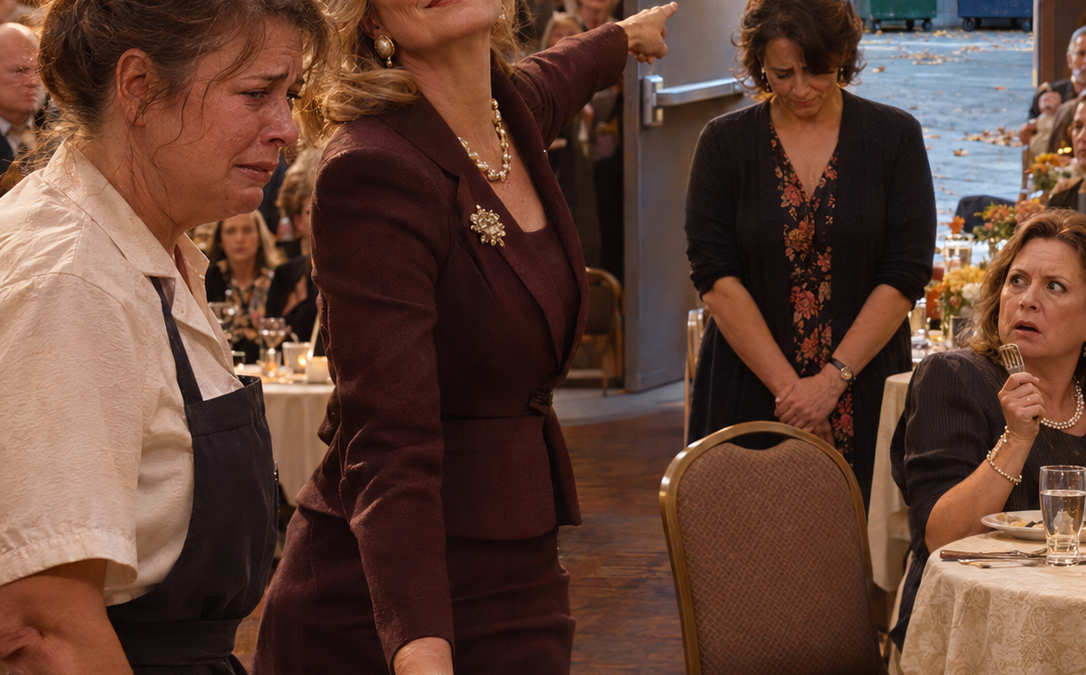
“Lunch ladies eat with the trash, not with our donors,” Kellie said.
Her finger pointed past the open rear door toward the dumpsters.
Thirty-two guests could hear her.
My dinner tray scraped across the folding table as Kellie pushed it toward me.
“I cooked this meal,” I said.
Kellie smiled like I had misunderstood a seating chart.
“And everyone appreciates that, Sonia.”
Then she pointed outside again.
The rear door stood wide enough for cold autumn wind to enter.
Behind Kellie, people sat over plates I had filled.
Roast chicken.
Buttered carrots.
Green beans with onions.
Mashed potatoes with garlic.
Dinner rolls brushed with melted butter.
Food I had bought myself.
Food I had cooked after eighteen years of feeding schoolchildren.
I was fifty-four by then.
Nearly all my working years had been spent behind serving counters.
That had never embarrassed me.
Kellie had been trying to make it embarrassing for months.
Small remarks at planning meetings.
Little corrections nobody had asked for.
“Presentation matters, Sonia.”
“Donors expect a certain level.”
“You understand how these events work.”
I understood perfectly.
She wanted my hands.
She did not want me beside the people eating what those hands made.
That hurt more than I wanted anyone to see.
My stomach tightened.
My face felt hot.
I looked at Nina.
Nina stood beside an empty chair near the kitchen doorway.
She could have moved it.
She could have said my name.
Instead, Nina lowered her eyes.
That was worse than Kellie’s finger.
Kellie enjoyed control.
Nina knew better.
I picked up my tray.
The metal edge caught the doorframe with a hard scrape.
Several guests looked over.
One woman froze with her fork raised above her plate.
A man beside her stared down at his plate.
Nobody said anything.
Silence was not kindness.
Silence made room for Kellie.
I stepped outside.
The wind hit the gravy first.
A thin skin formed across it almost immediately.
The rented hall backed onto a narrow service lane.
Two dumpsters sat against a cinder-block wall.
Kellie had pointed behind them.
So that was where I went.
I stood between cold metal and a stack of flattened boxes.
My tray rested against one forearm.
There was nowhere to sit.
I took one bite of chicken.
It had already started cooling.
I chewed slowly because my throat felt tight.
Through the open doorway, I could hear silverware touching plates.
People laughed once.
Then stopped.
Maybe they were embarrassed.
Maybe they were pretending nothing had happened.
Either way, I was still outside.
I had donated the supper willingly.
Kellie had accepted it willingly.
I had not donated my dignity with the potatoes.
Another gust came through the lane.
A dinner roll rolled against the tray’s raised edge.
I stopped it against the tray with my thumb.
My fingers trembled.
Anger had arrived beneath the hurt.
Quiet anger.
The kind that made me count facts.
Thirty-two guests.
One full supper.
Zero dollars requested from the association.
One promise from Kellie that my donation would be acknowledged.
I knew ingredients.
I knew portions.
I knew what things cost.
And I knew exactly what my gift included.
The wind lifted the corner of my napkin.
I untied my white kitchen apron.
Then I spread it over the tray.
The cloth covered the chicken, potatoes, vegetables, and roll.
My own dinner disappeared under the same apron I had worn while cooking theirs.
That picture stayed with me.
Worker covered.
Food protected.
Pride somewhere behind a dumpster.
I went inside for my coat.
Nobody stopped me.
Nina stood beside the kitchen counter sorting dessert forks.
I pulled my coat from the hook.
“I’ll clean my station,” I said.
Nina looked up.
“Then I’m leaving.”
Her mouth opened.
Before Nina answered, Kellie came through the swinging kitchen door.
“You can leave after dessert service,” Kellie said.
I stared at her.
She adjusted one pearl-colored earring.
Calm.
Neat.
Certain I would obey.
“I’m finished serving,” I said.
Kellie’s smile tightened.
“We still have thirty-two guests.”
“I know how many guests there are.”
“I’m only asking you to finish what you started.”
That cut deep.
I had started before sunrise with grocery bags on my kitchen floor.
I had peeled potatoes.
Trimmed beans.
Seasoned chicken.
Mixed dough.
Packed pans into my car.
Nothing about that woman’s tone sounded like gratitude.
It sounded like ownership.
I put on my coat.
“I’ll clean the kitchen station,” I said.
“No dessert service.”
Kellie looked past me at Nina.
“People notice when volunteers become difficult.”
My chest tightened again.
There was the threat.
Polite enough for company.
Sharp enough for me.
I had spent years hearing children complain about lunch.
Too salty.
Too green.
Wrong pudding.
Children usually forgot by the next day.
Adults could make cruelty sound organized.
I returned to the rear kitchen counter.
My covered tray still sat where I had left it.
The rear door had finally swung mostly shut.
Through its narrow window, I could see the foyer desk.
Bob Sanders sat behind it.
Bob was sixty-one and kept association accounts.
He asked exact questions and waited for exact answers.
Kellie approached him carrying a sealed white envelope.
I stopped wiping the counter.
Kellie placed the envelope beside Bob’s ledger.
She said something I could not hear.
Bob looked at the front.
Then at Kellie.
Kellie tapped one finger against the envelope.
Bob picked it up and placed it beside his calculator.
I didn’t know what the envelope held.
I only knew Kellie looked pleased.
The kitchen door opened behind me.
Nina came in carrying a folded event program.
“Sonia.”
Her voice was softer now.
I turned.
Nina held the program against her stomach.
“What?”
“I thought you should see this.”
My hands went still in the dishwater.
Earlier that week, Nina had told me my supper donation would be listed.
Nothing fancy.
No speech.
No plaque.
Just a line saying who had provided the food.
That was enough for me.
I dried my hands with a towel.
Nina passed me the program.
Her fingers released it quickly.
“I didn’t write the final wording,” she said.
I looked at her.
“Who did?”
Nina swallowed.
“Kellie approved it.”
I opened the folded page.
The auction items were listed first.
Classroom books.
Gift baskets.
A handmade quilt.
Then came the supper section.
I searched for my name.
Nothing.
I searched for the word donated.
Nothing.
My stomach turned.
“Where is my credit?”
Nina looked toward the kitchen door.
“I’m sorry.”
“That wasn’t my question.”
Nina pressed her lips together.
I looked back at the program.
One line sat beneath the supper heading.
A simple line.
Clean type.
Official enough for every guest to believe.
Evening meal provided through paid catering.
Paid catering.
My supper.
You may also like
My Husband Humiliated My Son At His Academy Banquet, So I Checked The Mail He Handled
My Mom Mocked My Job At Thanksgiving, So I Asked Questions And Uncovered My Brother’s Secret
My Stepdaughter Locked Me Out Of My Own Cabin Bedroom, So I Read Her Group Text Out Loud
My groceries.
My unpaid work.
Picking up where the Facebook post left off
Chapter 2: A Place She Cannot Offer
The words paid catering sat on the page like a stain.
I looked up at Nina.
“Who authorized this wording?”
Nina rubbed her thumb along the program’s folded edge.
“Kellie did.”
My covered tray stayed on the rear kitchen counter.
The apron I had already taken off still protected the cold food beneath it.
I held the program out toward Nina.
“She knew I donated supper.”
Nina nodded once.
“She knew I bought the groceries.”
Another nod.
“She knew I wasn’t charging anything.”
Nina looked toward the dining room.
“Yes.”
My stomach tightened again.
That answer hurt differently.
Kellie had not misunderstood.
She had chosen the wording.
Months of little remarks suddenly felt less little.
Presentation.
Standards.
Knowing my place.
Each one had been a warning I kept excusing.
I told myself she was fussy.
I told myself fundraisers made people bossy.
I told myself the food mattered more than who received credit.
But this was my name being removed from my own gift.
I walked toward the dining room doorway.
Kellie appeared before I reached it.
She glanced at the program in my hand.
Then at my coat.
“Are we finished with the drama?”
My fingers tightened around the paper.
“I need a seat inside.”
Kellie gave a small sigh.
“We discussed this.”
“No, you ordered me outside.”
Her expression stayed pleasant.
Several nearby guests could hear us.
Kellie lowered her voice only slightly.
“This evening needs an elegant appearance for the donors.”
I looked at the linen-covered tables.
Candles.
Water glasses.
My chicken on thirty-two plates.
“What part of me ruins the appearance?”
Kellie’s smile did not move.
“Please don’t make this personal.”
It was already personal.
She had sent me behind dumpsters.
She had removed my name.
Now she was pretending manners required both.
My cheeks burned.
My hands felt cold.
Cruelty sounded cleaner when Kellie called it etiquette.
“I’m not serving anything else.”
Kellie’s eyes sharpened.
“Dessert still needs to go out.”
“Someone else can carry it.”
“Sonia, everyone has a role.”
“So do I.”
I pointed at the plates beyond her.
“I cooked supper.”
Kellie’s jaw tightened.
For one second, her polished smile disappeared.
Then footsteps came toward us.
A woman from the nearest table approached holding her empty dinner plate.
She was around my age, with reading glasses hanging from a cord.
“That chicken was wonderful,” she said.
My anger loosened slightly.
“Thank you.”
“I wanted to tell whoever made it.”
Nina stepped between us before I could answer.
“Sonia asked not to be named.”
The woman paused.
I stared at Nina.
“What?”
Nina’s face changed immediately.
Kellie looked toward the dining room.
The guest glanced between us.
“I’m sorry,” Nina said quickly.
“She wanted the donation kept quiet.”
My chest hurt.
Not from embarrassment now.
From disbelief.
“I never asked that.”
The guest’s eyebrows lifted.
Nina swallowed.
“Sonia.”
“I never asked anyone to hide my name.”
The woman still held her plate.
I could see sauce dried near its rim.
A tiny ordinary thing.
It made the whole conversation feel even uglier.
Someone had eaten what I made.
Walked over to thank me.
And Nina had been ready to send her away with a lie.
“That’s what I was told,” Nina said.
“By whom?”
Nina looked at Kellie.
Kellie turned toward a dessert table as though she had heard nothing.
My anger became very still.
“Who told you I wanted anonymity?”
Nina pressed the programs against her chest.
“Kellie.”
The guest looked directly at Kellie now.
Kellie picked up a serving spoon.
“Excuse me,” she said.
Then she walked away.
No apology.
No correction.
Only escape disguised as work.
That hurt.
It also told me something.
Kellie did not want to answer while another person was listening.
The guest touched my arm lightly.
“Well, thank you, Sonia.”
“You’re welcome.”
“I mean it.”
“I know.”
She returned to her table.
Nina stayed beside me.
“I should have checked with you,” she said.
“Yes.”
“I thought Kellie had already discussed it with you.”
“She didn’t.”
Nina looked miserable.
I was hurt by her part in it.
I was also too angry to make her discomfort my job.
“You told people I requested this?”
“Only when someone asked.”
That sentence made my stomach drop.
More than one person had asked.
More than one person had been given my supposed answer.
A lie could become polite history very quickly.
I reached for my coat.
For one second, leaving still felt easier.
Clean my station.
Take my tray.
Drive home.
Lock the door.
Let them finish dessert without me.
Then I pictured tomorrow.
Someone would say Sonia did not want recognition.
Someone else would remember that I left early.
Kellie’s version would fit neatly around both facts.
My silence would become agreement.
That frightened me more than another argument.
I lowered my coat onto the counter.
Nina noticed.
“What are you doing?”
“Staying.”
Her eyes widened slightly.
“I thought you were leaving.”
“So did I.”
I picked up the program again.
“Leaving now lets Kellie use my name to support her story.”
Nina said nothing.
I tapped the line about paid catering.
“She says I asked not to be named.”
“Yes.”
“I want to see exactly what she told you.”
Nina’s fingers tightened around her stack.
“It was an email.”
“Open it.”
Nina glanced toward Kellie.
“Please.”
“No.”
My answer came out sharper than I expected.
Nina looked back at me.
“I’m not asking you to protect me from bad manners.”
I held up the program.
“I’m asking you to show me the instruction that changed my donation.”
Nina’s face went pale.
“I still have it.”
That was new.
Kellie had not merely told Nina something in passing.
There was an instruction.
Written somewhere Nina could open.
My pulse quickened.
“Then show me.”
Nina looked toward the foyer.
Then toward the kitchen.
“I need a minute.”
“You can have one.”
I took off my coat.
I placed it over the back of a kitchen chair.
Kellie had expected me to leave.
Nina had expected me to leave.
Ten minutes earlier, I had expected it too.
You may also like
My Son-in-Law Sent Me To A Motel For Christmas, So I Came Back With A Pie And His Own Texts
My Daughter-in-Law Trashed Sunday Lunch, So I Brought Proof That Silenced Her Celebration
My grandson skipped my 70th birthday for Vegas. Monday he stormed into my bingo night, furious his truck payment bounced, but the truck was in my name.
But I was not staying to carry dessert.
I was staying to make Kellie answer for the consent she invented for me.
Chapter 3: Two Messages
Nina still had Kellie’s email.
That fact kept me beside the kitchen chair.
“Show me,” I said.
Nina pulled her phone from her purse.
Her thumb hovered over the screen.
“I should have asked you before I changed anything.”
“Yes.”
“I was trying to keep the program finished.”
“I know.”
That did not erase what happened.
Nina had followed an order about my name without asking me.
I was hurt.
I was angry.
But Kellie had written the order.
That was what I needed to see.
Nina opened her email and searched.
A few seconds later, she turned the phone toward me.
The sender was Kellie.
The message had been sent that morning.
Nina scrolled until the instruction appeared.
Remove Sonia’s donated-supper credit. Do not ask her; I have decided.
I stared at the sentence.
Short.
Clear.
No misunderstanding hiding between the words.
Kellie knew it was donated.
She knew Nina had not asked me.
She specifically told Nina not to.
My hands felt cold again.
Being excluded hurt.
Seeing the instruction made it deliberate.
Little comments could be dismissed.
This could not.
“Keep that email,” I said.
Nina nodded.
“I will.”
“Print it too.”
Her face tightened.
“Sonia.”
“You said you should have asked me.”
“I should have.”
“Then help me keep the exact words.”
Nina looked at the screen.
After a moment, she nodded.
“There’s a volunteer printer in the office.”
We walked down the short hallway together.
The office was barely bigger than a storage closet.
A folding desk held an old printer beside boxes of auction bid sheets.
Nina forwarded Kellie’s email to the volunteer account.
The printer clicked.
Then it started whining.
One page slid out.
Nina picked it up.
Kellie’s instruction sat halfway down the sheet.
I read the line once more.
There was no request for reimbursement.
No dollar amount.
No claim about groceries.
Only an order to erase my credit.
“Keep your copy,” I said.
Nina looked surprised.
“You don’t want it?”
“I want you to keep the email and the printout.”
“Why?”
“Because she sent it to you.”
Nina folded the page carefully.
“I understand.”
I did too.
I needed my own paper.
Not Kellie’s instruction.
Mine.
I took out my phone.
The donation thread was still in my inbox.
I had sent it after Kellie asked whether the supper could fit the fundraiser budget.
I had answered plainly.
I always did better with plain words.
Food did not improve because somebody called carrots rustic.
A gift did not become clearer because somebody called it support.
I opened my message.
The original email listed what I was providing.
Groceries.
Cooking.
No reimbursement.
Then I found Kellie’s reply.
My heartbeat picked up.
“Nina.”
She leaned toward my screen.
I showed her the sentence.
I accept your gift of all supper ingredients and cooking. No reimbursement is due.
Nina’s mouth parted.
“She wrote that.”
“Yes.”
I felt something hard settle under my anger.
Kellie had removed the credit for something she had personally accepted as a gift.
That was not a memory problem.
That was not careless wording.
It was written.
“Can we print this?”
“Yes.”
Nina helped me send the thread to the same printer.
The machine pulled another sheet through.
I took it while it was still warm.
My name appeared at the top.
Kellie’s reply sat beneath mine.
I touched the edge of the page.
I had bought chicken because it was on sale.
I had counted potatoes by serving size.
I had used my own foil pans.
I had given hours of work because classroom books mattered.
I had asked for no money.
Only honest credit.
That seemed small now.
Maybe that was why Kellie thought she could take it.
Small things are easy to steal when everyone calls them unimportant.
I folded the printout once.
Then I went back toward the dining room.
Kellie was arranging dessert plates.
Her posture changed when she saw me.
“You’re still here.”
“Yes.”
I held up the program.
“This needs correcting.”
Kellie kept moving plates.
“We are not reprinting programs during dinner.”
“Then announce the correction.”
Her mouth tightened.
“There is nothing to correct.”
“You accepted the supper as a donation.”
“I know what I accepted.”
“Then why does this say paid catering?”
Kellie gave me the patient look adults use on difficult children.
“It’s a harmless simplification.”
My stomach turned.
“Paid and donated are opposites.”
“Guests do not care about accounting language.”
“I care about my name being removed.”
Kellie glanced toward Nina.
“This is becoming embarrassing.”
For me, apparently.
Never for her.
She could send me behind dumpsters.
She could erase my contribution.
But asking for accurate words was embarrassing.
My face burned.
I kept my voice level.
“Tell them I donated supper.”
“No.”
One word.
Polite.
Final.
I thought of her email.
Do not ask her; I have decided.
That was Kellie’s favorite kind of decision.
One made for someone else.
“Why do you need them to think it was paid for?” I asked.
Kellie picked up a dessert fork.
“You are making too much of one phrase.”
“Then changing it should be easy.”
She looked directly at me.
“I said no.”
I folded the program.
Then I folded my printed email smaller and slipped it into my coat pocket.
Kellie watched me do it.
For the first time that evening, her confidence looked strained.
Only slightly.
But I saw it.
A glass chimed in the dining room.
Bob had finished checking guests in.
Someone called for Kellie.
She smoothed the front of her blouse.
Then her public smile returned.
“Excuse me,” she said.
Kellie walked to the microphone.
Nina stayed near the program table.
I stood just inside the dining room.
The guests turned toward Kellie.
She thanked everyone for supporting classroom books.
She praised the auction donations.
Then she lifted one hand toward the plates.
“And tonight,” Kellie said, “we were able to provide you with an expensive catered supper worthy of this event.”
I stopped breathing for a second.
Expensive.
Catered.
You may also like
My Son-in-Law Called Me Forgetful On Mother’s Day, So I Took Notes And Exposed His Plan
My Cousin Called Me A Thief At Thanksgiving, So I Checked The Log And Found What He Hid
My Son-in-Law’s Mother Locked Me Out On MEA Weekend, So I Photographed What She Left Behind
She had said it aloud.
And thirty-two guests had heard her.
Chapter 4: The Envelope Opens
Thirty-two faces stayed turned toward Kellie.
Her words about an expensive catered supper were still in the room.
I stepped toward the microphone.
“Kellie, correct that.”
Her smile remained fixed.
She lowered the microphone slightly.
“We’re in the middle of the welcome.”
“Tell them the supper was donated.”
A few guests looked at me.
My stomach tightened.
I hated making a scene.
I hated more that telling the truth had become the scene.
“Give me the microphone,” I said.
Kellie’s eyes hardened.
“No.”
“I only need one sentence.”
“You have already disrupted enough.”
That hurt.
She had put me outside with the trash.
She had erased my name.
Now my objection was the disruption.
Little cuts.
Always dressed as my bad behavior.
I looked toward Nina.
“Nina, I want a correction before dinner ends.”
Kellie followed my eyes.
“Nina, if Sonia keeps this up, replace her on future fundraiser volunteer lists.”
Nina froze beside the stack of programs.
My face went hot.
There was the punishment.
Public.
Neat.
Small enough for Kellie to pretend it was administrative.
I had volunteered at school events for years.
But Kellie did not employ me.
She could remove my name from fundraiser lists.
She could not touch my school kitchen job.
That mattered.
My paycheck did not belong to her.
My eighteen years behind that lunch counter did not belong to her either.
I looked back at Kellie.
“You don’t control my job.”
“I never said I did.”
“You wanted that to sound bigger than it was.”
Her smile thinned.
“I’m trying to preserve standards.”
My hands trembled.
Standards.
Another clean word for humiliation.
I wanted to tell every guest exactly where she had made me eat.
I wanted to pull my printed email from my pocket.
Instead, I kept my voice low.
“Correct the program and your speech.”
“No.”
Kellie raised the microphone again.
“Now, if everyone would enjoy dessert before the auction.”
Conversation started carefully around the tables.
Forks moved.
Chairs scraped.
People tried to help Kellie make the moment disappear.
I stood there another second.
Then Nina gathered the program stack.
She did not look at me.
“Nina?”
Her hands tightened around the papers.
“I need to move these.”
“Are you replacing me?”
Nina’s eyes flicked toward Kellie.
“I don’t know.”
That answer hurt.
Nina knew what Kellie had written.
She had printed the instruction herself.
Still, she carried the programs away without defending me.
Fear could make decent people useful to cruel ones.
I had learned enough for one evening.
I returned to the kitchen.
My tray remained on the rear counter beneath my apron.
The food under it was cold now.
I did not uncover it.
I took a damp cloth and wiped my station.
Flour dust near the mixer.
A streak of gravy beside the warming pans.
Butter on the edge of a cutting board.
Work I understood.
A mess could be cleaned when you could see it.
People were harder.
I rinsed the cloth.
Then I wiped the counter again.
My coat waited on the chair.
I had stayed long enough to challenge the lie.
Kellie had refused.
Nina had backed away.
I was ready to leave.
I reached for my apron.
From the foyer, I heard my name.
“Sonia?”
I stopped.
Bob stood behind the check-in desk.
The last guest had already signed in.
His ledger was closed.
The sealed white envelope Kellie had handed him earlier was open.
Bob held several sheets in one hand.
“Sonia, come here a minute.”
Something in his voice made me put the apron down.
Exact.
Flat.
Concerned.
I walked toward the desk.
Kellie was across the hall talking to two guests.
She did not notice me move.
Bob spread the papers slightly.
I could see Kellie’s signature at the bottom of one page.
Above it was a block of typed text.
I caught only pieces at first.
Supper ingredients.
Cooking.
Catering reimbursement.
My stomach tightened.
Bob did not turn the page toward me yet.
He read another line.
Then another.
His forehead creased.
“What is that?” I asked.
“One minute.”
He placed the page beside his calculator.
A dollar amount sat near the bottom.
I could not see all the digits from where I stood.
But I could see the heading.
FINAL INVOICE.
My hands went cold.
Invoice.
For the supper.
The supper I had donated.
The supper Kellie had called expensive catering.
I touched the folded acceptance email inside my coat pocket.
Bob looked at the invoice.
Then at me.
You may also like
My Son-in-Law Banished Me At Christmas Dinner, So I Checked The Papers He Thought I’d Ignore
My Daughter Mocked My Seventieth Birthday, So I Checked A File That Changed Her Party
My Son Called Me His Dependent At Thanksgiving, So I Stopped Paying And Found His Family’s Secret
His voice stayed quiet.
“Did you send Kellie a bill?”
Chapter 5: What The Gift Became
Bob kept his finger beside the invoice.
“Did you send Kellie a bill?”
“No.”
He turned the page toward me.
The amount was fully visible now.
$6,800.
Below it was the payee.
Kellie Schultz.
Then the demand.
FINAL INVOICE — catering reimbursement, $6,800. Pay Kellie Schultz tonight.
My stomach dropped.
I had expected another insult.
I had not expected my gift to become her bill.
“She’s asking the association to pay her?”
Bob nodded once.
“For this supper.”
I pulled the folded email from my coat pocket.
“My supper.”
I opened the page on his desk.
Bob leaned closer.
I pointed to Kellie’s reply.
I accept your gift of all supper ingredients and cooking. No reimbursement is due.
Bob went completely still.
His eyes moved from my page to the invoice.
“Same meal?”
“Yes.”
“The chicken?”
“Yes.”
“Potatoes, vegetables, rolls?”
“All of it.”
“And your cooking?”
“Donated.”
My hands started shaking again.
Six thousand eight hundred dollars.
I thought about my grocery cart.
Chicken trays.
Butter.
Flour.
Potatoes.
The food had cost me real money.
The work had cost me hours.
But none of it had cost Kellie anything.
She had taken what I gave and put her own name beside a price.
That hurt in a new place.
Sending me outside had been contempt.
This was something colder.
Bob picked up his calculator, then set it down without pressing a key.
“I’m not paying this.”
I looked at him.
“Good.”
“I need to ask her for documentation.”
“She has my email.”
“I know.”
His voice stayed exact.
“But I need her answer about her own claim.”
Bob folded the invoice once and kept it in his hand.
“Stay here.”
He crossed the room toward Kellie.
I followed far enough to hear without standing beside them.
Bob stopped near the dessert table.
“Kellie, I need purchase receipts for the catering invoice.”
Her smile vanished.
“What receipts?”
“For the six thousand eight hundred dollars.”
Kellie glanced toward me.
Then back at Bob.
“That is the final amount.”
“I asked for receipts.”
“I handled the supper.”
“That isn’t a receipt.”
Her face tightened.
“This is not the time to audit me.”
Bob said nothing.
He was good at that.
Exact question.
Then silence.
Kellie filled it.
“The auction hasn’t even been counted yet.”
“That has nothing to do with supporting this expense.”
“I need the payment processed before those proceeds are counted.”
Bob’s eyebrows lifted slightly.
“No.”
One word.
Nothing polite wrapped around it.
Kellie’s cheeks colored.
“I’m the chair.”
“And I’m the treasurer.”
“You have a signed invoice.”
“I have an unsupported invoice.”
She looked at the paper in his hand.
Then at me.
My anger rose again.
No receipts.
No grocery slips.
Nothing showing she had spent one dollar on my supper.
Still, she wanted payment before anyone counted the auction money.
“Bob,” Kellie said, “please stop creating unnecessary confusion.”
He waited.
Her voice sharpened.
“Pay it tonight.”
“No.”
Kellie turned away from him.
Conversation over, according to her.
Bob came back to the desk.
He placed the invoice beside my acceptance email.
“Nothing gets paid.”
I believed him.
For the first time that evening, somebody with authority over the money had said no to Kellie.
It did not erase what she had done to me.
But it stopped the money from leaving.
I looked toward the dining room.
Guests were finishing dessert.
“They still think this was paid catering.”
Bob followed my gaze.
“Yes.”
“I asked her to correct it.”
“I heard part of that.”
“She refused.”
Bob looked at the program.
I slid it toward him.
“I want the public correction I already asked for.”
His eyes moved over the line.
Evening meal provided through paid catering.
Then he looked at the invoice again.
“There’s a budget announcement before the auction count.”
“I know.”
“I can ask her to explain the expense then.”
“In front of everyone?”
“Yes.”
My fear came back immediately.
Thirty-two guests.
One microphone.
Kellie smiling while she found another way to make me look difficult.
My hands felt damp.
I wanted the correction.
I also knew what public humiliation felt like now.
Still, I had already watched silence help her once.
Silence was not patience.
Silence was permission.
“Ask her,” I said.
Bob nodded.
Footsteps approached behind us.
Nina stood there holding the page she had printed earlier.
Kellie’s instruction.
She kept it pressed against her chest.
“I heard what Bob asked her.”
I looked at the paper.
“You still have it.”
“Yes.”
Bob held out his hand slightly, then stopped.
Nina did not give him the page.
She looked at me instead.
“I brought it because it shows what she told me.”
“Will you say that when Bob asks her?”
Nina’s eyes dropped.
“I can’t.”
The answer hurt.
Again.
She knew Kellie had ordered my credit removed.
She had proof in her hands.
But fear still had more authority over her than truth did.
“Nina.”
“I’m sorry.”
“I don’t need sorry.”
Her face tightened.
“I know.”
“Will you speak?”
“No.”
I looked at the printed instruction.
Then at Nina.
She had brought the evidence.
That mattered.
She still would not use her voice.
That mattered too.
Bob picked up the invoice.
“I’ll ask Kellie to identify this expense during the budget announcement.”
He tucked nothing away.
The invoice stayed visible in his hand.
My acceptance email stayed with me.
Nina kept her own printout.
Three papers.
Three people.
One woman about to be asked what she had done.
A spoon struck a water glass near the microphone.
Guests began turning toward the front.
You may also like
My Stepmother Demanded My Guest Cottage, So I Locked The Gate And Let Her Story Unravel
On Thanksgiving, my daughter told 31 relatives I was too confused to handle money and had filed for guardianship. In June she’d had me co-sign her $38,000 car loan.
My Ex Stole My Ring For His Wedding, So I Went Home And Found What He Forgot
Bob walked toward the microphone carrying Kellie’s invoice.
I followed him.
Chapter 6: The Cost Of Supper
Bob reached the microphone with Kellie’s invoice still in his hand.
I stopped beside him.
All thirty-two guests were still seated.
Forks rested beside half-finished desserts.
Coffee cups sat untouched.
Kellie stood near the auction table.
Bob tapped the microphone once.
“I need Kellie to identify an expense before we continue.”
Her smile disappeared.
“Bob, this can wait.”
“No.”
He held up the invoice without handing it to anyone.
“This one needs explaining now.”
Every face turned toward Kellie.
My stomach tightened.
I felt the same heat I had felt near the rear door.
Only now I was inside.
Kellie walked toward us.
“What expense?”
Bob looked down at the page.
“The supper.”
Her expression changed immediately.
Not surprise.
Annoyance.
“I paid for every ingredient and every hour in this supper.”
The room went quiet.
My hands started shaking.
She said it easily.
Thirty-two people had eaten food I bought.
She still looked them in the face and claimed it.
That hurt more than I expected.
My chicken.
My potatoes.
My hours.
Her sentence.
Bob looked at me.
“Sonia?”
I took my printed email from my coat pocket.
The fold had softened from being opened.
“My answer is in writing.”
Kellie crossed her arms.
I raised the sheet in front of me.
My voice shook on the first word.
Then it steadied.
“Kellie replied to my donation email.”
I read her sentence.
I accept your gift of all supper ingredients and cooking. No reimbursement is due.
Someone near the front stopped moving a coffee spoon.
I looked across the tables.
“You ate roast chicken I bought.”
I pointed gently toward the serving dishes.
“Mashed potatoes with garlic.”
“Buttered carrots.”
“Green beans with onions.”
“Dinner rolls I made.”
My throat tightened.
“All of it came from my groceries and my kitchen.”
Kellie gave a short sigh.
“You are confusing documents.”
“No.”
Bob’s answer came before mine.
He looked at Kellie.
“You just said you paid for every ingredient and every hour.”
“I did.”
I stared at her.
The lie was so complete it almost made me dizzy.
She had not bought one onion.
She had not stirred one pan.
But confidence made false things sound official.
That frightened me.
It also made me angry.
Bob lifted the invoice slightly.
Kellie pointed at it.
“That document was only an estimate, never a request for money.”
Bob looked down at the heading.
Then he brought the microphone closer.
He read slowly enough for everyone to hear.
“Final invoice.”
Kellie’s lips pressed together.
Bob continued.
“Catering reimbursement, six thousand eight hundred dollars.”
A man at the nearest table leaned back in his chair.
Someone whispered, “What?”
Bob kept reading.
“Pay Kellie Schultz tonight.”
My stomach turned again.
Hearing her name beside the money made it worse.
The page had looked ugly on Bob’s desk.
Spoken aloud, it sounded impossible.
Bob kept the invoice in his own hands.
He did not pass it to Kellie.
He did not pass it to me.
Then he looked at the guests.
“Nothing has been paid.”
A few people shifted in their chairs.
Kellie lifted one palm.
“I used the wrong template. You’re embarrassing the school.”
My face burned.
There it was.
She had asked for money in writing.
Bob had refused it.
Yet somehow I was still the embarrassment.
I thought about the dumpsters.
The cold chicken.
Her finger pointing outside.
The same woman who sent me there now wanted dignity from me.
My hurt hardened into anger.
Bob stayed calm.
“The template names you as payee.”
“It was an administrative mistake.”
“It also says final invoice.”
“I said it was the wrong template.”
Bob waited.
Kellie hated his silence.
I could see it.
She looked toward the guests instead.
“This entire thing is being distorted.”
I held my printed acceptance at my side.
“What part?”
Kellie ignored me.
Then her eyes landed on the programs.
“Sonia asked us to leave her donation out of the program.”
My chest tightened so sharply I pressed my lips together.
Again.
The same invented permission.
She had already used my supposed wishes to erase me.
Now she was using them to defend herself.
That hurt in a different way.
A lie about money was one thing.
A lie spoken in my name felt personal.
“I never asked that,” I said.
Kellie looked almost sympathetic.
“You wanted the focus on the students.”
“No.”
“You said you didn’t need attention.”
“I never said that either.”
Her smile returned.
Small.
Controlled.
“Sonia, people say things casually and forget.”
My hands curled around my email.
I did not forget being erased.
I did not forget being sent outside.
And I did not forget the exact instruction Nina had shown me.
I looked toward the program table.
Nina was standing behind it.
Her face had gone pale.
The printed email remained in her hand.
Kellie followed my eyes.
For a second, nobody moved.
Nina looked down at the page.
Then at Kellie.
Kellie’s expression sharpened.
“Nina, we don’t need more confusion.”
Nina took one step away from the programs.
My heart started beating faster.
She had refused me before.
She had said she would not speak.
I could still hear it.
I can’t.
That answer had hurt.
Now the same woman was walking toward us with Kellie’s instruction in her hand.
Kellie spoke again.
“Nina.”
Nina kept walking.
She stopped several feet from Bob.
Her fingers trembled around the printout.
Bob lowered the microphone.
Nina looked at it.
You may also like
My Daughter-in-Law Excluded Me From Christmas Eve, So I Made A Delivery She Never Expected
My Daughter-in-Law Soaked My Dress With Wine At Her Fundraiser, So I Read What She Wanted Hidden
My Son-in-Law Trashed My Retirement Lunch, So I Went For Ice And Found His Secret
Then she looked directly at him.
“Leave the microphone on.”
Chapter 7: Who Belongs Inside
“Leave the microphone on,” Nina said.
Bob raised it again.
Nina stood beside me with Kellie’s printed email in her hands.
Her fingers were shaking.
Kellie’s face had gone tight.
“Nina, think carefully.”
Nina looked at the page.
“I have.”
Then she read.
Remove Sonia’s donated-supper credit. Do not ask her; I have decided.
Nobody moved.
I heard a chair creak near the back table.
Nina lowered the paper.
“You told me not to ask her. I should have asked anyway.”
Her voice cracked on the last word.
That hurt.
Not because Nina had finally admitted it.
Because she had known enough earlier to wonder.
She had chosen obedience instead.
I had eaten behind dumpsters while that email sat in her inbox.
My chest tightened.
I was angry with her.
I was also relieved she had stopped hiding.
Both feelings could fit in the same room.
Kellie stepped toward the microphone.
“My organizing time has value even if her food was free.”
Bob looked down at the invoice.
Then back at Kellie.
“Where is the organizing fee?”
Kellie’s mouth opened.
Bob lifted the page slightly.
“This invoice says catering reimbursement.”
He tapped the paper with one finger.
“It lists ingredients and cooking.”
Kellie stared at him.
“There is no organizing fee anywhere on it.”
The room stayed quiet.
Kellie tried to smile.
“You know how much work I do.”
Bob waited.
Exact question.
Then silence.
I watched Kellie search for another sentence.
She had plenty when she was ordering me outside.
Now the words were harder.
I looked at the guests.
Thirty-two adults had watched me carry my tray away.
They had heard her tell me where I belonged.
Some had looked down.
Some had watched.
Nobody had stopped her.
My stomach hurt remembering it.
I did not want revenge.
I wanted the truth said in the same room as the lie.
I stepped closer to the microphone.
Kellie looked at me.
I said her own words back to her.
“Lunch ladies eat with the trash, not with our donors.”
Several guests looked down.
One woman covered her mouth.
Kellie’s face reddened.
“That was taken out of context.”
“No.”
My voice was steady now.
“You pointed at the dumpsters.”
Kellie looked toward Bob.
He said nothing.
I held my printed acceptance email at my side.
“You accepted the groceries and cooking as a gift.”
I pointed toward the tables.
“They ate the food.”
Then I looked directly at Kellie.
“Which part of a free supper entitled you to six thousand eight hundred dollars?”
Kellie said nothing.
My hands were still trembling.
But I did not hide them.
She had made me feel small all evening.
Too ordinary for the room.
Useful enough to cook.
Not polished enough to sit.
Then she had put her own name beside money for my work.
That hurt.
It still hurt.
But pain sounded different when I finally said what happened plainly.
Kellie reached toward the microphone.
Then stopped.
Bob did not move it closer.
I looked at her one last time.
“My supper was a gift. Your invoice wasn’t.”
Nobody clapped at first.
I was grateful.
I did not need applause turning it into a show.
I needed the facts to stay where Kellie could not brush them aside.
Then a chair scraped beside me.
Nina pulled it out from the program table.
“This was mine,” she said.
She looked at me.
“Please take it.”
I stared at the chair.
An indoor chair.
Such a small thing.
It should never have meant anything.
Now it meant more than it deserved to.
Kellie had turned a seat into a line between people.
Nina was trying to erase that line.
I hesitated.
My anger at Nina had not disappeared.
Neither had the picture of her lowering her eyes.
But she had finally used her voice when it cost her something.
I nodded.
“Thank you.”
A woman from the nearest table stood.
The same guest who had thanked me earlier.
“I’ll get your dinner.”
I started to object.
She shook her head.
“You cooked it.”
Then she walked toward the kitchen.
I sat down.
My knees felt weak.
For the first time that evening, I was sitting among the people eating my food.
The guest returned carrying my tray.
My apron still covered it.
She set it in front of me carefully.
The chicken was cold.
The potatoes had gone stiff.
I did not care.
I lifted the apron away.
Nina sat nowhere.
She remained standing beside the chair she had given me.
Kellie stayed near the microphone.
Bob looked at her.
“Do you want to answer Sonia’s question?”
Kellie looked around the room.
No one rescued her.
She had expected Nina to stay quiet.
She had expected Bob to process the invoice.
She had expected me to leave through the rear door.
None of that had happened.
Her hand touched the microphone stand.
Then dropped.
She walked back toward her table.
No explanation.
No receipt.
No answer.
I watched her sit.
Her plate was untouched.
Dessert remained beside it.
Bob followed slowly.
He still held the invoice.
I kept my acceptance email.
Nina still held her printed instruction.
Nothing changed hands.
Bob stopped beside Kellie’s place.
He laid the disputed invoice beside her untouched plate.
Six thousand eight hundred dollars.
You may also like
At my 68th birthday in the church hall, my son-in-law informed 40 guests I had skipped paying the caterer. My grandson’s phone video showed him canceling my $1,200 order.
My husband left his son the $1.2M lake house and me his old feed store. At the funeral lunch, my stepson laughed, not knowing the lake road crosses my lot.
My late husband’s brother charged his wife’s 17 relatives $2,400 to spend Thanksgiving at the hunting cabin I inherited. I found the rental listing with my porch on it.
Still unpaid.
Still hers to answer for.
Chapter 8: Nothing Paid
The invoice stayed beside Kellie’s untouched plate.
Three days later, Bob placed that same unpaid claim in front of her again.
Monday morning, I stood beside him before my lunch shift.
We were in a small association office near the school cafeteria.
Kellie sat across from us.
Bob placed a second page beside the invoice.
“This is the payment summary.”
Kellie glanced at it.
I could see the total from where I stood.
$0 paid.
My stomach tightened anyway.
Six thousand eight hundred dollars had almost been attached to my gift.
Now the only number that mattered was zero.
Bob folded his hands.
“You have two choices.”
Kellie looked at him.
“You can support this expense at the next association meeting.”
He tapped the invoice.
“Bring receipts and explain the claim.”
Then he touched the zero-payment summary.
“Or withdraw it.”
Kellie looked at me.
I knew that look.
She wanted me to feel like the problem had followed her here.
I did feel something.
Anger.
Hurt.
A little fear that she would invent another version before lunch.
But I did not look away.
Kellie leaned back.
“You’ve already decided I’m guilty.”
Bob’s face stayed still.
“I asked whether you can support the expense.”
“You humiliated me Friday.”
“No.”
Bob waited.
Kellie hated that pause.
She turned toward me instead.
“I hope you’re satisfied.”
The sentence hit harder than I expected.
As though stopping an unpaid false claim had been something I did to her.
As though the dumpsters were forgotten.
As though my name had removed itself from the program.
My hands tightened around the strap of my work bag.
“I wanted the truth corrected.”
Kellie gave a small laugh.
“You wanted a spectacle.”
My face warmed.
She still needed me to be unreasonable.
It was easier than admitting what she signed.
I thought about the cold chicken on my tray.
The rear door.
Thirty-two guests watching.
Then I thought about Bob saying zero.
Truth did not become cruelty because Kellie disliked hearing it.
Bob slid a pen across the desk.
“Do you intend to support the invoice?”
Kellie stared at the pen.
Then at the withdrawal form beside it.
Her mouth tightened.
“Then take my name off everything.”
Bob did not react.
“Be specific.”
Kellie looked furious.
“Everything.”
Bob moved another page forward.
“This is a voluntary resignation from the association chair position.”
She grabbed the pen.
I watched her sign the invoice withdrawal first.
Her handwriting pressed hard enough to leave marks through the paper.
Then she signed the resignation.
No speech.
No apology.
Only her name.
Kellie pushed the pages toward Bob.
He gathered both originals.
He placed them with the unpaid invoice and payment summary.
Nothing passed to me.
Nothing needed to.
The association had paid Kellie zero dollars for my supper.
Bob closed the folder.
“I’ll retain the originals.”
Kellie stood.
Her chair scraped sharply behind her.
“You can explain this mess without me.”
Then she walked out.
The door shut.
My shoulders dropped.
I had expected satisfaction.
What I felt was tired.
A lie could take five minutes to tell.
Cleaning it up could take days.
I checked the wall clock and picked up my work bag.
“I have lunch.”
Bob nodded.
“Go feed your kids.”
That sentence helped more than he knew.
My real job was still there.
Kellie had never owned it.
The cafeteria smelled like tomato soup when I walked in.
Trays rattled along the serving line.
Milk cartons thumped into plastic bins.
Normal noise.
Useful noise.
I tied on a clean apron.
Then I went to work.
No donors.
No speeches.
No elegant appearance.
Just children deciding whether peas were suspicious.
I served lunch the way I always had.
One tray at a time.
Near the end of the shift, I finally sat with my own food.
A coworker came past carrying clean utensils.
She set a spoon beside my tray.
That was all.
No congratulations.
No request for the story.
No speech about how brave I had been.
Just a clean spoon where I needed one.
I liked that.
Kindness did not always need an audience.
After cleanup, Nina found me near the cafeteria doors.
She held a printed draft.
“I need you to look at something.”
My stomach tightened again.
“What is it?”
“A correction for the fundraiser guests.”
I took the paper.
The first paragraph apologized for “confusion surrounding event acknowledgments.”
I stopped there.
“That says nothing.”
Nina nodded.
“I know.”
The next paragraph praised Kellie’s years of leadership.
I looked up.
“You’re sending another speech about her?”
“That was the old draft.”
Nina pointed lower.
“I want a factual correction instead.”
I kept reading.
The draft admitted the supper had not been paid catering.
It said no catering reimbursement had been issued.
That part was accurate.
Then came the line about me.
We apologize if any volunteer contribution was not described clearly.
My chest tightened.
“Not this.”
Nina looked embarrassed.
“I thought you’d say that.”
“It makes the mistake sound accidental.”
“Yes.”
“And it still doesn’t say what was missing.”
Nina held out a pen.
“Then change it.”
I thought about the thirty-two guests.
They had heard Kellie tell me where lunch ladies belonged.
They had watched me carry my tray outside.
Some had looked away.
Some had stayed silent.
Now they would receive a correction.
I did not know what they would do with it.
That part belonged to them.
But I knew what the correction needed to say.
No vague apology.
No polished language hiding the gift again.
I crossed out the sentence.
Then I wrote the missing credit underneath.
Sonia Benson donated all supper ingredients and cooking.
That was the correction.
You may also like
On Christmas Eve, my dad thanked my brother for paying his $31,400 knee surgery and gave him Grandpa’s watch in front of 22 relatives. His card was in my purse.
At Mom’s 75th birthday dinner, my brother told 22 relatives I let scammers take her $40,000. Then Mom called the number that texted her, and his jacket started ringing.
At my 71st birthday lunch, my son-in-law told 18 relatives I’d signed a power of attorney online to sell my $640,000 lake house. That Tuesday I was in surgery.
That was the truth.
And this time, my name stayed in it.
Chapter 9: Thirty-Two Names
Nina stared at the sentence I had written.
Sonia Benson donated all supper ingredients and cooking.
“That stays,” I said.
Nina nodded.
“It stays.”
She carried the correction to her desk and opened the guest list.
Thirty-two names.
The same thirty-two people who had eaten my food.
The same thirty-two who had watched me carry my tray outside.
Nina typed their addresses one by one.
Then she added mine to the copy line.
I stood beside her while she checked the message.
No praise for Kellie.
No soft language about confusion.
Just facts.
The supper was donated.
No catering reimbursement had been paid.
My name belonged beside the gift.
“Send it,” I said.
Nina clicked.
The message disappeared from her screen.
My phone buzzed seconds later.
There it was in my own inbox.
The correction.
My name.
The truth in plain words.
I expected relief.
Instead, my stomach tightened.
Thirty-two people were about to remember exactly what they had watched.
I wondered how many would answer.
The first reply came before Nina closed her laptop.
A woman from the front table wrote:
I saw Sonia leave through the rear door. I should have said something.
My throat tightened.
Another arrived.
I watched her carry her tray outside and assumed someone else would intervene.
Then another.
I knew it looked wrong. I stayed seated.
Those words hurt.
Nobody claimed they had missed it.
Nobody said the room was too loud.
They had seen me.
They had understood enough to feel uncomfortable.
They had simply waited for somebody braver.
I set my phone down.
Nina read the replies over my shoulder.
“I’m sorry,” she said.
I looked at her.
“You already said that.”
Her face reddened.
“I know.”
“This is the part where people say what they did.”
Nina nodded.
That mattered more to me than another polished apology.
A person could regret anything privately.
Owning it required a sentence with a subject.
I watched.
I stayed seated.
I should have spoken.
Those were harder words.
They were also honest.
More replies arrived through the afternoon.
Some were brief.
Some offered apologies.
One guest wrote that she had looked at the rear door after I disappeared and still kept eating.
That one stayed with me.
I understood fear.
I understood not wanting to challenge Kellie in public.
But knowing why people stayed quiet did not make the cold chicken warmer.
It did not move the dumpsters farther away.
Hurt did not vanish because someone finally named it.
It simply stopped being denied.
Later, Nina asked me to come into the volunteer office.
Two other volunteers were there with notebooks open.
Nina turned her laptop toward us.
“Kellie emailed.”
My shoulders tightened.
“What does she want?”
Nina opened the message.
Kellie had offered to organize another dinner.
She called it a chance to “restore professionalism.”
I stared at those words.
The woman who had sent me outside with the trash still wanted to define professionalism.
My face grew hot.
Old anger returned quickly.
Nina did not ask what I thought.
She began typing.
“Thank you for offering,” she said aloud.
Then she stopped.
One volunteer shook her head.
“No.”
The other woman nodded.
“We don’t need another chairperson running everything.”
Nina deleted the sentence.
She started again.
Your offer to organize the next dinner is declined.
Simple.
Direct.
Kellie could not turn it into an invitation.
Nina sent it while I watched.
Then the volunteers discussed the cleanup supper.
One woman offered to set tables.
Another would handle drinks.
Bob would bring the association records that needed filing.
Nina would cook.
Nobody was put in charge of being impressive.
Nobody talked about elegance.
They divided the work.
I listened.
It felt strange.
For months, Kellie had made every task sound like a favor only she knew how to grant.
Now four adults simply chose jobs.
No throne.
No performance.
Just work.
“We’re keeping supper modest,” Nina said.
“Good.”
“It’s Friday, November 20.”
I nodded.
Nina looked at me carefully.
“I want you there.”
My first thought came automatically.
“What should I bring?”
Nina’s expression changed.
“Nothing.”
I almost argued.
Cooking was how I entered rooms.
A casserole.
Rolls.
A pie.
Something useful in my hands.
Standing empty-handed felt rude.
Then I remembered the tray at the rear door.
Maybe I had spent too long believing usefulness was the price of a chair.
“What about dessert?” I asked.
“No.”
“Bread?”
“No.”
I looked at the other volunteers.
One smiled.
“You are not catering your own cleanup supper.”
The word catering still stung.
But this time nobody was putting a price beside my name.
I looked back at Nina.
“You’re cooking?”
“Yes.”
“Your groceries?”
“Volunteer budget.”
“Your labor?”
“My choice.”
I studied her face.
She looked nervous.
Not guilty this time.
Nervous because she was offering me something without knowing whether I would accept it.
“All right,” I said.
Nina blinked.
“All right?”
“I’ll come.”
Her shoulders relaxed.
“And I won’t bring food.”
That part felt harder.
She smiled carefully.
“Good.”
I went home without a grocery list.
That alone felt unnatural.
Over the next few days, more replies arrived from the fundraiser guests.
Some apologized.
Some simply acknowledged the correction.
Nobody challenged the facts.
Nobody claimed Kellie had paid for my supper.
The lie was getting smaller every time the truth was repeated.
Then Nina sent the invitation.
I opened it at my kitchen table.
No fundraiser title.
No donor language.
No volunteer assignments beside my name.
Just a modest supper in the same hall.
I scrolled to the attendance section.
My name appeared there.
Not under kitchen.
Not under service.
Not under donations.
Guest: Sonia Benson.
Guest.
You may also like
At my granddaughter’s wedding, my daughter-in-law told 120 guests the $8,000 dress came from a Philadelphia boutique. I’d sewn every stitch of it myself.
At my 70th birthday, my son told 40 guests I’d outlived my usefulness. That morning a realtor had emailed me photos of my own house, listed for $289,000.
On Thanksgiving, my daughter threw wine in my face in front of 14 guests. The $38,000 piano she brags about is still in my name.
Inside.
With nothing in my hands.
Chapter 10: The Inside Seat
The front door opened before I could reach for the handle.
My hands were empty.
Friday, November 20, I walked into the same hall without carrying one pan.
No apron.
No grocery bags.
No tray balanced against my hip.
Just me.
Three weeks earlier, I had entered through the kitchen and left my dinner behind dumpsters.
Now Nina stood inside the front entrance.
“Come in, Sonia.”
I did.
That should have been ordinary.
It did not feel ordinary.
My chest tightened as soon as I saw the rear door.
The same narrow window.
The same service lane beyond it.
The dumpsters were still there.
Places did not apologize.
People had to change what happened inside them.
Bob was at the sink with his sleeves rolled up.
Nina joined him after showing me the tables.
They washed serving dishes together before sitting down.
No one ordered me toward the kitchen.
No one asked me to wipe a counter.
I reached for a chair at the edge.
Nina shook her head.
“Center table.”
I looked at her.
“There’s plenty of room here.”
“I know.”
Her voice softened.
“That’s why I saved you a place.”
She touched my shoulder once.
A small gesture.
Warm.
Certain.
My eyes burned.
I looked down before anyone saw too much.
A chair should not have felt like forgiveness.
But after being told I belonged with the trash, being expected at a table nearly undid me.
Some people know exactly how it feels to be valued only while they are useful.
I knew that feeling too well.
Nina went back toward the kitchen.
Bob dried the last plate.
I sat at the center table.
Nobody stared.
Nobody applauded.
That helped.
The association had recorded no catering payment.
Kellie’s invoice had been withdrawn.
Her resignation was filed.
Her name was no longer attached to the chair position she had used like a private throne.
The correction had gone to the same thirty-two guests.
The facts were no longer mine alone to defend.
That was enough consequence for me.
I did not need to see Kellie lose anything else.
I needed what she had taken from me restored.
My name.
My work.
My place inside.
Nina returned carrying a washable cafeteria tray.
I recognized it immediately.
Same shape.
Same raised rim.
The kind that had scraped against the rear door when Kellie sent me outside.
Now it was spotless.
Nina set it in front of me.
Chicken.
Potatoes.
Green beans.
Nothing fancy.
“Your supper,” she said.
I touched the tray edge.
A laugh almost came out, but my throat tightened instead.
“The same kind.”
Nina nodded.
“I thought it should come back clean.”
That sentence hurt in the good way.
I moved the tray from the edge to the middle of the table.
Then I slid the empty chair next to me away from the table.
“Sit here.”
Nina looked at it.
“You sure?”
“Yes.”
Bob sat across from us a minute later.
The other volunteers joined as dishes were finished.
No head table.
No donor section.
No person outside.
I picked up my fork.
The chicken was hot.
Steam rose when I cut into the potatoes.
I ate before serving anyone else.
That felt strange.
Then it felt wonderful.
Halfway through supper, the autumn wind pushed against the rear door.
It rattled once.
A volunteer nearest it stood and closed it firmly.
The latch clicked.
The draft stopped.
I looked at that door longer than I meant to.
Three weeks ago, it had been left open while I stood outside.
Now somebody closed it because the people inside were cold.
Such a simple kindness.
I had spent years believing that being dependable meant taking whatever place was left.
I was wrong.
Work did not have to buy belonging.
Generosity did not require disappearance.
And gratitude meant very little if respect was missing.
I looked around the center table.
Nina was eating instead of managing.
Bob was telling someone where extra folders belonged.
Two volunteers were arguing cheerfully about who had made the coffee too strong.
Nobody was performing importance.
That was the rebuilt part.
Not perfection.
Just people sharing the work and leaving room for one another.
I finished my chicken while it was still warm.
No one asked me to earn the chair.
No one needed a speech.
Nina came back from the kitchen carrying a small basket.
You may also like
At my grandson’s 18th birthday dinner, my son told 22 relatives the $41,000 college fund I built would go to his stepson instead. He forgot whose name is on it.
At his brother’s food truck opening, my husband thanked our $60,000 home loan in front of 40 people. I never signed it because I was in surgery that day.
Eleven days after I gave birth, my husband’s sister moved into my nursery and told 9 relatives she’d raise the baby. My doorbell camera heard what she said at my door.
She sat beside me.
Then she set warm rolls between our trays.
THE END
More stories
At my 71st birthday brunch, in front of 20 relatives, my son-in-law pushed a “birthday card” across to me to sign. The notary he hired read it first.
At Thanksgiving, my mom told 18 relatives I’d stolen $27,000 from our family hardware store. All nine short deposits fell on my day off.
On Christmas Eve my son-in-law said I wasn’t family, then toasted ‘our house’ to 14 guests at a steakhouse. The lease on that house has me as landlord.
At 17 I found my clothes in feed sacks on Dad’s porch. Sixteen years later my stepmom parked a U-Haul at my farm stand and said I owed her a house.
My son-in-law dumped my lunch in the trash at my retirement party and told 14 guests he pays my mortgage. My bank statement said otherwise.
At her school board fundraiser, my daughter-in-law poured red wine on my cream dress before 300 guests. Her filing listed my house as hers.
You Might Also Enjoy




